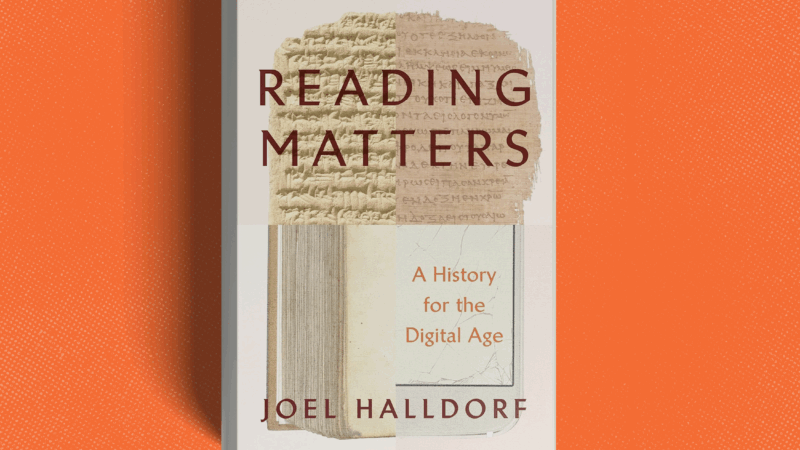
Reading Matters: A History for the Digital Age, by Joel Halldorf, New York University Press, 312 pages, $35
For those of us who like to think literacy is a form of liberation, there’s a troubling counterpoint: Mein Kampf. Adolf Hitler wasn’t interested in people thinking for themselves; he insisted they think like him. Propaganda, he recognized, is an assault on reflection: avoid abstraction, parrot slogans, abandon objectivity, and scapegoat your enemies.
In forms like Mein Kampf, books contributed to the poison. But for the German theologian and anti-Nazi conspirator Dietrich Bonhoeffer, they could also serve as an antidote. We need, he said before his execution, “to recover the lost sense of quality and a social order based on quality….It means a return from the newspaper and the radio to the book, from feverish activity to unhurried leisure, from dispersion to concentration, from sensationalism to reflection.” Bonhoeffer believed reading could serve as a prophylactic against propaganda, enabling individuals to reclaim possession of their minds and stand apart from the mob.
Why would Bonhoeffer ascribe such power to books? Because, as the historian Joel Halldorf shows in Reading Matters, the history of reading is in many ways the history of the individual, and of the kinds of communities individual reading habits enable.
Oral culture draws people together to hear a common message. Reading—particularly personal, silent reading—separates. The private reader peels off from the crowd and exists in his own world.
Christianity widened the path toward this interiority, first by advocating a form of light individualism in which adherents chose to abandon familial and civic cults and join a new body through a form of inward assent, and second by giving this new inwardness a tool. Uniquely in the ancient world, early Christians adopted the codex—bound pages previously reserved for workaday purposes in trades—as the community’s primary book format, instead of the more prestigious literary scroll.
Codices, Halldorf writes, were “cheaper, portable, easier to browse, and more manageable for beginners.” Christians cultivated a new, accessible sort of reading. It was a long way off from generating autonomous liberal selves, but some of those beginnings start there.
Gradually, books overtook sacrifice as the primary means of religious engagement. “The inner life began to take center stage,” says Halldorf. “In this new kind of spirituality, the human soul took on a sacred character, a space where one could encounter the divine. And books became a key to that inner sanctum….In the long run, this culture of books laid the groundwork for modern individualism.”
Steps along the way included medieval monasticism, which institutionalized this interior life. As monasteries mushroomed across Europe, so did monkish reading habits, particularly a meditative form of reading known as lectio divina. “Books,” says Halldorf, “were tools for contemplation.”
To facilitate this effort, scribes and monks improved the tools they inherited. Not only did they develop textual tools such as punctuation—Greco-Roman books got along without that—but they began inserting space between words. (Greco-Roman books jammed words together in a format called scriptio continua.) These innovations eased the burden of reading and expanded the accessibility of books, ultimately changing what could be done with them.
One simple but profound alteration? Scriptio continua books tended, of necessity, to be read aloud, often communally. Spaces between words enabled silent reading, and that meant private reading.
The early monastic model tended toward the reception of a limited number of works. But as books multiplied, the later scholastics began comparing multiple texts. They asked questions, amplified distinctions, raised objections, and pitted interpretations against each other. Light individualism moved toward heavy individualism.
No longer mere receivers, readers became arbiters, increasingly apt to determine the contours and content of their own understanding. Silent, scholastic reading, argues Halldorf, “enabled a more subversive inner life….Readers could explore ideas outside the mainstream.” Private reading created more space for dissent, heresy, eroticism, radicalism, even revolution.
Instead of individuals subjecting themselves to the book, individuals now had command of the library to do with as they chose, a situation furthered by the rise of universities and eventually the humanist movement, printing press, and the Reformation. In a medieval context, the church judged the Bible. In the humanist and Reformation context, the Bible judged the church—which is to say, the individual who interprets the Bible judged the church.
Ancient Alexandrians could have managed all this with scrolls written in scriptio continua. But compared to codices equipped with new textual aids (the table of contents, the index, the concordance), that’s like working from floppies instead of navigating the web. Still, Halldorf rejects any sort of linear liberation story. Technological developments expand possibilities; they don’t dictate outcomes.
Just as screens can be used for deep reading or doomscrolling, our tools can be put to different ends. Print and private reading allowed people like Martin Luther to break with Catholic authority. But print also allowed the Catholic Church to standardize and enforce doctrine, and Calvin’s Geneva demanded people think and do just as John Calvin desired.
Books could free an individual, but print culture also enabled the rise of bureaucracy and the nation-state. “As information technology advances, so, too, does the capacity for control,” says Halldorf. “The printing press launched a tug-of-war between freedom and pluralism, on one hand, and control and unity on the other.”
Print also ballooned the number of available books, from a few million across all of Europe to hundreds of millions. People could now read a standardized text in Lviv, Lisbon, and London, but what they took from it was entirely up to them and increasingly idiosyncratic.
Cheap paper and notebooks allowed common readers to keep commonplace books—extracts that were peculiar to their particular interests and attractions. And whereas medieval monks and nuns might meditate upon just a few dozen books across their entire life, managing the glut of print in the 17th century required different strategies.
“Some books are to be tasted,” advised Francis Bacon, “and some few to be chewed and digested; that is, some books are to be read only in parts; others to be read, but not curiously; and some few to be read wholly, and with diligence and attention.” X is filled with threads touting the benefits of deep or close reading over scrolling and skimming. But we’ve always been reading in all these modes as circumstances require.
The ancient Christians kept testimonia, collections of handy proof texts to wield in arguments; someone using a testimonia may never have even seen the original books from which the excerpts came. The scholastics fingered their way down page after page to compile propositions and counterpropositions. And early moderns like Bacon followed their whims through a sea of print to find what suited their fancies and served their unique purposes and projects.
Both hard and soft forms of control attempted to govern what people read. The Catholic Church’s Index of Prohibited Books tried to restrict what the faithful might entertain. Governments issued printing licenses and banned books deemed dangerous for one reason or another. Critics emerged to help sift wheat from chaff—and steer public taste.
As they always do, some skirted the prohibitions, and others told off the critics. “I must desire all those critics to mind their own business,” said Tom Jones author Henry Fielding in 1749, “and not to intermeddle with affairs or works which no ways concern them; for till they produce the authority by which they are constituted judges, I shall not plead to their jurisdiction.”
A bookish people tend to be an opinionated people, something print culture kept encouraging as newspapers and magazines began to proliferate in the 18th century. Once rotary presses were hooked up to steam engines in the 19th, these dynamics scaled to heights no monk could have imagined in any visionary moment of isolated ecstasy.
A virtue of Halldorf’s treatment lies in showing how these crosscurrents interact and over time produce social realities we can recognize in our own day—in fact, how they led to our own day. All the current anxieties about digital culture are prefigured in the book’s long and wobbly history, and are in essence the product of it.
“The press enabled the consolidation of cohesive and homogeneous cultures through the nation-states,” says Halldorf, the scariest versions being the Nazis and Soviets. At the same time, “it gave minorities the opportunity to construct their own subcultures by distributing, or sometimes smuggling, books that expressed their beliefs and values.” The same dynamic persists online.
If all this leaves us feeling uncertain, it probably should. We take books for granted, but they never developed along a predetermined path to now. They evolved as circumstances arose, and culturally we evolved with them. And despite the perennial fear that it will die, the book is still with us, still capable of empowering individuals, engendering communities, and, like Bonhoeffer urged, enabling us to stand apart from the mob if we choose.
The post Reading: The Quietest Way To Disobey appeared first on Reason.com.
from Latest – Reason.com https://ift.tt/yJCORBr
via IFTTT