The Democrats’ ‘All Trick, No Treat’ Strategy

The Democrats’ ‘All Trick, No Treat’ Strategy

Authored by Thaddeus G. McCotter via American Greatness,

The gloaming deepened on a Halloween in the early 1970s. A restless gaggle of youths just turned teens pondered making a final stab at trick-or-treating. The problem? They had no costumes, having earlier laughed at how such garb was for little kids, not for them. But now, uncool or not, those costumed kids were getting free candy. They were not.

Amid the enveloping darkness, Jack-o’-lanterns flickered and costumed children tittered and flitted from door to door. Time was expiring. What to do?

One youth, his face etched with angst, hesitantly floated a trial balloon in the gloaming. “Let’s just knock doors like this.”

The gaggle eyed one another’s black T-shirts, jeans, and boots. The bald suggestion hung in the air until –

Shrugs. Swiftly, pillowcases were pilfered from their unwitting parents and the gaggle’s quest for treats sans costumes commenced.

It didn’t go well. The adults who actually answered their doors to the gaggle were less than impressed by these youths’ brazen attempt to get candy. Their glares and questions were always the same. “Where are your costumes?”

The youths’ response, too, was constant: “We’re late 20th-century teenagers.” Almost invariably, it went over like a lead balloon (or, given it was the late 1970s, more like a Led Zeppelin). Needless to say, no free treat was forthcoming.

There was, however, a singular exception to the rule. One elderly man, upon opening his door, did let out a low whistle at the restless gaggle’s “gumption.” But this backhanded compliment was all he tendered before he yanked his candy bucket back behind his less-than-politely closed door.

The lesson of this Halloween horror story? Sometimes you need to wear a costume to get what you want.

Today, this lesson forms the basis of the Democrats’ general election strategy.

In their primaries, many successful Democrat candidates won by appealing to their party’s extreme, America-loathing, socialist wing. It was an authentic approach, for they were making a legitimate appeal to like-minded left-wing extremists. Being and articulating exactly who they are, these radical candidates received what they sought from their fellow travelers – the Democrat Party’s nomination.

Yet, while a necessary step, the nomination was not the ultimate destination. Thus, on the cusp of the general election, these far-left, extremist Democrats in competitive seats resembled the gaggle of restless youths from that Halloween back in the 1970s.

Were these Democrats to wage general election campaigns by remaining true to their radical selves, some citizens may well begrudgingly admire their gumption for admitting they are “21st-century Bolsheviks” and, in some socialist circles, reward them with a vote or two. But the bulk of voters would find these radical Democrats unpalatable. As a result, these extremists would not get the treat they sought – namely, enough votes to win the general election.

Their cynical solution? The Democrats’ “all trick, no treat” political strategy.

Armed with millions in billionaires’ chump change (and heaven knows what other funding sources), these Democrat extremists conveniently doff their hidebound socialist ideology, wrap themselves in the American flag, and tuck their hammer and sickle beneath it. Ta-da! These hardcore leftists are now the costumed “moderates” knocking on your door begging for your vote.

But before you reward them for temporarily cloaking their radicalism, recall the recent past when they tricked enough citizens into treating them with their vote.

How quickly these alleged moderates ripped off their masks and revealed themselves in word and deed.

These radical Democrats passed trillions of dollars in spending bills that enriched their political cronies and spurred rampant inflation; opened wide the border for millions of illegal entries; imposed the illiberal, inherently divisive diversity, equity, and inclusion identitarian ideology; weaponized the police powers and intelligence agencies of the state against those who dissented from their radical policies, including concerned parents and devout Catholics, among others; and waged their postmodernist war against objective truth, particularly Judeo-Christian principles and Western civilization generally.

It’s all a trick. And there is no treat – well, at least not for you.

Ironically, like the restless gaggle of youth who have no other option, it is the GOP whose nominees are trick-or-treating sans costume. They are who and what they claim to be: protectors and promoters of the permanent things of faith, family, community, and country.

No wonder the other part of the Democrats’ “all trick, no treat” campaign strategy is their deceitful ads trying to garb these GOP candidates in threadbare falsehoods equally as outrageous as the “moderate” costumes they cloak themselves in.

In fact, ironically reverting to the garb of the 1970s gaggle of youths, these far-left Democrats wear costumes of black T-shirts, jeans, boots, and sundry other “blue-collar” garb to court working voters, of whom they have, at best, an abstract understanding. All the while they calumniate their Republican opponents and ignore how their own party’s failures have caused the very problems they decry.

As for answers, however, they do have them. But you won’t hear them until they have tricked their way back into office and treated themselves to the levers of power over your life.

Only then will these radical Democrats once more rip off their “moderate” Captain America masks and reveal that their radical plans were already put forward during their primaries, when they were being themselves and talking to their fellow Democrat extremists.

Those in the public square who expect a costume in exchange for a treat will doubtless be displeased and not disposed to cast them a vote.

But for those in the public square who seek authenticity and sanity in their elected officials, one hopes they both admire the GOP candidates’ gumption and reward them with a vote.

Tyler Durden

via ZeroHedge News https://ift.tt/cM9IBHz Tyler Durden

Iran Issues Nov 1st Blanket Ban On South Korean Tanker Giant Moving One-Third Of Persian Gulf Oil Exports

Iran Issues Nov 1st Blanket Ban On South Korean Tanker Giant Moving One-Third Of Persian Gulf Oil Exports

South Korean tanker giant Sinokor is the world’s dominant VLCC owner (Very Large Crude Carrier) and has in recent weeks found itself front and center in the crosshairs of Iranian retaliation in the Strait of Hormuz and regional waters.

This past week, Iran’s Persian Gulf Strait Authority (PGSA) has put the major South Korean maritime shipping and logistics group on notice, saying Sinokor will suffer sweeping action against its fleet starting November 1st if it keeps violating Tehran’s protocol for shipping through the strait.

This has marked the first time the Islamic Republic issued a blanket warning covering a shipowner’s entire fleet, but this is perhaps because Sinokor alone accounted for about 37% of Hormuz oil transits in September and more than 50% of VLCC traffic in the first 10 days of October, according to Lloyd’s List Intelligence data.

Sinokor banks top dollar from sale of container ship brace
Source: Sinokor

Despite regional passage being fraught with obvious ultra high risks, Sinokor has risen to dominance in the Gulf’s shipping market, moving to capitalize on extraordinary freight rates.

However, this has come at a steep physical cost, with at least seven Sinokor-linked tankers having been attacked and struck by Iranian missiles or drones recently and during the conflict.

New VLCC’s contracted from shipyards can run from $125 million to $135 million to build – but a prompt delivery resale can run much, much highter – especially now.

Also, war risk insurance has been exploding in price. One industry watcher has put together a brief primer:

  • Standard hull and machinery insurance excludes war risks, so owners buy separate hull war cover and pay an additional premium (AP) each time a ship enters a Joint War Committee listed area.
  • Before the war that began on February 28, 2026, Hormuz war-risk cover typically cost 0.15% to 0.25% of hull value; brokers quoted 6% to 10% in early October 2026, according to the Financial Times.
  • On a $100 million tanker, that swing turns a roughly $250,000 premium into $6 million to $10 million for one transit, before cargo cover, which is bought separately.
  • Quoted rates are not an official index: they vary by ship, flag, ownership links, route and date, and underwriters can reprice or withdraw cover at short notice.

WarBrief Live has provided the following brief timeline and outline of soaring rates:

  • Pre-war rate: 0.15% to 0.25% of hull value (Lloyd’s List, March 11, 2026)
  • Early October 2026 quote: 6% to 10% of hull value per voyage (brokers via the Financial Times, reported October 7)
  • Worked example: $100 million tanker: about $250,000 before the war, $6 million to $10 million at early-October quotes
  • Trigger: entry into a Joint War Committee listed area, usually priced for a seven-day period

Days ago, Bloomberg highlighted the outsized role this single South Korean company has played in shipping contract pricing amid the global energy crisis:

The messages from the world’s biggest supertanker owner often begin with pleasantries: “Dear Ladies and Gentlemen.” Within minutes, the WhatsApps are the talk of the oil-tanker industry, a multibillion-dollar corner of the energy market that’s been plunged into chaos by the Iran war this year, and where word of mouth is the main way information spreads. The details vary, but the messages to shipbrokers from Sinokor Group, the South Korean company controlled by tycoon Ga-Hyun Chung, mostly boil down to the same thing — one of its vessels has just been hired at a new sky-high rate to ferry oil out of the Persian Gulf.

Some messages detail a new contract, listing the ship, counterparty and eyewatering price. Others just refer loosely to negotiations underway. The format fluctuates from terse strings of numbers and names to full sentences and florid signoffs: “Very respectfully. Thank you very much and best regards,” concludes one message sent to brokers in August, and seen by Bloomberg. Usually, in the days that follow, the global benchmark price set by London’s Baltic Exchange takes another leap higher. 

What would simply be fodder for gossip in most industries, brokers say that Sinokor’s WhatsApp messages have for months played an outsized role in setting the cost of transporting oil around the world. Rates for very-large crude carriers (VLCC) — the biggest kind of oil tanker — have soared more than 1,600% this year amid disruptions caused by the war, creating an unprecedented boom for the industry, but throwing a spotlight on the arcane system used to price the world’s shipping contracts, and the centuries-old institution that manages it. 

As for the threat against the company coming from Iran, it remains to be seen what unspecified “legal action” will be taken going forward or in what form, or how to interprete “appropriate enforcement measures” – which has so far involved full-on military attacks.

The statement PGSA released on October 27 said Sinokor vessels “have committed the highest number of crossing violations over the past 3 months” and that “appropriate enforcement actions have been taken against at least 7 of them.”

Tyler Durden

via ZeroHedge News https://ift.tt/7mtweg0 Tyler Durden

Sir Patrick Stewart, RIP

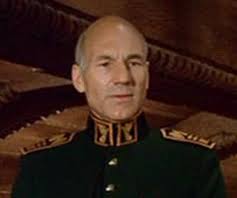
Patrick Stewart, as Captain Jean-Luc Picard. (CBS)


The great British actor, Sir Patrick Stewart, passed away yesterday. While Stewart began his career as a stage actor and performed in many Shakespeare plays, he is best known for his portrayal of Captain Jean-Luc Picard, in Star Trek: The Next Generation. Thanks to his impressive performance, Stewart and the character he played became science fiction icons.

Stewart brought extraordinary depth and perception to the role. And the character is an interesting contrast to the more instinctive and aggressive, less cerebral, Captain Kirk in the original Star Trek Series. Perhaps more than any other character, Stewart’s Picard epitomized Star Trek’s progressive liberal values: Enlightenment rationalism, technological optimism (highlighted by his defense of the rights of the android Data), racial and ethnic equality, and commitment to peace and diplomacy.

In many ways, Picard and TNG promoted these ideas to an even greater extent than the original series. Whereas Captain Kirk was often belligerent and acted on instinct, Picard sought diplomatic solutions to conflict, and tried to avoid doing anything drastic without careful deliberation. In the original series, the Klingons and Romulans are mostly depicted as evil and irreconcilable enemies of the Federation, in TNG the Klingons have become allies and there is hope that there will be peace with the Romulans, as well. In multiple episodes, Picard takes the lead in working to maintain and improve Federation relations with these and other previously hostile alien societies.

There is much to admire in this ideology and Picard’s advocacy of it. But, as I have pointed out in a 2016 article (see also this more recent piece), Star Trek’s ideology has a dark side, as well: its uncritical embrace of socialism. This is also reflected in the Federation’s seeming ideological homogeneity. Picard also exemplifies this negative aspect of Star Trek ideology, with his thinly veiled disdain for private enterprise, and people who seek to make a profit.

As depicted by Stewart, the Picard character also highlights another key tension in Star Trek ideology, this one relating to cultural diversity. Picard is supposed to be French; but other than his noticeable British accent, he seems little different from other human Federation characters. The “Doylist” real-world explanation for this is that Stewart himself was British, and trying to get him to speak with a French accent might have had bad results. But the “Watsonian” in-universe effect of this is to accentuate how the human characters in Star Trek have largely lost their cultural distinctiveness. French, British, and other human cultures have largely blended together, by the 24th century (when the show is set). Star Trek may champion diversity. But, culturally and politically, the human characters are mostly people who look different, but largely think alike.

As  I have previously noted, this ideological homogeneity and uncritical acceptance of Federation ideology gets challenged more in later Star Trek series, beginning with Deep Space 9. DS-9 and later series depict more ideological conflict among humans, and raise questions about Federation ideology. But Stewart’s Picard remains an iconic depiction of Federation ideals.

As always in assessing actors, we should not assume that the character necessarily reflects the views of the actor. We can and should recognize Picard’s shortcomings and those of Federation ideology, without blaming Stewart for them. Indeed, his performance deserves credit for providing a valuable window into these issues.

The more recent Picard series is not as good as TNG. But I feel the blame for that rests with the producers and their problematic plotlines, rather than Stewart.

In addition to his justly famous Star Trek role, Stewart also starred in the X-Men movie series (which I won’t comment on, as I know little about it). His first significant science fiction role was playing Gurney Halleck in the 1984 movie version of Dune.

Patrick Stewart as Gurney Halleck in Dune (1984). (Universal Pictures)


I’ve always thought the 1984 Dune movie is an incoherent mess, and not as good as the more recent Denis Villeneuve version (see my reviews of the latter here and here). But Stewart did a great job with his role, and really brought Halleck to life.

In sum, Sir Patrick Stewart was a great actor, and well deserves his status as an SF icon. He will be greatly missed.

The post Sir Patrick Stewart, RIP appeared first on Reason Magazine.

from Latest – Reason Magazine https://ift.tt/AOVlY7Q
via IFTTT

Trump vs. WSJ Libel Lawsuit over Trump’s Alleged Birthday Wishes to Epstein Thrown out

From Judge Darrin Gayles (S.D. Fla.) in Trump v. Dow Jones & Co., Inc.:

Those who won our independence believed … that public discussion is a political duty; and that this should be a fundamental principle of the American government. They recognized the risks to which all human institutions are subject. But they knew that order cannot be secured merely through fear of punishment for its infraction; that it is hazardous to discourage thought, hope and imagination; that fear breeds repression; that repression breeds hate; that hate menaces stable government; that the path of safety lies in the opportunity to discuss freely supposed grievances and proposed remedies; and that the fitting remedy for evil counsels is good ones. Believing in the power of reason as applied through public discussion, they eschewed silence coerced by law—the argument of force in its worst form. Recognizing the occasional tyrannies of governing majorities, they amended the Constitution so that free speech and assembly should be guaranteed.

New York Times Co. v. Sullivan (1964) (quoting Whitney v. California (1927) (Brandeis, J., concurring)).

Justice Brandeis’s words, as relevant today as they were nearly a century ago, formed the “background” behind the Supreme Court’s holding in Sullivan: the First Amendment “prohibits a public [figure] from recovering damages for a defamatory falsehood … unless he proves that the statement was made with actual malice[.]” This constitutional protection is not limited to post-discovery motions and trial. Because “[t]he costs and efforts required to defend a lawsuit through [discovery] could chill free speech nearly as effectively as the absence of the actual malice standard altogether[,]” a public figure plaintiff must plausibly allege actual malice at the outset of the litigation.

This Order addresses President Donald J. Trump’s second attempt to plead that Defendants … acted with actual malice when they published an article in the Wall Street Journal … linking him to convicted sex offender Jeffrey Epstein …. As with his first attempt, he has failed. Therefore, for the reasons below, … President Trump’s Amended Complaint is dismissed with prejudice….

The Article

On July 15, 2025, Palazzolo emailed then White House Press Secretary Karoline Leavitt (“Leavitt”) advising her that Dow Jones intended to publish an article (the “Article”) about a birthday letter that President Trump purportedly created for Epstein (the “Letter”). President Trump and his team responded quickly. Leavitt called Palazzolo and told him that the “subject matter” of the proposed Article was false. President Trump, through counsel, denied writing the Letter and warned Dow Jones not to publish the story. {President Trump also denied writing the Letter in an interview before publication.} And President Trump directly told Murdoch that he had not signed or sent the Letter. When Murdoch responded that he would “handle it,” President Trump thought the WSJ would not print the Article. Two days later, the WSJ online edition published the Article.

The title of the Article—”Jeffrey Epstein’s Friends Sent Him Bawdy Letters for a 50th Birthday Album. One was from Donald Trump”—is in bold print, with a subtitle below reading “[t]he leather-bound book was compiled by Ghislaine Maxwell. The president says the letter ‘is a fake thing.'” Leading with a picture of President Trump with Epstein, the Article states the following, in pertinent part:

It was Jeffrey Esptein’s 50th birthday, and Ghislaine Maxwell was preparing a special gift to mark the occasion. She turned to Epstein’s family and friends. One of them was Donald Trump.

Maxwell collected letters from Trump and dozens of Epstein’s other associates for a 2003 birthday album, according to documents reviewed by The Wall Street Journal.

Pages from the leather-bound album—assembled before Epstein was first arrested in 2006—are among the documents examined by Justice Department officials who investigated Epstein and Maxwell years ago, according to people who have reviewed the pages. It’s unclear if any of the pages are part of the Trump Administration’s recent review….

The letter bearing Trump’s name, which was reviewed by the Journal, is bawdy—like others in the album. It contains several lines of typewritten text framed by the outline of a naked woman, which appears to be hand-drawn with a heavy marker. A pair of small arcs denotes the woman’s breasts, and the future president’s signature is a squiggly “Donald” below her waist, mimicking pubic hair.

The letter concludes: “Happy Birthday—and may every day be another wonderful secret.”

In an interview with the Journal on Tuesday evening, Trump denied writing the letter or drawing the picture. “This is not me. This is a fake thing. It’s a fake Wall Street Journal story,” he said.

“I never wrote a picture in my life. I don’t draw pictures of women,” he said. “It’s not my language. It’s not my words.”

He told the Journal he was preparing to file a lawsuit if it published an article. “I’m gonna sue The Wall Street Journal just like I sued everyone else,” he said….

Justice Department officials didn’t respond to requests for comment or address questions about whether the Trump page and other pages of the birthday album were part of the agency’s recent documents review. The FBI declined to comment….

Among those who submitted letters were billionaire Leslie Wexner and attorney Alan Dershowitz … Wexner declined to comment through a spokesman … Dershowitz, who represented Epstein after his first arrest, said, “It’s been a long time and I don’t recall the content of what I may have written….

The book was put together by a New York City bookbinder, Herbert Weitz, according to people who were involved in the process. Weitz, who died in 2020, listed Epstein as a client on his website in 2003.

It isn’t clear how the letter with Trump’s signature was prepared. Inside the outline of the naked woman was a typewritten note styled as an imaginary conversation between Trump and Epstein, written in the third person.

[Description of Conversation]

When he turned 50, Epstein was already wealthy from managing Wexner’s fortune and was socializing with Trump, Clinton and other powerful people. He often entertained at this Manhattan townhouse, Palm Beach, Fla., home and private Caribbean island….

Epstein and Trump spent time together in the 1990s and early 2000s and were photographed at social events, including with Maxwell and Melania Trump….

Trump, along with others including Clinton, also appeared several times on flight logs for Epstein’s private jet.

A 2002 New York magazine profile of Epstein quoted Trump. “I’ve known Jeff for 15 years. Terrific guy,” Trump said. “He’s a lot of fun to be with. It is even said that he likes beautiful women as much as I do, and many of them are on the younger side. No doubt about it—Jeffrey enjoys his social life.”

Both men said that they subsequently had a falling-out. Trump has said their friendship ended before Epstein pleaded guilty to procuring a minor for prostitution in 2008, served time in a Florida jail and registered as a sex offender….

Maxwell, a British socialite, was convicted in 2021 of helping Epstein’s sex-trafficking and sentenced to 20 years in prison. Maxwell didn’t respond to a letter requesting an interview sent to her in prison. Arthur Aidala, an attorney who represented Maxwell, said, “At this point, she is focused on her case before the Supreme Court of the United States.” …

Epstein’s associations with Trump and many powerful people have been well documented….

On September 8, 2025, the WSJ published an article titled “A Visual Breakdown of the Trump Birthday Letter to Epstein” which compares the signature and typeface, drawing style, third-person point of view, and diction in the Letter with prior communications by President Trump (the “September 8 Article”). The September 8 Article includes President Trump’s denial that he wrote the Letter or drew the picture and Leavitt’s statement in a social media post that President Trump did not draw the picture in or sign the Letter….

President Trump contends that these statements are false because he (1) did not author, sign, or draw any portion of the Letter or direct anyone else to author it; (2) never made or dictated to anyone any of the statements in the voiceover or had any such conversation with Epstein as portrayed in the Letter; and (3) was not “childhood pals” with Epstein….

The court concluded that Trump hadn’t actually alleged “actual malice,” which is to say knowing or reckless falsehood:

Here, the Amended Complaint falls short of pleading actual malice. Indeed, the allegations regarding malice are conclusory, vague, sometimes inconsistent with the Article, and often irrelevant to whether Defendants knew or should have known that the statements in the Article were purportedly false.

[a.] Conclusory Language is not Enough

As an initial matter, President Trump’s conclusory allegations that Defendants acted with malice because they “knew or should have known” the statements in the Article were false, are insufficient to state a claim. See Reed v. Chamblee (11th Cir. 2025) (finding the plaintiff’s conclusory assertions that the defendant acted with actual malice insufficient).

[b.] Denial is not Enough

Though vague, the Amended Complaint appears to allege that by choosing to publish the Article despite President Trump’s and his team’s denials, Defendants acted with actual malice. In effect, President Trump argues that once he declared the Letter a “fake,” Defendants should have disregarded everything else they learned in their investigation and not published the story.

But that is not what the actual malice standard requires and runs afoul of the First Amendment. Indeed, were that the law, any time a public figure or his team denies an accusation, journalists would be immediately blocked from publishing negative or contradictory press—a result that flies in the face of the “American privilege to speak one’s mind, although not always with perfect good taste, on all public institutions[.]” Sullivan.

Moreover, the Article did not ignore or minimize President Trump’s denial. Rather, it informed readers that President Trump decried the Letter as a fake and denied writing it. By “allowing readers to decide for themselves what to conclude from the [Article], … any allegation of actual malice [is] less plausible.” … “[R]eporting perspectives contrary to the publisher’s own should be interpreted as helping to rebut, not establish, the presence of actual malice” ….

[c.] The Investigation

President Trump’s argument that the WSJ Defendants’ investigation was inadequate, and therefore an indication of malice, fares no better. As detailed above, a failure to investigate, without more, does not establish actual malice. Rather, “a plaintiff must show the defendant deliberately avoided investigating the veracity of the statement in order to evade learning the truth.”

The Amended Complaint comes nowhere close to this standard. Indeed, the Article details a thoughtful and detailed investigation. Before running the story, Defendants contacted President Trump and his team, Justice Department officials, and the FBI for comment.

President Trump and his team responded with his denial, the Justice Department did not respond at all, and the FBI declined to comment. Defendants also attempted to speak with Maxwell; she did not respond to their request and her attorney stated that she was focused on her case before the Supreme Court. In addition, Defendants reached out to other individuals named in the Birthday Book, including Leslie Wexner and Alan Dershowitz, and to individuals involved in binding the Birthday Book, who confirmed that Weitz put the book together. In short, President Trump’s allegation that Defendants failed to conduct an adequate investigation is rebutted by the Article and is insufficient to establish actual malice.

{President Trump argues that Harte-Hanks Communications, Inc. v. Connaughton (1989), supports his position that Defendants’ purported failure to investigate is enough to support an inference of actual malice. However, in Harte-Hanks, the Supreme Court expressly stated that “[a]lthough failure to investigate will not alone support a finding of actual malice, the purposeful avoidance of the truth is in a different category. Here, President Trump has not alleged any facts, beyond conclusory allegations, that support an inference that Defendants purposefully avoided the truth.}

Grasping at straws, the Amended Complaint attempts to manufacture flaws with the investigation. First, it alleges that the investigation was lacking because Defendants only reviewed the Letter but did not have a copy in their possession. The Court cannot discern any substantive difference—and certainly not one that would establish actual malice—between Defendants reviewing the Letter before publication and obtaining a copy of the Letter. Defendants reviewed the Letter and later reported on its contents. Nothing in the law suggests that Defendants needed to obtain, retain, or publish a copy.

In addition, President Trump’s focus on Maxwell is entirely misplaced. The Eleventh Circuit has found “allegations that the Defendants failed to fully investigate their statements by intentionally choosing not to speak with any witnesses who could have refuted the allegedly defamatory statements” insufficient to plead actual malice. And any argument that Defendants “purposely avoided” the truth by either not disclosing what Maxwell told them or by refusing to speak with her is difficult to reconcile with President Trump’s own allegations.

The Amended Complaint alleges that “Maxwell has stated, subject to penalty of perjury for lying to a federal officer, that she did not remember President Trump submitting a letter for Epstein’s 50th birthday.” Based on this allegation, Maxwell had little to offer to Defendants’ investigation. In short, references to Maxwell are a red herring and simply do not establish that Defendants “actually entertained serious doubts as to the veracity of the published account[] or was highly aware that the account was probably false.”

[d.] Omissions

President Trump’s argument that the Article omits certain facts does not save his claims. First, how or why the voiceover in the Letter was typewritten or how the voiceover was confirmed to be in the third person are inconsequential details that have no bearing on whether Defendants published the Article knowing its contents were false or with reckless disregard as to its falsity. Moreover, Defendants’ decisions about how to investigate and what to include in the Article do not establish malice. “Obviously the author of an article will have to choose which facts to include and which to omit. It is impossible to print all of the facts on which an opinion or belief is based …. Were the courts or criticized [parties] to be allowed to dictate the contents of such articles, censorship would have won out over free speech and the right to dissent.”

Finally, the allegation that Defendants intentionally omitted President Trump’s denial that he signed the Letter or a discussion on whether the signature on the Letter is authentic, is belied by the Article. It states, multiple times, that President Trump denies writing the Letter and that “[i]t isn’t clear how the letter with Trump’s signature was prepared.” . This is more than sufficient to encompass any denial that he “signed” the Letter or that the signature on the Letter is authentic.

[e.] The September 8 Article

The Amended Complaint’s reliance on the September 8 Article to establish malice is equally unavailing. Nothing in the law suggests that a journalist must report on every piece of evidence they uncover before going to print. Moreover, it is unclear why President Trump argues the September 8 Article shows that his signature “could not be more different” than the one in the Letter, when it contains several examples where President Trump’s actual signature and sketches are similar to those in the Letter. At bottom, the September 8 Article does not support a finding that Defendants knew or should have known that President Trump did not sign the Letter….

The post Trump vs. WSJ Libel Lawsuit over Trump's Alleged Birthday Wishes to Epstein Thrown out appeared first on Reason Magazine.

from Latest – Reason Magazine https://ift.tt/qBw1pFu
via IFTTT

Sir Patrick Stewart, RIP

Patrick Stewart, as Captain Jean-Luc Picard. (CBS)


The great British actor, Sir Patrick Stewart, passed away yesterday. While Stewart began his career as a stage actor and performed in many Shakespeare plays, he is best known for his portrayal of Captain Jean-Luc Picard, in Star Trek: The Next Generation. Thanks to his impressive performance, Stewart and the character he played became science fiction icons.

Stewart brought extraordinary depth and perception to the role. And the character is an interesting contrast to the more instinctive and aggressive, less cerebral, Captain Kirk in the original Star Trek Series. Perhaps more than any other character, Stewart’s Picard epitomized Star Trek’s progressive liberal values: Enlightenment rationalism, technological optimism (highlighted by his defense of the rights of the android Data), racial and ethnic equality, and commitment to peace and diplomacy.

In many ways, Picard and TNG promoted these ideas to an even greater extent than the original series. Whereas Captain Kirk was often belligerent and acted on instinct, Picard sought diplomatic solutions to conflict, and tried to avoid doing anything drastic without careful deliberation. In the original series, the Klingons and Romulans are mostly depicted as evil and irreconcilable enemies of the Federation, in TNG the Klingons have become allies and there is hope that there will be peace with the Romulans, as well. In multiple episodes, Picard takes the lead in working to maintain and improve Federation relations with these and other previously hostile alien societies.

There is much to admire in this ideology and Picard’s advocacy of it. But, as I have pointed out in a 2016 article (see also this more recent piece), Star Trek’s ideology has a dark side, as well: its uncritical embrace of socialism. This is also reflected in the Federation’s seeming ideological homogeneity. Picard also exemplifies this negative aspect of Star Trek ideology, with his thinly veiled disdain for private enterprise, and people who seek to make a profit.

As depicted by Stewart, the Picard character also highlights another key tension in Star Trek ideology, this one relating to cultural diversity. Picard is supposed to be French; but other than his noticeable British accent, he seems little different from other human Federation characters. The “Doylist” real-world explanation for this is that Stewart himself was British, and trying to get him to speak with a French accent might have had bad results. But the “Watsonian” in-universe effect of this is to accentuate how the human characters in Star Trek have largely lost their cultural distinctiveness. French, British, and other human cultures have largely blended together, by the 24th century (when the show is set). Star Trek may champion diversity. But, culturally and politically, the human characters are mostly people who look different, but largely think alike.

As  I have previously noted, this ideological homogeneity and uncritical acceptance of Federation ideology gets challenged more in later Star Trek series, beginning with Deep Space 9. DS-9 and later series depict more ideological conflict among humans, and raise questions about Federation ideology. But Stewart’s Picard remains an iconic depiction of Federation ideals.

As always in assessing actors, we should not assume that the character necessarily reflects the views of the actor. We can and should recognize Picard’s shortcomings and those of Federation ideology, without blaming Stewart for them. Indeed, his performance deserves credit for providing a valuable window into these issues.

The more recent Picard series is not as good as TNG. But I feel the blame for that rests with the producers and their problematic plotlines, rather than Stewart.

In addition to his justly famous Star Trek role, Stewart also starred in the X-Men movie series (which I won’t comment on, as I know little about it). His first significant science fiction role was playing Gurney Halleck in the 1984 movie version of Dune.

Patrick Stewart as Gurney Halleck in Dune (1984). (Universal Pictures)


I’ve always thought the 1984 Dune movie is an incoherent mess, and not as good as the more recent Denis Villeneuve version (see my reviews of the latter here and here). But Stewart did a great job with his role, and really brought Halleck to life.

In sum, Sir Patrick Stewart was a great actor, and well deserves his status as an SF icon. He will be greatly missed.

The post Sir Patrick Stewart, RIP appeared first on Reason Magazine.

from Latest – Reason Magazine https://ift.tt/AOVlY7Q
via IFTTT

Ilhan Omar’s Marriage Application To ‘Brother’ Surfaces With Some Bizarre Errors

Ilhan Omar’s Marriage Application To ‘Brother’ Surfaces With Some Bizarre Errors

Rep. Ilhan Omar’s 2009 Minnesota marriage license application to Ahmed Elmi, the man accused of being her brother, shows her surname written as Omar, crossed out and changed to Elmi, then changed back to Omar, according to a certified copy from Hennepin County obtained by the New York Post.

The name changes could matter because the Justice Department is investigating whether the Somalia-born Minnesota Democrat fraudulently obtained U.S. citizenship in 2000 by failing to use her true legal name and birthdate. That case grew out of an earlier probe into whether Omar committed immigration fraud by marrying Elmi, a British citizen.

The document arrives weeks into an escalating federal effort. Homeland Security Investigations agents raided Omar’s Washington, D.C., home on Oct. 12 as part of the immigration fraud probe. In a court filing last week, the Justice Department referred to her as “Congresswoman Ilhan Nur Said Elmi, a/k/a Ilhan Abdullahi Omar.”

A source familiar with the investigation told the Post that Omar is not her real name and that her birth surname is Elmi, the same as the man she married.

The application is dated Feb. 12, 2009. One question asks whether the bride and groom are related by blood or adoption, and the couple checked “no.” The first revision on the form reads “Ilhan Omar Elmi,” a version that differs from the name the Justice Department now uses in court. The document does not identify who filled it out, though all the entries appear to share one person’s handwriting.

An image of the application has circulated online for years. Alpha News, a Minnesota outlet, appears to have first published it in August 2016. Major news outlets gave it little attention until this month.

Scott W. Johnson, a retired Minneapolis attorney and former Alpha News board member, has spent ten years investigating Omar’s alleged immigration fraud.

“Questions should be asked. She’s never answered them,” Johnson said. “The whole thing was a joke. The marriage was a fraudulent marriage, brazenly fraudulent… It was entered into for a fraudulent purpose.”

A Christian minister married Omar and Elmi on Feb. 12, 2009, the same date the application bears. By then, Omar already had two children with Ahmed Hirsi, whom she had married in a 2002 Islamic ceremony that never became a legal marriage. In May 2009, Hirsi listed the address on the Omar-Elmi marriage license as his own home.

Omar had a third child with Hirsi in June 2012 and finalized her divorce from Elmi in 2017. She legally married Hirsi in 2018, filed for divorce a year later, and married her current husband, Tim Mynett, in 2020.

The Justice Department first opened an investigation into Omar in 2016, under President Barack Obama, into whether Omar married her brother so he could get a green card. The Biden administration closed that probe in 2021 for two reasons. The five-year statute of limitations had run out, meaning prosecutors would have had to file charges by 2014, and the FBI could not interview Elmi, who had returned to the U.K.

Legal experts told the Post that federal investigators now appear focused on a possible conspiracy involving ongoing acts, such as misstating a birthdate, which the earlier statute of limitations may not bar. Civil denaturalization carries no statute of limitations and could lead to Omar’s deportation.

In an academic paper published in August, Elmi, a doctoral researcher at the University of Bristol, identified himself as a “gay man of the East African diaspora.”

Omar has broadly dismissed the allegations as a racist conspiracy theory and a politically motivated smear. Last week, MS NOW anchor Chris Hayes asked her directly whether she married her brother.

“Not to my knowledge,” Omar said.

AJ Kern, a former Minnesota congressional candidate who has examined Omar’s immigration records and birthdate discrepancies, told the Post she sees the record as clear.

“I think it’s pretty clear she married her brother and committed immigration fraud,” Kern said.

Kern said the larger issue is the possibility of a non-citizen holding federal office.

“If we’ve had a foreign nationalist occupying a seat in Congress, that’s a problem,” she said, adding that Congress would be “failing to do their job.”

Tyler Durden

via ZeroHedge News https://ift.tt/A1FD9Cw Tyler Durden

The Pendulum Of History

The Pendulum Of History

Authored by Charles Hugh Smith via Of Two Minds,

This is Essay #8 in the series Truth Be Told.

A great many phenomena in both Nature and human history follow cyclical patterns, while others form waves. Author David Hackett Fischer (The Great Wave: Price Revolutions and the Rhythm of History) described the difference between cycles and waves:

“Cyclical rhythms are fixed and regular. Their periods are highly predictable. Great waves are more variable and less predictable. They differ in duration, magnitude, velocity, and momentum. One great price wave lasted less than ninety years; another continued more than 180 years. The irregularities in individual price movements make them no more (or less) predictable than individual waves in the sea.

Even so, all great waves had important qualities in common. They all shared the same wave-structure. They tended to have the same sequence of development, the same pattern of price relatives, similar movements of wages, rent, interest rates; and the same dangerous volatility in later stages. All major price revolutions in modern history began in periods of prosperity. Each ended in shattering world crises and was followed by periods of recovery and comparative equilibrium.”

As Fischer observed, waves of human history share characteristics with ocean waves, which can accrete energy and become giant rogue waves that cannot be predicted even as they can be foreseen as recurring phenomena.

Two cycles have attracted much commentary over the past decade: The Fourth Turning posited by William Strauss and Neil Howe in their 1997 book The Fourth Turning: An American Prophecy (subtitled What the Cycles of History Tell Us About America’s Next Rendezvous with Destiny) which laid out an 80-year cycle of four generational turnings (High, Awakening, Unraveling, Crisis) that culminate in a system-changing Fourth Turning.

This 80-year cycle aligns with the nation-changing crises of 1781 (the end of the Revolutionary War and the founding of the United States), 1861 (the start of the Civil War) and 1941 (America’s entry into an existential global conflict, World War II). This cycle suggests a nation-changing crisis began around 2021.

Strauss and Howe took pains to note that the outcome of each crisis isn’t pre-ordained to be positive. Complacency based on the idea that it will all turn out wonderfully due to the nation’s destiny could be fatal.

Peter Turchin and his colleagues have mapped out a 50-year cycle based on data ranging from archeological to financial–or in the case of coin hoards buried in times of crisis, both archeological and financial. Turchin’s prediction of a crisis beginning in 2020 drew skepticism which then flipped to recognition when the events of 2020 came to pass.

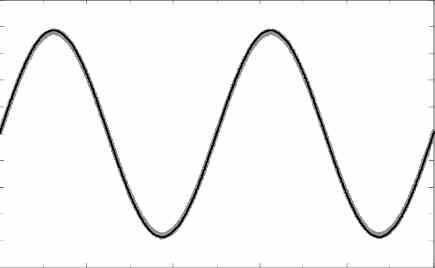
Cycles are generally depicted as some version of a sine wave:

Waves build up and break in irregular fashion. If we discern the forces at work–storms, etc.–we can predict the eventual arrival of waves but not their amplitude. In other words, the outcome of waves cannot be predicted. The complacency lent by cycles–everything will recover in time, etc.–is not possible in waves, as the wave might sweep away the entire status quo.

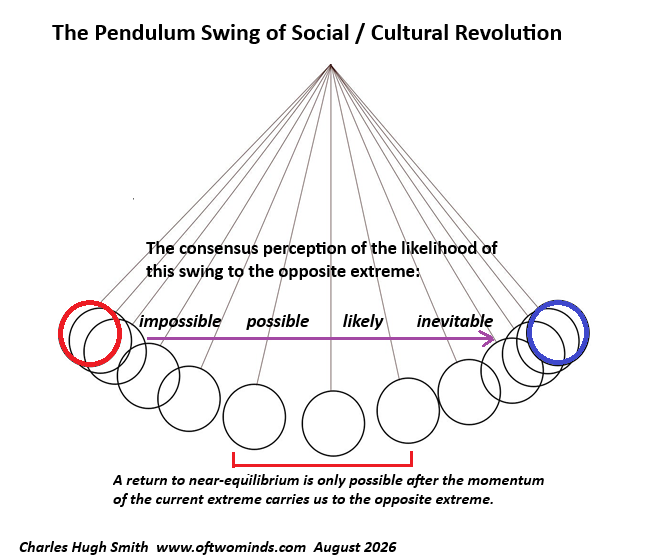
A pendulum offers a third model of history: asymmetries push the socio-political-economic order to an extreme that cannot be sustained, and the pendulum swings to the opposite extreme, for example, from order to chaos and from surplus to depletion.

In my framework, the shared interests of society are always in competition with the private interests of markets. Ideally, these generate a dynamic equilibrium, as adaptive forces provide feedback that counteracts any overreach.

But as I have taken pains to explain, when one set of interests gains the power to override or ignore competing interests and the shared interests of society, their power becoming self-reinforcing, with fatal consequences. When a financial-market elite gains enough wealth to take control of the political machinery, they use this power to increase their share of the economy’s output / gains at the expense of everyone else.

From their point of view, this is the natural order of things: we’ve gained supremacy because we’re smarter and therefore deserving of power.

What they miss is that by gaining dominance, they eliminate the adaptive forces needed to maintain systemic stability. The system veers into moral decay as self-interest is deemed all that’s necessary for “growth,” and rampant corruption / unfairness reigns as the system is tilted to benefit the few at the expense of the many.

The irony is rich: the status quo the dominant few believe is permanent cascades into disorder due to the destabilizing effects of their dominance.

Richard Bonugli and I discuss the resulting potential for nonlinear disruption in our latest podcast: Global Uncertainties may result in Nonlinear, Self-Reinforcing Instability (26:31 min)

This pendulum swing eventually reaches an extreme that cannot be increased or even sustained. The asymmetries imposed by the dominant few reach the limits of the system, and the pendulum pauses for a brief moment before beginning its mechanically inevitable swing to the opposite extreme.

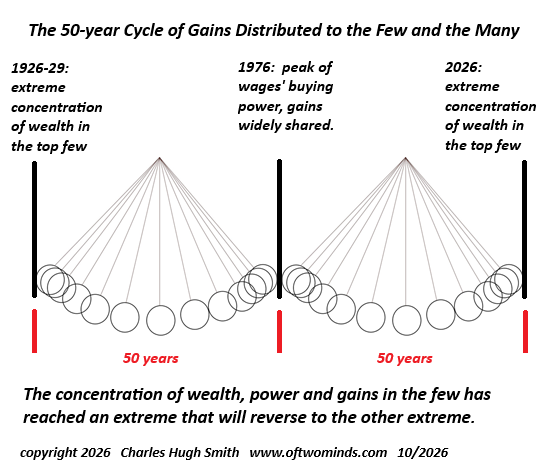
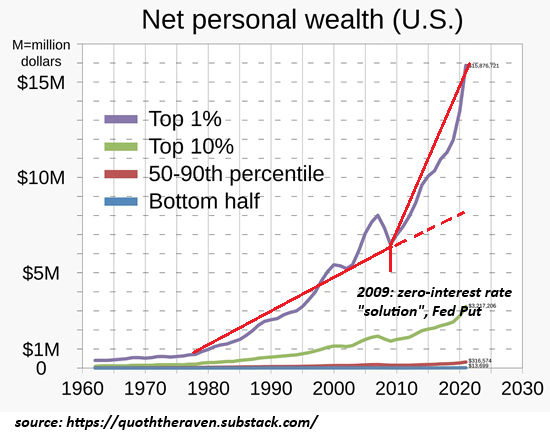
It’s impossible not to note the pendulum of wealth and power swinging from the extreme of elites owning most of the wealth and accumulating most of the gains to the other end of the spectrum of a more widely shared distribution of wealth, power and gains. Here we see Peter Turchin’s 50-year cycle depicted as pendulum swings.

We are currently poised in that brief moment in which the pendulum has reached an extreme that cannot be pushed any further as the asymmetries have reached their systemic limits. Wealth-power-income asymmetries have reached extremes of concentration that generate instability:

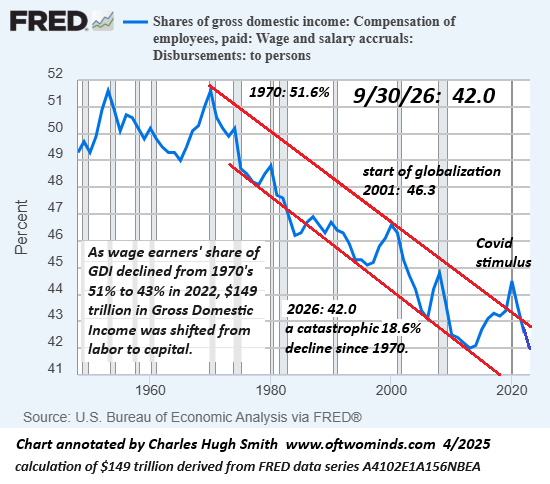
The broad-based distribution of the economy’s gains to the workforce has been siphoned off and distributed to the owners of capital in a highly asymmetric power-law distribution: over time, this resulted in the transfer of $150 trillion from the workforce to those at the top:

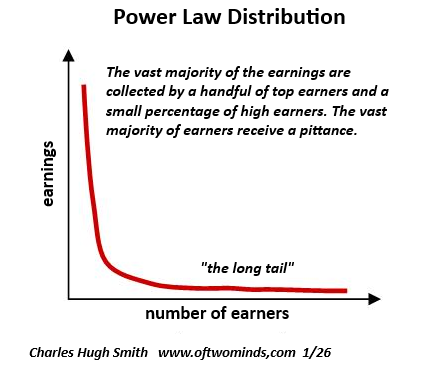
Wealth, income and power now follow a power law distribution that favors the few over the many due to the self-reinforcing nature of an economy dominated by what’s moral is what’s legal, and what’s legal is for sale:

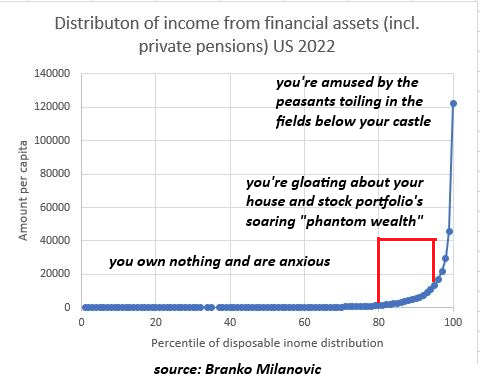
Life is good for Billionaire Tech Bros and the financial Nobility:

Thanks to the status quo’s mastery of The Big Con, the majority have been conned into believing the current moment of apparent stability is authentic stability. But this apparent stability is as fake as everything else in Ultra-Processed Life, as events will reveal.

I don’t follow the predictive gambling table in the casino, but I did overhear a peculiarly garbed stranger murmuring, with some urgency, “I bet 100 million quatloos the economy will collapse into disorder and depression by 2032.” I think he was given good odds from the gamblers who fell for The Big Con.

The delusion that technology and finance have given us god-like powers that moot the pendulum of history will be revealed as delusion in a most painful manner. A social-economic system in which what’s moral is what’s legal, and what’s legal is for sale generates its own demise, as The Big Con doesn’t work on the forces of history.

Tyler Durden

via ZeroHedge News https://ift.tt/PHuCSd6 Tyler Durden

“Very Intentional”: Steve Eisman Thinks Anthropic Is Hiding Something

“Very Intentional”: Steve Eisman Thinks Anthropic Is Hiding Something

Submitted by QTR’s Fringe Finance

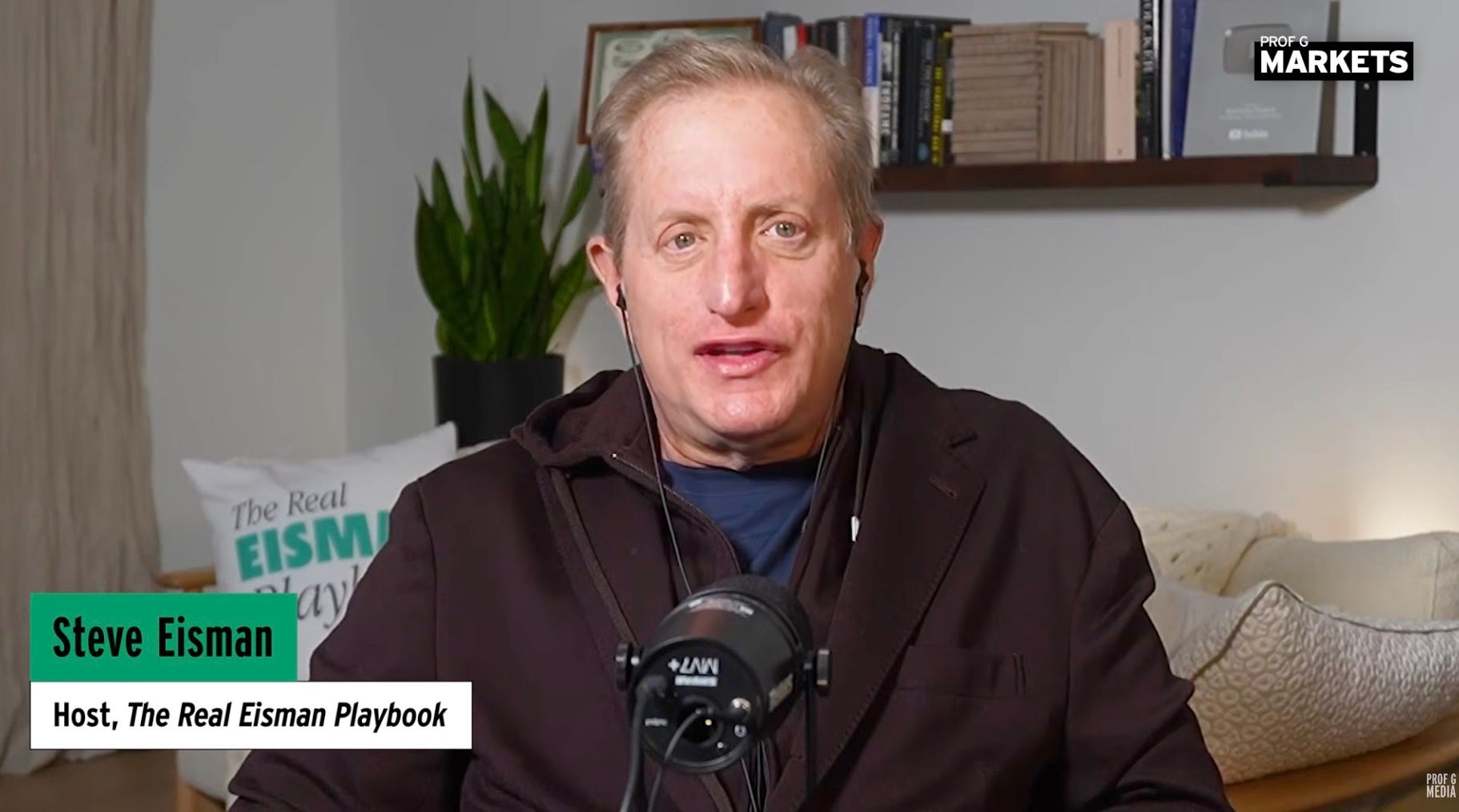
Steve Eisman, the investor made famous by The Big Short for recognizing the subprime mortgage disaster before much of Wall Street, is now accusing Anthropic of deliberately withholding its latest quarterly financial statements from investors ahead of its potentially $2 trillion IPO.

Speaking Wednesday on Prof G Markets, Eisman questioned why Anthropic’s October 26 prospectus contained financial statements only through June, despite more recent information suggesting the company’s explosive growth may already be losing momentum, according to the podcast and Yahoo.

Asked whether he believed the omission was deliberate, Eisman answered: “Only very intentional.”

That’s a pretty serious allegation, particularly coming from somebody whose reputation was built on recognizing financial absurdities that the rest of Wall Street was perfectly content to ignore. And it dovetails almost perfectly with what I’ve been arguing about the AI bubble for months.

On September 29, I published It’s Official: The AI Emperor Has No Clothes, examining Anthropic’s extraordinary losses, its enormous infrastructure commitments, and the growing disconnect between the enthusiasm in AI equities and the warnings emerging from credit markets.

My argument then was that investors were beginning to get their first meaningful look at the financial machinery behind the AI boom, and what they were discovering wasn’t particularly encouraging.

Now Eisman is suggesting that even this picture may be considerably rosier than the company’s latest numbers would indicate.

According to Reuters figures discussed by Eisman, Anthropic’s quarterly revenue growth decelerated from 144% in the second quarter to 45% in the third. That’s still spectacular growth by ordinary standards, but for a company seeking a valuation approaching $2 trillion, a slowdown of that magnitude deserves considerably more scrutiny than it’s getting.

More concerning is the apparent deterioration in the economics of generating that revenue. Eisman says Anthropic produced $2.08 in revenue for every dollar spent on computing and infrastructure during the second quarter. In the third quarter, that figure dropped to $1.70, a decline of approximately 18%.

In other words, compute spending went from consuming roughly 48 cents of every revenue dollar to nearly 59 cents in just three months.

That’s not exactly the direction you’d hope to see from a company about to IPO, whose valuation depends on the assumption that scaling its technology will eventually produce extraordinary profitability.

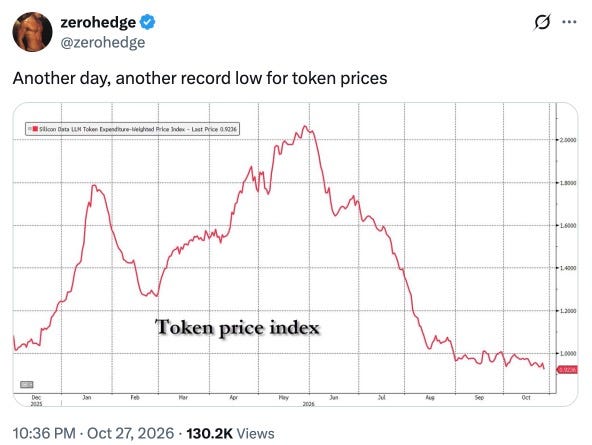
Eisman believes part of the explanation is the fading of what he calls “tokenmaxing,” a period when businesses encouraged employees to consume enormous quantities of AI computing resources without worrying much about the bill.

As corporate customers began paying closer attention to costs, spending apparently became more disciplined. Meanwhile, increasingly competitive Chinese AI models have introduced another potential headache: downward pressure on pricing.

If Eisman’s interpretation is correct, the industry may be discovering that customers love AI a whole lot more when somebody else is paying for it.

And that’s a problem when you’ve already committed to building enough computing infrastructure to power a small civilization.

Eisman estimates Anthropic’s potential future computing commitments could total between $800 billion and $900 billion, depending on which agreements are counted.

The company’s filing reportedly identifies at least $110 billion in commitments involving Amazon, another $114.5 billion associated with Google’s infrastructure, and $161.2 billion in equipment lease payments involving Broadcom.

That’s nearly $386 billion across just those arrangements, although the agreements span different periods and aren’t equivalent to debt payable immediately.

The precise total matters less than the fundamental problem: Anthropic needs an astonishing amount of future revenue to make these commitments economically sensible.

And as I pointed out in September, this isn’t just an Anthropic problem.

Oracle’s credit default swaps had been surging, long-dated borrowing costs were climbing, and CDS trading across major AI-related companies was exploding. Nvidia’s single-name CDS trading volume, for example, had reportedly increased from approximately $640 million to $6.9 billion between consecutive six-month periods.

Meanwhile, lower-quality corporate credit was already showing signs of stress, with yields on CCC-rated and lower bonds exceeding 16% in late September.

None of these indicators independently proves an AI collapse is coming. But taken together, they suggest lenders and credit investors are increasingly questioning the economics of the infrastructure boom even as equity investors continue pricing in years of extraordinary growth.

Now we’re getting another potential warning from the operating numbers themselves.

And what makes Eisman’s criticism especially interesting is that he isn’t merely questioning Anthropic’s valuation. He’s questioning whether the financial statements investors have been given adequately reflect the company’s current trajectory.

There is an important caveat here: excluding third-quarter statements from a preliminary prospectus doesn’t automatically mean Anthropic has done anything improper. IPO filings are routinely amended, and the company may need to provide updated financials before completing its offering.


85% OFF FOREVER IF YOU SUBSCRIBE TODAY: I am again offering an 85% discount to anyone that wants to become a Fringe Finance annual subscriber today. It’s a discount you can keep and stays applied for as long as you wish to remain a subscriber: Get 85% off forever


But Eisman’s broader concern remains legitimate. If newer figures reveal materially weaker growth and deteriorating computing economics, investors should want to see them before deciding what the company is worth.

Especially when we’re talking about a business with hundreds of billions of dollars in future commitments and a valuation that leaves precious little room for disappointment.

For years, the AI bull case has relied on the idea that today’s extraordinary expenditures will eventually be dwarfed by tomorrow’s extraordinary profits. Now, the accounting is getting…interesting…The Dirty Accounting Behind The AI Bubble

I’m not disputing the technological significance of AI, nor am I suggesting Anthropic can’t eventually build a highly profitable business.

But technological importance and attractive investment economics are two entirely different things, and Wall Street has a remarkable history of confusing the former with the latter.

What concerns me is the possibility that the industry is approaching the point where revenue growth begins normalizing long before infrastructure spending does.

That would leave companies with enormous contractual obligations, assets depreciating rapidly, increasingly aggressive competitors, and investors who have already priced in something close to perfection.

And if those economics deteriorate, the consequences won’t necessarily stop with Anthropic. They could ripple through the hyperscalers, chipmakers, infrastructure developers, creditors, and the broader market that has become so dependent on the AI investment narrative.

When Eisman was asked whether he’d participate in Anthropic’s IPO, his response was unequivocal: “No.”

I’m not suggesting anybody should automatically follow him. But I do think his concerns deserve serious attention, particularly given how closely they align with the financial and credit-market warning signs I’ve been highlighting.

Because the question is no longer simply whether AI will transform the world.

It’s whether the companies spending hundreds of billions of dollars to make that transformation happen can generate sufficient returns before the bills come due.

And if Eisman is right about what Anthropic’s missing quarter might reveal, we may be getting closer to finding out.

The AI emperor may not just be missing his clothes. He may be trying to get his IPO done before investors realize it.

You can watch Eisman’s full interview here.

QTR’s Disclaimer: Please read my full legal disclaimer on my About page here. This post represents my opinions only. In addition, please understand I am an idiot and very often get things wrong and lose money. I may own or transact in any names mentioned in this piece at any time without warning, meaning if I’m long I could sell or if I’m short I could cover at any time. Positions can change immediately. This is not a recommendation to buy or sell any stocks or securities, just my opinions. I often lose money on positions I trade/invest in. I may add any name mentioned in this article and sell any name mentioned in this piece at any time, without further warning.

I also may or may not own names I write about and are watching. Sometimes I’m bullish without owning things, sometimes I’m bearish and own things I’m bearish on. Just assume my positions could be exactly the opposite of what you think they are just in case. If I’m long I could quickly be short and vice versa. I won’t update my positions.

I cannot guarantee the accuracy of any or all facts and figures included in this article though I made an effort to get them right. I have been wrong before and will be wrong again, and encourage you to always double check, do your own research and speak to a licensed financial professional, which I am not.

Contributor posts, guest posts and curated posts have been hand selected by me, but have not been fact checked and are the opinions of their authors. They are either submitted to QTR by their author or reprinted under a Creative Commons license with my best effort to uphold what the license asks, or with the permission of the author.

Since 2026, I have been making an attempt to no longer actively trade as much as I once did (read my story here). In an attempt to lead a healthier lifestyle, I’ve also excluded myself from most fantasy sports, sports betting, online and in-person casinos and prediction markets.

My goal is for my investing/saving to be done by recurring contributions mostly to sector ETFs and a few select equities, trusted third parties who oversee my accounts, and advisors. Such advisors or funds, through individual equities, options, index funds, mutual funds, ETFs, or other securities, may have positions in, exposure to, or holdings of names mentioned herein that I know nothing about. Basically, it is possible I could own, have exposure to, or not own anything, at any point.

You are on your own. Do not make decisions based on my blog. I exist on the fringe. Again, I get shit wrong a lot, both in the market and in life, but am trying my best. If you see numbers and calculations of any sort, assume they are wrong and double check them. I failed Algebra in 8th grade and topped off my high school math accolades by getting a D- in remedial Calculus my senior year, before becoming an English major in college so I could bullshit my way through things easier. Hence, I am a writer. I write these posts after a couple beers sometimes. Many times I edit after my posts are published because I’m impatient and lazy, so if you see a typo, check back in a half hour. Thanks, you’ve been a great crowd and don’t forget to tip your servers.

Tyler Durden

via ZeroHedge News https://ift.tt/KpDfBEe Tyler Durden

Will Buyers Skip Apple’s iPhone Duo Amid “Crackgate”? UBS Flags Wait-Time Warning Signs To Watch

Will Buyers Skip Apple’s iPhone Duo Amid “Crackgate”? UBS Flags Wait-Time Warning Signs To Watch

“Crackgate” exploded last week on X and other social media platforms as dozens of users who dropped more than $2,000 on the new foldable iPhone Duo reported that, just days into owning the new handset, in some cases, hours into using the new smartphone, the screen cracked down the middle. 

Apple soon acknowledged the problem, calling it “display problems,” and said it would offer replacement units. But the potential failure point might go beyond a quality issue and could involve a structural problem with the hinge.

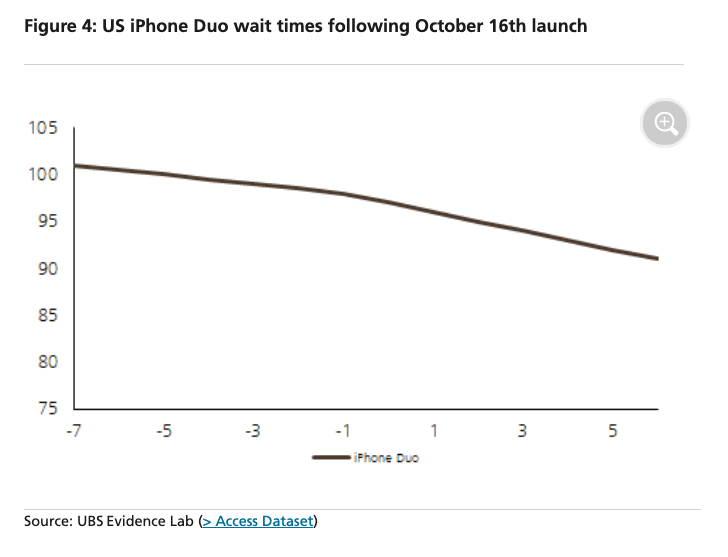
The latest average wait time for the iPhone Duo, measured by UBS Evidence Lab, is 89 days, which means anyone who places a Duo order today won’t receive it until the end of January. What’s impressive is that many Apple fans are willing to be guinea pigs testing the new model, even spending thousands of dollars to do so.

UBS technology analyst David Vogt wrote in a new report that wait times for the new Duo eased over the past week, but buyers still face a three-month delay.

Across more than 30 markets, Vogt and his team found that average wait times were about 89 days. The slight decline in wait times may suggest Apple is catching up with its order backlog, demand is cooling, or both. It doesn’t, on its own, establish that sales are weakening.

“While reports of display issues are a concern in our view, we do not believe that they are the primary driver of the Duo’s declining wait times,” Vogt wrote in the report.

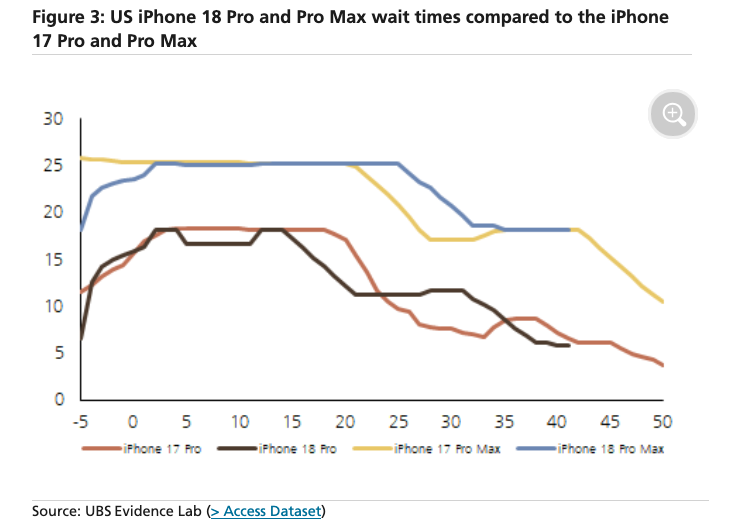
However, delivery trends across Apple’s other premium smartphone models could offer some clues. Average waits for the iPhone 18 Pro declined by three days to about five days, while Pro Max waits held at about 18 days. Both match the comparable models from the previous lineup. 

Vogt added, “We believe that WoW changes to Pro and Pro Max availability is worth tracking, as a tick up may indicate that consumers are opting for the legacy devices instead in our view. If the WoW decline in wait times for the Duo materially accelerate but the Pro and Pro Max continue to trend lower, it may indicate that consumers are deferring their purchases for a potential second-generation foldable that would theoretically launch roughly 8 months after the Duo’s January availability.”

Vogt left his iPhone forecasts unchanged, forecasting 2026 iPhone revenue of $252.5 billion, up 20.5%, and shipments of 261 million units, up 15.4%. He maintained his Neutral rating on the stock and a $296 12-month price target.

The takeaway is that if Pro and Pro Max wait times increase, it could suggest shoppers are switching away from the Duo amid all the negative headlines about cracked screens. Plus, the new foldable handsets are just downright unaffordable.

Tyler Durden

via ZeroHedge News https://ift.tt/FtSXNJY Tyler Durden

Trump vs. WSJ Libel Lawsuit over Trump’s Alleged Birthday Wishes to Epstein Thrown out

From Judge Darrin Gayles (S.D. Fla.) in Trump v. Dow Jones & Co., Inc.:

Those who won our independence believed … that public discussion is a political duty; and that this should be a fundamental principle of the American government. They recognized the risks to which all human institutions are subject. But they knew that order cannot be secured merely through fear of punishment for its infraction; that it is hazardous to discourage thought, hope and imagination; that fear breeds repression; that repression breeds hate; that hate menaces stable government; that the path of safety lies in the opportunity to discuss freely supposed grievances and proposed remedies; and that the fitting remedy for evil counsels is good ones. Believing in the power of reason as applied through public discussion, they eschewed silence coerced by law—the argument of force in its worst form. Recognizing the occasional tyrannies of governing majorities, they amended the Constitution so that free speech and assembly should be guaranteed.

New York Times Co. v. Sullivan (1964) (quoting Whitney v. California (1927) (Brandeis, J., concurring)).

Justice Brandeis’s words, as relevant today as they were nearly a century ago, formed the “background” behind the Supreme Court’s holding in Sullivan: the First Amendment “prohibits a public [figure] from recovering damages for a defamatory falsehood … unless he proves that the statement was made with actual malice[.]” This constitutional protection is not limited to post-discovery motions and trial. Because “[t]he costs and efforts required to defend a lawsuit through [discovery] could chill free speech nearly as effectively as the absence of the actual malice standard altogether[,]” a public figure plaintiff must plausibly allege actual malice at the outset of the litigation.

This Order addresses President Donald J. Trump’s second attempt to plead that Defendants … acted with actual malice when they published an article in the Wall Street Journal … linking him to convicted sex offender Jeffrey Epstein …. As with his first attempt, he has failed. Therefore, for the reasons below, … President Trump’s Amended Complaint is dismissed with prejudice….

The Article

On July 15, 2025, Palazzolo emailed then White House Press Secretary Karoline Leavitt (“Leavitt”) advising her that Dow Jones intended to publish an article (the “Article”) about a birthday letter that President Trump purportedly created for Epstein (the “Letter”). President Trump and his team responded quickly. Leavitt called Palazzolo and told him that the “subject matter” of the proposed Article was false. President Trump, through counsel, denied writing the Letter and warned Dow Jones not to publish the story. {President Trump also denied writing the Letter in an interview before publication.} And President Trump directly told Murdoch that he had not signed or sent the Letter. When Murdoch responded that he would “handle it,” President Trump thought the WSJ would not print the Article. Two days later, the WSJ online edition published the Article.

The title of the Article—”Jeffrey Epstein’s Friends Sent Him Bawdy Letters for a 50th Birthday Album. One was from Donald Trump”—is in bold print, with a subtitle below reading “[t]he leather-bound book was compiled by Ghislaine Maxwell. The president says the letter ‘is a fake thing.'” Leading with a picture of President Trump with Epstein, the Article states the following, in pertinent part:

It was Jeffrey Esptein’s 50th birthday, and Ghislaine Maxwell was preparing a special gift to mark the occasion. She turned to Epstein’s family and friends. One of them was Donald Trump.

Maxwell collected letters from Trump and dozens of Epstein’s other associates for a 2003 birthday album, according to documents reviewed by The Wall Street Journal.

Pages from the leather-bound album—assembled before Epstein was first arrested in 2006—are among the documents examined by Justice Department officials who investigated Epstein and Maxwell years ago, according to people who have reviewed the pages. It’s unclear if any of the pages are part of the Trump Administration’s recent review….

The letter bearing Trump’s name, which was reviewed by the Journal, is bawdy—like others in the album. It contains several lines of typewritten text framed by the outline of a naked woman, which appears to be hand-drawn with a heavy marker. A pair of small arcs denotes the woman’s breasts, and the future president’s signature is a squiggly “Donald” below her waist, mimicking pubic hair.

The letter concludes: “Happy Birthday—and may every day be another wonderful secret.”

In an interview with the Journal on Tuesday evening, Trump denied writing the letter or drawing the picture. “This is not me. This is a fake thing. It’s a fake Wall Street Journal story,” he said.

“I never wrote a picture in my life. I don’t draw pictures of women,” he said. “It’s not my language. It’s not my words.”

He told the Journal he was preparing to file a lawsuit if it published an article. “I’m gonna sue The Wall Street Journal just like I sued everyone else,” he said….

Justice Department officials didn’t respond to requests for comment or address questions about whether the Trump page and other pages of the birthday album were part of the agency’s recent documents review. The FBI declined to comment….

Among those who submitted letters were billionaire Leslie Wexner and attorney Alan Dershowitz … Wexner declined to comment through a spokesman … Dershowitz, who represented Epstein after his first arrest, said, “It’s been a long time and I don’t recall the content of what I may have written….

The book was put together by a New York City bookbinder, Herbert Weitz, according to people who were involved in the process. Weitz, who died in 2020, listed Epstein as a client on his website in 2003.

It isn’t clear how the letter with Trump’s signature was prepared. Inside the outline of the naked woman was a typewritten note styled as an imaginary conversation between Trump and Epstein, written in the third person.

[Description of Conversation]

When he turned 50, Epstein was already wealthy from managing Wexner’s fortune and was socializing with Trump, Clinton and other powerful people. He often entertained at this Manhattan townhouse, Palm Beach, Fla., home and private Caribbean island….

Epstein and Trump spent time together in the 1990s and early 2000s and were photographed at social events, including with Maxwell and Melania Trump….

Trump, along with others including Clinton, also appeared several times on flight logs for Epstein’s private jet.

A 2002 New York magazine profile of Epstein quoted Trump. “I’ve known Jeff for 15 years. Terrific guy,” Trump said. “He’s a lot of fun to be with. It is even said that he likes beautiful women as much as I do, and many of them are on the younger side. No doubt about it—Jeffrey enjoys his social life.”

Both men said that they subsequently had a falling-out. Trump has said their friendship ended before Epstein pleaded guilty to procuring a minor for prostitution in 2008, served time in a Florida jail and registered as a sex offender….

Maxwell, a British socialite, was convicted in 2021 of helping Epstein’s sex-trafficking and sentenced to 20 years in prison. Maxwell didn’t respond to a letter requesting an interview sent to her in prison. Arthur Aidala, an attorney who represented Maxwell, said, “At this point, she is focused on her case before the Supreme Court of the United States.” …

Epstein’s associations with Trump and many powerful people have been well documented….

On September 8, 2025, the WSJ published an article titled “A Visual Breakdown of the Trump Birthday Letter to Epstein” which compares the signature and typeface, drawing style, third-person point of view, and diction in the Letter with prior communications by President Trump (the “September 8 Article”). The September 8 Article includes President Trump’s denial that he wrote the Letter or drew the picture and Leavitt’s statement in a social media post that President Trump did not draw the picture in or sign the Letter….

President Trump contends that these statements are false because he (1) did not author, sign, or draw any portion of the Letter or direct anyone else to author it; (2) never made or dictated to anyone any of the statements in the voiceover or had any such conversation with Epstein as portrayed in the Letter; and (3) was not “childhood pals” with Epstein….

The court concluded that Trump hadn’t actually alleged “actual malice,” which is to say knowing or reckless falsehood:

Here, the Amended Complaint falls short of pleading actual malice. Indeed, the allegations regarding malice are conclusory, vague, sometimes inconsistent with the Article, and often irrelevant to whether Defendants knew or should have known that the statements in the Article were purportedly false.

[a.] Conclusory Language is not Enough

As an initial matter, President Trump’s conclusory allegations that Defendants acted with malice because they “knew or should have known” the statements in the Article were false, are insufficient to state a claim. See Reed v. Chamblee (11th Cir. 2025) (finding the plaintiff’s conclusory assertions that the defendant acted with actual malice insufficient).

[b.] Denial is not Enough

Though vague, the Amended Complaint appears to allege that by choosing to publish the Article despite President Trump’s and his team’s denials, Defendants acted with actual malice. In effect, President Trump argues that once he declared the Letter a “fake,” Defendants should have disregarded everything else they learned in their investigation and not published the story.

But that is not what the actual malice standard requires and runs afoul of the First Amendment. Indeed, were that the law, any time a public figure or his team denies an accusation, journalists would be immediately blocked from publishing negative or contradictory press—a result that flies in the face of the “American privilege to speak one’s mind, although not always with perfect good taste, on all public institutions[.]” Sullivan.

Moreover, the Article did not ignore or minimize President Trump’s denial. Rather, it informed readers that President Trump decried the Letter as a fake and denied writing it. By “allowing readers to decide for themselves what to conclude from the [Article], … any allegation of actual malice [is] less plausible.” … “[R]eporting perspectives contrary to the publisher’s own should be interpreted as helping to rebut, not establish, the presence of actual malice” ….

[c.] The Investigation

President Trump’s argument that the WSJ Defendants’ investigation was inadequate, and therefore an indication of malice, fares no better. As detailed above, a failure to investigate, without more, does not establish actual malice. Rather, “a plaintiff must show the defendant deliberately avoided investigating the veracity of the statement in order to evade learning the truth.”

The Amended Complaint comes nowhere close to this standard. Indeed, the Article details a thoughtful and detailed investigation. Before running the story, Defendants contacted President Trump and his team, Justice Department officials, and the FBI for comment.

President Trump and his team responded with his denial, the Justice Department did not respond at all, and the FBI declined to comment. Defendants also attempted to speak with Maxwell; she did not respond to their request and her attorney stated that she was focused on her case before the Supreme Court. In addition, Defendants reached out to other individuals named in the Birthday Book, including Leslie Wexner and Alan Dershowitz, and to individuals involved in binding the Birthday Book, who confirmed that Weitz put the book together. In short, President Trump’s allegation that Defendants failed to conduct an adequate investigation is rebutted by the Article and is insufficient to establish actual malice.

{President Trump argues that Harte-Hanks Communications, Inc. v. Connaughton (1989), supports his position that Defendants’ purported failure to investigate is enough to support an inference of actual malice. However, in Harte-Hanks, the Supreme Court expressly stated that “[a]lthough failure to investigate will not alone support a finding of actual malice, the purposeful avoidance of the truth is in a different category. Here, President Trump has not alleged any facts, beyond conclusory allegations, that support an inference that Defendants purposefully avoided the truth.}

Grasping at straws, the Amended Complaint attempts to manufacture flaws with the investigation. First, it alleges that the investigation was lacking because Defendants only reviewed the Letter but did not have a copy in their possession. The Court cannot discern any substantive difference—and certainly not one that would establish actual malice—between Defendants reviewing the Letter before publication and obtaining a copy of the Letter. Defendants reviewed the Letter and later reported on its contents. Nothing in the law suggests that Defendants needed to obtain, retain, or publish a copy.

In addition, President Trump’s focus on Maxwell is entirely misplaced. The Eleventh Circuit has found “allegations that the Defendants failed to fully investigate their statements by intentionally choosing not to speak with any witnesses who could have refuted the allegedly defamatory statements” insufficient to plead actual malice. And any argument that Defendants “purposely avoided” the truth by either not disclosing what Maxwell told them or by refusing to speak with her is difficult to reconcile with President Trump’s own allegations.

The Amended Complaint alleges that “Maxwell has stated, subject to penalty of perjury for lying to a federal officer, that she did not remember President Trump submitting a letter for Epstein’s 50th birthday.” Based on this allegation, Maxwell had little to offer to Defendants’ investigation. In short, references to Maxwell are a red herring and simply do not establish that Defendants “actually entertained serious doubts as to the veracity of the published account[] or was highly aware that the account was probably false.”

[d.] Omissions

President Trump’s argument that the Article omits certain facts does not save his claims. First, how or why the voiceover in the Letter was typewritten or how the voiceover was confirmed to be in the third person are inconsequential details that have no bearing on whether Defendants published the Article knowing its contents were false or with reckless disregard as to its falsity. Moreover, Defendants’ decisions about how to investigate and what to include in the Article do not establish malice. “Obviously the author of an article will have to choose which facts to include and which to omit. It is impossible to print all of the facts on which an opinion or belief is based …. Were the courts or criticized [parties] to be allowed to dictate the contents of such articles, censorship would have won out over free speech and the right to dissent.”

Finally, the allegation that Defendants intentionally omitted President Trump’s denial that he signed the Letter or a discussion on whether the signature on the Letter is authentic, is belied by the Article. It states, multiple times, that President Trump denies writing the Letter and that “[i]t isn’t clear how the letter with Trump’s signature was prepared.” . This is more than sufficient to encompass any denial that he “signed” the Letter or that the signature on the Letter is authentic.

[e.] The September 8 Article

The Amended Complaint’s reliance on the September 8 Article to establish malice is equally unavailing. Nothing in the law suggests that a journalist must report on every piece of evidence they uncover before going to print. Moreover, it is unclear why President Trump argues the September 8 Article shows that his signature “could not be more different” than the one in the Letter, when it contains several examples where President Trump’s actual signature and sketches are similar to those in the Letter. At bottom, the September 8 Article does not support a finding that Defendants knew or should have known that President Trump did not sign the Letter….

The post Trump vs. WSJ Libel Lawsuit over Trump's Alleged Birthday Wishes to Epstein Thrown out appeared first on Reason Magazine.

from Latest – Reason Magazine https://ift.tt/qBw1pFu
via IFTTT