“Content Modification” – Facebook’s New Campaign Should Have Free Speech Advocates Freaking Out

“Content Modification” – Facebook’s New Campaign Should Have Free Speech Advocates Freaking Out

Authored by Jonathan Turley,

In 1964, Stanley Kubrick released a dark comedy classic titled “Dr. Strangelove or: How I Learned to Stop Worrying and Love the Bomb.” The title captured the absurdity of getting people to embrace the concept of weapons of mass destruction. The movie came to mind recently with the public campaign of Facebook calling for people to change her attitudes about the Internet and rethink issues like “content modification” – the new Orwellian term for censorship.

The commercials show people like “Joshan” who says that he was born in 1996 and grew up with the internet.” Joshan mocks how much computers have changed and then asks why our regulations on privacy and censorship cannot evolve as much as our technology. The ads are clearly directed at younger users who may be more willing to accept censorship than their parents who hopelessly cling to old-fashioned notions of free speech.  Facebook knows that it cannot exercise more control over content unless it can get people to stop worrying and love the censor.

There was a time when this would have been viewed as chilling: a corporate giant running commercials to get people to support new regulations impacting basic values like free speech and privacy. After all, Joshan shows of his first computer was a “giant behemoth of a machine” but that was before he understood “the blending of the real world and the internet world.”

The Facebook campaign is chilling in its reference to “privacy” and “content modification” given the current controversies surrounding Big Tech. On one level, the commercial simply calls for rethinking regulatory controls after 25 years. However, the source of the campaign is a company which has been widely accused of rolling back on core values like free speech. Big Tech corporations are exercising increasing levels of control over what people write or read on the Internet. While these companies enjoy immunity from many lawsuits based on the notion of being neutral communication platforms (akin to telephone companies), they now censor ideas deemed misleading or dangerous on subjects ranging from climate denial to transgender criticism to election fraud.

Moreover, Facebook knows that there is ample support for increasing censorship and speech regulation in Congress and around the world. Free speech is under attack and losing ground — and Facebook knows it.

The rise of the corporate censor has challenged long-standing assumptions of the free speech community. Our Constitution and much of free speech writings are focused on the classic model of government censorship and state media. What we have seen in the last few years is that corporations have far greater ability to curtail speech and that you can have a type of state media without the state.

Free speech advocates are not the only ones to notice. Authoritarian figures have recognized these companies as competitors. Recently Russian President Vladimir Putin denounced Big Tech as a threat to “Democratic institutions” – a farcical objection from one of the world’s most blood-soaked, anti-democratic figures.

Other leaders have simply sought an alliance with the companies for mutually beneficial censorship. Countries like India appear to have out-sourced censorship duties to Big Tech. Twitter admitted recently that it is actively working with the Indian government to censor criticism of its handling of the pandemic. There are widespread reports that the Indian government has misrepresented the number of deaths and the true rate of cases could be as much as 30 times higher than reported. Thousands are dying each day due to a shortage of beds, oxygen, and other essentials. Twitter is saying that it had the power to “withhold access to the content in India only” if the company determined the content to be “illegal in a particular jurisdiction.” Thus, criticism of the government in this context is illegal so Twitter has agreed to become an arm of the government in censoring information.

Sikh groups last year objected that Facebook censored Sikh posts during #SikhGenocide remembrance movements. They also objected to such censorship by Instagram and Twitter, was centered on stifling anything linked to the Khalistan and likely was done at the behest of the Indian state.

These corporations are now offering politicians what they have long desired in controlling speech and curtailing criticism. Leaders in this country have encouraged the same mutually beneficial alliance. Politicians know that the First Amendment only deals with government censorship, but who needs “Big Brother” when a slew of “Little Brothers” can do the work more efficiently and comprehensively.

When Twitter’s CEO Jack Dorsey came before the Senate to apologize for blocking the Hunter Biden story before the election, he was met by demands from Democratic leaders for more censorship. Senator Chris Coons (D., Md.) pressed Dorsey to expand the categories of censored material to prevent people from sharing any views that he considers “climate denialism.” Likewise, Senator Richard Blumenthal (D., Conn.) chastised the companies for shying away from censorship and told them that he was “concerned that both of your companies are, in fact, backsliding or retrenching, that you are failing to take action against dangerous disinformation.” Accordingly, he demanded that they “commit to the same kind of robust content modification playbook in this coming election.”

That brings us back to Facebook’s glitzy media campaign. Polls show that younger Americans are more open to censorship after years of speech regulation in their high schools and colleges. They have grown up with media figures like CNN’s host Brian Stelter calling censorship simply a “harm reduction model.” They have read writers and editors embracing book banning and blacklisting. They have been conditioned to fear unrestrained free speech. making them natural allies in “evolving” with Big Tech companies.

What is fascinating about Joshan and his equally eager colleagues Chava and Adam is that they tie changes in technology to possible changes in core principles like reconsidering “content modification.” They were all born in 1996 — the sweet spot for censors between the Millennials and Generation Z members. Those generations, and particularly Gen Z, are the most likely to come stop fearing the censor and love “content modification.” Joshan and his technologically woke friends simply want us (and regulations) to “change” with our computers. After all, it may not be our content that needs to be “modified” but ourselves in our attitudes and assumptions. Just do not be surprised if that upgrade to You 2.0 requires the removal of the free speech bug that is inhibiting your “blending of the real world and the internet world.”

Tyler Durden
Tue, 05/04/2021 – 12:55

via ZeroHedge News https://ift.tt/3tj3U91 Tyler Durden

Kevin Spacey Sex Abuse Plaintiff Can’t Sue Under Pseudonym

American court proceedings are generally open to the public, both in civil and criminal cases. There are some exceptions, but they tend to be narrow.

The parties’ identities are generally treated the same way. People generally have to litigate under their names. But pseudonymous litigation is sometimes allowed, especially in certain categories of cases—for instance, those involving children, or certain kinds of litigation involving challenges to government action (see, e.g., this post, which mentions a case like that in which I was a lawyer). And pseudonymous litigation is not uncommon in cases involving sexual conduct, or other private matters, such as abortion (consider Roe v. Wade).

Still, even in those categories, pseudonymity isn’t certain. For instance, criminal defendants are almost never pseudonymous, even when they are accused of sex crimes (and may concede that the case involved sexual conduct, thought they might argue that it wasn’t criminal). Likewise, that’s so in at least some civil sex crime cases; rather than a categorical rule supporting pseudonymity, many courts use multi-factor balancing tests that come out differently in different cases.

We see that in Rapp v. Fowler, decided yesterday by Judge Lewis A. Kaplan (S.D.N.Y.); Fowler is (in)famous actor Kevin Spacey. A few key passages:

[1.] The harm that C.D. claims would result from the public disclosure of his name would be the “re-trigger[ing]” of his post-traumatic stress disorder (“PTSD”), which he allegedly developed as a consequence of the assault…. [But] even assuming there were no “leak” of C.D.’s identity as the case proceeded, “[b]eing ‘re-exposed’ to the perceived wrong [of which he complains] is an inevitable consequence of litigation itself. If the case goes forward, [plaintiff] will be deposed, no doubt in the presence of the accused defendant; in the less certain event of trial, [ ]he will presumably testify in a public courtroom and be subjected to cross-examination.” Neither of the declarations suggests that proceeding with the case anonymously would protect C.D. from those consequences.

[2.] [Pseudonymity is not justified here] despite the harassing Instagram comments that Rapp received after he went public with his allegations against Spacey, which C.D. implies that he will receive if he discloses his name…. [W]hile online harassment of any kind is repugnant, it is an unfortunate consequence of the social media age. Many who make accusations against public figures are forced to endure it. Without a specific threat of harm and a privacy interest that outweighs the prejudice to the defendant and the public’s right to open courts, however, C.D.’s allegation that he would be subjected to online harassment if he were identified, even if it proved accurate, would not alone entitle him to proceed by anonymously.

[3.] Spacey has shown that he would be prejudiced during discovery because C.D.’s use of a pseudonym likely would prevent persons with information about C.D. or his allegations that would be helpful to Spacey’s defense, but that now are unknown to Spacey, from coming forward.

Highly publicized cases can cause unknown witnesses to surface. By keeping C.D.’s identity confidential, “information about only one side may thus come to light.”

“Information and allegations that are highly sensitive and of a personal nature can flow both ways.” In other words, C.D.’s “allegations and public comments embarrass [Spacey] and place him under the same stigma that concerns” C.D. It would be harder to mitigate against that stigma if C.D. were permitted to remain anonymous.

[4.] C.D. actively has pursued this lawsuit—including by recruiting his co-plaintiff. He seeks over $40 million in damages. He makes serious charges and, as a result, has put his credibility in issue. “Fairness requires that [he] be prepared to stand behind [his] charges publicly.”

And here’s a much longer excerpt, which contains most of the court’s analysis:

Plaintiffs C.D. and Anthony Rapp claim that defendant Kevin Spacey Fowler, better known as Kevin Spacey, sexually assaulted them over 35 years ago. Their claims regard separate events that allegedly occurred when Spacey was in his twenties and plaintiffs were teenagers [age 14 in C.D.’s case]. The primary question now before the Court is whether the plaintiff currently known by the pseudonym “C.D.” should be permitted to litigate the case without publicly identifying himself. For the following reasons, his motion to proceed anonymously is denied….

The record as it relates to the events leading to this litigation is unusual. Some of the key facts derive from an article posted on a New York magazine web site, Vulture, in November 2017. The Vulture article describes an interview with a “man” who “approached” the magazine and made allegations against Spacey that are virtually identical to C.D.’s allegations in the complaint. Although the article does not disclose the man’s name and states that he wishes to remain anonymous, the parties agree that the victim of the alleged assault described in the article was C.D. As both parties rely on the Vulture article—and neither contests the accuracy of its description of C.D.’s interview with the press—the Court assumes the article’s accuracy for the purposes of this motion.

The genesis of the Vulture article was this. In late 2017, after Rapp publicly accused Spacey of sexually assaulting him, C.D., “who was friendly with a member of the New York staff,” “approached the magazine to talk about Spacey.” Later, when Vulture reached out to “people close to” C.D. to verify his story, those individuals stated that C.D. had spoken to them “about his relationship with Spacey as far back as the 1990s.” …

In August 2019, the New York Legislature passed the Child Victims Act, which temporarily revived the limitations period for civil claims of child sexual abuse under New York law. By the start of 2020, two additional things had occurred. First, C.D. had engaged his current counsel. Second, C.D. had approached Rapp—through a mutual friend—to see whether Rapp would be interested in bringing a civil suit against Spacey. The mutual friend provided Rapp with C.D.’s real name and contact information. Shortly afterward, Rapp connected with both C.D.—who informed Rapp about the New York Child Victims Act—and C.D.’s counsel….

[After C.D. sued, a]t this Court’s directive, plaintiffs provided Spacey with C.D.’s real name and other identifying information on the condition that it be kept confidential until the parties reached a mutually satisfactory agreement as to whether and to what extent C.D.’s identity would be kept from the public as the action proceeded or, in the event no agreement were reached, until the Court decided this motion. No agreement was reached….


As a preliminary matter, the Court will consider all of the papers it has received for purposes of these motions without regard to whether all parts of them would be admissible on summary judgment or at trial. Accordingly, Spacey’s motions to strike are denied and his objection to Dr. Block’s expert report is overruled. The Court turns to the merits of C.D.’s motion.

Openness long has been a central tenet of our legal system. Federal court proceedings and records presumptively are public absent a showing of exceptional circumstances. To this end, Rule 10(a) of the Federal Rules of Civil Procedure requires that “[e]very pleading … contain a caption setting forth the … title of the action,” which must “include the names of all the parties.” “[T]hough seemingly pedestrian,” Rule 10(a) “serves the vital purpose of facilitating public scrutiny of judicial proceedings and therefore cannot be set aside lightly.”

District courts have discretion to grant an exception to Rule 10(a) only where the litigant seeking to proceed anonymously has a substantial privacy interest that outweighs any prejudice to the opposing party and “the customary and constitutionally-embedded presumption of openness in judicial proceedings.” In Sealed Plaintiff v. Sealed Defendant, the Second Circuit identified a “non-exhaustive” list of ten factors that district courts should consider in balancing these interests:

(1) whether the litigation involves matters that are highly sensitive and of a personal nature,

(2) whether identification poses a risk of retaliatory physical or mental harm to the party seeking to proceed anonymously or even more critically, to innocent non-parties,

(3) whether identification presents other harms and the likely severity of those harms, including whether the injury litigated against would be incurred as a result of the disclosure of the plaintiff’s identity,

(4) whether the plaintiff is particularly vulnerable to the possible harms of disclosure, particularly in light of his age,

(5) whether the suit is challenging the actions of the government or that of private parties,

(6) whether the defendant is prejudiced by allowing the plaintiff to press his claims anonymously, whether the nature of that prejudice (if any) differs at any particular stage of the litigation, and whether any prejudice can be mitigated by the district court,

(7) whether the plaintiff’s identity has thus far been kept confidential,

(8) whether the public’s interest in the litigation is furthered by requiring the plaintiff to disclose his identity,

(9) whether, because of the purely legal nature of the issues presented or otherwise, there is an atypically weak public interest in knowing the litigants’ identities, and

(10) whether there are any alternative mechanisms for protecting the confidentiality of the plaintiff….

[T]he digital age has adversely affected the privacy of litigants. The days when court records of litigation largely escaped public notice as they languished in countless file rooms largely ended with the advent of electronic case files, the internet, search engines, and other aspects of the information age. And the loss of the earlier practical obscurity of court files no doubt is compounded when a litigant like C.D. brings a claim against someone in the public eye, especially if the substance of the claim makes it likely to attract significant media attention.

But the threat of significant media attention—however exacerbated by the modern era—alone does not entitle a plaintiff to the exceptional remedy of anonymity under Rule 10. {“[C]laims of public humiliation and embarrassment” due to “significant media attention … are not sufficient grounds for allowing a plaintiff in a civil suit to proceed anonymously.” Doe v. Shakur (S.D.N.Y. 1996) (denying motion to proceed by pseudonym brought by woman who alleged that rapper Tupac Shakur assaulted her despite the media attention the case likely was to attract); see also Doe v. Weinstein (S.D.N.Y. 2020) (denying motion to proceed by pseudonym brought by woman who alleged that movie producer Harvey Weinstein assaulted her despite that Weinstein’s “notoriety” was likely to cause significant media attention).}

Here, only one Sealed Plaintiff factor supports C.D.’s motion to proceed anonymously. Accordingly, C.D.’s privacy interest—despite the publicity that this case may generate—does not outweigh the prejudice to Spacey and the presumption of open judicial proceedings.

The first Sealed Plaintiff factor, which looks to whether the case involves claims that are “highly sensitive and of a personal nature,” weighs in favor of allowing C.D. to proceed anonymously. Allegations of sexual assault are “paradigmatic example[s]” of highly sensitive and personal claims and thus favor a plaintiff’s use of a pseudonym. Likewise, allegations of sexual abuse of minors typically weigh significantly in favor of a plaintiff’s interest. Importantly, however, “allegations of sexual assault, by themselves, are not sufficient to entitle a plaintiff to proceed under a pseudonym.” Doe v. Skyline Automobiles Inc. (S.D.N.Y. 2019) (citing Doe v. Shakur (S.D.N.Y. 1996) (collecting cases))….

The second, third, and seventh Sealed Plaintiff factors, which in this case appropriately may be considered together, do not favor C.D.’s use of a pseudonym. The second and third factors broadly require courts to take into account whether disclosure of the plaintiff’s name would result in harm, including “retaliatory physical or mental harm” to the plaintiff or, “even more critically, to innocent non-parties.” The seventh factor asks whether the plaintiff’s identity thus far has been kept confidential.

The harm that C.D. claims would result from the public disclosure of his name would be the “re-trigger[ing]” of his post-traumatic stress disorder (“PTSD”), which he allegedly developed as a consequence of the assault. With regard to “allegations of mental harm,” “plaintiffs must base their allegations … on more than just mere speculation.” When a plaintiff claims that disclosing his or her name would “retrigger” symptoms of PTSD, courts have required a “link between public disclosure of plaintiff’s name and the described psychological risk” otherwise “[t]here is simply no way to conclude that granting … permission to proceed under [a] pseudonym[ ] will prevent [plaintiff] from having to revisit the traumatic events.”

The Court takes C.D.’s claim of threatened psychological injury seriously. Sexual assault can have lasting, damaging consequences on a person’s emotional or mental health. But whether the alleged sexual assault caused C.D. to have PTSD or other psychological injuries is not the question before the Court. Rather, the questions are whether the public disclosure of C.D.’s name in the course of this lawsuit in fact uniquely would “retrigger” the PTSD that is said to have resulted from the alleged sexual assault and, if so, how grave the resultant harm would prove to be.

C.D.’s prior actions undercut his position on the rather unusual facts of this case.

C.D. has spoken since the 1990s to an unknown number of people about his “relationship” with Spacey. He does not claim that he received assurances of confidentiality from any of them.

Then, in 2017, C.D. approached a person with whom he was “friendly” to facilitate the publication of his claims against Spacey. He disclosed his identity to Vulture. Vulture in turn sought to verify aspects of C.D.’s assertions with friends or acquaintances of C.D. That necessarily would have required Vulture to identify C.D., by his true identity, to those persons and, at least to some extent, to connect C.D. to the allegations against Spacey. And after the New York Child Victims Act was passed, C.D. (1) hired a lawyer, (2) reached out again to a friend—who is not alleged to have agreed to keep C.D.’s identity confidential—for the purpose of contacting Rapp, and (3) then recruited Rapp to join him in this lawsuit. Thus, the evidence suggests that C.D. knowingly and repeatedly took the risk that any of these individuals at one point or another would reveal his true identity in a manner that would bring that identity to wide public attention, particularly given Spacey’s celebrity.

In this context, [the] declarations [of Neil Bonavita, a licensed clinical social worker who has seen C.D. since 2015, and Dr. Seymour Block, a forensic psychiatrist who evaluated C.D. via Facetime—after this motion was filed—at C.D.’s counsel’s request] do not carry the day for C.D on either of the pertinent questions, let alone both. Both say substantially the same thing: that “[C.D.’s] name being made public to the media, friends or on the internet … will trigger his post-traumatic stress disorder” causing “anxiety, anxiety attacks, nightmares, and depression.” But C.D. already has revealed the alleged facts to friends, revealed his identity to Vulture, and quite likely identified to Vulture people to whom he already had told his story for the purpose of enabling Vulture to try to confirm what he had told it.

Yet there is no suggestion in either declaration that any of those disclosures “to the media [and] friends” retriggered C.D.’s PTSD or, if they did not, why further disclosure would yield a different outcome. And it would be no satisfactory answer to say that one should infer that there was no “retriggering” because C.D. trusted, or assumed that he could trust, those to whom he repeated his story not to reveal C.D.’s identity. As media coverage of the allegations against Spacey grows, as would be very likely as this litigation proceeds and a trial approaches or takes place, it is only common sense to say that the risk of disclosure would grow.

Moreover, even assuming there were no “leak” of C.D.’s identity as the case proceeded, “[b]eing ‘re-exposed’ to the perceived wrong [of which he complains] is an inevitable consequence of litigation itself. If the case goes forward, [plaintiff] will be deposed, no doubt in the presence of the accused defendant; in the less certain event of trial, [ ]he will presumably testify in a public courtroom and be subjected to cross-examination.” Neither of the declarations suggests that proceeding with the case anonymously would protect C.D. from those consequences.

The declarations, no matter how sincere, ultimately are insufficiently persuasive for another reason. Neither gives any sense of the severity of any consequences of a “retriggering” of the alleged PTSD by future disclosure of C.D.’s identity beyond the conclusory statements that it would entail anxiety, nightmares, and depression. Any of these consequences of course would be regrettable. But the frequency, seriousness, clinical significance and treatability of feelings of anxiety and depression and of nightmares doubtless cover broad spectra. The declarations’ conclusory statements are of limited utility.

In sum factors two, three, and seven do not lend much support to C.D.’s position.

{This remains true despite the harassing Instagram comments that Rapp received after he went public with his allegations against Spacey, which C.D. implies that he will receive if he discloses his name. But his implication cannot be credited for two reasons.

First, Rapp admitted in text messages that “98% of what’s coming my way” as a result of his suing Spacey is “overwhelming support” and “the other 2% is random trolling on the web, which I was fully anticipating.” There is no reason to conclude that C.D.’s experience, were he identified, would differ.

Second, while online harassment of any kind is repugnant, it is an unfortunate consequence of the social media age. Many who make accusations against public figures are forced to endure it. Without a specific threat of harm and a privacy interest that outweighs the prejudice to the defendant and the public’s right to open courts, however, C.D.’s allegation that he would be subjected to online harassment if he were identified, even if it proved accurate, would not alone entitle him to proceed by anonymously.} …

The fourth factor, which looks to whether a plaintiff is particularly vulnerable to possible harms of disclosure, does not weigh in favor of C.D.’s use of a pseudonym either. “The plaintiff’s age is a critical factor” in the determination of the fourth factor, “as courts have been readier to protect the privacy interest of minors in legal proceedings than of adults.” “If a plaintiff is not a child, this factor weighs against a finding for anonymity.” Though C.D. brings allegations relating to alleged sexual abuse as a minor, he now is an adult in his 50s who has chosen to level serious charges against a defendant in the public eye. This factor weighs in favor of his shouldering the burden of such accusations….

The sixth factor looks to whether the defendant would be prejudiced if the plaintiff were permitted to proceed under a pseudonym. In considering the sixth factor, courts have examined “difficulties in conducting discovery,” the “reputational damage to defendants,” and the “fundamental fairness of proceeding anonymously.” Spacey has shown that he would be threatened with prejudice in all three ways if C.D.’s motion were granted.

First, Spacey has shown that he would be prejudiced during discovery because C.D.’s use of a pseudonym likely would prevent persons with information about C.D. or his allegations that would be helpful to Spacey’s defense, but that now are unknown to Spacey, from coming forward. If they do not know who this accuser is, they likely would have no way of knowing that their information would be pertinent. Contrary to C.D.’s assertions, this asymmetry in fact-gathering would not be avoided by the fact that C.D. already has provided Spacey with his name. Nor would it be remedied fully by plaintiffs’ proposed stipulation, which would allow Spacey to use and disclose C.D.’s name for discovery purposes on the condition that anyone who becomes privy to his identity would be obliged to keep it confidential. Highly publicized cases can cause unknown witnesses to surface. By keeping C.D.’s identity confidential, “information about only one side may thus come to light.” This not only would prejudice Spacey, but would hinder “the judicial interest in accurate fact-finding and fair adjudication.”

Second, Spacey has suffered significant reputational damage from C.D.’s allegations. “Information and allegations that are highly sensitive and of a personal nature can flow both ways.” In other words, C.D.’s “allegations and public comments embarrass [Spacey] and place him under the same stigma that concerns” C.D.” It would be harder to mitigate against that stigma if C.D. were permitted to remain anonymous.

Lastly, fundamental fairness suggests that defendants are prejudiced when “required to defend [themselves] publicly before a jury while plaintiff[s] … make … accusations from behind a cloak of anonymity.” C.D. actively has pursued this lawsuit—including by recruiting his co-plaintiff. He seeks over $40 million in damages. He makes serious charges and, as a result, has put his credibility in issue. “Fairness requires that [he] be prepared to stand behind [his] charges publicly.” …

Factors five, eight, and nine, all of which relate to the public’s interest in knowing the plaintiff’s identity, weigh against C.D.’s use of a pseudonym.

The fifth factor looks to whether the suit challenges the actions of the government or that of private parties. “In private civil suits, courts recognize there is a significant interest in open judicial proceedings since such suits ‘do not only advance the parties’ private interests, but also further the public’s interest in enforcing legal and social norms.'” C.D. brings allegations against a private party so this factor weighs against his use of a pseudonym.

The ninth factor looks to whether, because of the purely legal nature of the issues presented, there is an atypically weak public interest in knowing the litigants’ identities. C.D.’s allegations are decidedly factual in nature, so this factor too weighs against his use of a pseudonym.

The eighth factor generally requires courts to look to whether the public’s interest in the litigation is furthered by requiring the plaintiff to disclose his or her identity. As discussed above, the public “has a legitimate interest” in knowing the underlying facts of a litigation, including the identities of the litigants. Here, that interest is magnified because C.D. has made his allegations against a public figure.

C.D. argues that there is a competing public interest in keeping the identity of those who make sexual assault allegations anonymous so that they are not deterred from vindicating their rights. Along these lines, C.D.’s counsel in his latest letter stated that “C.D. has reluctantly decided” that “he is emotionally unable to proceed with the action and will discontinue his claims” if the Court denies his motion to proceed by pseudonym. It would be inappropriate at this juncture for the Court to play any role in deciding whether C.D. persists in his claims against Spacey, which of course would be his right regardless of the outcome of this motion. The Court’s role is to weigh C.D.’s privacy interest against the prejudice to Spacey and the public’s interest in open judicial proceedings. Though C.D. is correct that the public generally has an interest in protecting those who make sexual assault allegations so that they are not deterred from vindicating their rights, it does not follow that the public has an interest in maintaining the anonymity of every person who alleges sexual assault or other misconduct of a highly personal nature. For the foregoing reasons, C.D. has not shown that his privacy interest is sufficient to warrant allowing him to litigate his sexual assault allegations anonymously. Accordingly, on balance, the public interest does not weigh in favor of C.D.’s use of an pseudonym….

Finally, the tenth factor, which looks to whether there are any alternative mechanisms for protecting the confidentiality of the plaintiff, does not weigh in favor of C.D.’s use of a pseudonym. C.D. “can seek less drastic remedies than blanket anonymity, such as redactions to protect particularly sensitive information, or a protective order.” And Spacey already has expressed his amenability to such an order….
 

from Latest – Reason.com https://ift.tt/3aYKBLS
via IFTTT

Banks Start Freaking Out About Soaring Inflation, Which May Not Be “Transitory”

Banks Start Freaking Out About Soaring Inflation, Which May Not Be “Transitory”

For the past few months we – unlike the Fed – have been warning readers that the US is about to get by a wave of soaring prices the likes of which have not been seen since the early 1970s (see “”Buckle Up! Inflation Is Here!”). And while two weeks ago we noted the even “Companies Are Freaking Out About Soaring Costs“, sellside analysts had retained composure, with most comforting their clients that whatever inflation we get will be transitory (despite occasional luminaries such as Jeff Gundlach saying that the Fed and banks may well be wrong about the “transitory” narrative).

Well, as of this week, the analyst narrative has taken a sharp U-turn, starting with JPMorgan which yesterday admitted that there are an increasing amount of articles that illustrate rising inflation expectations, “even if those measures are not captured by official government releases” to wit:

And while JPM has long been in the “transitory” bandwagon, the bank’s strategist Andrew Tyler admits that in a crack to the party line, his view “is that we’ll see inflation expectations continue to move higher over the summer, as we see improving macro data (NFP, CPI, PPI, and Retail Sales the most topical).”

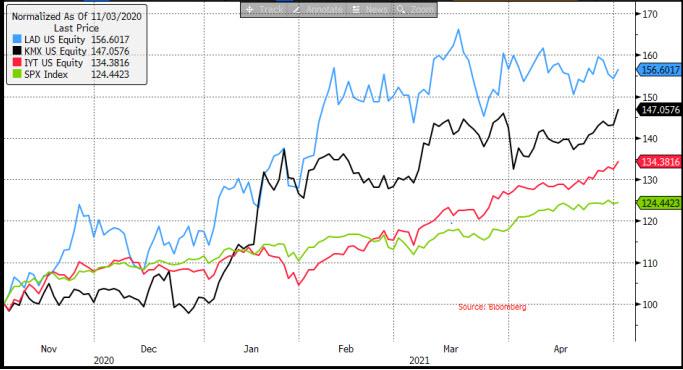
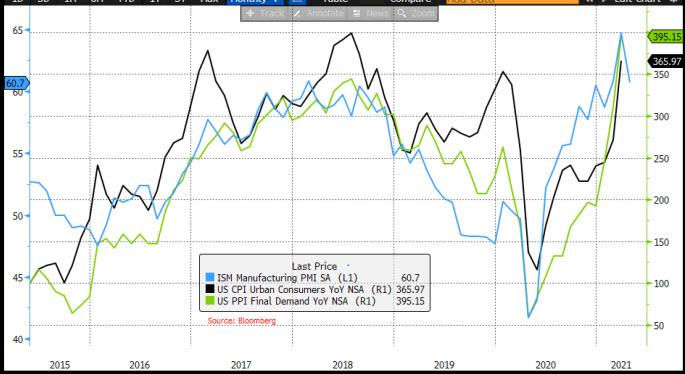
To help investors formulate their own inflation expectations – especially amid rising strains on the global supply chain created by COVID – he presents out the following charts:

LAD vs. KMX vs. IYT vs. SPX

ISM vs. CPI vs. PPI

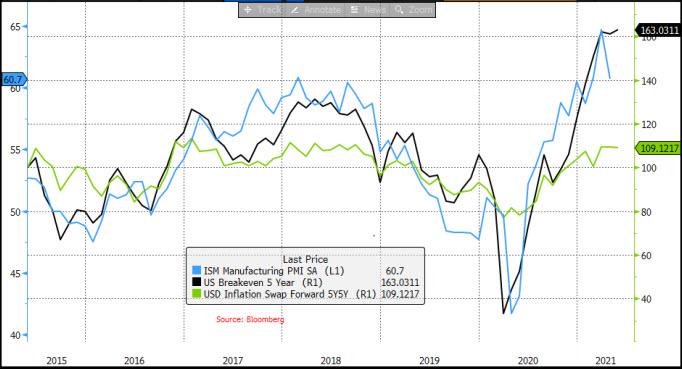
ISM vs. 5Y BREAKEVENS vs. 5Y5Y INFLATION SWAPS

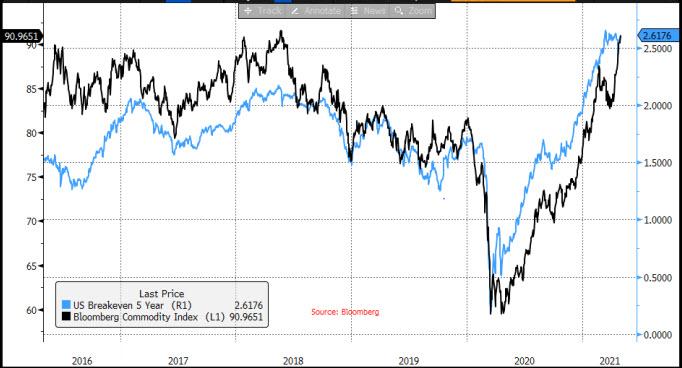
5Y BREAKEVENS vs. BLOOMBERG COMMODITY INDEX [BCOM]

As Tyler accurately concludes, “one of the biggest questions is how long this persists” adding that the answer to that question may help investors determine whether to update models with lower growth/margin expectations or to look through this seemingly one-time event (which may not be as one-time as so many say it will be). His advise for investors who need to hedge inflation exposure in their portfolios, he recommends adding commodities or commodity equities: “our favorite play is Energy.”

* * *

Goldman next picks up where JPM leaves off, with the bank’s Chris Hussey pointing out the obvious: “a combination of slowing growth and rising inflation” – i.e. stagflation, “is an unfavorable one for forward looking assets like equities.” And while he also falls back on Goldman economists’ macro view which expects inflation “to be benign over the near-term, and are less concerned about the prospect of an overheating economy”, a more nuanced industry breakdown reveals a far more dismal picture, with Hussey noting that Goldman analysts now focus on soaring input cost inflation and supply chain pressures across retail and housing. Consider:

  • Auto parts retail. Kate McShane believes Autoparts Retailers should be able to realize pricing power as they fulfill rising demand for do it for me (DIFM) projects in a re-opening economy in “Improving DIFM outlook + inflation pass-through ability.” Most Auroparts demand comes from must-have fix-it projects (non-discretionary), providing retailers with the ability to sustain prices. The group is also trading at a sharp discount to historical valuation levels — presenting a disconnect between valuation and fundamentals.

  • Grocers. By contrast, Kate McShane believes Grocers will struggle to pass rising food inflation onto its customers as promotions return to the industry following a pandemic hiatus in “Margin Pressure Potential in Grocery from Inflation and Competition.” The grocery competitive landscape did not change much during the pandemic giving us little reason to believe that the category will not become promotional again.

  • Housing. Strong housing demand and shortage of available homes should keep house price growth firm — potentially boosting core inflation in the shelter category through higher rent inflation, writes Ronnie Walker in a May-2 economics note “Housing on Fire.” And Sue Maklari remains bullish on bellwether homebuilder PHM following last week’s results as we believe the company should have the pricing power to offset rising lumber and labor cost.

* * *

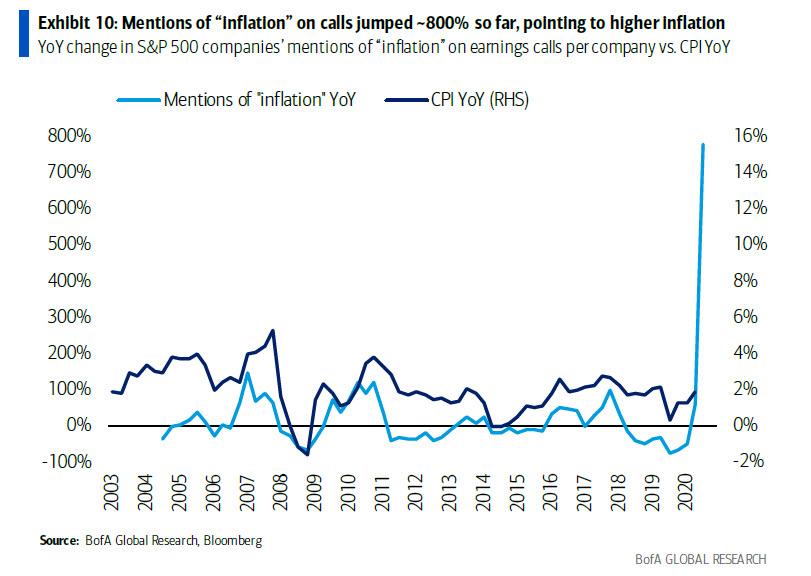
If that wasn’t enough, yesterday Bank of America made ripples across trading desks when in its summary of the third week of earnings season, the bank’s strategist Savita Subramanian, she noted that mentions of “inflation” have quadrupled YoY, and after last week, mentions have exploded nearly 800% YoY.

And the punchline from her report:

“on an absolute basis, mentions skyrocketed to near record highs from 2011, pointing to at the very least, “transitory” hyper-inflation ahead.”

Yes, this is a top 4 bank saying the US is facing “transitory hyperinflation.” Because when one thinks hyperinflation, “transitory” is what comes to mind.

In any case, digging into the actual data, BofA finds that by category, mentions of pricing (+36%) and transportation (+35%) rose the most, followed by materials (+28%), while labor-related mentions rose the least (+9%). And to further substantiate her point, Subramanian has pulled some of the most memorable “reflation” and “higher prices” remarks from recent conference calls:

  • FAST (Industrials): “we are experiencing significant material cost inflation, particularly for steel, fuel and transportation costs.”

  • GIS (Staples): “Looking ahead, as we experienced higher inflationary environment, our first line of defense will continue to be our strong holistic margin management cost savings program. In addition, we are taking actions now and in the coming months […] to drive net price realization that will benefit our FY2022. “

  • CAG (Staples): “we’re seeing input cost inflation accelerate in many of our categories and across the industry.”

  • LW (Staples): “while the pandemic-related effects on our supply chain were the primary drivers of our cost increases, we also realized higher costs due to input cost inflation in the low single-digits. We expect that rate will begin to tick up in the coming quarters as edible oil and transportation costs continue to increase.”

  • STZ (Staples): “similar to previous years, we’re expecting substantial inflation headwinds in the low to mid-single-digit increase range, largely related to glass and other packaging materials, raw materials, transportation and labor costs in Mexico. “

  • PPG (Materials): “we experienced a significant acceleration of raw material and logistics cost inflation during the quarter. Coming into the year, we were expecting an inflationary environment and had prioritized selling price increases across all of our businesses. This has helped us achieve solid price increases year-to-date. With a higher inflation backdrop, we have already secured further selling price increases and are in the process of executing additional ones during the second quarter. “

  • DOV (Industrials): “What we are going to fight against between now and the end of the year […] is inflationary input costs between raw materials, labor, and price/cost.

  • […] the way it’s looking we may have to intervene on price again in certain of the businesses over the balance of the year.”

  • TEL (Tech): “I would expect our margins to modestly improve as we work our way forward here into the third and fourth quarter based on some of the actions that are underway and our ability to combat some of the inflationary pressures out there. […] Certainly, we’re feeling the biggest inflation right now is on the freight side. The freight inflation has been significant. And as we battled through there and there’s a variety of reasons for that including higher air freight and so forth in terms of that. And that’s not unique to TE. Certainly, I think that’s been as well publicized across the overall supply chain. […] labor cost is not a major issue on the inflation side, but labor  availability in certain places that are still being more impacted by COVID continues to drive some inefficiencies.”

  • CMG (Consumer Discretionary): “So, all of that is very, very manageable and we feel like if there is going to be significant increased inflation because of market-driven or because of federal minimum wage, we think everybody in the restaurant industry is going to have to pass those costs along to the customer.”

  • ALLE (Industrials): “This guide incorporates pricing actions to offset direct material inflation, as well as reflecting our supply chain capability to mitigate industry challenges on supply and electronic component shortages. We anticipate that these challenges will persist for the balance of the year, and we will continue to monitor and adapt to changing market conditions.”

  • WHR (Consumer Discretionary): “The global material cost inflation in particular in steel and resins will negatively impact our business by about $1 billion. We expect cost increases to peak in the third quarter.”

  • PNR (Industrials): “All inflation remains high. We have instituted a number of selling price increases across the portfolio that we expect to help mitigate inflation in the second half of the year.”

  • TSCO (Consumer Discretionary): “Compared to our initial outlook for the year, our forecast does reflect higher transportation costs and product inflation. We experienced increasing pressures from these factors during the first quarter and expect them to continue to be a headwind throughout 2021.”

  • POOL (Consumer Discretionary): “We previously said that inflation would be in the 2% to 3% range but now believe it will be in the 4% to 5% with some products into double-digits. We don’t anticipate any of this getting hung up in the channel so that will provide a tailwind for the year. Considering that most of our – most of the cost of constructing a new pool or remodeling an existing pool is tied up in labor we don’t anticipate this inflation having a meaningful effect on demand as it relates to nondiscretionary products such as chemicals, inflation has simply passed through again with no real effects on demand.”

  • LUV (Industrials): “Outside of salary, wages and benefits, the largest drivers of our sequential cost pressure are flight driven cost increases and landing fees, employee, customer and revenue related cost, and maintenance expense…”

  • HON (Industrials): “Yeah, that’s definitely a watchout item for the year. And for us, inflation is taking hold. There’s no doubt about it. We knew it. We see it. It’s real. And if you don’t stay on top of it, the two areas where – and this is not a surprise – steel, semiconductors, copper, ethylene, those are the four elements that we saw substantial inflation in Q1. [..] I can tell you that we stood up a pricing team, which has been in place since the beginning of the year. We’re quickly taking actions and we are staying ahead of it. And we’re going to continue to monitor what happens and stay ahead of it. But it’s a watchout item. I don’t think things are going to abate. The short cycle is definitely hot. We all read the same articles around semiconductors and what’s going on there, and I think we’re going to have to just stay ahead of it. But we do expect an inflationary environment this year. And we’re going to stay ahead of it. That’s our commitment.”

  • CE (Materials): “We’re certainly feeling the inflationary factor. I think, the good news is we anticipated this coming back in the fourth quarter of last year already and started moving prices […] So, although it is an inflationary pressure, we’ve been able to push that through in our pricing and basically maintain the same level of variable margin.”

  • KMB (Staples): “The biggest reason being that our pricing actions and the benefits of that will be coming through the P&L in the second half. In terms of input cost inflation, that is ramping in the first quarter, and the second quarter. We expect that, it will peak and then moderate and, in some cases, come down a bit in the second half.”

  • MDLZ (Staples): “In terms of inflation, there is more inflation coming. And so, profitability is great in Q1. We believe we are going to hit the numbers as we had originally in mind. But the higher inflation will require some additional pricing and some additional productivities to offset the impact, which I believe at this point is absolutely manageable given that all these positions are pretty much hedged for 2021.”

  • SHW (Materials): “On the cost side of the equation we now expect raw material inflation for the year to be in the high-single-digit to low-double-digit range, a significant increase from the low- to mid-single-digit range we communicated in January. And let me just begin by reiterating a little bit what John and Al have been saying. This whole area of raw material inflation is a transitory issue for us. It’s not new for us. We’ve demonstrated an ability to manage through this many times in the past, and we’ll get through this as well.”

  • WM (Industrials): “We do expect that inflation will kick up a little bit, and so we’ll get some help. And we’re typically a beneficiary of higher inflation.”

  • PKG (Materials): “We also anticipate continued inflation with freight and logistics expenses as well as most of our operating and conversion costs. However, energy costs should improve as we move into seasonally milder weather.”

  • MMM (Industrials): “We are also raising prices, but it’s going to take a little bit of time. The inflation has come in faster. So you’re going to see 75 to 125 basis points of headwind which is the net of price versus inflation and logistics.” “On supply chain disruption, there are two pieces. One is of course the inflation that we’ve told you about which will cost 75 to 125 basis points of headwind between price and inflation and the raw material and logistics costs as well as making sure that we have all the product availability that we have. So that’s the other, I would say, headwind to 1Q.”

  • PHM (Consumer Discretionary): “We have updated our guide in terms of what the inflationary aspect of the sticks and bricks is. We have been at or near 5%, 6%. We’re now 6% to 8%. And depending what lumber does, that could move a little bit even higher than that.”

  • F (Consumer Discretionary): “We’re definitely feeling the commodity headwind, as John said. And inflation, it feels like we’re seeing inflation in variety parts of our industry kind of in ways we haven’t seen for many years. On the other hand, it feels like it’s all due to a lot of one-timers as the economy comes out of lockdown. So I think it’s a bit too early to declare the run rate or where it’s going to be. It’s just too hard to tell from my standpoint.”

  • AVY (Materials): “supply chains have remained tight and input costs have been increasing. As a result, raw material and freight inflation were above our initial expectations. And we have continued to see costs rise as we entered the second quarter We now expect mid to high single digit inflation for the year with variations by region and product category.”

  • IDX (Health Care): “I would say on the inflationary front, it’s kind of spotty for us. I mean remember we’re a little further down the food chain. We don’t buy a lot of giant quantities of base material. We buy things that have been converted, so it does have a little bit of a lag for us. And so we see the same things others are seeing where we buy lots of metals. There’s some inflationary pressure; electronics, a few other places but we’re navigating around those on the freight side. That’s certainly a challenge both on the price, frankly more on the availability side. […] We’re no different than anybody else trying to find sea containers, trucking, trains, port facilities that have to unclog all of those things. Our model helps us. Our folks help us. I think as we go further out, the inflationary pressure, I actually think that’s going to ramp up a bit for everybody.”

  • SWK (Industrials): “As many of you follow, steel and resin represent the two largest commodity exposures and they have been impacted by rapid spot market increases as the global supply chain response to the surge of demand and temporary supply gaps. This dynamic has occurred across many of our key commodities, components, finished goods that we purchase. We now expect inflation headwinds to approximate $235 million, which is up $160 million versus our previous outlook of $75 million.”

  • MAS (Industrials): “We have seen significant inflation in raw materials, namely copper, zinc, and resin, used in both our paint and plumbing businesses as well as increases in freight costs. All in, we expect our raw material and freight costs to be up in the  midsingle-digit range for the full year for both our Plumbing and Decorative segments, with inflation likely reaching high single-digit levels in both segments in the third and fourth quarters.”

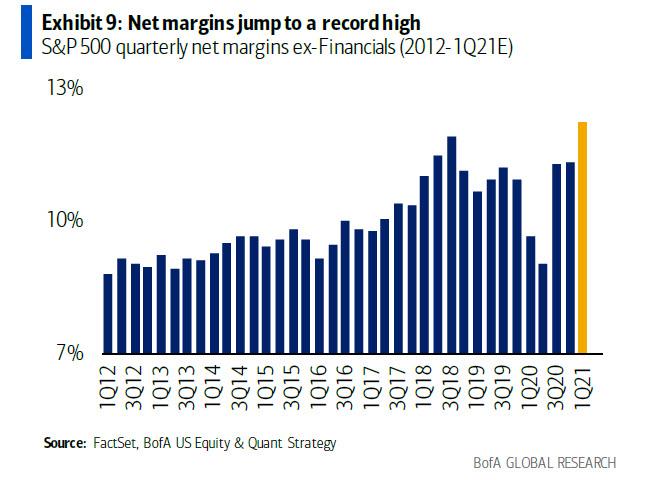
Last but not least, perhaps the most surprising finding by BofA, is that despite all the mentions of inflation coming from raw materials, transportation, and supply chain issues, S&P 500 non-Financial net margins jumped to a record level in 1Q. Of the 11 sectors, Real Estate and Utilities are expected to see lower margins YoY.

While we don’t know whether the coming “hyperinflation” will be transitory or not, but one thing we are certain of – if prices indeed enter their Zimbabwe phase, profit margins for the broader market will soon hit a record, only in the wrong direction.

Tyler Durden
Tue, 05/04/2021 – 12:40

via ZeroHedge News https://ift.tt/3nTuc0j Tyler Durden

Kevin Spacey Sex Abuse Plaintiff Can’t Sue Under Pseudonym

American court proceedings are generally open to the public, both in civil and criminal cases. There are some exceptions, but they tend to be narrow.

The parties’ identities are generally treated the same way. People generally have to litigate under their names. But pseudonymous litigation is sometimes allowed, especially in certain categories of cases—for instance, those involving children, or certain kinds of litigation involving challenges to government action (see, e.g., this post, which mentions a case like that in which I was a lawyer). And pseudonymous litigation is not uncommon in cases involving sexual conduct, or other private matters, such as abortion (consider Roe v. Wade).

Still, even in those categories, pseudonymity isn’t certain. For instance, criminal defendants are almost never pseudonymous, even when they are accused of sex crimes (and may concede that the case involved sexual conduct, thought they might argue that it wasn’t criminal). Likewise, that’s so in at least some civil sex crime cases; rather than a categorical rule supporting pseudonymity, many courts use multi-factor balancing tests that come out differently in different cases.

We see that in Rapp v. Fowler, decided yesterday by Judge Lewis A. Kaplan (S.D.N.Y.); Fowler is (in)famous actor Kevin Spacey. A few key passages:

[1.] The harm that C.D. claims would result from the public disclosure of his name would be the “re-trigger[ing]” of his post-traumatic stress disorder (“PTSD”), which he allegedly developed as a consequence of the assault…. [But] even assuming there were no “leak” of C.D.’s identity as the case proceeded, “[b]eing ‘re-exposed’ to the perceived wrong [of which he complains] is an inevitable consequence of litigation itself. If the case goes forward, [plaintiff] will be deposed, no doubt in the presence of the accused defendant; in the less certain event of trial, [ ]he will presumably testify in a public courtroom and be subjected to cross-examination.” Neither of the declarations suggests that proceeding with the case anonymously would protect C.D. from those consequences.

[2.] [Pseudonymity is not justified here] despite the harassing Instagram comments that Rapp received after he went public with his allegations against Spacey, which C.D. implies that he will receive if he discloses his name…. [W]hile online harassment of any kind is repugnant, it is an unfortunate consequence of the social media age. Many who make accusations against public figures are forced to endure it. Without a specific threat of harm and a privacy interest that outweighs the prejudice to the defendant and the public’s right to open courts, however, C.D.’s allegation that he would be subjected to online harassment if he were identified, even if it proved accurate, would not alone entitle him to proceed by anonymously.

[3.] Spacey has shown that he would be prejudiced during discovery because C.D.’s use of a pseudonym likely would prevent persons with information about C.D. or his allegations that would be helpful to Spacey’s defense, but that now are unknown to Spacey, from coming forward.

Highly publicized cases can cause unknown witnesses to surface. By keeping C.D.’s identity confidential, “information about only one side may thus come to light.”

“Information and allegations that are highly sensitive and of a personal nature can flow both ways.” In other words, C.D.’s “allegations and public comments embarrass [Spacey] and place him under the same stigma that concerns” C.D. It would be harder to mitigate against that stigma if C.D. were permitted to remain anonymous.

[4.] C.D. actively has pursued this lawsuit—including by recruiting his co-plaintiff. He seeks over $40 million in damages. He makes serious charges and, as a result, has put his credibility in issue. “Fairness requires that [he] be prepared to stand behind [his] charges publicly.”

And here’s a much longer excerpt, which contains most of the court’s analysis:

Plaintiffs C.D. and Anthony Rapp claim that defendant Kevin Spacey Fowler, better known as Kevin Spacey, sexually assaulted them over 35 years ago. Their claims regard separate events that allegedly occurred when Spacey was in his twenties and plaintiffs were teenagers [age 14 in C.D.’s case]. The primary question now before the Court is whether the plaintiff currently known by the pseudonym “C.D.” should be permitted to litigate the case without publicly identifying himself. For the following reasons, his motion to proceed anonymously is denied….

The record as it relates to the events leading to this litigation is unusual. Some of the key facts derive from an article posted on a New York magazine web site, Vulture, in November 2017. The Vulture article describes an interview with a “man” who “approached” the magazine and made allegations against Spacey that are virtually identical to C.D.’s allegations in the complaint. Although the article does not disclose the man’s name and states that he wishes to remain anonymous, the parties agree that the victim of the alleged assault described in the article was C.D. As both parties rely on the Vulture article—and neither contests the accuracy of its description of C.D.’s interview with the press—the Court assumes the article’s accuracy for the purposes of this motion.

The genesis of the Vulture article was this. In late 2017, after Rapp publicly accused Spacey of sexually assaulting him, C.D., “who was friendly with a member of the New York staff,” “approached the magazine to talk about Spacey.” Later, when Vulture reached out to “people close to” C.D. to verify his story, those individuals stated that C.D. had spoken to them “about his relationship with Spacey as far back as the 1990s.” …

In August 2019, the New York Legislature passed the Child Victims Act, which temporarily revived the limitations period for civil claims of child sexual abuse under New York law. By the start of 2020, two additional things had occurred. First, C.D. had engaged his current counsel. Second, C.D. had approached Rapp—through a mutual friend—to see whether Rapp would be interested in bringing a civil suit against Spacey. The mutual friend provided Rapp with C.D.’s real name and contact information. Shortly afterward, Rapp connected with both C.D.—who informed Rapp about the New York Child Victims Act—and C.D.’s counsel….

[After C.D. sued, a]t this Court’s directive, plaintiffs provided Spacey with C.D.’s real name and other identifying information on the condition that it be kept confidential until the parties reached a mutually satisfactory agreement as to whether and to what extent C.D.’s identity would be kept from the public as the action proceeded or, in the event no agreement were reached, until the Court decided this motion. No agreement was reached….


As a preliminary matter, the Court will consider all of the papers it has received for purposes of these motions without regard to whether all parts of them would be admissible on summary judgment or at trial. Accordingly, Spacey’s motions to strike are denied and his objection to Dr. Block’s expert report is overruled. The Court turns to the merits of C.D.’s motion.

Openness long has been a central tenet of our legal system. Federal court proceedings and records presumptively are public absent a showing of exceptional circumstances. To this end, Rule 10(a) of the Federal Rules of Civil Procedure requires that “[e]very pleading … contain a caption setting forth the … title of the action,” which must “include the names of all the parties.” “[T]hough seemingly pedestrian,” Rule 10(a) “serves the vital purpose of facilitating public scrutiny of judicial proceedings and therefore cannot be set aside lightly.”

District courts have discretion to grant an exception to Rule 10(a) only where the litigant seeking to proceed anonymously has a substantial privacy interest that outweighs any prejudice to the opposing party and “the customary and constitutionally-embedded presumption of openness in judicial proceedings.” In Sealed Plaintiff v. Sealed Defendant, the Second Circuit identified a “non-exhaustive” list of ten factors that district courts should consider in balancing these interests:

(1) whether the litigation involves matters that are highly sensitive and of a personal nature,

(2) whether identification poses a risk of retaliatory physical or mental harm to the party seeking to proceed anonymously or even more critically, to innocent non-parties,

(3) whether identification presents other harms and the likely severity of those harms, including whether the injury litigated against would be incurred as a result of the disclosure of the plaintiff’s identity,

(4) whether the plaintiff is particularly vulnerable to the possible harms of disclosure, particularly in light of his age,

(5) whether the suit is challenging the actions of the government or that of private parties,

(6) whether the defendant is prejudiced by allowing the plaintiff to press his claims anonymously, whether the nature of that prejudice (if any) differs at any particular stage of the litigation, and whether any prejudice can be mitigated by the district court,

(7) whether the plaintiff’s identity has thus far been kept confidential,

(8) whether the public’s interest in the litigation is furthered by requiring the plaintiff to disclose his identity,

(9) whether, because of the purely legal nature of the issues presented or otherwise, there is an atypically weak public interest in knowing the litigants’ identities, and

(10) whether there are any alternative mechanisms for protecting the confidentiality of the plaintiff….

[T]he digital age has adversely affected the privacy of litigants. The days when court records of litigation largely escaped public notice as they languished in countless file rooms largely ended with the advent of electronic case files, the internet, search engines, and other aspects of the information age. And the loss of the earlier practical obscurity of court files no doubt is compounded when a litigant like C.D. brings a claim against someone in the public eye, especially if the substance of the claim makes it likely to attract significant media attention.

But the threat of significant media attention—however exacerbated by the modern era—alone does not entitle a plaintiff to the exceptional remedy of anonymity under Rule 10. {“[C]laims of public humiliation and embarrassment” due to “significant media attention … are not sufficient grounds for allowing a plaintiff in a civil suit to proceed anonymously.” Doe v. Shakur (S.D.N.Y. 1996) (denying motion to proceed by pseudonym brought by woman who alleged that rapper Tupac Shakur assaulted her despite the media attention the case likely was to attract); see also Doe v. Weinstein (S.D.N.Y. 2020) (denying motion to proceed by pseudonym brought by woman who alleged that movie producer Harvey Weinstein assaulted her despite that Weinstein’s “notoriety” was likely to cause significant media attention).}

Here, only one Sealed Plaintiff factor supports C.D.’s motion to proceed anonymously. Accordingly, C.D.’s privacy interest—despite the publicity that this case may generate—does not outweigh the prejudice to Spacey and the presumption of open judicial proceedings.

The first Sealed Plaintiff factor, which looks to whether the case involves claims that are “highly sensitive and of a personal nature,” weighs in favor of allowing C.D. to proceed anonymously. Allegations of sexual assault are “paradigmatic example[s]” of highly sensitive and personal claims and thus favor a plaintiff’s use of a pseudonym. Likewise, allegations of sexual abuse of minors typically weigh significantly in favor of a plaintiff’s interest. Importantly, however, “allegations of sexual assault, by themselves, are not sufficient to entitle a plaintiff to proceed under a pseudonym.” Doe v. Skyline Automobiles Inc. (S.D.N.Y. 2019) (citing Doe v. Shakur (S.D.N.Y. 1996) (collecting cases))….

The second, third, and seventh Sealed Plaintiff factors, which in this case appropriately may be considered together, do not favor C.D.’s use of a pseudonym. The second and third factors broadly require courts to take into account whether disclosure of the plaintiff’s name would result in harm, including “retaliatory physical or mental harm” to the plaintiff or, “even more critically, to innocent non-parties.” The seventh factor asks whether the plaintiff’s identity thus far has been kept confidential.

The harm that C.D. claims would result from the public disclosure of his name would be the “re-trigger[ing]” of his post-traumatic stress disorder (“PTSD”), which he allegedly developed as a consequence of the assault. With regard to “allegations of mental harm,” “plaintiffs must base their allegations … on more than just mere speculation.” When a plaintiff claims that disclosing his or her name would “retrigger” symptoms of PTSD, courts have required a “link between public disclosure of plaintiff’s name and the described psychological risk” otherwise “[t]here is simply no way to conclude that granting … permission to proceed under [a] pseudonym[ ] will prevent [plaintiff] from having to revisit the traumatic events.”

The Court takes C.D.’s claim of threatened psychological injury seriously. Sexual assault can have lasting, damaging consequences on a person’s emotional or mental health. But whether the alleged sexual assault caused C.D. to have PTSD or other psychological injuries is not the question before the Court. Rather, the questions are whether the public disclosure of C.D.’s name in the course of this lawsuit in fact uniquely would “retrigger” the PTSD that is said to have resulted from the alleged sexual assault and, if so, how grave the resultant harm would prove to be.

C.D.’s prior actions undercut his position on the rather unusual facts of this case.

C.D. has spoken since the 1990s to an unknown number of people about his “relationship” with Spacey. He does not claim that he received assurances of confidentiality from any of them.

Then, in 2017, C.D. approached a person with whom he was “friendly” to facilitate the publication of his claims against Spacey. He disclosed his identity to Vulture. Vulture in turn sought to verify aspects of C.D.’s assertions with friends or acquaintances of C.D. That necessarily would have required Vulture to identify C.D., by his true identity, to those persons and, at least to some extent, to connect C.D. to the allegations against Spacey. And after the New York Child Victims Act was passed, C.D. (1) hired a lawyer, (2) reached out again to a friend—who is not alleged to have agreed to keep C.D.’s identity confidential—for the purpose of contacting Rapp, and (3) then recruited Rapp to join him in this lawsuit. Thus, the evidence suggests that C.D. knowingly and repeatedly took the risk that any of these individuals at one point or another would reveal his true identity in a manner that would bring that identity to wide public attention, particularly given Spacey’s celebrity.

In this context, [the] declarations [of Neil Bonavita, a licensed clinical social worker who has seen C.D. since 2015, and Dr. Seymour Block, a forensic psychiatrist who evaluated C.D. via Facetime—after this motion was filed—at C.D.’s counsel’s request] do not carry the day for C.D on either of the pertinent questions, let alone both. Both say substantially the same thing: that “[C.D.’s] name being made public to the media, friends or on the internet … will trigger his post-traumatic stress disorder” causing “anxiety, anxiety attacks, nightmares, and depression.” But C.D. already has revealed the alleged facts to friends, revealed his identity to Vulture, and quite likely identified to Vulture people to whom he already had told his story for the purpose of enabling Vulture to try to confirm what he had told it.

Yet there is no suggestion in either declaration that any of those disclosures “to the media [and] friends” retriggered C.D.’s PTSD or, if they did not, why further disclosure would yield a different outcome. And it would be no satisfactory answer to say that one should infer that there was no “retriggering” because C.D. trusted, or assumed that he could trust, those to whom he repeated his story not to reveal C.D.’s identity. As media coverage of the allegations against Spacey grows, as would be very likely as this litigation proceeds and a trial approaches or takes place, it is only common sense to say that the risk of disclosure would grow.

Moreover, even assuming there were no “leak” of C.D.’s identity as the case proceeded, “[b]eing ‘re-exposed’ to the perceived wrong [of which he complains] is an inevitable consequence of litigation itself. If the case goes forward, [plaintiff] will be deposed, no doubt in the presence of the accused defendant; in the less certain event of trial, [ ]he will presumably testify in a public courtroom and be subjected to cross-examination.” Neither of the declarations suggests that proceeding with the case anonymously would protect C.D. from those consequences.

The declarations, no matter how sincere, ultimately are insufficiently persuasive for another reason. Neither gives any sense of the severity of any consequences of a “retriggering” of the alleged PTSD by future disclosure of C.D.’s identity beyond the conclusory statements that it would entail anxiety, nightmares, and depression. Any of these consequences of course would be regrettable. But the frequency, seriousness, clinical significance and treatability of feelings of anxiety and depression and of nightmares doubtless cover broad spectra. The declarations’ conclusory statements are of limited utility.

In sum factors two, three, and seven do not lend much support to C.D.’s position.

{This remains true despite the harassing Instagram comments that Rapp received after he went public with his allegations against Spacey, which C.D. implies that he will receive if he discloses his name. But his implication cannot be credited for two reasons.

First, Rapp admitted in text messages that “98% of what’s coming my way” as a result of his suing Spacey is “overwhelming support” and “the other 2% is random trolling on the web, which I was fully anticipating.” There is no reason to conclude that C.D.’s experience, were he identified, would differ.

Second, while online harassment of any kind is repugnant, it is an unfortunate consequence of the social media age. Many who make accusations against public figures are forced to endure it. Without a specific threat of harm and a privacy interest that outweighs the prejudice to the defendant and the public’s right to open courts, however, C.D.’s allegation that he would be subjected to online harassment if he were identified, even if it proved accurate, would not alone entitle him to proceed by anonymously.} …

The fourth factor, which looks to whether a plaintiff is particularly vulnerable to possible harms of disclosure, does not weigh in favor of C.D.’s use of a pseudonym either. “The plaintiff’s age is a critical factor” in the determination of the fourth factor, “as courts have been readier to protect the privacy interest of minors in legal proceedings than of adults.” “If a plaintiff is not a child, this factor weighs against a finding for anonymity.” Though C.D. brings allegations relating to alleged sexual abuse as a minor, he now is an adult in his 50s who has chosen to level serious charges against a defendant in the public eye. This factor weighs in favor of his shouldering the burden of such accusations….

The sixth factor looks to whether the defendant would be prejudiced if the plaintiff were permitted to proceed under a pseudonym. In considering the sixth factor, courts have examined “difficulties in conducting discovery,” the “reputational damage to defendants,” and the “fundamental fairness of proceeding anonymously.” Spacey has shown that he would be threatened with prejudice in all three ways if C.D.’s motion were granted.

First, Spacey has shown that he would be prejudiced during discovery because C.D.’s use of a pseudonym likely would prevent persons with information about C.D. or his allegations that would be helpful to Spacey’s defense, but that now are unknown to Spacey, from coming forward. If they do not know who this accuser is, they likely would have no way of knowing that their information would be pertinent. Contrary to C.D.’s assertions, this asymmetry in fact-gathering would not be avoided by the fact that C.D. already has provided Spacey with his name. Nor would it be remedied fully by plaintiffs’ proposed stipulation, which would allow Spacey to use and disclose C.D.’s name for discovery purposes on the condition that anyone who becomes privy to his identity would be obliged to keep it confidential. Highly publicized cases can cause unknown witnesses to surface. By keeping C.D.’s identity confidential, “information about only one side may thus come to light.” This not only would prejudice Spacey, but would hinder “the judicial interest in accurate fact-finding and fair adjudication.”

Second, Spacey has suffered significant reputational damage from C.D.’s allegations. “Information and allegations that are highly sensitive and of a personal nature can flow both ways.” In other words, C.D.’s “allegations and public comments embarrass [Spacey] and place him under the same stigma that concerns” C.D.” It would be harder to mitigate against that stigma if C.D. were permitted to remain anonymous.

Lastly, fundamental fairness suggests that defendants are prejudiced when “required to defend [themselves] publicly before a jury while plaintiff[s] … make … accusations from behind a cloak of anonymity.” C.D. actively has pursued this lawsuit—including by recruiting his co-plaintiff. He seeks over $40 million in damages. He makes serious charges and, as a result, has put his credibility in issue. “Fairness requires that [he] be prepared to stand behind [his] charges publicly.” …

Factors five, eight, and nine, all of which relate to the public’s interest in knowing the plaintiff’s identity, weigh against C.D.’s use of a pseudonym.

The fifth factor looks to whether the suit challenges the actions of the government or that of private parties. “In private civil suits, courts recognize there is a significant interest in open judicial proceedings since such suits ‘do not only advance the parties’ private interests, but also further the public’s interest in enforcing legal and social norms.'” C.D. brings allegations against a private party so this factor weighs against his use of a pseudonym.

The ninth factor looks to whether, because of the purely legal nature of the issues presented, there is an atypically weak public interest in knowing the litigants’ identities. C.D.’s allegations are decidedly factual in nature, so this factor too weighs against his use of a pseudonym.

The eighth factor generally requires courts to look to whether the public’s interest in the litigation is furthered by requiring the plaintiff to disclose his or her identity. As discussed above, the public “has a legitimate interest” in knowing the underlying facts of a litigation, including the identities of the litigants. Here, that interest is magnified because C.D. has made his allegations against a public figure.

C.D. argues that there is a competing public interest in keeping the identity of those who make sexual assault allegations anonymous so that they are not deterred from vindicating their rights. Along these lines, C.D.’s counsel in his latest letter stated that “C.D. has reluctantly decided” that “he is emotionally unable to proceed with the action and will discontinue his claims” if the Court denies his motion to proceed by pseudonym. It would be inappropriate at this juncture for the Court to play any role in deciding whether C.D. persists in his claims against Spacey, which of course would be his right regardless of the outcome of this motion. The Court’s role is to weigh C.D.’s privacy interest against the prejudice to Spacey and the public’s interest in open judicial proceedings. Though C.D. is correct that the public generally has an interest in protecting those who make sexual assault allegations so that they are not deterred from vindicating their rights, it does not follow that the public has an interest in maintaining the anonymity of every person who alleges sexual assault or other misconduct of a highly personal nature. For the foregoing reasons, C.D. has not shown that his privacy interest is sufficient to warrant allowing him to litigate his sexual assault allegations anonymously. Accordingly, on balance, the public interest does not weigh in favor of C.D.’s use of an pseudonym….

Finally, the tenth factor, which looks to whether there are any alternative mechanisms for protecting the confidentiality of the plaintiff, does not weigh in favor of C.D.’s use of a pseudonym. C.D. “can seek less drastic remedies than blanket anonymity, such as redactions to protect particularly sensitive information, or a protective order.” And Spacey already has expressed his amenability to such an order….
 

from Latest – Reason.com https://ift.tt/3aYKBLS
via IFTTT

Blain: Failing Global Politics And Inflation Will Be A Nasty Shock

Blain: Failing Global Politics And Inflation Will Be A Nasty Shock

Authored by Bill Blain via MorningPorridge.com,

“A great civilisation is not conquered from without until it has destroyed itself from within… ”

Across the Occidental Economy there seems a trend towards political failure as polarization, sleaze and opportunism takes hold, even as electorates suffer from increasing inequality and declining prospects. As the threat of post-pandemic inflation rises, the ingredients are all there for further instability and labour strife. It’s all happening as the geo-political spheres of influence between China and the West are being redrawn.

The Gates’ divorce of the millennium is getting the headlines this morning – which could provide some welcome relief for many politicians, beset by increasingly noisy and hostile news flow. Increasingly institutional investors are concerned about how distorted the political process is becoming – and what the consequences for markets could be.

Growing political instability across Occidental Economies is becoming a trend. It takes two forms:

  • First is ineffectiveness – for all the political noise, nothing seems to get done.

  • Second is a rising tide of resentment as society becomes more fragmented between the haves and have-not.

Political failure could well become a mounting crisis for markets in coming years – especially if weak governments come alongside the kind of short, sharp shock of inflation which many strategists and economists now expect. Inflation could fuel union demands for wage rises at a time when corporates remain weakened in wake of pandemic – fuelling the kind of industrial wage militancy we last saw in the 1970s.

This time, political instability looks possible across the whole Western economy – with inflation simply being a spark to ignite the fire. But, the fire may already be alight. Let me illustrate this morning with snapshots from England, Scotland, France, and the USA about how politics is fuelling future instability.

It increasingly feels the politics of the west is tumbling into a deep black hole. It’s happening at a time of increasing concern about what future geopolitical fault-lines will mean for investment opportunities: Chinese expansion versus the increasingly fragmented and ineffective looking Western democracy.

More than a few market commentators have been drawing allusions between the current fracturing political situation in the West, and the last days of Rome. All the usual themes are there; from the threat of monetary weakness from inflation (which will no doubt fuel cryptocurrencies), rising inequality, a rising sense of everyone in it for themselves, and the masses being ignored.

Last night I watched the film Nomadland – it’s bleak, but catches the sense that while we all might be disposable to the Gods of Mammon it is still possible to retain dignity on our own terms. I’m really not so sure we all have that option.

UK

Let’s start a quick jaunt round the collapse of Western Democracy with Boris here in the UK.

While the UK struggles with massive issues like education, the future of the NHS, post-pandemic recovery and the threats of global supply chain crisis (already chip-shortages have effectively closed a large part of automotive manufacturing), the political noise across the nation is about how Boris paid for renovating his grace and favour flat.

Tory supporters are furious – how can such a little thing be important? They claim its proof of a media conspiracy against them. Equally it demonstrates the unworthiness of the political opposition against him – how dare the opposition Labour party be trying to score such pointless, meaningless, petty-pinching points at this moment of national victory against the virus? They see the noise around Wallpaper-gate as proof the establishment is biased, and determined to seize any opportunity to pillory him, and bring him down no matter what the cost to the nation.

But…. Rules are rules.

Where would you draw the line? A prime minister who nicks a kit-kat or one taking kick-backs on arms-deals? One who asks rich pals a few simple small favours, or the one who goes on to allow grand scale kleptocracy by his/her party as every politician sees a few “extras” as their right? Or Tory party politicians set to make millions by selling their contacts to dodgy finance firms, or from stakes in companies favoured for ill-governed pandemic contracts?

Compare and contrast the spluttering resentment of Tory diehards to the reality out in the burbs. We may get some signals from this week’s local elections, but the Tories will likely do well against the fragmented Labour party. The political opinion of voters is now so anaesthetised to muck that its increasingly seen as ok for politicians to lie. If they can lie, what’s the next step?

Put the few quid Boris might have overspent on the Downing Street Trianon in context with the over 700 Royal Mail postmasters who lost their jobs, their livelihoods, their reputations, went to jail or committed suicide on the back of dodgy Horizon software that Royal Mail executives knew wasn’t fit for purpose. For 20 years these hardworking people’s lives have been destroyed – and no one is being punished.

It’s difficult not to feel fury when reading about the crass behaviour of Royal Mail accountants, about covered up investigations, or pregnant postmasters sent to jail. Lives destroyed. The case is beyond shocking. These people had no chance to retain their dignity – like the heroine of Nomadland. They were not just discarded by the system, but actively destroyed by it.

Scotland

It is difficult not be impressed with the modern political masterclass that is Nicola Sturgeon. She is direct and, unlike any other modern politician, she answers the question – or, at least, gives the appearance of doing so. She has facts, numbers and information at her fingertips and presents her case with fluency, direct eye-contact. Love her or loathe her, Nicola looks and sounds credible.

At elections this week Sturgeon will hold her position as Scotland’s First Minister. The SNP may even win an overall majority of seats, empowering it to demand a new referendum on Scottish Independence, which is currently a 50/50 call for the Scot’s electorate. She has packed that vote by enfranchising 16-year olds, and she will present a rosy plan for Scotland as part of Europe with nary a care for a border with its largest trading partner – which, of course, is England.

She will gloss over the budgetary implausibility of independence and quote widely about the success of small nations. And since she is good – a damn good politician – she gives the impression she is listening, before calmly, rationally and effectively explaining how Scotland is doomed if it stays part of England, liberally blaming Boris for everything… and because you will agree with that, you will find yourself agreeing with the rest of her argument.

Like all very dangerous politicians the SNP are very clever. They don’t need their arguments for leaving the UK to stand up to scrutiny. They just need Scotland to reject Boris’ calls to stay.

Independence will, of course, be madness for Scotland and bad for the UK. Already analysts are advising clients to short GBP. But politically… it may happen.

France

Nothing ever changes in France – it remains the canary in the coal-mine for revolution, which is simmering. As the Far-left and police clashed at the regular Mayday fixture, the only beneficiary is the Far-Right, which is now the mid-right and determined to avoid the “vote for anyone but Le Pen” trap which won Macon the last election. The French electoral analysts now say Marine Le Pen represents a credible right-wing choice for French voters – which really should be worrying the rest of Europe.

Politically, the risks of right-wing, Euro-phobic French Government are barely being factored into the pricing equation on the Euro or the delicate political balance of Brussels and ECB. If it wobbles…

USA

I’ve deliberately saved up the USA for last in this rush round the collapsing political process – because it is most obvious.

How foolish we were to think Joe Biden could be a source for healing America. Rather than pull together Democrats and Republicans together on a plan for national rebuilding – which they all agree is required – the rancour and polarization between them has deepened. Senior republicans are full of fury that Biden is actually doing stuff.. (Much of it the same stuff Trump was going to do…)

A usually smart clever, erudite US chum was beside himself with rage that Biden was actually delivering left wing policies like Tax rises and accused him of pandering the hard left. He believes Biden’s “naked socialism” will deliver the next election to Trump. The US is setting itself up for a 4-year battle till the next presidential election – where MAGA and Trump will be setting the tone. It means 4 more wasted, hostile, polarising years…

The Chinese really could not be any happier with the outcome. Politics matter for markets.

* * *

Free Bronze subscription allows unlimited blog access, email notification and weekly round up

Tyler Durden
Tue, 05/04/2021 – 12:20

via ZeroHedge News https://ift.tt/2RqgPss Tyler Durden

Goldman Orders Employees To Report Back To The Office In June

Goldman Orders Employees To Report Back To The Office In June

A week ago, we reported that JP Morgan had given its employees their final notice that working-from-home had finally come to an end, and that they should prepare to report back to the office later this month.

Not to be outdone, the top brass at Goldman Sachs, already well aware of CEO David Solomon’s feelings about remote work, have reportedly just informed their employees that they should prepare to return to the office next month, with front-office staffers in the investment bank set to return by mid-June.

The investment bank is planning to tell staff that they should be prepared by mid-June to work from offices again, according to people with knowledge of the matter. The move follows a mandate last week from JPMorgan Chase & Co. chief Jamie Dimon, seeking to return his workforce in rotations from early July. Vanguard Group, with about 17,300 employees, said it’s planning a hybrid model for most of its staff.

Goldman Chief Executive Officer David Solomon joins Dimon in counting on an expanding vaccination drive to hasten the revival of pre-pandemic routines in an industry where legions have spent 14 months working remotely. The duo has been at the forefront in sketching out the most pressing timelines to refill towers, moves that are likely to put pressure on other firms in finance and beyond.

And Goldman likely won’t be the last US investment bank or consulting firm to summon employees back to the office, according to a recent survey cited by Bloomberg.

An Accenture Plc survey of 400 North American financial-services executives found that almost 80% prefer that workers spend four to five days in the office when the pandemic is over. Such plans could face resistance from the ranks. Many employees want to hang on to flexible schedules after proving they could stay productive while working from home, according to Accenture.

Especially now that NYC plans to “fully reopen” by July 1, with the subway to return to 24/7 service in a few weeks.

In New York, home to the two banking giants, plans are under way to fully reopen in two weeks, marked by the return of arenas, gyms, stores, restaurants and hair salons, New York Governor Andrew Cuomo said Monday at a briefing. Most capacity restrictions will also be lifted across New Jersey and Connecticut, while all-day subway service will resume in the city this month.

However, employees outside of London and NYC should wait to hear from their regional bosses, as the uneven pace of the pandemic will likely force the bank to wait longer before summoning staff in, say, India back to the downtown skyscrapers.

Tyler Durden
Tue, 05/04/2021 – 12:02

via ZeroHedge News https://ift.tt/3h5xUCD Tyler Durden

Peter Schiff: CPI Is A Lie!

Peter Schiff: CPI Is A Lie!

Via SchiffGold.com,

We’ve been talking a lot about the specter of inflation. Despite the Fed’s assurances not to worry because any price increases we’re seeing are transitory, some people are indeed worried. A former JP Morgan managing director warned about inflation and echoed Peter Schiff’s view that the central bank is powerless to fight it.

And we’re seeing rising prices all over the place, from the grocery store to the gas station. Even the government numbers flash warning signs. But as Peter Schiff explains in this clip from an interview with Jay Martin, it’s probably even worse than we realize because the government cooks the numbers when it calculates CPI.

The monthly rises in CPI through the first quarter show an upward trend. The CPI in January was up 0.3%. It was up 0.4% in February. And now it’s up 0.6% in March. That totals a 1.013% increase in Q1 alone. The question is does this really reflect the truth about inflation? Peter doesn’t think it does.

The government always makes changes to their methods of measuring things, whether it’s GDP, or inflation, or unemployment. And they always tweak the numbers to produce a better result as a report card.

Imagine if students in a school had the ability to change the metrics by which they were graded or the methodology the teacher used to calculate their grades.

Would it surprise anybody that all of a sudden they started getting more As and Bs and fewer Cs and Ds? The government always wants to make the good stuff better, like economic growth, and the bad stuff better, like unemployment or inflation. So, they want to find ways to make those numbers little and the good numbers big.”

The CPI is calculated by analyzing the price of a “basket of  goods.” The makeup of that basket has a big impact on the final CPI number. According to WolfStreet, 10.9% of the CPI is based on durable goods (computers, automobiles, appliances, etc.). Nondurable goods (primarily food and energy) make up 26.6% of CPI. Services account for the remaining 62.5% of the basket. This includes rent, healthcare, cellphone service etc.)

The things the government includes and excludes from the basket can make a profound difference in that final CPI number.

Back in 1998, the government significantly revised the CPI metrics. Even the Bureau of Labor Statistics (BLS) admitted the changes were “sweeping.”

According to the BLS, periodic changes to the CPI calculation are necessary because “consumers change their preferences or new products and services emerge. During these occasions, the Bureau reexamines the CPI item structure, which is the classification scheme of the CPI market basket. The item structure is a central feature of the CPI program and many CPI processes depend on it.”

In 1998, the BLS followed the recommendations of the Boskin Commission. It was appointed by the Senate in 1995. Initially called the “Advisory Commission to Study the Consumer Price Index,” its job was to study possible bias in the computation of the CPI. Unsurprisingly, it determined that the index overstated inflation — by about 1.1% per year in 1996 and about 1.3% prior to 1996. The 1998 changes to CPI were meant to address this “issue.”

As Peter pointed out, there is a lot of geometric weighting, substitution and hedonics built into the calculation. The government can basically create an index that outputs whatever it wants.

I think this period of ‘Oh wow! We have low inflation!’ It’s not a coincidence that it followed this major revision into how we calculate it.”

Peter said there is a bit of irony in government officials and central bankers constantly complaining about “not enough inflation.”

They’re the ones that are cooking the books to pretend that inflation is lower than it really is. Because what they’re really trying to do is get the go-ahead to produce more inflation, which is printing money.”

Peter said the CPI will never reveal the true extent of rising prices.

And there are other things that hide inflation. For instance, shrinking packaging so there is less product sold at the same price, or substituting lower quality ingredients, or requiring consumers to assemble items themselves.

They find different ways to lower the quality and not increase the price, and I’m sure that the government is not picking up on any of that. If the quality improves, yeah, yeah, they calculate that. But they probably ignore all the circumstances where the quality is diminished.”

The bottom line is we can’t trust CPI to tell us the truth about inflation.

Tyler Durden
Tue, 05/04/2021 – 11:40

via ZeroHedge News https://ift.tt/3vE4akm Tyler Durden

Stocks Extend Losses After Yellen Says “Rates Will Have To Rise”

Stocks Extend Losses After Yellen Says “Rates Will Have To Rise”

Treasury Secretary Janet Yellen is speaking at The Atlantic’s “Future Economy Summit” this morning – a speech she pre-recorded yesterday – and has sparked some chaos with her comments.

The highlight was this…

“It may be that interest rates will have to rise a little bit to make sure our economy doesn’t overheat”

And this didn’t help…

“We’ve gone for way too long letting long-term problems fester in our economy”

Is she talking about Fed-sponsored wealth-creation widening the inequality gap?

Watch her remarks here…

And the response – stocks puked as one would expect at the first signs of the punchbowl being taken away…

We wonder what Jay Powell will have to say about Janet stepping on his toes? Did she just start the process of thinking about thinking about thinking about normalization?

Tyler Durden
Tue, 05/04/2021 – 11:19

via ZeroHedge News https://ift.tt/3efNXMk Tyler Durden

$17.5 Million In Revenue And $5.4 Billion In Losses: Archegos Was A 300x-Levered Time Bomb For Credit Suisse

$17.5 Million In Revenue And $5.4 Billion In Losses: Archegos Was A 300x-Levered Time Bomb For Credit Suisse

A bank’s prime brokerage unit is supposed to be a safe, reliable and predictable generator of revenue, resulting from modest-margin transactions with a bank’s hedge fund client base. It’s safe because the bank’s risk managers scour the bank’s exposure to various hedge funds, and immediately flag any clients that become too big and a potential source of loss (it’s also “safe” because the bank’s prime brokerage management tends to make far less than the frontline Sales and Trading staff).

That is, at least, the theory. The practice, as the recent Archegos fiasco demonstrated, is anything but.

Case in point, the now infamous Credit Suisse disaster in its dealing with Archegos, which as of this moment have resulted in more than $5.4 billion in losses for the Swiss bank, and which as the FT reported today, resulted in a paltry CHF16 million (US$17.5 million) in revenue last year. In simplistic terms, this means that somehow the funding chain and the leverage Credit Suisse afforded to Archegos resulted in over 300x leverage in the wrong direction!

As the FT notes this morning, the paltry fees Credit Suisse received from Archegos “raises further questions about the risks the lender was prepared to shoulder in pursuit of relationships with ultra-wealthy clients” and adds that “the low level of fees and high risk exposure have caused concern among the board and senior executives, who are investigating the arrangement, according to two people with knowledge of the process.” It has also caused a flood of layoffs and terminations as the bank belatedly looked at its books – the infamous scene from Margin Call comes to mind here…

… and realized just how massive its exposure had been all along, and how nobody had any idea how big the loss would end up being until it was finally booked following the now infamous late-March liquidation frenzy.

As the FT reports, the bank’s management was “particularly alarmed” after it was told that Hwang was not a private banking client of the group, suggesting there was little incentive to pursue his prime brokerage business, which is bizarre considering how much leverage via TRS and CFDs the bank had afforded the relatively obscure family office.

As Risk.net first reported, Credit Suisse demanded a margin of only 10% for the equity swaps it traded with Archegos and allowed the family office 10-times leverage on some transactions. That was about double the leverage offered by fellow prime broker Goldman Sachs, which took minimal losses when unwinding its positions.

And with the horse having long ago fled the barn, on Friday, António Horta-Osório was confirmed as the chair of Credit Suisse and promised an urgent review of the bank’s risk management, strategy and culture. Which is great, the question is i) why this wasn’t done years ago, and ii) what kind of risk controls – if any – does Credit Suisse actually have on a client by client basis.

“Current and potential risks of Credit Suisse need to be a matter of immediate and close scrutiny,” said the former Lloyds Banking Group chief executive. “I firmly believe that any banker should be at heart a risk manager.”

To be sure, “action was taken” (even if confidence has yet to be restored) and Credit Suisse’s board already removed several senior executives, including chief risk and compliance officer, Lara Warner, and investment bank head, Brian Chin. Andreas Gottschling, who led the board’s risk committee, was forced to step down last week in expectation of a shareholder backlash. The two heads of the prime division have also stepped down.

CEO Thomas Gottstein also announced it will cut a third of its exposure in its prime services business, leading to even less revenue at a time when the bank just raised $1.9BN from shareholder to close the Archegos inflicted funding gap.

And while Credit Suisse does not disclose the amount of money it makes from its prime services division, JPMorgan analyst Kian Abouhossein estimated the unit made $900MM of revenues last year, just over a third of the total from its equities business. It means that the Archegos fiasco not only led to a total wipeout on a 300x levered position, but it will lead to a revenue plunge of more than half a billion dollars going forward as the bank finally purges other risky PB exposure.

Abouhossein said the prime brokerage generated bigger profit margins than other parts of the investment bank. “We see shrinkage as a material setback for the overall long-term viability of Credit Suisse’s investment bank,” he added.

Of course, the big question, as we discussed more than a month ago, is how widespread will the Prime Brokerage deleveraging be and will it hammer other Archegos-wannabes, forcing them to liquidate positions ahead of time. While Credit Suisse is the biggest European provider of prime services, it lags bigly behind global leaders Goldman, Morgan Stanley and JPMorgan. According to the FT,  the largest investment banks pulled in $15.2Bn in prime broking revenue last year, slightly less than the $16.5Bn they made in 2019, as hedge funds reduced their borrowing during the pandemic, according to Coalition Greenwich.


Tyler Durden
Tue, 05/04/2021 – 11:00

via ZeroHedge News https://ift.tt/2Rsko0Y Tyler Durden