France Launches New Military Service Plan To Counter Supposed Russian Menace

France Launches New Military Service Plan To Counter Supposed Russian Menace

Amid persistent confrontationalist rhetoric and determination to prolong the West’s proxy war against Russia in Ukraine, French President Emmanuel Macron on Thursday announced a new avenue of voluntary military service for 18- and 19-year olds with the goal of gradually bolstering both active duty and reserve strength. In a critical sweetener for would-be recruits who are wary of dying in Ukraine, those who enlist under the new program will only serve in the French mainland and French territories abroad.   

Macron announced the new voluntary service plan for 18- and 19-year-olds at the the Varces military base in the French Alps (Thomas Padilla, Pool Photo)

“A new national service is set to be gradually established, starting from next summer,” said Macron in a speech delivered at the Varces military base in the French Alps. Under the program, the 18- and 19-year-old volunteers will receive a month of training, followed by nine months of service in a unit. After that, they’ll be assigned to a reserve unit with the idea that they’d start a civilian career or take the next step in their education. The scheme will go live next summer with an initial round of 3,000 young volunteers, ramping up to 10,000 by 2030 and 50,000 a year by 2035.  France hasn’t drafted soldiers since 1996, and Macron says there’s no intention to restart conscription. 

When discussing the new service scheme, Macron has also stressed that he isn’t creating a conveyor belt that will carry French troops into Russia’s Ukraine meat grinder. “We must, in any case, immediately dispel any confusion that we are going to send our young people to Ukraine,” Macron said earlier this week. “That’s not at all what this is about.”

Recruits into the new program will be assured they’ll serve only in mainland France and overseas territories, unlike these French troops in Afghanistan in 2008 

The move comes as French and other European leaders are claiming Russia may be on course to attack NATO countries in the not-too-distant future. “Unfortunately, Russia today, based on the information I have access to, is preparing for a confrontation with our countries by 2030,” said French army Chief of Staff Fabien Mandon last week. “It is organizing itself for this, it is preparing for this, and it is convinced that its existential enemy is NATO.” Similarly, German Foreign Minister Johann Wadephul on Tuesday wrote, “Putin eyes the EU and NATO. Our intelligence services are issuing urgent warnings: at the very least, Russia is creating the option for itself to wage war against NATO by 2029.” 

“It’s good, it’s a difficult path,” Retired Gen. Jean-Paul Paloméros, a former head of the French Air Force, told AP, referring to the fact that training and equipping the new troops would require higher spending and create new demands on existing resources. “But nevertheless I think it was needed somewhere to make sure that the young generations understand that freedom and peace are not taken for granted and it doesn’t come as a free lunch.”

President Macron, pictured here in a 2018 visit to the French Caribbean island of Saint-Martin, says the new troops won’t be sent to Ukraine (Reuters via BBC)

The French move is part of rising militarism across NATO’s European member states. Poland has started its own voluntary service program, with a goal of training 100,000 service members a year starting in 2027. Earlier this month, we covered Germany’s moves toward potentially reinstating military conscription, which the country abandoned in 2011. The initial steps center on mandatory questionnaires and medical exams that will feed a database detailing each young man’s fitness, aptitude and willingness to serve. 

Promoting the new French avenue of military service, Macron stoked fears that Russia is keen on marching into Paris. “The day that you send a signal of weakness to Russia — which for 10 years has made a strategic choice to become an imperial power again, that’s to say advance wherever we are weak — well, it will continue to advance,” Macron told RTL last week. As is the standard for leaders of NATO countries, Macron’s rhetoric is pure gaslighting, as NATO’s own empire-building set the stage for the ongoing war in Ukraine.  

Tyler Durden
Sat, 11/29/2025 – 07:50

via ZeroHedge News https://ift.tt/yT7akp1 Tyler Durden

America’s Politicized Holiday Dinner


RFK Jr. speaks behind a podium | Aaron Schwartz - Pool via CNP/ZUMAPRESS/Newscom

In recent weeks, U.S. Health and Human Services Secretary Robert F. Kennedy Jr. has promised that the forthcoming revised U.S. Dietary Guidelines—spearheaded by his agency alongside the Department of Agriculture—will be released in December. As the deadline approaches, holiday hosts could be feeling understandably queasy about how thoroughly food policy now intrudes on what we serve and how we eat.

The dietary guidelines are revised every five years, and they’ve seen their share of controversy. In the past few decades, the federal government scrapped the infamous food pyramid (which allegedly could be making a return) and has notoriously issued poor dietary advice on more than one occasion. In the 1980s, the federal government urged Americans to shift away from saturated fats and meat and toward carbs. Under the food pyramid—unveiled in 1992—Americans were further encouraged to eat less animal fats and consume copious amounts of bread and cereal. Americans did not get healthier, and obesity rates skyrocketed

“It’s not as if we’re suddenly eating a lot of lentils and kale,” Yale School of Medicine’s David Katz told the Huffington Post back in 2017. “We replaced the fat with low-fat junk food.”

Enter RFK Jr., who argues that America’s food system is corrupt and “poisoning” Americans with hyper-processed additives. He advocates for increased saturated fat consumption—even recommending turkey deep-fried in beef tallow.

RFK Jr. has pledged that the new release will be only four to six pages long, as opposed to previous iterations that have run hundreds of pages—overlooking the fact that the current version includes a four-page consumer brochure alongside the full report. The collective backlash is already forming as we head into the holiday season, with one nutritionist predicting “substantial chaos.” Progressives can’t decide how to handle RFK Jr.’s approach—some of which they agree with, despite still largely opposing him.

All levels of American government are increasingly elbowing their way into a seat at our dinner tables. During his mayoral candidacy, New York City mayor-elect Zohran Mamdani argued for government-run grocery stores as an answer to food insecurity and affordability.

Beyond the economic folly of such an idea, government-run grocery stores would only further politicize food. A government that operates a grocery store is also a government that decides what food to stock on the shelves.

While urban progressives might feel comfortable letting the Mamdanis of the world make those decisions, would they feel the same about RFK Jr. or a future similar bureaucrat calling the shots on what Americans can eat? 

In the past year, New York City progressives have also been busy pushing a bevy of other food-related policy initiatives. A recently introduced city council bill would require all restaurants in the city to add warnings to high-salt and high-sugar foods on their menus. This mandate has already been in place for larger chain restaurants in the city for years, despite scant evidence that such warnings change what anyone orders.

Red states have seen their share of politicized food controversy. Various parts of the Florida government are unable to decide whether they advise for or against raw milk. Florida, Texas, Alabama, and North Carolina, among other states, are also attempting to ban lab-grown meat products from being available to residents. 

Several years ago, celebrity chef José Andrés declared: “Some of life’s greatest bridges are built over simmering pots and shared plates…we open possibilities for understanding that transcend political divides.” In 2025, it seems even a shared plate can’t escape the reach of politics.

The post America's Politicized Holiday Dinner appeared first on Reason.com.

from Latest – Reason.com https://ift.tt/HFXBkZT
via IFTTT

America’s Politicized Holiday Dinner


RFK Jr. speaks behind a podium | Aaron Schwartz - Pool via CNP/ZUMAPRESS/Newscom

In recent weeks, U.S. Health and Human Services Secretary Robert F. Kennedy Jr. has promised that the forthcoming revised U.S. Dietary Guidelines—spearheaded by his agency alongside the Department of Agriculture—will be released in December. As the deadline approaches, holiday hosts could be feeling understandably queasy about how thoroughly food policy now intrudes on what we serve and how we eat.

The dietary guidelines are revised every five years, and they’ve seen their share of controversy. In the past few decades, the federal government scrapped the infamous food pyramid (which allegedly could be making a return) and has notoriously issued poor dietary advice on more than one occasion. In the 1980s, the federal government urged Americans to shift away from saturated fats and meat and toward carbs. Under the food pyramid—unveiled in 1992—Americans were further encouraged to eat less animal fats and consume copious amounts of bread and cereal. Americans did not get healthier, and obesity rates skyrocketed

“It’s not as if we’re suddenly eating a lot of lentils and kale,” Yale School of Medicine’s David Katz told the Huffington Post back in 2017. “We replaced the fat with low-fat junk food.”

Enter RFK Jr., who argues that America’s food system is corrupt and “poisoning” Americans with hyper-processed additives. He advocates for increased saturated fat consumption—even recommending turkey deep-fried in beef tallow.

RFK Jr. has pledged that the new release will be only four to six pages long, as opposed to previous iterations that have run hundreds of pages—overlooking the fact that the current version includes a four-page consumer brochure alongside the full report. The collective backlash is already forming as we head into the holiday season, with one nutritionist predicting “substantial chaos.” Progressives can’t decide how to handle RFK Jr.’s approach—some of which they agree with, despite still largely opposing him.

All levels of American government are increasingly elbowing their way into a seat at our dinner tables. During his mayoral candidacy, New York City mayor-elect Zohran Mamdani argued for government-run grocery stores as an answer to food insecurity and affordability.

Beyond the economic folly of such an idea, government-run grocery stores would only further politicize food. A government that operates a grocery store is also a government that decides what food to stock on the shelves.

While urban progressives might feel comfortable letting the Mamdanis of the world make those decisions, would they feel the same about RFK Jr. or a future similar bureaucrat calling the shots on what Americans can eat? 

In the past year, New York City progressives have also been busy pushing a bevy of other food-related policy initiatives. A recently introduced city council bill would require all restaurants in the city to add warnings to high-salt and high-sugar foods on their menus. This mandate has already been in place for larger chain restaurants in the city for years, despite scant evidence that such warnings change what anyone orders.

Red states have seen their share of politicized food controversy. Various parts of the Florida government are unable to decide whether they advise for or against raw milk. Florida, Texas, Alabama, and North Carolina, among other states, are also attempting to ban lab-grown meat products from being available to residents. 

Several years ago, celebrity chef José Andrés declared: “Some of life’s greatest bridges are built over simmering pots and shared plates…we open possibilities for understanding that transcend political divides.” In 2025, it seems even a shared plate can’t escape the reach of politics.

The post America's Politicized Holiday Dinner appeared first on Reason.com.

from Latest – Reason.com https://ift.tt/HFXBkZT
via IFTTT

Trump Slammed Biden’s $52 Billion CHIPS Act. Then He Used It To Buy a Federal Stake in Intel.


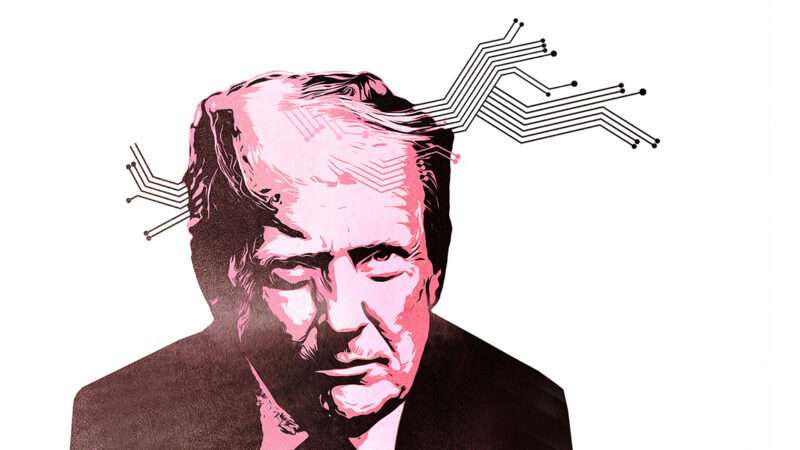
Donald Trump | Illustration: Joanna Andreasson; Source image: Gage Skidmore

In March, President Donald Trump blasted the Creating Helpful Incentives to Produce Semiconductors (CHIPS) and Science Act of 2022. He called it “a horrible, horrible thing.” Passed under President Joe Biden, the CHIPS Act was essentially a $52 billion industrial policy slush fund intended primarily to bolster domestic production of computer chips.

When the law passed in 2022, the Biden administration said it was a “smart investment” that would “strengthen American manufacturing, supply chains, and national security, and invest in research and development, science and technology” while bringing thousands of “good-paying manufacturing jobs back home.”

There was never much reason to believe in the previous administration’s industrial policy boosterism. Early grants largely went either to factories that were already in development and would have been built anyway or to facilities of questionable economic value that might not be completed even with the additional taxpayer funding.

So Trump was on solid ground when he told Congress, “You should get rid of the CHIPS Act, and whatever’s left over…you should use it to reduce debt, or any other reason you want to.” Yet in the months since, Trump has made use of CHIPS funding not to reduce the debt, but to pursue his own questionable industrial policy. His version is even less accountable and may well be even worse for taxpayers.

Among the recipients of CHIPS funding was computer chipmaker Intel, which was set to receive $11 billion to help fund the construction of semiconductor fabs in several states. By late summer, the company said it had already received more than $5 billion of the funds. But Intel struggled to fulfill those commitments, falling behind on factory construction in some places and laying off workers as it suffered from ongoing financial and managerial problems. By the middle of 2025, Intel looked very much like a failing business.

In theory, the CHIPS Act provided a mechanism for the federal government to retract the grant and get all or part of its money back should Intel fail to meet its obligations. It’s not clear whether the federal government would have exercised its option to take the money back, but it was an option—until Trump stepped in.

As the company flailed, Trump met with its CEO, Lip-Bu Tan. Trump first called for him to resign. Then in August, the Trump administration announced that the federal government would just take partial ownership of Intel. Essentially, the U.S. government would purchase a roughly 10 percent stake in the chipmaker, partially nationalizing the company. And funds from CHIPS would be used to do it.

Trump bragged about the deal, saying he planned to “do more of them.” The company’s stock price rose on the news, suggesting that investors liked it. But that’s probably because it was a good deal for the company, at taxpayer expense.

According to public financial filings, the federal government would disburse the remaining funds, about $6 billion, while clearing any obligations for the company to actually complete work on new domestic semiconductor fabs.

In exchange, the federal government would gain partial ownership—as well as all the financial risks stockholders usually have when they invest in companies. Those risks will now be borne by taxpayers. As Carnegie Endowment fellow Peter Harrell pointed out in a social media post, the move came with “a lot of downside risk.”

Fundamentally, Trump gave Intel a federal bailout, removing the company’s public obligations and accountability while loading more financial risk onto the public.

When the CHIPS Act passed in 2022, the Biden administration celebrated by declaring that “companies are investing in America again.” Under both Biden and Trump, the opposite turned out to be true: America was investing in companies—and getting little in return. Trump was right when he said CHIPS was a “horrible, horrible thing.” But his dealmaker’s twist on semiconductor subsidies didn’t make it any better.

The post Trump Slammed Biden's $52 Billion CHIPS Act. Then He Used It To Buy a Federal Stake in Intel. appeared first on Reason.com.

from Latest – Reason.com https://ift.tt/X4Yh1gd
via IFTTT

Trump Slammed Biden’s $52 Billion CHIPS Act. Then He Used It To Buy a Federal Stake in Intel.


Donald Trump | Illustration: Joanna Andreasson; Source image: Gage Skidmore

In March, President Donald Trump blasted the Creating Helpful Incentives to Produce Semiconductors (CHIPS) and Science Act of 2022. He called it “a horrible, horrible thing.” Passed under President Joe Biden, the CHIPS Act was essentially a $52 billion industrial policy slush fund intended primarily to bolster domestic production of computer chips.

When the law passed in 2022, the Biden administration said it was a “smart investment” that would “strengthen American manufacturing, supply chains, and national security, and invest in research and development, science and technology” while bringing thousands of “good-paying manufacturing jobs back home.”

There was never much reason to believe in the previous administration’s industrial policy boosterism. Early grants largely went either to factories that were already in development and would have been built anyway or to facilities of questionable economic value that might not be completed even with the additional taxpayer funding.

So Trump was on solid ground when he told Congress, “You should get rid of the CHIPS Act, and whatever’s left over…you should use it to reduce debt, or any other reason you want to.” Yet in the months since, Trump has made use of CHIPS funding not to reduce the debt, but to pursue his own questionable industrial policy. His version is even less accountable and may well be even worse for taxpayers.

Among the recipients of CHIPS funding was computer chipmaker Intel, which was set to receive $11 billion to help fund the construction of semiconductor fabs in several states. By late summer, the company said it had already received more than $5 billion of the funds. But Intel struggled to fulfill those commitments, falling behind on factory construction in some places and laying off workers as it suffered from ongoing financial and managerial problems. By the middle of 2025, Intel looked very much like a failing business.

In theory, the CHIPS Act provided a mechanism for the federal government to retract the grant and get all or part of its money back should Intel fail to meet its obligations. It’s not clear whether the federal government would have exercised its option to take the money back, but it was an option—until Trump stepped in.

As the company flailed, Trump met with its CEO, Lip-Bu Tan. Trump first called for him to resign. Then in August, the Trump administration announced that the federal government would just take partial ownership of Intel. Essentially, the U.S. government would purchase a roughly 10 percent stake in the chipmaker, partially nationalizing the company. And funds from CHIPS would be used to do it.

Trump bragged about the deal, saying he planned to “do more of them.” The company’s stock price rose on the news, suggesting that investors liked it. But that’s probably because it was a good deal for the company, at taxpayer expense.

According to public financial filings, the federal government would disburse the remaining funds, about $6 billion, while clearing any obligations for the company to actually complete work on new domestic semiconductor fabs.

In exchange, the federal government would gain partial ownership—as well as all the financial risks stockholders usually have when they invest in companies. Those risks will now be borne by taxpayers. As Carnegie Endowment fellow Peter Harrell pointed out in a social media post, the move came with “a lot of downside risk.”

Fundamentally, Trump gave Intel a federal bailout, removing the company’s public obligations and accountability while loading more financial risk onto the public.

When the CHIPS Act passed in 2022, the Biden administration celebrated by declaring that “companies are investing in America again.” Under both Biden and Trump, the opposite turned out to be true: America was investing in companies—and getting little in return. Trump was right when he said CHIPS was a “horrible, horrible thing.” But his dealmaker’s twist on semiconductor subsidies didn’t make it any better.

The post Trump Slammed Biden's $52 Billion CHIPS Act. Then He Used It To Buy a Federal Stake in Intel. appeared first on Reason.com.

from Latest – Reason.com https://ift.tt/X4Yh1gd
via IFTTT