The Barbell Economy: Why The Middle Is Vanishing

The Barbell Economy: Why The Middle Is Vanishing

Authored by Tamuz Itai via The Epoch Times,

There’s a pattern quietly reshaping daily life, work, and society itself. Economists now call it the “barbell economy.” Value, growth, and opportunity concentrate at the two extremes—ultra-cheap utility on one end, premium experience and status on the other—while the broad, reasonable middle thins out. Once you start noticing it, you can’t unsee it. And the data show it isn’t a fleeting trend.

Start with something as ordinary as dinner. Fast-food drive-throughs, delivery apps, and value menus deliver speed and rock-bottom prices with almost no human interaction. At the opposite pole, tasting menus and farm-to-table experiences turn meals into curated stories worth premium prices. The casual sit-down restaurant is struggling or closing—that reliable neighborhood spot that was neither rock-bottom cheap nor luxurious.

The same appears in travel. Airlines sell ultra-low fares for tighter seats but tack on fees for seat selection, bags, and boarding, while business- and first-class cabins keep expanding, with more space, better food, and priority service. Premium-cabin bookings on U.S. domestic flights have grown nearly three times faster than economy seats since 2020. Hotels follow suit: luxury and upper-upscale properties posted stronger revenue growth per available room (RevPAR) in early 2025 than midscale or economy tiers, where occupancy often hovers in the mid-50 percent range and room rates struggle to keep pace with inflation.

Even cars illustrate the point. The average new-vehicle transaction price hit roughly $49,353 in February 2026—up 3.4 percent from the prior year and near all-time highs. For many families, that means heavy debt, stretched budgets, or leaving the new-car market altogether. Some trade down to older or used vehicles; others finance their way into premium models. A reliable new car without major financial strain is becoming rare.

The pattern repeats across many sectors. In education, elite universities grow more expensive and selective, free online resources explode at the low end, and middle-tier institutions face rising costs alongside skepticism about value.

In the workplace, highly skilled, high-pay roles in tech, finance, and specialized fields expand at one pole; gig and service work grow at the other. Stable mid-skill, mid-income jobs have been under pressure for decades. Their share of employment fell from about 59 percent in 1983 to 45 percent by 2012, with high- and low-skill roles filling the gap—a trend that recent analyses tie directly to the barbell shift. Retail mirrors it: ultra-cheap, high-volume platforms on one side, luxury brands on the other, and many traditional mid-tier department stores and general retailers struggling to hold ground. Everywhere, it seems, the middle ground of reliability, reasonable quality, and fair pricing is becoming the hardest place to sustain.

Why the Middle Gets Squeezed

Some of the forces behind include several reinforcing dynamics. Technology drives costs down at the low end—through automation, digitization, and global scale—while amplifying differentiation at the high end, enabling personalized experiences, strong brands, and ecosystems that command premium prices. Globalization intensifies the pressure: mid-tier businesses now compete with both lower-cost producers abroad and globally scaled luxury players, forcing them to slash costs dramatically or move upmarket.

Markets themselves reward extremes. Massive scale wins on price; strong differentiation wins on margins. Being “solid and reliable” without either advantage leaves you exposed. Consumer psychology gravitates toward either “the cheapest thing that works” or “what feels worth it and represents me.” Mid-tier operators also face rising fixed costs—rent, labor, regulation, supply chains—without the efficiencies of giants or the pricing power of luxury brands. The math is getting tighter.

Why the Middle Still Matters

Historically, the middle wasn’t just a pricing tier. It was a stabilizing feature of society. A large middle class with stable work, enough income to build a life, and independence from both the state and the elite acted as an anchor. These people invested in communities, cared about long-term stability, participated in institutions, and generally worked within the system because they had a genuine stake in it.

When the middle thins, shared experiences shrink. Different groups consume, travel, learn, and even perceive reality differently. Social mobility feels less realistic. Trust in institutions erodes as more people feel the system no longer includes or needs them. Ancient to modern political thinkers have warned that societies dominated by extremes tend to be less stable.

What makes the pattern subtle—and hard to reverse—is that almost every individual decision makes sense. Companies cut costs or differentiate to survive. Consumers hunt for deals or splurge on what feels special. Governments open trade for growth. Investors seek returns. But cumulatively, they push supply and demand toward the extremes. It’s a classic case of local optima creating a suboptimal system-level outcome.

The Fork in the Road

If the middle continues to thin, and societies nevertheless wish to re-stabilize it, three broad paths are visible.

  • One is passive stability through distribution—ideas such as universal basic income. It could cushion immediate hardship but risks weakening the historical link between contribution, purpose, and livelihood. Also, large-scale central planning has a poor track record of sustaining broad prosperity (e.g., socialism).

  • A second path is a controlled middle class, common in centralized systems. People can still live comfortably, but their position depends more heavily on alignment with the state or institutions. This often limits the autonomy that made the traditional middle class a genuine stabilizer. We can see that in China today, under the CCP, where the middle class is not fulfilling its traditional role.

  • The third—and most hopeful—path is actively rebuilding a productive middle. This means reindustrialization, stronger domestic supply chains, infrastructure investment, technical education, and new pathways that don’t require elite credentials. The goal is restoring roles in which a broad group of people create real economic value.

Lessons From History—and Today

The old debate of “more free market” versus “more state” often misses how some countries actually succeeded. South Korea in the 1950s was poor and war-torn. Under President Park Chung-hee, the government didn’t simply let markets run free or impose permanent control. It provided guided support—directing credit to key industries, investing heavily in infrastructure and education, and pushing exports—but tied that support to performance. Companies that failed to compete internationally lost backing. As industries matured and became globally competitive, the state gradually stepped back, allowing more market autonomy. Success came from smart sequencing: early coordination to build capacity, followed by increasing competition within a strengthening institutional framework.

We see initiatives of a similar breed today in the United States, where recent policies have aimed to reshore manufacturing, support strategic sectors such as semiconductors and energy, and rebuild domestic capacity.

These efforts represent attempts to reform a system that long optimized purely for efficiency.

Rebuilding—or thoughtfully reshaping—the middle will require understanding the forces at work and making deliberate choices about the kind of society we want the economy to support.

Views expressed in this article are opinions of the author and do not necessarily reflect the views of The Epoch Times or ZeroHedge.

Tyler Durden
Wed, 04/01/2026 – 09:05

via ZeroHedge News https://ift.tt/x1Tbp0a Tyler Durden

Trump To Address Nation With ‘Important Update’ On Iran War: What Will He Say?

Trump To Address Nation With ‘Important Update’ On Iran War: What Will He Say?

Update (0845ET): Minutes after we prepared this post, President Trump posted on his social media feed that Iran has asked for a ceasefire:

“Iran’s New Regime President, much less Radicalized and far more intelligent than his predecessors, has just asked the United States of America for a CEASEFIRE!”

Trump added that he will consider it if the Strait is opened… or else!

“We will consider when Hormuz Strait is open, free, and clear. Until then, we are blasting Iran into oblivion or, as they say, back to the Stone Ages!!!

Presumably this will be a topic of tonight’s address to the nation, but once again it takes two (or three) to TACO and until the Strait is open, all bets are still off.

*  *  *

President Donald Trump is scheduled to address the nation on April 1 to give an update on the military operation in Iran, according to the White House.

White House press secretary Karoline Leavitt said in a post on X that the president will provide “an important update” about the ongoing war at 9 p.m. ET on Wednesday.

During a White House press conference on March 31, Trump indicated that the U.S. military may conclude its combat operations against Iran within weeks.

“I would say that within two weeks, maybe two weeks, maybe three. We’re hitting them very hard. Last night we knocked out tremendous amounts of missile-making facilities,” he told reporters.

“We’re finishing the job, and I think within, maybe two weeks, maybe a couple of days longer, to do the job. But we want to knock out every single thing they have.”

As The Epoch Times’ Aldgra Fredly reports, Trump said while there is a possibility of reaching a deal with Iran to end the military operations for Tehran’s surrender of its nuclear weapons program, the operation could still be ended without any deal.

“If they come to the table, that’ll be good. But it doesn’t matter whether they come or not. We’ve set them back, it’ll take 15 to 20 years for them to rebuild what we’ve done to them,” the president said.

When asked about the impact of the war on gas prices, Trump said, “All I have to do is leave Iran, and we’ll be doing that very soon, and they’ll come tumbling down.”

Iranian Foreign Minister Abbas Araghchi has denied engaging in direct negotiations with the United States. He told Al Jazeera on March 31, “We do not have any faith that negotiations with the U.S. will yield any results.”

Shipping through the Strait of Hormuz has been disrupted since the United States and Israel began military operations against Iran at the end of February. Tehran has retaliated by firing missiles and drones at Israel and U.S. military assets and targets across Gulf nations.

Oil prices have surged in recent weeks, with the U.S. national average retail price for a gallon of regular gasoline exceeding $4 on March 31 for the first time since August 2022, after Russia’s invasion of Ukraine began.

At a Pentagon press briefing on March 31, Secretary of War Pete Hegseth said the previous 24 hours had marked the lowest number of Iranian missile and attack drone launches since the fighting began.

“The latest intel is clear … our strikes are damaging the morale of the Iranian military, leading to widespread desertions, key personnel shortages, and causing frustrations amongst senior leaders,” Hegseth said.

Since the start of the military campaign—dubbed Operation Epic Fury—U.S. forces have struck more than 11,000 targets, according to U.S. Central Command.

So what will President Trump say?

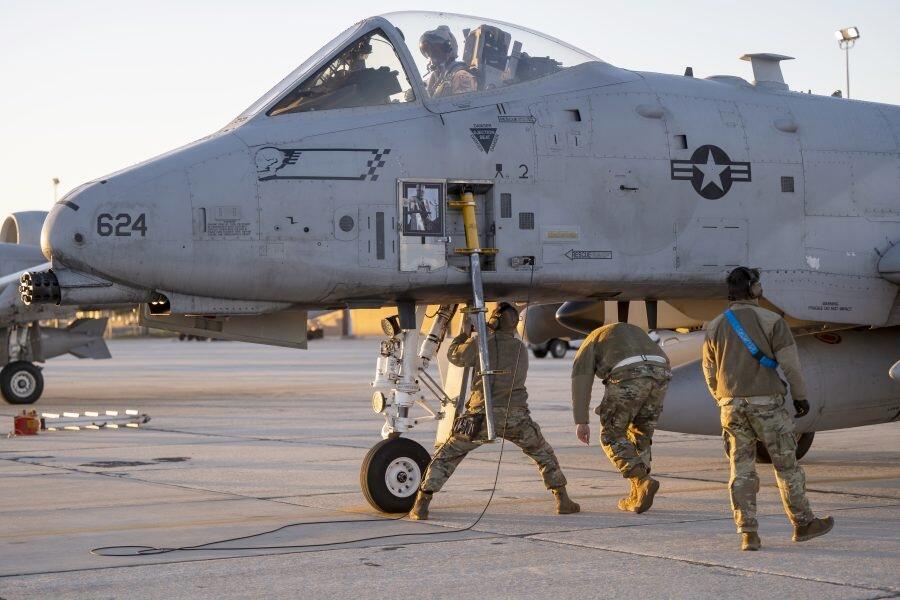
With the recent deployment of A-10s and Apaches (consistent with a military option that involves close-air support and/or attacks on Iranian fast boats and water drones) in mind, Larry Johnson lays out three possibilities:

Option 1 — Declare that negotiations with Iran via intermediaries (e.g., Pakistan) are progressing and that they United States is going to cease combat operations against Iran in order to support the negotiations and achieve a peaceful resolution.

Option 2 — Declare that victory has been achieved and that US forces will begin withdrawing from the region, leaving the status of the Strait of Hormuz in limbo.

Option 3 — Announce a massive air and ground operation to secure the freedom of navigation through the Strait of Hormuz.

The deployment of the A-10s and the Apaches can only mean one of two things:

  1. It is a show of force intended to pressure Iran to return to the negotiating table.

  2. The US is going to launch a massive attack against Iranian assets in the Persian Gulf, especially those located in and around the Strait of Hormuz.

Since Monday, March 30, 2026, President Donald Trump has made several public comments on the ongoing US-led Operation Epic Fury against Iran, primarily via Truth Social posts, interviews (including with the New York Post), and remarks to reporters. His statements emphasize US military successes, threats of further escalation if demands are unmet, criticism of allies, and a potential near-term wind-down of direct US involvement.

On Monday, Trump described Iran as effectively “decimated” or “obliterated,” with its air force, navy, and many ships sunk or destroyed. He portrayed the campaign as highly successful and “way ahead of schedule” in prior context, but continued highlighting strikes on “long-sought-after targets.” He shared video footage on Truth Social of a massive explosion and secondary blasts in Isfahan (linked to strikes on uranium-related or military sites), without additional caption in one instance.

Trump also posted that the US was in “serious discussions with a new, and more reasonable, regime” to end operations. He warned that if the Strait of Hormuz is not “immediately ‘Open for Business’” and a deal is not reached shortly, the US would “completely obliterate” Iran’s electric generating plants, oil wells, Kharg Island, and possibly desalination plants. He framed this as concluding the US “lovely ‘stay’ in Iran.” In follow-up comments, he suggested the US could respond to Iranian actions “twenty times harder” with “Death, Fire, and Fury.”

Overall, Trump’s messaging since March 30 combines triumphalism about US achievements, escalatory warnings tied to the Strait of Hormuz and energy targets, frustration with allies, and signals of de-escalation with a short timeline for reduced US involvement. These comments have influenced market reactions (e.g., oil prices and equities) and drawn responses from Iranian officials and international observers.

Trump’s remarks since Monday have boosted the confidence of the folks on Wall Street and contributed to a significant surge in the stock market, with the Dow up 1,125 points. The price for BRENT oil dropped from 118 to 103 during Tuesday trading. This means the financial folks believe the war is going to end.

I think Trump is counting on Iran offering up some concessions in the face of the US buildup of additional air combat assets.

Netanyahu reportedly just said Iran no longer poses threat to Israel’s existence… A dramatic pivot if true.

However, over the last few hours, Israel and the US carried out a large wave of attacks across Iran.

They struck targets across several parts of Tehran, as well as in the cities of Karaj, Shahriar, Ahvaz, Shiraz, Abadeh, Isfahan, and Bandar Abbas. Iran will retaliate in force to these latest attacks.

In short, I believe Donald Trump will announce a major offensive to try to force Iran to release its chokehold on the Strait of Hormuz… I believe that offensive will fail and that the war will escalate unless the US and Israel agree to two critical Iranian demands: the end of all sanctions and the removal of US military bases from the Persian Gulf arab countries.

Russia and China are two wild cards that could change the trajectory of the current war. If they engage and apply pressure on the diplomatic front — including ironclad security guarantees to Iran — Donald Trump may take the exit ramp.

Tyler Durden
Wed, 04/01/2026 – 08:46

via ZeroHedge News https://ift.tt/LFNYTBS Tyler Durden

US Retail Sales Jumped Most In 8 Months In February

US Retail Sales Jumped Most In 8 Months In February

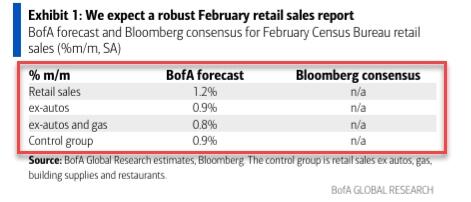
Bank of America’s omniscient analysts forecast a very strong month for Retail Sales in February data (released today)…

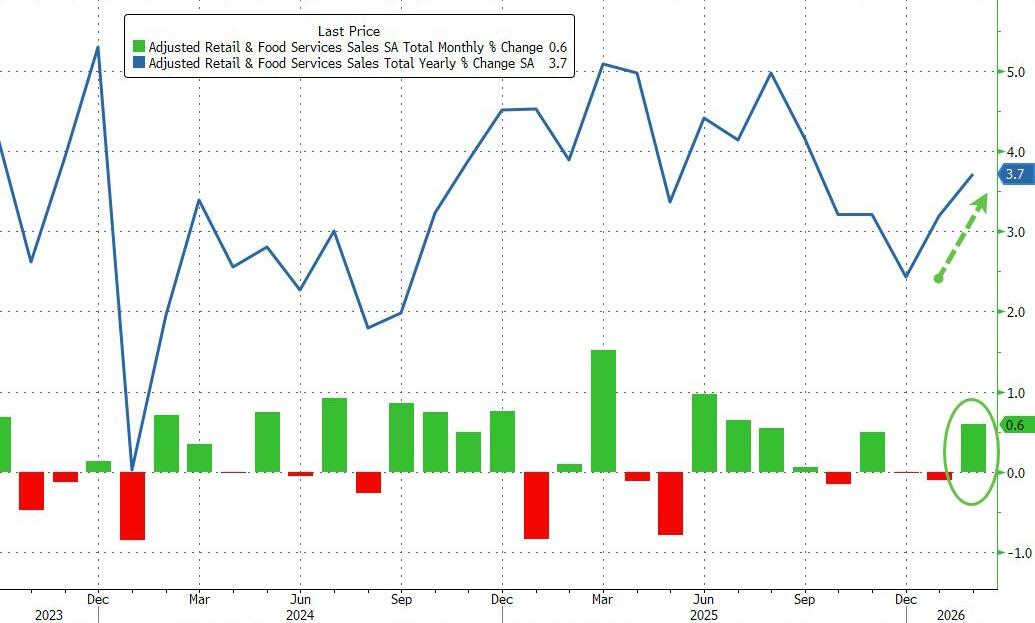
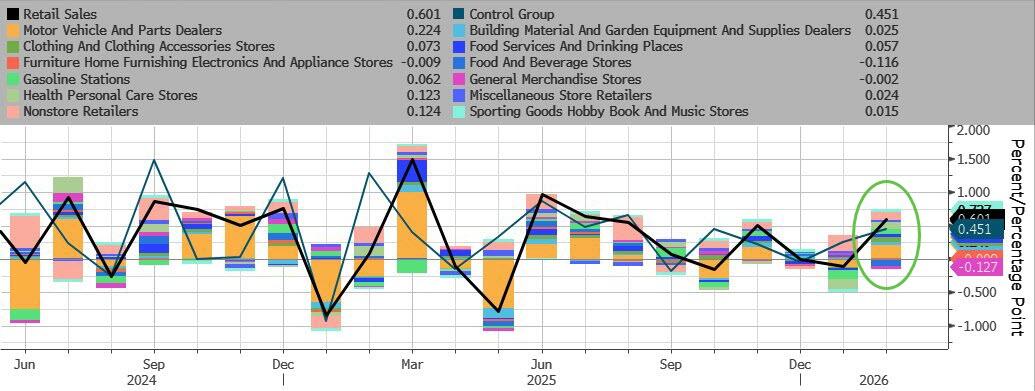
The actual print was +0.6% MoM (better than the 0.5% consensus, but less than BofA’s forecast) comes after a revised higher 0.1% MoM decline in January (and December’s nothingburger)…

Source: Bloomberg

That is the highest MoM rise since June 2025, and sales rose 3.7% YoY…

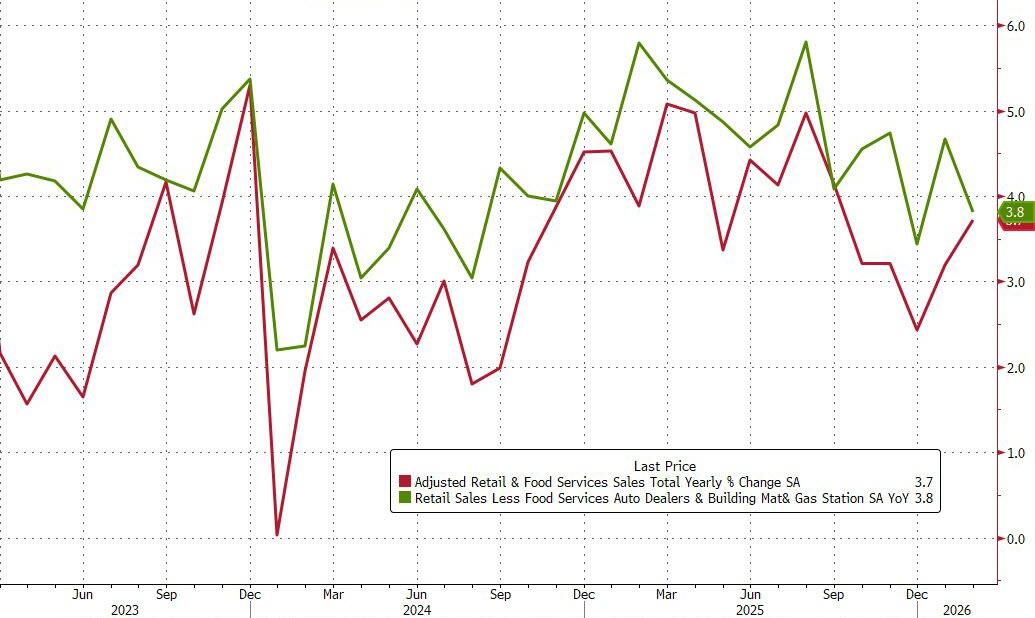
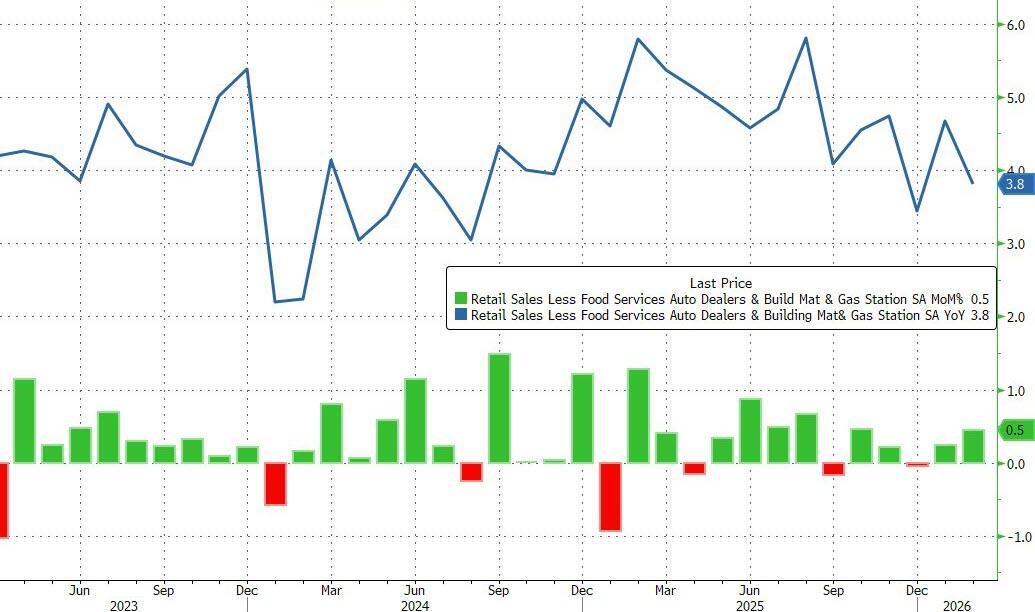
Core Retail Sales (Ex Autos) rose 0.5% MoM (much better than expected) and Ex Autos and Gas also rose more than expected (+0.4% MoM).

Food and Beverage spending fell while Motor Vehicle and Parts Dealers saw the biggest jump…

Most importantly, the ‘Control Group’ which plugs into the GDP calculation rose 0.5% MoM (also considerably better than expected).

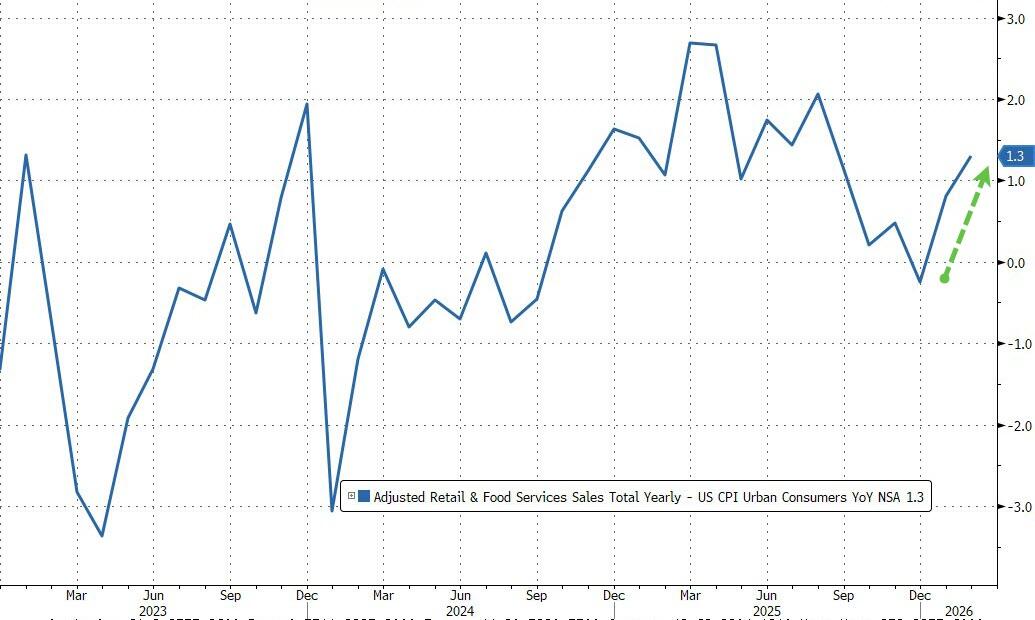
Interestingly, ‘real’ retail sales (admittedly crudely adjusted via CPI) have rebounded from a negative print in December…

Of course, this data was before the war started and before gas prices really exploded (but then again April’s tax refunds may offset some of the pain).

Tyler Durden
Wed, 04/01/2026 – 08:41

via ZeroHedge News https://ift.tt/w6pkK1Q Tyler Durden

Illegal To Defund NPR?


An illustration of an NPR tote bag on fire | Illustration: Lex Villena; Jakub Gojda

You can’t defund NPR? Last May, President Donald Trump issued an executive order on “Ending Taxpayer Subsidization of Biased Media.” 

The order targeted the Corporation for Public Broadcasting (CPB), which at the time doled out funds to National Public Radio (NPR) and the Public Broadcasting Service (PBS). Trump’s order directed the CPB to cease funding to NPR and PBS.

Trump’s reasoning for the order was quite explicit: “Americans have the right to expect that if their tax dollars fund public broadcasting at all, they fund only fair, accurate, unbiased, and nonpartisan news coverage.” 

Yesterday, a U.S. district judge said the ruling was illegal. The judge, Randolph Moss, ruled that Trump had violated the First Amendment with the order because it amounted to punishment for politically disfavored speech. 

The judge said the order “clearly crosses the line” into something like politically motivated censorship. “The message is clear,” Moss wrote. “NPR and PBS need not apply for any federal benefit because the president disapproves of their ‘left-wing’ coverage of the news.” Trump’s order, the judge wrote, amounted to government “retaliation” for speech.

There were several things to like about Trump’s initial executive order. It noted that today’s media market “is filled with abundant, diverse, and innovative news options,” and it declared that “government funding of news media in this environment is not only outdated and unnecessary but corrosive to the appearance of journalistic independence.” 

These are good points, and my colleagues at Reason have been making a similar case for many, many years. On the merits, there was never a good argument for taxpayer funding of public media. 

But as Reason’s Jesse Walker wrote last year, there were some genuine legal questions about whether Trump had the authority to defund public media through executive order.

And Trump’s criticism of NPR’s coverage of him made the executive order look like an act of personal pique rather than a speech-neutral decision not to fund a government program. Moss wrote that the text of the executive order, along with other public statements, made it “difficult to conceive of clearer evidence that a government action is targeted at viewpoints that the president does not like and seeks to squelch.”

As is sometimes the case, Trump did the right thing—but not in the ideal way. 

Practically, however, the ruling won’t have much of an impact. Shortly after Trump’s order was issued, Congress pulled about $500 million from the Corporation for Public Broadcasting, which then shut down. So at least in the short term, the ruling is moot. 


Strictly ballroom. That wasn’t the only loss Trump faced in court yesterday. Separately, a federal judge said that Trump could not proceed with the construction of his planned White House ballroom until the $400 million project was approved by Congress. 

The project is being funded with private donations that have been routed through the National Park Service. But even still, Judge Richard Leon said, Trump had exceeded his authority to proceed with the project unilaterally. Congress, he said, must explicitly authorize construction. 

As I noted yesterday, Trump’s ballroom plans have been criticized, with multiple media reports saying that some mostly unnamed architects are worried the ballroom plan was rushed through with insufficient review and oversight. Some of the stated concerns had merit, like stairs going nowhere and oddly placed windows and bathrooms. 

But while this project isn’t exactly typical, and public buildings are obviously different than private developments, it’s at least a little bit telling that one of the chief complaints about the project was that it was insufficiently bogged down in bureaucratic process and public review. It’s almost like the delays are the point. 

In any case, the judge says the ball, or rather the building, is now in the legislature’s court: “The President,” the judge wrote, “may at any time go to Congress to obtain express authority to construct a ballroom and to do so with private funds.” 

Congress? Act? I suppose there’s a first time for everything. 


Scenes from Washington, D.C.: For years, Tail Up Goat was hailed as one of D.C.’s best restaurants. But the Adams Morgan establishment closed and is now set to reopen with a new name and new concept from the same owners. The new restaurant will be called Rye Bunny—and instead of a full-service, sit-down restaurant, it will be a counter-service spot, almost like your local deli, except with high-end fare. 

There’s reason to suspect that this is a response to escalating labor costs in the District. The owners have talked about how dicey Tail Up Goat’s finances were, even with the good reviews. The new establishment is designed to be different. “From the restaurant’s perspective, the model is far more economically viable because they need nearly half as many front-of-house employees as they did before,” reports Washingtonian. (Front-of-house employees are waiters, bussers, and the like.)

D.C. has a great food scene, but restaurants have struggled in recent years, with a record number of closings last year. And at least part of the struggle has been the costs imposed by the city via changes to the way restaurants are required to compensate tipped workers. Yes, some of those changes have been paused, though not fully rolled back. But owning and operating a restaurant is tough in the best of times, and D.C.’s government has mostly made it more expensive and more onerous.

For more, watch Justin Zuckerman’s excellent 2024 documentary on why some D.C. restaurant workers prefer a lower minimum wage


QUICK HITS

  • Trump will address the nation about Iran tonight.

  • Meanwhile, Defense Secretary Pete Hegseth says regime change has already occurred in Iran. 
  • And an Iranian official says the Strait of Hormuz will reopen, just not for America.
  • New York City Mayor Zohran Mamdani, whose campaign was powered by social video, now says that city agencies may use TikTok
  • The Artemis II launch, which will take astronauts near the moon, is set for today. This will supposedly pave the way for an actual moon landing in the near future. The rocket being used for the launch is 322 feet tall. 
  • Congress is going after prediction markets.
  • The Supreme Court said that Colorado could not ban “conversion therapy” for gay and transgender minors. The state’s law “censors speech based on viewpoint,” wrote Justice Neil Gorsuch. 
  • “If Gen Z’s general disinterest in religion persists, American society will only secularize further.” On the supposed religious revival in America.
  • The decline in marriage is real. But it’s concentrated in working-class women, not the ambitious strivers who populate trend pieces. 
  • There’s a new trailer for this summer’s forthcoming Supergirl movie. For all you 1990s comic book nerds, it even shows off Lobo. Holy guacamole!

The post Illegal To Defund NPR? appeared first on Reason.com.

from Latest – Reason.com https://ift.tt/bzVrTqD
via IFTTT

No Pseudonymity for Lawyer Alleging Quid Pro Quo Sexual Harassment and Retaliation

From Judge Ronnie Abrams yesterday in Doe v. Legal Aid Society (S.D.N.Y.):

[1.] [Pseudonymity is more justified if] the litigation involves matters of a highly sensitive and personal nature. This case involves allegations of sexual harassment, which undoubtedly qualify. Thus, while this factor weighs in Plaintiff’s favor, courts in this District have routinely held that allegations of sexual harassment and assault alone “are not sufficient to entitle a plaintiff to proceed under a pseudonym.” …

[2.] Plaintiff presents no evidence of any existing or potential threats or intimidation that she would experience should her identity be revealed. She claims only that revealing her identity would cause her and her former clients at LAS emotional harm and embarrassment. As to the allegation that it will pose a risk of mental harm to her and her clients, it is conclusory at best.

Moreover, “a plaintiff must allege more than public humiliation—she must provide corroboration from medical professionals that detail the risk to plaintiff.” Such evidence “must detail how revealing [P]laintiff’s name in particular, as opposed to the trauma that could occur through reliving the experience through litigation, would cause harm.” Plaintiff provides no such evidence, and as such, the Court cannot “speculate about the nature and severity of any mental injury from disclosure.” …

[3.] Plaintiff argues that LAS is aware of her true identity, and as such, will be able to litigate the matter regardless of whether her identity is shared with the public. LAS’s only inconvenience, she maintains, would be “the need to make redactions and take measures not to disclose plaintiff’s identity,” which she acknowledges would create challenges for LAS during discovery.

While it is true that LAS may only be marginally inconvenienced were the Court to grant Plaintiff’s request, it is insufficient to tilt this factor in her favor, because, even where the defendant knows the plaintiff’s identity, “concealment of plaintiff’s identity from the public can still hamper defendants’ ability to conduct discovery.” “This is especially true in a case … that happened over ten years ago[,] where evidence and witnesses may be difficult to find.”

The events that gave rise to Plaintiff’s Privacy Motion stem from allegations that began over a decade ago. Furthermore, LAS is right to note that when claims involve sexual harassment or assault, “the reputational damage risk to Defendant is high and fairness requires that plaintiff be prepared to stand behind her charges publicly.” … “Allowing Plaintiff to proceed anonymously would disadvantage Defendants at all stages of litigation, including settlement, discovery, and trial.” …

[4.] The Court next considers whether Plaintiff’s identity has been kept confidential. As discussed above, and as Plaintiff acknowledges, her identity is known by LAS leadership and former colleagues. She nonetheless maintains that she has kept her identity concealed from the general public. While that may be true, LAS points to Plaintiff’s inclusion of her real name and contact information in her EEOC complaint, which courts have found to weigh against granting a motion to proceed anonymously….

[5.] “Courts have put weight on the right of the public to know the identity of the litigants as well as on the interest of the accused to be able publicly to confront the accuser.” Courts therefore require “something more … to rebut the presumption of public access, at least in cases involving adult sexual assault, and that something more frequently has to be evidence of real (and not conclusory) harm that is substantial and that will flow directly from and is directly linked to disclosure of the party’s name.”

Plaintiff’s arguments that the public interest is not served by disclosure are conclusory at best and “it does not follow that the public has an interest in maintaining the anonymity of every person who alleges sexual assault or other misconduct of a highly personal nature.” “Otherwise, this factor would, in effect, heavily favor anonymity in every sexual assault case.” …

Here’s the court’s summary of the factual allegations from the parties:

Over a decade ago, Plaintiff, then a staff attorney at LAS, began experiencing what she characterizes as a “long-lasting campaign of quid pro quo sexual harassment, and retaliation” against her by Christopher Pisciotta, the Attorney-in-Charge of the Staten Island Criminal Defense Office …. She claims her rebuffs were met with alleged retaliation by Pisciotta who would threaten discipline, among other acts. Following these encounters, Plaintiff maintains that rumors that she and Pisciotta were having an affair abounded at the Staten Island office, which she attempted to dispel by reporting his actions to management at LAS to no avail.

LAS tells a different story—one that identifies Plaintiff rather than Pisciotta as the source of the interpersonal dispute. Beginning in 2017, when Plaintiff was transferred from the Staten Island Office to the Queens County Office, LAS alleges that she began sending “unwanted text and email communications to” Pisciotta, and that it had to reprimand her on three different occasions.

In his declaration, LAS’s General Counsel Scott Rosenberg asserts that Plaintiff was eventually terminated from her position for insubordination on November 7, 2022. Despite Plaintiff’s representations that she was never terminated, the parties agreed to a Separation Agreement on February 6, 2023, which placed her on Unpaid Administrative Leave until December 31, 2023. By the beginning of 2023, Plaintiff began looking for a new position and that March secured an interview with Scott Banks at the Legal Aid Society of Nassau County for a family court supervisory position, which required her to provide professional references from her supervisors at LAS, including Pisciotta.

Hoping to thwart a negative reference, Plaintiff claims that she set up a call with Pisciotta to encourage him to dodge any communications from Banks. During the call, she alleges, Pisciotta sexually harassed her and threatened to divulge that she was “on leave, looking for work, and working with general counsel,” and that afterwards, Pisciotta called Banks back and followed up on his threat to tell him several “negative things” about her.

Plaintiff repeatedly sought information from Rosenberg about how the call went, and enraged by his responses, describes feeling “the great sense of crushing fear that not only was [Pisciotta] intensely focused on her but that he now had the written backing of the mighty LEGAL AID SOCIETY OF NEW YORK CITY to quid pro quo sexually harass the Plaintiff indefinitely either on the job with the prospective employer or on other legal service jobs.”

The post No Pseudonymity for Lawyer Alleging Quid Pro Quo Sexual Harassment and Retaliation appeared first on Reason.com.

from Latest – Reason.com https://ift.tt/ZzJ1hrt
via IFTTT

Futures, Bonds Surge On Optimism War May End, Oil Tumbles Below $100

Futures, Bonds Surge On Optimism War May End, Oil Tumbles Below $100

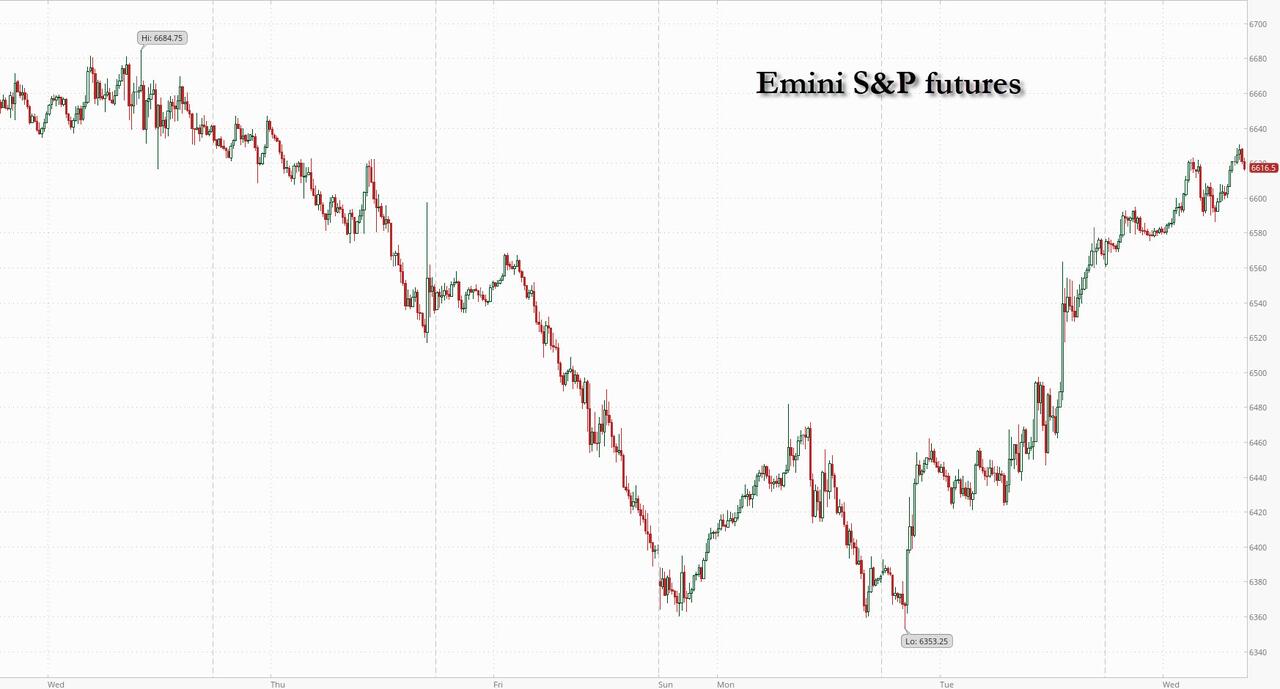
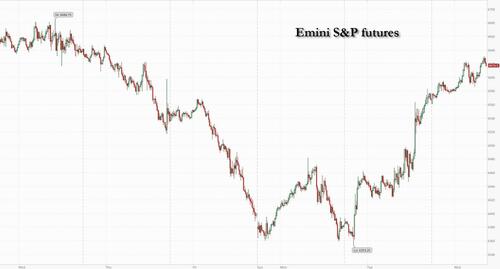
Futures and bonds jump and oil fell, sending Brent briefly below $100 a barrel, as the de-escalation/technical/macro led relief rally continues on hopes of the Middle East conflict reaching an end soon  after Donald Trump said he expects the war in Iran to end in two to three weeks, and indicated that it was possible that Iran could still reach a deal with the US during that timeframe. Trump has a national address tonight at 9pm ET to discuss Iran, but the content is unclear, with the market is expressing the view that this will be details on a wind-down rather than an escalation. As of 8:15am ET, S&P Futures were 0.7% higher,  after the cash index posted a near 3% advance on Tuesday, the best end to a quarter since September 2008. Nasdaq futures jumped 1.1% with all Mag 7 names higher premarket. European stocks jumped 2.6%, alongside a 4.9% surge in Asian shares. Final Mfg PMIs from the Europe were mixed (EU, Germany, Italy small beats/UK, France small missed) while Japan/Korea Manf PMIs were slightly better. Trump is set to address the nation tonight at 9pm EST and said he expects the war to end in two to three weeks/US would withdraw once Tehran can no longer obtain nuclear weapons. Otherwise, the US is sending a third aircraft carrier to the region, Iran said the US “isn’t serious about diplomacy”, the WSJ reported that the UAE wants to force the Strait of Hormuz open and is willing to join the fight, and attacks continued on both sides with Qatar saying Iran struck an oil tanker.  Brent fell 5.4% before paring the move as the Strait of Hormuz remained largely closed and attacks continued across the Gulf. Traders trimmed bets on tighter monetary policy, sending two-year Treasury yields three basis points lower to 3.76%. Comparable UK gilt yields dropped 10 basis points to 4.30%. Looking at today’s US economic calendar, we get March ADP employment change (8:15am), February retail sales (8:30am), March final S&P Global US manufacturing PMI (9:45am), March ISM manufacturing and January business inventories (10am). Fed speaker slate includes Musalem (9:05am) and Barr (9:10am)
In premarket trading, Mag 7 stocks are all higher (Tesla +2.1%, Microsoft +1.5%, Amazon +0.9%, Nvidia +1.4%, Meta +0.6%, Alphabet +0.9%, Apple +0.5%) 

  • Li Auto ADRs (LI) rise 4% after the Chinese EV firm reported March vehicle deliveries that surpassed its own guidance and analyst estimates.
  • MSC Industrial (MSM) falls 6% after the distributor of metalworking products reported adjusted earnings per share for the second quarter that missed the average analyst estimate.
  • NCino (NCNO) jumps 24% after the cloud-banking software company’s subscription revenue forecast for 2027 beat the average analyst estimate.
  • Nike (NKE) falls 10% after the retailer gave a surprisingly gloomy outlook for the year ahead, complicating Chief Executive Officer Elliott Hill’s efforts to turn around the business.
  • RH (RH) plunges 17% after the home furnishing company forecast revenue for the first quarter that missed the average analyst estimate.
  • Oric Pharmaceuticals (ORIC) slides 21% after the clinical-stage oncology company gave safety and efficacy data from an early-stage trial of its drug-candidate for prostate cancer that underwhelmed Wall Street.
  • Target Hospitality (TH) rises 24% after the provider of modular housing announced secured a multi-year contract worth more than $550 million. The company will construct and provide hospitality services for a hyperscaler’s data center development in North Texas.

In other corporate news, Unilever said talks to sell most of its food business to McCormick are advanced and a final deal could be announced later on Tuesday. Boeing will team up with Rheinmetall to offer drones known as the Ghost Bat to Germany’s military.

Signs of an increased desire for de-escalation from Trump may reduce anxiety over his threats to attack Iranian energy infrastructure. On the other hand, Tehran would be left in control of the key oil shipment chokepoint. Meanwhile, Iran hit a fully laden Kuwaiti oil tanker off Dubai in a drone attack.  Without a ceasefire or tangible progress in negotiations, the market will keep “fading the administration’s ‘everything is going well’ happy talk,” Vital Knowledge’s Adam Crisafulli wrote in a note. Carmignac Gestion’s Kevin Thozet observed that “Trump can’t simply turn an on/off switch on the crisis.” Other observers argue that rhetoric alone about a potential end to the conflict cannot create certainty for the market. 

Equities are, nonetheless, primed to rip higher on positive news about the war following large-scale unwinding of risk by hedge funds and CTAs. The concern is that, post an initial bounce, worries about the economy and the path for interest rates will trigger further volatility episodes, setting up stocks for months of roller-coaster conditions. 

In any case, traders said it would take time for oil flows to return to normal even if the war ends within Trump’s timeframe, especially given the damage to some energy facilities. Trump’s team has also suggested that reopening the Hormuz strait, which carries 20% of global crude, may not be necessary to end the hostilities.

“The correlation between Brent oil prices and global equity markets has been exceptionally strong since the conflict started,” said Wolf von Rotberg, equity strategist at Bank J Safra Sarasin. “This goes to show that a return to previous equity market highs would need the Strait of Hormuz to reopen and oil prices to drop significantly. It is probably too early for an all-clear yet.”

Trump, who will give an address at 9 p.m. Eastern Time to provide an “important update” on Iran, said the Islamic Republic could still reach a deal with the US. He added, however, that an agreement with Tehran isn’t a prerequisite to conclude the war. “We are seeing a relief rally, and with more information we may see a reversal, so we just need to be careful here,” Remi Olu-Pitan, multi-asset growth and income head at Schroders, told Bloomberg TV. “There’s still a lot of volatility, the market is still fragile.”

Oil remains in focus for traders, policy makers and consumers. WTI futures are trading above $100 a barrel, while there’s been more commentary around the risks of spikes to $200. Crucially, retail unleaded pump prices climbed above $4 a gallon, the highest since August 2022. With higher gas prices adding near-term pressure on household budgets, Tuesday’s consumer confidence print will be closely watched. Oil, and the uncertainty around the magnitude and duration of supply disruption, was cited by strategists at Morgan Stanley as they downgraded global equities to equal-weight.

The Middle East conflict has caught high-flying chip stocks in its tentacles. Citigroup’s Jim McCormick describes a market wake-up call, noting “we’re looking at a world of sustained higher yields and sustained higher energy costs and that doesn’t help the AI sector.”

Traders at Goldman Sachs Group Inc. and JPMorgan Chase & Co. suggested Tuesday’s sharp rebound in US stocks was more about the unwinding of negative positioning by market participants than a shift in sentiment over the war. “Investors have been counting on a swift off-ramp to war essentially since it began, but I think from a market or global economy perspective it’s important to define what the true clearing event to revisit risk and take down recession odds really is,” wrote JPMorgan industrials sector specialist sales Paige Hanson.

Space is also making the headlines this week, with Virgin Galactic soaring in late trading after it resumed some sales of commercial space flights. NASA is making final preparations for the Artemis II missions, while what a history-making SpaceX IPO could mean for the space economy is discussed in the Big Take podcast. 

European stocks are rallying, with the Stoxx 600 up 2% as markets look toward a potential resolution to the Iran conflict. Banks as well as travel and leisure shares are leading gains, while the energy sector is the biggest laggard.  Stoxx 600 rises 2.2% to 595.73 with 65 members down, 532 up, and 3 little changed. Here are the biggest movers Wednesday:

  • Athens Stock Exchange Index rises as much as 4.3% at Wednesday open, following index provider MSCI’s decision to upgrade the Greek market to developed status
  • Thule rises as much as 5.7% after SEB Equities upgrades to hold, removing the only sell rating on the maker of roof and bike racks, to reflect “more reasonable expectations” now baked into the stock
  • Sandoz shares rise as much as 5.1%, the most in five weeks, after Goldman Sachs initiated coverage on the stock with a buy recommendation
  • Inficon gains as much as 8.1%, the most since Jan. 15, as JPMorgan starts coverage at overweight, saying the vacuum instrument maker should be a beneficiary of the multiyear upcycle in wafer fabrication equipment
  • Arcadis shares rise as much as 6.6%, the most in six months, after Bank Degroof Petercam upgraded the engineering services firm on expectation that the new management team will be able to drive a recovery
  • Jungheinrich shares rise as much as 9.8%, their steepest ascent in around a year, as Bernstein boosts its price target on the German machinery company, citing enticing long-term prospects
  • Nordex falls as much as 3.8% after Bank of America downgraded the German wind turbine manufacturer to neutral from buy following a 56% year-to-date rally that the bank says has priced in most of the bull case
  • Berkeley Group shares plunge as much as 19% to hit a nine-year low, after the housebuilder’s profit goal for the FY27 to FY30 period significantly undershot expectations
  • SoftwareONE shares drop as much as 8.9%, hitting a seven-month low, after an investor offloaded shares at a discount to yesterday’s closing price. Shares have fallen below the offer price this morning
  • Cirsa Enterprises drops as much as 5% after one of its investors offloaded shares at a discount to Tuesday’s closing price. The stock is holding above the offer price on Wednesday

UK Prime Minister Keir Starmer said his government will coordinate a diplomatic push for the strait’s reopening, affirming Britain’s desire not to be dragged into the military conflict. “I would expect further volatility in the days to come and the market to oscillate between losses and gains for a few more sessions until we get clarity on how the crisis unfolds,” said Alexandre Baradez, chief market analyst at IG Markets. “This is likely more a temporary respite than a final game changer.”

Earlier in the session, Asian stocks jumped the most in nearly a year, tracking Wall Street’s rally on optimism that the war in Iran may end in the near future.  The MSCI Asia Pacific Index gained as much as 5.2%, the most since April 10, with shares in South Korea, Taiwan and Japan leading the gains. Technology giants Taiwan Semiconductor Manufacturing Co., Samsung Electronics Co. and SK Hynix Inc. provided the biggest boost to the gauge’s advance. Asian markets would stand to gain more than others if the US manages to defuse the war with Iran, as investors unwind an energy‑driven risk premium that has hit the region harder than most. The conflict has pushed oil prices sharply higher, driving equity sell‑offs and currency volatility across Asia’s oil‑importing economies. Still, the regional gauge remains  down about 9% from a peak in February, with investors questioning how quickly oil can fall and how credible Trump’s assurances are. Market focus will now shift to an “important update” on Iran that Trump is scheduled to deliver at 9 p.m. Washington time. 

In FX, the Bloomberg Dollar Spot Index fell as much as 0.4%, while Treasury yields dropped four basis across the curve. Swaps imply 11 basis points of Federal Reserve rate reductions by year-end, compared to 5bps on Tuesday. EUR/USD up as much as 0.5% to 1.1611, while GBP/USD up as much as 0.6% to 1.3301. USD/CHF drops 0.8% to 0.7928, EUR/CHF down 0.5% to 0.9190; leveraged desks seen unwinding franc shorts, a Europe-based trader says

In rates, fixed income markets have rallied but lost a bit of steam in recent trade. US yields are around 3bps lower across the curve as markets assign a 40% chance of a Fed rate cut by year-end versus a 64% chance of a hike last week. Treasury futures are off session highs in early US session, although yields remain 2bp-4bp lower across a steeper curve. US 10-year is about 3bp richer on the day near 4.29%, while 5s30s spread is steeper by ~1bp. Gilts outperform, with UK front-end yields richer by 8bp as oil broadly holds losses. Investors face the prospect that US President Trump, slated to speak at 9 p.m. in Washington, will soon declare an end to the war in Iran.

In commodities, despite the optimism in stocks, crude prices have faded declines in the European session. Brent is now back above $100 per barrel having earlier dropped below the key level. WTI crude oil contract has pared a 4.8% slump to about 2.5%, and was last trading just around $99. Precious metals are diverging, with spot gold up 1.4% and silver down 0.5%. Bitcoin has added 0.5%. 

Looking at today’s US economic calendar, we get March ADP employment change (8:15am), February retail sales (8:30am), March final S&P Global US manufacturing PMI (9:45am), March ISM manufacturing and January business inventories (10am). Fed speaker slate includes Musalem (9:05am) and Barr (9:10am)

Market Snapshot

  • S&P 500 mini +0.9%
  • Nasdaq 100 mini +0.8%
  • Russell 2000 mini +1.4%
  • Stoxx Europe 600 +0.7%
  • DAX +0.7%
  • CAC 40 +0.5%
  • 10-year Treasury yield -3 basis points at 4.32%
  • VIX -1.7 points at 28.87
  • Bloomberg Dollar Index little changed at 1221.56
  • euro little changed at $1.147
  • WTI crude -0.9% at $101.92/barrel

Top Overnight News

  • Trump will deliver a speech on Wednesday at 9 p.m. Washington time to give an update about the war in Iran: BBG
  • Oil fell, sending Brent briefly below $100 a barrel, after Donald Trump said he expects the war in Iran to end in two to three weeks. The US would withdraw once Tehran can no longer obtain nuclear weapons, he said. Attacks continued across the Middle East. Qatar said a cruise missile from Iran struck an oil tanker. BBG 
  • The United Arab Emirates is preparing to help the U.S. and other allies open the Strait of Hormuz by force, Arab officials said, a move that would make it the first Persian Gulf country to become a combatant, after being hit by Iranian attacks. WSJ 
  • Trump said he’s strongly considering pulling the US out of NATO after it didn’t join the war on Iran. He told the Telegraph that leaving the block was now “beyond reconsideration.” BBG 
  • California is confronting sky-high petrol prices and the threat of jet fuel shortages because of disruption caused by the Iran war, exposing US energy insecurity as the Strait of Hormuz remains closed. The most populous US state is vulnerable to the turmoil in world energy markets because it relies on imports of refined products such as petrol and jet fuel from Asia after introducing ambitious plans to phase out fossil fuels and significantly reduce refining capacity in favor of renewables. Californians pay the most for petrol in the country, with a gallon averaging $5.88 — the highest level since the pandemic — compared to $4.01 in the rest of the US, according to the American Automobile Association. FT 
  • Russia exported more liquefied natural gas in the first quarter of 2026 than it did a year earlier, with shipments to Europe increasing despite Moscow’s push to redirect supply away from the region. RTRS 
  • China’s factory activity slowed in March for export-oriented firms as their costs surged, according to RatingDog’s PMI. That contrasts with an official gauge that showed manufacturing improving despite the Iran war. BBG 
  • Chinese government bonds have sidestepped a global debt sell-off since the start of the Iran war, as the world’s second-biggest economy emerges as a haven from soaring energy prices and rising global inflation. Investors are betting that whereas major central banks in the US and Europe will be forced to keep interest rates at higher levels than previously expected to counter inflation triggered by rising oil and gas prices, China will be relatively insulated thanks to its energy mix and very low inflation before the conflict. FT 
  • Japan may face stagflation risks from the Iran war that would be challenging to deal with using monetary policy, new Bank of Japan board member Toichiro Asada said on Wednesday. RTRS 
  • Trump signs executive order related to mail-in voting, said working on proof of citizenship and that voter ID and citizenship proof are subjects for another time.
  • OpenAI raised $122 billion at an $852 billion valuation in its largest funding round yet. BBG 
  • Since the start of the Iran war, market pricing for the fed funds rate has swung sharply, and it now implies a roughly 45% chance that the FOMC will hike in 2026. While some of this reflects changing demand for insurance against the tail risk of more hikes, the market-implied probability that the FOMC delivers 1-2 cuts—the modal case before the war—has declined from 35-40% to about 18%. Expectations for other central banks have moved even more, and market pricing now implies about 70bp of hikes from the ECB in 2026, compared to 8bp of cuts before the war
  • Trump asks CPA for lists of insurers who were good to clients, and list who were bad in response to California fires.

A more detailed look at global markets courtesy of Newsquawk

APAC stocks mostly rallied with global risk sentiment buoyed by hopes for an end to the Iran conflict following encouraging comments from the US and Iran, while President Trump also suggested that the war could end in 2 or 3 weeks, and he will deliver a nationwide address on Wednesday evening to give an important update regarding Iran. ASX 200 gained at the open and was led by outperformance in mining, materials, resources and tech, with nearly all sectors in the green aside from some defensives, while the index also shrugged off weak PMIs. Nikkei 225 surged back above the 53,000 level amid hopes of a nearing end to the conflict and after the latest BoJ Tankan survey mostly topped forecasts, with the headline large manufacturing index at its highest in more than five years. Hang Seng and Shanghai Comp conformed to the broad upbeat mood across the region with notable strength seen in mining, tech and biopharmaceuticals, while a miss on Chinese RatingDog Manufacturing PMI and the smallest PBoC injection in more than a decade failed to derail the momentum.

Top Asian News

  • Chinese RatingDog Manufacturing PMI (Mar) 50.8 vs. Exp. 51.6 (Prev. 52.1, Low. 50.5, High. 53).
  • Japanese Tankan Large Manufacturers Index (Q1) 17 vs. Exp. 16 (Prev. 15, Low. 8, High. 18).
  • Japanese Tankan Large Non-Manufacturing Index (Q1) 36 vs. Exp. 33 (Prev. 34, Low. 28, High. 36)
  • Japanese Tankan Small Manufacturers Index (Q1) 7 vs. Exp. 7 (Prev. 6, Low. -1, High. 9)
  • Japanese Tankan Large Manufacturing Outlook (Q1) 14 vs. Exp. 13 (Prev. 15, Low. 5, High. 15)
  • Japanese Tankan Large Non-Manufacturing Outlook (Q1) 29 vs. Exp. 28 (Prev. 28, Low. 24, High. 34)
  • Japanese Tankan Large All Industry Capex (Q1) 3.3% vs. Exp. 13% (Prev. 12.6%)

European bourses (STOXX 600 +2.1%) continue to rebound, printing a third straight day of gains thus far. The positive was helped following reports that Iranian officials are leaning towards dialogue, while President Trump said that the war is coming to an end. European sectors are entirely in the green, ex. Energy. Banks and Travel and Leisure top the sector pile. Oil prices have been the main driver for airlines, with the drop in energy prices making jet fuel cheaper. Banks have been hit throughout the Iran war, so the prospects of it coming to an end have boosted the sector. To add, HSBC was added to Goldman Sachs’ European conviction list.

Top European News

  • Germany’s VDMA said German Engineering Orders -8% in Dec-Feb Y/Y (Domestic Orders -6%, Foreign Orders -8%).
  • German Economic Institutes confirm cutting 2026 and 2027 GDP growth forecasts.
  • UK government said new measures to ease cost of living pressure to come into force on April 1st. Increasing national living wage to £12.71. Energy bills are to be cut by average £117 a year for millions across the UK and locked in until end of June.

FX

  • DXY is on the backfoot this morning with markets pricing in a “de-escalation” trade, after US President Trump said to NBC News regarding the Iran war that “it is coming to an end”, with a White House official suggesting Trump is confident an agreement will be reached soon. Interestingly, from the Iranian side, President Pezeshkian noted that Iran seeks to end the war with guarantees against further attacks. DXY currently holds at the lower end of a 99.41-99.88 range. It is worth highlighting that the index saw some strength after the Iranian Deputy Speaker of Parliament said that the “Strait of Hormuz will never be opened, there has been no negotiation and there will be no negotiation”.
  • G10s are entirely stronger against the USD, albeit to varying degrees. The CHF outperforms, benefiting from lower energy prices – the likes of GBP and EUR also benefit. For the GBP specifically, the UK government confirmed new measures to ease the cost of living pressure are to come into force today, including an increase in the national living wage to GBP 12.71 and with energy bills to be cut by an average GBP 117 a year for millions across the UK, which will be locked in until end of June.
  • JPY also gains vs USD, albeit to a lesser degree vs peers. The seemingly easing Iran tensions has benefited the JPY, which builds on the strength seen in recent sessions, facilitated by jawboning and a hawkish-leaning BoJ SOO earlier this week. As for today, Japan’s Tankan survey was mostly stronger-than-expected, which supports the case for an April BoJ rate hike. USD/JPY currently trades within a narrow 158.27-159.01 range.

Central Banks

  • BoJ new Board Member Asada does not comment on any specific stance. Rising oil prices put upward pressure on inflation while weighing on growth, creating a stagflationary trend.
  • ECB’s Stournaras said if oil prices rise over USD 150/bbl Europe could face a recession.
  • ECB’s Dolenc said ECB’s adverse scenario is more likely to be the next baseline and current baseline is more like the best-case scenario.

Fixed Income

  • An overall positive start in the fixed income benchmarks, with energy prices falling and higher hopes of a potential end to the Iran conflict. President Trump stated that the war is coming to an end, while a White House official said that the President is confident that an agreement will be reached soon.
  • USTs are trading at the upper end of a 111-10 to 111-14+ range, albeit off best levels, as energy prices rebound slightly. Price action is set to remain rangebound ahead of a flurry of data and Fed speak, while Trump is set to speak at 21:00EDT/02:00BST.
  • Bunds, in tandem with its peers, are gaining and currently holding above the 126 handle. The 10yr yield extends further below 3.0%, printing a trough at 2.933% before bouncing slightly. EZ final manufacturing PMI ticked slightly higher above the prelim. Figure but failed to drive any move in EGBs. In addition, ECB speakers reiterated the impact higher energy prices have on the European economy.
  • Gilts outperform, continuing to be the beneficiary of lower energy prices, as BoE pricing remains sensitive to oil prices. Pricing for rate hikes have pulled back, now price in 44bps of hikes in 2026.
  • Germany sells EUR 3.025bln vs exp. EUR 4.0bln 2.50% 2032 Bund: b/c 1.11x (prev. 1.51x), average yield 2.78% (prev. 2.60%), retention 24.3% (prev. 20.1%).

Commodities

  • In geopolitics, optimism was seen on Tuesday over a potential end to the war, particularly following Trump’s overnight comments that the US could leave Iran in two to three weeks. This follows reports that the US could exit Iran without reopening the Strait of Hormuz, with Trump calling on users of the strait to secure it themselves. Trump is due to make an announcement tonight at 21:00 EDT/02:00 BST. Some of yesterday’s optimism waned after commentary from the Iranian Deputy Speaker of Parliament, who said: “Strait of Hormuz will never be opened, there has been no negotiation, and there will be no negotiation.”
  • WTI and Brent initially dipped to lows of USD 96.50/bbl and USD 98.35/bbl respectively as markets initially continued the move from yesterday, although a floor was later found on the Iranian deputy speaker comments, with Brent back above USD 100/bbl and WTI near USD 99/bbl at the time of writing, both still lower intraday by over USD 2/bbl apiece. Dutch TTF prices are softer once again after slipping over 7% in the prior session, with desks citing favourable weather alongside hopes of an Iranian war de-escalation.
  • Spot gold is slightly firmer amid the softer USD and lower oil prices, with the yellow metal back above its 100 DMA (4,642.48/oz) in a current USD 4,661.61-4,747.77/oz parameter. Conversely, spot silver is softer on the day following yesterday’s +7% gains, with the metal today finding resistance near its 100 DMA (USD 75.22/oz).
  • Base metals mostly eke out mild gains in what is seemingly a function of the USD alongside recent positive sentiment amid hopes of a de-escalation of the Iranian situation. 3M LME copper resides in a current USD 12,380.00- 12,499.75/t range after finding resistance around USD 12,500/t.
  • IEA Chief Birol says more than 12mln BPD of oil supply has been lost so far due to the Middle East crisis; the current crisis is worse than the 1970s oil shocks and the loss of Russian gas in 2022 combined. Oil supply losses in April are expected to be twice as high as in March. Biggest problem is a lack of jet fuel and diesel, already affecting Asia and coming to Europe in April–May.
  • UK PM Starmer said the fuel duty will remain where it is until September.
  • South Korea has raised its energy disruption alert to the second-highest level due to the possible crude oil supply crisis, via Yonhap.
  • US extended a Russian oil transit license via Kazakhstan to China until March 2027, according to IFX cites Kazakh Energy Ministry.
  • US Private Inventory Data (bbls): Crude +10.3mln (exp. -1.3mln), Distillate -10.4mln (exp. -1.3mln), Gasoline -3.2mln (exp. -2.2mln), Cushing +0.8mln.

Trade/Tariffs

  • India grants one-time customs duty relief for goods made in special economic zone and sold into domestic market.
  • US is rushing to put in place a system to pay back USD 166bln it collected now after Trump tariffs were ruled to be unconstitutional, according to Nikkei.

Geopolitics

  • US President Trump said he is strongly considering pulling the US out of NATO after it failed to join his war on Iran, The Telegraph reported.
  • US President Trump tells NBC News on Iran war “it is coming to an end”.
  • US advisers who speak regularly with the US President are reportedly uncertain about the mixed signals from Trump, according to Axios. “Some Trump aides and allies say he’s mostly improvising rather than following any clear plan”. “Aides have been convinced at various points that Trump was leaning toward a major escalation, and at others that he was eager for a swift resolution. “Nobody knows in the end what he’s really thinking,” a senior adviser said.”.
  • US Secretary of State Rubio said have largely destroyed Iran’s air force and can see the finish line with Iran objectives, adds end to Iran war is not today, not tomorrow but it is coming. said:. There’s nothing any country is doing to help Iran that is in any way impeding our mission. There is potential for a direct meeting with Iran at some point. US is to re-examine NATO ties post-Iran war.
  • Iranian Foreign Minister, when asked about the status of negotiations with the US, said “No decision has been made yet. We have many considerations. Our conditions for ending the war are very clear. We do not accept the ceasefire; We seek a complete end”.
  • Iranian Foreign Minister Araghchi reiterates Strait of Hormuz is closed to countries at war with Iran and said the US President must change his approach, also noted that a guarantee from 1-2 countries or from the UN Security Council is not enough. Iran has no plans for negotiations with the US. We are ready for any ground threat and are ready for at least six months of war.
  • Iran’s Foreign Minister Araghchi said Iran has zero trust in the US and dismisses the effectiveness of any potential ground operation targeting Iran.
  • Iranian Deputy Speaker of Parliament said “Strait of Hormuz will never be opened, there has been no negotiation and there will be no negotiation”, Fars reported.
  • Iran began a new round of missile attacks against Israeli positions, according to SNN.
  • Yemeni Houthi spokesperson claims a joint attack with Hezbollah against Israel, said the escalations will only drive Yemen “to further escalation in the coming period until the aggression stops and the blockade is lifted”.
  • Daily Mail columnist Andrew Neil posted “I am told by White House sources that Trump is seriously considering taking Kharg Island”.
  • Iran began a new round of missile attacks against Israeli positions, according to SNN.
  • Iranian drone reportedly strikes US Victoria base in Baghdad, according to Fars news agency.
  • Israeli military identified launch of missile from Yemen towards Israel.
  • US and Israel attacked weather facilities of Bushehr again, via ISNA.
  • Reports of a drone attack on an oil field in the “Chamanke” region, located in the north of Dohuk province in Iraqi Kurdistan; attack caused a fire in this oil field. The field is managed by an American company, Fars News reported.
  • Reports of explosions in Saudi Arabia; reporting in proximity to Saudi announcing the interception of two drones in the last few hours.
  • Qatari Defence said a cruise missile struck an oil tanker chartered for QatarEnergy in the economic waters, Al Arabiya reported.
  • United Arab Emirates is preparing to help the US and other allies open the Strait of Hormuz by force, according to WSJ.
  • Powerful explosion rocks American base in Erbil, according to Press TV.
  • Iran’s Mobarakeh steel plant hit in US-Israel strike and Khuzestan steel plant also targeted, Mehr News reported.
  • UK PM Starmer reaffirmed that the war in the Middle East is not our war and will not be dragged into the conflict. Exploring every diplomatic avenue to reopen Hormuz.
  • Russia’s Deputy Foreign Minister Galuzin told TASS that talks on Ukraine are on pause.

US Event Calendar

  • 9:00 am: United States Jan FHFA House Price Index MoM, est. 0.1%, prior 0.1%
  • 9:45 am: United States Mar MNI Chicago PMI, est. 55, prior 57.7
  • 10:00 am: United States Mar Conf. Board Consumer Confidence, est. 87.9, prior 91.2
  • 10:00 am: United States Feb JOLTS Job Openings, est. 6890k, prior 6946k
  • 12:00 pm: United States Fed’s Goolsbee Gives Opening Remarks at Eco Mobility Project
  • 1:10 pm: United States Fed’s Schmid Speaks on Monetary Policy and Economic Outlook
  • 3:00 pm: United States Fed’s Barr Discusses Stablecoin Regulation
  • 5:10 pm: United States Fed’s Bowman Speaks on Small Business

DB’s Jim Reid concludes the overnight wrap

What had been a torrid month of March for markets ended on a positive note yesterday, as the S&P 500 (+2.91%) posted its best day since last May as comments by US and Iranian officials drove hopes that an end to the Iran war could be coming closer into view. The increased optimism boosted a variety of asset classes including credit (-18bps for US HY spreads) and gold (+3.48%). Oil markets themselves saw more modest relief given still very uncertain prospects for the Strait of Hormuz, with Brent crude falling -3.18% yesterday but trading +1.36% higher at $105.21/bbl this morning. Meanwhile, US officials have joined in suggesting that the US may look for an offramp before long, with Secretary of State Rubio saying last night that the US “can see the finish line” on Iran objectives. And the White House posted last night that Trump will address the nation at 9pm EST today “to provide an important update on Iran”. S&P 500 futures (+0.20%) have solidified yesterday’s gains, while those on the Europe’s STOXX 50 (+1.80%) are catching up to yesterday’s US rally, having risen by a more modest +0.50% yesterday.

The biggest trigger for yesterday’s rally came shortly after the European close as Iran’s state news agency reported Iranian President Pezeshkian saying that Iran is willing to end the war but only if there are guarantees “to prevent the recurrence of aggression”. While it wasn’t clear if these comments represented a material change in Iran’s position – indeed, in large part they reiterated demands floated by Tehran last week – they helped drive an extension of the rally that emerged amid signals that the US may be looking for offramps out of the war.

The latest US comments then saw Trump say last night that he foresees ending the war “within two weeks, maybe three” and that while a deal with Iran was possible, such an agreement was not necessary for the US to end the conflict. Trump also suggested that “we’re not going to have anything to do with” what happens in the Strait of Hormuz, adding to a cacophony of signals that the US did not see reopening Hormuz as necessary to end the war. These ranged from the WSJ report we mentioned yesterday morning to Trump’s post earlier yesterday that countries who are reliant on energy from the Gulf should “go to the Strait and just TAKE IT” as well as his comments to the New York Post that the waterway would open “automatically” after the US leaves.

Oil prices moved lower following the Pezeshkian comments but are a little higher again this morning. WTI crude in particular saw modest moves in aggregate, down -1.46% yesterday to $101.38/bbl, after almost reaching $107/bbl in Asia trading yesterday, but edging back up to $103.19/bbl this morning as Trump’s comments overnight left plenty of uncertainty over Hormuz, especially if there isn’t a negotiated settlement. When it comes to talks, Iran’s Foreign Minister told Aljazeera yesterday that while there has been an exchange of messages with the US, these were not “negotiations”.

By contrast, US equities delivered a stunning rebound as the S&P 500 rose by +2.91%, its best day since May 12 last year, the day that US and China agreed to defuse their post-Liberation Day tariff escalation. The NASDAQ (+3.83%) and the Mag-7 (+4.48%) outperformed as tech stocks led the gains, while the S&P 500 airlines sector rebounded by +5.77%. The rally was also a broad one, with 421 advancers in the S&P 500, the most year-to-date, while the VIX index (-5.36pts to 25.25) saw its biggest daily decline since last April.

The positive mood has fed into Asian hours overnight, with key Asia indices also rebounding strongly. The KOSPI (+7.73%) is leading the way, also boosted by strong export data, while the Nikkei is up +4.58%. The Hang Seng (+1.97%), CSI (+1.43%), Shanghai Composite (+1.36%) and the S&P/ASX 200 +1.90% are also visibly higher.

The risk-on mood has also been visible across other asset classes, with US HY credit spreads tightening by -18bps yesterday, also their best day since last May’s US-China trade truce. Elsewhere, gold rose +3.48% to $4,668/oz in its best day since early February, while the dollar index fell -0.55% and is another -0.17% overnight.

In the rates space, Treasuries extended Monday’s rally, with the 2yr yield down -3.4bps to 3.80% and the 10yr down -3.1bps to 4.32%. 10yr yields are another -2.7bps lower overnight, which leaves them almost 20bps down from their 4.48% intra-day peak on Friday. Meanwhile, this morning in Asia, 10yr JGBs are -2.8bps lower at 2.32%.

European bonds also rallied yesterday, with yields on 10yr bunds down -3.0bps to 3.00%, while OATs (-4.5bps) and BTPs (-7.6bps) outperformed amid the risk on moves. The bond rally was also aided by the March euro area HICP print which saw both headline (+2.5% yoy) core inflation (+2.3%) come in a tenth below consensus. Gilts were a relative underperformer, with 10yr yields down a modest -1.7bps as the final Q4 GDP release saw 2025 real GDP growth revised up from +1.3% to +1.4%.

Yesterday’s cross-asset rally came at the end of what has been a pretty torrid month and quarter for markets, as you can see in our regular performance review that Henry will be publishing shortly. Clearly the Iran conflict dominated the agenda, with Q1 seeing the biggest quarterly rise in Brent crude oil since Q3 1990 when the Gulf War began. It also triggered a major cross-asset selloff, and March saw Europe’s STOXX 50 post its biggest monthly decline since the first Covid lockdowns in March 2020, whilst 10yr Treasury yields had their biggest monthly jump since December 2024. So nearly all the major assets struggled, and there were plenty of other stories to look out for too. In fact, the software component of the S&P 500 saw its biggest quarterly decline since the height of the GFC in 2008, whilst March saw gold’s biggest monthly decline since 2008 as well. See the full review in your inboxes shortly.

Recapping yesterday’s other news, we saw mixed data out of the US. On the positive side, the Conference Board consumer confidence unexpectedly improved in in March to 91.8 (versus 91.0 previous, 87.9 expected). So US consumer sentiment is proving relatively resilient in the face of the Iran shock, even if the expectations series did deteriorate from 72.6 to 70.9 (vs. 68.4 expected). However, the February JOLTS employment survey was on the softer side, with job openings largely in line with expectations but the quits rate edging down from 2.0% to 1.9% and layoffs rising to a 4-month high of 1,721k (vs 1,668k expected).

Turning to the data out of Asia this morning, in China the RatingDog manufacturing PMI came in at 50.8 in March, down from 52.1 in February and below the expected 51.6. Rising oil prices contributed to increased cost pressures, dragging from the strong momentum in February. Meanwhile in Japan, the BoJ’s Tankan survey improved for a fourth consecutive quarter, with sentiment among large manufacturers rising to +17 from +16 in December. Companies are also signaling a larger-than-expected increase in capital expenditure though they are more cautious about the future.

Finally, turning to the day ahead, the final manufacturing PMIs for March will be the highlight on the data side. In the US, we’ll also have the latest weekly ADP employment figures and the February retail sales data. Among central banks, the Fed’s Musalem and Barr and ECB’s Cipollone are due to speak.
Tyler Durden
Wed, 04/01/2026 – 08:30

via ZeroHedge News https://ift.tt/yfnP5TA Tyler Durden

Suspension Lifted On Helicopter Crews For Viral Fly-By At Kid Rock’s Home

Suspension Lifted On Helicopter Crews For Viral Fly-By At Kid Rock’s Home

Authored by Troy Myers via The Epoch Times,

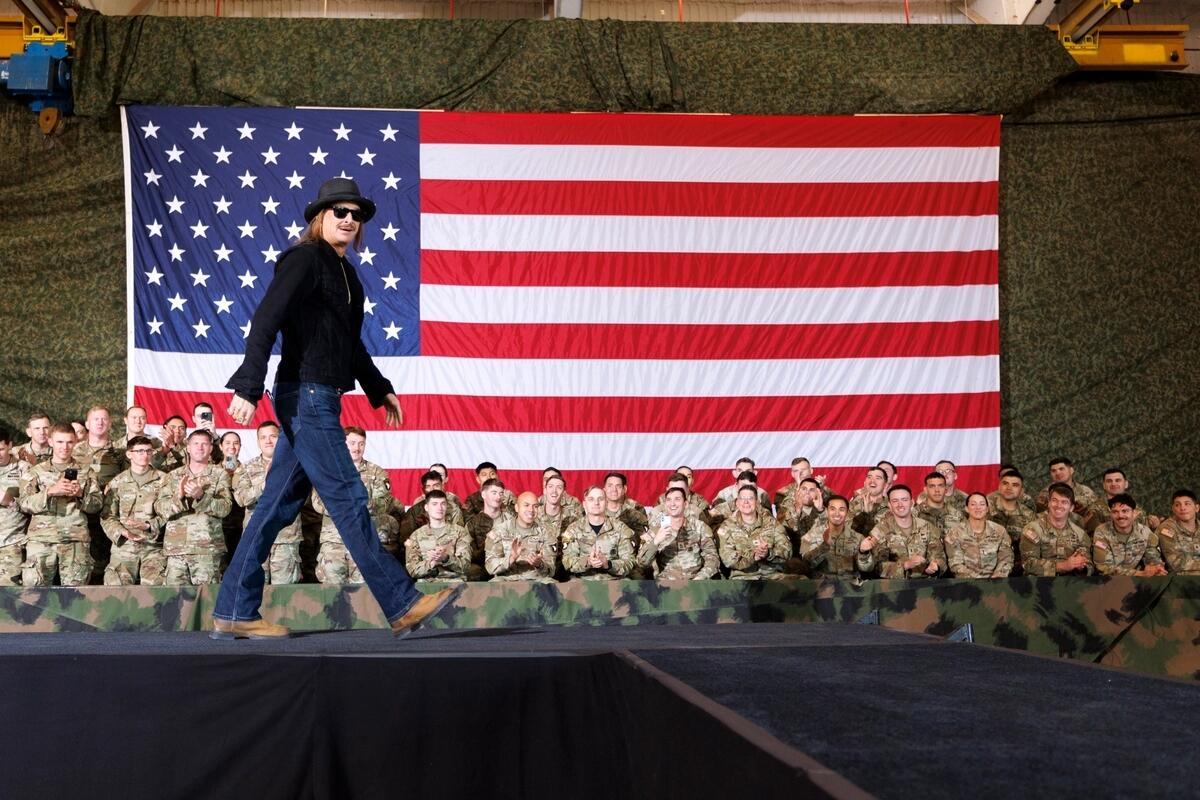
Two AH-64 Apache helicopter crews were suspended, then quickly unsuspended Tuesday after they hovered next to Kid Rock’s “Southern White House” home in Nashville on Saturday.

The long-time country rock musician posted a video of the fly-by on X, showing him clapping and saluting the helicopter crews, whose suspension was a discretionary step for an investigation, the Army said in a statement Tuesday.

Department of War Secretary Pete Hegseth pulled that suspension later the same day.

“Thank you [Kid Rock]. [U.S. Army] pilots suspension LIFTED. No punishment. No investigation. Carry on, patriots,” Hegseth wrote on X.

Prior to the secretary’s announcement, the army released a statement about the Saturday fly-by.

“The Army has confirmed that on March 28, two Apache helicopters from the 101st Combat Aviation Brigade at Fort Campbell conducted a flight in the Nashville area that has attracted public and media attention,” the Army said.

Kid Rock’s video on X, which he captioned with a grateful message to the U.S. military and a jab at California Gov. Gavin Newsom, has garnered more than 10 million views as of this publication.

Standing next to a replica of the Statue of Liberty, Kid Rock claps, salutes, and raises his fist as one of the helicopters hovers near his pool. The second helicopter can be seen zipping by in the background of a second video post on X.

Trump commented on the Army’s suspension of the crews, telling reporters in the Oval Office, “They probably shouldn’t have been doing it … You’re not supposed to be playing games.

“But I’ll take a look at it. You like Kid Rock? I like Kid Rock. Maybe they were trying to defend him—I don’t know.”

Kid Rock, whose real name is Robert James Ritchie, told a local Nashville station that it’s not uncommon for helicopters from nearby Fort Campbell to pass near his 27,000-square-foot mansion.

“I think they know this is a pretty friendly spot,” he told WKRN. “I’ve talked to some of these pilots. I’ve told them, ‘You guys see me waving when you come by the house?’ I’m like, ‘You guys are always welcome to cruise by my house, any time.’”

“If it makes their day a little brighter for their service to our country, protecting us, I think that’s a great thing.”

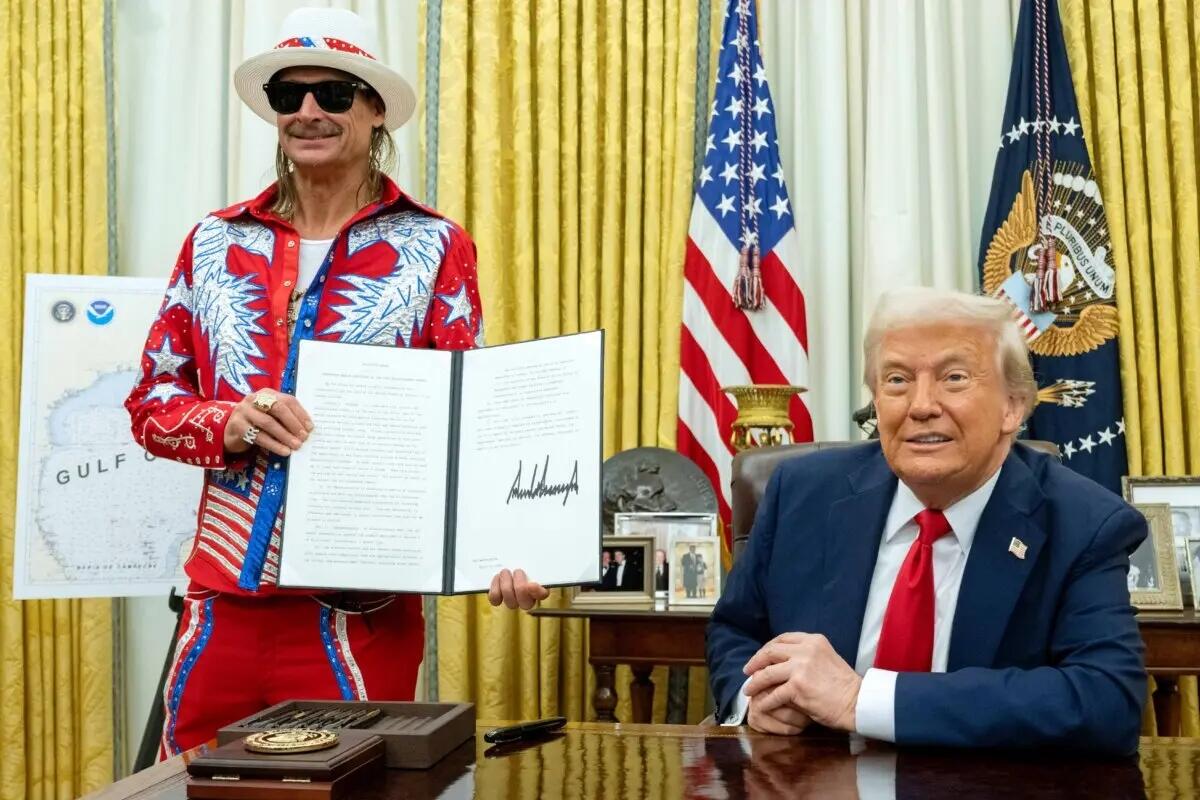
Singer Kid Rock holds an executive order signed by President Donald Trump in the Oval Office on March 31, 2025. Saul Loeb/AFP via Getty Images

When asked about possible repercussions for the pilots and rest of the crew, he said, “I think they’re going to be all right. My buddy’s the commander in chief.”

Kid Rock has openly befriended President Donald Trump and endorsed him for years, performing at multiple Republican events including the 2024 Republican National Convention and Turning Point USA’s alternative “All-American Halftime Show.”

As the Army continues its investigation, it said it will review the circumstances surrounding the day’s events, compliance with protocols, and approval requirements.

The helicopter crews were on a training mission when they stopped by Kid Rock’s “Southern White House” residence, Maj. Jonathan Bless, a public affairs officer for the 101st Airborne Division, said. They also flew over a “No Kings” protest against Trump that day, but their presence had nothing to do with the gathering, Bless added.

“Appropriate action will be taken if any violations are found. Until the review is complete, there will ​be no further comment,” a previous statement from the Army said.

Tyler Durden
Wed, 04/01/2026 – 08:25

via ZeroHedge News https://ift.tt/sBlVSAn Tyler Durden

ADP Employment Reports Shows Better Than Expected Job Gains, Accelerating Wages

ADP Employment Reports Shows Better Than Expected Job Gains, Accelerating Wages

Hiring and pay gains both held steady in March.

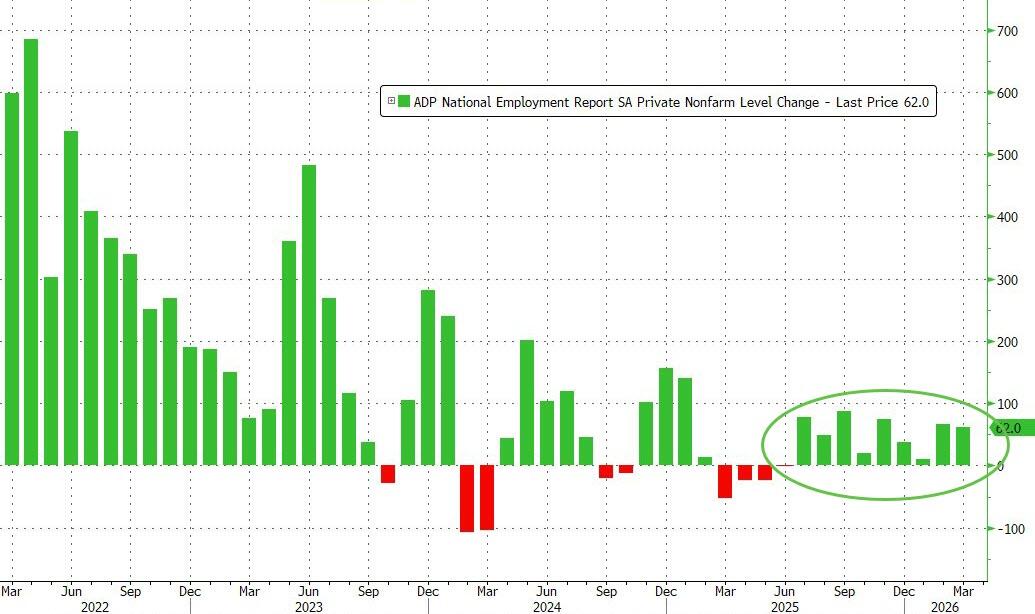
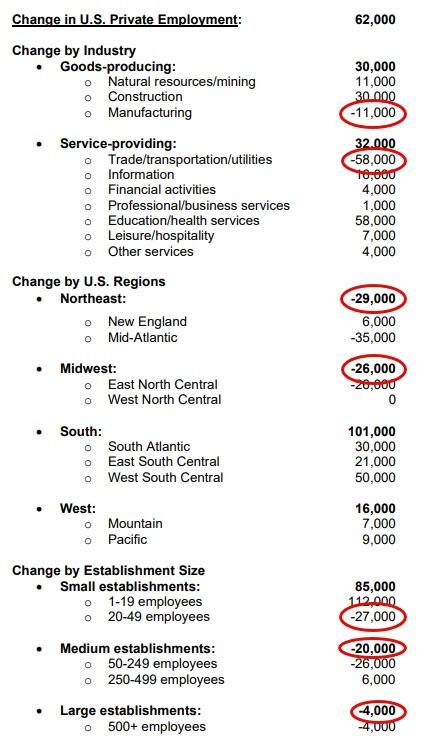
The ADP National Employment report printed a better than expected +62k jobs added in March (+40k exp) and modestly down from an upwardly revised 66k in February.

That is the ninth straight month of job gains.

Source: Bloomberg

The smallest employers drove job growth for a second month, while hiring in trade, transportation, and utilities continued to decline.

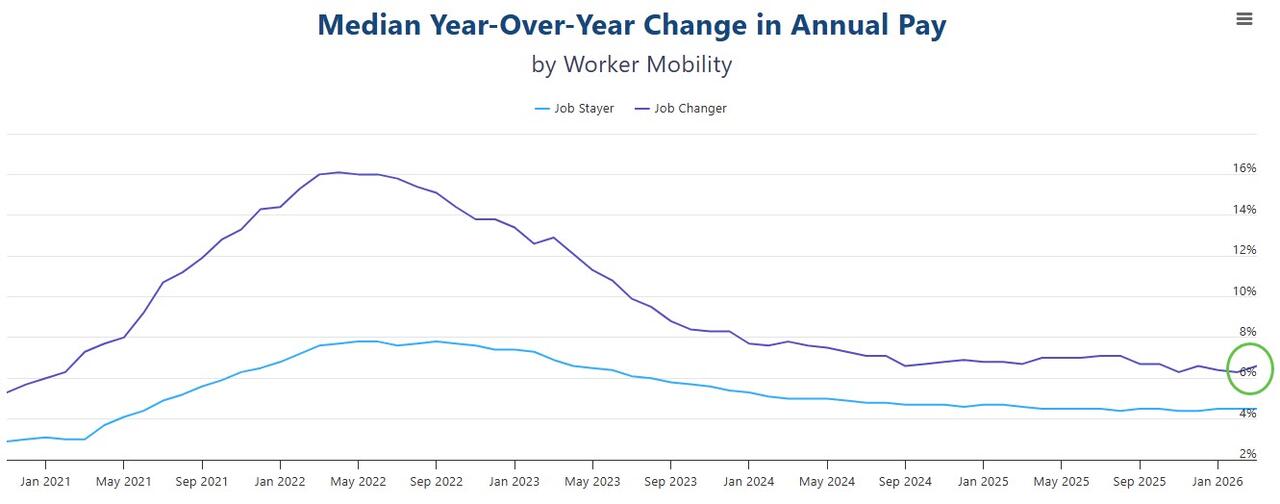
“Overall hiring is steady, but job growth continues to favor certain industries, including health care. In March, this solid performance was accompanied by a boost in pay gains for job-changers,” said Dr. Nela Richardson Chief Economist, ADP.

“In March, this solid performance was accompanied by a boost in pay gains for job-changers.”

Additionally, pay for job-stayers rose 4.5% in March Pay growth for job-stayers was unchanged for the third month. For job-changers, year-over-year pay gains accelerated to 6.6%…


Certainly no signs yet of the AI displacement as the no hire, no fire (after JOLTS and Claims) economy chugs along.

Tyler Durden
Wed, 04/01/2026 – 08:24

via ZeroHedge News https://ift.tt/Y3hFUvL Tyler Durden

UAE Poised To Join Anti-Iran Operations, As Trump Rips NATO ‘Paper Tiger’ – Says Exit ‘Beyond Reconsideration’

UAE Poised To Join Anti-Iran Operations, As Trump Rips NATO ‘Paper Tiger’ – Says Exit ‘Beyond Reconsideration’

Summary

  • UAE mulls becoming first Gulf country to directly joint US-Israeli war against Iran, lobbies for firm UNSC security resolution.

  • Trump open to exiting ‘paper tiger’ NATO after Iran war is over, angry over lack of help in Hormuz crisis.

  • Oil tanker leased to QatarEnergy was struck by an Iranian cruise missile in Qatari waters Wednesday.

  • IRGC has newly vowed to keep attacking with “full intensity and power” – suggesting this is far from over, as ceasefire talks remain theater lacking in much substance. Ayatollah praises Hezbollah in written statement.

*  *  *

First Gulf Country to Directly Join War?

The small but wealthy country of United Arab Emirates appears to be edging toward open confrontation, with Arab officials saying it is preparing to join the US and allied powers in forcibly reopening the Strait of Hormuz after absorbing Iranian strikes. If so, the move would mark the first time a Persian Gulf state formally enters the conflict as a combatant. Behind the scenes Abu Dhabi is reportedly pushing hard at the UN, lobbying for a Security Council resolution to legitimize military action, while simultaneously urging Washington and its European and Asian partners to assemble a coalition willing to act, according to The Wall Street Journal

At the same time, the UAE is quietly assessing what it can bring to the fight, from mine-clearing operations to broader logistical and naval support aimed at securing the vital shipping lane. But the ambitions don’t stop there, amid an opportunity to settle old grievances and a territory dispute. Gulf sources say the Emiratis are also floating a far more aggressive idea: that the US should seize key islands in the waterway, including Abu Musa – held by Iran for decades but claimed by the UAE.

However, the fine print is important here

Trump Mulls NATO Exit

In an interview with The Telegraph newspaper, the president described the alliance as “paper tiger” and, when asked if he would reconsider American membership in the bloc, Trump responded: “Oh yes, I would say [it’s] beyond reconsideration.”

“I was never swayed by NATO. I always knew they were a paper tiger, and Putin knows that too, by the way,” he said, in the remarks published Wednesday. He’s of course angry at refusal of allies to join a military campaign to force back open the Strait of Hormuz.

“Beyond not being there, it was actually hard to believe. And I didn’t do a big sale. I just said, ‘Hey’, you know, I didn’t insist too much. I just think it should be automatic,” he continued. “We’ve been there automatically, including Ukraine. Ukraine wasn’t our problem. It was a test, and we were there for them, and we would always have been there for them. They weren’t there for us.”

And here’s what Secretary of State Marco Rubio told Al Jazeera on Monday: “If NATO is just about us defending Europe if they’re attacked but then denying us basing rights when we need them, that’s not a very good arrangement. That’s a hard one to stay engaged in and say this is good for the United States.  So all of that is going to have to be reexamined.”

Anadolu/Getty Images

Oil Tanker in Qatari Waters Struck; Kuwait Airport Hit Again

A tanker leased to QatarEnergy was struck by an Iranian cruise missile in Qatari waters on Wednesday, in another escalation spilling directly into critical energy corridors. According to Qatar’s defense ministry, three missiles were launched from Iran, with two intercepted but the third slamming into the Aqua 1 fuel oil tanker. While there were no casualties and damage remained above the waterline, the hit came just 17 nautical miles off Ras Laffan, home to the world’s largest gas facility, as Reuters has detailed. Bloomberg has noted, “Since the start of the war in Iran, UKMTO has reported 16 attacks on vessels operating in the Persian Gulf, Strait of Hormuz and Gulf of Oman.”

Elsewhere, Kuwait reported a “large fire” at fuel tanks near its international airport following another Iranian strike. This marks the seventh time of the war that the international travel hub was hit, and the last time it took emergency crews well over two days to put out the fires.

The Pentagon continues moving thousands of Marines, Special Forces, and Airborne troops into the region. This is not enough for a full ground invasion force, but could be preparation for a campaign to cut Iran from its strategic islands, such as oil export hub Kharg Island…

Meanwhile, diplomacy continues to look like theater. Iranian Foreign Minister Abbas Araghchi said he has “no faith” in talks with Washington, confirming that while messages have been exchanged – but that “no negotiations are under way.” On the battlefield, Iran’s IRGC claims its latest barrage – spanning more than 100 heavy missiles, attack drones, and roughly 200 smaller rockets – hit targets across Israel and US military positions in the Gulf. Installations in Bahrain and Kuwait have also been hit, the group said, claiming that US helicopter was destroyed. The IRGC has newly vowed to keep attacking with “full intensity and power” – suggesting this is far from over.

Ayatollah Breaks Silence with Message Praising Hezbollah

The new, younger Ayatollah Khamenei – who may have been wounded in the early days of US-Israeli strikes, hasn’t been seen in any public way, not even on TV, throughout the war. There have not so much as been any official recent images of him circulated.

But Mojtaba Khamenei has apparently been issuing some limited written statements, mainly encouraging foreign proxies in their joining the war against US and Israeli forces in the region. State media has indicated he’s not making public appearances given the ongoing relentless bombing campaign and the Islamic Republic’s wartime footing.

The 56-year old Khamenei has on Wednesday praised Hezbollah for joining the war against Israel. Hezbollah has been launching hundreds of rockets on northern and central Israel, amid an emerging ground campaign in southern Lebanon, also as Israel bombs Beirut from the air. In the new words carried by Iranian state media, he praised Hezbollah for its “perseverance, steadfastness and patience” against “the most ruthless enemies of the Islamic world.”

Tyler Durden
Wed, 04/01/2026 – 08:05

via ZeroHedge News https://ift.tt/J8MlmRq Tyler Durden

EEOC May Subpoena Penn’s Records as to “Jewish-Related Organizations” (and Others) in Investigation of Anti-Semitic Harassment at Penn

From Judge Gerald Pappert (E.D. Pa.) yesterday in EEOC v. Univ. of Pa.:

Based on public statements by the University of Pennsylvania’s president and others affiliated with the school that individuals had been subject to antisemitism on Penn’s campus, United States Equal Employment Opportunity Commissioner Andrea K. Lucas issued in December of 2023 a charge that Penn engaged in a pattern or practice of harassment of Jewish employees in violation of Title VII of the Civil Rights Act of 1964. In July of 2025, the EEOC issued an administrative subpoena to gather evidence relevant to that charge.

The EEOC viewed this as a “garden variety” use of one of its common investigative methods, where it seeks contact information for possible victims of the employer’s alleged misconduct or witnesses thereto. But unlike investigations into, for example, sexual harassment or racial discrimination, the subpoena sought information pertaining to people’s faith, making its requests more intrusive and calling for greater sensitivity, something the EEOC now acknowledges.

One of those requests in particular sought, among other things, lists of school groups and organizations “related to the Jewish religion,” including personal contact information for Penn employees in those groups. Though ineptly worded, the request had an understandable purpose—to obtain in a narrowly tailored way, as opposed to seeking information on all university employees, information on individuals in Penn’s Jewish community who could have experienced or witnessed antisemitism in the workplace. Penn resisted the subpoena on various grounds and when the parties could not resolve their differences, the EEOC filed this subpoena enforcement action.

Penn and other groups and associations the Court permitted to intervene significantly raised the dispute’s temperature by impliedly and even expressly comparing the EEOC’s efforts to protect Jewish employees from antisemitism to the Holocaust and the Nazis’ compilation of “lists of Jews.” Such allegations are unfortunate and inappropriate. They also obfuscate the Court’s limited role and the discrete legal issues before it. And the EEOC no longer seeks any employee’s specific affiliation with a particular Jewish-related organization on campus….

The EEOC’s subpoena … seeks, among other things, (1) the names of employees who reported antisemitic harassment to Penn; (2) the Jewish-related organizations on campus and the private contact information (personal phone number, email address and mailing address) of the employee members in each organization; (3) the private contact information of employees in Penn’s Jewish Studies Program; (4) the private contact information of employees who participated in Penn’s March 2024 listening sessions on antisemitism; and (5) the private contact information of employees who received a Penn survey on antisemitism.

The court rejected (among other things) the argument that the subpoena unconstitutionally interfered with employees’ privacy:

Penn argues the affected employees have a [constitutionally protected] privacy interest in (1) their mailing addresses and personal phone numbers and (2) the fact that they participated in Penn’s listening sessions on antisemitism and received a Penn survey on antisemitism. But this information is unlike a person’s medical records, prescription medications, HIV diagnosis, sexual identity, or debts and salary [citing cases related to each -EV]. While such materials may reveal “intimate facts of a personal nature,” mailing addresses, phone numbers, participation in a campus event and receipt of a school survey do not….

Penn also argues its employees have a privacy interest in the fact that they have affiliations with Jewish-related organizations on campus and the Jewish Studies Program. But Penn does not show that this information is even private. Information is private if it is “general[ly] unavailab[le]” and a person “treat[s]” it as “confidential.” Penn offers no argument as to whether its employees’ mere affiliation with Jewish-related organizations and the Jewish Studies Program is generally unavailable, or whether the employees treat this information as confidential. And as the EEOC points out, the Jewish Studies Program lists its faculty and staff members’ names and pictures on its public-facing website. Penn doesn’t respond to this. {The EEOC cannot rely on the work contact information of employees listed on the Jewish Studies Program’s website. It seeks the employees’ personal information because it wishes to contact them without Penn monitoring any communications.}

Finally, respondents argue the affected employees have a privacy interest in both their private contact information and the fact that they are in some Jewish-related organization on campus because disclosure will create a “serious safety risk.” Information may be protected if disclosure threatens “personal security.” In Kallstrom v. City of Columbus (6th Cir. 1998), for example, three undercover officers testified against gang members in a criminal case. During trial, the City of Columbus disclosed the officers’ names and addresses along with the names and addresses of the officers’ relatives. Because the gang had a “propensity for violence” and would “likely … seek revenge,” the Sixth Circuit held substantive due process protected the officers’ personal information.

Respondents offer no evidence to show enforcement of the subpoena would create a “substantial risk of serious bodily harm.” They refer first to Nazi Germany. Penn, for example, argues “allowing regimes to collect lists of Jewish people has not boded well for their safety.” And the intervenors assert the EEOC seeks to “establish a central registry of the University’s Jews” which may result in “frightening implications” based on “historical echoes.” But comparing the EEOC’s investigation into antisemitism at Penn with Nazi Germany is counterproductive, as counsel acknowledged by attempting to backtrack from such analogies.

Respondents next believe the EEOC may publicly disclose the affected employees’ information which may lead to acts of private violence. But … respondents offer no evidence to show a reasonable probability the affected employees’ information will become public. And they offer no evidence to show that, if their information did become public, the affected employees would face a credible risk of harm. They state the Nation’s “political environment” is “saturated with unvarnished hate, including antisemitism.” But this “generalized” statement “fall[s] well short of the [requisite] substantial, direct, and individualized risk of bodily harm.” …

Title VII protects against “unauthorized disclosure” of the information. A “statutory penalty for unauthorized disclosures” is sufficient to safeguard employee information submitted to the Government. Under Title VII, it is “unlawful for any officer or employee of the Commission to make public in any manner whatever any information obtained by the Commission pursuant to its authority … prior to the institution of any proceeding … involving such information.” …

Penn argues the EEOC is “not immune to data breaches.” But “data breaches are a possibility any time the Government stores information.” NASA v. Nelson (2011). The “mere possibility that security measures will fail provides no proper ground for a broad-based attack on government information-collection practices.”

Respondents also argue the Department of Government Efficiency coerced the Social Security Administration to share private information with it in violation of federal law. Given this, they suggest DOGE may coerce the EEOC to share the affected employees’ information.  There is no evidence to support this argument. Nothing in the record shows how DOGE coerced the Social Security Administration to share information, what information the Social Security Administration shared or what federal law the Social Security Administration violated. The Court has no grounds upon which to conclude respondents have a reasonable justification for its purported fears.

The intervenors also argue the current presidential administration has “made an unprecedented push to share data across the federal government,” and in support, cite a March 2025 executive order. The order directs agency heads to, consistent with law, ensure that federal officials designated by the President or agency heads shall have access to, among other things, unclassified agency records and data. Nothing indicates the EEOC is required to share information it gathers during an investigation with other federal agencies.

Finally, the intervenors argue the affected employees’ information may “fall into the wrong hands” within the Government because two online articles reported that current administration officials have ties to antisemites. National Public Radio, for example, reported that a White House official worked on Andrew Tate’s legal team and attended a Nick Fuentes rally. And the New York Times reported this same official said in a text message that he had a “Nazi streak.” These are unserious political arguments, not serious legal ones which, as counsel admitted, undercut her position.

For similar reasons, the court rejected the argument that “the subpoena infringes the affected employees’ right to associate with Jewish-related organizations on campus”:

Respondents believe enforcement of the subpoena would make the affected employees less likely to participate in the Jewish-related organizations on Penn’s campus to which they belong…. [But even if this requires that the subpoena decision be judged under “exacting scrutiny,”] the EEOC satisfies it.

Under exacting scrutiny, there must be a substantial relation between the subpoena and an important governmental interest, and the governmental interest must “reflect the seriousness of the actual burden” imposed on the affected employees. The subpoena must also be narrowly tailored to the interest it promotes.

The EEOC has an important interest in investigating the charge of discrimination. When the EEOC issues a subpoena pursuant to a valid pattern-or-practice charge, it acts in the public interest to investigate allegations of systemic discrimination in the workplace.

There is a substantial relation between the EEOC’s interest and its subpoena. Commissioner Lucas alleges Penn subjected Jewish faculty, staff and other employees to a hostile work environment based on religion. The subpoena seeks contact information for employees in Jewish-related organizations because they are reasonably likely to have information relevant to the charge.

The EEOC’s interest reflects the actual burden imposed on the affected employees’ ability to associate with Jewish-related organizations on campus. The EEOC is no longer asking Penn to disclose any affected employee’s membership in a particular organization. In compelled-disclosure cases, the Government usually compels organizations to reveal information about their members or supporters. Or the Government might compel an individual to disclose the particular organizations to which he belongs or supports. That is no longer the case here.

Thus, while respondents assert that disclosing an employee’s membership in a specific Jewish-related organization may reveal whether he or she is a Zionist or an anti-Zionist, or whether he or she supports or opposes specific political positions, these burdens are misplaced. Because information provided in response to the subpoena will not reveal any employee’s affiliation with a specific organization, it does not impose a burden akin to the one imposed in the typical compelled-disclosure scenario.

Next, the subpoena does not require Penn to publicly disclose the affected employees’ information, which “reduce[s] the burden” imposed. And as explained, respondents fail to show a reasonable probability the EEOC will disclose the information to the public….

The intervenors propose two alternatives that they assert would address, in equal measure, the EEOC’s interest in investigating Commissioner Lucas’s charge. They contend Penn could tell its employees of the EEOC’s investigation and provide them with contact information for the EEOC. Or, they argue, the EEOC could invite Penn employees to contact it through a hotline.

These alternatives are “inadequate.” The first forces the EEOC to speak through Penn. “Messages from [the] EEOC to employees filtered through an employer always risk creating confusion, fear, and mistrust among recipients.” And the EEOC makes a valid point when it says the proposal is “unlikely to yield” any reports of harassment because there is a significant risk employees will be less likely to approach the EEOC if they are told to do so by their employer.

Both proposals, moreover, prohibit the EEOC from contacting potential victims or witnesses of harassment directly. Putting the burden on employees to come forward on their own defeats the point of a commissioner’s charge of discrimination. Commissioner Lucas issued the charge based on publicly available information, so employees did not have to come forward and accuse Penn of wrongdoing.

The EEOC seeks to investigate the charge by contacting potential victims or witnesses of harassment and informing them of their rights. Employees may refuse to participate in the investigation, but the EEOC needs the opportunity to talk to them directly to learn if they have evidence of discrimination….

And the court rejected, for similar reasons, the claims that the subpoena would violate academic freedom, the Religious Freedom Restoration Act, or the Free Exercise Clause.

Debra M. Lawrence represents the EEOC.

The post EEOC May Subpoena Penn's Records as to "Jewish-Related Organizations" (and Others) in Investigation of Anti-Semitic Harassment at Penn appeared first on Reason.com.

from Latest – Reason.com https://ift.tt/TPQxGFK
via IFTTT