Recent Books on the Constitution

Each fall, I teach a seminar called Recent Books on the Constitution. I initially designed this course when I visited Georgetown in 2005. At that time, because I tend to read what relates directly to my current projects, I felt that I was not keeping up with the literature. By assigning recent books on the Constitution to read as part of my teaching, I would actually read them. This has really worked for me. I have now read a lot of books on the Constitution. The complete list of all the books I have assigned is below.

Since 2005, I have assigned 105 books by 96 authors, with James Fleming, Sandy Levinson, Gerard Magliocca, Eric Segall, Dan Farber, Jonathan Gienapp, Philip Hamburger, Kim Roosevelt, and David Bernstein each making more than one appearance. Over the years, I assigned four books in manuscript before publication. In addition to my manuscript of the book I am now writing on libertarianism, here are the five “recent books on the Constitution” I am assigning for fall of 2026:

I select books I think I ought to read–either because of the subject or the author. I then hold off reading them myself so I can read them at the same time as the students. This enables me to react to the books along with them, and for me to remember the nuances of the books for class discussion.

The seminar format is to read 6 books, taking 2 weeks on each book, with the author coming to the class during the second week to discuss the book. The first book is now always one of mine to use as a trial run and to give the students an idea of where I am coming from when we discuss the other books. When books are longer than 250 pages, I ask the author to tell me which 250 pages I should assign. If I assign much more than 125 pages per week, I fear the students won’t read them, or won’t read them carefully enough. To help assure that they do, students submit one-page summaries of each half of the book (graded pass-fail). On the day before the author’s visit, they submit a 5500 character critique of the book, which I send to the author electronically the day before class. (They all read them.) When the class ends, there is no exam or paper for the students to write or for me to grade. We are done!

Students consistently tell me that the course is extremely enriching, and helps them develop their critical skills. They are never expected to read whole books and rarely asked to concisely formulate their own objections to scholarship. It is also empowering for them to see how well they are able to find the holes in a professor’s book-length presentation. I find that, collectively, the students are able to nail the weaknesses of every book (except mine, of course).

[Note to law professors: I have a budget to pay for the authors’ travel expenses. But now that we all have access to Zoom teaching, this seminar format can be replicated anywhere at zero cost. Wouldn’t it be great if there were a dozen or more such book seminars around the country? Try it. I promise you will love it.]

If you click on READ MORE you will see why teaching this class has been enormously rewarding for me. Offer my heartfelt thanks to all these authors for trekking to DC to discuss their books with my students.


2025

2024

2023


2022:

2021:

  • Ilan Wurman, The Second Founding: An Introduction to the 14th Amendment (2020)
  • Stephen Halbrook, The Right to Bear Arms: A Constitutional Right of the People or a Privilege of the Ruling Class? (2021)
  • Donald Drakeman, The Hollow Core of Constitutional Theory: Why We Need the Framers (2021)
  • Jamal Greene, How Rights Went Wrong: Why Our Obsession With Rights is Tearing America Apart (2021)
  • David Schwartz, The Spirit of the Constitution: John Marshall and the 200-Year Odyssey of McCulloch v. Maryland (2019)

2020:

2019:

  • Neal Devins, The Company They Keep: How Partisan Divisions Came to the Supreme Court (2019)
  • Larry Lessig, Fidelity & Constraint: How the Supreme Court Has Read the American Constitution (2019)
  • Jonathan Gienapp, The Second Creation: Fixing the American Constitution in the Founding Era (2018)
  • Rebecca Zietlow, The Forgotten Emancipator: James Mitchell Ashley and the Ideological Origins of Reconstruction (2017)
  • Lee Strang, Originalism’s Promise: A Natural Law Account of the American Constitution (2019)

2018:

  • Martha Jones, Birthright Citizens: A History of Race and Rights in Antebellum America (2018)
  • John Compton, The Evangelical Origins of the Living Constitution (2014)
  • Josh Chafetz, Congress’s Constitution: Legislative Authority and the Separation of Powers (2017)
  • Adam Carrington, Justice Stephen Field’s Cooperative Constitution of Liberty: Liberty in Full (2017)
  • Gerard Magliocca, The Heart of the Constitution: How the Bill of Rights became the Bill of Rights (2018)

2017:

  • Barry Friedman, Unwarranted: Policing Without Permission (2017)
  • Bruce Frohnen & George Carey, Constitutional Morality and the Rise of Quasi-Law (2016)
  • Geoffrey R. Stone, Sex and the Constitution (2017)
  • Suja Thomas, The Missing American Jury (2016)
  • Thomas G. West, The Political Theory of the American Founding (2017)

2016:

  • Carson Holloway, Hamilton versus Jefferson in the Washington Administration: Completing the Founding or Destroying the Founding? (2015)
  • Michael Paulsen & Luke Paulsen, The Constitution: An Introduction (2015)
  • Thomas Leonard, Illiberal Reformers: Race, Eugenics, and American Economics in the Progressive Era (2016)
  • Tara Smith, Judicial Review in an Objective Legal System (2015)
  • Ilya Somin, The Grasping Hand: Kelo v. City of New London and the Limits of Eminent Domain (2015)

2015:

  • Damon Root, Over Ruled: The Long War for the Control of the U.S. Supreme Court (Palgrave 2014)
  • F.H. Buckley, The Once and Future King: The Rise of Crown Government in America (Encounter 2014)
  • Brad Snyder, The House of Truth (Oxford 2017) (assigned ms)
  • Stephen Garbaum, The New Commonwealth Model of Constitutionalism (Cambridge 2013)
  • Laura Donohue, The Future of Foreign Intelligence (Chicago 2016) (assigned ms)

2014:

  • Clark Neily, Terms of Engagement: How Our Courts Should Enforce the Constitution’s Promise of Limited Government (Encounter 2013)
  • Thomas Healy, The Great Dissent: How Oliver Wendell Holmes Changes His Mind – and the History of Free Speech in America (Metropolitan Books, 2013)
  • John McGinnis & Michael Rappaport, Originalism and the Good Constitution (Harvard 2013)
  • Stephen Griffin, Long Wars and the Constitution (Harvard 2013)
  • Garrett Epps, American Epic: Reading the U.S. Constitution (Oxford 2013)
  • Louis Michael Seidman, On Constitutional Disobedience (Oxford 2012)

2012 (Fall):

  • Gerard Magliocca, John Bingham: America’s Founding Son (NYU, 2013) (assigned ms)
  • Akhil Reed Amar, America’s Unwritten Constitution (Basic Books, 2012)
  • John Inazu, Liberty’s Refuge: The Forgotten Freedom of Assembly (Yale 2012)
  • Justice Antonin Scalia, Reading Law: The Interpretation of Legal Texts (West, 2012)
  • Abner Greene, Against Obligation (Harvard 2012)
  • Sandy Levinson, Framed: America’s 51 Constitutions and the Crisis of Governance (Oxford 2012)

2012 (Spring)

  • Michael J. Gerhardt, The Power of Precedent (Oxford 2008)
  • Robert Bennett & Lawrence Solum, Constitutional Originalism (Cornell 2011)
  • Gary L McDowell, The Language of Law & the Foundations of American Constitutionalism (Cambridge 2010)
  • Eric Segall, Supreme Myths: Why the Supreme Court Is Not a Court and Its Justices Are Not Judges (Praeger 2012)
  • Michael Greve, The Upside-Down Constitution (Harvard 2012)
  • Alexander Tsesis, The Thirteenth Amendment and American Freedom (NYU 2004)

2011:

  • H. Jefferson Powell, Constitutional Conscience (Chicago, 2008)
  • Jeremy A Rabkin, Law Without Nations? (Princeton, 2005)
  • Christian G. Fritz, American Sovereigns (Cambridge, 2007)
  • Timothy Sandefur, The Right to Earn a Living (Cato Institute, 2010)
  • Sonu Bedi, Rejecting Rights (Cambridge, 2009)
  • Alison LaCroix, The Ideological Origins of American Federalism (Harvard, 2010)

2010:

  • David Bernstein, Rehabilitating Lochner (Chicago 2011) (assigned ms)
  • Brian Tamanaha, The Formalist-Realist Divide: The Role of Politics in Judging (Princeton, 2009)
  • Earl Maltz, Slavery and the Supreme Court, 1825-1861 (Kansas, 2009)
  • Michael Vorenberg, Final Freedom: The Civil War, the Abolition of Slavery, and the Thirteenth Amendment (Cambridge, 2004)
  • George Thomas,The Madisonian Constitution (Johns Hopkins, 2008)
  • David Strauss, The Living Constitution (Oxford, 2010)

2007:

  • Alex Aleinikoff, Semblances of Sovereignty: The Constitution, the State, and American Citizenship (Harvard, 2002)
  • Dan Farber, Retained by the People: The “Silent” Ninth Amendment and the Constitutional Rights Americans Don’t Know They Have (Perseus, 2007)
  • Jim Fleming, Securing Constitutional Democracy: The Case of Autonomy (Chicago, 2006)
  • Mark Graber, Dred Scott and the Problem of Constitutional Evil (Cambridge, 2006)
  • Keith Whittington, Political Foundations of Judicial Supremacy: The Presidency, the Supreme Court, and Constitutional Leadership in U.S. History (Princeton, 2007)

2006:

  • Philip Hamburger, Separation of Church and State (Harvard, 2002)
  • Kermit Roosevelt, The Myth of Judicial Activism: Making Sense of Supreme Court Decisions (Yale, 2006)
  • Elizabeth Price Foley, Liberty for All: Reclaiming Individual Privacy in a New Era of Public Morality (Yale, 2006)
  • John Yoo, The Powers of War and Peace : The Constitution and Foreign Affairs after 9/11 (Chicago, 2005)
  • Sanford Levinson, Our Undemocratic Constitution: Where the Constitution Goes Wrong (and How We the People Can Correct It) (Oxford, 2006)

2005 (Taught when I was a visitor at Georgetown. Only Mark Tushnet, who was then still on the Georgetown faculty, appeared. His class visit gave me the idea to invite all the authors in the future):

  • Mark Tushnet, Taking the Constitution Away from the Courts (Princeton, 2000)
  • Cass R. Sunstein, One Case at a Time: Judicial Minimalism on the Supreme Court (Harvard, 2001)
  • Larry D. Kramer, The People Themselves: Popular Constitutionalism and Judicial Review (Oxford, 2004)
  • Daniel A. Farber, Suzanna Sherry, Desperately Seeking Certainty: The Misguided Quest for Constitutional Foundations (Chicago, 2004)
  • James R. Stoner, Common Law Liberty: Rethinking American Constitutionalism (Kansas, 2003)

The post Recent Books on the Constitution appeared first on Reason.com.

from Latest – Reason.com https://ift.tt/zG1wKjS
via IFTTT
The Left’s Reaction To Arrest Of The Latest UK Stabbing Is As Predictable As It Is Disgraceful

The Left’s Reaction To Arrest Of The Latest UK Stabbing Is As Predictable As It Is Disgraceful

Authored by Paul Birch via DailySceptic.org,

These people have never been in a life-or-death situation like the arresting officers

One would think that even when the police successfully detain a suspect who was alleged to have been conducting a marauding knife attack, the professional activists would have a day off.

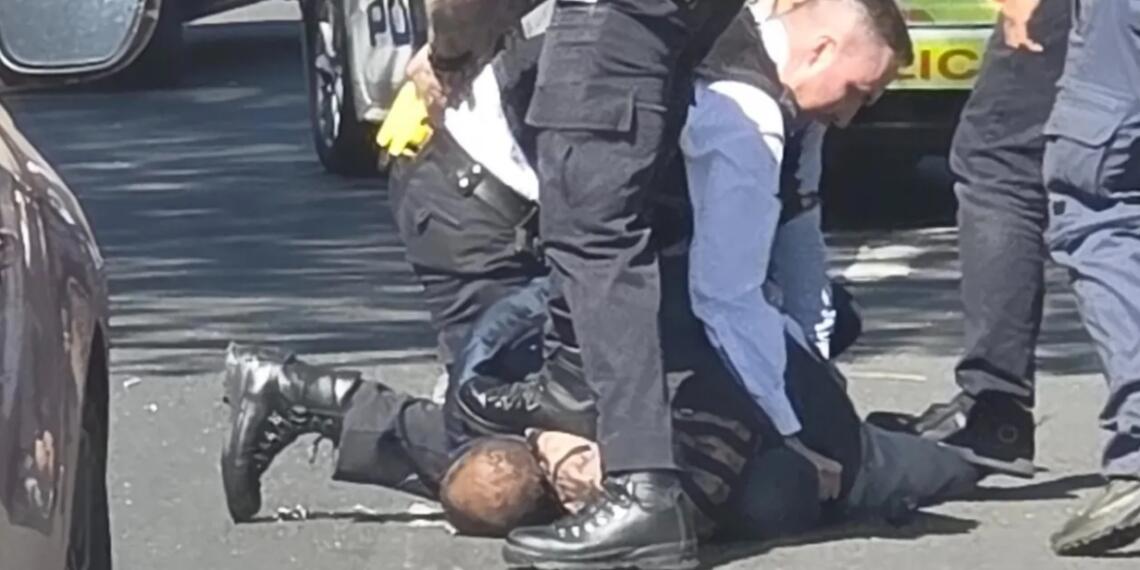
But you would be wrong. Amid all the ‘Don’t Look Back in Anger’ cliché bingo, voices of criticism were heard. Among them, the blue-tick career race-baiter Shola Mos-Shogbamimu. She was quick to take to X following yesterday’s attack on the Jewish community in Golders Green, north London. The 45 year-old suspect, a British national of Somali origin, had reportedly stabbed two Jewish men at random. The suspect – depressingly, inevitably – had previously been referred to the Government’s counter radicalisation programme, Prevent.

Shola Mos-Shogbamimu criticised police officers who are shown kicking the suspect in the head while he is on the ground. She opined:

Contemptible abuse of police power. Why kick him in the head several times when he’s already Tasered and in your control? Should he not be alive to be brought to justice in a court of law for stabbing two Jews??!! Disgusting.

Also, Green Party leader Zack Polanski, still playing at politics, was quick to condemn the actions of the arresting officers, using a retweet to maintain that:

Essentially his (Commissioner Mark Rowley’s) officers were reportedly and violently kicking a mentally ill man in the head when he was already incapacitated by taser.

What Shola, Zack and other commentators do not understand – because they have never been in a life-or-death situation – is that force is not judged by how it looks in a six-second clip. It is judged by necessity in the moment. These keyboard warriors have no idea what it’s like to face immediate and possibly lethal violence armed with often nothing more than some irritant spray and a stick. Your priority is to keep members of the public safe, followed by yourselves as much as possible.

These officers would have had no idea in such a fast moving situation whether the suspect was acting alone or as part of a cell. He needed to be neutralised as soon as possible in order to keep people safe. He wasn’t showing his hands; he was still holding a bloodied weapon that he had just used to attack Jewish members of the public; he had been moving rapidly towards them, and they would have had no idea if he was wearing an explosive vest (wearing a coat on a warm day is never a good sign).

Policing is not theatre. It is not performed for social media approval. It is messy, fast and often brutal. Because the people officers deal with are messy, fast and often brutal. A man armed with a knife who has already stabbed two people, who refuses repeated commands to disarm and who continues to pose a threat even after being tasered, is not “under control”. He is an active danger until the weapon is removed. That is the reality, no matter how uncomfortable it makes Left-leaning commentators feel.

The idea that officers should politely wait or somehow apply ‘gentler’ tactics while a suspect still has the capacity to kill is not just naïve in the extreme, it is dangerous. It puts officers’ lives at risk. It puts the public at risk. And it reveals a complete detachment from reality (I am reminded of the occasion when then Labour Party leader, Jeremy Corbyn, declared that Islamic State murderer Mohammed ‘Jihadi John’ Emwazi should have been arrested in war-torn Syria rather than killed.)

This is the gap at the heart of modern public debate on policing. One side deals in real-world consequences. The other deals in optics. The officers in Golders Green had seconds to act. Not minutes. Not the luxury of hindsight, slow-motion replays or viral commentary. Seconds. In those seconds they made unquestionably the right decision: remove the threat as quickly as possible, by whatever means necessary short of lethal force. And that point matters. Because the same voices now condemning ‘excessive force’ would be the first to demand answers if those officers had hesitated and others had been stabbed.

There is also an uncomfortable truth that many would rather avoid: this attack was not just violent, it was targeted. Two visibly Jewish men were attacked in broad daylight in a part of London with a large Jewish community. That context matters. It should matter. It’s part of an ever growing pattern of antisemitic attacks carried out by people holding extreme Islamist ideologies.

Yet instead of sustained outrage about antisemitic violence, the conversation was almost immediately derailed, redirected toward the conduct of the officers who stopped it. That inversion of priorities is telling.

It reflects a culture where the instinct is no longer to back those who confront violence but to scrutinise them first, and often most harshly. Where the benefit of the doubt is extended to offenders, those enforcing the law are expected to meet an impossible standard of perfection under extreme pressure – often from their own senior management.

And it is precisely this culture that erodes effective policing. If every split-second decision is second guessed by people with no operational understanding, officers will become more hesitant. More risk-averse. Less pro-active. That is not compassion. It is a recipe for more victims.

None of this means police should be beyond scrutiny. Of course they shouldn’t be. But scrutiny requires context. It requires full evidence. It requires intellectual honesty. A selectively edited clip on social media is not scrutiny. It is propaganda. That is the real issue here.

Not just one commentator getting it wrong, but an entire ecosystem that rewards outrage over accuracy, speed over truth and narrative over fact. The Metropolitan Police, to their credit, did something increasingly necessary: they put out the full body-worn footage. They showed the public what actually happened. And when people saw the complete picture, the narrative collapsed. Because reality is stubborn like that.

In the end, strip away the noise and the incentives of social media and the situation becomes very simple. A violent attacker stabbed two innocent men. Two unarmed officers confronted him. They stopped him. They went home alive, and so did everyone else.

That is not a scandal. That is policing working exactly as it should.

Tyler Durden
Sun, 05/03/2026 – 09:20

via ZeroHedge News https://ift.tt/DarMqfG Tyler Durden

Visualizing Europe’s Birth-Rate Collapse

Visualizing Europe’s Birth-Rate Collapse

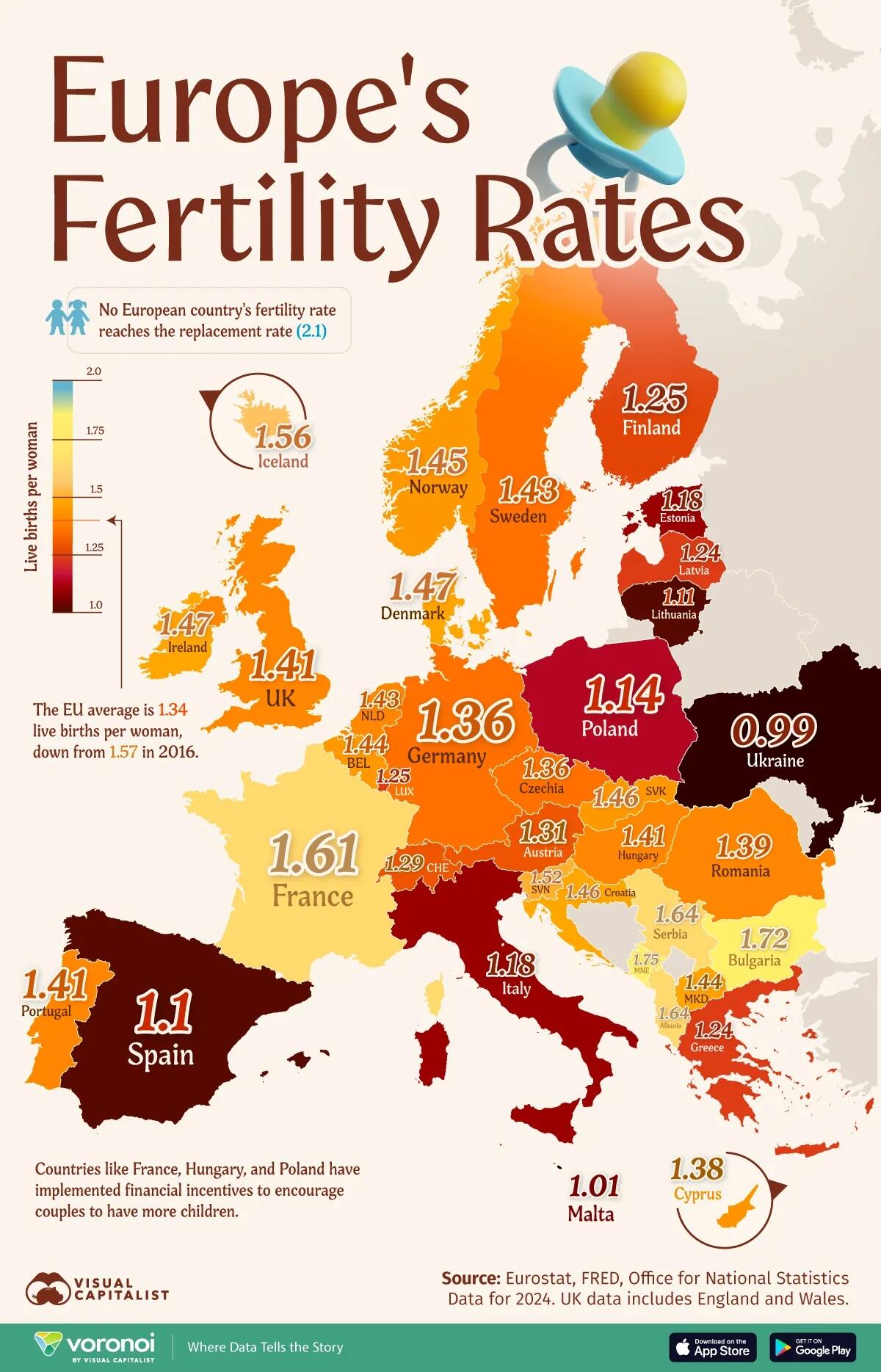
Europe’s population is no longer replacing itself.

Across the continent, fertility rates have fallen below the 2.1 births per woman needed to maintain stable population levels, with no country meeting that threshold as of 2024.

The map below, via Visual Capitalist’s Gabriel Cohen, shows the number of live births per woman across Europe using the most recent data from EurostatFRED, and the UK’s Office for National Statistics.

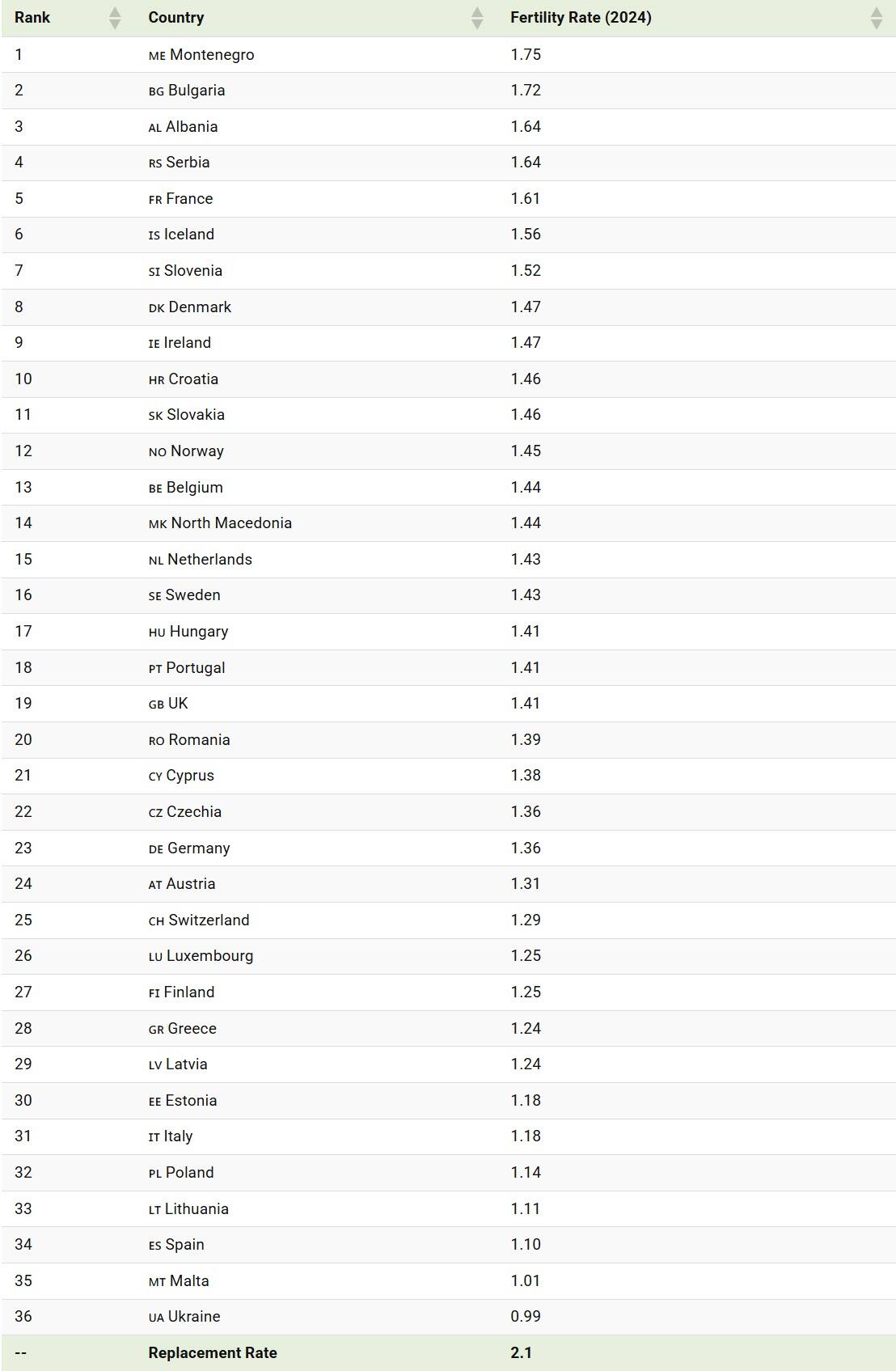
From Ukraine (0.99) to Spain (1.1), some of Europe’s largest countries now rank among those with the lowest birth rates, highlighting how widespread the decline has become.

Fertility Crisis in South and Eastern Europe

Europe’s lowest birth rates are concentrated in the east and south, where economic strain and geopolitical instability have accelerated long-term declines.

Ukraine has seen the sharpest drop. Its fertility rate, which last exceeded the replacement level in 1986, fell to 0.9 in 2022 before recovering slightly to 0.99 in 2024.

Among countries at peace, Malta has one of the lowest fertility rates at 1.01, followed by Spain (1.1) and Poland (1.14).

This data table lists European countries alongside their fertility rates as of 2024.

Lower fertility in countries like Spain and Poland reflects a mix of economic pressures, including lower wages and the rising cost of raising children, alongside broader trends seen across developed economies.

Aging populations are already reshaping national priorities. As Poland seeks to build a larger military, its shrinking population presents a strategic vulnerability.

Europe’s Fertility Woes

This trend extends across the continent. Europe’s largest economies, including Germany (1.36), the UK (1.41), France (1.61), and Italy (1.18), all remain well below replacement levels.

Even countries with relatively higher fertility rates, such as Bulgaria (1.72) and Montenegro (1.75), are not producing enough births to stabilize their populations.

One response has been increased immigration. In Germany, migration policy in the mid-2010s was shaped partly by the need to support the country’s labor system. However, this approach has also fueled political backlash and the rise of anti-immigration parties.

Family Incentives As A Solution?

Some countries are attempting to boost birth rates through financial incentives. France, Hungary, and Poland have introduced tax credits, subsidies, and other programs aimed at encouraging larger families.

Hungary, for example, has spent over a decade expanding benefits for young couples, with the goal of reaching the 2.1 replacement rate by 2030.

So far, the results have been limited. Hungary’s fertility rate of 1.41 is similar to countries like the UK and Portugal, suggesting that financial incentives alone may not reverse the broader trend.

To learn more about this topic, check out the Which European Nations Have the Best Fertility Treatment Policies? on Voronoi.

Tyler Durden
Sun, 05/03/2026 – 08:45

via ZeroHedge News https://ift.tt/FVz4yYd Tyler Durden

“Punctuation Matters. At the Heart of This Case Is the Placement of a Comma”

Thanks to Wikipedia for the koala photo.

From Remus Enterprises 1, LLC v. Breece, decided Thursday by the D.C. Court of Appeals (Judge Shanker, joined by Judges Easterly and Ruiz):

Punctuation matters. At the heart of this case is the placement of a comma. Appellant Remus Enterprises 1, LLC (“Remus 2023”) sued appellee Quinn Breece in Superior Court asserting tort claims arising out of Remus 2023’s alleged ownership of, and desire to sell, a parcel of property located at 3308 16th Street, NE, in Washington, D.C. But a consent judgment in another case established that a different entity with a name containing all the same words and letters but a differently placed comma—Remus Enterprises, 1 LLC (“Remus 2018”)—was the real owner of the property. Because Remus 2023 does not have standing to sue based on a different entity’s property interest, we conclude that the trial court lacked subject-matter jurisdiction over the case, and we affirm the trial court’s dismissal of Remus 2023’s complaint, although on grounds different from those relied on by the trial court….

The consent judgment in this case intended to conclusively settle the issue of who purchased, owned, and contracted to sell the 16th Street property. First, the text of the consent judgment supports this conclusion. It makes specific “factual findings,” related to that issue: that (1) Remus 2018 purchased the 16th Street property in February 2023; (2) the deed of transfer for that property contained a typographical error such that the name of the transferee mistakenly read “Remus Enterprises 1, LLC” rather than the correct name, “Remus Enterprises, 1 LLC”; (3) Remus 2023 did not purchase and does not own the 16th Street property; and (4) Remus 2018 entered into a contract to sell the 16th Street property. The presence of these findings in the stipulated consent judgment submitted by the parties and issued by the court supports the inference that the parties “specifically agreed” to be bound by the court’s determination of those issues….

Our resolution of the standing issue follows ineluctably from our resolution of the collateral estoppel issue. The consent judgment in the Nasi case found that Remus 2018, and not Remus 2023, purchased, owned, and contracted to sell the 16th Street property. In the case before us, Remus 2023 was the sole plaintiff, and it sought to base its injury on its alleged purchase, ownership of, and contract to sell the 16th Street property. But because we afford the consent judgment in the Nasi case preclusive effect (and also in light of the allegation in the complaint itself that Remus 2018 owned the property), Remus 2023 cannot allege an injury based on its purchase, ownership, or sale of the 16th Street property. And because Remus 2023’s claims derive entirely from an alleged injury to Remus 2018’s property interest, we conclude that Remus 2023 has not suffered an “injury in fact” sufficient to give it standing. Therefore, the trial court lacked subject matter jurisdiction over the case, and dismissal of the complaint is appropriate ….

{We note that Remus 2023’s counsel represented at argument that he was the sole member of both LLCs, and that ownership of the 16th Street property at one point transferred to him. But no allegations regarding these facts appear in the operative complaint, and Remus 2023 did not develop any argument addressing what implications, if any, this state of affairs could have on the resolution of the standing question in this case.}

Jude E. Wikramanayake represents Breece.

The post "Punctuation Matters. At the Heart of This Case Is the Placement of a Comma" appeared first on Reason.com.

from Latest – Reason.com https://ift.tt/VYfM2ER
via IFTTT

“Punctuation Matters. At the Heart of This Case Is the Placement of a Comma”

Thanks to Wikipedia for the koala photo.

From Remus Enterprises 1, LLC v. Breece, decided Thursday by the D.C. Court of Appeals (Judge Shanker, joined by Judges Easterly and Ruiz):

Punctuation matters. At the heart of this case is the placement of a comma. Appellant Remus Enterprises 1, LLC (“Remus 2023”) sued appellee Quinn Breece in Superior Court asserting tort claims arising out of Remus 2023’s alleged ownership of, and desire to sell, a parcel of property located at 3308 16th Street, NE, in Washington, D.C. But a consent judgment in another case established that a different entity with a name containing all the same words and letters but a differently placed comma—Remus Enterprises, 1 LLC (“Remus 2018”)—was the real owner of the property. Because Remus 2023 does not have standing to sue based on a different entity’s property interest, we conclude that the trial court lacked subject-matter jurisdiction over the case, and we affirm the trial court’s dismissal of Remus 2023’s complaint, although on grounds different from those relied on by the trial court….

The consent judgment in this case intended to conclusively settle the issue of who purchased, owned, and contracted to sell the 16th Street property. First, the text of the consent judgment supports this conclusion. It makes specific “factual findings,” related to that issue: that (1) Remus 2018 purchased the 16th Street property in February 2023; (2) the deed of transfer for that property contained a typographical error such that the name of the transferee mistakenly read “Remus Enterprises 1, LLC” rather than the correct name, “Remus Enterprises, 1 LLC”; (3) Remus 2023 did not purchase and does not own the 16th Street property; and (4) Remus 2018 entered into a contract to sell the 16th Street property. The presence of these findings in the stipulated consent judgment submitted by the parties and issued by the court supports the inference that the parties “specifically agreed” to be bound by the court’s determination of those issues….

Our resolution of the standing issue follows ineluctably from our resolution of the collateral estoppel issue. The consent judgment in the Nasi case found that Remus 2018, and not Remus 2023, purchased, owned, and contracted to sell the 16th Street property. In the case before us, Remus 2023 was the sole plaintiff, and it sought to base its injury on its alleged purchase, ownership of, and contract to sell the 16th Street property. But because we afford the consent judgment in the Nasi case preclusive effect (and also in light of the allegation in the complaint itself that Remus 2018 owned the property), Remus 2023 cannot allege an injury based on its purchase, ownership, or sale of the 16th Street property. And because Remus 2023’s claims derive entirely from an alleged injury to Remus 2018’s property interest, we conclude that Remus 2023 has not suffered an “injury in fact” sufficient to give it standing. Therefore, the trial court lacked subject matter jurisdiction over the case, and dismissal of the complaint is appropriate ….

{We note that Remus 2023’s counsel represented at argument that he was the sole member of both LLCs, and that ownership of the 16th Street property at one point transferred to him. But no allegations regarding these facts appear in the operative complaint, and Remus 2023 did not develop any argument addressing what implications, if any, this state of affairs could have on the resolution of the standing question in this case.}

Jude E. Wikramanayake represents Breece.

The post "Punctuation Matters. At the Heart of This Case Is the Placement of a Comma" appeared first on Reason.com.

from Latest – Reason.com https://ift.tt/VYfM2ER
via IFTTT

Today in Supreme Court History: May 3, 1802

5/3/1802: Washington D.C. incorporated as the capital of the United States. Article I, Section 8 empowers Congress to “To exercise exclusive Legislation in all Cases whatsoever, over such District (not exceeding ten Miles square) as may, by Cession of particular States, and the Acceptance of Congress, become the Seat of the Government of the United States.”

The post Today in Supreme Court History: May 3, 1802 appeared first on Reason.com.

from Latest – Reason.com https://ift.tt/1m9RwvI
via IFTTT

Ukraine Flexes With Much Deeper Drone Reach Targeting Russia’s Refineries 

Ukraine Flexes With Much Deeper Drone Reach Targeting Russia’s Refineries 

Ukraine has been demonstrating deeper targeting reach inside Russia, as several key oil sites have come under direct drone attack this week, resulting in significant destruction.

This as President Volodymyr Zelenskyy on Wednesday announced “a new stage in the use of Ukrainian weapons to limit the potential of Russia’s war.

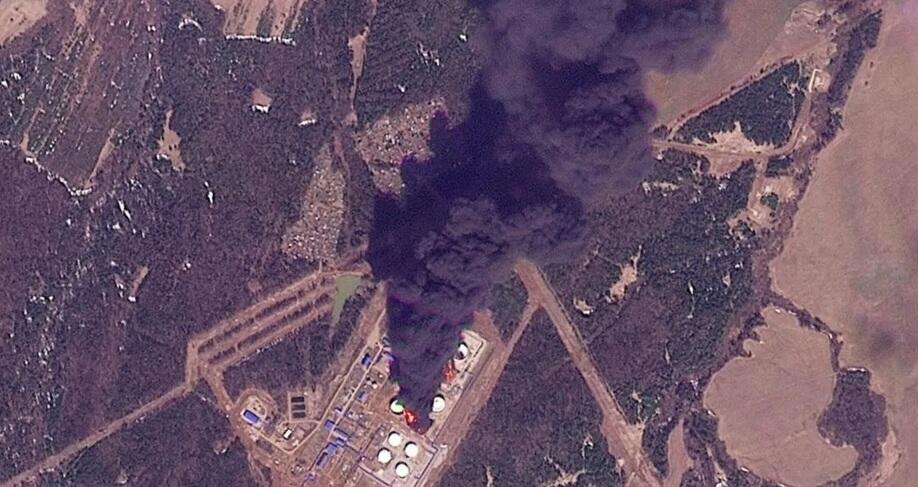
Satellite image of Perm attack aftermath, via Reuters.

The massive Tuapse complex on Russia’s Black Sea coast has been hit no less than three times in under a month, sparking a series of massive fires that in some cases took days for emergency crews to extinguish.

In some cases, targets in the Urals – nearly 1,000 miles away from the Ukraine border – have been hit.

Transneft’s oil pumping and distribution facility in the city of Perm was struck this week, which lies very far into Russian territory.

The Ukraine Security Service (SBU) owned up to it, boasting that the targeted facility is “a strategically important hub of the main oil transportation system.” It further declared that “almost all oil storage tanks are on fire.

Amid the fresh Perm attack, Russia had said it downed nearly 100 Ukrainian drones across various regions, while Russia’s presidential envoy to the region, Artem Zhoga, conceded that “The Urals are now within reach, be vigilant.”

Putin’s office has also denounced these fresh assaults on oil facilities as “terrorist attacks”. As for the prior Black Sea export and refining hub attacks of the last month, CNN reviews:

For the third time in 12 days, the Russian Black Sea town of Tuapse woke up Tuesday to apocalyptic scenes.

Thick toxic fumes, and flames rising up from the latest Ukrainian drone attack on the Rosneft-owned Tuapse oil refinery, almost reached the heights of the surrounding Caucasus mountains.

By Thursday morning, authorities said the fire had been extinguished. Fires from the two previous attacks, on April 16 and 20, also took days to put out, with toxic substances pouring down in black rain and blanketing cars and streets in oily grime, leading to what experts are dubbing the worst environmental disaster in the region in years.

Huge fireball at Perm oil site…

Currently, the globe’s attention is largely focused on the Iran war and the Hormuz Strait blockade, and with that efforts to reach a political and peace settlement in Ukraine have faded as well. Earlier in the Ukraine war, these major refinery attacks would dominate world headlines, but at the moment they have remained in the background given the constant Iran-related news flow. President Putin has lately communicated to Trump that he’s open to a ‘Victory Day’ ceasefire, a proposal the Kremlin said Washington has backed.

Tyler Durden
Sun, 05/03/2026 – 07:35

via ZeroHedge News https://ift.tt/ObdZ5XG Tyler Durden

Today in Supreme Court History: May 3, 1802

5/3/1802: Washington D.C. incorporated as the capital of the United States. Article I, Section 8 empowers Congress to “To exercise exclusive Legislation in all Cases whatsoever, over such District (not exceeding ten Miles square) as may, by Cession of particular States, and the Acceptance of Congress, become the Seat of the Government of the United States.”

The post Today in Supreme Court History: May 3, 1802 appeared first on Reason.com.

from Latest – Reason.com https://ift.tt/1m9RwvI
via IFTTT

Civilians Across the Middle East React to the Iran War: ‘A Fear That Settles in Your Heart’


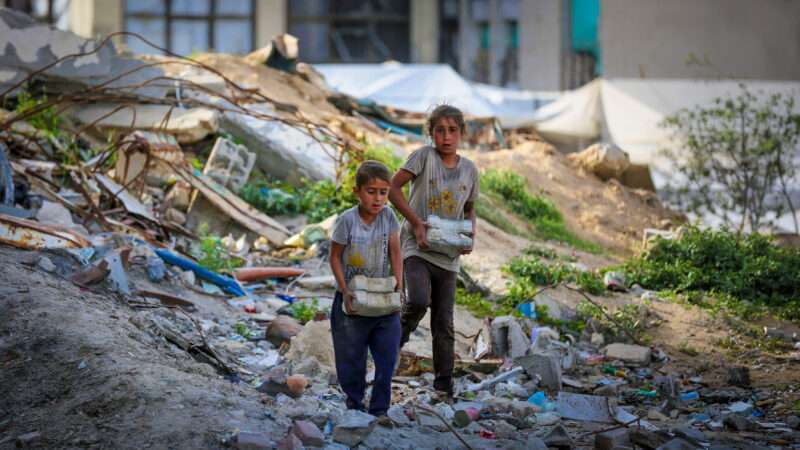
A photo of two small children carrying rubble through a bombed area | Saeed Jaras/MEI/SIPA/Newscom

Amena found out about the war when air raid alarms woke her. Hossein first heard it when fighter jets blew up a radio station as he listened to it. Jad found out about it on the news, two hours before the bombs fell on his neighborhood. And the parents of several volleyball players found out when their daughters were pulled from the burning wreckage of a school gym.

Most Americans have fortunately never seen war firsthand, and most of those who have were troops sent to fight far away. War in your hometown is a strange experience, especially a modern air war without front lines. Things you take for granted, from electricity to the freedom to go outside, disappear. Life’s soundtrack becomes sirens and explosions. The danger feels distant until it isn’t. Death comes seemingly at random.

On February 28, during a U.S.-Israeli surprise attack, missiles hit an elementary school in Minab and a gym in Lamerd, two towns on the Iranian coast. Mir Dehdasht, whose daughter Robab’s high school volleyball team was practicing at the gym, rushed over when a neighbor told him about the attack. “The injured were bleeding heavily, some had lost consciousness on the ground, others were screaming without stopping. Their voices were deafening,” he told Drop Site News after learning Robab had died.

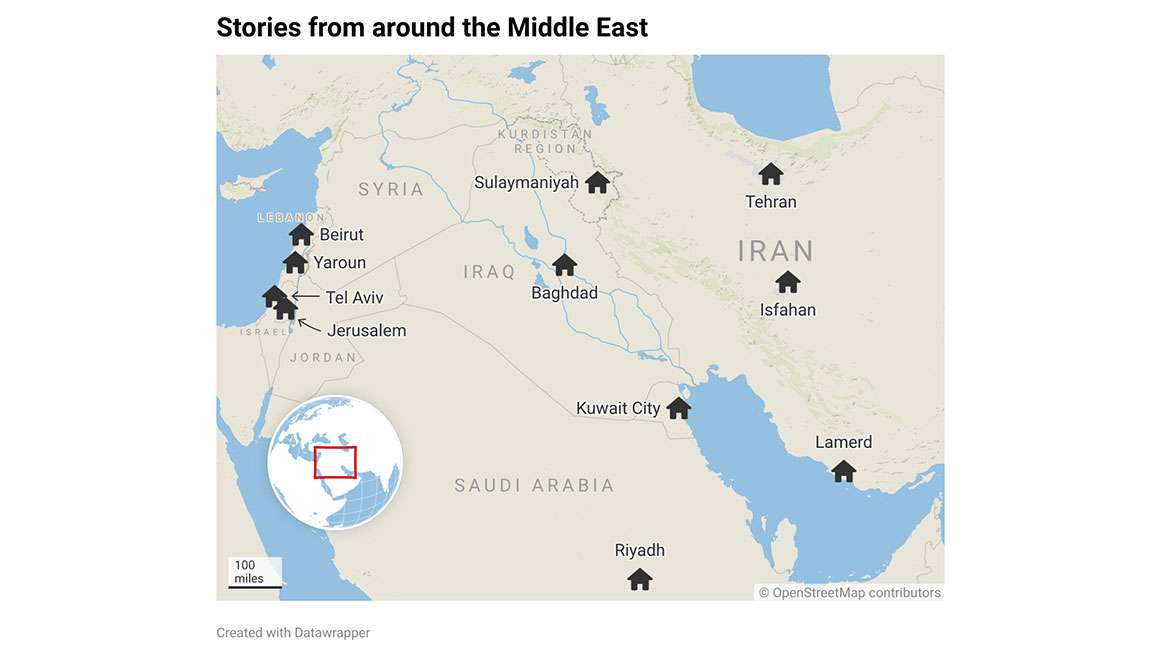
Since then, war has touched almost every corner of the Middle East. Reason spoke to civilians from all sides of the conflict in March and April about life under the bombs and the human cost of war. Most of their names have been changed to protect their safety.

Map: Matthew Petti

Hossein, a young Iranian man who lives with his parents in Isfahan, Iran, awoke on February 28 to hear his family talking about a foreign attack. They tried to leave the city but turned around when a warplane bombed the radio tower along the highway. Hossein heard the sound of the explosion and the radio cut out simultaneously.

“They are bombing really hard. Today at noon they hit a mosque at the end of our street, but thank God we are okay. Love and kisses,” Sepideh, an Iranian woman in Tehran, texted her American relative, who showed Reason the screenshots. “Now they are hitting everything. Nowhere is safe. But don’t worry, we are okay.”

Amena, a Palestinian-American woman living in Jerusalem, was jolted awake on the first morning of the war by a phone alert for incoming Iranian missile fire. “How do I explain to my sister sitting in California what it sounds like when bombs go off and your windows shake? There’s a fear that settles in your heart and never leaves. We live in a constant state of stress, it just doesn’t go away,” she says. “You can’t really go anywhere because you don’t know when you’ll get an alert to find a protective area to go to, you don’t know if there is one at the location you’re going to.”

War is lonely. New security checkpoints make it harder for Amena to visit her adult son in another part of Jerusalem. Her husband has been stuck in America for weeks because flights to the Middle East were canceled until the mid-April ceasefire.

Fuad, a Lebanese-American man, was planning to visit his aunt in Yaroun, his familial village in Lebanon near the Israeli border, on February 27. But his wife asked to stay an extra day in Beirut, the capital. The morning they were supposed to drive down to the village, Fuad turned on the news to see Israel and Iran were at war. A few days later, the war came to Lebanon, and Yaroun was evacuated.

“I’m not sure there’s anything left now,” Fuad says. “I miss my village.”

Jad, a Lebanese man from the Dahiyeh suburb of Beirut, was holding out hope that Lebanon would be spared. At 1 a.m. on March 2, he saw the news that the Dahiyeh-based militia Hezbollah was joining the war on Iran’s side. Two hours later, Israel began bombing the area. “After that, it was around two to three hours of chaos in Dahiyeh, people trying to evacuate while strikes were ongoing,” Jad says.

Jad was lucky enough to reach a relative’s house elsewhere in Beirut, but many others were left homeless or paying exorbitantly for temporary shelter. “The government’s not doing much,” says Fuad. “Mostly it’s independent organizations helping the refugees.”

In other countries, the disruption has not been quite as intense. Most of the air raids in Saudi Arabia and Kuwait have been aimed at military bases and industrial parks rather than cities. Salman, a Saudi man, describes the war as “a background noise you couldn’t shut off,” between new restrictions on daily life and constant rumors. “You mostly forget that you’re at war, but then you remember in moments,” says Jasim, a Kuwaiti man, who describes empty store shelves, intermittent sirens, and faraway booms.

Anas, another Kuwaiti man, says he actually slept through the opening attacks of the war. He woke up to his mother scolding him about sleeping in so late while sirens were blaring.

Even in places under heavy bombardment, some people have become desensitized to danger. Yahya, an Iranian-Canadian man who returned to Tehran after the war started, was startled by the sound of an explosion while walking to the Tehran subway early in the morning. “The crowd at the entrance of the underground station looked up nonchalantly and continued walking,” Yahya wrote in a message forwarded to Reason by a friend.

“In Kurdistan we say, ‘If you heard it, thank God, that means it wasn’t for you,'” says Meghan Bodette, an American researcher in Iraqi Kurdistan with whom I have collaborated on projects for the Kurdish Peace Institute. Iraq has the dubious honor of being bombed by both sides of the conflict, with dozens killed.

A video that went viral early in the war shows Iraqis filming and laughing at a rooftop bar in Baghdad while an Iranian drone flies overhead toward the U.S. Embassy. Jad says some Lebanese have similarly started spectating Israeli airstrikes from their rooftops.

David, an Israeli man near Tel Aviv, had been expecting the war to come for a while. “Psychologically speaking it’s intense, but nothing compared to the early Gaza War, especially immediately following October 7,” he says. “I think this time everyone saw it coming on some level.” He compares wartime life to the COVID-19 pandemic, when “everyone need[ed] to hunker down.”

On March 1, an Iranian missile punctured a bunker in the Jerusalem suburbs, killing four people sheltering inside. David says it was “unsettling” to Israelis at first, but people “handwaved” the danger by chalking it up to “shoddy” bunker construction.

In what could have been a festive omen, several holidays lined up this year. For the first time in decades, the Eid al-Fitr holiday at the end of the Islamic lunar month Ramadan coincided with Nowruz (New Years) on the Iranian and Kurdish solar calendars. Passover for Jews and Easter for Christians came right after. This holiday season was another reminder of how abnormal things were.

Hossein’s family Nowruz dinner was interrupted by the sounds of a “massive attack” that frightened the guests. On the last day of Nowruz break, typically a time for family picnics, the city held a war memorial service, which Hossein says was “packed” with relatives of the dead from wars “old and new.”

Passover “was a pain since it was a constant stream of alarms. Quite scary especially when you’re with your family or on the road,” says David. “A lot of Israelis have big families too so wrangling the kids to the shelter or safe room is pretty complicated.”

He adds that the situation near the Lebanese border was much more intense. David knows people in northern Israel who did their entire Seder, the traditional Passover service, inside a bunker due to rocket fire.

Citing a lack of protected areas and difficulty of access for rescue workers, Israeli police closed major holy sites in Jerusalem. The Jewish prayer for Passover at the Western Wall was restricted to a few dozen people at a time, Catholic Cardinal Pierbattista Pizzaballa celebrated Easter Mass in an empty Church of the Holy Sepulchre, and Muslims were unable to hold traditional Eid prayers at Al-Aqsa Mosque. “This is no comparison, but imagine Christmas without a tree, presents, or Santa,” says Amena.

The situation in Kuwait also worsened around Eid, when “the Iranians started hitting critical infrastructure instead of military installations,” according to Anas. “People are distressed because it’s not whether you get hit by a drone or fragments, but whether electricity shuts down,” he says.

That kind of economic damage is how most people in the world will feel this war. India is suffering severe cooking gas shortages, forcing families to cook with firewood. Slovenia, Indonesia, and Bangladesh are rationing fuel.

The longer the blockade of Hormuz drags on, the more likely these problems will cascade into America. U.S. gas prices jumped from around $3 per gallon before the war to over $4 per gallon after a month of war. CNN and USA Today have already found Americans skipping meals to pay for fuel.

There are typically 40,000 American troops in the Middle East, with another 10,000 deployed to fight this war, leaving hundreds of thousands of loved ones worried. “Who wants war?” Charles Simmons, father of fallen U.S. airman Tyler Simmons, told NBC. “Sometimes it’s a necessity, and I just don’t know what’s going on.” Other military families are suffering “a good amount of stress and anxiety…just around the unknowns right now,” Shannon Razsadin, head of the Military Family Advisory Network, told the Associated Press.

That was a common feeling from ordinary people on all sides of the war—not knowing what risks they will be exposed to, for how long, or why. “It has mildly disrupted work life for many, travel plans, et cetera, but a sense of foreboding has definitely set in,” Salman, the Saudi man, said before the ceasefire kicked in. “Fear and expectation that the situation will only escalate.”

The post Civilians Across the Middle East React to the Iran War: 'A Fear That Settles in Your Heart' appeared first on Reason.com.

from Latest – Reason.com https://ift.tt/ngkD1ez
via IFTTT

Civilians Across the Middle East React to the Iran War: ‘A Fear That Settles in Your Heart’


A photo of two small children carrying rubble through a bombed area | Saeed Jaras/MEI/SIPA/Newscom

Amena found out about the war when air raid alarms woke her. Hossein first heard it when fighter jets blew up a radio station as he listened to it. Jad found out about it on the news, two hours before the bombs fell on his neighborhood. And the parents of several volleyball players found out when their daughters were pulled from the burning wreckage of a school gym.

Most Americans have fortunately never seen war firsthand, and most of those who have were troops sent to fight far away. War in your hometown is a strange experience, especially a modern air war without front lines. Things you take for granted, from electricity to the freedom to go outside, disappear. Life’s soundtrack becomes sirens and explosions. The danger feels distant until it isn’t. Death comes seemingly at random.

On February 28, during a U.S.-Israeli surprise attack, missiles hit an elementary school in Minab and a gym in Lamerd, two towns on the Iranian coast. Mir Dehdasht, whose daughter Robab’s high school volleyball team was practicing at the gym, rushed over when a neighbor told him about the attack. “The injured were bleeding heavily, some had lost consciousness on the ground, others were screaming without stopping. Their voices were deafening,” he told Drop Site News after learning Robab had died.

Since then, war has touched almost every corner of the Middle East. Reason spoke to civilians from all sides of the conflict in March and April about life under the bombs and the human cost of war. Most of their names have been changed to protect their safety.

Map: Matthew Petti

Hossein, a young Iranian man who lives with his parents in Isfahan, Iran, awoke on February 28 to hear his family talking about a foreign attack. They tried to leave the city but turned around when a warplane bombed the radio tower along the highway. Hossein heard the sound of the explosion and the radio cut out simultaneously.

“They are bombing really hard. Today at noon they hit a mosque at the end of our street, but thank God we are okay. Love and kisses,” Sepideh, an Iranian woman in Tehran, texted her American relative, who showed Reason the screenshots. “Now they are hitting everything. Nowhere is safe. But don’t worry, we are okay.”

Amena, a Palestinian-American woman living in Jerusalem, was jolted awake on the first morning of the war by a phone alert for incoming Iranian missile fire. “How do I explain to my sister sitting in California what it sounds like when bombs go off and your windows shake? There’s a fear that settles in your heart and never leaves. We live in a constant state of stress, it just doesn’t go away,” she says. “You can’t really go anywhere because you don’t know when you’ll get an alert to find a protective area to go to, you don’t know if there is one at the location you’re going to.”

War is lonely. New security checkpoints make it harder for Amena to visit her adult son in another part of Jerusalem. Her husband has been stuck in America for weeks because flights to the Middle East were canceled until the mid-April ceasefire.

Fuad, a Lebanese-American man, was planning to visit his aunt in Yaroun, his familial village in Lebanon near the Israeli border, on February 27. But his wife asked to stay an extra day in Beirut, the capital. The morning they were supposed to drive down to the village, Fuad turned on the news to see Israel and Iran were at war. A few days later, the war came to Lebanon, and Yaroun was evacuated.

“I’m not sure there’s anything left now,” Fuad says. “I miss my village.”

Jad, a Lebanese man from the Dahiyeh suburb of Beirut, was holding out hope that Lebanon would be spared. At 1 a.m. on March 2, he saw the news that the Dahiyeh-based militia Hezbollah was joining the war on Iran’s side. Two hours later, Israel began bombing the area. “After that, it was around two to three hours of chaos in Dahiyeh, people trying to evacuate while strikes were ongoing,” Jad says.

Jad was lucky enough to reach a relative’s house elsewhere in Beirut, but many others were left homeless or paying exorbitantly for temporary shelter. “The government’s not doing much,” says Fuad. “Mostly it’s independent organizations helping the refugees.”

In other countries, the disruption has not been quite as intense. Most of the air raids in Saudi Arabia and Kuwait have been aimed at military bases and industrial parks rather than cities. Salman, a Saudi man, describes the war as “a background noise you couldn’t shut off,” between new restrictions on daily life and constant rumors. “You mostly forget that you’re at war, but then you remember in moments,” says Jasim, a Kuwaiti man, who describes empty store shelves, intermittent sirens, and faraway booms.

Anas, another Kuwaiti man, says he actually slept through the opening attacks of the war. He woke up to his mother scolding him about sleeping in so late while sirens were blaring.

Even in places under heavy bombardment, some people have become desensitized to danger. Yahya, an Iranian-Canadian man who returned to Tehran after the war started, was startled by the sound of an explosion while walking to the Tehran subway early in the morning. “The crowd at the entrance of the underground station looked up nonchalantly and continued walking,” Yahya wrote in a message forwarded to Reason by a friend.

“In Kurdistan we say, ‘If you heard it, thank God, that means it wasn’t for you,'” says Meghan Bodette, an American researcher in Iraqi Kurdistan with whom I have collaborated on projects for the Kurdish Peace Institute. Iraq has the dubious honor of being bombed by both sides of the conflict, with dozens killed.

A video that went viral early in the war shows Iraqis filming and laughing at a rooftop bar in Baghdad while an Iranian drone flies overhead toward the U.S. Embassy. Jad says some Lebanese have similarly started spectating Israeli airstrikes from their rooftops.

David, an Israeli man near Tel Aviv, had been expecting the war to come for a while. “Psychologically speaking it’s intense, but nothing compared to the early Gaza War, especially immediately following October 7,” he says. “I think this time everyone saw it coming on some level.” He compares wartime life to the COVID-19 pandemic, when “everyone need[ed] to hunker down.”

On March 1, an Iranian missile punctured a bunker in the Jerusalem suburbs, killing four people sheltering inside. David says it was “unsettling” to Israelis at first, but people “handwaved” the danger by chalking it up to “shoddy” bunker construction.

In what could have been a festive omen, several holidays lined up this year. For the first time in decades, the Eid al-Fitr holiday at the end of the Islamic lunar month Ramadan coincided with Nowruz (New Years) on the Iranian and Kurdish solar calendars. Passover for Jews and Easter for Christians came right after. This holiday season was another reminder of how abnormal things were.

Hossein’s family Nowruz dinner was interrupted by the sounds of a “massive attack” that frightened the guests. On the last day of Nowruz break, typically a time for family picnics, the city held a war memorial service, which Hossein says was “packed” with relatives of the dead from wars “old and new.”

Passover “was a pain since it was a constant stream of alarms. Quite scary especially when you’re with your family or on the road,” says David. “A lot of Israelis have big families too so wrangling the kids to the shelter or safe room is pretty complicated.”

He adds that the situation near the Lebanese border was much more intense. David knows people in northern Israel who did their entire Seder, the traditional Passover service, inside a bunker due to rocket fire.

Citing a lack of protected areas and difficulty of access for rescue workers, Israeli police closed major holy sites in Jerusalem. The Jewish prayer for Passover at the Western Wall was restricted to a few dozen people at a time, Catholic Cardinal Pierbattista Pizzaballa celebrated Easter Mass in an empty Church of the Holy Sepulchre, and Muslims were unable to hold traditional Eid prayers at Al-Aqsa Mosque. “This is no comparison, but imagine Christmas without a tree, presents, or Santa,” says Amena.

The situation in Kuwait also worsened around Eid, when “the Iranians started hitting critical infrastructure instead of military installations,” according to Anas. “People are distressed because it’s not whether you get hit by a drone or fragments, but whether electricity shuts down,” he says.

That kind of economic damage is how most people in the world will feel this war. India is suffering severe cooking gas shortages, forcing families to cook with firewood. Slovenia, Indonesia, and Bangladesh are rationing fuel.

The longer the blockade of Hormuz drags on, the more likely these problems will cascade into America. U.S. gas prices jumped from around $3 per gallon before the war to over $4 per gallon after a month of war. CNN and USA Today have already found Americans skipping meals to pay for fuel.

There are typically 40,000 American troops in the Middle East, with another 10,000 deployed to fight this war, leaving hundreds of thousands of loved ones worried. “Who wants war?” Charles Simmons, father of fallen U.S. airman Tyler Simmons, told NBC. “Sometimes it’s a necessity, and I just don’t know what’s going on.” Other military families are suffering “a good amount of stress and anxiety…just around the unknowns right now,” Shannon Razsadin, head of the Military Family Advisory Network, told the Associated Press.

That was a common feeling from ordinary people on all sides of the war—not knowing what risks they will be exposed to, for how long, or why. “It has mildly disrupted work life for many, travel plans, et cetera, but a sense of foreboding has definitely set in,” Salman, the Saudi man, said before the ceasefire kicked in. “Fear and expectation that the situation will only escalate.”

The post Civilians Across the Middle East React to the Iran War: 'A Fear That Settles in Your Heart' appeared first on Reason.com.

from Latest – Reason.com https://ift.tt/ngkD1ez
via IFTTT