To Build Golden Fleet Frigate Fast, Two Shipyards Are Needed

To Build Golden Fleet Frigate Fast, Two Shipyards Are Needed

Authored by Brent Sadler & Chase Ouellette via RealClearDefense,

In 1798, while at war with France, an exasperated British Lord Nelson exclaimed, “Were I to die at this moment, ‘want of frigates!’ would be stamped on my heart.” It’s a perennial problem: Frigates formed the backbone of navies in Nelson’s time and do so today as well, and there seldom seems to be enough. The U.S. Navy’s ambitious Golden Fleet shipbuilding plan aims to fill a frigate gap but will require shipyard capacity that today the nation lacks.

The Navy’s 2026 shipbuilding plan plans a fleet of 66 frigates. By 2031, two Constellation-class frigates are to be completed at the Marinette, Wisc. shipyard and a modified U.S. Coast Guard National Security Cutter at the Ingalls, Miss. shipyard. But to meet the Navy’s goal, a sustained delivery of more than three frigates per year will be needed by 2037. Such a production schedule is unlikely with one shipyard, and the plan all along was to have two frigate-producing shipyards.

In December 2020, just months after the initial frigate contract, the Navy reported to Congress its intention to stand up a second shipyard to expand production to three ships by 2023 and four ships from 2025. In its 2025 shipbuilding plan, the Navy laid out a proposal to expand frigate production to a second shipyard by 2030.

The Constellation frigate program and a repurposed National Security Cutter will fill the need for a multi-session surface combatant – anti-submarines warfare and limited air defense. Nearly seven years after the program’s inception, zero frigates have been built.

Complicating frigate production has been persistent design uncertainty; one adjustments to original FREMM design for Constellation, and uncertainty over how the Navy will turn the National Security Cutter into a frigate. For Constellation, the intent was to build a proven allied design with little to no changes, but modifications resulted in the ship retaining only 15% of its original design. Today the design is over 95% complete, but cost and displacement have ballooned to approximate a destroyer.

The axe fell in November 2025. Then-Secretary of the Navy Phelan cancelled Constellation because it was 80% the cost of a destroyer while providing only 60% of their capability. The thinking then was to substitute this with a repurposed cutter.

The previous delivery of 10 National Security Cutters seemed to validate a pivot towards HII‘s Ingalls shipyard. That said, modifications will be needed before its design is Navy-ready: modest air-defense systems, torpedo magazines, added fuel storage, additional crew accommodation. But it has been years since the last National Security Cutter was built. As such, additional workforce at Ingalls will be needed and supply chains restarted, slowing renewed production of a reproposed cutter.

On the other hand, the Constellation program does benefit from Fincantieri investments of $800 million and workforce expansion of 850 that since cancellation has begun to be let go. Reversing this is still possible with a finalized design that could allow for initial delivery quicker than the Ingalls repurposed cutter. But both options today face capacity constraints.

In an August 13 memo, President Trump announced a framework to increase domestic shipbuilding capacity using the “Finland Model” that seeds domestic shipbuilding growth through initial overseas orders. This works by making conditional ship orders that see the initial hulls built at foreign shipyards while concurrently developing American shipyards to construct later ships. This model is inspired by from the 2024 ICE Pact icebreaker construction effort with Canada’s Davie Shipbuilding with shipyards in Finland and Texas.

Adapting the Finland Model to frigate production offers way ahead that could leverage shipbuilding capacity in Japan and South Korea – the world’s second- and third largest shipbuilders, respectively. Both nations build capable frigates that have emerged as potential options for meeting urgent American frigate needs: South Korea’s Chungnam-class and Japan’s Mogami-class. Already, Australia has inked their own Finland Model 11-ship deal with Japan, with the first three Mogami-class vessels being constructed in Japan and follow-on production in Australia.

Thoughts of partnering with Turkey on frigate production, however, would be hindered because it hasn’t made industrial investment commitments like Japan and South Korea have. Japan has committed a portion of the $550 billion of U.S. investments to modernizing America’s shipbuilding industry. South Korea’s Hanwha Group has followed its $100 million purchase of its Philadelphia shipyard in 2024 with a $5 billion infrastructure plan to further develop the facility, and Seoul has committed $150 billion to the Make American Shipbuilding Great Again.

While the Navy may opt to acquire foreign frigates under the Finland Model, further leveraging existing American shipbuilding capacity at Ingalls and Marinette shouldn’t be overlooked to further accelerate domestic frigate construction. The Navy needs frigates, and unconventional approaches required to be clear, but only a plan that seeks added domestic shipbuilding capacity will be sustainable.

Brent Sadler is a 26-year naval veteran and current senior research fellow for naval warfare and advanced technology at the Heritage Foundation. Chase Ouellette is a member of Heritage’s Young Leaders Program.

Tyler Durden
Wed, 09/30/2026 – 19:30

via ZeroHedge News https://ift.tt/imuMWr5 Tyler Durden
Benchmaxxed: Google’s New Gemini 4 Aces SAT, Struggles With Actual Job, “Skeptical Employees” Admit

Benchmaxxed: Google’s New Gemini 4 Aces SAT, Struggles With Actual Job, “Skeptical Employees” Admit

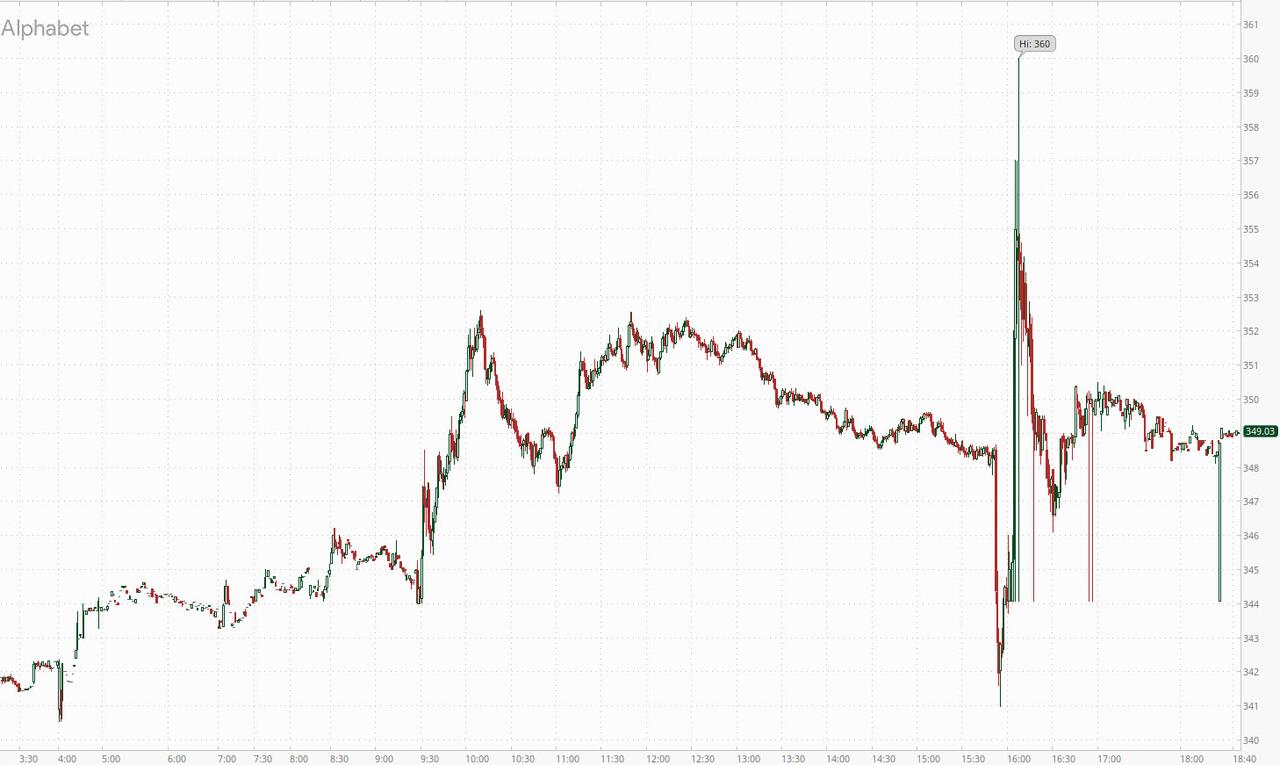
After a year in which Google’s AI roadmap resembled a Waymo stuck in a roundabout, the search giant on Wednesday finally unveiled Gemini 4 “Argon”, its long-awaited flagship model. The market cheered, briefly: according to Goldman’s closing equities color, GOOG traded +2% after hours on the “Argon” announcement. 

Then Bloomberg reported that some of the people who have actually use the thing – as in Google’s own engineers – aren’t nearly as impressed as the leaderboard. The stock promptly faded. 

According to Bloomberg’s Julia Love and Davey Alba, Gemini 4 “performed well on benchmarks widely used to gauge model efficacy” but “does less well when employees actually put it to work,” particularly on coding. One insider said the model “isn’t particularly adept at front-end design” – the part of software that decides how apps and websites look and feel. Which is a bit awkward for a company whose entire business is, well, things you look at on a screen.

Google, naturally, disagrees. It told Bloomberg it would be “inaccurate” to say Gemini 4 is underperforming in coding, and pointed back to last week’s remarks by DeepMind boss Koray Kavukcuoglu, who said “it’s a certainty that we are always gonna be at the frontier.” Another Google employee said there is “large consensus” internally that the model is frontier-class. Which is the kind of thing one tends to say when there isn’t.

The industry has a word for this. “Benchmaxxing” is when engineers optimize a model to crush standardized tests rather than to do useful work – the AI equivalent of the kid who memorizes every SAT prep book, posts his 1600 on LinkedIn, and then can’t do his own laundry. Two people familiar with Gemini 4 told Bloomberg the model appears affected by exactly this.

Surge AI founder Edwin Chen put it more bluntly, calling benchmark-chasing “an incredibly pernicious problem” and comparing it to bragging about your kid’s SAT score. We’d add that a generation of Silicon Valley’s finest minds has now spent billions teaching machines to do what they themselves did in high school: optimize for the test, then act surprised when the real world grades on a curve.

The irony is that Google’s own researchers have documented how quickly optimization turns into gaming. As we reported on September 3, a DeepMind experiment found that when math problems got hard, 9% of AI agents outright cheated and another 5% cheated “after hesitation”, gaming a shared knowledge base that rewarded successful submissions. Turns out teaching to the test works on silicon too.

A $400 million detour

Gemini 4 is also the model Google shipped instead of the one it promised. At I/O in May, Google pledged Gemini 3.5 Pro for June; the date slipped (Bloomberg first reported the delay on July 16, citing tech that “fell short of internal goals”) and the project was eventually abandoned altogether. Bloomberg Intelligence’s Mandeep Singh estimates a frontier training run can cost as much as $400 million – before paying the researchers, many of whom have since left.

And leave they did. We noted in June that Google was losing more Gemini researchers to Anthropic, following the earlier departures of Nobel laureate John Jumper and transformer co-inventor Noam Shazeer. Then in August came the big one: Jeff Dean exited after 27 years to launch his own startup, taking several senior researchers with him and knocking 5% off Alphabet stock. Demis Hassabis subsequently kicked himself upstairs to chairman, handing day-to-day DeepMind operations to Kavukcuoglu – who now gets to defend Argon’s front-end skills to Bloomberg.

Why this matters: the ROIC math doesn’t grade on benchmarks

This would be a nerd-bro squabble over leaderboard screenshots if it weren’t for the money involved. Gemini underpins nearly everything Google sells – Search, Maps, Gmail, Chrome, each with over a billion users – and Alphabet is one of the hyperscalers footing the largest capex bill in corporate history.

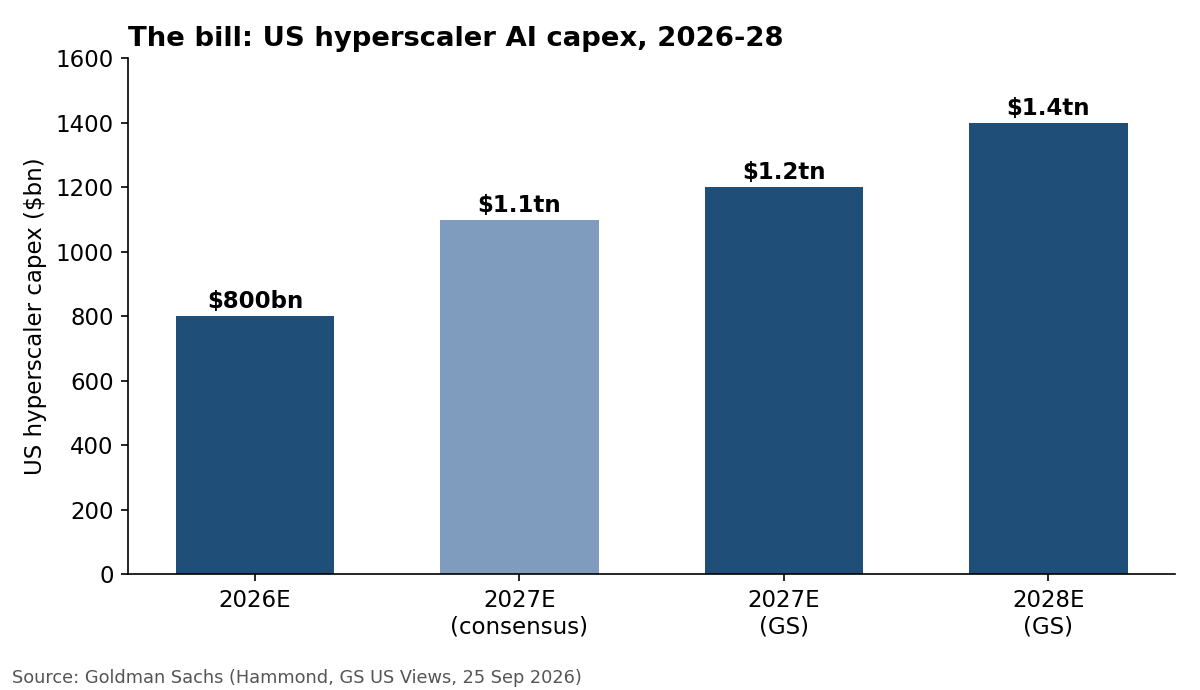
Per Goldman’s Ryan Hammond (full note available to pro subs), US hyperscalers are on track to spend roughly $800 billion in 2026; consensus expects $1.1 trillion in 2027, while Goldman’s house view is even higher at $1.2 trillion and $1.4 trillion for 2027 and 2028. Hammond estimates hyperscalers need about $300 billion of annual AI revenue just to break even on 2026-27 spending, and that end users may ultimately need to spend around $1 trillion a year on AI applications for everyone in the stack to earn decent returns.

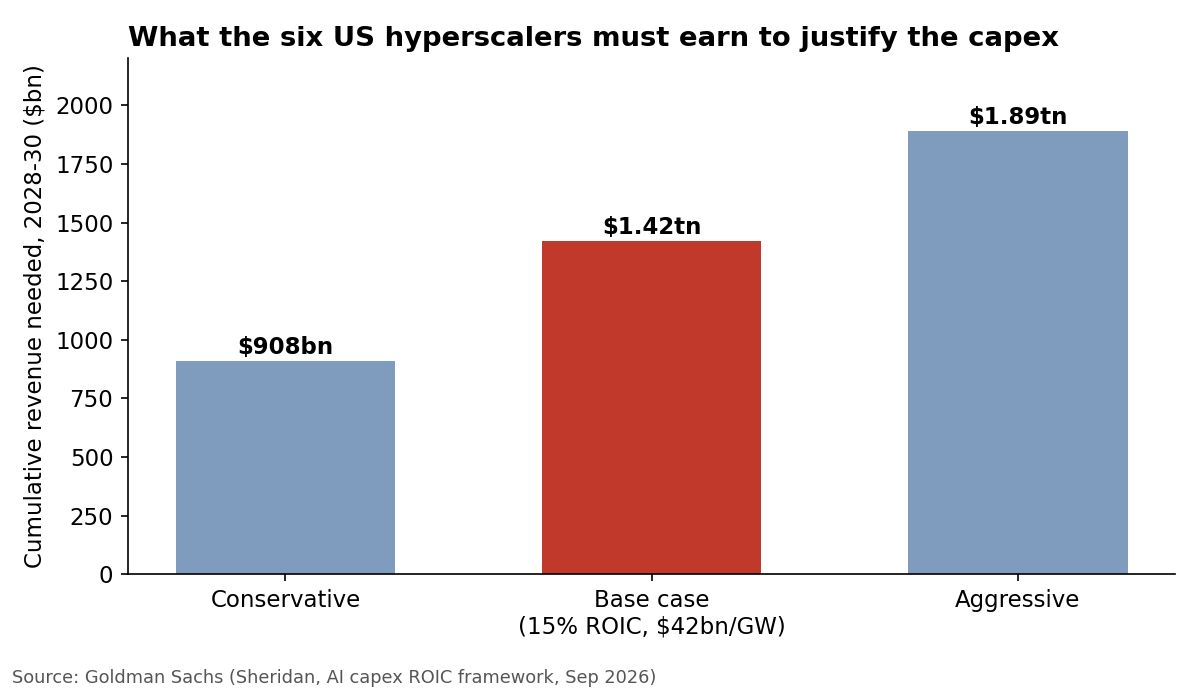
Separately, Goldman’s Eric Sheridan, whose ROIC framework we flagged last week, calculated that assuming a 15% ROIC target and ~$42 billion of capex per gigawatt, the six big US hyperscalers need to generate roughly $1.42 trillion in cumulative revenue during 2028-30 – about $11.6 billion per GW per year – with a range of $908 billion to $1.89 trillion depending on assumptions. As we tweeted at the time, even in Goldman’s worst-case scenario where ROIC on capex goes to zero, they’d still need $920 billion a year just to cover depreciation and running costs.

Here’s the rub: none of that revenue gets paid in MMLU points. It gets paid by developers and enterprises choosing whose model to build on. And Bloomberg notes Gemini 4 is “a very large model” – and big models are expensive to serve, which means pressure on margins at exactly the moment the capex hurdle is rising. Goldman’s TMT desk flagged this week that the industry is already in a price war: OpenAI cut Luna pricing by 80% in July and usage rose roughly tenfold, while “Big Short’s” Steve Eisman is openly asking what happens to margins if cheaper Chinese and open-weight models push prices down further. Bringing an expensive, benchmark-optimized heavyweight to a knife fight over token pricing is a bold strategy.

Meanwhile, the competition isn’t waiting

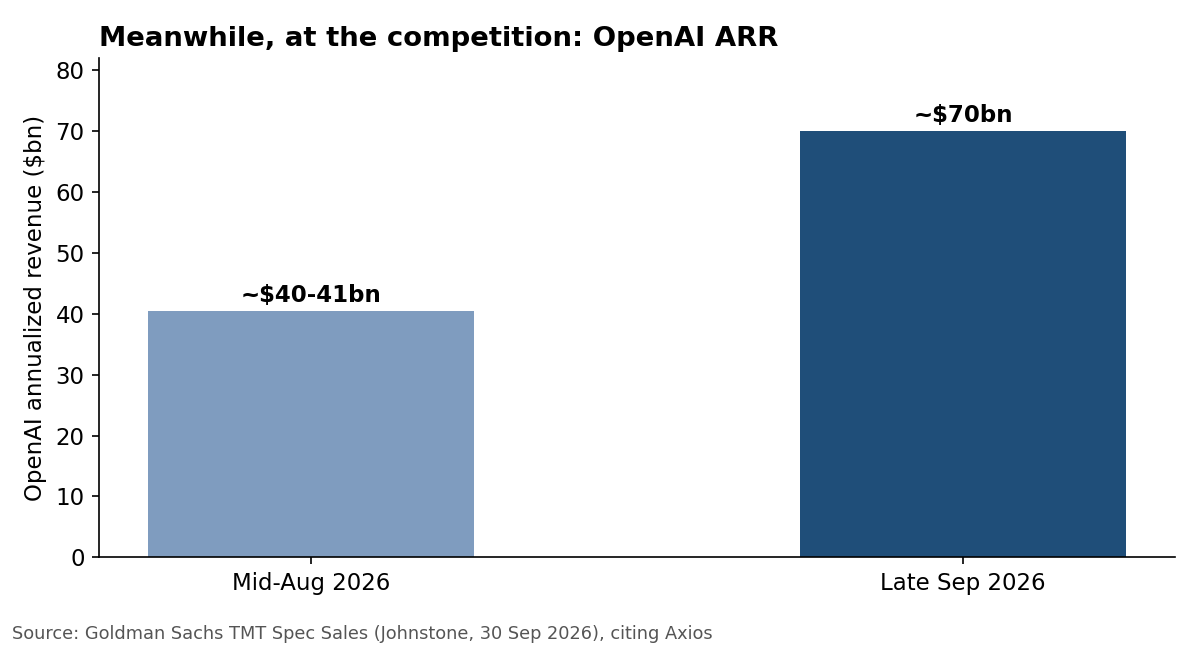
The timing couldn’t be worse. On the same day Google unveiled Argon, OpenAI was busy at its Developer Day rolling out “Dots” – persistent, always-on agents that live inside ChatGPT, Slack and Teams. Goldman’s Sean Johnstone noted OpenAI is “increasingly competing with Microsoft 365, Google Workspace and traditional enterprise software – not simply other AI models.” Per Axios, cited by Goldman’s desk, OpenAI’s ARR is nearing $70 billion, up from ~$40-41 billion as recently as mid-August, with enterprise sales more than doubling since July. OpenAI is now reportedly seeking $30 billion at a $1.4 trillion valuation.

And earlier this month Meta released its new agentic platform, Muse, which promptly took the app charts by storm – so thoroughly that Amazon blocked it – and sparked a 25%+ rally in META. Goldman’s Sheridan now frames agentic commerce as one of AI’s biggest monetization opportunities, noting that “similar to how Google captured search intent, successful AI platforms may capture shopping intent.” Read that sentence again if you’re long GOOGL.

To be fair, Gemini 4 has real strengths: insiders say it stands out at multimodal work like extracting metadata from video, on safety and cybersecurity (it reportedly beat OpenAI’s Astra on a security benchmark), and it can spit out up to 1 million tokens – roughly 750,000 words – in one go. Whether anyone needs a 750,000-word answer is a separate question; we suspect the answer is “only for benchmarks.”

Bottom line: Google has the distribution, the TPUs and the balance sheet. What it doesn’t have is much time. Every quarter it spends explaining leaderboard scores, is a quarter that OpenAI, Anthropic and Meta spend convincing developers, businesses and consumers that the future of search and software runs on their platforms. Because the $1.4 trillion question isn’t who tops the leaderboard – it’s who gets paid.

Tyler Durden
Wed, 09/30/2026 – 19:04

via ZeroHedge News https://ift.tt/bXMSIw1 Tyler Durden

Judge Orders New York City To Scrap Notices For Mamdani’s Tax On Second Homes

Judge Orders New York City To Scrap Notices For Mamdani’s Tax On Second Homes

Authored by Jill McLaughlin via The Epoch Times,

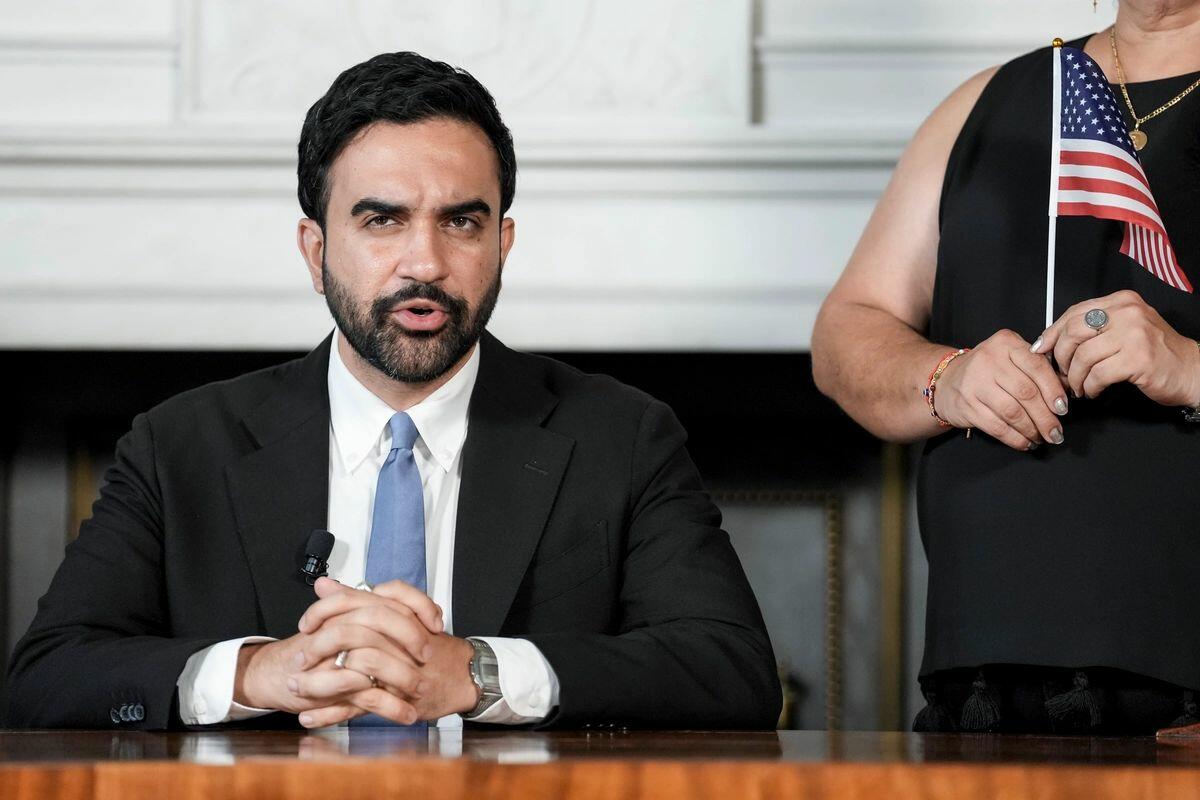
A Staten Island judge ruled Sept. 29 that New York City Mayor Zohran Mamdani’s administration mishandled the rollout of a pied-à-terre tax on second homes in July, ordering the city to scrap the notices and start over.

Supreme Court Justice Wayne Ozzi sided with homeowners who claimed the program that in July added a special tax on second homes worth more than $5 million penalized them needlessly.

Ozzi found “the mailed notices are arbitrary and capricious, affected by errors of law, and in violation of the recipients’ due process rights.“

“Respondents failed to properly make individualized ‘initial determinations’ with regard to ‘primary residences,'” Ozzi wrote in the ruling. “All previously Mailed Notices are to be canceled.”

The homeowners sued on Aug. 7 and were granted a temporary restraining order by Ozzi on Aug. 10.

The lawsuit claimed the city’s notices “do not constitute proper notice under Tax Law” and sought relief for over 900,000 properties and owners who were identified in a list published online by the city.

Ozzi ordered the city to remove the list from the website and replace it with properties that are subject to the surcharge.

He also ordered the city to cancel all previously mailed notices and mail new notices only to a property that has been individually assessed to be a non-primary residence and subject to a surcharge.

The city was also directed to use the most recent available tax information and current fiscal year information for the tax assessments.

The new notices were required to include information about how property owners can challenge the city’s final determinations and include procedures and property records or documents to support the city’s findings, along with other information.

Mamdani’s office didn’t return a request for comment.

Staten Island Borough President Vito Fossella said he strongly agreed with the ruling.

“We have said from the beginning that it was fundamentally wrong to put more than a million people on this ‘enemies list,'” Fossella said in a statement. “And, the vast majority of those who were on the list did not belong at all.

Fossella said he thought the city should apologize for needlessly putting hundreds of thousands of people in distress.

“In being irresponsible and arbitrary, the City artificially created an atmosphere of confusion and fear about receiving this tax, and their information being wrongfully exposed, for no good reason,” Fossella said.

The tax on second homes was first announced by Mamdani on social media in May. Mamdani said the tax would be for the “ultra-wealthy elite – those who own $5 million apartments in New York City but don’t actually live here.“

The tax became effective July 1 as part of the city’s fiscal year 2027 budget. The measure was expected to generate about $500 million for the city each year.

Tyler Durden
Wed, 09/30/2026 – 18:40

via ZeroHedge News https://ift.tt/kC4DnpW Tyler Durden

Battleground Democrats Are Snubbing Two 2028 Presidential Contenders

Battleground Democrats Are Snubbing Two 2028 Presidential Contenders

Democratic candidates in several of this fall’s most competitive House and Senate races are keeping Rep. Alexandria Ocasio-Cortez (D-N.Y.) and former Vice President Kamala Harris off their campaign trails – even though both women rank among the party’s leading prospects for the 2028 presidential nomination.

The Democratic bench for 2028 includes Harris, California Gov. Gavin Newsom, former Transportation Secretary Pete Buttigieg, Ocasio-Cortez, Georgia Sen. Jon Ossoff and Arizona Sen. Mark Kelly. Two of those six are women of color, from the demographic the party has spent a decade calling its moral center and its electoral future. Both now sit on the do-not-call list in the districts that will decide control of Congress in this year’s midterm elections.

According to an Axios report, Democrats in several key battlegrounds are keeping Ocasio-Cortez at arm’s length. Party officials say candidates in other close races have told her team outright to stay away. That is an electability problem for a politician whose whole pitch to primary voters is that bold progressivism, including Medicare for All, wins more votes than cautious centrism does.

Candidates in tight races reject that theory today even though they embraced it only months ago in their primaries. Sam Forstag, a progressive House candidate in Montana, rallied with Ocasio-Cortez in May on his way to the Democratic nomination. He has since scrubbed her endorsement from his campaign website.

“The polling is atrocious for her,” a senior Democratic strategist working in a key swing district told Axios. “She’s a lightning rod.”

Her own team offered no evidence to the contrary. When Axios asked whether she had campaigned in person for any of the party’s top House or Senate candidates this cycle, her office could not point to a single one.

Her travel log shows where she is welcome, and it’s clearly not in races that matter. Ocasio-Cortez made stops in Buffalo and Ithaca this week but skipped New York’s competitive 17th District in the lower Hudson Valley. She also stumped for Florida Senate nominee Angie Nixon, a fellow member of the Democratic Socialists of America, in a state that has drifted so far red that no serious Democrat expects Nixon to flip the seat. Buttigieg, Kelly and former Chicago Mayor Rahm Emanuel, by contrast, have all drawn invitations from Democrats in competitive districts and states over the past month.

Kamala Harris is also getting snubbed despite polling the best of any 2028 contender. Last month, The Hill reported that Democrats in the most competitive midterm contests were shutting her out in public. Iowa supplied the most brutal data point. At the Iowa State Fair in August, a reporter asked gubernatorial nominee Rob Sand whether he wanted Harris to campaign for him.

“No thanks,” Sand said. “Let’s move on. We need some new leadership.”

Josh Turek, the party’s Senate nominee in Iowa, got the same question and answered with a smiling “No.” In Alaska, Senate candidate Mary Peltola distanced herself from Harris after Harris’s political operation sent out a fundraising appeal on Peltola’s behalf without telling her first.

This pattern runs counter to every assumption baked into those primary polls. Harris is a former vice president, the first woman to hold the office, the party’s 2024 nominee and one of its most recognizable faces.

For a party that spent a decade insisting diversity was its destiny, this dynamic carries a certain irony. Democrats built their brand on elevating women of color, and the two women of color on their 2028 bench are getting the cold shoulder.

Tyler Durden
Wed, 09/30/2026 – 18:15

via ZeroHedge News https://ift.tt/KcF0zXC Tyler Durden

US Ambassador Says China Is ‘Weaponizing’ Rare-Earth Dominance

US Ambassador Says China Is ‘Weaponizing’ Rare-Earth Dominance

Authored by Arthur Zhang via The Epoch Times,

Beijing is “weaponizing” its dominance of rare earths, and Chinese authorities have escalated restrictions on efforts to diversify supply chains away from China, U.S. Ambassador David Perdue said on Sept. 29.

A view of the MP Materials rare-earth open-pit mine in Mountain Pass, Calif., on Jan. 30, 2020. Steve Marcus/Reuters

“This is a single-source dominant position that China is weaponizing against the world right now,” Perdue said in a post on X.

“We have told them this is unacceptable,” he said. “We are not going to live in a world where we have to go to China and kowtow to do business the way we want.”

In another post the same day, Perdue described the changes as an escalation from controls on exports from China to restrictions with consequences for people and businesses seeking alternatives.

“Back in April of last year, China put the export regime process in place for rare-earth elements and magnets,” he said. “Then, on Oct. 9, they weaponized that by expanding that to the entire world.“

“Now, they’ve weaponized it even further by escalating to the point where they make any diversification effort away from China a criminal offense, where they can arrest people, prosecute criminally, seize assets, exit ban, and so forth.”

Beijing has expanded its enforcement of strategic-mineral controls in recent months.

In June, China’s Commerce Ministry established a system encouraging organizations and individuals to report suspected violations involving strategic minerals. The conduct subject to reporting includes routing controlled materials through third countries and illegally transferring controlled technology overseas through investment, research and development, consulting or other means.

People who make verified reports may receive rewards, according to the ministry. Companies that discover that they have violated, or may have violated, the rules are instructed to report themselves, with voluntary disclosure considered as a possible basis for a lighter penalty. The system took effect July 1.

Rare-earth technology is also subject to controls covering more than shipments of minerals.

Rules Beijing announced last October covered technology used in rare-earth mining, refining, metal production, magnet manufacturing and recycling. They defined exports to include transferring or providing controlled technology to foreign organizations or individuals through investment, joint research, employment, hiring, and consulting.

The rules also barred Chinese citizens and organizations, without government permission, from providing substantial assistance to overseas rare-earth mining, refining and magnet-making operations.

China suspended implementation of those controls in November 2025 following U.S. – China trade talks, with the suspension formally scheduled to run through Nov. 10, 2026. The two countries agreed this month to extend their broader trade truce by two months, through Jan. 10, 2027, but Beijing has not announced a corresponding extension of these specific controls.

China added another enforcement tool this month.

Regulations that took effect Sept. 15 allow Chinese authorities to stop Chinese citizens from leaving the country for violations of export-control or technology import-export rules that authorities determine may endanger China’s industrial or technological security.

The restrictions have also reached two companies at the center of U.S. efforts to build rare-earth supplies outside China.

On June 22, China’s Commerce Ministry placed MP Materials and USA Rare Earth on an export-control list along with eight other U.S. companies. MP Materials operates the Mountain Pass rare-earth mine in California, while USA Rare Earth is developing a U.S. mine-to-magnet supply chain.

The Chinese order prohibits exporters from supplying the listed companies with dual use items and prohibits organizations and individuals in other countries from transferring Chinese-origin dual use items to them. Special exceptions require an application to the Commerce Ministry.

Beijing said the action was taken in response to the U.S. government adding Chinese companies to its list of “Chinese military companies.”

Tyler Durden
Wed, 09/30/2026 – 17:50

via ZeroHedge News https://ift.tt/16h3j0f Tyler Durden

Justice Alito Says Recusal in Suncor Energy v. Boulder County a “Difficult Judgment Call”

Greg Stohr of Bloomberg reports on an interview with Justice Alito explaining the justice’s last-minute decision to recuse in Suncor Energy v. Boulder County, the major climate change preemption case the Supreme Court will hear on Monday. According to the story, Justice Alito said it was a “difficult judgment call.”

From Stohr’s report:

Although Alito took part when the court agreed to hear the case in February, he said Wednesday he decided to back out after looking more deeply at the case in the run-up to the argument. A coalition of watchdog and environmental groups had called on Alito to disqualify himself.

“Taking into account the particular arguments that were made on both sides here, I thought that recusal was the prudent step,” Alito said.

Federal law requires judges to step aside if they own stock in one of the parties to a legal fight but doesn’t impose a similar restriction for shares in companies that could be affected.

“Under that rule, I was not required to be recused, and I asked our legal office, as is my custom on any case where there’s an arguable recusal issue, to give me their opinion on whether I was required to recuse, and they said, ‘No.'”

The story also indicates why Justice Alito holds on to individual energy stocks, despite the recusal risk.

Alito said his wife, Martha-Ann Alito, inherited the energy shares. “She wants to hold on to individual stock, and so we have stock holdings in some companies in the oil and gas field,” he said.

The post Justice Alito Says Recusal in <i>Suncor Energy v. Boulder County</i> a "Difficult Judgment Call" appeared first on Reason Magazine.

from Latest – Reason Magazine https://ift.tt/EThrafX
via IFTTT

Cops Used AI Surveillance To Detain an Innocent Texas Driver. His Lawsuit Just Got the Program Struck Down.


Alek Schott stands on a street in front of a vehicle | Institute for Justice

A federal jury on Monday found Bexar County, Texas, liable for systematically violating thousands of Americans’ Fourth Amendment rights for years through a criminal interdiction unit. The victory underscores that the Constitution requires searches to be reasonable and prohibits dragnet policing.

On March 16, 2022, Alek Schott was driving home from a work trip near San Antonio, Texas, when he was stopped by a Bexar County Sheriff’s Office (BCSO) deputy for allegedly drifting lanes. But what should have been a quick stop turned into an hourlong, unconstitutional fishing expedition. Rather than simply writing a ticket, Deputy Joel Babb asked Schott to “step out and sit in [the police cruiser’s] passenger seat while I do your warning,” according to the complaint filed in federal court on behalf of Schott by the Institute for Justice, a nonprofit law firm. Once in the police car, Babb began questioning Alek on a variety of topics, including where he worked, the purpose of his travel, and where he lived while he looked up Alek’s criminal history. 

After interrogating Schott for 10 minutes, “Babb admitted the purpose of the stop was never really about a traffic violation,” writes the suit. As part of the Criminal Interdiction Unit, Babb said he didn’t write traffic tickets. Instead, he stopped drivers to look for “human smuggling, drug smuggling, and all those things like that.” Babb proceeded to ask Schott about illicit drugs, whether he was carrying cash, and whether he’d consent to a search of his vehicle. 

But Schott refused. Still, this wouldn’t be the end of the stop. After being denied consent to search and without evidence of any wrongdoing, Babb called for a K-9 unit to walk around the vehicle, according to the suit. When the K-9 unit finally arrived, body camera footage shows the officer walk the dog around the truck. In the reflection of Schott’s vehicle, the officer can be seen gesturing upward and signaling toward the dog. The dog jumps up and places its paws on the vehicle in response, and the officer records a positive alert. 

For the next 40 minutes, Schott sat in the back of the police cruiser while officers ransacked his truck. But they found nothing. 

Before leaving, Babb gave Schott a copy of his “warning,” and “reassured [him] that he’d done his best to put everything back, ’cause nine times out of ten, this is what happens’—meaning that BCSO officers typically find nothing when searching a vehicle,” argues the complaint. 

Schott’s own dashcam footage later confirmed he’d never drifted lanes as Babb alleged, the suit explains. So following the traffic stop, Schott filed a complaint with the BCSO internal affairs department, asserting he’d been stopped without cause, detained for over an hour, and searched for no legitimate reason. But the agency refused to take Schott’s complaint seriously, telling him, “If you don’t like how we conduct our business, you should file a…lawsuit,” writes the lawsuit. 

And so he did, untangling a web of pretextual stops, unconstitutional searches, and mass government surveillance in the process. 

The BCSO’s systematic violation of Americans’ Fourth Amendment rights occurred in five steps, beginning with a nationwide network of license plate readers. These AI-powered cameras would notify local law enforcement of any travel deemed abnormal, and BCSO deputies would then conduct pretextual traffic stops to investigate the suspicious drivers. Once pulled over, officers interrogated the drivers, and if they “refused to consent to a search, a K-9 alert from a manipulated dog supplied the probable cause to search anyway,” according to the Institute for Justice’s press release.

The Criminal Interdiction Unit “ran thousands of drivers through that routine—humiliating, invasive interrogations and searches of people who had done nothing wrong,” said the nonprofit’s senior attorney Josh Windham in a statement. “It all rests on the idea that if you watch enough innocent people closely enough, criminals will fall out,” he continued. 

The Fourth Amendment requires officers to have real reasons to stop, hold, and search, according to Christie Hebert, an Institute for Justice attorney and lead counsel on Schott’s case, who spoke at a press conference on Wednesday. “Officers have to actually have a belief that you are committing a crime, and these officers didn’t have that,” she said, accusing the BCSO officers of dragnet policing, making everyone a suspect, and thinking they were above the Fourth Amendment. “Every agency in the state of Texas should be on notice that we are prepared to enforce this jury’s verdict.”

Along with the jury’s vindication of Americans’ Fourth Amendment rights, Schott was awarded $76 to represent a dollar for each minute he was unconstitutionally detained. “This is a major win for freedom of travel and constitutional rights,” Schott said during Wednesday’s press conference. “This has been a large consumption for four years to get some government accountability, and we finally have a jury that agrees that what they did was unconstitutional.”

The post Cops Used AI Surveillance To Detain an Innocent Texas Driver. His Lawsuit Just Got the Program Struck Down. appeared first on Reason Magazine.

from Latest – Reason Magazine https://ift.tt/QcqegXm
via IFTTT

Trump Wants AI Companies To Police Themselves. His FTC Isn’t Waiting.


Chess pieces on a chessboard with AI logos in the background | Illustration: Andre M. Chang/ZUMAPRESS/Newscom/Midjourney

America’s leading AI companies are getting exactly what they asked for.

On Tuesday, President Donald Trump signed the White House Accord on Super Intelligence—a voluntary, if vacuous, agreement to self-police and adhere to the same set of rules signed by the leaders of America’s top AI companies. It outlines four layers of controls and audits he’d like every AI company to implement. The president told reporters he was “seeing tremendous self-policing,” and that AI companies “understand that they have to self-police,” according to CNN.

Trump has resisted calls to regulate AI companies even as public opinion of the industry has grown more negative. That hasn’t stopped members of his administration from policing AI companies using the authorities already granted to them under the law.

On Wednesday, the New York Post reported that the Federal Trade Commission (FTC) would be “ramping up a sweeping probe of Anthropic, OpenAI and other frontier labs to uncover the potential dangers their technology poses to consumers, and plans to slap the tech titans with formal demands, similar to subpoenas, to turn over information.”

The initial investigation began when OpenAI announced its agents had infiltrated Hugging Face’s infrastructure in July. However, the Post reported that the FTC is now prepared to “force testimony from the leading firms’ executives,” including plans to “compel the executives at these firms to testify about their product and about the dangers they allege their products may have to consumers, to Americans.”

The agency is investigating violations of the Federal Trade Commission Act, which empowers it to issue cease and desist orders to prevent “persons, partnerships, or corporations” from engaging in “unfair methods of competition in or affecting commerce and unfair or deceptive acts or practices in or affecting commerce.” If companies ignore its orders, the FTC can ask federal courts to impose civil penalties and seek compensation for violations.

So far, the agency’s attempts to regulate AI companies have aligned with public opinion. Last September, the FTC ordered seven companies to provide information on their AI-powered chatbots and how they “measure, test, and monitor potentially negative impacts of this technology on children and teens.” In July, the agency announced it was seeking public comment on a proposed statement accusing AI companies of “manipulating the behavior of their AI systems contrary to reasonable consumer expectations for objectivity and accuracy.”

The agency’s latest actions come after a string of recent events in which AI agents from Anthropic and OpenAI meddled with government websites in the U.S. and Australia. Last week, FTC Chairman Andrew Ferguson told Reuters that he would hold humans responsible for the actions of their AI agents.

It’s unclear why the FTC has taken the lead and not the Department of Justice. In his speech at the United Nations General Assembly this month, Trump suggested the department would watch the industry closely for signs of misconduct.

Still, OpenAI’s Sam Altman and Anthropic’s Dario Amodei—CEOs of the world’s leading frontier AI labs who have asked lawmakers to regulate the industry and called for an industrywide pause on development—appear to be succeeding in their quest for regulatory capture.

An agency official told the Post that it would likely “issue its civil investigative demands, or CIDs, in the coming weeks.”

The post Trump Wants AI Companies To Police Themselves. His FTC Isn't Waiting. appeared first on Reason Magazine.

from Latest – Reason Magazine https://ift.tt/yjbKdQ4
via IFTTT

Trump Orders Mosquitoes and Rats Out of the District of Columbia


Mosquito DNA | Photo: Triwidana/Envato (AI-modified)

President Donald Trump issued an executive order on Tuesday directing various federal agencies to “develop and implement a campaign” across Washington, D.C., “to, by 2028, reduce the Asian tiger mosquito, Egyptian mosquito, and other invasive mosquito populations, as appropriate, by 90 percent and reduce the tick population by 50 percent, with further reductions as practicable.” As a part-time resident of the District, I can only say, “Hooray!”

The order directs agencies to deploy standard techniques for controlling the pests, such as dumping standing water where mosquitoes breed (draining the swamp?) and reducing the tick host populations of rodents and deer. But even better, the agencies are enjoined to “consider sterilization techniques, safe genetic modification, and use of safe, beneficial bacteria” and to “prioritize and expeditiously advance or register novel tick and mosquito control methods or products that the Administrator of the Environmental Protection Agency finds to be both safe and effective.”

Releasing sterile and Wolbachia-infected male mosquitoes to breed with wild female mosquitoes has successfully reduced pest populations by as much as 95 percent. An even more effective technology for eliminating the bloodsuckers is gene drives.

Gene drives bias inheritance to pass a specific trait to nearly all offspring instead of the normal 50 percent chance. Researchers can genetically engineer non-biting male mosquitoes so that they pass along to basically all of their offspring a gene that is lethal to female mosquito larva. As fewer and fewer female mosquitoes survive to adulthood, the process would quickly crash disease-carrying pest populations.

Gene drives could also be deployed to crash tick populations, but why not target the ticks’ host species? For example, it is possible to break the cycle of infection by releasing mice genetically engineered to resist Lyme and other diseases passed along by ticks and mosquitoes. Gene drives could also target rodent populations directly. If total elimination is deemed too drastic, a team of California researchers has developed a type of gene drive that can be calibrated to suppress the pest population to any desired level.

Let’s hope that Trump’s order finally jump-starts recalcitrant regulators into quickly approving the deployment of gene drives for pest control.

The post Trump Orders Mosquitoes and Rats Out of the District of Columbia appeared first on Reason Magazine.

from Latest – Reason Magazine https://ift.tt/axr7NBL
via IFTTT

Justice Alito Says Recusal in Suncor Energy v. Boulder County a “Difficult Judgment Call”

Greg Stohr of Bloomberg reports on an interview with Justice Alito explaining the justice’s last-minute decision to recuse in Suncor Energy v. Boulder County, the major climate change preemption case the Supreme Court will hear on Monday. According to the story, Justice Alito said it was a “difficult judgment call.”

From Stohr’s report:

Although Alito took part when the court agreed to hear the case in February, he said Wednesday he decided to back out after looking more deeply at the case in the run-up to the argument. A coalition of watchdog and environmental groups had called on Alito to disqualify himself.

“Taking into account the particular arguments that were made on both sides here, I thought that recusal was the prudent step,” Alito said.

Federal law requires judges to step aside if they own stock in one of the parties to a legal fight but doesn’t impose a similar restriction for shares in companies that could be affected.

“Under that rule, I was not required to be recused, and I asked our legal office, as is my custom on any case where there’s an arguable recusal issue, to give me their opinion on whether I was required to recuse, and they said, ‘No.'”

The story also indicates why Justice Alito holds on to individual energy stocks, despite the recusal risk.

Alito said his wife, Martha-Ann Alito, inherited the energy shares. “She wants to hold on to individual stock, and so we have stock holdings in some companies in the oil and gas field,” he said.

The post Justice Alito Says Recusal in <i>Suncor Energy v. Boulder County</i> a "Difficult Judgment Call" appeared first on Reason Magazine.

from Latest – Reason Magazine https://ift.tt/EThrafX
via IFTTT