How Americans Die

America is growing older.

Nowhere is this more obvious than in the conversion of America’s age pyramid into a rectangle from 1960 to 2050, as was shown in a recent post highlighting America’s two ‘slow-motion’ social dramas. As the Pew Institute summarized “we’ll have almost as many Americans over age 85 as under age 5. This is the result of longer life spans and lower birthrates. It’s uncharted territory, not just for us, but for all of humanity. And while it’s certainly good news over the long haul for the sustainability of the earth’s resources, it will create political and economic stress in the shorter term, as smaller cohorts of working age adults will be hard-pressed to finance the retirements of larger cohorts of older ones.”


And as society comes to grips with the realization that the average age of America will hit new record highs with every passing day for the indefinite future, a new, and far less pleasant topic is sure to gain prominence. Namely: how Americans Die.

This should be intuitive: since older people die sooner than the young, even despite the generally declining mortality by age cohort, the sheer record number of aged Americans will soon drown out the incremental improvements in life expectancy.

But it is not only age that is a key issue: one surprising finding (in addition to a curious tangent of a brief spike in AIDS-related deaths in the late 80s and early 90s for the 25-44 year old cohort), is that over the past decade, motor vehicle accidents has lost its top spot as the primary cause of violent deaths across the population, handing over the title to both drug-induced deaths and suicides. 

Incidentally, in 2010, the number of suicide deaths was nearly four times greater than the number of Americas murdered by firearm. Perhaps it is time to ban suicides.

All these and many other curious observations surrounding this fascinating topic are revealed in the following interactive visual data compendium by Bloomberg’s Matthew Klein.

So without further ado, here is a detailed look into How Americans Die.

First, it should be obvious that courtesy of numerous, life-extending advances over the past several decades, the morality rate has tumbled. Yet in recent years, it has been mostly males who have benefited. Overall progress stopped in the mid-1990s.


However the lack of improvement can be attributed to a simple factor: the aging of Americans, and specifially those aged 55 and over have risen as a total portion of the population from a little over a fifth of total in the year 2000 to a quarter currently.


Another obvious observation: old people die sooner than the young


Instead of breaking down the population into genders, looking at age cohorts over time shows a plunge in mortality across all age groups, with the biggest beneficiaries being Americans 25 and under.


However, something curious appears in the 25-44 age group sometime in the late 1980s…


That something was AIDS…


The AIDS epidemic was so bad for about a decade, the disease became the single largest killer of Americans in their prime, surpassing cancer, heart disease, and all other causes of death.


Of all races, however, the AIDS epidemic targeted mostly black men between 25 and 44.


Another curious observation: there has been no progress in mortality for the 45-54 year olds since the late 1990s.


This quandary is further compounded by the reduced mortality of cancer and heart disease – the biggest traditional killers of this age group – over the past several decades.


So what is the offset? Simple – a surge in deaths from two new killers – suicide and drug deaths.


As noted earlier, while until the mid-1990s, gun deaths outnumbered drug deaths, since then the number of gun murders has actually declined, while drug deaths have exploded. As have suicides. Actually perhaps it is time to ba suicides and drugs. Oh wait, somehow the pharma lobby wouldn’t be too happy with that.


As for cars, no need to ban those: motor-related deathes have plunged to a record low, even with seemingy everyone texting and driving.


Safer roads, however, have been more than offset by an explosion in suicides, with representatives of the 25-44 age group most likely to take their lives.


Still, despite all of the noted curious patern shifts, the reality remains that most Americans are living longer and dying of natural causes.


If there is any bad news here, it is that as Americans get older they increasingly succumb to such debilitating, age-related diseases as dementia and Alzheimer’s. Indeed, while there has been substantial progress in heart disease-related deaths, the total number of deaths in the 75 and older category has remained flat, precisely due to the increasing prevalence of such age-degenrative conditions.


Which means one thing is certain: the amount of spending on Alzheimer’s and other age-related diseases is set to soar.

Source: Bloomberg


via Zero Hedge http://ift.tt/1gVJRVA Tyler Durden

Should Revenge Porn Be a Crime?

“Should Revenge Porn Be a Crime?” produced by Amanda
Winkler. About 6 minutes.

Original release date was April 14, 2014 and original writeup is
below.

Romantic breakups are never fun — but add revenge porn to
the mix and things can get downright cruel. Revenge porn is defined
as the dissemination of sexually explicit images of an ex-lover
without their permission. It can often be emotionally
devastating and have lasting effects on a person’s reputation
and employability.

That’s exactly what Nicole Coon, a 25-year-old Virginia nursing
student, experienced last November when she found a sexually
explicit video of herself on the Internet. Coon had filmed and sent
the video to her boyfriend of 8 years; however, once the
relationship went sour he allegedly posted the video online. The
website where he allegedly posted advertises as a platform for
revenge porn.

Coon’s sexuality – intended only for the eyes of her partner –
was now being seen by family, friends, and potential employers.

“I did it because I was happy and in love and I trusted
someone,” says Coon, “the experience has changed me as far as
trust goes. My trust [in people] has gone down tremendously.”

Coon contacted the website asking for it to be taken down. The
website would only comply in exchange for $500. Coon declined to
pay, feeling that she shouldn’t be financially burdened for what
was a cruel invasion of her privacy. 

The nursing student fears for her future employment
opportunities. 

“My reputation is everything. I don’t want this situation to
alter anything in the future. I don’t want [people] to look at me
any less.”

Virginia Delegate Marcus
Simon
 (D-Falls Church) wants to deter this
behavior in his state. He introduced House
Bill 49
 last December that would make revenge porn a state
crime. Since then his bill has been incorporated into Delegate
Robert Bell’s (R-Charlottesville) House
Bill 326
. Bell’s legislation overwhelmingly passed both
chambers and was signed by Democratic Gov. Terry
McAuliffe in March.

The legislation will go into effect this July and makes it
unlawful for “any person who, with the intent to coerce, harass, or
intimidate, maliciously disseminates or sells” an image which
depicts another person in a “state of undress” where “such person
knows or has reason to know that he is not licensed or authorized”
to disseminate. The new law classifies any violation as a Class 1
misdemeanor, punishable by a fine and up to a year in jail.

Virginia, Utah, and Idaho have all enacted legislation this year
criminalizing revenge porn; they join New Jersey and
California which were the first states to do
so. Nineteen
other
 states have proposed similar legislation. 

While most people sympathize with the victims, some fear
criminalizing this behavior will have dire consequences on
constitutionally protected free speech.

“The Supreme Court’s position, rightly, is that all
speech is by default protected by the First Amendment,”
says Lee
Rowland
 of the American Civil Liberties Union
(ACLU). 

“We always start out with the presumption that speech is
protected by the First Amendment. It’s a messy, beautiful element
of our constitutional tradition. Where the Supreme Court has
acknowledged that you can assign penalties to behavior, it’s when
that behavior is conduct rather than speech. And that’s what makes
revenge porn so difficult, because the conduct is speech. The
conduct of posting a photograph without someone’s consent is
speech.”

Rowland argues that most state laws that have tried to grapple
with revenge porn end up criminalizing the posting of an image.

Revenge porn, according to Rowland, is better handled under
civil law. In most states, civil laws are already on the books that
make it unlawful to maliciously cause emotional distress,
intentionally invade someone’s privacy, or participate in extortion
and harassment. Expanding civil laws to include revenge porn where
they don’t, Rowland says, is a better solution than criminalizing
it.

“At the end of the day, those civil remedies need to take into
account the complexity of human intimacy, the violation of human
trust. Those are things that the civil law does all the time in the
context of human relationships – the criminal law not so
much. The criminal law is such a blunt instrument that we have
real doubts that it’s possible to draft these laws in a way that
won’t end up criminalizing pure speech.”Revenge porn

However, Rep. Jackie Speier, (D-Calif.), is looking to take
the criminalization of revenge porn to the federal level. Speier is
expected to introduce
the bill
 sometime next month. A federal law against
revenge porn could have a whole new set of First Amendment
consequences. State legislation, such as Virginia’s, only
targets the individual posters and not the websites which
serve as platforms. Most revenge porn websites are federally
protected by section 230 of the
Communications Decency Act
. This section prohibits websites
from being held liable for the actions of third parties. A
federal criminal law against revenge porn would nullify this
protection.

Civil libertarians are concerned this type of statute will lead
to overreach and have a chilling effect on speech. Internet
companies, it is feared, would respond to a criminal law against
speech by removing content anytime there is a complaint in order to
avoid legal issues. Individuals, too, will begin to self-censor
rather than be caught up in criminal court. If this happens, the
universe of speech available online will begin to
diminish. 

“I am truly concerned that the new wave of revenge porn laws
will create far more problems than solutions,” says
Rowland. 

About 6 minutes.

Produced by Amanda Winkler. Camera by Joshua Swain, Jim Epstein,
and Winkler. Narrated by Alexis Garcia. 

from Hit & Run http://ift.tt/1jkWWpO
via IFTTT

“Timestamp Fraud”: A Rigged Market Explained In One Simple Animation

The topic of High-Frequency-Trading quickly dissolves into a smorgasbord of mnemonics and ‘inside-baseball’ technical terms – just complicated enough to lose everyone that matters or should care about its implications. Despite the fair-and-balanced defense from the mainstream media business channels (sponsored by the belief in the status quo fair markets that ‘America the free’ is known for), the fact is that HFT does front-run (perfectly legal under the umbrella protection of Reg NMS) order flow, but there may be one more wrinkle – one which would cement the Michael Lewis (accurate) allegation that the market is rigged.

Because if as Nanex shows below, there is in addition to everything else the element of timestamp fraud involved in the distribution of NMS “compliant” trading data for Direct Feed-to-SIP matching purposes, this means that not only is the market rigged, but its rigging goes from the very top all the way to the lowliest algo.

What’s worse, the rigged system is so embedded there is nothing anyone can do about it, until it just collapses under its own weight: think May 2010 HFT-created flash crash, only without the mirror-image bounce. 

Via Nanex,

Direct vs SIP Data Feed

The animation below shows how a trade or quote sent on an exchange makes its way to the SIP (Securities Information Processor) and a Direct Feed used by High Frequency Traders (HFT). Reg NMS requires that an exchange (A) send data to the SIP (C) as fast or faster than it sends that data to direct feed subscribers (B). Here’s the relavent text from Regulation NMS:

Rule 603(a)(2) requires that any SRO, broker, or dealer that distributes market information must do so on terms that are not unreasonably discriminatory. These requirements prohibit, for example, a market from making its “core data” (i.e., data that it is required to provide to a Network processor) available to vendors on a more timely basis than it makes available the core data to a Network processor.

This is the same rule that NYSE broke and was fined $5M by the SEC in September 2012. We have a nice write up summarizing this fine as it applies to the SIP. Unfortunately, this practice continues at other exchanges. In the animation below, note that the information sent to the SIP has to travel significantly farther distances (40 miles vs 1000 feet), on a slower network (1 GBps vs 40 GBps) with a protocol that adds more latency (TCP vs UDP) than the same information sent to the direct feed. Sometimes this latency on the input side of the SIP shows up in SIP data as fantaseconds (a term we coined to describe trades printing before quotes). See this well documented example.

Timestamp Fraud

The animation also shows something that many aren’t aware of: the original timestamp gets stripped, and replaced with a fresh timestamp when the SIP transmits it to a subscriber! Watch the timestamp in the box get stripped when it enters, and replaced when it leaves, the circle labeled “SIP Tape A”. Keeping original timestamps is crucial for constructing audit trails, or for detecting system delays, which is why it’s integral to this solution which allows HFT and non-HFT to coexist.

Understanding the Animation

Reg NMS requires that exchanges provide core data (trades and quotes) to the SIP as fast or faster than direct feeds. In the animation above, that means a trade or quote originating at an exchange (labeled A) must arrive at the SIP (C) no later than it arrives on a direct feed (B).

The animation starts with a trade (or quote) in the symbol “F”, timestamped by the exchange at exactly 9:45. One network sends it to direct feed recipients (B) which are all 1000 feet away, and the other network sends it to the SIP (C) which is about 40 miles away. When the trade arrives at the SIP, the timestamp is removed and aggregated with trades from other exchanges (not shown). Finally, at the point where the SIP transmits the trade to a SIP subscriber (blue circle) it gets a new timestamp based on the SIP clock (which could be ahead or behind the original exchange’s clock).

This new timestamp, in effect, will hide any delays between the exchange (A) and the blue circle from SIP users. During the flash crash, delays of over 30 seconds occurred in many stocks and were impossible to detect, because of the altered timestamps. Had the original timestamps from the exchange remained, everyone, not just High Frequency Traders, would have been aware they were trading on stale data.

Sending data faster to HFT is against regulations. Period. Changing timestamps is just plain wrong, and one could argue that SIP subscribers are being denied the true timestamp that HFT enjoy. Keep in mind that nearly all brokerage reports on trade execution quality use the SIP and therefore, an altered timestamp.

Nearly 40% of trades are priced based on the SIP – this include practically all retail trades and most dark pools. Even Goldman Sach’s Dark Pool is executes based on SIP prices. When SIP prices lock or cross (due to slow input from one of 13 exchanges or even FINRA), it causes internalizers (retail trades) to stop trading until the condition is resolved: a phenomenon made clear during the flash crash.

Furthermore, speed differences between the direct feed and the SIP can lead to other undesirable market behaviors, such as momentum ignition, which have become quite common (we detailed one market-wide momentum ignition event here). Simply put, when prices suddenly move, those who can act earlier (HFT using direct feeds), will profit at the expense of those who cannot, such as internalizers and Dark Pool that are based on the SIP. With nearly 40% of trading based on the SIP, the profitability of this manipulative strategy can be great enough that the cost of inducing price shifts (momentum ignition) is worth the economic and regulatory risk.

Additional Reading


via Zero Hedge http://ift.tt/Rypsgn Tyler Durden

Assassins, Witches, Secret Societies, and Skepticism: Jesse Walker Discusses Conspiracy Theories with the National Capital Area Skeptics

On April 5 in Bethesda, Maryland, I gave a talk to the National
Capital Area Skeptics about conspiracy theories:

from Hit & Run http://ift.tt/1gVpNTq
via IFTTT

David Stockman On ‘The QE Follies’: Bernanke’s Swell Gift To The Big Four Banks

Submitted by David Stockman via Contra Corner blog,

I recently pointed out that the Fed’s 5-year campaign to drive the 30-year mortgage rate from 6.5% to 3.3% had accomplished nothing except to touch off another of those pointless “refi” booms which enable homeowners to swap an existing mortgage for a new one carrying a significantly lower interest rate and monthly service cost. Such debt churning exercises have been sponsored repeatedly by the Fed since the S&L debacle of the late 1980s.

I further noted that this time the Fed had really outdone itself:

During some periods upwards of 80% of new originations were not money purchase mortgages to finance a new home, the declared purpose of interest rate repression, but just refis of existing debt. By resorting to this maneuver to leave more money in the pocket of borrowers each month, our monetary central planners undoubtedly hoped that America’s flagging consumers would buy another flat screen TV, dinner at Red Lobster or new pair of shoes.

The choice of a flat screen TV or mortgage payment ought to be up to the  American people, not the monetary politburo in the Eccles Building. But even within its own terms, the Fed’s massive refi party made no sense. That’s because unless the Fed intended to peg the mortgage rate at artificial, sub-economic levels for all time to come, its refi maneuver could only shift consumer choices and their mix of spending between quarterly GDP reports; it could not generate permanent gains in national output and real wealth.

In fact, the Fed’s interest rate pegging policies amount to an arbitrary transfer of wealth from mortgage investors to mortgage borrowers—and even that is ultimately temporary. Capital markets do eventually, and often violently, reject central bank imposed financial repression—- as they did during the Great Inflation of the 1970s when bond prices plummeted.

So it was evident all along that even the mighty Fed would have to eventually take its thumb off the scales in the treasury market, thereby permitting benchmark interest rates to “normalize”. In that event, mortgage rates would rise and new homebuyers would find themselves spending more on their mortgage and less at the Red Lobster. And on the margin, a higher so-called “cap rate” for residential real estate would mean that housing prices would tend to weaken, not rise. The whole exercise was ultimately a circular delusion.

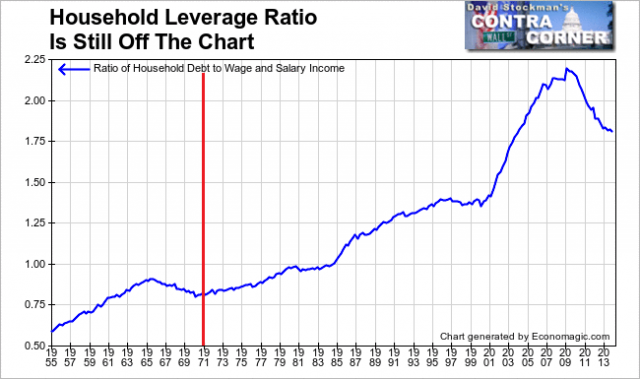
Even though this cash flow shuffle is perfectly silly, it has been stubbornly pursued by our paint-by-the-numbers Keynesian central bankers because they refuse to acknowledge the reality of “peak debt”—especially in the household sector. Yet only a permanent gain in leverage can cause consumer spending to remain elevated in response to monetary stimulus.

The overwhelming evidence, however, is that America’s shop-till-they-drop consumers have finally dropped. After a forty-year cycle of soaring household leverage ratios, “peak debt” ratios were finally encountered in 2007-2008— and now retrenchment has set in. Accordingly, consumer spending will now have to come solely out of income, not income plus incremental credit drawdowns which fueled the spending party for decades.
Household Leverage Ratio - Click to enlarge

Household Leverage Ratio – Click to enlarge

But while peak debt means that the Fed’s entire 5-year money printing spree was destined to fail, it nevertheless has produced massive impacts—–all of them bad or stupid. One of the most crucial is that it generated an artificial refi windfall to the Big Banks which now dominate the home mortgage business. And the profit windfall was a doozy.

Now that financial results for Q1 2014 have been posted, the impact on Big Four financial results can actually be quantified. The four charts below on mortgage originations per quarter during the course of the Fed’s balance sheet expansion binge are the smoking gun.

They show that during the most recent quarter the four banks only originated about $67 billion in new mortgages on a combined basis. That figure is a reasonable proxy for the steady-state condition that would have existed had the Fed not been engaged in a monetary cattle drive to get mortgage rates to the bottom of the valley. That is, had mortgage rates remained at their not unreasonable 2008 levels or oscillated randomly owing to the interaction of supply and demand for mortgage funds on the free market, there would have been no thundering stampede by American homeowners to refi their housing debts.

Accordingly, activity rates in the mortgage operations of the Big Four would have reflected mainly purchase money borrowing by households who were buying a new or existing home. So the difference between the peak mortgage origination rates shown in the graphs and Q1 results roughly measures Bernanke’s gift to the big banks.

On a combined basis, the Big Four originated mortgages at a peak rate of nearly $300 billion per quarter—or $1.2 trillion annually during the period between 2010 and early 2013. So the refi maneuver resulted in up to a 5X gain in the rate of mortgage originations—a process that gave rise to a triple dip of profits, as previously described:

As summarized in the Fortune article below, the mortgage originators were booking up to $3,300 of up front profit per refi.

And that was just the fee on the transaction—before booking the embedded “gain-on-sale” (often thousands more) when most of this booming mortgage volume was subsequently shuffled off to Freddie and Fannie to be packaged and resold as an MBS. Yes, and at that point, such newly minted “mortgage bonds” did flow back to Wall Street where they were doubtless churned many times over by the dealer side of the banking houses in their endless and remunerative chore of supplying “liquidity” to the homeowners of America….So the banking side of the Fed’s refi churn did well too—–enjoying a triple profit dip along the way.

As can be seen in the graphs, the windfall in some quarters was even more stupendous. The peak rate for Bank of America was 10X its Q1 2014 rate and for Citi it was 9X.

Yet the real story is in the Wells Fargo (WFC) data. During the third quarter of 2012 it originated $100 billion more in mortgages than it did in Q1 this year after the Fed’s refi cattle drive had ended. Stated differently, the geniuses who run Warren Buffet’s favorite bank were handed a  giant book of totally artificial businesses by the Fed— and the consequent opportunity to triple dip from mortgage volumes that amounted to nearly one-half trillion at an annualized rate. WFC had indeed learned at the knee of the nation’s master crony capitalist.


It should not take more than a moments reflection to grasp the hidden function of the massive mortgage churning shown in the left side of these graphs compared to the meager (and more market neutral) levels shown for Q1.Triple-dipping through their massive mortgage churn, the Big Four banks were able to book net income of $20-25 billion per quarter from originations, gain-on-sale and mortgage trading during much of this period.

That means that thanks to Bubbles Ben’s largesse they could pretend that their balance sheets were being repaired. Accordingly, raiding their equity accounts in order to fund dividends and stock buybacks was now fully copasetic.

So Uncle Warren along with his fast money trend followers got their reward in a munificent flow of cash out of bank vaults that had been wards of the state only a few months earlier—as did long suffering executives who’s stock options rose 5X in value owing to all the dividends and buybacks.

Indeed, during fiscal years 2009-2013 Wells Fargo disgorged $59 billion in cash to fund dividends and share repurchases and JPMorgan paid out $65 billion during the same 5-year period. Needless to say, $110 billion of cash flowing toward the bank stocks post at the Wall Street casino had the hedge fund speculators who continuously cycle in and out of these names delirious with excitement.

Likewise, their echo boxes in the financial press were quick to pronounce the all clear. The economy is fixed, the banks are back, and their stocks are soaring—surely proof that all is well. Compared to post-crisis lows, WFC’s stock price was recently at 6X (i.e. $60 per share vs. $10), JPM and BAC were at 3X and even the zombie known as Citi was at 2X.

Yes, some of the banks also raised new capital—especially in the early years after the crisis. But that was mainly a smokescreen to give false credibility to the phony “stress tests” concocted by Turbo Tim and Bubbles Ben. But even giving credit to new equity issued—the net cash distribution by WFC and JPM over the five-year period was just short of $80 billion. Adding in BAC, the Big Three distribution of cash for share repurchases and dividends amounted to nearly $35 billion during 2013 alone.

It goes without saying that this all amounted to a lot of “shareholder friendly” action—even if it did constitute horrid public policy. And Washington’s policy of allowing the same big banks—who allegedly brought the financial system to the brink of Armageddon just 66 months ago— out of supervisory lock-up is indeed horrible.

Every dime of big bank profits—honest earnings and windfall gains like these from the refi contraption alike—should have been sequestered on their balance sheets for years and years to come. Or at least until one of two conditions pertained.

One option would have been for some of them to grow up and become real free enterprises. But that would require  giving up the Fed’s discount window privilege, deposit insurance and undertaking an irrevocable renunciation of any future bailout claims on any agency of the state.

In the alternative, their balance sheets could have stayed in sequester during the entire five years since the crisis. This would have permitted retained earnings and capital to pile-up so deep that even the weak-kneed pettifoggers of the beltway would not be panicked into throwing the banks a life line next time they blow themselves up.

Neither option was chosen, obviously. Instead, while the Fed’s entire mortgage refi gambit did nothing for Main Street–except to confer cash flow windfalls on the less than 15% of  households that  actually did the refi— it did accomplish wonders on the Wall Street side.

Not only did it confer massive capital gains on speculators like Warren Buffet and the bank management teams who brought us the financial crisis, but it also amounted to a regulatory get out of jail free card.

Yet what was the all-fired hurry in Washington to open the flood gates to bank dividends and stock buybacks. Supposedly, that was to pepper the market for bank stock—so that they would raise new capital on their own.

Really? In our financialized economy and crony capitalist policy regime there is apparently no need for more bank capital. As was well demonstrated in 2008-2009, when push comes to shove the state treasury will be raided.

In the interim, its all about the secondary market. That is, goosing the price of existing stock certificates held by gamblers who scooped them up at the bottom and management teams who got themselves issued more options after Bubbles Ben pronounced the all clear.


via Zero Hedge http://ift.tt/1ll6eb9 Tyler Durden

Jon Basil Utley: Republicans Still Excel at Collecting Taxes for the State

The old accusation that Republicans are tax
collectors for the welfare state still rings true. Republicans
repeatedly promise lower tax rates in return for eliminating tax
deductions. Then, a few years later, tax rates are raised back up
to old levels—but the deductions stay gone forever. But it’s not
just the welfare state. As Jon Utley points out, Rep. Paul Ryan’s
(R-Wisc.) proposed budget would increase military spending
by some $50 billion per year starting in 2015, eliminating the
savings of the defense sequestration plan passed last year by
Congress.

View this article.

from Hit & Run http://ift.tt/1gUQkQL
via IFTTT

The One Thing Most Desired By Chinese Consumers Is…

Hint: it’s not designer clothes, shoes, bags or watches.


And some additional explanation from the World Gold Council:

The Chinese traditionally regard gold as a form of money. Indeed, the character for gold in Mandarin (jin) is also a synonym for money. This is an important fact when it comes to the motivations behind the purchase of jewellery. Asian buyers of plain, 22 or 24 carat jewellery have no doubt in their mind that they are buying gold as well as an object of beauty that can be worn. The perception of value is very important in markets such as India and China where plain, very high carat or ‘pure gold’ articles bought on low-mark-ups comprise the majority of gold jewellery consumption. As such, the level and direction of local gold prices usually have an important bearing on jewellery consumption. This was very clear in 2013 when in April of that year the sudden slump in prices triggered an extraordinary wave of buying in China. Consumers perceived this as a unique opportunity to exchange renminbi for gold at a very favourable rate. It was also of course a chance to bring forward planned purchases for gifts or weddings, especially as the consensus was that prices were bound, eventually, to move a good deal higher.


World Gold Council consumer research indicates that consumers remain very positively disposed towards ‘pure gold’ jewellery. It might be thought that the disappointing price trend in the second half of 2013 had undermined this optimism as well as the public’s desire to purchase ‘pure gold’ jewellery. This does not seem to be the case. An extensive consumer survey conducted towards the end of 2013 on behalf of the World Gold Council illustrates how China’s population continues to view ‘pure gold’ jewellery as a form of money, with little indication that this traditional attitude will change any time soon. Asked whether they agreed with the statement that 24 carat gold jewellery “…is as much an investment as it is a fashion item” no less than 80% of the sample agreed, while only 4% disagreed (16% held no view either way). Agreement levels were strong across all respondents. Moreover, support for future demand is strong: in a separate survey of over 10,000 Chinese consumers, 76% of those aged between 18 and 27 also affirmed ‘pure gold’ jewellery’s investment status. And the majority of respondents planned to maintain or increase their spending on 24 carat gold jewellery over the next 12 months (44% and 35% respectively.

h/t @RudyHavenstein


via Zero Hedge http://ift.tt/1qZB1Jz Tyler Durden

The Next Shoe Just Dropped: Court Denies Attorney-Client Privelege

Submitted by Simon Black via Sovereign Man blog,

In the Land of the Free, people grow up hearing a lot of things about their freedom.

You're told that you live in the freest country on the planet. You're told that other nations 'hate you' for your freedom.

And you're told that you have the most open and fair justice system in the world.

This justice system is supposedly founded on bedrock principles– things like a defendant being presumed innocent until proven guilty. The right to due process and an impartial hearing. The right to counsel and attorney-client privilege.

Yet each of these core pillars has been systematically dismantled over the years:

1. So that it can operate with impunity outside of the law, the federal government has set up its own secret FISA courts to rubber stamp NSA surveillance.

According to data obtained by the Electronic Privacy Information Center, of the nearly 34,000 surveillance requests made to FISA courts in the last 35-years, only ELEVEN have been rejected.

Unsurprising given that FISA courts only hear the case from the government's perspective. It is literally a one-sided argument in FISA courts. Hardly an impartial hearing, no?

2. The concept of 'innocent until proven guilty' may officially exist in courts, but administratively it was thrown out long ago.

These days there are hundreds of local, state, and federal agencies that can confiscate your assets, levy your bank account, and freeze you out of your life's savings. None of this requires a court order.

By the time a case goes to court, you have been deprived of the resources you need to defend yourself. You might technically be presumed innocent, but you have been treated and punished like a criminal from day one.

3. Attorney-Client privilege is a long-standing legal concept which ensures that communication between an attorney and his/her client is completely private.

In Upjohn vs. the United States, the Supreme Court itself upheld attorney-client privilege as necessary "to encourage full and frank communication between attorneys and their clients and thereby promote broader public interests in the observance of law. . ."

It doesn't matter what you're accused of– theft. treason. triple homicide. With very limited exceptions, an attorney cannot be compelled to testify against a client, nor can their communications be subpoenaed for evidence.

Yet in a United States Tax Court decision announced on Wednesday, the court dismissed attorney client privilege, stating that:

"When a person puts into issue his subjective intent in deciding how to comply with the law, he may forfeit the privilege afforded attorney-client communications."

In other words, if a person works with legal counsel within the confines of the tax code to legitimately minimize the amount of taxes owed, that communication is no longer protected by attorney-client privilege.

Furthermore, the ruling states that if the individuals do not submit attorney-client documentation as required, then the court would prohibit them from introducing any evidence to demonstrate their innocence.

Unbelievable.

While it's true that attorney-client privilege has long been assailed in numerous court cases (especially with regards to tax matters), this decision sets the most dangerous precedent yet.

With this ruling, government now has carte blanche to set aside long-standing legal protections and even deny a human being even the chance to defend himself.

Naturally, you won't hear a word about this in the mainstream media.

But it certainly begs the question, what's the point of even having a trial? Or a constitution?

When every right and protection you have can be disregarded in their sole discretion, one really has to wonder how anyone can call it a 'free country' any more.


via Zero Hedge http://ift.tt/PfSEa6 Tyler Durden

The Rule of Nobody: Saving America from Dead Laws and Broken Government – Q and A with Philip K. Howard

“The Rule of Nobody: Saving America from Dead Laws and
Broken Government – Q and A with Philip K. Howard,” produced by
Joshua Swain. About 45 minutes.

Original release date was April 15, 2014 and original writeup is
below.

“All of life works on responsibility,” says Philip K. Howard. ”Everybody
listening to this…has achieved what they’ve achieved in life
because they took responsibility to make it happen. Government is
no different than that.”

In 1995, Howard wrote The Death of Common Sense: How Law is
Suffocating America, kicking off a national conversation about
bureaucratic overreach and stupid regulations. In his new
book, The
Rule of Nobody: Saving America from Dead Laws and Broken
Government
, he extends and elaborates his analysis. It
isn’t bureaucratic gridlock or partisan polarization that’s keeping
Washington in perpetual mismanagement, argues Howard, but a fog of
rules and regulations that has made it nearly impossible to figure
out who is responsible.

Until civil servants can use common sense and practical
judgement, he says, the government won’t gain the flexibility
needed for solving today’s problems.

In a wide-ranging conversation with Reason’s Nick Gillespie,
Howard discusses many topics, including the following: the Port
Authority of New York and New Jersey’s inability to
quickly raise the height of the Bayonne Bridge to accommodate
newer, taller ships (00:57); why even President Obama doesn’t
control the executive branch (5:37); why regulations haven’t made
nursing homes better (7:50); how even New York Gov.
Andrew Cuomo couldn’t shut down an unused juvenile
detention center due to union rules (9:12); the long history of
doctors gaming Medicare (10:31); why businesses are
more flexible than governments (12:10); how technocratic views
of government took over America; why mandatory minimums
have led to abuse by prosecutors (18:42); specific reforms to
shift from “automatic government” to individual responsibility
(25:44); the goals of the Common Good
Foundation
 (43:00); and the high probablitiy of
“seismic change” in America’s political culture (44:10).

About 45 minutes.

Shot by Jim Epstein and Joshua Swain. Edited by Swain.

Scroll down for downloadable versions and subscribe to Reason
TV’s YouTube Channel to receive automatic updates when new material
goes live.

Read Gillespie’s review of The
Rule of Nobody
.

from Hit & Run http://ift.tt/1jTznGC
via IFTTT

Massive “Meteor-Like” Explosion Lights Up North Russian Night Sky

A little over a year ago, in February 2013, a meteor traveling at 19 miles per second above Chelyabinsk in the Russian Urals exploded in the morning sky, recorded by countless dashcams, with the resulting shock wave shattering windows hundreds of miles away. Fast forward to this night, when residents of Russia’s northern Murmansk region witnessed the fall of a celestial body similar to the famous Chelyabinsk meteorite on Saturday night. It flashed at 02:10 am local time and was clearly seen in the sky. However, no sound of explosions was heard.

Officials say that the nature of the celestial body is unknown, however since there were no warnings of any ICBM tests overnight, the meteor theory is the most valid one. Then again, the major Russian base of Severomorsk, and the administrative center of the Russia northern fleet, is located precisely in this area, so one can see why some of the already percolating theories suggest this may have been nothing but a military test.


via Zero Hedge http://ift.tt/1qZcNzp Tyler Durden