ECB Releases Full Details Of Its "Private QE" Program

As Mario Draghi promised, here are the full details of the ECB’s asset-backed securities and covered bond purchase programs, as prepped by Blackrock.

From the ECB:

ECB announces operational details of asset-backed securities and covered bond purchase programmes

  • Programmes will last at least two years
  • Will enhance transmission of monetary policy, support provision of credit to the euro area economy and, as a result, provide further monetary policy accommodation
  • Eurosystem collateral framework is guiding principle for eligibility of assets for purchase
  • Asset purchases to start in fourth quarter 2014, starting with covered bonds in second-half of October

The Governing Council of the European Central Bank (ECB) today agreed key details regarding the operation of its new programmes to buy simple and transparent asset-backed securities (ABSs) and a broad portfolio of euro-denominated covered bonds. Together with the targeted longer-term refinancing operations, the purchase programmes will further enhance the transmission of monetary policy. They will facilitate credit provision to the euro area economy, generate positive spill-overs to other markets and, as a result, ease the ECB’s monetary policy stance. These measures will have a sizeable impact on the Eurosystem’s balance sheet and will contribute to a return of inflation rates to levels closer to 2%.


The Eurosystem’s collateral framework – the rules that lay out which assets are acceptable as collateral for monetary policy credit operations – will be the guiding principle for deciding the eligibility of assets to be bought under the ABS purchase programme (ABSPP) and covered bond purchase programme (CBPP3). There will be some adjustments to take into account the difference between accepting assets as collateral and buying assets outright. To ensure that the programmes can include the whole euro area, ABSs and covered bonds from Greece and Cyprus that are currently not eligible as collateral for monetary policy operations will be subject to specific rules with risk-mitigating measures.


The two programmes will last for at least two years and are likely to have a stimulating effect on issuance. Asset purchases will commence in the fourth quarter of 2014, starting with covered bonds in the second half of October. The ABSPP will start after external service providers have been selected, following an ongoing procurement process.


Further technical details on the ABSPP are provided in Annex 1 of this press release and on CBPP3 in Annex 2.

Annex 1: Asset-Backed Securities Purchase Programme (ABSPP)

Annex 2: Covered Bond Purchase Programme (CBPP3)

* * *

Of course, none of the noted “spillovers” will ever take place, and instead we will merely get more of this type of headline: Bond Investors Gifted Best ABS Returns in 20 Months by ECB


via Zero Hedge http://ift.tt/1rPjV3U Tyler Durden

ECB Releases Full Details Of Its “Private QE” Program

As Mario Draghi promised, here are the full details of the ECB’s asset-backed securities and covered bond purchase programs, as prepped by Blackrock.

From the ECB:

ECB announces operational details of asset-backed securities and covered bond purchase programmes

  • Programmes will last at least two years
  • Will enhance transmission of monetary policy, support provision of credit to the euro area economy and, as a result, provide further monetary policy accommodation
  • Eurosystem collateral framework is guiding principle for eligibility of assets for purchase
  • Asset purchases to start in fourth quarter 2014, starting with covered bonds in second-half of October

The Governing Council of the European Central Bank (ECB) today agreed key details regarding the operation of its new programmes to buy simple and transparent asset-backed securities (ABSs) and a broad portfolio of euro-denominated covered bonds. Together with the targeted longer-term refinancing operations, the purchase programmes will further enhance the transmission of monetary policy. They will facilitate credit provision to the euro area economy, generate positive spill-overs to other markets and, as a result, ease the ECB’s monetary policy stance. These measures will have a sizeable impact on the Eurosystem’s balance sheet and will contribute to a return of inflation rates to levels closer to 2%.


The Eurosystem’s collateral framework – the rules that lay out which assets are acceptable as collateral for monetary policy credit operations – will be the guiding principle for deciding the eligibility of assets to be bought under the ABS purchase programme (ABSPP) and covered bond purchase programme (CBPP3). There will be some adjustments to take into account the difference between accepting assets as collateral and buying assets outright. To ensure that the programmes can include the whole euro area, ABSs and covered bonds from Greece and Cyprus that are currently not eligible as collateral for monetary policy operations will be subject to specific rules with risk-mitigating measures.


The two programmes will last for at least two years and are likely to have a stimulating effect on issuance. Asset purchases will commence in the fourth quarter of 2014, starting with covered bonds in the second half of October. The ABSPP will start after external service providers have been selected, following an ongoing procurement process.


Further technical details on the ABSPP are provided in Annex 1 of this press release and on CBPP3 in Annex 2.

Annex 1: Asset-Backed Securities Purchase Programme (ABSPP)

Annex 2: Covered Bond Purchase Programme (CBPP3)

* * *

Of course, none of the noted “spillovers” will ever take place, and instead we will merely get more of this type of headline: Bond Investors Gifted Best ABS Returns in 20 Months by ECB


via Zero Hedge http://ift.tt/1rPjV3U Tyler Durden

No Obamacare Bailouts for Insurers Without Congressional Approval, Says GAO

By forcing Americans to buy
their products, President Obama’s signature Affordable Care Act is
widely seen as a
winning proposition for health insurance companies
. Conscripted
customers! What more could a well-connected business want? But the
law’s complex rules require insurers to cover the costs imposed by
older and ailing customers with the payments from young and healthy
customers. Potentially, a company could end up with a
disproportionate ratio of sick customers drawn by the promise of
subsidized coverage—drowning the seemingly winning proposition in
red ink. If that happens, says the
Government Accountability Office (GAO)
, the administration
can’t bail out insurers without permission from Congress.

The GAO decision comes in response to a congressional inquiry
about the administration’s “risk corridors” (officially, the

premium stabilization programs
) scheme, which would subsidize
unprofitable plans by transferring money to them from those
actually in the black under Obamacare. The risk corridors plan is a
temporary measure intended to entice insurers to offer Obamacare
coverage while the program gets on its feet. The assumption is that
after 2016 plans will balance out costs and benefits because of
those conscripted customers.

But it’s not enough for a statute to require that an agency make
a payment—the funds have to be legally available. As the GAO
decision puts it, “At issue here is whether appropriations are
available to the Secretary of HHS to make the payments specified”
under the law. The GAO says they’re not.

The problem for the administration is that collecting money and
disbursing it through government agencies requires budgetary
authorization. That authorization can only come from Congress, and
must be authorized in each annual budget, year after year.

Language appropriating funds for “other responsibilities of the
Centers for Medicare and Medicaid Services” would need to be
included in the CMS PM appropriation for FY 2015 in order for it to
be available for payments to qualified health plans under
section 1342(b)(1). Similarly, language appropriating “such
sums as may be collected from authorized user fees” would need to
be included in the CMS PM appropriation for FY 2015 in order for
any amounts CMS collects in FY 2015 pursuant to
section 1342(b)(2) to be available to CMS for making the
payments pursuant to section 1342(b)(1)

So, if Congress doesn’t go along with the idea of gathering
money from profitable health exchange insurers and handing it to
unprofitable ones, the risk corridors idea is a non-starter.

Of course, Congress may authorize the payments because it
doesn’t have the backbone for another fight. That wouldn’t be a
shock. Or, the administration could ignore the GAO and use
executive authority to make yet another unilateral change to the
president’s health plan. That also wouldn’t be a shock.

But, if nothing else, the GAO decision is further evidence of
the slapdash crafting of the Affordable Care Act, even when it
comes to the legislative duct tape intended to hold it
together.

from Hit & Run http://ift.tt/1vxzVGE
via IFTTT

Global Markets React (Badly) To Draghi's Disappointing Nothing-Burger

Extending current programs (i.e. no imminent Sovereign QE)… may not spend the entire EUR1 trillion on current programs… no rate change… Markets are not happy. EUR is surging, European stocks are dropping, European peripheral bond risk is rising. Treasuries are bid and US equities have dropped to yesterday’s lows.


EURUSD not happy.. (and remember everyone and their mom is on one side of that trade)


European Stocks and Bonds not happy…


US equities (S&P 500) back at yesterday’s lows…


Charts: Bloomberg


via Zero Hedge http://ift.tt/1vcjqiX Tyler Durden

Global Markets React (Badly) To Draghi’s Disappointing Nothing-Burger

Extending current programs (i.e. no imminent Sovereign QE)… may not spend the entire EUR1 trillion on current programs… no rate change… Markets are not happy. EUR is surging, European stocks are dropping, European peripheral bond risk is rising. Treasuries are bid and US equities have dropped to yesterday’s lows.


EURUSD not happy.. (and remember everyone and their mom is on one side of that trade)


European Stocks and Bonds not happy…


US equities (S&P 500) back at yesterday’s lows…


Charts: Bloomberg


via Zero Hedge http://ift.tt/1vcjqiX Tyler Durden

Ireland’s Debt-Ridden Government Is Now Being Paid To Borrow

Submitted by David Stockman via Contra Corner blog,

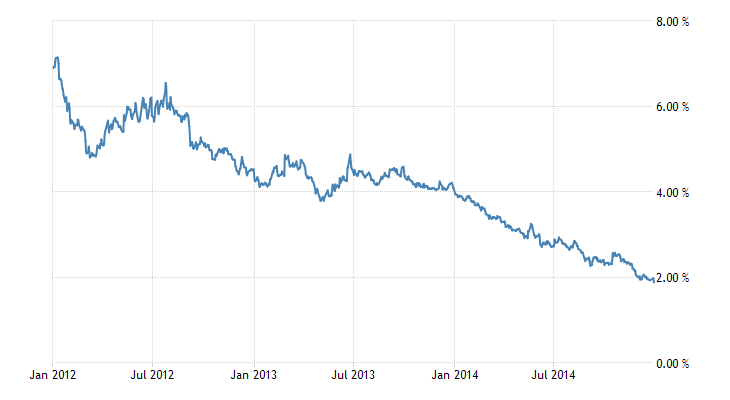
About 36 months ago Ireland’s two-year notes were yielding 14% and its government and the Brussels apparatchiks were scrambling with tin cup in hand to stave off disaster. Now their yield is negative 0.01%.


Mirabile dictu!

Yes, a wonder to behold – but not one I can explain. Better its left to the experts in today’s bizzzaro world of maniacal central banking. That is, with the reminder that the ECB has now set its deposit rate at negative 0.2%, here’s how Goldman explained the Irish note miracle to the WSJ:

If “you buy short-dated Irish or French paper and pay less [than depositing at the ECB], you’re improving your net income, even if the yields are still negative,” said Jonathan Bayliss, a managing director for global government bonds at Goldman Sachs Asset Management in London.

That’s right, down is the new up. The price and yield of government bonds no longer have anything to do with risk or economics; its all about central bank machinations. Actually, its all about the speculator driven momentum surges that are triggered by central bank maneuvers.

As is well known, Draghi’s “whatever it takes” pronouncement triggered the most blistering bond rally in recorded history. Leveraged speculators have literally made triple digit returns since July 2012 in the notes of still debt-besotted basket cases like Spain, Italy and Ireland.
Historical Data Chart

Historical Data Chart

Historical Data Chart

Indeed, in its breathless reporting on the miraculous recovery of the European bond market, the WSJ noted that red hot returns are still being earned two years after the fact—- as Draghi hints ever more strongly that a tsunami of ECB bond buying is just around the corner. During the last 9 months alone, punters have made double-digit returns on the debt of Italy and Spain—both of which are barely treading economic water and sinking deeper under the burden of public debt:

Spanish debt have fallen to 2% from 3.71% at the start of the year….That has lifted total returns—which includes price changes and interest payments—to 13%. On average, Italian bond yields have dropped to 2.33% from 3.78% over the same time frame, generating total returns of 12%.

Its not surprising, of course, that yield parched investors are being virtually herded into peripheral sovereign debt. After all, if they happened to have more confidence in the AA rated, stalwart supplier of the world’s sweet tooth (Nestle SA) than in Europe’s socialist politicians, for example, they would be able to garner the grand sum 0.4% on its five year notes.

So what you get is a vicious push-pull. The big time hedge fund gamblers pile on when they conclude the central bank is going to be buying or supporting a specific asset class. Then when bond prices start rising rapidly more cautious institutions join the fray. In the instant case, for example, Spanish and Italian banks have brought nearly $500 billion of their own country’s sovereign debt since mid-2012.

The bank bid adds thrust to the momentum play, but its also telling. With their marginal cost of funds at the zero deposit rate, why would European banks not harvest this ECB enabled yield curve arb all day rather than actually engaging in the act of loan-making? And then, finally, any timid bond fund managers left in the world can either choose to be fired for failing to hit their benchmark or pile on, too.

Needless to say, the end result is the complete destruction of price discovery and the rampant mis-pricing of risk. Yes, in the case of Ireland, there has been some sparks of rebound with GDP up in three of the last four quarters and its peak unemployment rate beginning to recede. But its pre-crisis debt binge was so spectacular that it is still hopelessly buried in the residue.

After all, the EC fix did not involve debt repudiation or meaningful lender haircuts: It was just another giant exercise in the toxic Brussels alchemy of refinancing the debt, stretching the maturities and, just generally, kicking the can. So, yes, after Irish bank debt outstanding tripled in six years through 2009 to the astonishing sum of $600 billion or 3X GDP, it has been sharply reduced by the bailout. Still, it remains at a GDP ratio far higher than the US.

As shown below, however, this was essentially accounting legerdemain. The towers of bank debt just moved over to the government accounts—leaving Ireland’s public debt to GDP ratio at 124%, and at a level 5X where it was in 2008 when the binge was cranking hard.

Ireland Bank Loans, creation

Ireland Government Debt to GDP

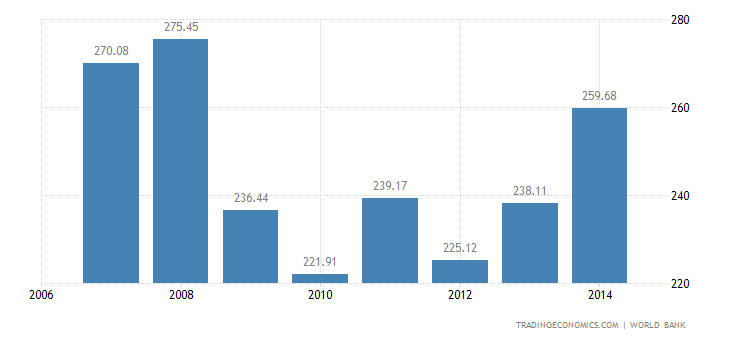
The problem is that on all the important economic metrics,  Ireland’s economy is still smaller than it was in 2008. On the broadest measure, GDP is still 17% below its 2009 peak. Even in real terms, the Irish economy is no larger than it was in 2007:
Historical Data Chart

Historical Data Chart

Likewise, its unemployment rate has dropped from 16% to around 12%, but like in the US there is less to that gain than meets the eye. Ireland has experienced a huge reduction in its labor force including outmigration. The telltale evidence is in the figures for the number of people actually employed.  That is still down by 10%.  Similarly, industrial production is no higher today than it was in 2007.

Historical Data Chart

Similarly, private final consumption expenditures have barely returned to 2006 levels after a 15% decline from the peak:

In short, there has been no Irish miracle turnaround that would remotely warrant the massive bond rally that has occurred since the crisis—to say nothing of a negative yield on its two-year notes. Instead, the crackpot financial engineers in Brussels have turned Ireland into a debt serf that, at best, may manage to tread water unti
l the next global downturn puts the damper on its export recovery.

But here’s the thing. Virtually none of the punters who have heeded Mario Draghi’s word clouds actually own Ireland’s debt. They all rent it by the day.

That means that Ireland’s two-year notes yielding negative 0.1% will be crushed on the sound of a single word.  Nein!

When the Germans say no to massive QE, the two-year rip in peripheral bonds will become a monumental wreck. And the Irish taxpayers and economy will be left with a mountain of debt—public and private—that at last count totaled about $2 trillion on a $225 billion GDP. It can’t possibly be serviced.


via Zero Hedge http://ift.tt/1vcjq2d Tyler Durden

Police Unleash Water Cannons, Tear Gas To Disperse ‘Block ECB’ Protesters In Naples – Live Feed

As Mario Draghi unveils more wealth creation mechanisms for the world’s elites, the people of Italy are revolting. Thousands have taken to the streets in Naples (where the ECB is meeting) to explain to Draghi “F##k Austerity” in a ‘parade’. Police used water cannons and tear gas to disperse the crowds.


The meeting in Naples of the board of the European Central Bank president Mario Draghi could not pass unnoticed in the world antagonist, which by the time you are preparing to 2 October for an event by the name Block ECB . Moreover, the Central Bank is not the only initiative held in Naples that day, as there will also be the European assembly of small and medium-sized enterprises (with the participation of the head of state Giorgio Napolitano and President of the EU Commission, Barroso).

Block ECB , however, will focus its protests against the meeting chaired by Mario Draghi. Protests that put the police on alert, as they are expected arrivals from all over Italy and beyond . It is feared as always the infiltration of extreme fringes that could escalate the whole; concern that appears to be legitimate, since this event is born from the initiative of the more radical groups.

On October 2, 2014 in Naples meets the Governing Council of the European Central Bank!
18 The governors of the central banks of the EU countries and the six executive director of the ECB, including President Mario Draghi, in the conference to “agree on policies of economic recovery,” in practice to “celebrate” the social disaster that they themselves prepared with the liberal government of the crisis with austerity policies and the total deregulation of the labor market, privatization of services, the subtraction of democracy and popular sovereignty with the treaties in the name of which are “justified” the cuts in social spending in all these years, from Maastricht to Fiscal Compact.

While unemployment exploded, consumption continued to shrink and too many people can not make it to the end of the month seems to us unacceptable arrogance of those who, with the construction of the euro, led the most powerful expropriation of social resources to the detriment of vulnerable social groups from all over Europe since the end of World War II. For the elite of European economic technocracy and the strong interests of which echoes the line certainly does not change: contract wages and rights is the only reform he believes really. The government Renzi, in the presidency of the European Union, will definitely be in the front row with his arduous attempt to make the Democratic Party the party of social stabilization and a political program that has already shown the true face with “Lupi decree” against the movement to the right the house and the Jobs Act to institutionalize perpetual insecurity


via Zero Hedge http://ift.tt/1vcjnUb Tyler Durden

Police Unleash Water Cannons, Tear Gas To Disperse 'Block ECB' Protesters In Naples – Live Feed

As Mario Draghi unveils more wealth creation mechanisms for the world’s elites, the people of Italy are revolting. Thousands have taken to the streets in Naples (where the ECB is meeting) to explain to Draghi “F##k Austerity” in a ‘parade’. Police used water cannons and tear gas to disperse the crowds.


The meeting in Naples of the board of the European Central Bank president Mario Draghi could not pass unnoticed in the world antagonist, which by the time you are preparing to 2 October for an event by the name Block ECB . Moreover, the Central Bank is not the only initiative held in Naples that day, as there will also be the European assembly of small and medium-sized enterprises (with the participation of the head of state Giorgio Napolitano and President of the EU Commission, Barroso).

Block ECB , however, will focus its protests against the meeting chaired by Mario Draghi. Protests that put the police on alert, as they are expected arrivals from all over Italy and beyond . It is feared as always the infiltration of extreme fringes that could escalate the whole; concern that appears to be legitimate, since this event is born from the initiative of the more radical groups.

On October 2, 2014 in Naples meets the Governing Council of the European Central Bank!
18 The governors of the central banks of the EU countries and the six executive director of the ECB, including President Mario Draghi, in the conference to “agree on policies of economic recovery,” in practice to “celebrate” the social disaster that they themselves prepared with the liberal government of the crisis with austerity policies and the total deregulation of the labor market, privatization of services, the subtraction of democracy and popular sovereignty with the treaties in the name of which are “justified” the cuts in social spending in all these years, from Maastricht to Fiscal Compact.

While unemployment exploded, consumption continued to shrink and too many people can not make it to the end of the month seems to us unacceptable arrogance of those who, with the construction of the euro, led the most powerful expropriation of social resources to the detriment of vulnerable social groups from all over Europe since the end of World War II. For the elite of European economic technocracy and the strong interests of which echoes the line certainly does not change: contract wages and rights is the only reform he believes really. The government Renzi, in the presidency of the European Union, will definitely be in the front row with his arduous attempt to make the Democratic Party the party of social stabilization and a political program that has already shown the true face with “Lupi decree” against the movement to the right the house and the Jobs Act to institutionalize perpetual insecurity


via Zero Hedge http://ift.tt/1vcjnUb Tyler Durden

Audit the Fed Already!

Before the House of Reps high-tailed it out of
D.C., it passed a bill to audit the Federal Reserve System by a
massive bipartisan vote of 333 to 92. Now the legislation goes to
the Senate, where it will…be ignored until the next Congress
starts in January and the process will begin again. Standing in the
way? Senate Majority Leader Harry Reid, who called for just such
legislation back in the 1990s. Not no more.

In the wake of the bombshell report from Pro Publica
illustrating absolute capture of Fed regulators by Goldman Sachs,
there’s even more reason to truly open the books of the nation’s
central bank and figure out exactly what’s on its balance sheet and
how it operates (the fed does get a perfunctory annual audit that
really doesn’t amount to much).

You don’t have to be a Bilderberger conspiracist or a lefty New
World Order wingnut to believe more transparency is called for
here. As I write at The Daily Beast,

The Fed as an inherently problematic institution. The central
bank is explicitly
tasked
 with the fundamentally incompatible duties of
conducting stable monetary policy, promoting full employment,
acting as a lender of last resort, and regulating the banks it
works with. Good luck with all that. Also, while it’s technically
independent, the federal government exerts massive political
pressure on the Fed and appoints its chair and board of
governors….

The Fed’s operational furtiveness—there’s a reason why William
Greider titled his 1989 history of the bank Secrets
of the Temple
—is hugely at odds with growing interest in
transparency in all aspects of contemporary life. How is it that we
can know more about the coffee beans we buy at the grocery store
than how our money gets made?


Read the whole thing.

from Hit & Run http://ift.tt/1nRe665
via IFTTT

Poll: 74 Percent Say Congress Should Prioritize Economic Growth Over Reducing Income Inequality

recent
Reason-Rupe poll
 finds 74 percent of Americans say they
want Congress to prioritize policies that promote economic growth,
while 20 percent want Congress to focus on reducing income
inequality instead.

Similarly, when asked which economic issue would be most
relevant to voters’ judgments this November 23
percent said
 the “gap between rich and poor.”

Focus on economic growth is a bi-partisan issue, including 69
percent of Democrats, 73 percent of independents, and 86 percent of
Republicans who prioritize promoting economic growth over reducing
income inequality.

Nevertheless, these results do not imply that Americans do not
care about income inequality, quite the opposite. The Pew
Research Center found
 that 78 percent of Americans think
“the gap between rich and poor” is a “big problem” for the country.
 Moreover, the Public
Religion Research Institute found
 66 percent of Americans
say “government should do more to reduce the gap between rich and
poor.”

But what do people mean when they say the government should “do
more” ? It could mean anything from income redistribution to
deregulating industries to allow for more job creation. In fact,
when Americans are offered more concrete alternatives, 58 percent
of Americans think that private sector growth is a better method
that government policy (31%) to reduce income inequality, according
to a New Models
National Brand Poll
.

In sum, Americans care about income inequality and would prefer
disparities attenuated. However, when policies intended to reduce
income inequality conflict with those intended to promote growth,
Americans opt for growth policies.

This implies that policy advocates should either explain why
policies intended to reduce income inequality will ultimately come
at the expense of economic growth, or alternatively why this
would not occur.

Ultimately, if Americans must make a choice, they opt for a more
prosperous economically differentiated society over a less
prosperous economically egalitarian society.

The Reason-Rupe national telephone poll, executed
by Princeton Survey Research Associates International,
conducted live interviews with 1000 adults on cell phones (500) and
landlines (500) August 6-10, 2014. The poll’s margin of error
is +/-3.7%. Full poll results can be found here. including
poll toplines (pdf) 
and crosstabs (xls).

from Hit & Run http://ift.tt/1x2uWir
via IFTTT