Bonds & Bullion Bid As Dow Dumps To 4-Month Lows Amid Geopolitical Chaos

A day dominated by geopolitical headlines saw stocks hit 4-month lows, gold jump to 3-week highs, and bond yields tumble to 14-month lows. The Dow made new "sell in May" lows today, now -1.5% from end-April (joined in weakness since then by the Russell). The S&P 500 broke its 100-day moving-average (and did not bounce) as USDJPY broke the critical 102.00 level. The Dow stalled at its 200-day moving-average (16343).  10Y Treasury yields continued to plunge pressing a 2.41% handle – new 14-month closing low-yields. Gold jumped above $1315 closing near the highs of the day (and silver above $20). The USD ended up on the day but JPY carry unwinds continued. VIX broke back above 17 (and remains inverted for the 10th day in a row). Equities continues to catch down to high-yield credit's weakness. A late-day buying-panic, sparked by VIX-slamming, was triggered as S&P futures broke 1900.


Gold reacted notably to every headline…


USDJPY was in charge (as EURJPY was off limits thanks to ECB and AUDJPY blew up last night)… 102.00 was all that mattered… fun-durr-mentals


Interestingly, The Russell 2000 remains green on the week with Trannies worst…


All the major indices are at or breaking key technical levels… (except Russell which is holding below)


"Sell In May" is working…


Stocks continue to slide towards credit's warning levels…


VIX pushed back above 17… but once the S&P 500 futures dropped to 1899.75, VIX was rammed lower…


With the VIX term structure inverted for 10 days now…


10Y Yields close at 14-month lows…


as the week sees compression accelerating


FX market were active with the USD ending higher – balanced between EUR weakness (Draghi's jawboning was mostly undone though) and JPY strength (carry unwinds)


Gold is up on the week as today saw oil prices start to react more as Iraq headline shit…


Charts: Bloomberg


via Zero Hedge http://ift.tt/1vhkvu2 Tyler Durden

Bonds & Bullion Bid As Dow Dumps To 4-Month Lows Amid Geopolitical Chaos

A day dominated by geopolitical headlines saw stocks hit 4-month lows, gold jump to 3-week highs, and bond yields tumble to 14-month lows. The Dow made new "sell in May" lows today, now -1.5% from end-April (joined in weakness since then by the Russell). The S&P 500 broke its 100-day moving-average (and did not bounce) as USDJPY broke the critical 102.00 level. The Dow stalled at its 200-day moving-average (16343).  10Y Treasury yields continued to plunge pressing a 2.41% handle – new 14-month closing low-yields. Gold jumped above $1315 closing near the highs of the day (and silver above $20). The USD ended up on the day but JPY carry unwinds continued. VIX broke back above 17 (and remains inverted for the 10th day in a row). Equities continues to catch down to high-yield credit's weakness. A late-day buying-panic, sparked by VIX-slamming, was triggered as S&P futures broke 1900.


Gold reacted notably to every headline…


USDJPY was in charge (as EURJPY was off limits thanks to ECB and AUDJPY blew up last night)… 102.00 was all that mattered… fun-durr-mentals


Interestingly, The Russell 2000 remains green on the week with Trannies worst…


All the major indices are at or breaking key technical levels… (except Russell which is holding below)


"Sell In May" is working…


Stocks continue to slide towards credit's warning levels…


VIX pushed back above 17… but once the S&P 500 futures dropped to 1899.75, VIX was rammed lower…


With the VIX term structure inverted for 10 days now…


10Y Yields close at 14-month lows…


as the week sees compression accelerating


FX market were active with the USD ending higher – balanced between EUR weakness (Draghi's jawboning was mostly undone though) and JPY strength (carry unwinds)


Gold is up on the week as today saw oil prices start to react more as Iraq headline shit…


Charts: Bloomberg


via Zero Hedge http://ift.tt/1vhkvu2 Tyler Durden

If You Like Your Exemption, Keep It: 90% Of Uninsured Won’t Pay Obamacare Penalties

No insurance, no penalty appears to be Obamacare’s new meme as The Wall Street Journal reports almost 90% of the nation’s 30 million uninsured won’t pay a penalty in 2016 because of a growing batch of exemptions to the health-coverage requirement. In the interests of socialism, the Obama administration has provided 14 ways people can avoid the fine (on top of exemptions carved out under the 2010 law for groups including illegal immigrants, members of Native American tribes and certain religious sects). The list of exemptions runs deep but one exemption for people who “experienced another hardship obtaining health insurance” (requiring documentation if possible but not requiring it) has been notably criticized as too broad. The exemptions are worrying insurers, as they could make it easier for younger, healthier people to forgo coverage, leaving the pools overly filled with old people or those with health problems. That, in turn, could cause premiums to rise.


As The Wall Street Journal reports,

Almost 90% of the nation’s 30 million uninsured won’t pay a penalty under the Affordable Care Act in 2016 because of a growing batch of exemptions to the health-coverage requirement.


The Obama administration has provided 14 ways people can avoid the fine based on hardships, including suffering domestic violence, experiencing substantial property damage from a fire or flood, and having a canceled insurance plan.


Those come on top of exemptions carved out under the 2010 law for groups including illegal immigrants, members of Native American tribes and certain religious sects.


Critics have assailed one exemption for people who “experienced another hardship obtaining health insurance” as too broad. That exemption asks for documentation if possible but doesn’t require it.


Factoring in the new exemptions, the congressional report in June lowered the number of people it expects to pay the fine in 2016 to four million, from its previous projection of six million.

The exemptions are worrying insurers.

The penalties were intended as a cudgel to increase the number of people signing up, thereby maximizing the pool of insured. Insurers are concerned that the exemptions could make it easier for younger, healthier people to forgo coverage, leaving the pools overly filled with old people or those with health problems. That, in turn, could cause premiums to rise.


Patrick Getzen, vice president and chief actuary at Blue Cross and Blue Shield of North Carolina, said he saw more “older and sicker people” enrolled in 2014 than projected. He attributed some of that to the weakened mandate.


“With a stronger penalty and less broad exemptions, that would be better for the risk pool.”

The White House response to all this…

“The Affordable Care Act requires people who can afford insurance to buy it, so that their medical bills are not passed onto the rest of us, which drives up health care costs for everyone.”

*  *  *
So, shut up and pay…


via Zero Hedge http://ift.tt/1vhkuqb Tyler Durden

If You Like Your Exemption, Keep It: 90% Of Uninsured Won't Pay Obamacare Penalties

No insurance, no penalty appears to be Obamacare’s new meme as The Wall Street Journal reports almost 90% of the nation’s 30 million uninsured won’t pay a penalty in 2016 because of a growing batch of exemptions to the health-coverage requirement. In the interests of socialism, the Obama administration has provided 14 ways people can avoid the fine (on top of exemptions carved out under the 2010 law for groups including illegal immigrants, members of Native American tribes and certain religious sects). The list of exemptions runs deep but one exemption for people who “experienced another hardship obtaining health insurance” (requiring documentation if possible but not requiring it) has been notably criticized as too broad. The exemptions are worrying insurers, as they could make it easier for younger, healthier people to forgo coverage, leaving the pools overly filled with old people or those with health problems. That, in turn, could cause premiums to rise.


As The Wall Street Journal reports,

Almost 90% of the nation’s 30 million uninsured won’t pay a penalty under the Affordable Care Act in 2016 because of a growing batch of exemptions to the health-coverage requirement.


The Obama administration has provided 14 ways people can avoid the fine based on hardships, including suffering domestic violence, experiencing substantial property damage from a fire or flood, and having a canceled insurance plan.


Those come on top of exemptions carved out under the 2010 law for groups including illegal immigrants, members of Native American tribes and certain religious sects.


Critics have assailed one exemption for people who “experienced another hardship obtaining health insurance” as too broad. That exemption asks for documentation if possible but doesn’t require it.


Factoring in the new exemptions, the congressional report in June lowered the number of people it expects to pay the fine in 2016 to four million, from its previous projection of six million.

The exemptions are worrying insurers.

The penalties were intended as a cudgel to increase the number of people signing up, thereby maximizing the pool of insured. Insurers are concerned that the exemptions could make it easier for younger, healthier people to forgo coverage, leaving the pools overly filled with old people or those with health problems. That, in turn, could cause premiums to rise.


Patrick Getzen, vice president and chief actuary at Blue Cross and Blue Shield of North Carolina, said he saw more “older and sicker people” enrolled in 2014 than projected. He attributed some of that to the weakened mandate.


“With a stronger penalty and less broad exemptions, that would be better for the risk pool.”

The White House response to all this…

“The Affordable Care Act requires people who can afford insurance to buy it, so that their medical bills are not passed onto the rest of us, which drives up health care costs for everyone.”

*  *  *
So, shut up and pay…


via Zero Hedge http://ift.tt/1vhkuqb Tyler Durden

Here’s The Dumbest Thing You’ll Hear All Week

Submitted by Simon Black via Sovereign Man blog,

In an unbelievable display of arrogance and self-importance, the Australian government recently announced the most sweeping changes to their national security legislation since 9/11.

The new laws will give the Australian government more powers to monitor all types of communication, both phone and internet.

What’s more, telecom companies will be required to store searchable metadata of all activity for two years, enabling the authorities to access details of every phone call made and every website visited.

Powers for “extended detention” and ‘preventative detention’, (pre-crime) have also been extended.

I’m sure it makes you feel better knowing that you could be preventively detained without actually committing any crime—you know, just in case…

It will also become a crime now to travel to a country where terrorists are ‘conducting hostile activities’ unless you have a ‘legitimate excuse’.

Just how these travel bans will be decided upon is unclear. Is Ukraine off limits? Spain? Northern Ireland? Thailand? Russia?

All of this is supposedly necessary because, according to the government, there are 125 Australian citizens currently part of terrorist groups overseas.

Even if correct, 125 people represent 0.0005% of the population of Australia. So for 125 people, the other 24+ million must be subjected to a Big Brother police state.

It all makes even less sense when your read the official justifications for it. Australia’s Prime Minister Tony Abbott said that:

We are under a lot of budget pressure at the moment, but the community won’t thank us if we skimp unreasonably on national security.

Ironically, he admits they don’t have the money for it. But they’re going to come up with an ADDITIONAL $630 million (a significant amount of money in Australia) to boost domestic spying and police state programs… all for 125 people.

But the prize for the dumbest comment you’ll hear this week goes to another pearl of wisdom from the Australian Prime Minister:

“The terrorist threat in this country has not changed, nevertheless it’s as high as it’s ever been.”

Now, as a native English speaker, I’m not entirely sure what he’s trying to tell me.

The government didn’t spend this money last year, and nothing happened.

But now since, according to the PM, nothing has changed, suddenly the government has to spend an additional $630 million to terrorize and spy on citizens.

What a brilliant piece of logic wrapped up in political Newspeak.

Basically they’re telling everyone that they should just be afraid… and that the government must spy on citizens in order to protect them.

This is how it always happens… and we can watch yet another country slide rapidly into a police state.


via Zero Hedge http://ift.tt/V1E353 Tyler Durden

Here's The Dumbest Thing You'll Hear All Week

Submitted by Simon Black via Sovereign Man blog,

In an unbelievable display of arrogance and self-importance, the Australian government recently announced the most sweeping changes to their national security legislation since 9/11.

The new laws will give the Australian government more powers to monitor all types of communication, both phone and internet.

What’s more, telecom companies will be required to store searchable metadata of all activity for two years, enabling the authorities to access details of every phone call made and every website visited.

Powers for “extended detention” and ‘preventative detention’, (pre-crime) have also been extended.

I’m sure it makes you feel better knowing that you could be preventively detained without actually committing any crime—you know, just in case…

It will also become a crime now to travel to a country where terrorists are ‘conducting hostile activities’ unless you have a ‘legitimate excuse’.

Just how these travel bans will be decided upon is unclear. Is Ukraine off limits? Spain? Northern Ireland? Thailand? Russia?

All of this is supposedly necessary because, according to the government, there are 125 Australian citizens currently part of terrorist groups overseas.

Even if correct, 125 people represent 0.0005% of the population of Australia. So for 125 people, the other 24+ million must be subjected to a Big Brother police state.

It all makes even less sense when your read the official justifications for it. Australia’s Prime Minister Tony Abbott said that:

We are under a lot of budget pressure at the moment, but the community won’t thank us if we skimp unreasonably on national security.

Ironically, he admits they don’t have the money for it. But they’re going to come up with an ADDITIONAL $630 million (a significant amount of money in Australia) to boost domestic spying and police state programs… all for 125 people.

But the prize for the dumbest comment you’ll hear this week goes to another pearl of wisdom from the Australian Prime Minister:

“The terrorist threat in this country has not changed, nevertheless it’s as high as it’s ever been.”

Now, as a native English speaker, I’m not entirely sure what he’s trying to tell me.

The government didn’t spend this money last year, and nothing happened.

But now since, according to the PM, nothing has changed, suddenly the government has to spend an additional $630 million to terrorize and spy on citizens.

What a brilliant piece of logic wrapped up in political Newspeak.

Basically they’re telling everyone that they should just be afraid… and that the government must spy on citizens in order to protect them.

This is how it always happens… and we can watch yet another country slide rapidly into a police state.


via Zero Hedge http://ift.tt/V1E353 Tyler Durden

Steve Liesman's Worst Nightmare: Consumer Credit Growth Tumbles, Misses By Most In 8 Months

Growth in Consumer Credit dropped for the 2nd month in a row (at $17.25bn) missing expectations by the most since November 2013. The March/April credit impulse has now completely faded. Given that “debt is the great bridge between working hard and playing hard in this country,” it would seem this news will disappoint Steve Liesman. Revolving credit dropped to its lowest since February as spend-what-you-don’t-have appears to be fading also.


And while the now conventional source of credit, namely Uncle Sam’s car and student loans, was solid, adding $16.3 billion in non-revolving loans – loans which will never be repaid and will see an Executive Ordered payment moratorium long before America’s conversion to a socialist paradise is complete –  it was the all important credit card debt, that closest proxy to a confident consumer, that posted its weakest growth in June since February, rising by only $942 million, and a far, far cry from the $8.8 billion outlier surge in April which will surely be revised away in a few months.


via Zero Hedge http://ift.tt/V5pUUj Tyler Durden

Steve Liesman’s Worst Nightmare: Consumer Credit Growth Tumbles, Misses By Most In 8 Months

Growth in Consumer Credit dropped for the 2nd month in a row (at $17.25bn) missing expectations by the most since November 2013. The March/April credit impulse has now completely faded. Given that “debt is the great bridge between working hard and playing hard in this country,” it would seem this news will disappoint Steve Liesman. Revolving credit dropped to its lowest since February as spend-what-you-don’t-have appears to be fading also.


And while the now conventional source of credit, namely Uncle Sam’s car and student loans, was solid, adding $16.3 billion in non-revolving loans – loans which will never be repaid and will see an Executive Ordered payment moratorium long before America’s conversion to a socialist paradise is complete –  it was the all important credit card debt, that closest proxy to a confident consumer, that posted its weakest growth in June since February, rising by only $942 million, and a far, far cry from the $8.8 billion outlier surge in April which will surely be revised away in a few months.


via Zero Hedge http://ift.tt/V5pUUj Tyler Durden

Record Numbers Of Americans Recounce Citizenship Under Obama

Obama has an odd definition of recovery.

While the commander in chief may exhibit an odd delight in his numerous TV appearances by taking “credit” for the near record stock market, the pre-revision Q2 GDP boost, or a wage-less job recovery driven by a surge in part-time jobs, the reality is that as we showed yesterday, living standards for the vast majority of the population have continued to deteriorate.

But one place where Obama’s track record leaves nothing open to interpretation, is in the number of Americans renouncing U.S. citizenship. According to the latest data released by the Federal Register, the number of US citizens who no longer want to be, stayed near an all-time high in the first half of the year before rules that make it harder to hide assets from tax authorities came into force.

It is unclear just who are these Americans willing to pay substantial amounts of money to expatriate, but it is safe to assume that many of them are of the “0.01%” persuasion, ironically the same social group who has, on the surface, benefited the most from Obama’s, pardon, Bernanke’s policies over the past 6 years.

According to Bloomberg, some 1,577 people gave up their nationality at U.S. embassies in the six months through June. While that’s a 13 percent decline from the year-earlier period, it’s only the second time there’s been a reading of more than 1,500, according to Bloomberg News calculations based on records starting in 1998.

Tougher asset-disclosure rules effective as of July 1 under the Foreign Account Tax Compliance Act, or Fatca, prompted 576 of the estimated 6 million Americans living overseas to give up their passports in the second quarter. The appeal of U.S. citizenship for expatriates faded as more than 100 Swiss banks turn over data on American clients to avoid prosecution for helping tax evaders.


“Fatca and the Swiss bank disclosure program has intensified the search for U.S. nationals beyond all measure,” said Matthew Ledvina, a U.S. tax lawyer at Anaford AG in Zurich. “It’s shocking the levels of due diligence they are going through to ensure they have cleaned house.”

Are the citizenship deniers all tax evaders? Not all, but most of them, yes.

The U.S., the only Organization for Economic Cooperation and Development nation that taxes citizens wherever they reside, stepped up the search for tax dodgers after UBS AG (UBSN) paid a $780 million penalty in 2009 and handed over data on about 4,700 accounts. Shunned by Swiss and German banks and with Fatca looming, almost 9,000 Americans living overseas gave up their passports over the past five years.


Fatca requires U.S. financial institutions to impose a 30 percent withholding tax on payments made to foreign banks that don’t agree to identify and provide information on U.S. account holders. It allows the U.S. to scoop up data from more than 77,000 institutions and 80 governments about its citizens’ overseas financial activities.


In establishing the 2010 Fatca law, Congress and President Barack Obama in effect threatened to cut off banks and other companies from easy access to the U.S. market if they didn’t pass along such information. It was projected to generate $8.7 billion over 10 years, according to the congressional Joint Committee on Taxation.

But the most direct impact of US tax policy on the richest Americans is this: “More than two-thirds of 400 U.S. expatriates surveyed in November by Zurich-based deVere Group said they had considered giving up their passports.”

Losing your US passport does not come cheap mind you: “Americans with a net worth exceeding $2 million and an average income tax of at least $157,000 over the previous five years must pay an exit tax on unrealized capital gains when they renounce U.S. citizenship.”

Which also happens to be a number that is not a concern to all those intent on becoming citizens of… anywhere else.

So for all those who adamantly claimed that Obama’s tax policy would not result in major defections of America’s uber wealthy – people who will now no longer pay any US taxes whatsoever – we present a chart showing the number of Americans who have expatriated in the past decade.

Congratulations president Obama, because this is certainly one chart which goes from the bottom left to the upper right you can take full credit for.


via Zero Hedge http://ift.tt/1vh27Sj Tyler Durden

The Financialization Of American Business: How Cheap Debt Fuels The Bubble, Not Growth

Submitted by David Stockman via Contra Corner blog,

Monetary central planning is failing to achieve Keynesian “escape velocity” because it has deeply impaired the engines of capitalist enterprise. Nowhere is this more apparent than in the grotesque financialization of American business that has occurred since the 1980s. As usual, this deformation is rooted in the massive growth of debt carried by non-financial businesses.

As shown below, non-financial business debt (corporate and non-corporate) has increased by nearly 8X since 1982 or at almost double the growth rate of GDP. Accordingly, the ratio of total business debt to GDP has risen from 53% to 81% over the last 32 years.

Tower of Business Debt - Click to enlarge

Tower of Business Debt – Click to enlarge

Needless to say, this debt tsunami was not devoted to investment in productive assets and therefore future growth and productivity. Especially since central bank money printing came to dominate the financial markets after the mid-1990s, the rate of real net business investment in the US economy has actually gone in the opposite direction—exhibiting an unprecedented decline. And in this context it is important to emphasize that the appropriate metric is net investment after current period consumption of capital is accounted for—- not gross CapEx as is measured in the GDP accounts and touted by Wall Street economists.

The latter measure is a Keynesian delusion based on “flow” economics. That is, the proposition that current quarter “spending” is all that counts because it helps to fill the bathtub of GDP closer to the rim of its purported full-employment potential.

But that ignores business cycle history and the productive structure of the economy. If a central bank induced financial bubble and bust has caused a deep economic slump, as it did in 2008-2009, and business investment has resultantly been sharply curtailed, that pull-back of current CapEx outlays does not stop the wear and tear on the business sector’s plant, equipment and other tools of production. Accordingly, during the recovery up-turn gross CapEx needs to compensate for recession shortfalls in capital replacement, as well as current period depreciation.

By contrast, when nominal CapEx does not cover accumulated depreciation – then the economy’s seed corn is being consumed. What results is a circumstance in which the headline readers on bubblevision breathlessly report a quarterly uptick in fixed business investment, but remain clueless to the possibility that it actually measures an erosion of productive capacity after accounting for deprecation, amortization and the inflation gap between current replacement prices for capital assets and their historic accounting basis.

In fact, that is exactly what has been happening since 1998. The modest recovery of business CapEx in each upturn has not been sufficient to cover cumulative capital consumption plus an increment for capacity growth. Accordingly, the trend level of real business investment spending has been heading south for the last 17 years, and now stands 20% below its turn of the century levels.
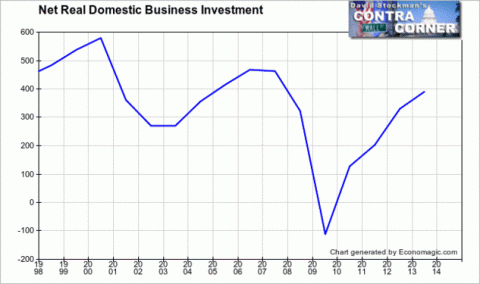
Real Business Investment - Click to enlarge

Real Business Investment – Click to enlarge

There can be no mystery, therefore, as to how the American business sector has deployed its vast accumulation of debt. It has overwhelmingly gone into financial engineering – that is, into the strip-mining of equity from the business sector by means of stock buybacks, LBOs and cash M&A takeovers. By definition, these maneuvers confer windfalls on equity holders, but add nothing to productive capacity.

During the years since the December 2007 pre-crisis peak, this trend has been especially apparent. Non-financial business debt outstanding has soared from $11 trillion to $14 trillion or by  nearly 30%. Yet, as is evident in the chart above, real net investment is still well below its 2007 level. Indeed, even gross business investment in plant and equipment is 5% below its prior peak.

By contrast, stock buybacks and M&A volumes have come roaring back. The former is now up by 5X from the 2009 bottom and is approaching its 2007 blow-off level.


Debt fueled M&A deals are also back at levels which resulted in massive restructurings and jobs cuts when the macro-economy turned down in 2008-2009. The potential for a reoccurrence is evident in the data for leveraged loans.

The continuous recycling of cash strip-mined from the balance sheets of American business into stock purchases has fueled the over-valuation of corporate equity in a major way. This is captured in the vast expansion of the unlevered enterprise value or TEV of non-financial corporations (debt plus market value of equity per the Fed’s flow-of-funds report). In effect, corporations lever up their balance sheets with debt and use the proceeds to goose the market value of their stock. The TEV measure captures both phases of the maneuver.
 
Accordingly, the TEV of non-financial corporations has literally exploded since the advent of monetary central planning, rising from $2.5 trillion in 1982 to to nearly $31 trillion at present. That represents a stunning gain of 12X over the period:
Total Enterprise Value Non-Financial Corporations - Click to enlarge

Total Enterprise Value Non-Financial Corporations – Click to enlarge

Obviously, neither GDP nor business value added has grown at anything like these rates during the last 30 years. As measured as a share of GDP, for example, the TEV of non-financial corporations has soared from 70% to 170% of GDP since 1982.

Total Enterprise Value of NonFinancial Corporations Ratio to GDP - Click to enlarge

Total Enterprise Value of NonFinancial Corporations Ratio to GDP – Click to enlarge

It goes without saying that this trend embodies a destructive cycle of financialization.  Rather than functioning as a dynamic engine of growth in productivity, enterprise and real wealth, the American business sector has become a tool of economic redistribution. Taking on more and more debt, the business sector cycles cash to Wall Street and the top 10% of households which hold most of the corporate equities.

Needless to say, this on-going plunder of business balance sheets goes hand-in-hand with the collapse of “breadwinner” jobs in the American economy. Once again, the July jobs report’s headlines touted another month of robust job creation. But as has been the case for the past 14 years, this headline job growth has been overwhelmingly concentrated in marginal part time jobs catering to the spending habits of the affluent upper strata. By contrast, owing to the lack of real investment in productive enterprise, the count of breadwinner jobs still remains 5% below its level when Bill Clinton was still in the oval office.

Part Time Economy - Click to enlarge

Part Time Economy – Click to enlarge


Breadwinner Economy - Click to enlarge

Breadwinner Economy – Click to enlarge

At the end of the day, there is no mystery as to why trend GDP growth has fallen to just 1.8% per annum since the year 2000 – a rate which is barely half its trend during the previous half-century. Monetary central planning inherently deforms market capitalism by flooding the business sector with cheap debt, thereby turning it into an engine for the redistribution of existing wealth rather than the generation of new growth, jobs and enterprise.


via Zero Hedge http://ift.tt/1nwLCYs Tyler Durden