Carmaker Hype Sends Palladium To Highest Against Gold In 10 Years

Gold is trading at the lowest level relative to palladium since 2004 as Bloomberg notes that prospects for a record shortage has lured investors to the metal used in pollution-control devices for cars amid concern that supply will be disrupted. As the chart below shows an oz of gold buys only 1.54 oz of palladium (less than a 3rd of the 5oz gold could buy in 2009) as supply problems (mining strikes and Russian sanctions) collide with demand expectations (the ‘recovery’ of the global car market). Despite GM’s problems, record levels of channel-stuffed inventories, and a still stagnant consumer (showing no interest in big purchases), IHS expects a record level of auto sales this year at 85 million. Seems like this ratio is an interesting derivative play on the excessive exuberance in the world’s car market expectations.


As Bloomberg notes,

Russia and South Africa are the world’s biggest producers of palladium.

A 17-week strike over pay at the South African mines of Anglo American Platinum Ltd., Impala Platinum Holdings Ltd. and Lonmin Plc, the largest producers, has squeezed supplies while western nations threaten Russia with sanctions for its actions in Ukraine. Johnson Matthey Plc predicts palladium’s shortage will expand to 1.61 million ounces in 2014 from 371,000 ounces last year. That would be the biggest shortfall since at least 1980, based on data on the company’s website.

“Beside the currently most important triggers for the price of palladium, namely the tense strike situation in South Africa as well as possible sanctions towards Russia in the Crimea crisis, global demand from the automobile industry should not be neglected,” Sonia Hellwig, senior manager for sales and marketing at Heraeus Metals Germany GmbH & Co. in Hanau, Germany, said by e-mail. “Furthermore the palladium ETFs continuously create positive impulses for the palladium price.”

IHS Automotive predicts that global auto sales will climb to a record 85 million this year. Usage by automakers increased 3.6 percent to a record 6.91 million ounces in 2013, according to Johnson Matthey, which makes about one in three of the world’s catalytic converters.


Just ignore this…


And this…


via Zero Hedge http://ift.tt/1t0unSt Tyler Durden

The Connection Between Oil Prices, Debt Levels, And Interest Rates

Submitted by Gail Tverberg of Our Finite World blog,

If oil is “just another commodity,” then there shouldn’t be any connection between oil prices, debt levels, interest rates, and total rates of return. But there clearly is a connection.

On one hand, spikes in oil prices are connected with recessions. According to economist James Hamilton, ten out of eleven post-World War II recessions have been associated with spikes in oil prices. There also is a logical reason for oil prices spikes to be associated with recession: oil is used in making and transporting food, and in commuting to work. These are necessities for most people. If these costs rise, there is a need to cut back on non-essential goods, leading to layoffs in discretionary sectors, and thus recession.

On the other hand, the manipulation of interest rates and the addition of governmental debt (by spending more than is collected in tax dollars) are the primary ways of “fixing” recession. According to Keynesian economics, output is strongly influenced by aggregate demand–in other words, total spending in the economy. Any approach that can increase total spending–either more debt, or more affordable debt will increase economic output.

What is the Direct Connection Between Increased Debt and Oil Prices?

The economy doesn’t just grow by itself (contrary to the belief of many economists). It grows because affordable energy products allow raw materials to be transformed into finished products. Increased debt helps energy products become more affordable.

Figure 1.

Figure 1.

Without debt, not a very large share of the total population could afford a car or a new home. In fact, most businesses could not afford new factories, without debt. The price of commodities of all sorts would drop off dramatically without the availability of debt, because there would be less demand for the commodities that are used go make goods.

With commodities, such as oil or copper, there is a two way pull:

  1. The amount it costs to extract the oil or copper (including taxes, shipping costs, and other indirect costs), and
  2. The selling price for the commodity. The selling price reflects the customers’ ability to pay for the product, based on wages and debt availability. It also reflects other issues, such as the availability of cheaper substitutes.

The availability of increased cheap debt tends to pull oil (and copper and other commodity) prices high enough that businesses find it profitable to extract these commodities. This is why Keynesian economics tends to work–at least historically. When oil prices dropped to the low $30s barrel in 2008, the issue was very much a “decrease in debt outstanding” problem–taking place even before the Lehman bankruptcy–as I will show in later charts.

Figure 2. Oil price based on EIA data with oval pointing out the drop in oil prices, with a drop in credit outstanding.

Figure 2. Oil price based on EIA data with oval pointing out the drop in oil prices, with a drop in credit outstanding.

The peak in oil prices took place in July 2008. When we look at US mortgage amounts outstanding, we find that home mortgage debt hit a peak on March 31, 2008, and very slightly declined by June 30, 2008. The bankruptcy of Lehman Brothers did not take place until September 15, 2008. A further decline in the amount of home mortgages outstanding occurred from that point on, partly because of declining sales prices and partly because commercial organizations bought homes to rent them out.

Figure 3. US home mortgage debt, based on Federal Reserve Z.1 data

Figure 3. US home mortgage debt, based on Federal Reserve Z.1 data

When we look at consumer credit outstanding, we find that consumer credit outstanding hit a maximum on July 31, 2008, and began declining by August 31, 2008. (Consumer credit is available monthly, while mortgage debt is available only quarterly. Some definitional change regarding consumer credit must have taken place as of December 31, 2010, to cause the jump in amounts in the graph.)
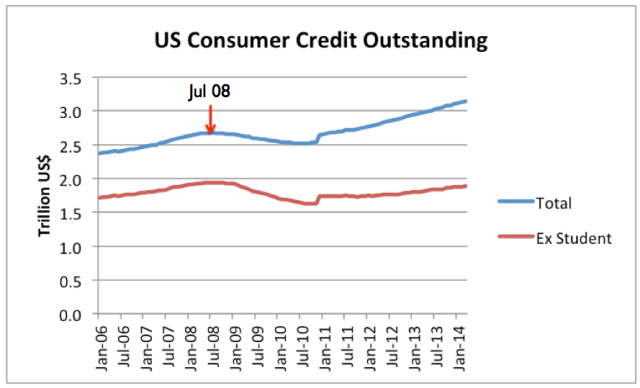
FIgure 4. Consumer Credit Outstanding based on Federal Reserve Data. Student Loan data was available only for 12/31/2008 and subsequent. Prior amounts were estimated.

FIgure 4. Consumer Credit Outstanding based on Federal Reserve Data. Student Loan data was available only for 12/31/2008 and subsequent. Prior amounts were estimated.

When student loans are excluded, consumer credit outstanding (including such items as credit card debt and auto loans) is still not back up to the July 31, 2008 level today (Figure 4).

I have not shown commercial and financial debt, but they decreased as well, with somewhat later peak dates, coinciding more with the Leyman collapse. In my view, the spending of individual citizens is primary. When their spending falls, it quickly ripples through to business and government accounts. We see this affect slightly later.

The Federal Government quickly stepped in with more spending (funded by debt), as shown in Figure 5, below.
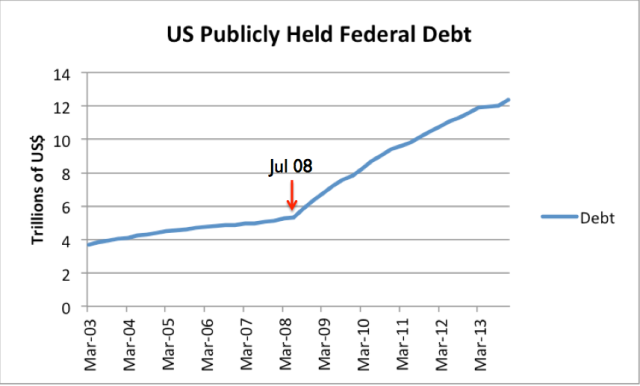
Figure 5. U S publicly held federal government debt, based on Federal Reserve data.

Figure 5. U S publicly held federal government debt, based on Federal Reserve data.

If we combine all United States debt (Figure 6, below), including both government and non-government, it becomes clear that the rate of increase in debt slowed markedly in 2008 and subsequent years.
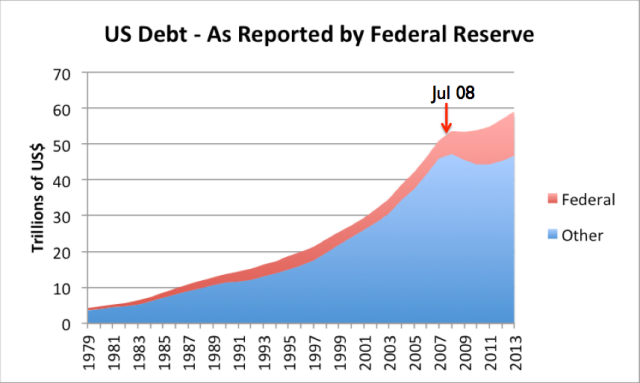
Figure 6. US debt, excluding debt which is owed to governmental agencies such as the Social Security Administration. Amounts based on Federal Reserve Z.1 data.

Figure 6. US debt, excluding debt which is owed to governmental agencies such as the Social Security Administration. Amounts based on Federal Reserve Z.1 data.

Without this increasing debt, oil prices dropped to less than one-fourth of their maximum values (Figure 2). Prices of other energy products–even uranium–dropped as well. Somehow the high prices of oil that occurred in early 2008 had turned off the “pump” of ever-increasing debt that had previously held up commodity prices.

Oil Prices and Interest Rates–the Two Big Factors Affecting Discretionary Income

If oil prices spike, clearly discretionary income falls, for reasons described above. If interest rates spike, suddenly goods that are bought with credit (such as automobiles, homes, and new factories) become more expensive. Thus, a spike in interest rates will tend to adversely affect discretionary income as well. If the Federal Reserve wants to counter high oil prices (which continue to affect discretionary income adversely for the long term), it needs to keep interest rates low. Hence, the attempts to keep interest rates low for the long term.

The primary approach to keeping interest rates low has been Quantitative Easing (QE).US QE was begun in late 2008 and has been kept in place since. Other major countries are also using QE to keep interest rates down. The hope is that with very low interest rates the economies can somehow recover.

QE Doesn’t Really Work, Because it Doesn’t Fix Wages, Which are the Underlying Problem

When oil prices are high, wages tend to stagnate (Figure 7, below).

Figure 7. Average US wages compared to oil price, both in 2012$. US Wages are from Bureau of Labor Statistics Table 2.1, adjusted to 2012 using CPI-Urban inflation. Oil prices are Brent equivalent in 2012$, from BP’s 2013 Statistical Review of World Energy.

Figure 7. Average US wages compared to oil price, both in 2012$. US Wages are from Bureau of Labor Statistics Table 2.1, adjusted to 2012 using CPI-Urban inflation. Oil prices are Brent equivalent in 2012$, from BP’s 2013 Statistical Review of World Energy.

The reason why wages tend to stagnate when oil prices are high has to do with the adverse impact high oil prices have on the economy. Consumers cut back on discretionary spending. This leads to a loss of jobs in discretionary sectors. Also, labor is one of the biggest costs most businesses have. If profits are squeezed by high oil prices, the logical response if to try to reduce wages in response. One way is to outsource production to a lower-wage country. Another is to mechanize the process more, thereby slightly increasing fuel usage but significantly decreasing wage costs.

Instead of going to individuals as wages, the money from QE seems to go to speculators, who use it to bid up stock prices and land prices. The money from QE also tends to hold home prices up, because some homes are purchase by speculators. The money from QE also helps encourage investment in marginal enterprises, such as in shale gas drilling. As a recent Bloomberg, described the situation, Shale Drillers Feast on Junk Debt to Stay on Treadmill.

What Really Pumps Up the Economy is a Rising Supply of Cheap Oil

One piece of evidence supporting the view that a rising supply of cheap oil pumps up the economy is the rising average wages seen in Figure 7 (above) during periods when oil prices are low. Another piece of evidence that this is the case is the close correlation between oil consumption (and energy consumption in general) and inflation-adjusted GDP (Figure 8, below).

Figure 8. Growth in world GDP, compared to growth in world of oil consumption and energy consumption, based on 3 year averages. Data from BP 2013 Statistical Review of World Energy and USDA compilation of World Real GDP.

Figure 8. Growth in world GDP, compared to growth in world of oil consumption and energy consumption, based on 3 year averages. Data from BP 2013 Statistical Review of World Energy and USDA compilation of World Real GDP.

When there is an inadequate supply of oil, it affects GDP growth. This happens because there is no inexpensive, quick way of switching away from oil. We need oil for very many uses, including transport, agriculture, and construction. In the late 70s and early 80s, we tried to switch away from oil as much as possible. Now the low-hanging fruit for making such a switch are mostly gone.

The spike in oil prices signaled that something had changed dramatically. We could no longer count on a rising supply of cheap oil to pump up the economy. People’s job opportunities were dropping. They found it necessary to cut back on debt. Either that, or creditors cut off credit availability. One way or another, citizens started using less debt.

World Oil Supply

World oil supply is growing only very slowly, as illustrated in Figure 9. While we hear much about the growth in oil from shale formations in the US, this is mostly acting to offset falling production elsewhere.

7. Growth in world oil supply, with fitted trend lines, based on BP 2013 Statistical Review of World Energy.

Figure 9. Growth in world oil supply, with fitted trend lines, based on BP 2013 Statistical Review of World Energy.

It is this lack of growth in oil supply together with the high price of oil that is holding back world economic growth. As stated previously, very low interest rates are needed to even maintain the level of economic growth we have now.

The Difference Between and Growing and Shrinking World Economy for Repaying Debt

In a growing economy, it is possible to repay debt with interest. But once an economy flattens, it is much harder to repay debt.

Figure 10. Repaying loans is easy in a growing economy, but much more difficult in a shrinking economy.

Figure 10. Repaying loans is easy in a growing economy, but much more difficult in a shrinking economy.

It is likely that it is this problem that underlies the difficulty economies have in increasing their indebtedness. Very low interest rates can help, but ultimately, if the economy is not expanding, debt doesn’t work well. Wages are not growing in inflation-adjusted terms, and because of this, it is not possible for citizens to take on much more debt. Increased student debt gets in the way of buying homes using mortgages later.

The Unfortunate Oil Price Problem We Have Now

The problem we have now is that a rising supply of cheap oil is no longer possible. Most of the cheap-to-extract oil is already gone.

Instead, the cost of extraction keeps rising, but wages are not going up enough for people to afford the high cost of extracting oil (even with super-low interest rates). The unfortunate outcome is that oil prices are now too low for many producers. I described this in my post, Beginning of the End? Oil Companies Cut Back on Spending.

Because oil prices are too low for companies doing the extraction, we really need higher oil prices. But if oil prices are higher, they will put the country (and the world) back into recession. Interest rates are already very low–it is not possible to lower them further to offset higher oil costs. We are reaching the edge of how much central banks can do to hold economies together.

The Effect of Rising Interest Rates on the Economy

If it takes very low interest rates to offset the impact of high oil prices, it should be clear that rising interest rates, if they ever should occur, will have a disastrous effect on the economy. If interest rates should rise, they could be expected to have a number of adverse effects, pretty much simultaneously.

  • They make the monthly payments for a new home or new car higher, reducing the sales of both
  • They reduce the sales price of existing bonds (carried on the books of banks, pension funds, and insurance companies)
  • They likely will reduce stock market prices, because bonds will look like they will yield better in comparison.
  • Also, the country will be shifted into recession, and lower stock prices will result based on the apparently worse prospects of most companies.
  • The resale value of homes will likely drop, because fewer people will be in the market for  a move-up home.
  • The US government will need to pay higher interest on its debt, necessitating a rise in taxes, further pushing the country toward recession.
  • With higher taxes and more layoffs, there will be more defaults on debts of all kinds. Banks, insurance companies, and pension plans will be especially affected. Many will need to be bailed out, but it will be increasingly difficult to do so.

The Federal Reserve has said that it is in the process of scaling back the amount of debt it buys under QE. The expected effect of scaling back QE is that interest rates will rise, especially at with respect to longer-term debt. For a while, US interest rates did rise, and home sales dropped off.  But more recently in 2014 year to date, interest rates seem to be falling rather than rising. This is strange, since this is the period when the scaling back of QE is supposedly actually taking place, rather than just planned. It is possible that overseas transactions are distorting what is really happening.

Getting Out of this Mess

The substitution of debt for additional salary isn’t necessarily a very good one, even with very low interest rates. For example, the maximum length of new car loans has increased from five years to six years to seven years, allowing people to afford more expensive cars. The catch is that loans are “underwater” longer, and it becomes harder to buy a replacement car. So ultimately, buyers tend to keep their cars longer, reducing the demand for new cars. The problem isn’t entirely solved; to some extent it is just delayed.

It is hard to see a way out of our current predicament. The ability of consumers to pay higher prices for goods and services under normal circumstances requires higher wages. But if higher wages are not available, higher debt plus very low interest rates can “sort of” substitute. This cannot be a permanent solution, because there are too many things that will disturb this equilibrium.

As we have seen, rising interest rates will bring an end to our current equilibrium, by raising costs in many ways, without raising salaries. It will also reduce equity values and bond prices. A rise in the cost of extraction of oil, if it isn’t accompanied by high oil prices, will also put an end to our equilibrium, because oil producers will stop drilling the number of wells needed to keep production up.  If oil prices rise (regardless of reason), this will tend to put the economy into recession, leading to job loss and debt defaults.

The only way to keep things going a bit longer might be negative interest rates. But even this seems “iffy.” We truly live in interesting times.


via Zero Hedge http://ift.tt/1n7jG0Q Tyler Durden

China’s Rising ‘Working Class Insurrection’ Problem

Last week we highlighted the stunning images of China’s “fists and daggers” police force training for a “working class insurrection.” It appears to be good timing, given last night’s terrible blasts in Urumqi. The chart below shows the worrying escalation in social unrest in China – at a time when the leadership is pushing a “strike first” anti-terrorist policy that appears to be failing badly. The “serious violent terrorist incident” that occurred last night in Urumqi, killing 31 and injuring 94, was the worst in years and prompted domestic security chief Meng Jianzhu to vow to strengthen a crackdown on the “arrogance of terrorists,” but, as one analyst warns tightening controls on the Uighur region may be “smacking them in the face.”


As Reuters reports,

he Xinjiang government could not be immediately reached for comment, but China’s Foreign Ministry spokesman Hong Lei said the attack “should be condemned jointly by the Chinese people and the international community”.

“The Chinese government has the confidence and the ability to combat the terrorists,” Hong said at a daily news briefing. “These terrorists are swollen with arrogance. Their schemes will not succeed.”

In a posting on its Chinese-language microblog account, the U.S. Embassy said it offered condolences to victims of the “violent attack”, but stopped short of labeling it terrorism.

In contrast, Russian President Vladimir Putin expressed condolences over what he called the “terrorist act” in Urumqi in a telegram to Chinese President Xi Jinping on Thursday, the Kremlin said, a day after a visit to Shanghai that produced a landmark agreement on supplies of Russian natural gas to China.

President Xi said police would tighten security at possible targets and vowed to “severely punish terrorists”, Xinhua reported.

However, in recent weeks, China has intensified a crackdown on Uighurs in the region, jailing dozens for spreading extremist propaganda and manufacturing arms, among other charges.

Christopher Johnson, a former China analyst at the CIA, said China’s leadership may eventually realize that a policy of constantly tightening controls on Xinjiang may not be effective in preventing attacks.

“I’m kind of doubtful that they are going to announce some sort of more liberal policy,” said Johnson, who now works at the Center for Strategic and International Studies in Washington.

“But sooner or later I think they are going to have to come to that reality because the evidence is just smacking them in the face.”

But hey – buy stocks because PMI printed in contraction but better than expected… even if employment was dismal.


via Zero Hedge http://ift.tt/1jIprSH Tyler Durden

Marc Faber: “The System Is Very Vulnerable,” Brace For A “General Asset Deflation”

With global debts 30% higher than they were at the 2007 crisis peaks, enabled by the money printing of central banks, Marc Faber warns that the “asset inflation” of the last years is not reflective of the broad growth seen in the 70s. “The system is still very vulnerable,” he warned as investors are exuberant over “hot new issues” just as they were in 2000 and fears “excessive speculation” means investors should brace for a “general asset deflation.” Emerging markets are relatively cheap to the US and Europe, he notes, but it is too early; there is nothing to like about low treasury yields but they are good to offset risk. As the market soared recently, fewer and fewer stocks are making new highs and this internal weakness (lack of breadth) and the breakdown in so many ‘loved’ stocks says the drop is coming sooner rather than later…


via Zero Hedge http://ift.tt/1oXTKH3 Tyler Durden

The Annotated History Of The World’s Next Reserve Currency

With de-dollarization escalating and Chinese officials now openly calling for “a new and more efficient system,” specifically on which is not dominated by the US and the dollar, it appears the day of a rebalancing is approaching more rapidly than most would like to believe. On the heels of the vice president of China’s central bank commenting that “renminbi will become the reserve currency” we thought it time to look at the long-run history of the Chinese currency and its rapidly rising internalization efforts.


As Simon Black of Sovereign Man noted recently, Chinese financial magazine Caijing has reported that the vice president of China’s central bank Pan Gongsheng made some rather candid remarks about the dollar and renminbi at a recent monetary seminar.

Over the past several years, the dollar has lost significant ground to other currencies, in its share of international trade transactions and national reserves settlement.

This means that, more and more, people around the world are dealing in currencies other than US dollars when they trade with one another.

Not to mention, central banks and national governments are starting to hold larger proportions of non-dollar currencies.

Mr. Pan pointed out that China has signed bilateral currency swap agreements with central banks and governments from nearly two dozen countries, in an amount exceeding 2.5 trillion renminbi ($416 billion).

Granted, this is just the tip of the iceberg. But Pan’s view is that the market is pushing for even greater internationalization of the renminbi.

Not to mention, two banks in China and Russia signed deals yesterday to bypass the US dollar and pay each other in local currency.

Again, while a drop in the bucket, it’s a major symbolic step towards undercutting the US. There will be more to follow.

Pan told his audience, as well as any foreign investor that cares to listen, that China would continue to promote “a new and more efficient system”, i.e. specifically one which is not dominated by the United States and the US dollar.

The entire world is screaming for this to happen.

Think about it– most of the world’s population, its productive capacity, its savings, and much of its natural resources, are in developing markets, especially in Asia.

The West has just a small percentage of global population… and nearly all of its DEBT.

How much longer can the West expect to continue to finance its debt-based standard of living on the backs of laborers earning $10/day in developing countries?

There will be a rebalancing. To believe otherwise is absolutely foolish.

And as China is set to overtake the United States as the world’s largest economy this year, they’re the obvious candidates to lead the charge.

Like a boxer telegraphing his punches, China is practically banging its shoe on the podium telling the rest of the world what’s going to happen… and soon.

Charts: Goldman Sachs

Remember, nothing lasts forever…


via Zero Hedge http://ift.tt/SpkgLU Tyler Durden

Keynesian Madness: Central Banks Waging War On Price Stability & Savers

Submitted by Detlev Schlichter via his blog,

There is apparently a new economic danger out there. It is called “very low inflation” and the eurozone is evidently at great risk of succumbing to this menace. “A long period of low inflation – or outright deflation, when prices fall persistently – alarms central bankers”, explains The Wall Street Journal, “because it [low inflation, DS] can cripple growth and make it harder for governments, businesses and consumers to service their debts.” Official inflation readings at the ECB are at 0.7 percent, still positive so no deflation, but certainly very low.

How low inflation cripples growth is not clear to me. “Very low inflation” was, of course, once known as “price stability” and used to invoke more positive connotations. It was not previously considered a health hazard. Why this has suddenly changed is not obvious. Certainly there is no empirical support – usually so highly regarded by market commentators – for the assertion that low inflation, or even deflation, is linked to recessions or depressions, although that link is assumed to exist implicitly or explicitly in the financial press almost daily. In the twentieth century the United States had many years of very low inflation and even outright deflation that were not marked by recessions. In the nineteenth century, throughout the rapidly industrializing world, “very low inflation” or even persistent deflation were the norm, and such deflation was frequently accompanied by growth rates that would today be the envy of any G8 country. To come to think of it, the capitalist economy with its constant tendency to increase productivity should create persistent deflation naturally. Stuff becomes more affordable. Things get cheaper.

“Breaking news: Consumers shocked out of consuming by low inflation!”

So what is the point at which reasonably low inflation suddenly turns into “very low inflation”, and thus becomes dangerous according to this new strand of thinking? Judging by the reception of the Bank of England’s UK inflation report delivered by Mark Carney last week, on the one hand, and the ridicule the financial industry piles onto the ECB on the other – “stupid” is what Appaloosa Management’s David Tepper calls the Frankfurt-based institution according to the FT (May 16) -, the demarcation must lie somewhere between the 1.6 percent reported by Mr. Carney, and the 0.7 that so embarrasses Mr. Draghi.

The argument is frequently advanced that low inflation or deflation cause people to postpone purchases, to defer consumption. By this logic, the Eurozonians expect a €1,000 item to cost €1,007 in a year’s time, and that is not sufficient a threat to their purchasing power to rush out and buy NOW! Hence, the depressed economy. The Brits, on the other hand, can reasonably expect a £1,000 item to fetch £1,016 in a year’s time, and this is a much more compelling reason, one assumes, to consume in the present. The Brits are in fact so keen to beat the coming 2 percent price hikes that they are even loading up on debt again and incur considerable interest rate expenses to buy in the here and now. “Britons are re-leveraging,” tells us Anne Pettifor in The Guardian, “Net consumer credit lending rose by £1.1bn in March alone. Total credit card debt in March 2014 was £56.9bn. The average interest rate on credit card lending, [stands at] at 16.86%.” Britain is, as Ms. Pettifor reminds us, the world’s most indebted nation.

I leave the question to one side for a minute whether these developments should be more reason to “alarm central bankers” than “very low inflation”. They certainly did not alarm Mr. Carney and his colleagues last week, who cheerfully left rates at rock bottom, and nobody called the Bank of England “stupid” either, to my knowledge. They certainly seem not to alarm Ms. Pettifor. She wants the Bank of England to keep rates low to help all those Britons in debt – and probably yet more Britons to get into debt.

Ms. Pettifor has a highly politicized view of money and monetary policy. To her this is all some giant class struggle between the class of savers/creditors and the class of spenders/debtors, and her allegiance is to the latter. Calls for rate hikes from other market commentator thus represent “certain interests,” meaning stingy savers and greedy creditors. That the policy could set up the economy for another crisis does not seem to trouble her.

Echoing Ms. Pettifor, Martin Wolf flatly stated in the FT recently that the “low-risk-seeking saver” no longer served a useful purpose in the global economy, and he approvingly quoted John Maynard Keynes with his call for the “euthanasia of the rentier”. “Interest today rewards no genuine sacrifice,” Keynes wrote back then, obviously in error: Just ask Britons today if not spending their money now but saving it for a rainy day does not involve a genuine sacrifice. Today’s rentiers do not even get interest for their sacrifices, thanks to all the “stimulus” policy. And now the call is for an end to price stability, for combining higher inflation with zero rates. It is not much fun being a saver these days – and I doubt that these policies will make anyone happy in the long run.

Euthanasia of the Japanese rentier

What the “euthanasia of the rentier” may look like we may have chance to see in Japan, an ideal test case for the policy given that the country is home to a rapidly aging population of life-long savers who will rely on their savings in old age. The new policy of Abenomics is supposed to reinvigorate the economy through, among other things, monetary debasement. “In as much as Abenomics was intended to generate strong nominal growth, I have been a big believer,” Trevor Greetham, asset allocation director at Fidelity Worldwide Investment, wrote in the FT last week (FT, May 15, 2014, page 28). “Japan has been in debt deflation for more than 20 years.”

Really? – In March 2013, when Mr. Abe installed Haruhiko Kuroda as his choice of Bank of Japan governor, and Abenomics started in earnest, Japan’s consumer price index stood at 99.4. 20 years earlier, in March 1994, it stood at 99.9 and 10 years ago, in March 2004, at 100.5. Over 20 years Japan’s consumer prices had dropped by 0.5 percent. Of course, there were periods of falling prices and periods of rising prices in between but you need a microscope to detect any broad price changes in the Japanese consumption basket over the long haul. By any realistic measure, the Japanese consumer has not suffered deflation but has enjoyed roughly price stability for 20 years.

“The main problem in the Japanese economy is not deflation, it’s demographics,” Masaaki Shirakawa declared in a speech at Dartmouth College two weeks ago (as reported by the Wall Street Journal Europe on May 15). Mr. Shirakawa is the former Bank of Japan governor who was unceremoniously ousted by Mr. Abe in 2013, so you may say he is biased. Never mind, his arguments make sense to me. “Mr. Shirakawa,” the Journal reports, “calls it ‘a very mild deflation’ [and I call it price stability, DS] that had the benefit of helping Japan maintain low unemployment.” The official unemployment rate in Japan stands at an eye-watering 3.60%. Maybe the Japanese have not fared so poorly with price stability.

Be that as it may, after a year of Abenomics it turns out that higher inflation is not really all it’s cracked up to be. Here is Fidelity’s Mr. Greetham again: “Things are not as straightforward as they were….The sales tax rise pushed Tokyo headline inflation to a 22-year high of 2.9 percent in April, cutting real purchasing power and worsening living standards for the many older consumers on fixed incomes.”

Mr. Greetham’s “older consumers” are probably Mr. Wolf’s “rentiers”, but in any case, these folks are not having a splendid time. The advocates of “easy money” tell us that a weaker currency is a boost to exports but in Japan’s case a weaker yen lifts energy prices as the country is heavily dependent on energy imports.

The Japanese were previously thought to not consume enough because prices weren’t rising fast enough, now they may not consume enough because prices are rising. The problem with going after “nominal growth” is that “real purchasing power” may get a hit.

If all of this is confusing, Fidelity’s Mr. Greetham offers hope. We may just need a bigger boat. More stimulus. “The stock market may need to get lower over the next few months before the government and Bank of Japan are shocked out of their complacency…When domestic policy eases further, as it inevitably will, the case for owning the Japanese market will be compelling once again.”

You see, that is the problem with Keynesian stimulus, you need to do ever more of it, and make it ever bigger, in an effort to outrun the unintended consequences.

Whether Mr. Greetham is right or not on the stock market, I do not know. But one thing seems pretty obvious to me. If you could lastingly improve your economy through easy money and currency debasement, Argentina would be one of the richest countries in the world today, as it indeed was at the beginning of the twentieth century, before the currency debasements of its many incompetent governments began.

No country has ever become more prosperous by debasing its currency and ripping off its savers.

This will end badly – although probably not soon.

Takeaways

What does it all mean? – I don’t know (and I could, of course, be wrong) but I guess the following:

The ECB will cut rates in June but this is the most advertised and anticipated policy easing in a long while. Euro bears will ultimately be disappointed. The ECB does not go ‘all in’, and there is no reason to do so. My hunch is that a pronounced weakening of the euro remains unlikely.

In my humble opinion, and contrary to market consensus, the ECB has run the least worst policy of all major central banks. No QE thus far; the balance sheet has even shrunk; large-scale inactivity. What is not to like?

Ms Pettifor and her fellow saver-haters will get their way in that any meaningful policy tightening is far off, including in the UK and the US. Central banks see their main role now in supporting asset markets, the economy, the banks, and the government. They are positively petrified of potentially derailing anything through tighter policy. They will structurally “under-tighten”. Higher inflation will be the endgame but when that will come is anyone’s guess. Growth will, by itself, not lead to a meaningful response from central bankers.

Abenomics will be tried but it will ultimately fail. The question is if it will first be implemented on such a scale as to cause disaster, or if it will receive its own quiet “euthanasia”, as Mr. Shirakawa seems to suggest. At Dartmouth he claimed “to have the quiet support of some Japanese business leaders who joined the Abe campaign pressuring the Shirakawa BoJ. ‘One of the surprising facts is what CEOs say privately is quite different from what they say publicly,’ he said….’in private they say, No, no, we are fed up with massive liquidity – money does not constrain our investment.’”


via Zero Hedge http://ift.tt/1he05GB Tyler Durden

The Battle For Africa: Chinese Investments Vs US Military

We have been vociferously following the 'battle for Africa' – the last untapped Keynesian credit growth economic region of the world – for a few years. One common theme has emerged China and the US are aggressively chasing down 'assets' – especially in the equatorial region. However, as the following two charts indicate, the two nations are engaged in very difference tactics for that 'takeover' – China's investment versus US brute force and military intimidation (and fake vaccination programs).

Africa is huge…


Why is everyone so interested in Africa (aside from the vast resources there of course)

While those in the power and money echelons of the "developed" world scramble day after day to hold the pieces of the collapsing tower of cards in place (and manipulating public perception that all is well), knowing full well what the final outcome eventually will be, those who still have the capacity to look, and invest, in the future, are looking neither toward the US, nor Asia, and certainly not Europe, for one simple reason: there is no more incremental debt capacity at any level: sovereign, household, financial or corporate. Because without the ability to create debt out of thin air, be it on a secured or unsecured basis, the ability to "create" growth, at least in the current Keynesian paradigm, goes away with it.


Yet there is one place where there is untapped credit creation potential, if not on an unsecured (i.e., future cash flow discounting), then certainly on a secured (hard asset collateral) basis. The place is Africa, and according to some estimates the continent, Africa can create between $5 and $10 trillion in secured debt, using its extensive untapped resources as first-lien collateral.

But the two major combatants for power over Africa – China and the US – appear to have very different approaches…


China – via Investment…


As Stratfor explains:

In late July, Beijing hosted the 5th Forum on China-Africa Cooperation, during which China pledged up to $20 billion to African countries over the next three years. China has proposed or committed about $101 billion to commercial projects in Africa since 2010, some of which are under negotiation while others are currently under way. Together, construction and natural resource deals total approximately $90 billion, or about 90 percent of Chinese commercial activity in Africa since 2010. These figures could be even higher because of an additional $7.5 billion in unspecified commitments to South Africa and Zambia, likely intended for mining projects. Of the remaining $3 billion in Chinese commercial commitments to Africa, about $2.1 billion will be used on local manufacturing projects.


While China has proposed $750 million for agriculture and general development aid and about $50 million to support small- and medium-sized business development in addition to the aforementioned projects, it has been criticized for the extractive nature of its relationship with many African countries, as well as the poor quality of some of its construction work. However, since many African countries lack the indigenous engineering capability to construct these large-scale projects or the capital to undertake them, African governments with limited resources welcome Chinese investments enthusiastically. These foreign investment projects are also a boon for Beijing, since China needs African resources to sustain its domestic economy, and the projects in Africa provide a destination for excess Chinese labor.


and The USA – by brute force and intimidation

President Obama's announcement that United States has deployed 80 troops to Chad came as a surprise to many. But as my colleague The Washington Post points out, the United States already has boots on the ground in a surprising number of African countries.

This map shows what sub-Saharan nations currently have a U.S. military presence engaged in actual military operations.

It should be noted that in most of these countries, there is a pretty small number of troops. But it is a clear sign of the U.S. Africa Command's increasingly broad position on the continent in what could be described as a growing shadow war against al-Qaeda affiliates and other militant groups.

It also shows an increasingly blurred line between U.S. military operations and the CIA in Africa.


via Zero Hedge http://ift.tt/1t02vy7 Tyler Durden

Hookers And Blow: How Changing The Definition Of GDP Officially Jumped The Shark

A year ago it was the US which first “boosted” America’s GDP by $500 billion – literally out of thin air – when it arbitrarily decided to add to the components that make up GDP adding “intangibles” into the calculation (in the process cutting over 5% from the US Debt/GDP ratio). Then Spain joined the fray. Then Greece. Then the UK. Then Nigeria, which showed those deveoped Keynesian basket cases how it is really done, when it doubled the size of its GDP overnight when it decided to change the base year of its GDP calculations. Now it is Italy’s turn, and like everything else Italy does, this latest “revision” of the definition of GDP easily wins in the style points category. As Bloomberg reports, “Italy will include prostitution and illegal drug sales in the gross domestic product calculation this year.” Yup: blow and hookers. And that, ladies and gents, how it’s done.

Alas for Keynesian economists everywhere, since this “adjustment” largely shows that what one includes in GDP is now absolutely meaningless and for lack of a better word, a joke, it also means that the core concept of economic growth measurement has now officially jumped the shark.

But at least one will get a laugh out of the Italian GDP line items for hookers and blow. Bloomberg has the full story:

Drugs, prostitution and smuggling will be part of GDP as of 2014 and prior-year figures will be adjusted to reflect the change in methodology, the Istat national statistics office said today. The revision was made to comply with European Union rules, it said.


Renzi, 39, is committed to narrowing Italy’s deficit to 2.6 percent of GDP this year, a task that’s easier if output is boosted by portions of the underground economy that previously went uncounted. Four recessions in the last 13 years left Italy’s GDP at 1.56 trillion euros ($2.13 trillion) last year, 2 percent lower than in 2001 after adjusting for inflation.

The punchline:

“Even if the impact is hard to quantify, it’s obvious it will have a positive impact on GDP,” said Giuseppe Di Taranto, economist and professor of financial history at Rome’s Luiss University. “Therefore Renzi will have a greater margin this year to spend” without breaching the deficit limit, he said.

And that’s what it is all about: literally making up a higher GDP number thus allowing the government to spend even more money it doesn’t have on ridiculous political schemes, kickbacks, and corruption and then when the people start to riot, blaming it all on “austerity.”


via Zero Hedge http://ift.tt/1olbxph Tyler Durden

From Rags to Riches in One Generation

By: Miha Zupan at http://ift.tt/146186R

My first experience with South Korea (or Korea) goes back to my university era when I, more by coincidence than anything else, ended up in a student exchange program there. It was during that time that I got my first insight into the country’s economic development, which could probably be best described with the phrase “from zero to hero”.

 Today Korea is one of the most economically and technologically advanced nations on the planet, but it wasn’t always like that.

Merely fifty years ago it was one of the poorest places on Earth. The country was poorer in fact than most of Africa and South America, and, ironically, poorer than its neighbor North Korea.

With the help of a stronger industrial base established during the pre-war Japanese colonial era, and excessive aid from the other communist countries, particularly from the Soviet Union, North Korea managed to quickly get back on its feet after the formal end of the Korean War in 1953. South Korea, on the other side, was suffering from political instability and high inflation. Interestingly enough, South Korea surpassed the economy of its northern neighbor only during the 1970s.

Things in the South started to turn around in 1961, when military general Park Cheung-hee (father of the current Korean president Park Geun-hye) took power and began the industrialization of the country through five-year economic plans.

BusanBusan, home to one of the largest ports in the world

In the fifty years since, South Korea has turned from one of the most impoverished to one of the world’s richest nations per capita. This remarkable economic transformation, also dubbed as “the miracle on the Han River”, after the Han River that flows through the Korean capital Seoul, was led by the chaebol, Korea’s family-owned conglomerates.

Chaebol such as Samsung, LG, Kia or Hyundai are synonyms for electronic gadgets or cars for many outside of Korea. But as I learned when squeezing toothpaste out of a LG branded tub, there’s much more to chaebol than that. In Korea, many of these chaebol supply pretty much everything, from toilet paper to medical care.

LG Toothpaste

A concept partially related to chaebol is something called jeonse. Wikipedia describes jeonse as:

“A real estate term unique to South Korea that refers to the way apartments are leased. Instead of paying monthly rent, a renter will make a lump-sum deposit on a rental space, at anywhere from 50% to 100% of the market value. At the end of the contract, usually two or three years, the landlord returns the amount in its entirety to the renter.”

To better understand the important role jeonse plays in the South Korean economy, let’s look at the Korean era of industrialization. Rapid economic transformation drew farmers from rural areas to seek higher paying jobs in the cities. With that the need for additional housing to be built occurred. However, local banks were mainly focused on financing chaebol and access to credit for smaller entrepreneurs was often limited.

Jeonse, a system with roots going back to the period of ancient Korea, turned to be a convenient solution to both problems. It is a hybrid of a rental system and informal lending scheme. Imagine pledging your empty apartment as collateral for an interest free loan to finance expansion of your business. On the other side, it induces people to pool savings, which would over time be used for purchasing their own home.

The system proved to be particularly resilient during the Asian financial crisis in 1997 when it offered an attractive alternative to fragile and heavily indebted banks. To reduce the hefty debt burden Koreans were queuing up to donate their gold to the state. Ultimately this campaign became so popular that the officials feared that this would drive down the global prices of gold. From what I’ve experienced so far this gesture paints a pretty accurate image of Korean patriotic spirit.

Jeonse, however, is not a bulletproof system. It only works well in the environment of high interest rates and rising real estate prices. In the wake of the Asian crisis, first cracks began to show in the system. Interest rates came down to historically low levels and landlords started to raise the deposits to match their return on investment.

After the collapse of Lehman Brothers, Korean property prices started to lose steam. Since then even more people have turned to renting instead of buying an apartment that is declining in value. This pushed jeonse prices even higher. As of last year a tenant would on average have to put down a $290,000 deposit to rent an apartment in Seoul.

Korean Condos

High deposits and low return have incentivized many tenants and landlords, respectively, to start turning to a monthly rental system that is more familiar to the Western world and dubbed wolse in Korea.

Also akin to the Western world as well as Korea is the high level of debt. Korea today has one of the highest consumer debt levels in the world, largely accumulated in the last two decades. It is considered to be one of the biggest threats hanging over the Korean economy.

In the last few decades, Koreans have proved that they are capable of achieving a lot. They have a proven track record of economic successes, which I hope will not be broken when dealing with debt.

As I am sitting at the airport to leave the country, perhaps, ???, a Korean word for encouragement is the best way to wrap it up.

– Miha


“When I was growing up in South Korea in the ’70s and early ’80s, the country was too poor to buy original records. Everything was bootlegged.” – Ha-Joon Chang


via Zero Hedge http://ift.tt/1olbxpe Capitalist Exploits

Bundesbank Warns European Investors: “We See Risks, Despite Calm Markets”

A day after the Federal Reserve warned that “low level of expected volatility implied by some financial market prices might also signal an increase in risk appetite” and this complacency; the Bundesbank has decided to try and jawbone back investors’ exuberance across Europe. As Die Welt reports, while stocks and bonds are near record highs across Europe – thanks to the ECB’s Mario Draghi’s promises, Bundesbank board member Andreas Dombret warned “we see risks – despite the fact that markets are calm,” and perhaps incredibly suggested investors “flatten all risks now to avoid the herd behavior.”


Via Die Welt (via Google Translate),

The Bundesbank is the spoilsport. While stocks and bonds of the euro-zone haussieren and politics everywhere knocks on the shoulder just before the European elections, how great the euro crisis has been mastered, the highest German monetary authorities appear suddenly as a stern warning voice. They warn of speculative excesses in the markets, drag the new risks to financial stability by itself.


“We see risks – despite the fact that the markets are calm,” Bundesbank board member Andreas Dombret said the financial agency Bloomberg. In many European countries, the real estate prices are very high. An exuberance is also reflected in the ratings of corporate bonds, he said. “The small fluctuations in the markets entice the market players to weigh in safety.”


“We must not again flatten all risks now. Transported the herd behavior”, Dombret said, referring to the market developments. The word of the 54-year-old certainly has weight. So Dombret care at the Bundesbank been responsible for financial stability.


And the Bundesbank board is not the only high-ranking central bankers, who warns against a false sense of security for investors. On Tuesday already U.S. central bankers Richard Fisher had raised the alarm. “I am disturbed by the fact that there is no volatility in the markets. This is not a healthy development.” Fisher’s concern is not unfounded. The last time that the financial markets moved in as quiet lanes, was in 2007, shortly before the outbreak of the financial crisis.


monetary authorities seem to be trying to counteract with verbal interventions. Financial stability plays an increasingly important role in the monetary policy. Thus, the financial crisis has shown in 2008 that bursting speculative bubbles entire economies can tear into the abyss.

Remember though – don’t fight the Fed (unless they say to sell)


via Zero Hedge http://ift.tt/1sZQZTh Tyler Durden