A Look At This Week’s Historic Market Anniversary… And What May Come Next

As BofA’s Michael Harnett reminds us, on Thursday, April 28th, the US equity “bull market” becomes second longest ever. Next Thursday the current bull market will be 2607 days old, exceeding the bull market of June 1949 to August 1956 by one day; the longest bull market ever was October 1990 to March 2000 (3452 days). The following chart shows the evolution of the three Great Bull Markets.


Here are three point from Hartnett for those curious what may come next.

The Path from No. 2 to No. 1

  • First, the last years of the longest ever equity bull market (i.e. the late-90s) were marked by cross-asset volatility and a bubble; that remains a plausible risk scenario.

  • Second, this bull market is trading more like the mid-50s bull market which slowly exhausted itself and then reversed for a year or two as the investment cycle moved to “overheating” in 1956-57 and then brief “recession” in 1956-57. Note how asset markets have struggled to produce upside since the era of excess liquidity came to an end and/or illustrates how low expected returns of bills, bonds, equities, and indeed all risk assets have become thanks to “financial repression”. The total return from a portfolio of equities, bonds, commodities, cash split percentage-wise 50/35/10/5 from the secular lows of 2009 to the end of QE3 in October 2014 of an investment of $100 would have grown to $198. Since the end of QE3 the same portfolio would have fallen 3.4% to a value of $192. Note this also shows a diminishing “wealth effect” for the economy, another reason to be long Main Street, short Wall Street.

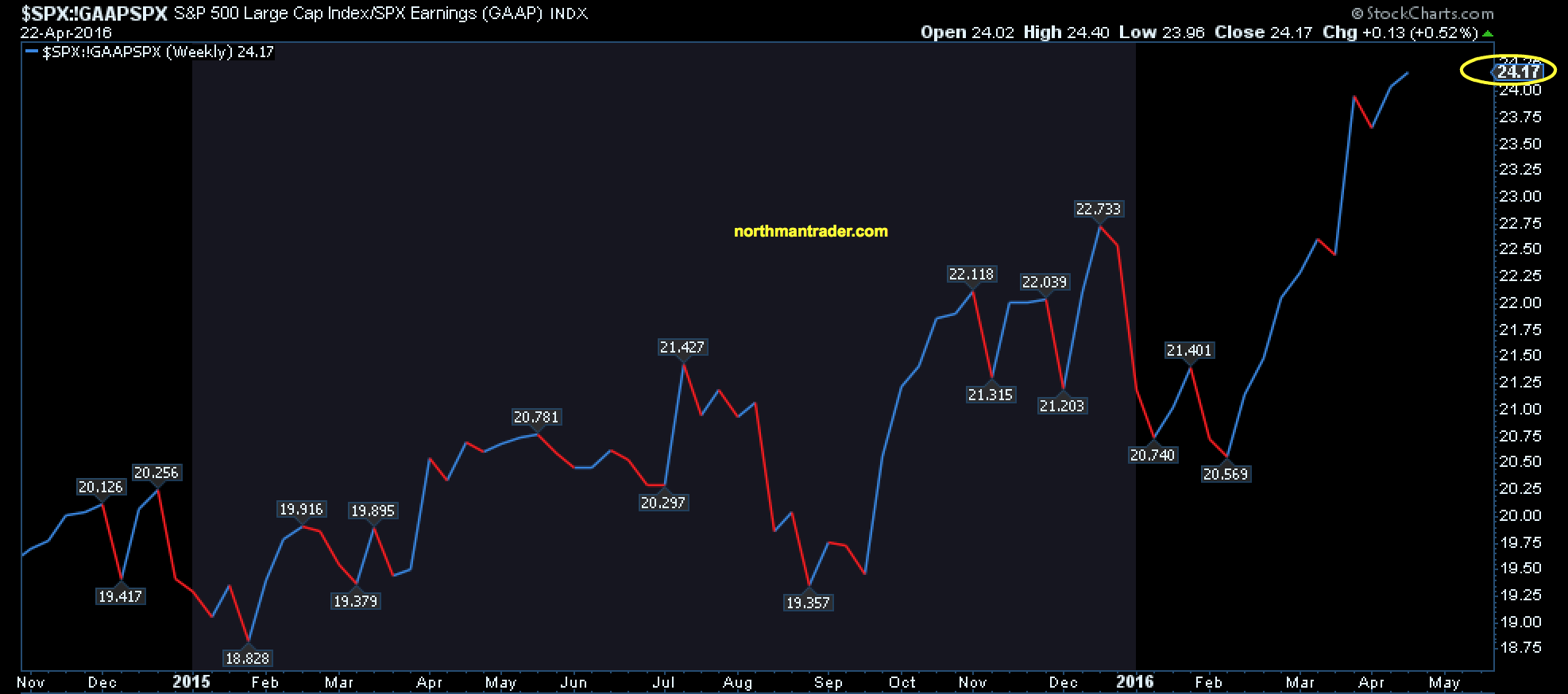
  • Third, another factor behind the fatigue is earnings, which as the following chart shows, have also faded in recent quarters (even excluding the energy sector). Our shift in recent years from “raging bull” to “sitting bull” to “volatility bull” reflects low probability of the Higher EPS & Lower Rates in coming quarters.


via http://ift.tt/1MRn0gv Tyler Durden

Everything’s Fake About China Except This…

Fake goods, fake economic growth, fake trade, fake cities, fake human rights, fake country. Real debt.

The global trade in counterfeit goods accounts for 2.5 percent of the world’s imports and is worth almost half a trillion euro, according to a report from the OECD and EUIPO. US, Italian and French brands suffer the most from the lucrative global trade in knockoffs. The report analyzed customs seizures around the world between 2011 and 2013, finding that China accounted for the most fake goods of any nation by some distance.

Infographic: Where The World's Fake Goods Originate  | Statista
You will find more statistics at Statista

h/t The BurningPlatform


So everything's fake about China! Except this! Real Debt!


And that bubble is bursting.

via http://ift.tt/24dR36s Tyler Durden

The Economy As It Is, Or The Economy As It “Should Be”

Submitted by Jeffrey Snider via Alhambra Investment Partners,

The mainstream view of the unemployment statistics suggest that any weakness in the US economy, manufacturing or beyond, will be temporary and shallow because employment growth remains robust. The question is not whether the statistics suggest such a trend but rather if those accounts correspond with anything real. As noted earlier this week, even the Federal Reserve’s relatively new measure of broader employment conditions has registered a clear deviation due to economic weakness that amplified toward the end of 2014.

At the very least, there is enormous pressure in the energy sector. It is being felt as a double shot from oil prices affecting direct business and now an almost certain turn in the credit cycle that will shut off additional liquidity just when weaker firms need it the most. The latest quarterly update from oil services giant Schlumberger is all that is necessary to understand the economic “headwind” coming from the energy space:

“The decline in global activity and the rate of activity disruption reached unprecedented levels as the industry displayed clear signs of operating in a full-scale cash crisis,” Chairman and Chief Executive Officer Paal Kibsgaard said in an earnings report Thursday. “This environment is expected to continue deteriorating over the coming quarter given the magnitude and erratic nature of the disruptions in activity.”

No cash and no prospects for achieving more junk flotations mean only more of the worst case – bankruptcies and, for the junk bubble, defaults. The significance of the oil industry is more than just its epic fall from flush and grace; it represents the first segment that has already passed through the economic boundary and there are already a number of other sectors ready to follow into the amplified downdraft. This morning I found that it is both oil and retail that is leading the current turn in bankruptcies already.

The jump in commercial bankruptcies and the timing of it corresponds quite well to what we find in actual consumer spending, especially activity in goods or just retail sales. It does not correlate at all with what the BLS is projecting about hiring and employment in the retail sector. Even if retail pressure is only just beginning, the last trend you would expect to find is sustained hiring at a truly historic rate. Since this downturn in activity is not just a sudden one or two month appearance, it is far more sensible to assume that retailers would have been cautious about staffing far a long time already.

ABOOK Apr 2016 Comml Bankruptcies Retail Hiring

Again, the inflection in commercial bankruptcies, especially retail firms, and the notable and sustained dropoff in retail sales makes sense; the BLS’s calculated strength in hiring in retail and the whole economy does not.

ABOOK Apr 2016 Payrolls Retail

It also cuts against the idea that this is some temporary problem even though temporary (or transitory) now stretches toward a third year. Some of the current rush of renewed optimism in certain riskier markets has been due to the idea that January and February were the worst of it, and that by March better economic numbers were the start of a real and durable uptrend. That was, in my view, always false hope and a misreading of March’s estimates especially in comparison to the very relevant longer-term trend. In other words, that some accounts were better in March did not suggest anything other than perhaps overall conditions just weren’t quite as bad as at the start of the year. That’s a far different proposition as it really isn’t saying much positive at all; less atrocious is still atrocious.

That view appears consistent with continued credit problems and even now potential retrenchment in manufacturing. The Markit Manufacturing PMI for April (flash) dropped to barely 50 and the lowest level (for Markit) of this “cycle.”

US factories reported their worst month for just over six-and-a-half years in April, dashing hopes that first quarter weakness will prove temporary.


Survey measures of output and order book backlogs are down to their lowest since the height of the global financial crisis, prompting employers to cut back on their hiring.

Unlike the view from the unemployment rate, a broader range of less imputed data suggests that economic weakness overall may have past that point of being self-reinforcing; that what Schlumberger’s CEO describes of oil services and indeed the whole oil patch is the future for many more industries. We just don’t know how far into the future that growing possibility might be (slope and all that).

What should be painfully obvious by now is that the major employment numbers have made themselves irrelevant. The “best jobs market in decades” that began supposedly in 2014 had absolutely no bearing on the sudden and “unexpected” weakness of 2015; had it been real and not just some BLS phantoms of upward biased variation it would have. Instead, the very idea of “transitory” was based on nothing more than the Establishment Survey and the unemployment rate’s isolated prompt for “full employment.” Weakness, of course, only continued and in reality the economy is only now weaker still. It is far beyond the bounds of reason to expect that the economy, which was conspicuously feeble before, became even more so to the point of contraction in many vital areas, now turning the credit cycle and jumpstarting, unfortunately, the bankruptcy trend, and through it all US businesses continued to hire at a rate not seen since the halcyon dot-com days of the late 1990’s.

Again, the payroll reports are irrelevant. Actual economic analysis and fruitful interpretation lies only in ignoring them. Viewing the economy only through the lens of the BLS figures leads to a world that just doesn’t exist; it’s why policymakers, economists, and the media can’t seem to gather that the recovery ended years ago. Recognizing that situation pulls the economy of 2016 as it is back within the boundaries of reason, leaving “unexpected” out of all of it.

via http://ift.tt/23T7JU6 Tyler Durden

Why Goldman Expects The Japanese Yen To Collapse Within 12 Months

Forget the G-20 agreement on no “competitive devaluations” – the full court press on the Bank of Japan to engage in the next round of aggressive currency devaluation is on, just three months after Kuroda unveiled Japan’s first negative interest rate.

Recall that it was Goldman who not only brought forward its forecast for a first rate hike from July to April and first suggested earlier this week that it is time for the Bank of Japan to forget about caution and to more than double its purchases of equities in the form of ETFs (and which the BOJ already owns a majority of all available securities) as doing either more NIRP and more QE may no longer have a favorable outcome:

… we think the BOJ is most likely to ease mainly via the qualitative measure, with increasing ETF purchasing the central pillar, with a view to improving business confidence. We think the market is already factoring in an increase in annual purchasing from ¥3.3 tn to ¥5-6 tn, and we thus think the BOJ may look to slightly more than double its current figure to around ¥7 tn.

This pushed both the USDJPY and the S&P off their overnight lows when it was first floated in the early morning of April 20.

Then, on Friday, the Yen had its biggest one day surge since the announcement of the expanded QQE in October 2014 when Bloomberg reported of the latest BOJ trial balloon whereby “the Bank of Japan may consider helping banks lend by offering a negative rate on some loans, according to people familiar with talks at the BOJ.” This happened just as the net spec short position in the USDJPY hit record short, forcing yet another massive squeeze in the currency which soared higher by nearly 300 pips in one day.


Which brings us to today, when in its latest attempt to throw everything at the wall and hope something sticks, Goldman Sachs’ FX team – whose trading recommendations in the past 6 months have been an unmitigated disaster – is predicting that the $/JPY will “move higher again in the near term and continue to forecast $/JPY at 130 a year from now.”

Why does Goldman expect a collapse in the Yen by nearly 20 big figures? 

Because as analysts Sylvia Ardagna and Robin Brooks note, “the BoJ faces an important challenge: it needs to reaffirm that the monetary easing arrow of Abenomics is still on course, or the market will price that the central bank is backtracking from the 2% inflation goal. This could be extremely disruptive for the Japanese economy. Using markets jargon, the BoJ is already so long into ‘the reflationary trade’ that it has to continue to deliver further accommodation for the time being.”

In other words, having committed to a terminal expansion of its balance sheet, it is far too late for Kuroda to backtrack, especially since the recent massive growth in its balance sheet has actually led to a just as massive capital outflow from Japan, as investors have been rapidly pulling out funds from Japan afraid that the BOJ will be the first central bank to lose all control. Goldman is basically saying that the Bank of Japan has no way out.


Indeed, since the launch of NIRP, the Bank of Japan has indeed effectively lost control, manifesting by the inverse reaction of the Yen to Japan’s launch of NIRP. This is Goldman’s take:

“Since the Bank of Japan introduced negative interest rates at the end of January, $/JPY has appreciated 8%. While part of this $/JPY strength has been triggered by a repricing of the Federal Reserve’s pace of hikes, the performance of the cross also reflects an increasing conviction among investors that the Bank of Japan has run out of ammunition and that its 2% inflation target will never be met. We in the FX Strategy team disagree with this line of argument, and in this FX Views we discuss our expectations for the outcome of the upcoming BoJ meeting, the monetary and fiscal policy mix that we expect to be implemented in Japan before the Summer, and why we believe the policy outlook is supportive of our strong conviction that $/JPY will move higher in coming months.”


As Exhibit 1 shows, the $/JPY appreciation since the end of January has been accompanied by a widening of the JPY-USD inflation differential. At the same time, spot inflation has decelerated and core CPI is at 0%. In a recent interview with the Wall Street Journal, Governor Kuroda emphasized that the BoJ remains committed to winning the battle against deflation, but that the recent broad-based JPY strength poses a material risk for the inflation dynamics[1]. A more dovish Fed that is also concerned about USD appreciation does not help to break this negative loop.


However, unlike its economist team, Goldman’s FX team is confident that the BOJ will revert to doing what it has been doing – and failing at – since 2013: massively expanding its balance sheet, nevermind concerns voiced both here years ago and by the IMF more recently, that the central bank is running out of willing sellers for government securities.

In the FX team, we think that the emphasis could be placed much more squarely on balance sheet expansion than on interest rates policy, in sympathy with the ECB in March. Investors are now justifiably asking whether shorting the currency or going long the Nikkei offers a better risk-reward going into the BoJ’s meeting if the focus is going to be on further balance sheet expansion and more ETF purchases. Our short answer is that we like both trades as, in coming months, we could see a replay of trends observed when QQE was first started.

Or just because it didn’t work for the first three years, and the Nikkei recently dipped to a level as if the BOJ’s QE expansion never actually happened, doesn’t mean doing even more won’t work. We can only imagine that Goldman has been talking to Krugman.

Indeed, for Goldman it is all about no longer doing what doesn’t push the market higher, namely more NIRP, and sticking with what has benefited Japan’s stocks, i.e., more monetization: “as the BoJ delivers more stimulus via QQE, asset prices should respond, as in the past, to an increasingly expansionary monetary policy stance. We expect $/JPY to move higher again in the near term and continue to forecast $/JPY at 130 a year from now.”


Furthermore, the BOJ will have one additional factor going in its favor: the recent devastating earthquakes, which will allow the Finance Ministry to unveil an extra budget. This means more bonds for the BOJ to monetize which directly leads to a lower Yen and a higher Nikkei. It appears that destructive  earthquakes are indeed a Keynesian’s best friend. To wit:

Our strong conviction on the currency is also linked to the broader policy mix we expect to be implemented in Japan before the Summer. To boost economic activity ahead of the July elections, Prime Minister Abe is likely to announce a fiscal expansion (between 1% and 2% of GDP). Moreover, following the recent earthquakes, there could be scope for increasing the size of the package. However, unlike at the beginning of its mandate, we in the FX team do not expect the government to announce a future fiscal contraction to offset the initial expansion (this is what happened in 2013, when the VAT tax increase was legislated to prevent concerns on debt sustainability and the BoJ independence).

In other words, as we suggested last week in “We Aren’t Thinking About It At All”, Or How Kuroda Just Assured That Helicopter Money Is Coming To Japan, the BOG is indeed making an overture to becoming the first central bank to openly embrace helicopter money.

This time, a larger deficit-to-GDP ratio could be more openly funded by a further expansion of the QQE program via purchases of long-dated JGBs. Negative bond yields across the maturity structure also make the fiscal expansion much less costly. The larger the fiscal expansion, the larger the amount of JGB purchases, and the longer the JGB maturities the Finance Ministry will issue and the BoJ will buy, increasing the probability of higher inflation, lower real rates and a weaker currency.


To Goldman what is about to be unveiled by Japan is an episode of fiscal and monetary policy “coordination”, which should lead to higher break-even inflation, lower real rates and a weaker currency. This would be the first baby step toward helicopter money, a move which according to Goldman is now justified for the following reasons:

  • First, the Japanese economy is in a liquidity trap with nominal interest rates negative up to 10-year maturities. So, all else equal, a fiscal expansion should not generate higher nominal interest rates and a stronger currency, crowding out investment and exports.
  • Second, the fiscal expansion would not occur in isolation, but would take place together with further monetary expansion. The BoJ would continue to support JGB prices, control yields along the term structure and prevent an increase in fiscal risk premia by purchasing larger quantities of short- and long-dated bonds.
  • Third, by making the fiscal expansion permanent and funded through money creation (a politically correct phrase for a form of ‘helicopter money’), expectations of future inflation should increase and real rates fall, not just because of the further increase in the monetary base, but mainly because a more open coordination of the fiscal and monetary authority would make it explicit that policy makers are willing to monetize part of the debt and any fiscal expansion announced by the government.

Goldman’s conclusion:

In a nutshell, it is the view of the writers that one or a series of permanent fiscal expansions accommodated by expansions and/or an extension of duration of JGB purchases by the BoJ could be a pretty strong policy mix that could help to boost inflation expectations, as it should become increasingly clear that monetary and fiscal policy independence remains an institutional feature de jure, but less so de facto. And, once started, the government could also continue to announce monetary financed expansionary fiscal policies, at least until inflation reaches the new target.


In the same Wall Street Journal interview cited above, Governor Kuroda strongly defended the independence of monetary and fiscal policy (and ruled out the use of ‘helicopter money’ and the risk of fiscal dominance), but he also acknowledged that the “monetary authority and the fiscal authorities can cooperate and coordinate their policies, and quite effectively’’. A more open coordination could move market expectations.


As our Japan economist Naohiko Baba wrote in “Fiscal discipline at a critical juncture with three-dimensional monetary easing” the fiscal and monetary policy mix could turn out to be similar to that implemented in the 1930s during the Takahashi administration. The outcome could even be an overshooting of the BoJ’s 2% inflation target.


It is striking that markets are not pricing this scenario at all. On the contrary, markets still doubt Prime Minister Abe and BoJ Governor Kuroda’s commitment to reflate the Japanese economy. We in the FX strategy team do not.

Yes, because the Goldman FX team’s track record has been so immaculate in the past year, and has been right in FX even as the market has been repeatedly wrong…

Sarcasm aside, it will be extremely interested to see the market’s reaction to this proposal for the BOJ to unleash helicopter money will be the response in Japanese yields, which are already trading at record low yields. If yields plunge even further into negative territory, then Goldman’s entire thesis that Helicopter money will be seen as reflationary will be thrown out of the window as the entire nation will scramble into the “safety” of Japanese paper, which now will be monetized by the BOJ will complete and utter abandon.

On the other hand, should yields spike, it may be even worse for Japan: after all with BOJ holdings rapidly approaching half of all marketable securities, there is absolutely no liquidity in the BOJ market, and should a sharp reversal take place there is an all too real risk the entire JGB market may go bidless unveiling the “endgame” scenario predicted by former IMF chief economist Olivier Blanchard just two weeks ago.

Of course, the most likely outcome here is that Goldman’s FX team will simply be dead wrong as has been the consistent case for months, and while Japan may indeed unveil helicopter money as soon as this week (after all Kuroda is known best for succumbing to peer pressure when it comes to monetary policy) the result may be not only a further plunge in JGB yields, but a surge in the Yen.

If that is indeed the outcome, then the first test of the monetary helicopter will be a crash on take off, which in turn will mean that the last play left in the central bankers’ playbook is dead on arrival. We eagerly look forward to finding out what “tools” they will have left after such an epic failure.

via http://ift.tt/23T5VKK Tyler Durden

Swedes Revolt Over Refugees Near Schools: Demand “F##king Answers” From Stockholm City Council

Having documented the growing tensions in Sweden between an immigration-happy government and a nation beset by refugee-crime sprees, it appears 'the people' have had enough. Stockholm residents are upset over the city council's plans to re-locate hundreds of Muslim migrants right next to a school and during a recent meeting, brawls broke out as Swedes exclaimed, "we demand f##king answers, now!" These are not ultra-right-wing nationalists exhorting their racist feelings, these are average Swedes and the revolution is building…

“You just can’t sit there, when we come here looking for answers, and SAY you can’t ANSWER that. That is not OK. There has to be some f**king order in a democracy! But you are NOT answering OUR questions, will want f**king answers! We will stop shouting when you answer out questions!”

As Shoebat notes, unfortunately, these ‘compassionate’ leftists, who have no respect for their own society or even themselves, are not only pushing the European people into a civil war, but possibly a world war.

This town council meeting is just one of the small ‘on the ground’ fires which shows that people are ANGRY they are being ignored and shoved aside along with their families and culture in the name of this ‘new Europe.’ This will end ultimately in nothing short of disaster.

via http://ift.tt/1T7uNDl Tyler Durden

Bitcoin Snaps: Surges To Fresh 2016 Highs On Burst Of Buying

Just three days ago, on April 21, when looking at the technical picture behind the recent bitcoin price action (having covered the extremely favorable fundamentals last September when it was trading at half its current price), we asked if “Bitcoin is about to soar.” We were focusing on the bullish pennant formation which suggested a breakout to the upside was imminent.


Moments ago, this is precisely what happened when following a burst of high volume buying, bitcoin spiked higher by over 4%, to a price of $470…

… hitting fresh 2016 highs.

After the Chinese started buying gold and silver last week following the launch of the Shanghai gold fix (as reported here), is the “wholesale bid” finally moving into the best way of avoiding capital controls available to several million Chinese?

via http://ift.tt/1Vw9UIk Tyler Durden

“They Should Be Met By Force” – US General Warns Russia Future Fly-Bys “Won’t End Well For You”

By Richard Sisk, first posted on Military.com

Russia should be warned that its dangerous flybys of U.S. ships and planes could be met by force, President Barack Obama’s nominee as the next NATO and U.S. European Command commander said Thursday.

“Sir, I believe that should be known — yes,” Army Gen. Curtis M. “Mike” Scaparrotti said when asked by Sen. John McCain whether Russia should be told that the U.S. would take action if American lives were endangered.

Pursuing the same line of questioning, Sen. Joe Donnelly, an Indiana Democrat, asked Scaparrotti whether the Russians should be told that “next time it doesn’t end well for you.”

The general responded that “we should engage them and make clear what’s acceptable. Once we make that known, we have to enforce it.

“I think they’re pushing the envelope in terms of our resolve,” Scaparrotti added. “It’s absolutely reckless, it’s unjustified and it’s dangerous.” As NATO commander, he said one of his first actions would be to review the rules of engagement for U.S. and allied forces in the region.

On Monday, two Russian Su-24 fighters made numerous, close-range and low-altitude passes while the U.S. guided missile destroyer USS Donald Cook was conducting landing drills with helicopters in the Baltic Sea.

On Tuesday, a Russian helicopter circled around the Cook seven times at a low altitude. About 40 minutes later, two Su-24s made 11 close-range and low-altitude passes.

Secretary of State John Kerry later said that the sailors of the Cook would have been justified in shooting down the Russian fighters.
“It’s unprofessional, and under the rules of engagement that could have been a shoot down, so people need to understand that this is serious business, and the United States is not going to be intimidated on the high seas,” Kerry said in an interview on CNN Espanol.
Scaparrotti, now commander of U.S. Forces Korea, was testifying before the Senate Armed Services Committee at what could be called a historic confirmation hearing.

Seated next to him at the witness table was Air Force Gen. Lori Robinson, currently commander of Pacific Air Forces, who has been nominated as the next commander of U.S. Northern Command and the North American Aerospace Defense Command (NORAD). If confirmed, Robinson would become the first woman to command a combatant command.

Both Robinson and Scaparrotti appeared headed to easy confirmation. “I look forward to moving your nominations through the U.S. Senate,” said McCain, an Arizona Republican and the SASC chairman.

via http://ift.tt/1XQ6FZZ Tyler Durden

What The Charts Say: No Bull – The Evidence

Via NorthmanTrader.com,

Sorry folks, it’s not a bull market. Not yet. The evidence I’ll outline indicates it may be too early to celebrate. I know the headlines are dominated by calls for new highs to come, a bull market in full swing ready to break out of a multi year consolidation. I’ve recently outlined the technical target should a sustained breakout indeed occur, but I’ve also outlined the structural bearish issues I see underlying the market.

Today I’m looking at the technical evidence that, so far, suggests that there is zero evidence to suggest that we are in a bull market. In fact it appears there is risk building that this is a completely broken market in its final inning. Yes we’ve had a massive rally off of the February lows, but the technical evidence is mounting that this may still be a bear market rally.

Why? Because key charts remain decisively bearish and any sizable pullback could literally kill any notion of a bull market.

Consider the actual evidence:

Since QE3 ended in October 2014 main markets in aggregate are in essence flat. Only the $NDX has shown any sizable gains, and advances have been driven by a few select mega cap stocks:

Performance

On this basis I have to ask: What bull market?

Note tech, the recent leader, may be on the verge of turning. While the latest sport is to ignore bad earnings key tech stocks are showing serious topping signs.

Let’s look at the $NDX in itself: This chart shows a potential heads and shoulders pattern of size with a broken wedge trend line to boot:

NDXW

Note the declining RSI and the weakening MACD. New highs are made of this?

Perhaps the underlying individual stock patterns are bullish? Not really.

$MSFT: That recent high showed a massive negative divergence with what appears to be a rounding top and a false breakout:

MSFT

$GOOGL: A similar picture.

GOOGL

$NFLX: Potential heads & shoulders, with a bear flag, broken trend line and horrid MACD:

NFLX

How about the flagship $AAPL? It could go either way I suppose based on the pattern below, but the trend line is also broken and the MACD is below the center line and recently we have seen lower highs. Will declining PC sales and a slowing smartphone market be the driver to new highs? Perhaps the upcoming earnings report next week will provide clarity:

AAPL

In terms of mega cap leaders on the $NDX that leaves us with $AMZN and $FB.

$AMZN: The weekly Bollinger band is now flat and the MACD is showing massive relative weakness. Could it fly back up to the upper Bollinger band? Yes, but a negative divergence is then an almost certainty:

AMZN

$FB, the most consistent stock out there has formed a multi-year wedge pattern and looks to be printing a MACD cross-over. New highs are possible, but the wedge pattern points to future danger:

FB

“But this rally has been so powerful, maybe it’s just tech that sees some sector rotation?” Perhaps, but then I must ask why are some of the most important stocks in the market looking just as concerning?

Consider:

$DIS: Multiple broken trend lines, lower highs, and a negative MACD:

DIS

$GS: MA reconnect, and lower highs and a negative MACD:

GS

$BAC: Gone nowhere, back into range with a MA reconnect:

BAC

$V: Just printed a major negative divergence on new highs:

V

The entire banking sector looks ready to face major MA resistance: I see no new highs anywhere:

BKX

BKX W

The largest retailer in the world $WMT just made its way back to reconnect with its monthly 50MA after a 6 month rally. It’s hitting major resistance with no new highs on the horizon:

WMT

$SBUX: Broken trend line and a negatively turning MACD:

SBUX

One of the biggest winner in this market has been $MCD and still we can observe a major rejection candle at the end of a major up trend basically begging for some sort of pullback and MA reconnect:

MCD

Which begs the question: What will these charts start looking like if a pullback develops?

The technicals strongly suggest at least a pullback is coming:

$NYSI is the most overbought since 2013:

NYSI

The $NYHILO is close to max and is at a level that has shown pullbacks to emerge from:

NYHILO

$BPSPX is in process of forming a bear flag:

BPSPX

And the $VIX- $SPX relationship suggests volatility may be coming to a market near you.

SPX VIX

$SPX made all time highs on May 21, 2015. Ironically the bear market rally in 2008 (a 14.5% move off its March lows) not only ended on May 20, but also marked the high for that year. Sell in May does apply in some years you know.

Bottom line: From my perspective the bull case remains unproven. It may still happen or it may not. Fact is we are still in range, yet highly overbought and one can certainly make the following argument until proven otherwise:

1.The $NYSE just rallied from its lower weekly Bollinger band to its upper weekly Bollinger band and reconnected with a key pivot MA, its weekly 100MA. And it was rejected. No new highs evident:

NYSE W

2. Central banks have once more succeeded in re-inflating a market that looked ready to break down. In popular media narrative this is called “resilient”. One can observe when markets are “resilient” and when they are not:

DJIA

Janet Yellen was busily on the phone to the BOE’s Carney and the ECB’s Mario Draghi during the February lows, this much is known according to the Fed’s own records. What was discussed remains unavailable to the public. But “whatever it takes” remains the rallying cry by central bankers world wide.

3. What have they achieved? In terms of asset inflation it remains a mixed picture. After all the global Dow Jones index remains below 2007 highs and has been making lower highs since its peak in 2015:

DJWM

And mind you, that’s with 650 rate cuts, over $60 trillion in global debt expansion (counted as GDP growth)  and massive central bank balance sheet expansions including the US Fed’s $4.5 trillion monstrosity.

Stocks have gone basically nowhere since QE3 ended in October 2014. However they have succeeded in getting more expensive:

P:Es

Bull market in multiple expansion.

Summary of the evidence: We have just witnessed a massive 16.6% market rally from heavily oversold conditions aided by global central bank intervention. Stocks in aggregate are in essence flat in return since QE3 ended while P/E ratios have expanded to new highs on a GAAP basis. Technical charts of major high cap stocks indicate major resistance ahead, signs of rolling over and negative divergences. Price remains in range and several key indices remain far below all time highs. Even new highs would print negative divergences which would make any initial breakout highly suspect. Participants remain highly complacent in the face of mounting evidence that all is not well in the global economy or in company earnings reports, yet market sentiment is expecting not only new highs, but also the dawning of a new bull market.

The evidence presented above suggests that the bull case remains unproven as of yet.

via http://ift.tt/21aRn46 Tyler Durden

Latest Shock From Europe’s Refugee Crisis: Austria Right-Wing Party Sweeps First Round Of Presidential Election

The fallout of popular anger emanating from Europe’s refugee crisis, which may have moderated in recent weeks following Europe’s desperate attempts to bribe Turkey to keep as many refugees in its borders as possible (unleashing the era of unprecedented Turkish leverage over European sovereigns, including Germany and the Netherlands) continued today with a dramatic result from the first round of Austria’s presidential election, where initial results showed that the candidate of the Freedom Party, Austria’s right-wing, anti-immigrant party has swept his competition, gathering over 35% of the vote and leaving the other five candidates far behind.

Austrian far right Freedom Party (FPOe) presidential candidate Norbert
Hofer during the final election rally in Vienna, Austria, April 22, 2016

Among the losers were the hopefuls nominated by the government coalition, reflecting significant voter dissatisfaction with the country’s political status quo.

The early triumph by Norbert Hofer of the Freedom Party is his party’s best-ever showing since its creation after World War II. Its previous best result was more than 27% in elections that decided Austria’s membership in the European Union.

According to AP, with just over 50% of polling stations reporting into the central electoral office, Hofer was far ahead of Alexander Van der Bellen and Irmgard Griss, both running as independents and within one percentage point of each other at close to 20%.

But the worst news today was for Rudolf Hundstorfer of the center-left Social Democrats and Andreas Khol of the centrist People’s Party, which form the present government coalition and have ruled either alone or together for much of the post-World-War II era. Both were polling at 11% in yet another confirmation of the anti-establishment revulsion sweeping not across just Europe, but virtually the entire world. Only political outsider Richard Lugner did more poorly, at under 3%.

Members of the right-wing Austrian Freedom Party (FPOe) celebrate
at the his party headquarters during Austrian presidential elections
in Vienna, Austria, 24 April 2016. (EPA Photo)

However, it may be too soon to declare a victory for the right-win party. The preliminary results show Van der Bellen and Griss in a close race to challenge Hofer in the May 22 runoff with both just under 12 percent support. That second round race will likely be closer, with most of those opposed to the Freedom Party expected to give one of the independents their support.

Hofer’s triumph reflects recent polls showing Freedom Party popularity. Driven by concerns over Europe’s migrant crisis, support for his party has surged to 32% compared with just over 20% for each of the governing parties.

However, Austrian voters were unhappy with the Social Democrats and the People’s Party even before the migrant crisis last year forced their coalition government to swing from open borders to tough asylum restrictions. Their bickering over key issues,  most recently tax, pension and education reform, has fed perceptions of political stagnation.

One person who will be watching the outcome of the May 22 runoff will be French 2017 presidential election frontrunner, National Front’s Marine Le Pen, who in recent polls has a double digit lead over her nearest competitor, and who stands to gain the most from the rising tide of immigrant and refugee anger that has swept across Europe in recent months. Considering her campaign promise to pull out of the Euro if elected, her ascendancy if unchecked, could have a far more calamitous outcome for the future of the common currency than this summer’s Brexit vote.

via http://ift.tt/1Ub1apz Tyler Durden

Turkey Blackmails Europe on Visa-Free Travel

Submitted by Soeren Kern via The Gatestone Institute,

  • The European Union now finds itself in a classic catch-22 situation. Large numbers of Muslim migrants will flow to Europe regardless of whether or not the EU approves the visa waiver for Turkey.

  • "If visa requirements are lifted completely, each of these persons could buy a cheap plane ticket to any German airport, utter the word 'asylum,' and trigger a years-long judicial process with a good chance of ending in a residency permit." — German analyst Andrew Hammel.

  • In their haste to stanch the rush of migrants, European officials effectively allowed Turkey to conflate the two very separate issues of a) uncontrolled migration into Europe and b) an end to visa restrictions for Turkish nationals.

  • "Why should a peaceful, stable, prosperous country like Germany import from some remote corner of some faraway land a violent ethnic conflict which has nothing whatsoever to do with Germany and which 98% Germans do not understand or care about?" — German analyst Andrew Hammel.

  • "Democracy, freedom and the rule of law…. For us, these words have absolutely no value any longer." — Turkish President Recep Tayyip Erdogan.

Turkey has threatened to renege on a landmark deal to curb illegal migration to the European Union if the bloc fails to grant visa-free travel to Europe for Turkey's 78 million citizens by the end of June.

If Ankara follows through on its threat, it would reopen the floodgates and allow potentially millions of migrants from Africa, Asia and the Middle East to flow from Turkey into the European Union.

Under the terms of the EU-Turkey deal, which entered into effect on March 20, Turkey agreed to take back migrants and refugees who illegally cross the Aegean Sea from Turkey to Greece. In exchange, the European Union agreed to resettle up to 72,000 Syrian refugees living in Turkey, and pledged up to 6 billion euros ($6.8 billion) in aid to Turkey during the next four years.

European officials also promised to restart Turkey's stalled EU membership talks by the end of July 2016, and to fast-track visa-free access for Turkish nationals to the Schengen (open-bordered) passport-free zone by June 30.

Turkish President Recep Tayyip Erdogan (left) has boasted that he is proud of blackmailing EU leaders, including European Commission President Jean-Claude Juncker (right), into granting Turkish citizens visa-free access to the EU and paying Turkey billions of euros.

To qualify for the visa waiver, Turkey has until April 30 to meet 72 conditions. These include: bringing the security features of Turkish passports up to EU standards; sharing information on forged and fraudulent documents used to travel to the EU and granting work permits to non-Syrian migrants in Turkey.

The European Commission, the administrative arm of the European Union, said it would issue a report on May 4 on whether Turkey adequately has met all of the conditions to qualify for visa liberalization.

During a hearing at the European Parliament on April 21, Marta Cygan, a director in the Commission's migration and home affairs unit, revealed that to date Ankara has satisfied only 35 of the 72 conditions. This implies that Turkey is unlikely to meet the other 37 conditions by the April 30 deadline, a window of fewer than ten days.

According to Turkish officials, however, Turkey is fulfilling all of its obligations under the EU deal and the onus rests on the European Union to approve visa liberalization — or else.

Addressing the Council of Europe in Strasbourg on April 19, Turkish Prime Minister Ahmet Davutoglu said that Turkey has now reduced the flow of migrants to Greece to an average of 60 a day, compared to several thousand a day at the height of the migrant crisis in late 2015. Davutoglu went on to say that this proves that Turkey has fulfilled its end of the deal and that Ankara will no longer honor the EU-Turkey deal if the bloc fails to deliver visa-free travel by June 30.

European Commission President Jean-Claude Juncker has insisted that Turkey must meet all 72 conditions for visa-free travel and that the EU will not water down its criteria. But European officials — under intense pressure to keep the migrant deal with Turkey alive — will be tempted to cede to Turkish demands.

EU Migration Commissioner Dimitris Avramopoulos on April 20 conceded that for the EU it is not a question of the number of conditions, but rather "how quickly the process is going on." He added: "I believe that at the end, if we continue working like this, most of the benchmarks will be met."

European officials alone are to blame for allowing themselves to be blackmailed in this way. In their haste to stanch the rush of migrants to Europe, they effectively allowed Turkey to conflate the two very separate issues of a) uncontrolled migration into Europe and b) an end to visa restrictions for Turkish nationals.

The original criteria for the visa waiver were established in December 2013 — more than two years before the EU-Turkey deal — by means of the so-called Visa Liberalization Dialogue and the accompanying Readmission Agreement. In it, Turkey agrees to take back third-country nationals who, after having transiting through Turkey, have entered the EU illegally.

By declaring that the visa waiver conditions are no longer binding because the flow of migrants to Greece has been reduced, Turkish officials, negotiating like merchants in Istanbul's Grand Bazaar, are running circles around the hapless European officials.

Or, as Turkish President Recep Tayyip Erdogan recently proclaimed: "The European Union needs Turkey more than Turkey needs the European Union."

The European Union now finds itself in a classic Catch-22 situation. Large numbers of Muslim migrants will flow to Europe regardless of whether or not the EU approves the visa waiver.

Critics of visa liberalization fear that millions of Turkish nationals may end up migrating to Europe. Indeed, many analysts believe that President Erdogan views the visa waiver as an opportunity to "export" Turkey's "Kurdish Problem" to Germany.

Bavarian Finance Minister Markus Söder, for example, worries that due to Erdogan's persecution of Kurds in Turkey, millions may take advantage of the visa waver to flee to Germany. "We are importing an internal Turkish conflict," he warned, adding: "In the end, fewer migrants may arrive by boat, but more will arrive by airplane."

In an insightful essay, German analyst Andrew Hammel writes:

"Let's do the math. There are currently 16 million Turkish citizens of Kurdish descent in Turkey. There is a long history of discrimination by Turkish governments against this ethnic minority, including torture, forced displacement, and other repressive measures. The current conservative-nationalist Turkish government is fighting an open war against various Kurdish rebel groups, both inside and outside Turkey.

"This means that under German law as it is currently being applied by the ruling coalition in the real world (not German law on the books), there are probably something like 5-8 million Turkish Kurds who might have a plausible claim for asylum or subsidiary protection. That's just a guess, the real number could be higher, but probably not much lower.


"If visa requirements are lifted completely, each of these persons could buy a cheap plane ticket to any German airport, utter the word 'asylum,' and trigger a years-long judicial process with a good chance of ending in a residency permit."

Hammel continues:

"There are already 800,000 Kurds living in Germany. As migration researchers know, existing kin networks in a destination country massively increase the likelihood and scope of migration…. As Turkish Kurds are likely to arrive speaking no German and with limited job skills, just like current migrants, where is the extra 60-70 billion euros/year [10 billion euros/year for every one million migrants] going to come from to provide them all with housing, food, welfare, medical care, education and German courses?

And finally, "the most important, most fundamental, most urgent question of all":

"Why should a peaceful, stable, prosperous country like Germany import from some remote corner of some faraway land a violent ethnic conflict which has nothing whatsoever to do with Germany and which 98% Germans do not understand or care about?"

Turkish-Kurdish violence is now commonplace in Germany, which is home to around three million people of Turkish origin — roughly one in four of whom are Kurds. German intelligence officials estimate that about 14,000 of these Kurds are active supporters of the Kurdistan Workers' Party (PKK), a militant group that has been fighting for Kurdish independence since 1974.

On April 10, hundreds of Kurds and Turks clashed in Munich and dozens fought in Cologne. Also on April 10, four people were injured when Kurds and Turks fought in Frankfurt. On March 27, nearly 40 people were arrested after Kurds attacked a demonstration of around 600 Turkish protesters in the Bavarian town of Aschaffenburg.

On September 11, 2015, dozens of Kurds and Turks clashed in Bielefeld. On September 10, more than a thousand Kurds and Turks fought in Berlin. Also on September 10, several hundred Kurds and Turks fought in Frankfurt.

On September 3, more than 100 Kurds and Turks clashed in Remscheid. On August 17, Kurds attacked a Turkish mosque in Berlin-Kreuzberg. In October 2014, hundreds of Kurds and Turks clashed at the main train station in Munich.

In an essay for the Financial Times titled "The EU Sells Its Soul to Strike a Deal with Turkey," columnist Wolfgang Münchau wrote:

"The deal with Turkey is as sordid as anything I have ever seen in modern European politics. On the day that EU leaders signed the deal, Recep Tayyip Erdogan, the Turkish president, gave the game away: 'Democracy, freedom and the rule of law…. For us, these words have absolutely no value any longer.' At that point the European Council should have ended the conversation with Ahmet Davutoglu, the Turkish prime minister, and sent him home. But instead, they made a deal with him — money and a lot more in return for help with the refugee crisis."

via http://ift.tt/1XPUBrM Tyler Durden