“Any Business in America Would Rather Not Have Their Internal Documents out in the Public”

From Judge Gail Weilheimer (E.D. Pa.) Thursday in Cultivatr, Inc. v. Peterson; the analysis strikes me as quite correct:

Cultivatr, Inc. and Sproutr, LLC … ask this Court to seal portions of the transcript of a bench trial held before the Court, claiming that publication will do harm to their business interests. Because this Court finds that they have not made a showing strong enough to outweigh the public interest in open proceedings, the Motion is denied….

This matter was commenced by Counterclaim Defendants Cultivatr and Sproutr as declaratory judgment Plaintiffs, with Nora Peterson filing a breach of contract counterclaim. The dispute centered around a verbal promise made by Cultivatr’s principals to Ms. Peterson to grant equity in Cultivatr in exchange for Ms. Peterson’s agreeing to join Sproutr as an executive. After a three-day bench trial, this Court issued findings of fact and conclusions of law, ultimately holding that Cultivatr indeed breached an enforceable verbal agreement when it failed to provide Ms. Peterson with the shares it owed her….

[T]he Cultivatr Parties ask this Court to seal portions of the bench trial transcript which deal with an investment into Sproutr made by a third party (the “Investor”). The Cultivatr Parties ask this Court to redact every mention of the name of the third party…. [T]he Cultivatr Parties also seek to redact large swaths of testimony and argument which discusses the investment, and particularly: (1) the amount of money invested; (2) the percentage of Sproutr acquired; and (3) the different options explored for treating the money as a matter of accounting….

This information was not merely contextual to the matter at trial, nor was it inconsequential or collateral. To the contrary, this Court found this investment was a motivating factor in the decisions by the principals of Cultivatr to welch on their promise to deliver equity to Nora Peterson…. “At base, this Court concludes that this is a case where [Cultivatr’s Principal], perhaps a bit overeager and bit inexperienced, rushed in and made a firm offer which was giving up more than she appreciated at the time. When a later investment made that offer much more expensive to live up to, she had buyer’s remorse and wishes she had included all sorts of bells and whistles that she did not.” … Further, the amount and nature of the investment provided the Court with the best available evidence from which it could make a reasonable calculation of the value of the shares which went undelivered at the time they reneged on their promise….

[T]he right to attend civil trials is protected by the First Amendment, and while the right is not absolute, “as a First Amendment right it is to be accorded the due process protection that other fundamental rights enjoy.” … Even the agreement of the parties does not bind our courts; indeed courts can deny sealing sua sponte or on motion of a third party….

Enforcement sua sponte makes good sense. It is certainly true that our system of justice relies heavily on the adversarial system to present important issues to the Court. But sometimes, where the issue involves the interest of the public or of the Court itself, the interests of the adversarial party may not align strongly enough with those other interests to reliably ensure the issue will be zealously litigated, or even litigated at all.

Indeed, the Court’s extensive experience with litigation has shown time and again that parties often “go along to get along” when it comes to confidentiality. Where that party does not particularly care about the publicity of a given case, it is often easier to just accept confidentiality designations than to spend their own money challenging them. Similarly, where a party knows they need certain sensitive documents to prove their case, they often will simply agree to a confidentiality designation to take the path of least resistance. These are entirely reasonable litigation decisions from a private party seeking to vindicate its own private interests. But given the powerful societal interest in the openness of our courthouses, it does create a gap which courts must diligently maintain….

The Cultivatr Parties … argue that the terms of the Investor’s investment are not public and not intended for public view. But that cannot carry the day. Many an embarrassing series of text messages or damaging private admission regularly are aired out in our courtrooms. In fact, that is largely what a courtroom is for. The fact that there was an intention that the nature of this investment be kept a secret does not mean that it gets to stay that way once implicated in federal litigation.

Next the Cultivatr Parties argue that the confidentiality agreement between them and the Investor supports sealing the transcript. But the private contractual relationship between Sproutr and the Investor does nothing to bind the court, and Ms. Peterson’s agreement to honor it is similarly without impact. There may well be collateral consequences to Sproutr as a result of these documents becoming relevant in this litigation. But that is a consideration to weigh before (not after) committing to a course of conduct likely to lead to litigation.

Notably, it was the Cultivatr Parties themselves who commenced this litigation as a declaratory action. Regardless of the outcome of this case, Cultivatr and Sproutr, in electing not to give Ms. Peterson the shares, put themselves on a set of tracks aimed squarely at litigation. The disclosure of information related to equity in the companies is a natural consequence of that decision, which should have been weighed at that time, or at various points in settlement discussions. They cannot now unilaterally impose the terms and conditions of their contract with the Investor upon the public.

The Cultivatr Parties next argue, with no factual support, that disclosure of this information could permit others to take advantage of them or the Investor. Given that there is no factual information presented by the Cultivatr Parties that this is so, the Court could reject that out of hand. But, addressing the merits, this does not strike the court as particularly credible. This involves a completed transaction from more than two years ago. How the terms of an investment agreement could possibly cause Sproutr or the Investor to lose customers is mystifying. At any rate, it is surely the sort of vague and non-specific argument that this Court is precluded from assigning weight under In re Avandia [the key Third Circuit precedent], and therefore this Court disregards it….

Any business in America would rather not have their internal documents out in the public. But that does not mean that litigants have a right to hide them from the public once they are implicated in court proceedings. It takes something more than the desire for secrecy to exclude information from the docket. A party seeking to seal needs articulated facts with specific examples. The Cultivatr Parties do not come close….

To the extent this ruling seems harsh, this Court will address three further points which are worth noting here. The first is that we are here, in Court, because the Cultivatr Parties filed a lawsuit. While the standard is not different for plaintiffs and defendants, the Cultivatr Parties can hardly claim to be surprised to find that documents related to equity ownership in Sproutr have come to public view in litigation over an equity dispute with a former employee.

More importantly, however, as Ms. Peterson observed in her opposition, the Cultivatr Parties publicly filed, as an attachment to their Complaint, the name of the Investor they seek to seal and the exact amount of that investment. So, too, does the Court refer to the Investor, the amount of the investment, and the discussions regarding the accounting consequences of that investment repeatedly in its Findings of Fact and Conclusions of Law. There has been no motion to seal those filings…. [T]he identity of the Investor has been no secret to any diligent court watcher since the very first filing in this case.

Finally, the Court is sympathetic to the possibility that the Cultivatr Parties may rather not have tried the case at all, had they known the Investor’s name would be made public. If that were the case, however, they could have gotten this determination before trial and strategized accordingly. They could have moved before trial to seal the courtroom, but they did not, or made some other pretrial motion as to maintaining confidentiality designations for trial purposes.

For the same reasons articulated here, this Court would, in all likelihood, have denied the motion. But at least the Cultivatr Parties would have had the lay of the land, and understand what proceeding to trial meant. But they did not, and are left with the consequences of the string of choices which brought them to this point….

The post "Any Business in America Would Rather Not Have Their Internal Documents out in the Public" appeared first on Reason.com.

from Latest – Reason.com https://ift.tt/eunBqSI
via IFTTT
Goldman Finds Consumer Trends Remain Solid Amid K-Shaped Economy Fears

Goldman Finds Consumer Trends Remain Solid Amid K-Shaped Economy Fears

Goldman analysts Scott Feiler and Eric Mihelc updated clients this week with the latest read on consumer health.

The key takeaway: spending trends remain resilient heading into spring, even as the K-shaped economy narrative dominates the news cycle and the Trump administration continues to push affordability measures.

It seems like consumer trends are still solid. It’s not a clean sweep, but we’re seeing January growth as strong, or stronger than December for most companies we have heard from,” Feiler said.

There was good news earlier this morning: University of Michigan consumer sentiment rose unexpectedly to a six-month high, driven largely by higher-income households benefiting from stock market gains. Economists surveyed by Bloomberg had expected a reading of 55, but the index came in at 57.3. The report also suggests that tariff-linked inflation fears have eased among Democratic-leaning respondents (read the report).

Back to Feiler’s note, where the key takeaway is that consumption trends remain solid:

I wanted to briefly highlight the conversations we are having, inbounds we are getting from investors and stocks in focus on the back of these themes.

1. Health of the Consumer. Fine, Right?: It seems like consumer trends are still solid. It’s not a clean sweep, but we’re seeing January growth as strong, or stronger than December for most companies we have heard from.  Last night, COST beat January sales and saw a 50 bps acceleration vs December. BOOT guided last night and spoke to broad-based acceleration in January comp. CMG spoke to momentum in January. Importantly, Visa provided a table showing acceleration in January trends vs the last 3 months.  There are also expectations for very strong revenues later this morning from TPR, RL & EL.

Bottom-line, any challenges with the market are not a result of any change to consumption trends, which are generally strong.

2. Under The Hood: At this point, it’s not a growth scare. Momentum trades & pockets of TMT are clearly the setter of price each day. Our generally US High Beta Momentum basket was -10% yesterday, its worst day since 2020 and 2nd worst day in the last 20 years. It’s barely a blip on the long-term chart. The difference between this episode and others is most seem to be struggling to pinpoint the exact reason for why (i.e. positioning, technicals, capex surprises, commodities, software worries spreading, etc). It’s not a consumer growth scare though.

3. Are Consumer Momentum Names Impacted?  The Consumer Momentum (high vs low) pair was “only” down -3.7% yesterday, so certainly an impact this week, but not as bad as at the TMT or market level.

4. Which Consumer Stocks Have Been Impacted to the Downside From the Momentum Factor?: The names that did come up in conversations as fitting this theme and seeing some relative weakness were CVNA, SN, ONON, AS, W, CELH, MNST & ROST (albeit small).

5. How are Consumer Investors Feeling?: Consumer Discretionary & Staples have both been substantial outperformers the last week and YTD (+600 bps), with the majority of that spread the last few days. Do investors seem happy about this? Feedback is not that positive, which is supported by outPB data. Why? A few of the pain points have been grocer outperformance, the move higher in WMT (shares short at 8 year highs), general staples strength, some underperformance in off-price and the choppiness in the cruise line pair trades.

6. GARP in Consumer? Expecting pushback here (given a debate about what’s a “reasonable price”). There has been a clear move the last few days into GARP in the market. We can debate whether some of these valuations actually fit the theme but some of the names it has impacted the last few trading sessions are WMT, SBUX in consumer, while Pete Callahan (TMT) highlighted AAPL, DIS, MA, ADI in other sectors. Any good GARP ideas? Happy to discuss as that’s where the search is for, based on feedback with all the other GS sector specialists.

7. Pressure Point Themes: Grocery outperformance, total staples outperformance vs most discretionary and cyclical pockets, momentum underperformance (of course), the lag (last week) in off-price and outperformance of Vegas-centric casinos.

8. Some Consumer Names in Focus:

  • WMT to all-time highs TGT rally (covering or real buying?)

  • SN weakness (just the momentum unwind? we think yes)

  • SBUX small bounce back part of the hunt for GARP (many would disagree the valuation fits GARP)

  • AS (part of the momentum factor, or something else?)

  • CPRI (one of the most 2-way debated names and active trading stocks on our desk)

9. From PB – 1st Time Since Covid: Yesterday’s moves severely impacted all equity strategies simultaneously, with more than two thirds of funds in each index down (GS PB data). The last time all three strategies were down more than 75 bps in a single day happened during the COVID sell-off.  Systematic L/S was down 76 bps yesterday, the worst day since 2nd October 2025 (still +2.5% YTD). Fundamental L/S down 84 bps (still +2.3% YTD).  Within this, TMT focused managers were down 278 bps on the day. Multi-Strats equity portfolios were down 190 bps, the worst day since 9th April 2025 (still +3.9% YTD).

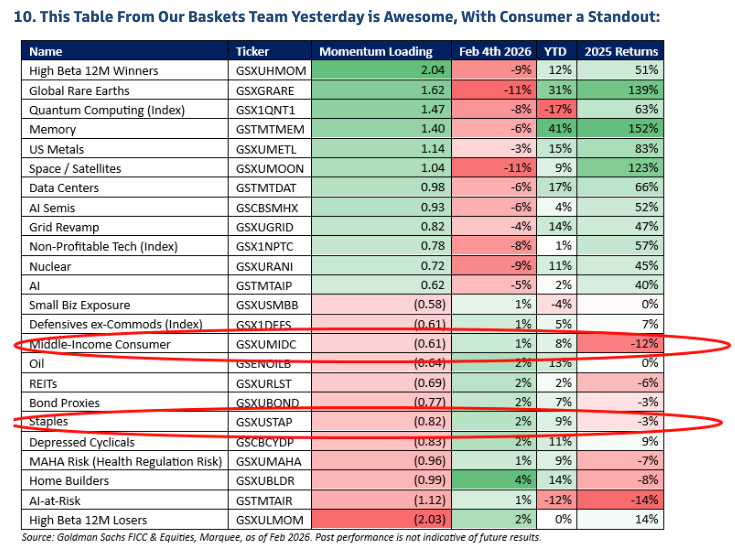
10. This Table From Our Baskets Team Yesterday is Awesome, With Consumer a Standout:

Separate from Feiler’s note, which presents no immediate alarm about the consumer, are the AI disruption risk and the software sell-off, which have dominated headlines this week.

Here’s the latest from our market desk:

Let’s not forget that last month, Treasury Secretary Scott Bessent promised consumers “substantial refunds” and bigger paychecks this spring as President Donald Trump’s economic agenda begins to deliver results.

The looming threat for the consumer is still the K-shaped economy…

Professional subscribers can learn more about the consumer space on our new Marketdesk.ai portal​​​​.

Tyler Durden
Sat, 02/07/2026 – 11:05

via ZeroHedge News https://ift.tt/vu2A3hJ Tyler Durden

US Retains Right To ‘Militarily Secure’ Chagos Air Base, Trump Says

US Retains Right To ‘Militarily Secure’ Chagos Air Base, Trump Says

Authored by Evgenia Filimianova via The Epoch Times,

U.S. President Donald Trump said on Feb. 5  he retained the right to “militarily secure” the U.S.–UK Diego Garcia air base in the Chagos Islands, if future arrangements threatened American access.

Trump has criticized the UK’s decision to cede sovereignty of the Chagos Islands to Mauritius, calling it an “act of total weakness” last month. Under the agreement, signed in October 2025, the Diego Garcia military base would remain under UK control for at least 99 years, ensuring continued access for U.S. forces.

Trump said in a Feb. 5 post on Truth Social that he held “productive discussions” with British Prime Minister Keir Starmer on the issue.

“I understand that the deal Prime Minister Starmer has made, according to many, the best he could make,” he said. “However, if the lease deal, sometime in the future, ever falls apart, or anyone threatens or endangers U.S. operations and forces at our base, I retain the right to militarily secure and reinforce the American presence in Diego Garcia.”

The base is regarded by the United States as a critical hub for operations across the Middle East, East Africa, and the Indo-Pacific.

Trump cited its strategic location and “great importance” to the U.S. national security.

“We have the most powerful Military in the World. Our Military Operations, over the course of the last year, were successful because of the strength of our warfighters, modern capability of our equipment and, very importantly, the strategic location of our Military Bases for staging, and other reasons,” he said. “Let it be known that I will never allow our presence on a Base as important as this to ever be undermined or threatened by fake claims or environmental nonsense.”

A Downing Street spokesperson said in a Feb. 5 statement that Starmer and Trump “agreed on the importance of the deal to secure the joint UK-U.S. base on Diego Garcia, which remains vital to shared security interests.”

“The UK and US will continue to work closely on the implementation of the deal, they agreed,” the spokesperson added.

An undated photograph shows an aerial view of Diego Garcia. U.S. Navy via AP

Starmer said in January that the issue had been raised repeatedly with the White House and maintained that the Trump administration had already reviewed and supported the agreement at an agency level.

Legislation to implement the Chagos treaty is currently in the final stages of British parliamentary scrutiny, known as “ping pong,” as amendments are exchanged between the House of Commons and the House of Lords.

The deal, which includes 3 billion pounds ($4 billion) to be paid by the UK to Mauritius over the term of the agreement, with an option for a 50-year extension, is opposed by a number of Conservative Party lawmakers.

Conservative Party leader Kemi Badenoch last month told lawmakers in Parliament that Starmer is “giving away” UK territory and paying 35 billion pounds ($47.5 billion) “for the privilege.”

“Donald Trump is right: Labour are betraying Britain by giving away the Chagos Islands. Keir Starmer is *paying* Mauritius £34bn to seize our sovereignty and make us a tenant in our own military base. He needs to end this self-sabotage,” Shadow Business Secretary Andrew Griffith said in a Jan. 20 post on X.

Addressing lawmakers during a debate in Parliament on Jan. 28, British Foreign Office Minister Seema Malhotra said that the treaty protected British and allied interests.

She said that the deal “guarantees full UK operational control of Diego Garcia for generations to come.”

Malhotra also said that the opposition’s cost estimates were “wildly exaggerated” and that government figures had been independently verified.

Tyler Durden
Sat, 02/07/2026 – 10:30

via ZeroHedge News https://ift.tt/8aP53Jg Tyler Durden

Guac Relief: Avocado Prices Tumble Ahead Of Super Bowl

Guac Relief: Avocado Prices Tumble Ahead Of Super Bowl

Guacamole, wings, pizza, chips, and beer dominate the typical Super Bowl menu, as the weekend becomes one of the world’s highest food-consumption sporting events.

We have good news for consumers. First, as we reported earlier, PepsiCo announced it will slash prices by 15% on snack brands such as Lay’s and Doritos.

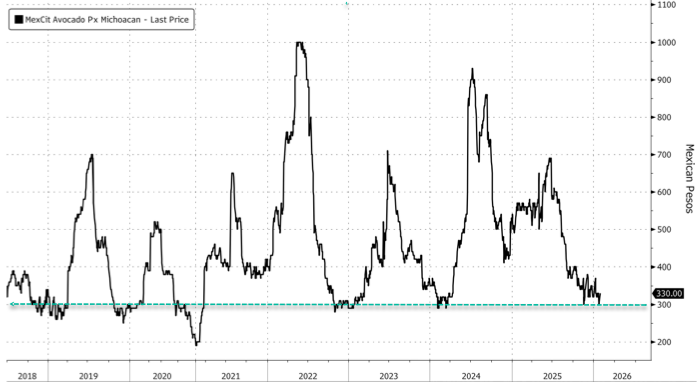
The second piece of good news is on the avocado front. Prices in Mexico have plunged, down more than 19% from a year earlier as of the end of December.

Bloomberg reports a bumper Mexican harvest after heavy rainfall has driven record US imports ahead of the Super Bowl, pushing supplies higher while driving prices lower, a perfect mix for millennials in the K-shaped economy.

The US sources nearly 90% of its avocados from Mexico, mostly Hass, with current retail prices ranging from 70 cents to $1.50 each, well below Covid-era highs.

“That has never happened before,” said Alvaro Luque, president and chief executive officer of Avocados from Mexico.

“Last year we had great rain, so the fruit not only was abundant, but the sizing of the fruit was very good,” Luque added.

Demand has spiked from millennials and Gen Z, he said, as there is no real substitute for avocados: “If you want guacamole, there’s only one option.”

Tyler Durden
Sat, 02/07/2026 – 09:55

via ZeroHedge News https://ift.tt/YgknHC0 Tyler Durden

Soros Praises Spain’s Sánchez For Mass Amnesty Of 500,000 Illegals

Soros Praises Spain’s Sánchez For Mass Amnesty Of 500,000 Illegals

Authored by Steve Watson via Modernity.news,

Alex Soros, son of billionaire George Soros, has lavished praise on Spanish Prime Minister Pedro Sánchez for granting legal status to up to 500,000 illegal migrants, stating that Sánchez shows “what real leadership looks like” by confronting issues with policies that are “both principled and pragmatic.”

Soros added, “We need more elected leaders like him!” This endorsement comes amid widespread backlash against Sánchez’s open-borders agenda, which critics slam as a betrayal of Spanish citizens.

In a post on X, Alex Soros highlighted Sánchez’s approach, quoting the prime minister’s own words: “They care for aging parents, work in small and large companies, and harvest the food on our tables. On weekends, they walk in our parks and play on the local amateur soccer team….”

The amnesty, implemented via a royal decree bypassing parliament, targets undocumented migrants who arrived before the end of 2025 and can prove at least five months of residence in Spain. 

As The New York Times reported , the Socialist-led government describes it as essential for Spain’s economy, where migrant labor supports agriculture and tourism.

Yet, this move has ignited fury across Spain, with opponents decrying it as an incentive for further illegal entries from North Africa and Latin America. 

As we detailed in our earlier coverage, Spaniards face the prospect of integrating another half-million migrants amid rising tensions and massive resource strains.

The timing of Soros’s praise is telling, as Sánchez’s regime grapples with corruption scandals and probes into his inner circle. 

Facing a firestorm of criticism on X, where users label the amnesty “treasonous,” the far-left government has threatened to “limit and likely ban” the platform entirely.

Sánchez himself, in addition to his underlings, has indicated a desire to ban X.

This crackdown mirrors broader European efforts to stifle dissent, from French raids on X’s offices to EU fines under the Digital Services Act. Musk himself fired back at Sánchez, dubbing him “dirty Sanchez” in response to the censorship push.

Soros’s intervention underscores the globalist playbook: push mass migration to reshape demographics, then silence opposition through free speech restrictions. 

With Spain’s amnesty poised to exacerbate border chaos—echoing Angela Merkel’s 2015 disaster—Sánchez’s policies prioritize foreign arrivals over native Spaniards, fueling demands for accountability.

Your support is crucial in helping us defeat mass censorship. Please consider donating via Locals or check out our unique merch. Follow us on X @ModernityNews.

Tyler Durden
Sat, 02/07/2026 – 09:20

via ZeroHedge News https://ift.tt/CQ280FJ Tyler Durden

HSBC Encouraging Departures By Offering “Little To Zero” Bonuses For Underperformers

HSBC Encouraging Departures By Offering “Little To Zero” Bonuses For Underperformers

HSBC is preparing to award little or no bonuses to some bankers as it adopts a tougher, performance-driven pay model similar to its US rivals, according to Bloomberg. Underperforming staff in investment banking and wealth management — including some managing directors — may be encouraged to leave after bonuses are paid in the coming weeks, according to people familiar with the matter. Final decisions have not yet been made.

The move reflects the strategy of CEO Georges Elhedery, who has pushed to align HSBC’s compensation practices with those of Wall Street firms. Since taking over in late 2024, he has led a major restructuring, shutting down much of the bank’s US and European deals and equity underwriting operations and merging commercial and investment banking. Several senior executives have exited as part of the overhaul.

According to Bloomberg, HSBC said it remains committed to rewarding employees competitively, with pay linked closely to performance.

The bank’s 2024 bonus pool remained flat at $3.8 billion, defying an industry trend toward higher payouts. Some staff, particularly in corporate and institutional banking, were warned to expect lower awards.

While Elhedery’s revamp is expected to deliver $3 billion in savings, it has raised costs in the short term. HSBC’s cost-to-income ratio rose to 49.9% in the first half of 2025, up from 43.7% a year earlier. Still, investors have responded positively, with shares nearly doubling since his appointment in September 2024, though gains trail rivals such as Barclays and Standard Chartered.

HSBC remains Europe’s largest bank by market value, at around £225 billion, ahead of Santander, UBS, and BNP Paribas.

Founded in Hong Kong in 1865, HSBC has strengthened its focus on Asia and the Middle East amid shifting geopolitical risks. The bank is also reviewing options for its Singapore insurance unit, following recent asset sales in Europe and North America, including insurance and banking businesses in the UK, Germany, and France.

Tyler Durden
Sat, 02/07/2026 – 08:45

via ZeroHedge News https://ift.tt/c6z710S Tyler Durden

Year Two Of The Largest Ever Global LNG Supply Wave Is Hitting Markets

Year Two Of The Largest Ever Global LNG Supply Wave Is Hitting Markets

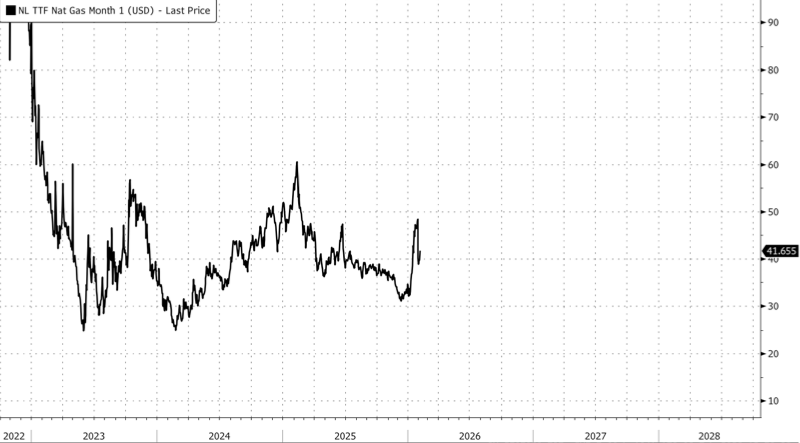
Roughly two and a half months after Goldman’s head of Global Commodities Research, Samantha Dart, laid out a timeline for what she called the “largest ever” LNG supply wave to hit global markets, she published a new client note late this week reiterating that the “supply wave is still on track.”

2025 was year one of what we see as the largest ever global LNG supply wave, lasting seven years,” Dart began the note, warning that “this wave is the main driver of a lengthy bearish cycle for European natural gas (TTF) and LNG (JKM), which we expect to bottom in 2028/29.”

Dart forecasts that TTF and JKM will average below $5/mmBtu by the end of the decade, around 2028-29, compared with current TTF prices of around $41/mmBtu.

Here is Dart’s update on the global LNG supply wave that is in year two, hitting markets:

We see realized 2025 and forecasted 2026 LNG supply largely in line with our previous expectations, despite the recent US disruptions and recent delays to liquefaction capacity starts. Specifically, 2025 global LNG supply averaged 431 mtpa, only marginally below our 433 mtpa expectation as of end-2024, as a large beat in the US (driven by larger-than-expected ramp up at Plaquemines) was ultimately offset by smaller misses across existing LNG producers. We see some of these misses, like for Algeria and Indonesia, as likely structural, owing partly to growing domestic energy demand, and we incorporate further supply losses (-1 mtpa in total initially, but building to -3 mtpa in 2028-2030[1]) in our forward balances.

Global LNG supply has started 2026 below our previous expectations driven by export capacity start delays in the US, Canada, Congo and Australia, though by 4Q26 we expect supply to largely catch up with our earlier numbers.

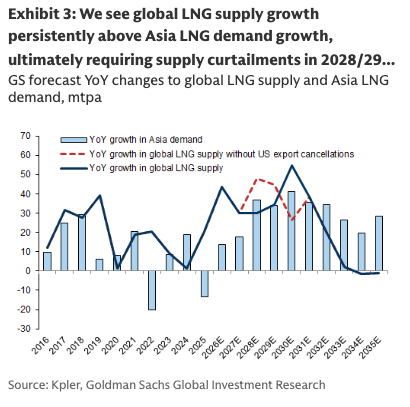
On net, we still expect 2025-to-2030 global LNG supply growth (+193 mtpa, 45% of 2025 global supply) to far exceed Asia demand growth (+144 mtpa), even taking into account our estimated demand response to low gas prices (>40 mtpa from China alone). We expect this oversupply to take European gas storage to congestion, particularly in 2028/29, leaving a temporary price-driven curtailment of US LNG exports as the likely solver of the imbalance in that period, in our view. We note that all but one of the supply projects in our balances through 2029 have already reached a Final Investment Decision (FID)[2].

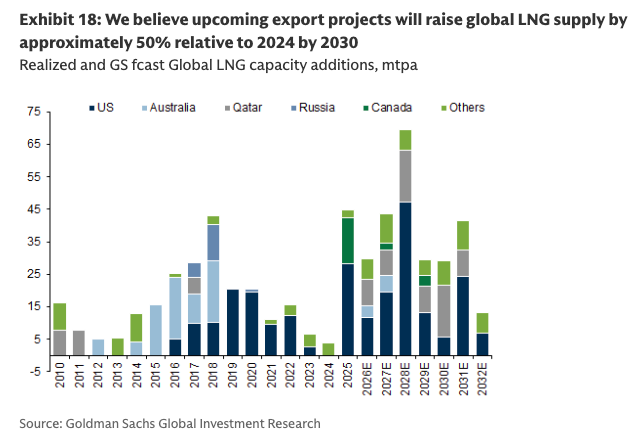
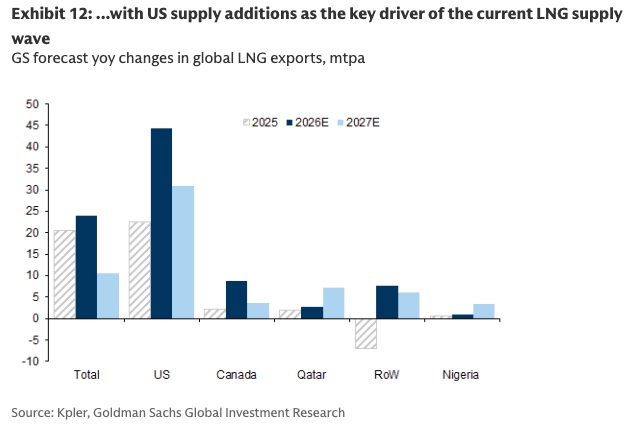
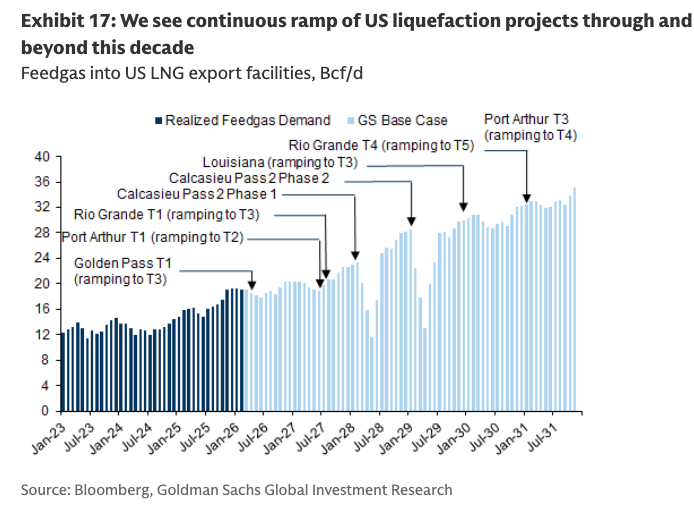
The largest ever LNG supply wave is underway, and the early leadership is clear: U.S. capacity is ramping fastest and setting the tone for global balances.

Exhibit 18: The LNG supply wave has started.

Exhibit 12: Supply growth is being led by the U.S.

Exhibit 17: U.S. liquefaction start ups and ramp schedules, the core driver of incremental volumes.

Exhibit 3: Global LNG supply growth remains structurally above Asia demand growth, pushing the market toward a late decade pressure point. In 2028 to 2029, the implied balancing mechanism is supply curtailment, most likely via price driven reductions in US LNG exports as storage and logistics constraints tighten.

Professional subscribers can find out more about NatGas markets on our new Marketdesk.ai portal​​​​.

Tyler Durden
Sat, 02/07/2026 – 07:35

via ZeroHedge News https://ift.tt/F29MBiY Tyler Durden

Watch: Comedy Writer Testifies Before US Congress On UK’s Chilling Free Speech Crackdown

Watch: Comedy Writer Testifies Before US Congress On UK’s Chilling Free Speech Crackdown

Authored by Steve Watson via Modernity.news,

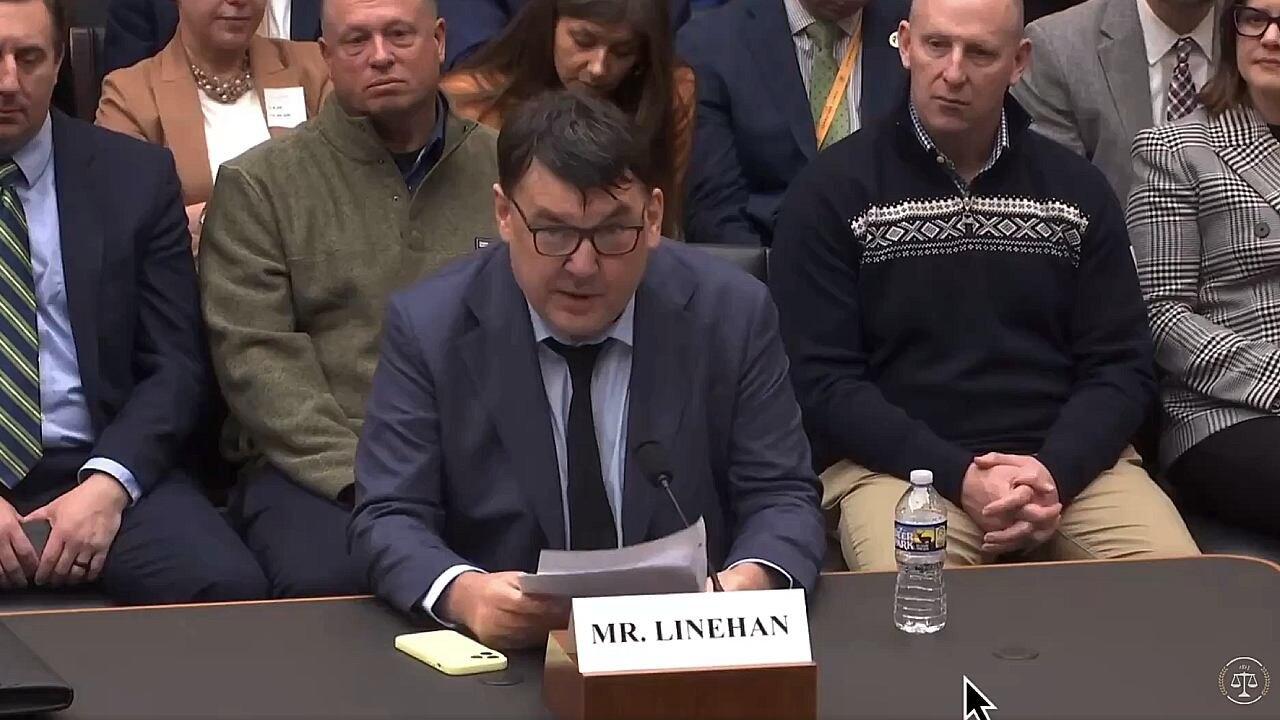
Graham Linehan, the Irish comedy writer, testified before the US House Judiciary Committee, detailing how Britain’s authorities hounded him over online posts challenging trans ideology—exposing the chilling grip of censorship under Keir Starmer’s government.

His appearance underscores America’s growing scrutiny of Europe’s speech-stifling laws, with Linehan urging lawmakers to push back against policies that silence women and crush free expression.

The hearing, titled “Europe’s Threat to American Speech and Innovation,” examined how regulations like the EU’s Digital Services Act and the UK’s Online Safety Act enable government overreach, forcing platforms to censor content globally and punishing dissenters. Chaired by Rep. Jim Jordan, it highlighted arrests for online speech, including Linehan’s own ordeal, as threats spilling over to US shores.

Linehan opened his testimony by recounting his shift from comedy to activism. “I spent 30 years writing comedy for British television. It was a career that I loved but it ended when I began noticing that women were losing their livelihoods, their social circles and even their freedom for defending rights won over 100 years ago by the suffragette movement,” he said.

He explained his views aligned with those facing backlash: “They believed as I do that single sex spaces are essential for women’s privacy, dignity and safety. They believed that children should not undergo experimental medical treatment that ravages their health and shortens their lives. They believe women have a right to fair sport.”

These stances, Linehan testified, made him a target. “For holding them I became the target of a series of harassment campaigns that cost me my career, my marriage and eventually drawn from my homeland.”

He detailed police involvement: “For a decade the British police have harassed me for expressing views that I don’t think in ten years not one person—not the police who arrested me and not the colleagues who condemned me or friends who turned away—has told any of us what we did wrong.”

Linehan stressed the ideological clash: “I want everyone to understand that gender ideology and free speech cannot coexist. You can hear the lie in the very language: trans woman meaning man, man meaning woman, health care opposite of health care. Men’s demands, ideology that tells lesbians they are bigoted for not accepting male partners is not progressive—it is homophobic.”

Bringing it stateside, he cited a US case: “Right now a man named Hobby Bingham who calls himself Princess Zoe Andromeda Love is a registered sex offender in this country. He raped a 12 year old girl, was transferred to the Washington Corrections centre where he raped a developmentally disabled female inmate. This is not happening in Britain—it’s here.”

Linehan called for action: “First, use every diplomatic lever you have to pressure the British government to implement its own Supreme Court ruling… Women just won a landmark case confirming that sex means biological sex… Please make sure to make it clear that America is watching.”

He continued, “Second, put pressure on the Irish government to reopen the conversation it never had in 2015… The Gender Recognition Act was quietly passed—no public consultation, referendum, no women’s rights organizations consulted.”

“Third, recognize free speech is not preserved simply by declining to arrest people,” Linehan urged, adding “We need new whistleblower protections for the digital age. If government will not defend dissenters from institutional retaliation and mob rule then what is the First Amendment for?”

This testimony stems from Linehan’s September 2025 arrest at Heathrow, where five armed officers detained him over three gender-critical tweets posted from the US. 

The incident spiked his blood pressure to stroke levels, landing him in hospital amid what he called a “persistent harassment campaign” by trans activists and police.

The testimony arrives amid escalating revelations about Britain’s free speech erosion. As we previously highlighted, some 10,000 arrests were made in 2024 for “grossly offensive” social media posts—30 per day—under vague communications laws, outpacing even Russia’s crackdown while real crimes like knife attacks and burglaries fester unsolved.

As we have also detailed, the Trump administration has offered asylum to UK “thought criminals,” including gender-critical activists.

Sources indicated the White House eyed protections for those prosecuted over silent protests or online dissent, influenced by Elon Musk’s highlighting of such cases.

Your support is crucial in helping us defeat mass censorship. Please consider donating via Locals or check out our unique merch. Follow us on X @ModernityNews.

Tyler Durden
Sat, 02/07/2026 – 07:00

via ZeroHedge News https://ift.tt/9aBJ4hT Tyler Durden

The Supreme Court Is Poised To Remind States That the Constitution Doesn’t Stop at the Liquor Store


A map of the United States, with the US Supreme Court and liquor stores in front. | Illustration: Onur Ersin/Dreamstime/Midjourney

Twice in the past two decades, the U.S. Supreme Court has heard landmark cases involving protectionist alcohol laws, and twice the Court has made it clear that when states discriminate against out-of-state alcohol businesses, they are running afoul of the U.S. Constitution. But so far, many lower courts have refused to listen. Now, the Supreme Court may be poised to step in and clarify once and for all that, when it comes to alcohol, regulators cannot simply ignore the Constitution.  

The latest case arises out of Arizona, where several wine enthusiasts have brought a legal challenge to the state’s requirement that all wine retailers must have an in-state physical storefront in order to ship wine directly to Arizona consumers. The challengers argue that this physical presence requirement violates the so-called Dormant Commerce Clause, which forbids states from unduly interfering with interstate commerce by discriminating against out-of-state economic interests.  

Requiring in-state storefronts puts a damper on what’s known as direct-to-consumer alcohol shipping, whereby out-of-state wine retailers could ship their products right to the doorsteps of Arizona customers. Since it is financially impossible for most out-of-state wine shops to open up brick-and-mortar storefronts in Arizona, the rule effectively locks out-of-state competitors out of the wine shipping market in the state.

The Supreme Court has grappled with similar questions before. In the 2005 case Granholm v. Heald, the Supreme Court struck down in-state physical presence requirements for wineries (but not wine retailers), thereby freeing up out-of-state wineries to ship across state lines directly to consumers. In 2019, the Court stepped into the fray again, striking down a Tennessee law that required liquor store owners to be residents of the state for multiple years before they were eligible to receive a retailing license.

The import of these landmark cases is clear: States cannot enact protectionist alcohol laws that discriminate against out-of-state economic interests unless they can show that such rules promote legitimate, nonprotectionist interests such as public health and safety. Instead of following these straightforward holdings, numerous lower courts have continued to narrowly interpret them or create manufactured loopholes to evade them.

Leading the charge is the infamous 9th Circuit, which has adopted what’s known as the “essential feature” test for evaluating alcohol laws like Arizona’s. Under this test, the 9th Circuit held that because Arizona’s in-state physical presence mandate was an “essential feature” of the state’s three-tier system of alcohol regulation, the law was immunized from a Dormant Commerce Clause challenge.

In the 9th Circuit’s view, the three-tier system—which requires that alcohol producers, wholesalers, and retailers all be legally distinct entities—is vital to the regulation of alcohol in America today. Therefore, if out-of-state wine retailers were allowed to ship directly to Arizona residents without an in-state physical storefront, they’d be bypassing the wholesaling and retailing tiers in Arizona.

Under the framing of the “essential feature” test, courts are simply able to deem discrete alcohol laws to be “essential” to the three-tier system, which in turn creates a get-out-of-jail-free card that inoculates these protectionist laws from constitutional scrutiny. Not only is the 9th Circuit’s test an obvious and willful evasion of past Supreme Court holdings, but it doesn’t even make sense on its own merits.

Alcohol delivery has exploded since COVID-19, as the vast majority of states have implemented some form of pro-delivery reform for booze. Regulating this delivery wave has proven relatively straightforward, with states using simple licensing and permitting rules.

Just like a brewery, winery, bar, or liquor store needs to obtain a license in order to operate, alcohol delivery likewise requires a license. If a retail shop proceeds to deliver or ship alcohol in a shady or dangerous way, the license can simply be revoked—just like a bar that is caught in a sting for serving underage patrons.

Requiring in-state storefronts is as non-essential a feature of the alcohol regulatory system as one can imagine. Moreover, 13 states plus Washington, D.C., already allow out-of-state wine retail shops to ship their products directly to in-state residents. All of these states have a three-tier system just like Arizona, further underscoring that in-state physical storefronts are entirely non-essential.

Given this backdrop, it’s clear that the 9th Circuit’s “essential feature” test is detached from the on-the-ground reality of how alcohol regulation actually works. Simply allowing states to deem parts of their alcohol regulatory code as “essential,” and thus magically escape a constitutional challenge, is an obvious sidestepping of the Supreme Court’s past decisions.

The Manhattan Institute and Reason Foundation have filed an amicus brief in support of petitioners in the Arizona case. Perhaps the third time this goes to the Supreme Court will be the charm.

The post The Supreme Court Is Poised To Remind States That the Constitution Doesn't Stop at the Liquor Store appeared first on Reason.com.

from Latest – Reason.com https://ift.tt/U9RGDJ5
via IFTTT