Most Americans Hate Trump’s Tariffs


Illustration of downward thumbs and President Donald Trump holding up his reciprocal tariff chart | Credit: Andrew Leyden/ZUMAPRESS/Newscom/Midjourney

President Donald Trump was reelected, in large part, because voters trusted he would improve the economy. Now public confidence in Trump’s economic plan is slipping.

In April 2025, an NPR/PBS News/Marist poll found that 55 percent of Americans disapproved of how Trump was handling the economy, while only 39 percent approved. The latest edition of the poll, published Thursday, found that 59 percent of Americans now disapprove of Trump’s economic policies, and 56 percent say his tariffs hurt the economy. The data are even more telling when broken down by partisan and educational demographics.

It comes as no surprise that a supermajority of Democrats (87 percent) consider tariffs harmful to the national economy—not only are they empirically correct, but they have partisan motives for believing their rival party’s policies are counterproductive. On the flip side, the finding that 66 percent of Republicans believe tariffs benefit the economy is also to be expected—they have partisan motives for denying the economic reality that tariffs have hurt the economy; inflation is high, and unemployment is up.

It’s with independents, who make up nearly half of all voters, that we begin to see just how unpopular Trump’s handling of the economy is. In April 2025, 59 percent of independents disapproved of Trump’s handling of the economy. Now, 66 percent disapprove. Even more telling is how white men without college degrees, a key voting constituency for Trump, feel about his economic policies. Last April, 52 percent of this demographic approved of his economic performance. Now, 51 percent either disapprove or are unsure.

Attitudes toward the president’s tariffs tell a more damning story for Trump and the GOP.

In April 2025, white men who are not college-educated were evenly split about Trump’s handling of tariffs, with 47 percent approving and 47 percent disapproving. In the latest survey, 46 percent of this demographic say that placing tariffs or fees on imported products hurts the U.S. economy, while only 41 percent say that doing so helps it.

Given Republicans’ razor-thin majority in the House of Representatives and how important lowering prices is to Americans, one would hope that these results would be enough to convince the GOP to stop supporting Trump’s economic plan. Political considerations aside, there are plenty of apolitical reasons why Republicans should rebuff Trump’s clearly unconstitutional and predictably harmful tariffs that have failed to achieve their stated goals.

Luckily for Americans, the Supreme Court could soon strike down the president’s trade policies. But even if that happens, it doesn’t change the fact that the GOP should never have supported them in the first place.

The post Most Americans Hate Trump's Tariffs appeared first on Reason.com.

from Latest – Reason.com https://ift.tt/NwLSCXp
via IFTTT

Most Americans Hate Trump’s Tariffs


Illustration of downward thumbs and President Donald Trump holding up his reciprocal tariff chart | Credit: Andrew Leyden/ZUMAPRESS/Newscom/Midjourney

President Donald Trump was reelected, in large part, because voters trusted he would improve the economy. Now public confidence in Trump’s economic plan is slipping.

In April 2025, an NPR/PBS News/Marist poll found that 55 percent of Americans disapproved of how Trump was handling the economy, while only 39 percent approved. The latest edition of the poll, published Thursday, found that 59 percent of Americans now disapprove of Trump’s economic policies, and 56 percent say his tariffs hurt the economy. The data are even more telling when broken down by partisan and educational demographics.

It comes as no surprise that a supermajority of Democrats (87 percent) consider tariffs harmful to the national economy—not only are they empirically correct, but they have partisan motives for believing their rival party’s policies are counterproductive. On the flip side, the finding that 66 percent of Republicans believe tariffs benefit the economy is also to be expected—they have partisan motives for denying the economic reality that tariffs have hurt the economy; inflation is high, and unemployment is up.

It’s with independents, who make up nearly half of all voters, that we begin to see just how unpopular Trump’s handling of the economy is. In April 2025, 59 percent of independents disapproved of Trump’s handling of the economy. Now, 66 percent disapprove. Even more telling is how white men without college degrees, a key voting constituency for Trump, feel about his economic policies. Last April, 52 percent of this demographic approved of his economic performance. Now, 51 percent either disapprove or are unsure.

Attitudes toward the president’s tariffs tell a more damning story for Trump and the GOP.

In April 2025, white men who are not college-educated were evenly split about Trump’s handling of tariffs, with 47 percent approving and 47 percent disapproving. In the latest survey, 46 percent of this demographic say that placing tariffs or fees on imported products hurts the U.S. economy, while only 41 percent say that doing so helps it.

Given Republicans’ razor-thin majority in the House of Representatives and how important lowering prices is to Americans, one would hope that these results would be enough to convince the GOP to stop supporting Trump’s economic plan. Political considerations aside, there are plenty of apolitical reasons why Republicans should rebuff Trump’s clearly unconstitutional and predictably harmful tariffs that have failed to achieve their stated goals.

Luckily for Americans, the Supreme Court could soon strike down the president’s trade policies. But even if that happens, it doesn’t change the fact that the GOP should never have supported them in the first place.

The post Most Americans Hate Trump's Tariffs appeared first on Reason.com.

from Latest – Reason.com https://ift.tt/NwLSCXp
via IFTTT

The Trump Administration Is Taking Credit for a Long-Running Murder Decline


IMG_1125 | Credit: Andrea Hanks/White House/ZUMA Press/Newscom/Envato

When Donald Trump ran for president in 2024, he said he’d “restore law and order.” The White House is now taking a victory lap on this campaign promise.

On Thursday, White House press secretary Karoline Leavitt touted a January report from the Council on Criminal Justice, which found “that the murder rate across America’s largest cities plummeted in 2025 to its lowest level since at least 1900,” according to Leavitt, who added that this was “the largest single-year drop in murders in recorded history.”

“This dramatic decline,” she said, “is what happens when a president secures the border, fully mobilizes federal law enforcement to arrest violent criminals and aggressively deport the worst of the worst illegal aliens from our country.”

The decline is noteworthy, but it is not especially surprising, given recent trends. “We’re seeing the largest one-year drop in murder for the third straight year in 2025,” crime data analyst Jeff Asher told Reason‘s Billy Binion earlier this week. “We’re seeing the murder rate at the lowest level that we’ve ever recorded it.”

While we won’t know the exact drop in the 2025 murder rate until official data come out in August or September of this year, Asher expects the decline to be “somewhere in the 18 to 20 percent range.” This would “supplant 2024, which supplanted 2023 as the largest one-year drop ever recorded.”

The exact reason for this decline is unknown. Some have theorized that trauma care at emergency rooms has improved, which has led to fewer casualties from shootings. That’s “a factor,” says Asher, but it doesn’t tell the whole story.

“We can show pretty convincingly with shooting data that murder has fallen the last years because shootings have fallen dramatically — not major improvements in trauma care,” Asher recently wrote on his Substack. “We can also show that shootings have not become less lethal over the last 10 to 15 years suggesting that any gains from better trauma care — which have undoubtedly occurred — may have been offset by changes in firearm availability.”

It’s not just the murder rate that is falling; crime as a whole is on the decline. As Our World in Data recently pointed out, violent crime rates in the U.S. “have more than halved,” since the early 1990s. In that time, property crimes have also fallen by about 60 percent.

These positive trends suggest that society is progressing and becoming safer. That may well be true, but the way we report and track crimes also matters. In cities like Washington, D.C., “crime is underreported,” says Asher. This includes about “a third of property crimes and about half of violent crimes other than murder.” There are myriad reasons for this, including how local and federal law enforcement agencies interact and share information, and personal preferences—sometimes people just don’t want to report a crime that’s happened to them.

Still, “there’s no reason to suspect that the overarching trends that we’re seeing are not accurate,” he says.

While it’s still too early to officially say, all signs indicate that 2025 will have the largest drop in murder rates in recorded history. The Trump administration will likely take credit for this feat, but this probably would have happened regardless of who was in the White House.

The post The Trump Administration Is Taking Credit for a Long-Running Murder Decline appeared first on Reason.com.

from Latest – Reason.com https://ift.tt/u35F7Wg
via IFTTT

Short Circuit: An inexhaustive weekly compendium of rulings from the federal courts of appeal

Please enjoy the latest edition of Short Circuit, a weekly feature written by a bunch of people at the Institute for Justice.

Where there is a right, there is also a legal remedy when that right is invaded—unless federal agents violate the Constitution. Over at The Unpopulist, IJ’s Anya Bidwell and Marie Miller take stock of the Federal Tort Claims Act, state tort law, Bivens claims, and Section 1983 analogs, and chart a path toward reconstructing first principles.

New on the Short Circuit podcast: A primer on how to sue YouTube. Or work with it. It’s up to you.

  1. “No fraud is more odious than an attempt to subvert the administration of justice.” When an opinion starts that way, you know you’re in for a bad time. So it is in this First Circuit case, involving a Puerto Rico man who tried to get his ex-wife not to testify against him in a civil case, allegedly by promising to make concessions in their ongoing custody battle.
  2. The statute of limitations on a legal malpractice claim doesn’t start running until the plaintiffs have reason to know they’ve been harmed by the malpractice, says the First Circuit, and it’s no fair to say the plaintiffs should have read these highly technical patent documents in order to figure out they were getting malpracticed. That’s what the lawyers were for in the first place.
  3. Wherein the Second Circuit reminds district courts not to conflate the merits of a claim with standing to assert that claim, here in the context of substantive and procedural due process challenges to New York foster-care and adoption rules that prevent family members with certain prior convictions or child-mistreatment allegations from fostering their child relatives who have been removed from their parents.
  4. Philadelphia’s school district dramatically overhauls its admission system for its selective high schools in 2021 to favor zip codes with overwhelmingly black and Hispanic residents. Statements by school officials before and after are suggestive that racial balancing was the reason. Third Circuit: The disparate impact of the policy to significantly shift the schools’ demographics, combined with the statements, is enough that a factfinder could find unconstitutional racial discrimination—aligning with the Second Circuit against the First and Fourth Circuits in similar cases.
  5. Remember how the First Circuit held that attempting to dissuade a witness from testifying is really bad? Well the attempted murder of a witness is even worse! Third Circuit: And it is also a “crime of violence,” triggering some pretty severe sentencing enhancements.
  6. Lawyers repeatedly filing—and winning—habeas petitions in deportation proceedings are feeling a tad more chipper this week, at least in the Third Circuit, where the court declared: “A petition for a writ of habeas corpus has been a civil action since before our law was our law.” This means that prevailing lawyers can petition for attorneys’ fees under the Equal Access to Justice Act. The ruling deepens a circuit split. The split seems not to yet include the Eighth Circuit (where Minnesota is) but you can bet your bottom dollar the question will arise there soon enough.
  7. Just after re-assuming the presidency, the current president issues executive orders ending various federal DEI programs. A district court issues a PI on First and Fifth Amendment grounds. Fourth Circuit: Oh man, you brought facial challenges? Yeah, they’re tough. PI vacated. Concurrence: Going along with this for now, but changing from Calibri back to Times New Roman because it’s too “woke”? C’mon. [Ed note: The concurrence concedes TNR is okay in the abstract; indeed, the circuit itself “favors [Marco Rubio’s] font choice.” We cannot let that go without comment. Let us once again beseech all courts and institutions to please discard TNR and move on to something not specifically designed for mid-20th century newspapers.]
  8. Arlington, Tex. police cadet suffers a fatal cardiac arrest during a self-defense training exercise at the academy. His wife sues the city and all the officers present, alleging violations of the Fourth and Fourteenth Amendments. Fifth Circuit: Qualified immunity. The cadet was not a criminal detainee—he was a voluntary participant in a training exercise. Maybe there’s a state-law negligence claim here, but there’s no constitutional claim.
  9. In 2013, right-of-way granted by the feds that allowed oil company to operate a pipeline across the Fort Berthold Reservation in North Dakota expires, and yet the company continues to operate. A trespass in violation of the landowners’ federal common law, right? Eighth Circuit (2021): Sure would help if the Bureau of Indian Affairs chimed in. BIA: We will not. Eighth Circuit (2026): Thanks for “thumb[ing your] noses at our request” with these difficult issues. Left to our own devices, we conclude that there’s no common law cause of action for the landowners because they’re acting individually rather than as a tribe and their land came to them via federal statutory allotments rather than Indian title. Dissent: Individual Indian landowners can, indeed, enforce their property rights.
  10. “To be sure, switchblades are not identical in form or character to Bowie knives, Arkansas tooth picks, slungshots, blackjacks, or clubs.” No, this is not a line from a Mickey Spillane novel. Instead it is from the Ninth Circuit in upholding California’s various restrictions on switchblades from a facial Second Amendment challenge.
  11. Oklahoma trooper stops a rental car for going 4 mph over the speed limit, begins preparing a warning, but calls in a canine unit after the driver and passenger give allegedly inconsistent travel plans. Yikes! Dog alerts and officers find 100 pounds of meth. Tenth Circuit: Arguable inconsistencies do not alone amount to reasonable suspicion, so officers had no basis for extending the stop with a dog sniff. Denial of motion to suppress reversed and case remanded.
  12. After their children are assaulted and battered by caretakers at gov’t-run daycare on Houston County, Ga. Air Force base, parents file suit under the Federal Tort Claims Act. District court: But the FTCA only lets you sue for intentional torts like assault and battery if those torts were committed by a law-enforcement officer, and these daycare employees don’t fit the bill. Eleventh Circuit: Case undismissed. If the gov’t gets into the business of childcare, it also gets into the business of making sure the kids are safe.

New case! Candi Mentink and her husband Todd Collard sell custom caskets in Oklahoma, buying the caskets wholesale and then custom-wrapping them with religious symbols, patriotic patterns, school and sports logos, and much more, which they then sell to funeral homes and directly to the public. But state law forbids the sale of caskets to state residents without a funeral-director license, and the funeral board has cracked down on Candi and Todd, who’d operated for years with no problems unaware of the law. They don’t want to direct funerals or embalm anyone, and indeed there is zero public health and safety justification to require them to learn how. So this week, they filed a suit in state court under the Oklahoma Constitution, which protects the right to earn an honest living free of unreasonable regulations. Click here to learn more.

The post Short Circuit: An inexhaustive weekly compendium of rulings from the federal courts of appeal appeared first on Reason.com.

from Latest – Reason.com https://ift.tt/yrzLx7g
via IFTTT

The Trump Administration Is Taking Credit for a Long-Running Murder Decline


IMG_1125 | Credit: Andrea Hanks/White House/ZUMA Press/Newscom/Envato

When Donald Trump ran for president in 2024, he said he’d “restore law and order.” The White House is now taking a victory lap on this campaign promise.

On Thursday, White House press secretary Karoline Leavitt touted a January report from the Council on Criminal Justice, which found “that the murder rate across America’s largest cities plummeted in 2025 to its lowest level since at least 1900,” according to Leavitt, who added that this was “the largest single-year drop in murders in recorded history.”

“This dramatic decline,” she said, “is what happens when a president secures the border, fully mobilizes federal law enforcement to arrest violent criminals and aggressively deport the worst of the worst illegal aliens from our country.”

The decline is noteworthy, but it is not especially surprising, given recent trends. “We’re seeing the largest one-year drop in murder for the third straight year in 2025,” crime data analyst Jeff Asher told Reason‘s Billy Binion earlier this week. “We’re seeing the murder rate at the lowest level that we’ve ever recorded it.”

While we won’t know the exact drop in the 2025 murder rate until official data come out in August or September of this year, Asher expects the decline to be “somewhere in the 18 to 20 percent range.” This would “supplant 2024, which supplanted 2023 as the largest one-year drop ever recorded.”

The exact reason for this decline is unknown. Some have theorized that trauma care at emergency rooms has improved, which has led to fewer casualties from shootings. That’s “a factor,” says Asher, but it doesn’t tell the whole story.

“We can show pretty convincingly with shooting data that murder has fallen the last years because shootings have fallen dramatically — not major improvements in trauma care,” Asher recently wrote on his Substack. “We can also show that shootings have not become less lethal over the last 10 to 15 years suggesting that any gains from better trauma care — which have undoubtedly occurred — may have been offset by changes in firearm availability.”

It’s not just the murder rate that is falling; crime as a whole is on the decline. As Our World in Data recently pointed out, violent crime rates in the U.S. “have more than halved,” since the early 1990s. In that time, property crimes have also fallen by about 60 percent.

These positive trends suggest that society is progressing and becoming safer. That may well be true, but the way we report and track crimes also matters. In cities like Washington, D.C., “crime is underreported,” says Asher. This includes about “a third of property crimes and about half of violent crimes other than murder.” There are myriad reasons for this, including how local and federal law enforcement agencies interact and share information, and personal preferences—sometimes people just don’t want to report a crime that’s happened to them.

Still, “there’s no reason to suspect that the overarching trends that we’re seeing are not accurate,” he says.

While it’s still too early to officially say, all signs indicate that 2025 will have the largest drop in murder rates in recorded history. The Trump administration will likely take credit for this feat, but this probably would have happened regardless of who was in the White House.

The post The Trump Administration Is Taking Credit for a Long-Running Murder Decline appeared first on Reason.com.

from Latest – Reason.com https://ift.tt/u35F7Wg
via IFTTT

Short Circuit: An inexhaustive weekly compendium of rulings from the federal courts of appeal

Please enjoy the latest edition of Short Circuit, a weekly feature written by a bunch of people at the Institute for Justice.

Where there is a right, there is also a legal remedy when that right is invaded—unless federal agents violate the Constitution. Over at The Unpopulist, IJ’s Anya Bidwell and Marie Miller take stock of the Federal Tort Claims Act, state tort law, Bivens claims, and Section 1983 analogs, and chart a path toward reconstructing first principles.

New on the Short Circuit podcast: A primer on how to sue YouTube. Or work with it. It’s up to you.

  1. “No fraud is more odious than an attempt to subvert the administration of justice.” When an opinion starts that way, you know you’re in for a bad time. So it is in this First Circuit case, involving a Puerto Rico man who tried to get his ex-wife not to testify against him in a civil case, allegedly by promising to make concessions in their ongoing custody battle.
  2. The statute of limitations on a legal malpractice claim doesn’t start running until the plaintiffs have reason to know they’ve been harmed by the malpractice, says the First Circuit, and it’s no fair to say the plaintiffs should have read these highly technical patent documents in order to figure out they were getting malpracticed. That’s what the lawyers were for in the first place.
  3. Wherein the Second Circuit reminds district courts not to conflate the merits of a claim with standing to assert that claim, here in the context of substantive and procedural due process challenges to New York foster-care and adoption rules that prevent family members with certain prior convictions or child-mistreatment allegations from fostering their child relatives who have been removed from their parents.
  4. Philadelphia’s school district dramatically overhauls its admission system for its selective high schools in 2021 to favor zip codes with overwhelmingly black and Hispanic residents. Statements by school officials before and after are suggestive that racial balancing was the reason. Third Circuit: The disparate impact of the policy to significantly shift the schools’ demographics, combined with the statements, is enough that a factfinder could find unconstitutional racial discrimination—aligning with the Second Circuit against the First and Fourth Circuits in similar cases.
  5. Remember how the First Circuit held that attempting to dissuade a witness from testifying is really bad? Well the attempted murder of a witness is even worse! Third Circuit: And it is also a “crime of violence,” triggering some pretty severe sentencing enhancements.
  6. Lawyers repeatedly filing—and winning—habeas petitions in deportation proceedings are feeling a tad more chipper this week, at least in the Third Circuit, where the court declared: “A petition for a writ of habeas corpus has been a civil action since before our law was our law.” This means that prevailing lawyers can petition for attorneys’ fees under the Equal Access to Justice Act. The ruling deepens a circuit split. The split seems not to yet include the Eighth Circuit (where Minnesota is) but you can bet your bottom dollar the question will arise there soon enough.
  7. Just after re-assuming the presidency, the current president issues executive orders ending various federal DEI programs. A district court issues a PI on First and Fifth Amendment grounds. Fourth Circuit: Oh man, you brought facial challenges? Yeah, they’re tough. PI vacated. Concurrence: Going along with this for now, but changing from Calibri back to Times New Roman because it’s too “woke”? C’mon. [Ed note: The concurrence concedes TNR is okay in the abstract; indeed, the circuit itself “favors [Marco Rubio’s] font choice.” We cannot let that go without comment. Let us once again beseech all courts and institutions to please discard TNR and move on to something not specifically designed for mid-20th century newspapers.]
  8. Arlington, Tex. police cadet suffers a fatal cardiac arrest during a self-defense training exercise at the academy. His wife sues the city and all the officers present, alleging violations of the Fourth and Fourteenth Amendments. Fifth Circuit: Qualified immunity. The cadet was not a criminal detainee—he was a voluntary participant in a training exercise. Maybe there’s a state-law negligence claim here, but there’s no constitutional claim.
  9. In 2013, right-of-way granted by the feds that allowed oil company to operate a pipeline across the Fort Berthold Reservation in North Dakota expires, and yet the company continues to operate. A trespass in violation of the landowners’ federal common law, right? Eighth Circuit (2021): Sure would help if the Bureau of Indian Affairs chimed in. BIA: We will not. Eighth Circuit (2026): Thanks for “thumb[ing your] noses at our request” with these difficult issues. Left to our own devices, we conclude that there’s no common law cause of action for the landowners because they’re acting individually rather than as a tribe and their land came to them via federal statutory allotments rather than Indian title. Dissent: Individual Indian landowners can, indeed, enforce their property rights.
  10. “To be sure, switchblades are not identical in form or character to Bowie knives, Arkansas tooth picks, slungshots, blackjacks, or clubs.” No, this is not a line from a Mickey Spillane novel. Instead it is from the Ninth Circuit in upholding California’s various restrictions on switchblades from a facial Second Amendment challenge.
  11. Oklahoma trooper stops a rental car for going 4 mph over the speed limit, begins preparing a warning, but calls in a canine unit after the driver and passenger give allegedly inconsistent travel plans. Yikes! Dog alerts and officers find 100 pounds of meth. Tenth Circuit: Arguable inconsistencies do not alone amount to reasonable suspicion, so officers had no basis for extending the stop with a dog sniff. Denial of motion to suppress reversed and case remanded.
  12. After their children are assaulted and battered by caretakers at gov’t-run daycare on Houston County, Ga. Air Force base, parents file suit under the Federal Tort Claims Act. District court: But the FTCA only lets you sue for intentional torts like assault and battery if those torts were committed by a law-enforcement officer, and these daycare employees don’t fit the bill. Eleventh Circuit: Case undismissed. If the gov’t gets into the business of childcare, it also gets into the business of making sure the kids are safe.

New case! Candi Mentink and her husband Todd Collard sell custom caskets in Oklahoma, buying the caskets wholesale and then custom-wrapping them with religious symbols, patriotic patterns, school and sports logos, and much more, which they then sell to funeral homes and directly to the public. But state law forbids the sale of caskets to state residents without a funeral-director license, and the funeral board has cracked down on Candi and Todd, who’d operated for years with no problems unaware of the law. They don’t want to direct funerals or embalm anyone, and indeed there is zero public health and safety justification to require them to learn how. So this week, they filed a suit in state court under the Oklahoma Constitution, which protects the right to earn an honest living free of unreasonable regulations. Click here to learn more.

The post Short Circuit: An inexhaustive weekly compendium of rulings from the federal courts of appeal appeared first on Reason.com.

from Latest – Reason.com https://ift.tt/yrzLx7g
via IFTTT

American Presidents Shouldn’t Endorse Foreign Political Candidates


Viktor Orbán and Donald Trump | Photo: CNP/MediaPunch/MEGA / Newscom/YBDAN/Newscom

President Donald Trump on Thursday did what few American presidents have ever done—issue explicit electoral endorsements to foreign candidates for the highest political office in electoral democracies.

“[Japanese] Prime Minister [Sanae] Takaichi is someone who deserves powerful recognition for the job she and her Coalition are doing and, therefore, as President of the United States of America, it is my Honor to give a Complete and Total Endorsement of her, and what her highly respected Coalition is representing,” the president Truth-Socialed Thursday afternoon, ahead of Japan’s snap elections this weekend.

Minutes later, Trump reiterated the favor for longtime Hungarian Prime Minister (and role model for America’s illiberal-conservative movement) Viktor Orbán, who faces a more uphill struggle in his country’s April elections. Orbán, the president stated, is

a truly strong and powerful Leader, with a proven track record of delivering phenomenal results. He fights tirelessly for, and loves, his Great Country and People, just like I do for the United States of America. Viktor works hard to Protect Hungary, Grow the Economy, Create Jobs, Promote Trade, Stop Illegal Immigration, and Ensure LAW AND ORDER! Relations between Hungary and the United States have reached new heights of cooperation and spectacular achievement under my Administration, thanks largely to Prime Minister Orbán. I look forward to continuing working closely with him so that both of our Countries can further advance this tremendous path to SUCCESS and cooperation. I was proud to ENDORSE Viktor for Re-Election in 2022, and am honored to do so again. Viktor Orbán is a true friend, fighter, and WINNER, and has my Complete and Total Endorsement for Re-Election as Prime Minister of Hungary — HE WILL NEVER LET THE GREAT PEOPLE OF HUNGARY DOWN!

Trump has additionally, during his convention-bending second presidency, endorsed Argentinian President Javier Milei and Honduran President Nasry Asfura.

American presidents have traditionally eschewed outright endorsements in non-authoritarian electoral contests for a handful of sensible reasons, beginning with the fact that bilateral relations will be materially soured, and/or produce a reciprocally partisan response, if the other candidate happens to win.

Barack Obama accelerated Israeli Prime Minister Benjamin Netanyahu’s upfront and controversial alignment with the Republican Party by having his State Department give an allegedly peace-process-supporting $350,000 grant to an organization that spent some of it on an “anyone but Bibi” political campaign. “It is completely unacceptable that U.S. taxpayer dollars were used to build a political campaign infrastructure that was deployed …against the leader of our closest ally in the Middle East,” Sen. Rob Portman (R–Ohio) said after a withering bipartisan report on the matter in 2016.

Putting the world’s largest thumbs on the scales of smaller and weaker countries can also contribute to the eventual downfall of endorsees who win, as it arguably did to Boris Yeltsin after Bill Clinton’s extensive meddling in 1996.

As that example illustrates, U.S. presidents have both fallible judgment and extensively tempting power at their fingertips. Clinton knew Yeltsin was a corrupt drunk, but plausibly feared a Communist resurgence so much that he reckoned a little timely pressure on the International Monetary Fund was worth it, especially if he could buy the Russians’ effective silence on NATO expansion. By the time Yeltsin wobbled out of office, his handpicked successor, then–little known KGB veteran Vladimir Putin, was gifted a wide, popular lane of cracking down on oligarchical excess and his predecessor’s diplomatic squandering of Russia’s Near Abroad.

It was during the Clinton years that I first developed an allergy to even implicit White House preferences in faraway elections. Ironically, it was due to Washington’s antipathy toward a politician who very much resembles both Donald Trump and the 21st century version of Viktor Orbán: Slovakia’s Vladimír Mečiar.

Mečiar, a crude and often funny brute fond of suing journalists and spinning conspiracy theories, was routinely and hyperbolically misportrayed in the international media as someone eager to lead Slovakia back into the depths of communism. (He in fact had been punished for anti–Communist Party activities in the late 1960s.) Everybody knew who Clinton and the various governmental and quasi-governmental bodies—the International Republican Institute, the National Democratic Institute, various regional “enterprise funds,” and so forth—preferred to see win.

Turns out that—who knew!—nationalist populists can make great political hay out of disdain from foreign elites. As ever, governmental interventions can produce consequences opposite their purported intent.

These are not the only reasons to oppose presidential endorsement of foreigners. Personalizing electoral contests self-evidently gives endorsers a personal stake in the outcomes, generating interests that can conflict with what’s best for the country. Trump pardoned Asfura’s party mate and predecessor, the convicted cocaine trafficker Juan Orlando Hernández, just days before the Honduran election, despite concurrently ordering the murder of suspected drug runners in the Gulf of Mexico. He goosed Milei’s pre-election prospects with a highly unusual currency swap and peso purchase. Japan’s Takaichi, whether to secure her own endorsement or a reduced tariff hike, endorsed Trump for the Nobel Peace Prize and gifted him some golf swag.

Americans tend to recoil at foreign countries expressing or acting upon interest in our elections. Long before (Democratic-pushed) Russiagate, there was (Republican-pushed) Chinagate and myriad forgotten scandals such as John Kerry boasting of (and then retreating from) international support in 2004. (“It is simply not appropriate for any foreign leader to endorse a candidate in America’s presidential election,” Kerry adviser Rand Beers said, trying to put that one to bed.) Trump doling out endorsements is guaranteed to produce more foreign-leader endorsements of American candidates.

The world-weary shruggers among us, including not a few intervention-skeptics, may retort that the United States has meddled quite a bit further in foreign elections than mere endorsement or financial lever-pull. To which one might reply, exactly. Especially, though not only, with the Cold War (and all of the compromises thereof) in our rearview mirror, I do not seek to return to promiscuous American involvement in overseas electoral politics, because that way eventually lies armed conflict and the smothering of smaller-country self-responsibility.

Donald Trump and his successors have history’s largest and most lethal military, a vast deep-state spying and skullduggery apparatus utterly unaccountable to the people paying for it, and (for the time being) a National Security Strategy that seeks to halt the “civilizational erasure” of our closest allies by encouraging “patriotic European parties” and cultivating “resistance to Europe’s current trajectory within European nations.” Adding explicit political endorsements to this unhealthy mix is a recipe for wholly avoidable tragedy.

The post American Presidents Shouldn't Endorse Foreign Political Candidates appeared first on Reason.com.

from Latest – Reason.com https://ift.tt/StNGdHg
via IFTTT

American Presidents Shouldn’t Endorse Foreign Political Candidates


Viktor Orbán and Donald Trump | Photo: CNP/MediaPunch/MEGA / Newscom/YBDAN/Newscom

President Donald Trump on Thursday did what few American presidents have ever done—issue explicit electoral endorsements to foreign candidates for the highest political office in electoral democracies.

“[Japanese] Prime Minister [Sanae] Takaichi is someone who deserves powerful recognition for the job she and her Coalition are doing and, therefore, as President of the United States of America, it is my Honor to give a Complete and Total Endorsement of her, and what her highly respected Coalition is representing,” the president Truth-Socialed Thursday afternoon, ahead of Japan’s snap elections this weekend.

Minutes later, Trump reiterated the favor for longtime Hungarian Prime Minister (and role model for America’s illiberal-conservative movement) Viktor Orbán, who faces a more uphill struggle in his country’s April elections. Orbán, the president stated, is

a truly strong and powerful Leader, with a proven track record of delivering phenomenal results. He fights tirelessly for, and loves, his Great Country and People, just like I do for the United States of America. Viktor works hard to Protect Hungary, Grow the Economy, Create Jobs, Promote Trade, Stop Illegal Immigration, and Ensure LAW AND ORDER! Relations between Hungary and the United States have reached new heights of cooperation and spectacular achievement under my Administration, thanks largely to Prime Minister Orbán. I look forward to continuing working closely with him so that both of our Countries can further advance this tremendous path to SUCCESS and cooperation. I was proud to ENDORSE Viktor for Re-Election in 2022, and am honored to do so again. Viktor Orbán is a true friend, fighter, and WINNER, and has my Complete and Total Endorsement for Re-Election as Prime Minister of Hungary — HE WILL NEVER LET THE GREAT PEOPLE OF HUNGARY DOWN!

Trump has additionally, during his convention-bending second presidency, endorsed Argentinian President Javier Milei and Honduran President Nasry Asfura.

American presidents have traditionally eschewed outright endorsements in non-authoritarian electoral contests for a handful of sensible reasons, beginning with the fact that bilateral relations will be materially soured, and/or produce a reciprocally partisan response, if the other candidate happens to win.

Barack Obama accelerated Israeli Prime Minister Benjamin Netanyahu’s upfront and controversial alignment with the Republican Party by having his State Department give an allegedly peace-process-supporting $350,000 grant to an organization that spent some of it on an “anyone but Bibi” political campaign. “It is completely unacceptable that U.S. taxpayer dollars were used to build a political campaign infrastructure that was deployed …against the leader of our closest ally in the Middle East,” Sen. Rob Portman (R–Ohio) said after a withering bipartisan report on the matter in 2016.

Putting the world’s largest thumbs on the scales of smaller and weaker countries can also contribute to the eventual downfall of endorsees who win, as it arguably did to Boris Yeltsin after Bill Clinton’s extensive meddling in 1996.

As that example illustrates, U.S. presidents have both fallible judgment and extensively tempting power at their fingertips. Clinton knew Yeltsin was a corrupt drunk, but plausibly feared a Communist resurgence so much that he reckoned a little timely pressure on the International Monetary Fund was worth it, especially if he could buy the Russians’ effective silence on NATO expansion. By the time Yeltsin wobbled out of office, his handpicked successor, then–little known KGB veteran Vladimir Putin, was gifted a wide, popular lane of cracking down on oligarchical excess and his predecessor’s diplomatic squandering of Russia’s Near Abroad.

It was during the Clinton years that I first developed an allergy to even implicit White House preferences in faraway elections. Ironically, it was due to Washington’s antipathy toward a politician who very much resembles both Donald Trump and the 21st century version of Viktor Orbán: Slovakia’s Vladimír Mečiar.

Mečiar, a crude and often funny brute fond of suing journalists and spinning conspiracy theories, was routinely and hyperbolically misportrayed in the international media as someone eager to lead Slovakia back into the depths of communism. (He in fact had been punished for anti–Communist Party activities in the late 1960s.) Everybody knew who Clinton and the various governmental and quasi-governmental bodies—the International Republican Institute, the National Democratic Institute, various regional “enterprise funds,” and so forth—preferred to see win.

Turns out that—who knew!—nationalist populists can make great political hay out of disdain from foreign elites. As ever, governmental interventions can produce consequences opposite their purported intent.

These are not the only reasons to oppose presidential endorsement of foreigners. Personalizing electoral contests self-evidently gives endorsers a personal stake in the outcomes, generating interests that can conflict with what’s best for the country. Trump pardoned Asfura’s party mate and predecessor, the convicted cocaine trafficker Juan Orlando Hernández, just days before the Honduran election, despite concurrently ordering the murder of suspected drug runners in the Gulf of Mexico. He goosed Milei’s pre-election prospects with a highly unusual currency swap and peso purchase. Japan’s Takaichi, whether to secure her own endorsement or a reduced tariff hike, endorsed Trump for the Nobel Peace Prize and gifted him some golf swag.

Americans tend to recoil at foreign countries expressing or acting upon interest in our elections. Long before (Democratic-pushed) Russiagate, there was (Republican-pushed) Chinagate and myriad forgotten scandals such as John Kerry boasting of (and then retreating from) international support in 2004. (“It is simply not appropriate for any foreign leader to endorse a candidate in America’s presidential election,” Kerry adviser Rand Beers said, trying to put that one to bed.) Trump doling out endorsements is guaranteed to produce more foreign-leader endorsements of American candidates.

The world-weary shruggers among us, including not a few intervention-skeptics, may retort that the United States has meddled quite a bit further in foreign elections than mere endorsement or financial lever-pull. To which one might reply, exactly. Especially, though not only, with the Cold War (and all of the compromises thereof) in our rearview mirror, I do not seek to return to promiscuous American involvement in overseas electoral politics, because that way eventually lies armed conflict and the smothering of smaller-country self-responsibility.

Donald Trump and his successors have history’s largest and most lethal military, a vast deep-state spying and skullduggery apparatus utterly unaccountable to the people paying for it, and (for the time being) a National Security Strategy that seeks to halt the “civilizational erasure” of our closest allies by encouraging “patriotic European parties” and cultivating “resistance to Europe’s current trajectory within European nations.” Adding explicit political endorsements to this unhealthy mix is a recipe for wholly avoidable tragedy.

The post American Presidents Shouldn't Endorse Foreign Political Candidates appeared first on Reason.com.

from Latest – Reason.com https://ift.tt/StNGdHg
via IFTTT

Once Again, a Federal Judge Orders ICE to Stop Unlawful Warrantless Arrests


A photo of a law enforcement officer accompanying a detainee | U.S. Immigration and Customs Enforcement

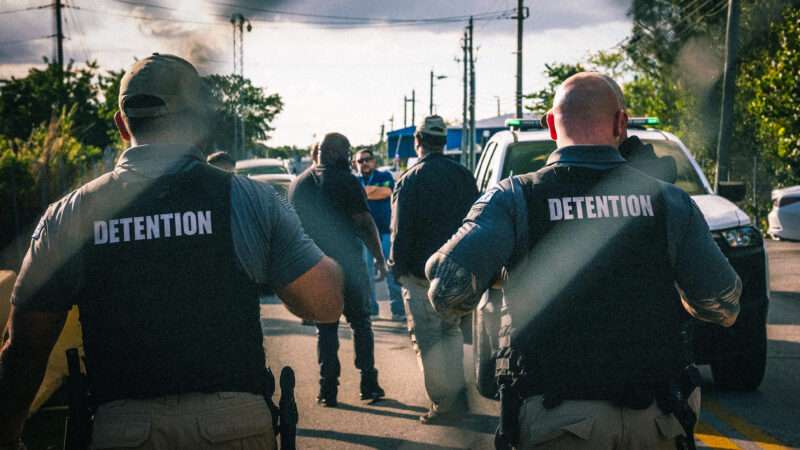
On Wednesday, a federal judge in Oregon issued an order barring Department of Homeland Security (DHS) agents from conducting warrantless arrests without first finding that an individual is likely to escape before a warrant can be obtained in accordance with federal law. 

The order stems from a lawsuit brought by the nonprofit law firm Innovation Law Lab, which accuses immigration enforcement agencies of engaging in a “detain first, justify later” pattern of practice that violates federal law. Under federal law, immigration agents may conduct a warrantless arrest only if the officer has both a “reason to believe” a person is violating an immigration law or regulation and is “likely to escape” before a warrant can be obtained. Critically, without both findings, an officer lacks the requisite probable cause to make a lawful arrest. 

During a hearing earlier this week, U.S. District Judge Mustafa Kasubhai heard evidence of immigration agents conducting warrantless arrests without making such a determination. One plaintiff, Victor Cruz Gamez, a 56-year-old grandfather, testified that he was held in immigration detention for three weeks following his unlawful warrantless arrest, according to the Associated Press. Gamez told the court that he was arrested after being pulled over by immigration agents despite having a driver’s license and a work permit, items that can be used as evidence that Gamez was not, in fact, “likely to escape” before a warrant could be obtained. 

Whether an individual is likely to escape is usually determined by considering factors like whether the person’s identity is known to the arresting officer, whether the person has previously evaded authorities, and any ties or lack thereof the person has to the community, including family and employment. 

Following the hearing, Kasubhai issued a preliminary injunction barring immigration agents from conducting warrantless arrests “without a pre-arrest individualized determination…of probable cause that the person being arrested is likely to escape before a warrant can be obtained.” Similar orders have also been recently issued in Washington, D.C., and Colorado. Immigration agents were also found to be flouting federal law in Chicago, where a federal judge ordered the release of over 600 immigrant detainees who were unlawfully arrested without a warrant.  

In response to the news of the order, DHS Assistant Secretary Tricia McLaughlin told Fox News that the “case really isn’t really about arrest procedures or legal standards” and accused “open-borders groups and activist judges” of trying to stop President Donald Trump’s mass deportation campaign. “It won’t work. DHS conducts enforcement operations in line with the U.S. Constitution and all applicable federal laws without fear, favor, or prejudice and will continue to do so,” McLaughlin said. 

However, just last week, the acting director of Immigration and Customs Enforcement, Todd Lyons, issued a memo with new guidance attempting to rewrite the agency’s definition of “likely to escape,” arguing that previous interpretations were “unreasoned” and “incorrect.” Under this new interpretation, a person is “likely to escape” if “he or she is unlikely to be located at the scene of the encounter or another clearly identifiable location once an administrative warrant is obtained.” Such an interpretation gives immigration agents more authority to arrest immigrants who have close ties to the community but who might leave the scene after an immigration stop. 

Whether the government has the authority to hold someone in custody is a question of paramount importance to liberty. And although the Trump administration’s attempt to rewrite federal law to suit its practices is alarming, at least for now, some courts are willing to uphold the rule of law.

The post Once Again, a Federal Judge Orders ICE to Stop Unlawful Warrantless Arrests appeared first on Reason.com.

from Latest – Reason.com https://ift.tt/Y5HGXtO
via IFTTT

Judge Orders Video and Texts Unsealed in Case of Chicago Woman Shot 5 Times by Border Patrol


Marimar Martinez | E. Jason Wambsgans/TNS/Newscom

A federal judge in Chicago today ordered evidence unsealed in the case of Marimar Martinez, a U.S. citizen who was shot five times by a Customs and Border Protection officer last October.

U.S. District Judge for the Northern District of Illinois Georgia Alexakis ruled that Martinez had shown good cause for the release of text messages and body camera footage from the officer who shot her, while the government had shown “zero concern” for Martinez’s reputation.

Martinez’s attorneys have been pressing to unseal the evidence because the Department of Homeland Security (DHS) refuses to retract its previous statements calling Martinez a “domestic terrorist,” despite federal prosecutors dropping the charges against her. If the government won’t correct the record, they argued, Martinez should have the opportunity to do it herself.

Alexakis agreed. “Ms. Martinez is a United States citizen. She’s a resident of this district. And under our legal system, she is presumed innocent of any offense of which she has not been convicted,” the judge said at today’s hearing.

Border Patrol officer Charles Exum shot Martinez five times on October 4 after a traffic incident in Chicago. Martinez says she was following the officers in her car and blowing her horn to warn others of their presence before the CBP vehicle sideswiped her. In a press release issued the same day as the shooting, DHS claimed that agents were “boxed in by 10 cars” when Martinez’s vehicle “rammed” their car. Officers were forced to fire defensive shots, the government claimed, when “a suspect tried to run them over.” The statement also said Martinez had a history of doxxing federal agents and was armed with a “semi-automatic weapon.”

Martinez and a man in the car, Anthony Santos Ruiz, were charged with multiple counts of impeding and assaulting federal law enforcement officers with a deadly weapon.

However, Martinez’s attorneys say the sealed body camera footage shows Martinez never rammed them, officers were never boxed in or obstructed (there were only two cars, not 10), and she never threatened officers with her car. What the sealed footage does show, Martinez’s lawyers told the Chicago Sun-Times, is an agent saying, “Do something, bitch,” shortly before crashing into Martinez.

Some of Exum’s text messages regarding the shooting were released in November. In one, he sent a link to a news story about the shooting and wrote, “Read it. Five shots, seven holes. I fired five rounds and she had seven holes. Put that in your book, boys.”

Later in November, federal prosecutors filed a motion to dismiss the charges and exonerate Martinez and Ruiz.

Despite that, the DHS has continued to attack Martinez in public statements. Following the dismissal of the case against her, the department told Chicago news outlet ABC7 that, “Border Patrol law enforcement officers were ambushed by domestic terrorists.…Our law enforcement shows incredible restraint and prudence in their exercise of force.”

In a story published January 31, NPR asked the DHS if it had plans to delete or update its statements on Martinez. DHS responded: “Border Patrol law enforcement officers were ambushed by domestic terrorists that rammed federal agents with their vehicles. The woman, Marimar Martinez, driving one of the vehicles, was armed with a semi-automatic weapon and has a history of doxing federal agents.”

Martinez’s attorneys say she is a 30-year-old Montessori school teacher with a legal concealed carry license, and that the allegations of “doxxing” are false.

Martinez originally agreed to keep the materials in the case sealed, but she changed her mind after the fatal shootings of Renee Good and Alex Pretti by federal immigration officers in Minnesota. The DHS Office of Public Affairs has repeatedly issued false statements about incidents regarding use-of-force incidents by immigration officers, including in the recent fatal shootings of Good and Pretti.

“I am their voice,” Martinez said in an interview with the Chicago Sun-Times and WBEZ, “I am here for a reason.”

The U.S. Attorney’s Office in Chicago agreed to the release of body camera footage but argued against unsealing more of Exum’s text messages. Lawyers for the U.S. government claimed in court filings that “the release of these messages after the charges against Ms. Martinez have been dismissed with prejudice will serve only to further sully Agent Exum, his family, and co-workers without any corresponding benefit to Ms. Martinez.”

In a court filing in response, Martinez’s attorneys said the irony of the government’s sudden concern about ruining someone’s reputation was “shocking.”

“Agent Exum sent these messages in the minutes, hours, and days after the shooting. These are his words,” the filing by Martinez’s attorneys said. “To the extent they would ‘sully’ his reputation more than his previously disclosed disgusting text messages already have, it is a fully deserved self-imposed sullying. Marimar Martinez had no say in being branded as a ‘domestic terrorist’ by her government. The Government drafted those words. The Government sent those words out to the world. Unlike Exum, she never had a say in the things being written about her, as opposed to Exum having had full say in the things he chose to write and disseminate.”

Alexakis denied Martinez’s request to also unseal automated license plate reader data collected by the government during its investigation of her.

Rep. Jesús “Chuy” Garcia (D–Illinois) announced this week that Martinez would be his guest at President Donald Trump’s State of the Union address to Congress later this month.

“Who knows? Maybe President Trump will even at that point retract the domestic terrorist label of her, which would be great and she would be there to see it,” Christopher Parente, Martinez’s attorney, told reporters outside a federal courthouse following the ruling.

The post Judge Orders Video and Texts Unsealed in Case of Chicago Woman Shot 5 Times by Border Patrol appeared first on Reason.com.

from Latest – Reason.com https://ift.tt/Rw51oH7
via IFTTT