Poland, Hungary Join Together To Challenge EU Bureaucracy

Submitted by Alex Gorka via The Strategic Culture Foundation,

The rifts within the EU continue to widen as Poland and Hungary join together in opposition to the EU bureaucracy.

Soon after Poland’s ultra-conservative Law and Justice (PiS) party came to power in October 2015, the Polish parliament passed a law allowing the government to appoint the judges of its choosing to the highest court and not recognize those chosen by its predecessor, the liberal Civic Platform party.

The crisis began in 2015 when Civic Platform, the party then in power, improperly nominated two judges to the constitutional court. When the PiS won October’s elections, it refused to recognize them and also blocked three other judges who had been properly selected by parliament. PiS also wants the court to hear cases in chronological order, rather than setting its own priorities for tackling its caseload. The Polish government believes it is unfair that a constitutional court with a majority of judges appointed under the previous parliament should be able to scupper flagship policies for which PiS secured a mandate in democratic elections in 2015.

Legal experts advising the Council of Europe, the continent’s top human rights watchdog, have concluded that the changes breach the rule of law, democracy and human rights. The Council and the European Parliament have expressed their concerns and urged the government to backtrack on its reform.The constitutional crisis has already given rise to a string of large demonstrations by a new Polish popular movement, the Committee for the Defence of Democracy.

Last December, President Andrzej Duda appointed a candidate backed by PiS as the new head of the constitutional court, which had been locked in a struggle with the government. In response, the European Commission said it considered the procedure which led to the appointment of Judge Julia Przy??bska to the post as “fundamentally flawed as regards the rule of law.” The Commission has set the Polish government a late February deadline to implement measures to protect the powers of the constitutional court.

On February 20, Poland dismissed demands that it implement judiciary reforms deemed essential by the European Commission to uphold the rule of law. Warsaw risks being stripped of its voting rights in the 28-member bloc, but such a move requires unanimity, while Hungary said it would not support sanctions. Hungary has also been harshly criticized by European structures for alleged violations of EU rules and standards.

In 2015, Poland and Hungary joined together to stop an EU ministerial agreement that would have forced all EU countries to honor same-sex “marriages” wherever they were contracted in the European Union. The botched agreement proposed by Luxemburg to the EU justice ministers addressed property rights, pensions and insurance. Poland and Hungary opposedit on the grounds that this would violate their sovereign prerogative to legislate on marriage and family matters.

The fact that two countries in the heart of Europe would oppose even an indirect recognition of same-sex “marriage,” and undoubtedly in the face of strong pressures from other EU states, speaks volumes about the direction Poland and Hungary have chosen. It is not the trajectory in which EU diplomacy, reliant on EU consensus, has taken so far.

The Hungary’s stance on Poland makes EU divisions come in the open to put an end to all the talkingabout the much-praised European unity. And it’s not Brexit only.

Actually, the EU is already divided. The «Alliance of Europe’s South» is being formed to include Greece, France, Italy, Spain, Portugal, Cyprus and Malta. Several EU members mull the possibility of a mini- Schengen bloc to comprise the Netherlands, Belgium, Luxembourg, Germany and Austria – the nations sharing deep cultural and historic links and opposing the idea of wealthy countries in the north subsidizing poorer EU members in the south.

The Visegrad group (Poland, Hungary, the Czech Republic and Slovakia) openly opposes the EU migration policy and offers its own vision of what the EU should become in the future. An extraordinary conference of the groups prime ministers in February, 2016, led to a statement reasserting the members’ insistence on “more effective protection” of the EU’s external borders to “stem the migratory flow.” It also repeated the countries’ opposition to a quota system for resettling refugees through the EU.

The group possesses enough significant growth and influence to move beyond the Continent. In particular, the combined GDP of the group makes it the world’s 15th largest economy, and the number of its representatives in the European Parliament is twice as large as the number of representatives of France, Italy and the United Kingdom.

Europe is facing a prolonged period of political upheaval, with elections also slated for 2017 in Germany, France, the Netherlands and Italy – all countries where economic anxiety, opposition to the EU and a surge in migration have fed growing support for populist parties.

The EU is also deeply divided over the sanctions imposed against Russia. Many countries oppose the «trade war» and the discontent is growing. Imposed three years ago, the restrictive measures have failed to achieve any results. The policy has little impact on Moscow. President Vladimir Putin has said manty times that Russia’s economy can rebound stronger from Western sanctions. It has been estimated that the cost to European farmers of the sanctions against Moscow is equal to 5.5 billion euros a year.

According to the Austrian Institute of Economic Research (WIFO), the macroeconomic effects of the trade loss, amounting to €34 billion in value added in the short run and €92 billion in the longer. Keeping farmers in business, on a drip of multi-million euro rescue packages is not a sustainable solution.

Poland and Hungary are getting closer as their criticism of European institutions grows stronger. Both nations defend measures to freeze the process of European integration and take back national prerogatives transferred to Brussels. They will work together to resist the EU’s attempts to enforce a scheme to relocate refugees across the bloc.

One thing leads to another. Poland is working to extend its influence beyond the Visegrad Group by giving a boost to the relations with Romania and Slovakia – EU member states also opposing the bloc’s asylum seekers’ relocation plans imposed by Germany.

The disenchantment with European integration is already pervasive in the region. Eurosceptics not only challenge Brussels, they demonstrate their willingness to unite. A new alliance appears to be emerging inside the EU to undermine it, or even destroy it, from within. Other nations inspired by this example are likely to join, spurring the process that can hardly be stopped.

via http://ift.tt/2mBST0s Tyler Durden
EU Lawmakers Urge “Federal Union” For European States… Or Else

The leaders of the lower chambers of parliament of Germany, Italy, France, and Luxembourg have called for a European “Federal Union” in an open letter published in Italian newspaper La Stampa on Sunday.

In the letter, four representatives of EU governments – Claude Bartolone of the French National Assembly, Laura Boldrini of the Italian Chamber of Deputies, Norbert Lammert of the German Bundestag, and Mars Di Bartolomeo of the Luxembourg Chamber of Deputies – say that closer cooperation is essential for dealing with problems that no one EU state can tackle on its own, such as immigration, terrorism, and climate change. As RT notes, the letter’s authors also warn that the European integration project is currently more at risk than ever before, with high unemployment and immigration problems driving populist and nationalist movements. The EU must also come to grips with the fact that, last June, the United Kingdom decided to leave the union after holding a national referendum, aka Brexit, becoming the first member nation to opt out of the bloc.

In less than a month, on March 17 next, we Presidents of the national parliaments of the EU we will meet in Rome, how will the representatives of governments, for the sixtieth anniversary of the Treaty from which it began: our Union.  


But it is plain for all that recurrence requires much more than just a historical commemoration. Birthday comes the most critical stage ever crossed by the European project. 


In such a situation we should not be paralyzed by fear, or by concerns related to the upcoming elections in some of our countries. We must act now, before it's too late. And take the opportunity of the anniversary to return to the vision and the spirit of the Founding Fathers and relaunch the construction of Europe on foundations refurbished.


We are convinced that in the face of crisis, we need more Europe, although we have to face headwinds. We can not ignore the social impact that the disastrous economic and financial measures have had on tens of millions of families. We need to focus on growth and jobs that Europe can have no charm for young people if they do not offer them credible job prospects. We must have the courage to share sovereignty in many sectors in which the action of individual States is now totally ineffective and doomed to fail: from global warming to energy policies, from financial markets to the rules for immigration, tax evasion to the fight against terrorism.  


Now is the moment to move towards closer political integration: Federal Union of States with large skills. We know that the prospect stirs up strong resistance, but the inaction of some can not be the paralysis of all. Those who believe in the European ideal is to be able to revive rather helplessly to its slow decline. And the United States who do not want to join immediately in that closer integration should be able to do it later. 

On Sunday, a number of EU states, including Germany, France and Italy, called for the UK to pay a hefty price as a “divorce settlement.”

The letter was published in the run-up to a meeting of parliamentary leaders in Rome on March 17 to mark the 60th anniversary of the Treaty of Rome, which established the European Economic Community (EEC). The treaty’s signing by six countries– Belgium, France, Italy, Luxembourg, West Germany and the Netherlands – in 1957 eventually paved the way for the Maastricht Treaty and the European Union in 1991.

In September of 2015, Lammert, Bartolone, Boldrini and di Bartolomeo also signed a declaration calling for deeper and faster European integration. However, greater European integration is being increasingly challenged by a number of Eurosceptic parties around the continent, including the Alternative for Germany, the National Front in France, and the Party for Freedom in the Netherlands. Upcoming elections could bring these parties closer to power.

According to the European Parliament’s chief Brexit negotiator, Guy Verhofstadt, the European Union must reform, or it risks disappearing under a barrage of internal and external attacks.

via http://ift.tt/2mBw1y4 Tyler Durden

Of Bread And Circuses

Originally authored by Admiral Ben Moreell on January 1st, 1956; via The Burning Platform blog,

A twentieth-century repetition of the mistakes of ancient Rome would be inexcusable. Rome was eight and a half centuries old when the poet, Juvenal, penned his famous tirade against his degenerate countrymen. About 100 A.D. he wrote: “Now that no one buys our votes, the public has long since cast off its cares; the people that once bestowed commands, consulships, legions and all else, now meddles no more and longs eagerly for just two things, bread and circuses.” (Carcopino, Daily Life in Roman Times [New Haven, Yale University Press, 1940], p. 202.) Forty years later, the Roman historian, Fronto, echoed the charge in more prosaic language: “The Roman people is absorbed by two things above all others, its food supplies and its shows.” (Ibid.)

Here was a once-proud people, whose government had been their servant, who had finally succumbed to the blandishments of clever political adventurers. They had gradually relinquished their sovereignty to government administrators to whom they had granted absolute powers, in return for food and entertainment. And the surprising thing about this insidious progression is that, at the time, few realized that they were witnessing the slow destruction of a people by a corruption that would eventually transmute a nation of self-reliant, courageous, sovereign individuals into a mob, dependent upon their government for the means of sustaining life.

There are no precise records that describe the feelings of those for whom the poet, Juvenal, felt such scorn. But using the clues we have, and judging by our own experience, we can make a good guess as to what the prevailing sentiments of the Roman populace were. If we were able to take a poll of public opinion of first and second century Rome, the overwhelming response would probably have been—“We never had it so good.” Those who lived on “public assistance” and in subsidized rent-free or low-rent dwellings would certainly have assured us that now, at last, they had “security.” Those in the rapidly expanding bureaucracy—one of the most efficient civil services the world has ever seen—would have told us that now government had a “conscience” and was using its vast resources to guarantee the “welfare” of all of its citizens; that the civil service gave them job security and retirement benefits; and that the best job was a government job! Progressive members of the business community would have said that business had never been so good, that the government was their largest customer, which assured them a dependable market, and that the government was inflating currency at about 2 per cent a year, which instilled confidence and gave everyone a sense of well-being and prosperity.

And no doubt the farmers were well pleased too. They supplied the grain, the pork and the olive oil, at or above parity prices, for the government’s doles.

The government had a continuous program of large-scale public works which were said to stimulate the economy, provide jobs and promote the general welfare, and which appealed to the national pride.

The high tax rates required by the subsidies discouraged the entrepreneur with risk capital which, in turn, favored the well-established, complacently prosperous businessman. It appears that there was no serious objection to this by any of the groups affected. An economic historian, writing of business conditions at this period, says, “The chief object of economic activity was to assure the individual, or his family, a placid and inactive life on a safe, if moderate, income . . . . There were no technical improvements in industry after the early part of the second century.” There was no incentive to venture. Inventions began to dry up because no one could reasonably expect to make a profit out of them.

Rome was sacked by Alaric and his Goths in 410 A.D. But long before the barbarian invasions, Rome was a hollow shell of the once noble Republic. Its real grandeur was gone and its people were demoralized. Most of the old forms and institutions remained. But a people whose horizons were limited by bread and circuses had destroyed the spirit while paying lip service to the letter of their once hallowed traditions.

The fall of Rome affords a pertinent illustration of the observation by the late President Lowell of Harvard University that “no society is ever murdered—it commits suicide.”

I do not imply that bread and circuses are evil things in themselves. Man needs material sustenance and he needs recreation. These needs are so basic that they come within the purview of every religion. In every religion there is a harvest festival of thanksgiving for good crops. And as for recreation, we need only recall that our word “holiday” was originally “holy day,” a day of religious observance. In fact, the circuses and games of old Rome were religious in origin. The evil was not in bread and circuses, per se, but in the willingness of the people to sell their rights as free men for full bellies and the excitement of the games which would serve to distract them from the other human hungers which bread and circuses can never appease. The moral decay of the people was not caused by the doles and the games. These merely provided a measure of their degradation. Things that were originally good had become perverted and, as Shakespeare reminds us, “Lilies that fester smell far worse than weeds.”

More than fifty years ago, the great historian of Rome, Theodore Mommsen, came to our country on a visit. At a reception in his honor, someone asked him, “Mr. Mommsen, what do you think of our country?” The great scholar replied, “With two thousand years of European experience before your eyes, you have repeated every one of Europe’s mistakes. I have no further interest in you.”

One wonders what Mommsen would say today in the light of the increasingly rapid destruction of our traditional values during the past 25 years.

Many of our people have been converted to the idea that liberty has been tried and found wanting, just as many believe that Christianity has been tried and found wanting. They do not know that what has been found wanting is not the true values of liberty and religion but only perversions, worthless counterfeits. So when we urge upon them those true values, they shy away. They have been fooled before, so they want to try something which they think is “new.”

How far have we departed from our traditional values? There is no mystery here. It is well known that the basic policies of the two major political parties with respect to the intrusion of the State into the economic and social lives of the people differ only in degree and method. There is no discernible difference in fundamental principle. Prominent political figures of both parties pay lip service to the letter of our Declaration of Independence and Constitution, while they violate the spirit.

The proponents of an all-powerful centralized government have erected a bureaucratic colossus which imposes upon our people controls, regimentation, punitive taxation and subsidies to pressure groups, thus paralleling the “organized mendicancy, subvention, bureaucracy and centralization” which played so great a part in the downfall of Rome!

We are demoralized by an indecent competition. Each one denounces government handouts and privileges for the other fellow—but maintains that his special privilege is for the “general welfare.” The slogan of many of us seems to be, “Beat the other fellow to the draw”—i.e., “draw out of the public treasury more than you put in, before someone else gets it.”

I am no prophet of inevitable doom. On the contrary, I am sounding an alarm that disaster lies ahead unless present danger signals are heeded.

What specific steps should we take? I believe that neither I nor anyone else, no matter how exalted his position, can determine for 165 million people their day-to-day economic and social decisions concerning such matters as wages, prices, production, associations and others. So I propose that these decisions, and the problems connected therewith, be returned to the people themselves. This could be done in four steps, as follows:

First—Let us stop this headlong rush toward collectivism. Let there be no more special privileges for employers, employees, farmers, businessmen or any other groups. This is the easiest step of all. We need only refrain from passing more socialistic laws.


Second— Let us undertake at once an orderly demobilization of many of the existing powers of government by the progressive repeal of those socialistic laws which we already have. This will be a very difficult step because every pressure group in the nation will fight to retain its subsidies, monopoly privileges and protection. But if freedom is to live, all special privileges must go.


Third—Of the powers that remain in government, let us return as many as possible to the states. For on the local level, the people will be able to apply more critical scrutiny to the acts of their government agents.


Fourth—Above all, let us resolve that never again will we yield to the seduction of the government panderer who comes among us offering “bread and circuses,” paid for with our own money, in return for our sovereign rights!

*  *  *

Admiral Ben Moreell (1892 – 1978) was the chief of the U.S. Navy’s Bureau of Yards and Docks and of the Civil Engineer Corps. Best known to the American public as the Father of the Navy’s Seabees, Moreell’s life spanned eight decades, two world wars, a great depression and the evolution of the United States as a superpower. He was a distinguished Naval Officer, a brilliant engineer, an industrial giant and articulate national spokesman.


via http://ift.tt/2mumedN Tyler Durden

Curious Gold-Silver Ratio That Did Not Fall, Report 26 Feb, 2017

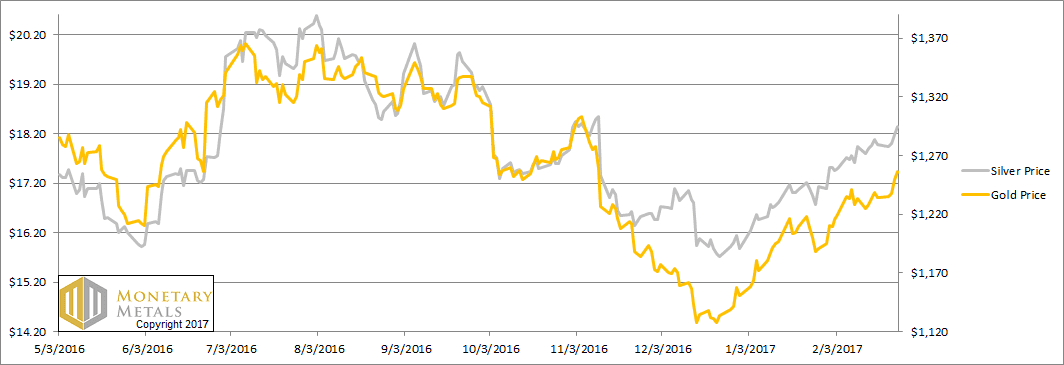
This holiday-shortened week (Monday was President’s Day in the US), the price of the dollar fell. In gold, it fell almost half a milligram to 24.75mg, and prices in silver it dropped 30mg, to 1.7 grams of the white monetary metal. Flipped upside down, gold went up 23 notes from the Federal Reserve, and silver appears to go up by 41 cents.

Below, we will show the only true picture of the gold and silver supply and demand fundamentals. But first, the price and ratio charts.

The Prices of Gold and Silver

Next, this is a graph of the gold price measured in silver, otherwise known as the gold to silver ratio. It moved sideways again this week, which would normally be odd for a time when the prices of the metals are rising.

The Ratio of the Gold Price to the Silver Price

For each metal, we will look at a graph of the basis and cobasis overlaid with the price of the dollar in terms of the respective metal. It will make it easier to provide brief commentary. The dollar will be represented in green, the basis in blue and cobasis in red.

Here is the gold graph.

The Gold Basis and Cobasis and the Dollar Price

For a very long time, we would post graphs that looked almost the same. Oh, the specifics of month, price, and basis would be different. But they had a certain sameness. The price of the dollar (i.e. inverse of the price of gold, in dollar terms) would move along with the cobasis (i.e. scarcity of gold). So as the dollar would rise (i.e. the price of gold would fall), the scarcity would rise. And vice versa. This means changes in price were due to changes in behavior by speculators.

And now we have a clear picture of … the opposite. The dollar has been falling since mid-December. And for that same time, the cobasis (scarcity of gold) has been rising.

Yes, gold has been getting scarcer as it becomes pricier.

How could this be possible? Doesn’t the law of supply and demand work for gold? You know, the standard “X” graph from Econ. 101?

Gold has several unique properties. One is that it is not purchased for consumption, but for monetary reserves or jewelry (which in most of the world is monetary reserves). Contrast that to copper which is purchased by plumbing manufacturers to make pipe. It’s a competitive market, and if the price of copper plumbing goes up too much then home builders will switch to plastic. Demand drops as price rises. Also, the marginal copper mine will increase production. Supply rises as price rises. It is self-correcting.

Gold, not being bought to consume, does not have a limit to demand as price rises. If anything a rising price (i.e. a falling currency) signals to people that holding gold is a good thing. They were wise to get out of their falling paper currency, and should consider buying more gold.

Also, virtually all of the gold ever mined in human history is still in human hands. All of this gold is potential supply, at the right price and under the right conditions. Even if gold mining worked like copper mining, and miners could just produce more, changes in mine production at the margin are not material to the overall gold supply. By official estimates, the total inventory of gold would take over 70 years to be produced at current mine production rates (and we believe this is a low estimate).

Readers may object that this question is a bit unfair, as any commodity can experience rising tightness and that will accompany its rising price for a while until the market can correct itself. That is true, but what we are looking at in gold is not that at all. When the market corrects itself—which we think is very likely, we do not see Armageddon just yet—it will not be because gold miners have cranked up their outputs, nor because gold users have substituted another metal. There is no substitute for monetary reservation, particularly as paper currencies are in the terminal stages of failure.

Our calculated fundamental price is now up to almost $1,400.

Now let’s look at silver.

The Silver Basis and Cobasis and the Dollar Price

The trend of falling dollar (i.e. rising price of silver) and rising cobasis (scarcity) is here in silver, too, but it’s weaker.

Silver does not quite have the same stocks to flows ratio as gold, but it has far and away a higher ratio than copper or any ordinary commodity. That is why silver is the other monetary metal.

The fundamental price of silver is now up to about $18.70. While this is over the market price of the metal, it’s not nearly so much above as gold.

This is why we calculate a fundamental on the gold-silver ratio over 74.

© 2017 Monetary Metals

via http://ift.tt/2mugLUG Monetary Metals

New Declassified CIA Memo Presents Blueprint for Syrian Regime Collapse

Submitted by Brad Hoff via The Libertarian Institute,

A newly declassified CIA document explored multiple scenarios of Syrian regime collapse at a time when Hafez al-Assad’s government was embroiled in a covert “dirty war” with Israel and the West, and in the midst of a diplomatic crisis which marked an unprecedented level of isolation for Syria.

The 24-page formerly classified memo entitled Syria: Scenarios of Dramatic Political Change was produced in July 1986, and had high level distribution within the Reagan administration and to agency directors, including presidential advisers, the National Security Council, and the US ambassador to Syria. The memo appears in the CIA’s latest CREST release (CIA Records Search Tool) of over 900,000 recently declassified documents.

A “severely restricted” report

The memo’s cover letter, drafted by the CIA’s Director of Global Issues (the report itself was prepared by the division’s Foreign Subversion and Instability Center), introduces the purpose of presenting “a number of possible scenarios that could lead to the ouster of President Assad or other dramatic change in Syria.”

It further curiously warns that, “Because the analysis out of context is susceptible to misunderstanding, external distribution has been severely restricted.” The report’s narrowed distribution list (sent to specific named national security heads, not entire agencies) indicates that it was considered at the highest levels of the Reagan administration.

The coming sectarian war for Syria

The intelligence report’s contents contain some striking passages which seem remarkably consistent with events as they unfolded decades later at the start of the Syrian war in 2011:

Although we judge that fear of reprisals and organizational problems make a second Sunni challenge unlikely, an excessive government reaction to minor outbreaks of Sunni dissidence might trigger large-scale unrest. In most instances the regime would have the resources to crush a Sunni opposition movement, but we believe widespread violence among the populace could stimulate large numbers of Sunni officers and conscripts to desert or munity, setting the stage for civil war. [pg.2]

The “second Sunni challenge” is a reference to the Syrian government’s prior long running war against a Muslim Brotherhood insurgency which culminated in the 1982 Hama Massacre. While downplaying the nationalist and pluralistic composition of the ruling Ba’ath party, the report envisions a renewal and exploitation of sectarian fault lines pitting Syria’s Sunni population against its Alawite leadership:

Sunnis make up 60 percent of the Syrian officer corps but are concentrated in junior officer ranks; enlisted men are predominantly Sunni conscripts. We believe that a renewal of communal violence between Alawis and Sunnis could inspire Sunnis in the military to turn against the regime. [pg.12]

Regime change and the Muslim Brotherhood

The possibility of the Muslim Brotherhood spearheading another future armed insurgency leading to regime change is given extensive focus. While the document’s tone suggests this as a long term future scenario (especially considering the Brotherhood suffered overwhelming defeat and went completely underground in Syria by the mid-1980’s), it is considered one of the top three “most likely” drivers of regime change (the other scenarios include “Succession Power Struggle” and “Military Reverses Spark a Coup”).

The potential for revival of the Muslim Brotherhood’s “militant faction” is introduced in the following:

Although the Muslim Brotherhood’s suppression drastically reduced armed dissidence, we judge a significant potential still exists for another Sunni opposition movement. In part the Brotherhood’s role was to exploit and orchestrate opposition activity by other organized groups… These groups still exist, and under proper leadership they could coalesce into a large movement… …young professionals who formed the base of support for the militant faction of the Muslim Brotherhood; and remnants of the Brotherhood itself who could become leaders in a new Sunni opposition movement… [pp.13-14]

The Brotherhood’s role is seen as escalating the potential for initially small Sunni protest movements to morph into violent sectarian civil war:

Sunni dissidence has been minimal since Assad crushed the Muslim Brotherhood in the early 1980s, but deep-seated tensions remain–keeping alive the potential for minor incidents to grow into major flareups of communal violence… Excessive government force in quelling such disturbances might be seen by Sunnis as evidence of a government vendetta against all Sunnis, precipitating even larger protests by other Sunni groups…


Mistaking the new protests as a resurgence of the Muslim Brotherhood, the government would step up its use of force and launch violent attacks on a broad spectrum of Sunni community leaders as well as on those engaged in protests. Regime efforts to restore order would founder if government violence against protestors inspired broad-based communal violence between Alawis and Sunnis. [pp.19-20]

The CIA report describes the final phase of an evolving sectarian war which witnesses the influx of fighters and weapons from neighboring countries. Consistent with a 1983 secret report that called for a US covert operation to utilize then US-allied Iraq as a base of attack on Syria, the 1986 analysis says, “Iraq might supply them with sufficient weapons to launch a civil war”:

A general campaign of Alawi violence against Sunnis might push even moderate Sunnis to join the opposition. Remnants of the Muslim Brotherhood–some returning from exile in Iraq–could provide a core of leadership for the movement. Although the regime has the resources to crush such a venture, we believe brutal attacks on Sunni civilians might prompt large numbers of Sunni officers and conscripts to desert or stage mutinies in support of dissidents, and Iraq might supply them with sufficient weapons to launch a civil war. [pp.20-21]

A Sunni regime serving Western economic interests

While the document is primarily a theoretical exploration projecting scenarios of Syrian regime weakening and collapse (its purpose is analysis and not necessarily policy), the authors admit of its “purposefully provocative” nature (see PREFACE) and closes with a list desired outcomes. One provocative outcome describes a pliant “Sunni regime” serving US economic interests:

In our view, US interests would be best served by a Sunni regime controlled by business-oriented moderates. Business moderates would see a strong need for Western aid and investment to build Syria’s private economy, thus opening the way for stronger ties to Western governments. [pg. 24]

Ironically, the Syrian government would accuse the United States and its allies of covert subversion within Syria after a string of domestic bombings created diplomatic tensions during the mid-1980’s.

Dirty tricks and diplomacy in the 1980’s

According to Patrick Seale’s landmark book, Asad of Syria: The Struggle for the Middle East, 1986 was a year that marked Syria’s greatest isolation among world powers as multiple diplomatic crises and terror events put Syria more and more out in the cold.

The year included “the Hindawi affair”a Syrian intelligence sponsored attempt to hijack and bomb an El Al flight to Tel Avivand may or may not have involved Nezar Hindawi working as a double agent on behalf of Israel. The foiled plot brought down international condemnation on Syria and lives on as one of the more famous and bizarre terror conspiracies in history. Not only were Syria and Israel once again generally on the brink of war in 1986, but a string of “dirty tricks” tactics were being utilized by Syria and its regional enemies to shape diplomatic outcomes primarily in Lebanon and Jordan.

In March and April of 1986 (months prior to the distribution of the CIA memo), a string of still largely unexplained car bombs rocked Damascus and at least 5 towns throughout Syria, leaving over 200 civilians dead in the most significant wave of attacks since the earlier ’79-’82 war with the Muslim Brotherhood (also see BBC News recount the attacks).

Patrick Seale’s book speculates of the bombings that, “It may not have been unconnected that in late 1985 the NSC’s Colonel Oliver North and Amiram Nir, Peres’s counter-terrorism expert, set up a dirty tricks outfit to strike back at the alleged sponsors of Middle East terrorism.”

Consistency with future WikiLeaks files

The casual reader of Syria: Scenarios of Dramatic Political Change will immediately recognize a strategic thinking on Syria that looks much the same as what is revealed in national security memos produced decades later in the run up to the current war in Syria.

When US cables or intelligence papers talk regime change in Syria they usually strategize in terms of exploiting sectarian fault lines. In a sense, this is the US national security bureaucracy’s fall-back approach to Syria.

One well-known example is contained in a December 2006 State Dept. cable sent from the US embassy in Syria (subsequently released by WikiLeaks). The cable’s stated purpose is to explore Syrian regime vulnerabilities and weaknesses to exploit (in similar fashion to the 1986 CIA memo):

PLAY ON SUNNI FEARS OF IRANIAN INFLUENCE: There are fears in Syria that the Iranians are active in both Shia proselytizing and conversion of, mostly poor, Sunnis. Though often exaggerated, such fears reflect an element of the Sunni community in Syria that is increasingly upset by and focused on the spread of Iranian influence in their country through activities ranging from mosque construction to business.

Another section of the 2006 cable explains precisely the same scenario laid out in the 1986 memo in describing the increased “possibility of a self-defeating over-reaction” on the part of the regime.:

ENCOURAGE RUMORS AND SIGNALS OF EXTERNAL PLOTTING: The regime is intensely sensitive to rumors about coup-plotting and restlessness in the security services and military. Regional allies like Egypt and Saudi Arabia should be encouraged to meet with figures like [former Vice President Abdul Halim] Khaddam and [younger brother of Hafez] Rif’at Asad as a way of sending such signals, with appropriate leaking of the meetings afterwards. This again touches on this insular regime’s paranoia and increases the possibility of a self-defeating over-reaction.

And ironically, Rif’at Asad and Khaddam are both mentioned extensively in the 1986 memo as key players during a speculative future “Succession Power Struggle.” [p.15]

An Islamic State in Damascus?

While the 1986 CIA report makes a case in its concluding paragraph for “a Sunni regime controlled by business-oriented moderates” in Syria, the authors acknowledge that the collapse of the Ba’ath state could actually usher in the worst of all possible outcomes for Washington and the region: “religious zealots” might seek to establish “an Islamic Republic”. The words take on a new and special importance now, after the rise of ISIS:

Although Syria’s secular traditions would make it extremely difficult for religious zealots to establish an Islamic Republic, should they succeed they would likely deepen hostilities with Israel and provide support and sanctuary to terrorists groups. [pg.24]

What continues to unfold in Syria has apparently surpassed even the worst case scenarios of intelligence planners in the 1980’s. Tinkering with regime change has proven itself to be the most dangerous of all games.

via http://ift.tt/2lLhvEJ Tyler Durden

Maine Drops 9,000 From Food Stamps After Refusal To Comply With Work Requirements

Republican Governor Paul LePage dared to begin enforcing Maine's volunteer and work requirements for food stamp (SNAP) recipients to keep their benefits. The end result was more than 9,000 non-disabled adults getting dropped from the program.


As CNS News' Eric Schiener reports, a Department of Health and Human Services (DHHS) spokesman tells the Associated Press that 12,000 non-disabled adults were in Maine’s SNAP program before Jan. 1 – a number that dropped to 2,680 by the end of March…

The rules prevent adults, who are not disabled and do not have dependents, from receiving food stamps for more than three months unless they work at least 20 hours a week, participate in a work-training program, or meet volunteer guidelines for 24 hours out of the month.


Any one of those three minimums getting met will result in an individual to retain their SNAP food benefits.


DHHS Commissioner Mary Mayhew said the goal of the requirements is to encourage people to find work.


"If you're on these programs it means you are living in poverty and so the more that we can help incentive people on that pathway to employment and self-sufficiency the better off they're going to be," Mayhew told the Associated Press.

In Maine, once someone loses their benefits, they cannot regain assistance for three years.

Patriot Chronicle points out, in Maine, 9,000 able-bodied people who are supposedly too poor to feed themselves couldn’t seem to handle that. In addition, those who lose their benefits in such a manner can’t reapply for assistance for three years.

Liberals have sold government dependence so deliberately well, that even doing 24 hours of approved volunteer work a month for a capable adult became too much for more than 9,000 people.


Either the Liberals have truly brain washed the voting masses into droning zombies, or they’re really not that needy for food.


Either way, the taxpayers who work hard for their paychecks, can feel some satisfaction at knowing they won’t have to support as much mediocrity as they used to.

As we noted previoulsy, thanks to many years of accelerated growth in the program under both George W. Bush and Barack Obama, 1 in 7 Americans now participate in the food stamp program.  There are, however, very large differences from state to state in how much the food stamp program has expanded. If we look at growth in the program from the year 2000 to 2015, we find growth varying from 641 percent growth in Nevada, to 54 percent growth in Wyoming:

Regionally, the areas of the country with the most growth are the South and West:


via http://ift.tt/2leE42E Tyler Durden

Citizen Militia Experiences Explosive Growth Following The Last Election

Submitted by Daniel Lang via SHTFPlan.com,

Until the 1990’s, civilian run volunteer militias weren’t all that common in the United States. They were the fringe of the fringe in our culture. But after Waco and Ruby Ridge, their ranks swelled and they became a common subject in the news and in pop culture.

Their numbers fell again under President Bush, and then grew to new heights under President Obama.

It’s an obvious pattern. Conservative militias multiply like crazy under Democratic presidents, and for good reason. When Democrats take the reigns of government, they always threaten to restrict gun ownership. They then decline under Republican administrations, when conservatives don’t feel as threatened.

However, there may be a new trend emerging. CBS Atlanta recently did a piece on a militia called the Three Percenter Security Force (which obviously showed them in slightly negative light, given the source).

CBS46 News

The organization is run by Marine Corps veteran Chris Hill, who says that their membership has grown from a few dozen, to roughly 400 members since November.

The Marine told CBS that the militia would protect the Second Amendment under any administration, and that “The government or law enforcement agencies, disarming people, it’s a constant threat.”

That doesn’t sound very different from the stated objectives of any conservative militia that has emerged since the 90s. So why is this militia’s membership growing so drastically during the early stages of a Republican administration? What’s different this time? The answer may lie in how the Left has responded to Trump being elected. According to Hill:

“The level of violence I see coming from these protests is alarming, I think that creates more of a need for people like us to be there,” Hill said.


Hill says, just as anti-Trump supporters have a right to organize and protest, his group wants to show their presence.


“We have a duty to protect, our freedom, our liberty, our constitutional Republic.” Hill said. “That responsibility can’t be deferred to you know Congress.”

So radical leftists and conservative militias are experiencing explosive growth at the same time, and neither of them are afraid to present themselves in the streets of America. While I do support the rights of militias, I have to say that this probably won’t end well.

via http://ift.tt/2lp8hgg Tyler Durden

America’s Border Patrol Budget: Spot The Obama Difference

President Trump's crackdown in illegal immigration means more wall-building, more ICE agents, and a notably bigger budget for the border patrol program. As the following chart shows, that would be an extreme departure from the stagnant spending on our nation's borders by President Obama.

As Statista's Dyfed Loesche notes, the overall enacted budget for the U.S. Border Patrol program has risen steadily since the 1990s… until 2011 – when President Obama appeared to kill any further spending…

You will find more statistics at Statista

Of course this budget entails spending for patrolling on all national borders. But it is perhaps noteworthy that the number of deportations plunged under president Obama…Under President Obama, the peak was reached in 2012 when almost 410,000 illegal immigrants were deported but it dipped in 2013, falling to 368,644.

Infographic: Deportations from the U.S. Dip in 2013 | Statista

You will find more statistics at Statista


Despite a surge in the number of immigrants during the same period of border patrol budget constraint…

Infographic: Level of Migration to the United States Not Unprecedented | Statista

You will find more statistics at Statista

Probably just a coincidence… or was that the plan all along?

via http://ift.tt/2mtIdSf Tyler Durden

Welcome Aboard… But First US Marshals Will Scan Your Retina

Submitted by Jeffrey Tucker via The Foundation for Economic Education,

For some 15 years, airport security has become steadily more invasive. There are ever more checkpoints, ever more requests for documents as you make your way from the airport entrance to the airplane. Passengers adapt to the new changes as they come. But my latest flight to Mexico, originating in Atlanta, presented all passengers with something I had never seen before.

We had already been through boarding pass checks, passport checks, scanners, and pat downs. At the gate, each passenger had already had their tickets scanned and we were all walking on the jet bridge to board. It’s at this point that most people assume that it is all done: finally we can enjoy some sense of normalcy.

This time was different. Halfway down the jetbridge, there was a new layer of security. Two US Marshals, heavily armed and dressed in dystopian-style black regalia, stood next to an upright machine with a glowing green eye. Every passenger, one by one, was told to step on a mat and look into the green scanner. It was scanning our eyes and matching that scan with the passport, which was also scanned (yet again).

Like everyone else, I complied. What was my choice? I guess I could have turned back at the point, decline to take the flight I had paid for, but it would be unclear what would then happen. After standing there for perhaps 8 seconds, the machine gave the go signal and I boarded.

I talked to a few passengers about this and others were just as shaken by the experience. They were reticent even to talk about it, as people tend to be when confronted with something like this.

I couldn’t find anyone who had ever seen something like this before. I wrote friends who travel internationally and none said they had ever seen anything like this.

I will tell you how it made me feel: like a prisoner in my own country. It’s one thing to control who comes into a country. But surveilling and permissioning American citizens as they leave their own country, even as they are about to board, is something else.

Where is the toggle switch that would have told the machine not to let me board, and who controls it? How prone is it to bureaucratic error? What happens to my scan now and who has access to it?

The scene reminded me of movies I’ve seen, like Hunger Games or 1984. It’s chilling and strange, even deeply alarming to anyone who has ever dreamed of what freedom might be like. It doesn’t look like this.

Why Now?

I’ve searched the web for some evidence that this new practice has been going on for a while and I just didn’t notice. I find nothing about it. I’ve looked to find some new order, maybe leftover from the Obama administration, that is just now being implemented. But I find nothing.

Update: a reader has pointed me to this page at Homeland Security:

As part of U.S. Customs and Border Protection’s (CBP) border security mission, the agency is deploying new technologies to verify travelers’ identities – both when they arrive and when they leave the United States – by matching a traveler to the document they are presenting. CBP’s goal is to enhance national security and protect a traveler’s identity against theft through the use of biometrics.


Biometric information (such as finger, face, or iris) measures a person’s unique physical characteristics. CBP incorporated fingerprints for biometric identification and verification in 2004, and is now testing facial and iris imaging capabilities to help improve travelers’ identity protection, the integrity of our immigration system, and our national security.

I happened to be on the "one daily flight" that gets exit scanned.

Another change has to do with new rules for Homeland Security just imposed by the Trump administration. They make deportation vastly easier for the government. I have no idea if these rules are the culprit for intensified emigration checks.

What people don’t often consider is that every rule that pertains to immigration ultimately applies to emigration as well. Every rule that government has to treat immigrants a certain way also necessarily applies to citizens as well.

Chandran Kukathas is right when he says that “controlling immigration means controlling everyone.”

Regulating immigration is not just about how people arrive, but about what they do once they have entered a country. It is about controlling how long people stay, where they travel, and what they do. Most of all, it means controlling whether or not and for whom they work (paid or unpaid), what they accept in financial remuneration, and what they must do to remain in employment, for as long as that is permitted. Yet this is not possible without controlling citizens and existing residents, who must be regulated, monitored and policed to make sure that they comply with immigration laws.

To be sure, there might have been some tip off that security officials received that triggered these special measures for this flight only. Maybe they were looking for something, someone, in particular. Maybe this was a one-time thing and will not become routine.

The point is that it happened without any change in the laws or regulations. Whatever the reason, it was some decision made by security. It can happen on any flight for any reason. And who is in charge of making that decision?

On the plane, finally, my mind raced through the deeper history here. Passports as we know them are only a little over a century old. In the late 19th century, the apotheosis of the liberal age, there were no passports. You could travel anywhere in the world through whatever means you could find. Nationalism unleashed by World War I ended that.

And here we are today, with ever more controls, seeming to follow Orwell’s blueprint for how to end whatever practical freedoms we have left. And we are going this way despite the absence of any real crisis, any imminent threat? The driving force seems to be this: our own government’s desire to control every aspect of our lives.

Think of it: there might be no getting out of the country without subjecting yourself to this process. It's a digital Berlin Wall. This is what it means to put “security” ahead of freedom: you get neither.

via http://ift.tt/2l1pNeu Tyler Durden