Atlanta Fed Slashes GDP Forecast (Again) After Small Dip In ISM Manufacturing Survey

Atlanta Fed Slashes GDP Forecast (Again) After Small Dip In ISM Manufacturing Survey

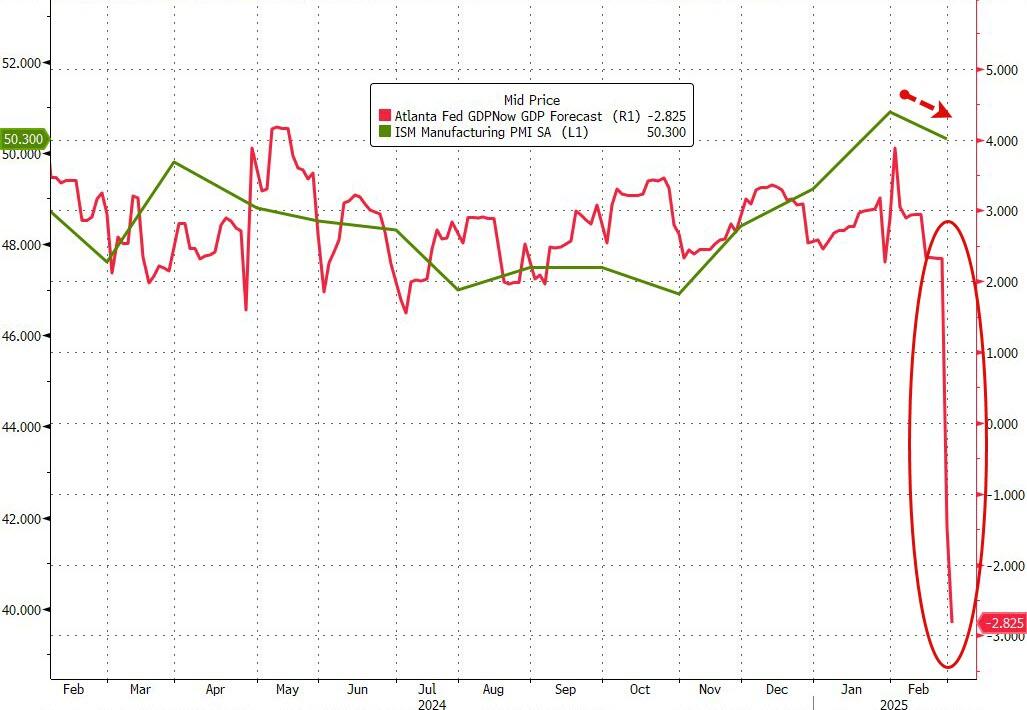
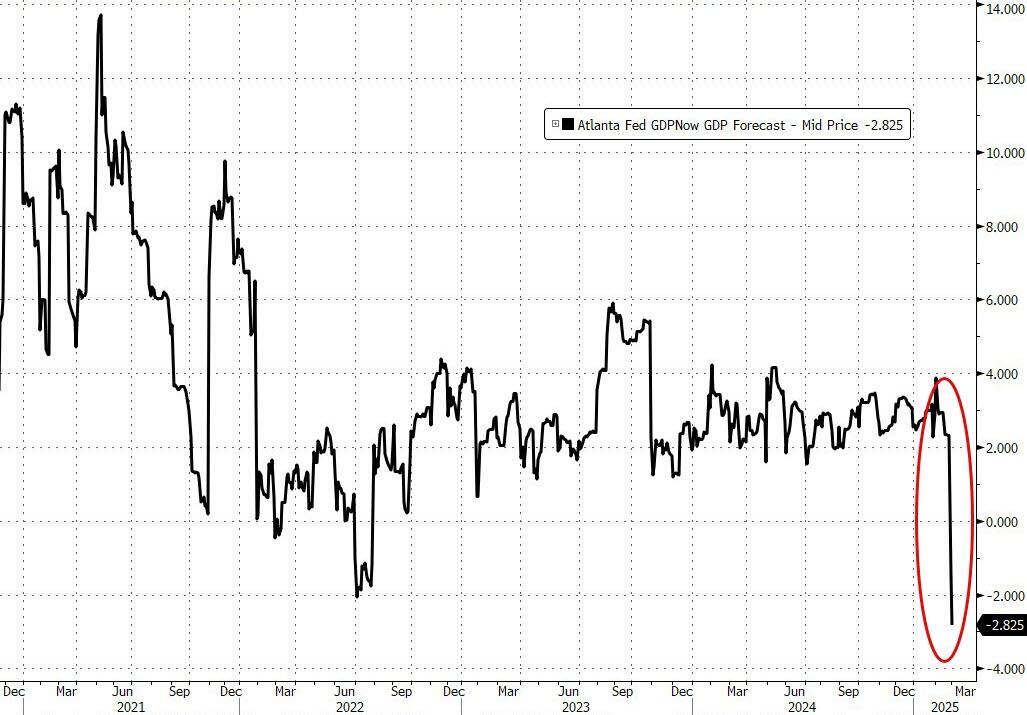
In the peace of two business days, The Atlanta Fed’s GDPNOW forecast for Q1 2025 has collapsed from +2.33% to -2.825% – a stunning 510bps plunge in growth expectations.

Today’s drop to a 2.825% contraction is the worst forecast for GDP since the COVID lockdowns in 2020

Source: Bloomberg

Friday’s plunge was blamed on the trade deficit, as we detailed earlier:

The January Goods Trade Deficit fell to a record -$153 billion versus expectations of -$116 billion. 

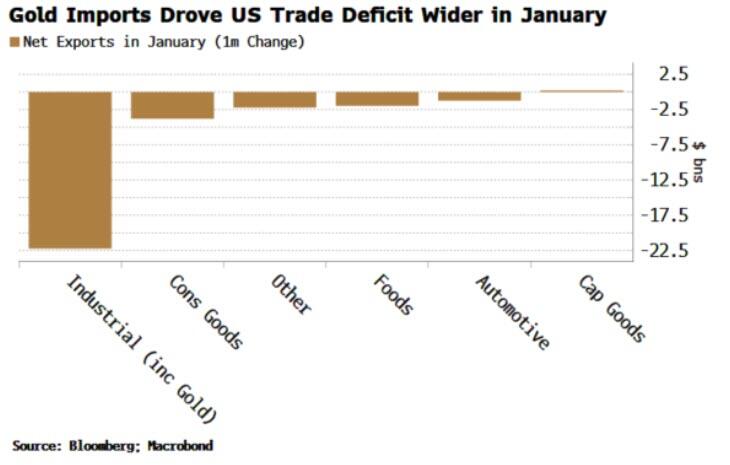
Moreover, as we share below, courtesy of MacroBond, the monthly decline of $31 billion is more than double any other instance since 1955. Imports rose by 12% while exports increased by 2%. The steep decline in the trade deficit is primarily due to US companies front-running tariffs. Approximately $22 billion of the $31 billion, or about two-thirds of the decline, came from industrial supplies. Consumer goods ($4 billion), food and beverages ($2 billion), and other goods ($2.3 billion) account for the bulk of the rest of the change. A similar large trade deficit will likely be reported for February.

The steep decline, mainly due to tariffs, will likely normalize over the coming months. The import demand will be less than typical as inventories for specific products are now bloated for those frontrunning the tariffs.


However, as we detailed here, most of the widening in the trade deficit in January was driven by a surge in gold imports.

We have discussed previously the dynamics in the gold market that has led to a jump in the amount of the metal leaving Europe and heading to the US.

It is likely to do with an ongoing squeeze in the physical metal in vaults in London and Switzerland driven by several years of EM central-bank hoarding – so nothing to do with cyclical economic growth in the US.

Today’s plunged from -1.5% to -2.8% was blamed on this morning’s blip lower in ISM Manufacturing survey:

After this morning’s releases from the US Census Bureau and the Institute for Supply Management, the nowcast of first-quarter real personal consumption expenditures growth and real private fixed investment growth fell from 1.3 percent and 3.5 percent, respectively, to 0.0 percent and 0.1 percent.

Now, to help people clarify what the fuck is going on here, the ISM Manufacturing survey (a soft survey data point being used to forecast hard data economic growth), fell from 50.9 (expansion) to 50.3 (still expansion)

So, to clarify – a 0.6ppt decline in the noisy-as-fuck ISM Manufacturing (which remains in expansion) was enough to drive The Atlanta Fed’s forecast for economic growth to its most recessionary since the COVID lockdowns?

Of course, as Treasury Seretary Bessent opined earlier, the all-too-convenient narrative is, of course, that this is all Trump (and Musk’s) fault. 

In fact, as Bessent explains “We’re seeing the hangover from the excess spending in the Biden 4 years. In 6 to 12 months, it becomes Trump’s economy.”

Just as we forecast would occur in full detail back in July…

Tyler Durden
Mon, 03/03/2025 – 11:47

via ZeroHedge News https://ift.tt/U9tiKwd Tyler Durden

Pentagon Deploys Mechanized Infantry And Air Support To Secure Mexico Border, Including Team Of 4,400 Soldiers

Pentagon Deploys Mechanized Infantry And Air Support To Secure Mexico Border, Including Team Of 4,400 Soldiers

The Pentagon is deploying a Stryker Brigade Combat Team and a General Support Aviation Battalion to the southwestern border, accelerating efforts to fulfill President Trump’s directive to bolster military support in securing the U.S. – Mexico border. The units, equipped with wheeled vehicle and air capabilities, are set to reinforce border operations in the coming weeks, Pentagon Press Secretary Sean Parnell announced over the weekend.

Each SBCT is a mechanized infantry force of approximately 4,400 soldiers, and the Army’s nine SBCTs — seven active-duty and two National Guard — are known for their rapid deployment and versatility. Built around the Stryker vehicle — an eight-wheeled armored platform — the brigade balances mobility, protection and firepower. Capable of transport via C-130 Hercules aircraft within 96 hours, the Stryker excels in operations requiring swift response. 

Complementing this, the GSAB, with roughly 650 troops, brings aviation muscle — UH-60 Black Hawks for command and medical evacuation, and CH-47 Chinooks for heavy lift — enhancing operational reach and support.  

The Stryker’s design — lighter than tanks, yet more robust than light infantry — makes it ideal for the border’s vast terrain, while the aviation battalion’s air traffic control and lift capacity ensure seamless coordination. 

“These forces will arrive in the coming weeks, and their deployment underscores the department’s unwavering dedication to working alongside the Department of Homeland Security to secure our southern border and maintain the sovereignty, territorial integrity and security of the United States under President Trump’s leadership,” Parnell said in a statement today.

This deployment marks the latest wave of active-duty troops sent to the border since Trump’s inauguration on Jan. 20, 2025. Following his declaration to “seal the border” and combat illegal immigration and drug trafficking, initial deployments included 1,600 Marines and soldiers by late January, joining 2,500 reservists already mobilized.  

Defense Secretary Pete Hegseth, addressing the mission’s scope on his first official day in late January, emphasized adaptability. “Whatever is needed at the border will be provided,” he said, signaling a robust commitment to the president’s homeland defense priority.

Tyler Durden
Mon, 03/03/2025 – 11:25

via ZeroHedge News https://ift.tt/cuOG4VH Tyler Durden

Singapore Probes Nvidia AI Chip Shipments By Middlemen To Malaysia Amid DeepSeek Scrutiny

Singapore Probes Nvidia AI Chip Shipments By Middlemen To Malaysia Amid DeepSeek Scrutiny

One month after US officials launched an investigation into whether Chinese AI startup DeepSeek acquired Nvidia AI chips through shell companies in Singapore to bypass US trade restrictions, a new report suggests that Singapore has opened a probe into intermediaries allegedly funneling AI semiconductors into Malaysia.

Bloomberg reports that Singaporean officials are investigating middlemen who shipped Dell and Super Micro servers with AI chips from Singapore to Malaysia and potentially misrepresented the end users of the hardware, raising fresh concerns that these chips may have ultimately reached China.

Law Minister K Shanmugam told reporters earlier that several people have been arrested for procuring and shipping Nvidia chips to Malaysia, violating US chip restrictions. 

“The question is whether Malaysia was a final destination or from Malaysia it went to somewhere else, which we do not know for certain at this point,” Shanmugam said. 

A little more than a month ago, we asked: Did DeepSeek Use Shell Companies In Singapore To Procure Nvidia Blacklisted Chips?

The new probe underscores the huge risk that Singapore-based companies may have funneled Nvidia chips through shell entities, ultimately delivering them to China and accelerating the country’s AI sector despite chip restrictions from the US.

Officials in the Trump administration have spent the last month trying to determine whether DeepSeek used intermediaries in Singapore to evade US export controls.

US Commerce Secretary Howard Lutnick recently suggested that DeepSeek evaded US export controls. 

“Nvidia’s chips, which they bought tons of, and they found their ways around it, drive their DeepSeek model,” Lutnick said, adding, “It’s got to end. If they are going to compete with us, let them compete, but stop using our tools to compete with us. So I’m going to be very strong on that.”

Late last year, public trade data showed Brussels and Washington’s efforts to block Moscow from accessing cutting-edge Western chips encountered a massive stumbling block after an Indian shell company was found to be exporting these chips to Russia. 

The Trump administration should consider slapping countries like Singapore with strict licensing requirements on Western chips and chip-making equipment to avoid this problem.

Tyler Durden
Mon, 03/03/2025 – 10:45

via ZeroHedge News https://ift.tt/DRmBZGv Tyler Durden

Le Pen Blasts Brussels Over Power-Grab, Says Peace Is The Only Option While Downplaying Zelensky-Trump Spat

Le Pen Blasts Brussels Over Power-Grab, Says Peace Is The Only Option While Downplaying Zelensky-Trump Spat

Authored by Liz Heflin via Remix News,

After a conference of pro-war leaders in London, Marine Le Pen took aim at the European Union on X for trying to “seize power.”

The European Commission is completely overstepping its authority. As always, it is using a crisis to seize power that does not belong to it, but to the Member States. It has already used this method before, when it seized immigration policy under the pretext of the migration crisis, and then health policy during the Covid crisis… This must be rejected in the strongest terms!” she posted. 

Le Pen had previously also made comments regarding the Zelensky-Trump meeting, reports Le Figaro

Asked about the argument in the Oval Office, Le Pen said the “unpleasant moment” did not “particularly surprise” her. 

“That two leaders of nations defend their national interests, defend the vision that they consider the most just for the world, does not seem to me to be something extraordinary. That there are frictions, words that go higher than what we would like, these are things that happen in politics, but often behind the scenes. Yesterday, to everyone’s astonishment, they happened in public,” she stated. 

Le Pen added that she hoped that “this difficult moment will be a step towards peace that I consider inexorable, while some would like to continue the war.”

The French nationalist politician also expressed regret at the fact that France, “a strong and independent voice,” had been “erased from the talks.” 

“We were, as young people would say, ‘ghosted’ from these negotiations, when our country could have intervened positively,” she said.  

In response to one journalist asking, “Are the United States still our allies?” Le Pen answered emphatically, “Yes,” adding that those who claim otherwise “are not reasonable.” 

The president of the National Rally (RN) group in the National Assembly also said the role of Europeans was “to work for peace,” while lamenting that there is no common European voice on this front and reiterating that she cannot advocate a continuation of the conflict. 

“If the European Commission wants to be at the forefront of continuing the war, then this will be a new subject of disagreement between us… It will not be the first,” she told media. 

Le Pen was also at the agricultural Salon on Saturday, where she told farmers she and her party were ready to defend them and help “French agriculture be reborn.”

Read more here…

Tyler Durden
Mon, 03/03/2025 – 10:25

via ZeroHedge News https://ift.tt/pCuDK8V Tyler Durden

Intel Jumps After Nvidia, Broadcom Test Chips On Intel 18A Process; Taiwan Semi To Invest $100BN In US Chip Plants

Intel Jumps After Nvidia, Broadcom Test Chips On Intel 18A Process; Taiwan Semi To Invest $100BN In US Chip Plants

Update: (10:30am ET): In related news, the WSJ reports that taiwan chip giant TSMC, or Taiwan Semiconductor, intends to invest $100 billion in chip manufacturing plants in the U.S. over the next four years under a plan expected to be announced later Monday by President Trump.

The investment would be used to build out cutting-edge chip-making facilities. Such an expansion would advance a long-pursued U.S. goal to regrow the domestic semiconductor industry after manufacturing fled largely to Asian countries in recent decades.

TSMC, the world’s largest contract chip-maker, set down roots in Arizona in 2020, when it said it would build a chip factory there for $12 billion. Its ambitions for the site have expanded rapidly since, with two more factories on the same site and a total investment of $65 billion. The company’s first factory began mass production late last year.

Since the Biden administration, the U.S. has expressed concerns about TSMC’s near-monopoly on advanced chip manufacturing and has been urging the company to relocate more of its cutting-edge production, including advanced chip packaging facilities, to the U.S. Advanced chip packaging is particularly critical for AI related chips, as it enhances performance by integrating multiple semiconductor components, reducing size, improving power efficiency, and ensuring faster data transfer — key factors for AI applications.

It wasn’t immediately clear if the TSMC investment would include Intel’s own chip fabs although it would certainly defeat Trump’s purpose of trying to prop up Intel if he is also encouraging the world’s biggest chipmaker to grab marketshare from Intel.

* * *

Earlier

Intel stock is sharply higher (or at least was until the market decided to dump just after the open), on a Reuters report that Nvidia and Broadcom are running manufacturing tests with Intel “demonstrating early confidence in the struggling company’s advanced production techniques.”

The two tests indicate “the companies are moving closer to determining whether they will commit hundreds of millions of dollars’ worth of manufacturing contracts to Intel.” The decision to do so could generate a revenue windfall and endorsement for Intel’s contract manufacturing business that has been beset by delays and has not yet announced a prominent chip designer customer. Separately, AMD is also evaluating whether Intel’s 18A manufacturing process is suitable for its needs but it was unclear if it had sent test chips through the factory.

An Intel spokesperson said, “We don’t comment on specific customers but continue to see strong interest and engagement on Intel 18A across our ecosystem.”

The tests by Nvidia and Broadcom are using Intel’s 18A process, a series of technologies and techniques developed over years that is capable of making advanced artificial intelligence processors and other complex chips. The 18A process competes with similar technology from Taiwan’s TSMC, which dominates the global chip market.

These tests are not being conducted on complete chip designs but are instead aimed at determining the behavior and capabilities of Intel’s 18A process. According to Reuters, chip designers sometimes purchase wafers to test specific components of a chip to work out any kinks before committing to producing a full design at high volume. Testing is under way and can last months. It is unclear when the tests started.

The success of Intel’s contract manufacturing business, or foundry, was the centerpiece of former CEO Pat Gelsinger’s plan to revive the once iconic American technology company. But the board fired Gelsinger in December. The interim co-CEOs mothballed its forthcoming artificial intelligence chip, which pushed back any hopes of a viable AI chip of its own until at least 2027.

Manufacturing tests are no assurance that Intel will eventually win new business. Last year, Reuters reported that a batch of Broadcom tests disappointed its executives and engineers. At the time, Broadcom said it was continuing to review Intel’s foundry. However, the market was clearly glad to read the news, pushing Intel stock up as much as 5% before it faded much of the gains amid the broader market selloff.

The early endorsement is happening against the backdrop of potential further delays in Intel’s ability to deliver chips for some contract manufacturing customers that rely on third-party intellectual property, according to two additional sources and documents seen by Reuters.

Intel’s struggling business has attracted the attention of President Trump’s administration, which is keen on restoring American manufacturing prowess and battling China. Intel is considered the only hope for the U.S. to manufacture the most advanced semiconductors within its borders. Earlier this year, administration officials met with C.C. Wei, CEO of Taiwan’s TSMC in New York about taking a majority stake in a joint venture in Intel’s factory unit, according to a source familiar with the matter. The talks included the possibility of other chip designers purchasing equity stakes in the new venture.

Intel has said it signed deals with Microsoft and Amazon.com to produce chips on 18A, but details are scarce. Intel did not disclose which chip Microsoft plans to use Intel’s factories for or a specific product in Amazon’s case. It was unclear how much manufacturing volume either deal represents.

The 18A process was already delayed to 2026 for potential contract manufacturing customers. Now, according to supplier documents reviewed by Reuters and two sources familiar with the matter, Intel has pushed back its timeline another six months.

The delay is due to the need to qualify crucial intellectual property for the 18A process, which is taking longer than anticipated. Without the qualified fundamental building blocks of intellectual property that small and mid-size chip designers rely on, a swath of potential customers would be unable to produce chips on 18A until at least mid-2026, according to the two sources and documents.

It is unclear why the intellectual property qualification has been delayed. Qualifying intellectual property includes a guarantee from the supplier that it will work on a given manufacturing process.

Asked about the delay, Intel said, “(We will) begin ramping production in the second half of this year, delivering on the commitments we have made to our customers.” The company added that it expects its factories to receive designs from customers this year.

Many chip designers are watching Intel’s foundry progress closely in the hope they will be able to use its manufacturing soon, according to industry experts.

Intel’s 18A process currently performs at a level between TSMC’s most advanced process and its predecessor, Sassine Ghazi, CEO of Synopsys, said in an interview after its financial results. Synopsys supplies some of the crucial intellectual property needed for Intel’s foundry.

“Right now, there are a lot of customers waiting – I’m talking foundry customers – to see the state of Intel. Will I commit? Will I not?” Ghazi said.

Tyler Durden
Mon, 03/03/2025 – 10:15

via ZeroHedge News https://ift.tt/mZGxDKo Tyler Durden

US Manufacturing Survey Signals Continued ‘Expansion’ But Inflation Fears Soar

US Manufacturing Survey Signals Continued ‘Expansion’ But Inflation Fears Soar

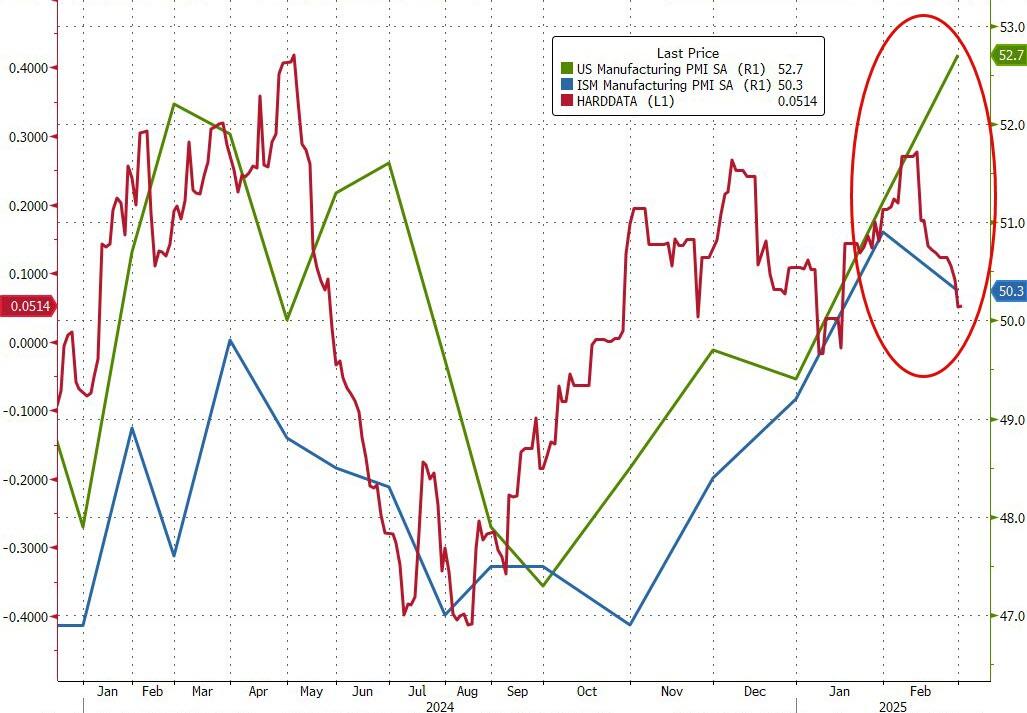
After Friday’s (tariff-front-running-import-surge-driven) tumble in Atlanta Fed’s GDPNOW accelerated growth scare anxiety in bonds (and stocks), this morning we see US Manufacturing PMI surge back into expansion (52.7 – better than the expected 51.6) – its strongest level of implied growth since June 2022 (despite the slide in US Macro Surprise data over the past month).

The ISM Manufacturing survey, on the other hand, disappointed, falling from 50.9 to 50.3 (50.8 exp)…

Source: Bloomberg

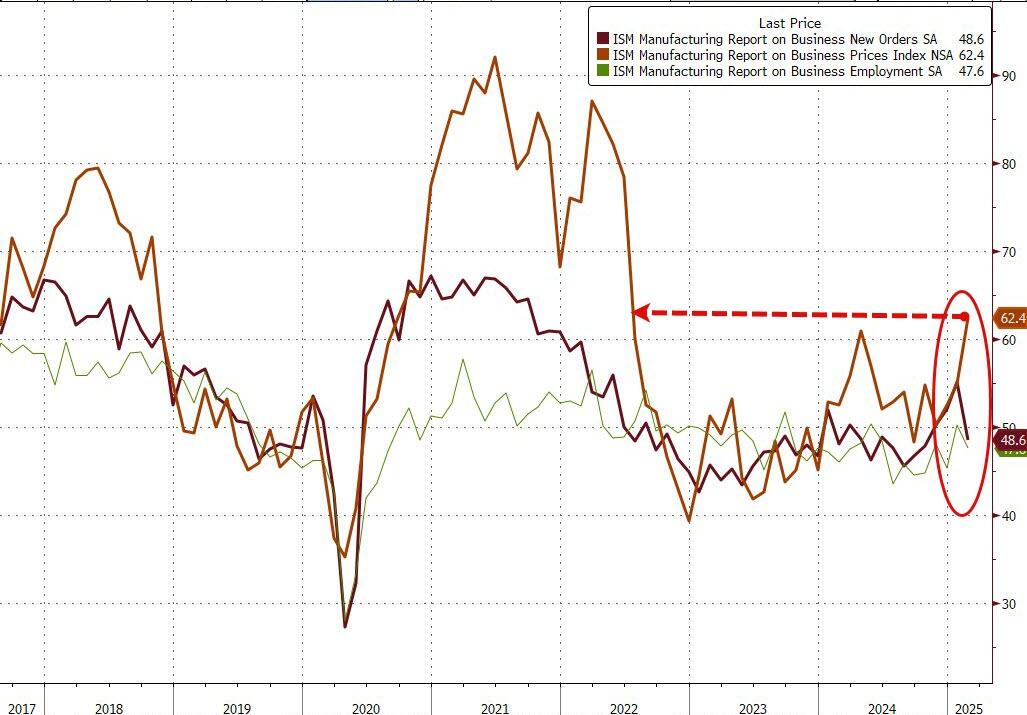
Under the hood, it was ugly with new orders tumbling as prices paid surged to the highest since June 2022…

Source: Bloomberg

Chris Williamson, Chief Business Economist at S&P Global Market Intelligence, notes that there are signs this surge in growth expectations will be short-lived:

“A rise in the PMI to a 32-month high signals an improvement in the health of the manufacturing sector which may only be skin deep. 

“Although manufacturing production grew at the strongest rates since May 2022 and new orders increased at the best pace in a year, there’s much to suggest that this improvement could be short lived. 

Production and purchasing were often buoyed by companies and their customers building inventory to beat price hikes and supply issues caused by tariffs. Exports have meanwhile slumped and supplier delivery delays were the most common since October 2022 amid disruptions to trade caused by tariff worries. 

Optimism fades:

Business optimism about the year ahead has consequently fallen compared to the buoyant mood evident in January, with February seeing an increase in the number of companies citing concerns over tariffs and other policies introduced by the new Trump administration. 

And inflation fears are spreading:

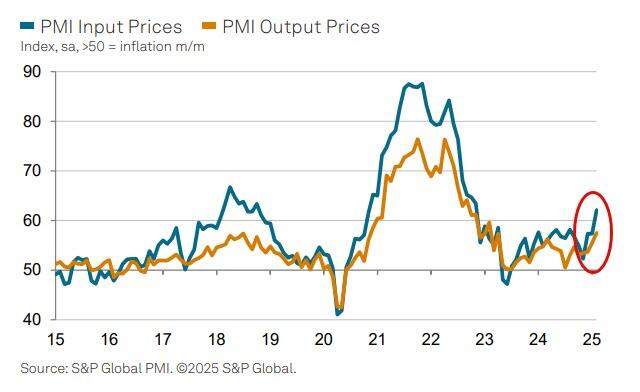
Worries have noticeably swelled in relation to the inflationary impact of tariffs, which were widely reported as having caused factory input costs to spike higher in February. These higher costs are being passed on to customers, resulting in the strongest factory gate price inflation recorded for two years, which manufacturers fear may in turn not only damage sales in the coming months but also encourage the Fed to take a more hawkish view of inflation.”

Not a pretty picture… Stagflation it is, for now!

Tyler Durden
Mon, 03/03/2025 – 10:04

via ZeroHedge News https://ift.tt/rqVOBT4 Tyler Durden

Key Events This Week: Tariffs, Payrolls, ISMs And Powell Speaks

Key Events This Week: Tariffs, Payrolls, ISMs And Powell Speaks

This week’s economic calendar is packed with important events, including potential US tariff actions as the White House weighs tariff actions on its largest trade partners. Recall that President Trump signaled that the Administration would implement 25% tariffs on Canada and Mexico as well as another 10ppts on China on Tuesday in response to those countries’ failure to stem the flow of illegal drugs into the US. Barring any last minute negotiations, these tariffs are expected to come into effect; US commerce secretary Lutnick said on Fox yesterday that they will be implemented but that the level is still being decided. That could signal some room for the 25% on Canada and Mexico to be lower. On top of that Trump is set to address a joint session of Congress outlining his agenda tomorrow, his first such speech since his inauguration last month

The fallout from an extraordinary televised row on Friday in the Oval Office between Trump and JD Vance on one hand and Zelenskiy on the other will also be a big talking point. Yesterday we had a large number of NATO countries’ leaders convene in London for an emergency (another!) summit on Ukraine. This was planned before Friday’s argument in the White House but it took on added importance after the clash. There was a lot of solidarity for Ukraine after the meeting but a lot still hinges on the US’s involvement.

In Germany things are moving fast after the election and speculation has increased over special funds for defence and infrastructure being established while the existing parliament sits rather than wait for the new one where centrist policies won’t have the two-thirds majority to reform the debt break on their own. Reuters reported yesterday that economists advising the talks have suggested the need for a EU400bn fund for defence and a EU400-500bn one for infrastructure. If this actually occurs before the new coalition is formed it will be a real positive “shock and awe” for Germany and Europe. Let’s see what we hear on this in the coming days. Things continue to move at pace in Europe and after we paraphrased Lenin’s famous “There are decades where nothing happens; and there are weeks where decades happen” quote two weeks ago, after the Munich Security Conference, the phrasing might need to be updated from weeks to days!

In terms of the data, the main focus will be on the US jobs report (Friday) and ISM indices in the US (today and Wednesday). Powell has a keynote economic speech on Friday to look forward to. 

In Europe, the ECB will likely cut rates a further 25bps on Thursday, the same day as a special EU summit on defence and Ukraine is set to take place. It’s getting hard to keep up with all these summits and emergency meetings. MNI sources yesterday suggested that we will hear about a EU100bn common funding for defence at this meeting which is a mere drop in the ocean as to what Europe will likely need to spend on defence in the next several years.

In China we will get the annual session of 14th NPC starting on Wednesday where the government is expected to outline its plans for 2025 including targets for the fiscal deficit and government bond issuance (full preview to follow). In Japan, the release of the annual shunto wage hike demands by labor unions on Thursday is a key event. 

As earnings season winds down after 485 of the S&P 500 and 310 of the Stoxx 600 have now reported, maybe keep an eye out for Broadcom’s results on Thursday which is the next cab off the ranks in terms of the Mag-7 or a firm member of the BATMMAAN group of stocks. Their market cap briefly went above Tesla last week and is only just behind now.

Going through a couple of the main events this week in a little more detail now and all roads point to the tariff deadline tomorrow and payrolls on Friday. DB economists have previously said that 25% tariffs on Canada and Mexico, If sustained, would likely create a 0.4-0.7ppts drag on 2025’s US GDP and boost core PCE by 0.3-0.7ppts. It is possible that the revenues from the tariffs allow for larger US tax cuts which may help reduce the growth impact but we’re also starting to see some of the trade uncertainty hit confidence so there are a lot of moving parts. Overall, it’s hard to see China tariffs being negotiated lower but there’s still a chance that those on Mexico and Canada are lower than 25% as hinted by Lutnick yesterday. We will see today.

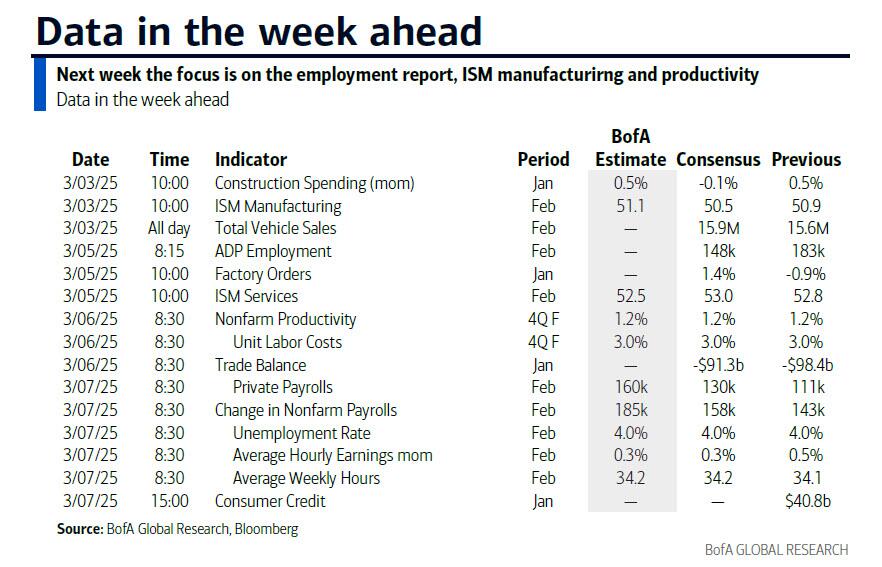
With regards to payrolls, our economists expect headline (160k forecast vs. 143k previously) and private (150k vs. 111k) payroll gains to rebound from weather-related and potential seasonal-factor related drags in the prior month. However there is a drag factored in from the start of federal government layoffs even if March may see a larger impact. DB think the unemployment rate will tick up a tenth to 4.1%. Today’s manufacturing ISM (DB at 51.8 vs. 50.9 last month) and Wednesday’s services ISM (DB at 52.1 vs. 52.8) will have employment components that along with Wednesday’s ADP report may sharpen the street’s forecasts as the week progresses.

Courtesy of DB, here is a day-by-day calendar of events

Monday March 3

  • Data: US February ISM index, total vehicle sales, January construction spending, China February Caixin manufacturing PMI, UK January net consumer credit, M4, Japan January jobless rate, job-to-applicant ratio, Q4 MoF survey, February monetary base, Italy February manufacturing PMI, new car registrations, budget balance, Eurozone February CPI, Canada February manufacturing PMI
  • Central banks: Fed’s Musalem speaks
  • Earnings: Okta, AST SpaceMobile

Tuesday March 4

  • Data: Japan February consumer confidence index, France January budget balance, Italy January unemployment rate, Eurozone January unemployment rate
  • Central banks: Fed’s Williams speaks
  • Earnings: Crowdstrike, Sea, Flutter Entertainment, Thales, Ashtead, On Holding, Davide Campari-Milano

Wednesday March 5

  • Data: US February ISM services, ADP report, January factory orders, China February Caixin services PMI, UK February new car registrations, official reserves changes, France January industrial production, Italy February services PMI, January retail sales, Eurozone January PPI, Canada Q4 labor productivity, Australia Q4 GDP, Switzerland February CPI
  • Central banks: Fed’s Beige Book, BoJ’s Uchida speaks, BoE’s Bailey, Pill, Greene and Taylor speak
  • Earnings: Marvell, adidas, Zscaler, Bayer, Sandoz, Abercrombie & Fitch

Thursday March 6

  • Data: US January trade balance, wholesale trade sales, initial jobless claims, UK February construction PMI, Germany February construction PMI, Eurozone January retail sales, Canada January international merchandise trade, Sweden February CPI
  • Central banks: ECB’s decision, Fed’s Waller speaks, BoE’s DMP survey
  • Earnings: Broadcom, Costco, JD.com, Merck KGaA, Universal Music Group, Reckitt Benckiser, Hewlett Packard Enterprise

Friday March 7

  • Data: US February jobs report, January consumer credit, China February foreign reserves, trade balance, Germany January factory orders, France January trade balance, current account balance, Canada February jobs report, Q4 capacity utilisation rate
  • Central banks: Fed’s Powell, Kugler, Bostic, Bowman and Williams speak, ECB’s Lagarde, Nagel, Knot, Panetta, Kazaks and Centeno speak, BoE’s Mann speaks

Finally, looking at the just the US, the key economic data releases this week are the ISM manufacturing and services reports on Monday and Wednesday and the employment report on Friday. Tariffs on Mexico, Canada, and China are scheduled to take effect on Tuesday. There are several speaking engagements by Fed officials this week including Chair Powell and Governors Waller, Bowman, and Kugler.

Monday, March 3

  • 09:45 AM S&P Global US manufacturing PMI, February final (consensus 51.6, last 51.6)
  • 10:00 AM Construction spending, January (GS +0.1%, consensus -0.1%, last +0.5%)
  • 10:00 AM ISM manufacturing index, February (GS 51.5, consensus 50.8, last 50.9): We estimate the ISM manufacturing index increased slightly in February (+0.6pt to 51.5), reflecting mixed manufacturing surveys so far for February but a tailwind from residual seasonality.
  • 12:35 PM St. Louis Fed President Musalem (FOMC voter) speaks:  St. Louis Fed President Alberto Musalem will give a keynote luncheon speech at a National Association for Business Economics conference on the US economy and monetary policy. Speech text and Q&A are expected. On February 20, Musalem said, “I judge that monetary policy is modestly restrictive, and meaningfully less restrictive than it was six months ago. Monetary policy is well positioned to address risks to both sides of the Fed’s dual mandate.”
  • 05:00 PM Lightweight motor vehicle sales, February (GS 16.4mn, consensus 16.1mn, last 15.6mn)

Tuesday, March 4

  • There are no major economic data releases scheduled.
  • 02:20 PM New York Fed President Williams (FOMC voter) speaks: New York Fed President John Williams will be interviewed by Bloomberg’s Michael McKee at the Bloomberg Invest Forum. On February 11, Williams said, “Monetary policy is well positioned to achieve maximum employment and price stability. The modestly restrictive stance of policy should support the return to 2 percent inflation while sustaining solid economic growth and labor market conditions.”

Wednesday, March 5

  • 08:15 AM ADP employment change, February (GS +125k, consensus +146k, last +183k)
  • 09:45 AM S&P Global US services PMI, February final (consensus 49.7, last 49.7)
  • 10:00 AM Factory orders, January (GS +1.7%, consensus +1.6%, last -0.9%); Factory orders ex-transportation, January (last +0.3%); Durable goods orders, January final (consensus +3.1%, last +3.1%); Durable goods orders ex-transportation, January final (last flat); Core capital goods orders, January final (last +0.8%); Core capital goods shipments, January final (last -0.3%);
  • 10:00 AM ISM services index, February (GS 52.5, consensus 52.7, last 52.8): We estimate that the ISM services index edged down to 52.5 in February, reflecting sequential softening in our non-manufacturing survey tracker (-0.8pt to 53.2 in February) but a tailwind from residual seasonality.
  • 02:00 PM Beige Book, March meeting period: The Fed’s Beige Book is a summary of regional economic anecdotes from the 12 Federal Reserve districts. The Beige Book for the January FOMC meeting period noted that economic activity and consumer spending increased slightly to moderately across all districts. Manufacturing activity decreased slightly on net and “a number of districts said manufacturers were stockpiling inventories in anticipation of higher tariffs.” In this month’s Beige Book, we look for anecdotes related to the evolution of labor demand and firms’ expectations of activity growth for the remainder of the year.

Thursday, March 6

  • 08:30 AM Trade Balance, January (GS -$129.2bn, consensus -$128.7bn, last -$98.4bn)
  • 08:30 AM Nonfarm productivity, Q4 final (GS +1.3%, consensus +1.2%, last +1.2%); Unit labor costs, Q4 final (GS +2.3%, consensus +3.0%, last +3.0%)
  • 08:30 AM Initial jobless claims, week ended March 1 (GS 230k, consensus 235k, last 242k); Continuing jobless claims, week ended February 22 (consensus 1,875k, last 1,862k)
  • 08:45 AM Philadelphia Fed President Harker (FOMC non-voter) speaks: Philadelphia Fed President Patrick Harker will speak on economic education. Speech text and Q&A are expected. On February 27, Harker said, “The policy rate remains restrictive enough to continue putting downward pressure on inflation over the longer term, as we need it to, while not negatively impacting the rest of the economy.”
  • 10:00 AM Wholesale inventories, January final (consensus +0.7%, last +0.7%)
  • 03:30 PM Fed Governor Waller speaks: Federal Reserve Governor Christopher Waller will speak on the economic outlook with WSJ’s Nick Timiraos. On February 18, Waller said, “I continue to believe that the current setting of monetary policy is restricting economic activity somewhat and putting downward pressure on inflation. If this winter-time lull in progress is temporary, as it was last year, then further policy easing will be appropriate. But until that is clear, I favor holding the policy rate steady.”
  • 07:00 PM Atlanta Fed President Bostic (FOMC non-voter) speaks: Atlanta Fed President Raphael Bostic will speak to The Birmingham Business Journal about the economic outlook. Q&A is expected.

Friday, March 7

  • 08:30 AM Nonfarm payroll employment, February (GS +170k, consensus +160k, last +143k); Private payroll employment, February (GS +150k, consensus +143k, last +111k); Average hourly earnings (MoM), February (GS +0.3%, consensus +0.3%, last +0.5%); Unemployment rate, February (GS 4.0%, consensus 4.0%, last 4.0%); Labor force participation rate, February (GS 62.6%, consensus 62.6%, last 62.6%): We estimate nonfarm payrolls rose 170k in February. On the positive side, big data indicators indicated a firm pace of job creation. Additionally, we expect continued above-trend (albeit moderating) contributions from catch-up hiring and the recent surge in immigration. On the negative side, we expect a limited drag—we assume 10k—from the combined reduction in force actions of the federal government, consisting of layoffs, a hiring freeze, and a deferred resignation program. Striking workers will be a 5k net drag, according to the strike report. We expect the net impact of the winter weather—an even colder-than-usual February than January but less snowfall on a seasonally adjusted basis—on job growth to be roughly neutral. We estimate that the unemployment rate was unchanged at 4.0% on a rounded basis and that the participation rate was unchanged at 62.6%. We estimate average hourly earnings rose 0.3% (month-over-month, seasonally adjusted), reflecting waning wage pressures but positive calendar effects.
  • 10:15 AM Fed Governor Bowman speaks: Federal Reserve Governor Michelle Bowman will discuss the 2025 US Monetary Policy Forum report at a conference in New York. Speech text and Q&A are expected. On February 18, Bowman said, “Assuming the economy evolves as I expect, I think that inflation will slow further this year,” but noted, ” I continue to see greater risks to price stability, especially while the labor market remains strong.” She later commented, “I would like to gain greater confidence that progress in lowering inflation will continue as we consider making further adjustments to the target range.”
  • 10:45 AM New York Fed President Williams (FOMC voter) speaks: New York Fed President John Williams will discuss the 2025 US Monetary Policy Forum report at a conference in New York. Speech text and Q&A are expected.
  • 12:20 PM Fed Governor Kugler speaks: Federal Reserve Governor Adriana Kugler will give a speech on rebalancing labor markets around the world at the Bank of Portugal’s Conference on Monetary Policy Transmission and the Labor Market. Speech text and Q&A are expected.
  • 12:30 PM Fed Chair Powell speaks: Federal Reserve Chair Jerome Powell will give the lunch keynote speech on the economic outlook at the 2025 US Monetary Policy Forum. Speech text and Q&A are expected.
  • 01:00 PM Fed Governor Kugler speaks: Federal Reserve Governor Adriana Kugler will speak on monetary policy in a panel discussion at Bank of Portugal’s Conference on Monetary Policy Transmission and the Labor Market. Q&A is expected.

Source: DB, Goldman, BofA

Tyler Durden
Mon, 03/03/2025 – 09:58

via ZeroHedge News https://ift.tt/5kYpOWM Tyler Durden

Peace For Our Dime

Peace For Our Dime

By Michael Every of Rabobank

I’ve said it before recently, but there are decades where nothing happens and weeks where decades happen: this is not one of those decades, but this is possibly one of those weeks.

First, Ukraine. The follow-on from Friday’s public White House meltdown between President Trump, Vice-President Vance, and President Zelenskyy — which is how diplomacy often works when the cameras are off — was another emergency European summit in London attended by all those whom the US and Russia have already cut out of negotiations, plus Canada, and at which Zelenskyy was literally embraced.

The easy work there was Zelenskyy again saying he’ll sign the US minerals agreement deal, as Trump and others make clear he has no other choice. The unresolved hard work is still what blew up Friday’s meeting: Zelenskyy’s demands for security guarantees and a reported desire to fight on rather than offer big concessions for a peace deal without them.

Europe is saying that it will step up to make Ukraine an “indigestible steel porcupine.” Their unfolding proposal is a one month pause in air, sea, and energy attacks, followed by a “Coalition of the willing” sending troops to Ukraine to enforce a ceasefire. Yet that proposal unfolds when Europe admits it still requires a US backstop, with the implication being NATO Article 5 protection.

As Elon Musk agreed with a call for the US to leave NATO and the UN, that may not fly as it would directly link America to a war they are trying to step away from to focus on Asia; the US is offering the presence of its businesses on the ground alone to deter Russian attacks. Moreover, Russia has previously said foreign troops in Ukraine is a casus bello: even the term “Coalition of the willing” was last used during the 2003 Iraq war which Russia opposed as illegal. That means that Europe would be embracing a strategy that risks direction confrontation with Russia unless the latter was utterly convinced that this could not work due to Europe’s ability to project overwhelming force. Even there we see huge risks: France and the UK could already extend their nuclear umbrellas to Ukraine, for example, but obviously won’t for fear of escalation, even as France considers doing so for Europe: so, what will Europe be prepared to do on the conventional front?

As Professor Helen Thompson puts it: “The veil often placed over US power to sooth European pride is being removed, but the core European demand in the horror at this exposure is for the US to maintain overstretch and exercise power it does not have.”

Vice-President Vance was more direct: “The bitter irony of America’s present predicament is that the very people who cheer for permanent arms shipments to Ukraine also supported the de-industrialization of America. The very things you want us to send are things we don’t make enough of.”

President Trump was, of course, far more provocative: “We should spend less time worrying about Putin, and more time worrying about migrant rape gangs, drug lords, murderers, and people from mental institutions entering our Country – So that we don’t end up like Europe!”

To be clear, Europe can support Ukraine and itself: it’s just going to be very expensive – and the Americans won’t be paying for Europe anymore.

Indeed, if in 1938 British PM Chamberlain claimed, “Peace for our time”, in 2025 PM Starmer is admitting, “Peace for our dime.” Bloomberg has estimated Europe might have to spend €300bn extra annually in defence spending ahead, but Jakub Janda from the Centre for Security Policy in Prague states: “It is possible to have strong European military to defend Europe. Even without the US. It costs at least 7-10% of GDP annually in initial years and then at least 5% of GDP. When the hell are we starting?” Is Europe serious about doing this? We will hear more on that this week, with a Bundesbank proposal on debt brake reform today, and another European summit on Thursday. Just recall there is a huge price tag for European inaction as well.

Yet even in crazy times, beware crazy press stories. For example, that the US is looking to reopen Nord Stream 2, with a former Stasi member driving the deal forwards. Given the US would then lose its LNG exports to Europe to cheaper Russian gas, and Europe would lose strategic autonomy vs. Russia, the only geopolitical worlds in which that deal could happen are one where either: 1) the US offers Russia a sphere of influence over all of Europe as quid pro quo for an inverse-Nixon strategy of Russia stepping away from its relationship with China; or 2) Europe walks away from Ukraine and the US and accepts the same de facto deal. To say that these scenarios come with large macro and market side effects is an understatement that those going cross-eyed at the idea of cheaper European energy prices will probably fail to see.

Second, tariffs. Tuesday sees 25% US tariffs on Mexico and Canada kick in, unless changes are made at the last minute, and an additional 10% on China, which seems a given. Notably, Mexico is offering to match the US external tariff against China, as well as buying more US goods, to avoid its own US tariff. US Treasury Secretary Bessent favours this “Fortress America” approach and has asked Canada to join (even as the US is also considering putting tariffs on lumber, which would hit Canada hardest). I flagged exactly this approach as logical economic statecraft from the start.

This is critical not just in terms of macro strategy but regarding ‘grand macro strategy’. If the US presses ahead with 25% tariffs, the White House is aiming at going solo. That means global chaos, and the market impact would be enormous. However, if the US builds a “Fortress America” vs. China, the same umbrella could extend to the UK, Europe, and others, if they agree the same terms. That means global bifurcation, and the market impact would again be huge. Indeed, as trade and defence policy become fused, even South Korea and Japan, despite their historic frictions, say they need to increase their cooperation rapidly: a long-standing US foreign policy goal is perhaps being achieved on that front.

Third, China. This week sees the “Two sessions” of the National People’s Congress and the Chinese People’s Political Consultative Conference. The policies announced are likely to focus on how to steer the economy through the turbulence of US tariffs and a changing world order. Markets will be most focused on how much stimulus is announced, and in what form. Given we already have an ongoing uptick in inflation in some places, and US tariffs are clearly adding to that momentum, large Chinese fiscal stimulus, if seen, could easily exacerbate market concerns.

Fourth, crypto. Prices of some of these assets have already soared from recent lows after they were included in an announcement on a planned US strategic crypto reserve. Friday will see a formal US Crypto Summit that may flesh out exactly how, and how much, crypto will be bought by the US, and to what end. There are potentially major implications here for the global financial architecture alongside “Buy all the things!” memetastic trading opportunities.

Fifth, the Middle East. The Israel-Hamas ceasefire is wobbling as Egypt’s plans for Gaza progress.

Sixth, traditional macro. Friday saw the Atlanta Fed GDPNow print plunge from 2.3% to -1.5%, driven by the DOGE cost-cutting on a US economy propped up by a 6-7% fiscal deficit. Markets will start thinking about a recession if that continues. That’s before we get the ECB meeting on Thursday (see our preview), and US payrolls on Friday, as federal workers fear for their jobs.
Tyler Durden
Mon, 03/03/2025 – 09:45

via ZeroHedge News https://ift.tt/AwvOy2r Tyler Durden

US Reportedly Halts Offensive Cyber Ops Against Russia As Trump Pulls World Back From Brink

US Reportedly Halts Offensive Cyber Ops Against Russia As Trump Pulls World Back From Brink

In the latest indication that we’re entering a new, less adversarial era of US-Russia relations, Defense Secretary Pete Hegseth has ordered a suspension of offensive cyber operations against Russia. 

The length of the pause is uncertain but the purpose seems clear: To demonstrate good will as the Trump administration earnestly seeks a negotiated end to the three-year-old war in Ukraine, which has been costly not only to the two warring countries, but to the United States and Western European countries that first precipitated that conflict, and then perpetuated it. The pause will continue as long as negotiations move forward, according to the Washington Post‘s sources. 

US officials tell various media outlets that the stand-down order was issued to US Cyber Command in late February. Headquartered at Ft Meade, Maryland and commanded by Air Force Gen. Tim Haugh, the mission of Cyber Command’s two to three thousand employees is to “plan and execute global cyber operations, activities, and missions to defend and advance national interests in collaboration with domestic and international partners across the full spectrum of competition and conflict.”

Created in 2010, US Cyber Command is headquartered at Fort Meade, Maryland

“I have seen many times when we are in some type of negotiation with another nation, especially if it’s one that is considered an adversary, that we stop operations, exercises, we even cancel speeches sometimes,” retired Cyber Command deputy commander Lt. Gen. Charlie Moore told the Post

The pause in offensive cyber-operations was first reported by The Record

The precise nature of the adjustment in activity is unclear, but the outlet’s sources say it does not apply to the National Security Agency and its signals intelligence-gathering.  

Right on cue, hawks squawked over the deescalation move. “Russia continues to be among the top cyberthreats to the United States,” James A. Lewis, a Clinton administration diplomat and former U.N. cyber negotiator told the Washington Post

“Turning off cyber operations to avoid blowing up the talks may be a prudent tactical step. But if we take our foot off the gas pedal and they take advantage of it, we could put national security at risk.” Senate Minority Leader Chuck Schumer accused Trump of giving Russian President Vladimir Putin “a free pass…to launch cyberoperations and ransomware attacks against critical American infrastructure.”

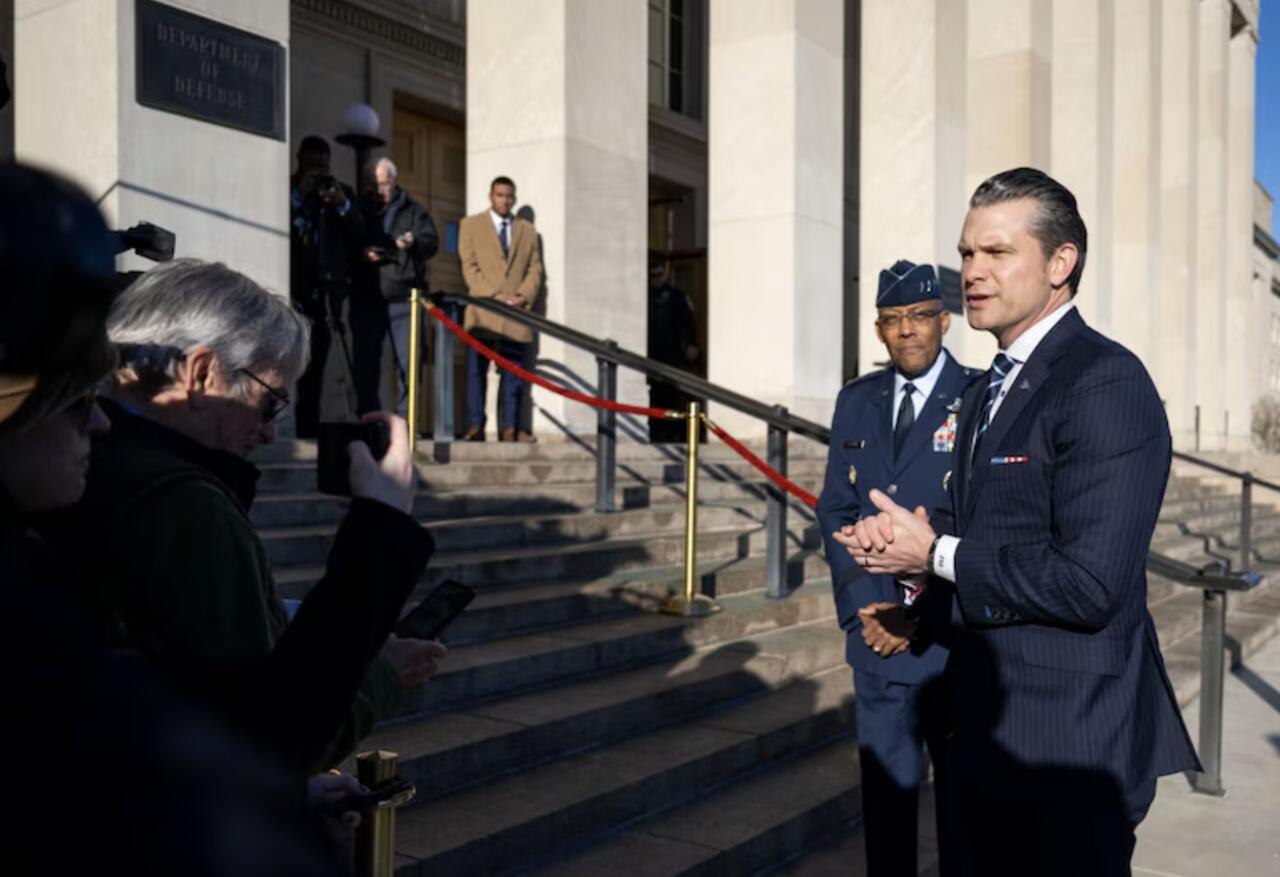
Pete Hegseth talks to reporters upon arriving at the Pentagon for his first day as Secretary of Defense (PO1 Alexander Kubitza via DOD)

Appearing on ABC’s This Week on Sunday, Secretary of State Marco Rubio pushed back on leftist hysterics about Trump’s eagerness to reach a negotiated ceasefire and lasting peace in Ukraine — consistent with his campaign pledges: 

“If this was a Democrat that was doing this, everyone would be saying, well, he’s on his way to the Nobel Peace Prize. This is absurd. We are trying to end a war. You cannot end a war unless both sides come to the table, starting with the Russians, and that is the point the president has made. And we have to do whatever we can to try to bring them to the table to see if it’s even possible.”

In another recent sign of easing tensions between the world’s two nuclear superpowers, the United States approved Russia’s selection of a new ambassador to Washington. Aside from the Ukraine peace overtures, current bilateral US-Russia dialogue has been focused on fully restoring relations and putting back in place all embassy staff in Washington and Moscow, respectively. As relations deteriorated during the Biden era, there had been several rounds of hostile, mutual booting of diplomats. Meanwhile, a summit between Trump and Putin is in the works

Time for the Union of Concerned Scientists to dial back its Doomsday Clock?   

Tyler Durden
Mon, 03/03/2025 – 09:30

via ZeroHedge News https://ift.tt/d36QzOH Tyler Durden

Zelensky Rejects Calls For Immediate Ceasefire & Won’t Apologize To Trump: ‘Ukraine Not For Sale’

Zelensky Rejects Calls For Immediate Ceasefire & Won’t Apologize To Trump: ‘Ukraine Not For Sale’

Ukrainian President Volodymyr Zelensky has remained defiant in the wake of Friday’s explosive confrontation with President Trump and Vice President JD Vance in the Oval Office. He said from London Sunday that he will not apologize that that his country’s freedom is “not for sale”.

He acknowledged that the public spat “didn’t bring anything positive or additional to us as partner” – however he also said “This relationship will continue because this is more than a relationship in one moment.”

Zelensky in London, AFP

“If you don’t have an end to the war and you don’t have security guarantees, no one is able to control a ceasefire,” he told reporters while preparing to leave the UK, following a meeting with European leaders to agree on continued support for Ukraine.

Financial Times has underscored that Zelensky is not only rejecting calls from the US to apologize to Trump and Vance, but he’s now openly pushing back against ceasefire. The Ukrainian leader…

rejected calls for Ukraine to agree an immediate ceasefire in its war with Russia, saying it would be “failure for everyone” if a cessation of hostilities were not accompanied by detailed security guarantees.

“If you don’t have an end to the war and you don’t have security guarantees, no one is able to control a ceasefire,” Zelensky stressed in these latest remarks.

He still proclaimed that he remains “ready” to sign a US-Ukraine minerals deal, confirming that his aides are now speaking to Trump’s team about ways to move forward on it.

Zelensky says he is prepared to sign a mineral rights deal with the US and thinks the relationship with Washington can be salvaged. —NBC

But the mood from the White House appears to be one of willingness to cut Zelensky off altogether. There are reports that President Trump is mulling cutting off all continuing defense aid to Ukraine.

Administration officials have sought to clarify that this was no ambush which played out before media cameras on Friday, but that Zelensky was rude and confrontational the whole time, and never satisfied with what the US was providing to Ukraine.

National Security Advisor Michael Waltz told the Sunday news shows that President Trump “was frustrated and angry because it’s unclear if Zelensky truly wants to stop the fighting. The President and VP said enough is enough.”

Walz added: “This [lecturing] was the wrong approach, wrong time, and the wrong president to try to do this kind of a thing. This is not Joe Biden. The entire world saw that, crystal clear.”

And this segment from Walz’s account in a Fox News interview is hugely revealing:

Q: How did Zelensky react after press left? Was he surprised?

Waltz: No. His team was. His ambassador, and adviser were practically in tears, wanting this to move forward. But Zelensky was still argumentative. I said “Mr. President, time is not on your side here, on the battlefield, and in terms of the world situation. And most importantly, USAID, and the taxpayers’ tolerance, is not unlimited”.

Waltz: I think Zelensky is used to hearing that “as long as it takes” and blank check from Biden.

He has not gotten the memo that this is a new sheriff in town. This is a new president, and we are determined to take a new approach towards peace.

European leaders are meanwhile trying to absorb the blowback and fallout, now talking about an alternative peace plan backed by “boots on the ground and planes in the air“. UK Prime Minister Sir Keir Starmer is leading the way on plans for a ‘stabilization force’ to back a Ukraine ceasefire, likely involving France – and which the Europeans hope Trump can sign on to. But the Kremlin is likely to immediately reject it, given the Western ‘boots on the ground’ aspect to the plan.

*  *  *

Grow your own food with a bucket of HEIRLOOM SEEDS (39 varieties – 4,500 seeds) from ZH Store!  Free shipping in the USA.

Click pic… buy seeds… take food supply into your own hands…

Tyler Durden
Mon, 03/03/2025 – 08:50

via ZeroHedge News https://ift.tt/5Qxf81G Tyler Durden