Orban Warns “We Could Now Lose Everything”: Sunday’s Hungarian Elections Have Profound Implications For Europe
As Hungarians head to the polls on Sunday, April 12, 2026, the country stands at a historic inflection point. For the first time since Viktor Orbán’s Fidesz party swept back into power in 2010, a credible challenger – Péter Magyar and his Tisza party – has a genuine shot at ending 16 years of what Orbán proudly calls his “illiberal laboratory.” In a final campaign rally, Orbán warned supporters they are choosing “not just a government, but the fate of the country” and could “now lose everything we have built together.”
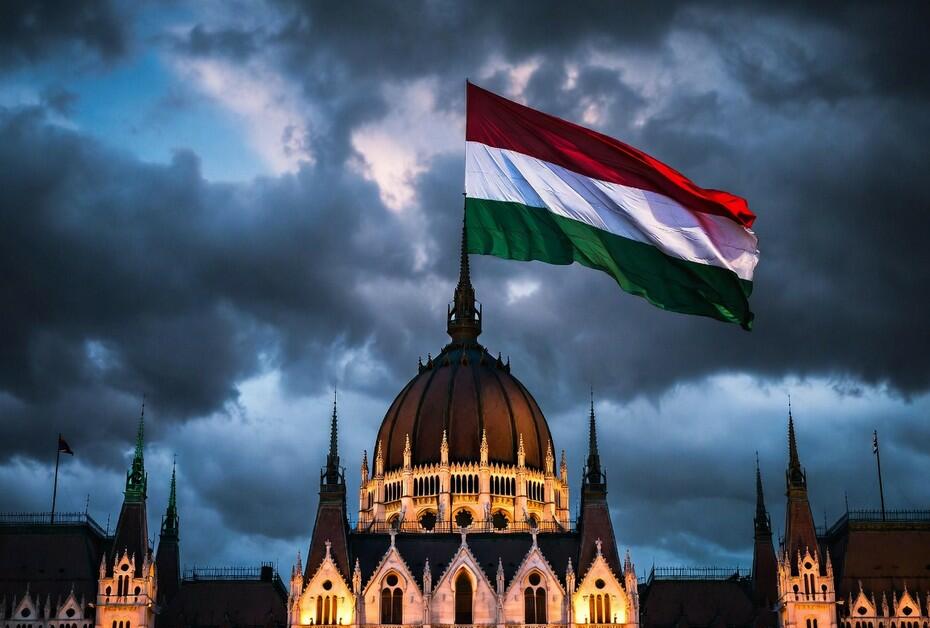
Bluntly put the election is a referendum on the durability of nationalist populism in Europe, the future of EU integration, energy security amid the Ukraine war, transatlantic conservative alliances under Trump 2.0, and even the fate of billions in Chinese investment that have reshaped Hungarian industry.
Right now, it looks like Magyar has it in the bag, so read on for the implications:
As Goldman notes, independent polls, seat projections, and prediction markets all point to a likely Tisza victory – potentially with the two-thirds supermajority needed to rewrite the constitution. Markets have been pricing it in for over a year, yet the stakes could hardly be higher, and the outcome remains fluid until the ballots are counted. A Fidesz upset or narrow hold would reverberate from Brussels to Beijing, from Kyiv to Washington. This is the “Battle for Hungary” – and its ripples could redefine the continent’s political fault lines, as noted by Andrew Korybko.
The Two-Man Race: Orbán’s Empire vs. Magyar’s Surge
Orbán, 62, has dominated Hungarian politics since 2010, crafting a model of “illiberal democracy” that mixes nationalist rhetoric, state-orchestrated economic control, and defiance of EU norms.
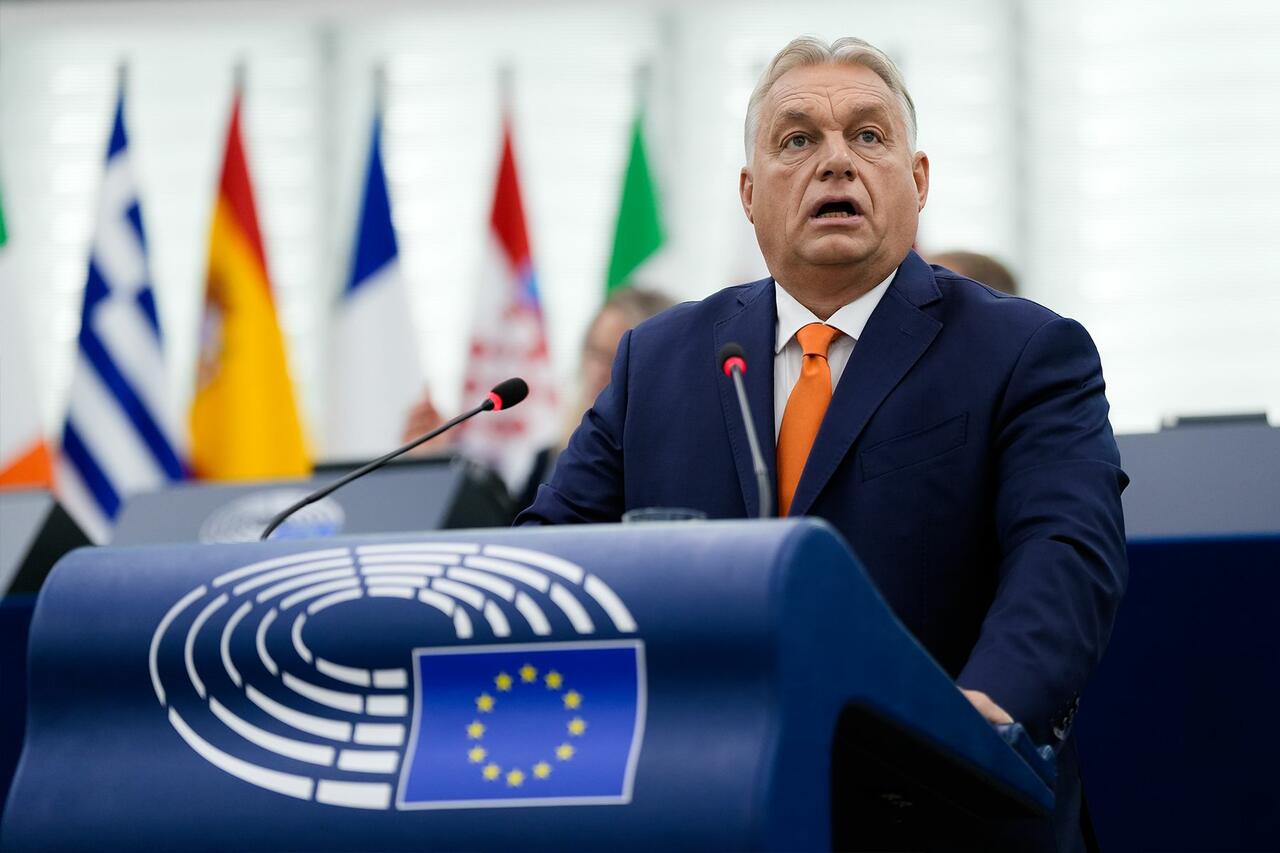
He positioned Hungary as a bulwark against mass migration, gender ideology, and Brussels overreach – exporting the playbook to allies like Donald Trump. Under his watch, Fidesz built an electoral machine that delivered supermajorities in 2010, 2014, 2018, and 2022, despite never exceeding roughly 54% of the vote, thanks to gerrymandering, diaspora voting, and first-past-the-post districts.
Enter Péter Magyar, 43, a former Fidesz insider turned insurgent.

A lawyer and ex-husband of a former justice minister, Magyar burst onto the scene in 2024 after a dramatic break with the party, railing against corruption, cronyism, and economic mismanagement. His Tisza party has consolidated the fragmented opposition into a genuine two-party contest. Magyar campaigns on restoring rule of law, unlocking frozen EU funds, and delivering economic relief without sacrificing sovereignty. He is explicitly targeting the two-thirds supermajority (133 of 199 seats) to repeal Fidesz’s “Cardinal Acts” and constitutional changes.
The numbers tell the story. Long-term polling charts show Fidesz’s support eroding from peaks near 48% in 2024 to the low 30s–low 40s today, while Tisza has rocketed from the mid-20s to 50–58% among decided voters.
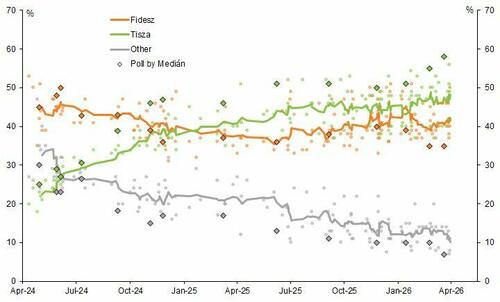
Independent pollsters like Medián consistently show Tisza at 55–58% and Fidesz at 35–38%, with “Other” parties collapsing into single digits.
On Polymarket, Péter Magyar is trading at 72% to become the next Prime Minister (versus 28% for Viktor Orbán), with over $62 million in trading volume. The “Hungary Parliamentary Election Winner” market gives Tisza a 75% probability of winning the most seats and forming the next government (Fidesz at 26%), with roughly $60 million traded.
Even accounting for the system’s built-in advantages for incumbents – 106 single-member FPTP districts, strong rural and Romanian-diaspora support for Fidesz – the market consensus strongly favors a decisive shift in power.
The Domestic Reckoning: Economy, Corruption, and Voter Fatigue
Hungary’s voters are not marching to the polls in a vacuum. Beneath the ideological battle lies raw economic pain. As Goldman notes further, cumulative price rises of 40% since 2021 have hammered households despite inflation cooling to +1.4%. Growth has stagnated. Corruption perceptions rank Hungary as the EU’s most graft-prone member, per Transparency International. Many Hungarians see Orbán’s system – subsidies, tax breaks, and special deals – as having enriched insiders while ordinary people footed the bill for the cost-of-living crisis.
Orbán has countered by highlighting 16 years of achievements – job creation, pension increases, and border barriers to halt illegal immigration – and warned that losing power would mean Hungarians “lose everything we have built together.”
A Tisza victory would likely deliver immediate relief: the unlocking of roughly €20 billion in frozen EU funds, contingent on judicial and anti-corruption reforms. Magyar has pledged a credible path to euro adoption by 2030, which would stabilize the forint and lower borrowing costs long-term. A supermajority would let Tisza dismantle the “Cardinal Acts” that entrenched Fidesz power over media, elections, pensions, and taxation.
As Korybko notes, the emotional undercurrent runs deeper. Orbán’s defenders credit him with shielding Hungary from the worst of the Ukraine war fallout – keeping Russian energy flowing, avoiding direct involvement, and preserving sovereignty. Many Chinese business owners in Hungary quietly echo that view: they grumble about bribes and cronyism but prefer the “devil they know” because “at least things get done,” according to SCMP.
How Hungarian Elections Work
Voters cast two ballots: one for a local candidate (106 seats via first-past-the-post) and one for a national party list (93 seats via proportional representation). A simple majority elects the prime minister and passes ordinary laws; two-thirds is required for constitutional amendments and Cardinal Acts.
Ballots open at 06:00 CEST and close at 19:00 CEST on Sunday. Counting begins immediately; a clear winner typically emerges election night, with official certification roughly one week later. Recounts are possible if margins are razor-thin. Turnout will be decisive: high participation historically favors challengers riding waves of discontent.
Geopolitical Earthquake: From Brussels to Beijing
Europe and the EU
Orbán has been the bloc’s most stubborn spoiler – vetoing Ukraine aid packages, blocking rule-of-law sanctions, and slowing federalization. A Tisza win would remove that veto leverage overnight. Brussels-friendly governance could accelerate EU integration, restore Hungary’s access to cohesion funds, and align Budapest with mainstream European policy.
Ukraine
Kyiv has clashed repeatedly with Orbán over energy imports from Russia and reluctance to arm Ukraine. Ukrainian pressure tactics – including weaponizing the Druzhba pipeline – have failed to move him. A
Ukraine hates Hungary too, but only because Orban refuses to arm it, continues purchasing energy from Russia, and has occasionally obstructed EU funding for this former Soviet Republic. In response, Ukraine has weaponized the Druzhba oil pipeline from Russia upon which Hungary relies to a large degree to pressure him into reversing his policies, but to no avail. Ukraine also colludes with the Hungarian opposition, which is now Ukraine’s and the EU’s joint proxy, in their Russiagate conspiracy theories. –Korybko
Magyar government would likely soften Hungary’s stance, easing EU-Ukraine funding bottlenecks and reducing pipeline friction.
United States and Trump 2.0
The international right has rallied behind Orbán. Former President Donald Trump endorsed him on social media, calling him “a truly strong and determined leader” with “a proven record of outstanding results” and a “true friend, a fighter, and a winner.” U.S. Vice President JD Vance visited Budapest and sharply criticized Brussels for “unprecedented interference” in the election process. A Fidesz hold would bolster that transatlantic populist axis; a Tisza victory would be a setback, signaling that even the strongest illiberal outpost can fall to domestic economic grievances.
European Populist Allies
Orbán has also received strong backing from key figures on the European right. France’s Marine Le Pen praised his stance on the Ukraine war as “very brave,” Italy’s Matteo Salvini framed the vote as a contest over Europe’s future and national sovereignty versus centralized EU control, and Germany’s AfD co-leader Alice Weidel voiced her support.
Russia
Moscow’s stake is modest but real: Orbán’s pragmatic energy deals and occasional obstruction of anti-Russia measures have been valuable. Putin sees Hungary as a potential future bridge for EU-Russia détente once the Ukraine war ends. Russia has avoided overt meddling, but a Tisza shift would narrow that window.
Out of the four foreign parties with stakes in the “Battle for Hungary”, Russia’s are the least. It supports Orban’s pragmatic approach to the Ukrainian Conflict and views Hungary as a valuable partner in Europe. More than that, however, Putin believes that Orban can help repair Russian-EU relations sometime after their proxy war in Ukraine ends. While certainly game-changing if it occurs, this scenario is admittedly unlikely, ergo why Russia isn’t meddling in his support despite conspiracy theories to the contrary. –Korybko
China
Billions in Chinese FDI – most visibly CATL’s massive battery plant in Debrecen – have become politically radioactive. Banners reading “No battery, no deal,” “Debrecen belongs to Hungarians,” and “Chinese, go home” dot the city. Chinese firms face local backlash over imported labor, environmental risks, and meager local economic spillovers. Tisza has been measured – calling for “pragmatic, mutually beneficial” ties while demanding stricter EU-compliant rules on labor, environment, and taxes. Projects already under construction are unlikely to be seized, but a new government would pivot from “seduction” (subsidies and visas) to enforcement.
Market Verdict: The Forint Has Already Spoken
Investors have been positioned for a Tisza outcome since early 2025. The forint has strengthened in anticipation. Goldman’s EM desk outlines clear scenarios:
- Tisza win (base case): EUR/HUF –2%, swaps –20 to –30 bps, credit spreads –15 to –25 tighter.
- Tisza + supermajority: EUR/HUF –4%, swaps –30 to –40 bps, spreads –25 to –40 tighter (+ €20bn EU funds unlock).
- Fidesz hold / upset: EUR/HUF +4%, swaps +40 to +50 bps, spreads +25 to +40 wider.
FX volatility desks price roughly 3% gap risk around the event, with positioning long HUF but some profit-taking near 375.
Aftermath Scenarios: Victory, Narrow Hold, or Chaos
A decisive Tisza victory would mark the end of the Orbán era and a constitutional reset. A narrow Fidesz government or blocking minority could trigger exactly the Color Revolution fears some analysts warn of – EU- and Ukraine-backed protests framed around “Russian meddling,” exactly the kind of destabilization Orbán has accused opponents of preparing. Hungarians themselves hold the greatest stake. They will live with the consequences – economic relief or continued stagnation, EU integration or defiant sovereignty, pragmatic Chinese investment or stricter oversight.
Why Europe – and the World – Should Watch Closely
This is more than a Hungarian election. It is a stress test for the durability of the populist wave that Orbán helped pioneer. A Tisza supermajority would deliver the clearest repudiation yet of illiberal governance in Europe, emboldening Brussels and weakening nationalist holdouts elsewhere. It would signal that economic pain and corruption fatigue can trump sovereignty rhetoric even in the EU’s most defiant member.
Conversely, an Orbán hold – against the polling tide – would validate the model’s resilience and give fresh oxygen to conservative-nationalist forces from Warsaw to Washington.
Sunday’s result will not just decide Hungary’s next prime minister. It could redraw the map of European populism, recalibrate great-power alignments, and determine whether the “illiberal laboratory” survives or becomes a historical footnote. Polls close at 19:00 CEST. By nightfall, we may know whether the Battle for Hungary ends in revolution – or resilience. The continent is watching.
Tyler Durden
Sat, 04/11/2026 – 12:15
via ZeroHedge News https://ift.tt/2kAoRFM Tyler Durden