Futures Storm Higher Into Record Territory On Now Daily Ceasefire Hopium
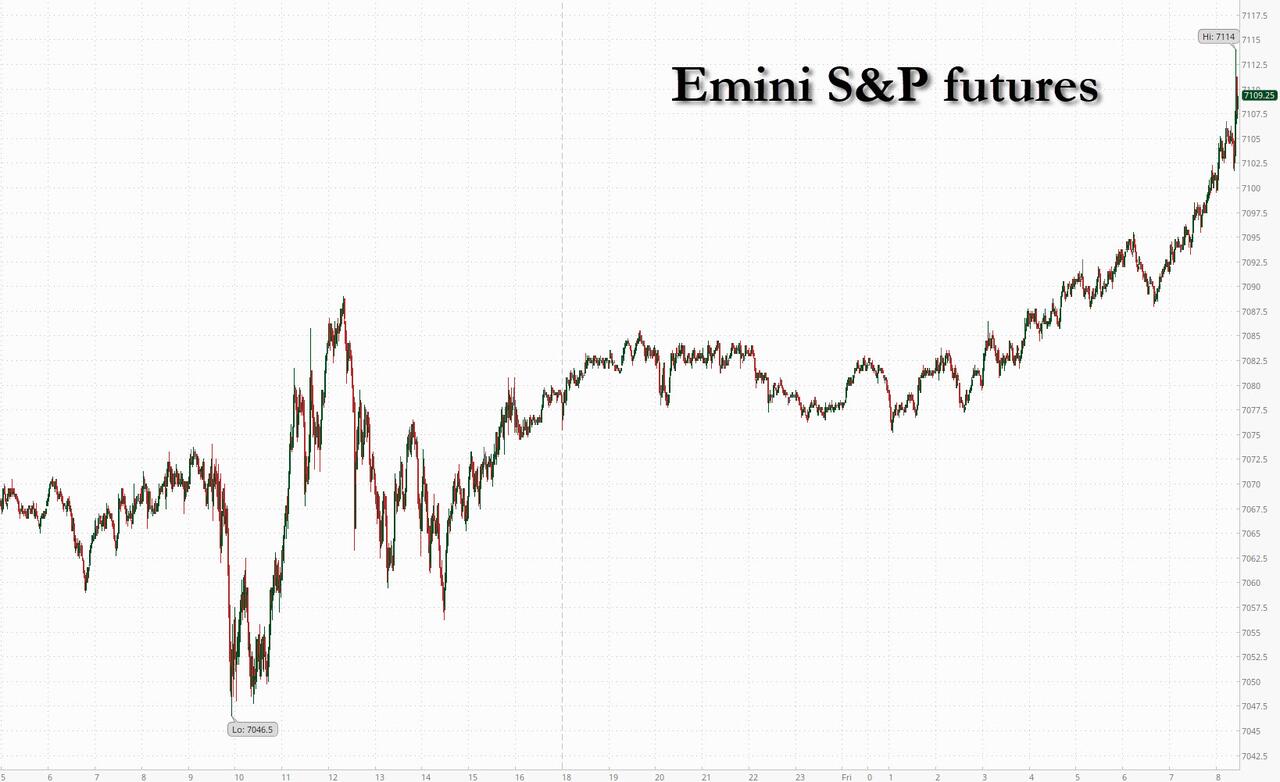
Stocks are pushing higher again on the same old regurgitated news: namely speculation that a deal to end the war between the US and Iran is getting closer, the same exact “speculation” that has pushed the Nasdaq higher for what will now be 13 days in a row, and the same speculation that may keep pushing stocks even higher until the reality of no ceasefire sends risk plunging in a few days. For now however, it is sufficient to lift markets thanks to the relentless CTA VWAP grind higher, and as of 8:15am, S&P futures are 0.4% higher, with Spoos trading above 7100 while Nasdaq futs gain 0.3% after both gauges hit record highs Thursday, with all Mag 7 stocks trading higher in the premarket (MSFT +1.1%, AAPL +0.8%). Netflix tumbled 10% after it gave a disappointing Q2 forecast and Reed Hastings announced he is stepping down as Chairman. The dollar was down 10 bps and headed for a February low. Global bonds were mixed, with the 10-year Treasury yield down two basis points at 4.30%. Overnight, headlines were largely quiet: while the date of the second round of US-Iran talk has not yet been determined, Trump signaled that talks could resume this weekend. Oil prices are extending their decline: WTI is down $4 below $88 with both Brent and WTI are both down around 4% for the session as traders await details of talks between the US and Iran following optimistic comments from President Trump. Base metals are all higher led by aluminum (+0.6%); Ags are mostly lower. No economic releases are expected today. Fed’s Daly, Barkin and Waller are scheduled to speak at events. Fed’s blackout period begins Saturday.
In premarket trading, Mag 7 stocks are all higher (Microsoft +1%, Apple +0.4%, Amazon +0.4%, Tesla +0.6%, Alphabet +0.1%, Nvidia +0.2%, Meta +0.2%)
- Alcoa (AA) slips 2% after the aluminum company said first-quarter earnings were hurt by higher costs and operational disruptions.
- Ally Financial Inc. (ALLY) rises 3% after reporting earnings that beat estimates, fueled by consumers purchasing more cars even as gas prices rose.
- Autoliv (ALV) gains 9% after the company saw better-than-expected sales in the first quarter, with particular strength seen in March. CEO Mikael Bratt says in an interview it isn’t wholly clear what was driving the boost, but says some of it may be pre-buying effects as vehicle manufacturers looked to shore up inventories amid rising volatility.
- Knight-Swift (KNX) slips 1% after the transportation and logistics services provider reported preliminary adjusted earnings per share for the first quarter that missed the average analyst estimate.
- Netflix (NFLX) tumbles 10% after the streaming company gave a forecast for the second quarter that fell short of analysts’ expectations, underwhelming Wall Street just months after it lost out on a bid for Warner Bros. Discovery Inc.
- NiSource Inc. (NI) gains 2% after the company announced a new long‑term energy agreement with a subsidiary of Alphabet Inc. to support the development and operation of a large‑scale data center in northern Indiana.
- Onto Innovation (ONTO) rises 5% as Stifel upgrades to buy, citing the semiconductor manufacturing company’s solid preliminary revenue.
In other corporate news, Apple’s marketing executive in charge of the Apple Watch, AirPods, health and smart home initiatives said he’s retiring, marking a changing of the guard for a series of key product lines. SpaceX has moved up a scheduled vesting date for shares awarded to employees to as soon as next week, ahead of an IPO. Increasing demand for AI services could continue to raise chip costs throughout the year, note Ericsson executives. Uber is raising its holding in Delivery Hero, buying a stake from its European rival’s biggest shareholder for €270 million ($318 million).
One of the most powerful rallies since World War II looks set to continue Friday as investors look past mixed signals on a Middle East peace deal, a muted Netflix outlook and the prospect of further US-Iran talks this weekend. As measured by the 14-day relative strength index, it took the US benchmark just 11 days to lurch from an oversold reading to Thursday’s arrival in overbought territory. That’s only outpaced by an even faster rally in 1982. Explanations for the abrupt change in momentum point to a combination of hedge unwinding, systematic buying and short covering by hedge funds in macro products.
While the Nasdaq’s 12-day winning streak has propelled the index to fresh all-time highs, tech valuations remain near their 10-year average. Earnings estimates have been rising in concert with stocks, keeping forward price-to-earnings ratios at low levels.
“This reset provides a more constructive entry point in equities, particularly across large-cap quality growth,” said Scott Rubner, Citadel Securities head of equity and equity derivatives strategy.
Brent dropped 4% below $96 a barrel after Trump claimed that Iran has made key concessions in negotiations with the US (Iran later denied it). The drop accelerated after Axios announced that the US is considering a $20 billion cash-for-uranium deal (Iran has yet to deny that).
Yet for all the optimism, the key transit route for about a fifth of global crude shipments remains all but shut under US and Iranian blockades. Some Gulf Arab and European leaders said that a US-Iran peace deal could take about six months to agree. And despite its overnight tumble, Brent continues to trade about a third higher since the conflict began in late February, with no clear indication of when flows through the Strait of Hormuz will resume. Bank of England policymaker Sarah Breeden warned that the war could trigger several market stresses at once.
“As we are heading closer and closer to May, the situation becomes serious,” said Andrea Gabellone, head of global equities at KBC Securities. “If no real traffic is seen by June at the latest, things will take a different turn.”
Not that the market cares: bond and equity stress measures show markets are growing more sanguine about an eventual resolution to the conflict. The V-shaped market recovery has meant investors hedging using monthly puts held to expiry have got little benefit in return for eating carry costs.
“Now that the dust appears to be settling on events in the Middle East, market attention will once again focus back on the fundamentals, in particular earnings given that the season has just started,” said Daniel Murray, deputy chief investment officer at EFG Asset Management. “Earnings expectations are buoyant, consistent with solid underlying macro trends.”
“It’s all about earnings. EPS estimates for 2026 and beyond continue to march higher. Investors are oblivious to anything else,” said Peter Berezin, Chief Global Strategist, BCA Research.
Trump struck an optimistic tone about prospects for a permanent ceasefire with Iran. “It’s looking very good that we’re going to make a deal with Iran, and it’s going to be a good deal,” he told reporters at the White House. Talks between Washington and Tehran could resume this weekend, he added. He also announced a 10-day ceasefire between Israel and Lebanon. Less encouragingly, some Gulf Arab and European leaders said a peace deal would take about six months to be agreed.
In politics, Democrat Analilia Mejia is projected to win the special election in New Jersey’s 11th Congressional District. President Trump sought to assuage voters’ fears about the cost of living despite higher energy prices stemming from his war in Iran at a rally to build support for his economic record ahead of November’s midterm elections.
European stocks are inching higher, with Stoxx 600 up by 0.2. Alstom SA shares slid the most in over two years in Paris after the manufacturer withdrew financial guidance for this fiscal year.
Asian equities retreated ahead of the weekend as investors await progress in talks to extend the US-Iran ceasefire. The MSCI Asia Pacific Index slid as much as 1.2%, with TSMC and Mitsubishi UFJ among the biggest drags on the gauge. Most major markets were in the red, and Japan’s Topix Index fell more than 1%. Enthusiasm for technology stocks has also waned, with chipmaking giant TSMC’s Taipei-listed shares leading declines in part due to investor unease over its heavy reliance on a small number of hyperscaler customers.
In FX, the Bloomberg Dollar Spot Index is down 0.1% and there are modest moves in other major currencies.
In rates, treasuries drift higher over Asia, early London session leaving yields richer by 1bp to 2bp across the curve, following similar price action across European bonds as speculation grows that a peace deal between the US and Iran is getting closer. US 10-year yields trade close to session lows into the early US session at 4.295% with bunds and gilt trading marginally cheaper on the day in the sector. In the UK, the yield on 10-year gilts held steady after Thursday’s move higher. New details about Prime Minister Keir Starmer’s appointment of Peter Mandelson as US ambassador have rekindled doubts about his grip on power. The pound was little changed. US session focus includes a handful of speakers, such as Waller on the economic outlook (2pm New York) ahead of Saturday’s start to the communications blackout period. Treasury auctions next week include $13 billion 20-year bond reopening on Wednesday
In commodities, oil prices are extending their decline but there are few signs of positive spillovers to other assets. Brent and WTI are both down around 4% for the session, as traders await details of talks between the US and Iran following optimistic comments from President Trump. Gold prices are steady slightly short of $4,800/oz.
US economic data calendar slate empty for the session. Fed speaker slate includes Daly (11:30am), Barkin (12:15pm) and Waller on the economic outlook (2pm — text and Q&A expected). Fed’s external communications blackout period begins Saturday, ahead of the April 29 policy announcement
Market Snapshot
- S&P 500 mini +0.5%,
- Nasdaq 100 mini +0.6%,
- Russell 2000 mini +0.4%
- Stoxx Europe 600 +0.3%
- DAX +0.7%
- CAC 40 +0.5%
- 10-year Treasury yield -1 basis point at 4.3%
- VIX +0.2 points at 18.14
- Bloomberg Dollar Index -0.1% at 1192.11
- euro +0.2% at $1.1799
- WTI crude -3.3% at $91.54/barrel
Top Overnight News
- The disruption of ME oil supplies due to the war in Iran has sparked a rush for US crude. Data on ship movements show about 70 VLCCs, or very large crude carriers, sailing towards the US Golf Coast mainly from Asia. The number is more than double last year’s average. Nikkei
- President Donald Trump said a deal to end the war in Iran could be reached soon, although the timing remained unclear, while U.S. allies were gathering on Friday to discuss reopening the vital Strait of Hormuz shipping route. BBG
- A Pakistan-flagged tanker that entered the Persian Gulf over the weekend became the first carrier to exit through the Strait of Hormuz with a crude cargo since the US blockade began on Monday. BBG
- The Strait of Hormuz remains in focus as the UK and France host a Paris summit to discuss a naval force to ensure freedom of navigation. Trump, meanwhile, moved to calm voters’ concerns about conflict-driven energy costs at a speech in Las Vegas. BBG
- The US Congressional Progressive Caucus discussed trying to force repeated House votes on Iran war powers resolutions, Punchbowl reports.
- The US plans to help build a first-of-its-kind industrial hub in the Philippines to boost production of inputs crucial to American supply chains. BBG
- The RBI urged state-run oil refiners to curb spot dollar purchases and tap a special credit line for their FX requirements. BBG
- The US government is at risk of losing its status as the lowest-cost USD borrower as global investors grow wary of Trump’s volatility. FT
- Keir Starmer fired the UK foreign office’s top civil servant, Olly Robbins, a person familiar said. The PM faces renewed calls to quit himself after revelations that his US envoy Peter Mandelson was granted security clearance despite officials’ objections. BBG
- Delays to a swath of new US data centers threaten to slow the rollout of AI by the world’s biggest tech companies, with almost 40 per cent of all projects due this year at risk of falling behind schedule. FT
- US President Trump posted “Sadly, Mayor Mamdani is DESTROYING New York! It has no chance! The United States of America should not contribute to its failure. It will only get WORSE. The TAX, TAX, TAX Policies are SO WRONG. People are fleeing”.
A more detailed look at global markets courtesy of Newsquawk
APAC stocks were mostly lower as markets lost steam following the recent rallies and with participants paring risk heading into the weekend, despite the Israel-Lebanon ceasefire taking effect and optimism by US President Trump regarding a deal between the US and Iran, which he said could resume talks over the weekend. ASX 200 was subdued with weakness seen in gold miners, financials and the consumer sectors, although the downside is limited amid a lack of fresh catalysts and a quiet data calendar. Nikkei 225 pulled back from its all-time record highs and just about returned to beneath the 59,000 level, with underperformance seen in some miners, manufacturers and semiconductor names. Hang Seng and Shanghai Comp conformed to the uninspired mood with the Hong Kong benchmark dragged lower by tech weakness, while participants also digested some earnings releases, including from Kweichow Moutai, which reported a 5% drop in FY profit.
Top Asian News
- Chinese scientists have reportedly developed diamond coating, which could improve cooling efficiency of AI data centres by around 80%, SCMP reported.
- China State Planner Vice Chair said economic operations are showing positive changes with significant improvements on both supply and demand side. Will reserve a batch of macro policy measures and roll out in a timely way based on needs.
- Fitch said China’s credit outlook remains constrained by weak domestic demand, adds Iran war has added external pressure through weaker energy, trade and global demand.
- Japanese Finance Minister Katayama said Japan Bank for International Cooperation is to establish new investment window of up to JPY 600bln to assist Asian nations in securing energy supplies.
European bourses (STOXX 600 +0.3%) are broadly gaining on the last day of the trading week. The FTSE MIB is the slight outperformer, while the FTSE 100 lags as miners underperform. European sectors are mixed. Media tops the sector pile, closely followed by Technology while Basic Resources resides at the bottom of the pile.
Top European News
- UK PM Starmer’s Chief Secretary Darren Jones said PM won’t resign and didn’t mislead Parliament, via BBC. The PM has not knowingly or unknowingly misled Parliament. He also stated that PM Starmer is furious; does not think it brings his future into question.
- Senior UK Minister said PM Starmer has not considered resigning amidst called for resignation following Mandelson scandal, according to BBC.
- UK Foreign Office senior official Sir Olly Robbins is leaving his post following the Mandelson vetting row, according to The Guardian’s Political Editor Crerar.
- UK PM Starmer faces resignation called over Mandelson vetting, according to The Telegraph.
- EU is planning its biggest relaxation of corporate merger rules in decades, while EU competition commissioner Ribera said merger rules are to favour scale and innovation, according to FT.
FX
- DXY is a touch lower on the day with crude benchmarks trading lower by around -3% as news emerged that a Pakistani-flagged tanker became the first crude carrier to surpass the US Blockade since Monday. Elsewhere on geopolitics, reports suggested Indian refiners are paying for Iranian crude in CNY, reporting which may have added to pressure in the USD. (Comprehensive geopolitical analysis on the headline feed)
- DXY trades a touch above the 98.00 level, which it has tested in recent days, while USD/JPY reversed from a high of 159.53 to move towards the 159.00 mark. On the latter, BoJ Governor Ueda was on the wires overnight, he reiterated that monetary conditions remain highly accommodative.
- Elsewhere, AUD mildly leads given its high-beta characteristics with gold also firmer, and the aforementioned reports that CNY was used to pay for Iranian crude. AUD/USD lifted from a 0.7154 base to mark a session high of 0.7182
- Sterling resilient to the political risks that emerged on Thursday afternoon. The UK PM is now facing calls to resign after news that Mandelson failed his vetting process for the Foreign Office. Some MPs have been calling for Starmer to resign: “I fail to see how Starmer survives this.”, one told the iPaper. Though close aides, like Chief Secretary Darren Jones, said the PM won’t resign and didn’t mislead Parliament. Starmer himself has denied any knowledge of the failed vetting. Given these reasons and the fact that PM has repeatedly said he wishes to see out his term with cabinet ministers recently voicing support for him, Gilts and Sterling, which initially weakened on the news, pared their respective losses.
Central Banks
- BoJ Governor Ueda said G20 discussed impacts of Middle East on prices and on the global economy, adds many said the Middle East is an important factor and remains uncertain. Supply shock-driven inflation is harder to tackle than demand-driven. Rising oil prices put upward pressure on underlying inflation, but worsen Japan’s terms of trade and weigh on the economy. Monetary conditions remain highly accommodative and Japan’s real interest rate is low. BoJ will decide policy based on likelihood of forecast materialising and risk at each meeting.
- ECB’s Muller said market’s rate bets are not completely unreasonable, its hard to argue there is an obvious case for an April hike; can not fully exclude it. Dangerous to assume energy shocks are temporary. ECB is better placed than it was in 2022 – does not have to wait to see second-round effects.
- BoE’s Breeden says the Middle East conflict raises the risk of correlated shocks across markets. On repo markets, would authorise considering reforms to gilt repo markets to improve resilience.
- Danske Bank sees two rates hikes by the Riksbank by August.
Fixed Income
- Global fixed benchmarks are mixed/flat, but have held an upward bias throughout the European session, with the crude complex residing towards lows. Focus remains on the geopolitical front, with Lebanon-Israel having agreed to a ceasefire (but there have been reports of flare-ups in the south of Lebanon), whilst the US-Iran have yet to agree on a second round of talks. Nonetheless, President Trump continues to remain positive, suggesting that “they are making a lot of progress on Iran, and he is not sure the ceasefire needs to be extended”.
- USTs are currently trading firmer by a couple of ticks and toward the upper end of a 111-04 to 111-09+ range. Aside from lower energy prices, US paper has not had much to digest, and this has been reflected in the fairly lacklustre price action. The US data docket is lacking, so more focus will be on Fed speak via Daly, Barkin and Waller later today.
- Bunds are flat, but have been moving higher throughout the European morning, alongside the pressure seen in the crude complex. Currently trading at the upper end of a 125.11 to 125.46 range. Earlier, there was some commentary from ECB’s Muller, who struck a familiar hawkish tone, noting that an April hike cannot be excluded; comments which add on to the hawkish tone struck by other ECB members and the Minutes released on Thursday.
- Gilts are firmer by around 10 ticks, where UK paper reacted to domestic politics. In brief, reports on Thursday suggested that Mandelson failed his vetting process for the Foreign Office – this has led to the Top Foreign Official to leave his role. This renewed some pressure for the PM to leave his position, but Chief Secretary Darren Jones, said the PM won’t resign – he struck a familiar line, where he suggested that Starmer had no knowledge of the failed vetting process. At least in the near term, the pressure on Starmer appears to be limited in nature, though MUFG highlights that the Labour Party could run into issues surrounding the local elections in early May. UK paper currently trades within a 87.83 to 88.38 range.
Commodities
- In geopolitics, a 10-day Israel-Lebanon ceasefire took effect at 17:00EDT/22:00BST on Thursday, though Israeli PM Netanyahu rejected Hezbollah’s demand for a full Israeli withdrawal from southern Lebanon, saying forces would remain in a security zone extending to the Syrian border. A Hezbollah source said Lebanon retains the right to resist by all means while Israeli forces remain, while Iran welcomed the ceasefire but also called for a full withdrawal. This morning, reports made the rounds that Israeli forces targeted an ambulance team in southern Lebanon (which breaches the ceasefire), although reporting on this was light overall. On Iran, President Trump struck an optimistic tone on prospects for a permanent US-Iran ceasefire and said Tehran had agreed to reopen the Strait of Hormuz, though some European and Gulf Arab leaders cautioned a deal could still take around six months; Trump nevertheless said an announcement could come soon. Meanwhile, a source told Al-Mayadeen that starting Friday at noon (10:00 BST), anyone wishing to cross Bab al-Mandab should be more vigilant than ever before in all six directions, while other reports said the warning was made by a resistance commander.
- Crude price action has been choppy this morning, prices fell on hopes of reduced Middle East supply disruption, with Brent Jun’26 moving towards USD 98/bbl (USD 96.15-98.98/bbl range) and WTI Jun’26 sub-90/bbl (in a USD 87.46-90.34/bbl range), before recovering slightly on the Lebanon ambulance report. New lows were hit shortly after wires re-ran overnight reports of a Pakistani-flagged tanker exiting the Persian Gulf, whilst other reports suggested Indian refiners are paying for Iranian crude in CNY. Do note the low for today is a moving target, at the time of writing.
- Spot gold trades within a narrow range, awaiting the next macro impulse. Ranges are narrow within USD 4,768-4,806/oz. Spot silver found some support near its 100 DMA (USD 77.95/oz) but remains contained to a USD 77.77-79.26/oz.
- Base metals flat/mixed with copper futures contained within a narrow band amid a lack of macro headlines ahead of a weekend of risk. 3M LME copper resides in a USD 13,182.53-13,300.60/t range at the time of writing.
- Indian refiners are reportedly settling rare cargoes of Iranian oil purchased under a temporary US sanctions waiver using CNY through ICICI Bank.
- Cumulative crude and condensate supply losses in the Middle East have reached 521mln barrels, according to Kpler’s Baker.
- South Korean officials say that a South Korean tanker, carrying crude oil, has passed through the Red Sea route from Saudi’s Yanbu port, AP reported.
- IEA chief said markets must brace for significant price surges if critical oil transit route remains closed, while IEA signals it’s not ready yet to release more reserves, though the option is being evaluated.
Geopolitics: Iran
- IRNA states that security and traffic measures have been intensified in Islamabad, preparing itself for a major international event, while highlighting that Pakistani officials have not yet confirmed or denied any negotiations, Iran International reported.
- US President Trump said Iran war is going swimmingly and should be ending pretty soon, adds going to see some incredible results.
- Israel and Lebanon 10-day ceasefire takes effect.
- US President Trump posted “I hope Hezbollah acts nicely and well during this important period of time. It will be an GREAT moment for them if they do. No more killing. Must finally have PEACE!”.
- Israel reportedly launched airstrikes on southern Lebanon minutes before the ceasefire, according to an Asharq correspondent.
- Iran stresses the need for full Israeli withdrawal from southern Lebanon, according to Iranian media citing a Foreign Ministry spokesman.
- Iran welcomes ceasefire in Lebanon, said was part of Iran-US ceasefire understanding mediated by Pakistan, Iranian media reported.
- Lebanon’s Army noted intermittent shelling on southern Lebanese villages after the ceasefire took effect.
- ISNA noted that the Lebanese army announced that the Israeli regime bombed several villages in southern Lebanon after announcing the ceasefire agreement.
- “Israeli forces target ambulance team in south Lebanon”, Al Jazeera reported.
- IRGC said the army and the IRGC are ready to respond forcefully to any “aggressive and criminal act of the enemies”, IRGC public relations channel reported.
- US Central Command said USS Abraham Lincoln transits the Arabian Sea and no vessels are violating the blockade so far.
- US Treasury Secretary Bessent met with Italy’s Giorgetti yesterday; also met with Ukraine PM; and with UK Chancellor Reeves and EU Commissioner Dombrovskis. Discussed Iran and Energy. Also met with Japan Finance Minister.
- French President Macron and UK PM Starmer are to hold a summit today on a plan to secure the Strait of Hormuz and are expected to brief US President Trump following the meeting, according to FT.
Geopolitics: Ukraine
- Governor said that Russian drones attack damaged port infrastructure facilities in Ukraine’s Odesa region overnight.
- G7 reaffirmed backing for Ukraine, including energy needs ahead of winter, and agreed to sustain pressure on Russia while they discussed Chernobyl repair efforts and IMF reform progress.
US Event Calendar
DB’s Jim Reid concludes the overnight wrap
Morning from a beautiful start to the day here in Copenhagen. The birds are probably chirping merrily but as my man-flu has gone straight to my head I can’t hear anything. An ideal excuse when I encounter difficult questions about the war from clients.
On that topic, there has been a little bit of derisking globally over the last 24 hours but markets remain broadly optimistic about the direction of travel. Oil prices are retreating back a little this morning with Brent crude down -1.09% to $98.31/bbl, after a +4.70% rise on Thursday that saw it almost reach $100/bbl again. There is some profit taking in Asia ahead of the weekend though, with the Hang Seng (-1.38%) leading the losses followed by the Nikkei (-0.96%) and the KOSPI (-0.90%). Other Asian markets are down two or three tenths of a percent. US equity futures are fairly flat.
The retreat in oil from yesterday’s high came as President Trump struck an optimistic tone on prospects for resolution, saying “It’s looking very good that we’re going to make a deal with Iran, and it’s going to be a good deal”. He predicted that agreement would be reached “fairly soon” and said that he would extend the current two-week ceasefire if a deal was close. The US President also claimed that “they’ve agreed to almost everything”, including handing over the “nuclear dust”, though there’s been no confirmation of this from the Iranian side. Earlier, Trump also announced a 10-day ceasefire between Israel and Lebanon, and he said that he’d be inviting Israel’s PM Netanyahu and Lebanon’s President Aoun to the White House. This ceasefire formally came into effect overnight.
Oil had moved higher for much of yesterday’s sessions following multiple more negative headlines, which dampened hopes about a near-term peace deal between the US and Iran. For instance, Reuters reported yesterday from two Iranian sources, who said that the US and Iranian negotiators had scaled back their ambitions for a comprehensive peace deal, and were instead looking at a temporary memorandum that would prevent a return to conflict. Moreover, Iran’s Tasnim news agency said in a report that “Iran has emphasized through Pakistani mediation that the US must first fulfill its commitments”, and that “without going through the preliminary arrangements and reaching the necessary framework, these negotiations will be of no benefit”.
That backdrop meant that oil prices moved higher yesterday, with Brent crude (+4.70%) closing at $99.39/bbl. Yet despite the latest advance for oil prices, the US equity rally continued. So not only did the S&P 500 (+0.26%) reach another record high, but yesterday saw the NASDAQ (+0.36%) advance for a 12th consecutive session for the first time since 2009. In fact, if we get a 13th advance today, it would be the longest run of consecutive gains since 1992.
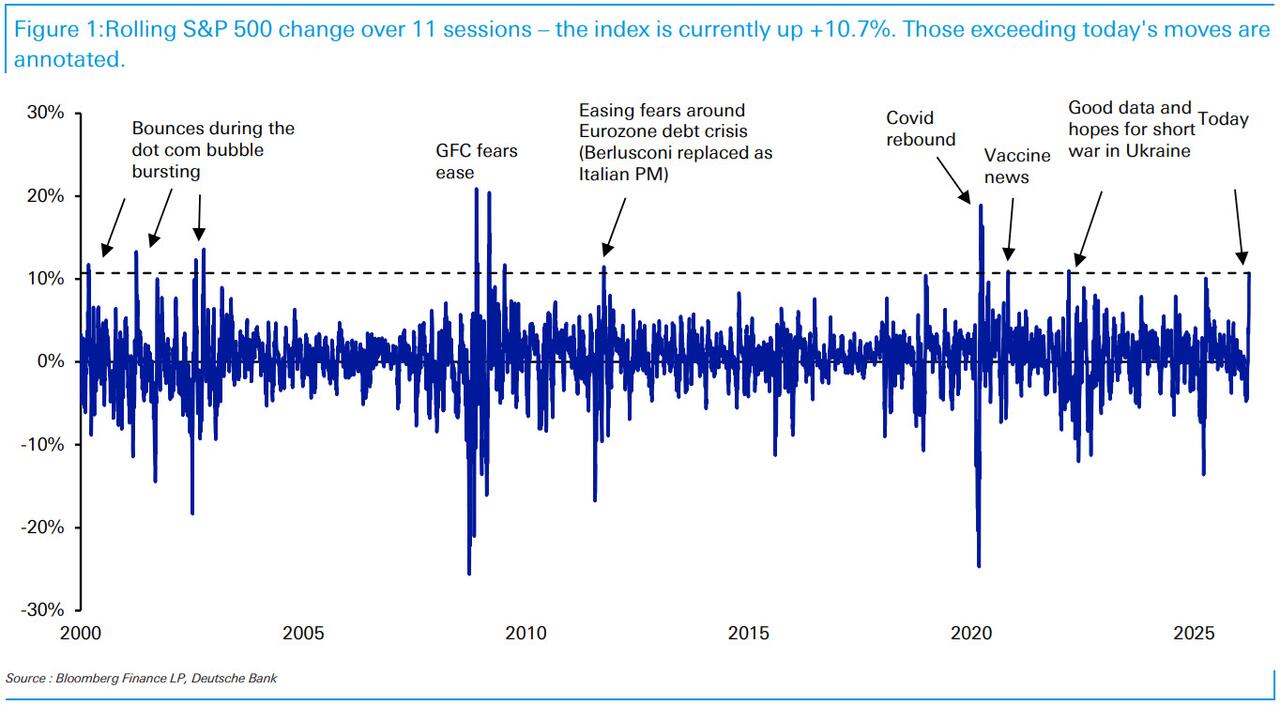
Generally I’m sympathetic to the view that a resolution is more likely than not over the coming weeks even if the path is unlikely to be a straight line. However the CoTD (link here) yesterday reminded us that the last time we had a larger move in the S&P 500 in 11 business days than we’ve just seen since March 30 (+10.7%) was back in March 2022. Back then, it was because of expectations that Russian and Ukraine talks would end up in an early ceasefire to the war which was only weeks old at the time. That obviously didn’t end well and the bear market soon continued. So one warning sign from the recent past.
However the macro environment was quite different back then and we were in the early stages of a big rate shock, waking us from the ZIRP slumber. Today the environment outside the war is healthier and there was further evidence yesterday, with the weekly initial jobless claims falling back to 207k in the week ending April 11 (vs. 213k expected). The labour market is showing many more signs of strength now than it did pre-war.
US Treasury yields crept higher as the upward move for oil continued. So the 2yr yield (+1.3bps) inched up to 3.78%, whilst the 10yr yield (+2.8bps) saw a slightly larger move to 4.31%. The only obvious driver was the oil move, as there weren’t materially new policy signals from Fed officials. In fact, New York Fed President Williams said given everything that was changing, “it doesn’t make sense for us to try to be giving strong forward guidance”. Governor Miran did again say that the Fed should lower rates, though in favouring “three, maybe four cuts this year”, this was perhaps a slight moderation of his dovishness given he penciled in four cuts in the March SEP. Miran had favoured a full 150bps of 2026 easing at the start of the year. Incidentally, today is the last chance for us to hear from Fed officials before the next meeting, as their blackout period begins tomorrow. That said, the nomination hearing for Kevin Warsh as the new Fed Chair is next Tuesday, so that will be one to watch.
Earlier in Europe, sovereign bonds put in a stronger performance. That partly came as investors reacted to a Bloomberg report after the previous day’s close, which said the ECB was leaning towards keeping rates on hold in a couple of weeks. So that eased concerns about a hawkish reaction to higher energy prices, and market pricing for an April rate hike fell to just 13%, the lowest in over a month (86% at the recent peak). In turn, that helped to bring yields down, with those on 2yr bunds down -2.7bps, while further out the curve yields on 10yr bunds (-1.2bps), OATs (-0.9bps) and BTPs (-1.2bps) saw more modest declines. However, equities slipped back slightly given the oil move, with the STOXX 600 down -0.05% by the close.
Finally in the UK, 10yr gilt yields (+3.4bps) saw a sharp move higher in the afternoon, driven by a Guardian story that former US ambassador Peter Mandelson had failed his security vetting clearance for that appointment, and the decision had been overruled by the Foreign Office. So that was seen as a problem for Prime Minister Starmer’s position, as he’d previously told the House of Commons that “full due process was followed”. That led to a negative market reaction, because the consensus view is that Starmer’s replacement would face pressure to ease the fiscal rules and borrow more, leading to higher gilt issuance. Meanwhile, gilts had been slightly underperforming even before that report, as data showed UK GDP grew by a monthly +0.5% in February (vs. +0.2% expected).
Looking at the day ahead, it’s a fairly quiet one, but central bank speakers include the Fed’s Daly, Barkin and Waller, the BoE’s Breeden and Bill, and Bank of Canada Governor Macklem.
Tyler Durden
Fri, 04/17/2026 – 08:47
via ZeroHedge News https://ift.tt/iBQARpK Tyler Durden