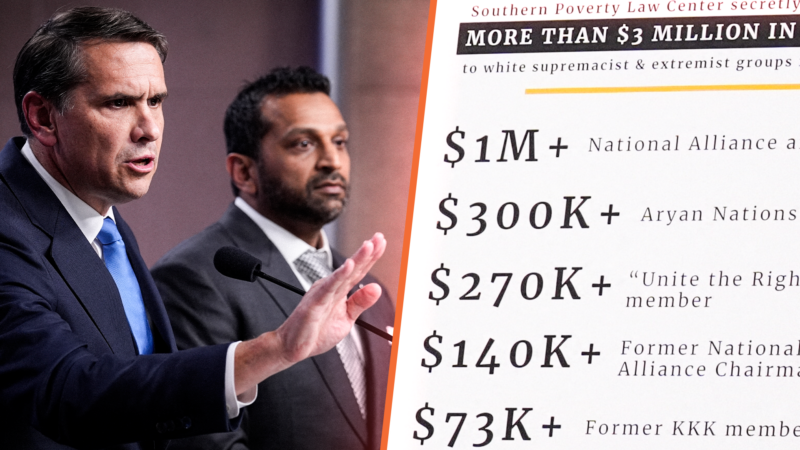
The Department of Justice (DOJ) is alleging the Southern Poverty Law Center (SPLC), a well-known civil rights organization that purports to monitor right-wing hate groups, secretly funneled millions of dollars to white nationalists and extremists who worked for those same groups. The SPLC says the purpose of the payments was to compensate informants who were working to dismantle hate groups from the inside, but according to the feds, such a scheme amounts to fraud and money laundering.
Acting U.S. Attorney General Todd Blanche announced the charges at a press conference on Tuesday, noting that a grand jury had already returned the indictment.
“The SPLC is manufacturing racism to justify its existence,” said Blanche.
That specific accusation is well-substantiated, even without considering these latest revelations about the SPLC’s role in funding the very groups it purports to monitor, track, and work to subvert. Whether it actually violates the law is another matter, though the creative means the SPLC employed to disguise its substantial payments to white nationalist activists seem dubious.
How substantial? According to the indictment, the SPLC paid $3 million to various figures who worked for extremist groups that were under the SPLC’s watchful eye between 2014 and 2023. Several of these paid informants are described as significant persons within the white nationalist movement: one was an imperial wizard of the Ku Klux Klan, and another was a leader of the National Socialist Movement and the Aryan Nations. There was even a member of the “online leadership chat group” that planned the infamous 2017 “Unite the Right” rally in Charlottesville, Virginia, where a woman was killed by a white nationalist. The DOJ also contends that the SPLC paid $270,000 to an informant who helped arrange logistics and transportation for that event.
To be abundantly clear, the SPLC takes the position that these were legitimate expenses and part of an effort to subvert right-wing hate groups. One informant who received $1 million dollars over a period of nine years stole boxes of documents from a violent extremist group and turned them over to the SPLC. The SPLC even paid a separate informant $6,000 to falsely take the blame for the theft, presumably to protect the cover for the other, more significant informant.
“Taking on violent hate and extremist groups is among the most dangerous work there is, and we believe it is also among the most important work we do,” said Bryan Fair, interim chief executive of the SPLC, in a statement. “The actions by the DOJ will not shake our resolve to fight for justice and ensure the promise of the Civil Rights movement becomes a reality for all.”
The federal government, however, says the payments were illegal, effectively because they misled donors and financial institutions. In order to disguise the nature of the payments, the SPLC set up fictitious entities that had zero employees and served no purpose other than to handle the transactions. The DOJ contends that this amounts to money laundering and wire fraud, which strikes me as plausible but difficult to parse given the complexities of nonprofit financial law.
The idea that the SPLC willfully misled its donors, on the other hand, seems at least somewhat dubious. This is an organization that is primarily funded by resistance liberal types who might actually be thrilled to discover that their money was spent infiltrating and taking down extremist groups, effectively doing the work of the FBI (which also uses paid informants) in some junior varsity capacity. Of course, some people have very reasonable objections to these tactics even when used by the FBI, since this often amounts to the government effectively inducing people to commit crimes. The supposed kidnapping plot against Michigan Gov. Gretchen Whitmer, for example, involved significant transfers of cash from the FBI to the would-be kidnappers in order to encourage them to move forward with the scheme. It is not a stretch to say that the plot might have gone nowhere except for the government’s encouragement.
The SPLC’s payments to informants, on the other hand, are even more suspect—and ultimately, self-discrediting. When law enforcement does this, the extent of the duplicity sometimes becomes known afterward, though not always. That’s bad enough; the SPLC’s funding of extremists, on the other hand, remained a secret until now. This is relevant since the SPLC’s primary role is to monitor and tabulate extremist organizations. By paying extremists, for whatever purpose, and then turning around and lamenting that extremism is on the rise, the SPLC is engaged in an elaborate fabrication.
This is nothing new. Critics of the SPLC—conservatives, libertarians, even leftists—have long accused the organization of routinely exaggerating the threat of neo-Nazi and white nationalist groups in America. The SPLC does this by weaponizing creative accounting. For instance, the SPLC keeps a watchlist of the number of “hate groups” in the U.S., and often makes it seem like that number is increasing year-over-year, even though an increase in the total number of hate groups could reflect a variety of mitigating circumstances—for instance, a group might collapse into infighting and break apart into multiple smaller groups.
Keep in mind that the SPLC is far from rigorous about what counts as a hate group, and many of the groups exhaustively tracked by the SPLC contain very few members and pose practically no threat to anyone. (It’s worth noting that the SPLC includes black nationalist groups on its lists.) Moreover, conservatives have expressed outrage that the SPLC has tracked very conservative organizations that do not plausibly meet the definition of a “hate group” unless hate is described broadly as merely reflecting a right-wing worldview.
But now we learn that some of these hate groups were comprised of individuals—or indeed, led by individuals—who were paid large sums of money to participate in the organization in order to establish cover for eventual sabotage? That one of the most appalling displays of surging white nationalism—the Charlottesville rally—was coordinated at least in part by a person on the SPLC’s payroll?
The SPLC is entitled to the presumption of innocence, and it would be a mistake to accept without question any claims made by federal prosecutors. But whether or not this scheme was illegal—or would have been opposed by donors—it deserves condemnation. For an organization that wants to shed light on the issue of extremism in America, the SPLC has spent far too much time and money obscuring the truth.
The post DOJ Indicts Southern Poverty Law Center for Secretly Funding Extremists appeared first on Reason.com.
from Latest – Reason.com https://ift.tt/YjV81r9
via IFTTT