California Senate Passes Bill Easing Up on Some Drug Sentencing

CocaineWith the news last week that Attorney General Jeff Sessions is telling federal prosecutors to ramp the war on drugs right back up, expect to see some resistant states publicizing efforts to do the opposite.

That’s happening in California, where the state’s Senate this week approved SB 180, 22-13. Nicknamed the Repeal Ineffective Sentencing (RISE) Act, the bill eliminates a particular drug-related sentencing enhancement under California law.

When a person is arrested for drug sale or possession for drug sale, the state requires their sentence be enhanced by three years for each previous felony conviction for violating similar laws, even if those previous convictions didn’t result in jail time.

SB 180, sponsored by Sens. Holly Mitchell and Ricardo Lara, both Democrats, would eliminate the mandated sentence enhancements, except for one that applies when the felon gets minors involved in the trade.

Even though the legislation was obviously in the works for some time, supporters of the bill cited Sessions’ recent call for tougher drug sentencing on the federal level as a concern, according to the Los Angeles Times.

And yes, apparently Republicans attempted crime fearmongering to try to stop it, pointing to the case of a cop in Whittier killed by a parolee with a lengthy history of crime. But that gentleman had a history of violent criminal behavior and parole violations. He was not a guy solely in jail over drug dealing. The assumption that the mandatory minimums and sentence enhancements are necessary to go after the violent criminals ignores the lengthy history and data showing these laws often swoop up non-violent, low-level criminals for long prison sentences.

The bill has many activist group co-sponsors, including the American Civil Liberties Union and the Drug Policy Alliance. Read the bill here. It is on its way to the Assembly now.

from Hit & Run http://ift.tt/2rnVZaE
via IFTTT

Israel Reportedly Source of Trump’s Leaked Intel, a Tale of Slavery in Seattle: P.M. Links

  • TrumpIsrael provided the intelligence that President Trump inadvertently shared with Russian officials, The New York Times reported.
  • Much ado about avocado toast.
  • Must-read story of the week: for decades, a first-generation immigrant’s family kept a woman in their house who could credibly be described as a slave.
  • Sen. Rand Paul feels misled by Attorney General Jeff Sessions.
  • Union Station accidentally showed a pornographic video on a giant screen.
  • I’ll take one in teal, please. (Just kidding!)

from Hit & Run http://ift.tt/2qOm5HE
via IFTTT

Old Times There Are Best Forgotten

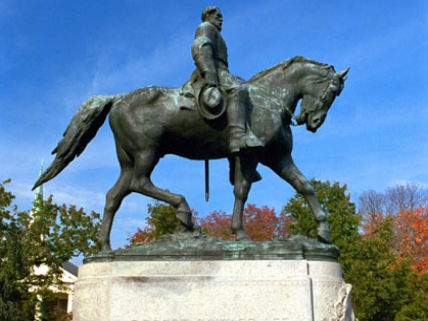
LeeStatueCharlottesvilleCHARLOTTESVILLE, VA—White-supremacist provocateur Richard Spencer showed up in my town this past Saturday to roil the debate over the city council’s planned removal of statues of Confederate Gens. Robert E. Lee and Stonewall Jackson. Spencer and a few score folks carrying flaming tiki torches gathered in Lee Park, a couple of blocks from my house, where they chanted, “What brings us together is that we are white, we are a people, we will not be replaced,” and “Russia is our friend.” Of course, Spencer and his associates have, as my Reason colleague Robby Soave points out, the constitutional right to their express their views in public.

Spencer and his supporters are, as usual, in the wrong. The time has come to remove from public land the monuments honoring the men who led the Confederacy to defeat. But doing so doesn’t mean we must then move on to purging slave-owning Founders or even memorials for dead southern soldiers. Looking back requires us to balance the good and the bad, and—on balance—Lee, Stonewall Jackson, and other Confederate leaders simply don’t make the cut.

Before delving a more deeply into the Confederate memorial controversy, let me set out my Southern bona fides. I was born Texas and reared on my family’s dairy farm in the Appalachian Mountains of Southwest Virginia. Our county schools were racially integrated in 1963 when I was in the third grade. My third grade Virginia history book referred to the Civil War as the War Between the States and asserted that that conflict was chiefly over state’s rights. Virginia Generals Lee, Jackson, and Stuart were portrayed as honorable and heroic defenders of Southern rights.

My high school’s team name was the Rebels and our fight song was Dixie. It was not uncommon to see the Stars and Bars being waved in stands during football games. It is, however, worth noting that in a school in which African Americans made up less than 10 percent of the student body, my class elected a black senior as our homecoming queen.

As a student at the University of Virginia in the early 1970s, I learned that many parts of the Commonwealth had not actually desegregated until 1971. At UVA I belonged to a literary and debating society whose members drank a great deal and often sang songs commemorating the Lost Cause including The Bonnie Blue Flag and Carry Me Back to Old Virginia, but also Yankee tunes like The Battle Hymn of the Republic.

I remained largely unconscious of how offensive Confederate symbols were to some people. That changed when my black roommate Dwayne Morris took a small Stars and Bars out of the coffee mug in which it was standing in our apartment, broke its staff in two and threw it in the trash. Several subsequent long boozy conversations ended any residual sentimental attachment to the Lost Cause that I may have retained from my earlier schooling.

Still, as a young Virginian I never gave much thought to what the Confederate monuments and memorials that appear in nearly every southern town represented. After Reconstruction, Ladies Memorial Associations (LMAs) in the South sprang up to advocate for and oversee the repatriation the remains of Confederate soldiers and to commemorate their deaths by erecting generic war memorial statues. Ultimately, the LMAs joined together for United Daughters of the Confederacy in 1894.

It is, however, plain historical fact, that most of those memorials to the Confederate dead and monuments to Confederate leaders were erected between 1890 and 1925 when Jim Crow racial apartheid was being established in the South. They were meant and served as powerful symbols of resurgent white supremacy. For example, the monument to Confederate President Jefferson Davis that was just taken down in New Orleans was dedicated in 1911 during a “Whites Only” ceremony featuring a living Stars and Bars formation that sang Dixie. (The Louisiana House of Representatives just passed a bill that would block the removal of Confederate monuments without a referendum.) In Charlottesville, the Lee statue was erected in 1924 and the Jackson statue in 1921.

Frankly, I don’t much worry about the generic memorial to the Confederate dead. They largely signify sorrow for the men who died in battle, an appropriate sentiment even if they died for a bad cause.

The monuments celebrating specific Confederate leaders are different. Here I turn to a perceptive distinction between monuments and memorials made by philosopher of art Arthur Danto. Cited by University of Richmond philosopher Gary Shapiro in a recent New York Times op-ed, Danto observed, “We erect monuments so that we shall always remember, and build memorials so that we shall never forget.” Monuments, Danto wrote, “commemorate the memorable and embody the myths of beginnings. Memorials ritualize remembrance and mark the reality of ends.” Obviously, monuments have multiple meanings, but the fame of Confederate leaders unavoidably implicates their tireless efforts to maintain millions in slavery.

Rather than remove the monuments to Confederate leaders like Lee, Davis, and Jackson, Shapiro would prefer to “contextualize” them, perhaps by including additional monuments celebrating those who resisted racism and Jim Crow. At the forefront of the crusade against Confederate monuments are many fierce proponents of political correctness. Given how much I loathe the shibboleths and moral grandstanding of contemporary purveyors of political correctness, Shapiro’s suggestion is initially attractive proposal, but ultimately insufficient.

In his insightful 2001 essay, “Old Times There Are Best Forgotten: The Future of Confederate Symbolism in the South,” in the literary journal Callaloo, Emory University English professor Lucas Carpenter notes, “Contemporary Confederate sympathizers want free use of Confederate symbolism because they say it represents their ‘heritage.’ It does, of course, but it is heritage chiefly characterized by its brutal oppression of slaves and their ‘free’ descendants. The most important thing to know about the South is that until recently it was a region ruled by slavery and apartheid.” If you think that Carpenter is overstating his case, contemplate for just a moment what your life would have been like had you been subjugated under Jim Crow.

Carpenter, whose ancestors fought for the Confederacy, argues that “the only circumstances under which a government-funded agency or institution should display Confederate symbols is when their use is required to identify historic sites or otherwise convey historical information.” Think Civil War battlefields, museums, and cemeteries. Carpenter, quite properly, asserts that the private display of Confederate symbols should not be suppressed by the state. After all, that would violate the free speech protections of the First Amendment. In the main, Carpenter, more or less, agrees with me that a Confederate memorial to the Civil War dead on a Southern town square can remain, but that “we must learn to see it as a reminder of what really used to be.”

Since there is no end to what can offend the politically correct, where does the iconoclasm stop? After all, some faculty and students at the university that Thomas Jefferson founded as the first secular university in the world are offended that its current president quotes him in emails. Why? Because the author of the Declaration of Independence was a slave owner. Slavery was a great moral evil, and one that Jefferson himself occasionally acknowledged. “Indeed I tremble for my country when I reflect that God is just, that his justice cannot sleep forever. Commerce between master and slave is despotism,” he wrote. “Nothing is more certainly written in the book of fate than that these people are to be free.”

How should we deal with the fact that many of the Founders were slave owners? Should the Jefferson Memorial and Washington Monument be torn down? Washington, D.C. and Washington State renamed? “The Founders deserve commemoration because the evil they did was outweighed by other, positive achievements, such as establishing the Constitution,” argues George Mason University law professor Ilya Somin. Once established in this country by the Founders, the logic of equal liberty became ineluctably extended to all individuals, no matter their race, creed, or sex. The Founders are rightly honored for creating a political system that over time enlarged the rights of its citizens.

I do believe that the vast majority of the folks who oppose removing and relocating Confederate monuments from public land sincerely do mean it when they say that they are defending “heritage, not hatred.” Nevertheless, Carpenter is right when he writes, “It is, quite simply, self-destructive for democratic governments to employ divisive symbolism.” No one is trying to “erase” Confederate leaders and the cause for which they fought from the historical record, but as Somin argues, “We should certainly remember them, and continue to study their deeds. We just should not honor them.”

from Hit & Run http://ift.tt/2rnSu53
via IFTTT

Dollar Slumps To 6-Month Lows As Stocks Do Something They Haven’t Done Since 1969

Anyone get the feeling we are at 45 seconds into this clip?


The Dollar is down 5 days in a row – today's drop is the biggest since Trump commented on the "too-strong" dollar two months ago. This move has now erased all the gains since the election…


This is the longest period of calm for the S&P 500 since 1969…


And that is happening as US macro data crashes to one-year lows… This is the biggest crash in macro data since March 2015


It appears we're gonna need more OPEC/Russia jawboning… (ahead of tonight's API inventory data)


and that weighed down stocks today…


NASDAQ outperformed (new record highs), Small Caps were panic-bid into the close and The Dow clung to unch… Buy The F**king Shitty Data Dip?

Who could have seen that coming?

Year-to-Date… presented with no comment…


Notably we dipped pretty hard in stocks after weak hoiusing data and McConnell comments sent the USD lower (USDJPY lower) but dip-buyers rejoiced..


VIX closed higher (marginally) as every effort was made to keep S&P above 2,400… The VIX range for the last 4 weeks has been 11.2 to 9.6 and S&P 500 range from 2380 to 2405.


The 17th day in a row that VIX closed below 11…NEVER HAPPENED BEFORE


Ford managed only modest losses despite announcing a 10% gutting of its workforce…


Treasury yields dropped – erasing yesterday's moves…


With 30Y back below 3.00% again…


EUR strength was the big drag on the USD index…


With EURUSD now at its highest since Trump was elected…


USD weakness spurred another up-day for precious metals (up 5 days in a row)…


via http://ift.tt/2pRXaia Tyler Durden

Facebook Refunds Some Advertisers After Admitting 5th Measurement Error

Fool me once…

For the fifth time since September, Facebook has come clean with an error in its advertising metric, and as The Wall Street Journal reports, is issuing refunds to some advertisers.

As Madison Avenue is demanding better and more transparent measurement from the social network, 'The' Social Network admitted in a blog post today that it had discovered a bug in its system that led it to overstate clicks on marketers' websites.

During our regular reviews to ensure the accuracy of our systems, we recently found and fixed a bug that misattributed some clicks on video carousel ads as link clicks. This bug occurred when people were on mobile web browsers on smartphones — not on desktop or in the Facebook mobile app.


The bug affected billing only for the following conditions: for the video carousel ad unit; when the advertiser chose to bid on link clicks; and only for people who were on smartphone web browsers. In these cases, instead of being billed only for link clicks (clicks to an advertiser’s selected destination), these advertisers were incorrectly billed when people clicked on the videos in the carousel to enlarge and watch them. Advertisers will receive a full credit for the charges they incurred for these misattributed clicks.


Most consumers use Facebook through the app on their phones, and mobile web browser ad impressions make up a small percentage of the overall ads impressions people see on Facebook. Given that this bug related to mobile web for smartphones only, and specifically for video carousel ads that bid on link clicks, the impact from a billing perspective was 0.04% of ads impressions. Regardless of how many impressions were affected, we take all bugs seriously and apologize for any inconvenience this has caused.

Only around 0.04% of the video carousel ads served on the mobile web were inaccurately billed over the time period Facebook was monitoring, the company said. Carolyn Everson, Facebook’s vice president of global marketing solutions, said the bug was uncovered as part of a recently introduced review process and the company is “committed to transparency” with its partners.

Finally, as WSJ notes, Facebook’s disclosure comes right in the middle of the annual U.S. television “upfront” season, when the biggest TV networks throw glitzy events and parties showcasing their programming in the hopes of securing billions of dollars in advertising commitments from marketers. It will play into the narrative among media executives that TV offers a safer and more predictable environment for marketers than digital platforms.

Unilever , the consumer packaged-goods giant that owns brands such as Dove and Hellmann’s, was one of the advertisers affected by the latest error and is receiving a full, but small, refund. Keith Weed, Unilever’s chief marketing and communications officer, said Facebook had been proactive to address the bug as quickly as possible, but that it nonetheless highlights the need for more transparency and third-party verification in the digital space to track both advertising effectiveness and that advertising transactions are working as agreed.


Mr. Weed added: “It highlights once again that while there has been progress there is still further improvement needed.”

Especially as click-farms grow…

via http://ift.tt/2rnKwsE Tyler Durden

Height Securities Begins Contemplating “Impeachment”: Here’s What To Look For

After the latest diplomatic scandal involving Donald Trump, which unleashed a frenzy of allegations that Trump is either a traitor or too dumb to govern for sharing allegedly confidential data to the Russian foreign minister, the angry response by Democrats – many of whom now demand hearings, transcripts, or worse – was predictable. What was unexpected was the loud criticism by some very prominent republican senators.

Earlier today, Sen. John McCain said that allegations Trump shared highly classified information with top Russian officials are “deeply disturbing,” and added that “regrettably, the time President Trump spent sharing sensitive information with the Russians was time he did not spend focusing on Russia’s aggressive behavior, including its interference in American and European elections, its illegal invasion of Ukraine and annexation of Crimea, its other destabilizing activities across Europe, and the slaughter of innocent civilians and targeting of hospitals in Syria,” he said.

He was not alone, joining other Republicans who voiced similar criticism about Trump’s actions in the Oval Office. One was Sen. Susan Collins who said earlier Tuesday that the Senate Intelligence Committee needs to be briefed on the report.  Sen. Ben Sasse told MSNBC that “It’s not helpful that this was with the Russians, right? I mean this is just weird.”

Senator Bob Corker was even more blunt, saying the White House is “in a downward spiral right now and have got to figure out a way to come to grips with all that’s happening. You know, the shame of it is there’s a really good national security team in place and there are good productive things that are under way through them and through others, but the chaos that is being created by the lack of discipline is creating an environment — it creates a worrisome environment.”

It was the harsh Republican response that prompted Height Securities’ Peter Cohn to write a note to clients on Tuesday that Trump’s recent conduct “raises questions for investors about whether senior Republicans will abandon ship.

Cutting to the chase, Cohn writes that ending Trump’s viability as president “depends on Republicans turning against him”, as impeachment proceedings can only begin with the majority party, and the 25th Amendment (allowing for president’s removal when unable to discharge powers/duties of his office) can only be invoked by Congress and/or vice president, majority of Cabinet.

What will Height be closely watching to see if the Trump drama enters a potentially terminal phase: the main catalyst is whether Sen. John McCain, chairman of Armed Services Committee, begins calling for Trump’s resignation, as U.S. national security issues may increase concern among Republican voters.

Cohn also says to closely watch other senators for even a faint trace of statements and speeches that can be parsed for any signs of throwing Trump “under the bus” as these will be a trial balloon for group sentiment toward Trump.

That said, The Height analyst sees immediate fallout on domestic policy agenda as limited for now as the issues raised by Trump’s “cavalier” disclosures are separate and unrelated to tax reform and Obamacare repeal/replace, which have represented Republican agenda for years prior to Trump’s candidacy and it is unlikely they’d abandon measures because of unrelated grievances about Trump’s handling of national security matters.

Should republicans increasingly voice displeasure with Trump, however, it will be a different story.

via http://ift.tt/2pTJrHb Tyler Durden

“Forget What You Think Know”, Fund Manager Advises “Trade Your Emotions, Not The Facts”

We're constantly told that we should learn from every experience, but stick around long enough (like the last 10 years of rigged markets) and you realize that there are some things it's better to forget.

The issue, of course, as Richard Breslow, former FX trader and fund manager who writes for Bloomberg, are you taking away the right lesson?

Garbage in and garbage out is no way to improve yourself. And you actually won’t become a better investor, if your thesis is based on it’s better to be lucky than smart.


It's a world where you thought you had dodged any weekend missteps and could get on with the week's business as Monday booted off. Only to wake this morning to "Aides Race to Limit Fallout." And it almost ceases to matter what it's about this time. So the lessons you need to keep learning is what traders care about here and now and lean on those biases. Flavor of the moment trumps grand design.


People have decided that it's Europe's turn to shine. Yes, there is that Italian election, but it's not soon and political crisis fatigue has most definitely settled in. Not to mention, the Germans are suddenly talking uncharacteristically nice.


I suspect that one has a sell-by date worth considering. The euro is trying to act the safe haven. Which makes it a buy on dips. Better growth is getting much more headline space than unemployment and structural mayhem. For the nonce Investors are just not ready to abandon bond markets. And no one’s been more bemused than me. It doesn’t matter how many theoretical discussions you have about term premia and central bank balance sheets. Don’t take my word for it. Sovereign and IG issuance continues with a flourish, yet yields have gone nowhere and buyers are plentiful.


The big story today hasn’t been supply concessions. It’s all about peripheral spreads coming in versus bunds. Until the U.S. 10-year closes safely above 2.43%, I can’t see the risk reward in even beginning to hate them. Go figure.


The yen has gone from the easy risk-on or off- trade to tricky. As equities were making record highs, USD/JPY was busy putting in multiple days of lower highs and lows. Even as the commentary kept running to “snaps higher” on take your pick. It’s trying to break the recent pattern today, but it’s early. Worth a gander.

For what seems like forever we’ve been talking about oil and commodities collapsing. Fracking, an utterly dysfunctional OPEC, weakening China, are among the reasons cited from the alarmists out in force. In the last week we heard just the opposite. With just as much conviction. Take a look at the charts. We are classically inside very well defined ranges. Skip the drama, trade the charts. They may be the only friend you have.

Equities investors are acting like the last honest man in town. Couldn’t care less about politics, geo or domestic. And aren’t ashamed to admit it. Give ’em tax cuts and deregulation and they’re happy. Throw in repatriation holidays to fund buybacks and they’re ecstatic. Add the sovereign wealth funds and they won’t even give you a dip to buy.


Earnings per share is as outdated a concept as value investing. It is what it is, until it ain’t.


One glimpse at the following chart of world stocks and that is clear…

As Breslow concludes – The world is becoming an increasingly emotional place. To an extreme. Right now, play on those emotions, not the facts.

via http://ift.tt/2pTHiuW Tyler Durden

Top Hedge Fund Manager Pay Tumbles To Lowest Since 2005

Last week news emerged that as a result of the deteriorating local economy, coupled with a plunge in hedge fund profits, the capital of Connecticut – Hartford – was preparing for bankruptcy. Among the reasons cited by Department of Revenue Services Commissioner Kevin Sullivan was that wealthy people are dramatically less wealthy than they were before.”

It turns out that, at least relatively speaking, he was correct.

According to the latest annual ranking by Institutional Investor’s Alpha magazine, the woes that have plagued hedge fund LPs who have paid 2 and 20 (or 1 and 10 as the case may ) for seven consecutive years of market underperformance have finally spread to management and in 2016 the 25 top paid hedge fund managers made a combined $11 billion. Although that sounds like a lot, it’s actually the lowest total since 2005, when the top 25 earned just $9.4 billion. It’s also just a little over half of what the top 25 managers earned just three years ago, when they reaped a total of $21.2 billion.

The average top earner made $440 million in 2016. The median earner made $250 million, the lowest since 2011, when the median earner made $235 million.

Surprisingly, even in 2008, when the stock market and many hedge funds were down by large-double-digit percentages, the highest earners made more money as a group: $11.6 billion.

To qualify for the top 25 this year, managers needed to earn “only” $130 million, the lowest floor since 2011, when a manager required $100 million to make the list. Last year’s comparatively lower numbers underscore the  dichotomy of the hedge fund industry in 2016.

And while data scorekeepers like HFR talked up the fact that the average hedge fund had its best year since 2013, that does not accurately portray what really happened on a fund-by-fund level. Rather, there has been a group of managers that enjoyed strong double-digit gains last year. However, looking beyond this top-performing group reveals that a significant proportion of the largest hedge fund firms – those whose principals are more likely to make the most money – either suffered small losses or eked out low-single-digit gains.

As has been the case in recent years, in 2016 compensation was led by the quants who have been least impacted by the death of fundamental analysis in a centrally-planned market. 

RenTec’s James Simons topped the table for the second year in a row, earnings $1.6 billion, down only $100 million from the previous year, after his two main funds posted double digit returns. In second place was Bridgewater’s Ray Dalio, which manages around $160bn in assets for 350 institutional clients, with earnings of $1.4 billion.  As the FT notes, the popularity of the computer-driven funds helped the quants rack up their eighth consecutive year of inflows in 2016, doubling their assets since 2009 to $918 billion, according to Hedge Fund Research.

After the top two earners, the ranking amounts drop considerably: two more quants filled out the third and ourth spot: Two Sigma founders John Overdeck and David Siegel, who each made $750 million. Last year their Compass Fund rose by double digits. Continuing a trend from the previous year, quantitatively focused firms, so called because they mostly or totally rely on computers to make their investment decisions, were among the big winners in 2016. The four highest earners on this year’s ranking hail from quant firms.

A total of13 managers from last year’s “Rich List” are among the top 25 earners this year; with several of qualifying even though they posted their worst results in several years. They include Kenneth Griffin of Citadel, the top earner in last year’s ranking, who slipped to 6th place after his total earnings fell by about 65%. In 2016, Citadel’s main multistrategy funds, Wellington and Kensington, rose a little more than 5 percent, their smallest gain in eight years.

Notably, some of the best-known names in the industry, including Bill Ackman, John Paulson and Eddie Lampert failed to make the list.

Among those missing in the Top 25 this year but qualified for last year’s top ranking, four are from firms headed by so-called
Tiger Cubs that lost money on their long-short funds in 2016.
They include Chase Coleman of Tiger Global Management, Andreas Halvorsen and Daniel Sundheim of Viking Global Investors, and Stephen Mandel Jr., of Lone Pine Capital. As a result, this
is the first time since 2010 that no one with ties to Julian Roberton’s Tiger Management qualified for
the top 25 ranking. 

Just to put these earnings in context, even the lowest-ranking manager on Alpha magazine’s expanded top-50 list made more money in 2016 than any big United States bank executive, including Jamie Dimon of J. P. Morgan, Lloyd Blankfein of Goldman Sachs and James Gorman of Morgan Stanley, all of who have been criticized for their big paychecks.

via http://ift.tt/2rcVP9y Tyler Durden

Manufacturing Resistance – The American Public is Being Manipulated Into Irrelevance

No honest person could accuse me of being a Trump fan or supporter. I refused to back his candidacy despite my total disdain for Hillary Clinton and pretty much everything she stands for. More importantly, I’ve written a multitude of articles since he was inaugurated severely taking him to task on a wide variety of subjects. I’ve tirelessly discussed how he’s outsourced his economic policy to Goldman Sachs, and condemned his burgeoning neocon foreign policy, evidenced by his disturbing coziness with the autocratic barbarians of Saudi Arabia.

Nevertheless, the most incredible aspect of the past four months is not how much of a fake populist Trump’s proven to be, but how the corporate media has managed to disgust me even more. I’m happy to become outraged at Trump, because I find many things about Trump to be outrageous. That said, I find it telling that the stuff about Trump that outrages me, is never the same stuff which outrages the corporate media. Why is that?

The reason is the corporate media doesn’t mind Goldman Sachs running U.S. economic policy. It also doesn’t mind a close alliance with the terrorist state of Saudi Arabia, or our government’s endless string of disastrous neocon wars abroad. In fact, when it comes to the latter, the corporate media is reliably the primary cheerleader for unprovoked militarism.

continue reading

from Liberty Blitzkrieg http://ift.tt/2pRt5PU
via IFTTT