Oil Headline Rescues Stocks From Bloodbath As Precious Metals Soar

Market Psychology has swung from this…


To this…Losing SPY Religion


And seemingly back.

*  *  *

Gold grabs the headlines today. After beginning to surge yesterday, Hong Kong's reopen sparked a spike which then accelerated all day.


This was gold's best day since Nov 2008 and the highest level in a year…


With the best quarter in 30 years…


Perhaps even more stunning is the collapse in USDJPY since Kuroda unleashed NIRP – this is the worst 2-week drop (Yen strength) since LTCM in 1998…


Damn It, Janet!


It seems much of today's turmoil began as Hong Kong re-opened last night…


An OPEC Rumor – which struck perfectly as the S&P broke 1812 – a crucial technical level (January's intraday low back to Feb 2014)… And just look at VIX!!! Does that look like a "normal" market?


Spiked stocks briefly (enabling NASDAQ to briefly get green before dropping), and the soared again…


Techs managed to scramble green in the last hour but financials were the biggest loser…


Deutsche Bank's dead-cat-bounce died and is back to tracking Lehman's analog…


And it is spreading to US banks – Sub financial credit risk is up 18% this week – the worst week since at least 2011…


Treasury yields crashed overnight – 2Y was down 10bps and 10Y down 20bps at its apex, before a miraculous bid for USDJPY appeared and rescued risk…


The yield curve (2s10s) collapsed even further below 100bps – to Dec 07 lows near 95bps at its lows today – leading financials lower…


The last time 2s10s was flattening and at these levels was Jan 2005


FX markets were volatile early on (with a huge drop in USDJPY when HK opened) and the USD drifted weaker…


The biggest 2-week drop in USD Index in 4 years…


Crude and Copper slumped as Gold & Silver surged…


As front-month crude plunged relative to 2nd month crude to 5 year lows..


Charts: Bloomberg

Bonus Chart: If everything is awesome, why is USA default risk on the rise?


via Zero Hedge http://ift.tt/20YgPd6 Tyler Durden

This Is What Central Bank Failure Looks Like (Part 3)

First, it was The BoJ’s utter collapse from omnipotence to impotence. Then came the collapse of The Fed’s credibility in the short-term. And now, in the most egregious example of total central bank failure – the ‘market’ has priced out any chance of a rate hike through 2018… and in fact, there is now a greater chance of a rate-cut (than rate-hike) into 2017.

Based on the Eurodollar market…


And while some hoped that Janet would clear it all up in 2 days of testimony, she just made it worse:

  • YELLEN: OUTLOOK HASN’T SUFFICIENTLY SHIFTED TO WARRANT RATE CUT


via Zero Hedge http://ift.tt/1Tbirha Tyler Durden

Is This The Biggest Crisis In History?

Talking of Oil and Gold, last week Deutsche Bank showed a long-term graph of Oil in real adjusted terms, showing that the average real price since 1861 was $47.

Following on from that, Deutsche notes one ratio they occasionally look at is the ratio of various assets to the price of Gold…

Today we update the Oil/Gold ratio back to 1865 and find that the Gold price has just hit an all time high at around 44 times the price of Oil.


The previous high of 41 in 1892 has just been exceeded.


For perspective, the ratio was at 6.6 in June 2008 and only 12 in May 2014. The long-term average is 15.5. While this says nothing about where the ratio is going in the short-term surely this looks a good trade to exploit over the longer-term for those who care about such things.  

However, as we noted recently, it merely predicts a crisis and according to the chart above it is the biggest crisis in history…


The previous “biggest crisis in history” was in 1893 when a serious economic depresion hit America. We just topped that in terms of the gold/oil “crisis” ratio, making us wonder: what crisis is just around the corner, and just how big will it be?


via Zero Hedge http://ift.tt/1WgJJBZ Tyler Durden

Oregon Refuge Occupation Ends, Cleveland Apologizes to Tamir Rice’s Family, Congress Approves Internet Tax Ban: P.M. Links

Follow us on Facebook and Twitter, and dont forget to sign up for Reasons daily updates for more content.

from Hit & Run http://ift.tt/1TfcOjk
via IFTTT

Sonia Sotomayor’s Inconsistent Defense of the Bill of Rights

“There is a place, I think, for jury nullification.” So said Supreme Court Justice Sonia Sotomayor in a talk this week at New York University Law School. As my colleague Jacob Sullum pointed out in response, jury nullification can be a good thing from a libertarian point of view, as it means “that jurors sometimes should consider information that the judge considers irrelevant. In a drug case, that information might include the stiff mandatory minimum awaiting the defendant, the defendant’s medical or religious motivation for violating the law, or the arbitrary disparity in punishment between crack and cocaine powder offenses.”

This is not the first time that Justice Sotomayor’s legal views lined up with those of libertarians. In her November 2015 dissent in Mullenix v. Luna, for example, Sotomayor faulted her colleagues on the Court for “sanctioning a ‘shoot first, think later’ approach to policing [that] renders the protections of the Fourth Amendment hollow.” Earlier that same year, during oral argument in Rodriguez v. United States, Sotomayor lectured a Justice Department lawyer on why “we can’t keep bending the Fourth Amendment to the resources of law enforcement.” It was a moment to warm even the coldest of libertarian hearts.

Yet Sotomayor is not always so constitutionally vigilant. During the same 2015 SCOTUS term, for example, the justices heard the case of Horne v. United States Department of Agriculture. At issue was the USDA’s attempt to force a pair of California raisin farmers named Marvin and Laura Horne to surrender a portion of their raisin crop each year to federal authorities for the purpose of creating an “orderly” domestic raisin market. The central question before the Supreme Court was whether the government’s attempt to confiscate those raisins (or their cash equivalent) counted as a taking under the Fifth Amendment, which requires the payment of just compensation when the government takes private property for a public use.

“Sounds like a taking to me,” observed Justice Stephen Breyer during oral argument. And Breyer was not the only one who thought so. The Court ultimately ruled 8-1 that the government’s attempt to take raisins qualified as an attempt to take raisins. Only Justice Sotomayor agreed with the USDA’s claim that the Fifth Amendment had no bearing on the matter because the case did not involve any sort of taking at all. “The government may condition the ability to offer goods in the market on the giving-up of certain property interests,” she asserted in her dissent. So much for not bending the Bill of Rights in favor of the government.

Justice Sotomayor is often a welcome voice in defense of civil liberties and the Fourth Amendment. Too bad she can’t seem to muster the same respect for the Fifth.

from Hit & Run http://ift.tt/1Ru2QcE
via IFTTT

It Was Never About Oil, Part 2: It Was Always Leverage & Volatility

Submitted by Jeffrey Snider via Alhambra Investment Partners,

Part 1 here…

The entire point of leveraged positions is the margin of safety. That is true on both sides of that equation, as for the provider and the borrower/user. In the most famous examples of collapse, from AIG to LTCM losses were never really the issue. None of them could withstand instead collateral calls to their liquidity reserves. As noted last week, AIG’s “toxic waste” positions ended up registering some $20 billion profits to the Federal Reserve and the government via its (illegal) Maiden Lane SIV’s. AIG just could not withstand the liquidity demands brought about by increasing calculated volatility.

Another famous episode offers the same interpretation while providing some further insight into the world of leverage and liquidity as it exists now. Orange County went into bankruptcy with assets that were all still money good. The county’s investment fund, run by Robert Citron, was holding paper from mostly government agencies and even UST’s. Out of the nearly $20 billion in the fund close to its demise, $16.7 billion was UST’s, agency fixed rate bonds, agency floating rate bonds, CD’s and commercial paper. The problem was the combination of the floating rate FNMA’s and that the fund was increasingly leveraged as Citron’s bets were further imperiled.

Throughout the early 1990’s, Orange County’s fund was handsomely beating every benchmark. So much so that municipalities throughout the county were beating down Citron’s door in order to invest in his magic; some cities, such as Irvine, even borrowed through bond offerings just to make available cash to put in. S&P, as the bankruptcy transcript tells, even conditioned its highest investment rating on Irvine’s bonds such that they were placed in Citron’s “care.”

The manner of the outperformance was as it usually is in modern wholesale finance; available and easy leverage of all kinds and all forms. In this specific instance, Citron was building the fund’s bond portfolio not for general coupon returns but so that they were available for reverse repos. When the interest rate environment was in his favor, the Orange County fund was leveraged less than 2 to 1; when it started turning against, that was when the leverage piled up as almost a gambler’s view of doubling down to “make it back.”

As it turned out, even though Citron’s broker Merrill Lynch had warned him about both the increasing volatility risk of an increasingly homogenous portfolio and that interest rates might rise, Citron continued on his course regardless of the advice (and Merrill kept selling securities to him and funding those positions). Later grand jury proceedings even found evidence that Mr. Citron was using a “mailorder astrologer and a psychic for interest rate predictions.” He was, starting in 1994, quite wrong with those predictions.

Still, the fact that rates had gone up even sharply did not alone produce catastrophe; there were no losses to book based on credit defaults or skipped coupons in any of the underlying. The “inverse floaters” at the center of the controversy were simply designed as a mechanism for FNMA to reduce or hedge its own funding costs in the event of conditions just the kind produced by the Fed’s rate hikes in 1994.

The inverse floating rate notes integral to Citron’s strategy for leveraged outperformance were agency coupon bonds that reset them regularly by LIBOR. In December 1993, the fund held approximately $100 million inverse FNMA floaters maturing in 1998, offered in reverse repo to Credit Suisse First Boston as collateral on $100 million funding (I haven’t seen anywhere descriptions of any haircuts, so it may just be or have been assumed 1 to 1). That was not the full extent of the leverage, as the bonds were repledged to total something like 3 to 1 leverage in other funded positions. All told, there were about $800 million in FNMA floaters that spearheaded the fall from grace.

The coupon of the floaters varied inversely to the volatility of LIBOR. The coupon rate is set as the initial payment rate minus some LIBOR spread, meaning that any increase in LIBOR reduces the coupon payments. For FNMA, it is funding protection; for Orange County and Citron, the bonds paid typically a much higher initial rate and in some cases might increase (up to a preset ceiling). The lowest possible rate was, conversely, 0%.

Because of this structure, the convexity of the bond is enormous, particularly when compared to the change in value of any fixed rate investment. In January 1993, the coupon on the FNMA 1998’s was 8.25%, but by 1994 the coupon rate was cut all the way to 2.3% and perhaps, via volatility calculations, on its way to zero. That didn’t mean that the bonds would default as they were agency paper, only that the current value of them would fall precipitously with the reset coupons being so far below the “market” interest rate.

If there had been no leverage involved, Citron’s run as something of a “guru” would have ended but at least not in a prison sentence; it would have continued in underperformance but absent loss as at maturity, in every underlying bond, principal would have been returned in full. As it was, given the repos, the current values of the securities pledged as collateral matters more than whether those prices actually mean credit losses or not. The more “sensitive” to changes in prices the larger the adjustments that will be made as volatility rises. For Orange County, the floaters that were pledged in reverse repos meant collateral calls and then eventually collateral seizure when prior demands for additional collateral were not met. Bankruptcy was the only means to stop the seizures (it was alleged), and even then banks viewed it within their rights to liquidate what they could at current (depressed) prices.

Thus the huge losses for Orange County were really produced because the fund could no longer fund itself; once liquidated, the assets were about $1.64 billion less than total liabilities including the nearly 3 to leverage employed near the end. For the overall fund of $20 some billion, even then $1.64 billion isn’t huge except that the underlying “equity” was just $8 billion.

It is not just a tale of woe and a lesson about the nature of leverage, it speaks to the nature of the whole idea of wholesale finance. Banking is no longer about lending and boring loans, it is about leveraged spreads and leveraged capital and leveraged capacity. When leverage is plentiful and in all types, there is great profit on all sides; from those doing the “investing” to those providing the funding and the advice. That is what built the eurodollar system before August 2007, the idea of plentiful leverage not just in repos and funding, but also in capital ratios and regulatory leverage provided by accounting rules (gain-on-sale for one) and math-as-money. The major conduit through which it all flowed was proprietary trading, where banks would mingle all sides of the leverage equations – as “investors” holding securities (in warehousing) and then testing the line of what might count as “hedging” those positions (which so often drew into outright speculation).

With all these avenues for profit available, it was simply accepted (and modeled in ridiculously low volatility) that it would continue forever and ever. And if recession were to result and interrupt the leverage festival, it was assumed the “Greenspan put” would work enough to keep it mild and temporary as was the case in 2001 (stocks may have suffered, but even the credit cycle did not interrupt the mortgage boom and eurodollar “hot money” pushing into every EM with access to the global financial network). It was the fatal flaw in the whole thing, assuming little or no volatility.
SABOOK Feb 2016 Never About Oil Money to Economy GR Eurodollar Decay

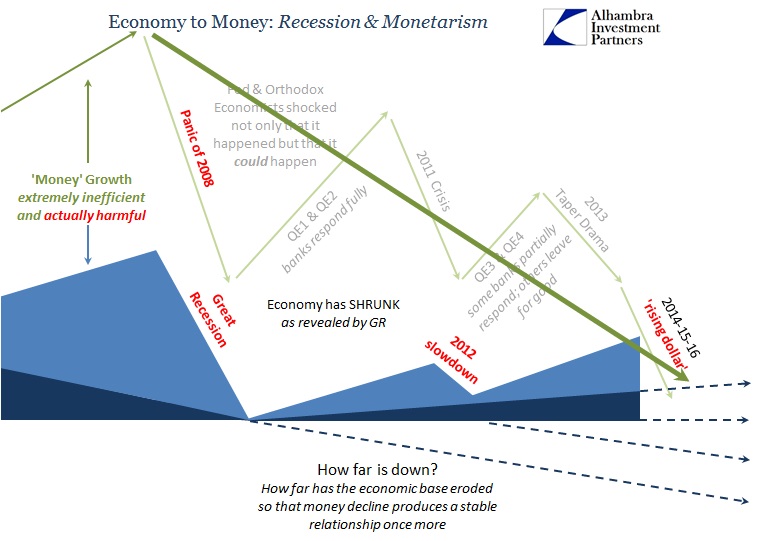
Without free flowing leverage on all sides, money dealing profits simply dried up. Banks have tried to make the most of it in the various QE’s and intermittent circumstances, but for the most part the world as it existed before 2008 just cannot be rebuilt. Again, it wasn’t losses so much as math (recalculated, post-crisis, volatility and “capital” efficiency that systemically sapped leverage capacity especially as reinforced by the events of 2011). It was, like Citron’s game, all an illusion based upon “perfect” circumstances that will never be repeated. It might have been possible had a real recovery started after the Great Recession was over, given enough time of a full and robust fundamental rebound, but as I wrote yesterday, that, too, was an illusion predicated on the lie of orthodox economics and the Phillips Curve view of economic potential.

Without leverage there is no money dealing, and without money dealing there will only be increasing volatility (leading to less leverage and so on). Some banks, such as UBS and Wells Fargo, worked that out early on; others, like Deutsche, Credit Suisse and Goldman Sachs, saw the potential rebirth of pre-crisis wholesale in Bernanke’s/Yellen’s fairy tale ending for QE and ZIRP. Like Citron’s psychically-derived interest rate forecasts, it was just a terrible idea and all the more so as leverage conditions have only worsened and worsened.

The difference now is, obviously, that EM debt and US corporate junk (including leveraged loans) are the center of the current and gathering liquidity storm. We might likely never know exactly what those banks have been doing, but through examples like AIG and Orange County we can see the destructive capacity and potential of volatility no matter if ever the credit cycle truly blasts apart this time – it is never losses that do it; it is illiquidity and lack of margin of safety. In the case of these particular banks though, there is a ready feedback that plays directly into quickening the process – they are both leveraged in their holdings and activities but also suppliers into those “dollar” conduits. It’s as if Orange County were not just reverse repo counterparty borrowing cash for its own portfolios but also then providing a good part of that cash or financial resources to the next guy. That is really what scared the Fed and the Treasury in 2008 into TBTF; which, of course, has only gotten worse over the intervening years.

I think that explains somewhat the trajectory of the eurodollar decay past the panic; that initially leverage restraint (including and especially collateral shortage) as compared to pre-crisis meant the downward baseline to begin with. Since 2013, increased volatility has only quickened that pace in the same manner as we have seen in all sorts of prior episodes. Again, some firms instead doubled down and are being undressed especially recently, which will only make it all the more difficult further on.

Restoring the eurodollar system as it was just wasn’t possible. That is why the collapse in oil and commodities is especially relevant as a signal about leverage and hidden liquidity capacity that otherwise goes unnoticed. The “thing” that made the eurodollar appear to work and work so well (at least as it was rapidly expanding to ridiculous proportions, in both quantitative and qualitative terms) were these artificial channels of leverage flow and capacity; the same kinds of ideas and “products” that made Robert Citron a hero are no different than what eurodollar banks had been up to all throughout their structures before the final reckoning in 2008. That might be the most important point about unwieldy and unconstrained leverage, that there is always an endpoint and then the cleanup.

Unfortunately, we remain stuck in the cleanup phase so long as economists and their ability to direct policy continue to suggest the Great Recession was anything other than systemic revelation along these lines; a permanent rift between what was and what can be. It is and was never about oil; only now that oil projects volatility into the dying days of eurodollar leverage.


via Zero Hedge http://ift.tt/1KemVSO Tyler Durden

Putting It All Together: When Does The Junk Bond Sell Off End, And When Should One Buy

UBS’ chief global credit strategist Matthew Mish has been on a roll lately. After first revealing “how the investment grade dominos will fall” in mid January (an analysis which was followed by another leg lower in IG bond prices), and then two weeks later instead of focusing on products, Mish analyzed sectors and explained “What’s The Next ‘Energy’ Sector In Credit Markets“, today he tries to put it all together and as he himself puts it, “the inquiries we have received are increasingly from investors across all asset classes and regions, and lines of questioning evolve in many directions. But the genesis of the debate comes down to three questions: first, why is the sell-off happening; second, when does it end; and third, what can slow or speed up the process?

We are certain that these are the questions asked by every single credit investor, so without further ado, here are Mish’s answers.

What is the clearing level for $1tn in stressed credit?

First, why are HY credit markets wilting? For non-credit investors the simple analogy is a balloon. The air going into the balloon was essentially inflows into credit funds. Our prior work suggests inflows have been driven by three factors: quantitative easing, credit losses and past performance. From 2010-2014 the environment was extraordinary; at its peak, the Fed was buying roughly $1tn annually in fixed income securities, crowding investors into corporate credit; defaults were low as capital markets were accessible and earnings were expanding, and prior HY returns were unprecedented. The money poured in, and credit funds put that cash to work. However, that mirage has faded; the Fed is tightening policy, defaults are rising due to commodity price declines and excessive leverage, and past performance has been negative. Outflows are triggering forced selling across real money and hedge funds.

However, the problem is not simply technical. The root cause is fundamental in nature. During that period of euphoria, credit portfolio managers were essentially forced to buy the market. The inflows were too robust. In that environment, fundamental credit analysis became secondary. Clients had yield targets to achieve, and with central banks pushing interest rates towards zero those that bought high grade credit in prior decades bought high yield; those who purchased high yield previously bought triple Cs. Unfortunately, investors were being compensated in a fairly linear fashion across IG, HY and CCCs. Later in this period a few hundred basis points was the yield differential between IG versus HY and HY versus CCCs (Figure 1). But realized defaults increase at an exponential rate when one moves from IG (Aa, A, Baa) to HY (Ba, B, Caa, Figure 2).

* * *

Second, when does the credit sell-off end? Unfortunately, we believe the answer to this question is complicated – complicated in that traditional models may not provide a perfect guide. Models always work better in than out-ofsample, but model risks increase when there is a structural or paradigm shift. In the current environment, there are at least two possibilities. First, the level of dispersion in US high yield between commodity and non-commodity industries is quite extreme by historical standards. Second, the lower quality segment of the high yield (and all leveraged credit markets) is undergoing a structural shift in that the proverbial balloon is no longer inflating, but deflating. Capital is wounded and illiquidity is complicating an exit as the saying goes ‘fool me once, shame on you; fool me twice, shame on me’. A new marginal buyer is needed. And the overwhelming majority of potential new buyers we speak with are fundamentally pricing lower quality risk through the cycle (or restructuring process) and under the assumption this debt is illiquid.

In our 2016 US high yield outlook we posited there is one central question that will dictate the outlook for high yield: will credit markets be able to absorb refinancing needs of almost $1tn stressed and distressed credit. And we continue to believe this should be THE debate in the market. In our view, if the lower quality rung of the market cannot stabilize the balance of risks is for contagion to spread further. So what is the clearing level for what we believe is upwards of $750 – 1tn in stressed credit? First, investors will require compensation for loss risks; cohorts of triple Cs typically experience 5yr cumulative default rates of 55 – 65% near the end of the cycle, implying half of the universe defaults before the end of year 5 and no longer pay coupons. Assuming recovery rates of 35% an investor should require roughly 12% yield to compensate for loss risks alone. What about mark-to-market and liquidity risks? While triple C bonds are trading on average in the low $60s, investors will likely need to stomach a further decline later in the cycle. Historically, triple C prices bottomed in the $40 – 50 range, so potential MTM declines could be significant (Figure 3).

Further, although our prior analysis assumes hold-to-maturity, investors will need to be compensated for the fact that illiquidity may prevent them from selling when needed. Bottom line, our conversations with investors suggest yields in the 20 – 25% context could be attractive enough to draw in marginal capital – although several investors noted that is reasonable for triple C risk excluding commodities. In short, we’re not there yet.

* * *

Third, what reverses or speeds up the process? We would reiterate the primary drivers of fund flows are credit fundamentals and central bank policy. Higher commodity prices would ease, albeit not remove, default concerns. Better-than-expected earnings could also help sustain excess leverage on corporate balance sheets. And aggressive monetary policy – that which could conceivably push investors back into lower rated credit – could extend the cycle. And the reverse is also true in both cases.


via Zero Hedge http://ift.tt/1SKKRQM Tyler Durden

Even WSJ Admits OPEC Production Cut Story “May Be Bogus”

He hope we are not the only ones who find it oddly confusing that moments after the WSJ reported that the UAE, supposedly speaking on behalf of the Saudis, said OPEC is “ready to cooperate on a production cut”, the very same WSJ writes that the “story may be bogus.”

From the WSJ:

Look, the OPEC thing may turn out to be bogus. Lord knows we’ve heard that line too many times to count, and oil’s at $26/barrel. Even if it is bogus, though, the episode illustrates one thing: there is still a sizable contingent of operators out there just waiting for an excuse to pounce on equities.


In other words, we still are not near capitulation.

Yes, it may very well be bogus, and no, it has nothing to do with operators pouncing, and everything to do with the latest violent short squeeze, one which was accelerated by frontrunning algos which swept away all the offers for minutes, sending the Nasdaq briefly into the green.


The WSJ also adds the following walkback:

It’s not that I think somebody planted a rumor, mind you. I’m not saying the news is wrong or that it’s being misreported. I just think that we hear this kind of talk out of OPEC a lot.


“We’ve heard this chatter enough times over the past month so take it with a grain of salt,” said Lindsey Group’s Peter Boockvar.


They have a notorious history of “agreeing” on cuts and quotas, and then going behind each other’s back and doing whatever is best for individual states.


It’s best to wait until OPEC actually does something on this front, and then to wait and see if they honor it. In other words, we’re a long way away from anything really happening here.

We expect the Saudis to chime in momentarily and explain how everyone got punked by the latest “OPEC headline” for the 6th time.


via Zero Hedge http://ift.tt/1mvjaN2 Tyler Durden

Video of the Day – See What Happens When College Kids Face Microaggressions

If you’ve had enough of the pc police on college campuses and need a good laugh, this video is a must watch.

Brilliantly done.

For some of my previous thoughts on college cry bullies, see:

continue reading

from Liberty Blitzkrieg http://ift.tt/1QuHgjg
via IFTTT