1 In 4 Cars Sold Globally Is An Electric Vehicle

1 In 4 Cars Sold Globally Is An Electric Vehicle

Electric vehicle adoption continues to accelerate worldwide, reaching new milestones in 2025.

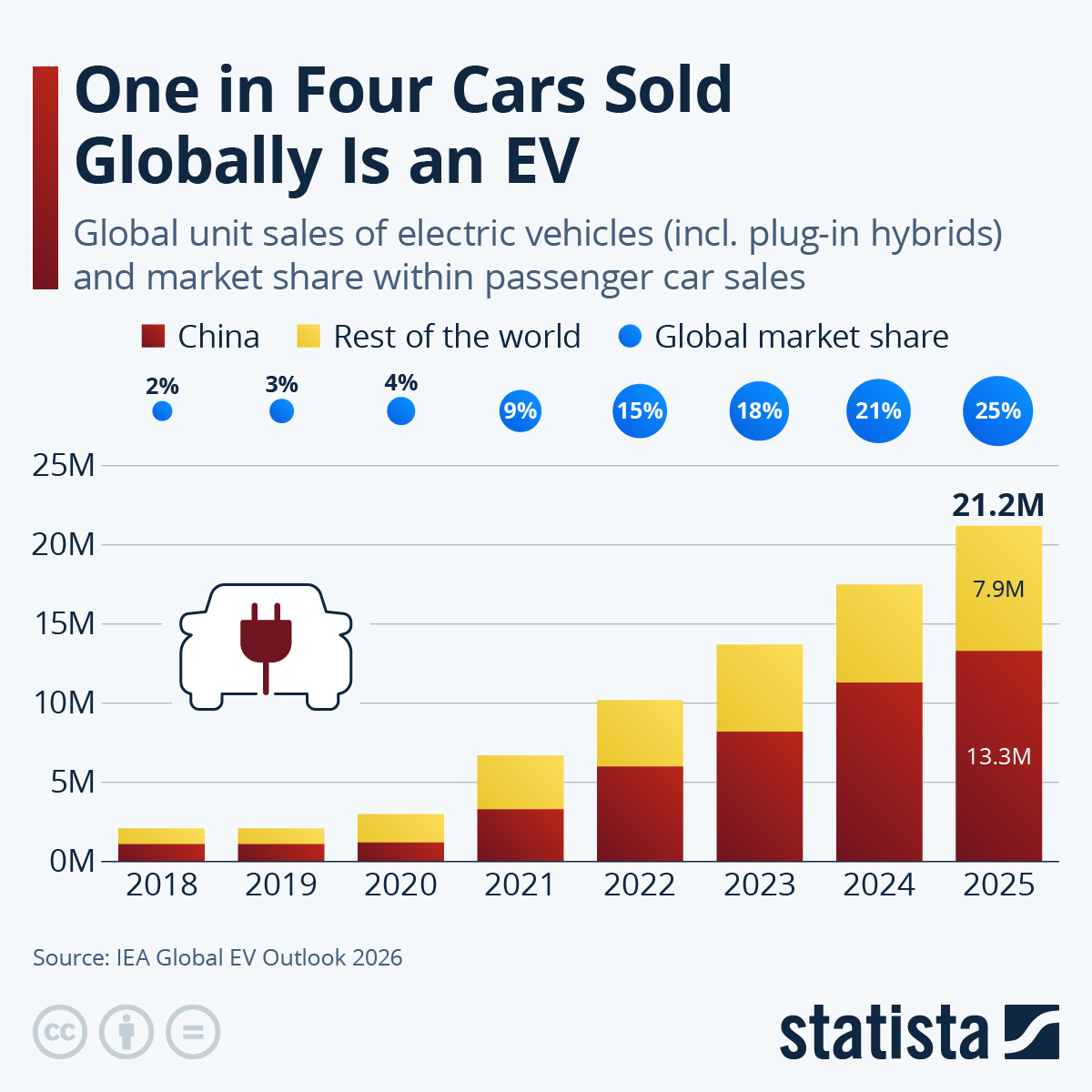
As Statista’s Tristan Gaudiaut details below, according to the IEA Global EV Outlook 2026, published on May 20, global sales of electric cars, including plug-in hybrids, surpassed 21 million units last year, more than doubling since 2022, when annual sales first exceeded 10 million.

As the chart shows, EVs now account for roughly one in four passenger car sales globally, meaning their market share climbed to 25 percent in 2025, up from just 2 percent in 2018.

Infographic: One in Four Cars Sold Globally Is an Electric Vehicle | Statista

You will find more infographics at Statista

This rapid growth has been driven largely by China, which remains by far the largest market.

With more than 13 million electric vehicles sold in 2025, the country alone accounted for around 60 percent of global sales.

While adoption has also increased steadily in the rest of the world, with nearly 8 million units sold – largely in Europe and the United States – the data highlight China’s dominant role in shaping the global EV market.

Tyler Durden
Sun, 05/24/2026 – 08:45

via ZeroHedge News https://ift.tt/bmxSJvc Tyler Durden

German Taxpayers Bled Dry: Mass Migration Cost €40 Billion In 2025

German Taxpayers Bled Dry: Mass Migration Cost €40 Billion In 2025

Via Remix News,

Migrants cost German taxpayers — just at the federal level — €24.8 billion in 2025, according to new data in the “refugee costs report” from the German Federal Ministry of Finance. However, the true sum is much higher.

The €24.8 billion is strictly the federal bill. The actual, combined national cost of migration for Germany is that €24.8 billion plus the massive, separate billions that the individual states and municipalities had to pull from their own local tax revenues to cover their own deficits brought on by mass immigration.

Welt notes that the total figure is indeed much higher, since it does not include states and local communes, but Welt does not provide this combined data.

Nevertheless, previous years indicate that this number is at least €15 to €20 billion. That means any total figure is likely well over €40 billion, but as in previous years, it may actually go as high as €50 billion.

The total costs cover several areas, including the federal government’s contribution to the refugee and integration costs of states and municipalities. One controversial issue is exactly how much money the federal government is transferring to the states and municipalities, which they argue is not enough to cover all their costs.

Essentially, the federal government only pays out a flat rate per initial asylum application, amounting to €7,500 from the federal government, allocated via a modification in the VAT distribution. This advance payment reached €1.25 billion for 2025. Additionally, the report assumes that the federal government holds a claim for repayment from the states totaling €250 million for 2025.

However, this only covers a fraction of the cost. The states indicate that the total costs in the area of flight and migration are significantly higher than the VAT resources available to them on the basis of the flat rate.

Of course, all of these expenses only cover specific areas like housing, direct social benefits, and integration courses. The true cost is still far higher than €40 billion to €50 billion.

The costs, for instance, do not cover expenses associated with the substantial foreign prison population. They also do not cover the need for the vastly increased police forces and counter-terrorism efforts. There are also “gray areas” that lead to other hidden taxes on Germans brought on by mass immigration. For instance, mass immigration has led to vastly higher housing prices, more road traffic, crowded hospitals, and longer wait times for medical treatments.

Germans are even paying higher health insurance premiums now due to mass immigration.

The head of the National Association of Statutory Health Insurance Funds (GKV-Spitzenverband) has repeatedly criticized the federal government for creating a massive multi-billion-euro deficit that forces them to raise premiums, with the core of the complaint revolving around “non-insurance benefits.” These are social welfare benefits mandated by the government that are paid out to people who have not paid regular insurance contributions into the system. This includes long-term unemployed citizens and refugees.

When asylum seekers first arrive in Germany, they are not members of the statutory health insurance system. Under the Asylum Seekers Benefits Act, their healthcare costs are covered, with local municipalities and state social offices paying their bills. 

The financial friction begins once a migrant’s asylum application is approved, or if they have been in the country for 36 months without a final decision. At this point, they transition into the standard welfare system, known as citizen’s money.

Once on welfare, they are fully integrated into the statutory health insurance system. This is where the GKV-Spitzenverband argues the math breaks down, with the government only paying €108 per person per month for welfare recipients, the majority of which are migrants and those with a migration background, when the care actually costs between €300 and €350 a month.

This has resulted in a multi-billion euro deficit, which the insurance companies say now needs to be passed on to Germans actually paying for their health insurance.

In short, Germans are being squeezed from all sides due to mass immigration, and despite claims that foreigners would pay the pensions of Germany’s aging population, this is clearly unrealistic. Instead, Germany’s elderly may now be expected to work even longer, with a strong movement in the government to raise the retirement age to 73.

Read more here…

Tyler Durden
Sun, 05/24/2026 – 08:10

via ZeroHedge News https://ift.tt/HfuPzSk Tyler Durden

US Approves “Homing All The Way Killer” Missile Support Sale To Ukraine

US Approves “Homing All The Way Killer” Missile Support Sale To Ukraine

The US State Department has officially cleared a $108.1 million hardware and sustainment package to keep Ukraine’s frontline air defenses online, after there’s not been much in the way of big dollar headlines concerning Washington’s longtime military support to Kiev of late.

The cash injection targets the maintenance and optimization of the US-designed HAWK system – which is short for the “Homing All the Way Killer” surface-to-air missile system.

Bild/Getty Images

Depending on the exact missile variant deployed, the platform handles tactical interceptions of enemy aircraft, drones, and cruise missiles at operational ranges spanning 25 to 30 miles.

The newly approved sale reportedly does not provide new systems, which would bring a much higher price tag, but is instead focused on keeping existing legacy systems operational.

The State Department’s Thursday news release detailed a transaction which featured long-term systems support, including erectable mast trailers, major technical modifications, spare parts, consumables, software support, and contractor engineering services – per a media redout.

The statement sought to provide ongoing justification from the Trump admin’s Ukraine policy:

“This proposed sale will support the foreign policy and national security objectives of the United States by improving the security of a partner country that is a force for political and economic stability in Europe,” it said.

The Defense Security Cooperation Agency has formally notified Congress of the package, and is expected to sail through, after which the contract will be mostly fulfilled by Colorado-based defense contractor Sierra Nevada Corp.  

Ukraine originally integrated the HAWK into its arsenal at the tail end of 2022 via a $400 million security assistance package. And last year Washington authorized a foreign military sale dedicated to a HAWK Phase III upgrade and related sustainment.

Ukraine could see a new rush by Western partners to supply and update air defense systems across the war-ravaged country, given the air war is steadily escalating.

Russia earlier this month sent a record 1,500+ drones and missiles against Ukrainian cities in only a 48-hour period. This was immediately on the heels of a successful 3-day ‘Victory Day’ ceasefire having held, which was backed by President Trump.

Tyler Durden
Sun, 05/24/2026 – 07:35

via ZeroHedge News https://ift.tt/fBIpWAs Tyler Durden

UK Net Migration Decline Masks True Demographic Replacement As British Exodus Accelerates

UK Net Migration Decline Masks True Demographic Replacement As British Exodus Accelerates

Via Remix News,

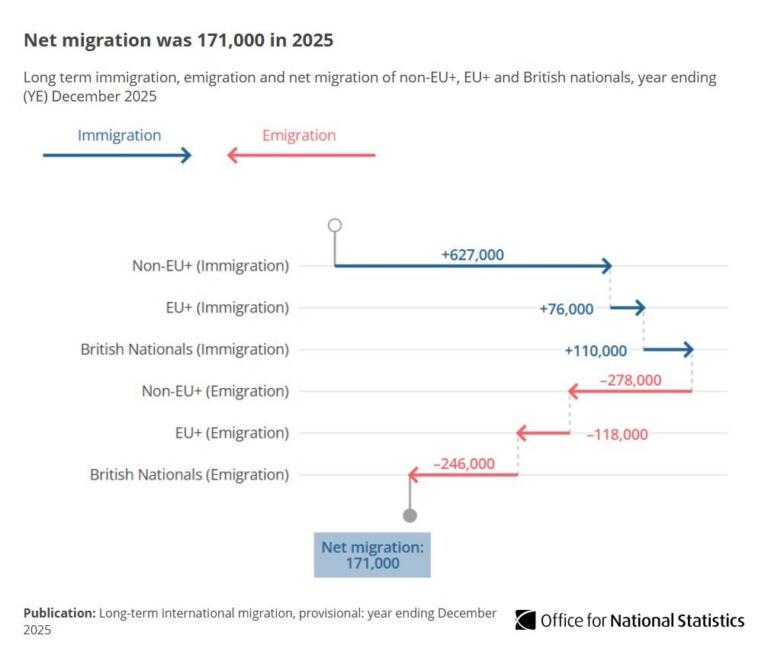
The left-wing U.K. government has claimed it is making real progress in tackling the ongoing migration crisis enveloping Britain after official statistics published on Thursday showed that net migration had decreased to 171,000 last year. However, that figure alone doesn’t tell the whole story.

“I promised to restore control to our borders. My government is delivering,” under-pressure Prime Minister Keir Starmer wrote on X in response to the latest publication by the Office for National Statistics.

“Net migration is now at 171,000, down from a high of 944,000 under the Conservatives,” added Home Secretary Shabana Mahmood, claiming the government had “restored order” after the unprecedented figures under the last Conservative administration.

Yet, a glance at the broader figures shows the reported number isn’t as impressive as the government would have you believe.

In the year ending December 2025, the total number of people immigrating to Britain stood at 813,000. For comparison, this figure is around two-thirds of the population of the U.K.’s second-largest city, Birmingham.

That figure comprises 110,000 British nationals returning to the U.K., and 76,000 EU citizens. By far the largest contingent of immigrants was from non-EU countries, accounting for 627,000 arrivals.

The 171,000 figure is also largely offset by emigration — nearly a quarter of a million (246,000) British nationals left the country, while 118,000 EU nationals and 278,000 non-EU nationals also packed their bags.

Total emigration of 642,000 was marginally down on the 680,000 recorded the previous year.

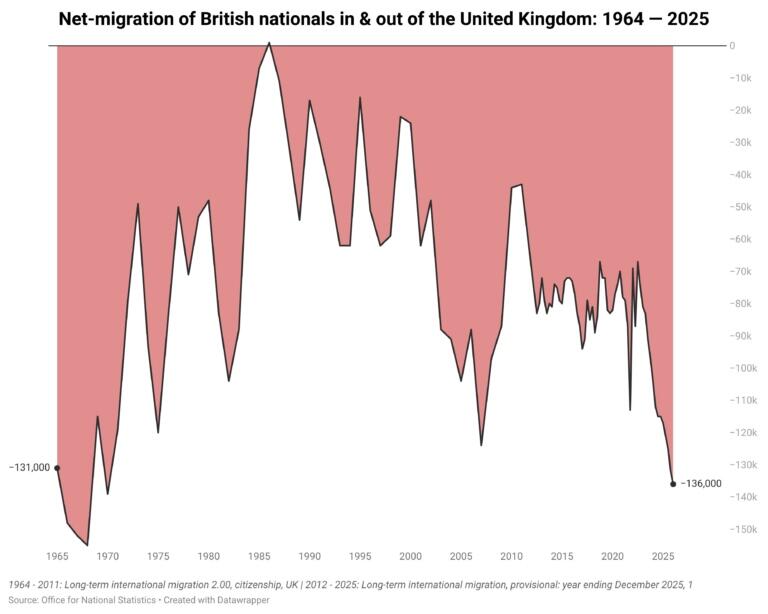
So, while the headline figure looks impressive, that is still a considerable decline in British nationals — down a net figure of 136,000 — effectively being replaced by largely non-EU immigrants. A total of 138,000 Indians, 56,000 Pakistanis, 54,000 Chinese, and 47,000 Nigerian nationals arrived.

The figures suggest that Britain remains a major destination for long-term migrants, and the scale of departures has become an increasingly important factor when reflecting on the overall migration picture.

The net figure for British nationals was the largest exodus since the 1960s.

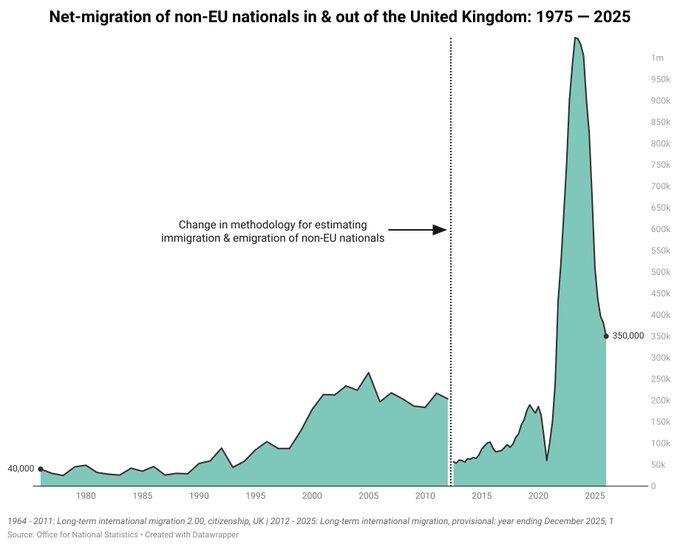
Meanwhile, non-EU net migration to the U.K. still remains higher (by some margin) than in any other year preceding 2021.

Migration monitoring groups released statements on Thursday contesting the Labour government’s assessment that it was successfully tackling the problem.

“Our immigration system is dysfunctional,” wrote the Centre for Migration Control.

“Three quarters of a million foreign nationals still arrive every year, and one in five people living in Britain was not born here.

“Rather than heed these warning signs, Labour ministers will insist they have ‘taken back control,’” it added.

Other commentators noted that the Home Office no longer publishes the numbers of immigrants who entered the country on a visa that has since expired, and assumes they have left, leaving the figures contentious.

“If people’s visas expire and ONS has no record of them leaving the country, they simply assume that they have left — one reason to treat emigration and ‘net’ migration figures with care,” noted Conservative MP Neil O’Brien.

Academic Matt Goodwin, who most recently stood for the right-wing Reform U.K. party in a by-election, warned, “The British people are being demographically replaced – there is no other term for it.”

Migration Watch U.K. called the recent migration wave into Britain “one of the most rapid and drastic demographic changes, outside of war, in human history — no wonder the public are concerned!”

It further questioned why the British public should be “thankful that net migration has ‘crashed’ from the city a size of Birmingham arriving in a single year, to a city the size of Norwich.”

“Where is the infrastructure for this massive inflow of immigrants?” it asked.

Read more here…

Tyler Durden
Sun, 05/24/2026 – 07:00

via ZeroHedge News https://ift.tt/iDsod26 Tyler Durden

Free Speech Shouldn’t Be Just For The Party In The White House

Free Speech Shouldn’t Be Just For The Party In The White House

Authored by Charles Sauer via RealClearMarkets,

One of the most important Executive Orders signed by President Trump on his first day in office was Restoring Freedom of Speech and Ending Federal Censorship. As the title suggests, the order forbids any U.S. Government employee from taking any actions that violate the First Amendment rights of any American citizen. The Executive Order is intended to protect against future encroachments on the right to free speech like those that occurred under the Biden Administration.

During the Biden years, government officials routinely pressured social media companies to silence Americans for questioning the official response to COVID-19. For example, Surgeon General Vivek Murthy said that, unless social media companies “voluntarily” removed posts containing “misinformation,” the Administration would apply “appropriate legal and regulatory measures.” Other members of the Administration sent messages to social media executives, addressing them as if they were poorly performing White House interns. At least one Biden staffer, Deputy Assistant to the President Rob Flaherty, even dropped an F-bomb in an email to Meta, parent company of Facebook and Instagram, inquiring why a post he “requested” be taken down was still up.

In March of this year, the Justice Department signed a consent decree with Louisiana and Mississippi settling a lawsuit brought by the states on behalf of their citizens whose First Amendment rights were violated by the Biden Administration’s censorship. The settlement forbids the Surgeon General, the Centers for Disease Control and Prevention, and the Cybersecurity and Infrastructure Agency from threatening social media companies for refusing to remove or limit the viewership of “content containing protected free speech.” Unfortunately, some members of the Trump Administration seem to have not read this Executive Order.

For example, Federal Trade Commission Chair Andrew Ferguson, while a vast improvement over his predecessor Lina Khan, thinks the FTC should use its power to punish woke corporations for engaging in First Amendment-protected activity. The FTC recently settled a case, along with eight states, brought against major advertising companies. The suit alleged that the companies worked with progressive media watchdog groups, such as NewsGuard and the Global Disinformation Index, in order to limit the placement of ads on conservative sites. The ad agencies’ defense was to claim that they were protecting brand safety.

Brand safety refers to advertising placement agencies avoiding sites with controversial political opinions or objectionable content. One problem with the FTC’s case is that being concerned with brand safety makes valid business sense. A business whose customers largely come from a demographic that tends to support progressive politics will not want to advertise on pro-MAGA websites for fear of alienating its existing customers. Similarly, a brand whose customers are mostly conservative will not want to advertise on AOC 2028. The main problem with the FTC case is that organizing boycotts of a business because of the business’s political activities is a First Amendment-protected activity.

Boycotts have a long and distinguished history. They were instrumental in the civil rights, labor, and other progressive movements. Boycotts have been used by conservatives, most notably by social conservatives, to pressure advertisers to stop running ads on programs that offended them. Organizers of these boycotts worked with conservative media watchdogs like the Media Research Center. Now, thanks to the precedent set by Andrew Ferguson, the next Democrat FTC Chair could target the Media Research Center and their allies for conspiring to restrain trade by organizing boycotts.

Chair Ferguson also wrote to (then) Apple CEO Tim Cook warning him that Apple could face a federal investigation for “unfair or deceptive or practices.” The deception in question is the claim that Apple’s news aggregation site is ideologically neutral, when in fact it promotes stories from left-wing sources while ignoring stories from conservative sources. Even if this were true, Apple has a First Amendment right to choose what news sources to feature in its news aggregator. If consumers are dissatisfied with Apple’s selection, they are free to use one of the many conservative news outlets on the internet.

Chair Ferguson and government officials like Federal Communications Commission (FCC) Chair Brendon Carr are not just violating the First Amendment – they are violating President Trump’s executive order on free speech. Unfortunately, the President’s commitment to free speech is also less than consistent. President Trump and his appointees must stop violating the First Amendment – otherwise America will become a country in which free speech only exists for those who won the last election.

Tyler Durden
Sat, 05/23/2026 – 23:20

via ZeroHedge News https://ift.tt/GxQHbiY Tyler Durden

Wyoming Is America’s Deadliest State For Workers

Wyoming Is America’s Deadliest State For Workers

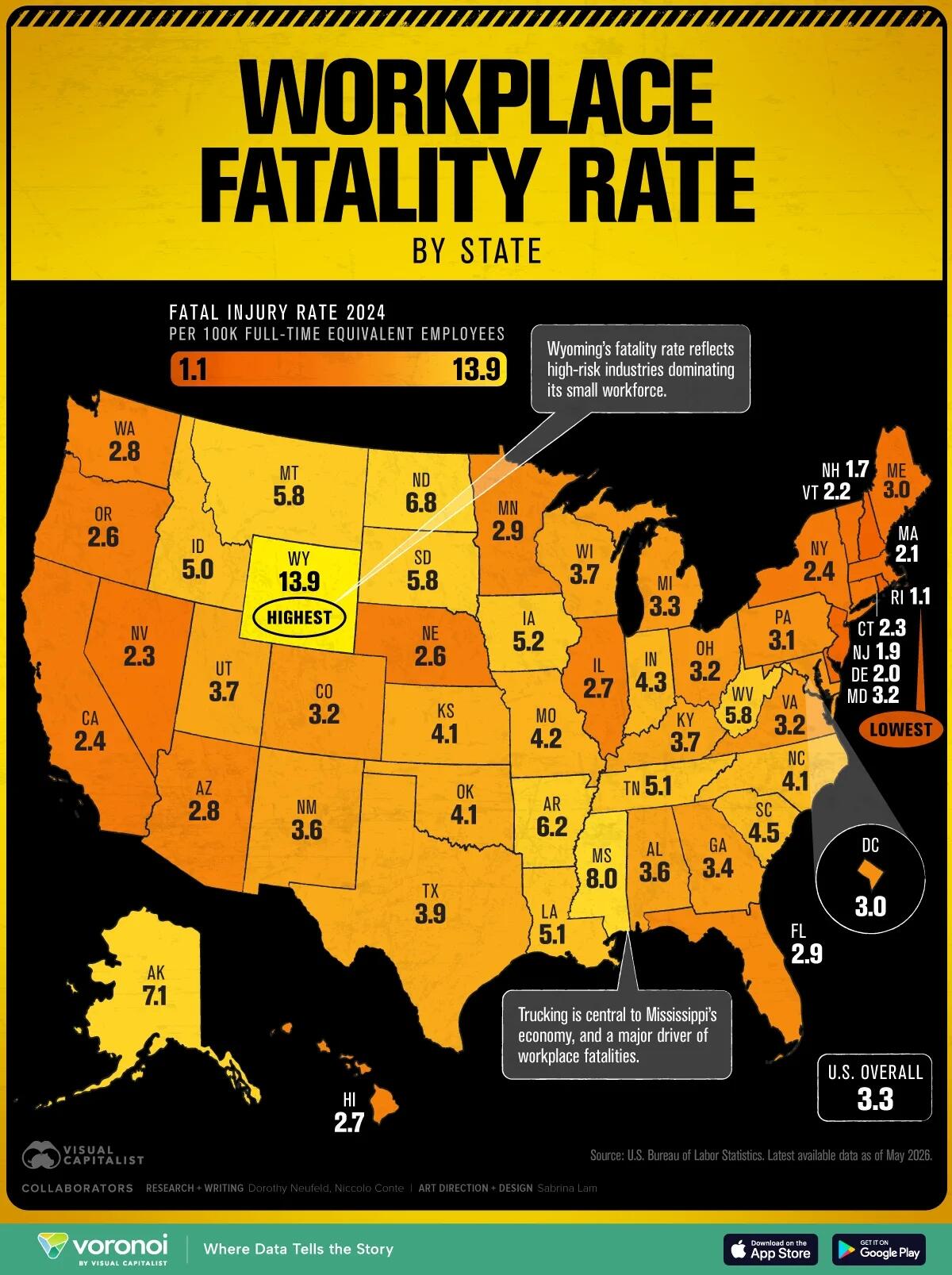
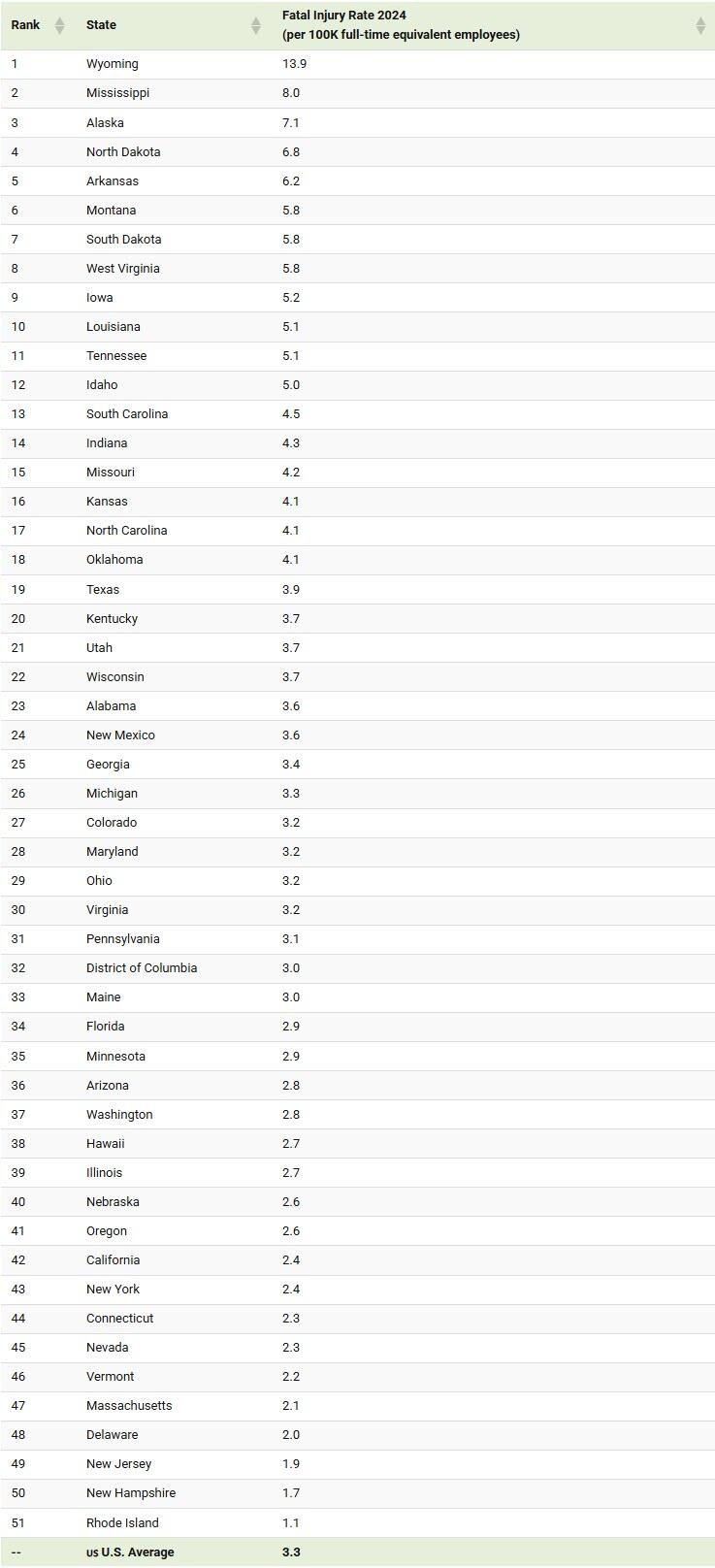
Using data from the U.S. Bureau of Labor Statistics (BLS), Visual Capitalist’s Dorothy Neufeld created the following map to show workplace fatality rates across all 50 states in 2024.

Wyoming recorded the nation’s highest workplace fatality rate at 13.9 deaths per 100,000 workers, compared with just 1.1 in Rhode Island.

Several Southern and Mountain West states also reported rates well above the national average of 3.3.

The state-level divide highlights how workplace risk remains concentrated in specific industries and regions across the U.S. economy.

Why Resource-Heavy States Rank So High

In states like Wyoming and North Dakota, oil and gas extraction remains a major source of employment. These industries often involve remote job sites, heavy equipment, long shifts, and hazardous operating conditions.

The concentration is especially visible in the data. Roughly 30% of Wyoming’s workplace deaths in 2024 occurred in natural resources and mining, while the industry accounted for nearly half of all workplace fatalities in North Dakota.

Agriculture and logging also contribute to elevated fatality rates across several rural states. Workers in these industries routinely operate large equipment, work outdoors in extreme conditions, and travel long distances on rural roads.

The national workplace fatality rate stood at 3.3 deaths per 100,000 workers in 2024, meaning several states recorded rates nearly double the U.S. average.

America’s Freight Corridors Also Face Higher Risks

Transportation incidents remain one of the leading causes of workplace deaths in the country.

States positioned along major freight and energy corridors often see higher concentrations of long-haul trucking, industrial transport, and warehouse activity. That includes parts of the South, Great Plains, and Mountain West.

Long driving hours, highway exposure, and physically demanding loading work all raise fatality risks for transportation workers. For instance, trucking remains central to Mississippi’s economy and is the leading industry for workplace deaths. In rural states, longer emergency response times can further worsen outcomes after serious accidents.

Why Northeastern States Tend to Be Safer

Many Northeastern states reported workplace fatality rates well below the national average in 2024.

Part of that divide comes from industry mix. States like Massachusetts, New Jersey, and Rhode Island have larger concentrations of office-based employment and fewer workers in mining, drilling, agriculture, or logging.

Higher population density may also play a role. Urbanized states tend to have shorter transportation routes, more developed infrastructure, and faster access to hospitals and emergency services.

Geography Still Shapes Workplace Risk in America

The gap between America’s safest and deadliest workplaces highlights how closely occupational risk is tied to local economies.

In many higher-risk states, dangerous industries are also some of the best-paying and most economically important. Energy, transportation, agriculture, and heavy industry continue to support thousands of jobs despite the elevated risks.

That creates a difficult tradeoff for many local economies, where some of the most economically important industries also carry the highest workplace risks.

As a result, workplace safety in America varies sharply depending on the industries that dominate each state’s economy.

To learn more about this topic, check out this graphic on manufacturing jobs by state.

Tyler Durden
Sat, 05/23/2026 – 22:45

via ZeroHedge News https://ift.tt/FPRYzo0 Tyler Durden

Gunman Dead, Bystander Wounded After Large Shootout With Secret Service Near White House, Trump Safe

Gunman Dead, Bystander Wounded After Large Shootout With Secret Service Near White House, Trump Safe

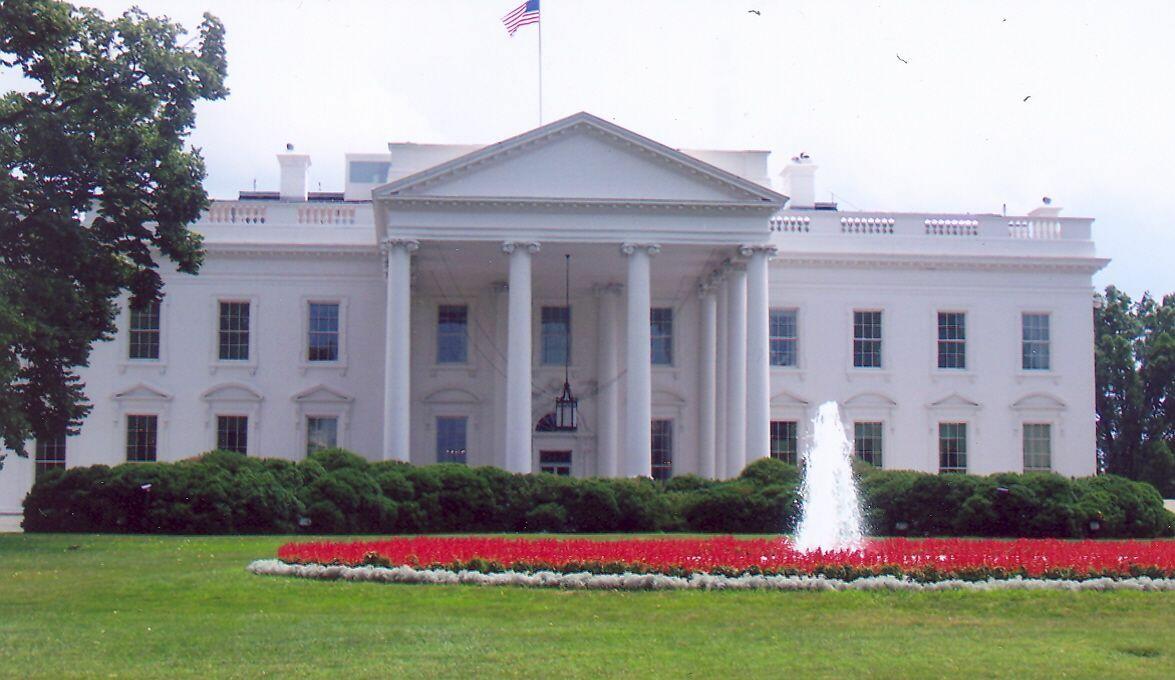
After a very busy day in Washington and at the White House, given the Saturday flurry of diplomatic activity over the announcement of a tentative Iran peace deal, but which is still awaiting word and some details from Tehran, a deadly shooting erupted just outside the White House, resulting in a massive security and response and presence.

President Trump was at the White House when at around 6pm ET the Secret Service responded in a hail of gunfire as 21-year-old Maryland man Nasire Best opened fire at 17th Street and Pennsylvania Avenue NW near the Eisenhower Executive Office Building.

via Reuters

The president is safe, and the emergency has been declared over.

Somewhere between approximately 15 to 30 gunshots were fired, according to CBS News, which spoke to local law enforcement. President Trump was at the White House during the incident, “but was not impacted,” the Secret Service spokesperson later announced.

A bystander was wounded, and the suspect was hit by by Secret Service officers upon returning fire. The gunman was wounded and taken to the hospital, where he later died

CBS reports upon the suspect’s name being identified that “According to the source, Best had a previous run-in with Secret Service in July 2025 in which he tried to gain entry to the White House and was arrested and sent to a psychiatric ward for mental health issues.”

A complete White House lockdown as since been lifted. According to more emerging details:

The Secret Service confirmed a couple of hours after the shooting that the man had died after exchanging fire with its agents.

The man had approached a White House security checkpoint and pulled a gun from his bag before opening fire, according to the Secret Service. Law enforcement shot back and wounded the man, who was taken to the hospital where he died. 

As for the wounded bystander, the victim’s information has not been released, and his condition not immediately known – after being rushed to the hospital.

Per CBS, Senate Majority Leader John Thune and House Speaker Mike Johnson both praised the rapid response of the Secret Service as the shooting unfolded

In a post on X, Thune declared he is “grateful for the Secret Service and the agents’ decisive actions to protect President Trump and everyone at and around the White House this evening.”

Tyler Durden
Sat, 05/23/2026 – 22:13

via ZeroHedge News https://ift.tt/vkCH8VM Tyler Durden

Dozens Of Nations Scramble For World Bank Financing Amid Iran War Global Shock

Dozens Of Nations Scramble For World Bank Financing Amid Iran War Global Shock

Via The Cradle

Twenty-seven countries have moved to activate emergency World Bank financing mechanisms since the US-Israeli war on Iran began in late February, Reuters reported Friday.

Three nations have already received approval for fast-tracked funding, while the other 24 are in the process of completing administrative procedures. 

Kenya and Iraq have publicly confirmed they are seeking emergency World Bank assistance, with Nairobi facing surging domestic fuel prices and Baghdad grappling with severely diminished oil revenues due to disruptions in maritime exports.

Getty Image

The 27 nations are drawn from a pool of 101 countries with access to pre-arranged contingent financing, including 54 that are enrolled in the World Bank’s Rapid Response Option, a mechanism that allows sovereign borrowers to immediately redirect up to 10 percent of their undisbursed project balances.

World Bank President Ajay Banga has outlined a three-tier funding structure. Between $20 billion and $25 billion is available immediately through existing crisis instruments, rising to $60 billion within six months if the bank reorients parts of its broader portfolio, with longer-term structural changes capable of pushing the total to around $100 billion. 

Activity at the International Monetary Fund (IMF), by contrast, has been minimal

Despite Managing Director Kristalina Georgieva anticipating that up to a dozen nations would seek between $20 billion and $50 billion in emergency assistance, sources told Reuters that very few formal requests have been filed, with countries in a “wait-and-see mode.”

The IMF previously warned that the US-Israeli war on Iran has significantly worsened the global economic outlook by disrupting energy markets, raising inflation, and weakening growth prospects worldwide.

It said the war had reduced expected global growth from 3.4 percent to 3.1 percent, significantly worsened inflation, and posed major risks of further deterioration in energy supply routes.

The IMF added that prolonged fighting could deepen regional economic damage, potentially push the global economy toward recession-level growth, heighten uncertainty in financial markets, and accelerate broader geopolitical and economic instability.

Tyler Durden
Sat, 05/23/2026 – 22:10

via ZeroHedge News https://ift.tt/6I31Tyk Tyler Durden

Ferrari Fever Hits Samsung, SK Hynix Workers As AI Memory Boom Mints New Wealth

Ferrari Fever Hits Samsung, SK Hynix Workers As AI Memory Boom Mints New Wealth

The global memory boom, with Samsung at the epicenter of the production ecosystem, appears to be generating a sudden wealth effect among some employees, with local media reporting that newly enriched chip workers are now panic-buying luxury sports cars. 

A short clip from MBC News, the news division of Munhwa Broadcasting Corporation and one of South Korea’s top national TV and radio broadcasters, featured at least one exotic car dealership reporting a sharp uptick in Samsung Electronics and Hynix employees seeking to buy high-end sports cars.

We’ve been getting dozens of phone calls every day for the past month. The customers coming in are mostly employees from Samsung Electronics and SK Hynix. There have been a lot more people coming to look at cars priced over 100 million won (~$73,000 USD),” a MBC reporter could be heard saying in the news segment.

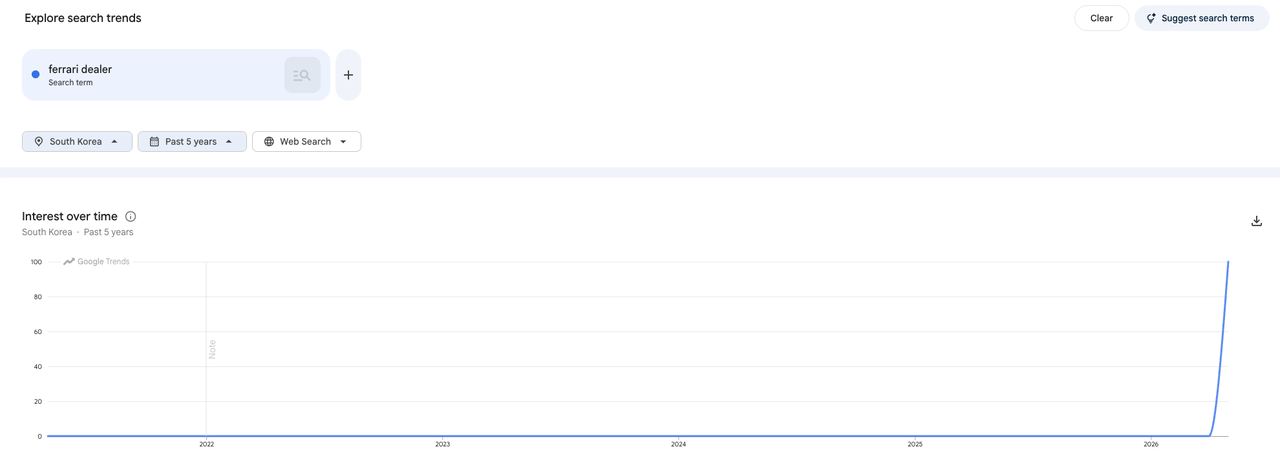
Google Search trends confirm a recent spike in internet searches for “Ferrari dealer” as Samsung and SK Hynix have become the world’s most important memory companies.

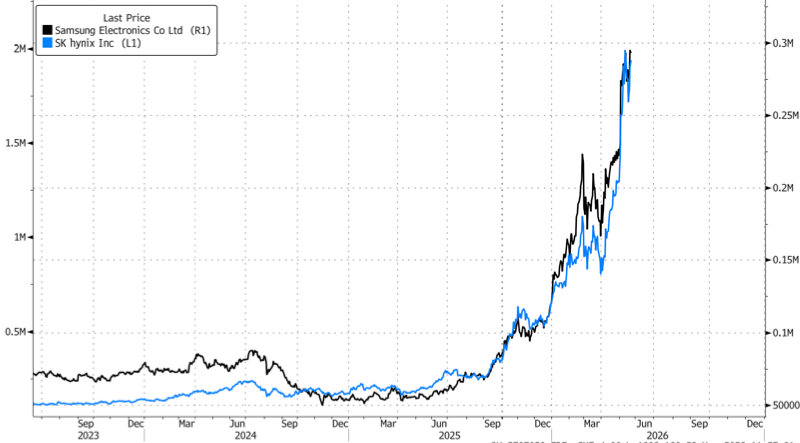
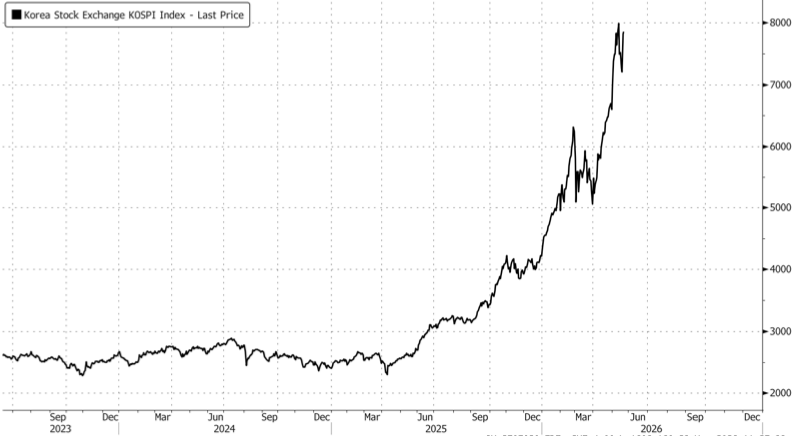
Shares of Samsung and SK Hynix have gone absolutely parabolic …

… as well as KOSPI.

Meanwhile…

We suspect the exotic-car buying spree will accelerate once Samsung and its largest union reach a new labor deal. Voting begins Saturday. Coverage here.

Tyler Durden
Sat, 05/23/2026 – 21:35

via ZeroHedge News https://ift.tt/kYndQFp Tyler Durden

State-Sponsored Suicide

State-Sponsored Suicide

Authored by MN Gordon via dollarcollapse.com

“A great civilization is not conquered from without until it has destroyed itself from within.”

– Will and Ariel Durant, The Story Of Civilization

Enemy Within

How does a superpower die?

Does it come from the blinding kill shot of a hypersonic missile streaking through the sky? Or, perhaps, a rogue cyberattack that mortally destroys the national power grid?

Will the end of America come with foreign tanks rolling through New York or a massive, coordinated amphibious attack on Los Angeles?

These dramatic scenarios make for captivating conjecture. But they’re highly unlikely. If you look at the autopsy reports of the world’s greatest empires, the ultimate cause of death is rarely a sudden, overwhelming external blow.

Long before the barbarians breached the gates of Rome, the Roman denarius had been systematically devalued into a glorified copper token to fund a bloated bureaucracy. This was characterized by widespread domestic corruption and endless military expansion.

So, too, long before the British Empire reluctantly packed up its global flags, it realized the staggering cost of multiple wars had left it financially bankrupt, structurally hollowed out, and entirely dependent on American loans.

Great civilizations don’t usually get slaughtered by their rivals. They commit slow, sophisticated, economically optimized suicide.

As we move through 2026, the United States is following a well-worn, dangerous path. But it’s traversing it at a speed and scale that would leave ancient Rome in the dust.

The reality that no politician will publicly admit is that America’s out-of-control federal spending and its monstrous, multi-trillion-dollar financial system are doing far more structural damage to the country’s long-term survival than any foreign adversary ever could.

By burying the nation in unpayable debt, Congress is willingly destroying America from the inside. Hence, the greatest threat to our future lies not across the ocean, but directly within our own borders.

Act Of War

Let’s talk about the ghastly numbers. They’re often ignored by the general population because our brains are hardwired to glaze over when we start talking about trillions. Here we’ll break them down for you.

Right now, the official U.S. national debt has blown past $39 trillion. To put that into perspective, if you spent one dollar every single second, it would take you about 32,000 years to spend $1 trillion. America owes 39 of those.

But the real issue isn’t just the total balance on Washington’s credit card. It’s the cost of keeping the account active. The yield on a 30-year Treasury bond recently climbed above 5 percent for the first time in nearly 20 years. Yet today’s balance is much larger than it was 20 years ago. When you owe $39 trillion, even a tiny uptick in interest rates transforms your budget into an insurmountable nightmare.

America is currently burning through roughly $3 billion every single day just to pay the interest on its existing debt.

Think about that for a second. Before a single pothole is filled, before a single soldier is paid, before a single school lunch is funded, or a Medicare claim is processed, $3 billion dollars vanishes into thin air every 24 hours. It doesn’t buy new equipment, it doesn’t rebuild infrastructure, and it doesn’t help struggling families. It’s purely the cost of treading water.

Instead of investing in the future, we’re paying for the profligacy of the past.

If a foreign nation managed to sabotage the U.S. economy so severely that it drained $3 billion a day out of the federal Treasury, it would be viewed as an act of war. We would mobilize the military.

Yet, because this bleeding is caused by our own fiscal policy, we pretend it isn’t happening and go back to scrolling on our phones.

Vicious Doom Loop

The entire American lifestyle – and by extension, the global economy – is built on the singular, fragile assumption that the rest of the world will always want to buy American debt. For decades, this was a safe bet. Treasuries were considered risk free in terms of default.

The U.S. dollar, while under threat of the U.S. government’s making, remains king of the global financial system – for now. When global chaos hits, investors run to U.S. Treasuries like a safe harbor in a storm. This exorbitant privilege allowed Washington to spend money it didn’t have without facing immediate consequences.

But that privilege resulted in a dangerous lack of discipline and created a catastrophic level of arrogance. Politicians on both sides of the aisle began treating the national debt like a meaningless artifact. To Congress, and as elaborated by the late Dick Cheney, “deficits don’t matter.”

Unfortunately, the mathematics of debt do matter. And right now, the system is locked into a vicious, mechanical doom loop. Here’s how it works…

Every month, while you pay your bills, live within your means, and balance your personal finance books, the Treasury issues mountains of new debt just to pay off the old debt that’s maturing. All the while, it’s borrowing more to cover current overspending. Yet, because the market is getting flooded with U.S. bonds, investors are demanding higher yields.

Higher yields mean refinancing becomes more expensive. More expensive refinancing creates even larger deficits. Larger deficits require issuing even more bonds.

The financial system is, in effect, cannibalizing itself to stay alive. No enemy army could design a more effective trap to paralyze the American financial system.

When an enemy attacks, the damage is obvious. Buildings fall, smoke rises, and the country rallies together. But when financial decay sets in the destruction is deceptive. For many people, the cause is unclear.

Inside Job

Over the decades, American leaders assumed the world had no choice but to use the dollar. Where else were they going to go?

But our adversaries and allies alike have watched this fiscal train wreck unfold and are methodically diversifying their reserves. They realize that a superpower running a $39 trillion deficit is a precarious foundation for the global economy.

Central banks around the world have accelerated their gold purchases to historic levels. Countries like China have been systematically reducing their holdings of long-term U.S. Treasuries.

It’s not a sudden boycott of the dollar. Rather, it’s a slow calculated diversification. As the rest of the world lightens up on their purchases of U.S. debt, the Federal Reserve becomes the buyer of last resort. That means creating credit out of thin air to buy U.S. Treasuries. This is a formula for runaway inflation. The type that has destroyed countless currencies throughout history.

To be clear, Fed asset purchases have been occurring for much of the 21st century. So, too, have U.S. government policies of dollar debasement. This sophisticated state-sponsored suicide takes place in ongoing Congressional hearings, mundane Treasury auctions, continuous debt ceiling increases, pretend government shutdowns, and carefully scripted statements by the Fed using concocted syntaxes that are designed to keep people from panicking.

As America closes in on its 250-year anniversary it’s being drained of its capital. The government continues to borrow tomorrow’s prosperity to pay for today’s political promises. All the while, the people watch the infrastructure of the nation’s cities crumble as $3 billion a day is directed to service interest payments. The currency buys less and less every year, forcing citizens onto an endless economic hamster wheel.

Alas, it hasn’t taken an enemy to destroy America. Our politicians have already done the job for them.

Sincerely,

MN Gordon
for Economic Prism
Tyler Durden
Sat, 05/23/2026 – 21:00

via ZeroHedge News https://ift.tt/lfO2jXd Tyler Durden