Putin: “Russian Meddling Is A Fiction Democrats Invented To Divert Blame For Their Defeat”

With McCarthyism 2.0 continues to run amok in the US, spread like a virulent plague by unnamed, unknown, even fabricated sources, over in France one day after his first meeting with French president Emanuel Macron, the man who supposedly colluded with and was Trump’s pre-election puppet master (but had to wait until after the election to set up back-channels with Jared Kushner) Vladimir Putin sat down for an interview with French newspaper Le Figaro in which the Russian president expressed the belief that Moscow and Western capitals “all want security, peace, safety and cooperation.”

“Therefore, we should not build up tensions or invent fictional threats from Russia, some hybrid warfare etc.,” the Russian leader told his French hosts. “What is the major security problem today? Terrorism. There are bombings in Europe, in Paris, in Russia, in Belgium. There is a war in the Middle East. This is the main concern. But no, let us keep speculating on the threat from Russia.”

Case in point, in the latest attempt to stir up an anti-Russian frenzy, America’s biggest neocon, John McCain said that Russia is even more dangerous than ISIS. “You made these things up yourselves and now scare yourselves with them and even use them to plan your prospective policies. These policies have no prospects. The only possible future is in cooperation in all areas, including security issues.”

“Hacking” Clinton And the DNC

Even with the FBI special investigation on “Russian collusion” with the Trump campaign and administration taking place in the background, Putin once again dismissed allegations of Russian meddling in last year’s U.S. presidential election as “fiction” invented by Democrats to divert the blame for their defeat. Putin repeated his strong denial of Russia’s involvement in the hacking of Democratic National Committee emails that yielded disclosures that proved embarrassing for Hillary Clinton’s campaign. Instead, he countered that claims of Russian interference were driven by the “desire of those who lost the U.S. elections to improve their standing.”

“They want to explain to themselves and prove to others that they had nothing to do with it, their policy was right, they have done everything well, but someone from the outside cheated them,” he continued. “It’s not so. They simply lost, and they must acknowledge it.” That has proven easier said than done, because half a year after the election, Hillary Clinton still blames Wikileaks and James Comey for her loss. Ironically, what Putin said next, namely that the “people who lost the vote hate to acknowledge that they indeed lost because the person who won was closer to the people and had a better understanding of what people wanted,” is precisely what even Joe Biden has admitted several weeks ago, and once again yesterday. Maybe Uncle Joe is a Russian secret agent too…

In reflecting on the ongoing scandal, which has seen constant, daily accusations of collusion and interference if no evidence (yet), Putin conceded that the damage has already been done and Russia’s hopes for a new detente under Trump have been shattered by congressional and FBI investigations of the Trump campaign’s ties to Russia. In the interview, Putin also said the accusations of meddling leveled at Russia have destabilized international affairs

Going back to the hotly debated topic of “influencing” the election, Putin once again made a dangerous dose of sense when he argued that trying to influence the U.S. vote would make no sense for Moscow as a U.S. president can’t unilaterally shape policies. “Russia has never engaged in that, we don’t need it and it makes no sense to do it,” he said. “Presidents come and go, but policies don’t change. You know why? Because the power of bureaucracy is very strong.” Especially when the bureaucracy in question is the so-called “deep state.”

Asked who could have been behind the hacking of the Democrats’ emails, The Russian leader added that he agreed with Trump that it could have been anyone. “Maybe someone lying in his bed invented something or maybe someone deliberately inserted a USB with a Russian citizen’s signature or anything else,” Putin said. “Anything can be done in this virtual world.” This echoed a remark by Trump during a September presidential debate in which he said of the DNC hacks: “It could be Russia, but it could be China, could also be lots of other people. It could be someone sitting on their bed that weighs 400 pounds.”

Assad, Red-Lines and Chemical Weapons

Putin was asked about French President Emmanuel Macron’s warning that any use of chemical weapons in Syria was a “red line” that would be met by reprisals, to which the Russian president said he agreed with that position. But he also reiterated Russia’s view that Syrian President Bashar Assad’s forces weren’t responsible for a fatal chemical attack in Syria in April. Putin said Russia had offered the U.S. and its allies the chance to inspect the Syrian base for traces of the chemical agent. He added that their refusal reflected a desire to justify military action against Assad. “There is no proof of Assad using chemical weapons,” Putin insisted in the interview. “We firmly believe that that this is a provocation. President Assad did not use chemical weapons.”

“Moreover, I believe that this issue should be addressed on a broader scale. President Macron shares this view. No matter who uses chemical weapons against people and organizations, the international community must formulate a common policy and find a solution that would make the use of such weapons impossible for anyone,” the Russian leader said.

On NATO’s Military Buildup across Russian borders

Weighing on the outcome of the recent NATO summit, at which Russia was branded a threat to security, Putin pointed to the ambiguous signals Moscow is receiving from the alliance. “What attracted my attention is that the NATO leaders spoke at their summit about a desire to improve relations with Russia. Then why are they increasing their military spending? Whom are they planning to fight against?” Putin said, adding that Russia nevertheless “feels confident” in its own defenses. Washington’s appeal to other NATO members to ramp up their military spending and alleviate the financial burden the US is forced to shoulder is “understandable” and “pragmatic,” Putin said.

But the strategy employed by the alliance against Russia is “shortsighted,” the Russian president added, referring to the NATO’s expanding missile defense infrastructure on Russia’s doorstep and calling it “an extremely dangerous development for international security.” Putin lamented that an idea of a comprehensive security system envisioned in the 1990s that would span Europe, Russia and US has never become a reality, arguing that it would have spared Russia many challenges to its security stemming from NATO. “Perhaps all this would not have happened. But it did, and we cannot rewind history, it is not a movie.”

via http://ift.tt/2rCIRmg Tyler Durden
For Every Action, There Is An Equal And Opposite Reaction

Authored by Jeff Thomas via InternationalMan.com,

Newton’s third law of motion has proven the test of time, since he first stated it in 1686. If we were to apply the same concept to political history, we might say,

A nation that rises to a great height will fall to an equally great depth.

At first glance, that seems to be merely clever wordsmithing. However, historically, it does seem to play out exactly that way. Most countries tend to ebb and flow as to their prosperity, but those that rise to great heights, particularly those that rise to become empires, tend to crash with a weight equal to their strength at the height of their power.

If we consider that point when we observe the present dominant empire, the US, we would expect that, at the point that the empire is teetering on the edge of collapse, we would see signs of rot within the government, the economy, and even within many of the people. The closer we get to the tipping point, the more this would be borne out by lunacy in the media, the courts, even the hallowed halls of education.

So, let’s have a peek into present events – events that may not be the most crucial in the state of the union but are indicators that the system is self-destructing.

The following are three briefs on articles that recently appeared in the same publication on the same day (they have not been edited by me):

“Mike Adams Reports the Boston Herald to the FBI for Recommending That Those who Oppose Vaccines Should Be Executed by Hanging”:

Mike Adams, the owner of the Natural News website, is filing a complaint with the Boston FBI against the Boston Herald for publishing a violence-inciting editorial attributed to the Boston Herald. The editorial claims that vaccines don't cause autism and that it ought to be a "hanging offense" for anyone who opposes this conventional theory.


“Black Student Group at UC Santa Cruz Threatens Takeover”:

The African/ Black Student Alliance (A/BSA) physically occupied a building on the UC Santa Cruz campus and was granted all of its demands, which includes mandatory ‘diversity training’ for all incoming students. Now they are threatening more civil disruption if their new demands are not met.


“Tim Allen’s TV Sitcom Cancelled After He Said Being a Conservative in Hollywood Was Like Living in Nazi Germany”:

Tim Allen starred as a positive conservative character in the ABC sitcom, Last Man Standing, which was cancelled despite high ratings. The cancellation comes two months after he made a comment on a talk show comparing living as a conservative in Hollywood to Nazi Germany.

No need to go into the entire articles. You get the point. The fact that these articles appeared on the same day in the same publication exemplifies the fact that these are not isolated incidents. They are a part of an overall social/legal/cultural trend that we see not only in the US, where these incidents occurred, but in much of what was once known as “the free world.”

These incidents represent the antithesis of freedom. They are the acts of individuals and small groups taking the position that they should be afforded the authority to determine the behavior of all others. They represent power without accountability and have the support of the rulers, media, and courts.

But, how is it that they have become so pervasive? How are they even acceptable points of view? The answer lies in one word: education.

This danger was predicted by a young Thomas Jefferson, when he stated, "A democracy is nothing more than mob rule, where fifty-one percent of the people may take away the rights of the other forty-nine."

Mister Jefferson was, to my mind, the greatest visionary of his time. He was eminently educated. He entered the prestigious College of William & Mary in 1760 and, upon graduation, rounded out his education under the great George Wythe in Williamsburg, Virginia. In Mister Jefferson’s day, education was the key to higher understanding.

He studied architecture, which led to his creation of several iconic buildings, whose designs are still studied today. He studied ancient history and improved upon the Athenian Republic when creating an outline for what would become the United States. He studied economics and successfully knocked down the ideas of a central bank and income taxes, as proposed by Alexander Hamilton, his nemesis in George Washington’s cabinet. These accomplishments were inspired by his education

A half-century ago, I was sent to school in Boston, which had long been regarded as the centre of higher education in the Western Hemisphere. In my final years there, I spent endless hours discussing higher concepts with others in and around the lawns of Harvard University, expanding my outlook. At that time, the emphasis in higher learning was on the expansion of the powers of reason—the ability of each individual to make use of existing knowledge in order to expand upon it. This was seen as essential, as those who were learning there were being prepared to lead the next generation in politics, economics, manufacturing, invention, and most every other endeavor.

And, yet, what was considered the very best in America has become, in many ways, the worst. Today, the nation’s universities, from Berkeley in California to Columbia in New York, have become the exact opposite of what they were created to be. Instead of cultivating the powers of reason in order to expand upon previous achievements, universities in America have become bastions of oppression, decrying and even punishing any thought that’s not strictly politically correct. And nowhere is this more true than at Harvard. It’s become a centre for collectivist thinking and a factory for the oppressors of the next generation.

To be sure, the students themselves did not create this atmosphere. But huge grants to both professors and schools have assured that the mindset of the instructors and the goals of the schools themselves have become the indoctrination of a future generation of leaders to a collectivist way of thinking.

The result of years of such indoctrination is that the US is today a culture in which the collectivist agenda is being pushed by those who are the most educated and respected. Not surprising then, that the media, the courts, and the public themselves now see collectivism as high-minded and fail to grasp what the American Founding Fathers knew: that a successful and progressive society is built upon freedom, not Orwellian domination.

Unfortunately, it’s ever-true that we’re the product of what we learn. More importantly, a country that’s successful in indoctrinating its youth to believe in oppression will bear fruit and become an oppressive nation.

The US rose to an unprecedented height in its developing years. In its decline, that hasn’t merely been diminished – it’s been reversed. Although some Americans do still grasp the Jeffersonian concept of freedom, the overall thrust of the nation is the opposite. The US still exists, but America has departed.

*  *  *

Freedom isn’t the only thing dying in the US. The country’s entire economic fabric is rapidly unraveling. Right now, we’re moving quickly toward a widespread financial collapse of historic proportions. And your hard-earned wealth is at far greater risk than you realize. This week, New York Times best-selling author Doug Casey is sharing straightforward strategies for protecting your money and profiting from the coming economic meltdown in an urgent video. Click here to watch it.

via http://ift.tt/2qzrbE4 Tyler Durden

The Internet Helped Kill Inflation In America, Says Credit Suisse

Whether or not San Francisco Fed President John Williams is right about US inflation and employment being about as close to the central bank’s targets as investors have seen – as he told CNBC two days ago – is irrelevant: The central bank is going to raise interest rates two more times this year no matter what happens to consumer prices, says Credit Suisse Chief Investment Officer for Switzerland Burkhard Varnholt.

That's because it's pointless waiting around for prices to rise when the real reason inflation is low – and will likely remain low – has nothing to do with the Fed, but with a structural shift in the US economy that’s being driven by technology giants like Amazon and Uber. Burkdard says these companies have “turned most companies and sectors into price takers rather than price makers."

“Well look, inflation has been gone for quite some time and what’s really killed inflation clearly isn’t the Federal Reserve’s monetary policy but the Internet – it’s the sharing economy, the network economy it’s the uber-deflationary companies like Uber, Amazon, Airbnb and the like who have transformed most companies and most sectors into price takers rather than price makers.”


When asked if there’s anything about the market that investors might be ignoring, Burkhart replied that investors might be underestimating demand for bonds in the coming years – especially at the long end of the curve.

“Monetary policy in 2017 will be about ‘walking the talk.” That means two rate hikes as [the Fed has] guided the public to expect will likely come forward, but that’s a small step in not a big picture, because the big picture – is that capital markets yields will remain lower for longer in the absence of inflation and also in the presence of structural excess demand for long-dated government securities from aging populations whose pension funds.”

Williams, who isn’t a voting member of the Fed’s interest-rate setting committee this year, has stuck to the Fed party line of calling for three rate hikes this year despite core consumer prices rising just 1.9% in April, the slowest pace in 19 months, while the labor force participation rate remains near multidecade lows.

via http://ift.tt/2qxz94l Tyler Durden

“I’m Sorry, I Went Too Far” – Kathy Griffin Apologizes For Video Of Beheaded Trump

Having been destroyed by the left (Chelsea Clinton: "vile and wrong"), the right (Trump Jr.: "Disgusting but not surprising"), and everyone in between ("you're a terrorist and an enemy of the state. She needs to be treated as such.") it seems 'comic' Kathy Griffin (most famous for presenting the New Year's Eve countdown) has decided to apologize for her video where she is seen holding the head of the president, which is slathered in fake blood.

And the response was not what she hoped for… (via DailyMail)

Ironically, it was a former first daughter that was quick to fire back at griffin, with Chelsea Clinton writing: 'This is vile and wrong. It is never funny to joke about killing a president.'


'This is discusting [sic] Kathy Griffin has never been funny,' said self-styled conservative paralegal NativeCA. 'This should be reported to the FBI & Twitter.'


Meanwhile, @nancygolliday said 'Parading beheading of POTUS makes @kathygriffing a terrorist and an enemy of the state. She needs to be treated as such.'


And Dr J wrote: 'You're disgusting. Honor our military but dishonor our President and Commander in Chief? You'd behead our President? Hypocrite.'

Even some self-described liberals got in on the act…

'Big time Liberal here – and a Kathy Griffin fan – and I agree,' said Tanya Crosse. 'This is not ok and there is no excuse. She should immediately apologize.'


Meanwhile, Simar wrote: 'We can't knock the alt right for promoting hate speech & then support Kathy Griffin for promoting violence against the President.' 

But then it got serious…

Which prompted a desperate career-saving PR rescue… "I'm sorry, I went too far, I was wrong"

We leave it to Donald Trump Jr. who summed up the hypocritical reality of America today so perfectly

And if anyone on 'the left', who has proclaimed with violence how 'hate speech' is not 'free speech', tries to defend this, it merely highlights just how low they will stoop into the hell of self-delusion to avoid facing the reality that Trump "is your president" whether you like it or not.

via http://ift.tt/2qE1FfZ Tyler Durden

Is This Saudi Arabia’s Newest Strategy To Boost Oil Prices?

Submitted by Nick Cunningham via OilPrice.com,

OPEC’s new strategy to balance the oil market is to cut oil exports to the U.S., a move intended to drain near-record-high crude oil inventories.

OPEC originally thought that six months of combined production cuts would be sufficient to balance the oil market, but the market still looks oversupplied. Not everyone agrees on this. The IEA has argued that we probably have already reached “balance,” which is to say, demand has caught up with supply. The energy agency says that the market is moving into a supply deficit situation in the second half of this year, if it hasn’t already.

But the problem is that the one metric that OPEC officials themselves have held up as the key barometer to watch is the level of global crude oil inventories, rather than the immediate supply/demand balance. And on that front, they sort of shot themselves in the foot by ramping up exports just ahead of the implementation of the cuts late last year.

Elevated exports in November and December meant that huge volumes of oil started reaching U.S. shores in January. It is no wonder that U.S. inventories surged in the first quarter. The flood of oil set back OPEC’s efforts right off the bat, and even close-to-100-percent compliance on the production cuts was not enough to drain inventories at the speed needed to declare victory by June.

The huge increase in U.S. inventories means that OPEC needs six months just to get inventories back to where they started at the end of last year. “Producers unintentionally accelerated activities that would ultimately obstruct, and for a period reverse, the very rebalancing they were trying to accelerate,Ed Morse, head of commodities research at Citigroup, said in April.

(Click to enlarge)

So, here we are, back at the starting line, this time with a promise of nine more months of cuts. OPEC’s strategy this time around is to directly target U.S. inventories, rather than simply taking barrels off of the global market. "Exports to the U.S. will drop measurably," Saudi energy minister Khalid Al-Falih told reporters after the OPEC meeting last week. Some sources familiar with the Saudi strategy told Bloomberg that Saudi oil exports to the U.S. will drop below 1 million barrels per day in June, a reduction of 15 percent below the average so far in 2017. If the Saudis keep exports below the 1 mb/d threshold, it will be the lowest level of exports to the U.S. in years.

In a global marketplace, why does it really matter where the Saudis send their oil? In terms of global supply, a barrel sent to Asia is the same as a barrel exported to the U.S., so what’s the point of targeting the U.S., specifically?

The logic is that the U.S. has nearly real-time data on crude oil storage, unlike most other places in the world – data that is publicly available. Some analysts believe that oil inventories have been falling around the world for quite a while even as they climbed in the U.S., but because the markets pay close attention to U.S. data, the increase in U.S. inventories in the first quarter weighed on sentiment and prices. After all, nobody really knows what is going on with storage levels in China, for example.

But precisely because the U.S. has transparent data, Saudi officials believe that they can provide a jolt to the market but attempting to put a dent in storage tanks along the U.S. Gulf Coast. The strategy could have some merit. "The market has been given clear independent and verifiable metric of how Saudi cuts — and hopefully broader OPEC — are working out over the summer,” Amrita Sen, chief oil analyst at Energy Aspects Ltd., told Bloomberg.

It will take a bit of time for the effects to be felt. The typical transit time for an oil tanker from the Middle East runs from 35 to 55 days, according to Bloomberg, which means that the U.S. import data should start showing some signs of the strategy by mid-July. If imports drop off, that will mean more oil will have to be drained out of storage. When that occurs, oil traders will grow more confident that the market is on the mend.

Of course, if Saudi Arabia simply reroutes some of those exports to Asia, then inventories in Asia could rise. But, because the data is poor, the markets might not realize that the barrels originally destined for U.S. shores are not actually coming off the market but are turning up elsewhere.


via http://ift.tt/2rCnGRd Tyler Durden

NBC Seeking To Hike Advertising Rates For New Megyn Kelly Show

NBC is seeking to massively raise the rates advertisers pay for the network’s 9 a.m. slot that will soon be occupied by former “Kelly File” host Megyn Kelly, Variety reports.

Kelly, who positioned herself as a leader of the anti-Trump during the campaign, is expected to garner even more viewers at her NBC post as the network doubles down on its Trump-bashing coverage.

Variety reports that the push appears to be a part of a years-long effort by NBCUniversal executive Linda Yaccarino to convince advertisers to pay prime-time rates for programs airing in other, less desirable, time slots.

"NBCU appears to be continuing a years-long effort to get advertisers to assign higher value to TV time that has typically been seen as deserving lower cost. Last year, NBCU sought to get primetime ad prices for its late-night mainstay “Saturday Night Live” after announcing it would trim the show’s ad load by approximately 30%. In 2013, NBCU made a bid for significant CPM increases for its airing of “Modern Family” repeats on USA."

As Variety notes, the maneuver isn’t without risk for the network.

"What if advertisers don’t see the value that NBC does in the non-prime inventory? NBCU met with resistance, for example, when it tried to convince ad buyers that “Modern Family” reruns merited broader-than-normal rates. And there is a danger that NBC could get higher deals, only to find viewership for a show is not what it guaranteed its clients. Rivals could also woo potential sponsors by offering narrower rate changes. Last year’s effort behind “SNL” would seem to have paid off: The show had its best ratings in more than two decades."

The network, which is owned by Comcast Corp., is betting big on Kelly, pitting her against Kelly Ripa and Ryan Seacrest, who host ABC’s “Live…”.

via http://ift.tt/2sc6Xl5 Tyler Durden

El Salvador Freaks Out As Trump Deports Hundreds Of MS-13 Gang Members

Content originally generated at iBankCoin.com

When migrants cross the border from El Salvador, they’re not sending their best. Criminals, drug dealers, and rapists have been sneaking into the United States in droves – which in the words of Donald Trump, “has become a dumping ground for everybody else’s problems.”

And while President Obama released nearly 600 illegal immigrants convicted of sex crimes in 2015 because their home countries wouldn’t take them – the ‘law and order’ President is doing the exact opposite…

The Washington Post, which, in a rare moment of journalistic integrity used verifiable sources, has reported that the government of El Salvador is freaking out over the record number of MS-13 gang members Trump has started to deport back to their home countries.

This year the U.S. government has deported 398 gang members to this country, compared with 534 in all of 2016, according to Salvadoran government statistics. This sharp increase in the rate of gang deportations — and the prospect of more gang roundups in the United States — has prompted Salvadoran authorities to hold emergency meetings and propose new legislation to monitor suspected criminals who are being sent home.


Trump has railed against MS-13

Throughout the 2016 election, Trump mentioned MS-13 in several tweets and speeches – citing the violent gang as a prime example of the types of violence which accompanies illegal immigration, and rightly so. MS-13 is possibly the most notorious street gang in the Western Hemisphere. Originating in refugee-rich neighborhoods in Los Angeles in the 80’s, the gang’s territory now extends all the way from El Salvador to Canada – engaging primarily in human trafficking and drug smuggling.

In Central America, MS-13’s presence has contributed heavily to making the “Northern Triangle” of Guatamala, El Salvador, and Honduras – the most violent place in the world not at war. (more)

ICE arrests

The New York Times – also using actual sources, reports that immigration arrests are up 38% for the first three months of 2017 over the same period last year.

From Jan. 22 to April 29, ICE officers arrested 41,318 people, at a rate of more than 400 people per day, compared with 30,028 over roughly the same period in 2016, the data showed.


“These statistics reflect President Trump’s commitment to enforce our immigration laws fairly and across the board,” said Thomas Homan, the acting director of ICE, on a phone call with reporters.

While about half of the increase in ICE arrests were for illegal immigrants who had otherwise committed no crime, the message is clear; there’s a line to enter the United States. Get in it and wait your turn. 

via http://ift.tt/2sjRazI ZeroPointNow

The Real Signs That Matter – There’s A Good Reason They Call It A Depression

Authored by Jeffrey Snider via Alhambra Investment Partners,

We don’t live in a perfect world by any means. Because of that, it may from time to time seem like mere noise when something just doesn’t to fit. There will always be irregularities in life, the inherent nature of humanity inherent in the systems humans create. Thus, it pays to remember not to let perfection become the enemy of good.

Even with that in mind, however, the current circumstances are being described as good not set against perfection but compared only with the worst. Upending that conventional wisdom, the economy in particularly is always judged from whatever trough rather than more appropriately to any prior peak. It’s easy to declare things are good compared to 2009, or even early last year; and it’s just as meaningless to say so.

There is, it seems, no compass with which to guide natural opinion on the subject. This isn’t a surprising result, if for no other reason than the uniqueness of the times. There aren’t many left from the generation who experienced the Great Depression, and so for the overwhelming majority of people especially in the developed world there is simply no personal frame of reference. It used to be enough that the “right” people would describe these sorts of conditions taken immediately at face value, but there has been a palpable disconnect that has left an indelible public perception that the experts have had it all wrong, and continue to be wrong even now.

The story isn’t playing out as expected this year, as investors and analysts navigate a slew of forces beyond just the path of short-term rates — faltering inflation data, waning confidence in Donald Trump’s agenda, haven demand and a growing conviction that the bond market will smoothly digest the transition to a smaller Fed balance sheet.

Not that long ago it was common for the third time to hear “interest rates have nowhere to go but up.” And each time that rallying cry of optimism is sounded the bond market is lower in yield than the last. It is perhaps not the most prominent and widely followed signal, but it is the most resolute and clear. The yield curve describes the economy particular the one expected in the near and intermediate future, and what it says today is unambiguous about the global state of economic affairs; “something” is still wrong. Liquidity preferences continue to be the dominant setting.

We can look to other places to confirm that diagnosis, a plethora of imperfections that in isolation would be curious oddities but all together describe a horrific imprint way worse than any single business cycle. The oil market was one of the chief symptoms of the “rising dollar”, whose crash in early 2015 was a prominent rejoinder to the mainstream narrative. It is ridiculous to try to claim the economy is about to take off at the same time as an outright collapse in crude, and those that tried in short order realized just how ridiculous it was.

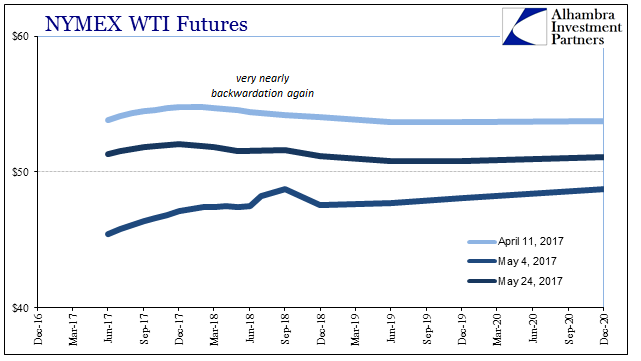
While there is a focus again on the oil price now as it is up from its trough last year, that indication was not alone the signal for distress. The futures curve went from its normal backwardation in the summer of 2014 to often unbelievably sharp contango. Despite the price drop which should have induced a pickup in demand as economics (small “e”) says, after just about three years the futures curve remains in contango. Even OPEC, they of the “supply glut” narrative feeding the one about “transitory”, now realizes it was always ever demand.

A more esoteric sign of great imbalance is swap spreads. It might be the most poorly understood given its complexity and situation far from everyday life, but swap spreads in general get our perceptions closer to the source. An interest rate swap is quoted by its fixed leg (an interest swap is itself an exchange of fixed payments for floating). Thus, in one sense it is a synthetic bond, with a coupon paid by a counterparty without a legal obligation to the notional value. If your choice is to repo a UST, which is free from credit risk, or engage in a synthetic bond (the floating rate payment mimics the repo aspect conceptually if more complicated in practice) you undertake the latter only if it pays for the increased risk of receiving the fixed payment from a financial counterparty rather than the US government.

The swap spread, the difference between the interest rate swap price (the fixed leg quote) and the same maturity UST, tells us about market perceptions of risk in terms of those swap counterparties paying fixed. Given that hierarchy, a negative swap spread, where the interest rate swap is priced below the same maturity UST yield, can only be gibberish, nonsense. There isn’t any realistic scenario where the credit markets would view largely bank and big name financials (like pension funds, insurance companies, and corporate treasuries) as less risky than the US government. If the US government has gotten itself into such a state where that might be possible, then those other counterparties would have been much worse off long before that point.

Therefore the nonsense of a negative swap spread is not purely so but rather meaningful in one vital respect. What it describes is not the same set of risks one way or the other but another more sinister one unrelated to comparable credit risks. If the market rate is paying less than UST yields at whatever maturity, or, as in 2015-16, almost all maturities (down to the 2-year), then there is open an immense arbitrage opportunity. Several if not dozens of trades (using the reverse of the synthetic repo paradigm) can be constructed to take advantage of the nonsense, all of which would be at close to zero risk.

While they would be free of risk, they are not free of every consideration. For the money dealers who are supposed to police this established hierarchy (covered interest parity), there are balance sheet considerations of all sorts, from capital ratio effects to VaR and other specific risk metrics. In a world where balance sheet risk capacity is not so freely traded, meaning volatility far more uncertain, while a negative swap spread represents the possibility of “free money” it might still be “too expensive” to undertake.

Given that demand on the fixed side is somewhat inflexible (the liability management of pension funds and insurance companies), a negative swap spread is indicative of the absence of dealers in that space because of those balance sheet constraints. Far from being totally nonsense, the appearance of a negative swap spread tells us that “something” is wrong deep inside the mathematics of wholesale banking. That swap spreads might persist as nonsense negative for so long, years even, tell us that “something” is fundamentally and structurally wrong deep inside the mathematics of what is the true global money system.

There is actually an economic equivalent to the negative swap spread, one that at first might be surprising. Deployed so easily and readily to fit the mainstream idea of an improving if not healthy economy, the unemployment rate upon closer inspection demonstrates instead the nature of its sickness. At such a low level, there should have been long before now significant wage acceleration due again to basic economics. Instead, economists and policymakers have for years now only been able to see “signs” of hastening.

Like a negative swap spread then, an extremely low unemployment rate that produces no wage inflation (at the point it happens let alone across several years) is similarly meaningful nonsense that points us in the direction of causation. Unlike swap spreads, the mystery of the unemployment rate is easily untangled; it applies to the official count of the employed as a percent of the official count of the labor force. If the latter is not comprehensive, neither can be the unemployment rate.

Therefore, a rate that signifies “full employment” but without the inflationary corroboration of that actual condition is instead describing an economy that shrunk apart from official acknowledgement. Ever since the mass layoffs in late 2008, economists have been telling us that those people outside the labor force don’t matter, at the very least for interpretation. But if you have to so fool yourself into rejecting what is a matter of pure common sense, then your position really is nonsense.

We have interest rates that don’t go up apart from brief but diminishing bursts despite the Federal Reserve’s “rate hikes”, an oil futures curve that after three years remains in contango, an interest rate swap paradigm declaring permanent nonsense, and an unemployment rate doing the same. None of these are trivial concerns, instead speaking directly about the real physical world behind the façade of mainstream description. Improving or healthy are economic qualifiers that would in the future only start to apply where all these imbalances have finally dissipated and disappeared for good.

After ten years now we are still stuck with them, a thoroughly disheartening picture of reality. To be cute, there is good reason why they used to call it depression.

via http://ift.tt/2rhP04b Tyler Durden

Commercial Banks Slash Auto Loans Outstanding For First Time In Six Years

After the subprime mortgage bubble burst back in 2009, new regulations prevented banks from rushing right back into mortgages to re-inflate a market that nearly took down the global financial system.  Of course, Uncle Sam didn’t restrict wall street from blowing massive bubbles in all asset classes, in fact the Fed seemingly condones it, just the mortgage market.

And so, all that loan volume shifted to autos…


…and student loans.


Alas, it seems as though commercials banks are finally starting to wonder whether they’ve inflated at least the auto loan bubble to the brink of bursting.  As the Financial Times points out today, the FDIC’s commercial lending report for 1Q 2017 showed that commercial banks slashed their auto loan exposure sequentially for the first time in the past six years.

But data released last week by the Federal Deposit Insurance Corporation showed the first sequential drop in car loans outstanding at commercial banks in at least six years. The total slipped $1.6bn to $440bn from the fourth quarter of last year to the first of this, suggesting that banks — wary of repeating the mistakes of the subprime mortgage crisis — have been spooked by rising delinquencies and the threat of litigation. 


Wells Fargo and JPMorgan Chase, the two biggest banks in the sector, saw first-quarter originations drop by double digits from the same period a year earlier. Even relatively aggressive specialists such as Capital One — which added a net $2bn to its $50bn car loan book over the first quarter — are toning down their outlook.


“We’re certainly one more notch cautious,” said Richard Scott Blackley, chief financial officer, noting bigger-than-expected falls in used car prices in the first quarter. “We think that by pulling back a little bit, we’re going to . . . maximise price over volume,” he said.

But for all you banking investors out there who are worried about replacing that juicy auto lending revenue stream, fear not because Citizens Financial’s CEO would like for you to know that while they “ran up auto for a while” they now see “better risk-adjusted returns” in things like student loans…. 

One of the banks pulling back is Citizens Financial Group, the US’s ninth largest by assets. Bruce van Saun, chief executive, told the Financial Times he would rather steer resources into areas such as student loans. “We ran up auto for a while when there was not much else going on. Now we have growth in other areas which offer better risk-adjusted returns.”

...which we guess is true if you simply ignore the fact that over $135 billion of student loans are currently in default.  

Of course, this shouldn’t be new news to our readers as we recently pointed out that after 21 consecutive quarters of loosening lending standards from 2Q 2011 through 2Q 2016, commercial banks finally started to pull back on auto loans in 3Q 2016…

Lending Standards Have Eased…: While overall household debt remains below pre-crisis peaks, auto debt has ballooned to all-time highs. While this debt grew, the median FICO score of borrowers receiving auto loans fell roughly 30 points from peak to trough. According to the Senior Loan Officer Opinion Survey (SLOOS), auto lenders eased lending standards for 21 consecutive quarters from 2Q 2011 through 2Q 2016.


…but Lenders Now Appear to Be Reversing Course and Tightening Standards: While FICO scores did drop precipitously, they have recovered in recent months, and the SLOOS reports 3 quarters of tightening standards after the 21 of easing. A look at the weighted average FICO scores of loans going into subprime ABS deals reveals similar trends, with a number of lenders reporting increases in these scores over recent years. However, the overall trend has moved lower since 2013.

Subprime


…which probably had something to do the soaring delinquency rates that have resulted from years of declining underwriting standards.

Subprime


But sure, 18mm new cars per year is probably a ‘normalized’ level of demand for the U.S. market…just like 1.3mm in new home sales was ‘normal’ in 2005.

via http://ift.tt/2qDQu72 Tyler Durden

Lance Roberts: This Market Is Like A Tanker Of Gasoline

Authored by Adam Taggart via PeakProsperity.com,

Lance Roberts, chief investment strategist of Clarity Financial and chief editor of Real Investment Advice has authored a number of impressive recent reports identifying potential failure points in today's financial markets. 

In this week's podcast, Lance explains how the massive flood of investment capital into passively-managed ETFs, along with record amounts of margin debt, has the potential to set the markets afire:

Fundamentally, there’s nothing different in today's markets because, at the end of the day, they are about evaluations, earnings — those types of things. Technically, the market is very different today because of quantitative easing, computerized trading etc.


What we see are two things happening, in particular, that people should be paying attention to. One is that investors are herding into passively-managed ETFs now, which is creating a dislocation between the underlying realities of individual stocks and their prices, because the piling into ETFs is requiring stocks like Facebook, Amazon, and Google to be bought in much greater volumes than they otherwise would. And people are making an assumption that there will always a buyer for every seller in the market.


Now that’s absolutely true. But it's often argued by the mainstream media that "For every buyer there’s a seller, so it doesn’t matter when the market turns. You’ll be okay." But you won’t, because, yes, at some point there is a buyer for every seller, but it always begs the question: At what price? And because of all the piling into these ETFs, when the market eventually breaks, yes, there will be a buyer; but that buyer could be at many percentages lower than where prices were before. We could very well see a vacuum appear in prices, with a gap down so sharp and so fast that it not only paralyzes most investors who may be hoping to get a little bit of recovery to sell into, but then will start triggering margin calls.


There’s been numerous articles written about margin debt: "margin debt is not a problem; don’t worry about margin debt." Well, margin debt is not fine. We’re at record levels of margin debts. It’s like a can of gasoline. If I set a can of gasoline in the middle of a room and nobody touches it, it's fine. But drop a match into that can of gasoline you have a different story.


So, the only thing that’s been missing up to this moment right now is the herding of individuals into a specific type of investment. But just like with real estate in the past, we have now people herding into ETFs. And now, with all these computers basically acting on the same set of information pushing stocks in the same direction because they’re all working off the same set of information, the market is like a tanker of gasoline. And somebody’s going to put a lit stick a dynamite into it because when this all reverses, you have these passive indexers become panic sellers. And then that beings to immediately trigger a reversal in the algorithms, which all feed on themselves in a negative direction. And the gap that opens up between the bid and sell prices will be staggering.  

Click the play button below to listen to Chris' interview with Lance Roberts (45m:28s).

via http://ift.tt/2r8WdFs Tyler Durden