“We’ll Become ISIS” – The Devaluation Of America’s Young Men

Submitted by James H. Kunstler via Kunstler.com,

I played fiddle at a small-town, country dance last night with several other musicians and it was a merry enough time because that kind of self-made music has the power to fortify spirits. About half the dancers were over 40 and the rest were teenage girls. The absence of young men was conspicuous. Toward the end of the evening, it was just girls dancing with girls. A wonderful and fundamental tension was not present in the room.

The young men are out there somewhere in the country towns, but this society increasingly has no use or no place for them, except in the army. There is absolutely no public conversation about the near total devaluation of young men in the economic and social life of the USA, though there is near-hysterical triumphalism about the success of young women in every realm from sports to politics to business, and to go with that an equal amount of valorization for people who develop an ambiguous sexual identity.

There really is no local forum for public discussion in the flyover regions of the USA. The few remaining local newspapers are parodies of what newspapers once were, and the schools maintain a fog of sanctimony that penalizes thinking outside the bright-side box. Television and its step-child, the internet, offer only the worst temptations of hyper-sexual stimulation, artificial violence, and grandiose wealth-and-power fantasies. There aren’t even any taverns where people can gather for casual talk.

Many of the remaining jobs “out there” are jobs that can be done by anyone — certainly the office work, but also the jobs with near-zero meaning, minimal income, and no status in the national chain burger shacks and box stores — and young women are more reliably subject to control than young men jacked on testosterone, corn syrup, and Grand Theft Auto.

Of course, the idea that higher education can lift a population out of this vortex of anomie is a cruel joke, especially now with the college loan racket parasitizing that flickering wish to succeed, turning young people into debt donkeys. The shelf-life of that particular set of lies and swindles will hit its sell-by date soon in a massive debt repudiation — and the nation will come to marvel at the mendacious system it allowed itself to get sucked into. But this still only begs the question of what young men will do in such a deceitful system.

My guess is that they will shift their attention and activity from the mind-slavery of the current Potemkin economy to the very monster we find ourselves fighting overseas: a domestic ISIS-style explosion of wrath wrapped in an extreme ideology of one kind or another replete with savagery and vengeance-seeking. The most dangerous thing that any society can do is invalidate young men. When the explosion of youthful male wrath occurs in the USA, it will come along at exactly the same time as all the other benchmarks of order become unmoored – especially the ones in money and politics – which will shatter the faith of the non-young and the non-male, too. Also, just imagine for a moment the numbers of young men America has trained with military skills the past 20 years. Not all of them will be disabled with PTSD, or mollified with rinky-dink jobs at the Wal-Mart, or lost in the transports of heroin and methedrine.

The authorities will have no way to understand what is happening and we are certain to endure a long season of violence and social chaos as a result. The re-set from that will be an economy and a society that few now yammering will recognize. That society emerging from the ashes of the current matrix of rackets will desperately need young men to rebuild, and there will be plenty of opportunity for them – though it won’t feature fast cars, Kanye West downloads, or bottle service.

There are other ways for young men to find a useful and valued place in a society, but these are too far beyond the ken of our current meager narratives.


via Zero Hedge http://ift.tt/1wSb5Cn Tyler Durden

The US Is Now 50% More Unequal Than Ancient Rome (And That Includes Slaves)

As we previously noted, only the highest income earners have seen any gains in compensation since the crisis began around 2007 to the current 'recovery' tops. It is perhaps not entirely surprising then that, the total income controlled by the Top 1% is drastically above that of the slave-included times of Ancient Rome and as high as the peak in the roaring 20s.


Current inequality is almost 50% worse than in Ancient Rome and as large as the end of the roaring 20s…


Source: @ConradHackett


Which is hardly surprising given that since 2007, incomes have only risen for highest wage-earners…


We leave it to the following 139 words by Elliott's Paul Singer to conclude – which in two short paragraphs explains everything one needs to know about America's record class inequality, including precisely who is the man responsible:

Inequality in the U.S. today is near its historical highs, largely because the Federal Reserve’s policies have succeeded in achieving their aim: namely, higher asset prices (especially the prices of stocks, bonds and high-end real estate), which are generally owned by taxpayers in the upper-income brackets. The Fed is doing all the work, because the President’s policies are growth-suppressive. In the absence of the Fed’s moneyprinting and ZIRP, the economy would either be softer or actually in a new recession.


The greatest irony is that the President is railing against inequality as one of the most important problems of the day, despite the fact that his policies are squeezing the middle class and causing the Fed – with the President’s encouragement – to engage in the radical monetary policy, which is exacerbating inequality. This simple truth cannot be repeated often enough.


via Zero Hedge http://ift.tt/YIfvzR Tyler Durden

The Goldman Tapes And Why The Delusion Of Macro-Prudential Regulation Means The Next Crash Is Nigh

Submitted by David Stockman via Contra Corner blog,

There is nothing like the release of secret tape recordings to clarify an inconclusive debate. I recall that happening with Nixon back in the day. Even as a Washington apprentice I could see that he was a ruthless, power hungry abuser of his office, but much of official Washington just denied it. Then came the tapes. Soon there was no doubt. In short order Nixon was gone.

So now comes the Goldman tapes – 46 hours of recordings by an embedded New York Fed regulator at Goldman Sachs who got fired for attempting to, well, regulate. Would that the Carmen Segarra affair generates a Nixonian result – that is, exposure that “regulatory capture” is an endemic, potent and inextricable evil that can’t be remediated in situ.

Never mind that what Ms. Segarra was attempting to regulate–whether Goldman had a conflict of interest policy with respect to its M&A clients—-was actually none of the state’s business in the first place. If in the instant case GS was giving squinty eyed advise to its client, El Paso Corporation, because it owned a $4 billion position in the other party to the transaction, Kinder Morgan, so be it. Either the conflict was harmless or eventually Goldman’s M&A business would have been punished by the marketplace—–even stupid executives and boards wouldn’t pay huge fees to be taken to the cleaners for long.

Actually, what the tapes really show is that the Fed’s latest policy contraption – macro-prudential regulation through a financial stability committee – is just a useless exercise in CYA. Apparently, even the colony of the bubble blind which inhabits the Eccles Building has started to get nervous about financial bubbles and instability in recent months. What with junk bond yields sporting a 5 handle, the Russell 2000 trading at 80X reported profits and the IPO market having gone full-tilt manic with last week’s pricing at 27X sales of a Chinese e-commerce mass merchant that is a pure proxy for the greatest credit fueled house of cards in human history—-it needed to show some gesture of concern.

Now, it might have gone straight to the horse’s mouth. It might have asked about 70 consecutive months of zero money market rates, for instance, and the manner in which that has enabled speculators to mount massive momentum trades everywhere in the financial markets by funding any “risk asset” that generates a yield or a short-run gain with nearly zero cost options or repo. Or it might have inquired about the destruction of the market’s natural internal mechanisms of stability and financial restraint—-that is, short sellers and two way trading—that has resulted from the Greenspan/Bernanke/Yellen Put; or it might have wondered whether its bald-faced doctrine of “wealth effects” and ever rising stock prices does not in itself create a massive bias toward speculative risking taking and a blind buy-the-dips herd mentality in the casino.

But that would have been inconvenient because it would meant an abrupt end to its labor market focused policy of “accommodation” and a violent hissy fit in the casino. So Yellen and here Keynesian compatriots have invented out of whole cloth a method to drive the wildly vibrating Wall Street financial jalopy with both feet to the floor. That is, on the monetary “policy” side they intend to perpetuate ZIRP for at least another 9 months and near-ZIRP as far as the eye can see , while at the same time interposing in today’s frothy financial markets a Stanley Fischer led posse of regulators to keep speculator exuberance within safe boundaries.

At this point it is not clear which part of the Fed’s “macro-pru” initiative is the more preposterous. Why would you think that a system which required only 9 months to fire Carmen Segarra for comparatively trivial meddling in Goldman’s M&A department is capable of bubble prevention when we are talking about trillions of inflated value in the stock, bond, derivatives and real estate markets?  Or that putting a proven serial bubble generator—-that’s essentially what Fischer accomplished during his stint as head of Israel’s central bank—at the head of the financial stability committee would produce, well, financial stability?

It should be evident by now that regulatory capture and the inherent capacity of the marketplace to evade bureaucratic rules, edicts and embedded supervisors mean that “macro-pru” is a crock—an excuse to prolong a dangerous monetary experiment that is inexorably fueling a giant financial bubble and the crash which must inevitably follow.

Take the soaring issuance of sub-prime auto credit, for example, which now accounts for a record 30% of car loans and is putting people in cars at 130% loan-to-value ratios—-borrowers that have no hope of avoiding the repo man a few months down the road. On the margin, nearly all of this explosive growth is being funded in the non-bank market. That is, by freshly minted sub-prime auto lenders who have been given a sliver of equity by LBO houses and a ton of debt by the high yield market.  Who is Stanley Fischer going to crack down upon—–the LBO houses creating these fly-by-night lenders, the Wall Street underwriters lead by Goldman who are distributing the junk or Bill Gross’s yield-parched successors at PIMCO and its mutual fund competitors who are buying the stuff?

OK, Stanley Fischer being from MIT, the IMF, Citibank, the Bank of Israel—and to say nothing of his long ago supervision of Ben Bernanke’s PhD thesis which merely Xeroxed  Milton Friedman’s false claim that the Fed’s failure to engage in massive QE during 1930-1932 caused the Great Depression—-is too sophisticated to say “no auto junk, period”. What his committee will likely do is issue guidance about keeping debt-to-EBITDA ratios “prudent” at some notional leverage of say 6-8X when these newly minted auto junk yards are issuing the same.

But that’s before the underwriters parade in with a host of complications embedded in “adjusted EBITDA” to account for the fact that two fly-by-night subprime lenders, for example, just merged and therefore need a pro forma adjustment for down-the-road synergy savings; or that a newly minted lender is still scaling up its volume and that on a last month’s run-rate basis, its adjusted EBITDA ratio is 7.8X, not the 16X ratio embedded in its actual GAAP results.

And that doesn’t even account for the fact that the loan books of these start-up auto sub-primes are inherently unseasoned. It does take some time for an assistant night shift manager at a McDonald’s to become the subject of a “restructuring” initiative by the local franchisee and to subsequently default on his car loan. Indeed, the Fischer committee would even be up against the inherently vexing math of a rapidly ramping loan book. That is, while the denominator of loans issued is soaring, the numerator of delinquencies is still lagging. So loan loss reserves are invariably understated during the final blow-off stage of a financial bubble, meaning that earnings and EBITDA are over-stated and hidden leverage risk is rampant. The evidence is there in s
pades in the wreckage of the LBO and high yield markets during 20009-2010.

In short, even assuming that the obsequious culture of accommodation at the New York Fed so evident in the Goldman tapes could be uprooted, macro-pru is inherently impotent because of information asymmetry. What the Austrian thinkers 100 years ago said about socialism in general is true in spades with respect to the gambling casinos created by the Keynesian money printers. Without honest market prices in the trading pits and at loan desks and underwriting syndicates, financial booms and busts are inevitable, and the state’s regulators and supervisors are hopelessly at sea because they cannot hope to gather and process enough information to stymie the army of speculators chasing false prices with cheap credit.

Or to take another example, what is the Fischer committee going to do about leveraged stock buybacks? Not only is this fueling the speculative rise in the stock averages and the illusion that earnings are growing, when in fact it is only the share count which is shrinking, but it is also adding to the dangerous build-up of corporate debt that will become hugely problematic when interest rates are finally allowed to normalize.

But imagine the utter hissy fit that would instantly arise on Wall Street if the Fischer committee was even rumored to be addressing the issue of leveraged stock buybacks. It would generate a violent sell-off of the likes not seen since the House Republicans voted down TARP the first time around.

And then would come the information miasma. Wall Street would trot out the cash on the sidelines canard, arguing there is no problem here because not withstanding the current $700 billion annualized run-rate of buybacks for the S&P 500 alone, there is plenty of cash cushion available to corporate chieftains who wish to invest in their own company’s future— albeit with shareholder money, not theirs.

In truth, of course, the business sector did not delever one wit after the financial crisis.  Since the fourth quarter of 2007, business debt in the US has risen from $11 to $14 trillion. That $3 trillion gain dwarfs the $500 billion pick up in business cash balances. In fact, the rise in cash was never a sign of returning financial health in the fist place: it was only a telltale sign that by causing debt to be drastically mis-priced, the Fed was encouraging companies to artificially balloon both sides of their balance sheets.

Yet it would take the Fischer committee months to sort-out the truth and refute the sell-side propaganda—even if it had the will. Meanwhile, the bubble would continue to expand.

So here’s the thing. Our monetary politburo has its ass backwards. Macro-pru is an impossible delusion that should not be taken seriously be sensible adults. It is not, as Janet Yellen insists, a supplementary tool to contain and remediate the unintended consequence – that is, excessive financial speculation – of the Fed’s primary drive to achieve full employment and fill the GDP bathtub to the very brim of its potential.

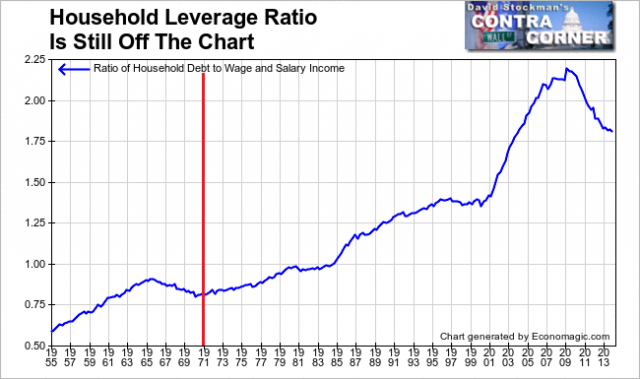
Instead,  rampant speculation, excessive leverage, phony liquidity and massive financial instability are the only real result of current Fed policy. We are at peak debt in the household and business sectors of the private economy. Accordingly, the credit channel of monetary transmission is broken and done. Indeed, the modest pick-up in leverage in the household sector  has been exclusively among utterly marginal borrowers. That is, among students who are just treading water until the eventual day of default and sub-prime auto borrowers who are actually underwater they day they take out their loans.

No, the central bankers’ one time parlor trick has been played and leverage was ratcheted-up until it reached a peak in 2007-2008.  Now the central bankers are pushing on a string.

Household Leverage Ratio - Click to enlarge

But even as their liquidity tsunami never escapes the canyons of Wall Street, and, as an empirical matter, circulates right back to excess reserves at the New York Fed, it does have an immense untoward effect during its circular journey. Namely, it causes the most important price in all of capitalism—that is, the cost of overnight money and the speculators’ “carry” on his asset positions—to be drastically mispriced. It turns the central bank into a serial bubble machine.

Not 10,000 Carmen Segarra’s could stop the boom and bust cycle thus manufactured by the money printers ensconced in the Eccles Building. Stanley Fischer’s financial stability committee, therefore, is not merely a pointless farce. Its evidence that the next financial crash is nigh.


via Zero Hedge http://ift.tt/YIfsnz Tyler Durden

PIMCO Liquidations Begin; And So Does The Retaliation: All Bill Gross Tweets Deleted

The last few days have been hectic for PIMCO executives. As we already noted, expectations of outflows persist and today's open in CDS markets suggested major concerns among market participants that PIMCO redemptions would force selling through an illiquid market. Sure enough, Bloomberg reports that PIMCO's Total Return Fund ETF was behind the auction of more than $170m of Fannie Mae CMBS on Friday (and more BWICs were seen today). As one trader noted, "you're going to sell your most liquid stuff first." Additionally, PIMCO has seen fit to delete all Bill Gross' tweets… so here are the last six months for the record.

As Bloomberg reports, the PIMCO liquidations have begun…

Pimco Total Return ETF behind auction of more than $170m of Fannie Mae CMBS on Friday, according to person with knowledge of the matter, who asked not to be named because the seller wasn’t disclosed.


List included most of ETF’s largest holdings in sector, according to Empirasign and Bloomberg data


Dealers also circulating ~$77m Fannie CMBS BWIC today with bonds in sizes similar to at least most of $3.6b ETF’s other holdings of the DUS securities, the data show


“You’re going to sell your most liquid stuff first. You don’t want to be a forced seller of anything. I would think these lists are going to be absorbed pretty well,” Brean Capital strategist Scott Buchta said in telephone interview


Other auction lists containing bonds in similar sizes to Pimco ETF’s holdings include: ~$59m of agency CMOs on Friday, ~$62m of subprime-mortgage securities today, ~$25m of senior CMBS today

h/t @SMulholland_


And then… PIMCO removed all of Bill Gross' tweets from the @PIMCO account…

Click image for large legible version of Bloomberg feed of the last 6 months of Bill Gross Tweets via @PIMCO


One wonders just what it is that PIMCO is so afraid of… are they about to take a 100% diametric market view to the 'Bond King' and need no evidence left of the entire company's top-down market thesis? Or is it just standard practice?


via Zero Hedge http://ift.tt/1rohp5n Tyler Durden

Presenting ISIS-Beating "Mad Max" Battle Tanks And Buses

When it comes to fighting the barbaric beheaders formerly known as ISIS, Kurdish fighters appear to have gone to the 1979 movie "Mad Max" for inspiration. As The Daily Mail notes, while significantly outgunned by Islamic State, the Kurds have created a fleet of well-armored, elaborately-designed, ominous-looking battle-buses by converting tractors and trucks into tanks…


Spot The Difference…

1979 Movie Mad Max…


And 2014 Kurdish Fighters…


Source: The Daily Mail

*  *  *

So to sum up – ISIS (the enemy) is using the latest and greatest US military equipment that it either stole from (or was given) Iraqi military and the Kurdish Peshmurga (our allies) are using tractors and trucks cobbled together with steel plates, duct tape, and surreal images.

Ok…


via Zero Hedge http://ift.tt/1vqn3Uy Tyler Durden

Presenting ISIS-Beating “Mad Max” Battle Tanks And Buses

When it comes to fighting the barbaric beheaders formerly known as ISIS, Kurdish fighters appear to have gone to the 1979 movie "Mad Max" for inspiration. As The Daily Mail notes, while significantly outgunned by Islamic State, the Kurds have created a fleet of well-armored, elaborately-designed, ominous-looking battle-buses by converting tractors and trucks into tanks…


Spot The Difference…

1979 Movie Mad Max…


And 2014 Kurdish Fighters…


Source: The Daily Mail

*  *  *

So to sum up – ISIS (the enemy) is using the latest and greatest US military equipment that it either stole from (or was given) Iraqi military and the Kurdish Peshmurga (our allies) are using tractors and trucks cobbled together with steel plates, duct tape, and surreal images.

Ok…


via Zero Hedge http://ift.tt/1vqn3Uy Tyler Durden

Despite Late-Day Buying Panic, Stocks Close Red

Heavy volume and volatile price action early in stocks and high-yield credit markets subsided later in the day as despite several big stocks in the red, the indices jammed higher in the last hour desparate to get positive (on terrible volume) but failed. Treasury yields fell 3-4bps early on and stuck near the lows of the day (ignoring equity's exuberance). High-yield credit rallied back off early spike wides at 380bps (with desks noting heavy demand for protection) but remains worse than stocks. VIX tested above 17 and crashed back below 15.5. The USD ended the day unchanged (AUD weakness notable) but gold and silver slipped lower with oil (back over $93) and copper up on the day. Camera-on-a-stick smashed over 11% higher to $91.50 as the 41% float short continues to get squeezed out.


Credit and stocks diverged early once again as selling was heavy and protection well bid…


And despite equity exuberance, Treasuries rallied then ignored stocks…


Even USDJPY decoupled from the exuberance…


As VIX ran the market once again…


As stocks scrambled lat eon to try and get green (with only Trannies successful)


All that matters for tomorrow is keeping the quarter green… (aint gonna happen for the Russell 2000)


Financials stocks continue to decouple from credit…


Investors continued to find safe harbor in camera-on-a-stick-or-dog…


Ford was monkey-hammred after "a disastrous commentary during analyst presentations"


Charts: Bloomberg


via Zero Hedge http://ift.tt/1or93Uz Tyler Durden

China Housing Bubble Bursts: Q3 Land Sales Crater 50%

China may be doing everything in its power to divert attention from the simple fact that its housing bubble, the largest in the world in terms of both assets comprising it as well as divergence from fair value, has burst. But while there is no clear threshold of what constitutes a bursting bubble when it comes to housing, the latest data out of Soufun, China’s largest real-estate website, which said that land sales have dropped a massive 22% to 1.7 trillion Yuan in 2014 so far, is likely as clear an indication as any that Beijing is about to panic.

And if that was not enough Bloomberg adds that land sales in 300 cites followed by Soufun fell almost 50% Y/Y to 415.9 billion yuan in 3Q, while residential land sales declined more than 50% to 265.3b yuan in 3Q.

So why, aside from the obvious, is this relevant? Because recall as we reported two weeks ago when looking at US household net worth, in the US it is all about (record) financial assets. So much so, in fact, that financial assets as a percentage of total household assets have never been higher at 70.3%, which also means that real estate as a percentage of total is as low as it has ever been.

Meanwhile, in China few households care as much about financial assets (the ones that do are largely a part of the Politburo or the ultra-rich oligrachy). Instead, the largest Chinese household asset is Real Estate, which at 74.7% of total household assets, is by far the most valuable asset that China’s population has.


And once a few hundred million Chinese wake up and realize that the “wealth effect” portrayed by the blue bar above has been obliterated, the riots currently taking place in Hong Kong will be a gentle warm up for what the People’s Liberation (sic) Army will be about to face.


via Zero Hedge http://ift.tt/1vq6mH5 Tyler Durden

Gross To Have Final Laugh? Whopping Two-Thirds Of PIMCO’s Flagship Fund May Be Withdrawn

The reason why the first article we wrote on Friday after news hit that PIMCO co-founder was shockingly leaving the firm on Friday, was listing the massive bond fund’s biggest holdings, was because it was only a matter of time: it, being of course, the massive redemptions that would follow Gross’ departure by people that his 30+ tenure at the bond fund made very rich, and who couldn’t care less about a brief central planning-inspired flame out. After all Gross isn’t the first person who has lost the plotline due to the Fed’s manipulation of every market.

So just how bad is it? Not for Gross of course: he has made his billions and is simply doing what he and Icahn do in their age: what they love. No, for Pimco, where the redemptions requests are already flooding in. According to the WSJ, just two days after the Gross announcement (both of which non-workdays), already some $10 billion has been withdrawn. And that is just the beginning:

Pacific Investment Management Co. suffered roughly $10 billion of withdrawals following the Friday departure of co-founder Bill Gross, a person familiar with the matter said, a sign of how quickly Mr. Gross’s surprise move is reshaping the bond-investing landscape.


Pimco is bracing for more outflows on the heels of the veteran investor’s departure after months of internal strife over his leadership. At the same time, some managers say they remain committed to the firm.


Some within the Newport Beach, Calif., investment firm are projecting it will lose at least $100 billion or more in assets due to withdrawals, the person familiar with the matter said, and some analysts peg the estimate higher.


Pimco Chief Executive Douglas Hodge said in a statement his firm “manages nearly $2 trillion in assets, and we are confident that the vast majority of our clients will continue to stand with us.”

Will they? Remember: it wasn’t Allianz, or Pimco, or some bond manager that was unknown until the El-Erian shake up earlier this year, that gave the Newport Beach bond manager $2 trillion in AUM. It was Bill Gross. And it would be a fitting farewell for Gross, who departed his former employer in what some say was a bout of rage, that his departure would also lead to the effective closure or outright liquidation of a bond fund which is forced to dump more than half of its holdings… at firesale prices in a bidless market!

The flight of $100 billion, more assets than many mutual funds hold, could roil some parts of the bond market with limited trading activity, experts say, as Pimco sells assets to meet investor redemptions and other managers put new money to work.

Rivals are trying to position themselves to attract some of the Pimco outflows.

“There is a good chance that Pimco will lose its dominant position as a fixed-income manager as assets find their way into other investment managers, thereby leveling the playing field in fixed income,” said Gary Pollack, who helps oversee $12 billion as head of fixed-income trading in New York at Deutsche Bank’s private wealth-management unit.

So far the biggest winner is the man many have coined the next bond king: “Competitor DoubleLine Capital saw its biggest inflow of the year Friday, taking in “hundreds of millions of dollars,” said Jeffrey Gundlach, chief executive.”

In the meantime, PIMCO, now ex-Gross is celebrating:

Even as Pimco prepared for some investors to follow Mr. Gross, Mr. Hodge said executives at the firm felt an “overwhelming” sense of excitement at the giant asset manager, which has been besieged with negative publicity, spotty performance in its flagship fund that Mr. Gross managed and investor outflows in that and other funds in recent months.

Sadly, the celebrations may end quickly if Kepler Cheuvreux ‘s take on the situation is proven correct.

Earlier today the French bank said that investors may withdraw a gargantuan $150 billion of Total Return Fund’s $221 billion AUM, which is also more than 10% of Pimco’s $1.44 trillion 3rd party AUM.  The report said that Pimco operating profit may drop almost 15% on withdrawals following CIO Bill Gross’s departure. Translated: no bonuses for anyone celebrating today. Of course, the shareholders were already hit when the stock of Allianz tumbled by 6% on Friday.

And if the liquidations accelerate, especially considering the woeful state of bond market liquidity these days when PIMCO suddenly becomes such a major player on the offer side the Fed may have to launch QE just to absorb what PIMCO has to sell so as to not crush the bond market, it is none other than Bill Gross who will have the final laugh, especially if he is able to pick off the bonds his former employer is liquidating in a blue light special.


via Zero Hedge http://ift.tt/ZleTkE Tyler Durden

Gross To Have Final Laugh? Whopping Two-Thirds Of PIMCO's Flagship Fund May Be Withdrawn

The reason why the first article we wrote on Friday after news hit that PIMCO co-founder was shockingly leaving the firm on Friday, was listing the massive bond fund’s biggest holdings, was because it was only a matter of time: it, being of course, the massive redemptions that would follow Gross’ departure by people that his 30+ tenure at the bond fund made very rich, and who couldn’t care less about a brief central planning-inspired flame out. After all Gross isn’t the first person who has lost the plotline due to the Fed’s manipulation of every market.

So just how bad is it? Not for Gross of course: he has made his billions and is simply doing what he and Icahn do in their age: what they love. No, for Pimco, where the redemptions requests are already flooding in. According to the WSJ, just two days after the Gross announcement (both of which non-workdays), already some $10 billion has been withdrawn. And that is just the beginning:

Pacific Investment Management Co. suffered roughly $10 billion of withdrawals following the Friday departure of co-founder Bill Gross, a person familiar with the matter said, a sign of how quickly Mr. Gross’s surprise move is reshaping the bond-investing landscape.


Pimco is bracing for more outflows on the heels of the veteran investor’s departure after months of internal strife over his leadership. At the same time, some managers say they remain committed to the firm.


Some within the Newport Beach, Calif., investment firm are projecting it will lose at least $100 billion or more in assets due to withdrawals, the person familiar with the matter said, and some analysts peg the estimate higher.


Pimco Chief Executive Douglas Hodge said in a statement his firm “manages nearly $2 trillion in assets, and we are confident that the vast majority of our clients will continue to stand with us.”

Will they? Remember: it wasn’t Allianz, or Pimco, or some bond manager that was unknown until the El-Erian shake up earlier this year, that gave the Newport Beach bond manager $2 trillion in AUM. It was Bill Gross. And it would be a fitting farewell for Gross, who departed his former employer in what some say was a bout of rage, that his departure would also lead to the effective closure or outright liquidation of a bond fund which is forced to dump more than half of its holdings… at firesale prices in a bidless market!

The flight of $100 billion, more assets than many mutual funds hold, could roil some parts of the bond market with limited trading activity, experts say, as Pimco sells assets to meet investor redemptions and other managers put new money to work.

Rivals are trying to position themselves to attract some of the Pimco outflows.

“There is a good chance that Pimco will lose its dominant position as a fixed-income manager as assets find their way into other investment managers, thereby leveling the playing field in fixed income,” said Gary Pollack, who helps oversee $12 billion as head of fixed-income trading in New York at Deutsche Bank’s private wealth-management unit.

So far the biggest winner is the man many have coined the next bond king: “Competitor DoubleLine Capital saw its biggest inflow of the year Friday, taking in “hundreds of millions of dollars,” said Jeffrey Gundlach, chief executive.”

In the meantime, PIMCO, now ex-Gross is celebrating:

Even as Pimco prepared for some investors to follow Mr. Gross, Mr. Hodge said executives at the firm felt an “overwhelming” sense of excitement at the giant asset manager, which has been besieged with negative publicity, spotty performance in its flagship fund that Mr. Gross managed and investor outflows in that and other funds in recent months.

Sadly, the celebrations may end quickly if Kepler Cheuvreux ‘s take on the situation is proven correct.

Earlier today the French bank said that investors may withdraw a gargantuan $150 billion of Total Return Fund’s $221 billion AUM, which is also more than 10% of Pimco’s $1.44 trillion 3rd party AUM.  The report said that Pimco operating profit may drop almost 15% on withdrawals following CIO Bill Gross’s departure. Translated: no bonuses for anyone celebrating today. Of course, the shareholders were already hit when the stock of Allianz tumbled by 6% on Friday.

And if the liquidations accelerate, especially considering the woeful state of bond market liquidity these days when PIMCO suddenly becomes such a major player on the offer side the Fed may have to launch QE just to absorb what PIMCO has to sell so as to not crush the bond market, it is none other than Bill Gross who will have the final laugh, especially if he is able to pick off the bonds his former employer is liquidating in a blue light special.


via Zero Hedge http://ift.tt/ZleTkE Tyler Durden