No, America Isn't Communist; It's Only 70% Communist

Submitted by Simon Black via Sovereign Man blog,

“The proletarians have nothing to lose but their chains. They have a world to win. Workers of the world, unite!”

Most people remember Karl Marx’s most potent points and phrases, and the mountain of corpses his disciples left behind, especially in the 20th century.

However, most forget or don’t even know the specific policies that Marx advocated.

Within his 1848 Communist Manifesto, Marx outlined a list of ten short-term demands. These, he thought, would be the precursor to the ideal stateless, classless communist society.

Ironically in today’s world, Marx’s demands look pretty much mainstream.

That is because nearly every single item on the list has been implemented to varying degrees in the United States.

Think that couldn’t be possible in the Land of the Free? Just take a look.

1. Topping Marx’s list is the abolition of private property.

True, private property exists, but only until the state wants to take it. With its powers of eminent domain, the government can and does confiscate people’s property when it wants for public use.

Your property isn’t unconditionally yours. Just think of property taxes, for example.

If it’s actually YOUR private property, then why would you need to pay tax on it? And why do they have the authority to take it from you if you don’t pay?

2. Likewise, while we haven’t seen the complete abolition of inheritance (another Marx demand), the government can take up to 40% of your estate when you die.

So ultimately your estate is not your own. You don’t get to control what happens to your wealth and possessions when you die. It’s just a matter of proportion.

3. and 4. Marx also demanded the centralization of transportation and communication. Check, and check.

Try broadcasting over the airwaves in the Land of the Free without a license and special permission.

Practically the entire electromagnetic spectrum is tightly controlled by the state, centralized by a handful of government agencies.

Same with the network of roads and highways. Because, after all, without government, who would build the roads…

5. Another point of Marx is state-guided agricultural production and combination of agriculture and manufacturing.

And the Land of the Free does not disappoint. Though its activities may not be as prominent in the news, the US Department of Agriculture is easily one of the busiest government departments.

With a budget of $146 billion a year, and much more for subsidies, USDA tirelessly works to dictate every major and miniscule activity in the sector.

6. Next on the list, is equal liability of all to labor. If you have at any point wondered, as I have, why politicians are always pushing jobs for the sake of jobs, rather than value and wealth creation—now you know why.

Between minimum wage laws and the constant stream of legislation that promises jobs for all, it is clear that politicians have wholly internalized this Marxian ideal.

Now, you might think that this is just a fluke, just a coincidence that some US policies resemble what’s on Marx’s list of demands.

But then you see these demands, which have not only been fully implemented in the US already, but are thoroughly entrenched in the national psyche:

7. First, there’s free education for all children, to enable the uniformity of thought. Check.

8. Then there’s a heavy progressive income tax. Yep, I’m pretty sure you’re familiar with this one, which has actually become so mainstream, that to have any system other than this would be considered revolutionary. Check.

9. Third, is the confiscation of the property of emigrants (expatriates) and rebels.

Between the IRS bullying of political opposition groups and the imposition of exit taxes for those that renounce their citizenship, the United States is firmly set up to discourage dissent and escape. Check.

10. And last but not least, the centralization of credit in the hands of the state, by means of a national bank. Check.

Remember, Karl Marx thought central banking was a great idea—the same guy who thought that individual success and private property were evil.

Think about that the next time the Federal Reserve comes up with a plan to help businesses and fix the economy.

So now you know, America isn’t communist. It’s only about 70% communist. No reason to worry.


via Zero Hedge http://ift.tt/ZlTzvv Tyler Durden

Clinkle is the New Color

Greetings from Palo Alto. Over three years (and thousands of posts……) ago, I wrote Color and the Mania in This Valley. The thrust of my post was:

+ Color.com had received $41 million to develop an app;
+ The app sucked out loud;
+ The company deserved to fail.

Well, fail it did (as I announced in the 4th post I did about the stupid place), and in those three+ years, the bubble has just continued to inflate. 2014 makes 2011 seem downright sensible.

Which brings us to Clinkle, which is a firm founded by a 22 year old with no business successes behind him (which at least Color.com’s founder could claim, as he sold his firm to Apple for a fortune). Clinkle initially received $25 million (fun fact: the same amount used to fund Google, which went on to bigger successes than building a single app) and has been ostensibly hard at work on this thing for years. Here is the mature and world-changing lad after he landed the funding:

Well, as Clinkle continued to produce nothing, they continued to garner funding, reported to be upwards of $40  million now (a number strangely coincident with Color’s). Recently, at long, long last, they launched their app. Here’s how they try to explain it:

0929-clinkle

So let me get this straight……..I download an app……..and then I sign up……….and they send me a Prepaid Visa Card (which I don’t need), and then I can put money on the card. The wrinkle to this, apparently, is that if my friends also use Clinkle, I can transmit cash to them if I want.

Allow me to express my reaction with three letters: B, F, and D. So this is what $40 million and a crack team of engineers was able to create? (Although the money wasn’t entirely wasted – – you can go to this page and check out the team member photos which, as you mouse over them, turn into zany poses – – hilarious! My goodness gracious.)

Perhaps I’m just a cranky blogger who likes to pee on the parade of this youngster who has been endowed with so much start-up cash, and in fact Clinkle is an awesome app. Let’s check out the reviews on the App Store, shall we?

0929-reviews

 So from what I saw, there were 19 reviews posted: 18 of them were 1-star (the lowest possible), and one of them was 5-star (which, I would wager, was posted by the man-child above clutching the dollar bills).

Clinkle has also added an elitist wrinkle to their little product by making it available only at certain colleges (as if the demand for this thing would otherwise overwhelm them). Perhaps they figure since Facebook started that way in 2004 (Harvard, Stanford, etc.) then surely that must be the pathway to billions.

What a bunch of feckless douchenozzles. I can’t wait for this damned bubble to finally pop, because I’m not sure how much more we can all endure this without becoming irreversibly nauseous. It’s not enough for Color.com…………or, soon, Clinkle…………..to collapse into a pile of worthless ashes. All this overfunded silliness has really got to end, because it’s an unsustainable distortion of reality.


via Zero Hedge http://ift.tt/1vqvhKL Tim Knight from Slope of Hope

Summarizing The "Long Dollar Trade" In One Chart

With the USD experiencing its longest stretch of weekly gains since Bretton Woods, it appears, as SocGen notes, that recent currency movements have triggered nostalgia of the pre-crisis world when dollar strength was synonymous with a prosperous global economy. However, given the extreme positioning and potential for policy-maker complacency, SocGen warns the paradox is thus that a strong dollar tantrum could be a more worrying scenario than a Fed tightening tantrum.


The Long USD Trade…


If you are a trend follower, the trend is your friend.

If you are a contrarian, you might want to go short the USD …

h/t Investir.ch
 

But as SocGen's Michala Marcussen warns, beware the strong dollar paradox….

Recent currency movements have triggered nostalgia of the pre-crisis world when dollar strength was synonymous with a prosperous global economy. Hope today is that a strong dollar will cap US inflation, delay Fed tightening and boost exports to the US. To make an impact on US inflation significant enough to slow the Fed, we estimate, however, that EUR/USD would drop to 1.10, USD/JPY to 120 and USD/CNY to 6.50 to significantly shift Fed expectations. To our minds, moreover, such a scenario would only materialise if the growth gap between the US and the other major economies were to widen further.

Should recent dollar appreciation, moreover, breed complacency amongst policymakers elsewhere, this risk scenario could become a very painful reality. The paradox is thus that a strong dollar tantrum could be a more worrying scenario than a Fed tightening tantrum.

1. Dollar not yet strong enough to delay the Fed

Dollar close to long run average: Recent dollar movements have been sharper-than-expected and several crosses (including EUR/USD, USD/JPY and USD/GBP) are now at levels that we had initially only expected to see early next year. For all the speed of movement, however, the dollar does not yet qualify as “strong”. Trade-weighted, the dollar is still just below the long run average. Moreover, on the type of horizons that matter for economics, dollar appreciation remains modest; the trade weighted dollar is up just 2% year-to-date over the 2013 average. Looking ahead, we expect further dollar gains and by mid-2015, we look for a gain of just over 6% on a full year basis.

US growing well above trend potential: The US economy is on course 3%+ growth rates over the coming quarters, well above the 2.2% at which we estimate trend potential. This week’s numerous data releases, including the key September employment report (we look for +260K on non-farm payrolls) should confirm firm US growth. With each batch of robust data taking the Fed a step closer to the exit, the debate now is just how much dollar appreciation it would take to delay the Fed.

The CNY has appreciated (!) against the US dollar: As a rule of thumb, using the OECD growth model, a 10% appreciation of the trade-weighted dollar cuts 0.5pp from GDP growth and 0.3pp from CPI inflation in the first year after the shock. Two points merit note, however. Firstly, by country, we find that China has tended to exert the most significant influence on US import prices. Since this latest dollar rally began in the early summer, the CNY has been one of the rare currencies to appreciate (!) against the dollar, albeit by a modest 1%. Secondly, we note that the narrowing energy deficit, as the result of the shale revolution, suggests reduced elasticities over time.

Taking account of these points, we find that to significantly delay Fed rate hikes, we would need to see an additional 10% appreciation of the trade weighted dollar relative to our baseline. That would entail EUR/USD at 1.10, USD/JPY at 120 and USD/CNY at 6.50 (and would require other major currencies such as the CAD and MXP to also depreciate significantly). Such a scenario, however, is most likely if growth disappoints materially in the other major economies relative to our baseline scenario. A significantly weaker outlook for the main trading partners of the US would it itself be a cause for the Fed to delay.

2. A worrying trend on growth gaps … and capital flows

Several EM economies set to growth at a slower pace than the US: While the consensus growth outlook for the US has improved further in recent months, the opposite has been true for several other major economies, including the euro area, Japan and China. Moreover, our own forecasts remain generally below consensus with the exception of the US, where we are above. This view underpins our expectation of further dollar appreciation. Today, moreover, several EM economies are growing at a slower pace than the US. This is a notable difference from the pre-crisis era and has several implications. First, this lower global growth configuration is one reason why we believe that elasticities linking currency depreciation to growth may now be lower. The correlation between commodity prices and the dollar has also shifted. Finally, we note that capital flows are now moving in a very different pattern.

Dollar and commodities: The link between the dollar and commodity prices has seen several shifts over time. Already prior to the latest moves in currency markets, commodity prices were trending lower in parallel with Chinese growth forecasts. More recently, it seems that dollar depreciation may have been an additional factor driving prices lower. For commodity importers, this is helpful; for exporters, this marks yet a headwind.

Fed tightening may be a better scenario than a very strong dollar: Pre-crisis, in a simplified summary, the strong dollar can be described as having been driven by a global savings glut (mainly from the official sector in emerging economies) seeking a home in US Treasuries and, at the same time, US investors seeking risky capital abroad to profit from strong EM growth. It is also worth recalling that QE1 drove the dollar stronger and supported risky US assets as Treasuries rallied. QE2, on the other hand, saw dollar depreciation as US investors sought return in higher yielding asset abroad, and notably in emerging economies. As discussed above, we believe that a significant appreciation of the dollar relative to our baseline would be consistent with much weaker growth elsewhere.

In such a scenario, dollar would equate to further capital outflows, placing further pressure on already vulnerable economies. Indeed, a “dollar tantrum” scenario could well prove more painful than a “Fed tightening tantrum”, assuming the later comes with better growth in the rest of the world.


via Zero Hedge http://ift.tt/ZlTBDu Tyler Durden

Summarizing The “Long Dollar Trade” In One Chart

With the USD experiencing its longest stretch of weekly gains since Bretton Woods, it appears, as SocGen notes, that recent currency movements have triggered nostalgia of the pre-crisis world when dollar strength was synonymous with a prosperous global economy. However, given the extreme positioning and potential for policy-maker complacency, SocGen warns the paradox is thus that a strong dollar tantrum could be a more worrying scenario than a Fed tightening tantrum.


The Long USD Trade…


If you are a trend follower, the trend is your friend.

If you are a contrarian, you might want to go short the USD …

h/t Investir.ch
 

But as SocGen's Michala Marcussen warns, beware the strong dollar paradox….

Recent currency movements have triggered nostalgia of the pre-crisis world when dollar strength was synonymous with a prosperous global economy. Hope today is that a strong dollar will cap US inflation, delay Fed tightening and boost exports to the US. To make an impact on US inflation significant enough to slow the Fed, we estimate, however, that EUR/USD would drop to 1.10, USD/JPY to 120 and USD/CNY to 6.50 to significantly shift Fed expectations. To our minds, moreover, such a scenario would only materialise if the growth gap between the US and the other major economies were to widen further.

Should recent dollar appreciation, moreover, breed complacency amongst policymakers elsewhere, this risk scenario could become a very painful reality. The paradox is thus that a strong dollar tantrum could be a more worrying scenario than a Fed tightening tantrum.

1. Dollar not yet strong enough to delay the Fed

Dollar close to long run average: Recent dollar movements have been sharper-than-expected and several crosses (including EUR/USD, USD/JPY and USD/GBP) are now at levels that we had initially only expected to see early next year. For all the speed of movement, however, the dollar does not yet qualify as “strong”. Trade-weighted, the dollar is still just below the long run average. Moreover, on the type of horizons that matter for economics, dollar appreciation remains modest; the trade weighted dollar is up just 2% year-to-date over the 2013 average. Looking ahead, we expect further dollar gains and by mid-2015, we look for a gain of just over 6% on a full year basis.

US growing well above trend potential: The US economy is on course 3%+ growth rates over the coming quarters, well above the 2.2% at which we estimate trend potential. This week’s numerous data releases, including the key September employment report (we look for +260K on non-farm payrolls) should confirm firm US growth. With each batch of robust data taking the Fed a step closer to the exit, the debate now is just how much dollar appreciation it would take to delay the Fed.

The CNY has appreciated (!) against the US dollar: As a rule of thumb, using the OECD growth model, a 10% appreciation of the trade-weighted dollar cuts 0.5pp from GDP growth and 0.3pp from CPI inflation in the first year after the shock. Two points merit note, however. Firstly, by country, we find that China has tended to exert the most significant influence on US import prices. Since this latest dollar rally began in the early summer, the CNY has been one of the rare currencies to appreciate (!) against the dollar, albeit by a modest 1%. Secondly, we note that the narrowing energy deficit, as the result of the shale revolution, suggests reduced elasticities over time.

Taking account of these points, we find that to significantly delay Fed rate hikes, we would need to see an additional 10% appreciation of the trade weighted dollar relative to our baseline. That would entail EUR/USD at 1.10, USD/JPY at 120 and USD/CNY at 6.50 (and would require other major currencies such as the CAD and MXP to also depreciate significantly). Such a scenario, however, is most likely if growth disappoints materially in the other major economies relative to our baseline scenario. A significantly weaker outlook for the main trading partners of the US would it itself be a cause for the Fed to delay.

2. A worrying trend on growth gaps … and capital flows

Several EM economies set to growth at a slower pace than the US: While the consensus growth outlook for the US has improved further in recent months, the opposite has been true for several other major economies, including the euro area, Japan and China. Moreover, our own forecasts remain generally below consensus with the exception of the US, where we are above. This view underpins our expectation of further dollar appreciation. Today, moreover, several EM economies are growing at a slower pace than the US. This is a notable difference from the pre-crisis era and has several implications. First, this lower global growth configuration is one reason why we believe that elasticities linking currency depreciation to growth may now be lower. The correlation between commodity prices and the dollar has also shifted. Finally, we note that capital flows are now moving in a very different pattern.

Dollar and commodities: The link between the dollar and commodity prices has seen several shifts over time. Already prior to the latest moves in currency markets, commodity prices were trending lower in parallel with Chinese growth forecasts. More recently, it seems that dollar depreciation may have been an additional factor driving prices lower. For commodity importers, this is helpful; for exporters, this marks yet a headwind.

Fed tightening may be a better scenario than a very strong dollar: Pre-crisis, in a simplified summary, the strong dollar can be described as having been driven by a global savings glut (mainly from the official sector in emerging economies) seeking a home in US Treasuries and, at the same time, US investors seeking risky capital abroad to profit from strong EM growth. It is also worth recalling that QE1 drove the dollar stronger and supported risky US assets as Treasuries rallied. QE2, on the other hand, saw dollar depreciation as US investors sought return in higher yielding asset abroad, and notably in emerging economies. As discussed above, we believe that a significant appreciation of the dollar relative to our baseline would be consistent with much weaker growth elsewhere.

In such a scenario, dollar would equate to further capital outflows, placing further pressure on already vulnerable economies. Indeed, a “dollar tantrum” scenario could well prove more painful than a “Fed tightening tantrum”, assuming the later comes with better growth in the rest of the world.


via Zero Hedge http://ift.tt/ZlTBDu Tyler Durden

Study Finds Treated Fracking Wastewater Still Too Toxic

Submitted by Andy Tully via OilPrice.com,

One of the biggest concerns about hydraulic fracturing, or fracking, is that the vast amount of wastewater produced by the process of extracting oil and gas from shale rock deep underground is incredibly toxic.  

Most often, the wastewater is injected into disposal wells deep underground. But a process does exist to convert contaminated water into drinking water that involves running it through wastewater treatment plants and into rivers.

Now a new report says that treated wastewater could be fouling drinking water supplies.

In an article published in Environmental Science & Technology — the journal of the American Chemical Society — a team of researchers acknowledged that the disposal of fracking wastewater is a serious challenge for energy companies that use hydraulic fracturing.

The wastewater left over from the process is not only highly radioactive, but also is contaminated with heavy metals salts known as halides, which are not suitable for consumption, according to the scientists.

Energy companies can opt to use commercial or municipal water treatment plants to purify the water, which is then released into local surface water such as rivers. The problem is that the process sometimes doesn’t remove most of the halides.

When that happens, the water is treated again, with more conventional methods such as chlorinization or ozonation. But there has been concern that this method could form toxic byproducts. The researchers decided to find out whether this was true.

They diluted samples of river water that contained fracking wastewater discharged from water treatment plants in Pennsylvania and Arkansas, simulating what happens when left-over fracking water gets into local surface waters. Then they used current methods of chlorinization and ozonation on the samples to remove the halides and determine whether the water was potable.

The results were not encouraging. The researchers found that the chlorine and ozone – used to rid samples of fracking wastewater containing as little as 0.01 percent and up to 0.1 percent of halides per volume of water – also formed an array of other toxic compounds known as “disinfection byproducts,” or DBPs.

As Climate Progress pointed out, “these chemicals — trihalomethanes, haloacetic acids, bromate, and chlorite — are formed when the disinfectants used in water treatment plants react with halides, according to the Environmental Protection Agency.” All are potentially dangerous to humans, not to mention wildlife.

The results of the study have led researchers to advise the industry not to discharge fracking wastewater into surface waters, even if it has been treated.


via Zero Hedge http://ift.tt/1rzswr1 Tyler Durden

Senate Sponsor Exposes The Real Reason For The Fed

Robert Latham Owen was a part-Cherokee Democratic Senator from Oklahoma between 1907 and 1925 who (ironically) championed efforts to strengthen public control of government.

He is, however, best-known as a co-sponsor of a bill that would change the world forever – The Federal Reserve Act of 1913 (which enabled the Federal Reserve System).

Writing later in his life, he reflected (as so many political leaders do once they leave office) on the real reason for the Federal Reserve Act…

From Robert Latham Owen’s “National economy and the banking system of the United States”


…Funding War!


h/t @RudyHavenstein


via Zero Hedge http://ift.tt/1orFwu2 Tyler Durden

"We'll Become ISIS" – The Devaluation Of America's Young Men

Submitted by James H. Kunstler via Kunstler.com,

I played fiddle at a small-town, country dance last night with several other musicians and it was a merry enough time because that kind of self-made music has the power to fortify spirits. About half the dancers were over 40 and the rest were teenage girls. The absence of young men was conspicuous. Toward the end of the evening, it was just girls dancing with girls. A wonderful and fundamental tension was not present in the room.

The young men are out there somewhere in the country towns, but this society increasingly has no use or no place for them, except in the army. There is absolutely no public conversation about the near total devaluation of young men in the economic and social life of the USA, though there is near-hysterical triumphalism about the success of young women in every realm from sports to politics to business, and to go with that an equal amount of valorization for people who develop an ambiguous sexual identity.

There really is no local forum for public discussion in the flyover regions of the USA. The few remaining local newspapers are parodies of what newspapers once were, and the schools maintain a fog of sanctimony that penalizes thinking outside the bright-side box. Television and its step-child, the internet, offer only the worst temptations of hyper-sexual stimulation, artificial violence, and grandiose wealth-and-power fantasies. There aren’t even any taverns where people can gather for casual talk.

Many of the remaining jobs “out there” are jobs that can be done by anyone — certainly the office work, but also the jobs with near-zero meaning, minimal income, and no status in the national chain burger shacks and box stores — and young women are more reliably subject to control than young men jacked on testosterone, corn syrup, and Grand Theft Auto.

Of course, the idea that higher education can lift a population out of this vortex of anomie is a cruel joke, especially now with the college loan racket parasitizing that flickering wish to succeed, turning young people into debt donkeys. The shelf-life of that particular set of lies and swindles will hit its sell-by date soon in a massive debt repudiation — and the nation will come to marvel at the mendacious system it allowed itself to get sucked into. But this still only begs the question of what young men will do in such a deceitful system.

My guess is that they will shift their attention and activity from the mind-slavery of the current Potemkin economy to the very monster we find ourselves fighting overseas: a domestic ISIS-style explosion of wrath wrapped in an extreme ideology of one kind or another replete with savagery and vengeance-seeking. The most dangerous thing that any society can do is invalidate young men. When the explosion of youthful male wrath occurs in the USA, it will come along at exactly the same time as all the other benchmarks of order become unmoored – especially the ones in money and politics – which will shatter the faith of the non-young and the non-male, too. Also, just imagine for a moment the numbers of young men America has trained with military skills the past 20 years. Not all of them will be disabled with PTSD, or mollified with rinky-dink jobs at the Wal-Mart, or lost in the transports of heroin and methedrine.

The authorities will have no way to understand what is happening and we are certain to endure a long season of violence and social chaos as a result. The re-set from that will be an economy and a society that few now yammering will recognize. That society emerging from the ashes of the current matrix of rackets will desperately need young men to rebuild, and there will be plenty of opportunity for them – though it won’t feature fast cars, Kanye West downloads, or bottle service.

There are other ways for young men to find a useful and valued place in a society, but these are too far beyond the ken of our current meager narratives.


via Zero Hedge http://ift.tt/1wSb5Cn Tyler Durden

“We’ll Become ISIS” – The Devaluation Of America’s Young Men

Submitted by James H. Kunstler via Kunstler.com,

I played fiddle at a small-town, country dance last night with several other musicians and it was a merry enough time because that kind of self-made music has the power to fortify spirits. About half the dancers were over 40 and the rest were teenage girls. The absence of young men was conspicuous. Toward the end of the evening, it was just girls dancing with girls. A wonderful and fundamental tension was not present in the room.

The young men are out there somewhere in the country towns, but this society increasingly has no use or no place for them, except in the army. There is absolutely no public conversation about the near total devaluation of young men in the economic and social life of the USA, though there is near-hysterical triumphalism about the success of young women in every realm from sports to politics to business, and to go with that an equal amount of valorization for people who develop an ambiguous sexual identity.

There really is no local forum for public discussion in the flyover regions of the USA. The few remaining local newspapers are parodies of what newspapers once were, and the schools maintain a fog of sanctimony that penalizes thinking outside the bright-side box. Television and its step-child, the internet, offer only the worst temptations of hyper-sexual stimulation, artificial violence, and grandiose wealth-and-power fantasies. There aren’t even any taverns where people can gather for casual talk.

Many of the remaining jobs “out there” are jobs that can be done by anyone — certainly the office work, but also the jobs with near-zero meaning, minimal income, and no status in the national chain burger shacks and box stores — and young women are more reliably subject to control than young men jacked on testosterone, corn syrup, and Grand Theft Auto.

Of course, the idea that higher education can lift a population out of this vortex of anomie is a cruel joke, especially now with the college loan racket parasitizing that flickering wish to succeed, turning young people into debt donkeys. The shelf-life of that particular set of lies and swindles will hit its sell-by date soon in a massive debt repudiation — and the nation will come to marvel at the mendacious system it allowed itself to get sucked into. But this still only begs the question of what young men will do in such a deceitful system.

My guess is that they will shift their attention and activity from the mind-slavery of the current Potemkin economy to the very monster we find ourselves fighting overseas: a domestic ISIS-style explosion of wrath wrapped in an extreme ideology of one kind or another replete with savagery and vengeance-seeking. The most dangerous thing that any society can do is invalidate young men. When the explosion of youthful male wrath occurs in the USA, it will come along at exactly the same time as all the other benchmarks of order become unmoored – especially the ones in money and politics – which will shatter the faith of the non-young and the non-male, too. Also, just imagine for a moment the numbers of young men America has trained with military skills the past 20 years. Not all of them will be disabled with PTSD, or mollified with rinky-dink jobs at the Wal-Mart, or lost in the transports of heroin and methedrine.

The authorities will have no way to understand what is happening and we are certain to endure a long season of violence and social chaos as a result. The re-set from that will be an economy and a society that few now yammering will recognize. That society emerging from the ashes of the current matrix of rackets will desperately need young men to rebuild, and there will be plenty of opportunity for them – though it won’t feature fast cars, Kanye West downloads, or bottle service.

There are other ways for young men to find a useful and valued place in a society, but these are too far beyond the ken of our current meager narratives.


via Zero Hedge http://ift.tt/1wSb5Cn Tyler Durden

The US Is Now 50% More Unequal Than Ancient Rome (And That Includes Slaves)

As we previously noted, only the highest income earners have seen any gains in compensation since the crisis began around 2007 to the current 'recovery' tops. It is perhaps not entirely surprising then that, the total income controlled by the Top 1% is drastically above that of the slave-included times of Ancient Rome and as high as the peak in the roaring 20s.


Current inequality is almost 50% worse than in Ancient Rome and as large as the end of the roaring 20s…


Source: @ConradHackett


Which is hardly surprising given that since 2007, incomes have only risen for highest wage-earners…


We leave it to the following 139 words by Elliott's Paul Singer to conclude – which in two short paragraphs explains everything one needs to know about America's record class inequality, including precisely who is the man responsible:

Inequality in the U.S. today is near its historical highs, largely because the Federal Reserve’s policies have succeeded in achieving their aim: namely, higher asset prices (especially the prices of stocks, bonds and high-end real estate), which are generally owned by taxpayers in the upper-income brackets. The Fed is doing all the work, because the President’s policies are growth-suppressive. In the absence of the Fed’s moneyprinting and ZIRP, the economy would either be softer or actually in a new recession.


The greatest irony is that the President is railing against inequality as one of the most important problems of the day, despite the fact that his policies are squeezing the middle class and causing the Fed – with the President’s encouragement – to engage in the radical monetary policy, which is exacerbating inequality. This simple truth cannot be repeated often enough.


via Zero Hedge http://ift.tt/YIfvzR Tyler Durden

The Goldman Tapes And Why The Delusion Of Macro-Prudential Regulation Means The Next Crash Is Nigh

Submitted by David Stockman via Contra Corner blog,

There is nothing like the release of secret tape recordings to clarify an inconclusive debate. I recall that happening with Nixon back in the day. Even as a Washington apprentice I could see that he was a ruthless, power hungry abuser of his office, but much of official Washington just denied it. Then came the tapes. Soon there was no doubt. In short order Nixon was gone.

So now comes the Goldman tapes – 46 hours of recordings by an embedded New York Fed regulator at Goldman Sachs who got fired for attempting to, well, regulate. Would that the Carmen Segarra affair generates a Nixonian result – that is, exposure that “regulatory capture” is an endemic, potent and inextricable evil that can’t be remediated in situ.

Never mind that what Ms. Segarra was attempting to regulate–whether Goldman had a conflict of interest policy with respect to its M&A clients—-was actually none of the state’s business in the first place. If in the instant case GS was giving squinty eyed advise to its client, El Paso Corporation, because it owned a $4 billion position in the other party to the transaction, Kinder Morgan, so be it. Either the conflict was harmless or eventually Goldman’s M&A business would have been punished by the marketplace—–even stupid executives and boards wouldn’t pay huge fees to be taken to the cleaners for long.

Actually, what the tapes really show is that the Fed’s latest policy contraption – macro-prudential regulation through a financial stability committee – is just a useless exercise in CYA. Apparently, even the colony of the bubble blind which inhabits the Eccles Building has started to get nervous about financial bubbles and instability in recent months. What with junk bond yields sporting a 5 handle, the Russell 2000 trading at 80X reported profits and the IPO market having gone full-tilt manic with last week’s pricing at 27X sales of a Chinese e-commerce mass merchant that is a pure proxy for the greatest credit fueled house of cards in human history—-it needed to show some gesture of concern.

Now, it might have gone straight to the horse’s mouth. It might have asked about 70 consecutive months of zero money market rates, for instance, and the manner in which that has enabled speculators to mount massive momentum trades everywhere in the financial markets by funding any “risk asset” that generates a yield or a short-run gain with nearly zero cost options or repo. Or it might have inquired about the destruction of the market’s natural internal mechanisms of stability and financial restraint—-that is, short sellers and two way trading—that has resulted from the Greenspan/Bernanke/Yellen Put; or it might have wondered whether its bald-faced doctrine of “wealth effects” and ever rising stock prices does not in itself create a massive bias toward speculative risking taking and a blind buy-the-dips herd mentality in the casino.

But that would have been inconvenient because it would meant an abrupt end to its labor market focused policy of “accommodation” and a violent hissy fit in the casino. So Yellen and here Keynesian compatriots have invented out of whole cloth a method to drive the wildly vibrating Wall Street financial jalopy with both feet to the floor. That is, on the monetary “policy” side they intend to perpetuate ZIRP for at least another 9 months and near-ZIRP as far as the eye can see , while at the same time interposing in today’s frothy financial markets a Stanley Fischer led posse of regulators to keep speculator exuberance within safe boundaries.

At this point it is not clear which part of the Fed’s “macro-pru” initiative is the more preposterous. Why would you think that a system which required only 9 months to fire Carmen Segarra for comparatively trivial meddling in Goldman’s M&A department is capable of bubble prevention when we are talking about trillions of inflated value in the stock, bond, derivatives and real estate markets?  Or that putting a proven serial bubble generator—-that’s essentially what Fischer accomplished during his stint as head of Israel’s central bank—at the head of the financial stability committee would produce, well, financial stability?

It should be evident by now that regulatory capture and the inherent capacity of the marketplace to evade bureaucratic rules, edicts and embedded supervisors mean that “macro-pru” is a crock—an excuse to prolong a dangerous monetary experiment that is inexorably fueling a giant financial bubble and the crash which must inevitably follow.

Take the soaring issuance of sub-prime auto credit, for example, which now accounts for a record 30% of car loans and is putting people in cars at 130% loan-to-value ratios—-borrowers that have no hope of avoiding the repo man a few months down the road. On the margin, nearly all of this explosive growth is being funded in the non-bank market. That is, by freshly minted sub-prime auto lenders who have been given a sliver of equity by LBO houses and a ton of debt by the high yield market.  Who is Stanley Fischer going to crack down upon—–the LBO houses creating these fly-by-night lenders, the Wall Street underwriters lead by Goldman who are distributing the junk or Bill Gross’s yield-parched successors at PIMCO and its mutual fund competitors who are buying the stuff?

OK, Stanley Fischer being from MIT, the IMF, Citibank, the Bank of Israel—and to say nothing of his long ago supervision of Ben Bernanke’s PhD thesis which merely Xeroxed  Milton Friedman’s false claim that the Fed’s failure to engage in massive QE during 1930-1932 caused the Great Depression—-is too sophisticated to say “no auto junk, period”. What his committee will likely do is issue guidance about keeping debt-to-EBITDA ratios “prudent” at some notional leverage of say 6-8X when these newly minted auto junk yards are issuing the same.

But that’s before the underwriters parade in with a host of complications embedded in “adjusted EBITDA” to account for the fact that two fly-by-night subprime lenders, for example, just merged and therefore need a pro forma adjustment for down-the-road synergy savings; or that a newly minted lender is still scaling up its volume and that on a last month’s run-rate basis, its adjusted EBITDA ratio is 7.8X, not the 16X ratio embedded in its actual GAAP results.

And that doesn’t even account for the fact that the loan books of these start-up auto sub-primes are inherently unseasoned. It does take some time for an assistant night shift manager at a McDonald’s to become the subject of a “restructuring” initiative by the local franchisee and to subsequently default on his car loan. Indeed, the Fischer committee would even be up against the inherently vexing math of a rapidly ramping loan book. That is, while the denominator of loans issued is soaring, the numerator of delinquencies is still lagging. So loan loss reserves are invariably understated during the final blow-off stage of a financial bubble, meaning that earnings and EBITDA are over-stated and hidden leverage risk is rampant. The evidence is there in s
pades in the wreckage of the LBO and high yield markets during 20009-2010.

In short, even assuming that the obsequious culture of accommodation at the New York Fed so evident in the Goldman tapes could be uprooted, macro-pru is inherently impotent because of information asymmetry. What the Austrian thinkers 100 years ago said about socialism in general is true in spades with respect to the gambling casinos created by the Keynesian money printers. Without honest market prices in the trading pits and at loan desks and underwriting syndicates, financial booms and busts are inevitable, and the state’s regulators and supervisors are hopelessly at sea because they cannot hope to gather and process enough information to stymie the army of speculators chasing false prices with cheap credit.

Or to take another example, what is the Fischer committee going to do about leveraged stock buybacks? Not only is this fueling the speculative rise in the stock averages and the illusion that earnings are growing, when in fact it is only the share count which is shrinking, but it is also adding to the dangerous build-up of corporate debt that will become hugely problematic when interest rates are finally allowed to normalize.

But imagine the utter hissy fit that would instantly arise on Wall Street if the Fischer committee was even rumored to be addressing the issue of leveraged stock buybacks. It would generate a violent sell-off of the likes not seen since the House Republicans voted down TARP the first time around.

And then would come the information miasma. Wall Street would trot out the cash on the sidelines canard, arguing there is no problem here because not withstanding the current $700 billion annualized run-rate of buybacks for the S&P 500 alone, there is plenty of cash cushion available to corporate chieftains who wish to invest in their own company’s future— albeit with shareholder money, not theirs.

In truth, of course, the business sector did not delever one wit after the financial crisis.  Since the fourth quarter of 2007, business debt in the US has risen from $11 to $14 trillion. That $3 trillion gain dwarfs the $500 billion pick up in business cash balances. In fact, the rise in cash was never a sign of returning financial health in the fist place: it was only a telltale sign that by causing debt to be drastically mis-priced, the Fed was encouraging companies to artificially balloon both sides of their balance sheets.

Yet it would take the Fischer committee months to sort-out the truth and refute the sell-side propaganda—even if it had the will. Meanwhile, the bubble would continue to expand.

So here’s the thing. Our monetary politburo has its ass backwards. Macro-pru is an impossible delusion that should not be taken seriously be sensible adults. It is not, as Janet Yellen insists, a supplementary tool to contain and remediate the unintended consequence – that is, excessive financial speculation – of the Fed’s primary drive to achieve full employment and fill the GDP bathtub to the very brim of its potential.

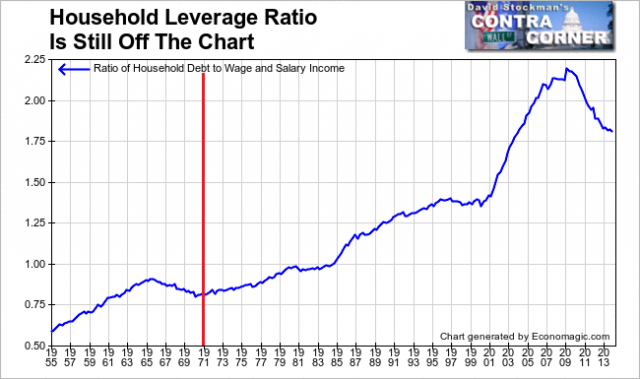
Instead,  rampant speculation, excessive leverage, phony liquidity and massive financial instability are the only real result of current Fed policy. We are at peak debt in the household and business sectors of the private economy. Accordingly, the credit channel of monetary transmission is broken and done. Indeed, the modest pick-up in leverage in the household sector  has been exclusively among utterly marginal borrowers. That is, among students who are just treading water until the eventual day of default and sub-prime auto borrowers who are actually underwater they day they take out their loans.

No, the central bankers’ one time parlor trick has been played and leverage was ratcheted-up until it reached a peak in 2007-2008.  Now the central bankers are pushing on a string.

Household Leverage Ratio - Click to enlarge

But even as their liquidity tsunami never escapes the canyons of Wall Street, and, as an empirical matter, circulates right back to excess reserves at the New York Fed, it does have an immense untoward effect during its circular journey. Namely, it causes the most important price in all of capitalism—that is, the cost of overnight money and the speculators’ “carry” on his asset positions—to be drastically mispriced. It turns the central bank into a serial bubble machine.

Not 10,000 Carmen Segarra’s could stop the boom and bust cycle thus manufactured by the money printers ensconced in the Eccles Building. Stanley Fischer’s financial stability committee, therefore, is not merely a pointless farce. Its evidence that the next financial crash is nigh.


via Zero Hedge http://ift.tt/YIfsnz Tyler Durden