Trump Tells Arab States Joining Abraham Accords Should Be ‘Mandatory’ – Throws Open Door For Iran In Grand Deal

Trump Tells Arab States Joining Abraham Accords Should Be ‘Mandatory’ – Throws Open Door For Iran In Grand Deal

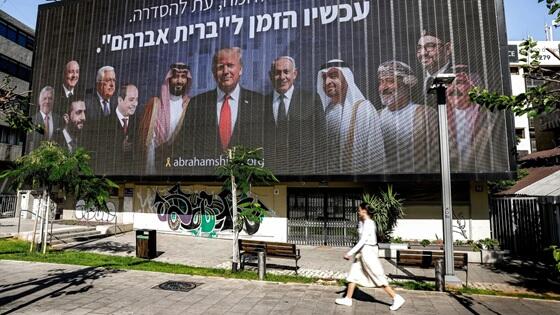
President Trump is still trying to play the role of the globe’s ultimate deal-maker via Truth Social, using a mix of mandatory diplomacy and ultimate economic carrots, issuing a lengthy missive on Iran talks and the Abraham Accords on Monday morning.

He introduced the post by stating that negotiations with Tehran are “proceeding nicely” before dropping a provocative diplomatic bombshell: a demand that a big list of major Middle Eastern nations immediately sign onto the Abraham Accords as a prerequisite for any broader peace framework.

The most unexpected aspect to the post laid out that if Tehran plays ball with Washington, Trump is dangling the prospect of the Islamic Republic itself joining the regional coalition, which it must be remembered hinges on ‘normalization’ with Israel.

“I stated that, after all the work done by the United States to try and pull this very complex puzzle together, it should be mandatory that all of these Countries, at a minimum, simultaneously, sign onto the Abraham Accords,” Trump wrote Monday, referencing a Saturday phone call with Arab leaders.

Trump detailed further:

Those Countries discussed are Saudi Arabia, The United Arab Emirates (already a Member!), Qatar, Pakistan, Türkiye, Egypt, Jordan, and Bahrain (already a Member!). It may be possible that one or two have a reason for not doing so, and that will be accepted, but most should be ready, willing, and able to make this Settlement with Iran a far more Historic Event than it would, otherwise, be. The Abraham Accords have proven to be, for the Countries involved (The United Arab Emirates, Bahrain, Morocco, Sudan, and Kazakhstan), a Financial, Economic, and Social BOOM, even during this time of Conflict and War, with the current Members never even suggesting leaving, or taking so much as even a pause.

The above was coupled with the following ultimatum: “It should start with the immediate signing by Saudi Arabia and Qatar, and everybody else should follow suit. If they don’t, they should not be part of this Deal in that it shows bad intention.”

And then he dropped the significant twist related to Tehran, in claiming that several of the regional leaders he spoke with “would be honored, as soon as our Document is signed, to have the Islamic Republic of Iran as part of the Abraham Accords. Wow, now that would be something special!”

Inviting Iran to join the Abraham Accords as a part of a broader final deal framework has resulted in a lot of head-scratching, given that just weeks ago Trump repeatedly threatened to bomb the country ‘back to the stone age’ and effectively end ‘civilization’ there. US rhetoric has been filled with scorn for Iran, and yet it is now being asked to join a grand US-backed alliance.

Trump is his very long message issued a final directive in the following:

“Therefore, I am mandatorily requesting that all Countries immediately sign the Abraham Accords, and that, if Iran signs its Agreement with me, as President of the United States of America, it would be an Honor to have them also be part of this unparalleled World Coalition. The Middle East would be United, Powerful, and Economically Strong, like perhaps no other area, anywhere in the World! By copy of this TRUTH, I am asking my Representatives to begin, and successfully complete, the process of signing these Countries into the already Historic Abraham Accords.”

Meanwhile, look who’s fully on board and has returned to singing Trump’s praises (after expressing concern over a ‘bad’ Iran deal in the works)…

Whether Trump can single-handedly force countries as far apart in their foreign policies as Saudi Arabia, Pakistan, and Turkey… or especially Iran, into a binding alignment with Tel Aviv remains a massive question mark (to put it mildly), or rather would be incredible and highly unrealistic. 

But with the threat of “shooting, but bigger and stronger than ever before” serving as the baseline, the White House has put regional powers officially on notice – in Trump’s logic at least.

Tyler Durden
Mon, 05/25/2026 – 13:30

via ZeroHedge News https://ift.tt/akvwVzb Tyler Durden

It Was Never About The Climate

It Was Never About The Climate

Authored by Silvio Canto Jr via AmericanThinker.com,

Here is a question for your long weekend:

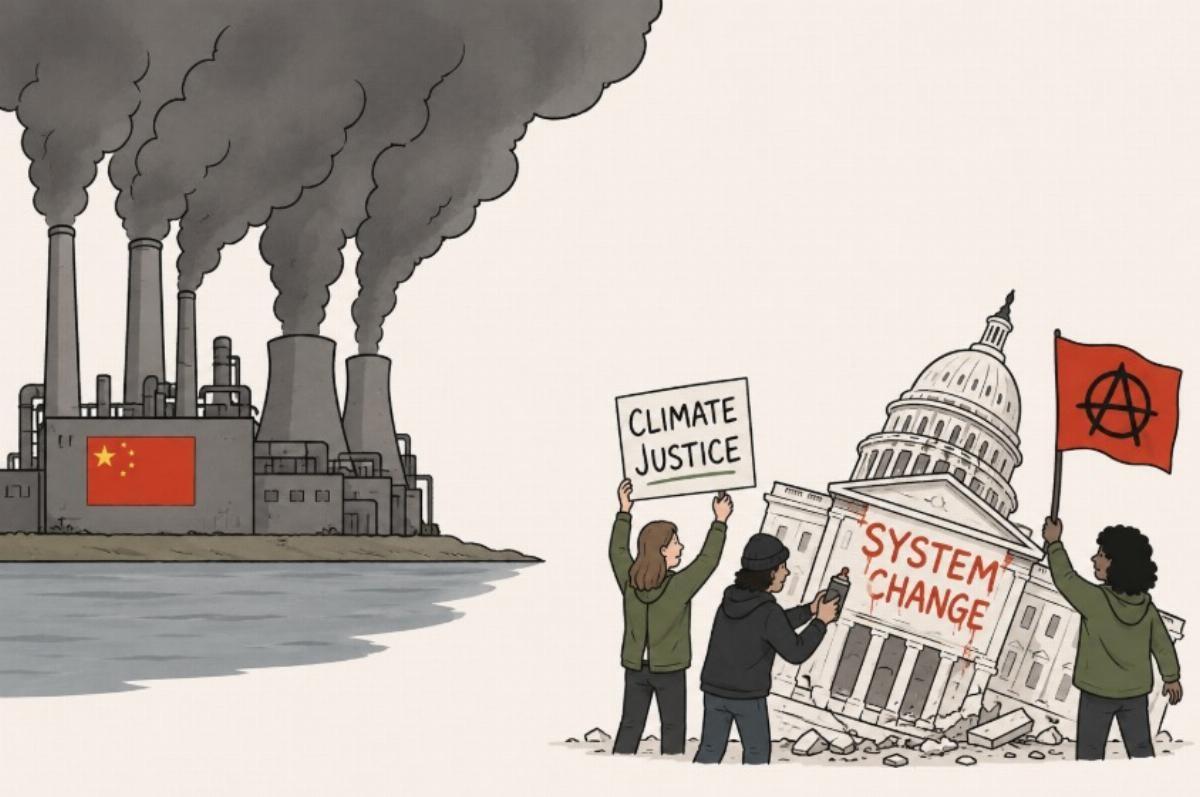
Why haven’t you ever seen a climate change protest before the Chinese embassy anywhere?

Why is it always the US or capitalism messing up the environment?

Why don’t they show up at all when China is a bigger threat to clean air than any US city?

The answer is obvious, but I’ll say it.

It was never about the climate but rather capitalism or the US.

Check this out:

In 2024, climate activists in New York City protested alongside anti-Israel protesters at a rally headlined “Climate Justice Means Free Palestine.”

Last year, climate change celebrity icon Greta Thunberg tried to storm Israel by sea on a flotilla protesting the country’s war in Gaza, yelling “Free! Free! Palestine!” when she was refused entry.

And, last week, activists from CodePink, a far-left feminist activist group that has received funds from an American expatriate, Neville Roy Singham, living in Shanghai, took a break from their rallies supporting the Islamic Republic of Iran and the Cuba Communist Party to circulate a video on Instagram, attacking a Utah data center project backed by investor Kevin O’Leary.

That’s a busy bunch protesting against the West.

Maybe someone should tell them that the clean air in Cuba is due to a collapse of industrial activity.

Or we can always remind them of how they treat gays in Palestine or women in general.

As the article points out, these marches were always about hating the West and what we stand for.

So don’t be fooled by the slogans or some well-meaning people showing up to protest.

The root of all of this is hatred of the West and our individual freedoms.

Tyler Durden
Mon, 05/25/2026 – 12:55

via ZeroHedge News https://ift.tt/bCsZTo5 Tyler Durden

Huawei Touts Sanctions-Busting Chip Breakthrough, SMIC Shares Erupt

Huawei Touts Sanctions-Busting Chip Breakthrough, SMIC Shares Erupt

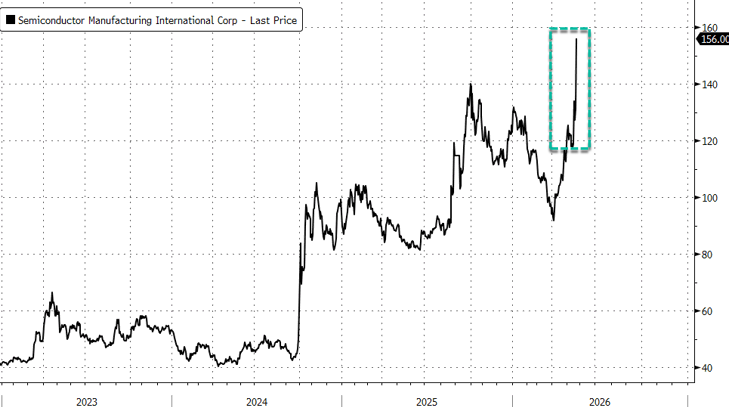
Semiconductor Manufacturing International soared to a record high in China after Huawei unveiled what it described as a breakthrough pathway for advanced semiconductor production at the IEEE ISCAS conference, without relying on the West’s most advanced chipmaking equipment.

Huawei’s semiconductor chief, He Tingbo, told the audience earlier today that the company has developed a “New Semiconductor Path in Practice” that replaces traditional Moore’s Law-style geometric scaling with time scaling and reducing signal propagation delay across devices, circuits, chips, and systems.

Huawei’s press release stated:

In her speech, she presented the Tau (τ) Scaling Law, a new principle for guiding the future development of the semiconductor industry. This law proposes replacing geometric scaling with time (τ) scaling as a new guiding principle for the evolution of both semiconductors and electronic systems. Based on this principle, innovative technologies such as LogicFolding can be used to continuously compress signal propagation delay and steadily improve transistor density, which will drive the ongoing evolution of semiconductors and electronic systems.

Tingbo said Huawei plans to make 1.4-nanometer chips by 2031 using its own “LogicFolding” architecture. TSMC has said it expects to begin mass production of 1.4nm chips in 2028, leaving Huawei about five years behind the global leader, Taiwan Semiconductor Manufacturing.

Tingbo claims LogicFolding can boost chip performance and will be used in upcoming Kirin mobile chips expected this fall.

This comes as U.S. sanctions on advanced chipmaking equipment and high-end semiconductors have been aimed at slowing China’s push into cutting-edge chip production.

Shares of Chinese chip stocks surged, with SMIC jumping more than 18% and Hua Hong Semiconductor hitting daily limits.

The view is that this is a potential breakthrough in China’s effort to bypass U.S.-led export controls and reduce dependence on Western semiconductor equipment.

We suspect someone in the Trump team will likely weigh in on this development in the coming days, if not weeks.

Tyler Durden
Mon, 05/25/2026 – 11:10

via ZeroHedge News https://ift.tt/FgZYdiV Tyler Durden

Spencer Pratt Literally Uses LA Shithole Filth As Campaign Ad

Spencer Pratt Literally Uses LA Shithole Filth As Campaign Ad

Authored by Steve Watson via Modernity.news,

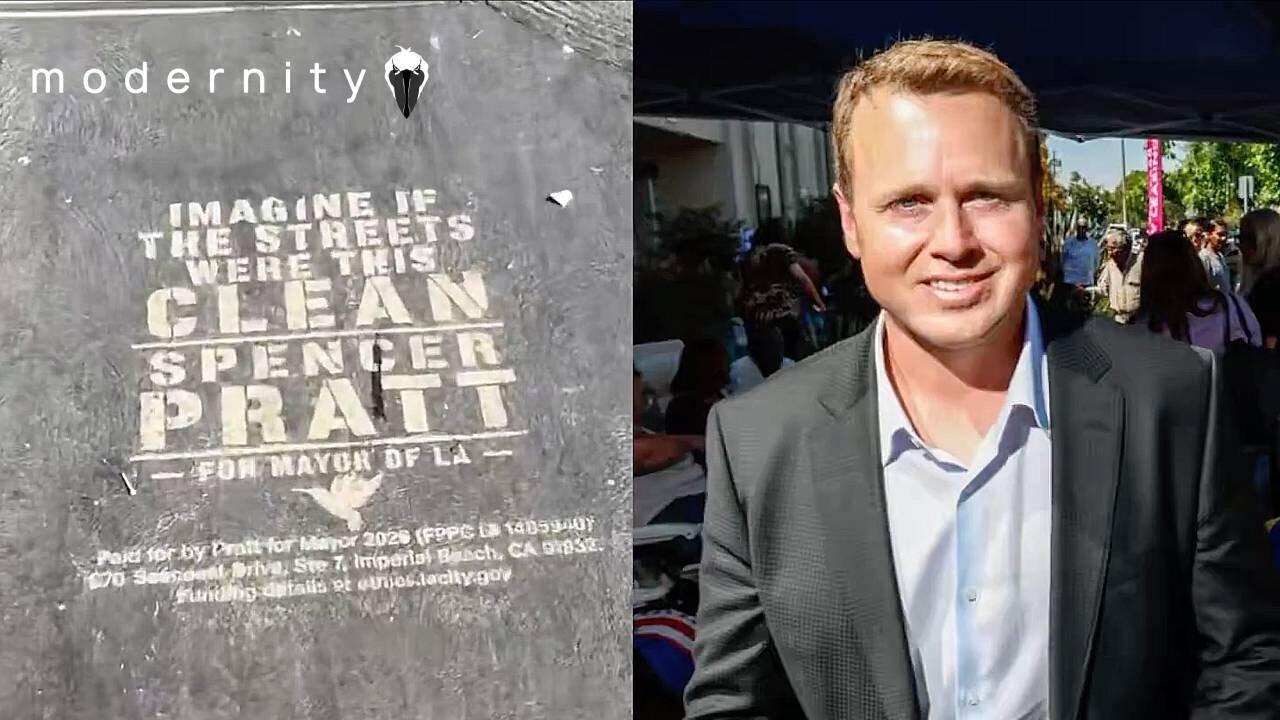
Spencer Pratt is running a campaign unlike anything seen in Los Angeles politics. The former reality star turned mayoral candidate isn’t just talking about the city’s collapse into filth, crime, and decay – he’s making the evidence work for him.

His team has taken to the streets with power washers and stencils, blasting clean messages like “IMAGINE IF THE STREETS WERE THIS CLEAN” and “SPENCER PRATT FOR MAYOR” directly into the grime accumulated under Democrat leadership.

The tactic is as simple as it is devastating. The cleaned sections stand out starkly against the surrounding trash and dirt, creating a living advertisement for change.

If Democrat Mayor Karen Bass wants the signs gone, her administration has to actually clean the streets – something residents say hasn’t happened consistently for years.

Pratt’s approach highlights the stark reality Los Angeles faces.

Recent reports and viral videos paint a picture of a once-great city reduced to dystopian conditions: massive homeless encampments overrun by rats, open-air drug markets operating brazenly, and public spaces buried under tents, trash, and human waste.

One video shows entire networks of makeshift homes under bridges tapping into city power.

Another resident-driven idea gaining traction involves marking potholes and blighted areas with pro-Pratt messages, forcing city crews to respond faster to erase political opposition than to basic maintenance.

Pratt has been vocal about the root causes. In campaign videos, he stresses that Los Angeles doesn’t have a homelessness problem so much as a drug addiction and failed leadership crisis. He points to billions spent with little visible improvement, calling out the “Homeless Industrial Complex” of nonprofits and bureaucrats who profit from perpetuating the cycle rather than solving it.

His five-step plan focuses on mandatory treatment, clearing encampments, cracking down on crime and drug use, and prioritizing public safety. “If that addict on your street were your own son, what would you do?” he asks, framing the issue as a moral and practical emergency.

The establishment is not amused. As Pratt surges in polls and fundraising – recent figures show him closing the gap on incumbent Karen Bass – the attacks have intensified. Hollywood figures and metropolitan leftists have lashed out, with “Price is Right” host Drew Carey calling Pratt a “serial scammer” and telling voters to reject him in a foul-mouthed rant.

Pratt’s organic, creative tactics, and direct appeals – have rattled the machine. Supporters see it as a masterclass in connecting with frustrated residents tired of excuses.

Decades of progressive policies prioritizing open borders, soft-on-crime approaches, and massive unchecked spending have produced predictable results. California has funneled enormous sums into homelessness programs, yet streets remain filthy and unsafe. Residents navigate urine-soaked doorways and blocked infrastructure daily while officials tout statistics that don’t match lived experience.

Pratt’s personal stake adds weight. His home in Pacific Palisades was lost in the fires, an event he ties directly to leadership failures. He frames his run as fighting for his family and the city he loves, rejecting the decline as inevitable.

This isn’t just another election cycle in LA. Pratt’s campaign forces a confrontation with reality: voters can continue down the path of managed decay or demand basic competence – clean streets, safe neighborhoods, and accountability. The power-washed messages make the choice literal. As the June primary approaches, Angelenos are paying attention.

The broader lesson extends beyond one city. When leadership prioritizes ideology over results, everyday life suffers. Pratt’s unorthodox push represents a rejection of that status quo in favor of practical restoration. Whether it translates to victory remains to be seen, but the conversation he has sparked is long overdue. Los Angeles deserves better than managed decline.

Tyler Durden
Mon, 05/25/2026 – 10:35

via ZeroHedge News https://ift.tt/NndKeFM Tyler Durden

Pentagon Conducts First Military Drill In Venezuela Since Maduro Overthrow

Pentagon Conducts First Military Drill In Venezuela Since Maduro Overthrow

On Saturday, the US military conducted a highly visible drill right in the heart of Caracas, marking the first known American military exercise on Venezuelan soil since the chaotic January 3rd operation to abduct Venezuelan President Nicolas Maduro.

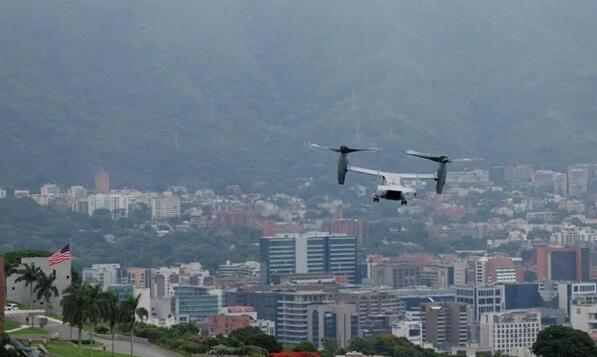
The show of force involved two US Marine Corps Osprey aircraft touching down near the recently reopened US Embassy in Caracas, which went operational only two months ago, in March.

via Reuters

“The drill, which the Venezuelan government said it had authorized as an evacuation drill for possible medical emergencies or disasters, included two MV-22B ​Osprey aircraft that landed near the U.S. embassy and vessels that entered Venezuelan ​waters in the Caribbean Sea,” Reuters detailed.

Venezuela’s Foreign Minister Yván Gil had announced and previewed the drill to the local population, and dubbed the action a ‘rapid response’ exercise in the heart of the capital.

There were reports of protests in the capital, by those who reject their country being used for American military drills:

While some Caracas residents gathered to observe the aircraft, a group of protesters elsewhere in the city displayed a Venezuelan flag with the message ‘No to the Yankee drill’ to express their opposition.

However, other crowds reportedly gathered just the watch the large Marine Corps Ospreys sweep in low to the city.

The US Embassy later revealed that Gen. Francis L. Donovan, the head of US Southern Command, was personally on board one of the Ospreys.

This marks Donovan’s second high-profile visit to Caracas since the January raid, which left a bloody trail of at least 83 dead – mostly Venezuelan military forces, Cuban presidential guards, but also reportedly four civilians.

According to an official post on X by the US Embassy, Donovan’s itinerary made for a busy day: “[Donovan] participated in bilateral talks with high-ranking representatives of the interim government, met with the leadership and staff of the United States Embassy, and observed the joint force conducting a military response exercise,” it said.

The current Venezuelan government, now helmed by Acting President Delcy Rodriguez (Maduro’s own former vice president), has been moving quickly to manage domestic optics.

The irony is that there has not in the end actually been ‘regime change’ in Venezuela – only government ‘decapitation’ – with Maduro on US soil and in federal custody. Rodriguez is a socialist as Latin American leaders have come, and she presides over the same government – only this time while serving Washington oil and business interests.

Tyler Durden
Mon, 05/25/2026 – 10:00

via ZeroHedge News https://ift.tt/kUSOGE8 Tyler Durden

Futures, Global Stocks Soar To All Time High, Oil Plunges On Endless “Iran Deal” Drumbeat

Futures, Global Stocks Soar To All Time High, Oil Plunges On Endless “Iran Deal” Drumbeat

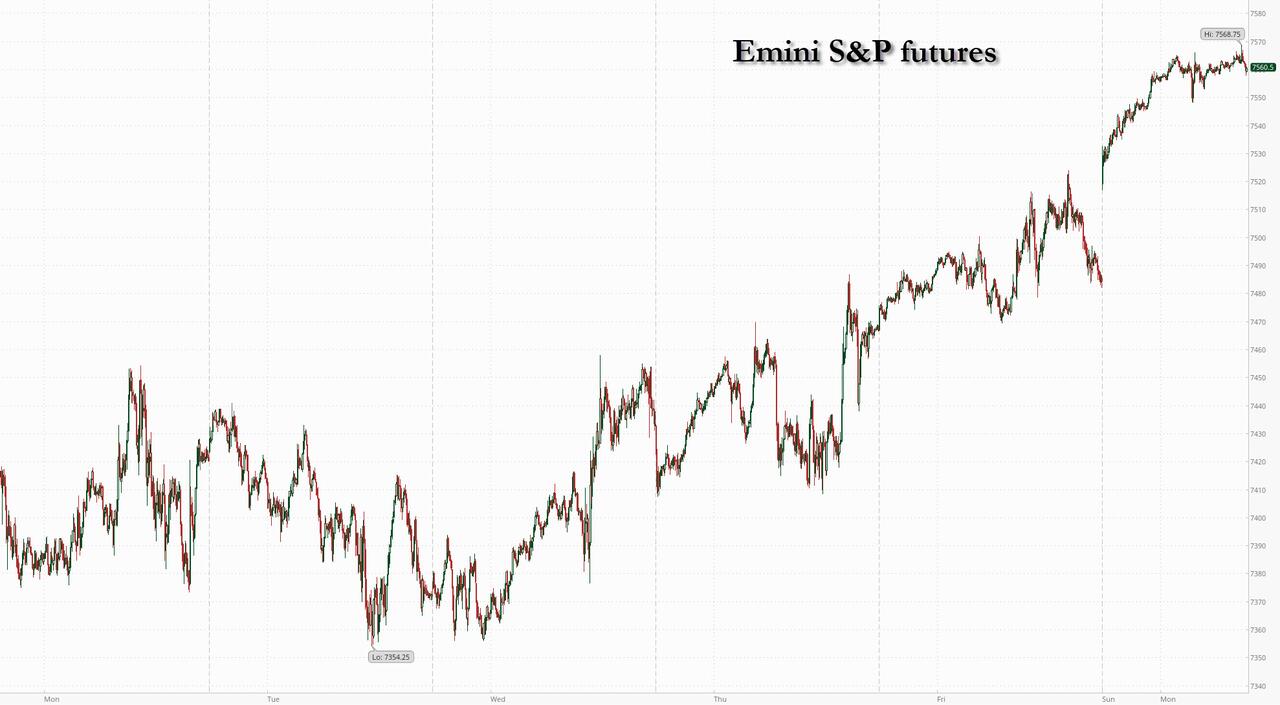
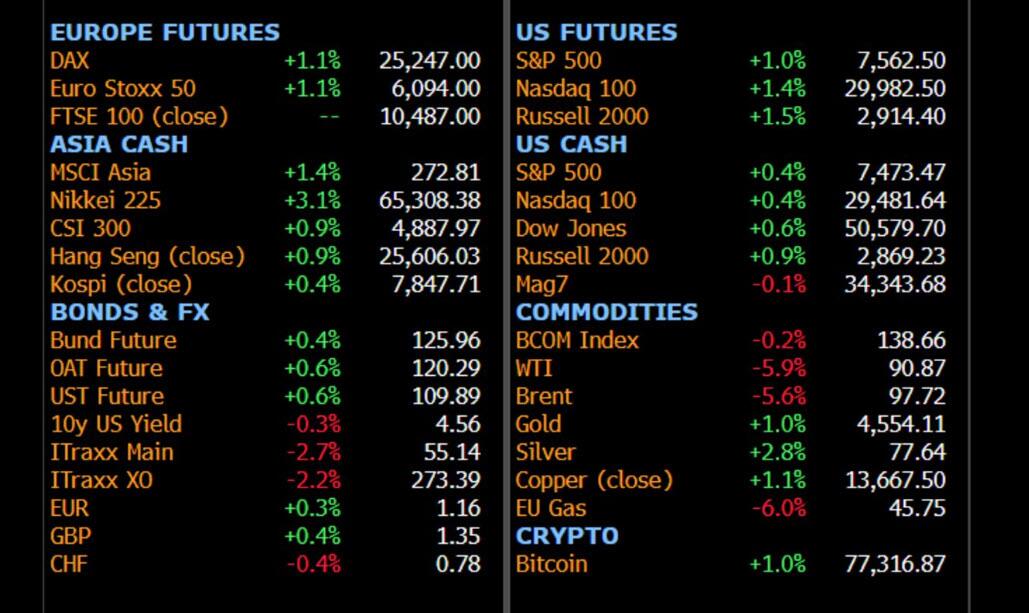
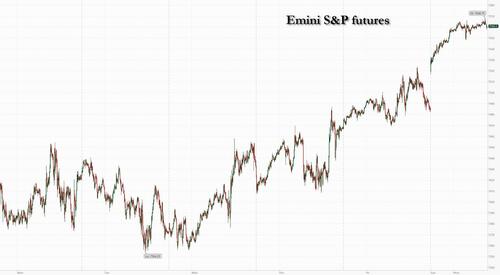
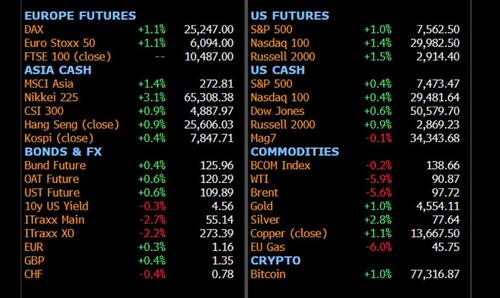
US equity futures jumped and global stocks rose to record highs as crude oil fell after officials signaled – once again – that the US was nearing a deal with Iran to reopen the Strait of Hormuz and restore oil flows. The dollar weakened while precious metals and crypto bounced from Friday’s drop. While the US and Iran closed in on a deal, Trump said he won’t “rush” into an agreement. The deal is still a work in progress and the US is going to give diplomacy every chance to succeed, Secretary of State Marco Rubio said. S&P 500 futures squeezed higher by 0.9%, in line with Goldman expectations, while Nasdaq futs were up 1.3%, both printing in record territory as the market just can’t get enough of news that “a deal is imminent.” US cash markets are shut Monday for the Memorial Day holiday. The dollar retreated against all of its Group-of-10 peers.  Crude oil slumps more than 5%: WTI crude futures fall to around $91 and Brent contracts drop below $98 a barrel. Aussie tops G-10 leaderboard; euro and pound both add about 0.3%. Nikkei surges more than 3% as Japanese equities hit record highs, and Taiex also jumps about 3%. Mainland China indexes are all in the green. Hong Kong and South Korea are closed for holidays. T-note futures jump 20/32 to near 109-28. Australian curve bull flattens with 10-year yield down 5 bps. JGB futures rally as Japan’s long-end yields slide. Gold rises more than $50 to near $4,560 and silver surges 3%.In short: global euphoria. 
Consistent The MSCI All Country World Index, the broadest measure of global equities, rose 0.4% to an all-time high closing level. Europe’s benchmark Stoxx 600 gained for a sixth straight session to the highest intraday level since the outbreak of the Iran war. Trading volumes were light, with a number of markets including the UK, Norway and Denmark closed for holidays. 

Brent tumbled almost 6% to below $100 a barrel amid optimism a deal will help restore the flow of oil through the vital Middle East artery.

Senior US officials said Sunday that the US and Iran were nearing an agreement that would reopen the Strait of Hormuz, though final approval from both sides could still take several days. Iran said a deal isn’t imminent, though there is consensus on a number of issues. While the US and Iran closed in on a deal, President Donald Trump said he won’t “rush” into an agreement. The deal is still a work in progress and the US is going to give diplomacy every chance to succeed, Secretary of State Marco Rubio said.

Similarly, Iran’s foreign ministry spokesperson says they have reached a framework with the US but nobody can say that an agreement between the two sides is imminent, Reuters reports. he adds that Iran will not collect tolls on the Strait of Hormuz but it’s normal that services provided would require a price.

In other words, we don’t have a deal as the key sticking points remain unresolved (and unresolcable) but the market is acting as if there is a deal, as has been the case since April. 

“After today’s market moves, the most likely scenario already appears to be largely priced in,” said Roberto Scholtes Ruiz, head of strategy at Singular Bank. “Therefore, I would expect some ‘sell the news’ dynamics once a deal is finally reached, and I would refrain from adding exposure to equities until yield curves move lower.”

The improvement in risk sentiment follows weeks of stalemate between the US and Iran after several previous efforts to strike a deal. Global equities have since surged on optimism that Middle East tensions may ease and on renewed enthusiasm for the artificial intelligence trade, while elevated oil prices and higher inflation pushed bond yields to multi-year highs.

“A clear FOMO factor contributes to unexpectedly strong global risk appetite: investors don’t want to be left out if the Iran war comes to an end while the AI theme continues to lift the stock market,” said Dana Malas, a strategist at SEB.

Traders also remain focused on inflation. They have fully priced in a Federal Reserve rate hike by year-end, underscoring expectations that the US central bank chair Kevin Warsh will need to act swiftly. Later this week, US Personal Consumption Expenditures data and inflation readings across Europe will offer clues on price pressures and the direction of interest rates.

Warsh, who has promised the biggest shakeup in decades at the US central bank, was sworn into office Friday. Trump stressed that he wants Warsh to independently lead the Fed, as he looked to downplay investor concern that he would pressure the new central bank chief on policy decisions. The Fed may have enough reason to justify an interest rate cut rather than a hike under new chairman Warsh, according to BlackRock Inc. 

Europe is picking up where it left off last week after Trump talked up the prospects of a peace deal over the weekend. SocGen’s strategists reckon “muscle memory” built in previous crises is encouraging investors to buy dips and BofA’s say London’s buyside is “long and paranoid.”
Euro Stoxx 600 futures are 1.1% higher amid lower trade volume as markets including London are closed for a holiday, with Denmark, Norway and Switzerland, among others, also shut. Cash trading in the US will also be closed for Memorial Day. Among individual stock moves in Europe, Delivery Hero SE jumped more than 10% after it received a take-over offer from Uber Technologies Inc. in a deal that would value the German delivery company at about €10 billion ($11.6 billion).  Here are the biggest movers Monday:

  • Delivery Hero shares rise 8.2% to €36.3 on Tradegate, above Uber’s indicative offer of €33 per share, signaling that some investors believe a higher takeover price is possible
  • Nexi shares rose as much as 5.5% after Italy’s state lender Cassa Depositi e Prestiti said it plans to raise its stake in the payments company to as much as 29.9%, tightening its grip on the Italian payments group
  • Kinnevik gains as much as 4.7% after the struggling Swedish investment group appointed the former finance boss of the Wallenberg family’s main holding company as its new chief executive officer
  • Hexagon gains as much as 2.3% after being upgraded to buy from neutral at SB1 Markets, with the broker saying the Swedish industrial technology group is an attractive investment after its upcoming spin-off of subsidiary Octave
  • Kambi shares advance as much as 10% after the Swedish sports betting services firm’s CEO Werner Becher bought 20,900 shares in the company at SEK156 per share, representing a 3% premium versus Friday’s close.
  • The Stoxx 600 energy sector is the worst-performer on Monday after oil declined as senior US officials gave further, positive signals on progress toward a deal with Iran to reopen the Strait of Hormuz, while airline and travel stocks outperform

Earlier in the session,  Asian stocks rose for a third straight session as expectations over AI-driven revenue bolstered tech shares, while signs of a potential US-Iran deal buoyed risk appetite. The MSCI Asia Pacific Index climbed as much as 1.5%, with TSMC, MediaTek and Delta Electronics providing the biggest support. A sub-gauge of information technology jumped to a record high. Taiwan and Japan led gains, though markets in Hong Kong and South Korea are closed for Buddha’s Birthday.

Sustained optimism around artificial intelligence and semiconductor demand continued to underpin sentiment across the region after upbeat earnings. Japan’s component makers including Taiyo Yuden surged, while Chinese semiconductor stocks also gained after Huawei Technologies touted a potential breakthrough in making advanced chips.

“The kind of near-term obsession with AI has really focused people much more heavily on Taiwan and South Korea,” Alison Shimada, senior portfolio manager at Allspring Global Investments, said on Bloomberg TV. At some point investors may take profit and rotate into markets like China and India selectively, she added.

China’s CSI 300 Index rose 1.6% amid expectations Beijing’s crackdown on cross-border trading would direct flows into domestic equities. Citic Securities said the move may hit as much as $32 billion of assets in Hong Kong, but said the impact is likely to be manageable.  Chinese coal mining stocks rose after a deadly accident in Shanxi province raised concerns about possible supply disruptions. 

Elsewhere, as reported last week, China launched an unprecedented campaign against illegal cross-border trading to stem capital outflows, threatening severe penalties against popular brokers and ordering non-compliant accounts to be liquidated within two years.

Top Overnight News

  • Iran Talks Bog Down Over Nuclear Program, Sanctions Relief: WSJ
  • US, Iran inch toward deal as gaps remain on uranium, sanctions: BBG
  • Iran’s foreign ministry spokesperson says they have reached a framework with the US but nobody can say that an agreement between the two sides is imminent; Iran will not collect tolls on the Strait of Hormuz but it’s normal that services provided would require a price: RTRS
  • Secretary of State Rubio says Iran deal is still a work in progress: BBG
  • Iran’s top envoys discussing potential peace deal with Qatar prime minister, official says: RTRS
  • Oil Slides as Ships Move Toward Hormuz: WSJ
  • Hassett says ending Iran war may create room for Fed rate cut: BBG
  • Pope urges AI regulation, apologizes for transatlantic slavery: RTRS
  • Pope Leo Compares AI Threat to Biblical ‘Tower of Babel’: WSJ
  • ECB likely to revise its inflation outlook in June, Lagarde says: BBG
  • Uganda confirms two more Ebola cases, taking total to seven: RTRS
  • Huawei Says It Has Workaround to Match Leading Chips: WSJ
  • Meet Mark Zuckerberg’s Right-Hand Man Who’s Unleashing AI at Meta: WSJ
  • Strategists warn yields to stay high even if Iran war ends: BBG
  • Former SNP chief pleads guilty to embezzling $540,000: RTRS
  • Pakistan Shi’ites deported from UAE return to lost jobs, frozen savings: RTRS

Iran War News

  • US President Trump posted on Saturday that an agreement has largely been negotiated, subject to finalisation between the US, Iran and various Middle Eastern countries, while the final aspects and details of the deal were being discussed, and will be announced shortly. Trump stated in addition to many other elements of the agreement, the Strait of Hormuz will be reopened.
  • US President Trump posted on Sunday that negotiations are proceeding in an orderly and constructive manner, while he informed representatives not to rush into a deal and that time is on their side. Trump stated the blockade will remain in full force and effect until an agreement is reached, certified, and signed, and that both sides must take their time and get it right.
  • US President Trump posted on Sunday “If I make a deal with Iran, it will be a good and proper one, not like the one made by Obama, which gave Iran massive amounts of CASH, and a clear and open path to a Nuclear Weapon. Our deal is the exact opposite, but nobody has seen it, or knows what it is. It isn’t even fully negotiated yet.”
  • US President Trump convened a meeting with his senior national security team on Friday morning regarding the war with Iran, according to Axios’s Ravid citing two US officials, while the sources stated that Trump was seriously considering launching new strikes against Iran, barring a last-minute breakthrough in negotiations.
  • US President Trump posted a generated image of a strike on Iranian-flagged vessels with the caption ‘Adios’.
  • US Secretary of State Rubio said there may be “some good news” regarding the blocked Strait of Hormuz in the coming hours, but not final news, while he also commented that a nuclear deal cannot be reached with Iran in 72 hours and that nuclear negotiations are very technical issues that cannot be done in 72 hours ‘on the back of a napkin’. Rubio separately commented that President Trump is not going to make a bad deal and that it takes time as they have to wait to hear back from Iran, while he suggested that signing a deal with Iran is still possible on Monday and that they will either a good agreement with Iran or will deal with the matter in another way, but will give diplomacy every chance to succeed before exploring alternatives.
  • US and Iran were reportedly close to signing an agreement involving a 60-day ceasefire extension, which could be extended by mutual consent, according to Axios. Furthermore, a US official said Trump’s key principle is “relief for performance”, while Iran wanted funds unfrozen immediately and permanent sanctions relief, but the US position is that this would only follow tangible concessions. It was also reported that US President Trump told leaders of Arab and Muslim countries during a Saturday conference call that if a deal to end the Iran war is achieved, he wants their nations to join the Abraham Accords and sign peace agreements with Israel, according to Axios’s Ravid.
  • US senior official said the White House doesn’t expect an agreement to end the war with Iran on Sunday and believes it could take several days for the deal’s approval by Iran’s leadership, according to Axios.
  • US senior officials said the naval blockade will only be lifted after Iran opens the Strait of Hormuz, and no funds will be released until enriched uranium is handed over, while it was stated that there is agreement on 95% of a deal, but it needs to be drafted. Furthermore, difficulties remained regarding issues, and it is estimated to take 5-6 days to receive approval from Supreme Leader Khamenei, with any further changes also requiring his consent, according to Jerusalem Post’s Amichai Stein.
  • US and Iran are said to have agreed in principle to a preliminary deal aimed at ending the war, which would reopen the Strait of Hormuz and limit Iran’s uranium stockpile, but remains subject to final approval, which is expected to take several days, according to NYT. A separate report also noted that the US understands that Iran agrees in principle to dispose of uranium stockpile and that the Supreme Leader endorses the broad template, although there was no immediate confirmation from Iran or elaboration on what an “in principle” agreement meant, according to Sky News.
  • US officials stated that Iranian negotiators are facing difficulty in communicating with Supreme Leader Khamenei, which is the reason for the delay in the agreement, according to CBS.
  • Iranian President Pezeshkian said their negotiating team will not compromise when it comes to the country’s honour or dignity, while he said they are ready to reassure the world that they are not seeking nuclear weapons.
  • Iranian source said Iran has no optimism towards the US and that there is no final deal yet, with challenges remaining. The source also stated that Iran rejects linking frozen assets to nuclear stockpiles and has not made any new nuclear commitments, while Iran demands the release of frozen assets as a condition for a deal and will monitor US actions if a deal is reached, according to Tasnim. Furthermore, it was reported that there is still the possibility an agreement may be cancelled.
  • Iran said on Friday that ‘no deal’ will reach a conclusion if the US demands enriched uranium handover. It was also reported that an Iranian official source said that stopping the war on all fronts is the essential prerequisite for discussing any future negotiations, while the source stated there was no final agreement yet, and work is underway to narrow the gap between Tehran and Washington, according to Al Jazeera.
  • IRGC advisor said their enemy knows that if it wants to make a mistake, it will receive an irreparable blow and that Iran would retaliate 10-fold against the US. It was separately reported that Iran shot down an Israeli surveillance drone, according to Mehr News Agency.
  • Iran’s Deputy Foreign Minister for Legal and International Affairs Kazem Gharibabadi said Iran and Oman discussed Hormuz maritime rules amid ongoing US talks.
  • Iranian officials said major disagreements remain, especially over the status of the Strait of Hormuz, Iran’s nuclear program and conflicts involving Tehran-backed groups in Lebanon, according to Al Jazeera.
  • Iranian Foreign Ministry spokesperson said on Friday that the differences between Iran and the US are so deep and numerous that it cannot be said that they will definitely reach a conclusion with several visits or negotiations within a few weeks, according to Fars.
  • Israeli PM Netanyahu told US President Trump that Israel will maintain the freedom to act in Lebanon, while Netanyahu said that Trump agrees that the Iran deal must remove the nuclear threat.
  • Israel conducted a strike on Arzoun in the city of Tyre, southern Lebanon.
  • Hezbollah deputy leader Naim Qassem said any attempt to disarm Hezbollah would lead to its elimination and the gradual Israeli occupation of Lebanon, while he added that Hezbollah will remain on the battlefield until an Israeli withdrawal.
  • A drone attack targeted the Pehmerga command centre in Salaymaniyah, Iraq, according to IRNA.

Market Snapshot
Tyler Durden
Mon, 05/25/2026 – 09:33

via ZeroHedge News https://ift.tt/vfopVds Tyler Durden

Debt Remembered And Debt Ignored

Debt Remembered And Debt Ignored

Authored by Greg Marasca via AmericanThinker.com,

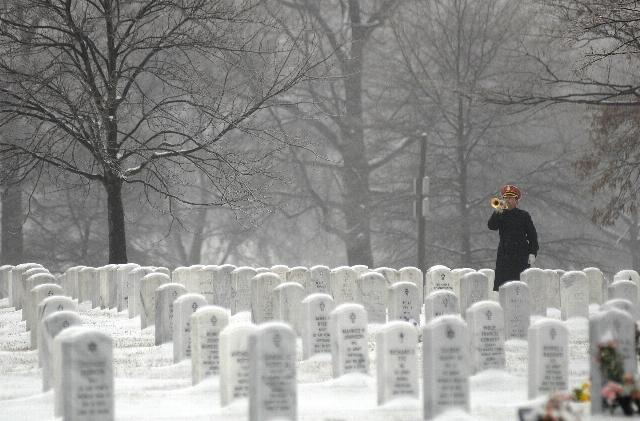
Memorial Day compels Americans to confront a word we avoid: debt.

Not the financial kind that Congress pretends will magically resolve itself, but the older, heavier meaning — the kind carved into headstones at Arlington and cemeteries across the country.

It is the debt paid in full by those who gave their lives, so the rest of us could live free.

No interest rate can measure it. No budget line can contain it. It is final, irrevocable, and sacred.

Every year, we pause, as we should, to acknowledge that liberty is no accident. Its purchase price is steep. Many stood a post, walked point, climbed into a cockpit, or sailed into hostile waters so that we could enjoy the ordinary luxuries of American life: arguing about politics, grilling in the backyard, complaining about work, raising families in relative peace. The fallen paid the ultimate debt, while the rest of us live on the dividends of their courage.

There remains another debt that all Americans must face, one far less noble and far more self-inflicted: the national debt that at $39 trillion is growing faster than the economy and its current path is unsustainable with interest payments amounting to $1 trillion a year — a figure most cannot comprehend.

Unlike the solemn debt honored on Memorial Day, this one grows not from sacrifice but from avoidance, avarice and unaccountability. It is the bill we keep pushing onto future generations because those elected lack the discipline and forbearance to make the difficult choices.

The contrast is stark.

On one side are the young Americans who never hesitated when their country asked for everything. On the other, a political culture that bemoans over the smallest act of fiscal restraint. The fallen gave their lives, while Washington can’t forego a spending increase.

Memorial Day reminds us that debts must be paid.

The laws of economics will not suspend themselves out of patriotic courtesy. We borrow to fund today’s comforts while expecting tomorrow’s citizens, many of whom are not yet born, to pay the bill.

Imagine explaining this to a Marine who never made it home from Fallujah or a soldier who fell in the Korengal Valley. They understood duty in its rawest form. They lived by the credo that you don’t hand your problems over to the next guy.  You handle them.  You carry your weight.  You complete the mission.

The contrast is telling and that is the point.

Memorial Day should not be reduced to a political talking point; rather it should remind us of the standards we once held. The men and women we honor this day lived with a clarity of purpose that our national budget sorely lacks. They understood that freedom requires responsibility. They knew that choices have consequences. They accepted that service is putting the country’s needs ahead of one’s personal initiatives.

If we truly want to honor their memory, we can start by adopting even a fraction of that discipline. We can demand leaders who treat the national debt as a real threat, not a distant abstraction. We can stop pretending that borrowing without limit is a harmless national pastime. And we can remember that the freedoms secured by the fallen are weakened when the nation they died for is weighed down by obligations it cannot meet.

The debt paid by America’s fallen is unpayable, but it is not unteachable. It is written in sacrifice, in folded flags, in names etched into stone.

One debt was paid in blood. The other is being charged to our children. 

And if we forget the difference, then we have learned nothing from those who paid the first.

Tyler Durden
Mon, 05/25/2026 – 09:20

via ZeroHedge News https://ift.tt/KzY8dO9 Tyler Durden

Dr. Oz Fires Back After Joy Behar’s TrumpRx Meltdown

Dr. Oz Fires Back After Joy Behar’s TrumpRx Meltdown

Authored by David Manney via PJMedia.com,

Dr. Mehmet Oz, the 17th administrator of the Centers for Medicare & Medicaid Services, answered Joy Behar after the longtime co-host of The View warned viewers about President Donald Trump’s prescription drug initiative.

Behar said once Trump puts his name on prescriptions, “We’re all going to die.”

She also reached for Trump’s past business failures, as if cheaper medicine belongs in the same dusty joke drawer as casino chatter and late-night monologue scraps.

Dr. Oz didn’t need a medical chart to spot the problem, saying TrumpRx.gov still has no medication for Trump Derangement Syndrome (TDS), though they’re working on it.

His joke landed because Behar’s reaction sounded less like analysis and more like a smoke alarm installed over a toaster sitting near a burning pile of pine boughs: loud, frantic, and not especially useful once breakfast remains intact.

President Trump announced on May 18 that TrumpRx would expand with over 600 generic medications. The AP reports:

The beefed-up website is the Trump administration’s answer to criticism from Democrats who have called TrumpRx performative and noted that many of the brand-name drugs it has featured are cheaper with insurance or have lower-cost generic versions sold elsewhere.

It also marks an effort to respond to a top voter concern for November’s midterm elections: affordability. Health costs are a worry for many Americans, an issue compounded by the Republican-led Congress’ recent cuts to Medicaid and the expiration of enhanced Affordable Care Act subsidies this year that sent some people’s premiums skyrocketing.

The expansion is made possible by partnerships with other online pharmacies, including Amazon Pharmacy, GoodRx and billionaire investor Mark Cuban’s Cost Plus Drugs, Trump said at an event at the White House.

TrumpRx doesn’t directly sell drugs, and it won’t replace insurance for everyone, but it gives uninsured patients, high-deductible families, and cash-paying customers another place to check before surrendering at the pharmacy counter.

Mark Cuban, co-founder of Cost Plus Drugs and a regular Trump critic, appeared at the White House event and backed the expansion. Cuban’s presence should’ve slowed the usual reflexive sneering; a Trump critic stood beside Trump because lowering drug prices helps people who don’t care which political tribe gets credit when the receipt shrinks.

Behar could’ve asked fair questions;.

Americans should want details about pharmacy benefit managers, deductibles, manufacturers, and insurance rules. Drug pricing has enough trapdoors to swallow a family budget whole.

Instead, she saw Trump’s name, grabbed the nearest panic button, and started whacking it like a carnival game she had no chance of winning.

The token conservative on The View, Alyssa Farah Griffin—I think she’s the sacrifice, honestly; I can’t keep up with the dissected corpses—pushed back during the segment and pointed out that lower drug prices can help real families. Sunny Hostin, unsurprisingly, also raised concerns, but Behar gave viewers doom theater.

Behar’s verbal bullets were blanks, and even the blanks sounded tired. She didn’t test the claim against the numbers, or anything for that matter, simply firing first and hoping the smoke would pass for thought.

Dr. Oz held the stronger ground because he kept the focus on access, prices, and practical relief. Prescription bills don’t arrive with political footnotes; seniors on fixed incomes don’t care whether Joy Behar approves of the label. Parents stretching paychecks want to know whether the medicine costs less, whether the pharmacy has it, and whether they can make rent after filling the bottle.

TrumpRx won’t solve every failure in American health care; no website can unwind decades of government bloat, drugmaker games, insurance headaches, and pharmacy middlemen. Yet a price-comparison tool with more than 600 generic medications gives families one more way around a broken system.

Behar mocked the name, while Oz pointed back to the medicine cabinet. One side filled airtime, as the other side at least tried to lower the bill.

Tyler Durden
Mon, 05/25/2026 – 08:00

via ZeroHedge News https://ift.tt/hK2ZFtW Tyler Durden

At Last Minute, SEC Suddenly Delays Plan To Allow Crypto Versions Of US Stocks

At Last Minute, SEC Suddenly Delays Plan To Allow Crypto Versions Of US Stocks

Authored by Micah Zimmerman via Bitcoin Magazine,

The Securities and Exchange Commission has pumped the brakes on its highly anticipated “innovation exemption” for tokenized stocks, pushing back the release of the framework as it weighs input from traditional stock exchanges and other market participants wary of the plan’s sweeping implications, according to Bloomberg reporting.

The SEC, under Chair Paul Atkins, was preparing to release the so-called innovation exemption as soon as this week.

The framework would create a new regulatory pathway allowing digital tokens linked to publicly traded company shares to trade on decentralized crypto platforms — 24 hours a day, seven days a week — bypassing the constraints of traditional stock exchanges. 

The exemption is part of Atkins’ broader “Project Crypto” initiative, which aims to relax existing crypto restrictions in line with the Trump administration’s pro-crypto agenda.

The SEC was reportedly leaning toward permitting third-party tokens — digital representations of stocks like Apple, Nvidia, or Tesla — to be issued and traded without the consent of the underlying public companies. 

This means outside actors, not the issuers themselves, could create blockchain-based wrappers tracking a company’s share price and list them on decentralized finance (DeFi) platforms.

These tokens may not carry traditional shareholder rights like voting or dividends, though the SEC is reportedly considering requiring platforms to provide those rights or risk delisting.

Why the SEC is delaying

The timing of the exemption’s release has been pushed back as the agency weighs feedback from stock-exchange officials and other market participants who met with SEC staff in recent days. 

The World Federation of Exchanges — whose members include Nasdaq, Cboe, and CME Group — previously warned the SEC in a November 2025 letter that such exemptions could “dilute” existing investor protections and “distort” competition by giving crypto exchanges a regulatory shortcut unavailable to traditional markets. 

The group cautioned that granting legitimacy to tokenized stocks before full compliance implementation would “undoubtedly have negative — potentially acute — consequences” for U.S. markets.

The tokenization debate is unfolding against a backdrop of competing visions for the future of U.S. equity markets. Nasdaq, which received SEC approval in March 2026 for its own tokenized securities proposal, is pursuing a different model: one that keeps all trades on-exchange with full shareholder rights intact, built on the DTCC’s enterprise blockchain. 

The innovation exemption, by contrast, would sanction a parallel, crypto-native market running alongside the existing system — potentially fragmenting liquidity across dozens of third-party token issuers for the same underlying stock.

Tyler Durden
Mon, 05/25/2026 – 06:20

via ZeroHedge News https://ift.tt/2U4bvRx Tyler Durden

The Race To Build The World’s Tallest Skyscraper

The Race To Build The World’s Tallest Skyscraper

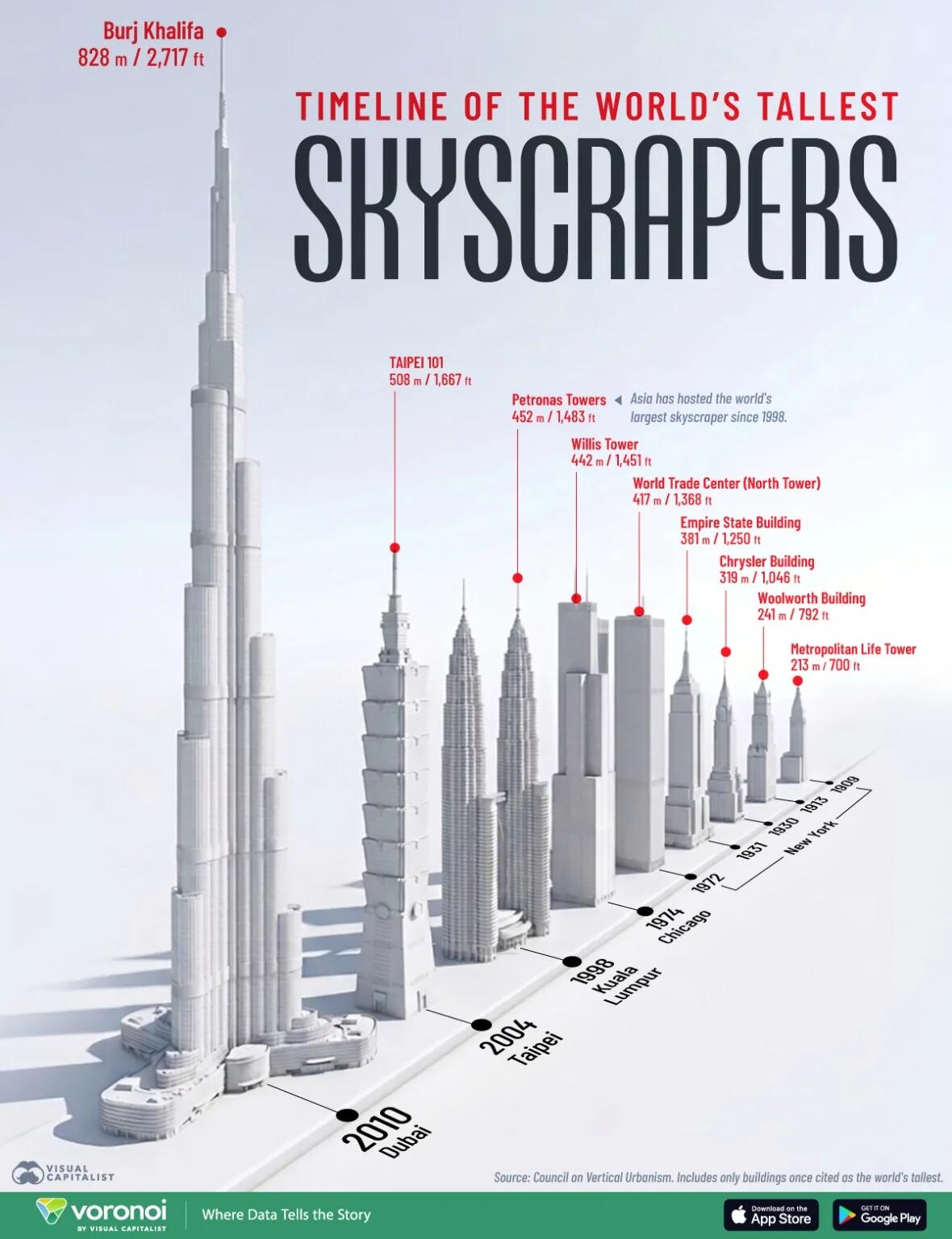
In 1909, New York’s Metropolitan Life Tower became the tallest building in the world at 700 feet. Just over a century later, Dubai’s Burj Khalifa reached 2,717 feet, nearly four times taller.

This timeline, via Visual Capitalist’s Gabriel Cohen, shows every building to hold the title of world’s tallest since 1909, using the most recent data available from the Council on Vertical Urbanism (CVU).

Per CVU methodology, buildings must include floors, excluding structures such as Toronto’s CN Tower and the Stratosphere in Las Vegas. Heights are measured to the architectural top, including spires but excluding detachable antennae, flagpoles, or signs.

New York’s Skyscraper Boom

For most of the 20th century, the U.S. housed the world’s tallest building. New York in particular held the crown, with the Big Apple producing back-to-back skyscraper marvels from 1909 to 1972.

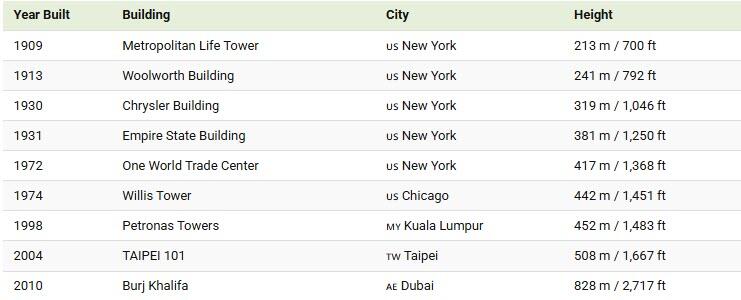
The Metropolitan Life Tower, constructed in New York’s Flatiron District, topped out at 700 feet in 1909. Within a few years, it would be surpassed by Tribeca’s Woolworth Building (792 feet), which itself lost the title by the late 1920s with the arrival of the Art Deco icon known as the Chrysler Building (1,046 feet).

The table below lists the world’s tallest buildings between 1909 and 2026.

The Chrysler Building, found in East Midtown, opened in 1930 as the world’s first supertall skyscraper. At the time, developers were racing to build the world’s tallest building, and the Chrysler Building famously beat rival 40 Wall Street by secretly assembling a 125-foot spire inside the tower before raising it into place after 40 Wall Street was completed.

The Chrysler Building’s victory was short-lived. In 1931, the Empire State Building (1,250 feet) opened and promptly became the world’s tallest building by a significant margin. However, Depression-era economic slowdowns caused abysmal tenancy rates in the new supertall skyscraper, which was popularly derided as the “Empty State Building” in the mid-1930s.

The Twin Towers and Chicago’s Resurgence

The Empire State Building maintained its position until the completion of the Twin Towers in New York’s Financial District in 1972. At that time, One World Trade Center, commonly known as the North Tower, took the title at over 1,368 feet, standing a few feet taller than its South Tower counterpart. The two towers would eventually be destroyed in the September 11 attacks of 2001.

Chicago, the birthplace of the modern skyscraper, reemerged as a dominant player in tall buildings with the 1974 opening of the Sears Tower (1,451 feet), named for the retailer headquartered there. The building held the title of world’s tallest for nearly a quarter-century, although it was renamed in the 2000s after British insurance broker Willis Group Holdings.

In the late 1990s, the Petronas Towers opened in the Malaysian capital of Kuala Lumpur at 1,483 feet, marking the first time in decades that the world’s tallest building was not located in the United States. Similar to the Chrysler Building nearly 70 years earlier, the Petronas Towers’ spires made the difference, much to Chicagoans’ dismay.

How Asia Took Over the Skyscraper Race

Since the Petronas Towers, the world’s tallest building has remained in Asia, albeit in different regions. TAIPEI 101, in the Taiwanese capital, held the title following its completion in 2004 at 1,667 feet. A few years later, Dubai’s Burj Khalifa opened at a staggering 2,717 feet tall.

The Burj Khalifa is over 60% taller than TAIPEI 101 and nearly four times taller than the Metropolitan Life Tower, which opened a century earlier. Its long reign as the world’s tallest building could come to an end in the coming years, however, as another Middle Eastern tower nears completion in nearby Saudi Arabia.

The Jeddah Tower, which will be the world’s first building to surpass one kilometer in height, is projected to open as early as 2028. Construction began in 2013 but has been plagued by delays and pauses, only passing the 100th floor as of April 2026. When completed, this megatall skyscraper is expected to stand at 3,300 feet, making it over 500 feet taller than the Burj Khalifa.

Where are the world’s tallest buildings concentrated today? Find out with The World’s Tallest Buildings in 2024 on Voronoi.

Tyler Durden
Mon, 05/25/2026 – 05:45

via ZeroHedge News https://ift.tt/N6unfUW Tyler Durden