The ATF Created a Backdoor Gun Registry. Lawmakers Want an Explanation.


A semiautomatic handgun and some papers on a desk. | Illustration: Midjourney

It has been illegal since 1986 for the federal government to establish a national forearms registry. As you might expect of the sort of people who gravitate to government employment, the bureaucrats at the Bureau of Alcohol, Tobacco, Firearms, and Explosives (ATF), enabled by Biden-era policy changes, have taken that as a challenge. Now, members of Congress want answers from the federal gun cops about a vast gun registry database that could threaten the liberty and privacy of firearms owners. They have been stonewalled so far.

Lawmakers Question an Illegal Gun Registry

On February 3, Rep. Michael Cloud (R–Texas) and 26 other members of Congress wrote to the ATF asking about the status of a year-old query that the regulatory agency has ignored. The original 2025 letter inquired about the ATF’s collection of Form 4473 firearms transaction records, which are filled out in the course of every firearms sale by a licensed dealer, from gun vendors that have gone out of business. These records have accumulated and turned into a gun registry in waiting.

“We fear that ATF could have as many as 1.1-billion-gun registration records in its database, if ATF has continued with this historic pace and digitalized an average of 50 million firearm transaction records per year,” the members of Congress reminded the ATF in the recent letter. “This is a violation of the federal prohibition on gun registration at 18 U.S.C. 926(a)(3).”

The source of concern for the 27 members of Congress is not only the de facto registry—though that’s disturbing enough—but that it has seemingly been created in defiance of a specific prohibition. Under the Firearms Owners’ Protection Act, which became law in 1986, “no such rule or regulation prescribed after the date of the enactment of the Firearms Owners’ Protection Act may require that…any system of registration of firearms, firearms owners, or firearms transactions or dispositions be established.”

However, that law also contained the seeds of mischief by requiring gun dealers to maintain sales records that, if they go out of business, must be surrendered to the government. For decades, dealers could purge older records, surrendering only more recent ones to the ATF if they closed their doors. That changed under the Biden administration.

ATF Builds on a Biden-Era Policy Change

“In 2022, the ATF finalized a rule requiring FFLs to maintain firearm transaction records indefinitely instead of destroying them after 20 years,” Del Schlangen wrote in 2024 for the University of Wyoming College of Law’s Firearms Research Center. “This move, along with the ATF’s ‘zero-tolerance’ guidance for revoking FFL licenses, has further fueled concerns about the potential for a federal gun registry.”

Schlangen also noted that instead of the masses of paper retained in the past, the ATF was now converting firearm transaction records to electronic format, and “as of 2021, the ATF had digitized over 50 million out-of-business records in that year alone.”

That figure wasn’t advertised by the Biden administration. Instead, the Gun Owners of America (GOA) gained access to internal ATF documents revealing that in 2021, the regulatory agency processed 54.7 million out-of-business records—mostly paper, but some submitted in increasingly common digital format. Those records quickly added up.

In response to a 2021 query from Cloud, who has turned the backdoor gun registry into a crusade, the gun bureaucrats conceded that “ATF manages 920,664,765 OBR [out of business records] as of November 2021. This includes digital and an estimated number of hard copy records that are awaiting image conversion. It is currently estimated that 865,787,086 of those records are in digitalized format.”

But the Registry Isn’t Searchable! Sort of.

A May 2022 report from GOA based on freedom of information requests revealed that the ATF stored these records in searchable PDF and JPEG formats. The agency claims it’s in compliance with the law banning gun registries, though, because the resulting database isn’t searchable by name. But that’s apparently a choice that can be altered at any time.

“It appears the only reason ATF’s registry is not searchable by name is because ATF has merely disabled the ability for its software to search that particular record field,” notes the GOA report. “Of course, something that is so easily disabled could be easily re-enabled.”

Besides, the report adds, “ATF records reveal its gun registry to be searchable by weapon type, make, model, serial number, and caliber, among other functions.”

In fact, proponents of a gun registry used the searchability of the Out of Business Records Imaging System (OBRIS) as a selling point after the attempted assassination of then-presidential candidate Donald Trump in Butler, Pennsylvania. After the would-be assassin was killed, law enforcement agents seized his rifle with hopes of retrieving details based on the serial number.

“They were able to do so in about 30 minutes,” Perry Stein reported for The Washington Post. “The search used sale records from an out-of-business gun store that the government is required to collect—but that Republican lawmakers and the gun lobby would like to place off-limits.”

Well, yes. Advocates of self-defense and of gun ownership in general oppose a gun registry because they fear it could lead to gun confiscation, as politicians including former Democratic presidential candidate Kamala Harris keep threatening. That’s why they successfully pushed to make a registry illegal. And a searchable database of gun sales that has had the search function for names temporarily disabled is a gun registry waiting to be activated. The fact that it has been built at all shows a bureaucracy champing at the bit to escape restrictions on its power.

As Rep. Cloud commented last week, “the American people have a right to know if their government is maintaining an unlawful registry of firearms and firearm owners in direct violation of U.S. code and the Second Amendment.”

Government Incompetence Is the Only Saving Grace

The only saving grace is that if the federal government ever flips the switch on that gun database, it’s going to be a mess. Records that are 10, 20, or 30 years out of date will have been superseded by the passage of time. Gun owners will have moved, divorced and divided their property, died and left their possessions to their heirs, lost guns, or transferred them in private transactions. Or they’ll just claim that their guns are long gone in tragic boating accidents.

But when has the federal government ever done anything especially well? Incompetence has never prevented government officials from taking on big projects like gun registries, and from damaging liberty as they do so.

The post The ATF Created a Backdoor Gun Registry. Lawmakers Want an Explanation. appeared first on Reason.com.

from Latest – Reason.com https://ift.tt/Edp1r6q
via IFTTT

Review: The Anarchist Writings of Robert Anton Wilson


minis_A-Non-Euclidean-Perspective | Hilaritas Press, LLC.

The works of Robert Anton Wilson, especially the Illuminatus! trilogy, were an alternative path to libertarianism in the late 20th century. His influence has been less appreciated than that of his fellow novelist Ayn Rand, whose apodictic certainty based in ancient Greek philosophy he hilariously lampooned via the made-up novel discussed within Illuminatus!, Telemachus Sneezed. Wilson was, to put it bluntly, hipper than your average libertarian: more into drugs, sex, the occult, and cutting-edge 20th century literary figures such as James Joyce and Ezra Pound, but still oriented toward his stated goal of “reduc[ing the State] to an object of contempt among all educated people.”

While his novels and nonfiction led many young seekers to the arcane lore of libertarianism, he wanted no permanent political labels. In A Non-Euclidean Perspective, a new volume of previously uncollected political articles and interviews, he expresses beliefs contrary to standard Austrian economic stances. Following 19th century individualist anarchists of the Benjamin Tucker school, Wilson was opposed to absentee landownership and doubted the legitimacy of interest, which he thought would fade in a world of total currency freedom.

“I’m the kind of anarchist whose chief objection to the state is that it kills so many people,” Wilson said in a 1976 interview. Too many who use the term libertarian today paradoxically embrace an extreme immigration enforcement state based on misguided applications of axiomatic thinking about property. Wilson’s influence, with his radiantly sane skepticism and his desire to minimize violence and cruelty, is sorely needed.

Beyond politics, Wilson’s sense of life that won so many fans—including Reason‘s Jesse Walker, who wrote the collection’s introduction—comes across in epigrams such as: “It is a great privilege to be conscious in this universe. Those who understand, shine like stars.”

The post Review: The Anarchist Writings of Robert Anton Wilson appeared first on Reason.com.

from Latest – Reason.com https://ift.tt/q3uPa4c
via IFTTT

Brickbat: Bad Judgment


Judge Rosie Speedlin-Gonzalez | Kens5

A grand jury in Bexar County, Texas, has indicted Judge Rosie Speedlin-Gonzalez on charges of felony unlawful restraint by a judicial officer and misdemeanor official oppression. During a probation revocation hearing in December 2024, Speedlin-Gonzalez asked if the defendant had failed to report to his probation officer, to which he responded, “true.” Defense attorney Elizabeth Russell then conferred with the defendant, who retracted his answer. Speedlin-Gonzalez accused the attorney of coaching her client and being argumentative, and she ordered bailiffs to handcuff Russell and place her in the jury box until she agreed to “behave professionally.”

The post Brickbat: Bad Judgment appeared first on Reason.com.

from Latest – Reason.com https://ift.tt/IumfRxp
via IFTTT

Carrie Prejean Boller Refuses To Address Candace Owens’s Anti-Semitic Comments

The Atlantic interviewed Carrie Prejean Boller, the recently removed commissioner of the White House Religious Liberty Commission. (Boller insists that only President Trump can fire her, and not the Chairman; I’m sure she will sue.) Boller maintains that her Catholic faith is inconsistent with (how she perceives) Zionism, and that it is “anti-Christian” to accuse her of anti-semitism.

Yair Rosenberg, who wrote about the Volokh Conspiracy back in 2014, asked Boller to address blatantly anti-semitic comments from Candace Owens. I’ll let the interview speak for itself:

As it happens, Owens has said many deranged things about Jews, plenty of which have nothing to do with Israel. So I was surprised to hear her so vigorously defended at a hearing ostensibly devoted to combatting anti-Jewish bigotry. I raised the subject with Boller, who regularly reposts content from Owens on social media, and I quoted several recent claims that the podcaster had made.

On February 2, for instance, Owens praised the decision of General Ulysses S. Grant to expel all Jews from his military district in 1862, during the Civil War. The move was soon reversed by President Abraham Lincoln, and Grant later disavowed it—but Owens did not. “Jewish supremacists,” she said, “had everything to do with the Civil War in America. They excel at creating the false dialectic, the North versus the South, the left versus the right. Ulysses S. Grant notoriously expelled Jews from his military district: Tennessee, Mississippi, Kentucky. You think he just—he was just, like, what? Another white supremacist? Everyone’s just a white supremacist,” she said. “Well, they would have called him a white supremacist” or said that “he was anti-Semitic.”

I read this monologue to Boller and asked her if she thought it was anti-Semitic to defend expelling American Jews. “I’m not going to get involved in any of that,” she said. “I watched her show, and I have never heard anything out of her mouth that is anti-Semitic. So I’m not gonna make a statement on something that I haven’t heard the full context of.” I offered to play Boller the audio of this remark in its full context. She declined to listen. So I moved on to another of Owens’s greatest hits: blaming American Jews for the African slave trade. This canard has been repeatedly debunked by historians and repeatedly invoked by Owens. “Jewish people were the ones that were trading us,” she said in December. “Jewish people were in control of the slave trade. They’ve buried a lot of it, but it’s there and you can find it.”

Was this anti-Semitic? “From what I’ve heard from my ears, from her mouth, I have not heard anything that is anti-Semitic,” Boller repeated. Okay, but if someone such as Owens did say such things, it would be anti-Semitic, right? “I’m not playing the ‘What if?’ game,” she said, her previous moral clarity abruptly turning into cagey ambiguity.

I had hoped to ask Boller for her opinion about other claims made by Owens—that “Talmudic Jews” think “that we’re animals, that they have a right to own us, that they have a right to make us worship them,” and that Israel was complicit in the 9/11 attacks and the assassination of President John F. Kennedy—but she refused to engage and eventually ended the call. Rather than reckon with anti-Semitic statements from those she had defended at a hearing intended to confront anti-Semitism, she repeatedly attempted to reroute our conversation back to the safer ground of criticizing Israel. She either did not realize that she was using anti-Zionism as a pretext to launder vulgar anti-Semitism and its purveyors into the public square, or she did not care.

I think there is enough here for a fifteen minute video.

Anti-semitism is as anti-semitism does. Please do not believe the canard that the fixation on Israel is because of Zionism. The hatred of Jews predates Christianity. It has existed since before the beginning of recorded history. My Christian friends often ask me why have Jews always been persecuted in every civilization. I wish I had an answer. When I was about 10 years old, I asked my Uncle, a Holocaust survivor, that question. He did not have a good answer, though he suggested that it took something like the Holocaust for the Jewish people to return to the land of Israel, and fulfill the biblical covenant. For a very brief moment, the world saw with clarity the need for a Jewish home state in Israel. That moment was far too brief.

More Christians need to speak up to preven Boller and others like her from hijacking their faiths. I appreciate the support from Kelly Shackelford of First Liberty and Bill Donohue of the Catholic League:

Kelly Shackelford, who is president, CEO and Chief Counsel for First Liberty Institute and a member of the Commission, said Ms. Prejean Boller’s “attempt to hijack the Commission meeting … was intended to promote an antisemitic agenda, and that was disgusting.”

“First Liberty Institute proudly represents synagogues and other Jewish clients, and we will continue to represent their cause as a core part of our mission to defend all people of faith in America,” he said.

Ms. Prejean Boller defended her actions on Tuesday, saying on social media that the commission was threatening to remove her over her Catholic faith, which she had converted to in April.

“Can you even imagine this? A Religious Liberty Commission prepared to fire a commissioner for her Catholic faith?” she wrote. “If that happens, it proves their mission was never religious liberty, but a Zionist agenda. I refuse to resign.”

Bill Donohue, president of the Catholic League, crowed in a statement Wednesday that the dismissal came just minutes after he called for it.

“At 9:57 a.m. I called for the ouster of Carrie Prejean Boller from President Trump’s Religious Liberty Commission. I just learned that the Commission chairman, Dan Patrick, gave her the boot at 10:03 a.m. Kudos to him,” he said.

This issue is not going away.

The post Carrie Prejean Boller Refuses To Address Candace Owens's Anti-Semitic Comments appeared first on Reason.com.

from Latest – Reason.com https://ift.tt/my8Jp7U
via IFTTT

Staten Island Goes To SCOTUS

In 2010, the Daily Show had a segment on how there were Supreme Court Justices from four of the five boroughs of New York City: Justice Scalia was from Queens, Justice Ginsburg was from Brooklyn, Justice Sotomayor was from the Bronx, and Justice Kagan was from Manhattan. But as Jon Stewart pointed out, there was no Justice from my home borough of Staten Island. I quipped at the time I was available, but I suppose I was delusional even back then.

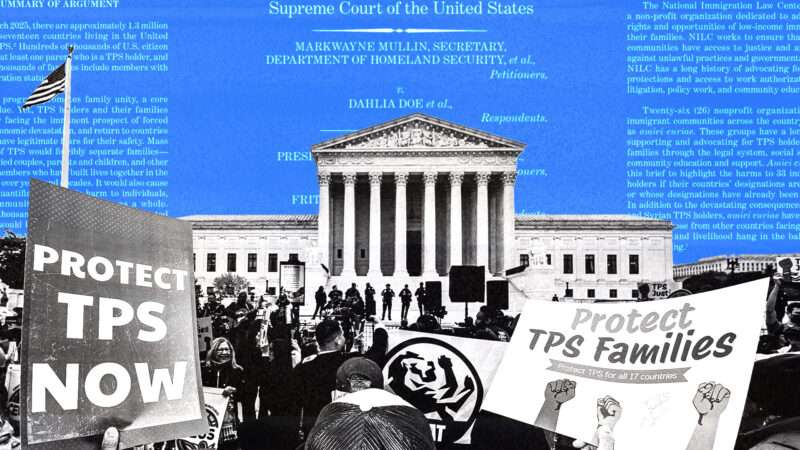
If SCOTUS won’t go to Staten Island, then Staten Island should go to SCOTUS. And so it has come to pass. I have blogged twice about a case that would splice the boundaries of Staten Island’s congressional district. Since then, the New York Appellate Division has declined to impose a stay, and the New York Court of Appeals (the highest court in New York) found it lacked jurisdiction. Nicole Maliotakis, the Representative from New York has filed an emergency petition in the Supreme Court.

Here is the summary of the argument:

Congresswoman Nicole Malliotakis and the Individual Voter Applicants (collectively, “Applicants”) request a stay of the order of the Supreme Court of the State of New York enjoining state officials from conducting any election under the State’s congressional map. The trial court’s order has thrown New York’s elections into chaos on the eve of the 2026 Congressional Election, which is set to begin on February 24, 2026. Applicants respectfully request emergency relief from this Court by February 23, 2026, so that the election can begin on February 24, under the legislatively adopted congressional map. Applicants presented this stay request to both the New York Appellate Division and Court of Appeals, asking for relief by February 10 so Applicants could give this Court a reasonable opportunity to grant them relief before February 24, if necessary. The New York Court of Appeals yesterday determined it lacks jurisdiction to give relief, and the Appellate Division has not yet acted. Petitioners are keenly aware of how seriously this Court takes the principle that “courts should ordinarily not alter the election rules on the eve of an election,” Abbott v. League of United Latin Am. Citizens, 146 S. Ct. 418, 419 (2025) (citation omitted), so they come to this Court before there is any suggestion that the election has begun, which is scheduled to occur on February 24. . . .

This Court is likely to reverse the trial court’s order if it were upheld by the New York appellate courts on any of three grounds. First, the decision clearly violates this Court’s Equal Protection Clause case law by prohibiting New York from running any congressional elections until it racially gerrymanders CD11 by “adding [enough] Black and Latino voters from elsewhere,” until the Black and Latino voters in CD11 control contested primaries and win most general elections. Although Applicants repeatedly told the trial court that racially reconfiguring CD11 would violate this Court’s binding strict-scrutiny framework, the trial court ignored this argument. This Court summarily reversed in less egregious circumstances in Wisconsin Legislature v. Wisconsin Elections Commission, 595 U.S. 398 (2002) (per curiam). Second, the trial court’s decision violated due process and related party-presentation principles by deciding the case based upon a theory that no party briefed, and that the Williams Respondents did not even present evidence to satisfy. Those are more extreme circumstances than those at issue in this Court’s recent summary reversal in Clark v. Sweeney, 607 U.S. 7 (2025) (per curiam). Finally, the trial court violated the Elections Clause under Moore v. Harper, 600 U.S. 1 (2023), by adopting an unbriefed, atextual test to invalidate a legislatively-adopted congressional map.

The timing here supports Malliotakis’s application. The nomination process begins on February 24. The lesson from Texas and Cailfornia is not to change maps on the eve of the election. This isn’t quite Purcell, but as I noted, the midterm primary date is the relevant deadline.

All equitable considerations call out for an immediate stay. Under New York law, the 2026 Congressional Election begins on February 24, 2026, when nominating petitions can start circulating. Congresswoman Malliotakis and her individual voter supporters who make up the Applicants have a right to begin their election activity for this federal office on that date. Yet, under the trial court’s order, the New York Board of Elections cannot take any steps to hold the election under the New York congressional map, unless and until CD11 is racial gerrymandered. At the same time, the trial court’s remedial mechanism—requiring New York’s Independent Redistricting Commission (“IRC”) to racially gerrymander CD11—is automatically stayed by operation of state law. That is a recipe for unconstitutional chaos, with no map in place and uncertainty as to whether nominating petitions can start circulating on February 24, with no end in sight. Applicants and the People of New York have the right to conduct their congressional elections under the lawful map that the New York Legislature adopted starting on February 24, free from a judicial mandate that violates multiple provisions of the United States Constitution. While Applicants had hoped—and still hope—that the New York appellate courts put an end to this unconstitutional mischief, they come to this Court now, so that this Court can provide relief before February 24, if the New York appellate courts do not do so.

I think is it relevant that the New York Court of Appeals dragged their feet after the Supreme Court’s GVR in Roman Catholic Diocese of Albany, as well as the Yeshiva University case. This track record does not inspire much confidence that the New York Court system will figure everything out in a few weeks.

The parties did not ask for an administrative stay, so the only thing for Circuit Justice Sotomayor to do is refer the matter to the Court.

The post Staten Island Goes To SCOTUS appeared first on Reason.com.

from Latest – Reason.com https://ift.tt/fUFW64d
via IFTTT

Second Amendment Roundup: New Jersey’s “Sensitive Places” Argued in 3rd Circuit En Banc

On February 11, the Third Circuit en banc heard oral argument in Koons v. Attorney General, which concerns New Jersey’s post-Bruen ban on firearm possession in numerous public places.  A panel decision previously upheld 2-1 most of the verboten locations as “sensitive places” where the Second Amendment right does not apply.  As I discussed here, the decision was based on a flawed misreading of supposed historical analogues.  Its basic premise is that a “sensitive place” is anything a legislature says it is without Founding-era analogues and without providing comprehensive security like that in modern courthouses and in the sterile area of airports (once you go past TSA screening).

We start with the Supreme Court’s methodology in Bruen that “when the Second Amendment’s plain text covers an individual’s conduct, the Constitution presumptively protects that conduct.  To justify its regulation, … the government must demonstrate that the regulation is consistent with this Nation’s historical tradition of firearm regulation.”  This means, as Rahimi put it, “the appropriate analysis involves considering whether the challenged regulation is consistent with the principles that underpin our regulatory tradition.”  Here, that burden to demonstrate the existence of a historical tradition as well as the extraction of the appropriate principles falls squarely upon New Jersey. And while New Jersey demonstrated neither, it was the instant plaintiffs that established the existence of a historically-based principle of the Supreme Court’s “sensitive places” doctrine as discussed below.

Previously, in Heller, the Court in dicta referred to “laws forbidding the carrying of firearms in sensitive places such as schools and government buildings” as being “presumptively lawful,” implying that the presumption may be subject to question, narrowing, or clarification.  Bruen – again in dicta – specifies “government buildings” that are sensitive places to include “legislative assemblies, polling places, and courthouses.” However, in Bruen, the Court rejected New York’s argument that it had the authority consistent with the Second Amendment to ban the carrying of handguns by claiming its restrictions were essentially “sensitive place” regulations. The Court specifically said that, for example, Manhattan could not constitutionally be considered a gun free zone “sensitive place” because it is crowded and police are generally present.

The provision of government security ties these historic “sensitive place” locations together.  At the Founding, governments provided enhanced security at those locations, in the persons of bailiffs, justices of the peace, sergeants-at-arms, doorkeepers, and sheriffs.  While covered in the briefs, these historical analogues are set forth in much greater detail in Dr. Angus McClellan’s recent SSRN post.  So, the three locations identified by Bruen were sensitive places because they were provided with enhanced armed security, and they are proper historical analogues with roots in the Founding.

Faced with defending gun bans in numerous public places that provide no real security (other than an occasional Paul Blart mall cop), New Jersey counsel, Angela Cai, denied that any security at all is necessary to be a “sensitive place.”  The state bans guns at public gatherings, zoos, parks, libraries and museums, bars and restaurants, and assorted other locations.  Places where people congregate, she argued, suffice to make a place sensitive – exactly a criterion Bruen explicitly rejected.  Even the “crowded place” argument gets dropped when gun bans at extensive wooded parks are defended.

At bottom, unmoored from comprehensive security, no limiting principle exists to what is a “sensitive place.” And, the benefit to comprehensive security as the criteria for demonstrating that a location is a “sensitive place” is that it is easy to administer for judges. After all, judges literally live within the bubble of comprehensive security whenever they go to work: armed guards, metal detectors and limited (and locked) entry points to ensure bad guys with guns cannot sneak in.  Furthermore, it is worth noting that where the Founders feared that churches were vulnerable to violent attacks, they did not declare them to be a “weapons free zone” but instead legally required Americans to bring their arms there.

Ms. Cai brought up the 1328 Statute of Northampton, but Bruen saw it as relevant only as reflected in Virginia’s 1786 rendition providing that “no man, great nor small, [shall] go nor ride armed by night nor by day, in fairs or markets, or in other places, in terror of the Country.”  She sought to separate the terror element from the crime of going armed in fairs or markets – fairs and markets being today’s supposed “crowded places” – but Bruen recognized no such separation.  The Founders regulated the misuse of the public carry of firearms by banning carrying firearms in a manner to terrify the public; peaceable carry was for defensive purposes and was not restricted even in urban settings, as none other than Founder and criminal defense attorney John Adams noted in his defense of the British after the Boston Massacre. Adams conceded that the colonists had every right to carry arms in Boston for defensive purposes.

In a classic example of “fake news,” Judge Chung asked counsel for Koons, Pete Patterson, about North Carolina’s supposed 1792 statutory enactment, which was “exactly the same as Northampton.”  As Mr. Patterson correctly responded, “There was no 1792 North Carolina statute. That was in a private lawyer’s collection of … the British laws he posited that were still in effect in North Carolina.”  And it even referenced “the King.”  I have previously written about how some judges have been duped by this “fake” 1792 NC statute, and have an article forthcoming on it in the Journal of Law & Civil Governance at Texas A&M. Instead, as I’ve explained in more detail, North Carolina enacted a law in 1741 and reenacted it in 1791 recognizing the offense of “go[ing] armed offensively,” which is another way of stating that one cannot publicly carry arms “to the terror” of the people.

In her Rahimi concurrence, Justice Barrett rejected the assumption that “founding-era legislatures maximally exercised their power to regulate, thereby adopting a ‘use it or lose it’ view of legislative authority.”  But the text-history method still applied, and she warned against too high a level of generality when considering historical analogues.  In response from a question from Judge Shwartz about legislative silence, Ms. Cai replied that little need existed at the Founding for expansive sensitive places, but the expiration of the patent for the Colt revolver in 1850 prompted more handgun production and consequent more interpersonal violence by the 1870s.  That explained the passage of restrictions in Texas, Missouri, and Tennessee.

But as Judge Porter asked: “Why is that a new social problem that had never been contemplated before? Isn’t that exactly the kind of thing that was addressed by the statute of Northampton going back 600 years?”  Ms. Cai added nothing new to her argument.  But it goes without saying that blunt instruments, edged weapons, spears, bows, tomahawks, and plenty of arms have been available over the centuries for both defensive and offensive use.

And it bears repeating, as Heller noted, that the Second Amendment protects modern arms that are in common use, and that if they are to be restricted, the burden falls on the state to show that they are not in common use.

As to the above three state laws cited by Ms. Cai, they were too little and too late.  Mr. Patterson pointed out that “the Supreme Court in Espinoza said more than 30 state laws from the late 19th century cannot create an early American tradition.”  Like the 1870s laws cited in this case, the laws at issue in Espinoza, which were held to violate the Free Exercise Clause, were not rooted in the Founding.

That also raises the 1791 versus 1868 issue.  Which prevails?  Chief Judge Chagares asked Ms. Cai:

You argue in your brief, in various places, in particular your reply brief at page 18, that in the event of a clash between founding era and reconstruction era historical analogues, that the latter ought to control for purposes of our inquiry under Bruen. Doesn’t Bruen tell us something different? … The opinion says on page 66, “Late 19th century evidence cannot provide much insight into the meaning of the Second Amendment when it contradicts earlier evidence.”

Ms. Cai replied: “You will not find a single case that a plaintiff has cited from either the founding period or the antebellum period or reconstruction that says restrictions at sensitive places and … many jurisdictions adopted them was unconstitutional.”  Well, that’s because there were virtually no such restrictions at the founding or antebellum periods, and there were only a handful during Reconstruction.

The fact is that the Founders were not silent, but spoke loudly, when they adopted the Second Amendment itself and also when they legislated to punish going armed in places of public congregation like fairs and markets in a manner to terrify others.  The right peaceably to bear arms at every public place is the default rule, and the only exceptions are narrowly-defined, government-protected sensitive places.  And it’s the government’s burden to demonstrate that those places are consistent with America’s historical tradition of regulation.

The extent to which facial challenges may be brought to arms restrictions has been a controverted subject of late, with the Fourth Circuit rejecting a parks restriction in LaFave v. Fairfax County in which a cert petition is now pending (I’m counsel in the case).  In Seigel (the companion case to Koons), in which challenges were made to parts, but not all, of certain sections of the law, Judge Freeman asked “what allows you to have a facial challenge to just a part of a statutory provision?”  Counsel Erin Murphy explained that bans on carry at playgrounds and youth sporting events were being challenged, but “we are only challenging the provisions that are there to reach things that are not happening on school property.”  Heller itself exemplified that a facial challenge may be brought to a law (D.C.’s complete ban on handguns), even though some other law could apply to a specific person (e.g., a felon) or to “sensitive places” (such as D.C.-located courthouses).

Judge Chung asked why the $200 fee for a handgun carry permit could not be applied to a person with a conviction for harming someone.  Ms. Murphy replied, “I’ve never understood facial challenge doctrine to mean that if you can come up with a completely different law the state could have written and shoehorn that in, then your facial challenge fails because the whole point of this law is to say, no, you have to pay the fee.”  This is correct. The government may not hypothesize about a non-existence statute that a legislature could have (but did not) actually enact in order to save an existing unconstitutionally-drafted statute. See Peter Patterson, Facial Confusion: Lower Court Misapplication of the Facial/As-Applied Distinction in Second Amendment Cases, Harvard JLPP (2025). The issue arose in part in the context of whether having to pay the fee creates irreparable harm for purposes of a preliminary injunction.  Imagine whether it would be irreparable harm to impose a poll tax of $1.50 to vote (the Supreme Court said yes in Harper v. Virginia).

It will not be surprising if the Koons court delays a decision until after the Supreme Court resolves Wolford, which concerns Hawaii’s ban on firearm possession on private property as applied to places open to the public.  The Supreme Court is sure to give further guidance on how far states may go in restricting the places where the right to bear arms exists.


The post Second Amendment Roundup: New Jersey's "Sensitive Places" Argued in 3rd Circuit En Banc appeared first on Reason.com.

from Latest – Reason.com https://ift.tt/hMW0APN
via IFTTT

Lessons of the End of Trump’s ICE “Surge” in Minnesota

Tom Homan
“Border czar” Tom Homan. (Holden Smith/ZUMAPRESS/Newscom)


Earlier today, Trump “border czar” Tom Homan announced that Operation Metro Surge – the massive deployment of some 3000 federal immigration enforcement officers to Minnesota – is about to end. Significantly, it is ending earlier than most expected, and without having achieved the stated goal of forcing Minnesota state and local governments to end their “sanctuary” policies restricting cooperation with federal immigration enforcement.

It seems likely that Trump gave up because the policy met with extensive resistance and has become highly unpopular. His public opinion approval ratings on immigration policy have plummeted. That setback for the administration occurred in large part because of a combination of legal and political resistance.

Courts ruled against the administration on some of its more blatantly illegal detentions, such as those targeting refugees. Federal Judge Katherine Menendez refused to grant a preliminary injunction in a Tenth Amendment suit filed by state and local governments, but made clear that the plaintiffs might well ultimately prevail. Meanwhile, a massive political mobilization helped draw attention to the administration’s cruel, abusive, and illegal tactics, increasing public revulsion and opposition.

In a May 2025 article for The UnPopulist, I argued that effective resistance to Trump’s many unjust and unconstitutional power grabs requires a combination of litigation and political action, exploiting synergies between the two. Litigation can help block unconstituitional policies, and highlight abuses. That can help stimulate public opposition and mobilization, which can in turn pave the way for more victories in court, as judges will often feel more able to rule against the administration if they believe they will have the backing of public and elite opinion. Judicial victories can then stimulate additional political mobilization, and so on. As noted in my particle, historical examples ranging from the Civil Rights Movement to struggles for constitutional property rights indicate this dynamic can be very effective.

Something like this dynamic seems to been at work in Minnesota. Abuses highlighted by court cases helped stimulate public opposition, and judges may be more willing to rule against abuses, given widespread public support. In particular, litigation likely helped more people realize that Trump’s detention deportation efforts were not targeting criminals and the “worst of the worst,” but instead primarily going after people who were living and working peacefully, contributing to their communities – including even many who were in the country legally, such as numerous refugees and asylum seekers. The ultimately successful litigation over the heartrending case of 5-year-old Liam Ramos and his family (who had an asylum application pending), was particularly notable in driving these points home.

These dynamics obviously not the only factors in the setback for Trump. But they helped. Going forward, advocates for migrant rights and other related causes would do well to learn from the Minnesota experience, and from other examples compiled in my UnPopulist article.

Obviously, the setback for Trump here is unlikely to completely end this administration’s often cruel and illegal immigration policies. Nor has it reversed all the massive harm done by Operation Metro Surge. As Judge Menendez noted in her ruling, “Operation Metro Surge has had…. profound and even heartbreaking, consequences on the State of Minnesota, the Twin Cities, and Minnesotans,” including the killing of two citizens by federal agents, large-scale “racial profiling, excessive use of force, and other harmful actions,” and  “negative impacts…. in almost every arena of daily life.” There also has been no accountability for the federal officials responsible for these outrages.

But the dual strategy of litigation and political action has at least mitigated the damage. And it can be used again in at least some situations going forward.

As noted in my UnPopulist article, this kind of strategy does have noteworthy limitations:

It is particularly important to recognize the limits of public attention and knowledge. Survey data shows most voters pay little attention to politics, and often don’t know even basic information about government and public policy—including judicial decisions. This makes it hard to attract public attention to more than a few legal battles at any given time. That dynamic limits the number of situations where advocates can count on judicial decisions, even important ones with sympathetic facts, moving public opinion….

Some complex legal issues, moreover, are difficult or impossible to present to the public in a way that enables people to grasp their significance. That doesn’t mean litigation in such cases is a bad idea. But it does mean it cannot rely on a boost from mobilizing public opinion.

In addition, while litigation efforts promoting popular results can help mobilize public opinion in support of a cause, litigation promoting unpopular ones can have the opposite effect….

Despite these constraints, utilizing synergies between litigation and political action can often be an effective strategy for curbing abuses of government power and strengthening constitutional protections. Minnesota is a notable additional case in point. We would do well to learn from it, as there are likely to be more opportunities to make use of the lesson.


The post Lessons of the End of Trump's ICE "Surge" in Minnesota appeared first on Reason.com.

from Latest – Reason.com https://ift.tt/OSXG80T
via IFTTT

Judge Preliminarily Blocks Military Disciplinary Measures Against Senator (and Retired Navy Captain) Mark Kelly

An excerpt from Judge Richard Leon’s long (and exclamation-point-filled) opinion today in Kelly v. Hegseth (D.D.C.):

United States Senator Mark Kelly, a retired naval officer, has been censured by Secretary of Defense Pete Hegseth for voicing certain opinions on military actions and policy. In addition, he has been subjected to proceedings to possibly reduce his retirement rank and pay and threatened with criminal prosecution if he continues to speak out on these issues. Secretary Hegseth relies on the well-established doctrine that military servicemembers enjoy less vigorous First Amendment protections given the fundamental obligation for obedience and discipline in the armed forces. Unfortunately for Secretary Hegseth, no court has ever extended those principles to retired servicemembers, much less a retired servicemember serving in Congress and exercising oversight responsibility over the military. This Court will not be the first to do so! …

Defendants boldly argue that Senator Kelly’s speech was unprotected [by the First Amendment], citing to a line of precedent establishing that First Amendment protections are more limited in the military context. See, e.g., Parker v. Levy (1974)…. Defendants rest their entire First Amendment defense on the argument that the more limited First Amendment protection for active-duty members of the military extends to a retired naval captain.

To be sure, while soldiers “are not excluded from” the First Amendment’s coverage, “the different character of the military community and of the military mission requires a different application of those protections.” From Parker onward, the Supreme Court has recognized that “[t]he fundamental necessity for obedience, and the consequent necessity for imposition of discipline, may render permissible within the military that which would be constitutionally impermissible outside it.” Therefore, given the countervailing interests at stake in the line of duty, “speech by a member of the military that undermines the chain of command, and the obedience, order, and discipline it is designed to ensure, does not receive First Amendment protection.”

However, the cases in this area uniformly involve active-duty servicemembers or speech on military bases. While retired servicemembers have an “ongoing duty to obey military orders” and may be recalled to active duty, Defendants have not identified a single case extending Parker‘s reasoning outside the context of active-duty soldiers.

This makes sense. Active-duty soldiers operate in “a specialized society separate from civilian society,” where the “law is that of obedience,” lest the military’s critical mission of maximum effectiveness and lethality be undermined. As such, active-duty soldiers urging others to “disregard orders” or “calling into question a commander’s credibility” may directly “undermine the effectiveness of response to command.” The military therefore has a “legitimate interest in prohibiting [such] conduct to promote discipline and uphold order among its members.”

The same rationale does not hold true for retired servicemembers—and certainly not those in Senator Kelly’s position. While still members of the military community, retired servicemembers are also part of the “civilian community” and are not fully immersed in the “specialized society” of the active armed forces. Speech from retired servicemembers—even speech opining on the lawfulness of military operations—does not threaten “obedience, unity, commitment, and esprit de corps” in the same way as speech from active-duty soldiers. Nor can speech from retired servicemembers “undermine the effectiveness of response to command” as directly as speech from active-duty soldiers. As such, the military cannot claim the same “legitimate interest in prohibiting” speech by retired veterans.

As applied to a sitting Member of Congress, the Parker rule has even less force! Our system of “representative government requires that legislators be given the widest latitude to express their views on issues of policy.” Legislators like Senator Kelly carry “an obligation to take positions on controversial political questions” both so their constituents may be “fully informed” as to the legislator’s views and so constituents “may be represented in governmental debates by the person they have elected to represent them.” Indeed, if legislators do not feel free to express their views and the views of their constituents without fear of reprisal by the Executive, our representative system of Government cannot function! Between the lack of precedent extending Parker outside the context of active-duty military and the heightened free speech protection for legislators, Senator Kelly’s speech must receive full First Amendment protection.

Defendants respond that Senator Kelly is seeking to exempt himself from the rules of military justice that “Congress has expressly made applicable to retired servicemembers.” Horsefeathers! While Congress has chosen to apply the Uniform Code of Military Justice to military retirees as well as active-duty servicemembers, that choice has little bearing on the scope of First Amendment protections for retirees. The First Amendment “is a limitation on the power of Congress,” not the other way around!

Without the benefit of Parker, Defendants have no other arguments for how Senator Kelly’s speech is unprotected under the First Amendment. {Senator Kelly points out that the social media video does not fit into any other recognized category of unprotected speech, like incitement. Defendants do not press an incitement argument here—and for good reason. The video was not, in any meaningful sense, likely to produce “imminent lawless action.” Brandenburg v. Ohio (1969).} …

Rather than trying to shrink the First Amendment liberties of retired servicemembers, Secretary Hegseth and his fellow Defendants might reflect and be grateful for the wisdom and expertise that retired servicemembers have brought to public discussions and debate on military matters in our Nation over the past 250 years. If so, they will more fully appreciate why the Founding Fathers made free speech the first Amendment in the Bill of Rights! Hopefully this injunction will in some small way help bring about a course correction in the Defense Department’s approach to these issues….

Here are more details on Kelly, his statements, and the government’s actions in response:

Plaintiff Mark Kelly is a retired United States Navy Captain and a sitting United States Senator from Arizona…. He serves on the Senate Armed Services Committee, which oversees the Department of Defense. He also serves on the Senate Select Committee on Intelligence….

[Among other speech critical of the Trump Administration, o]n November 18, 2025, Senator Kelly appeared in a video with five other members of Congress (all members of the Democratic Party and veterans of the armed forces or intelligence services) stating that members of the armed forces “can refuse illegal orders.” In the video, Senator Kelly identified himself as a Navy veteran: “I was a captain in the United States Navy.” The group sought to “speak directly to members of the military.” Acknowledging the “enormous stress and pressure” facing servicemembers, the group argued that the Trump Administration was “pitting our uniformed military … [a]gainst American citizens.” “Right now,” the group argued, “the threats to our Constitution aren’t just coming from abroad,… [b]ut from right here at home.” Senator Kelly then stated, “Our laws are clear. You can refuse illegal orders.” …

On January 5, 2026, Secretary Hegseth issued a Secretarial Letter of Censure against Senator Kelly. Secretary Hegseth found that “[b]etween June 2025 and December 2025, [Senator Kelly] engaged in a sustained pattern of public statements that characterized lawful military operations as illegal and counseled members of the Armed Forces to refuse orders related to those operations.” Secretary Hegseth concluded that Senator Kelly’s statements undermined the chain of command, counseled disobedience to lawful orders, created confusion about duty, and brought discredit upon the Armed Forces. Accordingly, the Secretary formally censured the Senator “for conduct prejudicial to good order and discipline in the armed forces and conduct unbecoming an officer.”

Secretary Hegseth also determined, based on his findings, that “good cause” existed to “reopen the determination of [Senator Kelly’s] retired grade,” and he directed the Secretary of the Navy to recommend “whether a reduction in grade is appropriate.” Secretary Hegseth further warned Senator Kelly that he may “subject [himself] to criminal prosecution or further administrative action” if he continued “to engage in conduct prejudicial to good order and discipline.” Senator Kelly may submit a “written rebuttal” to the Letter, but he has no “right to appeal.”

The same day, Senator Kelly received a letter from the Chief of Naval Personnel referring the Senator to retirement grade determination proceedings (hereinafter, “Retirement Grade Proceeding”). The Notification confirmed that Senator Kelly’s “retirement will be revisited,” with the sole “factual basis supporting [the] action” being the “Secretary of War letter of censure.” …

I think the court generally reaches the correct result, and for largely correct reasons, though I think some of the rhetoric (e.g., “Horsefeathers!”) undermines rather than strengthens the persuasive force of the argument.

Benjamin Mizer, Jeffrey Smith, Aaron Sobel, Bonnie Devany, Deborah A. Curtis, Samuel Francis Callahan, and Paul Joseph Fishman (Arnold & Porter Kaye Scholer LLP) represent Kelly.

The post Judge Preliminarily Blocks Military Disciplinary Measures Against Senator (and Retired Navy Captain) Mark Kelly appeared first on Reason.com.

from Latest – Reason.com https://ift.tt/l4gFyJc
via IFTTT

Fifth Circuit Comments on District Judge’s Discussion of Using AI in Judicial Decisionmaking

From La Union del Pueblo Entero v. Abbott, decided today by Judge Edith Jones, joined by Judge Kurt Engelhardt and District Judge Robert Summerhays (W.D. La.):

The district court gave an interview to the Wall Street Journal explaining how he had used artificial intelligence as an adjunct to his work on some aspects of a case “involving Texas[ ] election law.” Whether it was this case is uncertain. However, as one distinguished U.S. Senator [Grassley] has commented, AI “must not be a substitute for legal judgment,” nor must the public perceive that federal judges outsource our judgment to AI tools.

Thanks to Michael Smith (Smith Appellate Law Firm) for the pointer.

The post Fifth Circuit Comments on District Judge's Discussion of Using AI in Judicial Decisionmaking appeared first on Reason.com.

from Latest – Reason.com https://ift.tt/0Q5l9oE
via IFTTT