Dollar Tumbles On Trump’s Fed Attack, Sending Global Stocks Higher

The dollar slumped for the fourth consecutive day on Tuesday and US Treasuries dropped, after President Trump criticized higher interest rates and the Fed’s rate hike policy, while slamming China and EU for currency manipulation. The DXY index dropped 0.35%, down 1.2% in the last four days – its worst such run since late March – while the Bloomberg dollar index dropped to the lowest since August 9.

According to Bloomberg, Trump complained that Jerome Powell hadn’t been a “cheap-money Federal Reserve chairman” at a fund-raiser on Friday, and also accused China and the European Union of manipulating their currencies in an interview with Reuters.

“As of today, the Fed’s independence is guaranteed, but Trump has the ability to make his own appointments to the Fed board,” said Bob Parker, a member of the Investment Committee of Quilvest Wealth Management on Bloomberg TV. “If Fed independence does get threatened, you’re going to see a bond market reaction.”

The dollar weakness launched a sharp move higher in the euro which rose as much as 0.5%, or over 100 pips in 24 hours, spiking above $1.15 after when stops were hit in early Asian trading as funds covered short positions.

Nonetheless, JPM Asset Management said that it’s still too early to call the end to this year dollar’s rally, as escalating U.S.-China trade tensions fuel demand for the currency.

Trump’s comments were welcomed by global markets – as a reminder a weaker dollar is welcome in a world in which a dollar shortage is causing increasingly more pain for emerging markets – and U.S. stock index futures rose, and are once again just 15 points away from all time highs, following gains in Asia and Europe.

In Asia, the Shanghai Composite continued its advance, and rose over 1.3%, the most in over a week one day after state-backed funds, the so-called “national team”, were seen buying stocks to stabilize the market, while earnings optimism helped shrug-off early indecision from further liquidity efforts by the PBoC and Trump trade pessimism.

Australia’s ASX 200 (-1.0%) was the worst performer and was pressured by weakness in energy, financials and mining names with losses in industry giant BHP following disappointing earnings results. In addition, political uncertainty added to dampened tone in Australia after PM Turnbull survived a leadership challenge, although is still seen to be at risk and some have even suggested to be a dead man walking after 42% of the party voted against him. Elsewhere, Nikkei 225 (+0.1%) was initially dampened by a firmer currency but then gradually recovered.

President Trump said he has “no time-frame for ending China trade dispute” and does not anticipate much coming from the trade talks with China this week. Trump also accused China and Europe of currency manipulation and stated that when the US places tariffs on China, China artificially devalues its currency.

In Europe, the Eurostoxx 50 index rose 0.7%, with export-led UK stocks underperforming due to the stronger euro. The FTSE 100 which derives a large portion of its revenues in the United States and so benefits from dollar strength, was down -0.3%. Energy and Telecom names are underperforming while IT names outperform. Looking at individual stocks, Aggreko (+4.7%) and Bayer (+2.5%) are faring well following broker upgrades. Atlantia (+3.4%) remains in focus,  company shares are taking a breather after plunging over 9% yesterday.

But the main focus in overnight trading was the FX market in the aftermath of Trump’s comments; here the onshore yuan extended its gain for a fourth session, its longest such run since June 14, after the PBOC strengthened reference rate by the most since July 26. The onshore yuan rose 0.20% to 6.8443, pulling further away from 6.934, its weakest since January 2017 marked last week. The offshore yuan also edged higher, up 0.03% to 6.8335 per dollar as the CNH overnight deposit rate fell 10bps to 1.15%. Analyst believe the USDCNH is unlikely to move back above Aug. 15 high within next couple of weeks, especially with trade talks with the US once again on the table, as Beijing if unwilling to antagonize the US with another sharp currency devaluation.

In his Reuters interview, Trump also accused China of manipulating its currency and said there was little hope of progress in the ongoing trade dispute between the two countries in talks due this week.

The dollar’s weakness took the pressure off many emerging market currencies, that have struggled in recent weeks as worries over Turkey precipitated a sell-off across the globe. The Thai Baht led Asian currencies higher following BOT governor’s hawkish tone. Other Emerging currencies, including the South African rand, Mexican peso, Hungarian forint, Polish zloty and Indian rupee, were all higher by 0.2 to 0.8 percent against the dollar. Turkey’s lira bucked the trend, however, and extended its declines to a third day; the country’s markets remain closed for most of this week. The Russian ruble also slumped due to potential further sanctions and resumption of FX purchases from CBR.

Commodities that are priced in dollars and so benefit from any weakness were also higher across the board. Base metals prices rose, with London copper climbing for a second day and crossing the $6,000-a-tonne mark, while spot gold rose 0.28 percent to $1,193. Brent crude oil rose 0.12 percent to $72.35 per barrel. Industrial and precious metals rallied, led by zinc, nickel and silver.

Treasuries gave back some of Monday’s gains and European bonds were mixed with peripheral debt outperforming.  Germany’s Bunds extended losses, snapping lower after the strong open in European cash equities triggers a risk-driven rally; the 10y bund yield at 0.30% blocks upside progress. Italy’s BTPs bull steepened as positive risk sentiment gained momentum. BTPs pare all the losses triggered by the recent sell-off of the Turkish lira as FTSE MIB leads European indexes higher. Bunds snapped.

In geopolitics, President Trump said he thought he had a deal with Turkey for Pastor Brunson’s release and that he helped Israel to free a Turkish citizen for the pastor’s release. Trump said he would consider lifting Russian sanctions if Moscow took steps to cooperate with US on issues such as Syria and Ukraine, while he also stated it is fine if Iranian President Rouhani wants to meet him but that he could not care less if not. Trump later added that it is likely will have a 2nd summit with North Korean leader Kim.

Australian PM Turnbull survived a Liberal Party leadership challenge by 48 to 35 votes, which was brought on by Australian Home Affairs Minister Dutton who later stepped down. This followed reports that PM Turnbull abandoned his energy policy and conceded the legislation could not pass parliament given the coalition’s 1-seat majority and opposition from within the Liberal Party led by former PM Abbott, which reports had noted casted large doubts over Turnbull’s future as party leader and PM.

Investors are waiting to see if Fed Chair Jerome Powell will respond to Trump and offer more clues on monetary policy at the Jackson Hole conference of central bankers later this week. Upcoming trade talks between China and the U.S. will also be closely watched. In pre-market trading, the Tesla roller-coaster continued with the auto stock gaining after its a recent plunge.

J.M. Smucker, Kohl’s, Medtronic, and TJX are among companies reporting earnings; there are no economic reports or Fed speakers of note.

Market Snapshot

  • S&P 500 futures up 0.2% to 2,863.00
  • STOXX Europe 600 up 0.3% to 384.18
  • MXAP up 0.4% to 163.53
  • MXAPJ up 0.7% to 530.49
  • Nikkei up 0.09% to 22,219.73
  • Topix down 0.4% to 1,685.42
  • Hang Seng Index up 0.6% to 27,752.79
  • Shanghai Composite up 1.3% to 2,733.83
  • Sensex down 0.05% to 38,258.65
  • Australia S&P/ASX 200 down 1% to 6,284.38
  • Kospi up 1% to 2,270.06
  • German 10Y yield rose 1.2 bps to 0.314%
  • Euro up 0.3% to $1.1521
  • Italian 10Y yield fell 10.5 bps to 2.743%
  • Spanish 10Y yield fell 4.6 bps to 1.344%
  • Brent futures unchanged at $72.21/bbl
  • Gold spot up 0.5% to $1,190.48
  • U.S. Dollar Index down 0.4% to 95.54

Top Overnight news from Bloomberg

  • President Donald Trump said he expected Jerome Powell to be a cheap-money Fed chairman and lamented to wealthy Republican donors at a Hamptons fundraiser on Friday that his nominee instead had raised interest rates, according to three people present. He also accused China and the European Union of manipulating their currencies as he tries to wrestle concessions from two of the U.S.’s largest trade partners
  • Trump said he won’t make any concessions to Turkey to secure the freedom of a detained Christian evangelical pastor at the center of the diplomatic dispute that has rocked the NATO ally’s economy
  • China won’t use competitive currency devaluation or the foreign exchange rate as a tool to cope with trade frictions, according to a senior central bank official. “The yuan’s exchange rate is decided by the market,” Li Bo, director of the People’s Bank of China’s monetary policy department, said at a press conference in Beijing
  • Norway’s $1 trillion wealth fund had a return of $20 billion in the second quarter, erasing losses for the year, even as the prospect of increased trade barriers and a weaker growth outlook in Europe, China and emerging markets had an adverse effect
  • Microsoft Corp. warned that cyber-attackers linked to the Russian military are once again targeting American political groups, in a potential attempt to manipulate and disrupt the U.S. midterm elections in November
  • Australia’s Prime Minister Malcolm Turnbull survived a leadership vote on Tuesday, but may be challenged again amid growing unease among party colleagues about the government’s slumping poll ratings. Turnbull defeated Home Affairs Minister Peter Dutton by 48 votes to 35 in a ballot on Tuesday. Dutton resigned from the cabinet
  • Reserve Bank of Australia sketched out a scenario where faster global growth and U.S. stimulus withdrawal push the Aussie dollar lower and underpin a stronger domestic outlook
  • The Bank of Japan is likely to face trillions of yen of losses once it begins decisively exiting its radical stimulus, meaning it needs to work toward reining in its balance sheet now. That’s according to Mitsuhiro Fukao, professor of economics at Musashino University in Tokyo and a former BOJ official

Asia-Pac markets eventually traded mostly higher taking the positive lead from Wall St where stocks edged a 3rd consecutive gain and the S&P 500 finished around 15 points from all-time highs. ASX 200 (- 1.0%) was the worst performer and was pressured by weakness in energy, financials and mining names with losses in industry giant BHP following disappointing earnings results. In addition, political uncertainty added to dampened tone in Australia after PM Turnbull survived a leadership challenge, although is still seen to be at risk and some have even suggested to be a dead man walking after 42% of the party voted against him. Elsewhere, Nikkei 225 (+0.1%) was initially dampened by a firmer currency but then gradually recovered, while Hang Seng (+0.6%) and Shanghai Comp. (+1.3%) traded higher as earnings optimism helped shrug-off early indecision from further liquidity efforts by the PBoC and Trump trade pessimism. Finally, 10yr JGBs were marginally lower and retreated back below 150.00 with prices subdued amid an improvement of risk tone in Tokyo, while a mixed 20yr auction also failed to spur demand. US President Trump said he has no time-frame for ending China trade dispute and does not anticipate much coming from the trade talks with China this week. US President Trump also accused China and Europe of currency manipulation and stated that when the US places tariffs on China, China artificially devalues its currency.

Top Asian News

  • Chinese Shares Bounce for Second Day After State Support Seen
  • HNA Units Lose $10 Billion in Market Value After Resumptions

European equities trade mostly higher (Eurostoxx 50 +0.7%) with the FTSE 100 (-0.3%) underperforming, weighed by a firmer sterling and heavyweight BHP reported a 37% fall in profits due to a write-down on its US onshore oil and gas assets. Energy and Telecom names are underperforming while IT names outperform. Looking at individual stocks, Aggreko (+4.7%) and Bayer (+2.5%) are faring well following broker upgrades. Atlantia (+3.4%) remains in focus, company shares are taking a breather after plunging over 9% yesterday.

Top European News

  • The $11 Billion Reason Italy May Not Nationalize Autostrade
  • Greek Bad Loans Are a Drag Even After Crisis Shrank Bank Sector
  • U.K. Government Posts Biggest July Budget Surplus in 18 Years
  • Brevan Howard Said to Cut Gym, Kitchen as London Office Shrinks

In FX, Trump’s latest tirade on the USD has given FX markets some much needed traction after yesterday’s somewhat contained session. In his latest attack on the firmer USD, Trump has once again shifted blame onto the ‘independent’ Fed Chair Powell but stating that he was ‘not thrilled’ with the FOMC for lifting rates, adding that the Fed should do more to support the economy. Subsequently, the DXY sits on a 95 handle in EU trade with the greenback having given back some key levels to its major peers. More specifically, EUR/USD has reclaimed 1.1500 to the upside and went as high as 1.1543 overnight before pulling back to just above 1.1500 where around EUR 646mln of option expiries reside; EZ-specific newsflow and data remains light. JPY has failed to benefit much from the softer USD with the move in USD/JPY below 110.00 short-lived as the pair now resides in close proximity to USD 1.6bln of expiries between 110.00-10.

Elsewhere, AUD was a key focus overnight after extending yesterday’s move above 0.7300, largely off the back of USD weakness with gains capped by domestic political uncertainty. As a reminder, Australian PM Turnbull survived a Liberal Party leadership challenge by 48 to 35 votes, which was brought on by Australian Home Affairs Minister Dutton who later stepped down. This followed reports that PM Turnbull abandoned his energy policy and conceded the legislation could not pass parliament given the coalition’s 1-seat majority and opposition from within the Liberal Party led by former PM Abbott, which reports had noted casted large doubts over Turnbull’s future as party leader and PM. RBA minutes overnight were a non-event. A ‘calmer’ start to the session for TRY with USD/TRY (only!) up 1.0% thus far after US President Trump yesterday criticised Turkey by stating that he thought he had a deal with Turkey for Pastor Brunson’s release. TRY will continue to remain sensitive to any developments regarding the Pastor with Trump no-doubt wanting to get a ‘win’ in the eyes of the US electorate by securing his  release without conditions. That said, questions remain over what long-term impact the release of the Pastor will have on the TRY given Turkey’s current account woes and central bank inertia.

In commodities, WTI (Unch) and Brent (Unch) trade without a firm direction, while concern grows over the potential impacts of the US-Sino trade disputes. US President Trump stated last night that he has no time frames for ending the China trade disputes. Traders are noting the rise in WTI is supported by the tightening outlook for fuel in the coming months. Of note: US offered 11mln barrels of sour crude from its Strategic Petroleum Reserve yesterday. This release of oil could offset some expected supply shortfalls as a result of US sanctions on Iran. Traders will be keeping an eye on the API weekly crude inventories today. Elsewhere, gold (+0.3%) is higher as the yellow metal moves with the dollar, while base metals benefit from the weaker dollar

Looking ahead to today’s schedule, there aren’t many substantive data releases. The only release of note in Europe is the July public finances data in the UK. The EU’s chief negotiator Barnier will meet with UK Brexit Secreatry Raab this afternoon to resume technical discussions, and headlines emerging from that meeting could move markets. The pound is trading within 0.67% of its weakest level since last June, though our strategists note that it does look quite oversold on technical levels.

US Event Calendar

  • Nothing major scheduled

DB’s Jim reid concludes the overnight wrap

One of the more remarkable stories yesterday was the one which highlighted that Venezuelan TV have had to remove their version of “Who wants to be a millionaire?” from their screens due to hyperinflation making the show a little less dramatic than it once was. Indeed one million bolivars is now worth around 17US cents whereas at the start of the year the prize money was worth just over 100,000 USD.

Venezuela at the end of 2017 was ‘only’ the 51st largest economy in the world (IMF) so its woes are only a footnote on global markets at the moment but it’s worth highlighting that over the weekend they opted for one of the largest devaluations ever seen with a 95% fall in the Bolivar. The IMF’s previous forecast for one million percent yoy inflation this year might now be tested with this move. We say it’s little more than a footnote but it’s worth saying that at 51 it was only 4 places behind Portugal and 7 behind Finland. So not a tiny country but with gross external debt of around $47 billion, Venezuela’s relevance to global markets is dwarfed by countries like Turkey ($467 billion gross external debt) or even Portugal ($505 billion) which is similar in size. For further comparison with Turkey, at the end of 2017 the Turkish economy was 4 times as big and no. 17 on the global size rankings.

Staying with Turkey, while the Lira did extend losses yesterday (to close last night -1.06% weaker) the lack of any follow-through into wider markets meant it was a relatively non-eventful day. As a reminder Turkey is on holiday for the rest of the week which means we’re probably in for one of two things, either a much quieter week or one where by volatility spikes are the norm given potentially thin trading conditions. If you want a clear and succinct recap of the situation in Turkey and a primer on the likely path moving forward, our colleagues in EM published this useful Q&A yesterday.

The most interesting market story yesterday was one on Bloomberg suggesting that Mr Trump said at a Republican fundraiser that he expected Fed Chair Powell to be a cheap-money Fed chairman and was disappointed at recent rate rises. The comments mark another interesting divergence between him and his predecessors, and the dollar depreciated 0.26% versus the euro immediately following the story. Later in the evening, Reuters reported that Trump said that China and the EU are manipulating their currencies and that he was “not thrilled” with Fed Chair Powell raising interest rates (link) . The dollar weakened a little more in response to close the day -0.30%.

Over in Asia, Chinese authorities had boosted global equities yesterday when news media outlets (Bloomberg) reported that state funds had bought shares to stabilize the market. The Hang Seng and Shanghai Composite indexes rallied 1.41% and 1.11%, respectively late in the session. This morning in Asia, markets are broadly higher, with the Hang Seng (+0.48%), Shanghai Comp. (+1.43%) and Kospi (+0.93%) extending on yesterday’s gains while the Nikkei and futures on S&P are marginally down as we type. Meanwhile the US dollar has weakened further, as the Yuan is up c0.2% and EURUSD nudging pass 1.15 this morning.

The Asia session followed a firmer US close last night with the DOW (+0.35%) and S&P 500 (+0.24%) both up, with the latter now 16 points away from its’ record high. Prior to this, the Stoxx 600 had closed up +0.61% for its best day since August 3, while bond markets were generally stronger across the board, led by the peripherals. Ten-year Italian spreads to bunds rallied 10.4 basis points, their strongest single-day move since June. Spreads also tightened in Spain and Portugal by 5.6 and 5.8 basis points, respectively. In the US, 10-year Treasury yields fell 4 basis points to 2.821%, their lowest level since May.

Speaking of peripherals, it’s worth highlighting that yesterday was a milestone of sorts for Greece with the country ending its reliance on three separate bailout packages which started in 2010 and kept us up at night again for parts of  2015 when it looked like Greece might be on the brink of economic collapse. Greece’s 10y government bond now yields 4.329% which compares to the highs of over 19% only three years ago. The Greek equity market is down -55% in total return terms since the country agreed to its first bailout back in May 2010. Unsurprisingly the biggest fallers in that time have been the Banks.

Turning now to the latest Fed speak on rates and the yield curve. The Fed’s Bostic noted that risks are balanced yesterday, so his base case remains one more rate hike for 2018 and that “we’ve been on this gradual walk to get to a more neutral position and that is what we’re going to continue to do”. Notably he added that “I pledge to you I’ll not vote for anything that will knowingly invert the curve and I’m hopeful that as we move forward I won’t be faced with that”.

Back in Europe, the ECB’s Weidmann continues to believe that central banks  should have only one mandate (price stability), but it would be a mistake that if “monetary policy remain completely passive if financial imbalances were to build up”, in part as he believes that “in the long term, price stability and financial stability can complement each other…thus…central banks might be compelled to act on the build-up of financial imbalances despite having a single objective”.

Now turning to Italy, the Deputy Premier Salvini noted the country will resist international speculators as he said “we’ll resist the bond yield spread, speculation, credit downgrades, attacks…” without elaborating more. Notably ANSA reported that when asked whether Italy may breach the EU’s fiscal deficit limit of 3% of GDP, Mr Salvini noted he would not rule out “anything”. On the other side, the EU Economy Chief Moscovici said “…I’m prepared to have very solid discussions with the Italian government on the next budget”, although he added that “…there cannot be confrontation between Italy and Europe. That would be silly”.

Keeping with Italian risk, in credit, Michal in my team published a brief report “Can the ECB Sell the Atlantia Bonds Now? It’s Complicated.” In response to client questions, it is his quick take on the odds that the ECB sells the Atlantia bonds in the CSPP. He estimates the likely size of the ECB holdings of these bonds and compares it with previous instances of selling. He also analyses the incentives to sell at this point and argues that the central bank might not have any  effective “stop loss” option in this case. You can download the full report here.

Finally, there were relatively few data releases of note yesterday. German PPI inflation printed at 3.0% yoy as expected, slightly softer from its recent peak of 3.4% last year but much healthier than the outright PPI deflation seen from 2013-2016. Euro area construction output rose 2.6% yoy.

Looking ahead to today’s schedule, there aren’t many substantive data releases. The only release of note in Europe is the July public finances data in the UK. The EU’s chief negotiator Barnier will meet with UK Brexit Secreatry Raab this afternoon to resume technical discussions, and headlines emerging from that meeting could move markets. The pound is trading within 0.67% of its weakest level since last June, though our strategists note that it does look quite oversold on technical levels.

via RSS https://ift.tt/2OTsp8F Tyler Durden

Hutton Blames “Shit Life Syndrome” For Brits’ Slumping Life-Expectancy

Authored by Will Hutton, op-ed via The Guardian,

Life expectancy figures are going into reverse. But abandoning Brexit could save us

Britain and America are in the midst of a barely reported public health crisis. They are experiencing not merely a slowdown in life expectancy, which in many other rich countries is continuing to lengthen, but the start of an alarming increase in death rates across all our populations, men and women alike.

We are needlessly allowing our people to die early.

In Britain, life expectancy, which increased steadily for a century, slowed dramatically between 2010 and 2016. The rate of increase dropped by 90% for women and 76% for men, to 82.8 years and 79.1 years respectively. Now, death rates among older people have so much increased over the last two years – with expectations that this will continue – that two major insurance companies, Aviva and Legal and General, are releasing hundreds of millions of pounds they had been holding as reserves to pay annuities to pay to shareholders instead. Society, once again, affecting the citadels of high finance.

Trends in the US are more serious and foretell what is likely to happen in Britain without an urgent change in course. Death rates of people in midlife(between 25 and 64) are increasing across the racial and ethnic divide. It has long been known that the mortality rates of midlife American black and Hispanic people have been worse than the non-Hispanic white population, but last week the British Medical Journal published an important study re-examining the trends for all racial groups between 1999 and 2016 .

The malaises that have plagued the black population are extending to the non-Hispanic, midlife white population. As the report states: “All cause mortality increased… among non-Hispanic whites.” Why? “Drug overdoses were the leading cause of increased mortality in midlife, but mortality also increased for alcohol-related conditions, suicides and organ diseases involving multiple body systems” (notably liver, heart diseases and cancers).

US doctors coined a phrase for this condition: “shit-life syndrome”.

Poor working-age Americans of all races are locked in a cycle of poverty and neglect, amid wider affluence. They are ill educated and ill trained. The jobs available are drudge work paying the minimum wage, with minimal or no job security. They are trapped in poor neighbourhoods where the prospect of owning a home is a distant dream. There is little social housing, scant income support and contingent access to healthcare. Finding meaning in life is close to impossible; the struggle to survive commands all intellectual and emotional resources. Yet turn on the TV or visit a middle-class shopping mall and a very different and unattainable world presents itself. Knowing that you are valueless, you resort to drugs, antidepressants and booze. You eat junk food and watch your ill-treated body balloon. It is not just poverty, but growing relative poverty in an era of rising inequality, with all its psychological side-effects, that is the killer.

Shit-life syndrome captures the truth that the bald medical statistics have economic and social roots. Patients so depressed they are prescribed or seek opioids – or resort to alcohol – are suffering not so much from their demons but from the circumstances of their lives. They have a lot to be depressed about. They, and tens of millions like them teetering on the edge of the same condition, constitute Donald Trump’s electoral base, easily tempted by rhetoric that pins the blame on dark foreigners, while castigating countries such as Finland or Denmark, where the trends are so much better, as communist. In Britain, they were heavily represented among the swing voters who delivered Brexit.

Shit-life syndrome is not just a feature of a US city such as Baltimore, where the difference in life expectancy between the richer and poorer districts is as much as 20 years, it’s a feature of British cities, too. Within the London borough of Kensington and Chelsea, the difference in life expectancy between richest and poorest is 16 years. And the trends are deteriorating. Public Health England has published a hair-raising map of the English health experience from 2014 to 2016. The East and West Midlands, Yorkshire and Humberside, the north-west and north-east experienced declines in life expectancy. Nobody should have been surprised they voted against the status quo in the Brexit referendum.

What our citizens are experiencing is criminal, even if it has nothing to do with the EU, the great lie so brilliantly told by Brexiters and the malevolent political genius that is Nigel Farage. Instead of blaming Brussels and impoverishing ourselves with Brexit, Britain should be launching a multipronged assault on shit-life syndrome and the conditions that cause so many to die prematurely. Acknowledging the crisis, together with measures to address it, will be crucial to winning any second people’s vote on Brexit.

We need (as Andrew Adonis and I argue in Saving Britain) an industrial policy not just for the City, but for the country, a repurposing of enterprise, a re-enfranchisement of workforces and a remaking of our threadbare social contract, in particular the dysfunctional care system. Too many of England’s towns, even some in the south-east, are becoming crucibles of shit-life syndrome. They have become inward-looking, urban islands in which despair and despondency are too prevalent; their high streets in decline while hi-tech, knowledge-intensive jobs pass them by. Train and bus faresare so high that travelling within them has become prohibitively expensive. Stripped of power by the most centralised system in Europe, they are disempowered and sullen about the present and apprehensive of the future. All this can and must change.

Above all, it is an agenda for an effective parliamentary opposition – combining a campaign to stay in the EU with a campaign to change Britain. The life expectancy numbers tell a dramatic story. It is time to act on their message.

via RSS https://ift.tt/2w04vBm Tyler Durden

Iran Oil Minister Confirms French Energy Giant Total Quits $5bn Pars Gas Deal

On Monday Iran’s oil minister Bijan Namdar Zanganeh confirmed the official withdrawal of France’s Total from its project in the South Pars gas field, a contract totaling $4.9 billion.

The South Pars gas field is the world’s largest, and the announcement gives final confirmation to prior reporting of the deal’s imminent collapse due to the US reimposing sanctions on Iran in two phases in August and November after President Trump pulled out of the 2015 Iran nuclear deal. 

“Total has officially left the agreement for the development of phase 11 of South Pars (gas field). It has been more than two months that it announced that it would leave the contract,” Zanganeh told the ICANA news agency, which is linked to the oil ministry, according to the AFP.

Tehran also declared early this week that it will be able to maintain oil exports, even after extensive sanctions on the energy and baking sectors snap into effect on November 5.

Speaking to State news agency IRNA on Sunday, First Vice President Es’haq Jahangiri said that European countries have informed Tehran they will insure the Islamic Republic against any losses — though he was vague on specifics, only that the Europeans have “given assurances” and will keep Iran’s leadership informed of steps to mitigate the impact of US sanctions. The Vice President further noted that “Tehran is drawing up plans for all contingencies” according Press TV’s translation of the remarks. 

Analysts have predicted that Iran’s oil sales could fall by about 40% to 1.5 million bpd in November after the sanctions take effect, down from 2.7 million barrels per day in May — a month which set a record high since the lifting of international sanctions under the JCPOA. Currently exports are at about 2.1 million bpd.

Total had signed the contract with the National Iranian Oil Company in July 2017 but halted implementation in early 2018 while awaiting the Trump White House’s decision on the nuclear deal and US sanctions.

Meanwhile, other major firms that have recently curbed or halted business include Germany’s Siemens, French and German automotive manufacturers PSA and Daimler, airlines Air France and KLM, the world’s biggest shipping firm Maersk, French aircraft manufacturer Airbus, and Germany’s engineering and rail consortium Deutsche Bank .

via RSS https://ift.tt/2N52w5u Tyler Durden

Brickbat: Drink Up

Child drinking waterThe California legislature has approved a bill that would make water or non-flavored milk the default drink in any children’s meals served by restaurants. McDonald’s and other restaurant chains have already stopped serving sodas unless requested by parents with kid’s meals, but lawmakers say such voluntary efforts aren’t enough to fight childhood obesity.

from Hit & Run https://ift.tt/2OTO9RY
via IFTTT

Denmark As A Model For American Socialists?

Authored by Lars Hedegard via The Gatestone Institute,

Here are some facts to consider before American “democratic socialists” look to Denmark for guidance, as Senator Bernie Sanders did during the 2016 presidential campaign.

First of all, Danes actually pay for their brand of socialism through heavy taxation. In Denmark, everyone pays at least the 25% value-added tax (VAT) on all purchases. Income tax rates are high. If you receive public support and are of working age and healthy enough to work, the state will require that you look for a job or it will force a job on you.

The willingness of all the Danes to pay high taxes is predicated on the country’s high degree of homogeneity and level of citizens’ trust in each other, what sociologists call “social capital.” By and large, Danes do not mind paying into the welfare state because they know that the money will go to other Danes like themselves, who share their values and because they can easily imagine themselves to be in need of help — as most of them, from time to time, will be.

Whenever politicians propose tax cuts, they are met with vehement opposition: So, you want to cut taxes? What part of the welfare state are you willing to amputate? And that ends the debate.

Danes, in contrast to American socialists gaining ground in the Democratic Party, are increasingly aware that the welfare state cannot be sustained in conditions of open immigration. A political party agitating for “no borders” could never win a Danish election. Danes do not suffer from historical guilt: they have not attacked any other country for more than two centuries and have never committed a genocide.

Moreover, there is an even deeper truth to ponder: Denmark is not really socialist but constitutes a sui generis fusion of free-market capitalism and some socialist elements. Denmark has no minimum wage mandated by law. Wages, benefits and working conditions are determined through negotiations between employers and trade unions. 67% of Danish wage-earners are members of a union, compared to 19% in Germany and 8% in France. Strikes and lockouts are common, and the government will usually stay out of labor conflicts unless the parties are unable to agree.

It is uncomplicated for enterprises to fire workers, which gives them great flexibility to adapt to shifting market conditions. To alleviate the pain, the state has in place a number of arrangements such as generous unemployment benefits and programs to retrain and upgrade redundant workers.

Danish companies must make ends meet or perish. They generally will not get handouts from the government.

Denmark is more free-market oriented than the US. According to the Heritage Foundation’s 2018 Index of Economic Freedom, Denmark is number 12, ahead of the United States (number 18). Venezuela is at the bottom, one place ahead of number 180, North Korea.

Mads Lundby Hansen, chief economist of Denmark’s respected pro-free-market think tank CEPOS, comments:

“Very high taxes and the vast public sector clearly detract in the capitalism index and reduce economic freedom. But Denmark compensates by protecting property rights, by low corruption, relatively little regulation of private enterprise, open foreign trade, healthy public finances and more. This high degree of economic freedom is among the reasons for Denmark’s relatively high affluence.

Trish Regan recently claimed on Fox Business that Danes pay a “federal tax rate” of 56% on their income. This is misleading. The 55.8% is the levied on the marginal tax for the top income bracket, only on the part of their income above DKK 498,900 ($76,500). Any income under DKK 498,900 is taxed at lower rates. And the 55.8% marginal rate does not represent a “federal” or “national” rate. It represents the total of all taxes on income: national tax, regional tax, municipal tax and labor market tax. It does not, however, include Denmark’s 25% value-added tax (VAT), paid on all purchases.

Regan also claimed that Danes pay a 180% tax on cars. While it is true that there was once a maximum tax of 180% on care in Denmark, the vehicle tax rates have been lowered in recent years. Today, the first DKK 185,100 ($28,400) of the price of a gas- or diesel-powered car is taxed at 85%, and if the car’s price is above DKK 185,100, the remaining amount is taxed at 150% — which is of course bad enough.

Denmark’s total tax burden amounts to 45.9% of GDP, the highest of all countries in the Organisation for Economic Co-operation and Development (OECD).

Danish hundred-kroner banknotes. (Image source: iStock)

As pointed out in the Fox Business segment, all education for Danes is tuition-free, all the way through to a Ph.D. Not only that; the state will, within certain time constraints, pay students to study. For students at university level no longer living with their parents, the monthly cash grant comes to almost $1,000 per month. No fewer than 325,000 students out of a total population of 5.6 million benefit from this generous arrangement setting the state back to the tune of DKK 20.9 billion or 1% of GDP (latest 2018 figures just in and supplied by Mads Lundby Hansen). Denmark even pays student support to 20,000 foreign students.

Attempts by fiscal conservatives to cut down on payments to students have been successfully resisted by the vociferous and influential student organizations; at present it would appear impossible to muster anything like a parliamentary majority to limit the student handouts.

Fox Business is right that a great many Danes are on public transfer payments. Government figures from 2017 indicate that 712,300 Danes of working age (16-64) — not including recipients of student benefits — get public financial support. But Regan’s claim that most Danes do not work is ludicrous. According to Statistics Denmark, 69.9% of Danes aged 16-64 are active in the labor market.

How can Denmark pay for its comprehensive welfare state, which includes free medical care regardless of the severity of your condition? Regan claims that Denmark is “heavily in debt.” Not so. As it turns out, Denmark is among the least indebted countries in the world, even when compared to other Western countries. The Danish government’s gross debt stands at 35.9% of GDP. Compare that to, e.g., The United Kingdom (86.3 %), The United States (108%), Belgium (101%), Canada (86.6%), France (96.3%), Germany (59.8%), The Netherlands (53.5%), Italy (129.7%), Spain (96.7%) and even Switzerland (41.9%).

Comparing Denmark to the US, Madsen notes that the latter has a problem with fiscal sustainability that may necessitate tax increases. Denmark enjoys what he labels fiscal “oversustainability” (“overholdbarhed”).

At a time when socialism appears to be popular among certain sections of the American population, its proponents would do well not to cite Denmark as a model. The Danish fusion of free-market capitalism and a comprehensive welfare state has worked because Denmark is a small country with a very homogeneous population. This economic and social model rests on more than 150 years of political, social and economic compromises between peasants and landowners, business-owners and workers, and right- and left-leaning political parties. This has led to a measure of social and political stability that would be hard to emulate in much larger and more diverse counties such as the United States.

via RSS https://ift.tt/2LbmbPm Tyler Durden

As Lira Collapses, Turks Are Piling Into Cryptocurrency

The hype is dead, long live the hype.

2017 was a breakthrough year for cryptocurrency. Its combined market cap soared to unprecedented heights, leading to lots of media attention and celebrity endorsements, such as Paris Hilton and Floyd Mayweather, for Bitcoin and other similar currencies.

In 2018, however, the skyrocketing ascent began to turn around. In December 2017, one Bitcoin was valued at almost 20,000 U.S. dollars. By the the end of July 2018, the digital currency’s price was just above 8,000 U.S. dollars. Now, in the middle of August, the blockchain-driven coin is worth around 6,500 U.S. dollars.

However, as Statista’s Raynor de Best notes, this price drop could present new investors with an opportunity to enter the market. The latest results of the ING International Survey show that relatively few consumers have invested in Bitcoin or other virtual currencies.

Infographic: How Many Consumers Own Cryptocurrency? | Statista

You will find more infographics at Statista

Nine percent of European consumers indicate they own a type of cryptocurrency in 2018, compared to eight percent in the United States and seven percent in Australia.

According to the source, many respondents worry about the risks in investing in the currencies. In the Netherlands, the leading reason not to own cryptocurrencies was that people were not interested in it.

Luxembourg and Belgium reached the lowest percentage within Europe, whereas 18 percent in Turkey say they own a digital currency… and as the Lira collapses, we suspect even more.

via RSS https://ift.tt/2w1Y8h8 Tyler Durden

The Swedish Welfare State Leads To Poor Immigrant Assimilation

Authored by José Niño via The Mises Institute,

Are cracks emerging in the Swedish welfare state?

Leftist experts routinely praise the country for its generous welfare state, and cast shame on countries in the Anglo sphere, such as the United States, for not adopting Nordic style welfare systems.

Although Scandinavian countries feature sizeable welfare states, they are far from socialist. However, the presence of welfare mechanisms in an economy can still be problematic.

At the moment, Sweden is experiencing trouble in assimilating its immigrant population. Recent reports reveal a rising number of violent crimes in immigrant suburbs. Although Sweden’s overall crime rates are low, the country is experiencing increasing levels of gang violence and shootings, and the emergence of immigrant ghettoes.

This is not exclusive to Sweden, as other European countries like France, have had numerous issues with immigrant assimilation. Such troubles from new arrivals has spurred a populist uprising across Europe, with Sweden joining in the mix. In Sweden, the Sweden Democrats, an anti-immigration party, has gained steam campaigning on immigration.

The topic of immigration is nuanced, and both sides of the debate (closed vs. open borders) raise valid concerns. But there might be something more to this immigration assimilation conundrum than meets the eye.

Sweden Is not so Exceptional

Sweden’s vaunted welfare state could be the very culprit behind the recent wave of immigrant unrest. Since the publication of Nina Sanandaji’s Scandinavian Unexceptionalism, a growing number of intellectuals have started to remove the magical aura of the Scandinavian welfare model.

Scandinavian Unexceptionalism sheds light, however, on one overlooked development – immigration and assimilation. Sanandaji argues that the welfare state has impaired immigrants’ when it comes to integrating into, and contributing to, the Swedish economy.

Providing a balanced approach to the topic, Sanandaji offers a positive portrayal of immigration trends in the mid-twentieth century, highlighting how “the rate of employment for foreign-born residents was 20 per cent higher than that for the average citizen” in 1950s.

But as Sweden’s welfare state grew and its labor policies tightened, Sweden’s once rosy immigration story started to produce several worrisome trends, which Sanandaji covers in detail:

By 2000, however, the rate of employment was 30 per cent lower for the foreign-born residents. Another comparison shows that, in 1968, foreign-born individuals had 22 per cent higher income from work compared with those born in Sweden. In 1999, the average income of foreign-born residents was 45 per cent lower than that of those born in Sweden.

Middle Eastern immigrants, in particular, have bared the brunt of this integration dilemma.

Since the 1970s, Sweden has attracted immigrants from Middle Eastern countries such as Iraq, Iran, and Turkey — the author of Scandinavian Unexceptionialism himself is a Swede of Iranian origin. Initially, these immigrants were able to assimilate without issue.

However, in present times, Middle Eastern immigrants in Sweden are not reaping the same benefits as their counterparts in more labor-friendly countries such as the United States. Sanandaji’s shares how Iranian and Turkish immigrants’ work income stacks up against native Swedes:

Between 1993 and 2000, the income from work for the average Iranian immigrant was only 61 per cent, and for the average Turkish immigrant 74 per cent, of the average income of a native Swede.

In contrast, Iranian and Turkish immigrants to the United States have fared better:

According to the US Census for 2000, those born in Iran had an income that was 136 per cent of the average for native-born US residents. Those born in Turkey had an income of 114 per cent of the average for native-born residents.

Sanandaji concedes that differences exist between Iranian and Turkish migrants to the United States and those who migrated to Sweden. Nevertheless, Sanandaji contends that the differences alone cannot explain the huge gap in economic outcomes between the immigrant groups, since “many of those who left for Sweden had belonged to the Turkish or Iranian middle classes.”

Coming to Grips with the Toxicity of the Welfare State

So there may be overlooked institutional factors at play when analyzing Sweden’s immigrant dilemma. This is part of a systemic problem sweeping across Europe since bureaucratic entities like the European Commission have sponsored generous refugee programs.

These programs’ perverse incentives have created a form of “asylum shopping” where refugees bounce from one country that grants them asylum to another one with more generous welfare benefits.

A more sensible solution to this problem would be for private organizations to sponsor immigrants and refugees without having the state involved in any form of welfare provision. Ideally, there would be free movement of people to whichever location aligns with their interests.

But due to the welfare state creating distortions and questionable incentives, an open border system, as currently constructed, would not send out accurate market signals of economic opportunity.

It may be time for mainstream pundits to admit that the Nordic model of generous welfare states comes with significant costs. Although Nordic countries still enjoy high levels of economic freedom, their creeping levels of welfare socialism can still present problems.

Government’s natural tendency to grow and the presence of welfare states allow for politicians to buy votes and pursue myopic policies for the sake of political expediency. But like all government intervention, welfare policies comes with a cost — both economically and socially.

Recognizing this uncomfortable truth will bring us closer to understanding that free markets are the solution to the current problems. Flirting with another variant of statism — social democracy in this case — needs to be completely discarded just like other statist systems that have come before it.

via RSS https://ift.tt/2N1ECaT Tyler Durden

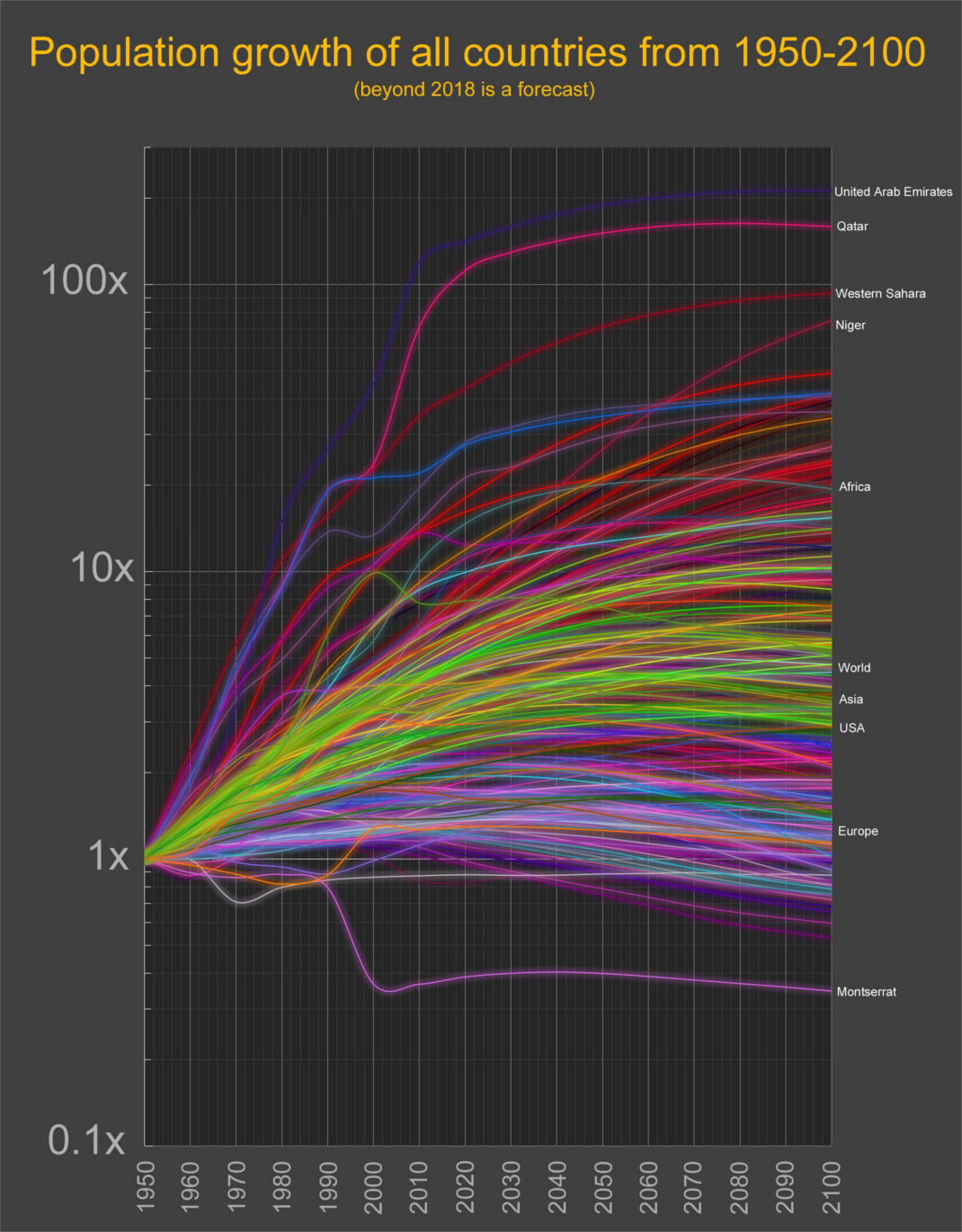
World Population Growth Visualized (1950-2100)

In any large set of data, there are bound to be some interesting outliers.

Today’s data visualization comes to us from Reddit user /r/mythicquale and it shows the population growth of every country using data and projections from the United Nations population division.

The graph is on a logarithmic scale, which ultimately groups together most growth rates even though they would be much further apart on a linear scale. This means the places outside of the middle range are the true outliers, gaining or losing many multiples of their original populations.

Courtesy of: Visual Capitalist

Visual Capitalist’s Jeff Desrjardins details the stories that are worth looking at in more depth.

WORLD POPULATION GROWTH OUTLIERS

How the population grows in any particular country is a function of fertility, mortality, and migration rates, and these outliers each have something anomalous happening at least one of these factors.

Montserrat

In 1995, a previously dormant volcano erupted in this British Overseas Territory in the Caribbean, destroying the island’s capital city of Plymouth. People evacuated, mostly fleeing to the United Kingdom, and the population of the island dropped by two-thirds over the period of five years.

Interestingly, Plymouth is still listed as the territory’s capital city today, making it the only capital city of a political jurisdiction that is completely abandoned.

U.A.E.

Dubai was once a fishing village, but now it’s an international real estate hub. Abu Dhabi had just 25,000 people in 1960, and today it’s a metropolis of almost 2 million people.

Oil wealth and significant investment is one side of the story, but the influx of foreign workers is an even bigger one. In fact, U.A.E. citizens only make up 11.5% of the population, and the rest (88.5%) is made of workers mostly from South Asia.

It’s also worth mentioning that immigrant labor in the U.A.E. has been the subject of scrutiny internationally, as there have been instances of human rights violations and accusations of forced labor.

Qatar

Qatar is another Middle Eastern country that has shot up in population, and it carries a similar story to the United Arab Emirates. Only about 12% of the population is Qatari, and the rest consists of migrant works mostly from South Asia. Qatar, which has the highest GDP per capita in the world, also has faced similar allegations as the U.A.E. regarding the use of forced labor.

Back in 1950, Qatar’s population was just 50,000, but today the country boasts 2.6 million people.

via RSS https://ift.tt/2nWUH6J Tyler Durden

Former MI6 Spy Alastair Crooke: The Metaphysics To Our Present Global Anguish

Authored by former MI6 spy and EU diplomat Alastair Crooke via The Strategic Culture Foundation,

James Jatras, a former US diplomat poses a highly pertinent question in his piece Lenin Updated: Firstly, he says, President Trump meets with President Putin and appears to make some progress in easing bilateral tensions. “Immediately all hell breaks loose: Trump is called a traitor. The ‘sanctions bill from hell’ is introduced in the Senate, and Trump is forced onto the defensive”.

Next, Senator Rand Paul goes to meet with Putin in Moscow, Jatras notes. Paul hands over a letter from the US President proposing moderate steps towards détente. Rand Paul then meets with, and invites Russian Senators to Washington, to continue the dialogue: “Immediately all hell breaks loose. Paul is called a traitor. The state Department ‘finds’ the Russians guilty of using illegal chemical weapons (in UK) … and imposes sanctions. Trump is forced even more on the defensive.”

Clearly, from the very outset, Trump has been “perceived by the globalist neo-liberal order as a mortal danger to the system which has enriched them” Jatras observes. The big question that Jatras poses in the wake of these events, is how could such collective hysteria have blossomed in to such visceral hostility, that parts of the ‘Anglo’ establishment are ready to intensify hostilities toward Russia – even to the point of risking “a catastrophic, uncontainable [nuclear] conflict”. How is it that the élite’s passion ‘to save globalism’ is so completely overwhelming that it demands their risking human extinction? Jatras suggests that we are dealing here with hugely powerful psychic impulses.

Image source: Getty via Foreign Policy

Jatras answers by evoking the zeitgeist of Lenin, when, in 1915, he made his infamous turn towards civil war inside Russia. That is, a war versus ‘Russia’ – in and of itself – its history, its culture, its religion, and its intellectual and political legacy. With up to 10 million Russians left dead by his cleansing, Lenin said “I spit on Russia. [The slaughter is but] only one stage we have to pass through, on our way to world revolution [i.e. to his vision of a universal Communism].

Professor John Gray, writing in his book, Black Mass, notes that “the world in which we find ourselves … is littered with the debris of utopian projects which – though they were framed in secular terms that denied the truth of religion – were in fact, vehicles for religious myth”. The Jacobin revolutionaries launched the Terror as a violent retribution for élite repression – inspired by Rousseau’s Enlightenment humanism; the Trotskyite Bolsheviks murdered millions in the name of reforming humanity through Scientific Empiricism; the Nazis did similar, in the name of pursuing ‘Scientific (Darwinian) Racism’.

All these utopian, (murderous) projects effectively flowed from a style of mechanical, single-track, thinking that had evolved in Europe, over the centuries, and which seated the unshakeable sense of one’s own certainty and conviction  in the West European thinker, at least.

These supposedly empirically-arrived-at certitudes  seated now in the human ego   triggered a re-awakening precisely to those early Judeo-Christian, apocalyptic notions: That history, somehow, was on a convergent course towards some human transformation, and an ‘End’, with fearful retribution for the corrupt, and a radically, redeemed, new world, for the elect. No longer (in today’s world), triggered through an act of God, but ‘engineered’ by the act of Enlightenment man.

World redemption from its state of corruption was to be brought into being through Enlightenment principles of rationality and science. Peace was expected to ensue, after the End Time.

These millenarian revolutionaries – exponents of the new Scientism, who hoped to force a shattering discontinuity in history (through which the flaws of human society would be excised from the body politic) – were, in the last resort, nothing other than secular representatives of the apocalyptic Judaic and Christian myth.

The American millenarian ‘myth’, then and now, was (and is), rooted in the fervent belief in the Manifest Destiny of the United States, ‘the New Jerusalem’, to represent humanity’s best hope for a utopian future. This belief in a special destiny has been reflected in a conviction that the United States must lead – or more properly, has the duty to coerce – mankind toward that future.

Some might argue, however, that early Enlightenment ‘liberal’ humanism, with its ‘good intentions’, has no connection to Jacobinism or Trotskyite Bolshevism. But, in practice, both are crucially similar: They are secular versions of progress towards a utopian, redemption of a flawed humanity: One strand aims to reclaim humanity through the revolutionary destruction of the irredeemable parts of society. And the other strand roots its redemption in a teleological process of ‘melting’ away cultural identity. It also seeks to weaken the sense of linkage through shared ‘blood’ and territory (place) – in order to create a tabula rasa on which a new homogenised non-national, cosmopolitan identity can be writ, that will be both peaceful and democratic.

The aim is a global, cosmopolitan society disembarrassed of religion, national culture and community, gender and social class. Processes of toleration that, formerly, were construed as essential to freedom have undergone an Orwellian metamorphosis to emerge as their antonyms: as instruments, rather, of repression. Any national leader standing against this project, any contrary national culture, or national pride displayed in a nation’s achievements, plainly constitutes an obstacle to this prospective universal realm – and must be destroyed. In other words, today’s millenarians may eschew the guillotine, but they are explicitly coercive – albeit, in a different manner – through the progressive ‘capture’ of narrative, and of state institutions.

Image via Strategic Culture Foundation

In short, a global space is being sought that would recognize only an international global humanity — much as the Trotskyites wanted

So, how is it, precisely, that Russia and Mr Putin has come to constitute the antithesis to the utopian project, and the trigger to such fear and hysteria amongst the globalist élites?

It springs, I suggest, from a percolating awareness amongst western élites that formal (Latin) Judeo-Christian monotheism – which gave western Europe its insistence on singularity of meaning, its linear itinerary, and its partner ideology of secular millenarianism – both find themselves increasingly questioned, and in decline.

Henry Kissinger says the mistake the West (and NATO) is making “is to think that there is a sort of historic evolution that will march across Eurasia – and not to understand that somewhere on that march it will encounter something – very different to a Westphalian [western idea of a liberal democratic and market orientated state] entity.” It is time to relinquish ‘old pretenses’, Kissinger emphasizes – for, “we are in a very, very grave period for the world”.

No doubt linked to this alienation from both revealed religion, and its secular utopian counterpart, is the general collapse in the optimistic certitudes connected with the idea of linear ‘progress’ – in which many (particularly the young), no longer believe (seeing the evidence of the world about them).

But what really riles the globalists is the contemporary trend, manifested most particularly, by Russia, towards a pluralism which privileges one’s culture, history, religiosity and ties of blood, land and language – and which sees in this re-appropriation of traditional values, the path to the re-sovereigntisation of a particular people. The Russian ‘Eurasian’ notion is one of different cultures, autonomous, and sovereign, which, at least implicitly, constitutes a rejection of the Latin theology of equality, and reductive universalism (i.e. achieved through Redemption.)

The idea rather, is of a grouping of ‘nations’, each reaching back to its primordial cultures and identities – i.e. Russia being ‘Russian’ in its own ‘Russian cultural way’ – and not permitting itself to be coerced into mimicking the westernisation impulse. What makes a wider grouping of Eurasian nations feasible is that cultural identities are complex and storied: It escapes the prevailing obsession to reduce every nation to a singularity in value, and to a singularity of ‘meaning’. The ground for collaboration and conversation thus widens beyond ‘the either-or’, to the differing strata of complex identities – and interests.

Why should this seem so ‘diabolical’ to the western global élites? Why all the hysteria? Well … they ‘scent’ in Russian Eurasianism (and so-called populism, more generally) a stealth reversion to the old, pre-Socratic values: For the Ancients, as just one example, the very notion of ‘man’, in that way, did not exist. There were only men: Greeks, Romans, barbarians, Syrians, and so on. This stands in obvious opposition to universal, cosmopolitan ‘man’.

Once the Roman Empire took over Christianity as a ‘westernised’ dissident form of Judaism, neither Europe nor Christianity conformed any longer to their origins, or somehow to their own ‘natures’. Absolute monotheism, in its dualistic form, was profoundly foreign to the European mind. Latin Christianity first tried (not very successfully) to repress the Ancient values, before deciding it was better to try to assimilate them into Christianity. Russian Orthodoxy however managed to retain its itinerary: whereas the Latin Church suffered multiple crises – not the least being that of the Enlightenment and the Protestant dissidence flooding across western Europe.

The fearful élites, in fact, are right: The disappearance in modernity of any external norm, beyond civic conformity, which might guide the individual in his or her life and actions, and the enforced eviction of the individual from any form of structure (social classes, Church, family, society and gender), has made a ‘turning back’ to what was always latent, if half forgotten, somehow inevitable.

Author Alistair Crook, founder of Conflicts Forum and former MI6 officer and EU diplomat. Image via Valdai Discussion Club

It represents a ‘reaching back’ to an old ‘storehouse’ of values – a silent religiosity; a ‘turn back’ to being again ‘in, and of’ the world. A storehouse that has in fact remained unchanged (albeit clothed in Christianity), with its foundational myths, and notion of cosmic ‘order’ (maat) still swirling in the deeper levels of the collective unconscious. Of course, ‘the Ancient’ cannot be an ad integrum return. It cannot be the simple restoration of what once was. It has to be brought forward as if ‘youth’ come back again – the eternal return – out of our own decomposition.

Henri Corbin, the scholar of Islam, once noting a panel in Iran in which the shapes of vases of various shapes were cut out from wooden back panel of a cupboard, suggested that, as with these vases whose solid forms no longer existed, somehow the space that that they once occupied still remains – if only as a void, marked by outline. So too, old notions and values somehow have left behind their outlines, too. And this, maybe, is what is driving the globalist élite to their medications: 500 years ago, the Enlightenment crushed the brief impulse from the Ancient world in Europe, known as the Renaissance. Now the shoe is on the other foot, and it is the world of today’s élites which is imploding. What had been imagined as defeated, beyond recovery, is cautiously arising out from our crumbled ruins. The wheel of time turns, and comes around, again. It may all fare badly – the mode of linear one-track thinking implanted in the West does have an inbuilt propensity towards totalitarianism. We shall see. 

Just as then, when the tide of the Enlightenment bulldozed through old beliefs, hauling everything that was Delphic and unfathomable, out into the laser gaze of radical scepticism – causing terrible psychic tensions (more than 10,000 Europeans were burnt alive during the Great Witch hysteria) – so, today, we have a wave of still inchoate ‘otherness’ emerging from the deepest levels of human psyche to hurl itself onto the rocks of Enlightenment self-certainty. The tensions and the hysteria, follow in a similar way.

Its ‘return’ is driving men and woman literally mad – mad enough, even to risk a catastrophic war, rather than to relinquish the myth of America’s Manifest Destiny, or even to acknowledge the flaws to their radically disjunctive way of thinking about a world that must be brought to some global convergence.

via RSS https://ift.tt/2MCu98R Tyler Durden

Majority Americans Want Diplomacy With Russia Over Sanctions: Gallup

A Monday Gallup poll reveals that most Americans feel it is more important for the United States to work towards improving relations with Russia, as opposed to sanctions. 

Of those surveyed, 58% say it’s “more important to improve relations with Russia,” while 36% say “strong diplomatic steps against Russia” are a priority. 

The poll, which took place between Aug. 1-12, comes after nearly two years of constant media bombardment over Russian hacking, invasive DOJ investigations which Trump refers to as a “witch hunt,” and an admission by Deputy Attorney General Rod Rosenstein that alleged hacking and social media influence campaigns by Russia had no effect on the 2016 US election. 

That said, 75% of those surveyed by Gallup believe Russia interfered in the election, while 16% say they did not. Of those who say Russia interfered, 36% said it didn’t change the outcome, while 39% say it did. 

Opionions over whether Russia actually influenced the election were also highly partisan – with 78% if Democrats saying that Russian interference affected the outcome of the election, and just 9% of Republicans who believe that Russia both hacked – and changed the outcome, of the election. The vast majority of Republicans (58%) think Russia did interfere, but it didn’t affect the outcome. 

Earlier this month, the Trump administration announced a new round of sanctions against Russia in response to allegations that the Kremlin was behind an attack against former Russia double-agent Sergei Skripal and his daughter Yulia. 

Gallup’s conclusion: “Although U.S.-Russian tensions continue to simmer, more Americans are inclined to believe the U.S. is better off trying to improve relations with Russia. Americans are largely convinced that Russia interfered in the 2016 presidential election but are divided, largely along party lines, as to whether that country’s involvement changed the outcome.”

via RSS https://ift.tt/2N32xqs Tyler Durden