Weekend Reading: The Bull/Bear Struggle Continues

Submitted by Lance Roberts via RealInvestmentAdvice.com,

The standoff between the “bulls” and “bears” continued this week as prices struggled to rise. The “bulls” continue to “hope” that the recent turmoil that started at the beginning of this year has come to an end. The “bears” continue to point out silly things like an ongoing earnings recession, weakening economic data, and deteriorating technicals to make their case.

Silly “bears”.

Interestingly, on Thursday, the ECB launched its biggest “bazooka” yet pushing further into negative interest rates, increasing their already failed QE program and crossing every finger and toe for “good luck.”  Via the ECB:

“At today’s meeting the Governing Council of the ECB took the following monetary policy decisions:

(1) The interest rate on the main refinancing operations of the Eurosystem will be decreased by 5 basis points to 0.00%, starting from the operation to be settled on 16 March 2016.

(2) The interest rate on the marginal lending facility will be decreased by 5 basis points to 0.25%, with effect from 16 March 2016.

(3) The interest rate on the deposit facility will be decreased by 10 basis points to -0.40%, with effect from 16 March 2016.

(4) The monthly purchases under the asset purchase programme will be expanded to €80 billion starting in April.

(5) Investment grade euro-denominated bonds issued by non-bank corporations established in the euro area will be included in the list of assets that are eligible for regular purchases.”

Question:

“What happens during the next global economic recession when these unsecured corporate bonds go bankrupt?” 

If you remember, Lehman bonds were IG unsecured corporate bonds the DAY BEFORE they went into bankruptcy. That event sparked the global financial crisis. But this time will be different, right?

I’m only asking the question.

Anyway, I digress. This week’s reading list takes a look at various views on the market, the latest jobs report, oil prices and other interesting reads.


1) Do Any Of The Recent Rallies Pass The Sniff Test by Charles Hugh Smith via OfTwoMinds

“As Chris Martenson and many others have noted, “price discovery” is a joke now, as markets are either propped up by central bank “we got your back” guarantees or outright asset purchases, or driven up and down by speculative hot money flows.


This is not capitalism, or a functioning market: this is the end-game of legalized looting and financialization. What’s the value of real estate? If interest rates are pushed negative, then that gooses housing demand, as the cost of interest on a mortgage declines to near-zero in real terms.”

smith-stockrally-031016


2)  The Markets Are Stretched, So I’m “All-In” Short by Doug Kass via Real Clear Markets

“My recent column Not So Super Tuesday highlights why I believe markets are tipping over to short-term bearish, while my Top 10 Reasons to Sell Stocks Now piece incorporates most of my intermediate-term concerns.


That’s why I moved to “all-in short” on Friday during the market’s post-jobs-report ramp-up. I believe stocks’ recent rally from their mid-February low has stretched valuations and drastically altered the risk-vs.-reward ratio.


I‘d also note that Friday’s seemingly good February U.S. jobs report wasn’t quite as “clean” as the strong headline number of 242,000 non-farm job gains suggests. For instance, average wages dropped by 0.1%, while average hours worked fell by 0.2 — a decline usually seen in recessions. (Previous similar drops occurred in February 2010 and December 2013.)”


3) The Wall Street Profits Illusion by Sam Ro via Yahoo Finance

“Wall Street gurus like Societe Generale’s Andrew Lapthorne, have been tracking the discrepancy between GAAP and non-GAAP reported profits for years.


But last fall, more experts like Deutsche Bank’s David Bianco grew increasingly concerned with what was becoming a growing divide between GAAP and non-GAAP profits.


‘Blended [non-GAAP] 4Q earnings per share is $29.49 with GAAP EPS of $19.92,’ Bianco said of S&P 500 profits on Monday. He further noted that this 67% ratio of GAAP to non-GAAP EPS is ‘well below the normal ~90% ex. recessions.'”

Earnings-GAAP-Illusion-031016


4) February Jobs Report A Little Misleading by John Crudele via New York Post

Labor trumpeted that 242,000 new jobs were created in February, although wages declined 0.1 percent, the average workweek dropped by 0.2 hours and aggregate hours worked fell 0.4 percent. And part-time work soared in February while full-time job growth was mediocre.


Even the 242,000 job growth looked hokey. Retailing, for instance, saw an unbelievable (as in “not to be believed”) jump of 55,000 jobs despite the fact that February isn’t exactly the month when stores hire people to handle a swarm of shoppers.


As I said last Thursday and in a special Saturday column, the February job report was helped by rogue statistics — untrustworthy seasonal adjustments (especially in retailing) and giddy assumptions made by Labor that will probably have to be corrected later.


5) Oil Prices Should Fall, Possibly Hard by Art Berman via Forbes

Oil prices should fall, possibly hard, in coming weeks. That is because fundamentals do not support the present price.


Prices should fall to around $30 once the empty nature of an OPEC-plus-Russia production freeze is understood. A return to the grim reality of over-supply and the weakness of the world economy could push prices well into the $20s.

OIl-Supply-Demand-030916


OTHER GOOD READS


“When the paddy wagon rolls up, they take the good girls with the bad” – Old Wall Street Bear Market Axiom


via Zero Hedge http://ift.tt/24VxH7s Tyler Durden
Draghi-Dip-Buyers Send Stocks, Crude To 2016 Highs; Gold Slammed

Was there ever any doubt…


So this happened…


Yes it is all very exciting, but year-to-date, Gold is outperforming The Dow by 20ppt…


For the best year since 1974…


And since The Fed hiked rates…


And before we start, remember how excited everyone was in mid-September (before The Fed folded)…

h/t @NorthmanTrader


Let's look at markets post-ECB…


And post-Draghi's "no more" comments, It looks like someone was desperate to make sure Gold (the anti-centrally-planned world asset) was outperforming…


Trannies and Small Caps ripped over 2% today…


On the week, it's all green for the 4th week in a row, led by The Dow (rather unusually)


But futures show the real craziness…


S&P 500 broke above its 200DMA for the first time this year…


And just look at the vol in Financials and Energy this week…


HYG (deluged with institutional cash looking for a home amid a barren primary issuance market) soared today to its best 4 week gain since Oct 2011 – which marked the top of that bounce…


One quick question – if everything is awesome, then why is financials' credit risk so extreme high still?


Treasury yields were all higher today (and on the week) with 30Y outperforming (pushing the 2s30s spread to Dec08 lows – 2nd biggest cirve flattening this year)


5Y Yields broke back to the middle of the range (up 25bps in 2 weeks – the most in 4 months)


The USD Index was smacked lower for the 2nd week in a row, near 5 month lows…


This is the biggest 6-week drop in USD Index since May 2015


USDJPY rallied back but not like stocks…


But EURUSD didn't give any back…


Gold and silver closed modestly lower on the week (slammed in the last hour of the day), copper dropped and oil popped…


Gold futures aretrading like a penny stock!!


Oil rallied for the 4th week in a row (for the first time since May 2015)…


The biggest 4-week run (30.8%) since March 2009…


Charts: Bloomberg


via Zero Hedge http://ift.tt/1Rc9h5j Tyler Durden

Clinton Thanks Nancy Reagan for AIDS Activism, Carson Endorsed Trump, Wounded Warrior Project Finances Scrutinized: P.M. Links

  • Donald TrumpHillary Clinton praised recently-deceased former First Lady Nancy Reagan for her work bringing attention to the AIDS crisis, but many people say that’s contrary to actual history.
  • Michelle Fields filed charges against the Donald Trump staffer who allegedly assaulted her. Video footage taken immediately prior to the altercation suggests that her account is accurate.
  • Greta Van Susteren, for once in her life, calls for less media coverage of something that involves Trump.
  • Ben Carson has endorsed Trump. Good surgeon, bad judge of character.
  • Trump University used “coercive tactics” to extort positive recommendations from students.
  • The Wounded Warrior Project spent a whole lot of money on candy.
  • Congrats on surviving a full week of my P.M. Links. You’re all terrific deal-makers, in my view. Just the best.

from Hit & Run http://ift.tt/1Rc9TIn
via IFTTT

“Stay Angry My Friends”

The last decade or two has been a failure…


For everyone apart from the elites…


Which created this…

Source: Townhall.com

Which is leading to this…


So stay angry my friends…

Source: Townhall.com

As we noted earlier, it seems more than a few are “angry”…


via Zero Hedge http://ift.tt/1nDC98R Tyler Durden

What Does Nasdaq Know?

Nasdaq risk is dramatically higher than S&P risk at current levels. Despite the exuberant ramp of the last few weeks, the ratio of Nasdaq VIX to S&P VIX is at its highest in over 6 months.


This is worrisome since the last time Nasdaq traders were this much more concerned about future risk than S&P traders, was right before the August flash-crash collapse

And if that wasn’t enough, look where we are…

h/t @NorthmanTrader


via Zero Hedge http://ift.tt/24VsnAJ Tyler Durden

Why Bond Traders Have No Idea What’s Going On

Draghi shot his ‘bazooka’ today and the initial reaction from investors is telling, according to BofA's Michael Contopoulos. The price action in markets (equities down, US rates higher, strength in the Euro) suggests that investors focused more on the signaling of no further interest rate cuts than on the reductions in three key interest rates and the additional bond purchases. In BAML's High Yield Strategists' view, this bolsters their case that markets have essentially lost confidence in the ability for central banks to stoke growth and inflation, and although they feel the initial selloff was perhaps a bit too severe, they find it leaves Draghi in a bit of a bind.

Clearly European growth and inflation is a severe concern. China exports have slowed and deflationary pressure in the Eurozone is causing unprecedented ECB action with consequences we have yet to likely appreciate. In fact, as we sit back and look at the macro landscape, we see very few reasons to be excited by today’s action or any development since the February 11th market lows.

As rates have plummeted globally, over $5tn in Japan alone, bank lending has failed to pick up. In fact, NIRP has coincided with an increased savings rate in Japan and Draghi today acknowledged the problems negative rates would have on financials. Furthermore, we question the rally in high yield, which was initially a consequence of overdone recession fears creating a short squeeze once the manufacturing sector showed signs of life and commodities began to rally. As yields fell, retail demand swelled, as flows tend to follow returns, and unfortunately, many investors have been left reluctantly buying bonds, ETFs and CDX HY to offset the increase in cash (Chart 1).

What we find so concerning is that fundamentals haven’t really changed. The increase in oil prices does little to nothing to help the financial health of the energy space and with redetermination on its way we think energy bonds could face more pressure later this spring. Furthermore, the retail money that chased returns is likely flighty, and potentially doesn’t quite appreciate that 50% of the market currently trades at an average of 300bp while 50% of the market trades north of an average of 1100bp. For context, the market lows of this cycle were 330bp. Though this bifurcation isn’t abnormal, we do think the higher yields optically create a false sense of broad market cheapness. The correlation with oil prices is a phenomenon we find very troubling (Chart 2).


By obsessing over the daily price movements of commodities, the market is clearly not paying attention to a poor earnings backdrop, revenue that is disappointing, leverage that is high, and capital markets that are difficult to tap. We think this is a very big mistake.

And although the additional bond purchases likely help to limit any further widening in European corporate spreads, and in fact likely cause them to rally, we are unconvinced the impact on US corporates will be long lasting. The European bond market is quite small, just $1.6tn in face value. It is hard to imagine a massive flow of capital to US high yield because of the additional buying.


via Zero Hedge http://ift.tt/21n73zJ Tyler Durden

SILVER OUTBREAK: Investment Demand Will Totally Overwhelm The Market

By The SRSrocco Report

It’s no secret to the precious metal community that silver is one of the most undervalued assets in the market, however 99% of Mainstream investors are still in the dark. This was done on purpose to keep the majority of individuals invested in Wall Street’s Greatest Financial Ponzi Scheme in history.

You see, this is the classic PUMP & DUMP strategy. Unfortunately, it’s not a lousy penny stock that Wall Street is pumping, rather it’s the entire market. Most pump & dump stock campaigns last a day, week or a few months. Sadly, this one has gone on for decades and the outcome will be disastrous for the typical American.

The problem is quite simple… there are way too many PAPER ASSETS floating around backed by very little PHYSICAL ASSETS. Or, let me put it another way. There are way too many DEBTS in the market masquerading as assets, while very few investors hold true STORES OF WEALTH.

And one of the best stores of wealth in the market is SILVER. Yes, gold is also another excellent store of wealth, but silver will outperform gold spectacularly when the Mainstream investor finally gets precious metal religion.

I was inspired to write this article due to a recent announcement by one of the well known silver analyst in the Mainstream and alternative media. Jeff Christian of the CPM Group made this statement which was reported in a recent Bloomberg article, Why Poor Man’s Gold May About To Get More Investor Love:

Not everyone is convinced.

“There’s a lot of bullishness forming around silver,” said Jeffrey Christian, managing director at New York-based CPM Group, a precious metals adviser. “We are of mixed minds. Silver is in surplus, plain and simple.”

Investors will only increase their purchases if there are more worrying economic, financial and political developments, Christian said in an e-mail dated March 3. CPM Group data on supply and demand show annual surpluses from 34 million ounces to 177 million ounces stretching back to 2006.

As many of you know, Jeff Christian’s CPM Group publishes the Silver Yearbook. According to their figures, the global silver market has enjoyed annual surpluses since 2006. Several of my readers forwarded this statement to me and asked me what I thought of it.

Here is the CPM Group’s chart showing annual silver surpluses since 2006:

CPM Silver Surplus Chart

Well, there you have it… the silver market did enjoy annual surpluses since 2006. Or did it?? If you were from the Mainstream media and you only read the CPM Group’s Silver Yearbook you would have been bamboozled by the data in this chart. Why? Because Jeff Christian’s CPM group cleverly OMITS silver investment demand from this calculation… LOL.

Here is part of the CPM Groups Silver Demand table showing how they arrive at their supposed surplus:

CPM Group Silver Demand Table

On the top is total supply, then they subtract out Photography, Jewelry & Silverware, Electronics & Batteries, Solar Panels and Other Uses to arrive at their surplus figure highlighted in green. They take that figure to make the annual silver surplus chart above it.

Then they QUIETLY subtract Official Silver Coin demand below it and make adjustments for changes in inventory. The figure highlighted on the bottom is the real annual net silver market balance. If we go by the CPM Groups figures here, they actually show a deficit for 2014 and 2015. How Mr. Christian can call this a surplus is beyond me.

You see, the CPM Group’s Investment calculation is titled as an “Addenda”. Why an addenda??? And where is Silver Investment Bar demand? I hate to say it, but CPM Group’s Supply & Demand figures receive a POOR GRADE compared to the data put out by the GFMS Team at Thomson Reuters who publishes the World Silver Surveys.

According to the Silver Institute news release on the Silver Interim Report, the GFMS Team at Thomson Reuters published the following Silver Supply & Demand table:

GFMS Silver Supply Demand Table

As we can see, they do a much better BANG UP job with their data by also subtracting Silver Bar & Coin demand from their total supply figures. Then first arrive at an annual Physical Surplus or Deficit. I didn’t highlight this but it’s located right below total Physical Demand. Once they get that figure they adjust for any ETF or Exchange Inventory Build, positive or negative. Lastly, they end up with a NET BALANCE which is highlighted in yellow.

This is the true overall surplus or deficit figure for the silver market. As we can see, the GFMS Team shows annual silver deficits as far as they eye can see. Okay at least for the past decade. I took these figures and made the chart below (also included data for 2004):

Global Annual Silver Net Balance 2004-2015

So, if we are going to use real professional data, the silver market suffered a 1 billion oz net deficit since 2004. How Mr. Christian can say, “The silver market is in surplus” is beyond me. Of course Jeff Christian is probably guilty of using semantics in his official statements to the press. There is probably some excellent reason why Mr. Christian tends to ignore silver investment demand in his surplus-deficit figures and is more negative about silver than other analysts. However, we can plainly see from the data above, Jeff Christian is most certainly talking out of a different part of his body than the folks at GFMS.

Sorry to be blunt here, but the evidence proves who the guilty party is here.


SILVER OUTBREAK: Investment Demand Will Totally Overwhelm The Market

Some readers may think that is a hyped title. Sure, it may be… but it’s true. I have said countless times in articles and interviews that investment demand will be the driving force for silver price in the future, not industrial demand.

Jeff Christian tends to harp on industrial demand.

Yes, it’s true… industrial demand has been falling and WILL CONTINUE TO FALL. According to the figures by the GFMS Team, industrial silver demand was 645 million oz (Moz) in 2010, but has fallen to 570 Moz in 2015. Sure, that might include the falling Photography demand, but that’s part of industrial consumption. And remember this, a lot of silver used in photography is recycled. So, as silver photography demand declines, so does the amount of recycled silver.

So once again, for all of the Mainstream silver analysts out there… forget about INDUSTRIAL SILVER DEMAND as a determining factor for price going forward. It’s a non issue. The key will be investment demand and I have a chart to prove it:

Estimated Global Silver Demand 2X 4X

According to the data by the GFMS Team, total Silver Bar & Coin demand was a paltry 51.2 Moz in 2007. This surged after the U.S. Investment Banking & Housing Market collapse to 240 Moz in 2015. While GFMS reports a total of 206 Moz for Silver Bar & Coin demand, they do not include private rounds and bar demand.

In an email exchange with the GFMS Team, they told me that getting figures for private silver rounds and bars was quite difficult. However, they were working on a system and would be publishing this figure in the future. They “unofficially” stated in the email that estimated private silver rounds and bars was likely 30-40 Moz in 2015. This is how I came up with the 240 Moz figure shown in the graph above.

In discussions with many analysts, I came up with a figure of 0.5% of the market was buying silver. Official estimates put the figures of global precious metal buying at approximately 1%. So, in all reality… global silver buying is probably less than 0.5%. But, let’s just use that figure as a ballpark.

So, once the world starts to wake up to the fact that they are the BIGGEST PAPER BAG HOLDERS of increasing worthless paper assets, there will be a mad rush into the silver market. Thus, if we had just a doubling to 1%, it would be 480 Moz of physical Silver Bar & Coin demand. And a quadrupling of 2015 demand would equate to 960 Moz. Just think about how that would impact the annual surplus-deficit figure… LOL.

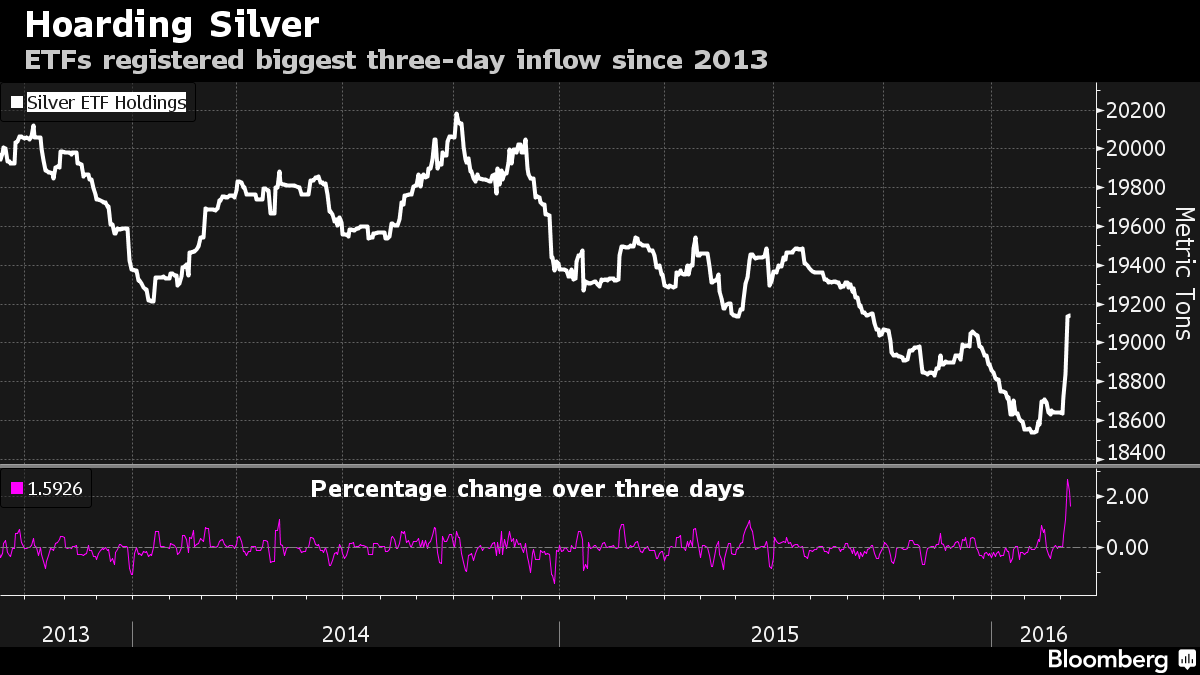
I actually believe just a doubling to 1% and 480 Moz of physical Silver Bar & Coin demand would totally overwhelm the market. Why? Because I haven’t even included the huge inflows from the Mainstream Investors. The same Bloomberg article linked above published the chart called Silver Hoarding- ETF Demand:

SILVER ETF Demand

As we can see, global Silver ETF’s added a whopping 500 metric tons in the past several weeks. That turns out to be 16 Moz. I would imagine Mr. Christian will also omit this data when he regurgitates his 2016 silver surplus figures next year.

I believe the reason Christian suggests that the silver markets has been in a surplus because he doesn’t see investment as true demand like industrial consumption. Most of industrial silver is lost forever, while a Silver Eagle coin is likely held in private hands waiting for the opportunity to sell it at a much higher price. However, most physical silver investment is being held TIGHTLY and will enter back into the market because its owners realize the Global Financial System will get flushed down the toilet when the Central Banks lose control.

While we have no idea if all of this silver is actually being deposited at these ETF’s, it is a sign that the Mainstream investor has a lot of leverage in the market. Actually, the Mainstream investor has more leverage because they comprise 99% of the market while the precious metals investor is 1%.

It makes a great deal of sense why the Fed and Wall Street continue to downplay gold and silver. Because a small percentage switch of investors into these metals would totally overwhelm the market and price.

Fortunately for precious metals investors, this is only a matter of time. While Ponzi Schemes can go on for many years, they all end in a disaster. The present insanity and extreme volatility in the markets provides us a clue that the END maybe coming a lot sooner than we realize.

Please check back for new articles and updates at the SRSrocco Report. You can also follow us at Twitter below:

SRSrocco Twitter


via Zero Hedge http://ift.tt/1XiWs7M SRSrocco

Now 2010 Is All That Matters

BofAML's Stephen Suttmeier views the 61.8% retracement of the May-Feb decline at 2010.72 as critically important. A failure to close above this retracement would send a bearish message, especially given negatively positioned and falling 100 and 200-day moving averages.

Key SPX levels: Watch that 61.8% retracement at 2010.72

 S&P 500 resistance at 1990-2025 has limited the rally this week. This is a confluence of chart, 100/200-day MA, and Fibonacci levels.


Should the tactical bulls continue their winning ways (with daily momentum staying overbought on a grind higher just like it did into the early November high) the upside count of the double bottom breakout at 2085 comes into focus. 

Supports remain 1963-1931 and 1902-1891, which are ahead of the 1812-1810 lows.


via Zero Hedge http://ift.tt/1QNfgvj Tyler Durden

Russian, Chinese Foreign Ministers Complain About North Korea Missile Tests, U.S. Korean Missile Defense System

Russian Foreign Minister Sergei Lavrov and Chinese Foreign Minister Wang Yi met a day after North Korea test-fired two short-range ballistic missiles into the sea as part of the hermetic Communist dictatorship’s latest round of nuclear sabre-rattling.

“We do not recognize the nuclear status of the DPRK,” Wang said at a press briefing, via translator, as reported by Reuters. “We should block further development of nuclear weapons in the DPRK,” he said later. The two urged North Korea to return to six party talks—involving the U.S., China, Rusia, Germany, France, and the U.K, and called the missile test “irresponsible.”

The two also criticized U.S. maneuvers on the Korean peninsula. “The deployment of this U.S. missile system far exceeds the actual defense needs of the (Korean) peninsula,” said Wang, and “will harm the strategic balance of power in the region, possibly leading to a new arms race.”

China’s meddling foreign policy has placed it in the position of having a client state next door that behaves in a way that invites military buildups in the region. While Wang expressed concern about a renewed arms race, he acknowledged last month that the decision on the missile system ultimately fell on South Korea, where it was being deployed and that China understood South Korea and the U.S.’s desire to ensure their defenses. China appears to have imposed a new round of sanctions on North Korea unilaterally earlier this week.

China says it’s concerned the missile system, reportedly consisting of Terminal High Altitude Area Defense batteries, reaches deep into its interior. President Obama called on an “Asia pivot” back in 2011, looking to challenge China in the Pacific theater. Since then, China’s foreign policy in the region has only become more aggressive.

At last night’s Republican debate, John Kasich suggested the U.S. should put “heat” on China to “work in North Korea” to get rid of the country’s dictator. China’s Korea policy did a good job on its own of doing that. Donald Trump, the Republican frontrunner, bemoaned that the U.S. was protecting South Korea without getting paid for it.

“Every time this maniac from North Korea does anything, we immediately send our ships,” Trump said. “We get virtually nothing.”

Not quite. While the U.S.’s military defense commitments around the world have long outlived any geopolitical or diplomatic usefulness they may have had, they continue to fuel a domestic military industry that supports millions of jobs, an underlying, if often unspoken, reason for bipartisan support for increased “defense” spending and military intervention irrespective of the particular sectarian rhetoric.

from Hit & Run http://ift.tt/1nDuB5Z
via IFTTT

The Carmichael Show and Crowded: New at Reason

Glenn Garvin reviews two new NBC sitcoms, The Carmichael Show and Crowded:

On the first episode of NBC’s Saturday Night Live following the Sept. 11 attacks, producer Lorne Michaels asked New York Mayor Rudy Giuliani if it was okay to be funny. “Why start now?” replied Giuliani. Fourteen years later, as the network rolls out two new sitcoms, it sadly appears that nobody at NBC understood the mayor was joking.

That’s perhaps a bit harsh on The Carmichael Show, based loosely on the life and relationships of 28-year-old producer and star Jerrod Carmichael, the supposed Next Big Thing in standup comedy. The show (not, technically, a debut, since it got a brief peek during a preview last summer) does deliver some laughs, though not nearly as many or hearty as it seems to think, and in general plays more like an unpolished pilot than a finished product.

View this article.

from Hit & Run http://ift.tt/1nDuBCZ
via IFTTT