“Recipe For Disaster”: Traders Have Never Been Longer Stocks And Shorter Treasuries

Something strange is going on in the market according to DB’s cross-asset desk, and it could be a recipe for disaster if current trends do not change.

First, recall from our Saturday note  that even as Goldman’s clients are getting more worried that today’s market increasingly resembles that of 1987, they have extended their net long equity exposure to previously unseen levels, and as of February 1, equity futures positions were at record highs…

… which is understandable when one considers that trader sentiment as calculated by Goldman’s proprietary model remains at 100, or the highest possible level, coupled with what until recently seemed unstoppable upward momentum.

Yet where things get confusing, is when looking at the bond (and interest rate) side of things, where as Deutsche Bank shows, positioning is likewise stretched to unprecedented levels.

First, consider that total net specs across the entire rate space, including Eurodollar and Treasury futures are back to all time lows (i.e. shorts).

However, where the trader short bias is especially pronounced, is at both the short-end, i.e. the 2Y treasury, where net specs just hit a new record net short, as well as the other end, or the Ultra-Long futures, where net specs also just hit an all time low position.

To be sure, the sharp spike in net shorts on the, well, short-end is something we cautioned two weeks ago, when we discussed that according to Bank of America, “Momentum Traders Wreak Havoc For 2Y Treasurys, Could Unleash Sharp Bond Liquidation.”

Since then, the combination of pro-inflationary economic data, coupled with the ever greater pile-on of CTAs and other momentum traders adding to their short exposure at the 2Y spot of the curve, has ignited a broad treasury selloff not only across the entire US curve, but in Asia (where the BOJ was forced to intervene twice last week to prevent a yield spike), as well as Europe, where Bund yields spike to levels last seen during the 2015 Tantrum.

The obvious problem as anyone who observed last week’s market action, is that the selloff in Treasurys was finally noticed by equities (see “How Long Before The Bond Selloff Slams Stocks? Wall Street Answers“), prompting a slew of post-hoc articles by Bloomberg this weekend, such as this one…

For almost a decade, investors have waited patiently for any hint of inflation in the U.S. economy, a sign the recovery can sustain itself without emergency stimulus from the Federal Reserve. Now they’re getting it, and many are shocked at the reaction.

… trying to predict what trader reaction will be to the biggest weekly selloff since January 2016:

Accounts of how concerned investors should be ran the gamut, from confidence traders will rush in and buy the dip, to warnings this time is different — that selloffs that begin in the bond market have a habit of snowballing.

The best part were the trader quotes, such as this one:

“It is now signaling, potentially, the end of this eight-year bull rally,” said Rich Weiss of American Century Investments. “The Fed is going to have to move the interest rates, the bond market is recognizing that this incremental economic growth will spur on inflation from various sources.”

And this:

It’s kind of a strange time and we seem to be driven by a fear of what everyone wants, and that’s higher rates,” said Joe “JJ” Kinahan, the chief market strategist at TD Ameritrade. “Higher rates confirm a stronger economy, and the market was very afraid of that all week long. And that’s been a big reason for selling.”

And, of course, the “bag of donuts” bet:

“‘I’ll bet you a bag of donuts that by Wednesday or Thursday of next week the equity market starts finding its footing against the backdrop of more stable bond yields,” Purves said. “And then, like any bottoming process, the market tests it and tests it again and then all of a sudden, boom, new buyers come in.”

But while everyone may have an opinion on what happens next, the reality is that nobody really knows with record positioning in both long equities and short treasuries, as one of the two is about to be hurt, badly, once the squeeze begins. One thing that is very likely is that risk-parity funds – those who benefit only as long as both stocks and bonds rise – are set to suffer the biggest hit.

As we pointed out yesterday, Friday’s equity market collapse and simultaneous bond market bloodbath was the biggest combined loss since December 2015, but perhaps more ominously, the week’s combined loss in bonds and stocks was the worst since Feb 2009.

And as we further noted, judging by the major correlation regime shift between stocks and bonds that started on Monday, this is something considerably more worrisome for investors…

… and especially risk-parity traders, who already saw their worst weekly performance since the Taper Tantrum…

… and will be forced to significantly delever in the coming days – to the tune of tens of billions in net exposure – if the vol surge persists.

What the above means is that, with all due respect to JPM’s head quant Marko Kolanovic who last week explicitly stated that he is not concerned about a quant puke as “the move was not large enough to trigger broad deleveraging” and “equity price momentum is positive and trend followers are not likely to reduce equity exposure“, we disagree… and it’s not just us, so does another prominent JPMorgan analyst, Nikolaos Panigirtzoglou, who voiced the same skepticism. This is what he wrote in his latest Flows and Liquidity letter:

The bond-equity correlation, which has been predominantly negative since the Lehman crisis, has been creeping up YTD towards positive territory. In turn, this raises concerns about de-risking by multi-asset investors who depend on this correlation staying in negative territory such as risk parity funds and balanced mutual funds

Visually:

Panigirtzoglou then explicitly warns under what conditions the risk parity derisking could spread to the broader market:

If these equity ETF flows which we believe are largely driven by retail investors start reversing, not only will the equity market retrench, but the resultant rise in bond-equity correlation would likely induce derisking by risk parity funds and balanced mutual funds, magnifying the eventual equity market sell-off.

Finally, note that his analysis does not include the threat of the record net equity longs and net treasury shorts, which was a profitable trade during the negative bond-stock correlation regime, but is a “recipe for disaster” as the correlation, which until recently was deeply negative, turns positive forcing one of the two sides to violently unwind.

via RSS http://ift.tt/2EhzJcU Tyler Durden

Could Bill Belichick’s Grasp Of Economics Be The Key To The Patriots’ Success?

Authored by Paul Solman via PBS.org,

The summer after the New England Patriots won their first Super Bowl, I visited their training camp for a PBS NewsHour story on their — and the NFL’s — success, from the point of view of economics. (That’s what economics really is, by the way: not a science but a point of view, an angle on how the world works.)

I confess that I went not just as an economics reporter but as a Patriots fan, a status now akin to “Trump supporter” in the eyes of those revolted by both the team and the president (no offense meant to either.) But in the summer of 2002, Spygate, Deflategate, the murders attributed to tight end Aaron Hernandez, and Donald Trump the Pats-Fan President were all to come. There was no Patriots dynasty, no Tom Brady-v.-Time health regimen, and no stigma whatsoever.

When I interviewed Coach Bill Belichick, then beginning only his third year with the Patriots, he gave no inkling of the Lord Voldemort he would become for so many. He was gracious, moderately expansive, and responsive. (He even thanked me at the end of half-an-hour, saying “that was very interesting” with a handshake.)

He: I majored in economics.

Me: So what have you applied from economics, if anything, to your coaching career?

He: Well, not a whole lot.

Me: Anything?

He: I think some of the economic concepts have been helpful in dealing with the salary cap but for the most part, probably one percent.

One percent? This was either disingenuous, or maybe he had just never much thought about it. But in either case, the coach was dead wrong. Because in fact, a substantial part of “Patriot Way” is the practical application of the economic concepts of opportunity cost and, as I learned at this year’s annual economics convention, convex preferences.


The relevance of both concepts is a function of the NFL salary cap Belichick underplayed, which, for you non-football fanatics, forces every team to work with the same finite budget, $71 million dollars back in 2002; $167 million this year.

Scott Pioli, the coach’s then-director of player personnel and the coach’s right-hand man in the front office, accorded cap management pride of place in explaining the Patriots’ unimagined 2001 success.

“Our 45th through the 53rd players on our roster were probably better than many of the other teams’ backup players,” Pioli said.

Managing the cap meant not overpaying for “marquee” players in order to afford average ones at positions for which other teams can only pay bottom dollar, and as a result wind up with bottom-tier talent. This is “opportunity cost,” arguably the most important practical idea in economics. The opportunity cost in football? Overpaying a star, and thus losing the opportunity of signing a player for worse money who isn’t that much worse a performer but, due to the mayhem of the game, may well have to play due to injury.

As Pioli put it back then, “We have only a certain amount of dollars to spend, and we have to build a team. And if we overspend in one area, we’re not going to be able to fill in certain other areas where it’s going to affect the team.”

In the 16 years since, the Patriots have become famous for jettisoning stars who, the team feels, command more on the open market than they’re worth. For the NFL buffs reading this, the opportunity cost of Lawyer Milloy, Richard Seymour, Asante Samuel, Logan Mankins, Vince Wilfork — lustrous names in Pats history all — had become too high.

Bill Belichick learned the concept of opportunity cost at Wesleyan, and maybe even earlier at Phillips Academy Andover, the prep school he attended. But what about “convex preferences”?

This idea is based on another deep truth in economics: diminishing returns. We’ve all experienced them. First ice cream cone — great; sixth — nauseating. First $100 million — “I’m rich.” Sixth $100 million — still rich.

Diminishing returns has been documented for almost any human activity (except love and sex, perhaps), and it also holds more broadly in the world around us. As in the pay scale for football players. You’re buying a team with a fixed budget. Are you better off allocating the great bulk of it to “the best” players. Oh, maybe for the quarterback, whose quality determines such a disproportionate share of the team’s success. But after him? The returns on what you spend tend to diminish.


So you want a mix: fewer stars; more what you might call “average” players. Which is what the concept of convex preferences connotes: that if you’re buying a basket of goods, you don’t load up on just one thing but a mix. In the ever-edited words of Wikipedia, “convex preferences are an individual’s ordering of various outcomes, typically with regard to the amounts of various goods consumed, with the property that, roughly speaking, ‘averages are better than the extremes.’”

And finally, why are they “convex”? Because economics just loves graphs and if you got as much value-per-dollar for every star as you did for every under-the-radar player, the trade-off would be one-for-one: a straight line in the graph below. So the curve is “convex” to bottom of the graph, where the horizontal and vertical axes meet.

The point is that since buying stars is subject to diminishing returns (and so is buying too many “average” players), then you’re better off with fewer of both — not loading up with 100 average players of whom only the best 53 make the cut, say, and not, of course, shooting your wad on 10 stars and bringing 43 guys in off the street at minimum wage. (Though admittedly, “minimum wage” in the NFL is $6,300 a week for the 10-man reserve known as the practice squad.)

Where NFL teams typically go wrong is falling for the stars and overpaying them, often because of public and media pressure, leaving too little money to optimally fill out their roster. Director of Player Personnel Scott Pioli said as much to me in 2002. The Patriots didn’t overpay “because there’s not always a direct correlation between marquee names, marquee salaries, and good football players.”

Pioli was a football groupie college student who drove daily to training camps in New York on his own from college in Connecticut in the mid-‘80s. Belichick, then an assistant coach with the New York Giants, noticed Pioli’s dedication and gave him an office to sleep in instead of commuting. Pioli went on to work for Belichick in Cleveland and Boston. It’s safe to say he learned pretty much everything he knew about football management from Belichick. So when he explained the economic strategy that built the improbable winner of the Super Bowl at the end of the 2001 season in which the Patriots were given a less than 8 percent chance of winning, that strategy was Bill Belichick’s, economics major. The key to the game and season for the Patriots and ever since: quarterback Tom Brady, paid $310,000 in 2001 to back up a star named Drew Bledsoe, who had signed a 10-year, $103 million-dollar contract before the season began (though only $14 million was guaranteed). Bledsoe got hurt; the bargain-basement backup took over; and with Brady at the helm and Bledsoe soon traded, the rest is a history as unexpected as it is unprecedented.

All because the Patriots applied the concept of opportunity cost, which has since become a standard metric of quantitative analysis in many sports. And because the team understood, at least intuitively, the notion of convex preferences. (The Patriots also have a different utility curve, but that’s for another column.)

Super Bowl coverage this week suggests the Philadelphia Eagles have, on average, the better roster for the game on Sunday. Advanced analytics like those at Pro Football Focus agree. What that suggests to me is that they too have learned to apply the key lessons of economics.

Outcome? The betting public thinks the Patriots will win by more than four points, which translates into a roughly two-thirds likelihood of success. But hey, it’s a probabilistic universe. The Patriots won their first Super Bowl with the odds more than 10-1 against them. And Donald Trump’s price on the prediction markets, as late as Election Day evening, was one chance in nine.

But yes, we will share the winner with you…on Monday.

via RSS http://ift.tt/2FJ8BR7 Tyler Durden

Turkey Warns US Troops In Northern Syria May Be Targeted By Its Armed Forces

Last week we reported  that days Turkey valiantly demanded that US forces vacate military bases in the Syrian district of Manbij, the US predictably refused, and on Monday a top American general said that US troops will not pull out from the northern Syrian city of Manbij, rebuffing Ankara demands to withdraw from the city and risking a potential confrontation between the two NATO allies.

One week later, in the latest dramatic escalation between the two NATO members, Turkey’s Deputy PM has warned that US troops fighting alongside Syrian Kurdish militias in the same uniform may be targeted by the Turkish army due to the difficulty of distinguishing them in the heat of battle, effectively stating that US troops in northern Syria are now “fair game” in the ongoing deadly conflict.

Speaking to CNN Turk on Sunday, Turkish Deputy Prime Minister Bekir Bozdag said if US troops wear “terrorists’ clothes” and find themselves among “terrorists” of the Kurdish YPG forces attacking the Turkish troops, “there is no chance that we will make a distinction at this point.”

The unambiguous warning comes at a time when Turkish troops are making further advances into the Kurdish-held Syrian province of Afrin as part of the recently launched “Operation Olive Branch.” As RT reports, Ankara had previously complained that the American troops’ embedding with Kurdish militias – regarded as terrorists in Turkey – is unacceptable for the US-Turkish alliance.

In the interview, Bozdag stressed that any person bearing weapons and fighting alongside the Kurds “is our target” however, he added that neither side wants open confrontation. Ankara has made it clear that US troops present in the area should stay away from where the Turks operate, and should not assist their Kurdish allies, he said.

“We are clearly saying that we do not want to confront our ally, the United States. I am sure that they do not want to face Turkey and Turkish armed forces,” Bozdag stated, although he also made it clear that a confrontation appears inevitable if the two sides continue on their present course.

Armed men identified as US special operations forces ride in the back of a pickup truck in northern Syria

Is Turkey accurate in warning that US soldiers can be mistaken for Kurdish rebels? Surprisingly – or maybe not – the answer is yes.

There have been numerous reports suggesting US Special Forces (SOF) teams use the insignia of Kurdish paramilitary groups. In May last year, an AFP photographer made a number of images showing armed men in uniform – identified by Syrian rebels as US SOF operators – in a pickup truck equipped with an Mk 19 grenade launcher.

Men in uniform identified by Syrian Democratic Forces as US special operations forces

The soldiers, sporting top-notch weapons and body armor, were wearing YPG badges. At the time, the Pentagon said “insignias and other identifying marks with their partner forces” were being worn in order to “blend in with the community.”

* * *

The Turkish armed forces have been fighting the Kurds since January, when Ankara green-lighted a ground offensive in the Kurdish enclave of Afrin, codenamed, with 100% irony, “Operation Olive Branch.” Syrian rebel forces loyal to Turkey are spearheading the offensive, while the Turkish military provide close air support and heavy weapons.

The operation aims to drive Kurdish militias from the area, but it does not come without setbacks. Bozdag said 13 soldiers “died martyrs” during the offensive, while 39 others were injured. Meanwhile, the Turkish command says some 900 Kurdish fighters have been “neutralized” so far, the state news agency Anadolu reports.

via RSS http://ift.tt/2E1w0g2 Tyler Durden

Why One Trader Is Confident That Central Banks Will Disappoint

Authored by Kevin Muir via The Macro Tourist blog,

Last week, markets got all excited about comments from Bank of Japan Governor Kuroda that Japan’s inflation is “finally close” to the BoJ’s 2% target. Overnight, there were suddenly all sorts of articles speculating on the end of the BoJ’s extraordinary easy monetary stimulus.

This pattern happens time and time again. A Central Banker makes some conciliatory noises about how the economy is getting better, and then BAM! markets instantly start testing their resolve by pushing prices against the Central Bank.

And the recent market action has played out perfectly according to script. In the wake of Kuroda’s comments, JGB traders pushed the yield on the 10-year maturity right up against the upper range of the Bank of Japan’s yield target peg. How did the BoJ respond? In no surprise, instead of rolling over and allowing the market to dictate when the peg will end, the BoJ executed an open market operation where they bid 11 basis points for unlimited amounts of 10-year JGBs. Man, that must be a fun order for the BoJ traders to send down to their bond brokers.

“I am 99.90 bid the 0.10%’s of 27.”

“OK, paying 90. For how many?”

“unlimited…”

Someday this sort of Central Bank bravado will be punished, but that day ain’t today.

For now, markets don’t have the fortitude to break these Central Bank pegs, so interpreting some fleeting comment from a Central Bank governor as it indicates a policy change is the wrong play. Now I understand why this happens. Markets are rightfully scared about this possibility, but I almost think too many pundits are confusing their desire to have QE end with the message that Central Bankers are actually sending.

Whether it is the Bank of Japan defending of the peg, or the ECB’s comments regarding recent Euro strength, these Central Bankers are in much less of a rush to ease off the accelerator than the market believes.

They will overshoot. The Bank of Japan especially has adopted Paul McCulley’s mantra that they need to be “responsibly irresponsible.” The BoJ has been burned too many times assuming that the economic recovery has become self-sustaining, only to find that as soon as they withdraw stimulus, the recovery falls on its face. They aren’t going to make that mistake again. No, the mistake they make this time will be completely in the opposite direction. Which is why it is foolish to constantly be looking for Central Bankers to ease off. They will do so only reluctantly and much slower than the market expects.

And what does that mean? Probably more of the same unfortunately.

Here is a great chart created by a couple of Bloomberg reporters showing the 10-year JGB yield with previous interventions highlighted.

We’ve been here before. And both times it meant a rally in JGBs as the BoJ defended the peg.

It’s not just the BoJ and the ECB

By my reckoning, the S&P 500 is up approximately 35% since Trump was elected. We have all seen the myriad of DJT tweets bragging about his business acumen and how the Donald has gotten the stock market soaring again.

Now I ask you this – what will happen if we get a 10% correction? Or heaven forbid, a 20% or 30% swoon?

Can you imagine the pressure the Federal Reserve Board Members will feel from Trump’s tweets? Especially if the stock market declines because of overly tight monetary policy. And let’s face it. That’s always how these cycles end – it’s only a question of how many tightenings before it stalls.

Right now the US economy is outperforming expectations and stocks are exploding higher, so the Fed and Trump are best friends. But make no mistake. This will not last.

Last spring, former PIMCO portfolio manager Paul McCulley and Irish economist David McWilliams produced this terrific video titled The Coming War between Trump and the Fed.

I think their McSquared production is a much watch. I am actually surprised it hasn’t become more popular, but I think too many market strategists don’t like McCulley’s easy monetary leanings. Personally, I understand their misgivings about solving the debt problem with hair-of-the-dog, but I have long given up hope that the financial system can be rebalanced through growth or austerity. Not only that, what I believe the correct monetary course is irrelevant. All that matters is the actual path. And to me, it’s clear. We are going to inflate. And therefore I suspect that McCulley type easy monetary policies will become all the rage.

Central Banks will disappoint

In the coming years as the global economy strengthens, bond markets will increasingly price in hawkish monetary policy shifts. But Central Bankers will resist them. We have seen this already with both the ECB and the BoJ. They will err in raising more slowly than the market wants. Over the past couple of years, the Federal Reserve has obviously been an exception. They have gotten somewhat ahead of the market. Yet that’s now changed. Trump’s election was a momentous signal that populist policies are what the people want. And what does that mean? More inflation.


But inflation is exactly what sends bond prices lower and previously caused Central Bankers to tighten. Well, I am a seller that Central Bankers throughout the world tighten anywhere near as much as bond markets are worried about. And ultimately that’s what will cause yield curves everywhere to steepen, eventually hitting record wides. Yup – that’s what I believe. Before this coming bond bear market is over, yield curves will hit record steep levels…

*  *  *

Bitcoin “miners”

It’s been a while since I have written about bitcoin. But I must admit, over the past month, it has been tough to hold my tongue as a bunch of Canadian speculative junior resource companies have switched from mining gold and silver, or drilling for oil and gas, to instead “mining” for bitcoin. The really frustrating part? For a while, the market was rewarding this sort of nonsense with a big boost in their share price.

Here is a press release from a typical “conversion”:

CALGARY, Alberta, Jan. 22, 2018 (GLOBE NEWSWIRE) – Iron Bridge Resources Inc. (“Iron Bridge”, “IBR” or the “Company”) (TSX:IBR) is pleased to announce the formation and launch of a wholly-owned cryptocurrency mining and hosting operation called Iron Chain Technology Corp. (“ICT”). ICT will own and operate cryptocurrency mining datacenters at Canadian oil and gas field sites, taking advantage of cheap, clean burning natural gas to generate its own electricity. As a result of this structure and the current Canadian gas price environment, ICT will benefit from some of the lowest cost power in the world.

“We are very excited to be joining the blockchain movement and together with our new technology team, we hope to contribute to the ecosystem by helping to increase transaction speeds and lower transaction costs,” said Iron Bridge Resources CEO, Rob Colcleugh. “Our IBR shareholders are expected to benefit from increased natural gas netbacks as we convert our clean, low priced gas to electricity and then direct that electricity to profitably mine cryptocurrency and host platforms for third-party mining equipment.”

Iron Chain Technology expects to begin operating its pilot cryptocurrency mining facility near IBR’s oil and gas operations at Elmworth, Alberta. ICT is already currently mining with equipment sourced and assembled by technology professionals who have been engaged by the Company. These professionals are IT systems architects who have extensive experience assembling mining equipment and have a history of profitably mining cryptocurrencies. ICT is providing hosting services for a limited amount of equipment from third-parties, and expects this to be a growth area for the Company. The Company is currently mining Bitcoin and intends to maintain flexibility with regard to the type of cryptocurrency coin that gets mined going forward.

I will leave it to my dear readers to decide the investing merits of both bitcoins and resource companies that switch from traditional mining and drilling to “mining” for bitcoins, but I did have reservations when I heard that Felderhof was getting back into the securities business. Supposedly his new company, CRE-Y, has a great land position right beside other bitcoin miners who have hit it big, and not only that, but rumour has it that he has discovered a big “deposit” of bitcoins – the likes of which were last seen in the early days of crypto…

For those not familiar with the sordid history of Canadian mining stock scams, this last bit was written with tongue-firmly-in-cheek.

via RSS http://ift.tt/2saH60W Tyler Durden

Schiff’s Latest Bizarre Claim: Russian Ads Promote 2nd Amendment “So We All Kill Each Other”

California Congressman Adam Schiff now says that Russian ads aimed at pushing Americans to kill each other…


The Second Amendment (Amendment II) to the United States Constitution protects the right of the people to keep and bear arms… and, as The Duran’s Alex Christoforou writes, according to California Congressman Adam Schiff, those pesky Russians are using bots to promote the second amendment with an ultimate goal of having Americans ‘kill each other.’

Once again, another brilliant plan hatched by Putin… good thing Schiff caught on to it and can now begin seizing American’s guns so as to thwart Russia’s evil plan.

On Thursday Democrat Schiff spoke to a crowd at the University of Pennsylvania, where the TDS – ‘Russia hysteria virus’ infected Schiff told the crowd Russian ads promoted the Second Amendment during the 2016 election “so we will kill each other.”

NTK Network reports

Rep. Adam Schiff (D-CA) said Thursday that Russia promoted content that supported the Second Amendment on social media during the 2016 election because they wanted Americans to kill one another.

“You had the content that was clearly anti-Hillary, and you had the content that was very pro-Trump. But even the bigger quantity of content that was being pushed through social media was just content designed to pit us against each other,” Schiff said while speaking at the University of Pennsylvania.

Which is false!

Facebook executive Colin Stretch told the US Senate Judiciary Committee in November that the total number of those illegitimate ads are a drop in the ocean — less than 0.004 percent of all content — or about 1 in 23,000 news feed items.

Russia didn’t flip the election.

And then Schiff exclaimed:

They also trumpeted the Second Amendment. Apparently Russians are very big fans of our Second Amendment. They don’t particularly want a Second Amendment of their own, but they’re really glad that we have one.”

“The Russians would be thrilled if we were doing nothing but killing each other every day, and sadly we are.”

Mr. Schiff’s constant delusional comments are so irrelevant to most Americans – and so unbelievable to many – that it should be no surprise to anyone that The Democrats favorability is sliding and Trump’s is rising. But it certainly seems to have shocked Brookings’ Benjamin Wittes: “Almost unfathomably, both Trump’s and the congressional Republicans’ position in polls seems to be improving.”


Will The Democrats never learn?


via RSS http://ift.tt/2BUdJQ1 Tyler Durden

Terrific Tom? The Super Bowl Indicator Might Disagree

Via LPLResearch.com,

The Super Bowl indicator suggests that stocks rise for the full year when the Super Bowl winner comes from the original National Football League (now the NFC), but when an original American Football League (now the AFC) team wins, stocks fall. We would be the first to admit that this indicator has no connection to the stock market, but the data doesn’t lie—the S&P 500 Index has performed better, and posted positive gains with greater frequency, over the past 51 Super Bowl games when NFC teams have won.

A simpler way to look at the Super Bowl indicator is to look at the average gain for the S&P 500 when the NFC has won versus the AFC—and ignore the history of the franchises. This similar set of criteria has produced an average price return of 10.8% when an NFC team has won, compared with a return of 5.8% with an AFC winner. An NFC winner has produced a positive year 82% of the time, while the S&P 500 has been up only 63% of the time when the winner came from the AFC.

Would you believe the numbers actually get worse when the Patriots are involved? That’s right; the S&P 500 has only gained 3.1% on average in years when the Patriots play in the big game, but things get even worse if they win.

“Pats fans might be ecstatic that Tom Brady is starting in a record-breaking eighth Super Bowl, but market bulls don’t want to see them win, as stocks are up only 1.5% for the year on average after a victory versus up 5.1% if they lose,” said Ryan Detrick, Senior Market Strategist.

“Tom might be terrific, but maybe not in all cases.”

We would like to reiterate that this is in no way relevant to investors, but it sure is more fun to talk about the Super Bowl and stock market returns than politics this Sunday evening. We hope everyone has a great Super Sunday and wish both the Eagles and Pats luck!

FULL DISCLOSURE – LPL Research has an office in Boston and we have many Patriots fans, but the author of this piece sure isn’t one.

via RSS http://ift.tt/2nHjT0N Tyler Durden

Memo Co-Author Trey Gowdy Says It “Won’t Have Any Impact” On Mueller’s Russia Probe

Accusations that the firing of Special Counsel Bob Mueller would provoke a “constitutional crisis” have percolated since the release of the long-anticipated “FISA memo” two days ago, as at least one House Republican has said he will push for a probe into “abuses” and possible”treason” by several senior DOJ officials.

But increasingly, some of the White House’s most steadfast political allies have played down the memo’s impact, with Chief of Staff John Kelly saying he thought House Intel Committee Chairman Devin Nunes’ claims were overblown. And now, South Carolina Rep. Trey Gowdy – who has presumably been freed to speak his mind after announcing his retirement from Congress – is saying he doesn’t expect the memo to impact the Mueller probe. 

Gowdy, the chairman of the House Oversight Committee, was asked about Trump’s claim that the memo “totally vindicates” him in the Russia probe. As Trump’s political allies so often must do, Gowdy tried to sanitize the leader of his party’s comments by saying Trump was probably just “frustrated” by House Intel Committee ranking member Adam Schiff “prejudging” the investigation.

“I’m sure the president is frustrated. You know, Adam Schiff prejudged the investigation before we interviewed the first witness,” Gowdy, a former prosecutor, said during the interview.

“So I’m sure that that instructs some of what he said. I actually don’t think it is has any impact on the Russia probe for this reason.”

Asked to clarify whether he believes the memo will have an impact on the Russia probe, Gowdy probably surprised his interviewer when he answered “not to me it doesn’t”.

As Gowdy explains, the “Trump dossier” has nothing to do with Don Jr.’s meeting with a Russian lawyer at Trump Tower, it doesn’t apply to a certain email sent by Cambridge Analytica to Wikileaks, and it has nothing to do with George Papadopoulos.

“There is a Russia investigation without a dossier… the dossier has nothing to do with the meeting at Trump Tower. The dossier has nothing to do with an email sent by Cambridge Analytica. The dossier really has nothing to do with George Papadopoulos’ meeting in Great Britain. It also doesn’t have anything to do with obstruction of justice…so there’s going to be a Russia probe even without the dossier.”

The memo accuses senior Justice Department officials of improperly using information from the dossier to obtain FISA Court surveillance warrants on Carter Page, a member of the Trump transition team and former Trump adviser. Democrats and the FBI has blasted the memo as misleading, and Democratic leaders have demanded that Nunes step down as head of the Intel Committee, while preparing to release their own memo…

Watch the full Gowdy interview below


* * *

In a tweet following the interview, Daily Caller reporter Chuck Ross pointed out two tidbits of news that Gowdy let slip: First, that the Steele Dossier was politically motivated was mentioned in a footnote of the original Fisa application. Second, he has never personally met President Trump…


via RSS http://ift.tt/2EgC9bE Tyler Durden

“Things Are Finally Starting To Get Interesting…”

Authored by Lance Roberts via RealInvestmentAdvice.com,

Market Takes A Tumble

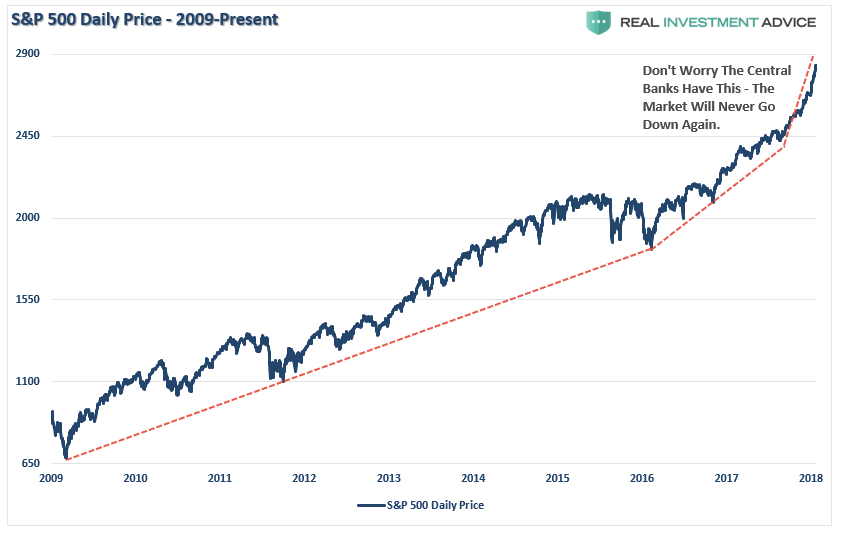
Last week, I discussed the continuation of the “market melt-up.” To wit: 

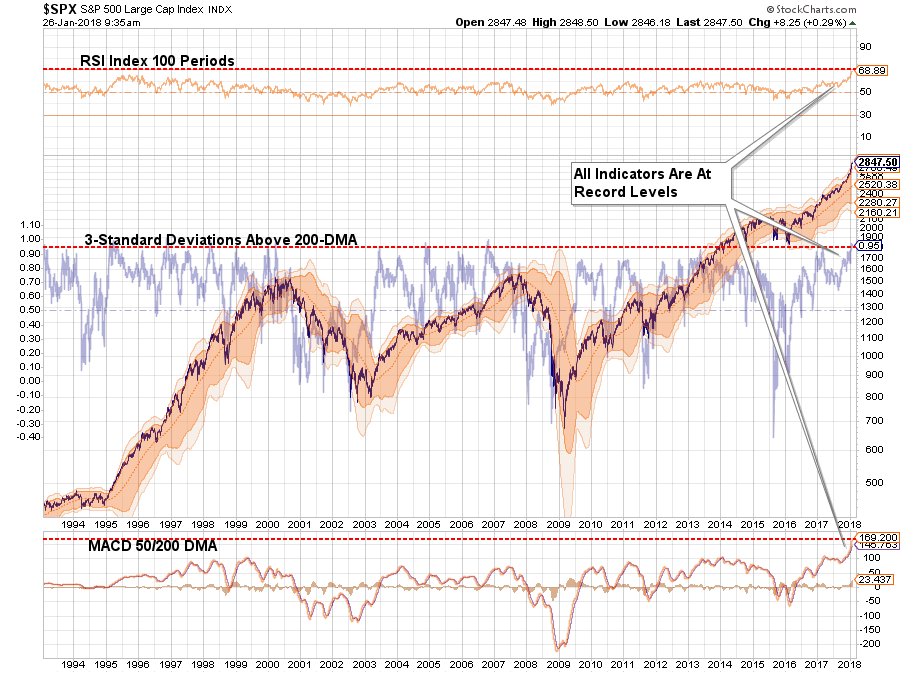
“Since the beginning of the year, the acceleration in the markets has continued unabated. As I showed yesterday, the acceleration in the S&P 500 has now gone parabolic.”

“Never before in recent history has the market been this overbought and extended from longer-term averages which suggests that a correction that reduces such conditions is highly likely in the near-term.”

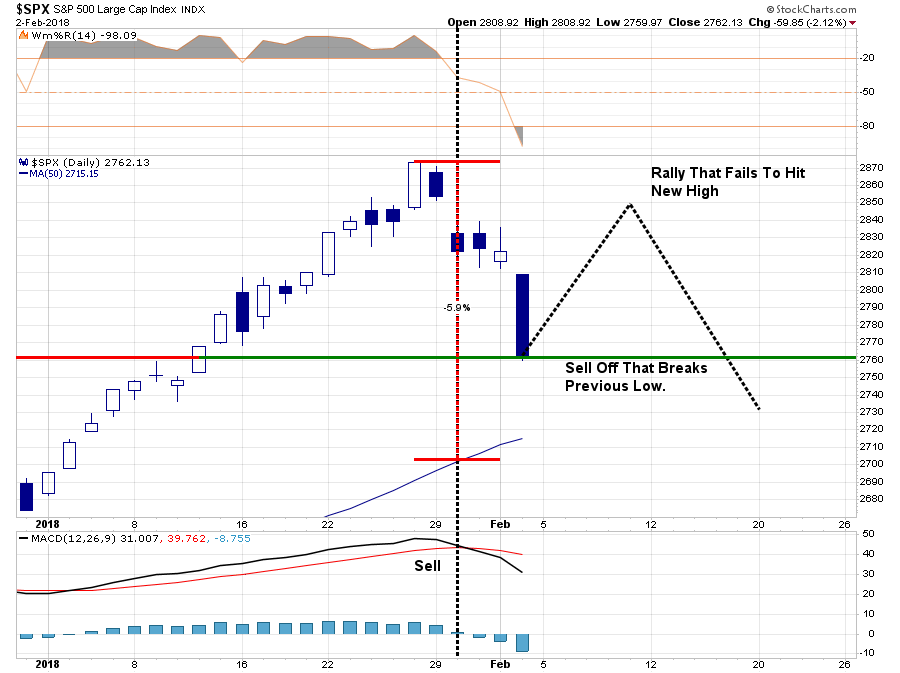
Well, this past week, the market tripped “over its own feet” after prices had created a massive extension above the 50-dma as shown below.  As I have previously warned, since that extension was so large, a correction just back to the moving average at this point will require nearly a -6% decline. 

I have also repeatedly written over the last year:

“The problem is that it has been so long since investors have even seen a 2-3% correction, a correction of 5%, or more, will ‘feel’ much worse than it actually is which will lead to ’emotionally driven’ mistakes.”

The question now, of course, is do you “buy the dip” or “run for the hills?”

Don’t do either one, yet.

Yes, corrections do not “feel” good. But they are part of a “healthy” market cycle. In more normal, healthy, bullish trends corrections should be used as buying opportunities to increase exposure to equity risk in portfolios.

However, the recent parabolic acceleration in the markets heading into the New Year was neither normal or healthy. Much of it had to do with the massive liquidity injection by the Federal Reserve at the end of 2017 as shown below.

But, after the stumble this past week, it will be interesting to watch the next the Fed’s balance sheet over the next month to see if they continue with their planned $30 billion / month reduction.

At the moment, this is the expected correction we have been discussing over the last several weeks. It is also something we had planned for by reducing overweight positions and adding a short-hedge to portfolios. 

With the markets on a short-term sell signal (noted by gold vertical dashed lines in the chart above,) the current correctional process is underway and still has room to go at this juncture. But, with the market now oversold on a VERY short-term basis a rally over the next week, or so, would not be surprising.

It is the outcome of that rally that is most important to the current bull market advance.

This is what we are looking for to drive our next set of portfolio actions:

  • If the market rallies back and sets a new closing high, the bullish trend will be confirmed and equity allocations will remain at target levels and hedges removed.
  • If the market rallies back BUT FAILS to set a new high, a series of actions will take place.
    • At the point of rally failure, portfolio hedges will be modestly increased.
    • If the subsequent decline breaks the previous low, the hedges will be further increased and tactical trading long positions will be reduced. 

Why is this important?


A Hint Of 1987

A recent article on Zerohedge discussing a view of Albert Edwards is salient to this discussion.

Certainly, as we explained at our Conference, the current conjuncture feels similar to just before the 1987 equity crash. All that was missing was the slanging match over the weak dollar between the US and Europe.”

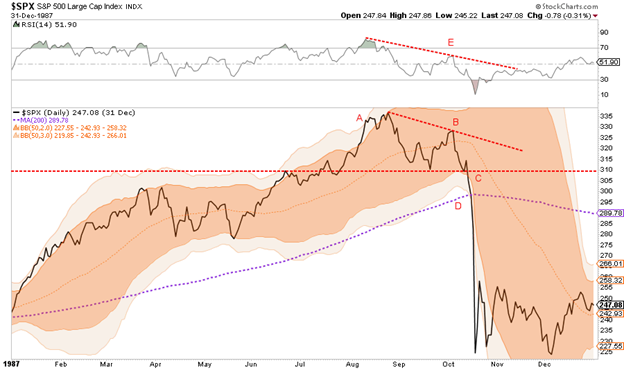
He’s right. There are many similarities between today and 1987. Recently passed tax legislation reform, exuberance in the markets, and a strong market rally.

And then the crash.

But no one could have seen that coming? Right?

(We have an in-depth report, titled 1987, coming out next week ONLY for our newsletter subscribers and those who have expressed an interest in our soon to be released RIA Pro.

If you are not currently on our email list and want a copy of the report click here.)

Actually, there were five technical signals, that when considered along with fundamental factors should have been enough to warrant caution at a minimum…that is if you were paying attention.

The graph above,  from our 1987 article, highlights the technical indicators which are explained in the report along with a summary of the myriad of fundamental factors that preceded Black Monday. There are certainly many differences between today and 1987, but as we highlight in the report there are many similarities as well worth considering.

Along with plummeting stock prices in October of 1987, interest rates also declined sharply as money sought the relative safety of bonds.

It is here that I also agree with Albert Edwards:

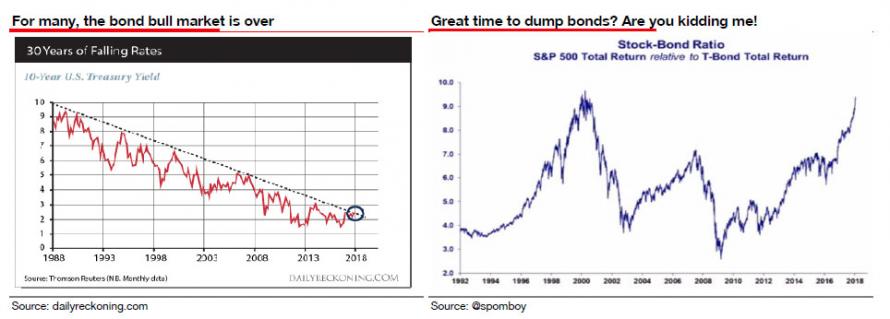
“Every man, woman, and child seems to have decided that the US 10y bond yield has broken out of its long-term downtrend and we are in a bond bear market. Our own excellent Technical Analyst, Stephanie Aymes, shows that 3% (not 2.6%) is the key long-term breakout yield we should be watching. But she thinks that 2.64% was also significant as this means the RSI downtrend has now been broken and a run to 3% is now perfectly plausible. That though does not mean the bond bull market is over.”

With yields now closing on 2¾% and the 30y closing on 3.0%, many see this as a great time to dump bonds and switch into equities. Really?

“Well, I expect that the true extent of how close the US is to actual outright deflation, and hence how high real yields currently are, will soon be revealed. But before US 10y yields turn negative, expect them to visit 3% first.

He is absolutely right. Despite a rampant rise in the markets, the recent spate of economic growth has been due to massive natural disasters across the lower third of the U.S. The impetus from those rebuilding efforts are now running their course and we are already seeing a weakness in the numbers.

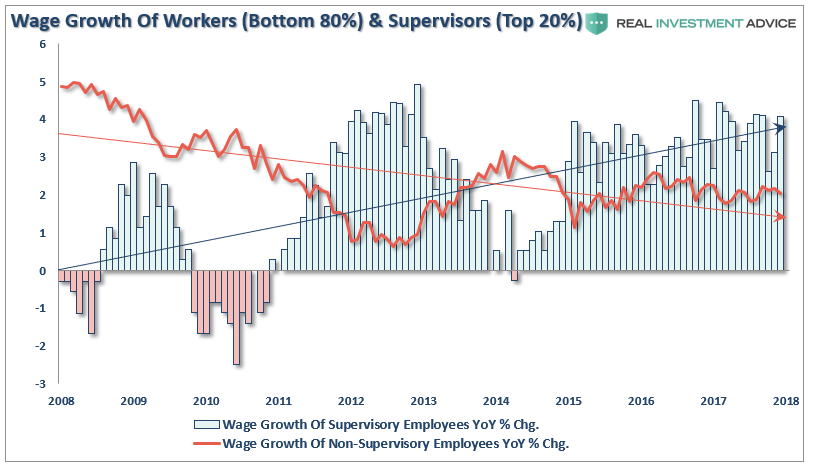
But wages are crushing it, and employment is booming?

Yes, wages are rising but only for the top 20% of workers.

And employment in the key demographic is not.


The Next Bull Market

Edwards is correct. There are several important points to understand about bonds.

  1. All interest rates are relative. With more than $10-Trillion in debt globally sporting negative interest rates, the assumption that rates in the U.S. are about to spike higher is likely wrong. Higher yields in U.S. debt attracts flows of capital from countries with negative yields which push rates lower in the U.S. Given the current push by Central Banks globally to suppress interest rates to keep nascent economic growth going, an eventual zero-yield on U.S. debt is not unrealistic.
  2. The coming budget deficit balloon. Given the lack of fiscal policy controls in Washington, and promises of continued largesse in the future, the budget deficit is set to swell back to $1 Trillion or more in the coming years. This will require more government bond issuance to fund future expenditures which will be magnified during the next recessionary spat as tax revenue falls.
  3. Central Banks will continue to be a buyer of bonds to maintain the current status quo, but will become more aggressive buyers during the next recession. The next QE program by the Fed to offset the next economic recession will likely be $2-4 Trillion which will push the 10-year yield towards zero.

The next bull market is coming, it just won’t be in stocks.

It will be in the U.S. Treasury market which will coincide with the next recessionary drag in the economy within the next 12-18 months (at the most).

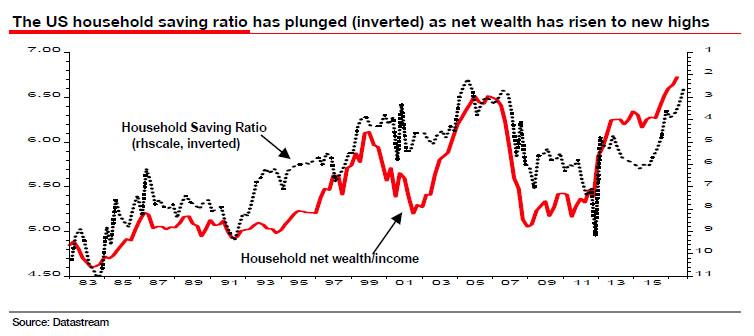
As I have written previously, interest rates have everything to do with economic growth. Since economic growth is almost 70% driven by consumption, with savings rates extraordinarily low and debt hitting record levels, small increases to interest rates will have an immediate negative impact on the consumptive capability of U.S. citizens.

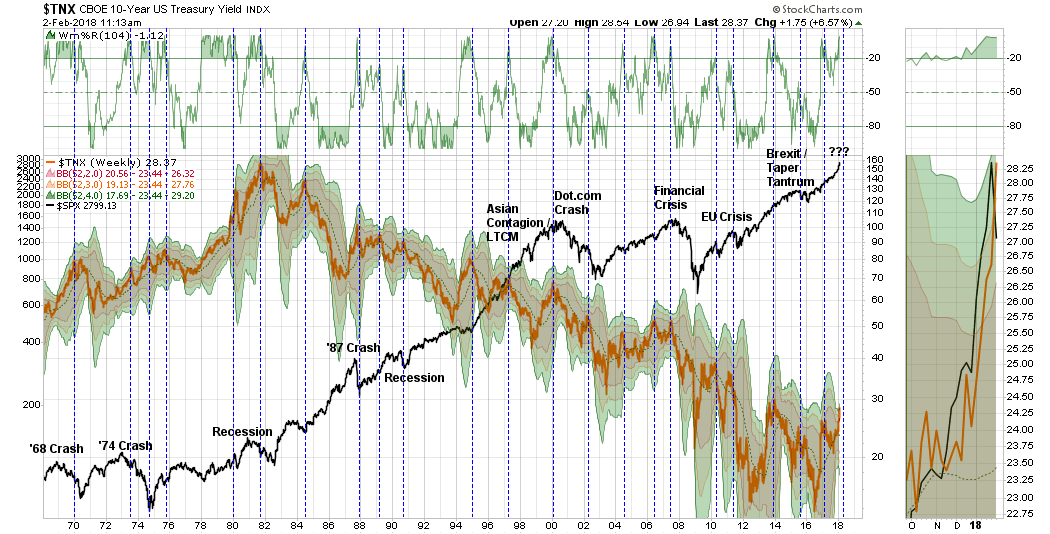
The chart below goes to my point. Currently, interest rates are 4-standard deviations above their 1-year moving average. (For an explanation read this.)

How often has this happened going back to 1965?

Never.

Negative events such as the S&L Crisis, Asian Contagion, Long-Term Capital Management, etc. all drove money out of stocks and into bonds pushing rates lower, recessionary environments are especially prone at suppressing rates further. Given the current low level of interest rates, the next recessionary bout in the economy will very likely see rates near zero.

Furthermore, given rates are already negative in many parts of the world, which will likely be even more negative during a global recessionary environment, zero yields will still remain more attractive to foreign investors. This will be from both a potential capital appreciation perspective (expectations of negative rates in the U.S.) and the perceived safety and liquidity of the U.S. Treasury market. 

However, what you will notice is that each time rates were as overbought as they are currently, they coincided with either a recession, a correction, or a major market crash.

Could this time be different? Sure. It’s possible.

But probably, it won’t be. The stock market is a reflection of the economy, not the other way around. Higher interest rates are a drag on economic growth which will impact earnings and valuations for the market.

Not tomorrow. Or even next week.

But over the next several months, higher interest rates, if they remain elevated for long, will have a deleterious effect on the economy. 

Valuations will become problematic.

Furthermore, the safety of bonds becomes much more attractive when the yield is significantly above the dividend yield in stocks. (Why take the risk is stocks for a sub-2% yield when I can get 3% in a U.S. Treasury?)

That’s not hard math.

Things are finally starting to get interesting.

via RSS http://ift.tt/2DZjFsH Tyler Durden

Disgruntled Democrats Draft Talking Points To Refute FISA Memo

Top House Judiciary Committee Democrat Jerry Nadler (D-NY) has circulated talking points to refute the four-page FISA memo created by GOP staffers for House Intel Committee Chairman Devin Nunes (R-CA), detailing abuses of US surveillance capabilities against the Trump campaign.


Maxine Waters (D-CA), Jerry Nadler (D-NY)

Nadler’s talking points – which are separate from the official response by House Intel Committee Democrats – call the GOP-authored memo “deeply misleading,” according to Bloomberg, and claims that Republicans are now “part and parcel to an organized effort to obstruct” Special Counsel Robert Mueller’s investigation into Russian interference in the 2016 election. 

Until now, we could only really accuse House Republicans of ignoring the President’s open attempts to block the Russia investigation,” Democratic members of the House Judiciary Committee said in the four-page letter released on Saturday. The document provided a point-by-point rebuttal to the Republican memo alleging bias in Mueller’s probe of possible links between Russia and Trump’s campaign, according to Bloomberg’s summary.

“With the release of the Nunes memo — a backhanded attempt to cast doubt on the origins of the Special Counsel’s investigation — we can only conclude that House Republicans are complicit in the effort to help the President avoid accountability for his actions and for the actions of his campaign,” reads the talking points.

The “Nunes memo,” as Democrats call it, claims that the FBI obtained a FISA warrant against one-time low-level Trump advisor, Carter Page.

Carter Page was, more likely than not, an agent of a foreign power. The Department of Justice thought so. A federal judge agreed. The consensus, supported by the facts, forms the basis of the warrant issued,” Nadler writes in the rebuttal. 

Meanwhile, President Trump tweeted on Saturday morning that the FISA memo had “totally vindicated” him – despite the “Russian Witch Hunt” continuing. 

Trump then quotes a Wall Street Journal article which says “the FBI became a tool of anti-Trump political actors. 

Ranking House Democrat Adam Schiff (CA) disagreed, tweeting “quite the opposite, Mr. President.” 

According to the New York Times, the FBI investigation into Russian collusion began after drunken Trump campaign volunteer, George Papadopoulos, reportedly told Australian diplomat Alexander Downer at a London bar in May, 2016 that “Russia had political dirt on Hillary Clinton.” When DNC emails began to leak, Australia apparently contacted US intelligence to report the drunken admission by Papadopoulos – igniting the Russia probe.

WASHINGTON — During a night of heavy drinking at an upscale London bar in May 2016, George Papadopoulos, a young foreign policy adviser to the Trump campaign, made a startling revelation to Australia’s top diplomat in Britain: Russia had political dirt on Hillary Clinton.

About three weeks earlier, Mr. Papadopoulos had been told that Moscow had thousands of emails that would embarrass Mrs. Clinton, apparently stolen in an effort to try to damage her campaign.

Exactly how much Mr. Papadopoulos said that night at the Kensington Wine Rooms with the Australian, Alexander Downer, is unclear. But two months later, when leaked Democratic emails began appearing online, Australian officials passed the information about Mr. Papadopoulos to their American counterparts, according to four current and former American and foreign officials with direct knowledge of the Australians’ role. NYT

This is in stark contrast to GOP leaders who say that the salacious and unverified 34-page opposition research dossier triggered the probe. 

For the New York Times – much like CNN’s botched “Bombshell” report from a few weeks ago that Donald Trump Jr. was told about the WikiLeaks emails before their release, only to issue a major correction because Trump Jr. was told after they were made public (by a random person), this “startling revelation” by the NYT that Papadopoulos spilled the beans about Russia having dirt on Clinton was already public information.

The Washington Examiner‘s Byron York tore into the NYT report:

Some have suggested that Trump is now contemplating firing Rosenstein while give Mueller 30 days to present all evidence gathered thus far before shutting down his probe, although that move is sure to be met with renewed claims by Democrats that Trump will launch a constitutional crisis should he interfere in the probe in any way.

Read the Democrat talking points here:

via RSS http://ift.tt/2BSvjDZ Tyler Durden

Hamas Leader Warns War With Israel Will Erupt “Within Days”

Next week a significant war drill will be conducted across Israel by Israel Defense Forces (IDF) together with the American military, as part of the biennial Juniper Cobra military exercise, which this year will imitate a simultaneous missile attack on Israel from both its northern and southern fronts.

Meanwhile, as Israel prepares for armed conflict, Al Hayat, an Arabic-language London-based newspaper, writes that Hamas’ chief Yahya Sinwar has ordered the Gaza-based Islamist militant group on high alert, indicating that war is a “95 percent probability” and it could erupt in hours or within days.


Hamas leader in Gaza Yahya Sinwar

According to Haaretz, Hamas’ chief in Gaza anticipates Israel will use the upcoming military exercises in the south to spark new conflict, and as a result Hamas has started preparing the Gaza Strip for a military incursion by Israel forces:

Sources that have met with Yahya Sinwar, Hamas’ political leader in Gaza, say that Palestinian factions believe that Israel will use a training exercise planned on the southern front to open a military operation against Hamas. The report further said that the military wing of Hamas has declared a state of high alert, evacuating sites and headquarters and even deploying road blocks accross the Strip.

Political and human rights activists in Gaza told Haaretz that the atmosphere in the Strip is very grim in light of the humanitarian crisis, some of which involves the non-implementation of the reconciliation agreement between Hamas and the Palestinian Authority and mutual recriminations between the PA and Hamas over the freeze in talks.

Hamas’ war preparations in the Gaza strip are in anticipation that the Israel Defense Forces (IDF) and the American military could use the Juniper Cobra war drill to strike the Gaza Strip.

Michael Shuval, a BBC News Arabic service producer in Israel and the West Bank states, “Israel conducted a wide scale security exercise in the south this morning. Police spox said it was “part of exercises planned throughout the year to be ready for a range of scenarios”, while Al Hayat reports Gaza’s leaders believe there’s a 95% likelihood of war “within days”.

Haaretz also notes that the humanitarian crisis in the Gaza Strip is rapidly deteriorating.

Political and human rights activists in Gaza told Haaretz that the atmosphere in the Strip is very grim in light of the humanitarian crisis, some of which involves the non-implementation of the reconciliation agreement between Hamas and the Palestinian Authority and mutual recriminations between the PA and Hamas over the freeze in talks.   

Over the weekend, Israeli warplanes bombed a Hamas military compound in the southern Gaza Strip, after Gaza militants launched a rocket into Israeli territory in the southern front. This was the second exchange of fire between Gaza militants and the IDF, after Israel bombed Hamas’ targets on Friday.


Fighters from the armed wing of Hamas march in the city of Khan

In total, at least 20 Hamas rockets have been fired into Israel – with Israel responding to every attack – since Trump’s controversial December 2017 declaration, which sparked the largest incidence of military exchanges between Israel-Hamas since 2014. According to i24 news, most of the rocket attacks have been attributed to splinter Palestinian factions in the Gaza Strip, and not Hamas, but Israel nonetheless holds Hamas responsible for any fire coming from the enclave. Israel and Hamas have fought three blood wars since the Islamic movement won elections in Gaza in 2006.

via RSS http://ift.tt/2BSWdM2 Tyler Durden