FX Weekly Preview: Defocusing On The USD

Submitted by Shant Movsesian and Rajan Dhall of fxdailyterminal.com

It has been Groundhog Day in the currency markets lately, the only real judgement to make that of when to start selling USDs again. 

While it is hard to argue against factors such as the lack of confidence, and growing concerns over US debt and the efficacy of policy reforms, the incessant nature of what is now an over-played theme is wearing even thinner.  There is also a large element of repositioning for differing stages in the tightening cycles currently under way globally, but we are at a stage where exchange rates are now over-compensating for this and we will continue to wait the correction.  

When looking at EUR/USD, it is easy to suggest the EUR is overbought, but on the crosses, it is not that prominent, so rather than look for a broad-based recovery in the greenback, we will, and are already starting to see some differentiation.  Where the EUR has particularly underwhelmed is in EUR/GBP, where we have survived another test below 0.8700, trying to maintain a foothold above 0.8800 again in order to put in a challenge on the stronger resistance into the low 0.8900’s. 

This leads us to one of the main events next week: the BoE meeting, which is accompanied by the Quarterly Inflation Report.  Since the 2016 rate cut was reversed last year, the market has been leaning towards further tightening in the 2-3 horizon, as the economic data has been holding up, but in truth, is only seen positive against some of the dire predictions and forecasts in the immediate aftermath of the vote to exit the EU.  Just over a week ago, Chancellor Hammond seemed happy with Q4 growth at 1.5% (a touch above consensus, which is truly astonishing under the circumstances, but we expect governor Carney and the rest of the MPC to take a more sanguine view.  Carney continues to highlight the under-performance he expects to see in the UK economy for 2018 and likely 2019, but relative pricing seems a thing of the past as the market lurches from one theme to another unreservedly and without much regard for the bigger picture.  There are concerns that some in the BoE will sound a touch more hawkish on rates despite the slack in the economy, and skew their thinking towards another rate hike this year rather than a more flexible 2 over the forecast horizon – this is restricting the pullbacks in GBP, which continues to find support either side of 1.4000 against the USD.

On Monday, we get the final – services – component in the PMIs, with both manufacturing and construction slipping, that latter now hovering over the contractionary 50.0 pivot.  On Brexit, there is clearly no sign that the EU will allow free trade in the single marker for UK financial services, so once again, we question where this sudden bout of optimism expressed through GBP has come from.  Some redress yes, but through 1.4000 in Cable and sub 0.8700 in GBP goes beyond that and is extremely premature to say the least.  Nevertheless, the chorus from asset managers on this has been from the same hymn sheet, so we can easily see a dash for the exits once this positive anticipation wears off. 

We also have the RBA meeting in the week ahead, but currency worries will have been allayed by the AUD/USD move back under 0.8000.  There is little scope for change in rates or the current rhetoric, with only modest swings in the data keeping expectations of a move on rates this year alive.  

As we have already noted, there are signs that it is not all USD related moving forward, and we look to have put a near term top in place in the mid 0.8100’s with event risk likely to keep is in and around the 0.7900 level until then.  Commodity prices took a hit at the end of last week in the aftermath of the US payrolls report – which will cover shortly – so the obvious place to express the broader positive USD impact was against the AUD.  What has been odd however is the perseverance of the NZD in light of some of the negative drivers on AUD, of which one was the inflation reading which missed expectations at 1.9% vs 2.0% consensus.  A week before this, we saw NZ inflation dropping from 1.9% to 1.6% so we concur with the view that economic data counts for little in the current market mindset, but recent calls for NZD strength off the back of strong equity markets will now be tested after Friday’s rout on Wall Street.  The RBNZ also meet, but we do not expect them to shift their bias away from the next rate hike coming in in H1 2019 at the earliest. 

Following on, Friday’s US jobs report in the US produced all the ingredients the Fed will have been waiting on.  Sustained headline growth, a pick up in wages and and an unemployment rate heading for sub 4.0%.  Treasuries sold off to lift the yields higher across the curve, with the benchmark 10yr Note now through 2.80% and now set to test 3.0% with US inflation only going one way with the USD as depressed as it is.  Spreads are seeing limited movement however, and as we have already covered the UK, Gilts in the 10yr are now close to 1.60%, which keeps this spread in the 115-125bp range.  

USD/JPY though has reacted, pushing through the 110.00 level, but this is not the chart to focus on – rather than CHF/JPY, which shows where the flow of money is going, and accentuated by losses in US equities.  We saw the S&P 500 shedding close to 60pts and the Dow printing an ominous -666, but many had anticipated this had US Treasury yields pushed up to current levels as they have.  As such, the SNB may have a job on their hands if sentiment remains the way it is, though sceptics will be waiting for dip buyers – let’s see.  USD/CHF looks to be the focus of central bank attention, and as governor Jordan is never shy to admit, they will intervene if they see fit.  Relentless one way moves are never comfortable for any central bank to stomach, but take the liquidity out of the market and this is what you get!

Canada reports its jobs report this Friday coming, and despite the positive trend developing, it is largely a flat month expected in Jan.  The BoC were a little more cautious on how they followed up their last rate hike, taking a more cautious line as they have been for the most part in the lead up to the 2 rate hikes seen last year.  Deputy governor Wilkins is also scheduled to speak and she has little choice but to exercise restraint given the propensity to overreact.  

Plenty of Fed speakers also due next week, and we highlight this on this occasion given most have been ardent doves.  Messrs Bullard, Evans and Kashkari have all been calling for a pause at the FOMC, and all though none of the above are voters this year, it will be interesting to see if they change their tune in light of the data readings last week as well as a weaker USD.

via RSS http://ift.tt/2GMwp7T Tyler Durden

Carmot Capital: “The Next Crisis Won’t Be A Flash Crash; It Will Be A Flash Flood”

Submitted by Dr. George Sokoloff and Ted Parkhill of Carmot Capital  and Incline Investment Management

THE STRAIGHT  FLUSH CRASH

AN ILLUSION OF SIMPLICITY, AN ENTANGLEMENT OF COMPLEXITY

Lately, there has been talk of so-called “elevated” markets. Equity markets, real estate markets and bond markets are indeed reaching new highs regularly. But how long will this last? Can it last indefinitely? Or as is often said, “It’s different this time,”; is it really? We posit that it is not different this time. In fact, there are very real parallels that should concern every investor. What could catalyze the next global financial crisis (“GFC II”)? We suggest that it won’t be a “Flash Crash.” Instead it will be a flash flood that could be caused by very real systemic risk. In other words, the system will flush itself of the market detritus accumulated over the last 8-9 years. We are calling it The Straight Flush Crash. This paper will explain why.

For anyone that has studied the sequence of events leading up to the Global Financial Crisis (“GFC”) of 2008-09, it would not be hard to put together the shape of the new crisis. The first GFC began with the New Century Financial bankruptcy that caused the first market hiccup on February 27, 2007 (when the VIX indicator jumped a record 60% in one day) and escalated to Bear Stearns, to Lehman Brothers, then to the whole GFC debacle. In our opinion, the market blip on August 24, 2015 (affectionately known as the ETF Flash Crash) was the first indication of the shape of things to come. During each crisis, a flashpoint has ignited the existing structure, which then toppled and in turn caused enormous losses for investors. For example, in the GFC of 2008-09, subprime lending was a small fraction of lending which ignited the whole structured finance pyramid and caused the liquidity crisis that bankrupted multiple banks.

Potential Catalysts

Let us start by posing some simple questions about potential catalysts. We believe that the risks in China are far greater than investors may realize. China’s banking system (total, including shadow) is a $40 trillion asset monster on top of a $2 trillion of equity in a $11 trillion economy and the level of non-performing loans in this asset base is extraordinarily high. Naturally, a question comes up, “Who will be the four horsemen of the Chinese financial apocalypse?”

Who will be the AIG, Bear Stearns, Lehman, and Countrywide of the next crash? The top candidates so far are Anbang, HNA, China Evergrande, and Dalian Wanda.

These conglomerates are overloaded with bad debt and went on an acquisition binge in an attempt to escape from China with whatever assets they could. But now the government is cracking down on conglomerates’ acquisition sprees, creating the need for liquidity at whatever cost. There are enough rumors which indicate that big banks, such as HSBC and BofA, are explicitly stopping their lending business with HNA. Additionally, an HNA subsidiary is selling 1-year USD-denominated notes at a 9% rate. Any of these companies going under would be the Bear Stearns moment of the GFC II.

Blockchain technology came to the rescue allowing Chinese investors to push billions of dollars through the cryptographically verified ledger. In our view, the cryptocurrency rush (BTC, LTC, Ripple, ETH) is an indication of the need for companies to “borrow mainland, hide offshore” and the exceptional need for ordinary investors to expatriate financially. It feels as if mainland investors are being pushed into cryptocurrencies on purpose.

Blockchain exists as long as most nodes communicate with each other. How hard would it be to creatively apply The Great Firewall to temporarily disrupt the synchronization process on the mainland nodes to create panic and ‘de-anonymize’ or punish participants? The Indian demonetization scheme of 2016 is infinitely cruder in comparison. On January 2, 2018 the news about China’s desire to regulate mainland cryptocurrency miners was published.  A coincidence? Not likely.

We are no Sinologists, but one of us has lived in a communist country and this feels eerily similar to the undertones in the news flow in Soviet Russia. China’s President Xi has significantly strengthened his positions at the party during the last congress. Some say he has now become the next Great Leader. With so many problems objectively facing the Chinese political and economic system, the leadership may rely on the tried and tested Communist method—the Great Purge. As an eastern philosopher might have said, “When the ants that built the great Red house turned into termites, it’s time to cleanse the system.” Xi has at least five years to right his ship.

Straight Flush Draw — Already on the Table

Alright, we’ve identified China as the ace of spades in the reaper’s hand. What about the king, queen, jack and ten
of spades to round out our theory of the Straight Flush?

The rest of the lucky hand is a group of liquidity and volatility-entangled strategies with gross exposure in the range of tens to hundreds of billions. There is plenty of kindling for this fire in the form of explicit and implicit short volatility bets that will unravel in a convex fashion—each position’s liquidation will cause the next position’s risk parameters to flash red and demand action.

Other market commentators have succinctly elaborated on the possible elements of the great negative convexity pyramid, ranging from the explicit short VIX futures positions to large risk premium parity portfolios. We believe ETFs are also an important part of the picture. The allure of simplicity in buying just one symbol to get a desired exposure in a market, sector or smart beta factor conceals a liquidity mismatch and massive constituent entanglement problem. Akin to close coupling in a complex machine, it’s the unintended consequence of design, which places sensitive elements next to each other creating fragility.

Stock weights in an ETF aren’t matched to the liquidity of components, creating a skew in returns when the need arises to move the underlying portfolio. Additionally, the set of links from a world of ETFs to the universe of stocks is a mesmerizing web of connections not readily tested in a market stress environment, except for the early hours of August 24, 2015 and during the flash crash of May 6, 2010. One ETF pulls on tens or hundreds of others, so to speak. While the majority of money still sits in liquid ETFs such as SPY, we are most concerned with large positions in ETFs that deal with less liquid products like investment-grade corporates and junk bonds and of course, levered and inverse volatility products. It is possible that the entire ETF market is as stable as a house of cards…

What about Central Banks? Can’t they stop it? From the looks of it, no. They are effectively out of ‘monetary bullets.’ The central banks have already herded investors into a narrow canyon of short volatility strategies. By suppressing volatility, the Central Banks made investors all feel like Nobel laureates by making explicit (short VIX, option writing) and implicit (risk parity) short volatility strategies excellent yield generators. Too bad these investors are now running LTCM clones—generating a positive yield while things are normal, and an extreme downside when they aren’t. In terms of correctional “macroprudential” actions that Central Banks could do, they are limited by inflation risks that would be hard to contain by simply raising rates. In fact, the Fed has already hiked multiple times, only to see the financial conditions index loosen on one hand, and the yield curve rapidly flatten, indicating incoming recession, on the other.

What’s the direct connection between events in China and our markets? We have a 10-J-Q-K straight draw, but would it be a straight flush with the ace added? Well, how did the Chinese market crash and the RMB revaluation cause ETF trading on the US exchanges to lose connection to underlying instruments, albeit briefly, in late August of 2015? What market conditions caused the VIX indicator to stop pricing at all with its sibling VXST index trading around 80? If one can find this connection, one can estimate the way the crisis of tomorrow will propagate. This exact mechanism will work similarly but on a larger scale next time around as China can reliably produce more than just a 2015-style hiccup and local strategies are wound much tighter with record gross exposures.

The Flush begins when these triggers are pulled. It starts small and then begins to gain momentum. At first, it could be just a few of the leveraged short VIX ETFs that get hammered when the VIX spikes. This would ultimately cause flight from other ETF strategies, thereby causing a potential run on ETFs in general, and eventually triggering the beginning of the great Flush. It all seems so simple; just buy the index and go home. But there are more ETFs today than individually listed equities. If there is a loss of faith in ETFs, it could cause a self-induced spiral out of these funds. But this simplicity may just be an illusion of strength. Any spike in volatility could be pulling back the curtain and exposing the structural weakness created by these multitudes of ETFs.

The Flash Flood that will Flush the Market…

The picture we have painted is very painfully clear. It is a perfect mirror image of the 2008 crisis with all components already in place, cocked and ready to fire. With news about HNA’s woes appearing almost weekly, the Bear Stearns moment is imminent. Yet, as students of the market, we must admit to the existence of unknown unknowns that will likely come into play and radically change the course of future events. The 2008 crisis has dramatically expanded our frame of reference regarding possible paths that a crisis could take. We have seen the impossible happen—Merrill Lynch? Lehman?! People called the 2008 crisis a black swan not because it was unpredictable in principle (although several investors predicted and profited from it)—it was the propagation path of the crisis that really opened up doors to the new world that we live in now. The prescient, now famous investors shorted subprime and bought CDS contracts but didn’t short Lehman Brothers shares or trade Eurodollar futures, anticipating 0.25% Fed Funds rate for 7 years straight. The next crisis will be a black swan in the same exact fashion. We won’t know where it’ll strike the hardest or how exactly floodwater would navigate around hastily constructed dams of preventive measures. But it seems clear that now is much likelier than in the past nine years.

Note that China might not necessarily be the culprit that sets things rolling. This straight flush draw can also be completed with a nine of spades. We don’t know which player has it or when she chooses to play it. We have some thoughts about who on the economic and geopolitical map could hold this card, but we are sure we would be fooled again. After all, these unknowns are in fact, unknown.

For further discussion please contact the authors: George Sokoloff at www.carmotcapital.com or Ted Parkhill at www.inclineim.com

via RSS http://ift.tt/2E2OzVn Tyler Durden

“Change Is Good” and Other Lessons from the “Heroic Era of the Internet”: Podcast

“[Donald] Trump is a refreshing reminder that the guy that’s in the White House is another human being,” says Louis Rossetto, the co-founder of Wired and author of the new book Change Is Good: A Story of the Heroic Era of the Internet. “The power of the state is way too exalted [and] bringing that power back to human scale is an important part of what needs to be done to correct the insanity that’s been going on in the post-war era.”

In 2013, Rossetto was the co-recipient of Reason’s very first Lanny Friedlander Prize, an award named after the magazine’s founder that’s handed out annually to an individual or group who has created a publication, medium, or distribution platform that vastly expands human freedom. Rossetto is also a longtime libertarian who knew Friedlander personally.

While still an undergraduate at Columbia University, Rossetto co-authored a 1971 cover story in the New York Times Magazine titled “The New Right Credo—Libertarianism,” writing that “[l]iberalism, conservatism, and leftist radicalism are all bankrupt philosophies,” and “refugees from the Old Right, the Old Left and the New Left, they are organizing independently under the New Right banner of libertarianism.”

Reason’s Nick Gillespie sat down with Rossetto to talk about his new book (the paper version was lavishly designed and crowdfunded on Kickstarter), the 1990s tech boom, and why Trump “diminishes the power of the state” in our heads.

Interview by Nick Gillespie. Edited by Ian Keyser. Cameras by Paul Detrick, Justin Monticello, Zach Weissmueller.

Machinery by Kai Engel is used under a Creative Commons license.

To listen to this as an audio podcast, click below or go to iTunes.

Subscribe to our podcast at iTunes or at SoundCloud.

For a video version of this, go here.

Click here for full text, a transcript, and downloadable versions.

Subscribe to our YouTube channel.

Like us on Facebook.

Follow us on Twitter.

from Hit & Run http://ift.tt/2nGrYmr
via IFTTT

The FISA Memo Is Just The Beginning Of Fighting The Swamp

Authored by Tom Luongo,

The FISA memo was released by the White House Friday.  Completely unredacted.  The fight to keep this memo out of the public eye has been intense.  And since it’s existence was made known it has clarified our domestic politics in a way that few objects ever have.

With Russia-gate failing, Special Counsel Robert Mueller’s investigation stalling, this memo will make it clear that the only thing that matters in Washington D.C. is winning.

Political victories, not serving the people who elected you, are more important than any other consideration.

From Rep. Adam Schiff’s increasingly desperate attempts to stonewall the truth to the FBI’s predictable appeals to secrecy from law enforcement to cover corruption, this memo is lifting the scales from the eyes of voters all over the country.

It’s telling them the cockroaches have run out of corners to hide in.

Time to put on our pointy shoes and start kickin’.

The reaction to this memo puts paid the classic libertarian critique that an organization’s highest priority is self-preservation.  Doing what you formed the organization to do comes a distant second.

Government creates organizations that are not directly accountable to the people who fund them and therefore can dig moats around themselves to ensure their survival no matter what.

This is the essence of corruption.  It is the essence of why the Swamp needs to be drained.

The FBI is a corrupt and venal organization of power-hungry, self-righteous arbiters of arbitrary justice.  Even the good agents are tainted by the organizational rot.  The same is true in every government department.

No one sees corruption like a government employee with half a conscience.

The pressure to not release this memo comes from formerly very powerful people – Obama and his staff, the Clintons, the DNC, etc. The fallout will be an overhaul from the ground up of multiple powerful agencies within the Federal Government.

This is what Donald Trump was elected to do.

It will destroy the credibility of the Democratic Party.  It will further weaken the credibility of their enablers at the top of the Republican Party.  Make no mistake, no one important in Washington wants this memo released.

They know it will destroy careers and upset the normal way of doing things.

Good.

The normal way of doing things is awful.  It leads to abuse, waste, fraud and enables the worst kind of criminal behavior.  But, it also allows a system of corruption to throw dirt on everyone; making all involved, including the good people, choose between staying and fighting within that system or walking away knowing someone worse will come behind them.

That is the means by which these organizations preserve their survival.

And this memo is a direct threat to that.  We may watch shows like House of Cards or even Game of Thrones and see the corruption play out in front of us.

But by dramatizing it we lose our fear of it.

Now we’ll get to see first-hand just how bad the corruption is and for those that still believe Trump is the anti-Christ or at least a repulsive boor, they will have to admit that the campaign against him was wrong.

That winning at all costs is not winning.  It’s just another day at the Swamp.


That mobilizing the resources of multiple intelligence agencies to stop his election, or overturn it, is anathema to what our government exists for in the first place.

The memo shows that this is true.  It’s time to end the childish tantrums, ask for some hip waders and get busy cleaning things up.

via RSS http://ift.tt/2EFovws Tyler Durden

“Selective Surveillance Outrage” and “Situational Libertarianism” Isn’t Good Enough, Congress!

Over at The Washington Examiner, Jim Antle has a sharp column up about the disturbing “situational libertarianism” and “selective surveillance outrage” that grips Congress every so often like Pazuzu took over Regan MacNeil in The Exorcist.

When it comes to “the memo” released by Rep. Devin Nunes (R-Calif.) that accuses the FBI and Department of Justice (DOJ) of relying on partisan research to get a warrant to surveil a Trump campaign adviser, there’s plenty of head-twisting, bed-bumping, and vomit-spewing, that’s for sure.

Somehow, Republicans who typically worship at the cult of the surveillance state are now accusing the FBI of being nothing more than an arm of Hillary Clinton’s election effort. And Democrats who screamed bloody murder about Bush-era overreaching are now shocked as hell that anyone anywhere would ever question the sagacity of the national surveillance state. As Antle writes:

Situational libertarianism has been the norm in Washington for years. Politicians are most likely to complain about prosecutors and federal agents run amuck when a member of their own party, especially the president, is the target.

Law and order versus civil liberties debates often play out similarly. Some politicians who protest police brutality, especially when racially motivated, are among the least likely to worry about whether a low-level Trump adviser was surveilled based on information sourced to a rival campaign.

Others who argue such concerns are tantamount to calling the police racist have no problem believing law enforcement would abuse its power when the alleged victim is President Trump or someone in his orbit.

That’s exactly right, completely appalling, and totally transparent. The partisan hackery of most members of Congress helps to explain why just one-third of Americans have confidence in the FBI and CIA—and why even fewer of us have any faith in Congress.

Antle points to libertarian-leaning folks such as Rep. Justin Amash (R-Mich.), who pointed out that many of his own party colleagues seem to only worry about warrantless searches when it might hurt other Republicans. In fact, Nunes once said that Amash was “al Qaeda’s best friend in Congress” because he insisted on securing warrants before spying on suspected terrorists. Rep. Thomas Massie (R-Ky.) tweeted, “My question: who made the decision to withhold evidence of FISA abuse until after Congress voted to renew FISA program?”

And then there’s Sen. Rand Paul (R-Ky.), whose consistency is as uplifting as it is rare.

“If you look at my positions, I had the same position under President Obama that I have under President Trump, and that is that the power to listen to people’s conservation — your private conversation — are private and nobody else’s business, and the government should not reveal that,” Paul told “The View” Friday.

Paul added that the victims of surveillance abuse were less likely to be powerful people in a presidential campaign but “minorities of opinion” and “minorities of color.”

Sadly, folks such as Paul, Massie, and Amash are basically a minority of three. We need more of them, and quickly, if we want to have a government that we can believe in.

Read full Antle column here.

from Hit & Run http://ift.tt/2EFk6tq
via IFTTT

Will Convexity Hedgers Unleash The Next Round Of Treasury Selling

Earlier, we noted that with spec Treasury net shorts hitting an all time high in both the 2Y and ultra-long futures…

… just as the long-running correlation between equities and yields finally snapped this week as higher yields are now seen as a risk to stocks..

… traders are increasingly worried, after the worst week for stocks since Jan 2016, what further Treasury selling could mean for equities as a result of a potential violent deleveraging of risk-parity strategies, which will be forced to significantly reduce their gross exposure following last week’s drubbing.

Yet with everyone’s attention now on deleveraging risk-parity funds, as well as momentum-chasers and CTAs “wreaking havoc” in the short-end, there is one potential source of Treasury selling that the market has largely forgotten about: convexity hedgers.

Luckily, thanks to Barclays’ Dennis Lee, here is a reminder of the selling overhang potential from convexity risk.

As Barclays writes, with the 10y having jumped 43bp since the start of the year, investors have begun to question how much convexity-related selling could result from the extension in mortgages. Since the start of the year, the Bloomberg-Barclays MBS index has extended 0.71 years

While this is sizeable, it is still far less than the 1.7yr extension in the index that occurred between November 8, 2016 and December 15, 2016, in the weeks following Trump’s election victory. Then again, the move may only be starting.

So what is the potential selling overhang as a result of recent rate moves?

Based on Barclays’ model, at the start of the year, a 50bp sell-off in rates would have led to a $667bn extension for the MBS universe expressed in 10y Treasury equivalents (chart below).

This compares with $849bn of 10y Treasury equivalent extension on November 8, 2016, the night of the presidential election, for a 50bp sell-off in rates. In comparison, we the British bank estimates that a similar sell-off in rates today would extend the MBS universe by only $408bn 10y Treasury equivalents, suggesting that further extension risk in MBS is fairly modest.

Alleviating the risk of a selloff is the fact that a smaller portion of the MBS universe dynamically hedges its duration exposure than it did before 2008. In particular, the Federal Reserve ($1.7trn in MBS holdings), many money managers (~$700bn in MBS holdings), and several overseas investors (~$800bn in MBS holdings) do not actively hedge duration in their MBS portfolios.

Furthermore, Barclays notes that empirical evidence also suggests that the MBS universe is exposed to less extension risk today than it was in late 2016. Part of the reason is that the average mortgage rate for the universe has continued to decline over the past several years.

For example, the average WAC among post-HARP FNCL pools stands at 4.26%, down from 4.33% at the time of the November 2016 elections (Figure 5). With the prevailing 30y no-point Freddie Survey Rate already at 4.33% as of this week, the majority of the universe now has little or no refinancing incentive.

This is a far cry from what occurred in November 2016. During that time, the 30y no-point Freddie Survey rate was approximately 3.64%, suggesting that a significant portion of the MBS universe had refinancing incentive. Indeed, we estimate that close to 50% of the post-HARP FNCL universe had at least 50bp of refinancing incentive at the time of the elections (Figure 6). At the start of 2018, this figure was only 15%, and today, we estimate that only 10% of the post-HARP FNCL universe has at least 50bp of refinancing incentive.

As such, Barclays concludes, at this point, even a further substantial sell-off in rates would not materially reduce the percentage of refinanceable borrowers.

In summary, this is good news for those worried about further self-reinforcing selling at least out of convexity hedgers. The bad – or at least so far undetermined – news, is that forced selling by “everyone else” may be sufficient to tip the overall market, mostly via vol-sellers, CTAs and risk-parity funds, into the next correction.

via RSS http://ift.tt/2GOpr27 Tyler Durden

Interview With India’s Three Largest Crypto-Exchanges: Ban Rumors Are False

Submitted by Cointelegraph, authored by Joseph Young

Earlier this week, many reports falsely suggested that the Indian government has banned cryptocurrency trading and the entire cryptocurrency market. Cointelegraph spoke to India’s three largest cryptocurrency exchanges, which unanimously stated that the cryptocurrency ban rumors are nothing more than so-called “FUD”.

In an exclusive interview, executives at Coinsecure, Unocoin and Zebpay, the most widely utilized cryptocurrency trading platforms in the country with millions of users, unanimously stated that the document released by the Ministry of Finance was misinterpreted.

The India Ministry of Finance reaffirmed that it intends to ban the usage of cryptocurrencies in financial crimes and illicit activities, but not ban cryptocurrencies in general. It is important to acknowledge that the use of cash or any currency in financial crimes is banned.The mainstream media, especially outlets in India, interpreted the statement as a ban on cryptocurrencies and released premature reports claiming the government has banned the market. This week, on national television, India’s Finance Minister strongly refuted  cryptocurrency ban rumors.

Unocoin comments

Sunny Ray, the founder and president of Unocoin, told Cointelegraph:

“We are happy that the Finance Minister has recognized the importance and popularity of cryptocurrency, and has chosen to talk about it on budget day. As far as the exact content of what he said, we are largely neutral about it. However, we are pained to see his words being misinterpreted and misreported, by a section of the media.”

Ray emphasized that the statement of India’s Finance Minister Arun Jaitley was misinterpreted by the media which reported it as a ban on cryptocurrencies when Jaitley simply noted that the use of cryptocurrencies in illegal activities will be prohibited and restricted. Also, Jaitley stated that Bitcoin is not a legal tender. But Bitcoin is not a legal tender in anywhere in the world. Legal tender implies that it is illegal not to accept a certain asset. It is certainly not illegal to not accept Bitcoin in Japan, the US, South Korea, and everywhere else globally.

Ray added:

“During question hour in Rajya Sabha on Jan. 2, 2018, the Finance Minister had made the exact same point, where he stated that, ‘Bitcoins or such cryptocurrencies are not legal tender.’ This has been the position taken by almost all governments around the world, and we regard this statement quite neutrally. It is our understanding that only currency notes and coins are legal tender. To extrapolate that to mean that such assets are ‘illegal’ is silly at best, and grossly irresponsible at worst.”

ZebPay comments

Sandeep Goenka, the co-founder of ZebPay, another major cryptocurrency exchange in India with millions of users on its mobile app alone, shared a similar sentiment as Unocoin’s Sunny Ray. Goenka stated that the India Blockchain Committee remains optimistic in regards to the statement released by India’s Finance Minister and that the media grossly misinterpreted his words.

Goenka further explained that local exchanges welcome the Indian government’s intention to eliminate the use of cryptocurrencies in criminal activities. Last year, Indian cryptocurrency exchanges assisted local enforcement in investigating into a bank theft that led to the loss of millions of dollars. As local exchanges have done in the past, they intend to continuously support the government in its crackdown on illicit activities surrounding cryptocurrencies. Goenka told Cointelegraph:

“Every citizen and business in this country should play their role in eliminating financing of illegitimate activities, regardless of whether such financing is done using legal tender, cryptocurrency, gold or any other medium. We welcome this move by the government and want to wholeheartedly support the government in this move. We encourage the government to work with our members, as we are committed to detect, report, and eliminate suspicious transactions in pretty much the same way as other institutions do.”

Coinsecure comments

Coinsecure CEO Mohit Kalra also reassured investors within the local cryptocurrency market that the government is not banning cryptocurrencies and it exchanges will operate as usual. Kaira advised customers not to be affected by the FUD and false reports issued over the past week.

“According to Mr. Jaitley, they will be stopping illicit activities happening using Bitcoin and other cryptocurrencies. For us, it’s business as usual. Would advise customers not to panic sell at lower rates,” Kaira told Cointelegraph.

Coinsecure COO Jincy Samuel emphasized that the cryptocurrency ban reports are nothing more than FUD, adding:

“This is in no way different from the various other statements given in the recent past. Nothing new has been determined. Just seems like a lot of unnecessary media FUD.”

via RSS http://ift.tt/2BTr770 Tyler Durden

Michael Isikoff Says He Was “Stunned” To See His Story Cited In Page FISA Warrant

It’s not every day that investigative journalists discover their work was cited in a controversial warrant application that has become a flashpoint of partisan conflict in the US. So, it’s telling that, rather than being honored to see his work having such a profound impact, Yahoo News reporter Michael Isikoff said he was “stunned” to see a story he published more than a year ago cited in the “FISA memo” as one of the justifications in a FISA warrant application for former Trump campaign adviser Carter Page.

As Isikoff explains, his story was almost entirely based on information from the Steele dossier, which was passed to him by an intermediary. Therefore, citing it would be redundant. The revelation, which was made in a memo released by the House Intelligence Committee on Friday, “stuns me,” Isikoff said in an episode of his podcast, “Skullduggery.”

Isikoff

The four-page memo alleges that the DOJ and FBI relied on the “unverified and salacious” (in the words of former FBI Director James Comey) dossier in their initial application for the Page warrant, as well as in the applications for renewal. The article, which was published by Yahoo on Sept. 23, 2016, was “cited extensively” in the application, which also notes that most of the information contained in the story was derived from the dossier. Isikoff’s story was largely ignored when it was published as the media was hyper focused on the fallout from the “Access Hollywood” tape and few people believed Trump would prevail.

Isikoff said it was “a bit beyond me” that the FBI would use his article in the FISA application.

“Obviously the information that I got from Christopher Steele was information the FBI already had,” he said, noting that Steele began sharing information from his dossier in July 2016.

“It’s self-referential,” he said of the article and its reliance on the dossier.

“My story is about the FBI’s own investigation,” he continued.

“So it seems a little odd that they would be citing the Yahoo! News story about the matter that they are investigating themselves based on the same material that had been separately presented to the FBI before I was ever briefed by Christopher Steele.”

The Republican spy memo makes a similar argument.

“This article does not corroborate the Steele dossier because it is derived from the information leaked by Steele himself to Yahoo! News,” it reads.

It also asserts that the Page FISA application “incorrectly assesses” that Steele was NOT a source for Isikoff.

According to the memo, that corroboration of the dossier was in its “infancy” at the time the FISA application was submitted. An FBI unit that tried to verify Steele’s research had determined that it was only “minimally corroborated” at the time the FISA warrant was granted.

Isikoff said on his podcast that he met Steele at a Washington hotel in September 2016. They were joined by his “old friend” Glenn Simpson, the founder of opposition research firm Fusion GPS.

Fusion hired Steele to investigate Donald Trump’s ties to Russia. The firm was working for the Clinton campaign and DNC, a fact which Isikoff was not aware of at the time of the meeting with Simpson and Steele.

He said on “Skullduggery” that he was aware that Simpson and Steele were working for Democrats, though he did not know it was the campaign and DNC.

Still, Isikoff wondered aloud whether the Republican memo accurately characterized the FISA application or whether the FBI/DOJ were trying to “dress up” the document. The latter scenario would be “embarrassing” for the US, he said.

Isikoff’s article revealed for the first time that investigators were scrutinizing Page’s contacts in Russia. It also provided the most extensive reporting on Page’s alleged activities in Russia up to that point in the campaign.

Isikoff reported that Page may have met secretly with two Kremlin insiders during a trip to Moscow in July 2016.

The dossier – and the Isikoff report – identified the two individuals as Igor Sechin and Igor Diveykin. Page has denied ever meeting the men. He is also suing Yahoo! News for publishing the article.

Page denies other allegations made by Steele in the dossier. Steele claims in the document that Page worked with former Trump campaign chairman Paul Manafort to collude directly with Russian operatives. Page says he has never met or spoken with Manafort. The dossier also asserts that it was Page’s idea to provide hacked DNC emails to Wikileaks in order to push Bernie Sanders supporters away from the Democrats’ camp.

Isikoff’s article also uses a quote from a senior US law enforcement official. The unidentified official told Isikoff that Page’s contacts in Russia were on investigators’ “radar screen.”

The identity of that source remains a mystery, and Isikoff did not disclose who it was. But he did rule out that the source was Bruce Ohr, a Justice Department official who met with Steele and Simpson before and after the election, and whose wife briefly worked for Fusion GPS, the oppo research firm that produced the dossier.

According to the memo, Ohr passed information from Steele to the Justice Department.

Isikoff’s comments were published around the same time that Trey Gowdy, an outgoing Republican Congressman who helped author the dossier, said it wouldn’t derail the Mueller probe.

* * *

Furthermore, as the Daily Caller’s Chuck Ross points out, Isikoff said during an interview with MSNBC’s Chris Hayes last summer that it’s “not unreasonable” to assume the dossier played an important role in launching the investigation.


via RSS http://ift.tt/2E2Oc8T Tyler Durden

Stockman Exposes The Two Elephants In The Room That The GOP Has Completely Forgotten

Authored by David Stockman via Contra Corner blog,

The US economy is threatened by two giant problems which cause all others to pale into insignificance.

We are referring to a rogue central bank that has become an absolute enemy of capitalist prosperity and a fiscal doomsday machine that is hostage to the ceaseless budgetary demands of the Warfare State, the Welfare State and the Baby Boom’s demographic imperatives.

Needless to say, both ends of the Acela Corridor are completely oblivious to these twin menaces. Indeed, they are the proverbial elephants in the room, thereby giving rise to a considerable irony: To wit, the GOP party of the elephant, which is supposed to be the palladium of financial rectitude in American politics, has forgotten about them completely.

For instance, in his triumphalist SOTU, the Donald didn’t utter so much as a single syllable about the Fed, the budget, entitlements, the $1 trillion per year deficits looming ahead or the nation’s soaring public debt.  Yet after omitting virtually everything which counts, he went on to crow about how he is making America Great Again (MAGA) by making better trade deals and borrowing untold sums from future generations.

That is to say, when he did veer into fiscal territory it was to demand repeal of the sequester caps, which are the one thing that has slightly braked runaway spending, and to boast about his own favorite deficit financed twins: The $1.5 trillion tax cut already passed and the additional $1.5 trillion infrastructure boondoggle he proposed to lob on top.

Oh, and there was also his $33 billion Mexican Wall, 5,000 new border patrol agents (in  addition to 20,000 already) and Federalization of two purported crises—the opioid epidemic and gangs like MS-13—-which should be a matter for local government, if the latter have any purpose at all.

As to the Wall Street end of the corridor, we got a good reminder of that during our appearance on Bloomberg TV last evening. The host objected to our fiscal warnings on the grounds that these threatened CR (continuing resolution) showdowns and debt ceiling crises arise episodically, but after a lot of partisan fire and brimstone they always get resolved.

The implication was that the fiscal file embodies just a messy process equation, but the pols eventually and reluctantly do their jobs. Accordingly, Wall Street’s cynicism about the matter is understandable and justified as in: Nothing to see here. Move along!

Needless to say, we beg to differ. In fact, the budget process is so utterly and irretrievably broken that by default Congress ends up kicking the can for want of an alternative; it’s evidence of serial failure, not of rising to the occasion.

The degree to which this has become institutionalized also became starkly evident yesterday when the new GOP chairman of the House budget committee, Rep. Steve Womack (R-Arkansas), announced that he wants to dispense with the legally required budget resolution for FY 2019 on the grounds that getting a consensus in an election year is just too hard!

“If I can read the tea leaves on what’s coming from the Senate, that doing a budget resolution that will be meaningful, that we can get House and Senate together on, is very problematic right now,” the Arkansas Republican said at a Thursday press conference here, where GOP lawmakers were having their annual retreat…… Of course, we add to the fact that it’s an election year and that makes it even more difficult to get things done,” he added.

Let’s see. The House GOP majority had no problem passing an unfinanced tax cut bill which will add $280 billion to the FY 2019 deficit alone; or approving $85 billion of disaster relief with no off-setting cuts or revenues; or enacting a $700 billion defense authorization with hardly a dissenting vote, while knowing that it would require busting the sequester caps by upwards of $80 billion.

Yet the once and former party of fiscal rectitude has apparently now found a Congressman from some Arkansas trailer park to head the budget committee, but who doesn’t want to bother with the real job of Congress, which is to safeguard the nation’s fiscal solvency.

Here’s the thing, however. Can-kicking has an inherent sell-by date. Hence the very nomenclature of it.

Yet there should never have been any mystery to economic conservatives as to the soaring public debt. To wit, the ills that have been ascribed to it from time immemorial were certain to reappear at the time that the Fed and other central banks stopped monetizing it.

After all, massive QE is, well, a massive fraud. It involved the removal from the global bond markets of upwards of $20 trillion worth of sovereign debt and other securities since 1995 by central banks, thereby tilting the market clearing yield sharply lower.

At the same time, the fiat credits snatched from thin air by the central banks to pay for these QE purchases flowed back into the financial markets where they became buying power for other securities such as corporates, junk bonds, ETFs, equities and various forms of Wall Street confected bespoke trades (gambles); or in the case of so-called excess bank reserves, they were hypothecated in support of bank borrowings that indirectly fattened the bid for risk assets.

At the end of the day, the QE bonds ended up sequestered in central bank vaults—even as the consequent rising pricing for these same securities encouraged private speculators to extract even more trillions of bonds from the trading pits.

This was accomplished by sequestering notes and bonds in the next best thing to a central bank vault. That is, a repo trade where said securities could be immobilized indefinitely by adroit traders, hedge funds and dealer prop desks making use of overnight funding pegged at zero cost by the Fed and other central banks.

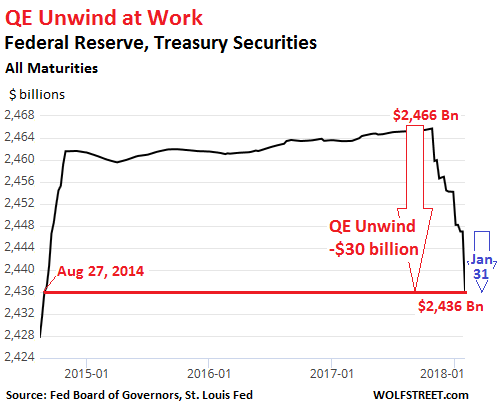
So if the now apparently de-feathered GOP deficit hawks wondered how they got away with kicking the fiscal can for so many years, the smoking gun is embedded in the chart below.

The Fed and other central banks had their Big Fat Thumb on the supply/demand scales in the markets for savings and debt. The “crowding out” effect and rising yields that enforced fiscal rectitude in the pre-Greenspan era were unplugged by Keynesian central bankers who discovered that having the central banking branch of the state print money is a lot more efficacious—as least in the middle term—than having the Treasury borrow it honestly in the capital markets.

Alas, even the middle-term is over. With the books now closed on January, it is evident that the Fed has indeed made an epochal pivot to QT (quantitative tightening) and is shrinking its balance  according to the automatic pilot plan it has set in motion.

Thus, during the current quarter it intends to let $12 billion per month of maturing treasury debt and $8 billion of GSE securities roll-off, which from a market pricing viewpoint amounts to the same thing as selling them.

That’s because neither Uncle Sam nor Fannie/Freddie are shrinking their own balance sheets. Instead, what the Fed doesn’t repurchase when securities in its swollen portfolio mature results in new issuance and sale to the dealers—-that is, ultimately to real money savers.

As Wolf Richter reminds in the post from which the above chart is extracted, the $20 billion per month shrinkage which happened in  January will escalate to $30 billion per month in Q2, $40 billion per month in Q3 and then $50 billion per month in Q4 and for a considerable period thereafter.

There is exactly no secret about this schedule, nor a shred of evidence that the law of supply and demand has been repealed. So after touching a generational low at 1.36% on July 8, 2016, the bond yield has already begin to rise sharply in anticipation of the rapidly escalating central bank drainage of cash from the dealer markets.

But there is something more. The same front-runners who functioned as private quasi-central bankers by sequestering debt paper in repo silos alongside the real central bank vaults, are not waiting around for the central bank bond dumping campaign to reach full stride.

In fact, when the 10-year UST hit 2.85% today that represented a 45 basis point rise since the last day of 2017. Stated differently, it also meant a 16% mark-to-market loss for repo carry traders since the turn of the year, and, in theory, a 48% loss since the generational bottom 19 months ago.

Needless to say, no hedge fund that wishes to survive is going to sit patiently on their repo silos at 95% leverage after their tiny slice of equity in the trade has been mauled and they are called upon to post more collateral.

To the contrary, as the bond yield reset accelerates, they are likely to not only begin selling with malice aforethought, but also to actually pivot to the other side. That is, start “shorting” what in effect the Fed has announced it will be shorting to the tune of $600 billion per year commencing next October.

So the quasi-hidden “accelerator” effect of the bond market front-runners is now about to shock both ends of the Acela Corridor. When the 10-year note pierces the 3.03% yield mark, where it topped out after the original Bernanke taper tantrum in 2013, it will be off to the races as the chart-driven robo-traders pile on.

To be sure, this will be described by Wall Street stock peddlers as an “oversold market”, which presents another swell opportunity to jump back in and buy the dip.

We sincerely doubt it. To the contrary, we think the denizens of the Imperial City are going to react badly as the carry cost of the Federal debt soars. Rather than the congealing of a last minute majority to kick-the-can, as has occurred so many times since August 2011, we think the kicking this time around will be more akin to that of a Polish firing squad.

That is to say, the fiscal bloodbath we have been predicting is now on the doorstep of Capitol Hill. As the latter stumbles from one false start to the next, and resorts to hideously abbreviated CR and debt ceiling fixes, the pandemonium will soon hop aboard the Acela and reach the canyons of Wall Street in no time.

As we said earlier this week: If you are still in the casino, run, don’t walk, toward the nearest emergency exit. The Trumpite/GOP is about to learn that deficits do matter and that what really ails the economy of Flyover America is the destructive Keynesian posse domiciled in the Eccles Building.

via RSS http://ift.tt/2EF5uKl Tyler Durden

House Intel Committee Will Take Up Democratic Memo On Monday: Report

As the fallout from the Friday release of the Republicans’ long-awaited FISA memo dominates the weekend news cycle, Reuters is reporting that the House Intelligence Committee will take up consideration of the Democrats’ rebuttal memo on Monday, according to two anonymous sources familiar with the deliberations.

The panel, which on Friday released the Republican document, will consider whether to declassify the Democratic memo, which Democrats say will highlight flaws and other shortcomings in the Republicans’ memo, which President Donald Trump tweeted Saturday that the memo “totally vindicates” him in the Russia probe. The meeting will take place at 5 pm ET on Monday, one of the sources said.

As we pointed out earlier, Democrats have begun drafting talking points to help rebut the memo – though these have been drafted independent of the memo.

Nadler’s talking points – which are separate from the official response by House Intel Committee Democrats – call the GOP-authored memo “deeply misleading,” and claim that Republicans are now “part and parcel to an organized effort to obstruct” Special Counsel Robert Mueller’s investigation into Russian interference in the 2016 election.

“Until now, we could only really accuse House Republicans of ignoring the President’s open attempts to block the Russia investigation,” Democratic members of the House Judiciary Committee said in the four-page letter released on Saturday. The document provided a point-by-point rebuttal to the Republican memo alleging bias in Mueller’s probe of possible links between Russia and Trump’s campaign, according to Bloomberg’s summary.

Schiff

House Intel Committee Ranking Member Adam Schiff

“With the release of the Nunes memo – a backhanded attempt to cast doubt on the origins of the Special Counsel’s investigation – we can only conclude that House Republicans are complicit in the effort to help the President avoid accountability for his actions and for the actions of his campaign,” the talking points read.

In the memo, Democrats argue that the Page warrant was justified because he was “more likely than not, an agent of a foreign power.”

“Carter Page was, more likely than not, an agent of a foreign power. The Department of Justice thought so. A federal judge agreed. The consensus, supported by the facts, forms the basis of the warrant issued,” Nadler writes in the rebuttal.

Assuming the issue of releasing the document is taken up by the House committee on Monday, it’s unclear when it will be released.

* * *

As a reminder, the House Intel Committee already voted down Ranking Member Adam Schiff’s demand that the committee vote to declassify the Democrats’ memo…

Schiff: “.. I find the memo to be deeply misleading. We wrote for the committee a memo that sets out the accurate facts and their proper context. And, of course, not surprisingly, when we took this up the last night and the majority said that in the interest of full transparency they thought the public should see this, we moved to make our own memoranda public at the same time, and they voted that down.

“And you could certainly say, well, isn’t the Democratic memo going to be just as skewed as the Republican memo? That’s not always the case. There are times when one party gets it right. The problem is the public won’t get to see the underlying materials, won’t get to make that judgment.”

But that’s the whole point of this GOP exercise. It’s the politicization of intelligence to protect the president, to circle the wagons around the White House as Bob Mueller’s investigation gets closer and closer to the president.”

Meanwhile, the Hill reports that, after initially opposing the release, Republicans on the Intel Committee are signaling mounting openness toward releasing the Democrats’ memo as political pressure mounts.

via RSS http://ift.tt/2EFK00a Tyler Durden