Why did Robert Mueller end the Russia investigation when he did? He could have let it drag it out for another year or so and severely hurt Trump’s chances for reelection. But he didn’t do that. Why?
Of course, we’re assuming that the investigation was never intended to uncover the truth. If it was, then Mueller would have interviewed Julian Assange, Craig Murray and retired members of the Intelligence Community (Ray McGovern, Bill Binney) who have shown that the Podesta emails were leaked by an insider (on a thumbdrive) not hacked by foreign agents. Mueller would have also seized the servers at DNC headquarters and done the necessary forensic investigation, which he never did. He also would have indicted senior-level agents at the FBI and DOJ who improperly obtained FISA warrants by withholding critical information from the FISA court. He didn’t do that either. Mueller did none of these things which simply proves that his final report was what many people had expected from the very beginning; a purely political document that twists the truth to achieve Mueller’s particular objectives. But to understand what those objectives are, we need to determine what the real goals of the investigation were. So, here they are:
To help sabotage Trump’s political agenda
To create a cloud of illegitimacy over Trump’s election
And to prevent Trump from implementing his plan to normalize relations with Russia.
These were the real objectives of the investigation, to create a forth branch of government (Special Counsel) that had the power to keep Trump permanently on the defensive while the media made him out to be either an unwitting accomplice in Russian espionage or, even worse, a traitor. The aim was to reign him in and keep the pressure on until a case could be made for his impeachment. Mueller played a key role in this travesty. His assignment was undermine Trump’s moral authority by brandishing the cudgel of criminal indictment over his head. This is how a D.O.J. appointee, who had never held public office in his life, became the most powerful man in Washington.
My question is simply this: Why did Mueller give up all that power when he did?
I think I can answer that, but first, we need a little more background. Check out this quote from candidate Trump in 2016:
“We will pursue a new foreign policy that finally learns from the mistakes of the past…We will stop looking to topple regimes and overthrow governments…. Our goal is stability not chaos, because we want to rebuild our country [the United States]… We will partner with any nation that is willing to join us in the effort to defeat ISIS and radical Islamic terrorism …In our dealings with other countries, we will seek shared interests wherever possible and pursue a new era of peace, understanding, and good will.”
Imagine how terrified the foreign policy establishment must have been when they heard Trump utter these words. No more regime change wars? Are you kidding me? That’s what we do: Regime-Change-Is-Us., and now this upstart, New York real estate tycoon is promising to do a complete 180 and move in another direction altogether. No more destabilizing coups, no more bloody military interventions, instead, we’re going to work collaboratively with countries like Russia and China to see if we can settle regional disputes and fight terrorism together? Really?
At the same time Trump was promising this new era of “peace, understanding, and good will,” Hillary Clinton was issuing her war whoop at every opportunity. Here’s candidate Hillary trying to drum up support for taking on the Russians in Syria:
“The situation in Syria is catastrophic. And every day that goes by, we see the results of the Assad regime in partnership with the Iranians on the ground, and the Russians in the air…When I was Secretary of State, I advocated and I advocate today a no-fly zone and safe zones.”
Interesting, isn’t it? Here’s Hillary, the “liberal” Democrat, pushing for a no-fly zone in Syria even though the Chairman of the Joint Chiefs of Staff, General Joseph Dunford, stated clearly that “Right now… for us to control all of the airspace in Syria would require us to go to war against Syria and Russia.” In other words, if Hillary had been elected, she was all ready to flip the switch and start WW3 ASAP. Is it any wonder why the establishment loved her?
“We have to work more closely with our partners and allies on the ground,” boomed Hillary, meaning that she fully supported the continued use of jihadist proxies in the fight against Assad. “I do think the use of special forces, the use of enablers and trainers in Iraq, which has had some positive effects, are very much in our interests, and so I do support what is happening.”
War, war and more war, that’s the Hillary Doctrine in a nutshell.
It was Hillary’s relentless hawkishness that pushed leftists into the Trump camp, not that they ever believed that Trump was anything more than what he appeared to be, an unprincipled narcissist with an insatiable lust for power. But they did hope that his dovish comments would steer the country away from nuclear annihilation. That was the hope at least, but then everything changed. And after it changed, Mueller released his report saying: “Trump is not guilty after all!”
So, what changed?
Trump changed.
Think about it: In mid December 2018, Trump announced the withdrawal of all U.S. troops in Syria within 30 days. But instead of withdrawal, the US has been sending hundreds of trucks with weapons to the front lines. The US has also increased its troop levels on the ground, the YPG (Kurdish militia, US proxies) are digging in on the Syria-Turkish border, and the US hasn’t lifted a finger to implement its agreements with NATO-ally Turkey under the Manbij Roadmap. The US is not withdrawing from Syria. Washington is beefing up its defenses and settling in for the long-haul. But, why? Why did Trump change his mind and do a complete about-face?
The same thing happened in Korea. For a while it looked like Trump was serious about cutting a deal with Kim Jong un. But then, sometime after the first summit, he began to backpeddle. He never honored any of his commitments under the Panmunjom Declaration and he never reciprocated for Kim’s cessation of all nuclear weapons and ballistic missile testing. Trump has made no effort to “build a lasting and stable peace regime on the Korean Peninsula” or to strengthen trust between the two leaders. Then, at the Hanoi Summit, Trump blindsided Kim by making demands that had never even been previously discussed. Kim was told that the North must destroy all of its chemical and biological weapons as well as its ballistic missile and nuclear weapons programs before the US will take reciprocal steps. In other words, Trump demanded that Kim completely and irreversibly disarm with the feint hope that the US would eventually lift sanctions.
Trump made these outrageous demands knowing that they would never be accepted. Which was the point, because the foreign policy establishment doesn’t want a deal. They want regime change, they’ve made that perfectly clear. But wasn’t Trump supposed to change all that? Wasn’t Trump going to pursue “a new foreign policy that finally learns from the mistakes of the past”?
Yes, that was Trump’s campaign promise. So, what happened?
There are other signs of capitulation too; like providing lethal weapons to the Ukrainian military, or nixing the short-range nuclear missile ban, or joining the Saudi’s genocidal war on Yemen, or threatening to topple the government of Venezuela, or stirring up trouble in the South China Sea. At every turn, Trump has backtracked on his promise to break with tradition and “stop toppling regimes and overthrowing governments.” …’ At every turn, Trump has joined the ranks of the warhawks he once criticized.
Trump is now marching in lockstep with the foreign policy establishment. In Libya, in Sudan, in Somalia, in Iran, in Lebanon, he is faithfully implementing the neocon agenda. Trump “the peacemaker” is no where to be found, while Trump the ‘madman with a knife’ is on the loose.
Is that why Mueller let Trump off the hook? Was there a quid pro quo: “You follow our foreign policy directives and we’ll make Mueller disappear?
It sure looks like it.
via ZeroHedge News http://bit.ly/2voEgUE Tyler Durden
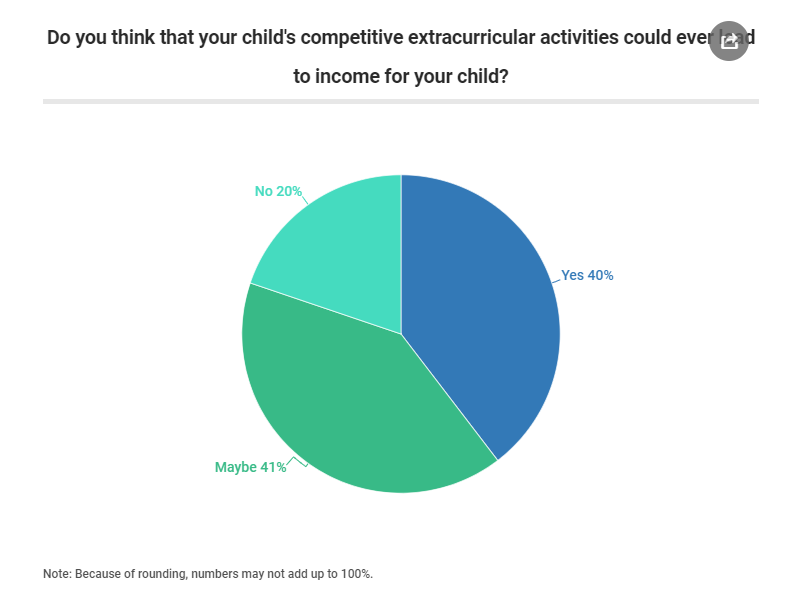
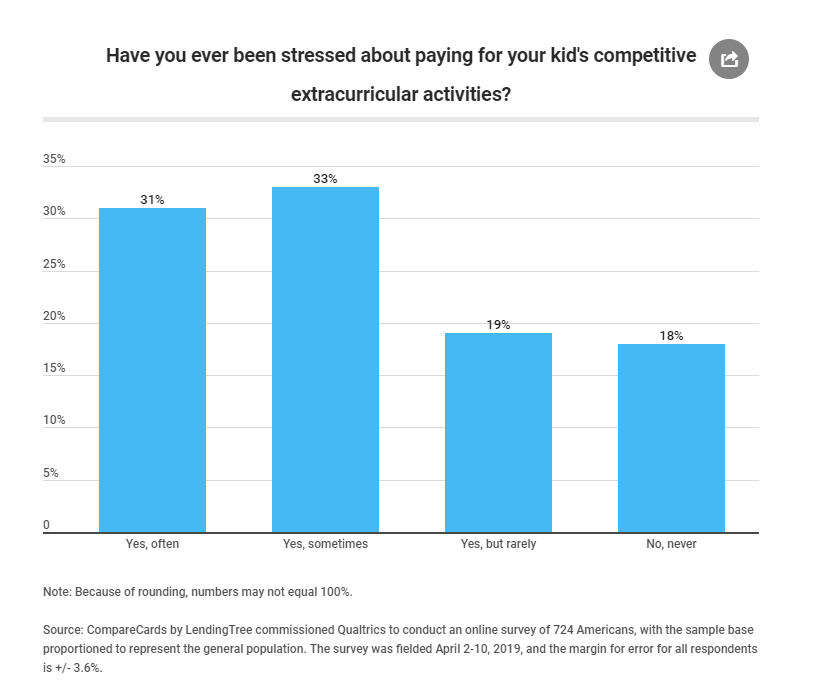
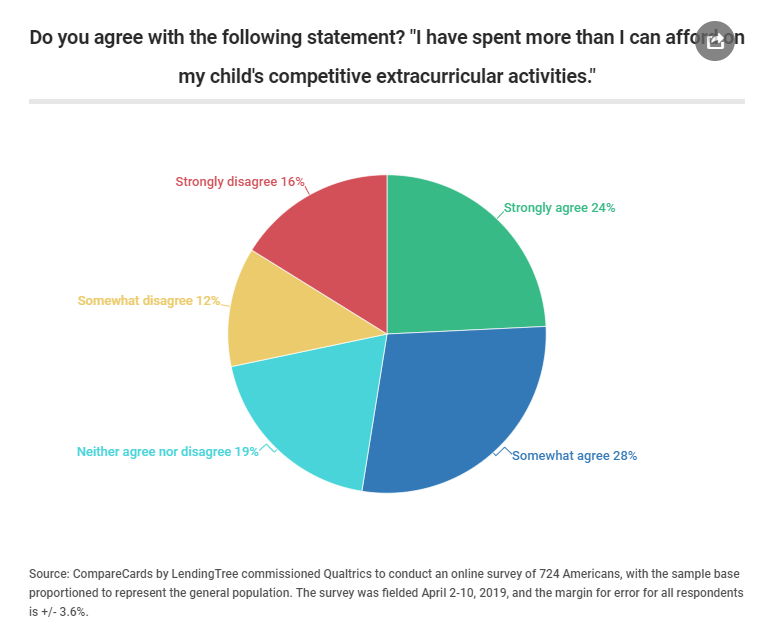
The extracurricular activities that used to just be “good old-fashioned fun” are now mandatory pieces to a college resume for kids. And the cost of these activities is pushing parents deep into debt and compromising them financially, according to MarketWatch. 8 in 10 parents in a new survey said that they’re hoping that signing kids up for extracurricular activities could help them bring in extra income someday. 66% of these parents have gone into debt to pay for things like soccer, ballet, dancing, and piano lessons.
CompareCards.com surveyed more than 700 parents with young children who participate in extracurricular activities. The more the parents spent, the more they believed that these activities would literally “pay off” in the long run. 90% of parents who dropped at least $4,000 a year believed their kid would earn money from that activity in the future, compared to 75% of parents who spent less than $1,000 who said the same.
Matt Schulz, chief industry analyst at CompareCards, said:
“And what the survey showed is, it’s not just sports parents who have these big dreams and big hopes for their sons and daughters; it’s music parents, it’s cheerleading parents, it’s debate team parents.”
The most popular activities included sports, reported by 30% of parents, music (16%), dance (15%), gymnastics (12%), cheerleading (9%), martial arts (8%), beauty pageants (3%) and debate teams (3%). 46% of parents said they spent more than $1000 annually and 27% said they’re spending more than $2000 quarterly.
This survey supports a University of Michigan poll that found 55% of parents said that school sponsored sports teams and extracurricular activities helped boost their child’s college application. Three times as many low income parents as high income said that the benefits of these activities are not worth the cost, indicating that the survey was skewed towards affluent parents.
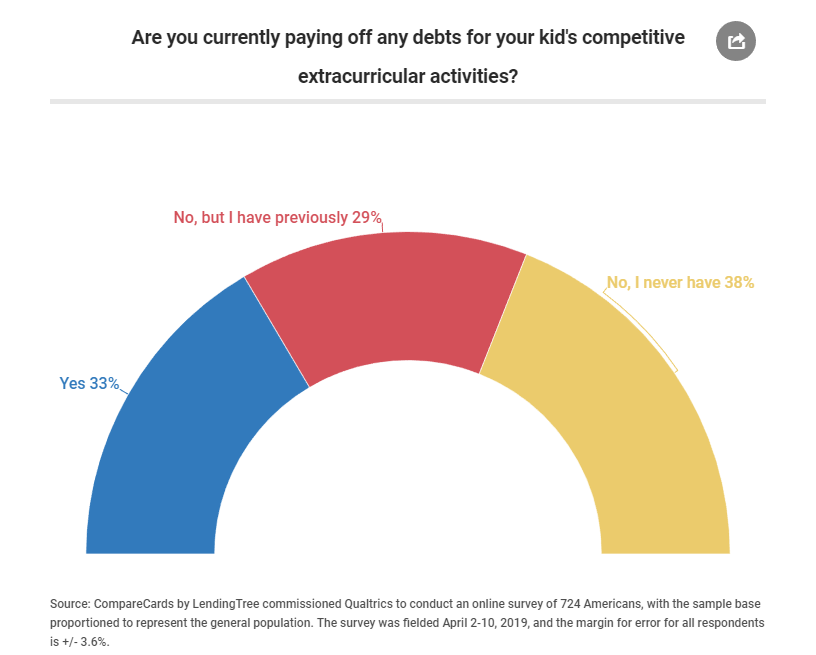
62% of parents revealed they’ve actually gone into debt for their children’s activities and 33% of them are still paying off related debt. Almost 1 in 10 parents of those in debt owe more than $5000 and 27% owe more than $3000 in debt.
“They do hope that perhaps those efforts in terms of time and money may be rewarded with maybe a scholarship, or maybe a professional career,” Schulz continued. Families can wind up spending more than $200,000 in total on private school tuition, SAT tutors, living in a certain school district and these extracurricular activities to help groom their kids for getting into a good college.
Athletics alone can sometimes cost $100-$499 a month and sports play a big role because recruited athletes have been shown to receive the largest admissions advantages – as the recent college admission scandal just showed us. Music lessons are expensive at $40-$60 per hour, language lessons cost $30-$45 per hour and art lessons cost $30-$60 per hour.
Vered DeLeeuw says that she and her husband have spent about $20,000 on extracurricular activities for their daughters. They included dance, gymnastics, swimming and Hebrew lessons.
DeLeeuw said: “We live in an extremely competitive world, and it’s also a world where many parents feel that their kids are their most important investment and their proudest achievement. I will do a lot to increase their chances of success. And extracurricular activities are part of that — of enriching them, giving them more tools, helping them develop into the best people they can possibly be. Developing skills and talents outside of school is important. And in the case of the Hebrew School, for example, it’s also a way to preserve tradition, language and cultural identity.”
They recognize that spending over $20,000 was “money that did not end up in our nest egg”, however.
Gone are the days when kids could just sit around, watch a little TV and then go outside to play with their friends. Veronica Hanson enrolled her daughters, ages 5 and 7, into activities when they were just a few months old. Their resume since then has included swimming, music classes, Japanese lessons, Girl Scouts, acting, soccer, rock climbing, art, hiking, yoga, cooking, ballet and gymnastics.
Hanson said: “I have two daughters who are part of our world’s future. My husband and I invest everything we can into making sure our kids are global citizens who can contribute to progress. I think it’s important to let them explore a bunch of different things when they’re young.”
“It is a huge investment,” she continued. She says she spends about $7,000 per summer on activities alone.
Shelly Schneider drops $3,000 a year on her three children for theater group, vocal coaches, Girl Scouts, tee ball, soccer, football, and piano lessons.
She concluded: “Through all of these things, [the kids] are proving themselves and building confidence, building relationships and growing their little brains, and that’s very important. I believe the arts are a very important part of learning and opening up the brain to help you with other subjects. Learning music is proven to help with math and science. And if they learn to love science and math, that can really expand their careers.”
“It’s noble to support your kid in the pursuit of their dreams, but it’s also important for a parent not to do that in a way that can wreck their own dreams of being financially stable and retiring someday,” Schulz concluded.
via ZeroHedge News http://bit.ly/2UNOBUi Tyler Durden
The Mueller Report is now public, and our Mainstream Media have filled the airways with all sorts of commentaries and interpretations. We know that – despite the very best efforts of the dedicated Leftist attorneys on Special Counsel Robert Mueller’s staff – there was absolutely no coordination between members of the Trump campaign, or any of his staffers, with Russians. No additional charges have come as a result, other than accusations made earlier of “process crimes” (e.g. failure to report earnings on tax forms, failure to report lobbying work, or not telling investigators what they demanded to hear—“crimes” that practically every politician in Washington has been guilty of at one time or another and would normally not cause much of a stir). None of these involved Russia.
Of course, that finding has not satisfied many Democrats or the unhinged Leftist crazies in the media, who continue to have visions of “collusion”—a kind of communications Alzheimers that has poisoned our media now for years. Thus, Representative Eric Swalwell (who is one of nearly two dozen Democrats running for president) continues to assert that there was “collusion,” as does the irrepressible (and irresponsible) Adam Schiff: “it’s there in plain sight,” they insist, “if you just look hard enough, and maybe squint just a bit—or maybe have those specialized 3-D Russia glasses!”
Such political leaders—along with those further out in the Leftist loonysphere like Representatives Maxine Waters and Alexandra Ocasio-Cortes—continue down their Primrose path of post-Marxist madness.
But beyond the collusion/coordination issue, the past couple of weeks have been filled with a swirling controversy concerning what is called “obstruction of justice.” And once again, the fundamental issues have been incredibly politicized. Special Counsel Robert Mueller had an obligation, if he and his minions discovered “obstruction of justice,” that is, concerted and illegal attempts to obstruct the investigations by the president or his staff, to present charges to the Department of Justice. Yet, all he was able to do was assemble a farrago of “he said/she said” instances, none of which rose to the level of criminal activity. Apparently President Trump told a subaltern “I wish would you fire Mueller,” or he wished in a speech in his joking style that “if the Russians had Hillary’s emails, they would release them,” or he had a private conversation with Vladimir Putin when they met (as all national leaders do!), or his son met with a Russian attorney who supposedly had some “dirt” on the Hillary Clinton campaign (which did not turn out to be the reason for the Trump Tower meeting at all).
None of the ten or eleven cited instances came anywhere close to being actionable or criminal under settled law. In each instance cited, the president’s actions (or desires) fell within his purview and authority under Article II of the Constitution. And regarding Trump’s desire to fire Mueller, he was on solid legal ground; the Supreme Court in its 1997 decision, Edmonds vs. the United States, declared that “inferior” officials, including an independent counsel, could be removed by presidential action as part of his delegated powers. And, in any case, Mueller was not dismissed.
Mueller had an obligation after examining these situations to make a finding; he did not. By so doing, by avoiding decisions and stringing out such instances in an obviously political sense, he abdicated his responsibility and did his best to impugn Donald Trump and his administration…and thus offer grist for continued Democrat attacks on the president…all the way through the 2020 election.
Mueller left it up to the Attorney General William Barr…and Congress…to decide how to proceed. And that is where we are today.
The one issue that both Democrats and most Republicans seem to agree on, the issue which both say is “proven conclusively” by Mueller is that the Russians “attempted to interfere and did interfere” in our 2016 election.
Interesting, is it not, that the Republicans who zealously defend the president and attack the obviously political nature of the Mueller Report would accept, as if on faith and without question, the accusations of Russian interference, also contained in the report?
Turn on Fox and watch, say, Martha MacCallum (e.g., “The Story,” April 24, 2019) declare “we all know now without doubt that the Russians tried to interfere” in our elections, or listen to most any GOP congressman repeat that same narrative with unquestioning certitude.
But that assertion – is it truly backed up factually? Where is the evidence, other than largely questionable information sourced from our largely discredited intelligence agencies which, as we know, had a determined goal of overthrowing the president by any means possible?
Almost three years have passed from the first fake news that appeared in the media on the subject of “Russian collusion,” a concerted effort launched to discredit at first the Donald Trump candidacy and then sabotage his presidency, including his efforts to stabilize Russian-American relations.
As proof of Russian actions, the Mueller Report cites the indictments against twenty-five Russian citizens who were indicted for attempted “interference” (those Russians are, let us add, quite conveniently out of the country and thus not prosecutable). When those indictments were issued, Russia pointed out the flimsy, unsupported and transparently made-up nature of the charges, and demanded that American authorities provide conclusive proof. Such requests were rebuffed.
In order to evaluate the evidence, the Russian government proposed reestablishing the bilateral expert group on information security that the Obama Administration had terminated, which could have served as a platform for conversation on these matters. The American side was also invited to send Justice Department officials to Russia to attend the proposed public questioning of the Russian citizens named by Mueller. Additionally, Russia offered to publicize the exchanges between the two countries following the publication of the accusations of cyberattacks, exchanges which were conducted through existing channels between October 2016 and January 2017.
Our government refused every offer.
A careful analysis, in fact, fails to show any substantial evidence of Russian cyberattacks and attempts to “subvert democracy.” By some estimates, possibly $160,000—a paltry sum—was spent by the Russians during 2016 on social media activities in the United States. Does anyone wish to discover and compare the amount the Chinese Communists or the Saudis would have expended during the same period, for their continued influence and power in Washington and inside-the-Beltway?
It is helpful to examine the charges that have been made, some included in the Mueller Report and accepted blindly by most pundits and politicians, both on the Left and by establishment conservatives.
The Russian government, via their embassy in Washington, has published a 120 page “white paper,”The Russiagate Hysteria: A Case of Severe Russiaphobia, responding to the accusations made against them since 2016. Obviously, the Russian document has a particular viewpoint and very specific goal, but that should not deter us from examining it and evaluating its arguments. (I have written on Russia and its relations with the United States on a number of occasions since 2015 and had pieces published by The Unz Review, Communities Digital News, and elsewhere. On my blog, “MY CORNER by Boyd Cathey,” I have authored a dozen columns addressing this question).
Here following I list twenty-one claims made regarding Russian interference in the 2016 election and in American domestic affairs. I follow each claim with the Russian response and how others, as noted, have also responded. In most cases I retain the original text, at times with my editing, but, in every case, with all the referenced sources.
These twenty-one claims should be examined more closely and more calmly, and the “Russophobic” hysteria we have experienced during the past several years needs to be put aside for the sake of rational investigative inquiry—and discovering how the Managerial State and global elites have attempted a “silent coup” against what’s left of our republic.
These claims and the responses deserve respectful consideration and detailed responses:
CLAIM: Russia “meddled” in the U.S. elections by conducting influence operations, including through social media.
FACT
All of the claims of Russian trolls that surfaced over the last few years (such as Russians using the Pokémon Go mobile game and sex toy ads to meddle in the elections – ) are so preposterous and contradictory that they virtually disprove themselves.
Not to mention the absurdity of the whole notion of 13 persons and 3 organizations (whichever country they might represent) charged on February 16, 2018, by Robert Mueller with criminally interfering with the elections, affecting in any way electoral processes in a country of more than 300 million people.
It is telling that when pressed about the scope of the alleged influence campaign, representatives of American social media companies give numbers, that even if they were valid (and there’s no evidence of a connection to the Russian government), are so minuscule as to be basically non-existent. For example, Facebook has identified 3,000 Russia-linked ads costing a total of about $100,000. That’s a miniscule number of ads and a fraction of Facebook’s revenues, which totaled $28 billion. Facebook estimates that 126 million people might – the emphasis is on the word “might” – have seen this content. But this number represents just 0.004% of the content those people saw on the Facebook platform.
Significantly, Google CEO Sundar Pichai testified to the U.S. House Judiciary Committee hearing on December 11th, 2018 that “ad accounts linked to Russia” spent about $4,700 in advertising” to politically influence Americans during the 2016 presidential election season.
To further cast doubt on the allegations, an American watchdog group “Campaign for Accountability” (“CFA”) admitted on September 4th, 2018, that it deliberately posted propaganda materials on Google disguised as “Russian hackers from the Internet Research Agency” to check how they would be filtered for “foreign interference”. Google officials then accused the CFA as having ties to a rival tech company “Oracle”. In other words, corporate intrigues disguised as “Russian interference“.
As American media has admitted, out of several dozen pre-election rallies supposedly organized by Russians, Special Counsel Mueller mentions in his indictment that only a couple actually appear to have successfully attracted anyone, and those that did were sparsely attended and, almost without exception, in deep-red enclaves that would have voted for Trump anyway.
Amidst all the hysteria about the alleged Russian meddling it is worth reading various research studies which show, quoting “The Washington Post”, that it is Americans, in particular our intelligence service, that peddle disinformation and hate speech.
According to Graham Brookie, director of the Atlantic Council’s Digital Forensic Research Lab, the scale and scope of domestic disinformation is much larger than any foreign influence operation. And academics from the Harvard’s Shorenstein Center on Media, Politics and Public Policy document in their study that there had been major spikes in outright fabrication and misleading information proliferating online before the 2018 U.S. election. A “significant portion” of the disinformation appeared to come from Americans, not foreigners, the Harvard researchers said.
CLAIM: Russian hackers accessed computer servers of the Democratic National Committee (DNC) and leaked materials through Wikileaks and other intermediaries
FACT
As President of the Russian Federation Vladimir Putin noted in his interview with NBC on June 5, 2017, when flatly denying any allegations of Russia interfering in internal affairs of the U.S., that today’s technology is such that the final internet address can be masked and camouflaged to an extent that no one will be able to understand the origin of that address. It is possible to set up any entity that may indicate one source when, in fact, the source is completely different.
No evidence has been presented linking Russia to leaked emails. In fact, there are credible studies arguing that DNC servers are much more likely to have been breached by someone with immediate and physical access. In 2017 a group of former officers of the U.S. intelligence community, members of the “Veteran Intelligence Professionals for Sanity” (VIPS), met with then-CIA Director Mike Pompeo to present their findings.
Another counterargument to the “Russian hackers” claim is that the DNC files published by Wikileaks were initially stored under the FAT (File Allocation System) method which is not related to internet transfers and can only be forwarded to an external device such as a thumb drive.
It is also suspicious that the DNC prohibited the FBI from examining the servers. Instead, a third-party tech firm was hired, “Crowd Strike”, which is known for peddling the “Russian interference” claims. And soon enough it, indeed, announced that “Russian malware” has been found, but again no solid evidence was produced.
According to the respected former UN weapons inspector Scott Ritter, the indictment by the Mueller team on July 13, 2018 of the 12 supposed Russian operatives was a politically motivated fraud. As Ritter explains, Mueller seems to have borrowed his list from an organizational chart of a supposed Russian military intelligence unit, contained in a classified document from the NSA titled “Spear-Phishing Campaign TTPs Used Against U.S. And Foreign Government Political Entities”, which was published by The Intercept online. As stated in that document, this is just a subjective judgement, not a known fact. Ritter concludes, that this is a far cry from the kind of incontrovertible proof that Mueller’s team suggests as existing to support its indictment.
Moreover, it is telling that the indictment was released just before the meeting between President Putin and Trump in Helsinki on July 16, 2018, seemingly as if the aim was to intentionally derail the bilateral summit.
CLAIM: Donald Trump colluded with Russia in the 2016 U.S. Presidential elections.
FACT
As concluded in the summary of the Special Counsel Robert Mueller’s report, the investigation did not find that the Trump campaign or anyone associated with it conspired or coordinated with Russia
If the Mueller team, having all the resources of the U.S. government, after 22 months of work, many millions of dollars spent, more than 2800 subpoenas issued, nearly 500 search warrants and 500 witness interviews, didn’t find any evidence of “collusion”, it is simply because there was never any. The whole claim of collusion was launched and peddled by the same group of Democrats, liberal-leaning media and the so-called “Never Trump Republicans”, as it became clear that Donald Trump had real chances of winning the election. And later it morphed into a campaign to derail the newly-elected President agenda, including his efforts to mitigate the damage done to U.S.-Russian relations.
CLAIM: Hacking of American political institutions was personally ordered by the Russian President Vladimir Putin.
FACT
This claim is based on nothing else but the infamous fraudulent “Steele Dossier”, paid for by political opponents [i.e., the Hilary Clinton campaign] of Donald Trump, and wild conjectures that “nothing in Russia happens without Putin’s approval” .
Needless to say, zero proof is presented. By the same logic, nothing in the U.S. happens without the President’s approval. For example, is he also responsible for Edward Snowden? After all, Mr. Snowden was doing work for the U.S. intelligence services. Or the deaths of all the civilians killed abroad by U.S. drone strikes? Every minute detail approved by the President?
CLAIM: Russia did not cooperate with the U.S. in tracing the source of the alleged hacking.
FACT
Russia has repeatedly offered to set up a professional and de-politicized dialogue on international information security only to be rebuffed by the U.S. State Department. For instance, following the discussion between Presidents Vladimir Putin and Donald Trump in Hamburg on July 7, 2017, Russia forwarded to the U.S. a proposal to reestablish a bilateral working group on cyber threats which would have been a perfect medium to discuss American concerns. Moreover, during his meeting with Donald Trump in Helsinki on July 17, 2018, Vladimir Putin offered to allow U.S. representatives to be present at an interrogation of the Russian citizens who were previously accused by the office of Special Counsel Robert Mueller of being guilty of electoral interference. Furthermore, in February 2019 the Russian government suggested publishing bilateral correspondence on the subject of unsanctioned access to U.S. electronic networks, which was conducted between Washington and Moscow through the Nuclear Threat Reduction Centers in the period from October 2016 to the end of January 2017.
Needless to say, all Russian offers were rejected. A conclusion is naturally reached that American State Department officials have little interest in hearing anything that contradicts their own narrative or the discredited version of the CIA.
CLAIM: Russia is interfering in elections all over the world
FACT
No credible evidence has been produced not only of Russia’s supposed meddling in the U.S. political processes, but to support similar allegations made by the U.S. in respect to other countries. For example, former National Security Advisor H.R. McMaster insinuated that Russia was interfering in the Mexican presidential elections of 2018. However, Mexican officials, including the president of the Mexican Senate Ernesto Cordero Arroyo, and Ambassador to Russia Norma Pensado during a press conference in Moscow in February, 2018, debunked this baseless claim.
Another example of fake news were reports saying that U.S. was increasingly convinced that Russia hacked French election on May 9, 2017. However, on June 1, 2017, the head of the French government’s cyber security agency said no trace was found of the claimed Russian hacking group behind the attack. On the other hand, the history of U.S. interfering in other countries’ elections is well documented by American sources (see: ).
For example, a Carnegie Mellon scholar, Dov H. Levin, has scoured the historical record and found 81 examples of U.S. election influence operations from 1946- to 2000. Often cited examples include Chile in 1964, Guyana in 1968, Nicaragua in 1990, Yugoslavia in 2000, Afghanistan in 2009, Ukraine in 2014, not to mention Russia in 1996! And how else could the current situation in Ukraine and Venezuela be described, with U.S. representative for Ukraine Kurt Volker openly pressuring Ukrainian voters to support the incumbent, and Washington possibly plotting a coup in Caracas?
CLAIM: The lawsuit of the Democratic National Committee against the Russian Federation related to “interference in the election” has a legal standing.
FACT
The DNC filed a civil lawsuit on April 20, 2018 against the Russian Federation and other entities and individuals. Named as defendants in the lawsuit are the Russian Federation; the General Staff of the Armed Forces of the Russian Federation (GRU); the GRU operative using the pseudonym “Guccifer 2.0”; Aras Iskenerovich Agalarov; Emin Araz Agalarov; Joseph Mifsud; WikiLeaks; Julian Assange; the Trump campaign (formally “Donald J. Trump for President, Inc.”); Donald Trump, Jr.; Paul Manafort; Roger Stone; Jared Kushner; George Papadopoulos; Richard W. Gates; and unnamed defendants sued as John Does 1–10. The DNC’s complaint accuses the Trump campaign of engaging in a racketeering enterprise in conjunction with Russia and WikiLeaks.
Even irrespective of the fact that there was no “interference” in the first place, the case has no legal standing. Exercise of U.S. jurisdiction over the pending case with respect to the Russian Federation is a violation of the international law, specifically, violation of jurisdictional immunities of the Russian Federation arising from the principle of the sovereign equality of states.
CLAIM: Russian Ambassador to the U.S. Sergey Kislyak was a spy.
FACT
In March of 2017 U.S. media began libeling Sergey Kislyak a “top spy and spy-recruiter” This preposterous claim was based on nothing but his contacts with Trump confidant Senator Jeff Sessions – carrying out work any ambassador would do. Per the Vienna Convention on Diplomatic Relations of 1961, among core diplomatic functions is ascertaining by all lawful means conditions and developments in the receiving state, and that certainly includes openly meeting leaders of Congress on Capitol Hill. Even former CIA Director John McLaughlin noted that Mr. Kislyak is an experienced diplomat, not a spy.
CLAIM: Russian Embassy retreat in Maryland was an intelligence base
FACT.
Among the unlawful acts that U.S. administrations undertook was the expropriation of a legal Russian property in Maryland, a summer retreat near the Chesapeake Bay under the pretext it was used for intelligence gathering. But where is the supposed-treasure trove of alleged spy equipment that U.S. authorities reportedly found there? Why not show them publicly to back up the claim? After the expropriation and the claims, not a word – silence.
The retreat, “dacha” as Russians would call it, was bought by the former Soviet Union in 1972. Since then, it was used for recreation, including hosting a children’s summer camp and regularly entertaining American visitors. One of the more popular events was the stop-over during the annual Chesapeake Regatta, completed with an expansive tour of the property. Presumably U.S. intelligence services could have used this for years to inspect the property. Why was nothing ever mentioned before the Obama Administration action?
CLAIM: The meeting in Trump Tower in New York on June 9, 2016 between Trump campaign officials and Russian lawyer Natalia Veselnitskaya was to discuss compromising materials that Russian had on Hillary Clinton.
FACT
According to testimony provided to the U.S. Senate Judiciary Committee, Ms. Veselnitskaya focused on explaining the illicit activities of U.S.-British investor Bill Browder, wanted in Russia for crimes, and brought attention to the adverse effects of the so-called “Magnitskiy Act”, adopted by U.S. Congress in 2012 and lobbied for by Browder.
CLAIM: Donald Trump’s former lawyer, Michael Cohen, met with Russians in Prague to “collude”.
FACT
It was reported in American media that the Justice Department special counsel had evidence that Donald Trump’s personal lawyer, Michael Cohen, secretly made a trip to Prague during the 2016 presidential campaign to meet with Russian representatives, a fact also mentioned in the discredited “Steele Dossier”. This was given as further evidence of “collusion”. But Cohen vehemently denied this – under oath. Passport records indicate that he never was in Prague. He was actually on vacation with his son at the supposed time. Given that he publicly turned on his former boss and still denied the fact of ever going to Prague disproves this claim further.
CLAIM: Former member of the Trump campaign team Carter Page was a Russian intelligence asset.
FACT
According to members of Congress and journalistic investigations, the redacted declassified documents of the U.S. Foreign Intelligence Surveillance Court (FISC, also called the FISA Court) show that the main source used by U.S. counterintelligence to justify spying on Mr. Page was the fraudulent so-called “Steele Dossier”.
Thus, Mr. Page for obvious reasons was not accused by the team of Robert Mueller of being involved in a “Russian conspiracy”.
CLAIM: On August 22, 2018, The Democratic National Committee filed a claim with the FBI, accusing the “Russian hackers” of infiltrating its electoral database.
FACT
Several days later members of the Democratic Party admitted that it was a “false alarm”, as it was simply a security check-up performed at the initiative of the Democratic Party’s affiliate in Michigan.
CLAIM: On August 8, 2018 U.S. Senator Bill Nelson accused Russia of breaching the infrastructure of the voter registration systems in several local election offices of Florida.
FACT
Florida’s Department of State spokesperson, Sarah Revell, stated on August 9, 2018, that Florida’s government had not received any evidence from competent authorities that Florida’s voting systems or election records had been compromised. The U.S. Department of Homeland Security and the FBI also could not confirm in any manner the accusations.
CLAIM: In September, 2017 the U.S. media, referring to the Department of Homeland Security, accused Russia of “cyberattacks” on electoral infrastructure in 21 states during the 2016 U.S. Presidential elections.
FACT
On September 27, 2017, Wisconsin and California authorities stated that their electoral systems were not targeted by cyberattacks. On November 12, 2017, the U.S. Secretary of the Treasury Steven Mnuchin said in a CBS interview that the “hackers’ activity” had no significant consequences and did not influence the outcome of the elections. And, indeed, the source of those attacks was not clear.
CLAIM: Russia meddled in the Alabama 2017 Senate elections to help the Republican candidate.
FACT
Despite the initial claims, it turned out that a group of Democratic tech experts decided to imitate so-called “Russian tactics” in the fiercely contested Alabama Senate racе. Even more jarring is the fact that one participant in the “Alabama project”, Jonathon Morgan, is chief executive of “New Knowledge”, a cyber security firm that wrote a scathing account of Russia’s social media operations in the 2016 election that was released in 2018 by the Senate Intelligence Committee. Once again, we have one of the main private sector players in hyping the Russian threat caught red-handed.
CLAIM: Paul Manafort, Donald Trump’s presidential campaign chairman, was a secret link to Russian intelligence.
FACT
Trump’s former campaign chairman was hit with two indictments from Mueller’s office. However, even as American media notes, both cases have nothing to do with Russia and stemmed from his years as a political consultant for the Ukrainian government and his failure to pay taxes on the millions he earned, his failure to report the foreign bank accounts he used to stash that money, and his failure to report his work to the US government. In his second case in Virginia, he was also chargedwith committing bank fraud to boost his assets when the Ukraine work dried up.
In fact, serious concerns have been raised in the U.S. that it was Ukrainian officials who tried to influence the 2016 elections by leaking compromising materials on Mr. Manafort.
The Ukrainian connection is also prevalent in the case of money transferred to accounts of American politicians. For instance, according to a “New York Times” article, Ukrainian billionaire Viktor Pinchuk donated over 10 million dollars to the “Clinton Foundation while just 150 thousand dollars to the “Trump Foundation”.
CLAIM: Russia compromised the Vermont power grid.
FACT
On December 31, 2016, “The Washington Post”, accused “Russian hackers” of compromising the Vermont power grid. The local company, “Burlington Electric”, allegedly traced a malware code in a laptop of one of its employees. It was stated that the same “code” was used to hack the Democratic Party servers in 2016. However, the “Wordfence” cybersecurity firm checked “Burlington Electric” for hacking, and said that the malware code was openly available, for instance, on a web-site of Ukrainian hackers. The attackers were using IP-addresses from across the world. “The Washington Post” later admitted that conclusions on Russia’s involvement were false.
CLAIM: Russian Alfa Bank was used as a secret communication link with the Trump campaign.
FACT
In October 2016 a new “accusation” appeared, alleging that a message exchange between the Alfa Bank server and Trump organizations indicated a «secret» Trump – Russia communication channel.
CLAIM: Russia cracked voter registration systems during the 2016 U.S. elections.
FACT
In July 2016 the U.S. Department of Homeland Security accused Russia of gaining unauthorized access to electronic voter registration systems in Arizona. But on April 8, 2018, “Reuters”, referring to a high-ranking U.S. administration official, wrote there was no proof Russia had anything to do with the mentioned cyberattack.
CLAIM: Russian Embassy bank transactions were linked to “election interference”.
FACT
American publication “Buzzfeed” repeatedly claimed that U.S. authorities flagged Russian Embassy financial transfers as suspicious, many of them dated around the 2016 election. In reality, the media outlet, by twisting the facts and placing them out of context, made routine banking transactions – salary transfers, payments to contractors – look nefarious. It is not uncommon for embassy personnel to receive larger payouts, transfer or withdraw larger sums of money at the end of their work. Furthermore, leaking of confidential banking information of persons and organizations protected by diplomatic immunity raised concerns about the likely involvement of security services.
The arrest in October 2018 of a U.S. Treasury Department’s Financial Crimes Enforcement Network official, charged with leaking information both about the Russian Embassy accounts and former Trump campaign chairman Paul Manafort, provides further proof to the theory of political skullduggery.
* * *
Most of these responses have not been fully examined or addressed by major media, nor, for that matter, by Fox News, dominated as it is by an almost instinctive Neoconservative Russophobia (the one possible exception being Tucker Carlson).
For the American Left, since the collapse of Communism and the growth of a traditionalist nationalism (under Vladimir Putin), Russia has become a convenient target. When the Soviets were in power prior to 1991, the USSR was seen as a “progressive” presence in the world, even if by the requirements of American politics the Left was forced to make ritualistic condemnations of the more extreme elements of Soviet statecraft. Now that post-Communist Russia bans same sex marriage, glorifies the traditional family, and the conservative Russian Orthodox Church occupies a special position of esteem and prominence, that admiration has turned to fear and loathing. And that Russia and its president have been viewed as favorable to the hated Donald Trump doubly confirms that hostility and targeting.
For the dominant Neoconservatives and many Republicans, contemporary Russia is seen as “anti-democratic,” “reactionary,” and a threat to American world hegemony (and the refusal to bow to that hegemony, whether economically, politically, or culturally). Indeed, as a major intellectual force, Neoconservatism owes much of its origins to Eastern European and Russia Jews, many of whose ancestors were at direct odds with the old pre-1917 Tsarist state. That animus, those nightmares of pogroms and oppression, have never completely subsided. A modern traditionalist, Orthodox Russia is viewed as antithetical to their more liberal, even Leftwing ideas (e.g., increasing “conservative” acceptance of same sex marriage, “moderate” feminism, and a whole panoply of “forward looking” views on civil rights issues—all of which are present on Fox News.)
Memory of “the bad old days” has never disappeared.
None of this history should prevent a close examination of the current accusations against Russia, nor our search for the truth. Much—perhaps the future of Western civilization itself—depends on it.
via ZeroHedge News http://bit.ly/2vs2FJa Tyler Durden
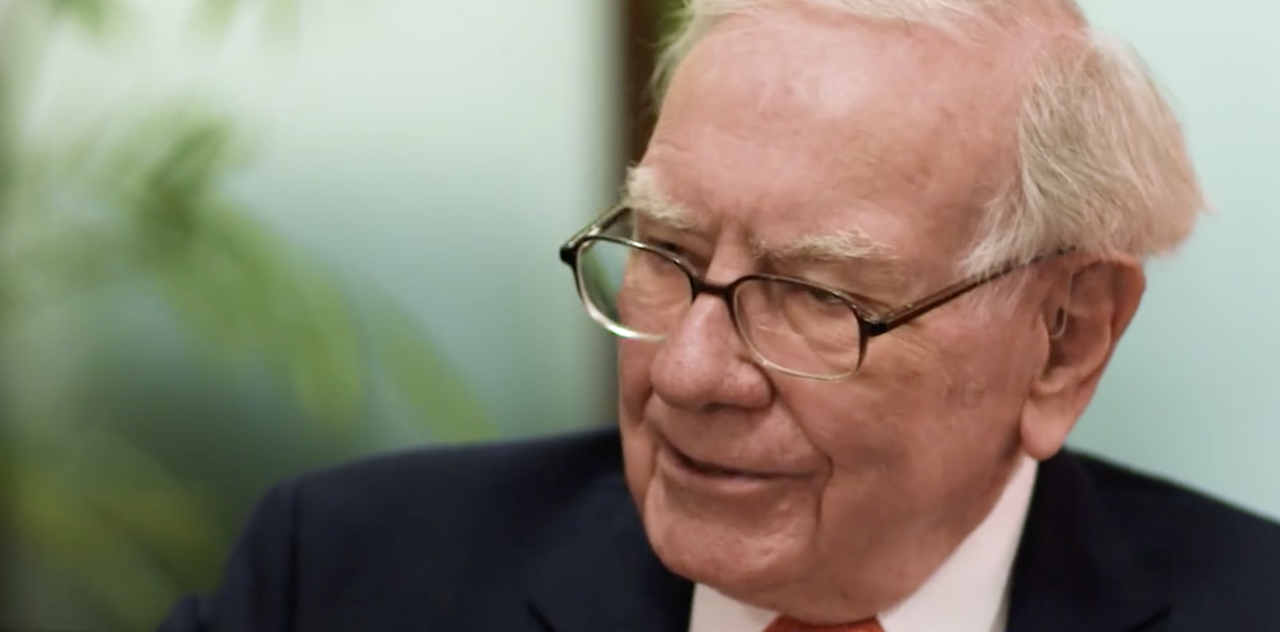
Forgive the Oracle of Omaha for sounding more like Captain Obvious here, but readers won’t be surprised to learn that the octogenarian billionaire investor doesn’t have the rosiest outlook for the long-suffering newspaper industry.
Buffett, who through his Berkshire Hathaway BH Media subsidiary owns a veritable print-media empire, said during an interview with Yahoo Finance (which will carry the live stream of Berkshire’s annual shareholder meeting on May 4) released on Tuesday that the newspaper industry is “toast”, and that most print papers (including, presumably, the 30 daily newspapers and 47 weeklies owned by BH) will soon cease to exist as they lose more vital advertising revenue to Internet powerhouses like Google and Facebook.
Fortunately for Berkshire, the decline of the industry won’t have much of an impact on its bottom line because BH bought its newspapers at a “reasonable” price, Buffett said.
As Buffett sees it, the problem with trying to shift to a subscription-based model is two-fold: Consumers once sought out print newspapers not just for the news content, but for the ads. The classifieds included vital information about job opportunities and housing, while supermarkets ran fliers about what products were on special that week. That functionality has largely been subsumed by Craigslist.
“It upsets the people in the newsroom to talk that way, but the ads were the most important editorial content from the standpoint of the reader,” Buffett said.
Between 2006 and 2016, the newspaper industry’s advertising revenue had fallen to nearly a third of what it once was, with newspapers bringing in $18 billion in ad revenue, compared with $49 billion ten years prior.
Today, consumers don’t have much use for local papers because they get their national political news and their national sports news online. What’s left, the local news, just isn’t compelling enough to warrant a subscription for many.
Of course, there are some exceptions. The New York Times, the Washington Post and the Wall Street Journal will survive thanks to their national prominence and a successful shift to digital.
But for most mid-sized regional papers, their fate has already been sealed.
Watch the full interview below:
via ZeroHedge News http://bit.ly/2V261lj Tyler Durden
Aspiring liberal presidential candidate Kamala Harris is turning her anti-capitalist and anti-corporate rage toward an iconic American company: McDonald’s. Her current manufactured “beef” with the fast food chain is how little it pays its workers, according to Bloomberg. Harris, who is part of a deep democratic presidential contender field, is desperately trying to pander seek out the endorsement of labor unions as we inch closer to the crucial primaries.
“You can’t go around talking about the Golden Arches, as a symbol of the best of America, when you are not conducting yourself in the best way in terms of supporting the working people of America,” Harris said this weekend at a labor-focused candidate forum in Las Vegas.
At a gathering on Saturday organized by the Service Employees International Union (SEIU) and the Center for American Progress Action Fund, Harris was asked what she would do to get the company to sit down with workers to create union jobs. McDonald’s has been the most prominent target of the SEIU’s “Fight for $15” campaign, which seeks union organizing rights and higher pay for workers. The organization has helped secure $15 wage laws in a number of cities and states and is now trying to force some of the largest fast food companies in the country to allow union representation.
According to BLS data, 10.5% of wage and salaried workers nationwide were a part of unions in 2018. This number has slumped from 20.1% in 1983. In 2016, 18% of voters said they belonged to a union household, down from 21 percent in 2008, exit polls show.
McDonald’s had previously announced it would no longer take part in efforts to lobbying against raising the minimum wage.
Harris responded to a question about California’s new standard making it harder to treat “gig” workers as contractors instead of employees by saying that workers deserve “the right to negotiate” and that ride-sharing employees, for example, should “not have to be in a working situation where it’s about desperation.”
At the same time, she conveniently declined to directly answer questions on limiting corporate stock buybacks.
Mary Kay Henry, SEIU’s international president said: “The specific thing that we’re interested in hearing from them about is how are they are going to rewrite the rules to allow working people to join together and bargain with corporations on the scale that we need in order to create family-sustaining jobs in the part of the work force that is laboring in poverty jobs.”
The wide open and fragmented Democratic presidential field has been giving labor unions power to reassert their political influence as candidates are seeking their support. Union labor could potentially be especially critical in Nevada, which has the highest rate of union membership out of any of the four early primary and caucus states. Joe Biden’s entry into the presidential campaign brought the Democratic field to 20, and unions will try to use numbers to their advantage, seeking out favor for their issues from whatever politicians are willing to appease them the most.
Recently Senate Majority Leader Harry Reid said: “The clout of organized labor is going to be stronger than it has been in the recent past.” Indeed, Trump’s victory in 2016 was partly the result of his ability to infiltrate union workers – more than most Republicans – in key states.
The question remains whether or not unions will be able to throw themselves behind one candidate early on. Early indications suggest that “won’t happen any time soon”. This time around, stung by feeling like they were “too quick” to back Hillary in 2016, unions have signaled they plan to move slowly. Clinton won the SEIU’s endorsement in November 2015, despite not having committed to support a $15-an-hour federal minimum wage. 51% of union member households voted for Clinton in 2016.
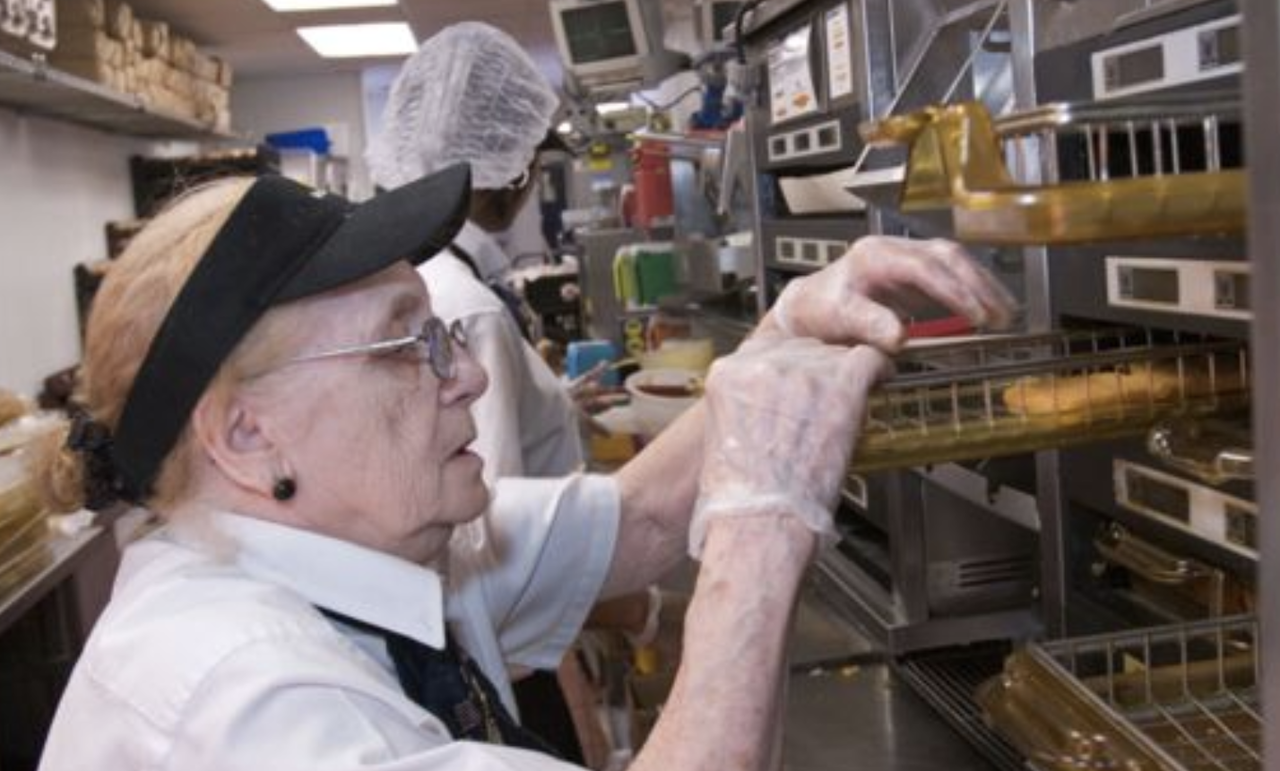
Meanwhile, it’s not like McDonald’s isn’t doing their part. For instance, just days ago we reported that the fast food chain was partnering with AARP to recruit broke senior citizens as workers. At a time when more seniors are being forced to return to the workforce, or simply can’t afford to retire, McDonald’s franchisees have hit upon a strategy to recruit more of them by partnering with AARP. The goal is to hire 250,000 elderly Americans this summer. Here’s more from MarketWatch:
“For the first time ever, five generations are now working together under the arches,” said Melissa Kersey, McDonald’s U.S. chief people officer.
McDonald’s wants to take advantage of “mature workers” from an “underutilized workforce,” according to a spokesperson. The company quotes Bureau of Labor Statistics data showing that adults ages 55 and over will make up nearly a quarter of the workforce by 2024.
Lucky for these “mature workers” the fast-food industry is on a hiring spree. Taco Bell, for example, is hosting 600 hiring parties through April 27, inviting applicants of all ages to attend a job fair for one of the 100,000 new U.S. jobs the company is creating through 2022.
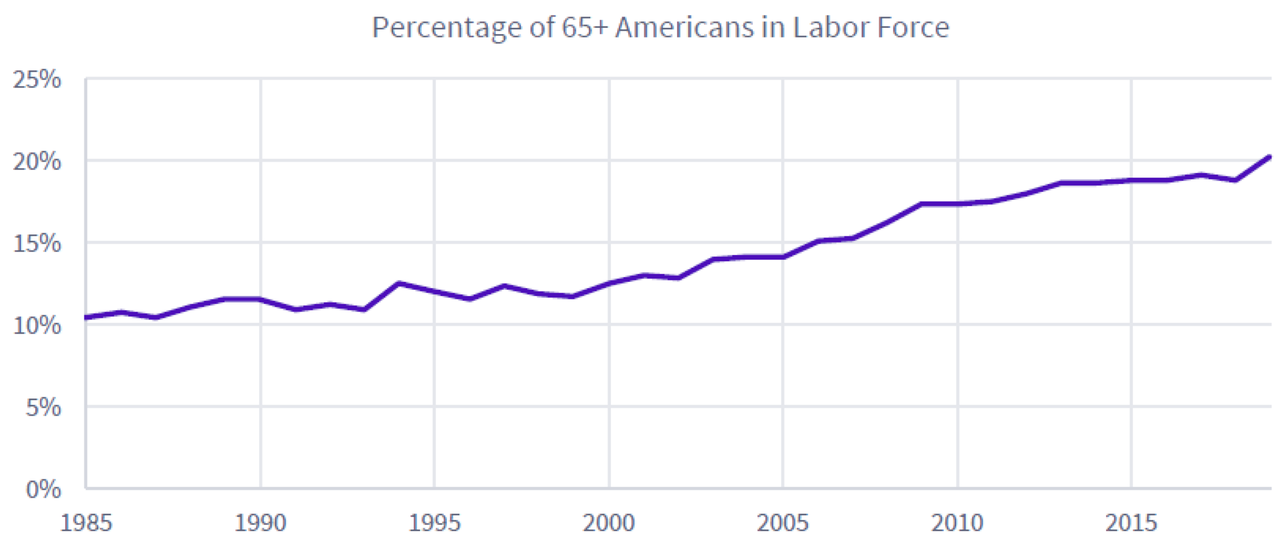
Meanwhile, the share of American workers over the age of 65 currently in the labor force has risen to its highest level in more than half a century – and while not in the scope of this article, a global demographic crisis is emerging as the population of those over 65 is above those 5 year and younger for the first time ever…
Following a round of promised wage hikes, McDonald’s and other fast food restaurants need to find ways to hire more workers without further hikes in pay. McDonald’s CFO said during the company’s Q4 earnings call that “wage pressures” are a key contributing factor.
While Harris may find some traction on the issue with labor unions, alongside of other Democratic candidates, we’re sure that the one issue she suspiciously has no comment on – stock buybacks – will help continue to offset these “wage pressures” for McDonald’s shareholders.
via ZeroHedge News http://bit.ly/2XX8FWt Tyler Durden
In recent years there has been a distinct change in the market as it relates to the “reaction function” of traders vis-a-vis volatility: whereas in the past (i.e. prior to the 2008 financial crisis) sliding volatility was a clear signal for both risk appreciation and broad market participation, ever since central banks took over both bond and equity markets over the past decade, collapsing vol has been increasingly seen as a warning sign that something is just not right, that central banks as part of their vol suppression strategy are artificially reducing the market’s perception of risk, and as such, high risk prices are artificial.
One need look no further than market action in 2019 where despite fresh record highs in the S&P – mostly the product of the Fed’s sudden tightening bias reversal and subsequent easing by both the US central bank and its global peers – equity outflows have hit an unprecedented pace, with continued stock upside attributable almost exclusively to stock buybacks, forced short squeezes and delta and gamma-imbalanced dealer books, where the higher equities rise, the greater the “forced chase” by dealer to keep bidding stocks even higher. Meanwhile, both institutional and retail investors have continued to flee global equities as the chart below from EPFR summarizing broad asset flows shows.
Another confirmation that low vol is no longer seen as a broad participatory signal are market volumes, which continue to shrink the higher markets rise; an indirect validation of the lack of faith in record asset prices.
While not addressing this topic explicitly, in his latest note, everyone’s favorite credit derivatives post modernist, Deutsche Bank’s Aleksandar Kocic who with every subsequent analysis transforms himself ever closer to the linguistic equivalent of a financial Slavoj Zizek, look at the perception of volatility in recent years, particularly through its circular interplay with broader market leverage, and writes that in the post-central bank era, the “leverage-volatility cycle has been disrupted and its amplitudes attenuated – there are no more booms and busts, just mellow undulations around slower growth and benign inflation.“
Taking a somewhat different approach than our assessment, Kocic writes that in the past, low volatility was a signal of build-up of latent risk due to vol-leverage dynamics, as “low volatility leads to excessive risk taking and misallocation of capital, which ultimately results in forced deleveraging”, and after several cycles the markets learned that these dynamics are an inherent aspect of market functioning. As a result, the vol-leverage trajectory has become “an outward spiral” and “in each subsequent sweep, leverage is higher and risk premia compression more extreme than in the previous episode, leading, naturally, to a deeper crisis and a need for an even more extreme policy response.” Then, resorting to every Austrian’s favorite Schumpeterian “creative destruction” analogy, Kocic writes that if stability is indeed destabilizing, then the main challenge lies not in how to avoid the mistakes, but instead in how to control their costs, and answers that “post-2008, this has been addressed by regulations, and policy adjustments.” In short, central banks step in every time the cycle of vol-leverage dynamics threatens to spiral out of control.
Perhaps as a result of this now constant “Fed put”, which emerged so vividly in late December 2018, Kocic writes that while “in the past, fear has had bad reputation — it stood as a sign of incompleteness, something one needs to outgrow”, the “post-2008 period can be seen effectively as an exoneration of fear”:
Fear has become a sign of wisdom, elevated to a new heuristic or cognitive principle. On the back of this shift in attitude, the resulting excessive caution by both investors and policy makers led to generally lower risk tolerance and has been the leading cause of gradual collapse of market volatility.
While this does not directly address our fundamental thesis, namely that the prevailing sentiment toward low vol has been turned upside down due to central bank intervention, and is no longer a sign of “all clear, the water is warm” by investors but is rather a symbol of foreboding – confirmation that central banks are worried and are therefore artificially suppressing vol – Kocic next looks at just how the leverage-vol cycle broke down within the financial sector, where despite the collapse in vol, leverage never managed to recover.
As such, Kocic believes that the “financial sector was the center of leverage transmission pre-2008” and was essential for converting low volatility into high leverage, which was seen as one of the main engines of growth. This is shown in the chart below, which shows the history of financial subsector of the S&P index overlaid with the levels of volatility on the inverted axis. Periods of low volatility were most profitable for financial institutions as they provided the main engine for conversion of credit into liquidity risk.
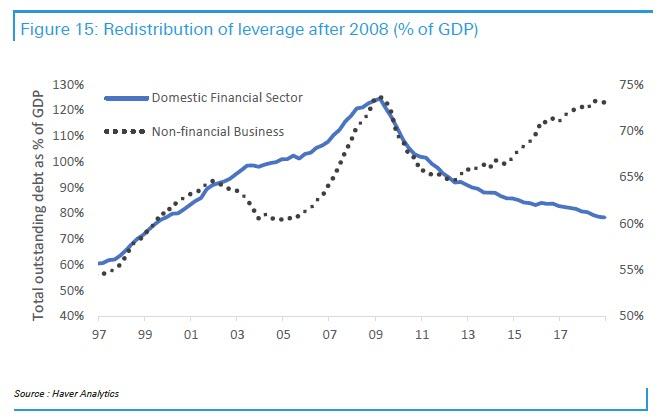
And while prior to the 2008 crisis, the “prosperity of financial sector and low volatility show high degree of coordination”, the subsequent departure is a consequence of the changes in the regulatory environment and redistribution of leverage away from the financial into corporate sector, something which Kocic shows in the next chart.
This transition of leverage away from the financial to other sectors had singificant consequences for all aspect of risk prices, and naturally, for volatility. As Kocic explains the “rationale of this maneuver” when it comes to credit risk, “corporate sector is more transparent than the combination of households and financial sectors together. By resyphoning leverage from financials and households to corporates and government, risk has been made less systemic and the margin of error in assessing and monitoring the aggregate credit risk and its misrepresentations in the markets have been reduced.”
Superficially, this is good news, because as a result of the decline in financial sector leverage, “there are no longer casualties of big “collisions”, only parking accidents” as Kocic puts it:
This redistribution of leverage has put the speed limit on possible future encounters with forced deleveraging associated with booms and busts. There are no longer casualties of big “collisions”, only parking accidents.
And yet, going back to the Schumpeter analogy above, if the system is preemptively absolved from the risk of crashes, it also remove the potential for substantial real growth, or as the DB strategist puts it, “reducing and constraining the leverage of financial sector also confines its propagation into the economy. Although stabilizing, in the existing paradigm, this appears to stifle growth — by preventing bad behavior, in the economy which is dependent on financialization, the system is deprived of one of the main engines of growth.”
How do interest rates fit into this?
While the above discussion explains the drift in the traditional relationship between leverage and volatility, there is another distinct historical correlation between the yield curve (which in recent months has gotten abnormal focus due to its inversion) and volatility surface which recently have “topologically converged to each other”, or as Kocic explains, “the curve is on the verge of inversion and the surface on the verge of disinversion” and elaborates as follows: “While Inverted curve appears ominous (at least, in the eyes of the market), disinverted vol surface is soothing — it predicts persistent and uninterrupted calm”, even though we would disagree with this simplistic assessment of the vol surface which, as most traders will admit, reflect nothing more than central bank vol suppression, and therefore the more “normal” the vol surface appears, paradoxically the greater the level of underlying angst.
In fact, we are disappointed that Kocic seems to agree with the far more simplistic explanation, on which absolves the yield curve inversion of any ominous signaling, while suggesting that the disinverted vol surface should be taken at face value, and that any lingering concerns about low vol, or the “residual (consensus) discomfort before ominously low vol” is merely a “consequence of the aftertaste of previous crises when the current regulations were absent.”
Perhaps Kocic was listening to the latest Zizek audiobook when central banks injected their $20th trillion of liquidity in the artificial “markets” or when now chair Powell was making the stunning admission in 2012 that the Fed has a “short volatility position” to appreciate just how naive such an argument is, especially when other traders see right the farce of low vol and also right through the superficial sophistry of anyone who tries to underscore just how credible low volatility is… but we digress.
What is more interesting is not Kocic’s philosophical beliefs in what vol may or may not be telling us, but his quantification of the correlation between the vol surface and the yield curve… and how this has changed over time.
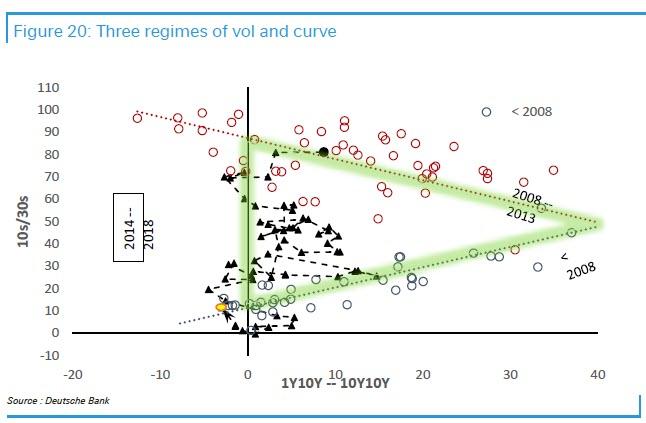
As the DB strategist writes, while the shape of curve and volatility term structure have a logical connection, “their relationship has undergone structural shifts as a consequence of significant changes in the market structure and conditions.” To wit, Kocic highlights three distinct regimes between these two key market vairables.
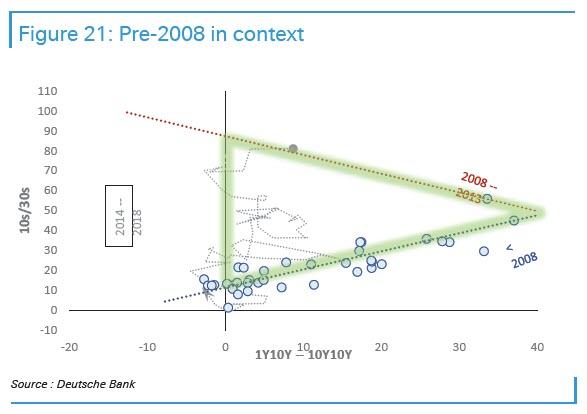
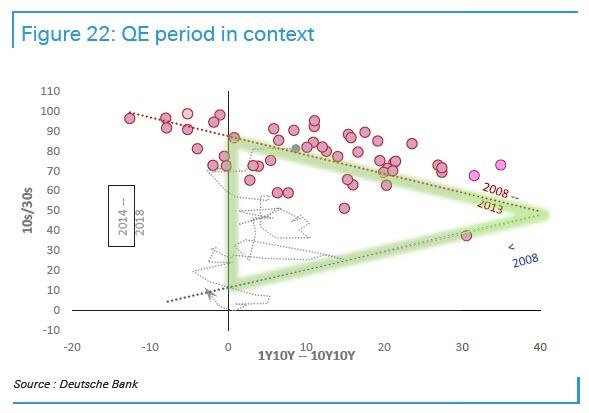
This is shown in the next chart which highlights the interplay between inversion of the vol surface and the 10s/30s slope of the curve. When seen in this context, Kocic claims that the current flattening of the yield curve is consistent with the surface if taken for what it really is, i.e. as a result of compression of risk premia, rather than a forecast of recession.
Looking at the three temporal regimes defined by Kocic, we start with…
Pre-2008: here, in this pre-central bank time, vol and curve were unified by carry. Kocic explains: “While logically the two are related, the transmission that reinforced that bond was mortgage convexity hedging. As both recession and mortgage prepayment are low rates phenomena, bid for rates volatility was reinforced in recessionary markets as mortgage hedgers became more active. Curve moved in bull steepening and bear flattening mode. Volatile bull steepening and calm bear flatteners associated with rate hikes were the stylized facts of that period.”
Post-2008: To the DB strategist, this period marks “the period of nationalization of negative mortgage convexity and severance of the traditional transmission mechanisms as well as the structural shift between the curve and vol interaction.” The front end of the curve was anchored and the referendum on effectiveness of the monetary policy was expressed by the back end. Bull flatteners marked volatile risk-off episodes while bear steepeners, being a positive verdict on QE, were calming, risk-on modes.
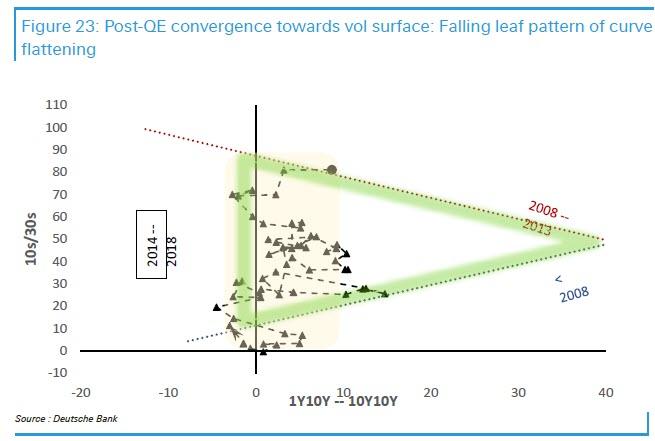
Describing the post-2008 phase in other words, the post-QE period “marks a gradual and systematic curve flattening while vol remained low and surface disinverted” amid the collapse of risk premia. To make his point that the yield curve is no longer signal but merely noise, i.e., it chases vol, Kocic claims that “the curve has converged to where volatility surface has already settled. The flattening pressure was a function of the tight fiscal policy, regulations, and supply shocks in oil.” As such the post-2014 sub-period marks “a systematic compression of risk premia across the board with markets continuing to align with slower growth, lack of excitement across extended horizons and a likely shift towards more aggressive savings.”
Going back to his analogy that we no live in a period where “there are no longer casualties of big “collisions”, only parking accidents”, Kocic next argues that this mode of curve repricing is consistent with the expectations of mild shocks and their persistent effect, and that the vol market “has captured this through low mean reversion, with lower vol and surface inversion remaining in a tight range, while other risk premia collapsed (Figure).”
Assuming this take is accurate, what does it imply for the future of volatility?
In the context of the reflexive relationship between vol and yield, at this point, volatility would appear to be a prisoner of the curve. Regressing to an analogy he has repeatedly used in the past, Kocic argues that the spread between short and long rate – “the playground that defines the range of what can possibly happen” – is now so tight that it does not allow any substantial range in rates, and therefore no meaningful rise in volatility.
The logical next question is what could prompt a spike in the spread in rates, to which the “derivative(s) Zizek” writes that “outside of tail risk, the first step in creating conditions for bear steepeners is a move towards tolerating higher inflation. This could be achieved by a change of inflation targeting policy. Additional disorder could follow the relaxing of the regulatory constraints, which would free bank balance sheets and boost the credit impulse that could possibly stimulate investment and in turn lead to higher productivity growth.”
However, a problem emerges, as the demand-side has to be addressed at the same time. Indeed, the new technologies that would attract investment now destroy more jobs than they create as “the old paradigm does not seem to be capable of achieving these goals; it has failed to deliver desired results, while the new one is politically difficult to pass.” This, then brings us to the above core argument, namely that any effort in this direction is a source of further political volatility and dissipation of consensus which further stifles change. Paradoxically, one event that could restore some vol is an easier Fed, or as Kocic explains:
Adjustment of monetary policy through rate cuts would free some room for rates to move by opening the policy gap, the spread between long rate and near-term Fed expectations, from below. This is a temporary rise in realized volatility but without steepening of the long end of the curve.
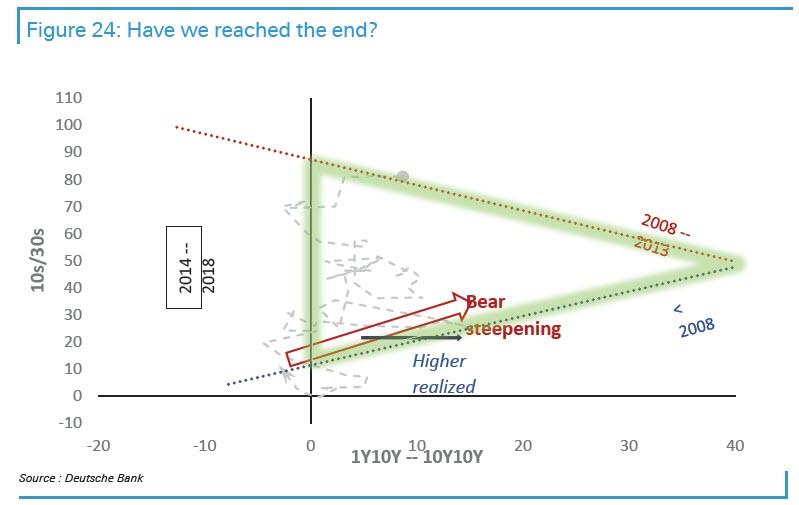
Which brings us to the conclusion: barring the abovementioned “fat tail”, Kocic asks “have we reached the end“ of the post-2008 phase of collapsing vol and flattening yield curve, and parallel to that “what could create conditions for volatility return?”
The answer here is that while there are two directions of curve-vol reshaping, Kocic argues that the main boost for volatility “is to liberate the right side of the (rates) distribution” which would mean “that higher rates and steeper curve have to be allowed.” In this mode, gamma would lead the way followed by the disinversion of the long-dated sector. The chart below shows two directions of change, i.e. curve first needs to steepen before realized volatility can rise.
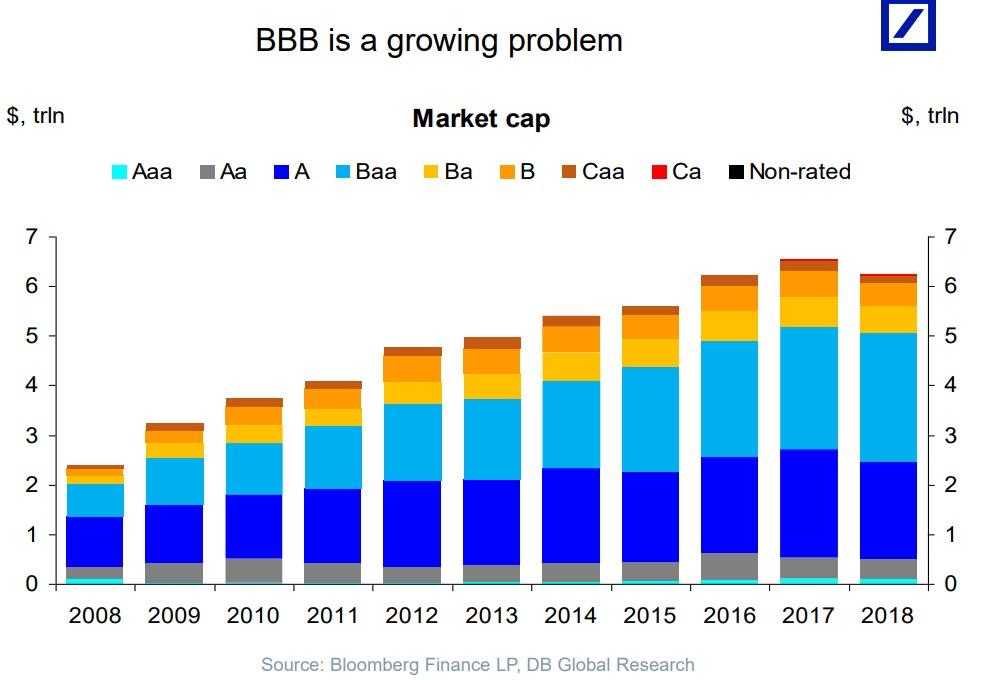
This is also the “vol shift mode that could take us closer to the tail risk as concentrated risks in the corporates.” Incidentally, this takes us back full circle to what so many analysts believe will be the source of the next crisis: the wholesale prolapse of the BBB-rated investment grade space, a tsunami of “fallen angels” that would obliterate the junk bond market as it more than doubles in size overnight from $1.1 trillion, and catalyzes the next financial crash. Or, as Kocic puts it, “the global hunt for yield has encouraged investors to move down the credit spectrum to enhance returns. Within the IG universe, BBB issuance has grown significantly.” This is shown in the chart below, which shows that more than 50% of the entire IG index is now BBB-rated.
To Kocic, this is also the most negatively convex sector which is sensitive to spread wideners in steepening sell off. In other words, a possible wholesale downgrade to BB or lower would result in disorderly unwind of positions of the IG money managers which would be capable of raising volatility significantly. From there it would promptly spread to the rest of the market, and global economy, and lead to the next financial crisis. What happens to vol then should be clear to anyone.
The good news is that, at least in the near term, it appears that not much can go wrong as “there seems to be an embedded mechanism that dampens the volatility away from the upper left corner.” In fact, and ironically, at this moment it appears that the Fed seems to be the only source of shocks with their effects localized at the front end of the curve and the upper left corner of the volatility surface. For long tenor vol (gamma or vega alike) to revive, we need bear steepening of the curve.
That said, to Kocic the worst case scenario, as note above, is a bear-steepener, which “is seen as tail risk that would cause the most violent repricing in credit.” Which incidentally is precisely what we said one month ago, if with far fewer words in “Curve Inversion Is Bad, But It’s The Steepening After That Kills.”
via ZeroHedge News http://bit.ly/2DCFKzk Tyler Durden
There wasn’t a group of people more wrong about the 2008 financial crisis than those at the Federal Reserve.
Mere months before the disaster hit in earnest, the nation’s highest economic and financial officials were vocal that there was nothing to worry about.
Most memorable of these are perhaps two comments from former Fed Chairman Ben Bernanke…
In January 2008, he said, “The Federal Reserve is not currently forecasting a recession.”
And later that year, in July, he said Fannie Mae and Freddie Mac – the two government-sponsored enterprises that kicked off the credit crisis a few months later – were “in no danger of failing.”
And it wasn’t just Bernanke. The same delusional sentiment was echoed by almost all the top Fed and Treasury officials… as well as those in the mainstream financial media and academia.
Of course, we all know how things played out…
When the housing bubble burst in 2008, the effects rippled throughout the economy, kicking off the largest financial and economic crisis since the Great Depression.
And the S&P 500 – a good proxy for the U.S. stock market – went on to fall by over 56%.
The reason I’m telling you this today is to remind you that people exhibit laughable sentiments near the peak of bull markets.
And today, we’re hearing much of the same sentiment that was displayed before the 2008 crisis.
But as you’ll see below, it’s not the only sign I’m seeing of a coming crisis…
And as I’m about to show you, there are clear indicators of a coming crisis… in the auto sector… the housing sector… and in the economy as a whole.
Despite this, Fed Chairman Jerome Powell recently said, “I don’t see a recession [in 2019].” And when asked if the bull market can go on indefinitely, he said:
Not every business cycle is going to last forever, but no reason to believe this cycle can’t go on for quite some time, effectively indefinitely.
We don’t see the kind of buildup in risks in the financial markets, let alone the banking system.
That echoed Powell’s predecessor, Janet Yellen, who said this in 2017 when asked about the next financial crisis:
Would I say there will never, ever be another financial crisis? You know probably that would be going too far, but I do think we’re much safer and I hope that it will not be in our lifetimes and I don’t believe it will be.
But there are a few reasons why I’m not convinced…
About-Face
Despite all this bullish talk, the Fed recently did a 180 on its tightening of monetary policy.
If you remember, the Fed has been steadily raising rates since December 2015. It raised them four times in 2018 alone… and in December last year, it claimed it would raise them twice in 2019.
But at its meeting last month, the Fed announced it would likely not raise interest rates in 2019, and it would likely raise them only once in 2020.
Here’s why this about-face matters…
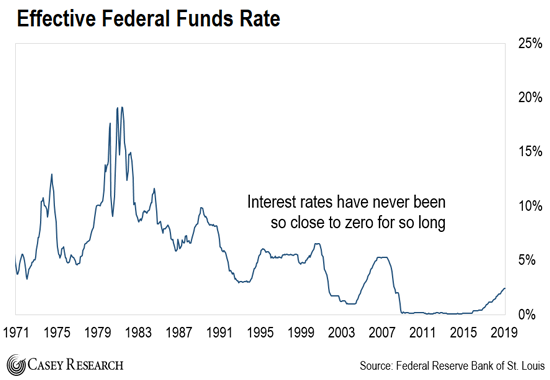
Interest rates are barely coming off the lowest levels they’ve been in all of human history.
The Fed artificially brought rates down to 0% after the 2008 crisis and kept them there for over six years. You can see this in the next chart:
The Fed also announced it would phase out its balance sheet reduction program in the fall.
You might recall that the Fed created $3.7 trillion out of thin air in the wake of the 2008 crisis, under its money-printing programs euphemistically known as quantitative easing, or QE. That money was used to buy bonds, which sit on the Fed’s bloated balance sheet.
Now, some people think the Fed saved the day by pushing pause on its rate hikes. After all, it claims it’s doing this as a precaution “in light of global economic and financial developments.”
But I don’t buy it.
In fact, this whole charade proves to me that a crash is already underway – as the Fed inadvertently admitted we’re on the cusp of big problems.
After all, why would the Fed stop tightening monetary policy if it thinks there’s no chance of a recession?
Trouble Ahead
Something doesn’t add up. And at the core of this charade is the fact that the U.S. economy is hooked on artificially low interest rates.
You see, the damage from the previous rate hikes and balance sheet reduction is already done.
For one, the cost to service debt has gone up across the board. And that could be fatal for many companies and entire industries that have grown dependent on artificially low rates.
After nearly six years of 0% interest rates, the U.S. economy is hooked on easy money.
It can’t even tolerate a modest reduction in the Fed’s balance sheet and 2.25% interest rates, which are still far below historical averages.
And we’re already seeing this take its toll in industries most dependent on easy money and 0% interest rates – the housing and auto markets.
“Constrained Financial Conditions”
For example, single-family new-home groundbreakings recently plummeted to a four-year low. That’s lower than what analysts had expected.
Then there’s the fact that housing sales are contracting in ways not seen since the last crisis.
And John Williams, the president and CEO of the New York Fed, says we’re seeing signs of a construction slowdown. The culprits, he says, are “constrained financial conditions.”
This might be the closest we get to the Fed admitting that the modest rise in interest rates is hurting the housing market.
But we don’t need the Fed to admit anything. We can already see this weakness in homebuilding stocks.
Take the SPDR S&P Homebuilders ETF (XHB), for example. This fund tracks the performance of companies with exposure to homebuilding activity.
Before the Fed announced its pause, XHB had collapsed over 33% from its peak last year. Today, it’s still down over 13%.
And like I mentioned earlier, the car market is also getting hit.
Auto sales in the first quarter of 2019 are off to their slowest start in six years. And they’re expected to be 4.9% lower than a year ago.
At the same time financing costs are surging, overall car prices are hitting record highs. And in February, auto loans were the most expensive they’ve been over the past 10 years.
Higher interest rates and tighter credit in the future will make further growth almost impossible.
Shockwaves
The point of all this is that, in the weeks ahead, we will see shockwaves spread out, not only through the car and housing industries, but the economy overall.
That’s why now is a good time to take a close look at your portfolio.
Look at every position you own, and ask yourself: Would I be comfortable holding this through a recession… or even a crisis?
If the answer is no, consider lightening up on those weaker positions.
This way, you won’t have to worry about losing all your wealth in the recession I see coming.
via ZeroHedge News http://bit.ly/2Ld0bc7 Tyler Durden
A businessman from Christchurch, New Zealand pleaded guilty to two charges of distributing footage of the Al Noor Mosque attack, according to the New Zealand Herald.
Philip Neville Arps was convicted on both charges, one of which was for sharing raw footage from accused shooter Brenton Tarrant’s rampage to approximately 30 people on Facebook.
Neville’s other charge was for requesting that another person modify the footage by overlaying crosshairs and a “kill count,” which the court heard that he intended to distribute as an internet meme.
The 44-year-old Arps said that the modified footage was “awesome,” according to a police statement.
In 2016, Arps was convicted of offensive behavior for filming himself giving a hitler salute while delivering boxes of pigs heads and offal to the Al Noor mosque, according to the Herald.
“White power. … Bring on the cull,” said Arps, owner of Beneficial Insulation, the logo for which is an ancient sun-wheel symbol reintroduced by Heinrich Himmler during Nazi Germany.
50 people were killed in two consecutive terrorist attacks were carried out on March 15 by 28-year-old Australian Brenton Tarrant, who posted about his attack beforehand over internet message boards – which included a link to his Facebook livestream.
The video, as well as a 74-page manifesto posted by Tarrant titled “The Great Replacement,” were deemed “objectionable” by New Zealand’s Chief Censor, making them unlawful to possess or distribute within the country.
via ZeroHedge News http://bit.ly/2IM6O3h Tyler Durden
It’s no secret that socialism – in all its forms – doesn’t work very well.
You soon run out of other people’s money. And people don’t always want to give up their money readily. Or let you boss them around.
Inevitably, the more ambitious your plans, the more people you need to kill.
Reform Capitalism
But today, we turn our attention to those who say we need to “reform” capitalism to save it.
In this category, we lump all those who claim to support free markets – such as most of today’s Republicans and Democrats – but still think they can make them work better, with trade barriers, phony tax cuts, fake money, fake interest rates, regulations, controls, etc., etc.
Journalist Edward Luce, for example, writing in the Financial Times, explained that we need to “save American capitalism from itself.”
Whenever you read somebody in a newspaper suggest that “we need to,” you can be almost sure that the next words are nonsense. This is no exception.
“The question America’s financial and tech elites must ask,” Luce continues, “is ‘what price social peace?’”
Circuses are not enough; the mob wants more bread. And after having cheated them out of trillions, Luce thinks we should at least toss them a few crumbs.
Winners and Losers
The first thing we notice is that anyone who says he wants to “reform” or “improve” capitalism must not know what it is. Capitalism doesn’t allow you to pick winners and losers. There is no way to improve it. And it doesn’t care whether there is “social peace” or not.
It is a free spirit… wandering around, with no knowable destination… going where it whilst, at its own speed, in its own way.
Where it will end up, no one knows; but wherever it is… it is where it should be. And it must be left alone, unmolested and undisturbed… or it will end up somewhere else!
Which is precisely what so aggravates the world improvers. AOC and Bernie Sanders whoop for socialism because they think capitalism has failed.
The reformers – Luce and Dalio – think it has succeeded too well; leaving the masses hopelessly behind.
But the lynch mob – socialists and capitalist apologists alike – has grabbed the wrong man.
America’s economy is not really capitalist.It is a form of late, degenerate state-controlled, crony-manipulated, empire-addled, pseudo-capitalist claptrap. And you can quote us on that!
A quarter of the economy is directly run by the feds. Another quarter – including medical care and education – is guided and approved by them. And the remainder is chock-a-block with rules and regulations… All of them intended to upgrade, or at least to genetically modify, the fruits of naked capitalism.
We don’t know what America would look like if capitalism were permitted. But it would certainly be a whole lot richer. Especially the working stiffs.
Socialism is always a drag on an economy. And the more the feds decide who wins and who loses, the more they tilt the playing field to favor their friends, cronies, and the Deep State elite.
We’ve seen studies suggesting that if economic freedom had been allowed in the USA, average incomes would be more than twice what they are today.
JPMorgan Chase CEO, Jamie Dimon, says the U.S. economy should have added $4 trillion more to GDP in the last decade alone; it should have grown by 40%, not 20%, he says.
“Why have productivity and economic growth been so anemic,” he asks? Good question. And here’s the companion question that Edward Luce should have asked: “How come the rich got so rich while everyone else was losing ground?”
Here’s why…
Giveaways and Throwaways
Every year, trillions of dollars of output are wasted. Silly wars, goofball programs, giveaways, and throwaways – at least half the federal budget is tossed down the drain.
In fact, the government’s entire monthly budget was sunk on just three federal spending items: Social Security, Medicare, and interest on the national debt.
Then, too, all the paperwork, delays, malinvestments, tax filings, labor-law mandates, make-work, and standing in line demanded by the feds must easily cost the nation another few trillion.
And we haven’t even gotten to the big losses, caused by the feds’ fake money system. There, of course, is where we find the real source of the “inequality” that so worries Obama, Ray Dalio, AOC, and so many others.
It was not capitalism that boosted stock prices close to 150% of GDP while wages flattened. Normally, the stock market is worth about 80% of GDP. That would mean about $16 trillion worth of stocks today. But at 150%, investors – the rich and the elite – got some $14 trillion more.
Where did that money come from? Why were America’s corporations suddenly worth so much more?
Looking at pre-tax earnings, we see that corporate America hardly made a penny more in 2018 than it had in 2012. In an honest, capitalist system there was no reason for stocks to go up. But the fix was in.
The feds were lending fake money at fake rates, so the corporations could earn fake profits and buy back their own shares with free money.
The result? A huge shift of wealth from the middle classes of Main Street to the upper classes of Wall Street, Washington, and cronies everywhere.
Did these pseudo-capitalists say “Thank You”? You bet they did!
They slipped the feds campaign contributions; they offered jobs in their think tanks and lobbying firms; they gave them lavish “speaking fees” for blah-blahing about nothing to people who weren’t even listening.
And now, having banged, bent, and bamboozled capitalism for their own ends…
…and feeling perhaps a little guilty… and worrying that the masses might be getting restless… they propose to take a sledgehammer to what’s left of it.
* * *
Clearly, there are many strange things afoot in the world. Distortions of markets, distortions of culture. It’s wise to wonder what’s going to happen, and to take advantage of growth while also being prepared for crisis. How will you protect yourself in the next crisis? See our PDF guide that will show you exactly how. Click here to download it now.
via ZeroHedge News http://bit.ly/2IPhoXd Tyler Durden
Ride-hailing platform Shenma Zhuanche is demanding that Tesla compensate them for losses incurred after claiming that more than 20% of their cars are faulty, according to the Global Times.
Based in the city of Chengdu in China’s southwestern Sichuan province, Shenma is the largest single buyer of Teslas in the Asia-Pacific region, according to the Times, with 278 of the electric vehicles purchased from 2016 to 2017.
The company also knocked the inefficiency and unresponsiveness of Tesla’s customer service – claiming that some of the vehicles took over a year-and-a-half to be repaired, causing the company direct economic losses of up t 6.5 million yuan ($970,000).
In order to let the (Chinese speaking) world know about their Tesla issues, Shenma took to Times Square – where they took out several billboards to advertise their woes with such phrases as “Can not repair” and “Don’t pay for it!” while also demanding that Tesla repair the defective vehicles and compensate them for their losses.
“Shenma Special Car” a Chinese company upset with the low quality of the 278 Teslas it purchased, is going to pay for ads to be put on the Times Square Reuters billboard saying, “Can not repair” and “Don’t pay for it!”@danahull@lopezlinette@lorakolodny@CGrantWSJpic.twitter.com/i3loP6idUv