An 80-year-old woman in Bootle, England, was handed a £50 fine ($65 U.S.) by code enforcement for walking her dog on a leash that was too long. The officers who cited her warned her the fine would increase to £2,500 ($3,200) if she did not pay it in two weeks. After local media picked up the story, the local council dropped the charge.
from Latest – Reason.com http://bit.ly/2VD7i1o
via IFTTT
Q: What is the result of the Symposium in Florence?
Michel Chossudovsky: The event was a great success, with the participation of speakers from the United States, Europe and Russia. We presented the history of NATO. We identified and carefully documented its crimes against humanity. And at the end of the Symposium, we presented the “Declaration of Florence,” a way of exiting the war system.
Q:In your introduction, you affirmed that the Atlantic Alliance is not a true alliance…
Michel Chossudovsky: On the contrary, under the appearance of a multinational military alliance, it is the Pentagon which dominates the decision-making mechanisms of NATO. The USA controls the command structures of NATO, which are incorporated with those of the United States. The Supreme Allied Commander in Europe (SACEUR) is always a US General nominated by Washington. The Secretary General, currently Jens Stoltenberg, is essentially a bureaucrat who handles public relations. He has no decision-making role.
Q:Another theme you raised was that of the US military bases in Italy and other European countries, including in the East, despite the fact that the Warsaw Pact has not existed since 1991, and despite the promise made to Gorbachev that no extension of NATO towards the East would ever occur. What is the purpose of these bases?
Michel Chossudovsky: NATO’s tacit objective – an important theme in our debate in Florence – is to implement, under a different denomination, the de facto “military occupation” of Western Europe. The United States not only continue to “occupy” the ex-members of the Second World War “Axis countries” (Italy, Germany), but have used the badge of NATO to set up US military bases in all of Western Europe, and, thereafter, in Eastern Europe in the wake of the Cold War, and in the Balkans in the wake of the NATO war against Yugoslavia (Serbia-Montenegro).
Q:What has changed in terms of the possible use of nuclear weapons?
Michel Chossudovsky: Immediately after the Cold War, a new nuclear doctrine was formulated, focused on the preventive use of nuclear weapons, in other words, on a nuclear first strike as a means of self-defence. Within the framework of USA-NATO interventions, presented as peace-keeping measures, a new generation of “low power” and “non-usable” nuclear weapons was created, described as “inoffensive for civilians”. US political leaders consider them to be “bombs for pacification.” The Cold War agreements, which established certain safety measures, have now been abandoned. The concept of “Mutually Assured Destruction,” relative to the use of nuclear weapons, has been replaced by the doctrine of preventive nuclear war.
Q:NATO was “obsolete” at the beginning of the Trump presidency, but now it has been rebooted by the White House. What relation is there between the arms race and the economic crisis?
Michel Chossudovsky: War and globalisation go hand in hand. Militarisation relies on the imposition of macro-economic restructuration in the target countries. It imposes military spending in order to support the war economy to the detriment of civil economy. It leads to economic destabilisation and the loss of the power of national institutions. An example – recently President Trump proposed huge budget cuts in the health and teaching sectors, and in social infrastructures, although he has asked for a massive increase in the budget of the Pentagon. At the beginning of his administration, President Trump confirmed the increase of expenditure in the military nuclear programme, launched by Obama, from 1,000 to 1,200 billions of dollars, claiming that this would serve to make the world safer. All over the European Union, the increase in military spending, coupled with austerity measures, is leading to the demise of what used to be called “the Welfare State.” Now, under US pressure, NATO is engaged in increasing military spending, and Secretary General Jens Stoltenberg declares that this is the correct decision to “guarantee the safety of our population.” The military interventions are coupled with concomitant acts of economic sabotage and financial manipulation. The final objective is the conquest of both human and material resources and of political institutions. The acts of war support a process of total economic conquest. The hegemonic project of the United States is to transform countries and international sovereign institutions into territories which are open for their penetration. One of their instruments is the imposition of heavy penalties on debt-ridden countries. The imposition of lethal macro-economic reforms serves to impoverish vast sectors of the world population.
Q:What is now, and what will become the role of the medias?
Michel Chossudovsky:Without the disinformation broadcast, in general, by almost all the medias, the military programme of the USA-NATO would collapse like a house of cards. The imminent dangers of a new war with the most modern weapons and the atomic peril are not the sort of news that makes the headlines. War is presented as an act of pacification. War criminals are depicted as pacifiers. War becomes peace. Reality is reversed. When lies become truth, there is no going back.
via ZeroHedge News http://bit.ly/2ILUlwl Tyler Durden
In the third season finale of Game of Thrones, Melisandre stared into the flames and declared, “This war of five kings means nothing. The true war lies to the north.” As with many of the red priestess’s prophecies, this one contained a small truth and a bigger lie.
Understand this: Game of Thrones‘s primary conflict was not the battle against the Night King, which came to an abrupt conclusion at the climax of the final season’s third episode, “The Long Night.” It’s called Game of Thrones for a reason: This is a show about the ambitions of a slew of characters vying for supreme political power. Our heroes did not vanquish the true enemy last night, because the true enemy was never the Night King: It’s Cersei Lannister, sitting pretty on the Iron Throne in King’s Landing (a location she has never left since returning to it in the third episode of the series).
Frankly, I’m relieved. Unlike George R.R. Martin’s books, where the White Walkers and the Army of Dead are an alluring and mostly unseen threat, the show never did a particularly good job of turning ice zombies into compelling adversaries. While they were occasionally used effectively—particularly in “Hardhome” and “The Door”—their lack of discernible motivation made them uninteresting in larger doses. (Bran’s partial explanation that the Night King seeks to wipe out all memory was a bit too perfunctory for my tastes.)
Whatever they were trying to accomplish, the White Walkers made a serious mistake letting their commander—whose continued existence is apparently necessary to sustain the magic that keeps them intact—waltz right into harm’s way. Arya killed him with a Valyrian steal dagger, fulfilling Melisandre’s earlier prophecy that she would shut “blue eyes” forever. Indeed, Arya fulfilled a lot of prophecies. It would seem that everyone’s favorite Stark is “the prince or princess who was promised,” the Lord of Light’s chosen hero Azor Ahai, etc. This is a bit of a surprise, since it had seemed that either Jon or Daenerys—or both of them—were intended to fulfill such a role. But prophecies are tricky things, as Melisandre has come to understand. We will likely never understand exactly what the Lord of Light was doing, but perhaps his various interventions—the resurrections of Jon and Beric—were really just about getting Arya where she needed to be.
Her task completed, Melisandre allowed herself to succumb to her advanced age and wither away in the snow—an enthralling and graceful end for a fascinating character. Theon and Ser Jorah received fitting send-offs as well, though most of the core cast survived—including Brienne, Podrick, Tormund, and Grey Worm, who all seemed truly doomed at various moments. All named characters hiding in the crypts appeared to survive, as did both dragons and Jon’s direwolf, Ghost. All in all, it was much less death than expected.
No matter. The true war lies to the south, where Cersei is waiting. Various pundits and commentators seem mildly concerned about this development: By offing the Night King in the middle of the season and saving Cersei for later, Game of Thrones is choosing a less fantastical and more conventional endgame. But really, this is GOT playing to its strengths. The Mad Queen is a more fitting villain, and one audiences understand a bit better. We know what she wants, and why she feels she deserves it. We know what she is willing to do to get it. And of course, we know she has some tricks up her sleeves. The Night King is not the only one who can raise the dead to battle the living.
from Latest – Reason.com http://bit.ly/2L82BZD
via IFTTT
With the Irish border the main sticking point in Brexit negotiations, Statista’s Niall McCarthy points out that it may come a surprise to hear that only a quarter of British people actually know who the Irish taoiseach or prime minister is.
YouGov tracks awareness levels of various international politicians among the British public (excluding Northern Ireland) and only 26 percent have heard of Irish Taoiseach Leo Varadkar.
In the third season finale of Game of Thrones, Melisandre stared into the flames and declared, “This war of five kings means nothing. The true war lies to the north.” As with many of the red priestess’s prophecies, this one contained a small truth and a bigger lie.
Understand this: Game of Thrones‘s primary conflict was not the battle against the Night King, which came to an abrupt conclusion at the climax of the final season’s third episode, “The Long Night.” It’s called Game of Thrones for a reason: This is a show about the ambitions of a slew of characters vying for supreme political power. Our heroes did not vanquish the true enemy last night, because the true enemy was never the Night King: It’s Cersei Lannister, sitting pretty on the Iron Throne in King’s Landing (a location she has never left since returning to it in the third episode of the series).
Frankly, I’m relieved. Unlike George R.R. Martin’s books, where the White Walkers and the Army of Dead are an alluring and mostly unseen threat, the show never did a particularly good job of turning ice zombies into compelling adversaries. While they were occasionally used effectively—particularly in “Hardhome” and “The Door”—their lack of discernible motivation made them uninteresting in larger doses. (Bran’s partial explanation that the Night King seeks to wipe out all memory was a bit too perfunctory for my tastes.)
Whatever they were trying to accomplish, the White Walkers made a serious mistake letting their commander—whose continued existence is apparently necessary to sustain the magic that keeps them intact—waltz right into harm’s way. Arya killed him with a Valyrian steal dagger, fulfilling Melisandre’s earlier prophecy that she would shut “blue eyes” forever. Indeed, Arya fulfilled a lot of prophecies. It would seem that everyone’s favorite Stark is “the prince or princess who was promised,” the Lord of Light’s chosen hero Azor Ahai, etc. This is a bit of a surprise, since it had seemed that either Jon or Daenerys—or both of them—were intended to fulfill such a role. But prophecies are tricky things, as Melisandre has come to understand. We will likely never understand exactly what the Lord of Light was doing, but perhaps his various interventions—the resurrections of Jon and Beric—were really just about getting Arya where she needed to be.
Her task completed, Melisandre allowed herself to succumb to her advanced age and wither away in the snow—an enthralling and graceful end for a fascinating character. Theon and Ser Jorah received fitting send-offs as well, though most of the core cast survived—including Brienne, Podrick, Tormund, and Grey Worm, who all seemed truly doomed at various moments. All named characters hiding in the crypts appeared to survive, as did both dragons and Jon’s direwolf, Ghost. All in all, it was much less death than expected.
No matter. The true war lies to the south, where Cersei is waiting. Various pundits and commentators seem mildly concerned about this development: By offing the Night King in the middle of the season and saving Cersei for later, Game of Thrones is choosing a less fantastical and more conventional endgame. But really, this is GOT playing to its strengths. The Mad Queen is a more fitting villain, and one audiences understand a bit better. We know what she wants, and why she feels she deserves it. We know what she is willing to do to get it. And of course, we know she has some tricks up her sleeves. The Night King is not the only one who can raise the dead to battle the living.
from Latest – Reason.com http://bit.ly/2L82BZD
via IFTTT
Islamic extremists have seen that the West has not mobilized to prevent them from repressing Christians, as if unconsciously there were a strange convergence between our silence and the ethnic cleansing project of the Islamic State, aimed at erasing Christians.
“Religious liberty, the core value of western civilisation, is being destroyed across large parts of the world. Yet the West, myopically denying this religious war, is averting its gaze…” — Melanie Phillips, British journalist, The Times, November 17, 2014.
The Duke of Cambridge, Prince William, just visited the Muslim survivors of the attack on the mosques in Christchurch, New Zealand. Why does the same compassion not spur the British royal family to stop in Sri Lanka, their former colony, to meet the Christian survivors, before going back to England?
The appeal of Asia Bibi’s daughters to help her mother met a deaf West. The UK refused to offer asylum to this persecuted Pakistani Christian family.
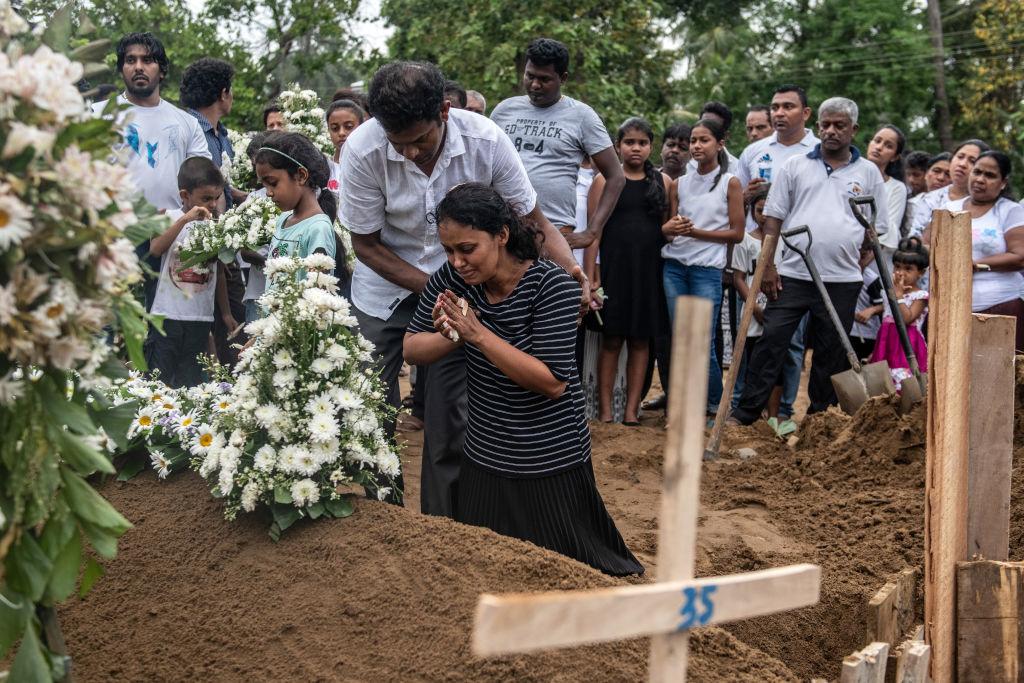
Sri Lanka after the jihadist massacre of Christians is not just a terrible succession of crying mothers and little coffins. Unfortunately, it also tells us a lot about the discouraging state of the West. Pictured: The funeral of one of the victims of the April 21 Easter Sunday attack in Sri Lanka. (Photo by Carl Court/Getty Images)
“Where is the solidarity for the Sri Lanka’s Christians?” asked the British scholar Rakib Ehsan, a Muslim.
“The differences in tone and nature between the condemnations of the Christchurch and Sri Lanka terrorist attacks are striking. After Christchurch, there was no hesitation about stating the religious backgrounds of the victims and directing emotion and affection towards Muslim communities. Politicians took no issue with categorising the events in Christchurch as terrorism.
“In contrast, the words ‘terrorism’ and ‘Christianity’, along with their associated terms, have so far failed to feature in much of the reaction to the attacks in Sri Lanka.
“What is evident is not only a clear reluctance to specify the religious background of Christians who were killed in Sri Lanka, but also an absence of heartfelt solidarity with Christian communities across the world, which continue to suffer grave forms of persecution on the grounds of their faith.”
Rakib Ehsan asked the right question. But it might be rewritten as: Where is the Western solidarity for the Sri Lanka’s murdered Christians?
This is a drama in three acts. The first act consists of the Christians and other non-Muslim indigenous peoples being violated and murdered. The second act consists of Muslim extremists who create this genocide. And the third act consists of the indifferent West, which looks everywhere else.
The number of murdered victims in the April 21 Easter Sunday jihadist attacks in Sri Lanka is too terrible even to think about: 253 dead. Among the victims, 45 children were murdered. Their small faces and stories have begun to emerge. The Islamic terrorists knew there were many children in the three churches, and they deliberately targeted them with their bombs. Footage shows one of the bombers patting a young child on the head before he enters the St. Sebastian’s Church in Negombo, where “everyone has lost someone“.
The Fernando family had taken a photograph at the baptism of their third child, Seth. In Negombo they were all buried together. Father, mother and three children aged 6, 4, and 11 months. According to the New York Times:
“Fabiola Fernando, 6, was an elementary school student. In a photo posted to her mother’s Facebook page, she showed off a gold medal, a small smile on her face. Leona Fernando, 4, the middle child in her family, was learning to read and was holding a copy of “Sleeping Beauty” in the picture. Seth Fernando, 11 months, was the newest addition to the Fernando family. He was buried alongside his parents and two sisters.”
The silence of the Western intellectual world and the media is particularly deafening. The new humanitarian conscience seems to see only two groups: those who have the right to the compassion and protection of the international community, and those, such as Christians, unworthy of help or solidarity.
The deliberate murder of an 8-month-old baby, Matthew, in a Sri Lankan church apparently did not upset or chill the West, did not go viral on social media, did not to become a hashtag, did not to push the Europeans to crowd into their public squares, did not press the Islamic world to examine its conscience, did not to induce Western politicians and opinion-makers seriously to reflect on who killed that child, or on those who foment and finance the Islamist anti-Christian hatred.
Sudesh Kolonne was waiting outside St. Sebastian’s Church when he heard the blast. He then ran inside and searched for his wife and daughter. It took him a half hour to find their bodies.
The attacks also killed three children of a Danish billionaire. Another woman losther daughter, son, husband, sister-in-law and two nieces. A British father had to make a choice over which of his two children to save. Another British family was destroyed. To add horror to horror, the pregnant wife of one of the terrorists, when police raided her home, detonated a suicide vest, killing her own children.
The Duke of Cambridge, Prince William, just visited the Muslim survivors of the attack on the mosques in Christchurch, New Zealand, including children recovering in the hospitals. It was a gesture of humanity and compassion. Why does the same compassion not spur the British royal family to stop in Sri Lanka, their former colony, to meet the Christian survivors, before going back to England? Entire Christian families were decimated in the attack.
Where is the outrage in the West for the annihilation of Christian life and people? It feels as if there is no indignation, only silence, interrupted by bombs and “Allahu Akbar”. The history books of the future will not condone this Western betrayal. If the West had taken seriously the persecutions of Christians, now the bell would not toll for the death of the Christian presence — not only in historic lands of Christianity, but also for the West. Islamic extremists have seen that the West has not mobilized to prevent them from repressing Christians, as if unconsciously there were a strange convergence between our silence and the ethnic cleansing project of the Islamic State, aimed at erasing Christians.
The British author Melanie Phillips has called this persecution of Christians “our guilty secret.”
“Religious liberty, the core value of western civilisation, is being destroyed across large parts of the world. Yet the West, myopically denying this religious war, is averting its gaze from the destruction of its foundational creed in the Middle East and the attempt to eradicate it elsewhere. It is therefore no surprise that, faced with jihadist barbarities abroad and cultural inroads at home, the free world is proving so ineffectual”.
The jihadist attack in Sri Lanka was not only “the deadliest attack on Christians in South Asia in recent memory.” It was also the largest massacre of Christian children. But no newspaper has launched a campaign to raise awareness of European public opinion, no pro-Christian solidarity movement has arisen, no Western leader appears to have visited a church in solidarity, no Western church leaders had the courage to point out the culprits by calling them by name, no Western mayors hung photographs of the 45 children torn to pieces, no public square was filled in thousands saying “Je suis chrétien”.
A few years ago, at the height of the migrant crisis in Europe, a photograph conquered public opinion in the West. It was the famous picture of the three-year-old Syrian boy, Alan Kurdi, who drowned off the coast of Bodrum, Turkey. That little migrant moved the West. His image went viral. The New York Times called it “Aylan Kurdi’s Europe“.
“For historical reasons, Angela Merkel feared images of armed German police confronting civilians on our borders,” wroteRobin Alexander,Die Welt’s leading journalist, in his book, Die Getriebenen (“The Driven Ones”). If photographs of migrant children spurred Europe’s leaders to open their borders, the photographs of murdered Christian children — such as the 45 in Sri Lanka — apparently left them indifferent.
The appeal of Asia Bibi’s daughters to help her mother met a deaf West. The UK refused to offer asylum to this Pakistani Christian family and take persecuted Christians.
“It is with indifference that we witness a catastrophe of civilization with no precedent”, wrote the French scholar historian Jean-François Colosimo, commenting on the destruction of Eastern Christianity. No religion, no community, is today more persecuted than Christians. Why, then, this silence by the West? Have we become so foreign to ourselves, to our roots and to our history, that we can contemplate this outbreak of jihadi violence without blinking an eye? Or are we so short-sighted that we hoped to buy “peace” with the Muslim extremists at the cost of abandoning those Christians? The same jihadi ideology that murdered Christian children in Sri Lanka, targeted European children in Nice, Manchester and Barcelona.
Sri Lanka after the massacre is not just a terrible succession of crying mothers and little coffins. Unfortunately, it also tells us a lot about the discouraging state of the West.
via ZeroHedge News http://bit.ly/2vqUmwX Tyler Durden
Liberal cities across America are collapsing into Third World status. It’s not just the fact that San Francisco’s streets are now littered with drug needles and human feces, either. Seattle is also collapsing into rampant homelessness and drug addiction, creating an entire class of impoverished, homeless residents who are breeding grounds for HIV and other infectious diseases.
Yet Seattle’s liberal city leaders — like all “progressives” — are unwilling to take any action to resolve the problems in the first place. Instead, they enact new policies that make the problems worse while calling it “progress.”
Local reporter Eric Johnson recently released a documentary called Seattle is Dying which dared to document the city’s collapse into Third World status. (See video below.) But instead of working to resolve the root of the problem (i.e. brain dead liberal economic policies that always lead to destitution and collapse), the city’s elite have launched a P.R. campaign to brainwash local citizens with engineered happy messages that are dutifully broadcast by local news networks.
Earlier this month, leaked documents revealed that a group of prominent nonprofits—the Bill & Melinda Gates Foundation, the Campion Advocacy Fund, the Raikes Foundation, and the Ballmer Group—hired a PR firm, Pyramid Communications, to conduct polling, create messaging, and disseminate the resulting content through a network of silent partners in academia, the press, government, and the nonprofit sector. The campaign, #SeattleForAll, is a case study in what writer James Lindsay calls “idea laundering”—creating misinformation and legitimizing it as objective truth through repetition in sympathetic media.
This propaganda campaign, of course, is exactly what the vaccine industry does on a daily basis all across America. Monsanto and the GMO industry has been pursuing the same dishonest tactics for years. First, they fabricate industry lies and pay off doctors and health experts to sign their names to industry-funded junk science. Then they issue propaganda directives to the corporate-run media which dutifully broadcasts all their propaganda. From there, the tech giants shadowban and de-platform anyone who opposes the “official narrative.”
So now, Seattle’s wealthy elite are trying to brainwash the population into rejecting the evidence right in front of their own eyes. Seattle is rapidly turning into a s##thole liberal city, because liberals destroy everything they control.
Although it’s verboten to mention this in the we’re-so-fabulous local media, many of these high-cost urban regions are hopelessly dysfunctional. Taxpayers have ponied up billions of dollars in new taxes, fees and bond measures, and yet none of the problems that make daily life miserable ever get better.
The forced flight from unaffordable and dysfunctional urban regions is as yet a trickle, but watch what happens when a recession causes widespread layoffs in high-wage sectors and suddenly the hipster bistro that was always jammed is empty, and then shuttered. To replaced the taxes lost to layoffs and closed businesses, the political class will have no choice but to launch a frenzy of higher taxes, fees and surcharges on those left behind.
Every liberal city headed toward a Venezuela-style collapse
This story is about much more than just Seattle. What every American needs to understand is that liberals are right now in the process of economically gutting every major U.S. city that’s under their control.
Chicago, Los Angeles, San Francisco, New York City, Houston, Miami, Denver, Portland and other liberal cities are all headed toward total economic and humanitarian disaster. Leftist policies always breed homelessness, drug addiction, disease and starvation. In cities like Seattle, the government even pays for needles and drugs to continue supporting the substance abuse habits of local citizens. If liberals regain the White House in the future, they will do the same thing to America that they’re right now doing to Seattle.
Instead of solving problems, liberals would much rather portray those who suffer from the problems as “victims” of oppression. Yet it’s the liberal / Democrat policies that are creating these nightmare conditions to begin with, driving people out of jobs with mandatory minimum wage hikes, for example, that also cause business owners to flee the cities and states run by liberals.
Remember: Left-wing societies are characterized by authoritarian, wealthy elitists who rule over the impoverished masses while destroying the middle class. That’s exactly what’s happening across the West Coast liberal cities today.
Listen to my recent podcast which explains more about where this is all headed:
And get out of the liberal cities while you still can. Sooner or later, they are going to start confiscating pensions and private property to fund their insane spending sprees in a desperate effort to keep buying votes from the very same people they have trapped in a cycle of poverty and hopelessness.
There will come a day when you can no longer sell your home in Chicago, for example, because the government’s confiscatory taxes on all real estate sales will make it nearly pointless to engage in real estate transactions at all.
It’s all going to hit the fan in the coming years, and liberal cities will collapse much like Venezuela. Get out while you can still sell your property for something close to its actual value. Buy a place in the country and practice self-reliance.
via ZeroHedge News http://bit.ly/2GJcKX3 Tyler Durden
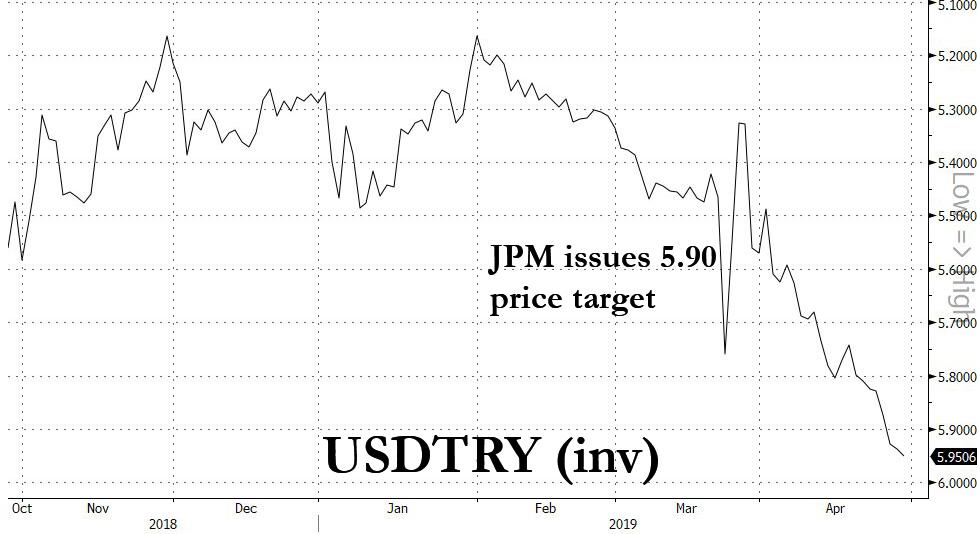
One month ago, on March 22, when the Turkish lira suddenly cracked, and suffered what was then its biggest one-day drop since last summer’s crisis as public attention turned to the sudden plunge in the nation’s reserves and the bank’s unexpected 150bps equivalent tightening in policy, JPMorgan FX strategists poured gasoline on the fire when – as the lira was sliding – they published a note recommending a 5.90 target on the USDTRY.
As JPM analysts Anezka Christovova and Saad Siddiqui wrote then, recommending a lira short, Turkish authorities would likely “attach less significance to lira stability and reduce FX reserve support” for the currency following March 31 elections, resulting in further lira weakness, adding that the pace at which Turkey’s burning net foreign reserves is “unsustainable” and therefore “FX reserve support will abate post local elections on March 31, which could lead to USDTRY trading substantially higher.”
Predictably, it also prompted Erdogan’s anger, with Turkey’s banking and capital markets regulators opening separate investigations into JPMorgan Chase the bank’s recommendation to short the lira.
Desperate to create a scapegoat for the sudden plunge in the currency, which as it turned out had since last summer been artificially propped up by local banks (while the central bank pretended not to intervene and thus misrepresented the true level of its reserves), Turkey delighted at the opportunity to blame the plunge in the lira, which is only just now restarting, on JPMorgan. As a result, the banking regulator BRSA said the JPMorgan analysts’ note had “misguiding and manipulative” content that resulted in volatility in markets and hurt the reputation of Turkish banks, according to state news agency Anadolu. The Capital Markets Board began its own investigation on similar grounds, according to a statement on its website.
In the month since then, the lira plunge has only accelerated, and whether the result of JPM’s short reco or the fact that the central bank was misrepresenting its reserves by roughly 100%, the lira has since plunged well below JPM’s 5.90 target, hitting 5.95 against the dollar on Friday; and so the fury at JPMorgan was promptly forgotten.
But now, a new bank has decided to take JPMorgan’s spot and provoke Erdogan’s ire, with a fresh lira short recommendation, that sees the Turkish lira crashing to its lowest level on record within 12 months.
In a note published late on Friday by Goldman Sachs, the bank’s FX strategist Zach Pandl has assured himself immediate detention, or worse, should he ever step foot on Turkish soil, by predicting that the Turkish central bank’s move away from boosting confidence in the lira is likely to send the currency sliding to levels last seen during the mid-2018 crisis, and worse.
According to Goldman, the unexpected removal last week by the central bank of its pledge for additional tightening if needed “opened the door” to both interest-rate cuts and further currency depreciation.
“Rates are still not high enough to restore confidence in the lira,” as indicated by continuing “dollarization”, or the increasing share of foreign-exchange deposits in the banking system, Goldman economists Murat Unur and Clemens Grafe wrote in separate note April 25 according to Bloomberg. They also wrote that the central bank will “need to take action to stabilize the lira,” adding that “savers require higher risk premia to be willing to hold a higher share of their deposits in TRY.”
As a result, Goldman projects TRY to fall to 6.25 in three months, 6.5 in six months, and crash to an all time low of 7 within 12 months, marking a 15% slide in coming year. On Sunday night, Lira was trading at 5.9500.
The full Goldman note is below:
TRY: TCMB opens the door to a cut (and more currency depreciation). On Thursday the TCMB kept its policy rate unchanged at 24%, but removed its tightening bias which stated, “if needed, further tightening would be delivered”. By removing this bias, the central bank opened the door to not only a rate cut at its next meeting on June 12 but also further currency depreciation. The sharp hike in policy rates last year was a necessary condition to stabilize the Lira; and while the policy rate is high enough to achieve a balanced current account, a renewed series of cuts will not help with anchoring inflation expectations or stemming the degree of ongoing dollarization in the economy. Our economists have raised their year-end inflation forecasts to +14% yoy by year-end, taking into account the depreciation of the Lira in recent weeks, and we are rolling our forecasts to show even further depreciation (USD/TRY to 6.25, 6.50 and 7.00 in 3, 6 and 12 months).
We expect Turkey will launch a probe into Goldman’s tentacular ways within 24 hours.
via ZeroHedge News http://bit.ly/2J2jsKH Tyler Durden
While most Americans know May 1st as May Day, a holiday that once was celebrated with mayday poles and flowers, most people across the world know the day as Labor Day.
The story of how May 1st became Labor Day actually begins in the U.S. in 1886. As Statista’s Sarah Feldman notes, workers across the U.S. coordinated a multi-day protest starting on May 1st in multiple cities to agitate for an eight-hour workday. On the second day of protests, violence between police and peaceful protestors broke out in Chicago at an event that became known as the Haymarket affair. By 1889, the International Socialist Conference declared May 1st an international holiday for labor now known as International Workers’ Day.
That held true in the U.S. too, until 1958 when President Eisenhower, reacting to the anti-communist tensions of the early Cold War, signed a resolution naming May 1st “Loyalty Day” to avoid association with the universalist, workers first-language that the day was known for. Loyalty Day is not widely celebrated or commemorated in the United States, while Labor Day in the U.S. occurs during the first weekend of September.
Much like attitudes towards labor have changed over time and place, the current culture around working hours change based on where in the world a worker is employed.
According to the OECDin Mexico, the average worker works the most hours a year, putting in over 2,200 hours of labor. South Korea comes in second with slightly over 2,000 hours of work per year. The United States is just 34 hours above the OECD average, while the average German worker enjoys around 1,356 average annual hours of work, 390 hours below the OECD average.
via ZeroHedge News http://bit.ly/2vrJkYs Tyler Durden
Spain’s ruling socialist party led by prime minister Pedro Sanchez is set to regain control with his left-leaning allies close to a majority following Sunday’s vote for Spain’s Congress of Deputies, although based on most all of the votes counted, he would need a handful of votes from Catalan separatists, which may prove to be problematic.
According to Goldman Sachs, based on a projections of votes counted by 11:45 pm BST (roughly 99.8% of the sections where votes have been collected for Congress and about 89% for the Senate) point to a hung Parliament, in line with indications from opinion and exit polls. In other words, as expected no party has won enough votes to form a government on its own. The Socialist Party (PSOE) is projected to be the party with the highest share of seats in Parliament. And while Goldman expects that it will take time for a new government to be put in place, a center-left coalition led by PSOE is likely to emerge as a government, potentially with the support of a moderate group of Basque separatists.
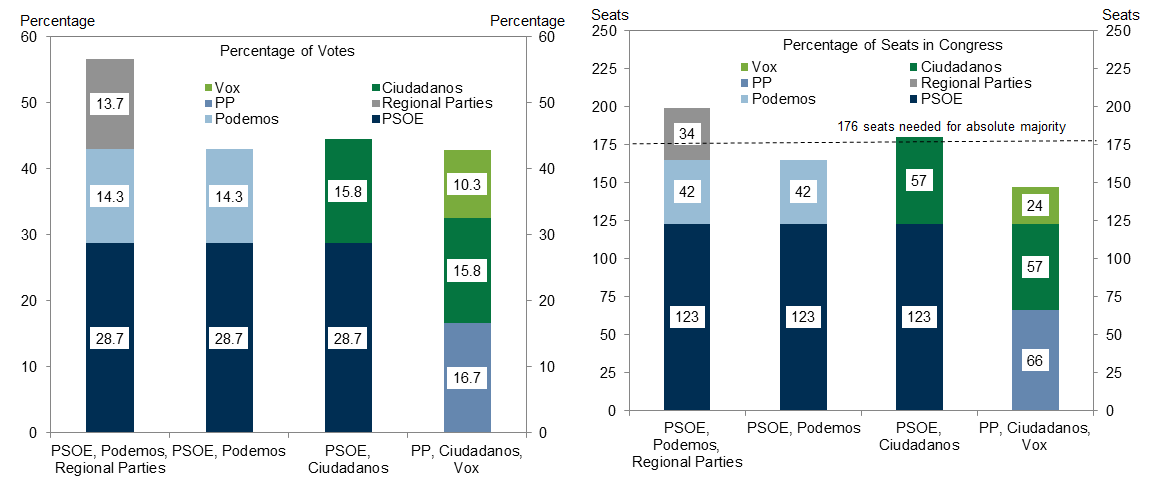
As Bloomberg adds, the ruling Socialists are on track to win 123 seats, up from 85 in 2016. Its left-wing ally Podemos platform has another 42 seats while the Basque Nationalists, another group close to Sanchez, has six. That would give Sanchez 171 seats, just shy of the 176 he would need for a majority. The moderate Catalan separatist group Esquerra Republicana has another 15 seats and has signaled its willing to help. This could give the 47-year-old premier a shot at forming Spain’s first stable government in almost four years and enable him to chart a way forward for the country after years of economic crisis and political turmoil.
It will mean a government in Madrid that seeks conciliation rather than confrontation with the separatists controlling Catalonia and will make him the standard bearer for social democracy in Europe
Notably, a second Sanchez government would reverse the trend of a collapse in voter support for Europe’s other center-left parties. He achieved this by boosting the minimum wage and pension payments while remaining committed to spending within the fiscal limits set by the European Union. While Sanchez had already served 10 months as the head of a minority government, he was forced to call a snap election when he failed to pass his budget.
Also of note: a new nationalist party has emerged “to motivate supporters, who have historically been less reliable than voters on the right” according to Bloomberg. Vox is set to win seats in parliament for the first time, but its 24 seats suggest it’s set to fall short of expectations and the huge buzz around their sudden emergence on the political scene. Vox’s parliamentary presence will mean Spain is no longer exempt from the right-wing populism that’s swept across Europe and the U.S. But unlike Italy and some other European nations, Spain remains a particularly enthusiastic member of the European Union. Not even Vox is suggesting pulling out.
The traditional conservative group, the People’s Party, lost about half its seats and will have 67 deputies in the new parliament.
Vote Highlights via Goldman:
On 28 April, all 350 seats in the Spanish Congress of Deputies were up for election, as well as 208 of the 266 seats in the Spanish Senate. According to projections based on votes counted by 11.45 pm BST, the allocation of seats in Congress is as follows:
Socialist Party (PSOE) – centre-left: 123 seats (28.7% of votes)
People’s Party (PP) – centre-right: 66 seats (16.7% of votes)
Ciudadanos party – liberal: 57 seats (15.8% of votes)
Unidos Podemos – left-leaning: 42 seats (14.3% of votes)
Vox – right-leaning: 24 seats (10.3% of votes)
Small regional parties: 38 seats (14.2% of votes).
1. The general election has delivered a hung Congress, with no party winning an absolute majority of seats. About 89% of votes have been counted for the Senate, and projections show that PSOE has a majority of seats (122 seats out of 208). A coalition government is likely to emerge but only after lengthy negotiations among political parties, which will likely start only after the regional and European elections on May 26. Forming a government could prove challenging given how fragmented Congress is.
2. A centre-left coalition of PSOE, Unidos Podemos and regional nationalist parties from the Basque Country, Valencia, the Canary Islands and Catalonia (including the separatist Catalan Republican Left, ERC and Catalan European Democratic Party, PdeCAT), would have the strongest majority in Congress, controlling 199 seats, of which 123 seats would be held by PSOE, 42 by Unidos Podemos and 34 by regional parties (of which 10 are from regional non-separatist parties, and 24 from separatist parties). But, it could prove challenging to form such a government, since regional nationalist parties, which did not vote in favour of the government budget in March causing the government’s collapse, would play a critical role in the coalition.
3. Two other possible coalitions would not have the majority of seats in Congress (176) needed to form a majority government. A centre-left coalition of PSOE and Unidos Podemos would have 165 seats and a centre-right coalition government formed by PP, Ciudadanos and Vox would have 147 seats. Finally, the centre-left coalition of PSOE and Ciudadanos would have an absolute majority of seats in Congress (180 seats), but, so far, Ciudadanos has denied the potential for such a coalition because of differences with PSOE over how to confront the separatist movement in Catalonia.
4. Given the fragmentation in Congress, the possibility of a minority government can not be excluded, or that a government cannot be formed as happened in 2015. Also, it could be possible that any coalition government that may eventually emerge will not remain in power for the entire term and that new elections will be necessary at some point in the future, before the end of the legislature.
5. Political and policy uncertainty will be of little consequence for the 2019 economic outlook, but the type of government that emerges from the general election could matter for Spain’s medium-term outlook.
via ZeroHedge News http://bit.ly/2VvuI8T Tyler Durden