Tesla filed its keenly-awaited 10-Q for the first quarter 2019 this morning, and the document was full of additional color on the company’s horrific Q1 earnings report, which missed analyst estimates by a mile and caused the stock to crater more than 10% in the days following the report.
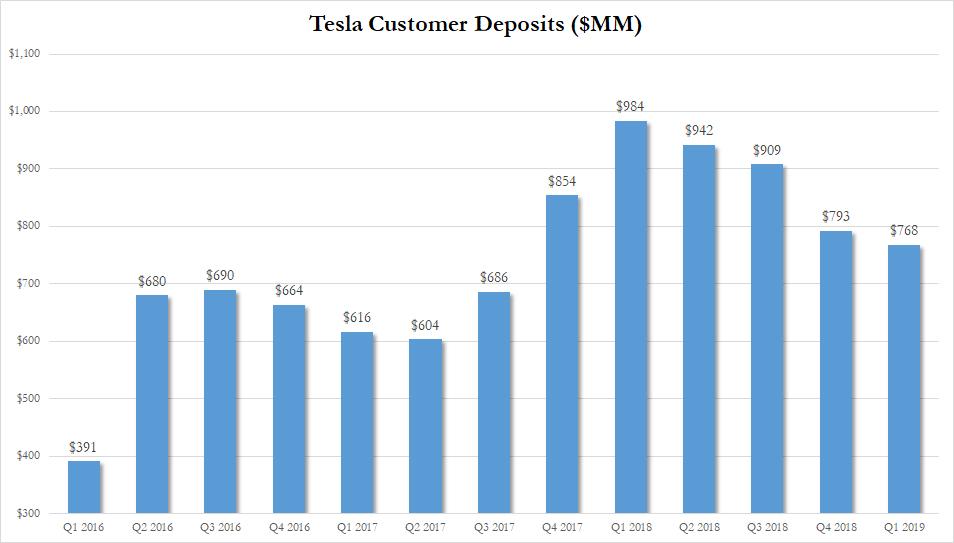
Hilariously, the company turned more of its focus to the Model Y in the 10-Q, saying that production of the new model will reach “high volume” by the end of 2020. This is also funny because, as we first reported, customer deposits actually decreased after the introduction of the Model Y.
And so while the company may be producing at a high-volume come 2020, but the demand is another question.
$TSLA customer deposits fell QoQ despite launch of model Y
The company also said it has ’adequate’ liquidity over at least the next 12 months and that capital expenditures would be $2.5 billion to $3 billion annually for next two fiscal years. As we’ve already questioned, we don’t know where the company is going to get the cash to meet its capex guide for the rest of the 2019.
The company also said that cash generated from its core operations would be “generally be sufficient to cover our future capital expenditures and to pay down our near-term debt obligation,” but then said it “may choose to seek alternative financing sources”. The financing questions continue: why include language about alternative financing? Is the company free to tap the equity markets, as it has claimed? If it does, would there be a bid? Have the credit markets soured to Tesla? It smells like the next financing could come from individual investors or Beijing – or perhaps debtors in possession.
By the end of 2019, Tesla is still guiding to produce 7,000 Model 3s per week – a run rate that the company hasn’t really even come close to achieving, but has talked about several times. Tesla has been notorious for missing its production run rate guidance for the Model 3 – and its guidance in general – over the last couple years, as one user pointed out.
The company also took Elon Musk’s 500,000 yearly total unit guidance that recently got him in trouble with the SEC and claimed that they would shift that forward six months, meeting the goal of 500,000 units produced in 12 month period by June 30, 2020.
Finally, Twitter weighed in with some additional “anomalies”, including the company’s sale of $216 million in regulatory credits during the quarter, observing that without them, company’s automotive gross margins were below 10%.
$TSLA sold $216 MM of regulatory credits in the 1Q. True automotive gross margins (incl Service) were well below 10% this quarter. pic.twitter.com/EiJNSejmKv
It was also noted that the company’s Q1 cash included $140M from that “$500 million” FCA deal the company signed weeks ago:
Wow. $TSLA‘s Q1 cash included $140MM from FCA that it has to earn over the next 2-3 years by delivering cars in Europe. FCA bought indulgences at a discount from the most desperate seller. Tesla can’t replicate this again for years to come. $TSLAQhttps://t.co/MStuYILUsd
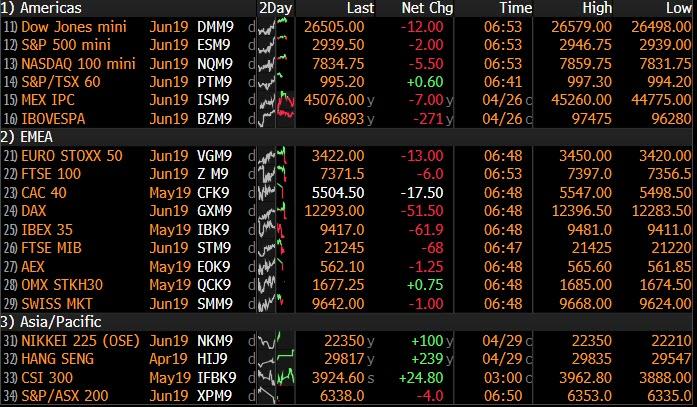
US equity futures and European bourses drifted lower, failing to carry over Asian optimism into Monday trading, while Chinese stocks extended the worst weekly loss of 2019 with another 0.8% drop to start the week despite profits at Chinese industrial firms growing for the first time in four months and a strong GDP print, if only superficially, on Friday. Most European markets were mostly in the red, with Italy sliding despite S&P reaffirming Italy’s BBB rating late on Friday, while the dollar rose alongside US Treasury yields, while the yen slumped as Japan remains closed for a weeklong holiday.
The MSCI All-Country World Index was flat after the start of European trading, lifted higher by Asian markets (ex China) but pressured by poor European trading. After rising initially, the Stoxx 600 dropped to session lows while the Spain’s IBEX 35 index underperformed peers, down over half a percent after Prime Minister Pedro Sanchez overcame a challenge from nationalists in elections on Sunday. The elections had little immediate impact on the country’s bond market. Shares in Italian banks got a boost and Italian government bonds rallied after S&P Global affirmed Italy’s sovereign credit rating.
Also in Europe, the ECB reported that Eurozone credit growth decelerated markedly despite decent M3 growth, as loan growth to firms decreased to 3.5% in March from 3.8% in Feb, while loans to households stood at 3.2% in March, down from 3.3% in Feb.
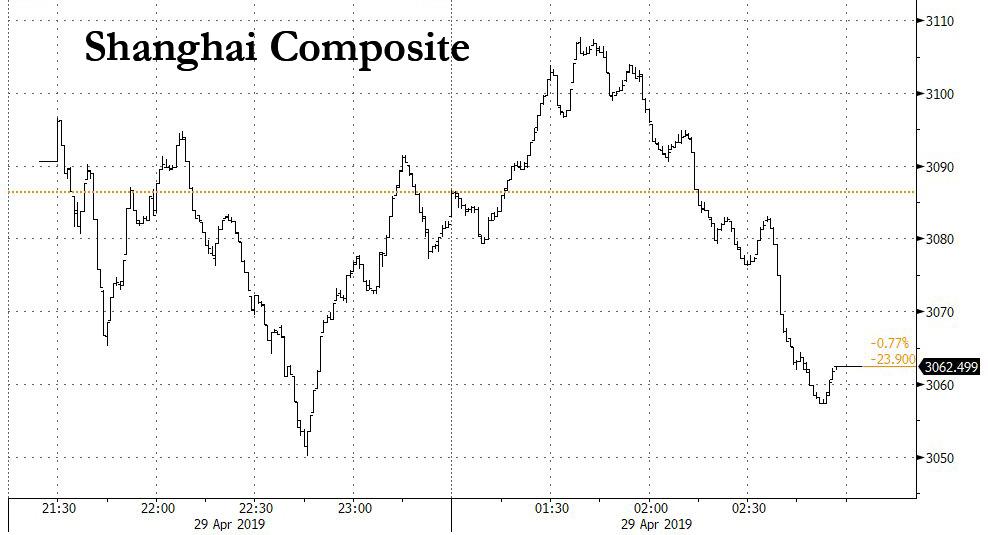
Earlier in the session, a similar see-saw pattern was observed in Chinese stocks, which initially moved higher but closed near session lows, down 0.8% after losing 5.6% last week, the worst of 2019.
The latest Chinese data showed industrial profits grew in March after four months of contraction, but analysts said sentiment remained fragile. Economists polled by Reuters expect factory activity in the world’s second largest economy to grow at a steady but modest pace in April.
Australian shares were down 0.4% after hitting an 11-year closing high on Friday, while Seoul’s KOSPI was up 1.4 percent. While Japan’s cash markets are closed for a long national holiday this week, Nikkei 225 futures index in Singapore was 0.9% higher.
Emerging-market stocks headed for their biggest advance in almost two weeks and currencies traded stronger for a second day after the S&P 500 hit a record on Friday while the dollar rally cooled.
In currencies, with Japan on an extended break, currency markets were calm ahead of the FOMC meeting and U.S. jobs numbers. The dollar was 0.2 percent higher against the yen at 111.74, and the euro was up 0.1 percent at $1.1162. The dollar index, which tracks the greenback against a basket of six major rivals, slipped 0.03 percent to 97.985. South Africa’s rand led the gains, set for its best run in almost a month with elections approaching at the start of May. Turkey’s lira edged higher even as Goldman Sachs Group Inc. questioned the central bank’s credibility and predicted losses for the currency over the coming 12 months. The pound led Group-of-10 currency gains as some strategists predicted the Bank of England to adopt a slightly more hawkish tone at this week’s meeting. The euro held up and bunds slipped amid fading fears of political instability in Spain, with Pedro Sanchez set to return as prime minister after Sunday’s election saw the Socialists emerge as winners.
Monday’s directionless trading followed data showing U.S. gross domestic product grew at a 3.2% annualized rate in the first quarter, but the internals were far weaker. Nomura FX strategist Jordan Rochester noted last week’s U.S. GDP was driven by a surge in inventories, government spending, and a big contribution from net trade. “None of those are likely to be sustained, hence why market reaction was limited,” he said in a note to clients. “But overall, the past week has been dominated by higher U.S. equity prices and consequently a U.S. dollar outperformance story. In our view, this week should see a test of that new trend,” he said, referencing upcoming economic data this week.
Investors were mostly on the sidelines ahead of an event-packed week, and were looking forward to the latest Fed meeting and Chinese factory data for further clues on policy direction in the world’s biggest economies.
“For stock traders, it seems that the important catalysts are pointing higher: the U.S. sees strong domestic growth, low inflation keeps the Fed at bay and could potentially trigger a rate cut so it seems that equities have nowhere to go but higher – at least in the short term,” said Konstantinos Anthis, head of research at ADSS.
The March reading for core personal consumption expenditures (PCE), the Fed’s favored inflation measure, is due later on Monday. The central bank’s Federal Open Market Committee (FOMC) will announce its policy decision on Wednesday, with Chair Powell expected to balance the strong domestic growth data against persistent concerns over the global outlook. Markets will also be looking to global factory activity surveys this week, particularly official and private readings on Chinese manufacturing which will both be released on Tuesday.
Alphabet is the highlight of Monday’s earnings, with Spotify and NXP Semiconductors also reporting. Data on personal income and spending is due.
In commodities, oil prices fell, extending a slump from Friday that ended weeks of rallying, after President Donald Trump demanded that producer club OPEC raise output to soften the impact of U.S. sanctions against Iran. Brent crude fell half a percent to $71.80 per barrel. Spot gold was down 0.3 percent, trading at $1,281.81 per ounce
Market Snapshot
S&P 500 futures down 0.1% at 2,939
STOXX Europe 600 up 0.1% to 391.55
MXAP up 0.3% to 162.56
MXAPJ up 0.5% to 540.49
Nikkei down 0.2% to 22,258.73
Topix down 0.2% to 1,617.93
Hang Seng Index up 1% to 29,892.81
Shanghai Composite down 0.8% to 3,062.50
Sensex up 0.9% to 39,067.33
Australia S&P/ASX 200 down 0.4% to 6,359.49
Kospi up 1.7% to 2,216.43
German 10Y yield rose 1.5 bps to -0.007%
Euro up 0.07% to $1.1159
Brent Futures down 0.7% to $71.67/bbl
Italian 10Y yield fell 10.3 bps to 2.213%
Spanish 10Y yield fell 1.9 bps to 1.005%
Brent Futures down 0.7% at $71.67/bbl
Gold spot down 0.4% at $1,281.70
U.S. Dollar Index down 0.02% at 97.98
Top Overnight Headlines from Bloomberg
Socialist Sanchez is set to return as prime minister of Spain with his left-leaning allies close to a majority, though he may still rely on Catalan separatists to govern
Economic confidence in the euro area dropped for a 10th month in April to the lowest in more than two years, indicating the region may struggle to pick up from its recent slump
The next round of China-U.S. trade talks will get under way in Beijing this week with significant issues still unresolved, according to a senior Trump administration official
The Bank of England got its Brexit forecasts wrong, according to lawmakers and pundits. Mark Carney would beg to differ, and has defended pre-referendum predictions that a vote to leave would lead to slower growth, a drop in the pound and faster inflation — all of which transpired
China’s largest lenders posted increases in first-quarter profit and higher interest income as authorities encouraged fresh lending to support the economy. Industrial & Commercial Bank of China Ltd., Agricultural Bank of China Ltd., Bank of Communications Co. and Bank of China Ltd. reported net income rose as much as 4.9 percent in the three months ended March 31
Chinese industrial firms’ profits rose 13.9% in March y/y, vs a 14% decline in the first two months of this year combined
President Trump urged Japan to end tariffs on U.S. farm products when he met Prime Minister Shinzo Abe, who appears to have deflected the most damaging U.S. demands on trade weeks before the pair are likely to meet again
Asian equities traded mixed despite last Friday’s gains on Wall St where strong Q1 GDP and soft Core PCE Prices suggested a Goldilocks economy and propelled US stock markets to fresh record closes, as this week’s looming risk events and holiday closures restricted upside for the region. ASX 200 (-0.4%) was the laggard amid losses in its largest-weighted financials sector and with energy names also downbeat after a pullback in oil prices, while this week’s array of key releases including Chinese PMI, US NFP, BoE and FOMC announcements also added to the tentative tone. Elsewhere, Hang Seng (+0.9%) was positive after data showed Chinese Industrial Profits recovered in March and with focus on earnings including Agricultural Bank of China which kicked off the Big 4 bank earnings with an improvement in Q1 net, while Shanghai Comp. (-0.7%) was less decisive after the PBoC refrained from liquidity operations and with the mainland only open for the first 2 days of this week. As a reminder, Japan is closed until May 7th.
Top Asian News
CIC Said to Estimate 3-4% Overseas Investment Loss for 2018
China Firm’s Plunge Is Said to Cost Interactive Brokers Millions
Thai Finance Ministry Cuts 2019 GDP Growth, Export Forecasts
Goldman Says These Australia Stocks at Risk of Profit Warnings
Major European indices are choppy but overall marginally lower [Euro Stoxx 50 -0.5%], following on from their Asian counterparts ahead of a week with multiple market closures and several key risk events. Sectors are similarly mixed, with some mild underperformance seen in energy names in-line with the complex in general. The IBEX 35 (-0.4%) is lagging its peers this morning following on from the Spanish elections where the incumbent Socialist party emerged as the only one with the potential to form a coalition; within the index utility names are underperforming, which is dragging the utility sector in general down, with some speculation that this may be due to the success of the far right Vox party which secured 24 seats. Downside in utilities likely stemming from pledges by Vox to keep nuclear plants open, which contradicts the incumbent socialist party’s policies of closing nuclear plants and supporting renewable energy, which has been beneficial to Spanish utility names. Notable movers this morning include, Altice (+5.1%) who have reportedly attracted 3 potential bidders for their fibre optic network. Following the dissolution of merger discussions, Commerzbank (+1.6%) have rebutted speculation that the Co. may be sold, stating that they are strong enough alone and their customer relationships remain intact. Elsewhere, Bayer (-2.5%) are down after a spokesman stated that the majority of the Co’s investors voted against ratifying the executive boards 2018 business conduct, for reference the Co. are trading ex-div today.
Top European News
Czech Bank Stocks Slump as Babis Mulls Turnaround on Extra Tax
Caius Capital Hires Credit Analysts in Distressed-Debt Expansion
Opus Jumps to Highest Since January on China-Linked Rail Deal
UBS Banker Cleared After Seeing Tip on Eurostar Neighbor’s Phone
In FX, the Greenback has regained some composure after last Friday’s post-data downturn, but remains on a mixed footing vs G10 peers and EM currencies at the start of what looks like a busy/pivotal week on paper at least. First up, more inflation data and the Fed’s preferred price measure in the form of core y/y PCE following softer than expected Q1 reads within the advance GDP release, and then it’s month end on Tuesday with FX rebalancing models suggesting a Usd sell signal that could be countered to an extent by supportive SOMA flows. On to May 1, and the FOMC follows the first NFP proxies for Friday via the ADP survey plus employment readings in the manufacturing PMI and ISM. In the run up, the index is straddling 98.000 in a relatively narrow 98.066-97.917 range, with last week’s new 98.330 ytd peak providing resistance vs support at 97.693 that held on Friday.
GBP/EUR/AUD/NZD – Cable continues to display resilience ahead of the 1.2900 handle even though Brexit remains up in the air and talks between the Tory and Labour Party are still grid-locked, but the Pound is still looking toppy around 1.2950 amidst offers at 1.2945 (last month’s low) and with DMAs in close proximity (100 and 200 from 1.2962-65). Similarly, the single currency is finding support off 1.1100 and 2019 lows, as mostly weaker than forecast Eurozone sentiment indicators are countered by a degree of relief post-Spanish election and S&P reaffirming Italy’s BBB rating. Meanwhile, an improvement in Chinese industrial profits and latest US-China trade reports suggesting negotiations are reaching the last stretch are propping up the Aussie and Kiwi circa 0.7050 and 0.6670 respectively.
CHF/CAD/JPY – All on a more even keel vs the Usd and in relatively thin confines as the Franc meanders between 1.0200-1.0185 and Loonie roams from 1.3472-51 amidst a further pull-back in crude and ahead of tomorrow’s Canadian monthly GDP and PPI data. Meanwhile, Usd/Jpy has extended its trading parameters, but only to 111.54-77 in the absence of Japanese markets at the start of Golden Week and with strong chart support sub-111.50 as the 30 DMA, 38.2% Fib retracement of April peak to March trough (112.40-109.70) and last week’s low all fall at 111.37.
EM – At last some respite for the beleaguered Lira as an improvement in Turkish industrial confidence nudges Usd/Try off near 5.9600 peaks awaiting Tuesday’s CBRT inflation report for more independent impetus. As we reported last night, Goldman Sachs sees EUR/USD declining to 1.10 in the next 3 months and DXY rising to 99.00, while it suggested global growth is unlikely to be strong enough to weigh on the greenback. Furthermore, Goldman Sachs forecasts USD/TRY at 6.25 in 3 months, 6.50 in 6 months and 7.00 in 12 months.
In commodities, Brent (-0.9%) and WTI (-0.5%) prices are subdued in reaction to US President Trump’s comments on Friday that he contacted OPEC and told them to lower oil prices; although, there were subsequent reports that OPEC or Saudi officials have not spoken to President Trump regarding oil prices. However, some of the downside was mitigated by the Baker Hughes total rig count which fell by 21, with oil rigs falling by 20 to 805 in the steepest decline since January. Regarding the Iranian waivers a Trump Official says there is no wind down period or short-term waiver being considered for China’s oil purchases from Iran, and that it should be easy for China to comply as business with the US is more important for them than Iran. Elsewhere, sources report that exports of Nigeria’s Amenam crude oil is currently under a force majeure; these exports are operated by Total and typically equal 100k BPD. Gold (-0.3%) is marginally weaker, although the yellow metal is trading within a relatively narrow USD 5/oz range. After the metal printed its biggest daily gain in over a month on Friday, following US data which was disappointing in-spite of the larger than expected headline GDP print of 3.2%. Elsewhere, China’s Iron and Steel association stated that the industry is at risk from excess capacity which could impact profits in the industry.
US Event Calendar
8:30am: Personal Income, est. 0.4%, prior 0.2%
8:30am: Personal Spending, est. 0.7%; Real Personal Spending, est. 0.3%
8:30am: PCE Deflator MoM, est. 0.3%; PCE Deflator YoY, est. 1.6%
8:30am: PCE Core Deflator MoM, est. 0.1%; PCE Core Deflator YoY, est. 1.7%
10:30am: Dallas Fed Manf. Activity, est. 10, prior 8.3
DB’s Craig Nicol concludes the overnight wrap
If markets had the excuse of having too few catalysts to trade off in the last couple of weeks then the same excuse need not apply this week as we’ve got a star-studded line of up events to look forward to. We’ll touch on them in more detail further down but to whet the appetite they include Fed and BoE policy meetings, the latest US employment report, the final PMIs around the world, Q1 GDP in the Euro Area, various inflation readings in the US and Europe, more US and China trade talks and another bumper week of earnings. Last week it felt like the market was having a bit of a tug of war on the global growth narrative particularly with the US versus Europe story and then separately DM versus EM. So, this week could be a very important test and could very well go a long way to answering some of the lingering questions out there at the moment.
All that to look forward to then but in the meantime, it’s straight to the weekend news where the highlight was the election in Spain. With all votes counted, the centre-left PSOE was the clear winner with 123 seats and 28.7% of the vote, up from 85 seats in 2016, with 176 needed for a majority. DB’s Marc De-Muizon notes that this was broadly in line with polls. The centre-right PP gained the second most seats but suffered a huge drop, going from 137 seats to 66 seats. Citizens Party gained 57 seats compared to 32 seats previously while Podemos dropped to 42 seats from 71 previously.
Marc highlights in his report this morning (see here ) that there appears to be only two options to form a government that in Sanchez’s words will be a “pro-EU government, to fortify and not weaken Europe”. One is a PSOE-Podemos alliance supported by regionalist and Catalan independent parties. The other is a PSOE-Citizens alliance. The latter does, however, appear fairly unlikely at this point. In any case parties are unlikely to reach an agreement before June given upcoming regional and European elections, so it’s likely to drag on for some time.
The hasn’t been much of a reaction in the Euro post that result, making a modest +0.08% advance this morning. Risk assets more broadly in Asia are lacking direction meanwhile, with the Hang Seng (+0.78%) and Kospi (+1.07%) making decent gains, but the Shanghai Comp (-0.11%) and ASX (-0.51%) both down. Markets in Japan are closed for an extended holiday-week. Meanwhile bond markets are quiet, and US equity futures are slightly up.
Back to this week where for the Fed on Wednesday, while no policy change is expected, all eyes will be on how Powell and the Committee balance the dichotomy of improved growth prospects and easy financial conditions on the one hand and easy softening inflation pressures on the other – as Friday’s Q1 GDP report details showed (more on that below). Our economists ultimately believe that the Committee is likely to continue to emphasize that the current policy remains appropriate and that patience remains the proper prescription. You can see their full preview here .
As for the data, we’ll warm up with the March PCE report in the US today before China’s official April PMIs become the next focal point early tomorrow morning. The Q1 GDP print for the Euro Area in just over 24 hours’ time follows that where the market is looking for a +0.3% qoq reading. There’s little slowdown as Wednesday follows with the April ISM manufacturing reading in the US before we get the final April manufacturing PMIs in Europe on Thursday. A reminder that the Euro Area reading ‘improved’ to 47.8 when we got the flash albeit with <50 readings for Germany and France, with Italy also expected to post a similar reading. If that wasn’t enough then Friday ends with a bang with the April employment report where our economists expect a slight slowdown for nonfarm payrolls growth to 160k, albeit enough to hold the unemployment rate at 3.8%. They also expect earnings to rise +0.2% mom, which would be enough to hold the year-on-year rate at +3.2%.
There’s also the not-so-insignificant obstacle of 164 S&P 500 earnings reports to get through this week including the likes of Google today and Apple tomorrow. And last but by no means least, Lighthizer and Mnuchin travel to Beijing tomorrow for yet another round of trade talks. However, given that both sides have signalled hope of getting to a draft agreement by the end of next month, these talks may go some way to deciding the fate of that pledge. Interestingly, a Bloomberg story this morning suggests that Trump may walk away from talks with China should he not be satisfied with how talks progress this week.
Plenty to keep us all busy then. Turning now to a recap of Friday’s action, where US equities advanced strongly and treasury yields fell. The S&P 500 ended the week +1.20% higher (+0.47% on Friday) as economic data came in stronger-than expected and earnings reports continued to surprise to the upside. With 230 of S&P 500 companies having reported first quarter results, 78% have beaten earnings expectations for an aggregate beat of 5.36%. The surprises have been concentrated in the tech sector (where 24 of 25 companies have beaten profit expectations for a beat of 7.40%) and the consumer discretionary (aggregate beat of 27.02% thanks to Amazon’s 51.60% earnings beat). Earnings also helped the NASDAQ to a +1.85% gain (+0.34% Friday), though the DOW fell -0.06% (+0.31%) as a few large-cap firms like 3M, Intel, and Caterpillar disappointed.
Away from earnings, focus was on the first quarter US GDP report, which surprised to the upside, showing growth 3.2% on an annualized basis. That substantially beat expectations for a print of 2.3%, but the details were less encouraging. Core PCE inflation was 0.1pp lower than expected at 1.3% qoq, which raises the risk that a monthly print will fall to 1.5% mom, possibly worrying the Fed. Inventories and net exports (due to weak import growth) both contributed extra to the headline print, leaving underlying domestic demand running a bit soft at 1.3%. Still, seasonality effects and the government shutdown both weighed a bit on the headline figure.
The print’s softer details helped Treasury yields fall -6.2bps on the week (-3.4bps Friday). Bund yields were down -4.6bps (-1.3bps Friday), while BTPs experienced volatility, rising as much as 10bps earlier in the week only to retrace and end -1.8bps lower (-10.5bps Friday). After markets closed on Friday, ratings agency S&P affirmed Italy’s credit rating at BBB with a negative outlook. WTI oil prices also took a roundtrip on the week, rising as much as +4.06% early in the week after the Trump administration declined to renew waivers on Iran sanctions. They then retraced after US data showed another build in inventories and President Trump tweeted about asking OPEC to increase production, ultimately ending the week -1.20% lower (-2.93% Friday).
via ZeroHedge News http://bit.ly/2ZRRI1s Tyler Durden
It looks like the big banks aren’t the only ones finding new uses for blockchain technology more than a year after the great crypto bubble of 2017 ended in tears for thousands of investors.
In an announcement that came as a pleasant surprise to crypto bulls, British carmaker Jaguar Land Rover announced that it was testing technology to incorporate IOTA wallets into the software of its cars, part of a plan to use the cryptocurrency in a rewards program.
The program would reward drivers with cryptocurrency for sharing data, such as traffic congestion or potholes, with navigation providers and local authorities, while also incentivizing them to participate in ride-sharing programs.
Earned tokens could be used to pay tolls, parking, as well as charging for electric cars. The overall goal was to “achieve zero emissions, zero accidents, and zero congestion,” the company said.
Jaguar doesn’t have a timeline for when the program will see a wide-release; currently, it’s testing the technology with software engineers in Shannon, Ireland.
The British car company is testing the technology at the new Jaguar Land Rover software engineering base in Shannon, Ireland, where engineers have already equipped several vehicles, including the Jaguar F-PACE and Range Rover Velar, with “smart wallet” features, the company said.
It does not yet have a timetable for when it will be commercially available, said Jaguar, a subsidiary of Tata Motors.
The IOTA token is based on a distributed ledger technology that enables people and machines to transfer money and data without any transaction fees. IOTA trades on digital asset exchanges and was last at 27 U.S. cents per token.
During an otherwise mixed period for cryptocurrencies, IOTA surged more than 20% to peak at 32.5 cents per token at around 1 am Eastern Time.
On Twitter, reactions varied. Blockchain true-believers celebrated their ‘vindication’ after last year’s bruising year for crypto. Recent news out of JP Morgan and Jaguar suggests that companies really are looking to permanently integrate blockchain technology into their operations, suggesting that it wasn’t ‘just a fad’.
BREAKING: Jaguar Land Rover has partnered with IOTA to enable car owners & drivers to earn cryptocurrency.
We’re talking digital wallets, tokens, and an entire ecosystem.
Though some were more skeptical…questioning why Jaguar didn’t simply opt to reward its customers with bitcoin, the closest thing to ‘hard money’ in the cryptoverse.
Jaguar will start giving $IOTA as rewards to its drivers…
Then they’ll figure out that IOTA is vaporware…
And instead will do what they should have done all along…
Jaguar Land Rover and IOTA jointly announced the program late Sunday. Though, to be sure, the program is still in its testing phase. However, IOTA insiders touted the program as the first step toward establishing IOTA as the ‘smart wallet technology’ of choice for global automakers looking into these types of rewards programs.
“The smart wallet technology … can be easily adapted into all new vehicles,” Dominik Schiener, IOTA co-founder and co-chairman of its board, told Reuters on Friday. “IOTA wants to enable interoperability with all these different players. So there is no Jaguar coin, no BMW coin, but one universal token for this machine economy.”
In short: While this is a tremendous vote of confidence for IOTA, the program is still in its early phases and could still be abandoned.
via ZeroHedge News http://bit.ly/2IPBCjm Tyler Durden
Though it was entirely ignored by the market, the latest US-China trade-deal headline, which hit late last night, shortly before Robert Lighthizer and Steve Mnuchin were set to leave for Beijing to begin what was supposed to be the ‘final’ round of talks, offers what has become an increasingly rare dose of pessimism right in the Bloomberg headline: With ‘significant issues’ still unresolved (despite Larry Kudlow’s assurances that he was ‘cautiously optimistic’ about a deal breakthrough), President Trump is once again threatening to walk away “if he isn’t satisfied with how talks are progressing.”
According to a White House statement, this week’s talks “will cover trade issues including intellectual property, forced technology transfer, non-tariff barriers, agriculture, services, purchases, and enforcement.”
After this week’s round of talks wraps up, Chinese Vice Premier Liu He will lead a delegation to Washington for talks beginning on May 8. Reports last week suggested that Washington and Beijing had been hoping to announce a tentative deal, and a date for a signing summit between President Trump and Xi Jinping, following the close of last week’s talks.
Though both China and the US recently reported better than expected Q1 growth (though the data underlying the headline weren’t quite so rosy, and some have raised questions about ‘fake growth’, while the pickup in China was likely driven by one of the biggest credit injections on record), gauges of global trade have showed a sharp drop off since the beginning of the year.
Expressing dissatisfaction with Beijing’s willingness to compromise on issues like IP protections (Beijing has reportedly rankled at furhter compromise after passing a law purportedly banning forced technology transfers) and market access, Washington kept China on a “priority watch list” of nations that don’t adequately protect IP rights, according to the annual report of the USTR’s office on IP practices around the world.
Meanwhile, during a speech to 40 world leaders at Beijing’s annual “Belt & Road Initiative” conference, Xi promised to scale back Beijing’s ‘debt trap diplomacy’ and also offered some positive comments about the trade deal.
via ZeroHedge News http://bit.ly/2Wl1UNu Tyler Durden
Robert Crumb is the undisputed godfather of alternative comics. His work has appeared in museums across the world, from the Venice Biennale to New York’s Museum of Modern Art; he was the subject of Terry Zwigoff’s acclaimed documentary Crumb (Gene Siskel’s favorite film of 1994); his drawings are so coveted by collectors that a sale of some sketchbooks in the early 1990s bought him a centuries-old chateau in southeast France. The legendary art critic Robert Hughes has favorably compared his portrayals of the human grotesque to Pieter Bruegel and William Hogarth, declaring Crumb “the one and only genius the 1960s underground produced in visual art, either in America or Europe.”
Nearly every milestone on the long road comics have crawled from derided trash to treasured American art form was inspired either directly or secondhand by Crumb’s choices and achievements. With his first issue of Zap in 1968, Crumb singlehandedly invented a format and sensibility, under the broad label of “underground comix,” that permanently changed how printed cartoon stories are perceived. Along the way, it opened the form to social criticism, history, outrageous satire, and the full range of deeply personal human experience, including the both lightly and darkly sexual.
Crumb’s occasional collaborator Harvey Pekar, one of the major innovators of quotidian comic autobiography, says his partner demonstrated that “comics were as good an art form as any that existed. You could write any kind of story in comics. It was as versatile a medium as film or television.” Similar praise from other creators for Crumb’s mind-blowing importance to them could go on for pages; anyone making noncorporate, nongenre, self-expressive comics occupies a space he created.
But events in the comics world last year served notice that the social-justice re-evaluation currently sweeping comedy, film, and literature has arrived at the doorstep of free-thinking comics. In September, at the Small Press Expo’s Ignatz Awards ceremony in Bethesda, Maryland, Crumb’s successor generation of alt artists let the 75-year-old have it with both barrels.
While presenting the award for Outstanding Artist, the cartoonist Ben Passmore, who is black, asserted that “comics is changing…and it’s not an accident.” He lamented the continued industry presence of “creeps” and “apologists,” then called out the godfather by name: “Shit’s not going to change on its own. You gotta keep on being annoying about it.…A while ago someone like R. Crumb would be ‘Outstanding.'”
The room erupted with both “ooohs” and booing. “A little while ago there’d be no boos,” Passmore responded. “I wouldn’t be up here, real talk, and yo—fuck that dude.” The crowd burst into applause.
The brief against Crumb is both specific to his famous idiosyncrasies and generally familiar to our modern culture of outrage archeology. His art has trafficked in crude racial and anti-Semitic stereotypes, expressed an open sense of misogyny, and included depictions of incest and rape. Crumb’s comics are “seriously problematic because of the pain and harm caused by perpetuating images of racial stereotypes and sexual violence,” the Massachusetts Independent Comics Expo (MICE) explained last year when removing Crumb’s name from one of its exhibit rooms.
Such talk alarms Gary Groth, co-founder of Fantagraphics, the premiere American publisher of quality adult comics, including a 17-volume series of The Complete Crumb Comics. “The spontaneity and vehemence” of the backlash, Groth says, “surprised me—and I guess what also disheartened me was, I’m pretty sure the vast majority of people booing Crumb are not familiar with his work.…This visceral dislike of him has no basis in understanding who Crumb is, his place in comics history, his contribution to the form.”
Key to the misunderstanding is Crumb’s willingness to probe human darkness, including his own, and his sheer maniacal delight in transgression. (Crumb’s own explanation for one of his more notorious incest-related strips was, “I was just being a punk.”) The Ignatz Awards crowd, Groth worries, “will not tolerate that kind of expression, and I think that’s disturbing. Cartooning has a long history of being transgressive and controversial and pushing boundaries, and now we have a generation very much opposed to that, who want to censure fellow artists from doing work they don’t approve of—even though they are able to do what they are doing and want to do precisely because of trailblazing on the part of artists they now abominate.”
Crumb blew minds and inspired a generation with his eagerness to portray and explore “the stark reality at the bottom of life,” as he put it, delivering “a psychotic manifestation of some grimy part of America’s collective unconscious.” In pursuit of that goal, he produced many comics, sometimes with reasonably clear comic grotesquerie, sometimes with undeniable—Crumb himself never denied it—truly dark personal expressions that would strike most people now (and many even then) as unacceptably hostile toward women.
Two of his most notorious stories were titled “When the Niggers Take Over America!” and “When the Goddamn Jews Take Over America!” His fans insist they were obvious pitch-black satires of bigoted madness. But they were so outrageous that they were reprinted in actual American Nazi papers. Crumb told TheNew Yorker in 1994, “I just had to expose all the myths people have of blacks and Jews in the rawest way possible to tilt the scale toward truth.”
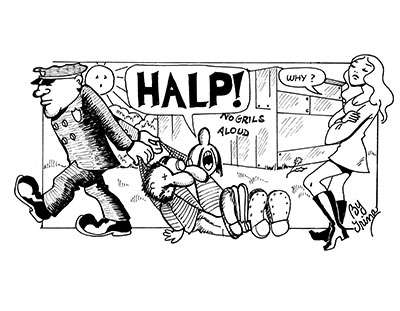
Trina Robbins, the first female cartoonist in Crumb’s San Francisco coterie in the late 1960s and a co-founder of Wimmen’s Comix (the longest-running all-woman-made comic series), was the first prominent voice raising feminist objections to how he portrayed women and sex. She says she was written off as an annoying scold by the scene’s “little boys club” for noting the violent hostility toward women expressed in some of his work.
Defenses of Crumb, who is no longer producing new comics, read as anachronistic to many in our woke age. The Massachusetts Expo’s reasoning for shunning Crumb follows an all-too-recognizable one-two formula for casting problematic artists adrift: “We recognize Crumb’s singular importance to the development of independent and alternative comics, the influence that he has had on many of our most respected cartoonists, and the quality and brilliance of much of his work,” the organizers explained. But! “We also recognize the negative impact carried by some of the imagery and narratives that Crumb has produced, impact felt most acutely by those whose voices have not been historically respected or accommodated.”
Passmore did not respond to emailed attempts to interview him for this story. But MICE-like, he seemed to imply that respect for Crumb necessarily means disrespect for black cartoonists—that the racial and gender diversity flourishing in comics today is definitionally opposed to Crumb. As he said at the Ignatz Awards, “I wouldn’t be here.”
His comments elicited a wave of social media support from fellow artists and fans. A white male cartoonist named Derf Backderf, who belongs to the generation between Crumb and Passmore and is best known for a gripping memoir about being childhood friends with Jeffrey Dahmer, initially came to the master’s defense on Twitter. But Backderf soon deleted his pro-Crumb tweets, admitting on further contemplation that he was prepared to “box up Crumb and stick him in the attic.”
In Backderf’s final tweet on the episode, he said he was moved by a post from black female cartoonist and publisher C. Spike Trotman, who said, “Personally speaking, I’m pretty relieved I no longer live in a world where I walk into a comic shop and there are Angelfood McSpade chocolate bars by the register.”
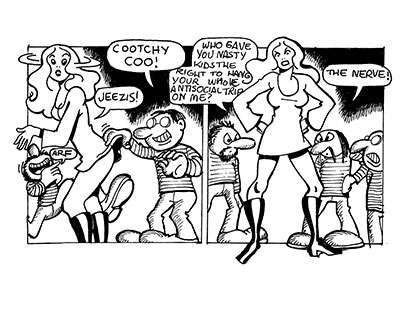
Trina Robbins cartoon. Fantagraphics Books
Angelfood McSpade was Crumb’s absurdly exaggerated and sexed-up depiction of an African wild woman. It is very easy to understand why a black woman would feel uncomfortable viewing that character. And yet, as the comics historian and New Republic writer Jeet Heer commented in a post not directly responding to Trotman at The Hooded Utilitarian blog, “anyone who can’t see the satirical (indeed outlandishly satirical) element of Angelfood McSpade has no business being a comics critic.…I think it is to Crumb’s credit that he is willing to implicate himself in his satires on racism—that he doesn’t see racism as cultural phenomenon outside of himself that needs to be condemned but as cultural legacies that pervasively shape his own sensibility and need to be confronted internally.”
Today, many think that fine distinctions between racist art and art that satirizes or complicates American racism are a luxury for people who, because of color or status, don’t have to personally endure bigotry or its vestiges. Whatever the intent, they say, a racist caricature is a racist caricature, and it’s long past time for that sort of thing to disappear.
But those familiar with Crumb’s history have reasons to be suspicious of the idea that some art is so vile and offensive that its creators, distributors, and even consumers should not be tolerated. That attitude has led to bad places, in living memory.
‘Zap No. 4 Is an Exploiter’
Crumb made the first two issues of Zap by himself, but soon a murderer’s row of cartoon superstars formed a collective to produce the book. One of them was Robert Williams, now a founding father of a school of “lowbrow” figurative painting valorized in galleries from New York to Japan. At a 2018 San Diego Comic-Con panel discussion, Williams cheekily said that “me and Crumb appreciated that what we did, someone would have to pay for.” Meaning: “Someone at a newsstand had to sell the damn thing, and that poor clerk could be arrested.”
Indeed, many clerks were. On the panel, Ron Turner of the underground publisher Last Gasp told tales of his friends at stores and galleries being dragged downtown by vice squads. Joyce Farmer, founding co-editor of one of the first underground comix entirely by women, Tits & Clits, somberly revealed that she was scared off of creating anything potentially controversial for years after seeing a bookstore that had been run by her editing partner raided because of the comics she made and enjoyed. On a separate Comic-Con panel, Robbins said that the legal heat in the early 1970s around underground comix was so severe that Ms. magazine refused to print an ad for Wimmen’s Comix for fear that Ms. itself could wind up charged with marketing obscene material.
Even finding a printer was fraught; some might keep and destroy your negatives after deciding they didn’t approve of the comic you’d paid them to reproduce.
Most of the arrests from this era did not result in convictions, for various reasons. At Comic-Con, Turner and Williams tag-teamed a well-honed tale of an early ’70s prosecution coming a cropper after an offending comic was apparently purloined from the evidence room by a sleazy cop, leaving a judge to ask in open court, to no avail, “Where’s the Felch?”
An existing network of head shops and record stores, which had first centered around the market for psychedelic concert poster art, eventually took up the wave of underground comix being made by Crumb and his pals. Although Crumb himself cares for almost no American culture past 1930, Zap and a plethora of fellow travelers became a core part of the hip revolutionary counterculture of the time.
Thus, some suspect there was more than a concern with the moral fabric of Manhattan—something more like animus toward youth culture—that led a New York undercover agent from the Morals Squad to enter two different bookstores in August and September of 1969 to buy copies of Zap issue No. 4. On the second visit, he arrested several employees for selling an obscene publication.
East Side Bookstore manager Peter Dargis admitted to having stocked and sold around 200 copies of the comic, though he said he had not read it himself. He pointed out to the court that his business stocked more than 16,000 titles and that comics such as Zap amounted to less than 1 percent of the store’s gross. Charles Kirkpatrick, manager of the New Yorker Book Store, told a similar story of a huge stock, a tiny percentage of which was potentially naughty comics whose specific content he had not studied.
The case was presided over by Judge Joel Tyler, the same man who declared the movie Deep Throat to be legally obscene. The district attorney offered no evidence other than the copy of Zap 4, whose scurrilousness was supposed to speak for itself. The sellers pointed out that the material was marked “adults only” and that the undercover agent was indeed an adult.
Expert witnesses from the world of comics and art—including Whitney Museum curator Robert Doty, who had included some Crumb comics in an exhibit, “Human Concern/Personal Torment: The Grotesque in American Art”—tried to convince Tyler there was more to Crumb and Co.’s work than smut.
Sidney Jacobson, who worked for the children’s comic company Harvey, home of Richie Rich and Casper the Friendly Ghost, shook things up by insisting that Archie Comics, a rival, produced cartoons “purposely written and drawn to arouse sexualities in teenagers.” The publishers and creators of Archie, Jacobson maintained, “are trying within it to appeal to the sexual desires of their public,” while Zap‘s more grotesque representations of sex, including Crumb’s depiction of sex acts between family members, were designed to be less arousing than Betty and Veronica. (Jacobson offended Tyler by referring to his own company’s work as aimed at the lowest age group. The judge harrumphed that he himself read Harvey comics regularly.)
Dargis and Kirkpatrick were convicted in October 1970, with Tyler deciding that Zap was “utterly unredeemed and unredeemable, save, perhaps, only by the quality of the paper upon which it is printed. It is patently offensive.…It is a part of the underworld press—the growing world of deceit in sex—and it is not reality or honesty, as they often claim it to be. It represents an emotional incapacity to view sex as a basis for establishing genuine human relationships, or as a normal part of human condition.—Zap No. 4 is an exploiter; its effect is to purvey ‘filth for filth’s sake.’ It is hard-core pornography.…The material must fail by any legal test yet announced.”
Sellers of such filth, Tyler ruled, should have known it was impermissibly obscene (even though it did not become legally obscene for sure until the judge said so). As for those eggheaded claims to artistic value, he found “these witnesses failed to particularize in understandable lay terms their generalizations that the cartoonists were ‘original,’ or how they were ‘influencing a new generation of cartoonists,’ or how they showed ‘enormous vitality,’ or where was the satire or parody of the sexual experiences depicted…or how do these cartoons, dealing as they do in the main with perverted sexual experiences, attempt to ‘humorously outrage’ the reader and place in perspective human values.”
In lieu of a 90-day jail sentence, the store managers were fined $500, the equivalent of more than $3,200 today. Their appeals in the New York state system failed essentially on grounds that they couldn’t prove they didn’t know Zap 4 was obscene. The U.S. Supreme Court affirmed that outcome in October 1973, leaving in place a ruling that the then-chief of the American Booksellers Association called “frightening,” since “no one can possibly know in advance what a judge will consider obscene. The effect of this decision is to make every bookseller in the state a censor.”
In a blistering dissent, Justice William Brennan repeated his assertion from an earlier case that “the First and Fourteenth Amendments prohibit the state and federal governments from attempting wholly to suppress sexually oriented materials on the basis of their allegedly ‘obscene’ contents.” Yet the Court seemed to have it out for Crumb and his compatriots in 1973. Earlier that year, in Miller v. California, it had shifted obscenity law by giving localities the power to punish expression for being obscene if it violated local mores while lacking “serious literary, artistic, political, or scientific value.” Many blame Miller for wrecking underground comics as a viable business, with hippie entrepreneurs in college towns across the nation deciding that the profit margins on these curious 50-cent pamphlets were not worth risking fines or jail time.
To Crumb’s Zap partner Williams, applying a square’s community standards to their transgressive work was an outrage. These comics “were not made for the general public,” he said at Comic-Con. “They were made for an audience that seeked them out…an intellectual group in favor of free thought and imagination.”
Censure, Not Censorship
No one of significance in the comics community today is calling for 1970s-style legal punishment for unwoke cartoonists. Charles Brownstein, who heads up the Comic Book Legal Defense Fund, points out that “there’s a distinction between censorship in the courts vs. dissenting points of view in the public square.”
Trina Robbins cartoon. Fantagraphics Books
Brownstein’s organization was born of a 1986 arrest and conviction (later reversed) of a comic shop clerk for selling, among other things, an issue of a Crumb-founded comic called Weirdo. The cases he deals with these days are more likely to be about censoring comics in specific public places, such as public schools and libraries. Arrests of comic sellers aren’t much of a thing anymore.
Fantagraphics’ Groth, who keeps in print the very same comic that got Kirkpatrick and Dargis hauled into court, grants that he hasn’t once over the last two decades seriously feared any legal trouble for selling Crumb. Prosecutions of printed materials not clearly marketed as masturbatory aids are rarely pursued this century. And thanks to Crumb’s gallery cred and fame, most prosecutors probably assume that judges and juries will consider his work, if only because it is his, to have literary or artistic value.
But obscenity laws still exist, and that prosecutorial energy has been especially fierce in the past few decades when targeting sexual depictions involving children. One of Zap 4’s more offensive strips is an incest riff featuring kids having sex with their parents, so it isn’t completely insane to fear that Crumb’s work might once again come to be seen as not merely unwoke but illegal. The anti-Crumb sentiments are “still dangerous,” Groth says, “because laws can in fact change because of public attitudes.” Those attitudes now include mainstream consideration of legislation aimed at curtailing “hate speech.”
During the social media storm kicked off by Passmore’s comments, Jules Rivera, a black female cartoonist, tweeted out two panels of a Crumb comic in which an obvious cartoon version of him is having sex with a woman identified as being in “a drunken stupor,” with no signs of consent. “I’m keeping that rapist ass Crumb art on my phone,” she continued. “If anyone challenges me, I’ll bust out my phone and say ‘so you’re down with this?’ In person. To your face.”
But holding art and expression to the moral demands implicit in that tweet may actually hobble what art is for. Appreciating a creator isn’t—or needn’t be—a matter of being “down with” the actions portrayed in his every work. One of the many reasons humans have art is to understand, play with, portray, question, and explore the human condition. Which, as Crumb firmly believes, includes a lot of awful, unacceptable thoughts and behavior.
Portraying darkness and evil in art is not the same as celebrating darkness and evil, even when the depiction is not safely anchored to a clear statement of the artist’s anti-evil sympathies. Offense and transgression can be a vital part of how expression stays lively, fresh, startling, moving, and true to the human condition. That transgressive art is hard to defend in sober, sensible ways is precisely the point. As Simpsons creator Matt Groening wrote in an introduction to 1998’s The Life and Times of R. Crumb, “it sure is a relief to read someone’s beautiful Bad Thoughts and realize the world won’t come crashing down after all.”
The teen Crumb in his published letters saw himself as a good liberal condemning the racial ignorance and prejudice of the yokels surrounding him. The adult Crumb, in addition to his transgressions, did some excellent cartooning on the lives of black musicians who had made the old-time music he revered. Building a wall of exclusion around his art denies audiences the galvanizing work of an artist whose declared intent often aligns with that of his modern-day indicters, even if he’s willing to toy with imagery they recoil from.
In a world of free expression and diminishing legal speech controls, if you want to “cancel” Crumb, well, it’s your right to try. But Groth for one finds that attitude troubling. It “feels similar to trying to erase Ezra Pound or Yeats or Wyndham Lewis, any number of reactionaries in the history of art and literature,” he says. “It’s provincial and philistine and based on historical ignorance, and I don’t think that’s what art should be about.”
The Frustrating Tango of Liberal Tolerance
The American culture that R. Crumb and his contemporaries grew up in restricted the ways people could talk about sex, violence, race, and class. The first wave of underground comix artists reacted with metaphorical explosive violence, especially once they realized nothing was stopping them but the constraints of their own minds. That freedom, in all its messiness and ugliness, upset and unnerved and offended many. It also inspired massive amounts of interesting, strange, life-enhancing art, not just in the comics world but in such offshoots of Crumb’s aesthetic as National Lampoon, Saturday Night Live, and The Simpsons.
The attitudes Crumb satirized were real and, he thought, deserving of ridicule via crazed exaggeration. His feelings of hostility toward women are, as he has insisted in his comics and in interviews, true to him (and, he is certain, to many other men). What is to be gained by pretending they’re not? Crumb was honest about being the sort of resentful nebbish who in his pre-fame days saw women as controlling something he desperately wanted and couldn’t have—what would now be called a corrosive “incel” mentality, after the men who self-identify as involuntarily celibate.
In a 1991 interview with The Comics Journal, Crumb said art should be judged not on ideological purity but on whether it is “interesting or boring…honest and truthful and real…saying what’s really on [the artists’] minds.…If it’s really in there it ought to come out on paper.” At the same time, he reflected, “I don’t know, maybe we’re all just dragging society down. Maybe we should all be locked up.”
The paradox of liberal tolerance remains: Neither the transgressors nor the offended have a right to force the other side to just shut up about what its members think, feel, or imagine. The two are intimately linked in a mutually frustrating tango. The offended want certain expressions to go away or be universally recognized as unacceptable, and the transgressors want a social space to express themselves without feeling driven from society.
Liberal tolerance, as exemplified by the First Amendment—refusing to violently punish someone for his or her expression—offers a way for these battles to take place without anyone being physically hurt. The figurative game of expression, reaction, pushback, and constantly shifting mores can keep being played without either side mistaking the contest for mortal combat. Although cancel culture (without law enforcement involvement) stops short of violence, those who like to wield it should understand that human beings are social animals. To be told that you and anyone who doesn’t join enthusiastically in condemning you should be expelled from society can feel like war when you’re the target.
Many people understand that art is for expressing and exploring the human mind and soul—and the human mind and soul contain darkness, sexual mania, racism, hostility, and any number of awful truths. To force those things out of the conversation is to unreasonably limit the whole project, they say. Art is a treasured aspect of the healthy human condition, even if what the art says is unhealthy on various dimensions. Many others consider that tradeoff worth it in the name of protecting the status and feelings of previously excluded or oppressed groups.
Crumb’s attempt to open comics to a vast range of human expression was victorious: Whether they want to acknowledge it or not, those working in the field today are his descendants. Like all children and grandchildren, they can choose whether or not to understand their patriarch, whether to emulate him or tell him to fuck off. Their choices may not always be kind or wise, but such is human freedom.
from Latest – Reason.com http://bit.ly/2GORtN4
via IFTTT
Robert Crumb is the undisputed godfather of alternative comics. His work has appeared in museums across the world, from the Venice Biennale to New York’s Museum of Modern Art; he was the subject of Terry Zwigoff’s acclaimed documentary Crumb (Gene Siskel’s favorite film of 1994); his drawings are so coveted by collectors that a sale of some sketchbooks in the early 1990s bought him a centuries-old chateau in southeast France. The legendary art critic Robert Hughes has favorably compared his portrayals of the human grotesque to Pieter Bruegel and William Hogarth, declaring Crumb “the one and only genius the 1960s underground produced in visual art, either in America or Europe.”
Nearly every milestone on the long road comics have crawled from derided trash to treasured American art form was inspired either directly or secondhand by Crumb’s choices and achievements. With his first issue of Zap in 1968, Crumb singlehandedly invented a format and sensibility, under the broad label of “underground comix,” that permanently changed how printed cartoon stories are perceived. Along the way, it opened the form to social criticism, history, outrageous satire, and the full range of deeply personal human experience, including the both lightly and darkly sexual.
Crumb’s occasional collaborator Harvey Pekar, one of the major innovators of quotidian comic autobiography, says his partner demonstrated that “comics were as good an art form as any that existed. You could write any kind of story in comics. It was as versatile a medium as film or television.” Similar praise from other creators for Crumb’s mind-blowing importance to them could go on for pages; anyone making noncorporate, nongenre, self-expressive comics occupies a space he created.
But events in the comics world last year served notice that the social-justice re-evaluation currently sweeping comedy, film, and literature has arrived at the doorstep of free-thinking comics. In September, at the Small Press Expo’s Ignatz Awards ceremony in Bethesda, Maryland, Crumb’s successor generation of alt artists let the 75-year-old have it with both barrels.
While presenting the award for Outstanding Artist, the cartoonist Ben Passmore, who is black, asserted that “comics is changing…and it’s not an accident.” He lamented the continued industry presence of “creeps” and “apologists,” then called out the godfather by name: “Shit’s not going to change on its own. You gotta keep on being annoying about it.…A while ago someone like R. Crumb would be ‘Outstanding.'”
The room erupted with both “ooohs” and booing. “A little while ago there’d be no boos,” Passmore responded. “I wouldn’t be up here, real talk, and yo—fuck that dude.” The crowd burst into applause.
The brief against Crumb is both specific to his famous idiosyncrasies and generally familiar to our modern culture of outrage archeology. His art has trafficked in crude racial and anti-Semitic stereotypes, expressed an open sense of misogyny, and included depictions of incest and rape. Crumb’s comics are “seriously problematic because of the pain and harm caused by perpetuating images of racial stereotypes and sexual violence,” the Massachusetts Independent Comics Expo (MICE) explained last year when removing Crumb’s name from one of its exhibit rooms.
Such talk alarms Gary Groth, co-founder of Fantagraphics, the premiere American publisher of quality adult comics, including a 17-volume series of The Complete Crumb Comics. “The spontaneity and vehemence” of the backlash, Groth says, “surprised me—and I guess what also disheartened me was, I’m pretty sure the vast majority of people booing Crumb are not familiar with his work.…This visceral dislike of him has no basis in understanding who Crumb is, his place in comics history, his contribution to the form.”
Key to the misunderstanding is Crumb’s willingness to probe human darkness, including his own, and his sheer maniacal delight in transgression. (Crumb’s own explanation for one of his more notorious incest-related strips was, “I was just being a punk.”) The Ignatz Awards crowd, Groth worries, “will not tolerate that kind of expression, and I think that’s disturbing. Cartooning has a long history of being transgressive and controversial and pushing boundaries, and now we have a generation very much opposed to that, who want to censure fellow artists from doing work they don’t approve of—even though they are able to do what they are doing and want to do precisely because of trailblazing on the part of artists they now abominate.”
Crumb blew minds and inspired a generation with his eagerness to portray and explore “the stark reality at the bottom of life,” as he put it, delivering “a psychotic manifestation of some grimy part of America’s collective unconscious.” In pursuit of that goal, he produced many comics, sometimes with reasonably clear comic grotesquerie, sometimes with undeniable—Crumb himself never denied it—truly dark personal expressions that would strike most people now (and many even then) as unacceptably hostile toward women.
Two of his most notorious stories were titled “When the Niggers Take Over America!” and “When the Goddamn Jews Take Over America!” His fans insist they were obvious pitch-black satires of bigoted madness. But they were so outrageous that they were reprinted in actual American Nazi papers. Crumb told TheNew Yorker in 1994, “I just had to expose all the myths people have of blacks and Jews in the rawest way possible to tilt the scale toward truth.”
Trina Robbins, the first female cartoonist in Crumb’s San Francisco coterie in the late 1960s and a co-founder of Wimmen’s Comix (the longest-running all-woman-made comic series), was the first prominent voice raising feminist objections to how he portrayed women and sex. She says she was written off as an annoying scold by the scene’s “little boys club” for noting the violent hostility toward women expressed in some of his work.
Defenses of Crumb, who is no longer producing new comics, read as anachronistic to many in our woke age. The Massachusetts Expo’s reasoning for shunning Crumb follows an all-too-recognizable one-two formula for casting problematic artists adrift: “We recognize Crumb’s singular importance to the development of independent and alternative comics, the influence that he has had on many of our most respected cartoonists, and the quality and brilliance of much of his work,” the organizers explained. But! “We also recognize the negative impact carried by some of the imagery and narratives that Crumb has produced, impact felt most acutely by those whose voices have not been historically respected or accommodated.”
Passmore did not respond to emailed attempts to interview him for this story. But MICE-like, he seemed to imply that respect for Crumb necessarily means disrespect for black cartoonists—that the racial and gender diversity flourishing in comics today is definitionally opposed to Crumb. As he said at the Ignatz Awards, “I wouldn’t be here.”
His comments elicited a wave of social media support from fellow artists and fans. A white male cartoonist named Derf Backderf, who belongs to the generation between Crumb and Passmore and is best known for a gripping memoir about being childhood friends with Jeffrey Dahmer, initially came to the master’s defense on Twitter. But Backderf soon deleted his pro-Crumb tweets, admitting on further contemplation that he was prepared to “box up Crumb and stick him in the attic.”
In Backderf’s final tweet on the episode, he said he was moved by a post from black female cartoonist and publisher C. Spike Trotman, who said, “Personally speaking, I’m pretty relieved I no longer live in a world where I walk into a comic shop and there are Angelfood McSpade chocolate bars by the register.”
Trina Robbins cartoon. Fantagraphics Books
Angelfood McSpade was Crumb’s absurdly exaggerated and sexed-up depiction of an African wild woman. It is very easy to understand why a black woman would feel uncomfortable viewing that character. And yet, as the comics historian and New Republic writer Jeet Heer commented in a post not directly responding to Trotman at The Hooded Utilitarian blog, “anyone who can’t see the satirical (indeed outlandishly satirical) element of Angelfood McSpade has no business being a comics critic.…I think it is to Crumb’s credit that he is willing to implicate himself in his satires on racism—that he doesn’t see racism as cultural phenomenon outside of himself that needs to be condemned but as cultural legacies that pervasively shape his own sensibility and need to be confronted internally.”
Today, many think that fine distinctions between racist art and art that satirizes or complicates American racism are a luxury for people who, because of color or status, don’t have to personally endure bigotry or its vestiges. Whatever the intent, they say, a racist caricature is a racist caricature, and it’s long past time for that sort of thing to disappear.
But those familiar with Crumb’s history have reasons to be suspicious of the idea that some art is so vile and offensive that its creators, distributors, and even consumers should not be tolerated. That attitude has led to bad places, in living memory.
‘Zap No. 4 Is an Exploiter’
Crumb made the first two issues of Zap by himself, but soon a murderer’s row of cartoon superstars formed a collective to produce the book. One of them was Robert Williams, now a founding father of a school of “lowbrow” figurative painting valorized in galleries from New York to Japan. At a 2018 San Diego Comic-Con panel discussion, Williams cheekily said that “me and Crumb appreciated that what we did, someone would have to pay for.” Meaning: “Someone at a newsstand had to sell the damn thing, and that poor clerk could be arrested.”
Indeed, many clerks were. On the panel, Ron Turner of the underground publisher Last Gasp told tales of his friends at stores and galleries being dragged downtown by vice squads. Joyce Farmer, founding co-editor of one of the first underground comix entirely by women, Tits & Clits, somberly revealed that she was scared off of creating anything potentially controversial for years after seeing a bookstore that had been run by her editing partner raided because of the comics she made and enjoyed. On a separate Comic-Con panel, Robbins said that the legal heat in the early 1970s around underground comix was so severe that Ms. magazine refused to print an ad for Wimmen’s Comix for fear that Ms. itself could wind up charged with marketing obscene material.
Even finding a printer was fraught; some might keep and destroy your negatives after deciding they didn’t approve of the comic you’d paid them to reproduce.
Most of the arrests from this era did not result in convictions, for various reasons. At Comic-Con, Turner and Williams tag-teamed a well-honed tale of an early ’70s prosecution coming a cropper after an offending comic was apparently purloined from the evidence room by a sleazy cop, leaving a judge to ask in open court, to no avail, “Where’s the Felch?”
An existing network of head shops and record stores, which had first centered around the market for psychedelic concert poster art, eventually took up the wave of underground comix being made by Crumb and his pals. Although Crumb himself cares for almost no American culture past 1930, Zap and a plethora of fellow travelers became a core part of the hip revolutionary counterculture of the time.
Thus, some suspect there was more than a concern with the moral fabric of Manhattan—something more like animus toward youth culture—that led a New York undercover agent from the Morals Squad to enter two different bookstores in August and September of 1969 to buy copies of Zap issue No. 4. On the second visit, he arrested several employees for selling an obscene publication.
East Side Bookstore manager Peter Dargis admitted to having stocked and sold around 200 copies of the comic, though he said he had not read it himself. He pointed out to the court that his business stocked more than 16,000 titles and that comics such as Zap amounted to less than 1 percent of the store’s gross. Charles Kirkpatrick, manager of the New Yorker Book Store, told a similar story of a huge stock, a tiny percentage of which was potentially naughty comics whose specific content he had not studied.
The case was presided over by Judge Joel Tyler, the same man who declared the movie Deep Throat to be legally obscene. The district attorney offered no evidence other than the copy of Zap 4, whose scurrilousness was supposed to speak for itself. The sellers pointed out that the material was marked “adults only” and that the undercover agent was indeed an adult.
Expert witnesses from the world of comics and art—including Whitney Museum curator Robert Doty, who had included some Crumb comics in an exhibit, “Human Concern/Personal Torment: The Grotesque in American Art”—tried to convince Tyler there was more to Crumb and Co.’s work than smut.
Sidney Jacobson, who worked for the children’s comic company Harvey, home of Richie Rich and Casper the Friendly Ghost, shook things up by insisting that Archie Comics, a rival, produced cartoons “purposely written and drawn to arouse sexualities in teenagers.” The publishers and creators of Archie, Jacobson maintained, “are trying within it to appeal to the sexual desires of their public,” while Zap‘s more grotesque representations of sex, including Crumb’s depiction of sex acts between family members, were designed to be less arousing than Betty and Veronica. (Jacobson offended Tyler by referring to his own company’s work as aimed at the lowest age group. The judge harrumphed that he himself read Harvey comics regularly.)
Dargis and Kirkpatrick were convicted in October 1970, with Tyler deciding that Zap was “utterly unredeemed and unredeemable, save, perhaps, only by the quality of the paper upon which it is printed. It is patently offensive.…It is a part of the underworld press—the growing world of deceit in sex—and it is not reality or honesty, as they often claim it to be. It represents an emotional incapacity to view sex as a basis for establishing genuine human relationships, or as a normal part of human condition.—Zap No. 4 is an exploiter; its effect is to purvey ‘filth for filth’s sake.’ It is hard-core pornography.…The material must fail by any legal test yet announced.”
Sellers of such filth, Tyler ruled, should have known it was impermissibly obscene (even though it did not become legally obscene for sure until the judge said so). As for those eggheaded claims to artistic value, he found “these witnesses failed to particularize in understandable lay terms their generalizations that the cartoonists were ‘original,’ or how they were ‘influencing a new generation of cartoonists,’ or how they showed ‘enormous vitality,’ or where was the satire or parody of the sexual experiences depicted…or how do these cartoons, dealing as they do in the main with perverted sexual experiences, attempt to ‘humorously outrage’ the reader and place in perspective human values.”
In lieu of a 90-day jail sentence, the store managers were fined $500, the equivalent of more than $3,200 today. Their appeals in the New York state system failed essentially on grounds that they couldn’t prove they didn’t know Zap 4 was obscene. The U.S. Supreme Court affirmed that outcome in October 1973, leaving in place a ruling that the then-chief of the American Booksellers Association called “frightening,” since “no one can possibly know in advance what a judge will consider obscene. The effect of this decision is to make every bookseller in the state a censor.”
In a blistering dissent, Justice William Brennan repeated his assertion from an earlier case that “the First and Fourteenth Amendments prohibit the state and federal governments from attempting wholly to suppress sexually oriented materials on the basis of their allegedly ‘obscene’ contents.” Yet the Court seemed to have it out for Crumb and his compatriots in 1973. Earlier that year, in Miller v. California, it had shifted obscenity law by giving localities the power to punish expression for being obscene if it violated local mores while lacking “serious literary, artistic, political, or scientific value.” Many blame Miller for wrecking underground comics as a viable business, with hippie entrepreneurs in college towns across the nation deciding that the profit margins on these curious 50-cent pamphlets were not worth risking fines or jail time.
To Crumb’s Zap partner Williams, applying a square’s community standards to their transgressive work was an outrage. These comics “were not made for the general public,” he said at Comic-Con. “They were made for an audience that seeked them out…an intellectual group in favor of free thought and imagination.”
Censure, Not Censorship
No one of significance in the comics community today is calling for 1970s-style legal punishment for unwoke cartoonists. Charles Brownstein, who heads up the Comic Book Legal Defense Fund, points out that “there’s a distinction between censorship in the courts vs. dissenting points of view in the public square.”
Trina Robbins cartoon. Fantagraphics Books
Brownstein’s organization was born of a 1986 arrest and conviction (later reversed) of a comic shop clerk for selling, among other things, an issue of a Crumb-founded comic called Weirdo. The cases he deals with these days are more likely to be about censoring comics in specific public places, such as public schools and libraries. Arrests of comic sellers aren’t much of a thing anymore.
Fantagraphics’ Groth, who keeps in print the very same comic that got Kirkpatrick and Dargis hauled into court, grants that he hasn’t once over the last two decades seriously feared any legal trouble for selling Crumb. Prosecutions of printed materials not clearly marketed as masturbatory aids are rarely pursued this century. And thanks to Crumb’s gallery cred and fame, most prosecutors probably assume that judges and juries will consider his work, if only because it is his, to have literary or artistic value.
But obscenity laws still exist, and that prosecutorial energy has been especially fierce in the past few decades when targeting sexual depictions involving children. One of Zap 4’s more offensive strips is an incest riff featuring kids having sex with their parents, so it isn’t completely insane to fear that Crumb’s work might once again come to be seen as not merely unwoke but illegal. The anti-Crumb sentiments are “still dangerous,” Groth says, “because laws can in fact change because of public attitudes.” Those attitudes now include mainstream consideration of legislation aimed at curtailing “hate speech.”
During the social media storm kicked off by Passmore’s comments, Jules Rivera, a black female cartoonist, tweeted out two panels of a Crumb comic in which an obvious cartoon version of him is having sex with a woman identified as being in “a drunken stupor,” with no signs of consent. “I’m keeping that rapist ass Crumb art on my phone,” she continued. “If anyone challenges me, I’ll bust out my phone and say ‘so you’re down with this?’ In person. To your face.”
But holding art and expression to the moral demands implicit in that tweet may actually hobble what art is for. Appreciating a creator isn’t—or needn’t be—a matter of being “down with” the actions portrayed in his every work. One of the many reasons humans have art is to understand, play with, portray, question, and explore the human condition. Which, as Crumb firmly believes, includes a lot of awful, unacceptable thoughts and behavior.
Portraying darkness and evil in art is not the same as celebrating darkness and evil, even when the depiction is not safely anchored to a clear statement of the artist’s anti-evil sympathies. Offense and transgression can be a vital part of how expression stays lively, fresh, startling, moving, and true to the human condition. That transgressive art is hard to defend in sober, sensible ways is precisely the point. As Simpsons creator Matt Groening wrote in an introduction to 1998’s The Life and Times of R. Crumb, “it sure is a relief to read someone’s beautiful Bad Thoughts and realize the world won’t come crashing down after all.”
The teen Crumb in his published letters saw himself as a good liberal condemning the racial ignorance and prejudice of the yokels surrounding him. The adult Crumb, in addition to his transgressions, did some excellent cartooning on the lives of black musicians who had made the old-time music he revered. Building a wall of exclusion around his art denies audiences the galvanizing work of an artist whose declared intent often aligns with that of his modern-day indicters, even if he’s willing to toy with imagery they recoil from.
In a world of free expression and diminishing legal speech controls, if you want to “cancel” Crumb, well, it’s your right to try. But Groth for one finds that attitude troubling. It “feels similar to trying to erase Ezra Pound or Yeats or Wyndham Lewis, any number of reactionaries in the history of art and literature,” he says. “It’s provincial and philistine and based on historical ignorance, and I don’t think that’s what art should be about.”
The Frustrating Tango of Liberal Tolerance
The American culture that R. Crumb and his contemporaries grew up in restricted the ways people could talk about sex, violence, race, and class. The first wave of underground comix artists reacted with metaphorical explosive violence, especially once they realized nothing was stopping them but the constraints of their own minds. That freedom, in all its messiness and ugliness, upset and unnerved and offended many. It also inspired massive amounts of interesting, strange, life-enhancing art, not just in the comics world but in such offshoots of Crumb’s aesthetic as National Lampoon, Saturday Night Live, and The Simpsons.
The attitudes Crumb satirized were real and, he thought, deserving of ridicule via crazed exaggeration. His feelings of hostility toward women are, as he has insisted in his comics and in interviews, true to him (and, he is certain, to many other men). What is to be gained by pretending they’re not? Crumb was honest about being the sort of resentful nebbish who in his pre-fame days saw women as controlling something he desperately wanted and couldn’t have—what would now be called a corrosive “incel” mentality, after the men who self-identify as involuntarily celibate.
In a 1991 interview with The Comics Journal, Crumb said art should be judged not on ideological purity but on whether it is “interesting or boring…honest and truthful and real…saying what’s really on [the artists’] minds.…If it’s really in there it ought to come out on paper.” At the same time, he reflected, “I don’t know, maybe we’re all just dragging society down. Maybe we should all be locked up.”
The paradox of liberal tolerance remains: Neither the transgressors nor the offended have a right to force the other side to just shut up about what its members think, feel, or imagine. The two are intimately linked in a mutually frustrating tango. The offended want certain expressions to go away or be universally recognized as unacceptable, and the transgressors want a social space to express themselves without feeling driven from society.
Liberal tolerance, as exemplified by the First Amendment—refusing to violently punish someone for his or her expression—offers a way for these battles to take place without anyone being physically hurt. The figurative game of expression, reaction, pushback, and constantly shifting mores can keep being played without either side mistaking the contest for mortal combat. Although cancel culture (without law enforcement involvement) stops short of violence, those who like to wield it should understand that human beings are social animals. To be told that you and anyone who doesn’t join enthusiastically in condemning you should be expelled from society can feel like war when you’re the target.
Many people understand that art is for expressing and exploring the human mind and soul—and the human mind and soul contain darkness, sexual mania, racism, hostility, and any number of awful truths. To force those things out of the conversation is to unreasonably limit the whole project, they say. Art is a treasured aspect of the healthy human condition, even if what the art says is unhealthy on various dimensions. Many others consider that tradeoff worth it in the name of protecting the status and feelings of previously excluded or oppressed groups.
Crumb’s attempt to open comics to a vast range of human expression was victorious: Whether they want to acknowledge it or not, those working in the field today are his descendants. Like all children and grandchildren, they can choose whether or not to understand their patriarch, whether to emulate him or tell him to fuck off. Their choices may not always be kind or wise, but such is human freedom.
from Latest – Reason.com http://bit.ly/2GORtN4
via IFTTT
Handing a rare victory to a hostile bidder, and what would be a serious coup for Occidental CEO Vicki Hollub if the deal goes through, Anadarko Petroleum is reportedly preparing to endorse a bid from Occcidental Petroleum, which launched a hostile campaign for Anadarko and its valuable shale assets after the driller accepted a bid from energy giant Chevron.
Reuters broke the news overnight that Anadarko would pursue deal talks with Occidental, with the FT taking the story a step further and confirming that Anadarko was preparing to endorse the hostile bid. BBG soon confirmed.
Anadarko, a Woodlands, Texas-based oil and gas company, is expected to make a statement this week after its board determined that a cash and stock offer from Occidental would be superior to the deal with Chevron. If Anadarko follows through, Chevron will be given a chance to launch a counter-bid, though anonymous sources quoted by BBG contend that there’s little appetite at Chevron for a higher bid. If Chevron does lose out, Anadarko will need to pay it a $1 billion break-up fee, per the terms of their deal agreement. The FT previously reported that Chevron has already once refused to raise its bid.
For its part, Chevron declined to answer a question during its earnings call on Friday about how it would respond should Anadarko’s board favor Occidental’s proposal. However, Chevron’s CFO, Pierre Breber, said Chevron had the ability to up its offer, though the company has expressed unwillingness to become embroiled in a protracted bidding war.
Vicki Hollub
Occidental, one of the five largest American oil and gas firms, made a cash-and-stock offer worth $76 per share to Anadarko shareholders, a 22% premium to the bid from Chevron, which is worth roughly $63 per share.
Another apparent advantage for Occidental: its bid was evenly split in cash and stock. Chevron offered to pay 0.39 of its own stock and $16.25 in cash for each share of Anadarko outstanding.
“This is much more synergistic for us than any other company that might look at this,” Hollub told the FT last week.
Though to be fair, Anadarko’s assets would be a valuable addition to the portfolio of any American energy firm. The company owns valuable shale oil acreage (roughly a quarter million acres) in the Permian, where low-cost drilling techniques can produce supplies for decades, as well as assets in the Gulf of Mexico and a natural gas project in Mozambique. Overcoming analyst warnings that they didn’t see how she could outbid her larger rival, Hollub started looking into a counteroffer minutes after news about the Chevron bid broke. To make the deal more palatable to shareholders, she has promised to sell off assets worth $16.5 billion.
Still, the deal isn’t done yet; in fact, the real work is just beginning as the two companies start to talk through the terms of a deal.
If a bidding war breaks out, it would unfold against a backdrop of a rally in oil prices that has sent President Trump scrambling to browbeat OPEC and American rivals to pump up production.
via ZeroHedge News http://bit.ly/2GQqroH Tyler Durden
Turkey has indicted a third US Consulate employee and his wife and daughter on charges of membership of a terrorist group, according to a copy of the indictment seen by Reuters, a move likely to further strain ties between Ankara and Washington.
Nazmi Mete Canturk, a security officer at the US Consulate in Istanbul, and his wife and daughter are accused in the indictment of links to the network of Fethullah Gulen, the US-based Muslim cleric blamed by Ankara for a failed 2016 coup.
A Turkish prosecutor is seeking jail sentences for all three on charges of membership of an armed terrorist organisation, according to the indictment, which was completed on March 8 but has not been made public.
It says Canturk was in contact with dozens of individuals under investigation for being members of Gulen’s network and that “evidence has been obtained regarding the suspect’s actions in line with the instructions of the (terrorist) organisation”.
Canturk, his wife and daughter are cited in the indictment as denying the charges.
A spokesman for the Istanbul prosecutor’s office did not respond to a request for comment. A lawyer for Canturk declined to comment. The US Consulate referred questions to Washington.
A State Department spokeswoman said Washington had seen no credible evidence that Canturk was involved in any illegal activities and that, in his 30-year career, he had had many contacts with Turkish government and security officials in the course of his work. She called for a timely, transparent, and fair resolution of his case.
She added that the United States has raised Canturk’s case with the Turkish government. “We have expressed our concerns on multiple occasions to the Turkish government at the highest levels publicly and privately,” she said.
Canturk was questioned by Istanbul police in January 2018 and subsequently put under house arrest, according to the indictment and a preliminary proceedings report seen by Reuters. That report, dated March 22, said that his first hearing would be held on June 25.
Two other locally employed US Consulate workers, also Turkish citizens, were arrested in 2017 on terrorism and espionage charges. The detentions prompted Washington to suspend non-immigrant visa applications from the country, triggering a reciprocal move from Ankara which snowballed into one of the worst crises between the two NATO allies.
A Turkish court ruled on March 28 that one of them, Metin Topuz, a translator and fixer for the Drug Enforcement Agency (DEA) at the US consulate in Istanbul, should remain in jail until his trial resumes on May 15. If convicted, Topuz could face a sentence of life in prison.
The other, Hamza Ulucay, who worked as a translator at the US Consulate in the southern city of Adana, was sentenced to four-and-a-half years in prison on terrorism charges but was released in January, with travel restrictions, after almost two years in detention.
Topuz has denied charges of espionage and links to Gulen. Ulucay also denied any links to terrorist organisations during his trial.
Earlier this month, two US senators introduced a bipartisan bill requiring the imposition of sanctions on Turkish officials responsible for the detentions of US citizens and local consulate staff.
In a meeting with Turkish Foreign Minister Mevlut Cavusoglu earlier this month, US Secretary of State Mike Pompeo also called for the swift resolution of the remaining cases, the State Department said. Despite being NATO allies, Washington and Ankara are already at loggerheads over their opposing interests in Syria and Ankara’s plans to buy Russian missile defences.
via ZeroHedge News http://bit.ly/2vr7emL Tyler Durden
An 80-year-old woman in Bootle, England, was handed a £50 fine ($65 U.S.) by code enforcement for walking her dog on a leash that was too long. The officers who cited her warned her the fine would increase to £2,500 ($3,200) if she did not pay it in two weeks. After local media picked up the story, the local council dropped the charge.
from Latest – Reason.com http://bit.ly/2VD7i1o
via IFTTT
Iranian Foreign Minister Mohammad Javad Zarif told Chris Walls on Fox News Sunday that he believes President Trump’s own advisers as well as Middle East allies like Saudi Arabia and Israel are “dragging the United States into a conflict” with Iran.
It comes just days after Zarif made similar statements about the possibility of US and Iranian ships clashing in the Persian Gulf, warning that a false flag “accident” scenario could “lure” Trump into war — something which he thinksTrump himself doesn’t want to see happen. It appears Tehran’s new strategy as it reels from the sanctions squeeze on oil and Trump ending the crude export waiver program is to try and delicately peel Trump away from the American ‘deep state’.
FM Zarif appeared on Fox News Sunday, via FOX
Zarif specifically named National Security Advisor John Bolton, Israel, Saudi Arabia, along with close Saudi ally the United Arab Emirates, all as seeking to escalate tensions leading toward a regime change war on Iran.
Wallace asked if they’re “all trying to exercise regime change?” according to Fox, and Zarif responded, “at least, at least.” Iran’s top diplomat explained:
“They have all shown an interest in dragging the United States into a conflict. I do not believe that President Trump wants to do that, I believe President Trump ran on a campaign promise of not bringing the United States into another war. But I believe President Trump’s intention to put pressure, the policy of maximum pressure on Iran in order to bring Iran to its knees so that we would succumb to pressure, is doomed to failure.”
Iranian Foreign Minister says 4 key leaders are trying to drag Trump into a conflict with Iran pic.twitter.com/lIAWviy88z
Interestingly, it appears Zarif is attempting a direct appeal to Trump and the generally non-interventionist “bring the troops home” stance he campaigned on in 2016.
Tehran’s leaders could be hoping for a Kim Jong Un style approach to Trump. Trump’s North Korea opening over the past year was marked by a series of off the cuff personal appeals and communications that led to one-on-one dialogue and thawing of tensions.
Middle East historian and analyst Asad Abukhalil noted “the media blitz by Zarif is clear in its intention: the Iranian regime has decided to negotiate with Trump – with Trump and not with his team. They think that they can split the administration.” Professor Abukhalil concluded, however, that “The calculation is not irrational but Trump does not see Iran like he sees North Korea.”
Soon after the Zarif interviewed aired Sunday morning, John Bolton appeared on Fox to dismiss what he called Iran’s “carefully prepared propaganda script”.
He slammed Zarif for attempting to “sow disinformation in the American body politic”— in an acknowledgement of Iran’s apparent new strategy to try and split Trump from the “deep state” agenda on Iran.
via ZeroHedge News http://bit.ly/2IMxe4X Tyler Durden