US COVID-19 Cases Hit New Record; Germany 12th Country To Top 1 Million: Live Updates Tyler Durden
Sat, 11/28/2020 – 14:40
Summary:
US sees new record as daily tests top 2 million
Germany tops 1 million cases
Merkel urges Germans to do more to rein in virus
London avoids toughest COVID restrictions
Hundreds of Argentines take to the streets
Italy ICU patients fall
Japan plans distribution of vaccines
WHO official weighs in on COVID measures
* * *
Perhaps the biggest COVID-19 news comes out of the US, as LA County has temporarily banned public and private social gatherings of individuals from different households will be banned for at least three weeks starting Monday under new restrictions local health officials unveiled on Friday, citing a continued surge in COVID-19 infections.
This latest public health order affects some 20 million people living in and around the second-largest city in the US. After a US judge barred NY Gov Andrew Cuomo from placing restrictions on religious gatherings, LA County specifically exempted religious services and protests due to the fact that they are constitutionally protected gathering.
After falling test numbers led to lower case numbers for a few days, the numbers jumped back on Saturday.
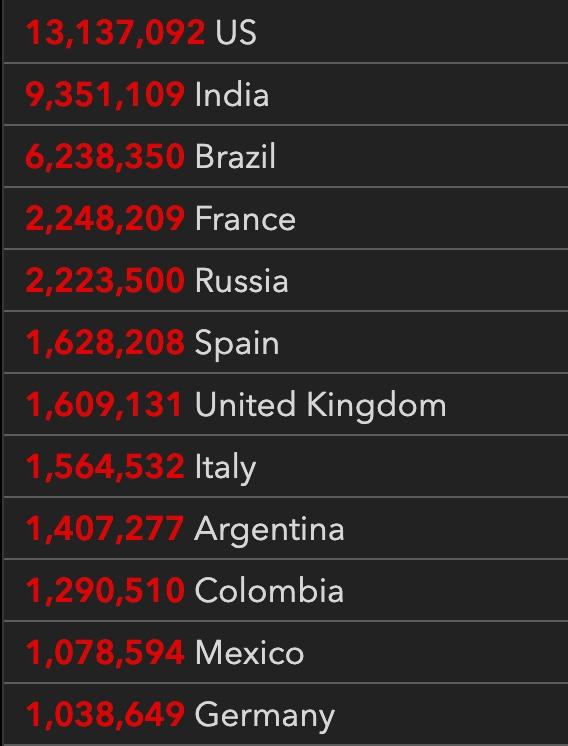
In Europe, the total number of cases in Germany topped 1 million, making Germany the 12th country to top that milestone, just days after Mexico became No. 11.
Given the new numbers, Chancellor Angela Merkel urged Germans to do more to rein in the pandemic and called on Europe’s ski resorts to do more to stop vacationers.
Meanwhile, London plans to avoid the toughest coronavirus restrictions when England’s partial lockdown ends next week, allowing municipalities in England to start allowing more patients. The number of severely ill French patients in ICU fell to the lowest level in more than three weeks. Argentines are still mourning the death of soccer icon Diego Maradona ignored virus restrictions. In Australia, Victoria reported 0 new cases for the 28th straight day, a new record, which suggests that Australia might be among a handful of western nations that can reliably hold Christmas holidays with only limited restrictions.
Globally, coronavirus cases have reached 61,585,651 according to Johns Hopkins University data, while the worldwide death toll has hit 1,441,335.
Here’s some new coronavirus news from overnight and Saturday morning:
Hundreds of thousands of Argentines took to the streets of Buenos Aires to mourn Wednesday’s death of soccer icon Diego Maradona, upending the nation’s strict Covid restrictions (Source: Bloomberg).
The number of patients in Italy’s intensive-care units fell to 3,846, the first decline in seven weeks, and new infections dropped 20% from a week ago, adding to signs that the virus is spreading more slowly in the country (Source: Bloomberg).
Japan looks to begin distribution of COVID-19 vaccines by the March end of the fiscal year as clinical trials on a number of candidates move forward. Tokyo aims to secure enough vaccine for the country’s entire population by the first half of 2021. It is set to source doses for 145 million people from Pfizer, AstraZeneca and Moderna (Source: Nikkei).
The WHO’s top emergency official weighs in on the origins of the novel coronavirus. “I think it’s highly speculative for us to say that the disease did not emerge in China,” Mike Ryan told a virtual briefing in Geneva after being asked whether COVID-19 could have first emerged outside China. “It is clear from a public health perspective that you start your investigations where the human cases first emerged,” Ryan said (Source: Nikkei).
via ZeroHedge News https://ift.tt/33pAega Tyler Durden
While most Americans were eating turkey and stuffing at whatever kind of socially-distanced gathering their state government would allow, “peaceful protesters” — who never spread the coronavirus, apparently — toppled statues and spray-painted anti-Thanksgiving messages to celebrate the holiday.
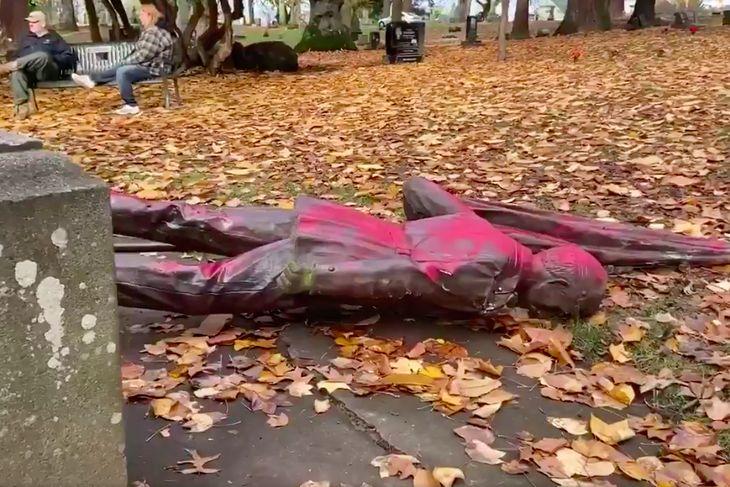
Vandals targeted statues of President William McKinley in Chicago, a veterans monument in Portland, an Abraham Lincoln statue in Spokane, Wash., and two statues in Minneapolis: one of George Washington and another celebrating pioneers.
“Stop colinization [sic]. End Thanksgiving. F**k 12,” vandals spray-painted on the plinth of the Washington statue in Washburn Fair Oaks Park in Minneapolis. The vandals targeted the statue either late on Wednesday night or early on Thanksgiving morning.
George Washington’s statue was taken down & the Pioneers Statue was vandalized with the words “no more genocide” “decolonize,“ “#landback,“ & more.https://t.co/Y3zcdckTz3
A group organizing under the Pan-Indigenous People’s Liberation (PIPL) network took credit for the vandalism, which they said was part of a “national decolonial day of action.”
A few miles away from the Washington statue, vandals also targeted a large granite monument to pioneers in the city’s B.F. Nelson Park. Vandals spray-painted the messages, “no thanks,” “no more genocide,” decolonize,” and “land back” on the statue, the Minneapolis Star-Tribune reported.
Park Board spokeswoman Dawn Sommers promised, “We will start removing the paint as soon as we can.”
Both a George Washington and “Pioneer Statue” were vandalized during the Thanksgiving holiday in Minneapolis. The Washington was knocked over and splattered with paint. The Minneapolis Park and Rec. board is working to “address and respond using a racial equity lens” (WCCO) pic.twitter.com/yGD0nymLPP
“Land back” seemingly refers to The LANDBACK campaign, a Native American movement supposedly fighting “white supremacy.” The campaign calls for the dismantling of the “white supremacy structures” supposedly responsible for removing Native Americans from their lands, including the Bureau of Land Management and the National Park Service; for the defunding of “white supremacy” in the forms of the police, the military-industrial complex, Border Patrol, and ICE; a “return” of “all public lands back into Indigenous hands”; and a policy of “consent.”
However, targeting patriotic symbols just before Thanksgiving seems particularly disgusting.
Early on Wednesday morning, police prevented vandals from toppling a statue of President William McKinley in a Chicago park. The vandals tethered a rope to a police car and spray-painted the statue with the words “Land Back,” NBC 5 Chicago reported. Activists have condemned McKinley, who served as president from 1897 to his death in 1901, as a racist because he championed westward expansion.
Vandals in Spokane, Wash., spilled red paint on a statue of Abraham Lincoln in an attack that may or may not have been related to the “Land Back” campaign.
Someone is not feeling so thankful on this holiday as the Abe Lincoln statue on Main & Monroe in Downtown Spokane has now been vandalized.
In Portland, the antifa group Youth Liberation Front called for “a decentralized, anti-colonial day of action on Thanksgiving eve,” with the message, “F**k Thanksgiving, F**k Black Friday!”
The Youth Liberation Front, an antifa group, was one of several who incited violence in Portland to oppose Thanksgiving. pic.twitter.com/o4HlkvKaZZ
An antifa mob broke windows and sprayed graffiti, including the phrase, “Land Back.” Portland police arrested three suspects.
The antifa radicals targeted a veterans’ monument at Portland’s Lone Fir Cemetery. Vandals spray-painted, “F**k USA,” and “Eat sh*t, colonizers!” on the Soldiers Monument Statue, unveiled in 1903 to honor soldiers of the Civil War, the Spanish-American War, the Mexican-American War, and the Indian Wars.
“Fu** USA” graffitied on the base of a statue that was toppled in Lone Fir Cemetery sometime this morning. The statue was erected in 1902, in honor of Indian, Spanish-American, Mexican, and Civil War Veterans. #PDX#Portlandpic.twitter.com/iOy7T2vD7z
Antifa rioters also spray-painted, “F**k Thanksgiving” underneath an ATM.
“F— Thanksgiving”
Overnight many businesses on Hawthorne Blvd. in southeast Portland were defaced with BLM, antifa & other far-left messages. Antifa earlier this week gave instructions on how to scout out & attack locations for Thanksgiving. #antifapic.twitter.com/zCFAkPvvAU
Such Thanksgiving attacks on national symbols make perverse sense in light of the Black Lives Matter riots this past summer, the Marxist critical race theory promoted by The New York Times‘ “1619 Project,” and the impact of organizations like the far-left smear factory the Southern Poverty Law Center (SPLC).
Just before Thanksgiving, the SPLC published an article entitled, “Indigenous Slavery and the Thanksgiving Difference.” In that article, Harvard University professor Tiya Miles argues that “Thanksgiving is a holiday long past due for an overhaul.”
Miles claims that the mythology of the First Thanksgiving “is based on a misunderstanding of the early relationships between Wampanoag residents and the English newcomers at Massachusetts Bay.” She notes that Tisquantum (popularly known as Squanto) served as a translator between the Wampanoag and the Pilgrims, having learned English during his capture and enslavement in England.
She also notes that the Wampanoag leader Pumetacom allied with the Narragansetts and Nipmucks in a war against the colonists that ended in the natives’ defeat. “Thousands would be killed or sold into slavery in the conflict, which ended Indigenous independence in New England. It is no wonder that some Native American families see Thanksgiving as a day of mourning,” she writes.
Much of the history between Native Americans and European settlers is indeed tragic, but leftist narratives often deprive the victims of their agency. Tisquantum, for instance, appears to have been plotting to overthrow the Wampanoag leader before Tisquantum’s untimely death, and his machinations likely contributed to the ultimate Puritan victory. History is far messier than the simple narrative of evil European colonialism and “white supremacy” suggests.
Americans should reexamine our history, but the nefarious message of Marxist critical race theory suggests we should upend society in order to satisfy historical grievances in the name of racial justice. This toxic vision undermines the very real progress America has made in terms of establishing civil rights regardless of race and in terms of securing broad prosperity through a free market economy.
Americans have a great deal for which to be thankful, even in the midst of a pandemic. Rather than railing against the supposed oppressors who established and celebrated Thanksgiving, these vandals should consider just how indebted they are to the system that provides peace and prosperity to the United States.
via ZeroHedge News https://ift.tt/3q7bhQl Tyler Durden
How The Fed Created The Ultimate Paradox: Stocks At All-Time Highs With No Liquidity And Soaring Realized Vol Tyler Durden
Sat, 11/28/2020 – 13:50
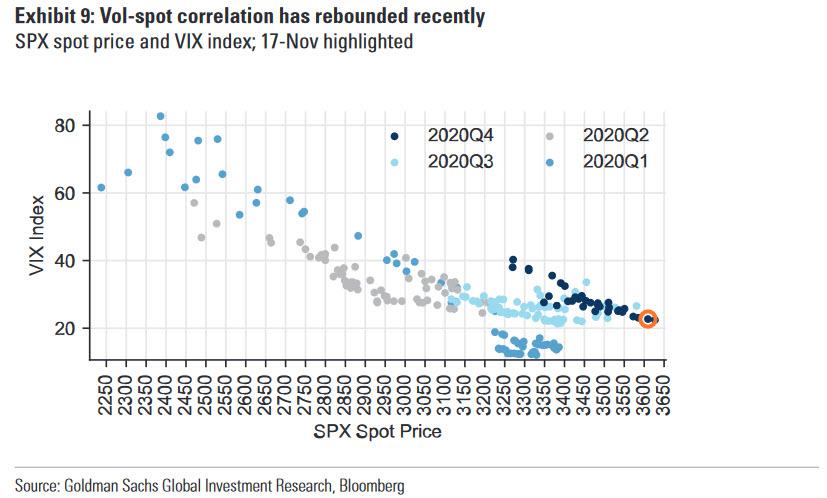
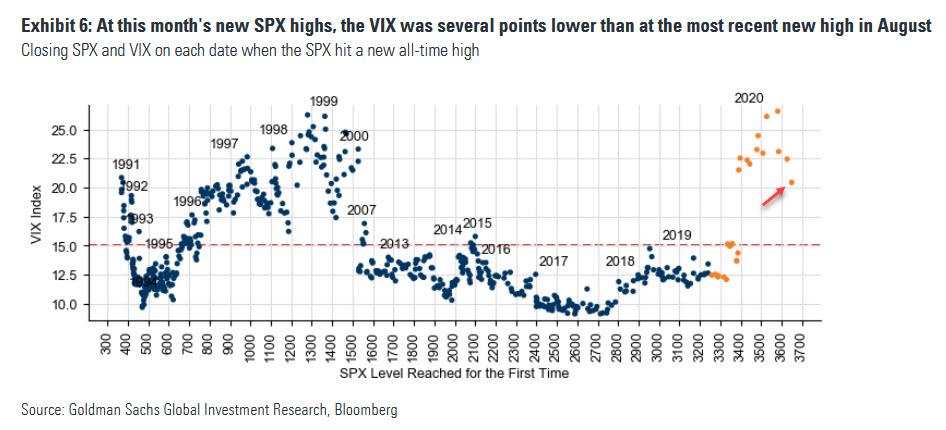
For the entire duration of the record rally since the March “pandemic shutdown” lows, which has pushed the S&P to all time highs, there has been something off about the market: virtually every new all-time high in spoos took place at a level of the VIX that was also a new all time high. This is a paradox: traditionally, a rising VIX (i.e., higher implied vol and a willingness by traders to pay more for downside protection) means a growing sense of apprehension about the future, and yet that has not been the case since March, in fact quite the contrary – the higher the VIX rose, the higher the S&P moved as well, prompting many veteran traders to scratch their heads.
As shown in the chart below, the vol-SPX spot correlation clearly shifted to a new regime in the aftermath of the covid crash (Q2 2020 and onward)…
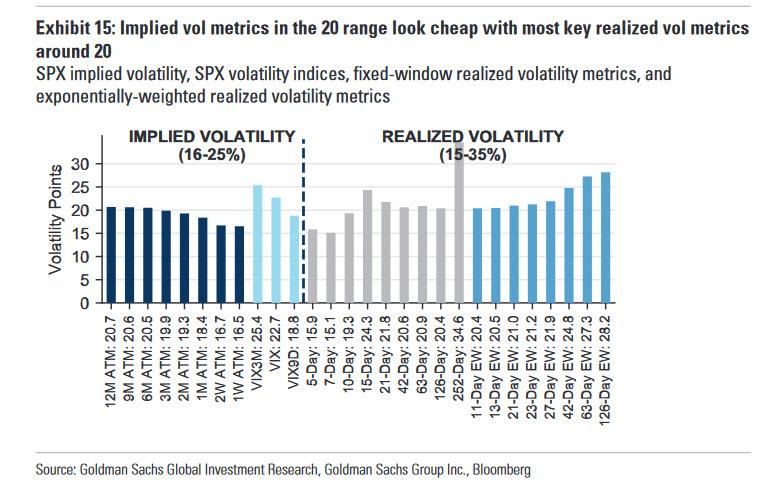
… and only recently did the S&P breakout to its latest record highs see the VIX decline, although at 21 the VIX is still far above the average level the VIX traded at when the SPX hit new record highs.
Yet while implied vol has been surprisingly high – if finally drifting lower now – realized vol has been even higher and stickier.
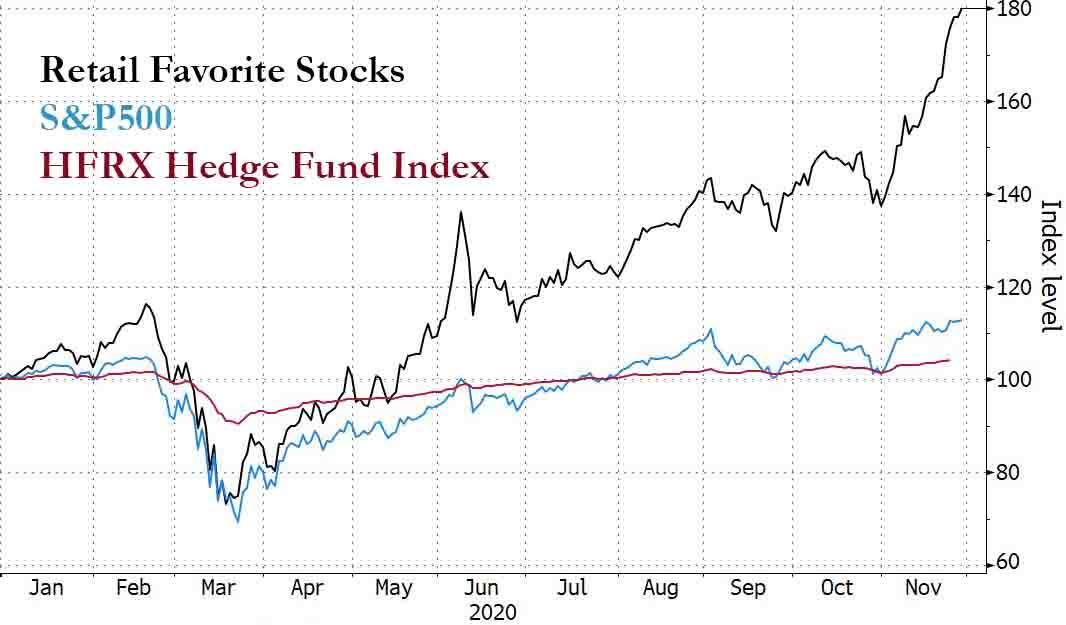
This is just one of the countless dislocations pointed out by traders, at least those older than 16 (who are currently generating 80%+ returns on Robinhood and outperforming hedge funds 20-to-1)…
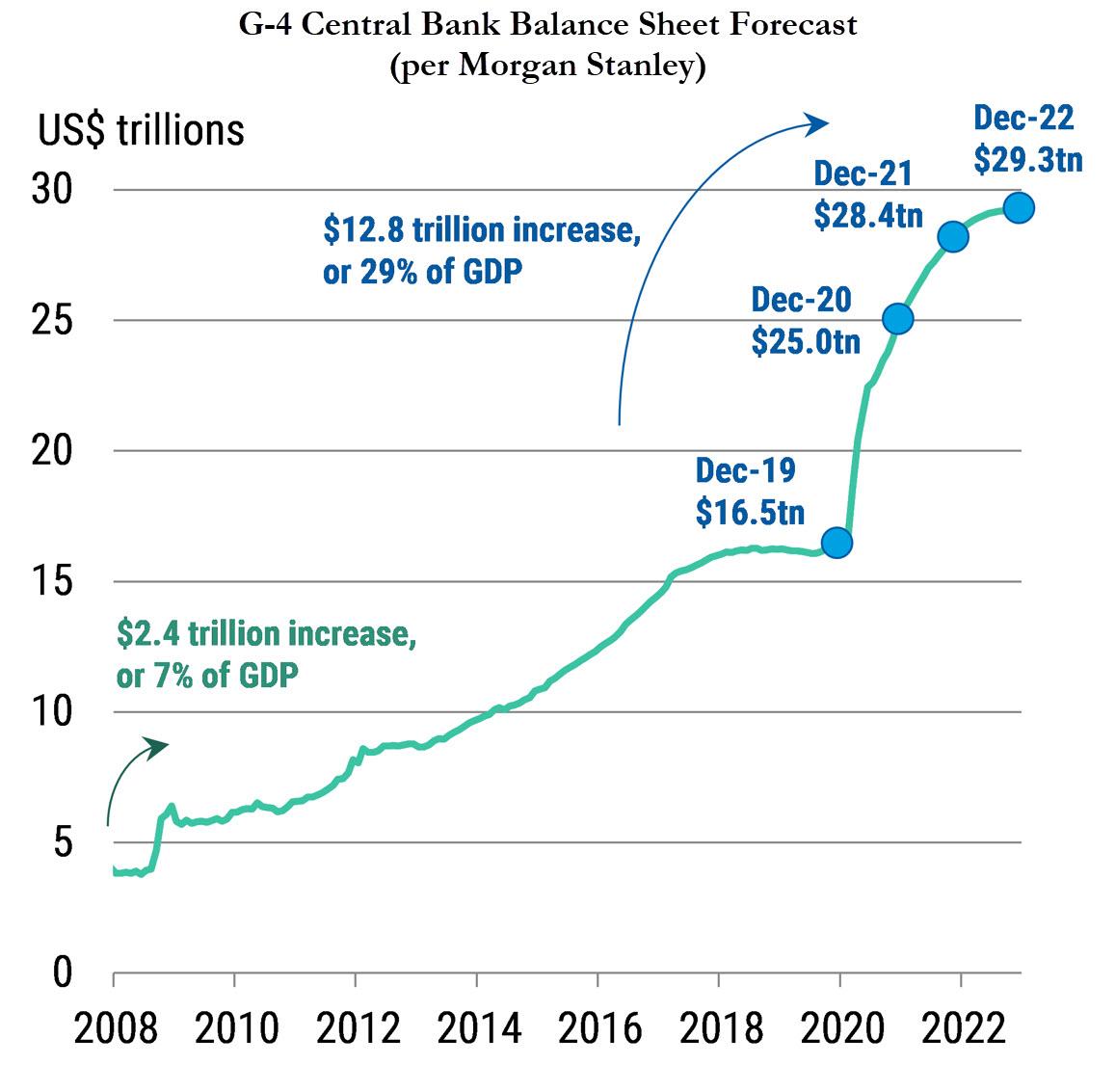
… and as usual the root cause can be found in two familiar culprits: the soaring balance sheet of central banks which have crushed price discovery as they now add 0.7% of global GDP in liquidity every single month…
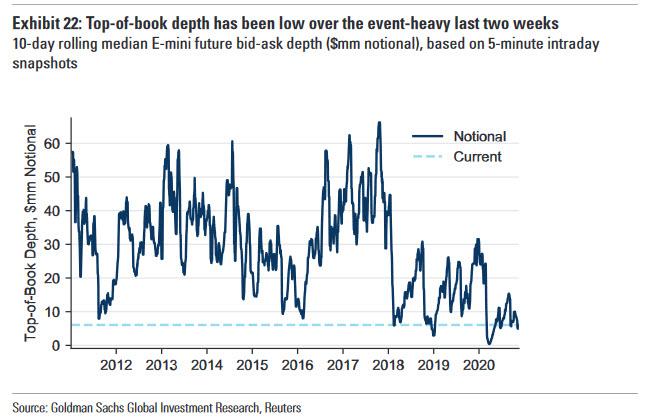
… and linked to that, the ongoing obliteration of equity liquidity, which means that even odd-lot orders can now push the market at will.
Now, thanks to SocGen strategist Sandrine Ungari, we can show the direct link between central bank market intervention, the resulting lack of market liquidity and the surprisingly high – and sticky – realized volatility. As Ungari writes, “the availability or scarcity of liquidity in the most liquid markets is becoming one of the determinants of realized volatility.”
In a recent lengthy research report titled “Electronic markets under the microscope”, Ungari looks at the covid crisis, where we notes that we have seen a feedback loop, or liquidity cascade which can be summarized as follows: “uncertainty depresses the willingness of market markers to provide liquidity, and liquidity droughts maintain a high level of realized volatility” (a topic we have discussed here on countless occasions over the past decade, and which was summarized effectively for recent market entrants in a recent note on “Liquidity Cascades” from Newfound Research).
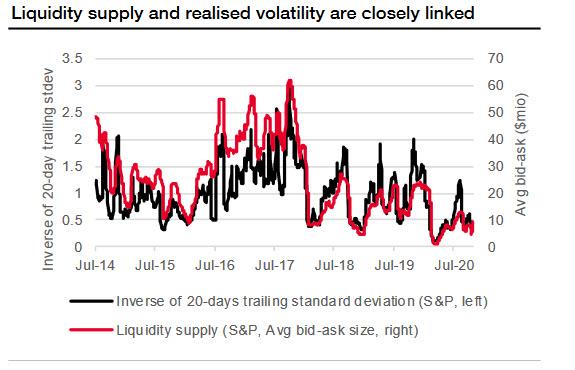
This effect becomes obvious when looking at liquidity supply versus the inverse of realized market volatility. Liquidity supply here is measured as the average bid and ask sizes from first limit quotes, similar to the Goldman chart above looking at e-mini top-of-book bid-ask depth (or lack thereof) and is broadly a proxy for the average liquidity available in the equity market at any one moment.
What it shows is that in March 2020, during the depths of the covid crash and subsequent Fed nationalization of the bond market, realized volatility reached historical levels that had not been seen since 2008 as the supply from liquidity providers collapsed.
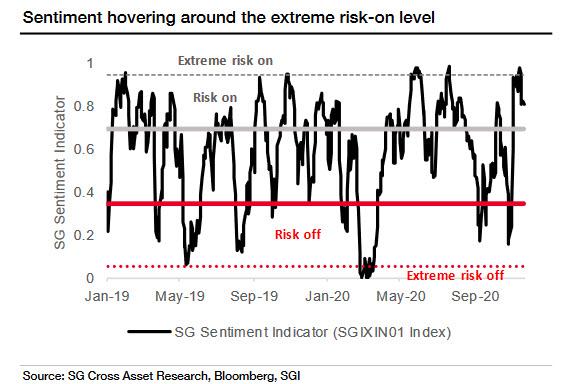
And here the Fed-created paradox emerges: while trader sentiment in the aftermath of the Pfizer covid vaccine news – which pushed the S&P500 up 7.5%, Europe’s STOXX 600 up 12%, European value stocks 20% higher and high-yield credit spreads tighter by almost 80bp – is at a “risk on” extreme…
… liquidity supply remains virtually non-existent and is at the bottom of the range since the start of SocGen’s dataset in 2014 and in line with the levels of realized volatility which as noted above are not only surprisingly high, but are even above where they should be based on the stubbornly high VIX.
The surprisingly clear – and inverted – relationship between market liquidity and realized vol is shown in the chart below:
As SocGen concludes, at current levels, “markets are well inflated, while economies will need a few more months to absorb the second lockdown consequences.” This means that “the path to normality is probably going to be a long one, with bumps along the way. Liquidity is most likely to become, once again a topic of concern.”
And when it does, sparking another market selloff, the Fed will inject even more liquidity, leading to even less market liquidity until eventually we reach the inevitable singularity where the Fed’s latest “bailout” will mean there is no liquidity at all left in the what was once known as “the market.”
via ZeroHedge News https://ift.tt/3o3qoIB Tyler Durden
America’s Most Dangerous Roads For Truckers Tyler Durden
Sat, 11/28/2020 – 13:25
By Nick Austin, Director of Weather Analytics and Senior Meteorologist at FreightWaves,
Truck driving is one of the riskiest jobs in the U.S., but the majority of professional drivers get through their careers without being involved in major accidents. The more skilled and safety conscious drivers are, the less likely they are to cause wrecks.
But some things, like road designs, are out of a driver’s control. Based on driver experiences, U.S. Department of Transportation data and harsh weather, these are the top ten U.S. roads that truckers should avoid whenever possible.
U.S. Highway 2 in Montana
According to the University of Minnesota, U.S. Highway 2 (US-2) in Montana has the highest traffic death rate compared to the rest of the highway. Winter weather conditions make it particularly dangerous.
This 760-mile stretch of US-2 — from the Washington state line to just east of Bainville — is prone to high winds, blizzards and black ice. It runs through extremely rural areas that are far apart from each other. The emergency response time of ambulances averages 80 minutes. Because of the limited population, there is not much traffic and so people tend to drive fast.
U.S. Highway 550 in Colorado (The Million Dollar Highway)
The Million Dollar Highway is the portion of U.S. Highway 550 in Colorado, from Ouray to Silverton. It got its name because it cost a million dollars to build it all the way back in the 1880s.
This 25-mile stretch of the highway has many twists and turns through the mountains, ascending to an elevation of up to 11,000 feet. The weather in this part of the country can be erratic, with frequent snow, ice and high winds several months of the year. What makes this stretch of US-550 especially dangerous for truckers is the lack of shoulders or guardrails, and the drop-off can be extremely steep.
A section of the Million Dollar Highway (U.S. 550) in Colorado. (Photo: Alan Stark/Flickr)
Interstate 95 in Connecticut
Interstate 95 runs for more than 1,900 miles from Houlton, Maine, to Miami. It’s one of the nation’s oldest highways, and it’s the longest north-south interstate in the country.
Because it runs through numerous heavily populated cities, especially in the Northeast, I-95 accounts for many highway fatalities each year. The majority of accidents on this highway happen on an 8-mile stretch in the city of Norwalk, Connecticut. Winter storms, springtime heavy rains and occasional high winds add to the risk of potential tractor-trailer wrecks.
Interstate 10 in Arizona
Arizona’s share of Interstate 10 totals more than 360 miles. Because of the high traffic volume and lack of median barriers, the 150-mile span from Phoenix to the California border is among the nation’s most dangerous highways. It averages about 85 fatalities per year. There is just one actual fuel stop located at the halfway point, in Coldfoot.
This section of I-10 consists of long desert stretches, which tend to lull drivers into inattention.
I-10 is part of the original interstate highway network, which started in 1956, and is America’s fourth-longest interstate highway.
Dalton Highway in Alaska
Alaska’s James W. Dalton Highway — known as the Dalton Highway or Alaska Route 11 — is a highly dangerous route, mainly because it winds through mountainous terrain. It has only one fuel stop and little access to emergency services.
The Dalton Highway runs for 414 miles, from Fairbanks to Deadhorse, and is the main road for truckers from Fairbanks to the northern areas of the state. It’s infamous for dangerously icy driving conditions.
What makes this road so bad is how it meanders and winds through the mountains of the Brooks Range, where America’s lowest temperature of 80 degrees below zero was recorded in 1971. Making issues worse, the Dalton Highway was opened to tourists in 1994. Usually twice a day, helicopters patrol the area looking for breakdowns and accidents.
California Route 138: ‘Blood Alley’
Truckers shouldn’t be fooled by California Route 138’s official name of Pearblossom Highway. Because of its deadly history, many Californians call the road “Blood Alley” or “Highway of Death.”
Stretch of California Route 138. (Photo: Opprimé Cycling Team)
The highway runs about 65 miles from Crestline to Palmdale, through the Mojave Desert. It got its ominous nicknames after a five-year period in which 56 people were killed and 875 were injured trying to tame it. The most dangerous stretch of the highway is east of the San Bernardino County line. The twisty two-lane road continued to average more than 10 fatalities per year until crews widened lanes and cleared sight lines in 2006, making it a bit safer.
Interstate 4 in Florida
Congestion and ongoing construction make any number of routes in Florida unappealing to truckers, especially Interstate 4. Running 140 miles from Tampa to Daytona Beach, it consistently ranks as one of the deadliest highways in the country.
According to Fatal Accident Reporting System (FARS) data from the National Highway Traffic Safety Administration (NHTSA), there were more than 165 deaths on Interstate 4 from 2014 to 2019. That’s around one death per mile.
U.S. Highway 24: Toledo to Fort Wayne
Built in 1926, U.S. Route 24 is a main commercial route between Toledo, Ohio, and Fort Wayne, Indiana. For decades, an overwhelming number of serious accidents occurred on the narrow road, leading to its nickname, “The Killway.”
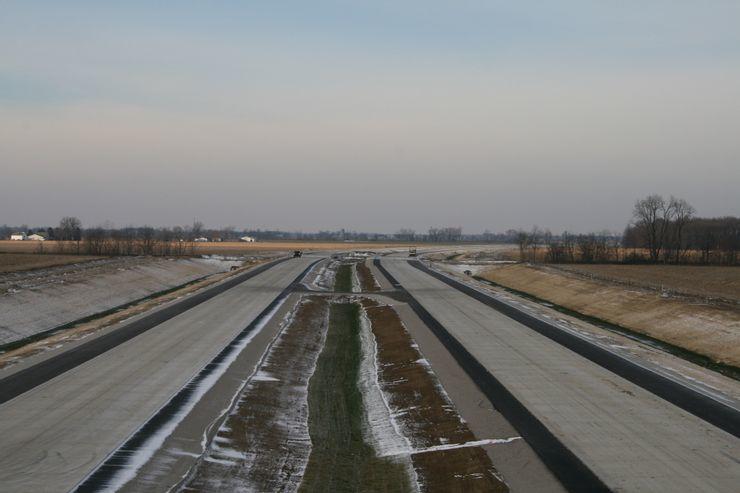
Stretch of U.S. Highway 24 between Ft. Wayne, Indiana and Toledo, Ohio. (Photo: Wikiwand)
The Toledo Blade has reported that the road was known for “gruesome head-on collisions” among tractor-trailers. This 100-mile stretch of highway had dangerous turns and blind curves. Finally, in 2012, the road was widened to better accommodate trucks. However, drivers still consider it a dangerous, high-volume route.
Interstate 15: Las Vegas to Los Angeles
While the open spaces of this highway may appeal to the unwise or unseasoned trucker, the fact is it’s particularly deadly for a few reasons.
According to the American Automobile Association (AAA), Interstate 15 from Las Vegas to Los Angeles is one of the most dangerous stretches of highway in this region of the West. The culprits are the number of people commuting between the two large metropolitan areas, and many of those people not using seatbelts. In addition, truckers report a lot of drunk and distracted driving along the road’s 270 miles.
Periods of Santa Ana winds, which can reach 100 mph, also put drivers at a high risk of rollovers on this stretch of highway.
U.S. Highway 129: North Carolina to Tennessee
One section of U.S. Highway 129 in North Carolina has 318 curves in an 11-mile span, earning its name the “Tail of the Dragon,” as well as its reputation for being one of America’s most dangerous roads. Some people just call it “The Dragon.”
The Dragon starts near Cheoah Dam, also called Fugitive Dam because Harrison Ford jumps off it in the movie “The Fugitive.” The other end of The Dragon finishes in Tennessee at the Tabcat Creek bridge.
A stretch of “The Dragon”, part of U.S. Highway 129 across the North Carolina-Tennessee border. (Photo: Alexey Stiop)
Bordered by the beautiful Great Smoky Mountains and Cherokee National Forest, The Dragon is popular for bikers. But driving on this notorious road is no time for sightseeing. Many of its curves are blind switchback “S” curves, so a moment spent looking the wrong way could lead to catastrophic consequences for a commercial truck driver. Also, there are no fuel stations or other businesses along The Dragon.
via ZeroHedge News https://ift.tt/3qcmMG2 Tyler Durden
Israeli Embassies On ‘High Alert’ Globally As Iran Vows Revenge For Covert Hit Tyler Durden
Sat, 11/28/2020 – 13:00
After Iran’s leaders on Friday accused Israeli and United States intelligence agencies of being behind the killing of top nuclear scientist Mohsen Fakhrizadeh, Israel has put its embassies and diplomatic compounds across the globe on ‘high alert’.
A series of statements from Iran had laid clear blame on Israel, which has been known for assassinating Iranian scientists in the past as part of efforts to curb and derail the Islamic Republic’s alleged pursuit of an atomic bomb. “Once again, the evil hands of global arrogance were stained with the blood of the mercenary usurper Zionist regime,” President Hassan Rouhani said in a statement.
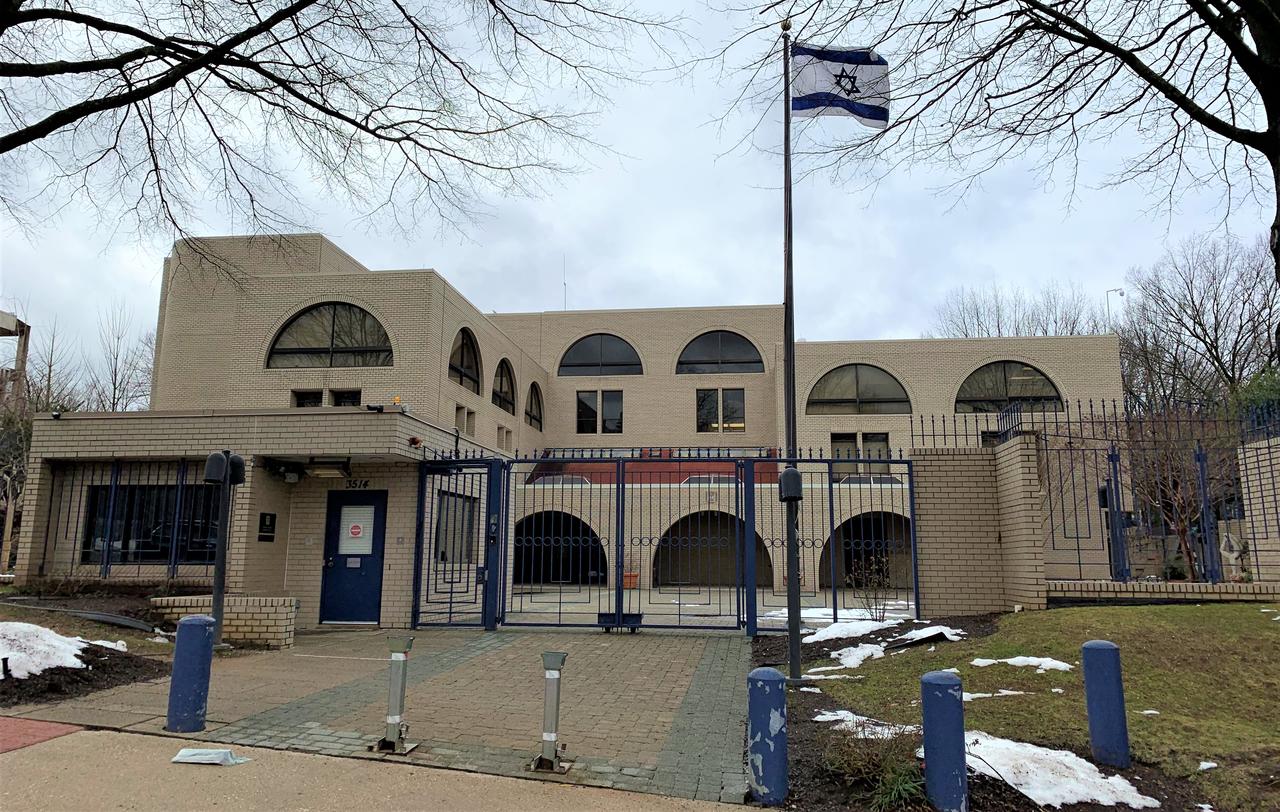
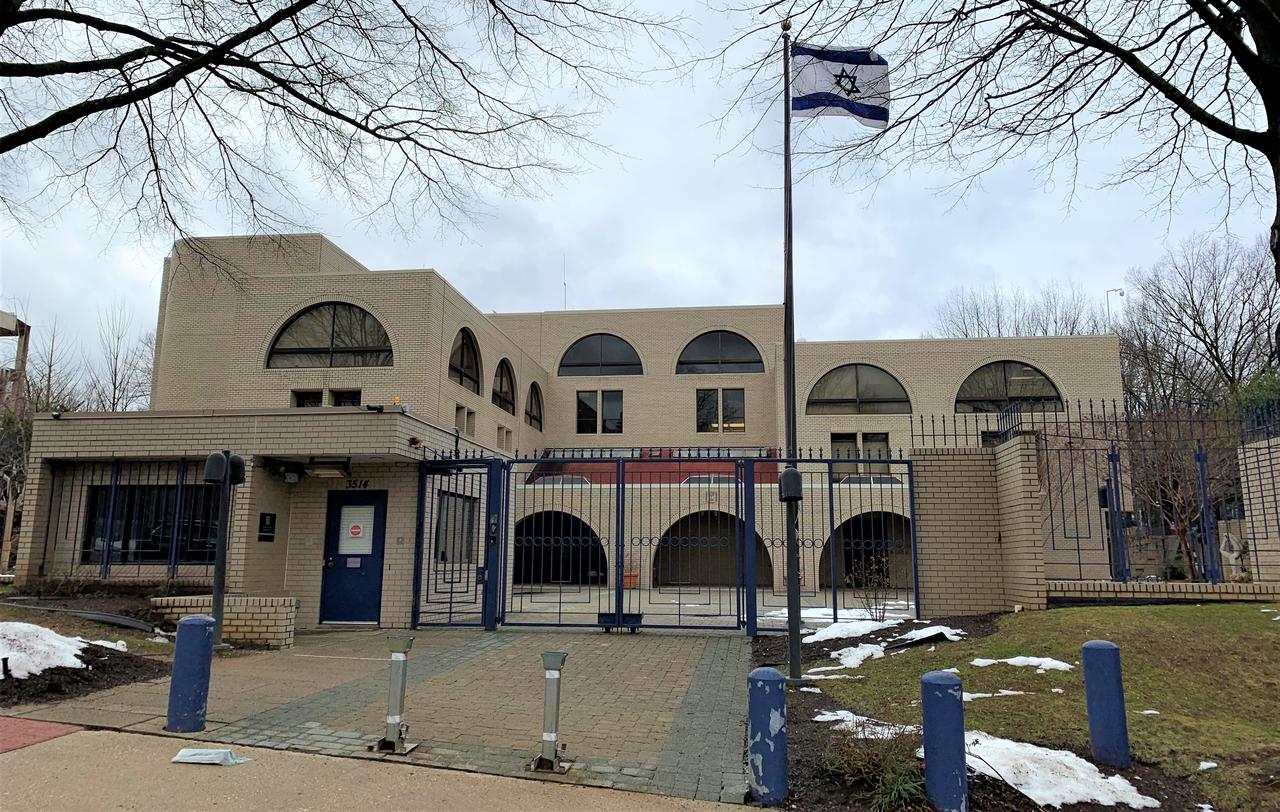
Israeli Embassy in Washington D.C., file image
Iran has vowed revenge for the killing of the man Ayatollah Ali Khamenei acknowledged as “the country’s prominent and distinguished nuclear and defensive scientist” even though Fakhrizadeh for years presented himself to the world as a mere academic and public intellectual. Khamenei called for the “definitive punishment of the perpetrators and those who ordered it” but without giving details.
Interestingly, Israeli officials said “no comment” to repeat inquiries from international media over whether the Jewish state had a role in the plot, which involved gunmen attacking Fakhrizadeh and his bodyguards outside of Tehran before detonating a suicide blast. The nuclear scientist later died in a nearby hospital after being life-flighted there.
Meanwhile, Israeli and US outposts especially in the Middle East are bracing for possible retaliation from either Iran or its regional proxies. Reuters reports:
Israel put its embassies around the world on high alert on Saturday after Iranian threats of retaliation following the killing of a nuclear scientist near Tehran, Israeli N12 news reported on Saturday.
A spokesman for the Israeli Foreign Ministry said the ministry did not comment on matters of security regarding its representatives abroad.
Fakhrizadeh was reportedly on a Mossad hit list for years, which is no doubt also why he always traveled with bodyguards.
All relevant administrators must seriously place two crucial matters on their agendas: 1st to investigate this crime and firmly prosecute its perpetrators and its commanders, 2nd to continue the martyr’s scientific and technological efforts in all the sectors where he was active.
Prime Minister Benjamin Netanyahu even made public reference to him in a 2018 speech detailing Iran’s nuclear ambitions and attempts to hide its weapons program.
As Times of Israel recounts, When Netanyahu revealed then that Israel had removed from a warehouse in Tehran a vast archive of Iran’s own material detailing its nuclear weapons program, he said: “Remember that name, Fakhrizadeh.”
It’s certainly a huge unknown whether Iran will seek any level of retaliation especially given the impending US presidential transition. Tehran has accused Israel of seeking to provoke a “full-blown war” just before Trump leaves office. The thinking is that by orchestrating a major provocation that would induce an Iranian response, the White House would be drawn into military action.
via ZeroHedge News https://ift.tt/33ptQp0 Tyler Durden
Illinois To Borrow Another $2 BIllion From The Fed, Only State To Do So Tyler Durden
Sat, 11/28/2020 – 12:35
By Ted Dabrowski of Wirepoints
Illinois has announced $2 billion more in additional borrowing from the Federal Reserve Bank’s Municipal Liquidity Facility (MLF). Gov. J.B. Pritzker has informed the Fed of the state’s intention to borrow the funds before the facility expires at the end of December. The facility was put in place by the CARES act as a backstop for governments hit by financial market disruptions due to COVID.
While the presence of the Fed facility is credited with bringing stability to the municipal markets, the reality is only one state or city in the entire country has borrowed from the facility since its inception: the state of Illinois. All others have successfully raised billions from the traditional markets during the pandemic (New York’s Metropolitan Transit Authority is the only other government in the country to borrow from the MLF.)
Illinois’ increased reliance on borrowing follows the public’s rejection of a $3.1 billion tax hike referendum on Nov. 3. More debt, in the absence of major spending reforms, means a junk rating is increasingly likely for Illinois. No state in modern history has ever been rated junk.
Illinois’ legislature authorized in the spring up to $5 billion in borrowings from the Fed to cover the state’s 2021 shortfalls, but Gov. Pritzker recently said:
“I am very reluctant to saddle our state with that large amount of short-term debt. I believe it would be irresponsible to borrow that entire amount, given the persistent fiscal pain it would cause over the next three years, as we would struggle to repay that entire amount. Our collective intention is to repay this line of credit as early as possible, after either the awarding of stimulus by Congress or a sufficient recovery of state revenues.”
Said another way, $5 billion in additional debt, with such a short repayment period, would likely trigger the credit rating agencies to act sooner than later. Moody’s recently said in an October report, “[Illinois’] ability to weather the coronavirus pandemic without hurting its credit quality will require keeping growth of its long-term liabilities within its capacity to pay.”
All three agencies rate Illinois just one notch above junk and all have a negative outlook on the state. In fact, Illinois bonds have already been trading at junk-level interest rates for some time.
The state’s budget hole in 2021 is reportedly at $4 billion, while its unpaid bills currently total $7 billion. That’s on top of a Moody’s-estimated $261 billion shortfall for Illinois’ five state-run pension plans, and $56 billion in unfunded state retiree health insurance obligations.
Since the rejection of the progressive tax hike by the public, state officials have yet to put together a financial plan that shows how it will deal with its short-term financial needs. The state’s planned legislative sessions in November and December were cancelled due to COVID, meaning nothing will get done before year end.
The governor and the legislature have also shown no inclination to deal with the larger pension crisis. The governor earlier this year even went as far as to call the pursuit of a pension amendment and pension reform a “fantasy,” saying any reforms would be struck down at the federal level. The governor is likely unaware that both Rhode Island and Arizona have successfully reformed their pensions in recent years, with neither running afoul of the federal Contracts Clause. Wirepoints has covered the legality of reforms, including details of the reforms in both states, in its recent report: Solving Illinois’ Pension Problem: Why Pension Reform is Legal. (Other parts of Wirepoints’ reform plan are at the site Pension Solutions.)
Moody’s has also said it would regard pension holidays and reamortizations as a credit negative: “Underfunding pensions again could lead to further credit deterioration, depending on the degree of underfunding, the state’s other financial strategies and the performance of its pension investments.”
With the options to borrow, tax and postpone debt repayments being taken away from them, Gov. Pritzker and the legislature must begin to realize they can no longer avoid real reforms, starting with a push for a pension amendment. Sure, another stimulus round may provide some temporary relief, but it will do nothing to fix Illinois’ structural problems and to avoid an eventual junk rating.
Reforms in Illinois were once seen as impossible, but they are quickly becoming inevitable.
via ZeroHedge News https://ift.tt/3miJtX1 Tyler Durden
After a Pennsylvania Judge blocked the state from ‘taking any further steps’ to complete the certification of the presidential race on Wednesday – she dropped a detailed opinion on Friday justifying her decision, which concludes that the state’s changes to mail-in balloting procedures were likely illegal.
The order is currently delayed while the state Supreme Court considers the case on an expedited basis, which was filed by a group of Republicans.
Pennsylvania trial court rules the 2020 election was likely unconstitutional in Pennsylvania, and that gives state legislators power to choose electors. https://t.co/pWt9g81ld1
Commonwealth Judge Patricia McCullough noted in her opinion that the plaintiffs “have established a likelihood to succeed on the merits” of the case, because “the Constitution does not provide a mechanism for the legislature to allow for the expansion of absentee voting without a constitutional amendment.”
BREAKING REPORT: Judge Patricia A. McCullough rules that PA preliminary ELECTION CERTIFICATION injunction was PROPERLY ISSUED and should be upheld..
“Additionally, Petitioners appear to have established a
likelihood to succeed.”
“Petitioners appear to have a viable claim that the mail-in ballot procedures set forth in Act 77 contravene Pa. Const. Article VII Section 14 as the plain language of that constitutional provision is at odds with the mail-in provisions of Act 77.“
Judge McCullough adds that without the emergency injunction, the plaintiffs would likely suffer “irreparable harm.”
“If what may be an unconstitutional mail-in voting process remains extant, such mail-in ballots may make the difference as to whether he is successful or not.”
In short; Judge McCullough believes that Pennsylvania’s last-minute changes to mail-in ballots was likely unconstitutional, and if allowed to remain in place may negatively affect at least one of the plaintiffs (a GOP congressman) in future elections.
via ZeroHedge News https://ift.tt/3fIubZ7 Tyler Durden
Facebook Censorship Algos Go Haywire, Blocking Ads From Struggling Legitimate Businesses As “Hate Speech” Tyler Durden
Sat, 11/28/2020 – 11:45
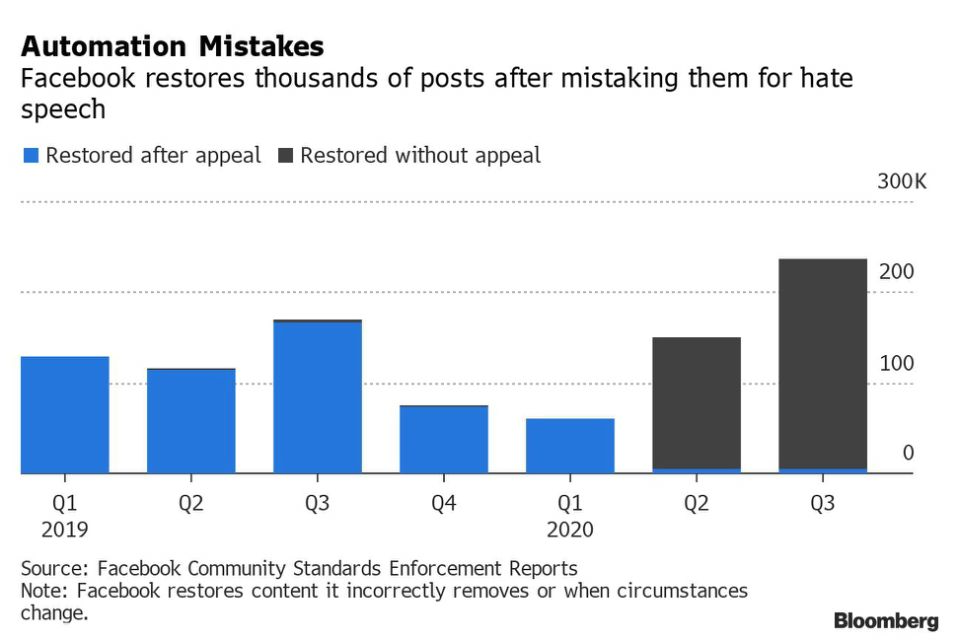
In what is definitely some type of Karmic payback for social media companies now appending some type of label to what seems like every other post nowadays, Facebook just found out that its super-duper censoring algorithm also banned advertisements from some struggling businesses, mistaking them as hate speech.
We love it when a plan comes together.
One woman, Ruth Harrigan, who advertises on Facebook to sell her honey and beeswax-based products, told Bloombergshe thought she missed out on an estimated $5,000 in revenue after Facebook mistakenly banned her ads right before black Friday.
She said: “I was getting a little anxious thinking, ‘Oh my God, Black Friday is around the corner, most of my sales for the year happen in November and December and that’s it,’. I said, ‘If I’m shut down any longer than this, it’ll cripple me.’”
The company’s “misfiring content-moderation software” was to blame – and it happened in the middle of a pandemic when sellers are more reliant on Facebook and social media advertising to drive business. In fact, Facebook has been censoring so much content this year, it has relied heavily on software to do the job, since they don’t have enough human moderators.
And it wasn’t just Harrigan that had issues. Sellers like Ivonne Sanchez, who runs a makeup clinic in Ottawa, had her ads blocked too due to a “policy violation”. She said: “In the middle of a crucial shopping season, it left us shaken. This experience makes us very nervous about investing dollars into a system that is operated seemingly by a bot.”
Yaniv Gershom, co-founder of digital marketing firm 4AM Media, said a Facebook ban that has lasted 6 months has caused him to have to cut 12 jobs. “The only people who are OK are massive spenders who get a Facebook rep that can escalate issues and find out what’s wrong,” he said.
Justin Brooke, founder of Adskills.com, said: “It just exploded. They turned up the AI recently — somebody changed something — and all of the sudden everybody was getting shut down.”
Many other types of businesses saw similar bans, including a coffee delivery service and a reusable water bottle company.
Facebook offered the following half assed comment: “We know it can be frustrating to experience any type of business disruption, especially at such a critical time of the year. While we offer free support for all businesses, we regularly work to improve our tools and systems, and to make the support we offer easier to use and access. We apologize for any inconvenience recent disruptions may have caused.”
Now, back to that Section 230 discussion…
via ZeroHedge News https://ift.tt/33lFX6E Tyler Durden
Something remarkable happened on Tuesday. The Dow Jones Industrial Average (DJIA) broke the 30,000 point barrier for the first time ever. President Trump commemorated the feat by calling the number “sacred.”
Some Americans were especially grateful as they said their Thanksgiving Day grace. These generally include wealthy owners of stocks and other financial assets. Forty years of inflationary monetary policies have elevated their prosperity to holiness.
The remaining Americans, through no fault of their own, missed out on these sanctified blessings. Perhaps they’ll get some leftover table scraps for Christmas. These, indeed, are the questions being asked.
Will Washington make this a Merry Christmas for cash strapped Americans? Will the Treasury send out a second round of $1,200 stimulus checks for the yuletide? Will Congress be Ebenezer Scrooge or Mr. Fezziwig?
These are important questions as 2020 approaches its twilight. And this is the season of giving. After months of rolling lockdowns ordered by state and local governments Americans need relief. Moreover, they must first receive from Uncle Sam so they can give to their fellow kindreds.
This was a recent finding of a Franklin Templeton-Gallup survey. Specifically, the survey found that 16 percent of Americans plan to spend more on holiday gifts this year. But with another $1,200 stimulus check, 22 percent of Americans say they will spend more this holiday season.
Somehow, Christmas spending has become dependent on government stimulus checks. But, remember, government stimulus is dependent on printing press money. And printing press money is dependent on the dollar retaining some semblance of value.
Thus, herein lies the sacred folly. The more that printing press money’s emitted, the more value the dollar loses. We’ll have more on what this means for you and your wealth in just a moment. But first some context…
Eternal Punishment
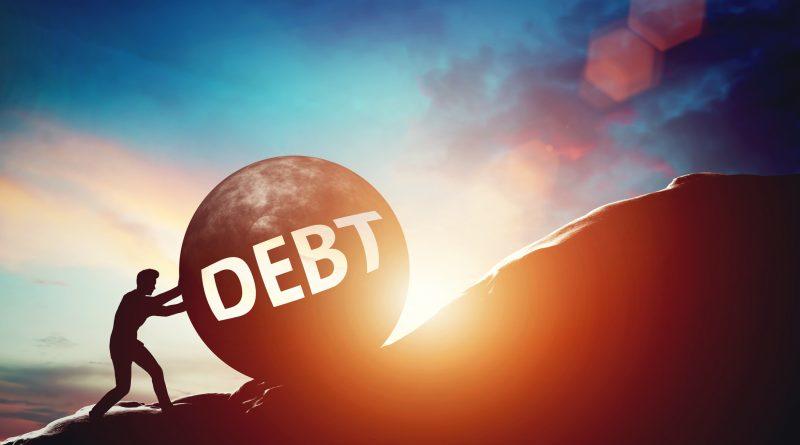
Sisyphus, the cunning king of Corinth, may have cheated death twice. But Zeus ultimately got the last laugh. Sisyphus was condemned to the eternal punishment of forever rolling a boulder up a hill in the depths of Hades.
Odysseus, the hero in Homer’s Odyssey, after descending into Hades, observed Sisyphus in his never ending tedium. Odysseus provided the following account:
“Then I witnessed the torture of Sisyphus, as he wrestled with a huge rock with both hands. Bracing himself and thrusting with hands and feet he pushed the boulder uphill to the top. But every time, as he was about to send it toppling over the crest, its sheer weight turned it back, and once again towards the plain the pitiless rock rolled down. So once more he had to wrestle with the thing and push it up, while the sweat poured from his limbs and the dust rose high above his head.”
The torturous task of Sisyphus’s condemnation was impossible to complete. But what was worse: The physical exertion of pushing the boulder uphill? Or the senseless repetition of having to do it again and again?
The futility of it all likely proved to be far more painful than the act of pushing the boulder itself. From our experience, tender hands and a sore back quickly recede in the triumph of completing an arduous job. Yet the drudgery of a meaningless task is further compounded when it can never be completed.
Corporate lawyers, for example, contribute little of meaningful value. They may save their clients big bucks. And for that they receive handsome compensation. Yet they work long hours, delving into tedium and minutia. Their work never ends. Many are overweight. Nearly all are miserable.
Likewise, paper pushers within government agencies make a career out of pursuing the meaningless. The silver lining to the hell of their employment is the promise of a bountiful retirement. Their dream, it seems, is a retirement where they can pursue the meaningless in comfort. For many, this dream turns out to be a nightmare.
Here’s the point…
The Sisyphean Folly of Printing Press Money
We are living the Sisyphean folly of printing press money. With each passing decade, extreme monetary and fiscal policies distort the economy and financial market in irregular and insane ways. When the lopsided effects become wholly unstable the inevitable crisis arrives.
The solutions from the Federal Reserve and Congress are always the same. To inject credit into financial markets and the economy. Yet each bailout iteration requires greater and greater applications of credit. What’s more, each bailout iteration then leads to the next crisis.
From Black Monday in 1987 to the savings and loan crisis of the early 1990s. Then through the Asian financial crisis in 1997 to the dot com bubble and bust at the birth of the new millennium. And on to the housing collapse and Great Recession in 2008-09 to now the 2020 fiasco.
The fingerprints of central planners are everywhere. Yet, like Sisyphus, their task is never complete. They’re resolute in their attempts to control the uncontrollable…while making a giant mess.
Many governments throughout history have attempted to stimulate the economy by debasing the currency. Such vigorous and persistent attempts to substitute natural laws in finance for the wishes of legislatures are doomed. Complete financial, moral, and political collapse always follows.
The folly would be comical if it weren’t so destructive. Thanks to the planners’ handiwork, we’ve arrived at the absurd place where printing press money is being requested for Christmas.
How people earn their livelihood is no laughing matter. Government interference through lockdowns or other penalties, to then provide compensation via printing press money is a downright insult. And it has far reaching ramifications.
The dollar is being systematically destroyed. This destruction has been going on for 107 years; since the passage of the Federal Reserve Act in 1913. It has been going on in earnest since President Richard Nixon closed the gold window in 1971.
However, the $3.1 trillion deficit in 2020 to paper over the economic consequences of government lockdown orders is something special. The Treasury in concert with the Fed is financing deficits with printing press money, and calling it stimulus. This is outright dollar debasement.
What does this mean for you and your wealth?
Remember, the money you’ve saved, in addition to being property, also represents time and the sacrifices made to earn it. When the Fed inflates your money away it not only steals your money. It steals your life.
Albert Camus, in his 1942 essay The Myth of Sisyphus, saw Sisyphus as characterizing the absurdity of human life. But Camus concluded:
“The struggle itself toward the heights is enough to fill a man’s heart. One must imagine Sisyphus happy.”
We’re not so sure. Still, we keep on pushing.
via ZeroHedge News https://ift.tt/2V9uPFs Tyler Durden
Slain ‘Father’ Of Iran Nukes Was On Mossad Hit List For Years Tyler Durden
Sat, 11/28/2020 – 10:55
The man dubbed the “father” of Iran’s alleged nuclear weapons program, Mohsen Fakhrizadeh, who was assassinated outside Tehran on Friday had been on an Israeli Mossad hit list for years, according to reporting in The New York Times and Times of Israel.
Israeli spy officials have long believed Fakhrizadeh, who succumbed to his wounds in a Tehran hospital after the suicide bombing attack on his vehicle, is the architect of Iran’s atomic weapons program.
Times of Israel/YouTube screenshot: Prime Minister Benjamin Netanyahu stands in front of a picture of Mohsen Fakhrizadeh, who he named as the head of Iran’s nuclear weapons program, April 30, 2018.
Iran has consistently maintained that its nuclear development is for peaceful domestic energy purposes, however.
A shadowy figure, Mr. Fakhrizadeh had long been the No. 1 target of the Mossad, Israel’s intelligence service, which is widely believed to be behind a series of assassinations of scientists a decade ago that included some of Mr. Fakhrizadeh’s deputies.
The Times then goes on to cite specific intelligence as well as an IAEA briefing that disclosed his work overseeing cutting edge programs allegedly related to development of nuclear warheads:
Mr. Fakhrizadeh was an academic, but a series of classified reports, notably a lengthy 2007 assessment done by the C.I.A. for the George W. Bush administration, said the academic role was a cover story. In 2008, his name was added to a list of Iranian officials whose assets were ordered frozen by the United States.
That same year, his activities were disclosed in an unclassified briefing by the I.A.E.A.’s chief inspector. Later, it became clear that he ran what the Iranians called Projects 110 and 111 — an effort to tackle the most difficult problems bomb designers face as they try to make a warhead small enough to fit atop a missile and make it survive the rigors of re-entry into the atmosphere.
Perhaps the most obvious indicator that Israel was secretly behind Friday’s killing (and likely with assistance from US intelligence), is that Fakhrizadeh was singled out by Israeli Prime Minister Benjamin Netanyahu in a 2018 televised speech attempting to prove Iran is seeking a nuclear bomb right under the noses of nuclear inspectors connected to the 2015 JCPOA.
Undated image of Dr. Fakhrizadeh, via Times of Israel
Netanyahu described of an organization within Iran’s defense ministry called S.P.N.D. that “You will not be surprised to hear that S.P.N.D. is led by the same person who led Project Amad, Dr. Fakhrizadeh.”
When Netanyahu revealed then that Israel had removed from a warehouse in Tehran a vast archive of Iran’s own material detailing its nuclear weapons program, he said: “Remember that name, Fakhrizadeh.”
Just hours after the assassination, which drove international headlines Friday, Iranian Foreign Minister Javad Zarif said there were“Serious indications of Israeli role” in killing of Fakhrizadeh, and other officials have vowed a serious response, which they also blame on the United States.
The extent of the Mossad’s remarkable intelligence and operational reach inside the Islamic Republic must be quite unsettling for the mullahs.
In past brazen killings of Iranian scientists, foreign intelligence agencies are believed to have worked through local proxies to conduct the hit such as the Iranian opposition movement and paramilitary group Mujahedin-e-Khalq (MEK).
via ZeroHedge News https://ift.tt/3qc0moo Tyler Durden