U.S. And German Yields Will Bear Brunt Of Lockdowns

U.S. And German Yields Will Bear Brunt Of Lockdowns

Tyler Durden

Sat, 11/28/2020 – 10:30

By Richard Jones, macro commentator at Bloomberg

Increased pandemic restrictions will serve as a massive economic drag in Europe and the U.S. in the coming months, leading to material downside for bund and Treasury yields.

Stocks have rallied this month on vaccine optimism and reduced U.S. political uncertainty. Yet bonds’ reaction on both sides of the Atlantic have been much more circumspect. While the Stoxx 600 and S&P 500 have posted double digit percentage gains, the 10-year UST yield is unchanged and the corresponding bund yield is only 5bps higher, suggesting virus concerns are more in play.
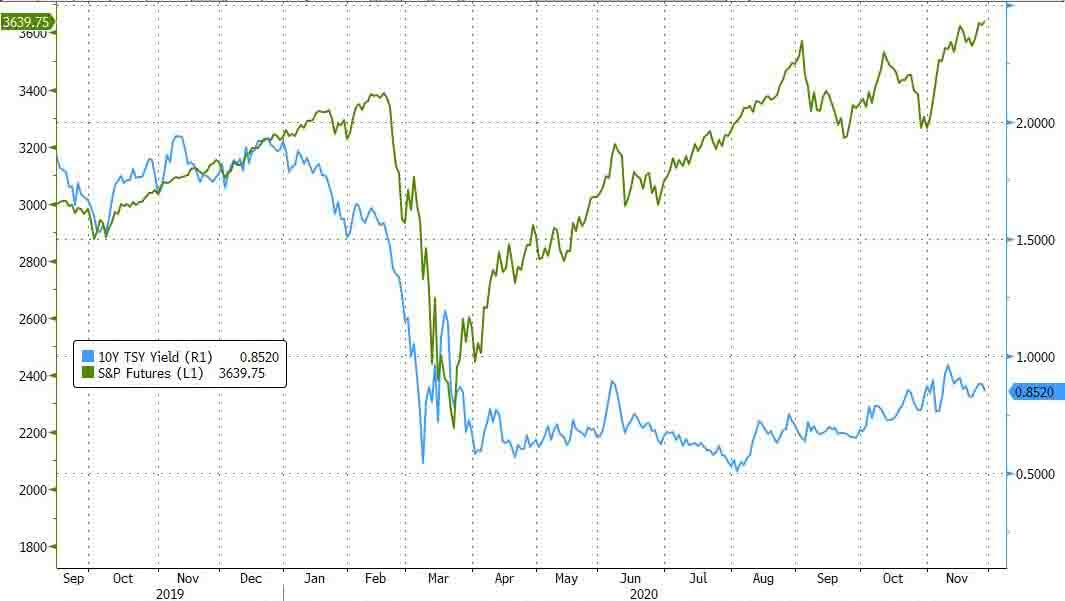
By year-end, given existing partial lockdowns, the 10-year German yield can revisit the -0.67% low seen on Nov. 4. The 10-year UST can trade back down to 0.72%, the Nov. 5 low.

The pandemic is worsening in the U.S. and Europe, and the resulting economic drag will become more evident in the coming weeks and months. Active Covid-19 cases in Germany have almost tripled in the past month. In France, cases have doubled, and in the U.S. they have increased by 50%. With this rapid acceleration, governments have enacted partial lockdowns — and extended them in Germany.

And with the temptation to relax regulations, it is not unreasonable to fear a further spike in cases over the next month or so at a time when health systems are already stressed.

Business and consumer sentiment is already souring and layoffs rising. Should rising caseloads and stretched resources lead to even tighter restrictions in 2021, the all-time lows in the 10-year UST (0.31%) and bund (-0.91%) yields could easily be revisited.

This is especially possible given fiscal stimulus efforts in the U.S. and euro area have stalled with two U.S. unemployment-insurance programs set to expire.

With the make-up of the U.S. Senate still up in the air, it is uncertain how much pandemic aid can be implemented by the incoming Biden administration. Any package will likely be less expansive than the previous initiatives, and may still be several months away.

The European Union recovery program, once hailed as a game-changer, has run aground on political infighting between member states. With negotiations ongoing, the disbursement of funds will be delayed beyond the envisioned starting point at the turn of 2021.

The lack of an aggressive fiscal impulse will leave the ECB and Fed to pick up the stimulus slack required by economies over the winter. To be sure, restrictions may get the virus under control heading into 2021 and fiscal stimulus might yet be implemented soon. Failing these eventualities, the pandemic’s economic drag opens up a lot of downside for German and U.S. yields.

via ZeroHedge News https://ift.tt/36g0wmZ Tyler Durden
Russia Ramps Up Ballistic & Hypersonic Missile Tests As START Treaty Expires

Russia Ramps Up Ballistic & Hypersonic Missile Tests As START Treaty Expires

Tyler Durden

Sat, 11/28/2020 – 09:55

Russia’s Defense Ministry has released stunning video of its latest test of its modernized anti-ballistic missile system (ABM) carried out this week over Kazakhstan.

Already in service with Russia’s aerospace forces, it’s being described as protection against air and space attacks. Moscow and Washington have lately downplayed the other’s ballistic capabilities, and Russia is hoping to “prove” what officials previously called “false information” advanced by the US.

“At the Sary-Shagan testing range (Republic of Kazakhstan), a combat crew of the air and missile defense troops of the Aerospace Forces successfully carried out a regular test launch of a new missile of the Russian missile defense system,” the ministry said.

The announcement of the successful test also came synonymous to a White Sea test of a “hypersonic anti-ship missile” off Russia’s northwest coast.

That separate missile test reportedly struck a target at up to 450km away and traveled at a speed of over Mach 8.

TASS described of the far northern operation:

“In its flight, the missile developed a speed of over Mach 8,” the ministry stressed.

The frigate Admiral Gorshkov test-fried a Tsirkon hypersonic missile for the first time in early October. The missile launched from the White Sea struck a sea target in the Barents Sea, flying at eight times the speed of sound at an altitude of 28 km.

Footage of a prior Tsirkon test from October: 

Russia previously vowed it would conduct a series of hypersonic and ballistic missile tests through the end of the year.

This is worrisome especially given the potential for a ‘new Cold War’ style arms race between the United States and Russia as the landmark New START nuclear arms reduction treaty is set to expire in February 5, 2021, unless it is renewed.

Ongoing negotiations between the Kremlin and the Trump administration has looked promising, but it’s likely Russia will at this point wait to continue the talks with the incoming Biden administration.

via ZeroHedge News https://ift.tt/2HJO710 Tyler Durden

Pennsylvania Republicans To Introduce Resolution Disputing Election Results

Pennsylvania Republicans To Introduce Resolution Disputing Election Results

Tyler Durden

Sat, 11/28/2020 – 09:20

Authored by Ivan Pentchoukov via the Epoch Times (emphasis ours)

Republican state lawmakers in Pennsylvania released a memo on Nov. 27, advising that they will soon introduce a resolution to dispute the results of the 2020 election.

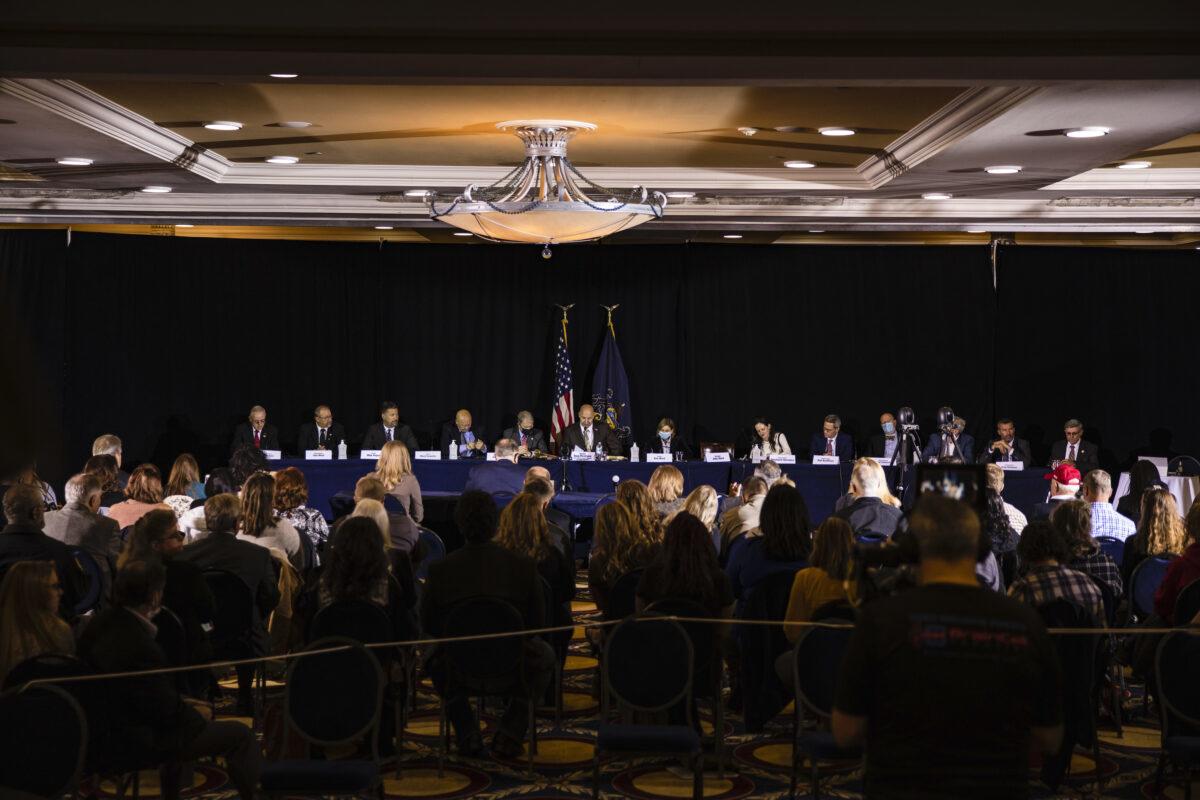
The Pennsylvania Senate Majority Policy Committee holds a public hearing Wednesday at the Wyndham Gettysburg hotel to discuss 2020 election issues and irregularities with President Trumps lawyer Rudy Giuliani in Gettysburg, Pa., on Nov. 25, 2020. (Samuel Corum/Getty Images)

The resolution states that the executive and judicial branches of the Keystone State’s government usurped the legislature’s constitutional power to set the rules of the election.

The resolution “declares that the selection of presidential electors and other statewide electoral contest results in this commonwealth is in dispute” and “urges the secretary of the commonwealth and the governor to withdraw or vacate the certification of presidential electors and to delay certification of results in other statewide electoral contests voted on at the 2020 general election.”

It also “urges the United States Congress to declare the selection of presidential electors in this Commonwealth to be in dispute.”

The proposed text lists three steps taken by the judicial and executive branches to change the rule of the election.

First, on Sept. 17, the Pennsylvania Supreme Court “unlawfully and unilaterally” extended the deadline by which mail ballots could be received, mandated that ballots without a postmark would be treated as timely, and allowed for ballots without a verified voted signature to be accepted, the resolution says.

Second, on Oct. 23, upon a petition from the secretary of the commonwealth, the Pennsylvania Supreme Court ruled that signatures on mail-in ballots need not be authenticated.

And third, on Nov. 2, the secretary of the commonwealth “encouraged certain counties to notify party and candidate representatives of mail-in voters whose ballots contained defects,” the resolution says.

All of the changes are contrary to the Pennsylvania Election Code, which requires mail-in ballots to be received at 8 p.m. on Election Day, mandates that signatures on the mail-in ballots be authenticated, and forbids the counting of defective mail-in ballots.

The resolution also lists a variety of election irregularities and potential fraud, including the issues brought up by witnesses during the hearing before the Pennsylvania Senate Majority Policy Committee on Nov. 25.

“On November 24, 2020, the Secretary of the Commonwealth unilaterally and prematurely certified results of the November 3, 2020 election regarding presidential electors despite ongoing litigation,” the resolution states.

“The Pennsylvania House of Representatives has the duty to ensure that no citizen of this Commonwealth is disenfranchised, to insist that all elections are conducted according to the law, and to satisfy the general public that every legal vote is counted accurately.”

Pennsylvania State Sen. Doug Mastriano, a Republican, said Friday that the GOP-controlled state legislature will make a bid to reclaim its power to appoint the state’s electors to the Electoral College, saying they could start the process on Nov. 30.

“So, we’re gonna do a resolution between the House and Senate, hopefully today,” he told Steve Bannon’s War Room on Friday. “I’ve spent two hours online trying to coordinate this with my colleagues. And there’s a lot of good people working this here. Saying, that the resolution saying we’re going to take our power back. We’re gonna seat the electors. Now obviously we’re gonna need the support of the leadership of the House and Senate, we’re getting there on that.”

Jack Phillips contributed to this report.

Follow Ivan on Twitter: @ivanpentchoukov

via ZeroHedge News https://ift.tt/2Jgwkzo Tyler Durden

Joe Biden Should Think Twice About Cracking Down on Meat-Processing Plants

meatplant

President-elect Joe Biden’s administration will likely ramp up regulation of meatpackers after Covid-19 outbreaks spread through many of the nation’s biggest processing plants, USA Today reported this week. While these facilities have not managed COVID-19 well, any new regulations will likely have unintended consequences.

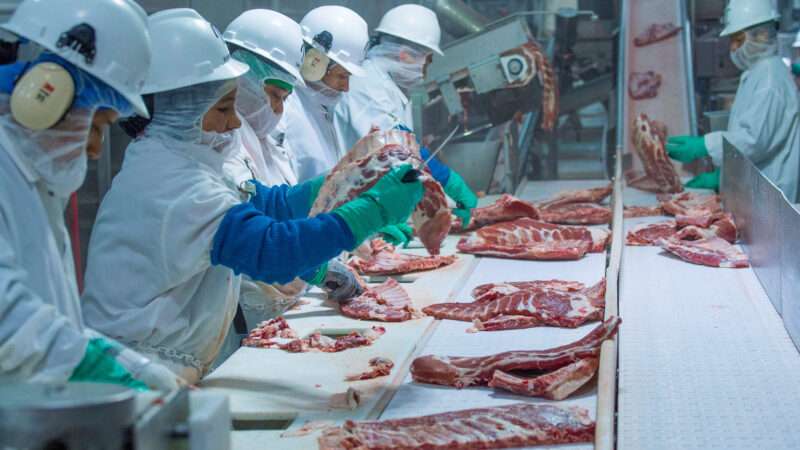
As I explained in a May article on COVID-19 outbreaks at meat processing plants, these facilities necessarily require “hundreds of employees to stand elbow-to-elbow while working at breakneck speed.” Social distancing? Not a chance. The sheer number of people working quickly and closely together is what likely turned these processing plants into daily superspreader events. Plants were forced to close temporarily after thousands of workers were sickened. Hundreds of those workers died.

The USA Today report says OSHA, the federal agency charged with regulating workplace safety, refused or failed to enforce its own guidelines to protect these meat-plant workers during the pandemic. And it suggests Biden will use a “heavier hand” to regulate the industry.

While the piece notes Biden has so far offered no specifics about any plans to increase plant regulations, it points to prior Biden critiques of the Trump administration’s handling of plant worker safety during the pandemic, and calls for new workplace standards, hiring more OSHA inspectors, and requiring employers to ensure workers are socially distanced and provided with masks and other health and safety tools. 

While some of those changes could happen quickly, one expert cited in the USA Today piece says implementing such wholesale changes would require “major legislation” to be passed. That’s unlikely.

Whether or not the Biden administration’s nebulous plans ultimately coalesce, I see at least three ways any such plans may cause workers to lose their jobs.

First, whichever rules the Biden administration might impose, if they reduce worker density at meat plants that are already operating at capacity, then there simply won’t be room—or jobs—for all of the workers that currently staff these plants. 

That’s because meatpacking plants are designed to maximize output while complying with existing rules. Changing the rules means changing the plants. That’s not easy.

“Please understand, processing plants were no more designed to operate in a pandemic than hospitals were designed to produce pork,” meat processing giant Smithfield wrote in a public communication this past summer. “In other words, for better or worse, our plants are what they are. Four walls, engineered design, efficient use of space, etc. Spread out? OK. Where?”

That’s not just some industry doublespeak. Douglas Trout, a Centers for Disease Control expert who focuses on workplace health and safety, told the industry publication Meatingplace recently he saw “no reason, necessarily, to have the occupational safety and health controls to prevent person-to-person spread of a virus like SARS-CoV-2 prior to this epidemic.”

If decreased worker density becomes mandatory, the industry will need to build new plants to meet demand. But building dozens or more new plants won’t happen anytime soon. The biggest plants cost hundreds of millions of dollars to build. Even a slightly smaller plant can cost tens of millions of dollars.

That’s why these same processing plants may just decide it’s cheaper, safer, and more efficient to replace most of their workers in their existing facilities with computer software and hardware.

Even before the pandemic, the news was rife with stories about a coming wave of meat-plant automation. Automated meat processing has the ability to make safer the dangerous business of cutting up livestock. And automation is more efficient.

But these reports have only grown in number since the pandemic ripped through the nation’s largest processing plants. Meat plants that are using artificial intelligence have seen “remarkable advancements” in productivity. And highly automated plants, unsurprisingly, have had far fewer Covid-19 outbreaks among workers.

Robots can’t do everything humans can do in a processing plant yet. But they can perform some key processing and packaging tasks, VentureBeat reported in August, and they can also “scan, weigh, and measure carcasses to eviscerate them ‘intelligently,’ with the more sophisticated models planning blade trajectories for cutting, separating meat from carcasses and boning them out.

Hopes and fears that robots and other automated systems will replace meat-industry workers are no pipe dream. Consider, for example, that the push for a $15 minimum wage is spurring the fast-food industry to replace human workers with cheaper automation.

Third, if one or more of the Covid-19 vaccines are successful—as I hope they will be soon—then any rules the Biden administration might draft could become moot by the time they take force. That doesn’t mean, mind you, that any such rules would be scrapped. That would leave meat processors to comply with rules that—even if, charitably, they made sense at the time they were adopted—are costly, overbearing, and outdated. Frankly, though, such a situation would make those rules almost exactly like a lot of other meat regulations.

I’m one of the many people who noted during the pandemic that no worker’s life, at any point in a supply chain, is worth sacrificing for a hamburger. I stand by that. But are those same workers’ jobs worth sacrificing?

from Latest – Reason.com https://ift.tt/2JqVqer
via IFTTT

UN Dubs Self ‘Trusted’ Pandemic News Source, Teams Up With World Economic Forum To Encourage ‘New Social Norms’

UN Dubs Self ‘Trusted’ Pandemic News Source, Teams Up With World Economic Forum To Encourage ‘New Social Norms’

Tyler Durden

Sat, 11/28/2020 – 08:45

The United Nations has ‘launched a counter-attack’ against coronavirus misinformation – by teaming up with the World Economic Forum to battle coronavirus misinformation and other ‘potentially dubious content.’

“When COVID-19 emerged, it was clear from the outset this was not just a public health emergency, but a communications crisis as well,” says Melissa Flemming, the UN’s head of global communications.

“We’re trying to create this new social norm called ‘pause – take care before you share’ – she continued, adding “We’re equipping people, through this new social norm, with a bit of ‘information scepticism’.”

The new initiative also seeks to rope social media influencers into spreading ‘real news’ about the pandemic – which we assume means nothing to do with hydroxychloroquine, incredibly low fatality rates for most people below retirement age, or anyone even slightly opposed to business-killing lockdowns.

One also has to wonder how the UN and WEF would cover egregious flip-flops from global health authorities on everything from transmissibility to mask use.

Regardless, the UN’s campaign is steadfast in their self-determined authority as arbiters of all things COVID.

“So far, we’ve recruited 110,000 information volunteers, and we equip these information volunteers with the kind of knowledge about how misinformation spreads and ask them to serve as kind of ‘digital first-responders‘ in those spaces where misinformation travels,” said Flemming.


via ZeroHedge News https://ift.tt/36fK5XP Tyler Durden

Joe Biden Should Think Twice About Cracking Down on Meat-Processing Plants

meatplant

President-elect Joe Biden’s administration will likely ramp up regulation of meatpackers after Covid-19 outbreaks spread through many of the nation’s biggest processing plants, USA Today reported this week. While these facilities have not managed COVID-19 well, any new regulations will likely have unintended consequences.

As I explained in a May article on COVID-19 outbreaks at meat processing plants, these facilities necessarily require “hundreds of employees to stand elbow-to-elbow while working at breakneck speed.” Social distancing? Not a chance. The sheer number of people working quickly and closely together is what likely turned these processing plants into daily superspreader events. Plants were forced to close temporarily after thousands of workers were sickened. Hundreds of those workers died.

The USA Today report says OSHA, the federal agency charged with regulating workplace safety, refused or failed to enforce its own guidelines to protect these meat-plant workers during the pandemic. And it suggests Biden will use a “heavier hand” to regulate the industry.

While the piece notes Biden has so far offered no specifics about any plans to increase plant regulations, it points to prior Biden critiques of the Trump administration’s handling of plant worker safety during the pandemic, and calls for new workplace standards, hiring more OSHA inspectors, and requiring employers to ensure workers are socially distanced and provided with masks and other health and safety tools. 

While some of those changes could happen quickly, one expert cited in the USA Today piece says implementing such wholesale changes would require “major legislation” to be passed. That’s unlikely.

Whether or not the Biden administration’s nebulous plans ultimately coalesce, I see at least three ways any such plans may cause workers to lose their jobs.

First, whichever rules the Biden administration might impose, if they reduce worker density at meat plants that are already operating at capacity, then there simply won’t be room—or jobs—for all of the workers that currently staff these plants. 

That’s because meatpacking plants are designed to maximize output while complying with existing rules. Changing the rules means changing the plants. That’s not easy.

“Please understand, processing plants were no more designed to operate in a pandemic than hospitals were designed to produce pork,” meat processing giant Smithfield wrote in a public communication this past summer. “In other words, for better or worse, our plants are what they are. Four walls, engineered design, efficient use of space, etc. Spread out? OK. Where?”

That’s not just some industry doublespeak. Douglas Trout, a Centers for Disease Control expert who focuses on workplace health and safety, told the industry publication Meatingplace recently he saw “no reason, necessarily, to have the occupational safety and health controls to prevent person-to-person spread of a virus like SARS-CoV-2 prior to this epidemic.”

If decreased worker density becomes mandatory, the industry will need to build new plants to meet demand. But building dozens or more new plants won’t happen anytime soon. The biggest plants cost hundreds of millions of dollars to build. Even a slightly smaller plant can cost tens of millions of dollars.

That’s why these same processing plants may just decide it’s cheaper, safer, and more efficient to replace most of their workers in their existing facilities with computer software and hardware.

Even before the pandemic, the news was rife with stories about a coming wave of meat-plant automation. Automated meat processing has the ability to make safer the dangerous business of cutting up livestock. And automation is more efficient.

But these reports have only grown in number since the pandemic ripped through the nation’s largest processing plants. Meat plants that are using artificial intelligence have seen “remarkable advancements” in productivity. And highly automated plants, unsurprisingly, have had far fewer Covid-19 outbreaks among workers.

Robots can’t do everything humans can do in a processing plant yet. But they can perform some key processing and packaging tasks, VentureBeat reported in August, and they can also “scan, weigh, and measure carcasses to eviscerate them ‘intelligently,’ with the more sophisticated models planning blade trajectories for cutting, separating meat from carcasses and boning them out.

Hopes and fears that robots and other automated systems will replace meat-industry workers are no pipe dream. Consider, for example, that the push for a $15 minimum wage is spurring the fast-food industry to replace human workers with cheaper automation.

Third, if one or more of the Covid-19 vaccines are successful—as I hope they will be soon—then any rules the Biden administration might draft could become moot by the time they take force. That doesn’t mean, mind you, that any such rules would be scrapped. That would leave meat processors to comply with rules that—even if, charitably, they made sense at the time they were adopted—are costly, overbearing, and outdated. Frankly, though, such a situation would make those rules almost exactly like a lot of other meat regulations.

I’m one of the many people who noted during the pandemic that no worker’s life, at any point in a supply chain, is worth sacrificing for a hamburger. I stand by that. But are those same workers’ jobs worth sacrificing?

from Latest – Reason.com https://ift.tt/2JqVqer
via IFTTT

“Life Won’t Ever Be Completely Normal Again” – Renowned Infection/Immunity Expert Warns COVID Is Not Going Away

“Life Won’t Ever Be Completely Normal Again” – Renowned Infection/Immunity Expert Warns COVID Is Not Going Away

Tyler Durden

Sat, 11/28/2020 – 08:10

Authored by Damir Mujezinovic via Inquisitr.com,

In a Thursday interview with Spanish newspaper El Pais, Dr. Ian Lipkin, director of the Center for Infection and Immunity at Columbia’s Mailman School of Public Health, said that the novel coronavirus may never go away.

Per Newsweek, which published a translation of the interview, Lipkin said that the public will have to adapt and learn how to “live the rest of our lives with this virus.”

“It is going to be a recurring problem. I don’t think life will ever be completely normal again.”

Lipkin said that it is likely future generations will be vaccinated against COVID-19, but noted that additional booster doses may be necessary. The expert described the progress in vaccine development as “staggering,” suggesting that vaccines developed by Moderna and Pfizer will be able to significantly reduce the spread of the virus.

However, Lipkin pointed out that there could be logistical challenges and that distribution will not be easy.

“We will be able to distribute these vaccines in most of Europe and the U.S. But getting them to developing countries will be a daunting challenge,” he said.

Pfizer and BioNTech announced earlier this month that their candidate is 95 percent effective at stopping coronavirus, while Moderna said that its mRNA-1273 had an efficacy of 94.5 percent. However, neither of the vaccines can be stored at standard refrigeration temperatures, which could be a major issue in some parts of the world.

Achieving “global group immunity” is the end goal, according to Lipkin, who explained that between 60 and 80 percent of the world’s population needs to be immune before normalcy is restored.

Governments across the globe have implemented public health measures to curb the spread of coronavirus, some more successfully than others. China, where the virus is thought to have originated, has been very successful in controlling the pandemic.

Lipkin — who assisted the Chinese government during the 2003 SARS epidemic and advised Saudi Arabia during the MERS outbreak — suggested that it is unrealistic to expect western governments to achieve the same results.

“In China, if the government decides to do something, it is done. It is not like in Spain or the United States where there can be debate about confinements and closures,” he said.

Getty Images / Getty Images

The expert concluded the interview on a more optimistic note, saying that the coronavirus crisis “has also demonstrated our ability to respond with science, compassion and a common goal.”

According to the population data site Worldometers, more than 61 million coronavirus cases have been recorded in the world so far and nearly 1.5 million people have died from complications caused by the disease.

via ZeroHedge News https://ift.tt/36fVKpB Tyler Durden

Has Europe Broken The Second Wave?

Has Europe Broken The Second Wave?

Tyler Durden

Sat, 11/28/2020 – 07:35

A couple of weeks after several European countries went on (at least partial) lockdown once again in the face of surging COVID-19 cases, the tightening of restrictions appears to be paying off.

As Statista’s Felix Richter shows in the following chart, based on data from the Johns Hopkins University, shows, the seven-day average of newly confirmed cases across the continent started trending downwards again, fueling hopes that the second wave of the pandemic is about to break.

Infographic: Has Europe Broken the Second Wave? | Statista

You will find more infographics at Statista

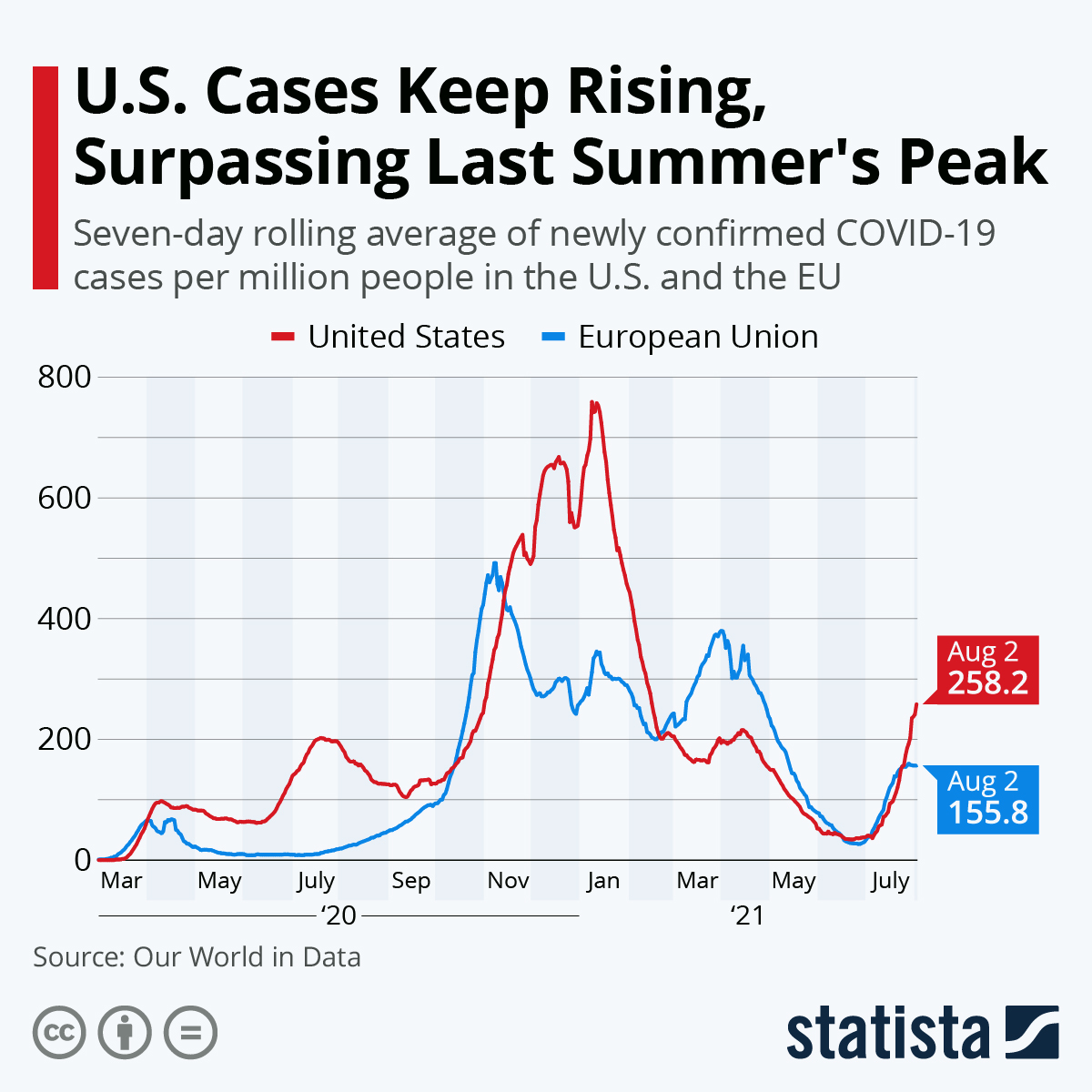
After successfully keeping new infections at a very low level over the summer, case numbers in Europe had started trending upwards again in mid-July, climbing to unprecedented highs by the end of September, which is also when the EU surpassed the United States in terms of daily new cases. The rate of new infections continued to accelerate through October, with the seven-day average of new cases increasing almost fivefold between October 1 and October 31.

Meanwhile, the situation in the U.S. is worsening again, with the number of daily new cases climbing towards 200,000 after surpassing 100,000 for the first time on November 3. As of November 23, the seven-day average of new cases had reached 172,000 in the United States, with total cases rising from 10 to 12.4 million since November 8.

via ZeroHedge News https://ift.tt/3o5cA0g Tyler Durden