The Shaky Foundations Of LA’s Housing “Entitlement” For The Homeless

The Shaky Foundations Of LA’s Housing “Entitlement” For The Homeless

Authored by Christopher Rufo via RealClearInvestigations.com,

In 2016 influential political leaders, activists, and media outlets in Los Angeles said they had a simple solution to homelessness: build more housing. Echoing an argument heard across the country, they claimed that rising rents have thrown people onto the streets and that by directly providing free “permanent supportive housing,” cities can reduce the number of people on the streets and save costs on emergency services.

In response, 77% of Los Angeles voters approved a $1.2 billion bond for the construction of 10,000 units for the city’s homeless. That commitment made Los Angeles the most significant testing ground for the “Housing First” approach that has become the dominant policy idea on homelessness for West Coast cities. Even before the passage of the bond, the concept’s creator, Sam Tsemberis, was lavished with praise by the national media. In 2015, the Washington Post wrote that Tsemberis had “all but solved chronic homelessness” and that his research “commands the support of most scholars.”

Sam Tsemberis: He has been hailed by the Washington Post as having “all but solved homelessness.” But Los Angeles, above, challenges his “Housing First” model.

In the years since, “Housing First” has taken even greater hold in California and the across the West. Los Angeles Mayor Eric Garcetti recently declared that “we need to have an entitlement to housing.” California Gov. Gavin Newsom went a step further, arguing that “doctors should be able to write prescriptions for housing the same way they do for insulin or antibiotics.”

Five years in, the project has been plagued by construction delays, massive cost overruns, and accusations of corruption. The Los Angeles city controller issued a scathing report, “The High Cost of Homeless Housing,” which shows that some studio and one-bedroom apartments were costing taxpayers more than $700,000 each, with 40% of total costs devoted to consultants, lawyers, fees, and permitting. The project is a boon for real estate developers and a constellation of nonprofits and service providers, but a boondoggle for taxpayers. The physical apartment units are bare-bones — small square footage, cheap flooring, vinyl surfaces — but have construction costs similar to luxury condos in the fashionable parts of Los Angeles. Meanwhile, unsheltered homelessness has increased 41%, vastly outpacing the construction of new supportive housing units. Los Angeles magazine, which initially supported the measure, now wonders whether it has become “a historic public housing debacle.”

Before completing a single housing unit, the city reduced its projected construction from 10,000 units to 5,873 units over 10 years, with the potential for further reductions in the future. But the long-term problem runs much deeper: Even if one accepts that permanent supportive housing is the solution, there are currently more than 66,000 homeless people in Los Angeles County. Under the best-case scenario, Proposition HHH will solve less than 10% of the problem over the course of a decade.

Arrested development: Five years in, most of LA’s homeless projects are barely off the ground.

Despite Housing First’s uncertainties, other West Coast cities desperate to solve homelessness, including Seattle and San Francisco, have been captured by its seductive messaging and promise of respite. As Los Angeles grapples with the unforeseen consequences of its big bet on “Housing First,” the federal, state, and local governments, especially in major metropolitan areas, are preparing to commit billions of dollars to the program, whose track record remains woefully underexamined.

As Los Angeles’s “Housing First” program has failed to meet expectations, Mayor Eric Garcetti is now downplaying it as just one of several needed approaches to homelessness.

Ever since clinical psychologist Tsemberis pioneered the model in New York City in the 1990s, political leaders, activists, and academics have insisted that Housing First is an “evidence-based” intervention that reduces homelessness, saves taxpayer money, and improves lives. Supporters frequently argue that the program reduced costs in a study of chronic alcoholics in Seattle, consistently demonstrates high retention rates in multiple academic surveys, and eliminated chronic homelessness in Utah. “We’re going to stem this crisis by building supportive housing in every neighborhood throughout Los Angeles,” City Council member Herb Wesson recently claimed.

These studies, however, are not as persuasive as activists suggest. Although the study of chronic alcoholics in Seattle does show a net reduction in monthly social service costs of $2,449 per person, this figure does not include $11 million in capital and construction costs for the housing units themselves; in other words, Housing First saves money if the cost of housing is not included. Even on its own favorable terms, the study’s purported savings aren’t as dramatic as they appear: While the Housing First participants showed a 63% reduction in service costs over six months, a wait-listed control group that was not provided housing showed a 42% reduction in service costs over the same time period, raising questions about the specific effectiveness of the intervention.

Claims that studies show one-year retention rates of roughly 80% for Housing First participants are open to question. In a meta-study of three best-in-class Housing First sites, researchers found that 43% remained in housing for the first 12 months, 41% were “intermittent stayers” who left and returned, and 16% abandoned the program or died within the first year. These findings challenge the argument that Housing First is a long-term solution to homelessness.

Finally, advocates and the media have long touted Utah as the gold standard of Housing First. “The Daily Show” called the state’s program “mind-blowing,” the Los Angeles Times reported in 2015 that Utah “is winning the war on chronic homelessness,” and dozens of media outlets announced that the state “reduced chronic homelessness by 91%.” These miraculous results, however, were not the result of Housing First policies, but apparently clerical manipulation by state officials. According to the Deseret News and economist Kevin Corinth, “As much as 85% of Utah’s touted reductions in chronic homelessness … may have been due to changes in how the homeless were counted.” It’s not that all of the chronically homeless were housed; they were simply transposed onto a new spreadsheet. Moreover, between 2016 and 2018, the number of unsheltered homeless in Utah nearly doubled – hardly the victory that Housing First activists had declared.

Media, including Comedy Central’s “Daily Show,” hailed “Housing First” in Utah. But stats were fudged.

The recent debate surrounding Housing First has predominantly been focused on the physical and budgetary metrics of housing retention and cost reductions. But these surface-level concerns obscure a deeper question: What happens to the human beings in these programs? The results, according to the vast majority of studies, point to a grim conclusion: Housing First does not meaningfully improve human lives.

Although housing programs are often an effective solution for families experiencing a temporary loss of shelter, Housing First programs do not have a strong track record improving the lives of the unsheltered homeless — the people in tents, cars, and on the streets — who often suffer from more severe challenges. According to research by the California Policy Lab, 75% of the unsheltered homeless have substance abuse condition, 78% have mental health conditions, and 84% have physical health conditions. In theory, Housing First would address these problems. In every program, residents are offered a wide range of services. At the Pathways to Housing program in New York City, a flagship program founded by Sam Tsemberis himself, residents are served by an “interdisciplinary team of professionals that includes social workers, nurses, psychiatrists, and vocational and substance abuse counselors who are available to assist consumers 7 days a week 24 hours a day.” However, despite this massive intervention, the Pathways program shows no reduction in substance abuse or psychiatric symptoms over time – in fact, those conditions often worsened.

This basic finding is confirmed by a range of studies showing that residents of Housing First programs show no improvement regarding addiction and mental illness. They are housed but broken, wracked by the cruelest psychoses, compulsions, and torments – all under the guise of medical care.

Los Angeles’s “Housing First” produces homes, but fails to address the problems of the once-homeless.

A Housing First experiment in Ottawa, Canada, illustrates this paradoxical outcome in stark terms. Researchers divided the study into two populations: an “intervention” group that was provided Housing First and access to primary care, medically assisted treatment, social workers, and on-demand services; and a non-intervention “control” group that was not provided housing or services – they were simply left on the streets. To the shock of the researchers, after 24 months the non-intervention control group reported better results regarding substance abuse, mental health, quality of life, family relations, and mortality than the Housing First group. In other words, doing nothing resulted in superior human outcomes than providing Housing First with wraparound services.

One explanation may be that Housing First programs are deliberately not oriented toward recovery, rehabilitation, and renewal. They operate on the “harm reduction” model, which allows residents to continue using drugs such as alcohol, heroin, and methamphetamine, and does not require mental health treatment as a condition of residency. In theory, this permissive policy would help “reduce harm” to the individual; in practice, however, it may create a community-level effect that makes it hard for any individual to find recovery. Here is the basic chain of events: Homeless individuals with substance abuse and psychiatric disorders are placed together in a residential facility where they are allowed to continue the way of life they had on the streets. Despite the availability of services, there is no incentive to use those services and no disincentive to the problematic behavior associated with street homelessness. Consequently, widespread addiction often becomes the norm within Housing First programs. 

Preferring Homelessness

This chain of events is not just a thought experiment. In Birmingham, Ala., researchers inadvertently created this exact problem when they put participants of two different programs – one “recovery” program and one “harm reduction” program – in the same apartment complex. Immediately after beginning the experiment, the recovery group “began abandoning the provided housing, complaining that their proximity to persons not required to remain abstinent (i.e., the other trial group) was detrimental to their recovery. They claimed that they preferred to return to homelessness rather than live near drug users.” The researchers quickly stopped and reorganized the trial, writing that “this unexpected reaction shows one possible risk to housing persons with active addiction.”

Still, Housing First advocates insist that their policy is working. When reached for comment, Tsemberis insisted that the Washington Post headline declaring that he had “solved homelessness” is true. “The most effective way to end homelessness for people with mental health and addiction is to provide housing and wraparound support,” Tsemberis said. He points towards rates of “housing stability” as the key metric, while conceding that Housing First does not provide “a cure for mental illness and addiction.” This is a suggestion that policymakers have “solved homelessness” simply by bringing people indoors, no matter their addictions, mental illnesses, and human torments.

Advocates portray Housing First as a science that transcends politics. The policy was first adopted by the George W. Bush administration and has gained support from Republicans and Democrats alike. As the Washington Post observed, it is “a model so simple children could grasp it, so cost-effective fiscal hawks loved it, so socially progressive liberals praised it.

However, the real-world evidence from cities such as Los Angeles challenges this narrative. If Housing First has demonstrated anything, it is this: It provides a stable residential environment for the homeless to live out their pathologies, subsidized by the public and administered by the social-scientific sector. It does, not however, address addiction, mental illness and other factors that limit human potential and lead to homelessness.

A defensive Garcetti: “Nobody embraces only housing. It’s got to be housing with services together.” 

In Los Angeles, despite the insistence that Housing First is the answer, some uncertainty is creeping in. Mayor Garcetti is now on the defensive, as homelessness in Los Angeles continues to increase despite billions in spending. After the federal government released a study questioning the premises of Housing First, Garcetti backed away from the unidimensional approach, telling reporters with irritation in his voice: “Sometimes people parody Housing First as ‘only housing.’ Nobody embraces only housing. It’s got to be housing with services together.”

In more bad news for public officials and supporters of Housing First, there is an emerging body of evidence that calls into question the “cost savings” of the program. A recent study in Massachusetts shows that Housing First does not reduce rehospitalization and service utilization, while another study in Chicago suggests that Housing First might increase overall costs. Furthermore, researchers have concluded that the purported cost savings in earlier Housing First studies would not apply to the 82% of the homeless population that is not chronically homeless.

Ron Galperin: The Los Angeles controller has found the city’s housing program to be riddled with high costs and delays.

In Los Angeles, this could spell disaster. In the most optimistic scenario laid out by the controller’s office, the city will build 5,873 supportive housing units at an initial cost of $1.2 billion, plus an estimated $88 million in annual service costs associated with the Housing First model. The recipients of this housing will not meaningfully improve their lives in terms of addiction, mental illness, and spiritual well-being — and there will still be 60,000 people on the streets across Los Angeles County. In other words, even under its own theoretical assumptions, Proposition HHH is doomed to fail.

The City of Los Angeles did not return a request for comment.

The potential silver living might be that a reconsideration of the Housing First approach could lead to a wider reckoning for policymakers and political leaders. At the end of the Housing First experiment in Los Angeles, the city will be responsible for thousands of wards of the state with little hope for recovery, as well as tens of thousands of campers in its public spaces. A few curious citizens will read through the academic literature and find a vast discrepancy between the ideological promises of Housing First and its real-world outcomes. They might then conclude that proponents should have known better.

Tyler Durden
Thu, 04/29/2021 – 23:10

via ZeroHedge News https://ift.tt/3aPHztk Tyler Durden

“We’ve Seen Some Deaths” – StanChart Scrambles To Find Oxygen For COVID-Stricken Staffers In India

“We’ve Seen Some Deaths” – StanChart Scrambles To Find Oxygen For COVID-Stricken Staffers In India

If the last year has taught us anything, it’s that dealmaking doesn’t come to a stop just because of a once-in-a-century global pandemic. And although some have written the obituary for the SPAC boom, there’s clearly still enough dealmaking activity happening in India to warrant investment banks pushing ahead even as the second wave of the country’s COVID-19 pandemic leads to unprecedented devastation.

And as banks work to ensure their employees can grind on regardless of the circumstances, Bloomberg reported that StanChart is attempting to buy medical grade oxygen for workers in its Indian offices who have become stricken with COVID-19.

Chief Financial Officer Andy Halford says the London-based bank is “actively” attempting to find oxygen concentrators with hundreds of the company’s 20K-plus staff based in India infected.

“I think we have got 800 cases currently of Covid and I think in total we have had some deaths among our employees in India to date,” Halford said in a phone interview after the bank published first-quarter earnings.

“We are actively out there seeing what we can do make vaccine more available, and particularly offer more locations where staff can get it,” he said. However, he added the bank was reluctant to use “connections that would be inappropriate.”

Standard Chartered is one of the biggest international banks operating in India. As well as providing banking and wealth management services in the country it also operates major back-office hubs in Bangalore and Chennai.

StanChart CEO Bill Winters said that in reaction to the crisis, the bank is looking to transfer work away from India to service centers in Kuala Lumpur, Tianjian and Warsaw to help support employees within the country. “We are looking carefully at how we can rebalance loads,” Winters reportedly told the bank’s analysts on Thursday.

“We have material case counts amongst our population, both in our services center and in the bank itself, consistent with what we are seeing across the country,” Winters said. “We’ve kept most of our branches open, banks are considered essential services, so we have had a disproportionate share of the cases in the branches’ staff, very unfortunately.”

While most of the bank’s staffers are working from home, especially in hard-hit cities like Bangalore and Chennai, where the bank has thousands of employees, some 10% of front-office personnel are still working in the office at least part time.

Their efforts helped the bank post an 18% jump in Q1 pre-tax profit as it cited the economic “recovery” seen in many of its key international markets (including India) as COVID-19 restrictions were loosened. To be sure, some of the bank’s strong quarterly performance was due to the bank dedicating less cash to offset feared loan losses, but trading, dealmaking and particularly strong performance in the bank’s wealth management business also contributed to the jump in profits.

Tyler Durden
Thu, 04/29/2021 – 22:50

via ZeroHedge News https://ift.tt/2R9xLmX Tyler Durden

“Election Panic” Coming In 2022, Martin Armstrong Warns “It’s Going To Turn Violent”

“Election Panic” Coming In 2022, Martin Armstrong Warns “It’s Going To Turn Violent”

Via Greg Hunter’s USAWatchdog.com,

According to a recent poll, 51% of Americans think Joe Biden cheated to get into the White House.  The breakdown is 74% Republicans and an astounding 30% Democrats think cheating played at least a part of the 2020 Election outcome.  In Arizona, the 2020 Election ballots are finally being audited as court battles to stop it continue.  Legendary financial and geopolitical cycle analyst Martin Armstrong is predicting an election “panic in 2022.”  

Armstrong explains, “It means extremely high volatility…”

”  Despite whatever they want to say, there is a large proportion of the population that do not believe the election.  Polls are saying it’s at 51%, but it’s probably close to 60% or 70%.  You are also seeing that 60% of Americans want a third party, and you are talking about Democrats and Republicans…

I think because we have such a high number of people who do not trust the election results, I don’t think they are going to be able to get away with rigging the elections again.  It’s going to turn into violence.  There is no question about that.”

Armstrong also sees Biden Administration tax plans on things like capital gains causing problems in the not-too-distant future.  Armstrong says,

“If they raise capital gains, I don’t care if you are Republican or Democrat, you are going to have to sell.  Your accountant is going to say if you don’t sell, you going to pay twice or three times as much in taxes next year.  So, they can create a serious, serious collapse in the world economy.  This is in addition to all this Covid nonsense that they have created.”

Armstrong has been saying for months that deflation would be the overarching theme in the economy.  Is that going to continue or has there been a change?  Armstrong says, “Deflation is now over…”

”  People have to understand.  It has nothing to do with the supply of money. . . . If you don’t see a bright rosy future, what do you do?  You save your money. . . . One of the number one selling objects in Europe is a safe.  People are storing cash. 

Biden was the straw that broke the camel’s back.  People are now seeing that things are going to cost more in the future than they do today.  They have also created shortages because of these lockdowns.  The inflation is just beginning to start now.  It’s based on shortages, and it will continue going into about 2024.”

The bottom line on the cause of inflation, according to Armstrong, is “a loss of confidence in government.”

Armstrong also predicts,

We are looking at the prospect of a serious war between 2025 and 2027.  All this is completely because of this great reset nonsense.  They have been using the Corona Virus as an excuse to try and shut down the economy.  If you look at rents in New York City, they are in a freefall.  Real estate is going crazy outside of the urban centers.  In Florida, what was a $500,000 house last year is now more than $1 million.”

On Trump, Armstrong says, “I don’t see him returning to office before 2024.”

But, if massive ballot fraud is proven with the Arizona audit going on right now, Armstrong predicts, “The state legislature can recall a Senator” who won by election rigging.

Join Greg Hunter of USAWatchdog.com as he goes One-on-One in this in-depth interview (60 mins. in length) with Martin Armstrong of ArmstrongEconomics.com.  (What is written above is a very small sample of the actual interview.)

*  *  *

To Donate to USAWatchdog.com Click Here

Martin Armstrong also told me there are a number of events that could cause the stock market to sell-off quickly and plunge deeply.  So, stay on guard, and stay hedged and protected for unforeseen developments. There is some free information, analysis and articles on ArmstrongEconomics.com. To get a copy of Armstrong’s latest book “The Cycle of War and the Coronavirus,” click here. There is also a PDF version of “The Cycle of War and the Coronavirus” you can get by clicking here.

Tyler Durden
Thu, 04/29/2021 – 22:30

via ZeroHedge News https://ift.tt/3aMUg7R Tyler Durden

White House Says Afghanistan Troop Drawdown Has Officially Begun

White House Says Afghanistan Troop Drawdown Has Officially Begun

Following the earlier this month Biden-ordered full troop exit from Afghanistan slated to be completed by Sept.11 of this year, the White House on Thursday announced the military withdrawal has now officially begun

While traveling aboard Air Force One, the deputy White House press secretary Karine Jean-Pierre confirmed to reporters that “A drawdown is underway,” but also added the caveat that, “While these actions will initially result in increased forces levels, we remain committed to having all of US military personnel out of Afghanistan by September 11, 2020.”

Via Reuters

“The President’s intent is clear, the US military departure from Afghanistan will not be rushed.… It will be delivered and conducted in a safe and responsible manner that ensures the protection of our forces,” Jean-Pierre explained.

Previously Pentagon officials have described “increased forces levels” as constituting the security and personnel required to oversee a safe logistical exit from the country that includes a vast amount of military equipment and defense facilities that have accumulated over the course of the two-decade long war and occupation. 

CNN details thatFewer than 100 troops, along with military equipment, have been moved largely by aircraft to execute President Joe Biden’s order to begin the withdrawal process no later than May 1, according to several US defense officials.”

“There have been about 2,500 US troops in Afghanistan that are openly acknowledged, plus several hundred additional special operations forces. All of them will depart under the President’s orders,” the report adds. NATO at the same time is signaling a full draw down within months.

It’s likely these slew of new statements Thursday are intended to seek to assure the Taliban that an exit is indeed in motion. But Saturday could see a proverbial all hell breaking loose given May 1 is the deadline (from the Taliban’s perspective) based on the prior Trump admin-Taliban deal that was inked in February 2020.

The Taliban has vowed to strike at any American targets should troops remain in the country after that date. US leaders are now worried that the Taliban could hit hard just as the Pentagon is in the midst of its draw down; and in the medium to longer term it’s expected that entire major cities could once again fall to the hardline Islamic fundamentalist group.

To protect the exiting US troops, over the past weeks the US has sent additional B-52 bombers to the region to safeguard the pullout, along with the presence in regional waters of the USS Eisenhower aircraft carrier. 

Many pundits ultimately see this whole spectacle as just a recipe for continuing to stay far past Biden’s anticipated Sept.11 exit, given there’s a seeming endless number of ways this could go wrong. So it’s worth asking: will we still be seeing similar headlines of “drawdown has begun” a few years from now as the prior pattern has shown when it comes to America’s longest ever running war?

Tyler Durden
Thu, 04/29/2021 – 22:10

via ZeroHedge News https://ift.tt/3t9gkjw Tyler Durden

Biden Erased Decades Of Historic Crimes In His Speech To Congress

Biden Erased Decades Of Historic Crimes In His Speech To Congress

Authored by Glenn Greenwald and Siraj Hashmi via Outside Voices Substack, (emphasis ours)

Biden’s claim that the Capitol Riot was the “worst attack on our democracy since the Civil War” is ahistorical garbage…

As President Biden wrapped up a 65-minute joint address to Congress to mark his administration’s first 100 days, what was shared in the lead-up to his speech sowed discord over the entire affair:

Sure enough, the President delivered on this. Opening his address, Biden stated, “I took the oath of office — lifted my hand off our family Bible — and inherited a nation in crisis. The worst pandemic in a century. The worst economic crisis since the Great Depression. The worst attack on our democracy since the Civil War.”

Yes, the January 6th siege on the U.S. Capitol building, often alluded to as an “insurrection,” was an embarrassing day for our country. But to suggest that it was “the worst attack on our democracy since the Civil War” is disingenuous at best. At worst, it’s a malicious attempt to whitewash the history of attacks carried out both by and on the government that have had much more catastrophic results.

Apart from the September 11th terrorist attacks that targeted the country’s financial system, Al Qaeda terrorists attacked the defenders of our democracy when a hijacked American Airlines flight 77 flew into the Pentagon. Were it not for the heroes who resisted against the hijackers of United flight 93, Al Qaeda’s attempt to fly a commercial airline into the White House or U.S. Capitol building would have come to fruition. Despite being a horrific tragedy, 9/11 has been dismissed by some as being explicitly a “foreign attack,” not one from within.

So, let’s explore attacks on our democracy from within.

Following 9/11, the Bush administration, in conjunction with Congress, expedited the passage of the Patriot Act, a wide-sweeping national security law that infringed on the civil liberties of every American in the name of fighting terror. The Fourth Amendment became a relic of the past as the government’s power to surveil and spy on its own citizens reached its peak. Individuals who shared names with persons of interest or suspected terrorists, including U.S. citizens, landed on government no-fly lists, restricting their right to freely move about the country for dubious reasons and with no due process or recourse. And even worse, many had their right to due process eviscerated when they were detained by the newly-created Department of Homeland Security and found themselves at Guantanamo Bay without even being charged with a crime.

Yet this is not the first time that American citizens, or even permanent residents for that matter, had their rights infringed upon by the government.

As the FBI was formed in the early 20th century, Americans whose ideologies were at odds with the government’s interests were often targeted by the agency’s longest-serving director, J. Edgar Hoover. In the eyes of the FBI Director, Dr. Martin Luther King Jr. was a suspected communist given his ties to Stanley Levison, whose suspected pro-communist activities were monitored by the FBI in the 1950s. Although Dr. King has been viewed as one of the most consequential leaders in American history due to his role in the civil rights movement, at the time, Hoover and many in the FBI viewed him as a threat to our democracy, ushering in communism under the guise of “civil rights.” The FBI infamously blackmailed Dr. King by sending him a letter advocating he commit suicide. 

J Edgar Hoover (1895 -1972) points his finger while testifying before the House on Un-American Activities Committee, Washington, DC. (Photo by Hulton Archive/Getty Images)

The Red Scare was so severe in the United States that the government actively sought to chip away at Americans’ First Amendment rights to prevent the spread of such ideas. And through the Lavender Scare in the early 1950s, thousands of people were forced out of government service for simply for being suspected of being homosexual. 

When the United States entered the First World War, President Woodrow Wilson signed the Espionage Act of 1917 into law, which then gave way to the Sedition Act of 1918. These two laws worked in conjunction to strip away the First Amendment rights of every American and demand undying fealty towards the U.S. government. Expressing even the slightest bit of criticism of the U.S. or associating with groups like the Communist Party could result in, at the very least, a government wiretap, and, at worst, a hefty prison sentence and possible execution. In the same token that President Franklin Roosevelt interned approximately 120,000 Japanese Americans during World War II in fear that they might side with the Japanese Empire, the Espionage and Sedition Acts under President Wilson explicitly targeted German-born American residents during World War I, with over 2,000 arrested and sent to internment camps.

While the FBI has had its fair share of attacking our democracy, its intelligence counterpart, the CIA, has interfered in the affairs of other countries countless times. As Americans decry countries like Russia, China, and Iran for interfering in our electoral process, the CIA has had a hand in interfering in the affairs of well over a dozen nations. For as many autocratic regimes as the CIA tried to topple in places like Cuba, Indonesia, and the Dominican Republic, the CIA had a hand in the overthrow of democracies as well in countries like Iran, Chile, and Guatemala.

For decades, J. Edgar Hoover — the notorious FBI Director after whom the law enforcement’s DC headquarters continues to be named — assaulted democracy in every way imaginable. Hoover kept dossiers on political leaders to enforce his will over them. His agency tried to blackmail Dr. Martin Luther King, Jr. into suicide with threats to expose alleged adultery. FBI agents routinely infiltrated anti-war and civil rights groups as part of its COINTELPRO program and other similar domestic spying activities. And the NSA notoriously spied on millions of American citizens without warrants.

There is a strong argument to be made that the CIA is responsible for interfering in American democracy, too.

The first impeachment of President Donald Trump in 2019 occurred when a whistleblower within the CIA filed a complaint after Trump had a call with Ukrainian President Volodymyr Zelensky in which Trump asked his Ukrainian counterpart to investigate his political rival, Joe Biden, in exchange for $400 million in military aid.

But it didn’t end there.

The story of the Russian Bounty program on U.S. troops in Afghanistan that broke publicly in the summer of 2020 made a significant impact in tipping the scales during the 2020 presidential election. The CIA produced the initial intelligence assessment in 2019, which later broke publicly in the summer of 2020, further cementing the perception that Trump was in the pocket of Russian President Vladimir Putin––a claim that was exacerbated when then-President Trump dismissed the allegations outright, calling it “fake news.” However, in April 2021, Trump would be vindicated as the U.S. government revealed that the Intelligence Community had “low to moderate confidence” in the intelligence assessment. In other words, there was little evidence to prove that it was real.

On top of these government abuses that took place on a wide scale impacting every American, there was a long-drawn-out period since the Civil War that impacted millions of Americans that has had consequences that last to this day: Jim Crow.

Following the Civil War and Reconstruction, the implementation of Jim Crow laws in Southern former slave states not only segregated black people from the white population, but also barred them from fully participating in society as equal members. Through policies like poll taxes, literacy tests, and increased residency requirements, black people had their right to vote stripped away, essentially removing them from the political process, keeping them further ostracized from society. It was authoritarianism in the most sinister manner, targeting a racial group that was perceived to be subhuman to their white counterpart, all in the name of protecting democracy.

A young boy drinks from the ‘colored’ water fountain on the county courthouse lawn, Hallifax, North Carolina, April 1938. (Photo by John Vacha/FPG/Getty Images)

Despite all these examples in which our democracy––and the democracies of other nations––were attacked with our government playing the central antagonist, there were a half dozen times where the sitting U.S. president and, by extension, our democracy were attacked from within. Since the Civil War, four U.S. presidents were assassinated (Lincoln in 1865, Garfield in 1881, McKinley in 1901, and Kennedy in 1963) and two presidents were injured in assassination attempts (Roosevelt in 1912 and Reagan in 1981). These were six attacks on the duly elected leaders of the people of the United States. Not only does changing the leadership alter the trajectory for a nation, but due to its status, it has lasting effects for the rest of the world.

If President Biden is to suggest that the siege on Capitol Hill on January 6th was “the worst attack on our democracy since the Civil War,” then we should demand that our leaders be honest about what does and does not constitute an “attack on our democracy.” Attacks on our democracy aren’t just reserved for storming the U.S. Capitol and targeting U.S. lawmakers with historically low approval ratings. If that’s the case, that a certain set of rules only applies to the political elite and not the people, then it’s safe to say that we do not truly live in a democracy.

Tyler Durden
Thu, 04/29/2021 – 21:50

via ZeroHedge News https://ift.tt/2R6Gmqm Tyler Durden

China PMIs Disappoint Again As Production, New Orders Slide

China PMIs Disappoint Again As Production, New Orders Slide

For the 4th time in the last 5 months, China’s Services and Manufacturing PMIs missed expectations in April.

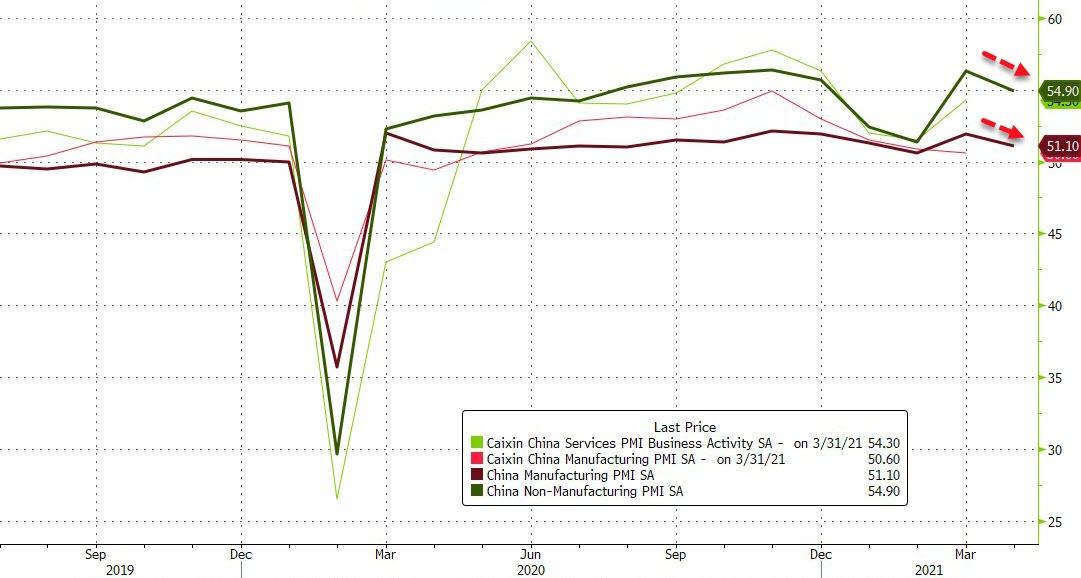
China’s official manufacturing purchasing managers index declined to 51.1 in April from 51.9 in March (and well below the 51.8 expectations), according to data released Friday by the National Bureau of Statistics.

The non-manufacturing gauge, which measures activity in the construction and services sectors, dropped to 54.9 (from 56.3 in March), compared to 56.1 projected by economists.

While the trend is not the friend of the Chinese economy, we do note that both PMIs remain above the 50-level demarcating an expansion in output. The reading has now remained in expansionary territory for 14 straight months.

The subindex measuring production fell to 52.2 from 53.9 in March. Total new orders also dropped to 52 from 53.6 in March, and new export orders fell from 51.2 in March to 50.4, but stayed in the expansionary territory for two straight months.

Surveyed manufacturers said chip shortages, international logistics jams and rising delivery costs have weighed on their operations, the statistics bureau said.

The non-manufacturing PMI again outpaced manufacturing, supporting the view of the services sector is catching up and manufacturing activity peaking.

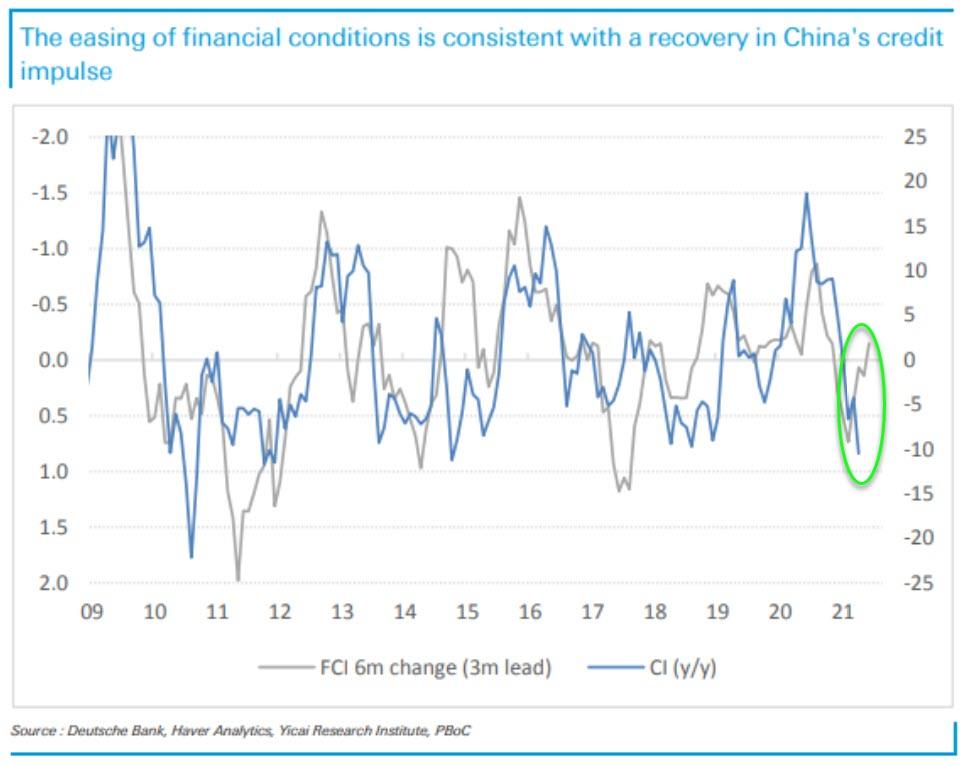
The one potential silver lining, looking ahead, is that China’s economy could be about to get a boost as Deutsche Bank notes that from June onward, the credit impulse -on a YoY basis – should mechanically rebound thanks to base effects. More importantly, as the chart below shows, higher frequency leading indicators are also consistent with a recovery in the credit impulse.

Indeed, recent easing of financial conditions suggests the credit impulse should converge towardsa zero. In turn, this would be consistent with stable PMI manufacturing new orders. And even more notably, for those paying attention to supply chain disruptions and inflationary impulses worldwide, a stabilization of China’s manufacturing is key given that it tends to lead global manufacturing and is a key driver of global inflation expectations.

Tyler Durden
Thu, 04/29/2021 – 21:38

via ZeroHedge News https://ift.tt/3aPBZHf Tyler Durden

Paris Mayor Backs Military Chiefs Who Threatened To Seize Control From Macron Over Inaction On Radical Islam

Paris Mayor Backs Military Chiefs Who Threatened To Seize Control From Macron Over Inaction On Radical Islam

A Paris Mayor who was raised in a devout Muslim household by Algerian immigrant parents threw her support behind a controversial letter by current and former military chiefs who said that if nothing is done about the “laxist” policies on radical Islam, it would require “the intervention of our comrades on active duty in a perilous mission of protection of our civilizational values.”

Rachida Dati, mayor of Paris’ 7th arrondissement, said that the concerns expressed in the letter to Emmanuel Macron were valid.

“What is written in this letter is a reality,” Mayor Rachida Dati of Paris’ 7th arrondissement told France Info radio. “When you have a country plagued by urban guerrilla warfare, when you have a constant and high terrorist threat, when you have increasingly glaring and flagrant inequalities … we cannot say that the country is doing well.

“The hour is grave, France is in peril,” reads the letter, adding that failure to act against the “suburban hordes” would lead to “civil war” and deaths “in the thousands.”

The letter was signed by hundreds of retired soldiers, including 20 retired generals, as well as several active duty members of the military – 18 of whom are to be fired, the country’s armed forces chief confirmed on Thursday, according to the Daily Mail.

Army Corps General Christian Piquemal, 80, was the lead signatory of the 20 retired generals who backed the letter. He is pictured at an anti-Islam rally in Calais in 2016.

The police have become a target for terrorists” said Dati, 55, who served as justice minister under Nicolas Sarkozy from 2007 to 2009. Her comments follow the fatal stabbing last week of a policewoman in the southwest Paris neighborhood of Rambouillet. The suspect, a Tunisian national, had been watching jihadist propaganda videos prior to the attack.

“I am afraid that the police will break down one day,” Dati continued, adding “And if they crack, we go well beyond the disintegration of society.”

Dati’s comments come as France’s Chief of Defense, François Lecointre, called the letter “absolutely revolting,” adding of the active-duty signatories: “I hope that their automatic retirement will be decided.”

“This is an exceptional procedure, which we are launching immediately at the request of the Minister of the Armed Forces,” he added. “These general officers will each pass before a higher military council. At the end of this procedure, it is the President of the Republic who signs a decree expelling them.”

President Macron’s government strongly condemned the letter, which was published on the 60th anniversary of a failed coup d’etat by generals opposed to France granting independence to Algeria, its former North African colony.

Prime Minister Jean Castex said the letter by military figures was ‘against all of our republican principles, of honour and the duty of the army’.

And Florence Parly, the Defence Minister, said: ‘This is unacceptable. There will be consequences, naturally.

The soldiers behind the letter were all said to be anti-immigration activists with racist views and strong ties to the far-Right Rassemblement National (National Rally).

The lead signatory was Christian Piquemal, 80, who commanded the French Foreign Legion before losing his privileges as a retired officer after being arrested while taking part in an anti-Islam demonstration in 2016. –Daily Mail

Supporting the signatories was Marine Le Pen, the Rassemblement National leader, writing in response to the letter: “I invite you to join us in taking part in the coming battle, which is the battle of France.”

Tyler Durden
Thu, 04/29/2021 – 21:30

via ZeroHedge News https://ift.tt/330zoWD Tyler Durden

China Population Still Growing… For Now

China Population Still Growing… For Now

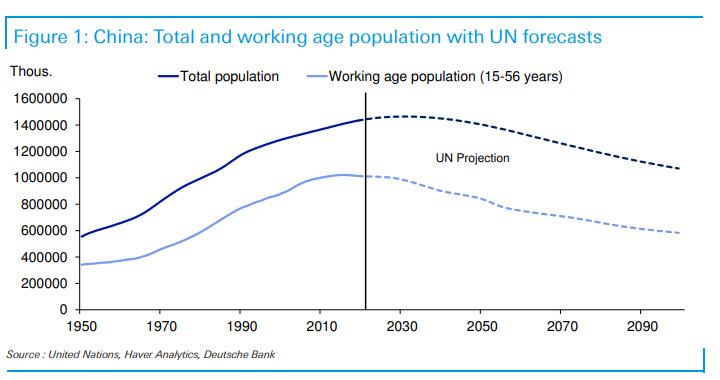
Earlier this week, we highlighted an interesting article in the FT this according to which China’s population was set to decline for the first time since the 1950s when the national census data is released soon. However, in response to the report which prompted widespread speculation over implications of this demographic inflection point, the Chinese National Bureau of Statistics (NBS) best known for faking every possible piece of data, released a statement this morning saying that the population continued to grow in 2020 ahead of the official release. Watch for 2016-19 revisions though.

So although a decline was avoided, the NBS recently said that China’s demographics “has reached an important turning point”.

Here Deutsche Bank’s Jim Reid reminds us that using UN population forecasts, China’s population is predicted to peak in 2031 at around 2% above 2019 levels, so expectations were already that the population was plateauing. With normal margins of error the peak could come notably before (maybe even now) or indeed after. For the record, on the UN’s data, India’s population is expected to climb above China’s in 2027 – to be the largest in the world – and will be 17% above by 2050.

More interestingly, the working-age population peaked in China around 2015 (2013 using NBS data) having surged in the globalization era. In the forty years to 2015 this increased c.97% but is predicted to fall c.-12% over the next 20 years.

As Reid concludes, we can only speculate whether this changes the global inflation outlook. Over the last few decades the surge of global workers and the integration of originally very cheap Chinese labor into the global system has had a very depressing impact on inflation. But as workers become relatively more scarce across the world, including the now much higher-paid Chinese, not to mention with countless supply chains permanently frayed or broken, will there be more pricing power for labor in the years ahead?

Tyler Durden
Thu, 04/29/2021 – 21:10

via ZeroHedge News https://ift.tt/3xz1QwM Tyler Durden

“Historic Moment!” – China Successfully Launches First Module Of Next-Gen Space Station 

“Historic Moment!” – China Successfully Launches First Module Of Next-Gen Space Station 

China successfully launched a key module of a new space station Thursday, a mission that shows the country’s ‘space dream’ of dominating low Earth orbit is quickly becoming a reality. 

China National Space Administration announced Thursday morning that the Long March-5B Y2 rocket lifted off in the southern province of Hainan with the core capsule of the new Tiangong space station. 

The next-generation space station will take 18 months to build in low Earth orbit, with a completion year sometime in 2022. The space station is designed as a scientific research outpost for China through the end of the decade since it has been excluded from using the International Space Station (ISS). 

When completed, the Tiangong space station will be approximately one-fifth the mass of the ISS and weigh about 90-metric-ton in the shape of a T. The size will be comparable to the Russian Mir space station, which operated from 1986 to 2000. 

“We did not intend to compete with the ISS in terms of scale,” Gu Yidong, chief scientist of the China Manned Space program, was quoted by Scientific American as saying.

The ISS recently celebrated its 20 years in operation with an end of lifespan by 2030. Already, the space station has shown signs of wear and tear amid a series of malfunctions, including air leaks

In early April, Russia said it would pull out of the ISS in 2025 and build a space station by 2030 if Russian President Vladimir Putin provides funding. If not, Russia could soon find itself working with the Chinese in space.

President Xi Jinping has touted China’s space dream as he was cited by state media as saying it’s the path to “national rejuvenation.” 

China has recent made no secret of its space ambitions. From the moon to Mars, the country has recently landed multiple spacecraft on these extraterrestrial bodies.

Meanwhile, the US is doing the same as a space race between both countries heats up. 

Tyler Durden
Thu, 04/29/2021 – 20:50

via ZeroHedge News https://ift.tt/3xzo7L0 Tyler Durden

America Has A Problem With Poorly-Trained Police Officers, Not “Systemic Racism”

America Has A Problem With Poorly-Trained Police Officers, Not “Systemic Racism”

Authored by Robert Bridge via The Strategic Culture Foundation,

In what just might be the most misguided attempt at ‘utopian’ living ever conceived, progressive Democrats continue to demand the defunding and disbanding of police forces in cities around the country. Yet, like a doctor that has made the wrong diagnosis on a patient, such a radical idea will not bring peace and security to America’s ailing neighborhoods. In fact, it will make them virtually unlivable.

The United States desperately needs a national debate on the root causes of police violence, which the political left has prematurely and wrongly attributed to “systemic racism.” Missing from the bigger picture are questions pertaining to economic hardship, broken homes, drug abuse and street gangs – and perhaps most importantly of all, poorly trained police – as just a few of the contributing factors that have placed law enforcement between a rock and a hard place.

For every Derek Chauvin, the former Minneapolis police officer charged in the murder of George Floyd, there are dozens of cops like Nicholas Reardon, who was forced to make a split-second decision after a Black girl, Ma’Khia Bryant, 16, attempted to stab another teenager. Reardon, who shot and killed Bryant, has found himself something of a celebrity not for potentially saving the life of a young girl, but for being the fresh face of “white supremacy.”

NBA star Lebron James led the charge against the cop when he unconscionably tweeted to his 46.5 followers a photograph of Nicholas Reardon with the caption, “YOU’RE NEXT, beside the emoji of an hourglass. Some people may consider that a threat.

In another incident, Kim Potter, a 26-year department veteran of the Minneapolis police force, shot and killed Daunte Wright, 20, just blocks away from where George Floyd was killed. The similarities don’t end there. As was the case with Floyd, Daunte Wright, for whom the police had an outstanding warrant, struggled with the police and even managed to make it back inside of his vehicle before being fatally shot. Potter, who appears to have mistaken her gun for a taser in the chaos that ensued, has been charged with second-degree manslaughter in Wright’s death.

In yet another highly publicized incident, Adam Toledo, a 13-year-old Latino boy, was shot and killed last month by Chicago Police Department officer Eric Stillman following a foot chase down a dark alley. Footage from Stillman’s body cam appears to show Toledo dropping a handgun moments before turning and raising his hands, immediately prior to being killed.

Is it fair to blame the phantom of “systemic racism” for these and other killings that occasionally occur between civilians and the police? That would seem ludicrous, yet that is how these tragic incidences are being framed in the media and by civil rights groups, like Black Lives Matter, who continue to bang the drum for disbanding the police. Would it not make more sense to fight not only for better training in the police ranks, but for getting the word out to the youth that resisting arrest is not the best strategy when confronted by a law enforcement officer? Yet such a rational plan of action would deprive the Democrats of the political points they receive every time a member of the minority gets killed during a run-in with the police. At the same time, it would dry up corporate donations to BLM, which has helped its co-founder and self-described Marxist, Patrisse Khan-Cullors, purchase four luxury homes in the United States alone.

Getting back to the question of police training, why didn’t Nicholas Reardon opt to shoot a warning shot instead, or perhaps “aim low,” as a means to prevent Miss Bryant from stabbing that young lady? And why was Officer Stillman in pursuit of an individual down a dark alley in the West End of Chicago without any backup? And finally, how in the world was it possible for Kim Potter, a trained police officer, to confuse a weighty Glock-22 with a lightweight Taser? Brandon Tatum, a Black American political commentator and former police officer, offered as an alternative to the ‘systemic racism’ theory, the possibility that Potter was part of an affirmative action hiring program.

“They are hiring people to meet quotas,” Tatum commented on his YouTube channel, “and they’re not hiring the best people for the job.”

That is one possible theory to explain police violence that the mainstream media will not be entertaining anytime soon. The question is “why”? Why is the media, just like it is with so many major corporations, hyping and funding the idea of systemic racism as the source of police violence when there are many other far more plausible explanations? While the ultimate motivation for assuming such a dangerous position may never be known, it is clear that anyone who challenges the ‘racist’ narrative risks attracting the wrath of the woke brigade. This would include, perhaps more than anyone, the academics.

In 2019, psychologists Joseph Cesario of Michigan State and David Johnson of the University of Maryland examined 917 fatal police shootings of civilians from 2015 to ask a simple question: did the race of the police officer or the civilian play any role in those tragic events? The answer: no they didn’t. Cesario and Johnson concluded there was “no significant evidence of antiblack disparity in the likelihood of being fatally shot by police.” Their findings were published in the Proceedings of the National Academy of Sciences, a peer-reviewed journal. Would it surprise anyone to know that “citizen behavior,” i.e. resisting arrest, is the greatest determinate of police behavior?

Perhaps equally unsurprising is the establishment came down hard on the two number crunchers, especially after their research was cited by author Heather MacDonald in an article for the Wall Street Journal entitled, The Myth of Systemic Police Racism.

“It set off a firestorm at Michigan State,” MacDonald wrote. “The university’s Graduate Employees Union pressured the MSU press office to apologize for the “harm it caused” by mentioning my article in a newsletter. The union targeted physicist Steve Hsu, who had approved funding for Mr. Cesario’s research. MSU sacked Mr. Hsu from his administrative position. PNAS editorialized that Messrs. Cesario and Johnson had “poorly framed” their article—the one that got through the journal’s three levels of editorial and peer review.”

As par for course, various student groups took up petitions to have Hsu fired, while the school profusely apologized. In the end, the mob declared yet another victory as Hsu finally stepped down from his position.

The controversial paper’s co-author Cesario told WSJ that he feared the activists would continue “pushing for a narrowing of what kinds of topics people can talk about, or what kinds of conclusions people can come to.”

It appears that Mr. Cesario’s fears have materialized faster than he could have realized as a wall of censorship has been constructed around the world of academia, the one place where the truth on “systemic racism” was being exposed for the lie it is. Now that there is no one left to tell the people, aside from a handful of rigidly regulated and censored truth-seeking publications, America can expect a future of artificially induced racial tensions as a number of good cops are forced to take the blame for a “systemic racism” that only exists on the pages of the mainstream media.

Tyler Durden
Thu, 04/29/2021 – 20:30

via ZeroHedge News https://ift.tt/2S6Goio Tyler Durden