Manhattan Retail Rents Continue Slide As Recovery Narrative Falls Apart
Manhattan’s “prime” retail real estate market remained under pressure in the first quarter even as COVID-19 vaccines became widely available and public health restrictions eased.
According to Bloomberg, citing a report by Cushman & Wakefield, SoHo, a neighborhood in Lower Manhattan known for designer boutiques, fancy chain stores, and high-end art galleries, experienced the worst slump in retail rents in the first quarter, down 20% from a year earlier to $279 a square foot. The latest surge in long-term leases barely put a dent in overhead supply that has been increasing since the beginning of the pandemic. About 30% of SoHo’s retail space is dormant and available for rent.
Besides SoHo, Herald Square and Madison Ave.’s retail rents tumbled 19% over the same quarter last year. Madison Avenue had the most inventory available, with the availability rate at a whopping 40%.
“The bad news is that first quarter of 2021 is showing the true impact of the pandemic on the market,” Steven Soutendijk, an executive managing director at Cushman & Wakefield, told Bloomberg.
Soutendijk continued: “The good news is that landlords are responding and adjusting rents even further downwards to spur leasing.”
Mayor DeBlasio’s solution to mitigate the virus spread has doomed the city. A speedy economic recovery is now questionable.
Former New York City Mayor Rudy Giuliani recently said DeBlasio has “ruined” the metro area through strict public health orders crushing businesses and liberal policies that have made the area more dangerous.
“Now he’s consistently doing horrible things and destroying my city,” Giuliani said. “He’s ruining it all, he’s doing it in a flash of an eye.”
To revive the city, DeBlasio will spend $30 million on a tourism campaign this summer to attract tourists.
“It’s critical that we deliver the message that New York City is open and welcoming visitors once again,” Fred Dixon, president and chief executive officer of NYC & Company, the city’s official tourism organization, told WSJ.
Tourism accounts for hundreds of thousands of jobs – for a sustainable recovery, there needs to be an influx of tourists to visit attractions, shop at retail shops, eat at restaurants, and stay in hotels.
An exodus of office workers, companies, and residents also adds to the city’s economic woes. Without the uptick in foot traffic on streets, the city should prepare for a new reality, one where its economic recovery lags the rest of the country.
“Heaven is purpose and principle. Purgatory is paper and procedure. Hell is rules and regulation.”
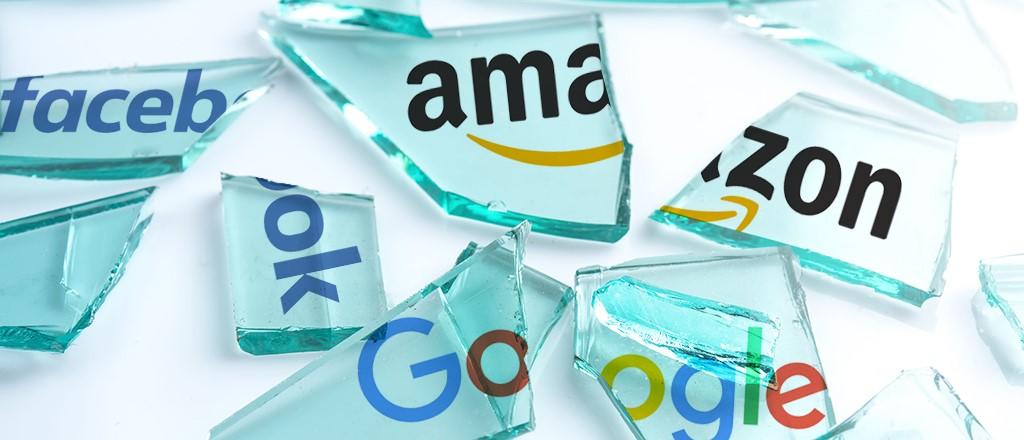
We had a slew of spectacular Big Tech results this week, but has the time come to regulate them more closely to avoid increasingly monopolistic behaviour, and to protect the population from the pernicious effect of the manipulation of big data? It’s as much an argument about the role of the state as it is about the success of companies. There will be winners and losers.
As always there is lots going on in markets, but the run of superb Tech results has been truly spectacular. Many tech firms have successfully navigated the Pandemic, selling into bored WFH workers, and achieved staggering success. Let’s use the moment to ponder the difficult question of how should we value Tech, and should it be more thoroughly regulated?
To the upside, new value and economic growth is created from new ideas creating new demand and markets. Invention leads to innovation – which is why everyone is so over-excited about the swift adoption potential of AI, Virtual Reality, 3-D printing, Meatless meat, Robotics, autonomous systems from drones to cars and all the other wonderful things we read about in the new tech space. The companies trade on extraordinary multiples based on their perceived potential – and is often exaggerated.
In real reality, (as opposed to virtual), these ideas are often brilliant solutions in search of problems; they take time, effort, and travel many wrong paths on the road to monetisation. We see that repeatedly in the miserable negative profits generated by so many tech unicorns that promised so much. Some stuff works. Much doesn’t.
There is nothing wrong with the Tech adoption process. The massive personal rewards Tech entrepreneurs can make for themselves is a major reason why the West is so innovative. Long may it be encouraged.
On the downside, some Big Tech – most these most closely thriving off the back of the monetisation of data – have been massively profitable. Their success creates a completely different series of moral sentiment dilemmas, as Adam Smith may have put it.
Where do limits on Big Tech need to come?
It’s been said the goal of every entrepreneur is to become a monopoly and reap monopoly-like returns. The goal of legislators is to avoid it happening. Regulatory oversight of profits is not an attractive option for investors who’ve funded the entrepreneur on the basis they’ll get monopoly-like yields.
Google’s results earlier this week were spectacular. So spectacular they have raised fears for the prospect of further government/interventions to rein back on Big Tech money making machines. Google’s success (nobody calls it Alphabet) came on the back of the pandemic spurring up user numbers, web advertising, YouTube and the stock rose to a new record on a $50 bln stock buyback plan – what else would a tech giant find to do with its money, aside from buying Waymo’s driverless car tech and building more data centres?
Facebook posted a beat on earnings and $26 bln revenues on the back of a 30% rise in ad revenue, and an increase in the volume of ads. My Facebook pages are now 80% ads for leather desk mats, outdoor kitchens, light fittings, Scandinavian furniture, wine storage and all the other stuff She-who-is-Mrs-Blain and I have googled as we renovate the house. I barely use the thing any more. My kids don’t touch it. Facebook makes nearly $10 for every user from Ad revenue.
Amazon reports later today, and its looking like another massive winner on the back of boosted pandemic sales, the lack of high street competition due to lockdowns, its increasing dominance, and the fleet of Imperial Star Destroyers it’s planning to use to host drone deliveries…. (Ok.. but soon..)
Apple is different. It sells real stuff, and regular readers will know I’m an addict of its goods and services. Its results were stellar – double digit growth across the product range, revenues of $90 bln – half of which was iPhone sales, 42.5% margins and authorisation for a $90 bln stock buyback programme.
However, Apple is under the regulatory cosh for the way in which it’s using its massively powerful App Store gateway to gouge profits from App Developers – the Fortnite maker Epic Games takes Apple to court next week. Apple can do that because iOS and Mac is its own ecosystem/tech-habitat, and if you want access to its Bright-Shiny-Things you play by their rules.
The problem of Big Tech’s success is its sheer scale, and many firms have passed the innovation/inventive stage into the monetisation phase. That is when some of them will morph from moving society forward into a pure profit play as they seek monopoly status. They stop inventing stuff, and seek to make their stuff pay, becoming increasingly bureaucratic as they do so.
I read recently Matt Stoller of the American Liberties Project pointing out:
“What these firms are doing to get 20-30% returns is capturing market power, they are not creating wealth.”
Many politicians now agree. They see Facebook, Amazon, Google et al as de-facto monopolies reaping unwarrantable windfall profits while creating untold harm to consumers and other firms from anti-competitive business policies. Its a factor legislators around the globe are determined to address. (Especially if it makes them look strong to voters.)
The question is – how much should government intervene to regulate and licence big tech? The Libertarian right would say not at all. But Adam Smith would have recognised the dangers inherent in Big Tech’s control and use of big data. Information is a public good. Rather than allowing Big Tech to own and control it – should it be owned by the people and licenced by the state as a public good? That’s a question, btw, not a statement
Investors will say no – they want the returns. But these companies now utterly dominate their space. They are no longer inventive tech companies expanding the limits of innovation – now they are monopolies milking their data streams.
That’s why Apple’s new privacy controls are so interesting. This week they upgraded the operating system to stop Apps from tracking Apple User’s data. Google is also on board to kill the App tracking cookies. That’s terrifying news for Facebook which has been monetising that data to sell ads. The social media site is on the wires arguing its bad for smaller niche advertisers, and that its just Apple and Google looking to concentrate the data in their own hands.
There is any amount of economic literature to explain why monopolies are such a bad idea. Monopolies that exploit the information revealed by internet users about themselves are perhaps even worse – inserting themselves virus-like into their victims and driving their spending decisions. Its wider than just trying to sell us stuff our browsing history has suggested we might like to buy.
As the degree of polarisation in recent elections has shown, the rising problem of this modern age is that billions of voters think they have free will, but their every action and belief is now increasingly set according to the algorithms dictating what the read, see and buy. In the US, its been the subject of judicial hearings: Algorithms and Amplification: How Social Media Platforms Shape our Discourse and Our Minds.
Regulation is never a great solution, but maybe it is time for greater government action over the windfall profits being made by Big Tech behemoths? If Amazon is swamping the high-street because it runs cheaper – even it out by taxing them higher! The logic is simple: Amazon’s success puts high streets out of business and causes additional social welfare, medical and other costs from the workers and businesses it displaces. You can make similar arguments for any Big Tech monopoly…
Except, maybe Facebook. If I can think of any reason not to dump Facebook, I’ll be sure to let you know. Basically it’s just an advertising platform, and its primary advantage of targeted advertising to likely interested, motivate buyers, is about to get much weaker. Sell. There are plenty of other ways to advertise.
I have some further points to make re the need to regulate Tech, looking at it from a slightly different perspective of when Tech is Good or Bad for the environment and ecosystem (not just from the perspective of climate change), but I will save that up for Part 2… It will be about the pros, cons, and potential costs of launching Low Earth Orbit coms satellites, and will ask about the perceived public need vs public good!
Zarif-Gate Leak Causes Shake-Up In Iran’s Presidential Office As FM Expresses ‘Regret’
This week’s ‘Zarif-Gate’ audio leak has caused a shake-up in Iran’s presidential office, reportedly leading to the resignation Hessameddin Ashena, head of the Strategic Studies Center (a think tank closely associated with the Iranian presidency), as he was present during the interview with Zarif. The top Iranian diplomat had essentially said it was the military leadership that sets policy.
“Hesamodin Ashena of the Center for Strategic Studies resigned over ‘the theft’ of the three-hour tape of Foreign Minister Mohammad Javad Zarif being interviewed at the CSS,” AFP reports Thursday. “Ashena, who held the post of Iranian deputy intelligence minister in the 2000s, has headed the center since 2013 and also serves as adviser to President Hassan Rouhani.”
But it’s not enough for Islamic hardliners representing the clerical and military establishment, who are now calling for Zarif to step down immediately, also given his remarks were taken as disparaging toward the late “national hero” Soleimani.
The interview, which was reportedly captured months ago and was never meant to be made public, included Zarif speaking with surprising frankness and criticism toward the role of the Islamic Revolutionary Guard Corps (IRGC) in the Islamic Republic. He bluntly admitted, for example, that the powerful IRGC often overrides government decisions and that the late Quds Force chief Qassem Soleimani’s actions often harmed diplomacy. Even Iranian newspapers described the leak as a major “scandal” which embarrassed Iran on the world stage at a moment of “progress” at the Vienna nuclear talks.
In his first public comments since the scandal, Zarif said in an Instagram post that he’s committed to “protecting the interests” of the country and Iranian people. He expressed regret, but stopped short of a direct apology:
“I am very sorry how a secret, theoretical discussion about the necessity of increasing cooperation between diplomacy and the field (the Guard) — in order for the next officials to use the valuable experiences of the last eight years –- became an internal conflict,” Zarif wrote.
“I did not censor myself, because this is a betrayal of the people,” he added.
“I have always been subject to the policies approved by the country and I have strongly defended them. But in expressing my expert opinion, I have considered seeking forgiveness, appeasement, and self-censorship as betrayal,” he said, essentially suggesting it was the leak itself that was a betrayal.
“Zarif also says that by assassinating [Soleimani] in Iraq, the United States delivered a major blow to Iran, more damaging than if it had wiped out an entire city in an attack.” https://t.co/J7tFMnspzg
While the widespread international coverage of the leaked tapes triggered a firestorm of debate within Iran which in typical fashion pitted the Islamic hardliners against ‘moderates’ (Zarif and Rouhani are widely seen within the “moderate” camp that seeks engagement with the West), it appears the Iranian top diplomat’s job is safe, for now.
There’s speculation that the leak was intended to sabotage Vienna talks, which is viewed by deep suspicion within the Iranian hardliner political camp – particularly represented in parliament and among the Shia clerical establishment.
Washington Post book critic Ron Charles writes, “I suspect some major publishers still don’t understand what having a diverse workforce entails. It was never just about making your office look like a Benetton ad. The real goal behind a diverse workforce is a wide range of experiences and ideas — and people empowered to act on them.”
In one of those impossible-to-parody moments, he explains in some detail that this means that books that don’t meet the woke standards of left-wing employees of publishing companies should not be published. No books that leftists don’t like at this publisher! We want to accommodate a wide range of ideas!
Charles himself is hardly the voice of reason, suggesting that publishers shouldn’t publish a book by Mike Pence because he is a “fascist.”
Let’s see how many levels of absurdity we can discern here. First, as suggested above, “a wide range of experience and ideas” apparently totally excludes and right-of-center ideas, or close to it. So the wide range is in fact quite narrow.
Second, in turn this is apparently because Charles believes that only white men hold right-of-center ideas. So a diverse workforce wouldn’t include any women or non-white who aren’t sufficiently left-wing. More generally, it doesn’t even occur to the author that Simon & Schuster may have employees who are not leftists, much less conservatives, much less Trump supporters–and that some of them might not be white men.
Third, and perhaps most self-parodyingly, as near as I can tell from the picture up at the Post’s website, Charles himself is a white man. So when he says that editorial judgments in the past “were based on what White men considered important, valid and entertaining,” he could be talking about his own column. By definition, his column focuses on what a white guy finds important, valid, and entertaining. So by his own logic, Charles should be canceled.
from Latest – Reason.com https://ift.tt/3xC0q4M
via IFTTT
This year has marked the first time ever that trust in news media dropped below fifty percent in the United States, continuing a trend of decline that’s been ongoing for years.
And actually it doesn’t ultimately matter what mainstream pundits and reporters believe is the cause of the public’s growing disgust with them, because there’s nothing they can do to fix it anyway. The mass media will never regain the public’s trust.
They’ll never regain the public’s trust for a couple of reasons, the first of which is because they’ll never be able to become trustworthy. At no point will the mass media ever begin wowing the public with its journalistic integrity and causing people to re-evaluate their opinion of mainstream news reporters. At no point will people’s disdain for these outlets ever cease to be reinforced and confirmed by the manipulative and deceitful behaviors which caused that disdain in the first place.
A propaganda outlet will never be anything other than a propaganda outlet. A lot of half-awake people with one eye open and one eye closed will notice how the news media don’t practice journalism and don’t report the facts, and they’ll assume that something went wrong at some point. “Just do your jobs and report the news!” they’ll shout in frustration.
But nothing has gone wrong, and they are doing their jobs. They are doing their jobs extremely well.
Telling the mass media to “just do their jobs” and report the news is like bursting into a shoe factory yelling “Just do your jobs and start manufacturing dentures!” Their job is not to report the news, their job is to manipulate public perception for the benefit of the media-owning class. And toward that end they’ve been immensely successful.
There’s no point admonishing the mainstream press for the public’s plummeting trust in it, because a thing that has only ever existed to administer propaganda can’t suddenly become journalism. It’s like yelling at a rock for not being a tree.
The mass media are completely and utterly irredeemable, and always have been. It’s a waste of energy to try and get plutocratic propaganda institutions to suddenly begin doing journalism; that’s not what they’re for. Instead, our energy is better spent teaching people to stop seeing them as journalistic outlets.
The other reason the mass media will never regain the public’s trust is that humanity’s relationship with narrative is evolving too far beyond the level that once saw Americans gathered around the television listening with Bambi-eyed faith to the words of Walter Cronkite. That level of widespread blind credulity in the official stories of the day will never again exist.
Our old relationship with narrative is crumbling, and people’s old ways of understanding what’s going on in the world just aren’t holding together anymore.
As cold war tensions with Russia and China continue to mount while the US-centralized empire fights with increasing desperation to retain its dominance, we’re seeing propaganda hit white noise saturation levels to such an extent that we’ll likely soon find out how aggressively the collective consciousness can be pummelled with mass-scale psyops before it snaps.
America just went through four years with a president whose words had no relationship with facts or reality, and who made no attempt to pretend otherwise.
The mainstream public is becoming increasingly aware of the widespread nature of disinformation and propaganda.
Deepfake technology means we soon won’t even be able to trust video anymore.
Ordinary people are hurting financially while Wall Street is booming, a glaring plot hole in the story of the economy that’s only getting more pronounced.
There are numerous different narratives about Covid-19 and the government responses to it running parallel to each other with everyone still to this day absolutely certain that their position is the only correct one.
The entire media class is acting stranger and stranger, now routinely reporting bogus stories en masse like the Russian collusion narrative or the “Bountygate” narrative and then simply acting like it’s no big deal when those stories they’d fed us with such urgency are completely discredited.
You can’t twist and shove the collective consciousness around like that without something snapping. Without people beginning to look at the thoughts in their heads with suspicion and beginning to question their sense of reality. Without people wondering if everything they believe is a lie.
Narrative Is Crumbling
“We are now, as a species, collectively squeezing ourselves out of our old unhealthy relationship with narrative.”https://t.co/iYK2oC7YXf
We’ve been seeing signs that humanity is moving into a new relationship with narrative for some time now as people learn across all sectors of society that so many of the seemingly solid rules we once took so seriously are just empty thought fluff that we are free to rewrite at any time.
Atheism and secularism, once fringe positions, are now mainstream as people have discovered that they don’t need to allow their lives to be controlled by words written by long-dead men in far off lands from cultural and historical contexts which have no relevance to our own circumstances.
People are beginning to recognize that money is made up and we can collectively change the rules of how it works whenever we want, with the rising popularity of both socialism and cryptocurrencies capturing the public imagination of what’s possible.
People are beginning to understand that what we call gender is a large network of conceptual constructs which we have overlaid upon human anatomy, and that we are free to disregard and re-author those conceptual constructs if that feels right to us.
People are beginning to understand that romantic relationships don’t need to look the way they’ve been modeled for us across the centuries, with unmarried, same-sex, polyamorous, or other relationship models also being perfectly acceptable options.
People are beginning to understand that “family” doesn’t need to refer to people to whom we are related by blood, with the concept of chosen family gaining in popularity.
People are beginning to understand that the failed drug war is an immoral abuse and that we should be allowed to experiment with our own consciousness using whatever substances we see fit.
These are all signs of a growing awareness that the “How It Is” narratives we’ve been fed by culture do not have the concrete reality to them that we once assumed they did. We’re beginning to see them as what they are: stories. Stories that we are free to ignore or re-write to whatever extent we find useful.
For propagandists whose manipulations depend on their targets imbuing their narratives with a great degree of significance, this recent development is very problematic. If a ‘How It Is’ narrative isn’t taken seriously, it can’t be used to manipulate the way people think, behave, and vote. And this seriousness is exactly what we’re seeing deteriorate in humanity’s relationship with narrative.
This could end up being a very, very good thing. All human destructiveness is ultimately caused by our taking thought seriously instead of simply using it as the tool it’s meant to be and setting it down when we’re done with it; look at any manifestation of human self-destructiveness, no matter how large or how small, and you’ll find a belief being taken too seriously underlying it. This shift in our relationship with narrative could end up being what saves us from our self-destructive patterns as a species.
But it won’t lend itself to trust in the mainstream media. This too would be a very good thing.
The best way to get around the internet censors and make sure you see the stuff I publish is to subscribe to the mailing list for at my website or on Substack, which will get you an email notification for everything I publish. My work is entirely reader-supported, so if you enjoyed this piece please consider sharing it around, liking me on Facebook, following my antics on Twitter, or throwing some money into my tip jar on Ko-fi, Patreon or Paypal. If you want to read more you can buy my books. For more info on who I am, where I stand, and what I’m trying to do with this platform, click here. Everyone, racist platforms excluded, has my permission to republish, use or translate any part of this work (or anything else I’ve written) in any way they like free of charge.
Washington Post book critic Ron Charles writes, “I suspect some major publishers still don’t understand what having a diverse workforce entails. It was never just about making your office look like a Benetton ad. The real goal behind a diverse workforce is a wide range of experiences and ideas — and people empowered to act on them.”
In one of those impossible-to-parody moments, he explains in some detail that this means that books that don’t meet the woke standards of left-wing employees of publishing companies should not be published. No books that leftists don’t like at this publisher! We want to accommodate a wide range of ideas!
Charles himself is hardly the voice of reason, suggesting that publishers shouldn’t publish a book by Mike Pence because he is a “fascist.”
Let’s see how many levels of absurdity we can discern here. First, as suggested above, “a wide range of experience and ideas” apparently totally excludes and right-of-center ideas, or close to it. So the wide range is in fact quite narrow.
Second, in turn this is apparently because Charles believes that only white men hold right-of-center ideas. So a diverse workforce wouldn’t include any women or non-white who aren’t sufficiently left-wing. More generally, it doesn’t even occur to the author that Simon & Schuster may have employees who are not leftists, much less conservatives, much less Trump supporters–and that some of them might not be white men.
Third, and perhaps most self-parodyingly, as near as I can tell from the picture up at the Post’s website, Charles himself is a white man. So when he says that editorial judgments in the past “were based on what White men considered important, valid and entertaining,” he could be talking about his own column. By definition, his column focuses on what a white guy finds important, valid, and entertaining. So by his own logic, Charles should be canceled.
from Latest – Reason.com https://ift.tt/3xC0q4M
via IFTTT
An interesting column by Dan Schmutter in the New York Post today, arguing that, while Congress’s setting the initial size of the Court was “necessary and proper” and thus allowed under the Necessary and Proper Clause, changing the size to change its decisions would not be:
Can it reasonably be said that court-packing, an act whose goal is to materially alter the balance of power in Washington for explicitly ideological ends, lies within “the letter and spirit of the Constitution” [quoting McCulloch v. Maryland]? Hardly. Rather, it is a frontal assault against the separation of powers—a value deeply ingrained in the Constitution.
Thus, even if court-packing might meet the loose definition of necessary, it is difficult to say that such an assertion of congressional power would qualify as necessary and proper.
That important limitation on the Necessary and Proper Clause remains valid today. As recently as 2012, in the ObamaCare case NFIB v. Sebelius, the high court held that Congress couldn’t look to the Necessary and Proper Clause for the authority to enact the Affordable Care Act’s individual mandate. (The government ultimately won the case because the court held that the mandate was a tax and was therefore within Congress’ enumerated powers.) … In rejecting the government’s position, the court explained that “such laws, which are not consistent with the letter and spirit of the Constitution, are not proper means for carrying into execution Congress’ enumerated powers. Rather, they are, in the words of The Federalist, merely acts of usurpation which deserve to be treated as such.”
I’m skeptical about the argument; it seems to me that if setting the size of a body is “necessary and proper,” changing it (whatever the underlying motive) would be, too. But I thought this was an interesting argument, and worth passing along.
from Latest – Reason.com https://ift.tt/33egjAx
via IFTTT
An interesting column by Dan Schmutter in the New York Post today, arguing that, while Congress’s setting the initial size of the Court was “necessary and proper” and thus allowed under the Necessary and Proper Clause, changing the size to change its decisions would not be:
Can it reasonably be said that court-packing, an act whose goal is to materially alter the balance of power in Washington for explicitly ideological ends, lies within “the letter and spirit of the Constitution” [quoting McCulloch v. Maryland]? Hardly. Rather, it is a frontal assault against the separation of powers—a value deeply ingrained in the Constitution.
Thus, even if court-packing might meet the loose definition of necessary, it is difficult to say that such an assertion of congressional power would qualify as necessary and proper.
That important limitation on the Necessary and Proper Clause remains valid today. As recently as 2012, in the ObamaCare case NFIB v. Sebelius, the high court held that Congress couldn’t look to the Necessary and Proper Clause for the authority to enact the Affordable Care Act’s individual mandate. (The government ultimately won the case because the court held that the mandate was a tax and was therefore within Congress’ enumerated powers.) … In rejecting the government’s position, the court explained that “such laws, which are not consistent with the letter and spirit of the Constitution, are not proper means for carrying into execution Congress’ enumerated powers. Rather, they are, in the words of The Federalist, merely acts of usurpation which deserve to be treated as such.”
I’m skeptical about the argument; it seems to me that if setting the size of a body is “necessary and proper,” changing it (whatever the underlying motive) would be, too. But I thought this was an interesting argument, and worth passing along.
from Latest – Reason.com https://ift.tt/33egjAx
via IFTTT
Biden Talks Tough On China; Beijing Says US Defense Budget Reflects “Sick Psychology”
President Joe Biden addressed a joint session of Congress in Washington on Wednesday evening. He made it a point that America and its allies must work closely together against competition from China.
Biden said President Xi Jinping is “deadly earnest on becoming the most significant, consequential nation in the world.” The rhetoric from Biden last night is that his administration will continue pressuring China and maintain former President Tump’s firm position on Beijing, including tariffs, sanctions, strong defense budget, and heightened military activity in the Pacific.
“We are in competition with China and other countries to win the 21st century,” Biden said. “We are at a great inflection point in history. We have to do more than just build back better. … We have to compete more strenuously.”
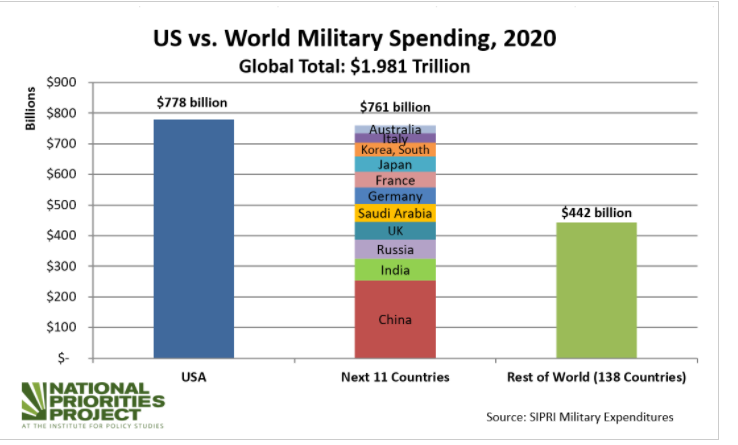
To keep up with China, Biden has ambitions to increase military spending above the past administration. For some context on current military spending, the Pentagon is already spending $740,000,000,000 this fiscal year, $2,000,000,000 every day, $1,000,000 every minute.
Under a Biden administration, U.S. military vessels and surveillance planes directed toward China have increased significantly.
Bloomberg quoted defense Ministry spokesman Senior Colonel Wu Qian at a press conference on Thursday in Beijing, saying activity by U.S. military ships was up 20% and by planes 40% in areas China claims since Biden took office January over the same period last year.
The U.S.’ constant deployment of ships and planes to operate in seas and airspace near China has created a more hostile area. Wu also addressed the massive U.S. defense budget with a heavy focus on China, reflecting a “sick psychology.”
Even during COVID-19, the U.S. military ramped up its military spending, outpacing much of the world.
A great power competition between the U.S. and China is evident. Biden continues pressuring China and ramping of military activity around the country with plans to increase defense budgets. Perhaps, the reason for this is that Taiwan’s Foreign Ministry Joseph Wu recently warned that China is planning “for their final military assault against Taiwan.”
While China sets its eyes on Taiwan, the U.S. is falling into Thucydides Trap, where it attempts to squash rising China.
Scientists have found that volcanoes deep in the ocean discharge so much energy potential when they erupt that they could theoretically power the whole of the United States. Scientists at the University of Leeds in the UK have gathered data via remotely operated vehicles from deep-sea volcanic activity in the Northeast Pacific. They found that ocean volcanoes were as intriguing to study as volcanoes on land, although the observer doesn’t get as spectacular views from ocean-erupting volcanoes as from those on land.
The University of Leeds scientists suggest in their research, published this week in the journal Nature Communications, that submarine volcanoes create the so-called hydrothermal megaplumes when they erupt. The researchers estimate that extremely high rates of energy are being discharged during those eruptions.
“The rate of energy released and required to carry ash to the observed distances is extremely high – equivalent to the power used by the whole of the USA,” the University of Leeds said about the research carried out by Dr Sam Pegler, from the School of Mathematics, and Dr David Ferguson, from the School of Earth and Environment.
The rapid release of immense energy from submarine eruptions means that submarine volcanic eruptions lead to the rapid emptying of reservoirs of hot fluids within the earth’s crust. As the magma forces its way upwards towards the seafloor, it drives this hot fluid with it, the scientists say.
“Our results demonstrate that intervals of rapid hydrothermal discharge are likely commonplace during deep-ocean volcanism,” the researchers said in their paper.
“Observing a submarine eruption in person remains extremely difficult but the development of instruments based on the seafloor means data can be streamed live as the activity occurs,” Dr. Ferguson said in a statement.
Although scientists have now begun to understand how ocean volcanoes work, the harnessing of the immense energy could be impossible.
Geothermal energy on land is one thing, but capturing the huge energy deep in the Pacific Ocean could be a whole different story.
Major oil corporations have moved to invest in geothermal energy on land. One of the latest was an announcement from U.S. supermajor Chevron last month that it invested in a private investment company focused on the development and operation of low-temperature geothermal and heat power assets in the United States and internationally.
The U.S. Department of Energy says that ‘Geothermal is America’s untapped energy giant,’ highlighting in its analysis that this kind of “always-on” flexible renewable energy resource could grow 26-fold to generate 8.5 percent of U.S. electricity by 2050.
Geothermal resources in the U.S. are enormous, but geothermal energy accounted for just 0.4 percent of total utility-scale electricity generation in the United States in 2020, according to EIA data. Globally, America leads in geothermal electricity generation, but on a U.S. scale, geothermal is a negligible part of total electricity generation.
However, geothermal energy generation near volcanic activity is riskier to operate, as a recent incident showed.
In Hawaii, the lava flows from the Kilauea volcano led to the shutdown of the Puna Geothermal Venture power plant in 2018, which voluntarily ceased operations ahead of the approaching lava flow. The 38-megawatt (MW) facility is the only geothermal plant on the island, and it produced about 29 percent of the island’s electricity generation in 2017, as per EIA data.
In 2018 during the Kilauea volcano eruption, production wells at a geothermal plant were plugged to prevent the release of toxic gases.
The power plant returned online in November 2020, sending electricity to the Hawaii Island grid two and a half years after the eruption of the Kilauea volcano put it out of operation.
Geothermal power development near active volcanoes on land is not without risks. In the ocean, the energy from submarine volcanoes could be enormous, but it will likely never be tapped. Still, understanding deep ocean volcano activity could give scientists more insight into how the earth works and how it affects marine life.