Nothing To See Here: Microsoft Files Patent To Mine Cryptos Using Human Brain Activity
Today in “we are totally not heading head-first into a completely dystopian future at a billion miles an hour” news…
Microsoft is reportedly proposing a method to generate cryptocurrency by “monitoring people’s brain activity and other personal biometric data,” according to a new report in The Independent.
The company has reportedly filed for a patent called “Cryptocurrency System Using Body Activity Data” which details how a person could attach sensors to their body to “earn” cryptocurrency through mining. Microsoft is apparently not just satisfied with computers doing the crypto mining, they are pushing for mining via a “human body activity associated with a task”.
The patent states: “For example, a brain wave or body heat emitted from the user when the user performs the task provided by an information service provider, such as viewing an advertisement or using certain internet services, can be used in the mining process.”
It continues: “Instead of massive computation work required by some conventional cryptocurrency systems, data generated based on the body activity of the user can be proof-of-work, and therefore, a user can solve the computationally difficult problem unconsciously.”
Such a system would require “hooking up” a device to sensors on the body that “detect the activity required of the user to generate the cryptocurrency.” The report says that “body fluid flow” and “organ activity and movement” are two such body functions, along with brain waves and body heat, that could be monitored.
The patent lists 28 concepts for using such a system to mine for cryptocurrency.
When we think of corrupt American cities, Chicago always tops the list. However, San Francisco has long had one of the more corrupt American civic governments. However, because the City was still better managed than Chicago, nobody really commented on that fact.
A Twitter thread about the City’s “stupidvisors” (as I’ve always called them), turning down free internet access highlights just how corrupt they are.
I worked in San Francisco for several decades and spent a great deal of that time dealing with City Hall through the judicial system. It was an enormously frustrating place, with byzantine rules, clerks that spoke minimal English, and few corrupt judges. However, that was small potatoes compared to the Building Department. I knew a man who made a very rich living contracting his services out to people who were trying to build or remodel in San Francisco. If you didn’t have an expensive guide to handle the rules and grease people’s palms, you’d never get anything done.
Perhaps the greatest corruption, though, was at the political level, among the Supervisors, elected representatives from each San Francisco neighborhood. I never heard stories about these people demanding money for initiatives, although I’m sure some did. The real corruption was ideological. In the 1960s and 1970s, these Supervisors were mostly Democrats. Starting in the 1980s and moving to the present day, the Supervisors (or, as I said, Stupidvisors) were leftists, even if they still used the old Democrat label.
That’s why I was completely unsurprised when I read Chris Sacca’s Twitter thread about his efforts to give free internet to the City of San Francisco. Everything he writes is consistent with my understanding of how the San Francisco government operates. I’ll stop now and let Sacca take up the narrative:
15 years ago, I co-led a team trying to give 100% free Internet access to all of San Francisco starting with the poorest neighborhoods first. The network would be anonymous, with no ads, no cookies, etc. Approximately a $20-25 million gift. The result? We were chased out of town. https://t.co/U1azq6S4SQ
One SF Supervisor told us she would vote against it unless we promised to fund quarterly field trips (eg to the zoo) for the kids in her district.
Another promised to vote against it because we wouldn’t give free laptops to all of SF.
One Supe rejected it because poor people needed “training to use the Net.”
Countless low/no-income residents spoke at hearings about how they had computers and knew how to use the web, but couldn’t afford Comcast. Supes mansplained back to those very people that they were wrong.
We built a demonstration network in a public housing project in Hunters Point. It was saturated with use. Those residents testified that laptops and phones weren’t expensive, cable and data plans were the problem. The Supes just couldn’t accept that those people were Net savvy.
Ultimately, one Supervisor told us straight up: He didn’t care what this meant for the people of his district, he was blocking it because it would give the mayor a win in a political year.
He was the deciding vote and I will never forget what he said…
“Stop lecturing me about the digital divide, because I don’t give a fuck. Now get the hell out of my office.”
Our team walked out stunned, sat in the lobby of City Hall, and realized it was over.
My partners and I had done Q&A sessions in every Supe’s district and in community and senior centers all over town. Support for the network was off the charts, particularly among those who needed it most. But it was clear that the Supes didn’t care about poor San Franciscans.
They wouldn’t listen to their own constituents. They perpetuated racist tropes and demeaning stereotypes about their poorest residents. And for what? It was all a big game to the politicians. The winners were the Supes’ egos and the losers were the people they supposedly served.
San Francisco is a wonderful city that I was lucky to call home for years. But I’ve never seen any place in the world better at cutting off its nose to spite its face. My heart aches for what that city was and could be. Cheers to those of you still trying to help.
Epilogue:After SF rejected our offer, we built a free, city-wide network in Mountain View, CA. About 12-15,000 people used it every day for years. The majority of them spoke Spanish as their primary language and told us they couldn’t afford regular Internet access.
Once upon a time, San Francisco had functional corruption – it existed, both financially and morally, but it wasn’t so bad that it prevented the City from getting things done. Once the old-fashioned Democrats retired, though, and the hard-leftists moved in, San Francisco began its slow slide into dysfunctional leftism. Sacca is describing events from 15 years ago, but there’s no reason to believe that things are any different in the once beautiful City by the Bay. As long as leftists are in charge, it will be governed by people who are racist, power-hungry, arrogant, and short-sighted.
Suez Canal Nearly Doubles Capacity To Clear Traffic Jam Of Ships
The Suez Canal Authority (SAC) is working overtime to clear the massive logjam of vessels at either end of the canal.
Chairman of the SAC Osama Rabie told Egypt Today that the canal is being upgraded so as many as 95 vessels per day can transit, a 90% increase from the average flow of 50 ships per day.
Inchcape Shipping Services, a maritime services provider, reported Thursday morning as many as 324 vessels were waiting to transit the canal. There were 151 vessels north of Suez, and 173 south of Suez. By the day, ships continue to arrive at the canal, and the reasoning behind SAC’s capacity increase is to ensure a logjam of vessels does not persist.
Rabie told local news Al-Hayat TV that backlogs are being solved by increased capacity. He said: “We’re planning, God willing, that by Friday night or Saturday morning, to have cleared” the logjam.
As shown in the map below, dozens of vessels are transiting the world’s most important way, with increased capacity expected to start today.
Consultant to the SAC, Captain Sayed Sheisha, told Egypt Today that he will lead an investigation into why the Ever Given containership ran aground in the canal’s southern part.
The captain revealed, “investigations shall answer the question of whether the ship’s captain followed the instructions of the Suez Canal guide.” He pointed out the investigation will be conducted for the public as it is a “global interest.”
He also said, if Ever Given rejects the investigation and doesn’t hand over the necessary information, Egypt will “temporarily confiscate” the vessel and its load, and a civil lawsuit will be filed. He said that process would take upwards of two years but doubts that would happen. He speculates an investigation and resolution to the matter will be reached in 3-4 days.
The investigation includes examining the ship’s equipment to determine if the captain used it before entering the canal.
We noted Tuesday, one day after Even Given was dislodged from the canal’s bank, huge legal issues mount for Even Given and insurers.
Already, shipping insurer Lloyd’s of London expects a “large loss” the could be more than $100 million. Fitch Ratings said the blockage is expected to dent global reinsurers’ earnings, already crushed by the virus pandemic disrupting global supply chains, winter storms in the US, and flooding in Australia. After the Suez crisis, marine reinsurance is expected to rise.
The good news is that capacity is nearly doubled on the canal, with normalization nearing, possibly by the weekend. The six-day blockage of the canal was the longest in half a century.
Chinese submarine, identified as the Type-100 Class is reportedly contesting Russian Navy’s mighty Pr.941 Typhoon Class submarine as the largest ever built.
The new submarine is reportedly armed with 48 Submarine Launched Ballistic Missiles (SLBMs). It can also carry massive nuclear-powered nuclear-armed autonomous torpedoes.
The submarine was unveiled on April 1st
It was revealed at the Bohai Shipyard in Huludao, China, the new submarine is believed to be the Type-100 ‘Sun Tzu’ class. The timing, together with its type number, appear to refer to the 100th year anniversary of the Chinese Communist Party (CCP).
The vessel is approximately 210 meters long and about 30 meters across. This compares to a paltry 175 meters and 23 meters for the Typhoon Class. Although figures for the new submarine’s displacement are not known, it is almost certainly greater than the 48,000 ton Typhoon.
This makes the Chinese submarine, three or four times larger than the US Navy’s Ohio-class submarine.
Furthermore, the Ohio class carries “only” 24 ballistic missiles.
In the bow are at least 8 Intercontinental nuclear-powered nuclear-armed hydrosonic torpedoes. These weapons are similar to the Russian Navy’s Poseidon weapon.
The hydrosonic torpedoes have an effectively unlimited range and are difficult to counter with current weaponry.
According to Sutton, its development, so soon after Russia moved forward with Poseidon, suggests that Poseidon has been exported. Or that some degree of a technology transfer has taken place.
The shift to a massive submarine may hint, like Typhoon, at an Arctic role. China regards itself as a Near-Arctic country and may intend to use the ice cap to protect its at-sea nuclear deterrence.
The C-100 also has an open hangar on its back, potentially for the “sailless” submarine, that was built in Shanghai.
One potential use for this is to provide layered self-defense for the host submarine. Another possibility is that it is for severing undersea internet cables in times of war.
It has been suggested that this tactic could be used to bring about the immediate collapse of Western economies.
After all, it should be remembered that April 1st may now go down in history for when the new era of submarines became, as this “God of Submarines” entered the scene.
One should also remember that the commissioning of the Russian Project 941 Typhoon-class submarines took place between 1981 and 1989, and then all except a single one were scrapped within the next 20 years. As of 2021 there is only one of these submarines left, since a massive underwater monster isn’t too hard to track, find and even potentially destroy.
One should keep in mind that this report is almost 100% certainly an April Fools’ Day joke, but on the off-chance it isn’t the West better prepare itself.
March Payrolls Preview: Big Data Hints At Blowout Numbers
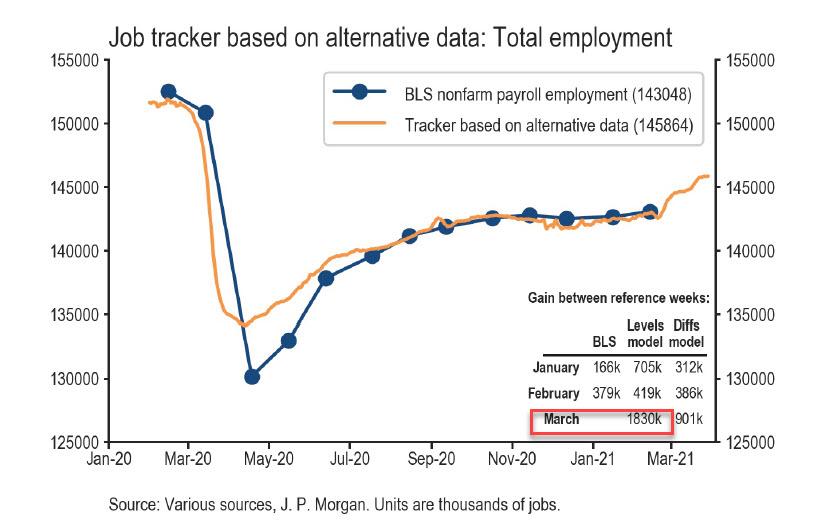
The March nonfarm Payroll Report will be released at 8:30 am tomorrow, on Good Friday, when most markets will be shut, and those that are open – like US cash Treasurys, which close at noon – will suffer from thin liquidity conditions, and therefore, potentially choppy price action. As noted earlier, amid expectations of a potentially blockbuster payrolls report where consensus is 660K but whisper numbers are at or above 1 million…
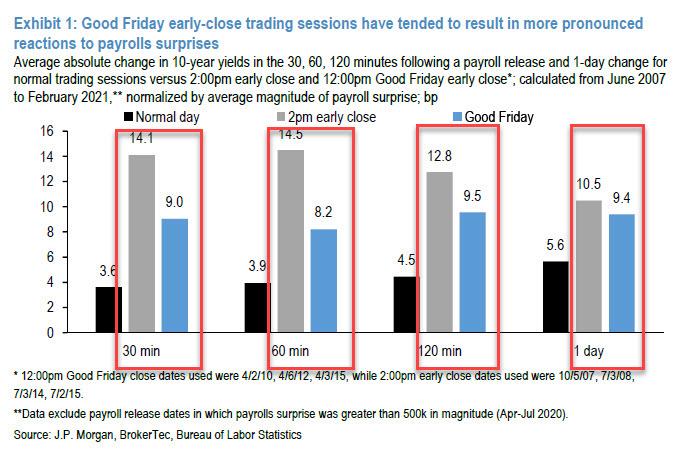
… due to much stronger “big and/or alternative data” reads (see below), JPM warned that markets should expect extra treasury volatility should the jobs number emerge as a big upside (or downside) surprise due to the lack of liquidity in the bond market. As the bank warned, “our work in the past has shown that Treasury yields are sensitive to payroll surprises and that these moves can be amplified when employment data are released on holiday-shortened trading sessions.”
The chart above shows the average absolute change in 10-year yields over various periods around payrolls releases, normalized by the average size of payrolls surprise, during various types of trading sessions. The data show that in the hours following payrolls releases on Good Friday 12pm early-close sessions, Treasury markets appear to be approximately 2 times more volatile than observed during a normal session, for a given magnitude of surprise, and in 2pm early close sessions, they are roughly 3 times more volatile than that of a full session following releases. Looking ahead, JPM concludes that “these results suggest that Treasury yields could exhibit greater volatility in response to a surprise in the employment report on Friday.”
Blockbuster surprise – and fireworks in the bond market – aside, current expectations are as follows:
Change in non-farm payrolls +660k in March from the 379k printed in Feb;
Change in private non-farm payrolls +643K, up from 465K
Unemployment rate 6.1% from 6.2%.
Average hourly earnings M/M +0.1%, from 0.2%
Average hourly earnings Y/Y +4.5%, from 5.3%
Labor force participation rate 61.5%, from 61.4%
As Newsquawk adds, the signals from the weekly initial jobless claims data are subject to distortions, making it difficult to infer an accurate read: initial jobless claims in the week that corresponds to the jobs report survey window jumped in the week, although this was a result of the sharp rise in Texas, which accounted for around half of the rise, due to weather conditions seen in February; but PUA benefit claims fell, which could have been a result of claims in Ohio, which were reported to be subject to fraud, came down. Continuing claims in the corresponding week, however, fell by more than analysts were anticipating, which bodes well for the BLS data.
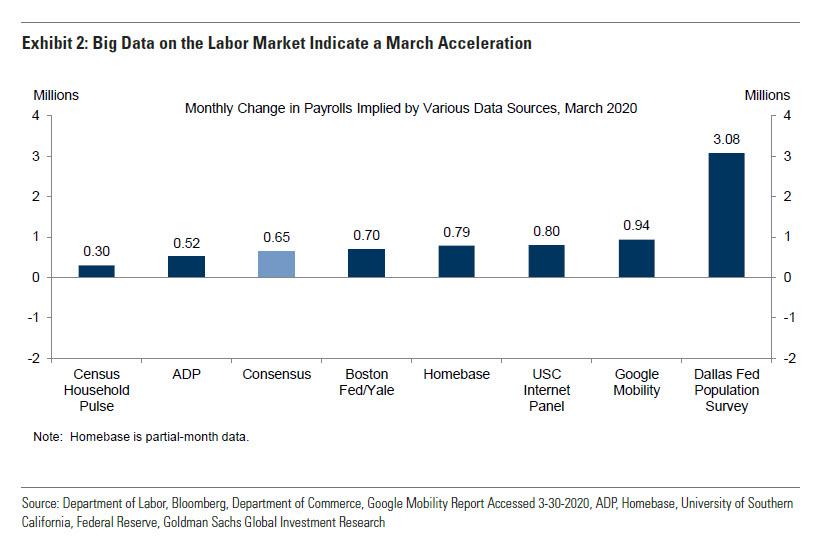
In its preview of tomorrow’s jobs report, Goldman is far more upbeat than consensus and estimates that nonfarm payrolls rose 775k in March, roughly double the 379k pace in February and above the consensus of 660K, as falling infection rates and a net easing of business restrictions likely supported job growth in virus-sensitive industries, particularly leisure and hospitality. Big Data employment signals also indicate a pickup in job growth, with the more accurate measures clustered in the 700-900k range.
Additionally, Goldman expects a rebound from the winter storms in February, with a net boost to March job growth on the order of 50-100k. Finally, the bank believes higher jobless claims readings this year mostly reflect policy incentives and non-economic factors, as opposed to new layoffs.
The surge in payrolls means that Goldman also estimates a three-tenth decline in the unemployment rate to 5.9% (consensus 6.0%), reflecting a strong expected gain in household employment. That being said, a vaccine- and reopening-related rebound in labor force participation is likely to start this month, and this could limit the magnitude of the decline in the jobless rate.
On the wage side, Goldman estimates a 0.1% increase in average hourly earnings (and 4.5% yoy, in line with consensus), due to negative calendar effects and negative composition effects.
Below are some data points arguing for a better-than-expected report:
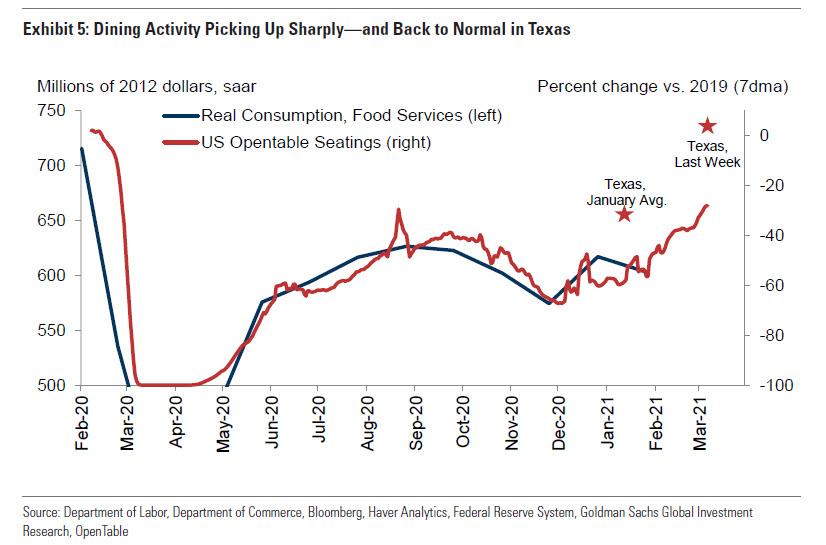
Reopening. While cases remain elevated in much of the country, infection rates generally fell and the severity of business restrictions eased between the February and March survey period. Reflecting this, restaurant seatings on OpenTable rebounded sharply to -37% from -57% (yoy survey week to survey week). And in Texas, dining activity had returned to normal shortly after the end of the survey week.
Big Data. High-frequency data on the labor market were generally positive in March, with five of the seven measures Goldman tracks indicating a better-than-expected report relative to consensus, and stronger gains in the more reliable datasets
Better weather. Winter storms in the eastern half of the country weighed on February job growth, with an outright decline in US construction employment (-61k, weakest since the April 2020 lockdowns), and nonfarm payroll declines in the West South Central region (-38k, includes Texas). Normalization in the weather suggests scope for a boost to March job growth of 50-100k (mom sa).
Employer surveys. Business activity surveys increased on net in March. The employment components of both services (+0.9pt to 58.5) and manufacturing (+0.7 to 58.1, the highest level since August 2018) survey trackers increased.
Job availability. The Conference Board labor differential—the difference between the percent of respondents saying jobs are plentiful and those saying jobs are hard to get — increased into expansionary territory (to +7.8 in March from -0.8 in February), its highest level since March 2020 (+29.5).
Job cuts. Announced layoffs reported by Challenger, Gray & Christmas fell by 16% in March after declining by 59% in February (mom, SA by GS). Layoffs were at the lowest level since May 2018 (30k, SA by GS).
Neutral/mixed factors:
Jobless claims. Initial jobless claims declined during the March payroll month, averaging 749k per week vs. 827k in February, although the decrease likely overstates the underlying labor market improvement, since claims in Ohio and Illinois normalized from inflated levels. Continuing claims fell 549k between the payroll survey weeks, but this decline partly reflects expiring regular-state-programs (as opposed to reemployment). Across all employee programs including emergency benefits, continuing claims increased by 82k (some of which reflect benefit renewals following the Phase 4 package).
ADP. Private sector employment in the ADP report increased by 517k in March, below consensus expectations but above the pace of the official measure in February. Goldman warns that the ADP panel methodology may undercount workers returning to their previous employers, which would argue for a larger gain in the official payroll measure.
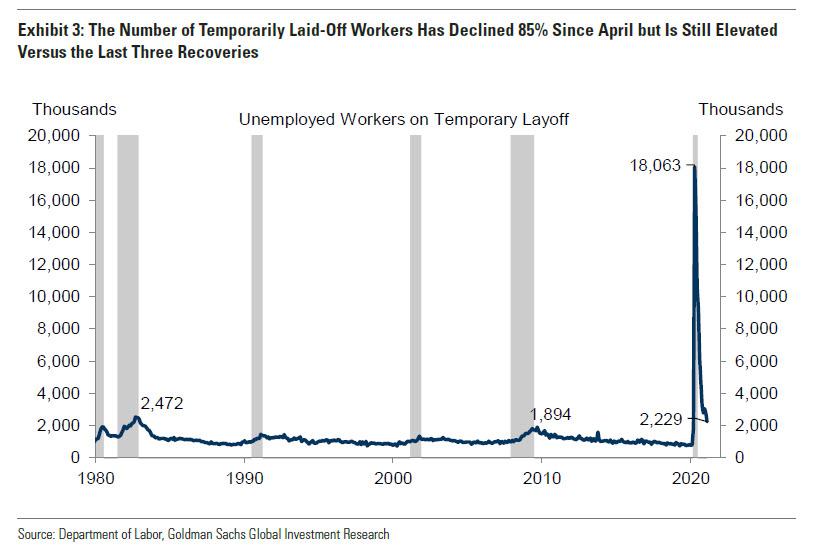
As always, pay close attention to the number of unemployed workers on temporary layoff, which spiked to a record-high 18.1mn last April but had retraced to 2.2mn by February of this year.
The smaller number of workers left on temporary layoff reduces the scope for the rapid pace of gains seen last summer, but it remains a positive factor relative to the pre-coronavirus pace of job gains.
White House Enlists Governors To Help Boost “Public Confidence” In JNJ Jab
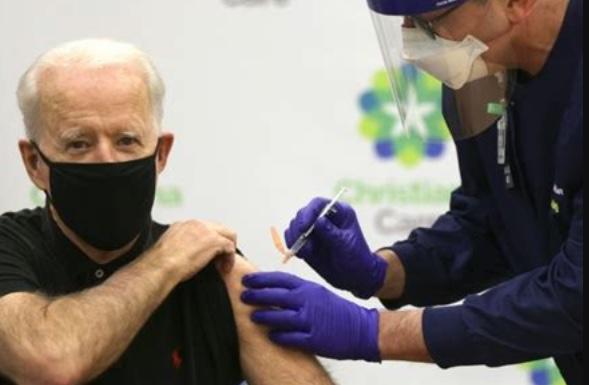
Despite releasing trial results from Pfizer on an almost daily basis this week, the federal government is still worried about public confidence in Biden’s vaccine effort (even after the president made a spectacle out of doubling his target for doses distributed during his first 100 days). And as skepticism about the efficacy of the JNJ jab, which only requires one dose instead of the two required for Moderna and Pfizer, persists, the Hill reports that the White House has enlisted the help of Democratic governors to “boost confidence” in the jab.
Several governors have purposely taken the JNJ jab in recent weeks to try and show the vaccine is safe at the behest of the White House. A few weeks ago, Biden held a call with top communications staff from a bevy of governors, including Tim Walz from Minnesota and JB Pritzker from Illinois.
Now, the government is once again in damage-control mode after reports that 15MM doses were ruined during a manufacturing snafu, the latest public issue related to the jab.
When approached by the Hill, the governors’ denied that they took their marching orders from the president.
Not every governor opted for the Johnson & Johnson shot because of the White House ask, but some said it influenced their choice”
“Governor Northam’s decision to get the Johnson & Johnson vaccine two weeks ago was intended to increase public confidence in that particular vaccine,” said Marissa Astor, a spokesperson for Northam. “He felt it was important to demonstrate that there are three safe and effective vaccines available, including Johnson & Johnson.”
A spokesperson for Walz stressed that the governor wants to assure Minnesotans that “the best vaccine is the one you’re offered.”
Walz’s decision to get the Johnson & Johnson shot was intentional, the spokesperson said, but it was made before White House officials specifically encouraged governors to get that vaccine.
Stitt, who got the vaccine this week, got the Johnson & Johnson shot because the state health department had it available, an official with his office said. Oklahoma is among the top 10 states for vaccines administered, the official noted, and Stitt wanted to publicly encourage residents to get their shot.
A White House official who spoke with the Hill “was adamant” that they were seeing “enthusiasm” for the JNJ jab (and presumably, vaccines generally), and that any outreach to governors was part of “a multipronged stragey to engage government, religious and cultural leaders”.
Dr. Anthony Fauci also helped out with the charm offensive. He appeared in a video posted by the White House last week in which he laid out the basis about the JNJ vaccine and assured the public it was safe and effective.
“I would definitely take the Johnson & Johnson vaccine,” Fauci said, noting it’s “virtually 100 percent protective” against hospitalization and death. “This is a vaccine that works, and it only requires one dose.”
Texas COVID-Positivity-Rate Plunges To Record Low After Mask-Mandate Lifted, Restaurants Back To Pre-Crisis Levels
According to the relentless pro-mask propaganda, this wasn’t supposed to happen.
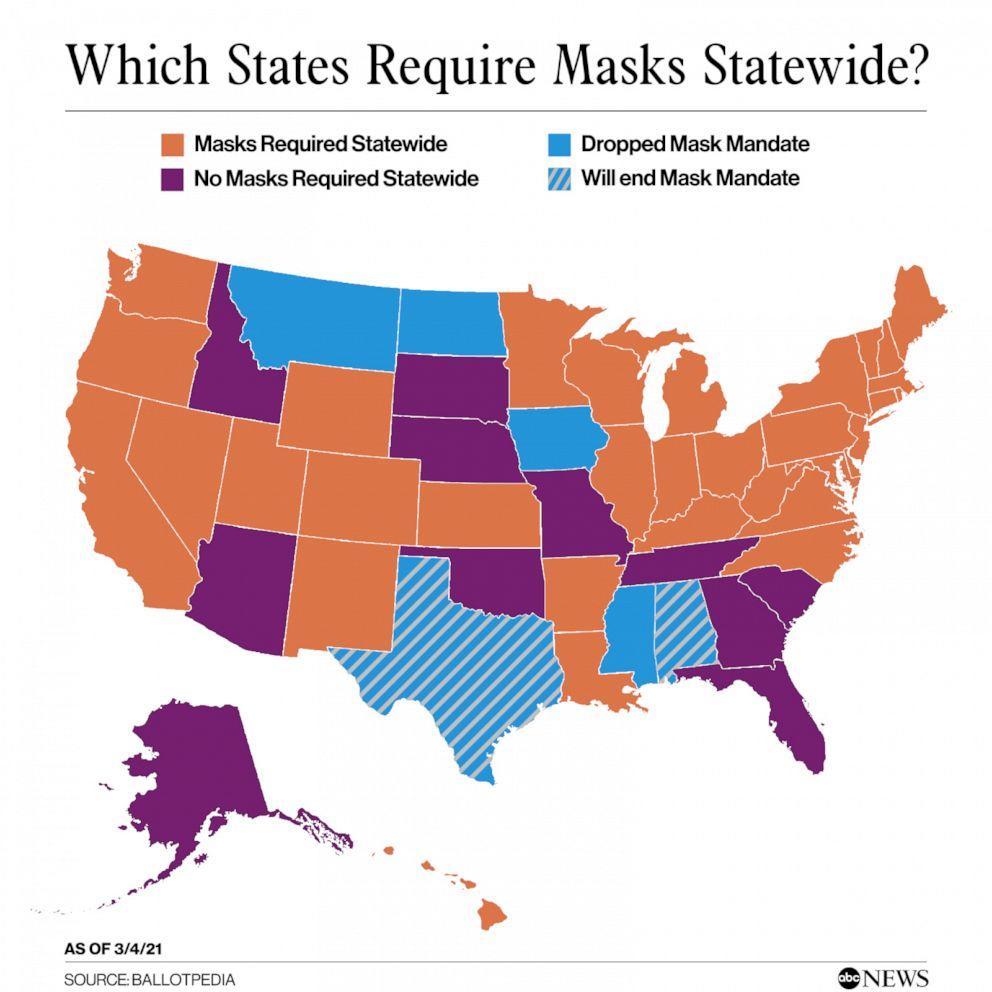
For the better part of the past year, the US public was bombarded with “science” how only the wearing of a mask (or two masks, or three masks or more) was the only thing that stood between the Western way of life and Armageddon (despite the periodic emergence of cold, hard data showing no improvement in covid transmission in states that mandated masks vs those that did not, at least until Twitter decided to ban it). Then, one month ago, Texas had had enough and its governor shocked the Faucis of the world – and the White House – when he declared that the mask mandate in the state was officially over.
What happened then?
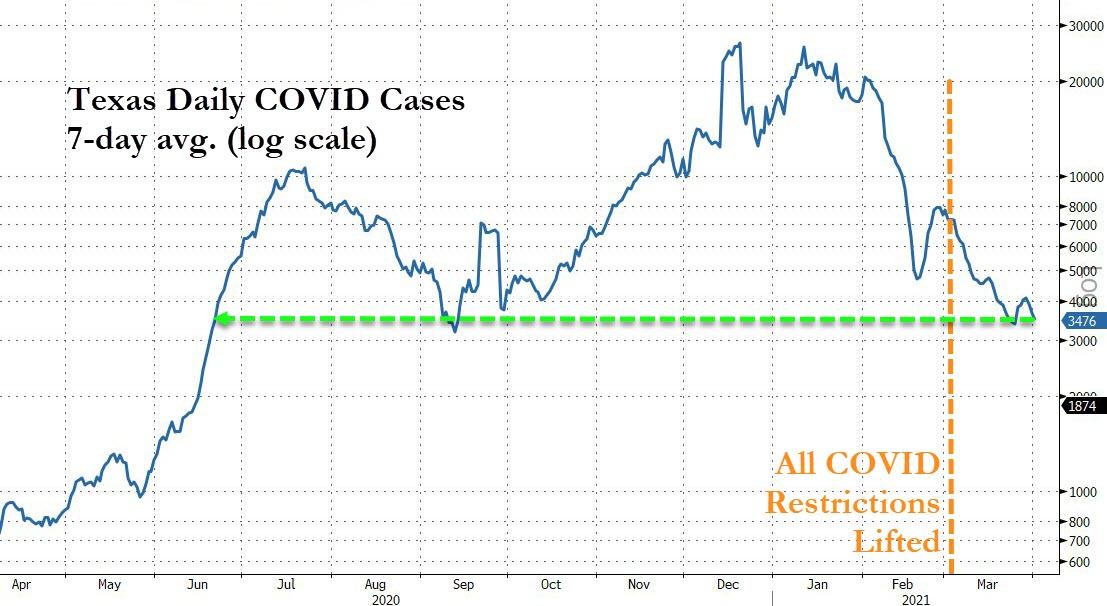
Well, in a development that would likely shock Dr. Fauci, newly confirmed Coronavirus cases in Texas plunged to their lowest since June, roughly three weeks after the state lifted its mask mandate and reopened businesses.
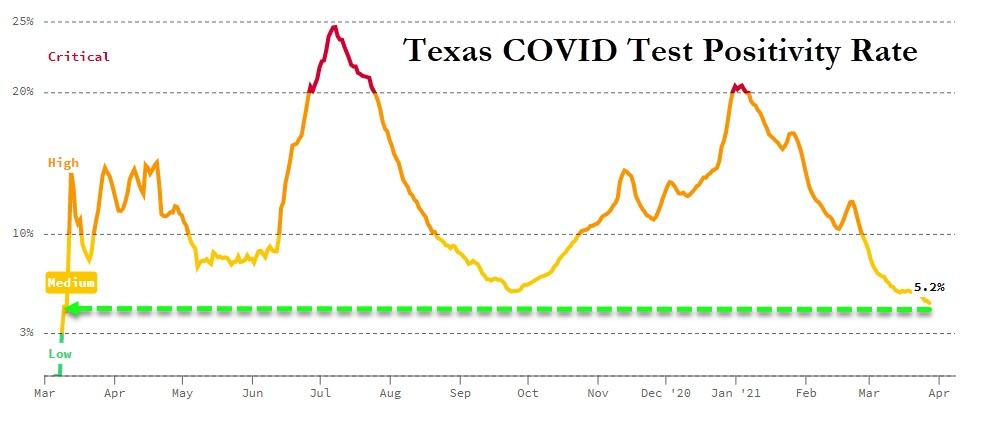
Additionally, the 7-day Covid positivity rate dropped to a new recorded low: 4.95%…
Texas Governor Greg Abbott wrote in a tweet over the weekend. “Everyone now qualifies for a shot. They are highly recommended to prevent getting Covid but always voluntary.”
Today the 7-day Covid positivity rate dropped to a new recorded low: 4.95%
Hospitalizations dropped to a 6 month low
This week we have 1 million 1st vaccines available
Everyone now qualifies for a shot. They are highly recommended to prevent getting Covid but always voluntary
The 4.95 percent test positivity rate is the lowest the state has seen since the start of the pandemic. According to the Texas Department of State Health Services, some 1,900 new virus cases were reported on Sunday, which is the lowest daily number the state has seen since early June.
Data from the U.S. Centers for Disease Control and Prevention showed that the seven-day moving average number of cases in Texas dropped to the lowest level since mid-June. According to the CDC, Texas was averaging 3,783 daily cases as of March 27.
Abbott’s tweet also noted that hospitalizations dropped to their lowest number in the past six months. According to data from the Texas Department of State Health Services (DSHS), 3,104 COVID-19 patients were in hospitals across the state as of Saturday. Data shows that the state has not recorded a number this low since September 19, when there were 3,081 hospitalizations. As of Monday, Texas has reported more than 2.3 million confirmed coronavirus cases and at least 47,156 deaths.
In an updated tweet from Wednesday, Abbott noted that Covid hospitalizations dropped to a new 6 month low, with the 7-day Covid positivity rate remaining below 6% for the 9th day in a row.
240,162 Texans got a Covid shot today.
We surpassed 11 million total shots–just 5 days after passing 10 million.
Hospitalizations went down to a new 6 month low.
The 7-day Covid positivity rate has remained below 6% for the 9th day in a row.
The drop in virus cases, hospitalizations and the testing positivity rate comes three weeks after the state officially lifted its pandemic restrictions, including a statewide mask mandate.
Abbott first announced the removal of most COVID-19 restrictions on March 2, when he tweeted that “Texas is OPEN 100%.”
“I also ended the statewide mask mandate,” Abbott wrote in the tweet. His executive order reopening the state went into effect March 10.
Separately, in a note from Goldman, the bank found that in Texas dining activity is now back above pre-crisis norms. The bank goes on to note that “while this may increase public health risks in coming months, it also suggests scope for a more rapid normalization in business activity in the interim.” Another way of saying this: small business are rejoicing having had the oppressive boot of government interference lifted from their daily lives.
Meanwhile, as Newsweek notes, Mississippi also removed its COVID-19 restrictions around the same time. Like Texas, Mississippi has seen a drop in virus cases and hospitalizations. According to CDC data, as of Saturday Mississippi was seeing an average of 254 daily cases, which is a decrease from the previous month, where the state was averaging around 520.
According to the state’s health department, Mississippi also saw a drop in COVID-19 hospitalizations, reporting 238 hospitalized patients with confirmed infections this past Friday, which is the lowest the state has seen since May.
Before the decreases in cases and hospitalizations in Texas and Mississippi, the two states received daily criticism for their coronavirus policies, including from Joe Biden’s teleprompter. Shortly after both states said they were lifting their COVID-19 restrictions, Biden said, “The last thing we need is Neanderthal thinking, that, in the meantime, everything’s fine, take off your mask, forget it. It still matters.”
It appears that the Neanderthals were right, after all.
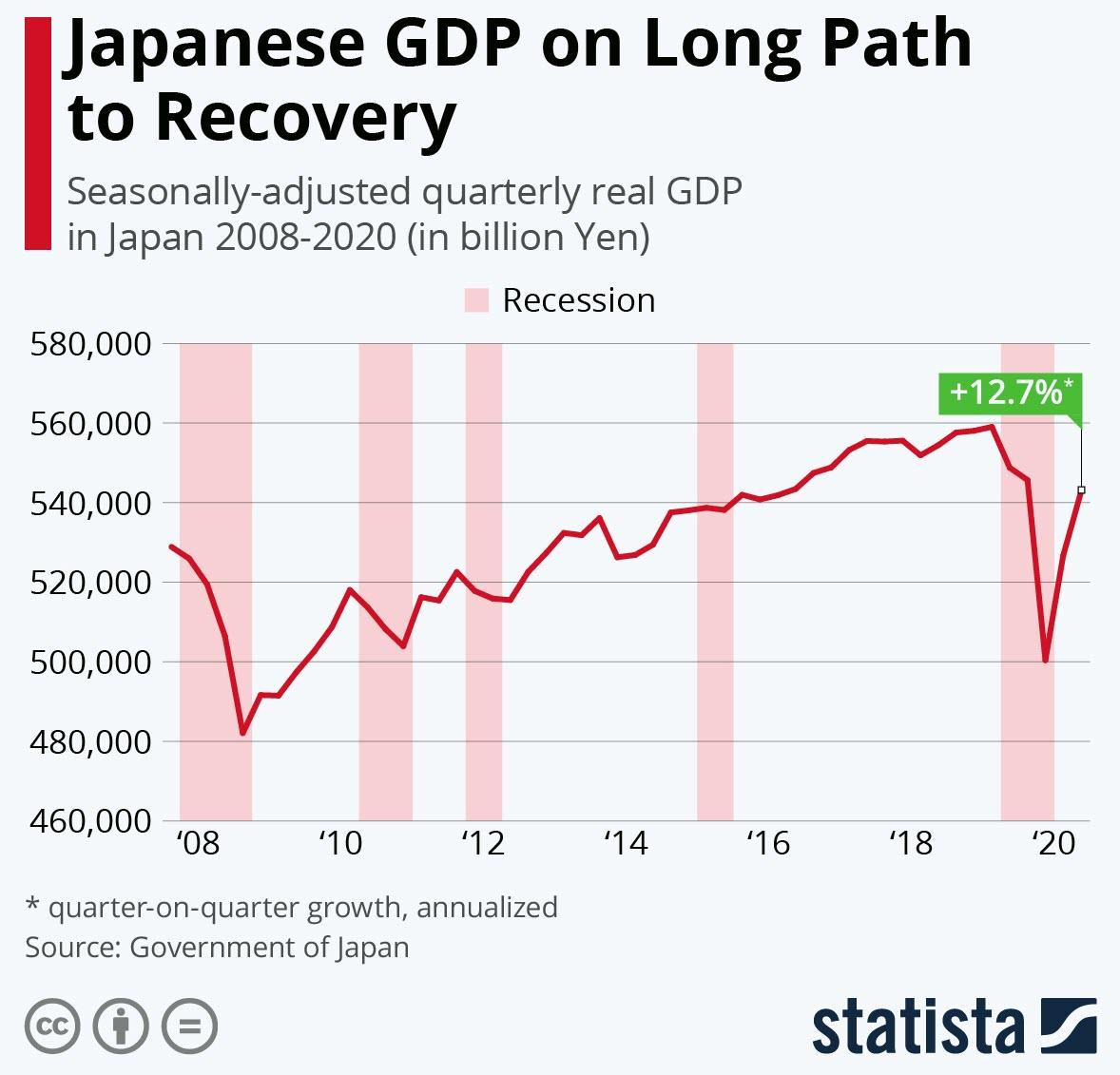
Japan. the world’s third-largest economy is highly dependent on exports and the reality it is still struggling even after a great deal of America’s stimulus money leaked into buying imported goods speaks volumes. While it feels a bit like ancient history, Japan’s GDP contracted at an annualized rate of 28.8 percent in Q2 of 2020, the biggest decline on record. Even after bouncing back 21.4 percent quarter-on-quarter in Q3 and 12.7 percent in Q4 Japanese national accounts are still lagging behind mid-2019 levels. For all of 2020, spending by households with at least two people fell 5.3% due to the hit from the pandemic. It was down 6.5% for all households, the worst drop since comparable data became available in 2001.
All in all, this means the country is still playing catch up, partly because Japan also experienced two additional quarters of negative growth in Q1 of 2020 and Q4 of 2019. Adding to the problem is Japan’s household spending fell for the first time in three months in December, in a sign consumer sentiment was weakening even before the government called a state of emergency to control a new wave of the coronavirus. Lower demand for services such as travel tours also weighed, as the pandemic forced the cancellation of domestic tourism promotions. Last year, spending on accommodations fell 43.7%, while overseas and domestic tour travel expenditure slumped 85.8% and 61.9%, respectively.
Not only is Japan again struggling to stay out of recession, but it also faces a wall of debt that can only be addressed by printing more money and debasing its currency. This means they will be paying off their debt with worthless yen where possible and in many cases defaulting on the promises they have made. Japancurrently has a debt/GDP ratio of about 240% which is the highest in the industrialized world. With the government financing almost 40 percent of its annual budget through debt it becomes easy to draw comparisons between Greece and Japan.
Over the years Japan has been able to sidestep default due to the good fortune of sporting a huge trade surplus with America and forming tight economic ties with China during the years it was rapidly growing. Unfortunately, for Japan, the benefit of both those forces may be waning.China has moved up the manufacturing chain and no longer needs Japan as much as it did. This leaves Japan in the unenvious position of having to find new ways to move forward at a time when few friendly trends have surfaced to aid in its endeavor.
The Japanese economy has been no stranger to recessions even before the coronavirus outbreak. In fact, Japan experienced three mild recessions between the COVID-19 pandemic and the global financial crisis. The first was caused by the devastating earthquake and tsunami that rocked Japan in 2011. The other two and single negative growth quarters appeared to be just part of the long stagnation the Japanese economy has been in since its asset price bubble burst in the 1990s.
In the aftermath of the crisis, Japan amassed a mountain of debt that it carries to this day. Japan’s aging population and shrinking consumer market have made it hard to revive the Japanese economy. The country’s continued reliance on exports and tendency to invest overseas rather than at home have become a big part of what Japan does. For years the now-former Prime Minister Shinzo Abe promised the country relief through his “Abenomics” economic revival program but it never did lift the country out of stagnation. The Abe administration significantly eased monetary policy and increased government spending, while simultaneously talking about needed structural reforms most of which always seemed to be pushed back or get delayed.
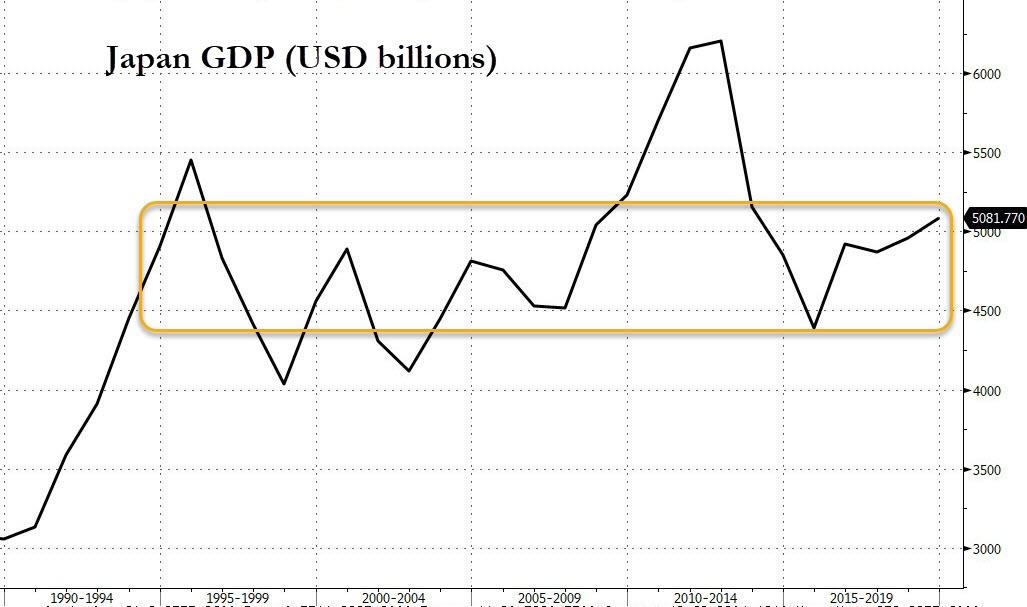
Japan’s GDP Is Flat Since 1990
Not all economists see more deficit spending as the answer to Japan’s problems and argue that more spending will only hurt efforts such as the recent consumption tax hike to improve Japan’s overall fiscal health. Japan holds the title of havingthe industrial world’s heaviest public debt burden. Its debt is more than twice the size of its $5 trillion economy.
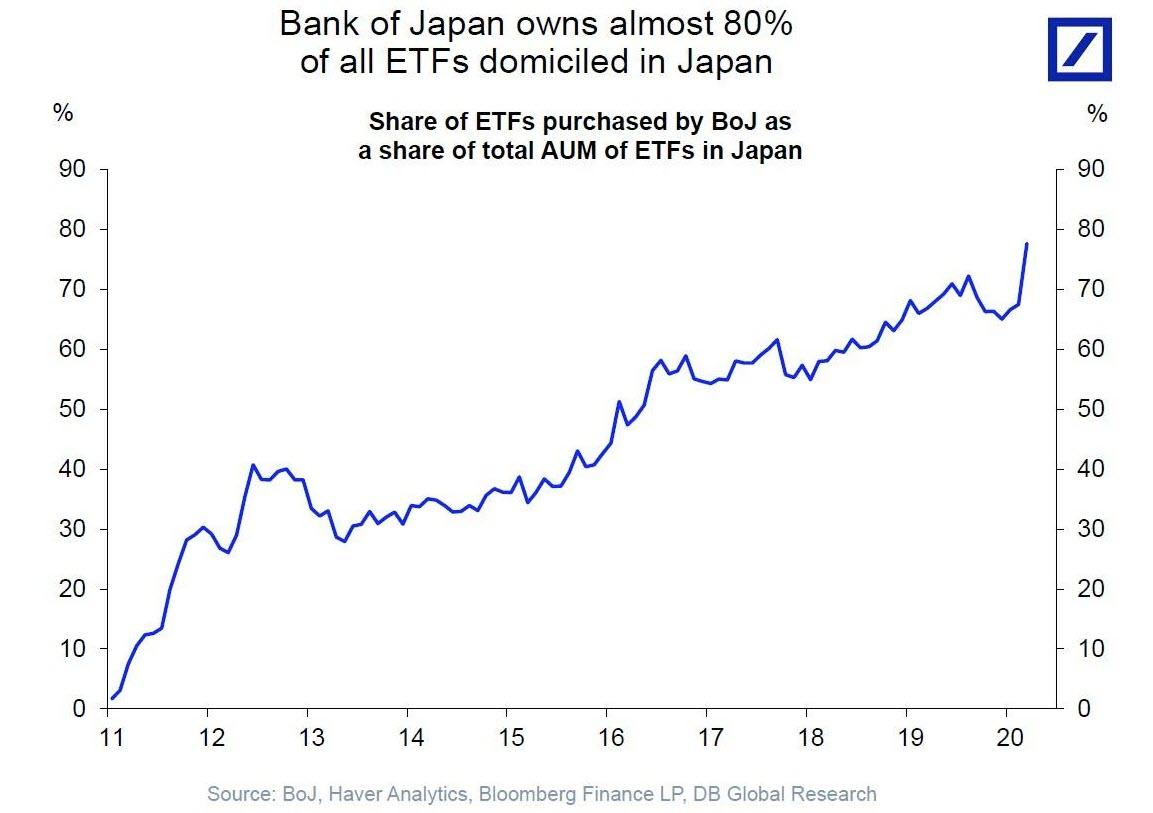
The world’s negative-yielding debt hit a record $17 trillion at the start of September, mostly as a result of most Japanese debt trading in negative territory as the Bank Of Japan continues to monetize the country’s debt. All this also flows into Japan’s stock market where, when we see Japanese shares rise we are now forced to wonder how much of it has to do with Kuroda and the BOJ pumping up Japan’s stock market bybuying more ETFs. It is difficult to argue that in effect, the BOJ buying stock is not nationalizing Japanese companies.
The BOJ Owns Nearly 80% Of Japan’s ETFs
All this has morphed into a program that seems akin to fraud based on doing “whatever it takes” to give the appearance their economy is moving forward. Following along the line of thought that while there is no way of avoiding the final collapse of a boom brought about by credit expansion years ago, Ludwig von Mises wrote; “The alternative is only whether the crisis should come sooner as the result of a voluntary abandonment of further credit expansion, or later as a final and total catastrophe of the currency system involved.” In short, the BOJ now has little choice but to go all-in which strips away any illusion all is well. In some ways, the actions of Japan’s central bank could be considered nothing more than a new model of “stealth nationalization.” This is a course filled with moral hazard.
What we see occurring in Japan stems from a far greater problem than simply slow growth. At some point, reality will set in and the yen will suffer as a result of Japanese policies. For many years Japan’s relationship with China has bolstered the yen. The collapse of the yen would debunk the myth that major currencies in our modern world are immune to failure and release a slew of new problems across the world. While this has been expected for some time it most likely will not be the catalyst for global financial collapse since the yen constitutes around only 4% of the world’s reserve currency, however, it would gravely wound fiat currencies and alter how they are viewed.
Factoring into all of this, in September of 2020, Yoshihide Suga, became Japan’s new prime minister. Suga took over from 65-year-old Shinzo Abe, the country’s longest-serving prime minister, who resigned due to health reasons. On the domestic stage, Suga inherits a troubled agenda swamped by the coronavirus pandemic, he also has to deal with the disaster of the postponed Tokyo Olympics. As the leader of one of America’s closest allies he also has to navigate a tense geopolitical climate resulting from the rapidly deteriorating U.S.-China relations and the idea Japan wants the U.S. to deter China’s military aggression in Asia.”
Borrowing a huge part of a nation’s economic output every year to prop up the status quo is akin to putting a Band-Aid over a wound, that in this case, is rapidly growing larger. In short, Japan’s flawed prescription for future growth will never work. Many of the policies that have failed in Japan over the decades are now being played out across the world. Interestingly, over time, the “Japanification” of the world’s economy may play out far worse for the global financial system than it did for Japan.
Progressives Push Biden Towards $10 Trillion ‘Green Infrastructure, Climate Justice’ Bill
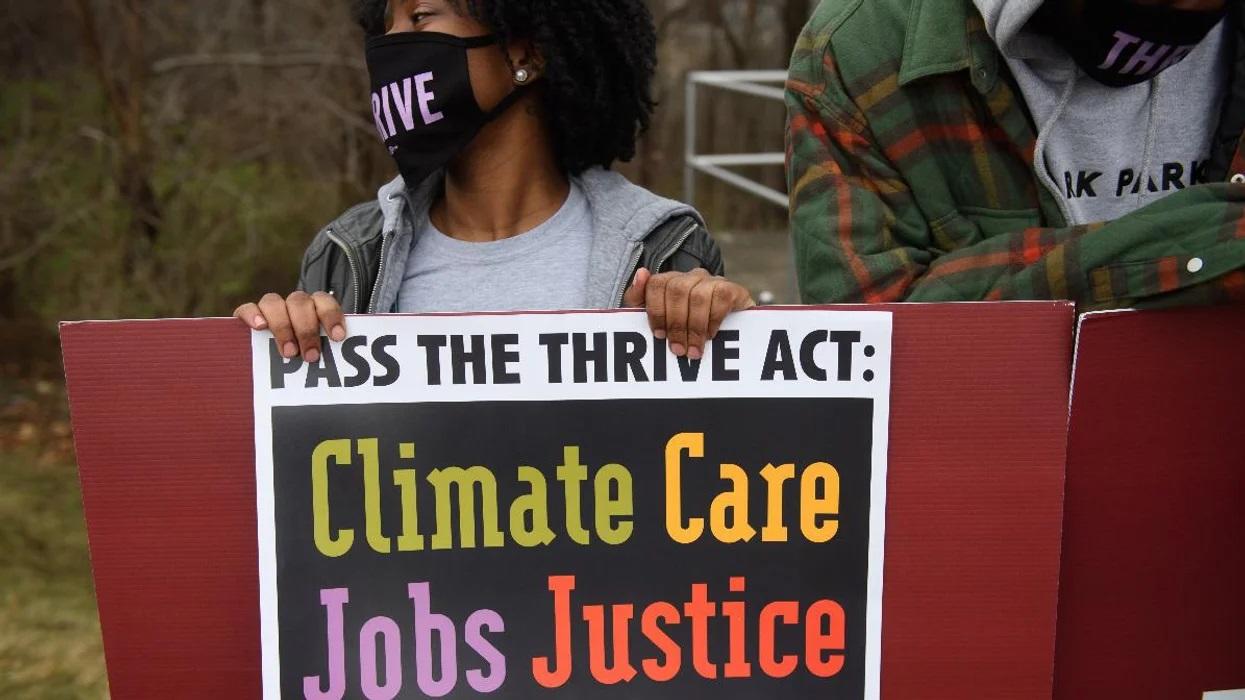
President Biden is feeling pressure from progressive Democrats to dramatically increase the size of the next economic stimulus – after they introduced a new measure that would invest $10 trillion over 10 years in renewable energy, green infrastructure, and climate justice initiatives.
The proposed bill – known as the “Transform, Heal and Renew by Investing in a Vibrant Economy (THRIVE) Act, would make a series of sweeping changes to American infrastructure – and contains elements of the Green New Deal – including, as Fox Business notes, “establishing a goal of 100% zero-carbon electricity by 2035, zero emissions from new buildings by 2025 and expanding clean public transit options to most Americans by 2030.”
The THRIVE act also directs at least 40% of federal investments towards communities which have been “excluded, oppressed and harmed by racist unjust practices,” according to the report.
“We are facing a series of intersecting crises: climate change, a public health pandemic, racial injustice and economic inequality,” said co-sponsor Sen. Ed Markey (D-MA) at a Monday press conference. “We can’t defeat any of these crises alone. We must develop a roadmap for recovery that addresses them all.”
Biden’s $2.25 trillion infrastructure proposal on Wednesday – the first component of more than $3 trillion in proposals – just isn’t enough for progressives, despite the fact that it’s already going to be tough sledding to pass given the Democrats’ narrow margin in the Senate – and is receiving criticism from all sides. Meanwhile in the House, Speaker Nancy Pelosi can only afford to lose three Democratic votes if Republicans are unified in opposition.
One key moderate, Sen. Rob Portman (R-Ohio), took a shot at Biden’s plan Wednesday, calling the proposal to raise corporate tax rates “the wrong approach,” an early sign that attracting Republican votes will be difficult.
“This might be the last opportunity we have to really do big things under reconciliation. We need to see more here, and I think that’s the universal thought across the movement right now,” said Yvette Simpson, the CEO of Democracy for America, a progressive advocacy group, referring to special budget rules that allow Democrats to pass bills through the Senate with simple-majority votes.
Senate Majority Leader Charles Schumer (D-N.Y.) is making the argument to the Senate parliamentarian that Democrats should be allowed to move two more packages under those special budgetary rules. -The Hill
Last week progressive Sen. Elizabeth Warren (D-MA) raised concerns that Biden’s focus on popular priorities in the first infrastructure proposal, such as fixing highways, bridges and upgrading ports, could make it much harder to pass additional legislation that addresses economic inequality.
“I want to see the details of how they’re planning to make sure that the climate issues and the child care issues don’t get left behind. We can’t have the train leave the station and critical parts are left on the platform,” said Warren, who tweeted on Wednesday that.
Rep. Alexandria Ocasio-Cortez (D-NY) said on Tuesday that Biden’s plan needs to be “way bigger,” tweeting “This is not nearly enough. The important context here is that it’s $2.25T spread out over 10 years. For context, the COVID package was $1.9T for this year *alone,* with some provision lasting 2 years.”
Another progressive lawmaker, Rep. Pramila Jayapal (D-WA) who heads the Congressional Progressive Caucus, said on Tuesday that the White House needs to go even bigger – and that Biden’s proposal is far smaller than what he promised last year on the campaign trail.
“The Biden infrastructure proposal on the campaign trail was significantly larger than what’s been discussed so far with Build Back Better,” she said during a call with reporters, citing a $6.5 trillion – $11 trillion previously estimated cost over 10 years. “So we really think that there’s ample room to get the overall number up to somewhere in that range in order to really tackle the scale of investment that we need to make,” she added.
Jayapal supports including tax hikes in the package but primarily as a way to bring more “fairness” to the tax code, rather than simply to offset the cost of infrastructure improvements.
“Democrats should not constrain ourselves or lower our ambitions because of manufactured concerns about the deficit,” she said.
Among progressive activists, there are growing questions about whether Biden’s infrastructure plan will do enough to tackle economic inequality in historically marginalized communities.
“There’s a lot more that needs to be addressed, especially when we think about how equity has been reflected in climate justice work,” said Joanne Pérodin, an activist with Florida Rising. “This is the time for us to get bolder.”
She said the White House and Congress needs to make sure investment will be equitably spread across “Black communities, brown communities, indigenous communities.” -The Hill
On Tuesday, Sen. Markey called the $10 trillion proposal a “historic opportunity,” adding “With a Democratic White House and Senate and House of Representatives we have a chance to lift the gaze of our country to the constellation of possibilities in job creation and to finally rectify the historic racial injustices so many people of color have faced in this country, all while solving the climate crisis at the same time.“
With reports that President Joe Biden’s administration is planning for imposing a vaccine passport mandate in America, expect to see in the media a deluge of vaccine passport propaganda. What will that propaganda look like? A template illustrating several elements you can expect to see in the propaganda push was provided several weeks ago in a CNN interview.
In the first week of March, host Fareed Zakaria and his guest Arthur Caplan provided at CNN a textbook example of how to present vaccine passport propaganda to the American people. Let’s look at some of the major elements of the propaganda template as demonstrated by Zakaria and Caplan.
1) Include some short expression that the idea of vaccine passports can be troubling, but make sure to only bring this up superficially. This is accomplished in the CNN segment by starting with a clip from a short scene from the movie Casablanca. In the clip, a policeman asks to see a man’s “papers,” the man says he does not have them, and the policeman responds, “in that case we’ll have to ask you to come along.” Not shown is the remainder of the scene in which the accosted man, after presenting apparently expired papers, attempts to flee only to be gunned down. Not showing the full scene demonstrates the care demanded in the propaganda to not allow any depiction of potential dire consequences from imposing vaccine passports.
2) Frame the imposing of a vaccine passport mandate as something that is both inevitable and threatens only minimal, if any, harm. Zakaria accomplishes this task with the first sentence he utters to begin the media segment. Zakaria states: “From Casablanca to today, a demand to produce personal documents can be uncomfortable, but, post-pandemic, it’s something we’ll all likely have to get more and more comfortable with.” Masterfully, Zakaria, in addition to minimizing the problems with passports as just causing discomfort, asserts that even that discomfort with time will disappear, suggesting objecting to vaccine passports is just an irrational or silly reaction.
3) Bring on a guest who, despite his description making him sound like someone who would be looking out for the interests of people concerned about vaccine passports, pretty much says that vaccine passports are the best thing since sliced bread. In the CNN interview the guest performing this role is Arthur Caplan, who Zakaria introduces as a “medical ethicist” and “professor at NYU.” A medical ethicist will surely provide some warning about dangers from vaccine passports, right? Yes, in many cases. But, Caplan is not that sort of medical ethicists. He is the one picked to be interviewed in a media segment designed to promote acceptance of vaccine passports.
4) Reiterate that vaccine passports are inevitable, and that people should support them. Zakaria hits the nail on the head with this, presenting this first question to his guest: “So explain why you think, basically, that this is the future and we should be comfortable with it.”
5) Declare that vaccine passports must be imposed on the American people because of coronavirus. Caplan accomplishes this task in his first words in the media segment. He states: “Well, I’m sure that the future holds vaccine passports for us, partly to protect against the spread of Covid.” Of course, as coronavirus has turned out not to be a major danger to most people, imposing a vaccine passport mandate to counter it makes no more sense than doing it to counter any other of many diseases. But, this is not a topic to be brought up when selling people on vaccine passports. Fearmongering, no matter how ridiculously unjustified, is the name of the game. This is the fraudulent message people are encouraged to act on without much critical thought: Coronavirus is gonna kill us all unless we take the shots and show our papers!
6) Say that mandating vaccine passports is really no big deal because of some other supposedly very similar restriction to which some people are already subjected. Caplan states: “And, you know, it’s not a new idea, we have it for yellow fever; there are about more than a dozen countries that say you can’t come in if you haven’t been vaccinated against yellow fever, and many others require you to show proof of vaccination if you transit through those countries.” Are the yellow fever-related requirements justified? Caplan does not say more than that, because these somewhat similar restrictions exist someplace, the mandating of vaccine passports in America is fine. That’s medical ethicist reasoning? Anyway, the yellow fever stuff, because most Americans have no experience with or knowledge of it, is a fine example for the propaganda. Few watchers of the segment will have any basis for questioning the current practice that is used to justify the new desired mandate. One big difference, though, jumps out on further consideration. Caplan explains that the yellow fever requirements apply for just coming to several countries. In contrast, Zakaria early in the interview says the vaccine passports that will, he claims, inevitably be imposed on Americans will be required for people “to get on an airplane, to go to a concert, or to go back to work.” The vaccine passport mandate is, thus, much more troublesome for most Americans than yellow-fever-related requirements for entry into a few countries that most Americans never visit. But, the point is to quickly present the example as if it provides conclusive support no matter how far that representation is from the truth.
7) Dismiss as insignificant people’s concerns about being required, in order to go about their daily activities, to present a vaccine passport and to take a vaccine, or, really, an experimental coronavirus vaccine that is not even a vaccine under the normal meaning of the term. Assert instead that the only danger to freedom could be something theoretical that could be additionally required in the future. Here is how Zakaria puts it in a question to Caplan: “What about the concerns that many people have about privacy, about the privacy of their health data, that, you know, is there a slippery slope here — ‘OK, I’m comfortable telling you whether or not I have Covid, but does that mean it becomes OK to ask about other things?'” Of course, many people are justifiably wary of being pressured to take the shots and then having their mandated vaccine passport used to track them as they go about their daily activities. That is why this media segment and others like it are being presented, after all.
8) Dismiss any concern that vaccine passports can in fact harm freedom. Instead, describe people as benefiting from and gaining freedom by their being mandated to take experimental coronavirus vaccines and present vaccination passports in order to go about their daily activities. Oh yeah, and keep quiet about all the mass surveillance facilitated by a vaccine passport program, the vaccinations-based caste system resulting from the mandate that will make people who do not take the shots suffer, and how the vaccine passport program can be expanded to advance many additional types of control over people. Here is how Caplan puts it: “With a Covid certification, you’re going to gain freedom, you’re going to gain mobility, and I’m going to suggest that you’re probably going to be able to get certain jobs.” Talk about turning things on their head. The mandate really means that people who do not comply will be barred from the mobility they already have and fired from their jobs. Freedom is supported by rejecting the mandate, not by supporting it.
9) Insist that the vaccine passport mandate is fine because it will be applied equally to all people. This is something Zakaria and Caplan spend a long time talking about in the CNN segment. Come on guys, something bad does not become good because it is applied to the maximum number of people, irrespective of their race, sex, or whatever. We are dealing with a mandate here, not giving everyone a serving of his favorite dessert.
10) Declare that a vaccine passport mandate helps encourage people to take the shots. (Unlike the other nine elements of the vaccine passport mandate propaganda template, this one is likely true. Threats can yield compliance. Still, the threats could deter some people from taking the experimental coronavirus vaccine shots. It sure makes you wonder about shots’ supposed safety when an extreme, and unprecedented, act of force is employed to ensure people take the shots.) States Caplan in the interview: “It also gives you an incentive to overcome vaccine hesitancy. Some people are not sure still whether they want to do the vaccine, but if you promise them more mobility, more ability to get a job, more ability to get travel, that’s a very powerful incentive to actually achieve fuller vaccination.” What Caplan is really talking about is coercion. He is saying that people who would otherwise refuse taking the shots will be forced to do so by the vaccine passport mandate severely restricting their activities and even depriving them of the ability to earn an income so long as they do not give in to the demand they take the shots. All this authoritarianism is dressed up in deceptive language. “Vaccine hesitancy” is substituted for “vaccine refusal” to disguise that the vaccine passport mandate is about stopping people from exercising free choice. “Incentive” is substituted for “coercive technique.”
Watch Zakaria and Caplan’s interview here:
Hopefully, many people will see through the deception and be able to prevent the implementation of the vaccine passport mandate Zakaria, Caplan, and others are promoting in the media.