Biden Taps Susan Rice To Expand Vote By Mail

Biden Taps Susan Rice To Expand Vote By Mail

President Biden has put former national security adviser Susan Rice in charge of directing hundreds of federal agencies and departments to comply with a March executive order expanding voting registration procedures for voting by mail. Per the EO, federal agencies must submit to Rice “a strategic plan outlining the ways identified under this review that the agency can promote voter registration and voter participation” within 200 days of the order, according to the Washington Free Beacon.

“Agencies shall consider ways to expand citizens’ opportunities to register to vote and to obtain information about, and participate in, the electoral process,” reads the order. “The head of each agency shall evaluate ways in which the agency can, as appropriate and consistent with applicable law, promote voter registration and voter participation.”

It requires agencies to distribute registration and vote-by-mail ballot application forms, as well as to assist any applicants in completing the forms. It also pushes agencies to allow “approved, nonpartisan third-party organizations and State officials to provide voter registration services on agency premises.”

Biden arrived in the White House thanks in large part to the record number of mail-in ballots in the 2020 election. Former president Donald Trump led in many major swing states at the close of Election Day, only to see his lead evaporate as mail-in ballots were counted that heavily favored Biden.

Critics of Biden’s order warned that it represents a massive federal government overreach into election policies put in place by state lawmakers. Chase Martin, legal affairs director for the Foundation for Government Accountability, said the order is “an overly broad federal mandate.”

The order is about inflicting the federal government’s will on the states,” Martin said. “There’s a ton of room for this process to be abused.” –Free Beacon

The EO followed in the wake of the extremely contentious 2020 election, which also led to a new election law in Florida which created new regulations to improve the integrity of both mail-in and in-person voting. Biden, criticizing the law, said Georgia Republicans are recreating “Jim Crow in the 21st century.” Hilariously, the Washington Post debunked Biden’s criticisms, saying he misrepresented the new law’s impacts on early voting.

“The Post awarded Biden four Pinocchios after voting experts said the final bill expanded opportunities for early voting. That has not stopped several groups from filing lawsuits against the Georgia law, alleging that Republican lawmakers put the law in place after Democrats won the state in the presidential election as well as two runoff elections in January,” according to the Free Beacon.

In February, the Brennan Center for Justice found that 43 states are considering bills which seek to limit mail-in voting or institute voter ID requirements on in-person voting, which Democrats say disenfranchise people of color despite the obvious impacts they would have on election integrity.

Tyler Durden
Thu, 04/01/2021 – 20:00

via ZeroHedge News https://ift.tt/3sLerdp Tyler Durden

Hooray! The Price Of Toilet Paper Is Going Up Again, Are You Cheering Too

Hooray! The Price Of Toilet Paper Is Going Up Again, Are You Cheering Too

Authored by Mike Shedlock via MishTalk,

The Fed is rooting for more inflation. It’s coming and the Fed is cheering.

1000 Sheets Will Now Cost More

Huggies maker Kimberly-Clark announced price hikes, joining General Mills, Hormel and others in passing along added costs.

The Fed is undoubtedly pleased that Higher Commodity Costs are Now Passed on to Shoppers

Makers of everything from diapers to cereal are starting to feel the strain of higher commodity prices, and some are passing the added cost along to consumers.

Kimberly-Clark Corp. (KMB) said Wednesday it plans to raise selling prices across much of its North America consumer-products business to help counter rising raw-material costs.

Kimberly-Clark said its increases, which will be implemented almost entirely through changes in list prices, are needed to help offset significant commodity cost inflation.

Price Hikes 

  • The maker of Huggies diapers and Scott paper products said the percentage increases would be in the mid- to high-single digits and take effect in late June. They will apply to the company’s baby- and child-care, adult-care and Scott bathroom-tissue businesses.

  • Cheerios maker General Mills Inc. (GIS) said it will raise prices to partly offset higher freight and manufacturing costs, in addition to rising commodity prices. “Our competitors and retailers are facing the same thing we are,” General Mills Chief Executive Jeff Harmening said.

  • Hormel Foods Corp. (HRL)said in February it raised prices of its turkey products, such as Jennie-O ground turkey, to counter sharply higher grain costs. If the rally in the commodity markets were to continue, the company would likely pass along further increases, Chief Executive Jim Snee said. Hormel also raised prices of its Skippy peanut butter.

  • J.M. Smucker Co. (SJM)  said it recently raised prices for its Jif peanut butter and that it might do the same with pet snacks because of higher shipping costs and other inflationary pressure. Smucker Chief Executive Mark Smucker said retailers are passing increases along to consumers. “We only raise prices when costs are meaningfully higher, and we partner with the retailers to make sure it’s justified and that we move together,” he said.

Hooray! Hooray! Hooray!

In addition to toilet paper, price hikes are slated for Huggies, Cheerios, peanut butter, and turkey.

No doubt, that’s just a start.

The Fed is very pleased that your dollar buys less than a month ago. Are you cheering  too?

Easy Money Quote of the Day: Fed “Won’t Take the Punch Bowl Away”

On March 25, I noted the Easy Money Quote of the Day: Fed “Won’t Take the Punch Bowl Away”

San Francisco Fed President Mary Daly won the gold medal for easy money statements.  She said the central bank would show at least “a healthy dose” of patience. ”We are not going to take this punch bowl away,” said Daly.

She wants higher inflation as do four other Fed presidents I cited. 

Spotlight on the Fed

Fed Chair Jerome Powell wants to let inflation run hot to make for alleged lack of inflation in the past.  

In short, he is unhappy to have failed at destroying the purchasing power of your dollar fast enough.

He would not recognize inflation if it jumped off the table and spit grapefruit juice in his eyes.

As discussed previously, Inflation is Poised to Soar, 3% by June is “Almost Certain”

Historical Perspective on CPI Deflations

A BIS study of deflations shows the Fed’s fear of deflation is foolish.

Deflation may actually boost output. Lower prices increase real incomes and wealth. And they may also make export goods more competitive,” concluded the study.

For discussion, please see Historical Perspective on CPI Deflations: How Damaging are They?

Japan has tried what the Fed is doing now for over a decade, with no results.

Yet, Powell hell bent on producing more than 2% inflation until the strategy “works”.

It already has, using the word “works” rather loosely.

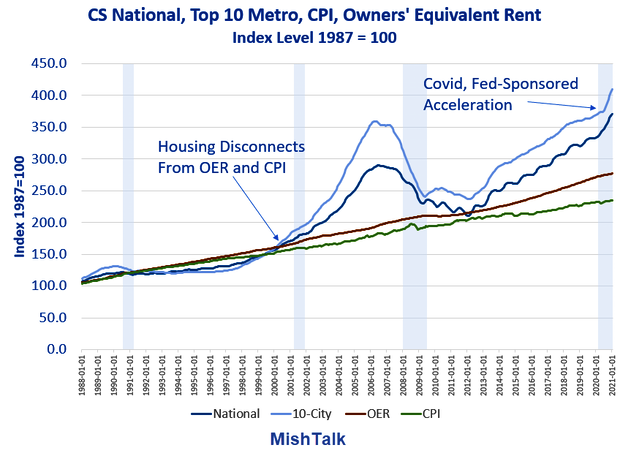
Home Prices Rise at Fastest Pace in 15 Years

Inflation is Rampant and Obvious 

Yesterday I commented Hello Fed, Inflation is Rampant and Obvious, Why Can’t You See It?

The national level average year-over-year increase in home prices is 11.2%.

Click on the above link for a series of 5 charts that explain what’s happening.

What Would I Do?

For the answer, please see Reader Question: What Would I do Differently Than the Fed?

Tyler Durden
Thu, 04/01/2021 – 19:40

via ZeroHedge News https://ift.tt/3mbiVHK Tyler Durden

Will Biden’s ‘Infrastructure’ Plan Pass Congress?

Will Biden’s ‘Infrastructure’ Plan Pass Congress?

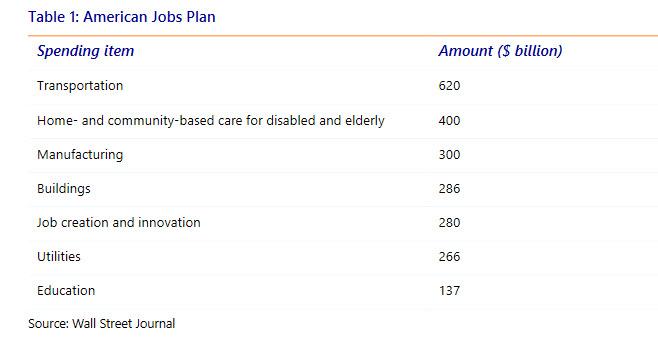
Yesterday in Pittsburgh, Joe Biden proposed the first part of his long-term plan to sustain the economic recovery. As Rabobank’s Philip Marey summarizes (full PDF note here), this first part – the American Jobs Plan – focuses on infrastructure(and care), the second – the American Family Plan –is expected to focus on health care, child care and poverty reduction. The American Jobs Plan amounts to $2.25 trillion in government spending on infrastructure and care for the disabled and the elderly, to be spent in 8 years. It should be fully paid for in the next 15 years. The American Family Plan, which is scheduled to be presented later in April, could add a sizeable amount bringing the total of the two plans to $3-4trillion. As Rabobank previously noted in its American Rescue Plan report, the spending spree of the Democrats only started with the covid relief package signed into law by President Biden on March 11.

First, a little background: what’s in the Plan?

The American Jobs Plan focuses on infrastructure, but also contains a large component aimed at care for the disabled and the elderly. The largest spending item in the American Jobs Plan is transportation ($620 billion). This includes a $174 billion investment in electric vehicles, $115 billion spending on bridges, highways and roads, $85 billion on public transit and $80 billion on passenger and freight trains. However, the plan also supports manufacturing ($300 billion), including $50 billion to support the domestic production of semiconductors and $46 billion for clean energy. The plan also provides money for buildings ($286 billion), including $213 billion for affordable housing, and utilities ($266 billion), including $111 billion for removing lead pipes and improving water system safety and $100 billion for improving the power grid infrastructure. The plan also supports job creation and innovation ($280 billion) through investment in R&D and training. The plan also supports education ($137 billion), including $100 billion for upgrading and building new public schools. In addition to infrastructure spending, the plan includes a large chunk for home-and community-based care for the disabled and the elderly ($400 billion),which should create caregiving jobs for low-skilled job seekers.

How will the Plan be funded?

To pay for the $2.25 trillion in spending the American Jobs Plan proposes to raise the corporate tax rate to 28% from 21%. In addition, there should be a 21% global minimum tax for corporates, at present it is 10.5%. The deduction for offshoring jobs will be abolished and IRS enforcement against companies will be ramped up. During his Pittsburgh speech Biden pointed out that a middle class couple pays 22% in federal income taxes, while Amazon pays 0%. The American Jobs Plan does not include tax hikes for households. In fact, during his speech Biden repeated his promise not to raise taxes for people making less than $400,000 per year. However, this still leaves room for tax hikes for higher income individuals in the next plan, the American Family Plan.

Besides finding money to pay for new government spending, the Democrats want to raise taxes to reduce inequality. Progressives point to polling data showing that people think companies and wealthy people pay too little in taxes. As Marey notes, “at least the Democrats are still thinking within the boundaries of mainstream thought about fiscal policy where public debt has to be repaid by tax payers. Hence tax hikes.” The alternative, of course, is to invoke MMT and keep spending until inflation gets out of hand. Either way, spending discipline does not seem to be part of the Democratic approach, as Rabo wryly observes.

Republican response

While there may be some common ground between Democrats and Republicans on infrastructure, for a large part they are thinking about different forms of infrastructure. While Republicans may be willing to spend federal money on highways, bridges and airports, Democrats are thinking of green infrastructure facilitating clean energy and electric vehicles. In early March after Biden had a bipartisan meeting with members of the House of Representatives on infrastructure spending, Republican Representative Sam Graves already said that Republicans won’t support another Green New Deal disguising itself as a transportation bill. In fact, a few moderate Democrats may also be opposed to it. Besides different preferences regarding the type of infrastructure to invest in, finding the funds to invest has been a challenge for decades. Keep in mind that President Trump promised a $1 trillion infrastructure bill during his 2016 campaign., but did not find support for this in Congress. And President Trump was focused on the Republican definition of infrastructure, not the greener Democratic one. What’s more, the Republicans passed the Tax Cuts and Jobs Act in 2017, through budget reconciliation, reducing the corporate tax rate from 35% to 21%. It is very unlikely that four years later they are going to support raising that rate to 28%.

Will The Biden Plan Pass Congress

With two packages and only one more budget reconciliation procedure left in 2021, one package would have to get a supermajority to be passed this year. The most obvious candidate is the infrastructure plan, as both parties may be willing to do something about the outdated infrastructure of the country. However, when Democrats and Republicans talk about infrastructure they think of very different things. Hence in order to get a supermajority it would have to be a traditional infrastructure plan. The greener it gets, the less likely it is to get Republican support. Republican senator John Thune (South Dakota) has already indicated that the Republicans would not support an infrastructure package if Democrats were lining up another package -that Republicans would oppose – to be passed at a later stage through budget reconciliation. In other words, in terms of Republican support, part 2 of the plan makes part 1 less likely or at least smaller in size.

Sure enough, on Wednesday, Mitch McConnell repeated that the infrastructure proposal is a Trojan horse with massive tax increases and more borrowed money. Then on Thursday, Politico reported that Mitch McConnell ruled out all support from Republicans for President Biden’s new infrastructure plan, all but ensuring that the proposal will have to pass with lockstep Democratic unity in the Senate.

Meanwhile, some Democrats, even progressives, are skeptical of linking complicated tax reforms to straightforward infrastructure spending, fearing it will slow down the process.

Will Democrats Be United Enough?

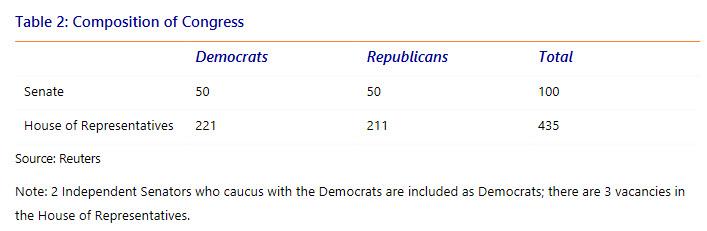
With McConnell stating that Republicans will not support the Plan, it means that either this plan will have to be slashed down considerably, or the Democrats will have to resort to budget reconciliation to get the plan through Congress. However, this means that this shortcut – which only requires a simple majority in the Senate – will already be used for fiscal year 2022.  Consequently, the Democrats will have to wait for fiscal year 2023 to use the budget reconciliation trick again, or they will have to find bipartisan support for the American Family Plan to pass the Senate. The delay, according to Rabo’s Marey, will further increase the pressure of progressive Democrats on centrist Democrats to eliminate the filibuster in order to get rid of supermajority requirements altogether.

Meanwhile, taking the route of budget reconciliation is not a guarantee for success. In the Senate, the Democrats cannot afford a single dissenter. Centrist Senators such as Joe Manchin and Kyrsten Sinema, who also featured in Rabo’s American Rescue Plan report, may be difficult to keep on board. In other words, while the American Jobs Plan has the potential to unite the Republicans in their opposition to Biden, it will also put tremendous pressure on the internal relations between the left and the right of the Democratic Party.

Tyler Durden
Thu, 04/01/2021 – 19:20

via ZeroHedge News https://ift.tt/3cGMOfT Tyler Durden

“Courts Should Not Permit Parties to Yada, Yada, Yada Their Way” to Sealing a Document

From Judge Joshua D. Wolson’s opinion yesterday in Kivett v. Neolpharma, Inc.:

Open, public courts stand as a pillar of American democracy, to which motions to seal stand in derogation. Yet all too often, parties pay little attention to a motion to seal that accompanies a complicated filing. Instead, the sealing motion includes only generalized recitations of the factors that a court must consider before placing material under seal. Given the important public interest at stake, courts should not permit parties to yada, yada, yada their way to a showing of injury. Instead, they must require the party filing under seal to provide a specific, detailed description of the way that disclosure of the information at issue would cause harm. Many parties could make such a showing. Few do.

Defendants’ motion to seal exhibits is of the yada, yada, yada variety. It asserts that Defendants’ competitors could use information in certain exhibits to their summary judgment motion to compete unfairly, but it says nothing about how they could use that information. The Court requires more before it can place material under seal. It will therefore deny Defendants’ motion….

David Kivett claims in this case that Neolpharma Inc. engaged Mr. Kivett to find business leads, including both manufacturing and sales opportunities. Mr. Kivett claims that he found such leads, but that Neolpharma and two corporate affiliates (collectively, “Neolharma”) have not paid him commissions that it owes him.

On March 26, 2021, Neolpharma filed a summary judgment motion. It also filed a motion for leave to file under seal Exhibits E, G, and H to its summary judgment motion. Exhibit E is an internal Neolpharma memorandum dated October 7, 2019, that discusses Neolpharma’s plan to decommission all projects related to a particular project. Neolpharma designated it “Highly Confidential—Attorney’s Eyes Only” in discovery. Exhibits G and H are an interim and final distribution agreement between Neolpharma and Lanett Co., Inc. Neolpharma designated the agreements “Highly Confidential—Attorney’s Eyes Only” during discovery, and each agreement includes a confidentiality provision….

The common law presumes that the public has a right of access to judicial materials. To overcome the common law presumption a movant must show that an interest in secrecy outweighs the presumption by demonstrating that the material is the kind of information that courts will protect and that disclosure will work a clearly defined and serious injury to the party seeking closure…. “Broad allegations of harm, bereft of specific examples or articulated reasoning, are insufficient.” In addition, to mind the public’s right of access, parties seeking to file material under seal should distinguish between portions of a document containing protectible information and portions of a document that do not. Where possible, they should propose redactions, rather than placing a whole document under seal.

As the Court recently noted, this “arduous standard reflects the importance of the public’s right to access public records, including those that are part of judicial proceedings.” The need for public access of judicial records is not a benefit to the parties, and the parties cannot stipulate it away. At the same time, because the parties have no independent incentive to protect the right of public access, the Court cannot rely on an adversarial system to vindicate the public’s right of access. Instead, similar to questions about subject matter jurisdiction, courts have an independent obligation to ensure that parties make the required showing before material gets filed under seal.

Defendants have not carried their heavy burden. Defendants have not shown that Exhibit E contains the type of information that courts will protect. Not every internal document contains such information. Exhibit E says only that Neolpharma discontinued its involvement with a product. Absent more, the Court has no basis to find that it is the type of information that courts protect.

As for Exhibits G and H, they do appear to contain the type of information that courts protect: confidential pricing terms. Even for these documents, though, Defendants make no effort to parse the documents to identify which information courts protect and which they do not. For example, while the term of an agreement and pricing information might be confidential, government reporting obligations, representations and warranties, and choice-of-law provisions might not be. The mere fact that the contract includes a confidentiality provision, or that lawyers designate a document “Confidential” or “Highly Confidential” in discovery does not mean that the document contains the type of information that courts will protect. To hold otherwise would be to offer parties a loophole that could gut the public’s right of access to judicial records.

Even assuming that Exhibits G and H contain information that the Court can protect, Defendants have not shown a clearly defined injury from their disclosure. In their Motion, they say that if information in the exhibits were made public, Defendants’ competitors could “unfairly compete against Defendants in the marketplace.” But they never say how any competitor could use the information or describe any harm they might suffer.

Their generalized assertion that disclosure could cause them competitive harm does not satisfy their heavy burden. They had to show more. While no single formula will satisfy this burden, the Court needs some detail about the harm that will result. For information that has commercial sensitivity, a party seeking to file it under seal must explain why the information is sensitive and what they expect competitors might do with the information if they had it. Defendants did not [do] that….

Motions to seal cannot be an afterthought that parties throw together as they wrap up a big filing. Any party seeking to file material under seal must pay careful attention and make a specific, detailed showing about the harm that would result from disclosure. Defendants did not do that, so the Court will deny their motion. An appropriate Order follows.


from Latest – Reason.com https://ift.tt/39CgY23
via IFTTT

“Courts Should Not Permit Parties to Yada, Yada, Yada Their Way” to Sealing a Document

From Judge Joshua D. Wolson’s opinion yesterday in Kivett v. Neolpharma, Inc.:

Open, public courts stand as a pillar of American democracy, to which motions to seal stand in derogation. Yet all too often, parties pay little attention to a motion to seal that accompanies a complicated filing. Instead, the sealing motion includes only generalized recitations of the factors that a court must consider before placing material under seal. Given the important public interest at stake, courts should not permit parties to yada, yada, yada their way to a showing of injury. Instead, they must require the party filing under seal to provide a specific, detailed description of the way that disclosure of the information at issue would cause harm. Many parties could make such a showing. Few do.

Defendants’ motion to seal exhibits is of the yada, yada, yada variety. It asserts that Defendants’ competitors could use information in certain exhibits to their summary judgment motion to compete unfairly, but it says nothing about how they could use that information. The Court requires more before it can place material under seal. It will therefore deny Defendants’ motion….

David Kivett claims in this case that Neolpharma Inc. engaged Mr. Kivett to find business leads, including both manufacturing and sales opportunities. Mr. Kivett claims that he found such leads, but that Neolpharma and two corporate affiliates (collectively, “Neolharma”) have not paid him commissions that it owes him.

On March 26, 2021, Neolpharma filed a summary judgment motion. It also filed a motion for leave to file under seal Exhibits E, G, and H to its summary judgment motion. Exhibit E is an internal Neolpharma memorandum dated October 7, 2019, that discusses Neolpharma’s plan to decommission all projects related to a particular project. Neolpharma designated it “Highly Confidential—Attorney’s Eyes Only” in discovery. Exhibits G and H are an interim and final distribution agreement between Neolpharma and Lanett Co., Inc. Neolpharma designated the agreements “Highly Confidential—Attorney’s Eyes Only” during discovery, and each agreement includes a confidentiality provision….

The common law presumes that the public has a right of access to judicial materials. To overcome the common law presumption a movant must show that an interest in secrecy outweighs the presumption by demonstrating that the material is the kind of information that courts will protect and that disclosure will work a clearly defined and serious injury to the party seeking closure…. “Broad allegations of harm, bereft of specific examples or articulated reasoning, are insufficient.” In addition, to mind the public’s right of access, parties seeking to file material under seal should distinguish between portions of a document containing protectible information and portions of a document that do not. Where possible, they should propose redactions, rather than placing a whole document under seal.

As the Court recently noted, this “arduous standard reflects the importance of the public’s right to access public records, including those that are part of judicial proceedings.” The need for public access of judicial records is not a benefit to the parties, and the parties cannot stipulate it away. At the same time, because the parties have no independent incentive to protect the right of public access, the Court cannot rely on an adversarial system to vindicate the public’s right of access. Instead, similar to questions about subject matter jurisdiction, courts have an independent obligation to ensure that parties make the required showing before material gets filed under seal.

Defendants have not carried their heavy burden. Defendants have not shown that Exhibit E contains the type of information that courts will protect. Not every internal document contains such information. Exhibit E says only that Neolpharma discontinued its involvement with a product. Absent more, the Court has no basis to find that it is the type of information that courts protect.

As for Exhibits G and H, they do appear to contain the type of information that courts protect: confidential pricing terms. Even for these documents, though, Defendants make no effort to parse the documents to identify which information courts protect and which they do not. For example, while the term of an agreement and pricing information might be confidential, government reporting obligations, representations and warranties, and choice-of-law provisions might not be. The mere fact that the contract includes a confidentiality provision, or that lawyers designate a document “Confidential” or “Highly Confidential” in discovery does not mean that the document contains the type of information that courts will protect. To hold otherwise would be to offer parties a loophole that could gut the public’s right of access to judicial records.

Even assuming that Exhibits G and H contain information that the Court can protect, Defendants have not shown a clearly defined injury from their disclosure. In their Motion, they say that if information in the exhibits were made public, Defendants’ competitors could “unfairly compete against Defendants in the marketplace.” But they never say how any competitor could use the information or describe any harm they might suffer.

Their generalized assertion that disclosure could cause them competitive harm does not satisfy their heavy burden. They had to show more. While no single formula will satisfy this burden, the Court needs some detail about the harm that will result. For information that has commercial sensitivity, a party seeking to file it under seal must explain why the information is sensitive and what they expect competitors might do with the information if they had it. Defendants did not [do] that….

Motions to seal cannot be an afterthought that parties throw together as they wrap up a big filing. Any party seeking to file material under seal must pay careful attention and make a specific, detailed showing about the harm that would result from disclosure. Defendants did not do that, so the Court will deny their motion. An appropriate Order follows.


from Latest – Reason.com https://ift.tt/39CgY23
via IFTTT

Rand Paul “Pages” Fauci With CDC Confirmation That Vaccinated And Recovered Cannot Pass On COVID

Rand Paul “Pages” Fauci With CDC Confirmation That Vaccinated And Recovered Cannot Pass On COVID

Authored by Steve Watson via Summit News,

Senator Rand Paul shared video Wednesday of CDC Director Rochelle Walensky announcing that new data suggests vaccinated and recovered people do not carry Covid-19.

Paul directed his comments at White House chief medical advisor Anthony Fauci, writing “paging Dr Fauci:  please end the mask theater now that cdc admits evidence that the vaccinated do not carry the virus.”

In a further post, Paul also shared a study examining T cell responses in people who have recovered from Covid-19.

“T cell immunity after natural infection shown to include variants,” Paul, who is also a physician, noted.

He again addressed Fauci, asking “Do we still need to wear multiple masks after we’ve recovered or been vaccinated?”

The Senator clashed with Fauci a fortnight ago, telling him “You’ve been vaccinated and you parade around in two masks for show. You can’t get it again.”

“There’s virtually zero percent chance you’re going to get it and you’re telling people that have had the vaccine who have immunity — You’re defying everything we know about immunity by telling people to wear masks who have been vaccinated,” Paul charged during the hearing.

Fauci has repeatedly flip flopped on the efficacy of masks, and has admitted that there is little science behind lockdown restrictions.

Nevertheless, Facui still will not drop the mask charade, even suggesting that the world needs to carry on wearing them into 2022, and that children should be wearing them in order to play together, until they are all vaccinated from the age of 6 months old.

*  *  *

Brand new merch now available! Get it at https://www.pjwshop.com/

*  *  *

In the age of mass Silicon Valley censorship It is crucial that we stay in touch. We need you to sign up for our free newsletter here.  Support our sponsor – Turbo Force – a supercharged boost of clean energy without the comedown. Also, we urgently need your financial support here.

Tyler Durden
Thu, 04/01/2021 – 19:00

via ZeroHedge News https://ift.tt/3dn0b4a Tyler Durden

Biden To Propose New Sanctions Relief Deal As Iran Again Expands Enrichment Capability

Biden To Propose New Sanctions Relief Deal As Iran Again Expands Enrichment Capability

Iran’s President Hassan Rouhani on Wednesday slammed the Biden administration’s lack of initiative in rejoining the 2015 nuclear deal, in contrast to Biden’s previously hyping such a move as he sought election (which he used to set his foreign policy vision apart from Trump’s on the campaign trail last year).

Rouhani said in his latest remarks he’s seen “no serious efforts” from the Biden White House on reviving the JCPOA. He called out the apparent hypocrisy in Biden’s denouncing Trump’s “maximum pressure” campaign while yet still keeping full sanctions in place. 

Earlier this week Politico revealed a new Biden administration proposal in the works which would partially lift sanctions in exchange for an immediate reversal of some key nuclear deal violations on the part of Tehran, especially a reversal of its 20% uranium enrichment. Further, it would require Iran shutting down use of its advanced centrifuges. 

Officials told Politico that the new US plan is expected to be pitched as early as this week; however, it appears Iran has already preemptively rejected it, reiterating its demands that all sanctions be dropped first as part US compliance to what it previously agreed to in 2015

Iranian Foreign Minister Javad Zarif said in a recent interview which underscored that the Islamic Republic can no longer trust the United States: “If the U.S. passes the test of [the 2015 deal], which doesn’t seem very likely, then we can consider other issues.” He added: “But I don’t think the U.S. would be prepared to discuss those issues. Is the U.S. ready to reduce its arms shipments to the region?”

Politico detailed of the sensitive timing of Biden’s new proposal:

“Iran is poised to blow through additional nuclear deal restrictions in the next few weeks. This is the crucial time to avoid an escalation of the situation,” said Daryl Kimball, executive director of the Arms Control Association, an organization that has closely tracked nuclear negotiations involving Iran.

One reason for a sense of urgency among some U.S. officials as well as those outside American government is that Iran holds presidential elections in June, with campaign season kicking off in May. The politics surrounding the 2015 nuclear agreement are very sensitive in Iran, so the theocratic regime there is unlikely to allow any major moves on it amid a campaign.

Meanwhile the clock is ticking, given Iran’s latest further uranium enrichment breach of JCPOA caps.

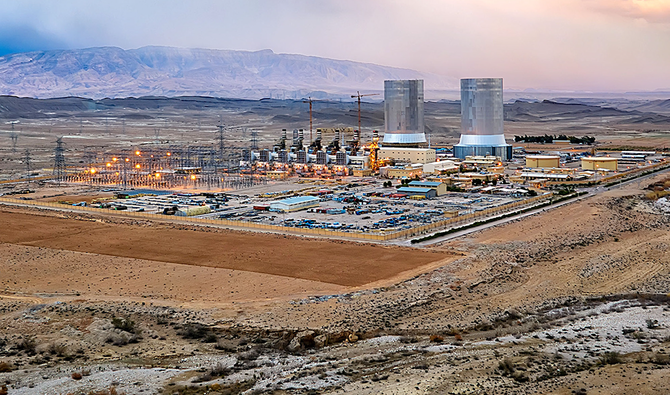
On Thursday morning Reuters is reporting that Iran has “started enriching uranium with a fourth cascade of 174 advanced IR-2M centrifuges at its underground Natanz plan.”

“On 31 March 2021, the Agency verified at FEP that: Iran had begun feeding natural UF6 into a fourth cascade of 174 IR-2m centrifuges,” the International Atomic Energy Agency said in the report dated Wednesday, referring to the underground Fuel Enrichment Plant and to uranium hexafluoride, the form in which uranium is fed into centrifuges for enrichment.

The report says the fresh information is based on new International Atomic Energy Agency (IAEA) findings obtained by Reuters.

Tyler Durden
Thu, 04/01/2021 – 18:40

via ZeroHedge News https://ift.tt/3dqnpXh Tyler Durden

Rehypothecated Leverage: How Archegos Built A $100 Billion Portfolio Out Of Thin Air… And Then Blew Up

Rehypothecated Leverage: How Archegos Built A $100 Billion Portfolio Out Of Thin Air… And Then Blew Up

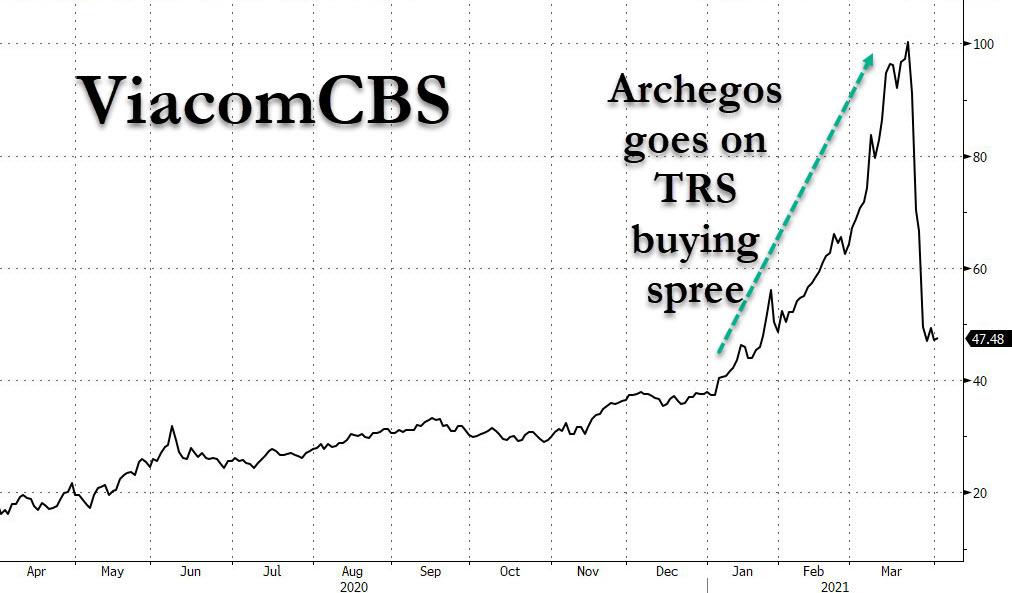
One week after the biggest, and most spectacular hedge fund collapse since LTCM, we now have an (almost) clear picture of how Bill Hwang’s Archegos family office managed to single-handedly make a boring media stock the best performing stock of 2021, then when its luck suddenly ended  it was margin called to extinction, leading to billions in losses for the banks that enabled what Bloomberg has dubbed its “leveraged blowout.”

Thanks to detailed reports by the Financial Times and Bloomberg, we now have the missing pieces to complete the picture of the biggest hedge fund implosion of the 21st century.

As a reminder, and as we previously discussed, we already knew how Archegos was building up stakes in its various holdings: unlike most other investors the fund never actually owned the underlying stock or even calls on the stock, but rather transacted by purchasing equity swaps known as Total Return Swaps (TRS) or Certificates For Difference (CFD). Similar to Credit Default Swaps, TRS exposed Archegos to the daily variation margin on the underlying stock, and as such while the fund would benefit economically from increases in the underlying stock price (and, inversely, would be hit by price drops forcing it to put up more cash as margin any day the stock price dropped) it would never be the actual owner of record of the underlying stock. Instead, the stock that Archegos was long would be “owned” by its prime broker, the same entity that allowed it to enter into TRS in the first place. As such Archegos also never had any disclosure requirements, allowing it to transact completely in the dark while being fully compliant with SEC disclosure requirements – since it didn’t own the underlying stock, Archegos did not have to disclose it. Simple and brilliant.

This part is important because the lack of a documented trail of ownership to Archegos is what enabled the entire Ponzi bezzle… and the staggering leverage the fund applied to its portfolio. Furthermore, well aware that there was almost no way to verify just how much of a given stock he owned, Hwang proceeded to have nearly identical positions with not one, not two but at least eight prime brokers (the final number is still being determined as more and more come out of the woodwork).

Not that Archegos prime brokers were completely clueless as to what was going on.

As Bloomberg reports, while much of the investing world watched in stunned silence how an “old media” company – ViacomCBS – shot up almost 300% in weeks, becoming the best performing stock in the S&P500 and prompting investors to speculate that the stock was was either undervalued, or like GameStop, or a takeover target, a handful of execs at Wall Street’s top trading firms were aware of what was behind the move: it was Archegos Capital Management, who was building a massive position in ViacomCBS and a handful of other stocks… using leverage the same banks so generously offered with stock which the banks themselves technically owned!
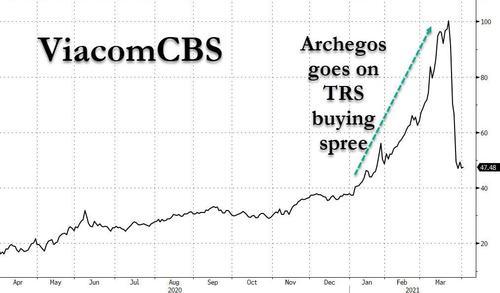
But while banks around the world – from Goldman, Morgan Stanley and Wells in the US, to Credit Susse, UBS and Deutsche Bank in Europe, to Nomura and Mitsubishi UFJ in Japan – kept giving Hwang the leverage he needed to acquire more and more of the stock, until he became the biggest economic if not registered owner of Viacom, what they did not know – thanks to the was Total Return Swaps are structured – was the full extent of his wagers. Which were massive: he stealthily amassed $10 billion of Viacom.

Viacom was just one of many: using even more TRS and even more leverage across even more Prime Brokers, Archegos was able to place colossal wagers while avoiding the disclosures required of most investors. And so “almost invisibly” Hwang accumulated a portfolio which according to Bloomberg sources was as much as $100 billion!

Eventually, Archegos built positions in at least nine stocks that were big enough to rank him among the largest holders, fueled by a level of bank leverage that would have been unusual even for a hedge fund.

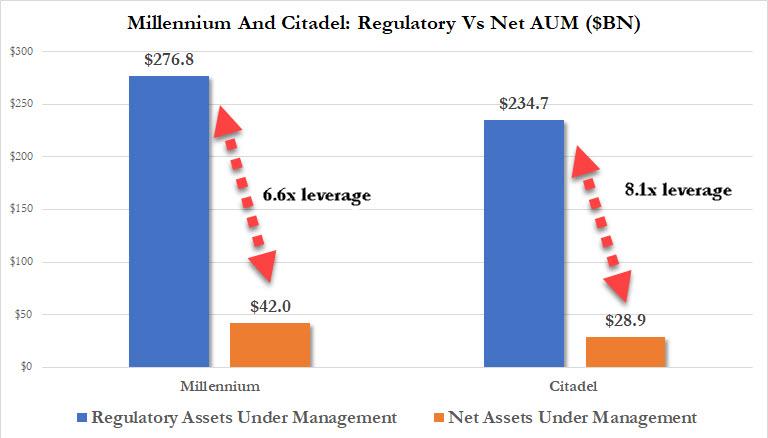
While we previously discussed the leverage aspect of Archegos strategy, here it is again: with Bill Hwuang managing approximately $10BN in assets under management, the multiple Total Return Swaps with unwitting prime brokers allowed the fund to build up a staggering $100 billion in positions, implying a huge 10x leverage. This is the kind of leverage one associated with the likes of financial titans like Citadel and Millennium, not a smallish family office which has zero downside protection (as we would eventually learn).
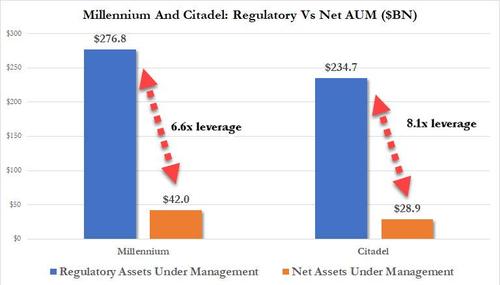
What is amazing about this unilateral Ponzi scheme is that it relied on what we have dubbed rehypothecated leverage: the fund never even owned the underlying stock which was layered with billions in generous Prime Broker debt, but it was Archegos’ Prime Brokers who not only would own the actual stock but would also allow Hwang to add tens of billions in leverage… on an asset that they owned!

What is also remarkable is that Archegos’ ponzi scheme could have continued indefinitely if only Viacom stock had i) continue to rise or ii) avoided a crash. After all, having ignited the initial upward moment, Archegos had effectively forced benchmark-tracking investors, exchange-traded funds, CTAs and other momentum investors to buy as well.

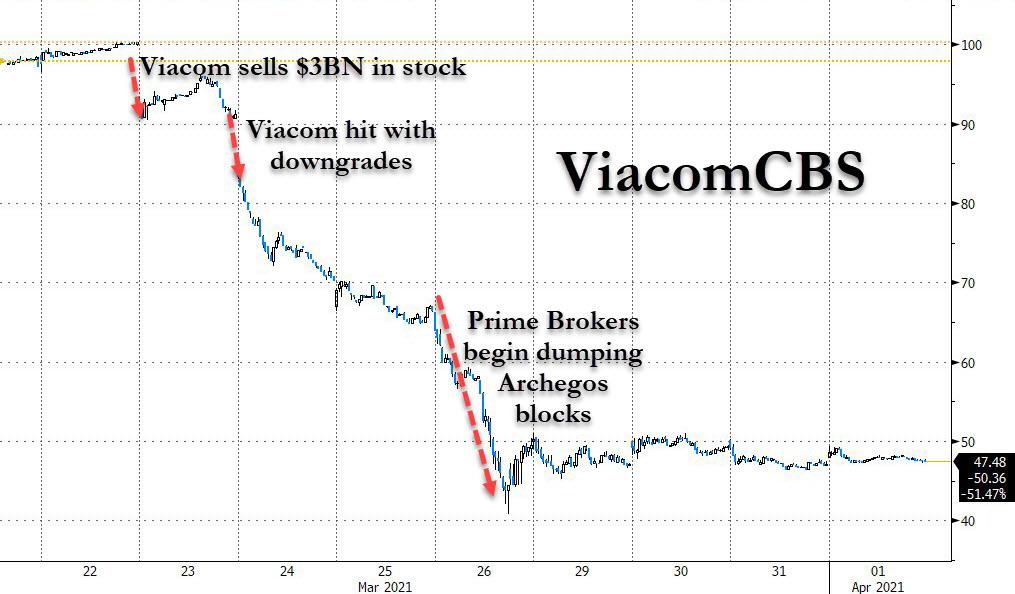
Sadly for Hwang (and his Primer Brokers) the upward momentum ended with a bang last Monday, when with its shares trading at $100, Viacom announced a $3BN stock sale, which hammered the stock, followed by a round of analyst downgrades, which sent the stock tumbling. It was at this point that Archegos was now facing tens of billions in margin calls on its VIACA Total Return Swaps from its Prime Brokers.
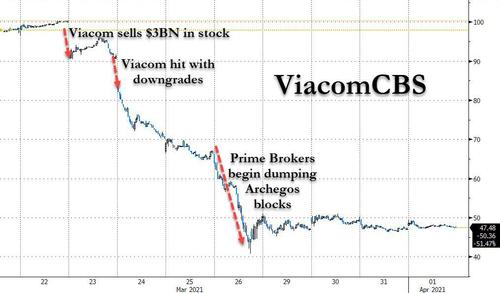
And therein lies the rub, because when the time came to unwind the Archegos Ponzi, the Prime Brokers’ counterparty was not Archegos but other Prime Brokers. This is what led to the infamous meeting late last Thursday, where a bunch of PBs tried to reach an amicable resolution ahead of Friday’s bloodbath. As Bloomberg adds, at several points during those exchanges, bankers implored Hwang to buy himself breathing room by selling some stocks and raising cash to post collateral. But “he wouldn’t budge.”

As a result, Morgan Stanley and Goldman promptly started dumping blocks of stock backing Archegos TRS in the open market. In doing so the started a margin call liquidation, in which those who sold first – like Goldman, Morgan Stanley and Deutsche – would avoid massive losses, while those who waited like Nomura and Credit Suisse… would not. Indeed, we already knew that Nomura, Japan’s largest investment bank, said its losses could hit $2Bn, while losses at Credit Suisse could be as large as $4Bn according to the FT.

At this point, many questions popped up, especially (and belatedly) inside the banks themselves: as the FT reports, executives within the prime brokerage divisions of at least two banks “are being quizzed by risk managers over why they offered a business as small as Archegos tens of billions of dollars of leverage on trades in volatile equities through swaps contracts,.”

As the FT further notes, echoing what we said above, while prime brokerage clients typically provide few details about their other trading activities, “executives from at least two of the six banks are investigating whether Hwang deliberately misled them or withheld vital information about mirror positions he had built up at rival banks, according to people involved in the probes.”

Well, no: Archegos did not mislead anyone. He simply used (and abused) a system where – as we put it – one investor can create as much rehypothecated leverage as the investors’ banks and Prime Brokers will allow him. In this case we know the number may have been as high as a mindblowing $90 billion.

Naturally, had the banks known that in a worst case scenario they would be facing other banks since such replicated, or rather rehypothecated position would magnify the risks on each of the trades making a bank less likely to extend so much credit against them  – none of this would have been possible. However, as long as everything was going up, and all of Archegos positions were pleasasntly surging nobody seemed to care… or bother to calculate just how big the downside risk was (one can thank the Fed Put for that).

One final remarkable aspect of this whole story is that this is not Hwang’s first crisis. In 2012 he submitted a guilty plea on behalf of his hedge fund to a charge of wire fraud, and he resolved related civil claims of insider trading without admitting or denying wrongdoing. Archegos is the family office he formed after winding down that firm, Tiger Asia Management.

However, as if nothing had ever happened, prime brokerages immediately began lining up to help the new business. Morgan Stanley was among his early backers. Deutsche Bank signed him as a client at the urging of at least one senior executive, according to Bloomberg, “who was unperturbed by the insider-trading taint and didn’t believe Hwang had done anything wrong, according to a person familiar with that decision.” Ironically, just a few years later, Hwang did something wrong and it would prove to be the biggest hedge fund collapse in post-LTCM history.

Not every bank acted like an idiot: one firm resisted the lure. Archegos approached JPMorgan sometime between 2016 and 2018 and was rebuffed, according to the Bloomberg report. At the time, JPMorgan was still revamping the equity prime-brokerage unit it had acquired with Bear Stearns during the 2008 financial crisis. “Dumb luck or not, the bank dodged a bullet.”

* * *

The rest of the story is mostly known, so now what.

Well, as we first hinted and as Bloomberg reports, already regulators are dropping hints of new rules to come, with SEC officials signaling to banks that they intend to make trading disclosures from hedge funds a higher priority, while also finding ways to address risk and leverage.

Senior finance executives acknowledge that a crackdown of some form, whether on borrowing or transparency or both, is inevitable.

Amusingly, and picking up on the FT’s reporting, Bloomberg also notes that while some of those firms have disclosed the financial impact of their roles in the Archegos collapse, none is willing to comment on how or why they enabled Hwang to become such a force in the market. After all what can they say: “the other guys vetted him, so we assumed he was clean”…

There are also questions whether Hwang’s counterparties knew about his relationships with other banks and the scale of the leverage he was using for what appear to be concentrated positions in a handful of companies. And – more ominously – if they did not know anything about his exposure, why the hell not?  As we reported on Tuesday, JPMorgan (which successfully managed to avoid this scandal completely) estimated that the Prime Brokers facing Archegos may end up absorbing as much as $10 billion in combined losses.

Already credit rating agencies have downgraded outlooks for Credit Suisse and Nomura, citing concerns over “the quality of risk management” while activist investors are demanding better governance and would not mind if senior execs were summarily fired over this episode to restore confidence.

“Risk controls still are not where they should be,” David Herro, one of Credit Suisse’s biggest shareholders, said Wednesday in a Bloomberg TV interview. “Hopefully, this is a wake-up call to expedite the cultural change that is needed in this company.”

But going back to Bloomberg’s original point, for all their silence the prime-brokerage units of Nomura, Goldman Sachs, Morgan Stanley, Credit Suisse and others, had clues about what Archegos was doing. These firms knew about the trades they had financed, of course, and also had some visibility into his total borrowings. And yet they didn’t bother to ask about what, if any, risk management was being implemented to avoid an uncontrolled unwind. Or rather, the questions emerged only after the margin call.

What the Prime Brokers also didn’t know is that Hwang was taking parallel positions at multiple firms, piling more leverage onto the same few stocks, which brings us back to our rehypothecated leverage concept which we are confident we will use much more in the coming months, especially since “unwinding a series of large, leveraged bets placed by a single account is one thing; doing so when rival banks are liquidating the same positions held by the same client is quite another.”

Archegos’ own “Lehman moment” came late on March 25 when Hwang’s prime brokers met again and discussed the possibility of standing down temporarily to let tensions ease, as we reported previously, but any attempt at solidarity proved short-lived: shortly after some PBs sent Archegos notices of default, clearing the way for Goldman and Morgan Stanley to dump Hwang’s positions.

“Hopefully this will cause the prime brokerages of regulated banking organizations (and their supervisors) to re-assess their relationships with highly leveraged hedge funds,” former FDIC chair Sheila Bair tweeted.

She is, of course, wrong.

In fact, if anything we expect Prime Brokers will make leverage even easier to obtain for non-bank, hedge fund and family office clients, because the one big mistake Archegos (and its Prime Brokers) made was that it was not big and systemic enough to merit a Fed bailout. Now, if Archegos had a portfolio of $200 billion, $300 billion or more, while using Citadel’s 50x leverage, now we’re talking “size”…  size enough for the Fed to step in and make everyone whole on the back of taxpayers… the same way the Fed bailed out Citadel, Millennium and Point72 in September 2019 during the repo crisis (as both Zero Hedge and subsequently Bloomberg, explained).

There is another reason nothing will change: hedge funds, Prime Brokers, banks – in fact the Fed itself – are all incentivized to not look at what skeletons may be found in the closet. Why? Because if the banks are forced to admit that there are more Archegos funds – and there are countless – Prime Brokers will have no choice but to sequester collateral from more clients, sparking more margin calls, leading to more stock liquidations, and resulting in even bigger investor panic. Call it a side effect of building castles on crooked foundations in an artificial, fake, Fed-supported market.

Is another market panic what the Fed wants? Or what the Biden admin wants? Of course not.

Which is why we will get a token Congressional hearing where politicians care more to hear themselves talk than listen to the answers, the banks will slap a few hands, one or two small sacrificial hedge funds will be shut down, and the world will move on, especially once Archegos is no longer on the front page of the financial media.

It’s also why when the next major hedge fund implosion does happen, it will be far more catastrophic.

Tyler Durden
Thu, 04/01/2021 – 18:13

via ZeroHedge News https://ift.tt/3uiAusb Tyler Durden

​​​​​​​April Temperature Anomalies Spike In Central US As Farmers Prepare For Early Spring Planting 

​​​​​​​April Temperature Anomalies Spike In Central US As Farmers Prepare For Early Spring Planting 

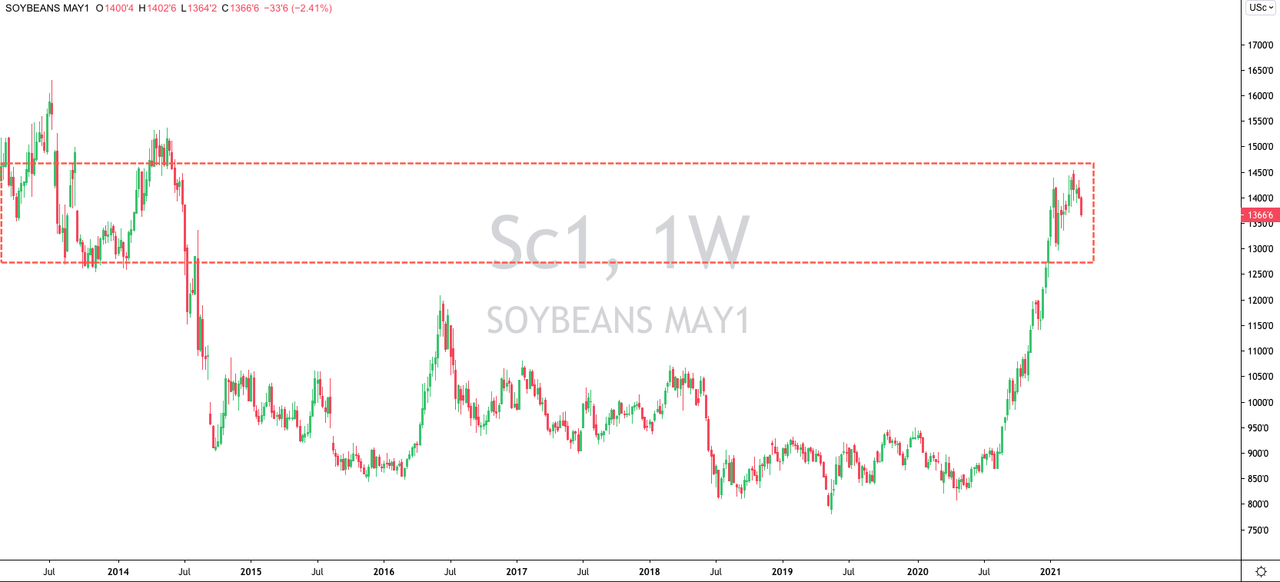
Weather models are forecasting warmer than average temperatures for much of the Central US. This is excellent news for farmers who may have an early start to the planting season as soft commodity prices have seen a parabolic rise due to demand increases from China. 

BAMWX meteorologist Kirk Hinz wrote in his latest weather note that “one of the more robust warm ensemble model solutions” is being seen across the Central US. He said the weather model shows the 5-10 day period in some regions across Central US could experience “+15-20F” above-average temperatures for April. 

Hinz’s temperature anomaly shows the most above-average region in April spans from parts of the Rockies into the Northern and Central Plains and northern Great Lakes.

This is terrific news for farmers who have kept a close eye on skyrocketing soft commodity prices. An early spring may suggest more planting acres which would help alleviate supply constraints after China boosted demand for American farm goods. 

In mid-March, David Iverson, the national secretary of the United Soybean Board, told Agweek that soaring soybean prices had boosted interest in the bean to its highest levels in recent memory. 

“We’ve had down prices for a number of years and all of a sudden we get a big rally. So there’s more interest in soybeans now,” said Iverson said. 

Soybean prices are now at the highest price since late 2014.

Perhaps an early start to the planting season, combined with soaring Chinese demand for US farm goods, maybe a boon for farm income after years of depression. 

Tyler Durden
Thu, 04/01/2021 – 18:00

via ZeroHedge News https://ift.tt/3fxtXGb Tyler Durden

Daily Briefing: Twilight of the 60/40 Portfolio: Boomers, Bonds, and Bitcoin

Daily Briefing: Twilight of the 60/40 Portfolio: Boomers, Bonds, and Bitcoin

Tyler Neville, senior editor at Blockworks, and Real Vision’s Jack Farley briefly look at the S&P 500’s breach beyond 4000 as bond yields retreat and the dollar marches higher. Tyler also interprets recent currency volatility, examining the U.S. dollar’s recent strength against the Euro, Japanese Yen, and Chinese Yuan. Tyler and Jack then turn to the bond market, analyzing how rising yields have taken down an otherwise triumphant credit market. Tyler notes that the 60/40 is severely weakened by ultra-low yields and argues that Bitcoin could be a serious replacement to bonds. Jack and Tyler discuss other assets within crypto such as non-fungible tokens and assets within decentralized finance (DeFi) before taking another look at the Archegos liquidation.

Tyler Durden
Thu, 04/01/2021 – 15:00

via ZeroHedge News https://ift.tt/39xVjIc Tyler Durden