Our 20-Year War In Afghanistan Comes To An Ignominious End

Our 20-Year War In Afghanistan Comes To An Ignominious End

Authored by Buck Sexton via American Consequences,

They didn’t even wait until their August 31 deadline was up…

And the Biden team still left Americans behind.

The U.S. military is no longer in Afghanistan, and we are left to wonder: How did our final hours in America’s longest war turn into such a debacle?

Despite the frenzied nature of the exit, the Biden White House is surely just relieved that a weeks-long news cycle focused on their extreme incompetence is over.

It was impossible to put a proper public-relations spin on the unbelievably fast collapse of the Afghan National Security Forces after Biden said they were 300,000-plus strong and as well-equipped as any army in the world (also not true).

The American people saw one of the biggest intelligence and policy failures in living memory unfold in real time… And the mythology of Biden as the steady hand who could steer America through tough times evaporated with it.

In July, Biden’s team thought they would have many more months to plan for the U.S. to exit Afghanistan – in reality, it was just days.

Without any way to explain the stunningly inept withdrawal plan, Biden’s Secretary of State, Antony Blinken, gave a speech on Monday, August 30 at the State Department, officially declaring that the U.S. evacuation of Kabul had finished ahead of schedule:

Now U.S. military flights have ended. And our troops have departed Afghanistan. A new chapter of America’s engagement with Afghanistan has begun. It’s one in which we will lead with our diplomacy. The military mission is over.

Americans Abandoned 

But there’s one glaring problem… While the withdrawal mission was accomplished, there are still Americans stuck in Afghanistan, left to the mercy of the Taliban. Secretary Blinken insists the number is low, and not to worry – there will be continued efforts to get them out of the country:

We believe there are still a small number of Americans, under 200 and likely closer to 100, who remain in Afghanistan and want to leave. We’re trying to determine exactly how many. We’re going through manifests and calling and texting through our lists, and we will have more details to share as soon as possible.

What is said much more quietly in policy circles is that the evacuation of these remaining Americans will be up to the Taliban’s consent. It has not yet turned into a full-blown hostage crisis, but it very well could.

The Taliban’s new leadership could easily decide to leverage the remaining Americans for concessions on our side. To deepen America’s humiliation at leaving behind our own on a foreign battlefield, the Taliban could even demand an exorbitant “exfiltration” fee for any American whom it allows to escape.

GOP lawmakers have since blasted Biden and his administration for withdrawing troops despite not having all Americans evacuated… Sen. Ben Sasse called the evacuation a “national disgrace” and a “direct result of President Biden’s cowardice and incompetence.”

Sen. Bill Hagerty also said that Biden “will forever be remembered for leaving American citizens and U.S. legal permanent residents behind and in harm’s way in Afghanistan.”

Joe Biden: Jimmy Carter, But Worse

The optics here would certainly strengthen the comparisons already being made between Biden and Jimmy Carter – though they are becoming increasingly unfair to Jimmy Carter, who for all his shortcomings was smarter and more capable than Biden has ever shown himself to be.

Another major challenge for the Biden team is going to be the ramifications of arming and equipping what is now the largest terrorist army in the world.

The Taliban has seized billions of dollars of military equipment, including Black Hawk helicopters, armored Humvees, attack planes, and even some C-130 cargo aircraft. They have enough small arms to equip a military several times larger than their current standing force.

To say it’s an embarrassment for the U.S. taxpayer to have armed up our terrorist foes is a gross understatement…

Will the Taliban end up playing host again to major international Jihadist entities like Al Qaeda? That’s the critical question right now for which no one can offer a clear answer.

That the Taliban recently hanged someone from a Black Hawk helicopter in broad daylight flying over Kabul is a pretty strong indicator that they are not some kinder, gentler terrorist group. There are also plenty of early reports of gruesome reprisal killings against any Afghan who worked with the U.S. military.

Whether the Biden administration pays a political price for the debacle of the drawdown remains to be seen…

Former U.S. Senator Jim Webb just wrote in The National Interest magazine:

Perhaps we should look at the calamitous blunderings in Afghanistan as an opportunity to demand a true turning point. Americans know that a great deal of our governmental process is now either institutionally corrupt or calcified… The military itself is increasingly being used by leftist activists as a social laboratory to advance extreme political agendas.

Recent polling puts the president’s approval rating in the low 40s, but the midterms are still more than a year away… That’s plenty of time to change, lie, misdirect, and alter public perception of Joe’s Afghan calamity.

And the perfidious media will go into overdrive to help him…

Give it a week or two, and the Democrat corporate journalists will be talking about Biden’s “genius” in ending the war and the amazing improvisation his team showed under pressure – and they will look at anyone who questions this Soviet-style rewriting of recent history like they’re the crazy one.

* * * 

Read our latest issues of American Consequences.

Love us? Hate us? Let us know at feedback@americanconsequences.com.

* * * 

… and a reminder to the completely botched withdraw of Afghanistan by the Biden administration, encrypted text messages between an Army colonel and a former Special Forces soldier working on a private effort to extricate stranded Americans from Afghanistan reveal that the US evacuation was anything but the ‘extraordinary success’ President Biden declared on Tuesday.

“We are fucking abandoning American citizens,” said an Army colonel assigned to the 82nd Airborne Division in an encrypted Sunday text message to Michael Yon, who revealed the message to Just the News.

Yon told Just the News that a group of Americans were abandoned at the Kabul airport, pleading for help as military officials told them they were finished with evacuations.

“We had them out there waving their passport screaming, ‘I’m American,'” Yon said Tuesday while appearing on the John Solomon Reports podcast. -Just The News

“People were turned away from the gate by our own Army,” said Yon, the former Special Forces soldier and war correspondent.

Text messages between Michael Yon and an Army Colonel. “AMCITS” is shorthand for American Citizens.

Tyler Durden
Thu, 09/02/2021 – 22:00

via ZeroHedge News https://ift.tt/3zT2NAE Tyler Durden

China Warns US “Wrongdoings” Will Imperil Climate Cooperation

China Warns US “Wrongdoings” Will Imperil Climate Cooperation

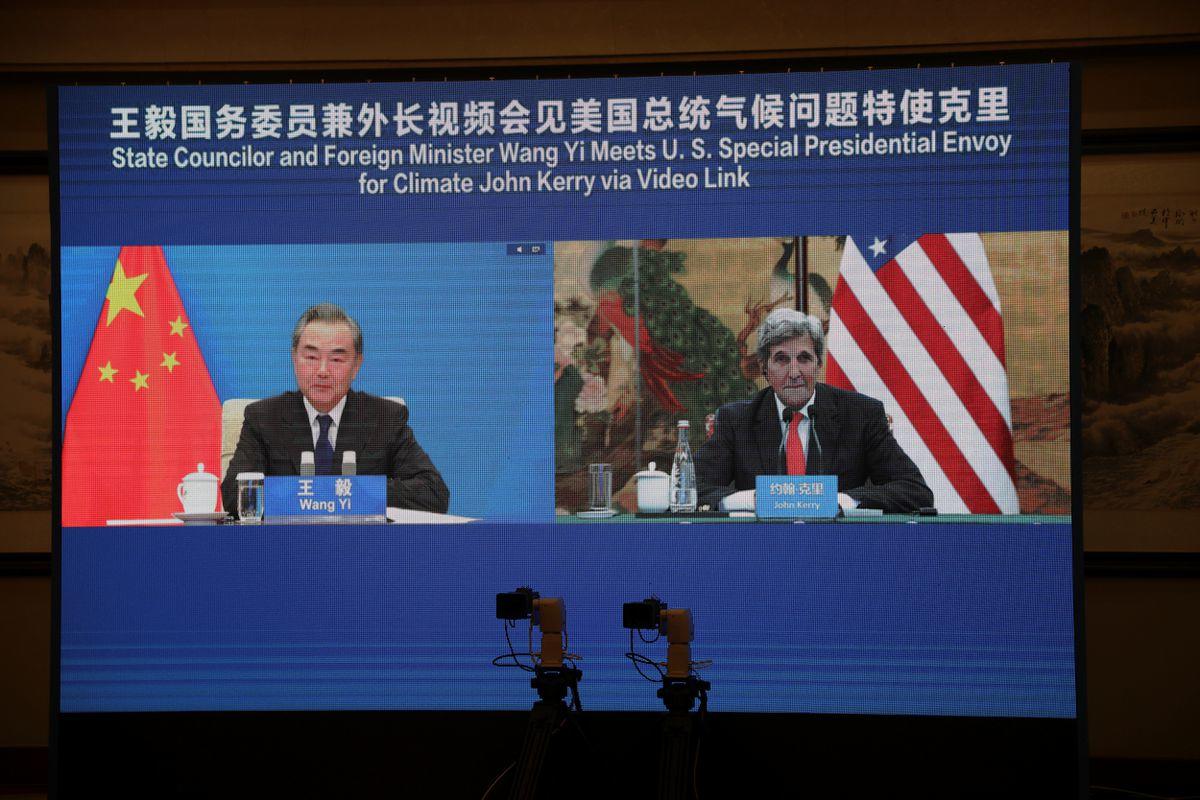
Despite the US long wanting ‘climate diplomacy’ to remain a separate issue apart from its wider disputes with China, such as on trade and human rights, Chinese Foreign Minister Wang Yi is now warning deteriorating ties threaten joint efforts to tackle global warming and climate change.

Wang informed Biden’s US climate envoy John Kerry during the latter’s visit to the Chinese city of Tianjin on Thursday that “climate cooperation cannot be separated from the wider environment” of US-China relations.

Via AFP/Getty

The Chinese top diplomat likened the potential for close US-China cooperation on climate to an “oasis” and explained, “But surrounding the oasis is a desert, and the oasis could be desertified very soon.”

That’s when he concluded while speaking by video-link: “China-U.S. climate co-operation cannot be separated from the wider environment of China-U.S. relations.”

“Everyone who met with you will have to spend two weeks in quarantine, but we’re willing to pay that price, to discuss co-operation with the U.S. on affairs of mutual concerns,” he was quoted further as saying.

It’s widely perceived that if one side or the other links climate with the broader tensions besetting US-China relations, it would greatly slow any substantive climate action.

Via Reuters

According to Reuters:

Though Wang warned that climate change could now be tied to other diplomatic issues, China has said its efforts to cut emissions and adopt cleaner forms of energy are vital to its ambitious domestic agenda.

“Chinese leaders have long said they are engaged in climate action not because of outside pressure, but because it benefits China and the world at large,” said Alex Wang, a climate expert and professor at UCLA.

And additionally Yang Jiechi, a member of the Political Bureau of the Communist Party of China (CPC) Central Committee and director of the Office of the Foreign Affairs Commission called on the US to “correct its wrongdoings” and make efforts to “bring bilateral ties back on the right track.”

On the US side, Kerry urged China to do more while also vowing willingness to improve communication with China.

“Secretary Kerry affirmed that the United States remains committed to co-operating with the world to tackle the climate crisis, which must be addressed with the seriousness and urgency that it demands, and encouraged the PRC to take additional steps to reduce emissions,” a State Department spokesperson said in a statement.

Tyler Durden
Thu, 09/02/2021 – 21:40

via ZeroHedge News https://ift.tt/2YoW7N1 Tyler Durden

Federal Use Of Facial Recognition Technology Expanding: GAO Report

Federal Use Of Facial Recognition Technology Expanding: GAO Report

Authored by Ken Silva via The Epoch Times (emphasis ours),

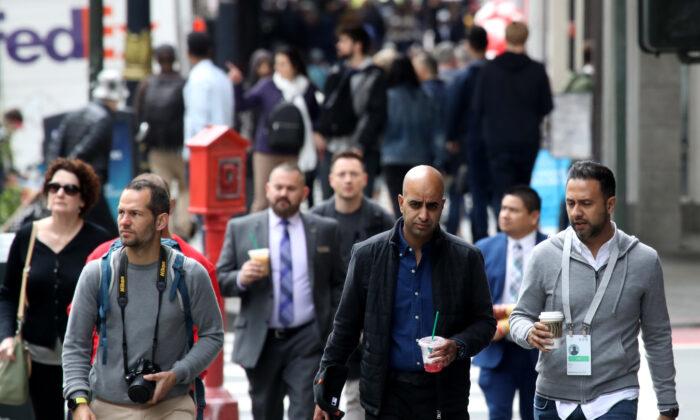
Pedestrians walk along Powell Street in San Francisco on May 14, 2019. (Justin Sullivan/Getty Images)

A recent Government Accountability Office (GAO) survey shows that at least 10 federal agencies have plans to expand their use of facial recognition technology over the next two years—a prospect that alarms privacy advocates who worry about a lack of oversight.

The GAO released the results of a survey of 24 federal agencies, finding that 18 of them use facial recognition technology. Fourteen of those agencies use the tech for routine activity, such as unlocking agency-issued smartphones, while six reported using facial recognition software for criminal investigations and five others use the technology for surveillance, the Aug. 24 report found.

“For example, [U.S. Department of Health and Human Services] reported that it used an FRT system (AnyVision) to monitor its facilities by searching live camera feeds in real-time for individuals on watchlists or suspected of criminal activity, which reduces the need for security guards to memorize these individuals’ faces,” the GAO said. “This system automatically alerts personnel when an individual on a watchlist is present.”

According to the GAO, at least 10 government agencies plan to expand their use of facial recognition technology through 2023. To do so, many agencies are turning to the private sector.

For example, “[the] U.S. Air Force Office of Special Investigations reported it began an operational pilot using Clearview AI in June 2020, which supports the agency’s counterterrorism, counterintelligence, and criminal investigations,” the GAO said.

“The agency reported it already collects facial images with mobile devices to search national databases and plans to enhance searches by accessing Clearview AI’s large repository of facial images from open sources to search for matches.”

The GAO’s Aug. 24 report follows June research that focused specifically on law enforcement’s use of facial recognition technology. The GAO’s June report revealed the vast troves of data held by federal law enforcement, including 836 million images held by the Department of Homeland Security alone.

The June report also revealed the lack of oversight regarding facial recognition technology. According to the report, 13 of the 20 federal law enforcement agencies that use the technology didn’t know what systems they use.

“For example, when we requested information from one of the agencies about its use of non-federal systems, agency officials told us they had to poll field division personnel because the information was not maintained by the agency,” the report said.

“These agency officials also told us that the field division personnel had to work from their memory about their past use of non-federal systems and that they could not ensure we were provided comprehensive information about the agency’s use of non-federal systems.”

The lack of oversight of the government’s use of surveillance technology is an issue that has drawn the attention of lawmakers from both sides of the aisle. Democrats have largely focused on the racial disparities in the accuracy of facial recognition, while some Republicans have expressed concerns about domestic surveillance.

Michigan resident Robert Williams, a Black man who was wrongly arrested in January after Detroit police incorrectly identified him as a felon based on shoddy facial recognition technology, testified about such problems at a U.S. House Judiciary Committee hearing.

Why is law enforcement even allowed to use such technology when it obviously doesn’t work?” Williams said to lawmakers July 13. “I get angry when I hear companies, politicians, and police talk about how this technology isn’t dangerous or flawed or say that they only use it as an investigative tool.

“If any of that was true, I wouldn’t have been arrested.”

Williams said he supports the Facial Recognition and Biometric Technology Moratorium Act, which would halt the use of facial recognition technology by federal agencies until that use was authorized by Congress. However, little action has been taken on the measure—though Sen. Ed Markey (D-Mass.) reintroduced the legislation in June.

With inaction on the federal level, states and localities have taken to curbing the use of facial recognition technology.

The state of Washington enacted a law in March 2020 that requires government agencies to obtain a warrant to run facial recognition scans. Local jurisdictions such as Oakland, San Francisco, and King County, Washington, have also banned government use of the technology.

Groups such as the American Civil Liberties Union (ACLU) support such efforts, arguing that the expansion of facial recognition technology must be halted until lawmakers can enact safeguards.

Others have cautioned against banning useful technology in the zeal to protect privacy.

“Critics miss the fact that the benefits of law enforcement use of facial recognition are well-proven—they are used today to help solve crimes, identify victims, and find witnesses—and most of the concerns about the technology remain hypothetical,” the Information Technology & Innovation Foundation, a largely pro-tech industry think tank, stated.

“In fact, critics of the technology almost always make a ‘slippery slope’ argument about the potential threat of expanding police surveillance, rather than pointing to specific instances of harm. Banning the technology now would do more harm than good.”

Ken Silva covers national security issues for The Epoch Times. His reporting background also includes cybersecurity, crime and offshore finance – including three years as a reporter in the British Virgin Islands and two years in the Cayman Islands. Contact him at ken.silva@epochtimes.us

Tyler Durden
Thu, 09/02/2021 – 21:20

via ZeroHedge News https://ift.tt/38Ivp3D Tyler Durden

August Payrolls Preview: It Will Be A Miss, The Question Is How Big

August Payrolls Preview: It Will Be A Miss, The Question Is How Big

Summary: The consensus looks for the pace of hiring to cool in August, especially after Wednesday’s disastrous ADP report, although the short-term trend rates are still likely to improve; if the consensus is correct, it may offer further accumulated evidence that the labor market is making progress towards the Fed’s ‘substantial’ threshold where it will feel comfortable in scaling back its asset purchases, according to Newsquawk..

Key expectations:

  • Headline non-farm payrolls are expected to print 725k (prev. 943k).
  • The unemployment rate is expected to decline by 0.2% to 5.2%, although this figure may not give a true reflection of the labor market;
  • Analysts will be focused on the participation rate (which rose to 61.7% in July from 61.6% in June vs 63.2% pre-pandemic), the U6 measure of underemployment (which fell to 9.2% in July from 9.8% in June vs 7.0% pre-pandemic), and the employment-population ratio (which rose to 58.4% in July from 58.0% in June vs 61.1% pre-pandemic).
  • Average hourly earnings are expected to rise 0.3% M/M, down from 0.4% in July, and 4.0% Y/Y.

Labor market gauges have been mixed in August: while ADP’s private payrolls disappointed expectations (again), the weekly initial jobless claims and continuing claims fell to a new post-pandemic low. Other metrics, however, offer a gloomier assessment: the ISM and Markit manufacturing surveys allude to a cooling in labor market conditions, with the Delta variant being cited as a reason for the softer pace of hiring. Given that the jobs data will be framed within the context of the Fed’s policy reaction, many analysts have been suggesting a ‘good data is bad for the prospects of further accommodation’ playbook, and vice versa; however, this strategy was not seen in wake of the disappointing ADP data this week. Many argue that the market has already moved on from the timing of the taper announcement – assumed to be in Q4 before implementation late this year or early next – and focus is on the pace of the reductions and the duration of the taper, and the August jobs data is not likely to inform the latter two meaningfully.

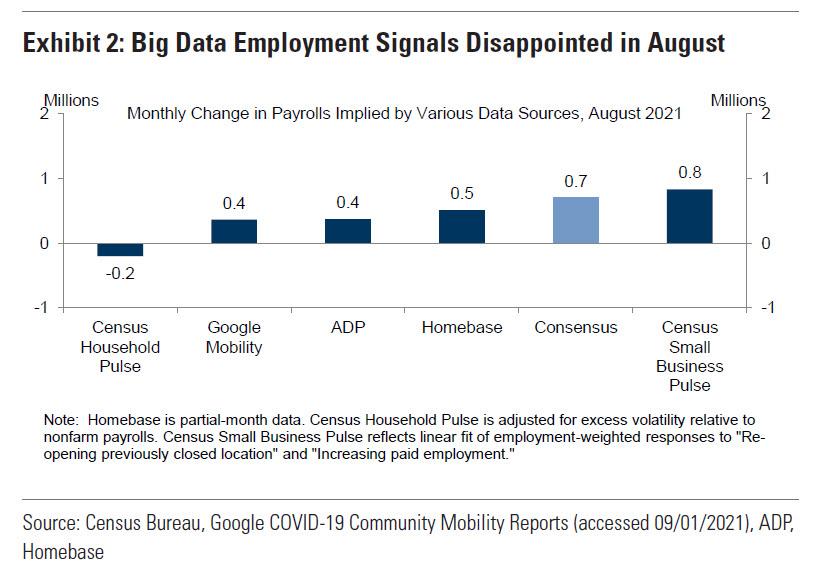
While Consensus remains surprisingly bullish, Goldman’s forecast was recently slashed to just 500K, about a third lower than consensus of 725K. As the bank explains, “while the seasonal hurdle is relatively low in August, the monthly pace and cross-section of Big Data employment indicators are consistent with a sizeable drag from the Delta variant.” Specifically, the bank notes that high-frequency data on the labor market were disappointing between the July and August survey weeks with all of the indicators we track consistent with a slowdown from the 943k July pace. Only one of the five measures Goldman tracks indicated an underlying job gain in excess of consensus (Census Small Business Pulse, +0.8mn). On the positive side, Goldman expects the reopening of schools to boost job growth by around 150k in tomorrow’s report.

POLICY FOCUS: Many Fed officials want to see further accumulated evidence that the labor market is progressing towards its ‘substantial further progress’ threshold for tapering asset purchases before they commit to a timeline for scaling back these purchases, as well as the modalities of how the taper will look. The August jobs data will be eyed within this context, with analysts suggesting that a weak reading will allow the Fed more time to shape its views, while a stronger-than-expected report will add urgency to a process that some Fed officials want wrapped-up by mid-2022. The Fed has been framing the post-pandemic upside in inflation as transitory, although not everyone is convinced.

SLACK: Headline non-farm payrolls are expected to print 728k (prev. 943k) in August; private payrolls are seen at 665k (prev. 703k), and government payrolls are seen at 25k (prev. 27k). The unemployment rate is expected to decline to 5.2% from 5.4%; many officials do not think that the headline unemployment rate is truly indicative of the health of the labour market, and in recent months, have been monitoring measures like the participation rate (which rose to 61.7% in July from 61.6% in June vs 63.2% pre-pandemic), the U6 measure of underemployment (which fell to 9.2% in July from 9.8% in June vs 7.0% pre-pandemic), and the employment-population ratio (which rose to 58.4% in July from 58.0% in June vs 61.1% pre-pandemic) which all offer better insight into the progress being made in eroding the slack seen since the pandemic.

TREND RATES: There are still 5.7mln fewer Americans in employment compared to pre-pandemic levels in February 2020. The Fed does not specifically quantify what ‘substantial further progress’ means; market participants have argued that, at minimum, it should mean a continuation of current trends, if not an improving trend rate. The short-term trends improved in the July data; the 3-month trend rate stood at 832k in July (vs 607k trend in the 3-months through June); the 6-month trend rate stood at 681k in July (vs the 563k in the 3-months through June); but the 12-month trend rate was 605k in July (vs 670k in the 12-months through June). If the August consensus expectation of 728k was realised, the 3- month and 6-month trend rates would improve again, possibly giving Fed officials evidence of accumulated progress towards the ‘substantial further progress’ threshold.

WAGES: Average hourly earnings are seen rising +0.3% M/M (prev. +0.4% M/M), though the annualized measure is seen unchanged at 4.0% Y/Y; the average workweek is expected to be unchanged at 34.8hrs. Analysts will be carefully monitoring the average hourly earnings measures; the argument is that higher prices may stoke consumer inflation expectations, as seen in recent consumer confidence reports, and will result in higher compensation as workers demand more cash amid rising prices; analysts say that this would add to evidence that inflation is more persistent than the Fed is currently admitting to.

ADP: The private payrolls survey by ADP disappointed expectations, showing just 374k jobs were added to the US economy in August; analysts were expecting 613k, following the (also) disappointing 326k it reported in July. ADP attributed the weak August report to the Delta variant; Moody’s Analytics said “the Delta variant appears to have dented the job market recovery,” but “job growth remains strong, but well-off the pace of recent months, and job growth remains inextricably tied to the path of the pandemic.” Fed officials have recently been more sanguine on the impact of Delta, although some officials have argued that the Fed is still capable of tweaking policy if the pandemic once again became more persistent. NOTE: The ADP data uses previous official BLS data within its methodology; that July BLS data was strong relative to expectations, so does allude to a more tepid pace of hiring in August, although desks continue to note the tenuous relationship that the ADP data has in signalling the official BLS data; last month, for instance, the ADP flagged a weaker jobs report, although the official data surprised to the upside.

INITIAL JOBLESS CLAIMS: Weekly claims data that coincides with the traditional BLS survey window showed claims falling to a post-pandemic low at 349k; the four-week moving average also declined relative to the July survey window, both boding well for the official jobs report. The continuing claims data which coincides with the traditional BLS survey window also fell to a post-pandemic low at 2.862mln (vs 3.296mln heading into the July jobs data). Pantheon Macroeconomics said that the claims numbers are now finally free of the distortions caused by the automakers’ retooling shutdowns and the trend is still falling, which suggests that the surge in COVID cases had not yet triggered an increase in layoffs. “These data, however, tell us nothing about the pace of gross hiring, and it’s entirely possible that firms’  first reaction to the Delta wave has been to slow the pace of recruitment, before taking the more difficult decision to let go existing staff,” Pantheon said, “still, these data are encouraging.” Other desks also point out that the claims data only gives insight into workers being laid off (and is essentially corroborated by Challenger’s lay-offs data, which fell to the lowest since June 1997), whereas some argue that the labour market weakness seen of late is likely a function of slowing hiring amid the spread of the Delta variant, which is more reflected in surveys.

BUSINESS SURVEYS: The business survey data only offers a partial glimpse of the labour market this month, given that the Services ISM and Markit’s Final Services PMI for August are both set for release after the jobs report (NOTE: the flash services data from Markit showed employment falling by 2.5 points to 50.8). The ISM manufacturing report saw its employment sub-index tumble by almost 4 points into contractionary territory at 49.0, with the survey noting that new surges of COVID-19 were adding to pandemic-related issues, like worker absenteeism, short-term shutdowns due to parts shortages, as well as difficulties in filling open positions and overseas supply chain problems. That said, the report also said that companies were still struggling to meet labour-management plans, but despite a contracting index, there were positive signs compared to recent months, partly mitigating the gloom implied by the index itself. Meanwhile, Markit’s manufacturing PMI alluded to employment growth easing as firms struggled to retain staff and find suitable candidates for current vacancies.

ARGUING FOR A WEAKER-THAN-EXPECTED REPORT:

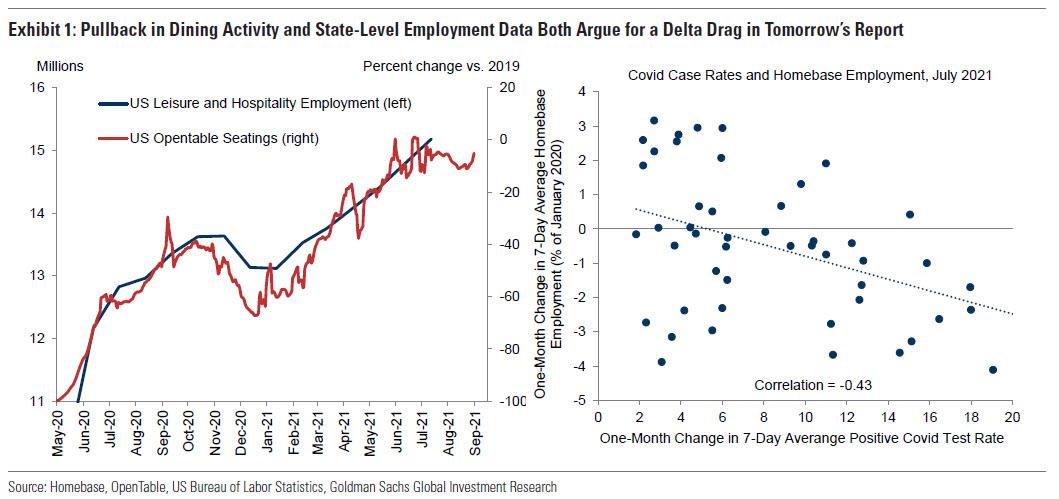
  • Delta variant. Unlike in the first month of the covid resurgence, the Delta variant now appears to be affecting services consumption and the labor market. The revival of the CDC’s mask recommendation on July 27 occurred after the July payroll survey week had ended, which would be consistent with a drag in tomorrow’s report despite the strong gains in the previous one. As shown in the left panel of Exhibit 1, restaurant seatings on Open Table pulled back at the turn of the month, falling to 89% of their 2019 levels during the August survey week, compared to 95% in the July survey week. This would argue for a pause or pullback in US leisure and hospitality employment in tomorrow’s report. Additionally, as shown in the right panel, rising infection rates were associated with weaker employment growth in the state cross-section of the Homebase dataset, consistent with a negative Delta impact on labor demand, labor supply, or both.

  • Big Data. High-frequency data on the labor market were disappointing between the July and August survey weeks (see Exhibit 2), with all of the indicators we track consistent with a slowdown from the 943k July pace. Only one of the five measures we track indicates an underlying job gain in excess of consensus (Census Small Business Pulse, +0.8mn), though we acknowledge that the track record for Big Data indicators during the crisis has been mixed.

  • ADP. Private sector employment in the ADP report increased by 374k in August, below consensus expectations for a 625k gain. Because the statistical inputs to the ADP model probably boosted their jobs estimate, we believe the underlying ADP sample showed only modest gains in the month.

ARGUING FOR A STRONGER-THAN-EXPECTED REPORT

  • School reopening. We expect a roughly 150k boost from the reopening of schools, as many teachers and support staff return for the fall school year (some of whom were not working at the end of the prior one). While a pace of reopening similar to August 2020would contribute nearly 300k jobs (mom sa), the level of education employment is 600khigher a year later, and we believe some janitors and support staff did not return due to capacity restrictions and hybrid teaching models.
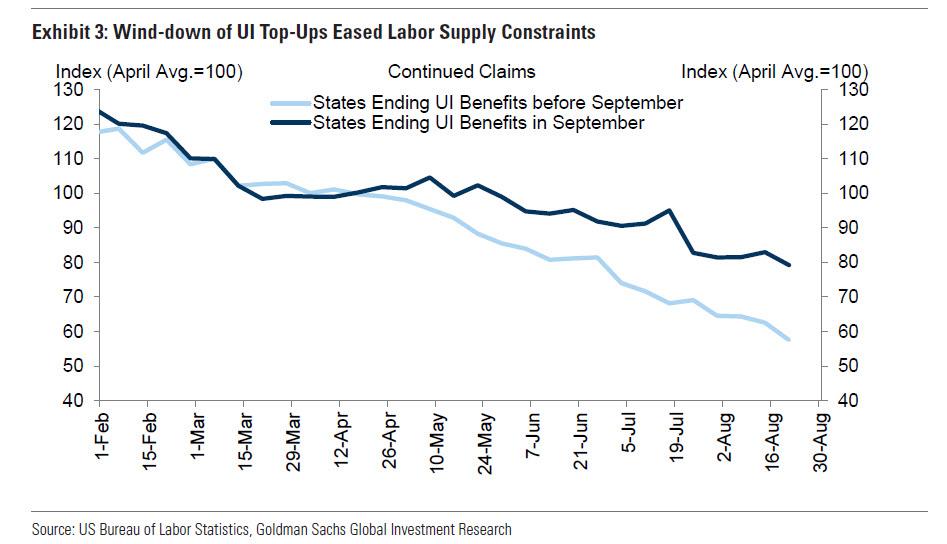
  • Wind-down of Top-ups. The expiration of federal benefits in some states has boosted labor supply and job-finding rates. Federal benefits were partially or fully curtailed in half of US states (representing 29% of the outstanding job losses since the start of the pandemic) in June and early July. And encouragingly, continuing claims have continued to decline more quickly in these states (by roughly 150k relative to the trend in all other states in the August payroll month).
  • Seasonality. The August seasonal hurdle is relatively low: the BLS adjustment factors generally assume a 100-200k decline in private payrolls (which exclude public schools),compared to +0.5mn over the previous four months.
  • Job availability. The Conference Board labor differential—the difference between the percent of respondents saying jobs are plentiful and those saying jobs are hard to get—decreased by 1.3pt to +42.8 in August but remains at a high level. Additionally, job openings increased by 590k to a record high in June, according to the JOLTS report.
  • Jobless claims. Initial jobless claims edged down during the August payroll month,averaging 355k per week vs. 393k in July. Continuing claims also decreased, averaging2,840k in August vs. 3,140k in July. Across all employee programs including emergency benefits, continuing claims remained roughly unchanged between the payroll survey weeks.

NEUTRAL/MIXED FACTORS:

  • Employer surveys. The employment component of the ISM Manufacturing Index fell into contractionary territory (-3.9pt to 49.0). The employment component of our manufacturing survey tracker also decreased (-0.8pt to 58.3), but the employment component of our services survey tracker increased (+0.1pt to 54.9). The employment component of the GSAI increased by 2.8pt to 70.0.
  • Job cuts. Announced layoffs reported by Challenger, Gray & Christmas decreased by1% in August after decreasing by 13% in July (mom, SA by GS). Layoffs were at the lowest level since 1993.

REACTION: Citi argues that given still net-long broader USD positions, any miss relative to the consensus may buoy Treasuries (as traders reason that the Fed would remain accommodative for longer), and any decline in yields would likely accelerate the Dollar’s recent underperformance. “A ‘goldilocks’ release that entails a slight miss would be most ideal for risk assets heading into an extended weekend,” but the bigger picture Citi says is that “the broader taper narrative will not have long-lasting market implications given broad expectations for a Q4 conclusion; nonetheless, the interim run-up will see taper talk as a persistent albeit fading influence on market moves.”

Tyler Durden
Thu, 09/02/2021 – 21:00

via ZeroHedge News https://ift.tt/38E8LcJ Tyler Durden

Quantitative Brainwashing

Quantitative Brainwashing

Authored by Jeff Thomas via InternationalMan.com,

We’re all familiar with the term, “quantitative easing.” It’s described as meaning, “A monetary policy in which a central bank purchases government securities or other securities from the market in order to lower interest rates and increase the money supply.”

Well, that sounds reasonable… even beneficial. But, unfortunately, that’s not really the whole story.

When QE was implemented, the purchasing power was weak and both government and personal debt had become so great that further borrowing would not solve the problem; it would only postpone it and, in the end, exacerbate it. Effectively, QE is not a solution to an economic problem, it’s a bonus of epic proportions, given to banks by governments, at the expense of the taxpayer.

But, of course, we shouldn’t be surprised that governments have passed off a massive redistribution of wealth from the taxpayer to their pals in the banking sector with such clever terms. Governments of today have become extremely adept at creating euphemisms for their misdeeds in order to pull the wool over the eyes of the populace.

At this point, we cannot turn on the daily news without being fed a full meal of carefully-worded mumbo jumbo, designed to further overwhelm whatever small voices of truth may be out there.

Let’s put this in perspective for a moment.

For millennia, political leaders have been in the practice of altering, confusing and even obliterating the truth, when possible. And it’s probably safe to say that, for as long as there have been media, there have been political leaders doing their best to control them.

During times of war, political leaders have serially restricted the media from simply telling the truth. During the American civil war, President Lincoln shut down some 300 newspapers and arrested some 14,000 journalists who had the audacity to contradict his statements to the public.

As extreme as that may sound, this practice has been more the rule in history than the exception.

In most countries, in most eras, some publications go against the official story line and may very well pay a price for doing so. But, other publications go along with the official story line to a greater or lesser degree and are often rewarded for doing so.

It should come as no surprise, then, that media outlets often come to report the news in a less than accurate manner.

Mark Twain is claimed to have said, “If you don’t read the newspaper, you’re uninformed. If you do read the newspaper, you’re misinformed.” Quite so.

Still, only fifty years ago, much of the then “Free World” enjoyed a relatively objective Press. Even on television, reporters such as Walter Cronkite, Huntley and Brinkley, etc. presented the news in a bland manner. It wasn’t very exciting, but at least it was relatively balanced and, to this day, most people who were around then still have no idea as to whether reporters like Walter Cronkite were liberal or conservative. Although he was a committed Democrat, he never allowed that to significantly colour his reporting.

But today, we have a very different corporate structure as regards the media. The same six corporations hold the controlling interest of over 80% of the media. And those same corporations also own a controlling interest in the military industrial complex, Wall Street, the major banks, Big Pharma, etc.

What we’re witnessing today is media having been transformed into something more akin to a three-ring circus than journalism of old. This is no accident.

The present travesty that is the 21st century media, is journalism in name only.

So, why should this be so?

Well, as it happens, people tend not to like governments dominating their lives – simple as that.

And yet, the primary objective of any government is to increase its size and power as rapidly as the populace will tolerate it. The only reason that they rarely do this quickly, is that they can’t get away with it. Like boiling a frog, it takes time to lull the populace into submission, bit by bit.

Once having had enough time to do so, there comes a point at which the government becomes woefully top-heavy, as well as unworkably autocratic. At such times, all that’s necessary to make people rebel is an economic crisis.

Such is the case in much of the world today – the EU, the US, Canada, etc.. Even in their arrogance, the powers that be have to be aware that they’re right at the tipping point. An economic crisis would almost certainly push the situation over the edge.

When truth threatens to undermine machinations for self-aggrandizement, individuals tend to obfuscate in order to delay the inevitable fallout. Governments are no different.

So it was that, in 1999, the largest banks entered into a massive lending scam that would most certainly collapse within a decade. However, before putting the scam in place, they arranged for a “bailout” by the government, which would effectively pass the bill to the taxpayer, while the banks themselves simply increased their own wealth massively.

Of course, QE, as massive as it was, was a mere Band-Aid solution. All those involved (big business and the government) understood that it would hang like a sword of Damocles over the economy until it inevitably came crashing down – a fate far worse than if QE had never been implemented.

And so, for those entities to have invested into the domination of the media was, in fact, essential. Had they not done so, it’s entirely likely that, with a free press, the man on the street would, by now, have figured out that he’d been hoodwinked.

Thus do we see the journalistic equivalent of Quantitative Brainwashing, in which the inevitable realization is delayed for as long as possible.

And, in order to make sure that the public do not figure out what’s been done to them, the news reporting becomes Orwellian in its endless repetition of a false narrative.

It is, however, true that, “You can’t fool all of the people all of the time.” Eventually, the Band-Aid peels back to reveal an infection that’s far beyond what had been generally perceived. It then falls away in layers, as increasing numbers of people become aware that they’ve been scammed – that the media is entirely corrupt and that the media’s owners – big business – have, with the enthusiastic compliance of the government, robbed them on a wholesale basis.

Historically, that’s when the jig is up. What happens then is a matter of historic record.

*  *  *

It’s clear the Fed’s money printing is about to go into overdrive. The Fed has already pumped enormous distortions into the economy and inflated an “everything bubble.” The next round of money printing is likely to bring the situation to a breaking point. We’re on the cusp of a global economic crisis that could eclipse anything we’ve seen before. That’s precisely why bestselling author and legendary speculator Doug Casey just released this urgent video. Click here to watch it now.

Tyler Durden
Thu, 09/02/2021 – 20:40

via ZeroHedge News https://ift.tt/38yqwdH Tyler Durden

Tesla Halted Production In China For 4 Days In August Due To The Semiconductor Shortage

Tesla Halted Production In China For 4 Days In August Due To The Semiconductor Shortage

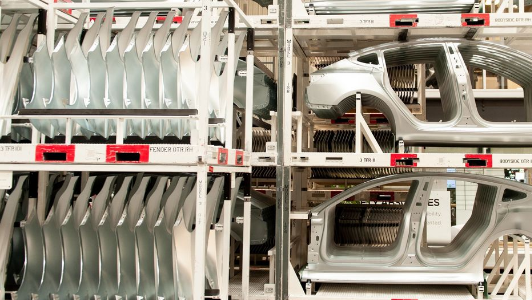
Production output for Tesla in China has reportedly once again been halted and is being (once again) blamed on the global semiconductor shortage.

Short of the pandemic, the semi shortage has become a very convenient scapegoat, especially for the auto industry, for numerous manufacturers who have shut down production temporarily and idled plants throughout 2021.

Tesla’s Shanghai plant was halted “for about four days” in August, according to a new report from Reuters

Production is reportedly now “back to normal” and the halt was blamed on shortages with the availability of electronic control units, mainly for the company’s Model Y.

In China, Tesla sold 32,968 China-made vehicles in July – this includes vehicles sold in China and vehicles exported – according to the China Passenger Car Association (CPCA). This was below the 33,155 vehicles sold in June; a number that we pointed out could have been a sign that the ship had steadied between Tesla and China – and that demand was once again rising.

But July’s numbers seem to indicate little, if any, growth in demand between June and July. 

Shipments of locally made vehicles sold in China plunged, to 8,621 cars from 28,138 in June. There is generally cyclicality for automaker sales wherein the beginning of a quarter (July) comes in markedly lower than the end of the previous quarter (June).

PCA Secretary General Cui Dongshu said during a briefing last month: “Tesla tends to be aggressive in exports regardless of the domestic market in July. The fact that Tesla’s domestic deliveries didn’t reach 10,000 is normal and fine.”

24,347 of the 32,968 cars made in China were manufactured for export. 

Tesla fell between BYD, who sold 50,387 China-made EVs and GM/SAIC, who sold 27.347 EVs.

Recall, other automakers have slowed production due to the semi shortage, too. We reported last month that Toyota had slashed global production for September by 40% from its previous outlook. The production cut will reduce Toyota’s global production for September from 900,000 automobiles to 500,000.

As a result, Toyota’s global production for the month will be below that of last September, when demand was beginning to recover from the initial stages of the coronavirus pandemic and Toyota turned out 840,000 units.

Tyler Durden
Thu, 09/02/2021 – 20:20

via ZeroHedge News https://ift.tt/3zIX7ZY Tyler Durden

Stakeholder Capitalism Is A Trojan Horse For China

Stakeholder Capitalism Is A Trojan Horse For China

Authored by Vivek Ramaswamy via Common Sense with Bari Weiss (emphasis ours),

“Stakeholder capitalism” may not be a phrase you are intimately familiar with, or it may be a phrase that makes your eyes glaze over. But it’s definitely something you’ve witnessed.

Let me give you an example:

This May, when the actor John Cena was promoting the latest movie in the “Fast and Furious” franchise, he called Taiwan a country. This, needless to say, displeased China — and Cena offered a groveling apology. “I love and respect China and Chinese people. I’m very very sorry for my mistake,” he said in Mandarin on Chinese social media. 

Here’s another:

Last summer, while Uber was putting out soaring statements about becoming an anti-racist company — it promised, among other pledges, to implement anti-racism education for riders and drivers in California — the company was pushing for Prop 22, which allowed the company to continue to classify its drivers as independent contractors rather than employees.

So “stakeholder capitalism” is the kind of gauzy expression that suggests a freer, fairer, more diverse, environmentally and LGBTQ-friendly world. But in reality it is something far different. It looks, in the case of Cena, like an American movie star doing the bidding of the Chinese Communist Party. In the case of Uber, assurances about “antiracism” allowed the company to distract the public from a political issue with real economic stakes.

This corporate hustle is the subject of a new, bestselling book called Woke Inc: Inside Corporate America’s Social Justice Scam by biotech entrepreneur Vivek Ramaswamy. Ramaswamy makes the compelling case that “stakeholder capitalism” sounds like a good thing, but is in fact deeply damaging our democracy. He explains why in the essay below. — BW


There is nothing more important to progressives today than to apologize: Antiracists apologizing for being racist. Electric-vehicle drivers apologizing for having polluted the planet. And devotees of “stakeholder capitalism” saying sorry for, well, capitalism.

Joe Biden has called conventional, or shareholder, capitalism a “farce,” saying corporations “have a responsibility to their workers, their community, to their country.” Elizabeth Warren’s “accountable capitalism” calls for higher wages, and greater employee involvement in selecting boards of directors and making political contributions. Al Gore has said that, as the value of socially conscious capitalism gains traction, “investors who fail to take it into account may be at risk of violating their fiduciary duty to their clients” — and, presumably, vulnerable to a lawsuit.

Nor is stakeholder capitalism limited to politicians or progressive activists: America’s most powerful CEOs have embraced it. In late 2019, the Business Roundtable, a lobbying group representing the country’s biggest corporations, announced it was revising its statement of purpose with an eye toward “stakeholders.” Jamie Dimon, the chairman and CEO of JPMorgan and the chairman of the Business Roundtable, wrote in a follow-up article in Time: “Capitalism has been the most successful economic system in history. But we can improve upon it to help solve society’s problems and lift up more people.”

Here’s what “stakeholder capitalists” miss: Once corporations become vehicles to further an agenda other than shareholder value, they become vehicles to advance any agenda, including those of foreign adversaries. 

Case in point: In recent years, the Chinese Communist Party has become a key stakeholder of many American multinationals — from Nike to Visa to BlackRock. It’s now flexing its muscle in ways that — no surprise — strengthens China’s interests at the expense of American ones.

The case of Airbnb is illuminating. 

In May 2019, the Silicon Valley darling hired Sean Joyce, a former FBI deputy director, to be its first chief trust officer. Joyce’s job was to protect users’ safety — limiting data breaches, fraud and the many risks, online and off, that come with hundreds of millions of users spread across 5.6 million rental properties in 100,000 cities worldwide.

By October of that year, Joyce had left Airbnb. According to The Wall Street Journal, Joyce quit because he was concerned that Airbnb was secretly sharing data on millions of guests and hosts — who, presumably, are among Airbnb’s most important “stakeholders” — with Chinese officials. This data included phone numbers, email addresses and the content of messages between users and the company. After authorities in Beijing asked Airbnb for even more “real-time data” — which, Joyce feared, would enhance the regime’s surveillance of minority ethnic groups — Joyce took his concerns to Airbnb’s CEO, Brian Chesky, among other senior executives. Nathan Blecharczyk, the company’s chief strategy officer, reportedly told Joyce: “We’re not here to promote American values.”

Soon after, Joyce resigned, citing “a difference in values.”

Three months later, Airbnb announced, with great fanfare, that it had embraced a new philosophy of doing business. “Serving all stakeholders is the best way to build a highly valuable business and it’s the right thing to do for society,” a January 2020 blog post from the company declared. Instead of the conventional shareholders’ meeting, Airbnb would now hold Stakeholder Day, and it would even change its pay structure, linking bonuses to key social targets and creating a “stakeholder committee” on the board of directors. The blog post added: “The stakeholders who make up the Airbnb community are Guests, Hosts, Communities, Shareholders, and Employees.” It did not mention the Chinese Communist Party.

The stakeholder rebrand isn’t just a sideshow; it’s an essential tool for powerful companies. Airbnb has amassed a huge millennial user base in no small part by portraying itself as a forward-looking, stakeholder-oriented company — one that embraces diversity, equity and inclusion, and proudly aligns itself with #BlackLivesMatter while quietly allowing Chinese users to discriminate against ethnic minorities. (According to Wired, many Airbnb listings in China contain language meant to ward off Uighurs, Tibetans and other minority groups. One such listening read: “We do not have the permission of the police station” to host Uighurs, so “please do not book.”)

So Airbnb gets credit for being “progressive” while turning a blind eye toward real repression. 

No doubt, more traditional, “shareholder” corporations do all kinds of terrible things to curry favor with unsavory, foreign regimes. Consider pretty much every international energy company that has tapped into Russia’s massive oil and gas reserves. But those companies aren’t trading on their reputation for being forward-looking or right-minded or stakeholder-ish. Airbnb is.

Nor is this just about Airbnb or any other American corporation. It’s also about the countries those companies do business in.

The net effect of companies like Airbnb bemoaning every microaggression committed against every black, brown or trans person in the United States while staying silent when it comes to genuine human-rights atrocities in China — cramming more than one million Uighurs into concentration camps; forcibly sterilizing them; and criminalizing the practice of Islam — is to create the impression that China is our equal when it comes to civil liberties.

Sure enough, when E.U. officials, in late 2020, pressed Xi Jinping about human-rights abuses in Xinjiang, the home to most of China’s Uighurs, Xi shot back that the very existence of Black Lives Matter is proof that the United States is no better than China. When State Department spokesperson Morgan Ortagus criticized Beijing for its crackdown on Hong Kong demonstrators, in late May 2020, Chinese Foreign Ministry spokesperson Hua Chunying tweeted: “I can’t breathe,” a not so subtle allusion to Black Lives Matter. In March, China’s top diplomat, Yang Jiechi, lambasted the United States for “slaughtering” black Americans, adding that China hopes America will do better on human rights. 

Disney, too, has bent over backward to avoid doing anything that might ruffle Chinese officials.

In 2019 Disney’s CEO that it would be “very difficult” for Disney to film movies in any state in the United States that restricts abortion access. But the company’s respect for women’s rights did not prohibit it from filming “Mulan” in Xinjiang, where Chinese authorities have embarked on a program of systemic rape — part of an effort to dissolve ancient family and communal bonds, and transform Uighurs into what Beijing regards as full-fledged, non-Muslim Chinese. Not only that: In the credits of “Mulan,” Disney gave “special thanks” to those same authorities.

Then there was the Ancient One, a character in Disney’s 2016 hit “Dr. Strange.” The Ancient One was supposed to be a Tibetan monk, but this upset Beijing, which, no doubt, worried audiences might think Disney was saying something good about another Tibetan monk: the Dalai Lama. So Disney made the monk white. Progressives, in the United States, howled that Disney had replaced an Asian character with a white one. So Disney did what it had to do to assuage the progressives: It made the monk a woman. This did the trick. White-woman-washing the Ancient One was good for China and Disney. Not so much for Tibet.

Consider Apple. The $2 trillion giant now hides the Taiwanese flag emoji from users in Hong Kong and Macau. It has removed songs from iTunes that refer to Tiananmen Square. All the while, it relentlessly scolds America for its “systemic racism.”

Then there’s the NBA, considered the wokest professional sports league in America. When Houston Rockets General Manager Daryl Morey tweeted, in October 2019, from his personal account, “Fight for freedom, stand with Hong Kong,” and the Chinese consulate in Houston denounced Morey, the Rockets’ owner followed suit, nearly firing him. Rockets star James Harden publicly apologized to China. LeBron James suggested Morey had abused his First Amendment rights: “I believe he wasn’t educated on the situation at hand, and he spoke, and so many people could have been harmed not only financially, physically, emotionally, spiritually. So just be careful what we tweet and say and we do, even though, yes, we do have freedom of speech, but there can be a lot of negative that comes with that, too.”

To make sure Chinese authorities knew that it, too, was very upset with the Rockets, Nike pulled its Rockets gear from stores in China. In June, during a call with Wall Street analysts, CEO John Donahoe told investors, “Nike is a brand that is of China and for China.” Donahoe did not mention that some Chinese Uighurs serve as forced labor in factories employed by Nike. This from the same company that, in 2019, canceled its Betsy Ross Flag sneaker ahead of the July Fourth holiday after Colin Kaepernick declared that the flag was linked to nation’s history of slavery.

China may be the most prominent example of stakeholder capitalism gone awry, but it is hardly alone.

Any number of American corporations now lavishing untold sums of capital on diversity, inclusion and equity initiatives in the United States are eager to do business in countries with reprehensible human-rights records: Citigroup, in the Democratic Republic of the Congo, where extrajudicial killings and violence against women are rampant; Hilton, in Abu Dhabi and Sri Lanka, where it’s illegal to be gay; the pharmaceutical giant Merck, in Russia, where democratic activist Alexei Navalny is in prison; and BlackRock, the world’s No. 1 investment-management firm, in Latin America, southeast Asia and sub-Saharan Africa, where companies that BlackRock has invested in have razed forests and exacerbated greenhouse-gas emissions. And so many more.

So persists an inescapable contradiction of stakeholder capitalism: All of these corporations have successfully rebranded themselves as good citizens, global stewards and combatants in the war against systemic racism, which has obviously proven good for business, but very bad for America, blurring the moral distinction between democracies and closed societies, between the free West and fear-based societies like China.

And because this business strategy is dressed in the garments of justice, it only compounds our innumerable confusions about what makes us us.

Tyler Durden
Thu, 09/02/2021 – 20:00

via ZeroHedge News https://ift.tt/3kNUcZN Tyler Durden

“This Isn’t What We Were Promised” – Critics Slam $10BN Purdue Pharma Opioid Settlement For Letting Sacklers ‘Off The Hook’

“This Isn’t What We Were Promised” – Critics Slam $10BN Purdue Pharma Opioid Settlement For Letting Sacklers ‘Off The Hook’

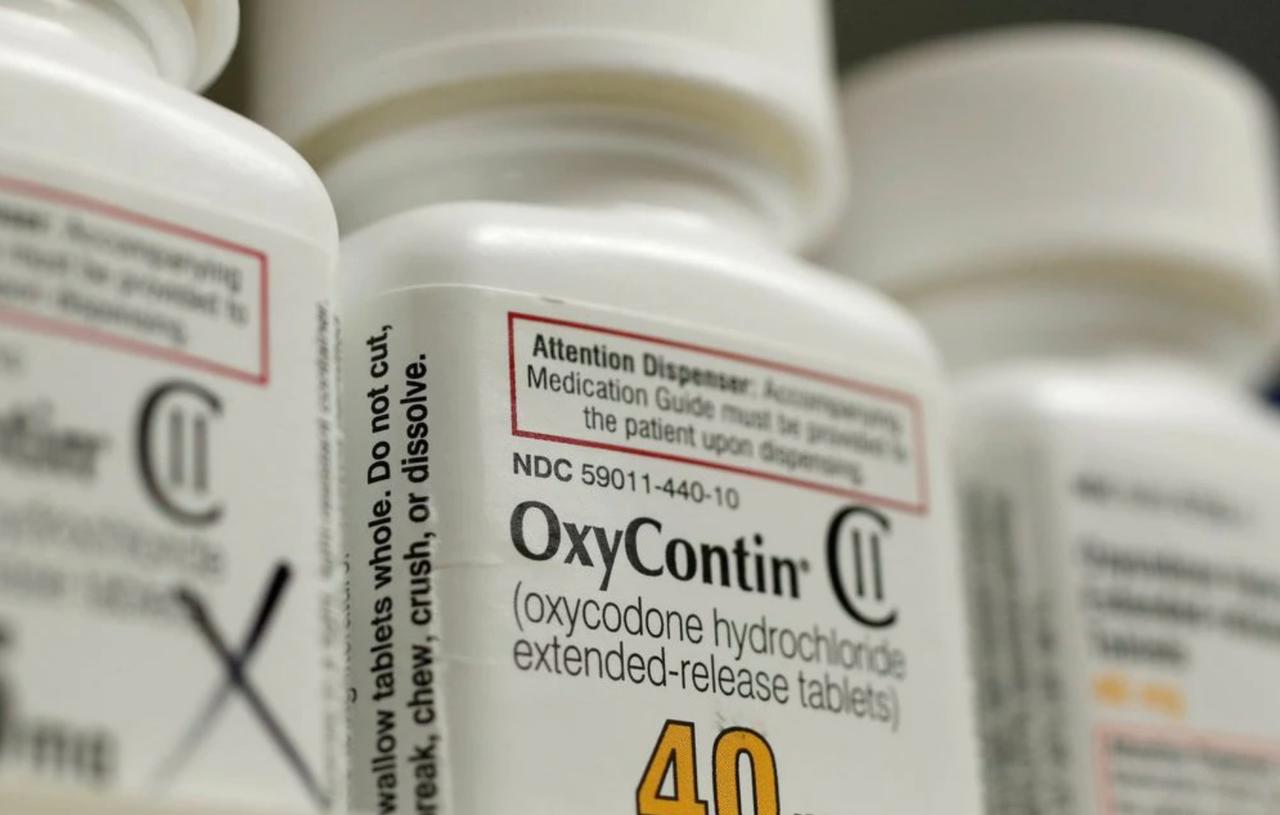
A federal bankruptcy judge has signed off on a settlement between OxyContin maker Purdue Pharma and thousands of creditors and litigants participating in a mountain of lawsuits filed against the company over its role in developing and marketing OcyContin in ways that plaintiffs say violated laws and knowingly exposed millions to an extremely addictive substance.

Under the settlement reached with creditors, including individual victims and thousands of state and local governments, the Sackler family will give up ownership of the company and contribute $4.5 billion, some of which will be used for a victims’ compensation fund. In exchange, members of the family will be freed from liability for any future opioid-related lawsuits, allowing them to retain much of their family fortune, even if their cash cow is now no longer under their control. In total, Purdue values the plan at $10 billion.

The new company will be reorganized under a board chosen by public officials. Profits will go to government efforts to prevent and treat opioid addiction.

Judge Drain said Wednesday after speaking from the bench for more than six hours that he would approve the plan as long as two technical changes were made. Once made, he plans to enter the final order on Thursday.

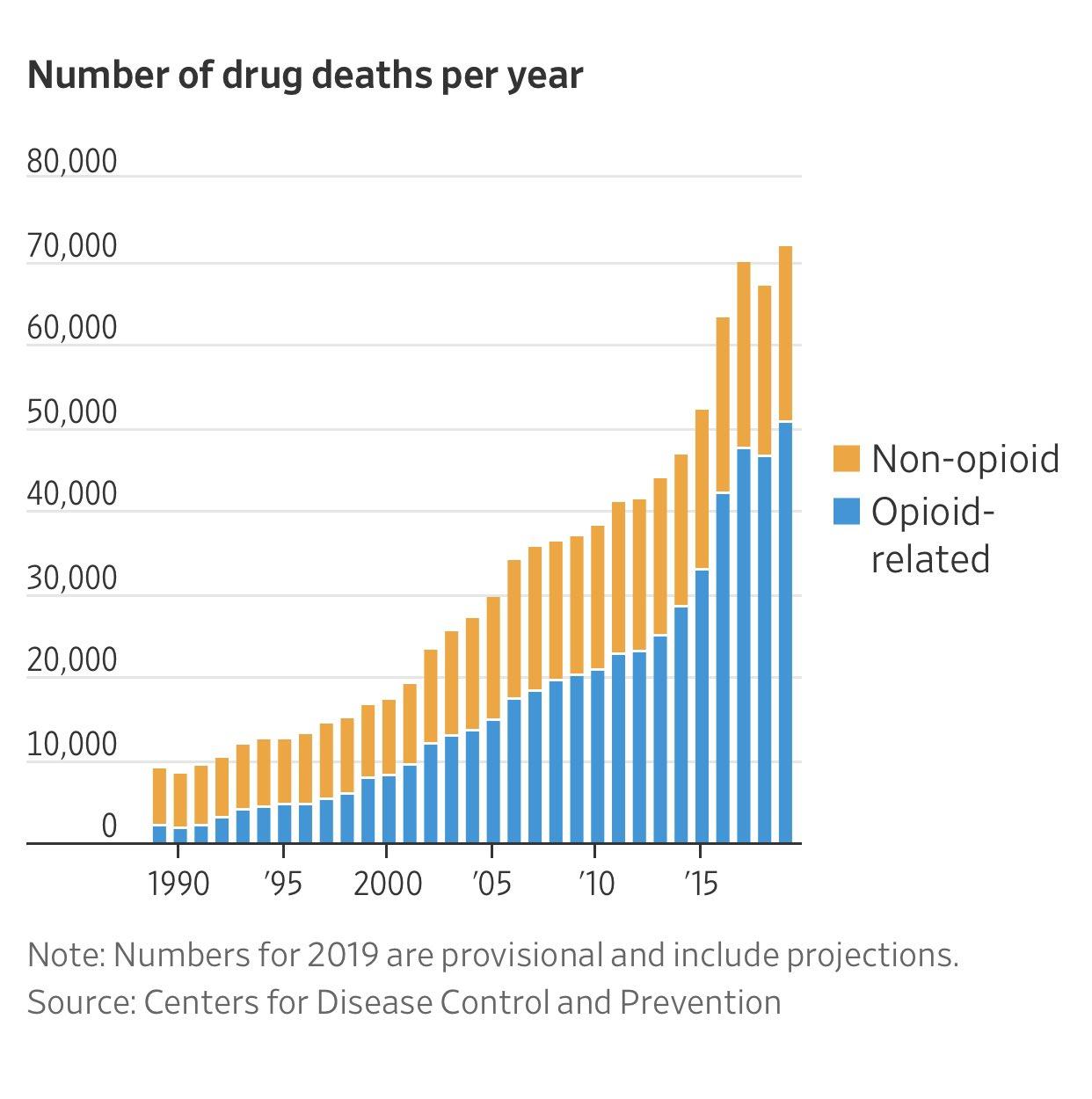
Opioids have killed roughly half a million Americans over the last decade, according to CDC data.

Source: WSJ

One party to the settlement said the deal “isn’t what we were promised.”

“It isn’t what we were promised or what we were hoping for,” said Ryan Hampton, an author and activist who had represented victims during the bankruptcy. Hampton resigned from his post on the victims committee the day before the judge’s decision, in part because he believed the compensation for victims was inadequate, especially compared with the proportion of the fund set aside for the cities, counties, states and other public entities suing Purdue.

At least three parties, led by Washington AG Bob Ferguson, objected to the plan, and are appealing its approval. Ferguson said the settlement as it stands lets the Sackler’s “off the hook”

“This order lets the Sacklers off the hook by granting them permanent immunity from lawsuits in exchange for a fraction of the profits they made from the opioid epidemic — and sends a message that billionaires operate by a different set of rules than everybody else,” Ferguson said.

The chairman of Purdue’s board praised the settlement.

Steve Miller, chairman of Purdue’s board of directors, praised the judge’s decision, saying it was “an outcome that is truly in the public interest.”

“Instead of years of value-destructive litigation, including between and among creditors, this Plan ensures that billions of dollars will be devoted to helping people and communities who have been hurt by the opioid crisis,” he said in a statement.

Once effective, the bankruptcy plan will set aside funds for cities, counties and other entities. Individuals, including those who suffered from addiction, families of people who died of overdoses and babies exposed to opioids in the womb and born with neonatal abstinence syndrome, or NAS, would be entitled to payments ranging from $3,500 to $48,000. The claims would still need to be adjudicated, an effort that could be complicated by that fact that years-old medical records may no longer exist.

Tyler Durden
Thu, 09/02/2021 – 19:40

via ZeroHedge News https://ift.tt/3t9gxoq Tyler Durden

ACLU Says The State Forcing People To Take Vaccines Is A Victory For Civil Liberties

ACLU Says The State Forcing People To Take Vaccines Is A Victory For Civil Liberties

Authored by Paul Joseph Watson via Summit News,

The ACLU has published an article in the New York Times followed up by a tweet which asserts that the government forcing people to take vaccines is a victory for civil liberties.

No, this isn’t out of the Babylon Bee.

“Far from compromising them, vaccine mandates actually further civil liberties,” the organization’s tweet ludicrously claimed. “They protect the most vulnerable, people with disabilities and fragile immune systems, children too young to be vaccinated, and communities of color hit hard by the disease.”

The tweet linked to a New York Times opinion piece written by ACLU staffers which further amplified claims that the government forcing people to take a vaccine under threat of them losing their jobs, social lives and potentially in the future the right to buy and sell was actually a boon for civil liberties.

What’s next? Maybe the ACLU will call for the government to forcibly incarcerate Americans for their controversial political opinions because it might ‘prevent harm’.

Respondents on Twitter were swift to ridicule the organization’s absurd hypocrisy.

“The government forcing a needle in your arm is actually them furthering your civil liberties” is quite the take even from Marxists like you. Thank you for dropping the mask to reveal yourselves though,” remarked Robby Starbuck.

“Look at that stretch!” commented Charlie Nash.

“It is so sad to see how much leftism has destroyed your organization. Any real civil liberties union needs to be actively against the left and you are example #1 as to why,” tweeted Steven Kolln.

Perhaps the best summary was tweeted by journalist Glenn Greenwald.

“Having the state force citizens to inject their bodies with a medicine they don’t want is a victory for civil liberties actually, says the @ACLU.”

*  *  *

Brand new merch now available! Get it at https://www.pjwshop.com/

In the age of mass Silicon Valley censorship It is crucial that we stay in touch. I need you to sign up for my free newsletter here. Support my sponsor – Turbo Force – a supercharged boost of clean energy without the comedown. Get early access, exclusive content and behinds the scenes stuff by following me on Locals.

Tyler Durden
Thu, 09/02/2021 – 19:20

via ZeroHedge News https://ift.tt/3kM8NFf Tyler Durden

Huarong Finally Got Its State-Backed Bailout, But Future Chinese Firms May Not Be So Lucky

Huarong Finally Got Its State-Backed Bailout, But Future Chinese Firms May Not Be So Lucky

Distressed Chinese asset manager China Huarong Asset Management is getting its bailout.

Citic Group, in conjunction with China’s Ministry of Finance, has stepped in at the urging of the state to prevent the asset manager from becoming a massive Lehman-style blowup in China for the time being. Defaults have been avoided, according to a new Bloomberg article. While bondholders can breathe a sigh of relief, equity holders likely won’t be as lucky. 

The rescue of the company was announced on August 18th after months of the state trying to pin down exactly who would step in, where, to help the distressed entity. 

“Beijing didn’t allow a systemically important financial institution directly owned by the central government to default on its debt, an event that had the potential to upend debt markets and possibly precipitate a financial crisis,” The Wall Street Journal wrote earlier this month.

The bailout took the form of a “recapitalization” with government funding, Forbes noted, calling it “a financial infusion (unspecified in form or amount) from a group of Chinese state-owned enterprises. It is a straight bailout, as per precedent (although many had feared precedent might not hold).”

But the bailout comes against the backdrop of President Xi reining in China’s major internet and tech companies with regulations that have collectively erased more than $1 trillion in shareholder value from names like Alibaba and Tencent. 

Thanks to this shift in tone, Sergey Dergachev, a senior portfolio manager at Union Investment in Frankfurt, told Bloomberg he believes that after Huarong, the days of guaranteed bailouts are over: “This assumption is not valid anymore.”

Huarong borrowed extensively since the late 1990s to help it expand and safeguard other Chinese banks. The company’s longtime chairman Lai Xiaomin eventually wound up being caught in a corruption scandal and finally left the asset manager this January. By the summer, it was obvious the asset manager needed help. From there, it became months of arguing and infighting amongst the state and private investors to try and organize a bailout. 

Citic was eventually engaged, according to Bloomberg:

For nearly two months, a Citic team pored over the books at Huarong’s headquarters. Even at Citic, a Chinese company as connected as they come, the political nature of the task raised eyebrows. Huarong’s finances were so troubled and past dealings so fraught that some members of the Citic team worried they might be blamed for the mess. They wanted assurances that they wouldn’t be held responsible should higher ups take issue with any rescue plan later on, one of the people said.

The numbers, audited by Ernst & Young, were dire. Huarong had lost 102.9 billion yuan ($15.9 billion) in 2020, more than its combined profits since going public in 2015. It wrote off 107.8 billion yuan in bad investments. 

Then, in August, the company’s bailout was officially announced:

At last, terms were drawn up and the State Council, long silent about Huarong, gave its blessing to a rescue that combines a government bailout with a more market-driven recapitalization. Huarong will get about 50 billion yuan of fresh capital from a group of investors led by Citic, which will assume the Ministry of Finance’s controlling stake, people familiar have said. Huarong is expected to raise 50 billion yuan more by selling non-core financial assets. On August 18, Huarong went public with its huge losses and quickly followed up with news of its rescue.

Recall, in April we had noted that China’s central bank was considering a plan to “assume more than 100 billion yuan ($15 billion) of assets from China Huarong Asset Management, helping the state-owned company clean up its balance sheet and refocus on its core business of managing distressed debt.”

With Huarong out of the way, China Evergrande Group now becomes to the country’s largest worry…

And for those who think these entities are all too big to fail, David Loevinger, a former senior coordinator for China affairs at the U.S. Treasury, concluded:

“Now, you cannot say that with 100% certainty,”

Tyler Durden
Thu, 09/02/2021 – 19:00

via ZeroHedge News https://ift.tt/3BtwE3g Tyler Durden