“We’re All Ruined”: Biden Drone Strike In Kabul Kills 10 Civilians, Family Says

“We’re All Ruined”: Biden Drone Strike In Kabul Kills 10 Civilians, Family Says

10 civilian members of an Afghani family including seven children were killed in a US drone strike on Sunday, according to NBC News (!?), which spoke with relatives of the Ahmadi family who said they were hoping to make it onto an evacuation flight out of Kabul before the United States ended its withdrawal from the country.

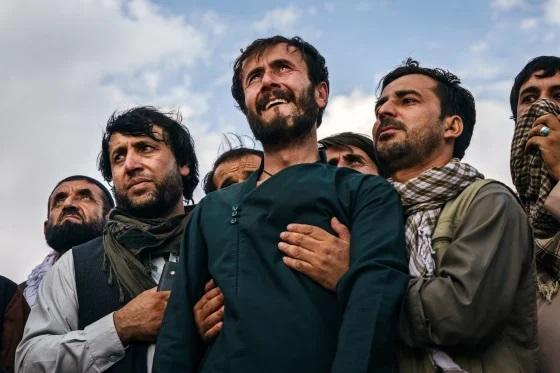
Ramal Ahmadi is supported by family members during a mass funeral in Kabul on Monday.Marcus Yam / Los Angeles Times via Getty Images

“They were 10 civilians,” said Emal Ahmadi, whose 2-year-old toddler, Malika was among those killed. “My daughter … she was 2 years old,” he said.

Malika Ahmadi, 2, was among those killed in Sunday’s U.S. drone strike in Kabul, her father, Emal Ahmadi, told NBC News.Courtesy / Emal Ahmadi

More via NBC News:

That day, Ahmadi’s cousin, Zemari Ahmadi, 38, had just pulled up at home from work, with his 13-year-old son, Farzad, his youngest of three, racing to greet him. (Other reports have said Farzad was 12, but both Ahmadi and another relative told NBC News he was 13.)

Farzad, who had just learned to drive, wanted to park his father’s car, a wish Zemari was happy to oblige as other family members gathered around.

It was in that moment that Ahmadi said an explosion tore through the vehicle, killing Zemari, Farzad and eight other family members, as was first reported by The New York Times and The Washington Post.

According to Pentagon spokesman John Kirby, Washington is “not in a position” to dispute reports that the Sunday drone strike killed civilians, however he claimed that one of the family members belonged to radical Islamic group, ISIS-K.

Malika and two other toddlers were the youngest family members killed, along with Ahmadi’s nephews Arwin, 7, and Benyamin, 6, and Zemari’s two other sons, Zamir, 20, and Faisal, 16, Ahmadi said.

Zemari was a technical engineer for Nutrition and Education International, a nonprofit working to address malnutrition based in Pasadena, California.

Just a day before his death, he had been helping to prepare and deliver soy-based meals to women and children at refugee camps in Kabul, Steven Kwon, president of NEI, told NBC News in an email.

One colleague and friend of six years to Zemari said he was devastated, while also describing Ahmadi as a “good man with good ethics.”

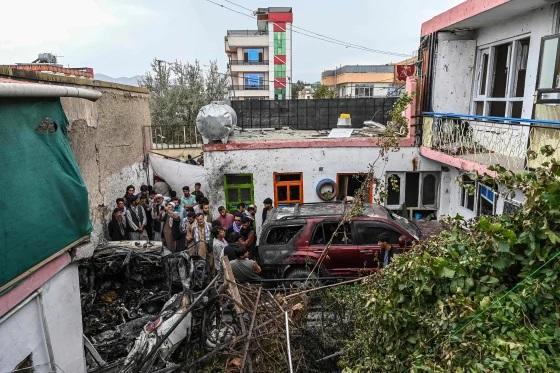
Residents and family members gather next to a damaged vehicle a day after the drone strike. Wakil Kohsar / AFP – Getty Images

Also killed in Biden’s drone strike was Ahmad Naser – a former officer in the Afghan Army and contractor with the US military, according to his cousin. Naser was days away from his wedding when he was killed.

Instead, there will be a funeral.

“They were all buried,” said 31-year-old Yousef. “We’re all ruined. The family is gone.”

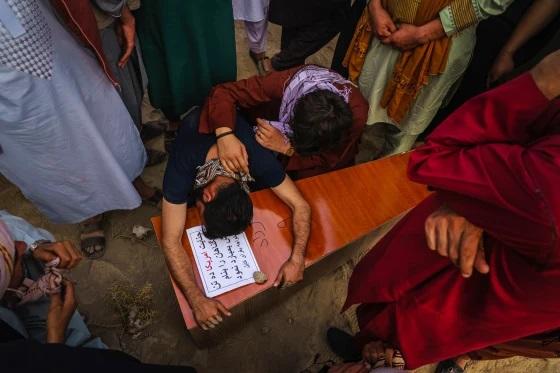
A relative throws himself on Farzad’s casket.Marcus Yam / Los Angeles Times via Getty Images

According to an evidence-free statement by US Central Command, however, there “were substantial and powerful subsequent explosions resulting from the destruction of the vehicle,” suggesting that there was a “large amount of explosive material inside that may have caused additional casualties.”

That said, we tend to doubt that that a car full of children would be headed to the airport to set off another suicide bomb, following the previous week’s attack that left 169 Afghan civilians and 13 members of the US military dead.

Tyler Durden
Thu, 09/02/2021 – 18:40

via ZeroHedge News https://ift.tt/3jLePqx Tyler Durden

CCP Cracks Down On “Incorrect Politics” & “Effeminate Men” In Show Business

CCP Cracks Down On “Incorrect Politics” & “Effeminate Men” In Show Business

The CCP’s push to reshape China’s economy and society has moved from a crackdown on its biggest technology companies, to imposing the most restrictive rules in the world surrounding minors access to video games, while reshaping industries from the private education space to ride-sharing to – its latest focus – entertainment.

After Beijing purged one of China’s most popular actresses (she was edited out of movies and TV shows) from its Internet in a manner that some likened to being “wiped from history”, it’s continuing with its crackdown on the entertainment industry, declaring Thursday that broadcasters must shun artists with “incorrect political positions” or “effeminate styles”, according to Reuters.

Here’s more on the crackdown, which is being led by two government regulators, from Reuters:

Two government ministries, including the National Radio and Television Administration (NRTA), and an industry association published fresh guidelines on Thursday,

The NRTA, a ministry level body, said it will strengthen regulation of stars’ salaries and punish tax evaders. It also said it would weed out any content in cultural programmes that it deems to be unhealthy.

Last week, China’s internet regulator said it was taking action against what it described as a “chaotic” celebrity fan culture.

The selection of actors and guests should be carefully controlled, with political literacy and moral conduct included as criteria, NRTA said, adding that performers should be encouraged to participate in public welfare programmes and assume social responsibilities.

The notice further said that programmes portraying “effeminate” behaviour and other content deemed “warped” should be stopped, along with shows built around scandals, ostentatious wealth and “vulgar” internet celebrities.

Unhealthy fan culture should be deterred and strict controls placed on programmes with voting segments, and any that encourage fans to spend money to vote should be forbidden, the notice added.

Regulators also issued new guidelines for film and TV calling for directors to avoid using male actors who wear makeup, claiming it makes them look “effeminate” and undermined the credibility of the Chinese military.

Separate notices also published on Thursday by the Ministry of Culture and Tourism and the China Association of Performing Arts said that performers, like livestreaming stars, should undergo periodic training on professional ethics while agencies should terminate contracts with performers who “lack moral discipline.”

Besides criticising the culture of celebrity worship, authorities and state media have criticised male stars who favour heavy make-up andcarefully styled hair and project a feminine image, saying Chinese boys should become more manly.

Some “effeminate” stars are immoral and can damage adolescents’ values, according to an opinion piece in the state-run Guangming Daily on Aug. 27, written by a former official at a military newspaper.

When such stars act as soldiers fighting in the war against the Japanese – a popular setting for Chinese movies and TV shows – they also make the “righteous” and “heroic” characters appear childish, said the piece.

One popular video-maker on Douyin, a short video platform, had his account suspended in late August after complaints that he was too “effeminate”.

Moving on: After paying a nearly $3 billion fine earlier this year, Alibaba announced on Thursday that it would commit 100 billion yuan ($15.5 billion) over five years toward Xi Jinping’s “common prosperity” vision, the latest sign that the CCP is depending on Big Tech companies to bankroll its new vision for lifting hundreds of millions more Chinese out of poverty. According to Bloomberg, Alibaba will spread the money between 10 initiatives encompassing technology investment and support for small companies, the government-backed Zhejiang Daily reported Thursday. Tencent, which said last month that it would double the amount of money it’s allocating for social responsibility programs to about $15 billion.

Finally, Chinese regulators ordered Didi, Meituan, Alibaba and other companies with ride-hailing services to rectify instances of misconduct when it comes to safeguarding consumer’s data, adding to the scrutiny surrounding the ride-sharing industry just as shares of Didi, the embattled US ride sharing company,

Tyler Durden
Thu, 09/02/2021 – 18:20

via ZeroHedge News https://ift.tt/3jDlhzy Tyler Durden

Biden & Bennett Renewed Agreement On Israel’s Secret Nuclear Weapons Program

Biden & Bennett Renewed Agreement On Israel’s Secret Nuclear Weapons Program

Authored by Dave DeCamp via AntiWar.com,

President Biden and Israeli Prime Minister Naftali Bennett renewed a decades-old agreement on Israel’s secret nuclear weapons program during their meeting in Washington last week, Axios reported on Wednesday.

It is believed that Israel first produced nuclear weapons in the late 1960s, and current estimates put Israel’s arsenal somewhere between 90 and 300 warheads. Every US president since Nixon has agreed not to press Israel to sign the Non-Proliferation Treaty. In return, Israel agrees not to declare its nuclear arsenal and operates the program covertly.

The UK’s WE117B nuclear missile, via Flickr

The ambiguity allows the US to give Israel aid, which is technically illegal due to the existence of Israel’s nuclear arsenal. Under foreign assistance laws, the US cannot provide aid to nuclear-armed states that refuse to sign the NPT.

The irony of the arrangement is that Israel constantly accuses Iran of operating a secret nuclear weapons program. And one of the main Israeli talking points is that if Iran ever acquires a nuclear bomb, it would trigger a regional arms race.

Israel is not just waging a propaganda war against Iran. The accusations come along with covert attacks on Iranian nuclear facilities and brazen assassinations of nuclear scientists.

The US entertains the Israeli narrative, and pressure from Israel is what led to the Trump administration withdrawing from the Iran nuclear deal, known as the JCPOA. Iran remains under heavy US sanctions, and this economic warfare is justified by the idea that Tehran is racing to develop a bomb when that is not the case.

The JCPOA puts strict limits on Iran’s nuclear program. But instead of favoring a US return to the deal, Israel is doing everything to sabotage negotiations. One reason the Israelis say they are against the JCPOA is that it has an expiration date. But that ignores the fact that after the JCPOA, Iran would still be bound by the NPT.

Tyler Durden
Thu, 09/02/2021 – 18:00

via ZeroHedge News https://ift.tt/2WMVwDS Tyler Durden

Virginia Isn’t Bound by 1890 Deed to Perpetually Display Robert E. Lee Monument

Today’s Virginia Supreme Court decision in Taylor v. Northam (unanimous opinion by Judge Bernard Goodwyn) deals with an 1890 deed, which conveyed a Robert E. Lee monument to the State, with the provision that,

The State of Virginia, party of the third part acting by and through the Governor of the Commonwealth and pursuant to the terms and provisions of the [1889 Joint Resolution] executes this instrument in token of her acceptance of the gift and of her guarantee that she will hold [the Lee Monument and the Circle] perpetually sacred to the Monumental purpose to which they have been devoted and that she will faithfully guard it and affectionately protect it.

In 2020, Governor Ralph Northam decided to remove the Lee Monument from the donated land, and plaintiffs objected. The court concluded, in part:

The merits of the arguments for and against the retention of the Lee Monument in its present location are for the political branches to consider. Our function as a Court is to address the legal claims before us. The essence of our republican form of government is for the sovereign people to elect representatives, who then chart the public policy of the Commonwealth or of the Nation. Democracy is inherently dynamic. Values change and public policy changes too.

The Government of the Commonwealth is entitled to select the views that it supports and the values that it wants to express. The Taylor Plaintiffs erroneously assert that the Commonwealth is perpetually bound to display the Lee Monument because of the 1887 Deed, the 1890 Deed, and the 1889 Joint Resolution.

A restrictive covenant against the government is unreasonable if it compels the government to contract away, abridge, or weaken any sovereign right because such a restrictive covenant would interfere with the interest of the public. “[T]he State cannot barter away, or in any manner abridge or weaken, any of those essential powers which are inherent in all governments, and the exercise of which in full vigor is important to the well-being of organized society.” “[C]ontracts to that end are void upon general principles,” and they cannot be saved from invalidity by the constitutional prohibition against laws that impair the obligation of contracts.

Governor McKinney had no power to contract away the Commonwealth’s essential power of freedom of government speech in perpetuity by simply signing the 1890 Deed. Similarly, the General Assembly of 1889 had no authority to perpetually bind future administrations’ exercise of government speech through the simple expedient of a joint resolution authorizing the 1890 Deed. The Commonwealth has the power to cease from engaging in a form of government speech when the message conveyed by the expression changes into a message that the Commonwealth does not support, even if some members of the citizenry disagree because, ultimately, the check on the Commonwealth’s government speech must be the electoral process, not the contrary beliefs of a portion of the citizenry, or of a nineteenth-century governor and legislature.

Therefore, any restrictive covenant purportedly created through the 1890 Deed, which would prevent the Commonwealth from moving a monument owned by the Commonwealth and on property owned by the Commonwealth is unenforceable because, at its core, that private property interest is the product of a nineteenth-century attempt to barter away the free exercise of government speech regarding the Lee Monument in perpetuity.

The government’s right to free speech is an essential power inherent in all governments, and that agreement, entered by Governor McKinney signing the 1890 Deed as authorized by the General Assembly, is unenforceable. The circuit court also did not err in holding that any restrictive covenants created by the 1887 Deed or the 1890 Deed, as applied to the Commonwealth, are unenforceable because they contradict current public policy and are unreasonable, even without considering the effect of the 2020 Budget Amendment on the enforceability of those covenants….

Seems right to me.

from Latest – Reason.com https://ift.tt/3BASVft
via IFTTT

Ban on Photographing Children in Parks Struck Down,

From today’s Eighth Circuit opinion in Ness v. City of Bloomington, by Judge Steven Colloton (joined by Judges Roger Wollman & Jonathan Kobes):

In 2011, the Bloomington City Council approved a conditional use permit for the Al Farooq Youth and Family Center to operate a school, day care, and place of assembly at a property adjacent to a public park called Smith Park. A joint use agreement governs the sharing of parking facilities between the City and the Center, and allows the Center to use Smith Park for its programs. A charter school, Success Academy, opened on the Center’s property in 2017. The school uses Smith Park for recess.

Ness is a Bloomington resident who lives in the Smith Park neighborhood. She describes herself as the “point person” for delivering neighborhood concerns to the City about the Center’s alleged violations of its agreements related to use of the park and the parking spaces surrounding the park. Ness records videos and takes photographs from public sidewalks and streets around the park, the driveways of homes across the street from the park, and within the park itself. She documents her concerns by posting the photographs and videos on a Facebook page and an internet blog….

[I]n October 2019, the City Council approved an ordinance proscribing the photography and recording of children in city parks. The ordinance provides that in city parks, “[n]o person shall intentionally take a photograph or otherwise record a child without the consent of the child’s parent or guardian.” A violation is punished as a petty misdemeanor.

Ness sued; the Eighth Circuit declined to consider he challenge to the Minnesota harassment statute, because that statute had been narrowed in the meantime by the Legislature, but held that the city ordinance was invalid:

If the act of making a photograph or recording is to facilitate speech that will follow, the act is a step in the “speech process,” and thus qualifies itself as speech protected by the First Amendment…. Ness’s photography and video recording is [therefore] speech. Ness wants to photograph and record the asserted “noncompliant and overuse of Smith Park” by the Center and Success Academy, and she wants to post those photographs and videos to an internet blog and a Facebook page “in order to inform the public” about the controversy. Thus, her photography and recording is analogous to news gathering. The acts of taking photographs and recording videos are entitled to First Amendment protection because they are an important stage of the speech process that ends with the dissemination of information about a public controversy….

A public park is a traditional public forum. Content-neutral time, place, and manner restrictions are permitted in traditional public fora if the restrictions “are narrowly tailored to serve a significant governmental interest.” Content-based restrictions, however, “are presumptively unconstitutional” and must satisfy strict scrutiny. To enforce a content-based restriction, the government must show that the restriction “furthers a compelling interest and is narrowly tailored to achieve that interest.” …

[The restriction here is content-based], because city officials must examine the content of the speech to determine whether it is prohibited. To determine whether Ness’s photography or recording in a park is proscribed by the ordinance, an official must examine the content of the photograph or video recording to determine whether a child’s image is captured. Thus, the ordinance is content-based as applied to the facts of this case.

Even though the ordinance is content-based, the City may still enforce it against Ness if the restriction furthers a compelling government interest and is narrowly tailored to that end. The City contends that it has a compelling interest in “protecting children from intimidation or exploitation,” and that the ordinance proscribes “potentially frightening interactions with children.”

We may assume that a narrowly tailored ordinance aimed at protecting children from intimidation and exploitation could pass strict scrutiny. The present ordinance, however, is not narrowly tailored to that end as applied to Ness. Ness seeks to photograph and video record a matter of public interest—purported violations of permits issued by the City—and does not intend to harass, intimidate, or exploit children. Ness also advised the City that it was her practice to “block” out the identities of juveniles when she posts images online, and the City produced no evidence to the contrary. Yet her photography and recording is nonetheless proscribed by the ordinance.

Because the ordinance is significantly overinclusive with respect to the City’s asserted interest, it is not narrowly tailored and fails strict scrutiny as applied to Ness’s proposed conduct. We therefore conclude that the ordinance, as applied to Ness’s activity that forms the basis for this lawsuit, is unconstitutional under the First Amendment. Ness is entitled to judgment to that extent. Ness also seeks a declaration that the ordinance is unconstitutional on its face, but we need not address that contention. We apply the rule that “a federal court should not extend its invalidation of a statute further than necessary to dispose of the case before it.”

Seems correct to me.

Ness had also been investigated for violating the Minnesota “harassment” statute:

In August 2018, someone lodged a formal complaint against Ness for possible violations of the [state] harassment statute, based on her recording and photography at Smith Park. The City did not file charges against Ness at the time.

In August 2019, Bloomington police officers Meyer and Roepke approached Ness while she was video recording activities relating to alleged violations of the joint use agreement near the Center. The officers were investigating a harassment complaint filed by the principal of Success Academy and the parent of a student. The officers warned Ness that she could be arrested for violating the harassment statute if children felt threatened or intimidated by her filming, regardless of her intent. According to Officer Meyer’s report, he asked Ness to “stop filming.”

In October 2019, two city police detectives and a community liaison met with Ness at her home. The detectives informed Ness that she was a “suspect” in a “harassment case,” based on her recording of alleged overuse and noncompliant use of Smith Park by the Center and the school. Neither the County nor the City prosecuted Ness under the harassment statute.

But because the statute was narrowed in the meantime, the court held that Ness’s challenge to the statute was moot.

from Latest – Reason.com https://ift.tt/3tabVhW
via IFTTT

Rep. Peter Meijer Is ‘Furious’ at the White House’s Afghanistan ‘Lies’


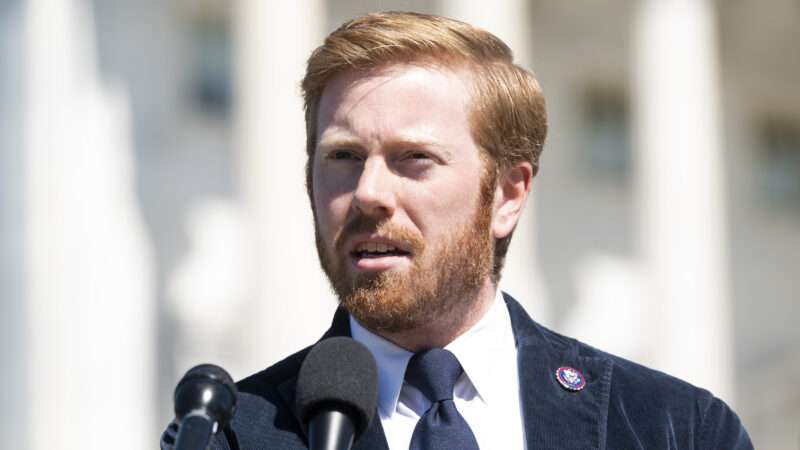
MeijerPic

Because “the information we were getting from the administration was outdated, it was inaccurate, and sometimes just plain deceptive,” freshman Rep. Peter Meijer (R–Mich.) and four-term Rep. Seth Moulton (D–Mass.) made an unannounced trip to Afghanistan on August 24.

The congressional duo—both of them Iraq War vets, both of them intervention skeptics—were promptly criticized for recklessness by the White House, the congressional leadership and the Pentagon. Meijer was defiant about the importance of what he learned there: “We were being lied to up and down.”

On Wednesday morning, hours after President Joe Biden’s speech marking the end of the 20-year U.S. military involvement in Afghanistan, Meijer was still describing himself as “very angry at everybody”—about the hundreds of Americans and visa-qualified Afghans left behind, about the two decades of failed leadership and congressional abdication that led up to this, and about the administration’s brazen dishonesty.

“If you want to talk to specific lies,” the 33-year-old Meijer told me over the phone, “one: that there is no more Al Qaeda in Afghanistan. That’s a lie; we know it. Two: them saying that the Haqqani network and the Taliban are two separate entities. That’s a lie. Three: that Americans were not ‘stranded’—Jen Psaki, that was a lie. Four: that Americans were not being beaten by the Taliban or being harassed trying to get into the airport. That was a lie. Boy, there’s a bunch of others too.”

Meijer, who holds the Grand Rapids congressional seat previously represented by Libertarian Justin Amash, first jumped into politics in 2019 out of concern that Amash, still then a Republican, was spending too much time bashing Donald Trump. In his first month on the job, Meijer himself faced intense criticism and a GOP primary challenger for witheringly criticizing Trump and then voting to impeach him for his role in stoking the Capitol riot.

Though the two men diverge philosophically, they share an independent streak, a desire to “end the endless wars,” and a certain generational facility with social media. After the State Department left stranded dozens of employees of the U.S. Agency for Global Media, which funds Radio Free Europe/Radio Liberty and Voice of America, one of a group of 15 such journalists got out of Afghanistan at the last minute only by sliding into Meijer’s DMs.

“They’re now resettled in a safe country,” Meijer said. “But it’s just astounding how out of touch or unaware or oblivious this administration has been. It’s just been every step of the process.”

Now making the media rounds, Meijer is calling for Congress to buff up its foreign policy responsibilities iand repeal open-ended Authorizations for the Use of Military Force (AUMFs). He is also calling for the resignations of officials who botched the U.S. retreat.

“There are a lot of things that I cannot wait to share until we are a little bit past this point—because there are situations with folks who are still trying to get out—that are just jaw-dropping for the organizational failures,” he said.

The following is an edited transcript of our conversation. “It’s delusional,” Meijer contends, “to call what has happened over the past two decades, and as we saw encapsulated over the past two weeks, as anything but an abject failure.”

Reason: What was your impression of President Biden’s speech?

Peter Meijer: What my fear has been for a while is that there will be these victory laps and attempts to make this a Mission Accomplished moment. Without a doubt, the men and women of our armed services and our diplomatic personnel on the ground have done incredible work. But I’m a lot less focused on the people we were able to get out than on those we left behind, and I think that’s where our focus needs to continue to be, no matter how much the president would like to put this in the rearview and focus on his domestic agenda.

Reason: Tell us a little bit, given your knowledge and your ongoing work on this, about who is left behind. Who are these people, what is your sense of their danger, and how many of them are there?

Meijer: We have several hundred Americans. And again, for each of these American citizens, they in many cases have non-U.S.-citizen family members. So it’s those American citizens who were left behind and their family members. And then it’s also a staggering number—thousands upon tens of thousands of individuals who either have Special Immigrant Visas, have applied for them and are close in the pipeline, or are otherwise eligible for those Special Immigrant Visas who are currently being hunted by the Taliban.

We’ve seen plenty of incidents of reprisal killings, and I don’t know that I’ve spoken to somebody who hasn’t said, “The Taliban have come to my house, have asked my family where I am.” Or they came to their house and the house was empty because they’re in hiding, and asked the neighbors where these people are. So I think there’s a very real and palpable fear that the Taliban will not respect the general amnesty that they put out, but are instead interested in retribution. I hope that that’s not the case, but I think it is very wise and prudent to assume any worst-case scenario here.

Reason: I know that you are in favor of withdrawing from the war, and you’ve been a critic of some of our ongoing missions out there. The president last night said, “I was not going to extend this forever war, and I was not extending a forever exit.” What if anything is wrong with that approach?

Meijer: One thing I want to make very clear, one of the reasons why I was optimistic and supportive of the withdrawal, was because of the work that was being done in Doha to negotiate towards a power-sharing agreement and a unity government that was likely going to be more decentralized, that would allow a bit more provincial autonomy.

In order to negotiate, you need to have leverage, and the two points of leverage we had, one, was our physical presence on the ground, and number two was the existence of the Afghan government and the Afghan National Security Forces. So while I am sympathetic at the notion that we don’t want to be engaged in the forever war and we don’t want to be engaged in a forever exit, the reality is that we were moving towards this negotiated power-sharing agreement, and then frankly stumbled on the one yard line. We failed to adjust our withdrawal, adjust the conditions as the security situation eroded, as the Afghan National Security Forces and Afghan government’s credibility and durability eroded. We just made the mad rush for the exits.

So we should not have had as mad a rush to the exits without any adjustments, without any accounting for the situation as it was collapsing. Because once that snowball starts to pick up steam, you wind up with tens of thousands of people overrunning the runways. You wind up with crushes at these gates that exposed our Marine soldiers and sailors to mortal peril, and for which 13 of whom lost their lives.

This is not an indictment on the idea of withdrawing, but on the way in which we so recklessly, and against all reports coming out of the ground, stuck to an untenable approach.

Reason: You worked in intelligence in Iraq. This rapid collapse in Afghanistan has been seen by outside critics as a massive intelligence failure. What is your assessment?

Meijer: I think it’s right to call it an intelligence failure. Now, the intelligence community says that it was not a failure of collection, that they had the information, they tried to pass it on; it was not a failure of assessment, they analyzed what they collected and they provided that. But whether it’s a failure of collection, assessment, dissemination, or absorption, the reality is that our national security apparatus was taken by surprise, and they shouldn’t have been taken by surprise.

Again, I don’t think the blame either before the withdrawal, or for the entirety of this 20-year conflict, is going to boil down to one simple answer. While the president is ultimately responsible, this failure has a thousand fathers, so we need to make sure that we hold all to account and that we have an unsparing examination of not only how things went so wrong, but how we got into this position in the first place.

Reason: Walk us through your decision and motivation to go to Afghanistan.

Meijer: First off, the information we were getting from the administration was outdated, it was inaccurate, and sometimes just plain deceptive,

Reason: And you knew this before you decided to go?

Meijer: That was one of the strong, driving motivations to go. A number of us felt that we were not getting the information that we needed. That when it came to evacuating individuals, a lot of the expected assistance from the executive branch, unless you had personal contacts and connections, as some of us did, you were sending out cases into an email inbox that oftentimes was backlogged and it would bounce those emails back.

Reason: Wow.

Meijer: This was incredibly infuriating, because you were getting in our case over a thousand requests that were coming in that we were trying to action, trying to connect with sources on the ground. The way in which so much of the evacuations that people were able to get to safety got to safety was because we were in contact with people at those gates. We could send a photo to somebody on the ground and say, “Look for this guy and grab him.” That was not something most congressional offices had.

So both in terms of understanding what the dynamic was on the ground, understanding the decision and the consequences of either keeping to the August 31 withdrawal deadline or trying to extend that, and the question of how do we most efficiently and effectively connect congressional offices and the people reaching out to them needing an evacuation with the folks on the ground, we came to the realization that we can’t do this from afar, that we need to see what’s going on, that this is a bit of a black hole and that it is the most important thing going on in the country—probably one of those significant foreign policy moments of recent memory. And the fact that we have no understanding, no visibility and ultimately no oversight, is problematic and troubling. And we need to correct that.

Reason: What did you see and learn on the ground that you did not know? How did it change your assessment of the situation?

Meijer: What I did not know from the onset was just how completely dependent we were on the Taliban for perimeter security, for physical security. That if our agreement with the Taliban broke down, that if they made the decision that they didn’t want us there anymore, that we frankly would not be able to evacuate the vulnerable individuals: American citizens and our loyal Afghan allies. We might not even be able to evacuate our own uniformed military personnel. That it was a fragile, dangerous, volatile dynamic around that perimeter.

That was one of the reasons why we both changed our minds, and after speaking with commanders said, “We understand and we respect and support this decision to stick to this deadline. Not because we think it’s a good option, but because of all of the bad options it is the least worse.”

The other thing that we saw was just how many prophecies broke down, how hard it was to actually get folks through, and just the impossible position we were putting the Marines and soldiers who were manning those gates. And then more broadly, how little planning ahead of time had actually been done, and how much of everything that was achieved was on the fly, ad hoc, and thanks to military men and women, diplomatic individuals on the ground, rather than any significant degree of external support.

It’s just a very volatile picture on the whole, and we were able to get insight that we couldn’t have gotten through other channels, especially while the administration was stonewalling, or frankly I think didn’t know as much of what was going on.

Reason: We’re seeing some people on, for lack of a better phrase, the Tucker Carlson right, who are deeply skeptical about the national security wisdom of accepting refugees from Afghanistan. That basically we’re inviting trouble, potential terrorist violence. Can you talk to your confidence in the vetting process and your feelings about such fears as expressed?

Meijer: On the vetting side, we saw the Department of Homeland Security personnel and our consular officials on the ground there doing that vetting: comparing the individuals who are there and who have passed the preliminary checks at the Kabul airport, but making sure that they actually A) have the requisite authorization and background or experience to be qualified for the programs that we have, to get them out. B) that those individuals pass our security vetting and screening criteria.

So they’re checking their biometrics, checking them against their biometrics databases, doing name searches, other background check components that we’re actually able to do far better than in most other circumstances, simply for the fact that we’ve been in Afghanistan collecting information for 20 years. So we have a much bigger body of knowledge than we would have in Syria, or in other comparable conflict areas.

I will say about a lot of the, to use your phrase, the Tucker Carlson right, is that it just doesn’t have a full understanding of what they’re talking about. And I get it, it’s an easy way of falling back on tired tropes of these sort of dangerous dirty people from the outside world. The reality is that the folks we’re bringing in, by and large, if they’re not U.S. citizens, if they’re not U.S. legal permanent residents, the people coming are those who are coming because the Taliban are trying to hunt them down because of the work they did for our government. So it’s not just a random assemblage, it’s not whoever was able to get on the plane. These are people who are known to us, who have veterans back home who are advocating for them.

I think it’s telling that some of the passionate proponents of this evacuation, and working tirelessly to do so, have been the veterans community, have been people who’ve served in Afghanistan and to whom this is a personal issue, who know that these are not random individuals, these are our friends that we still talk to on WhatsApp and FaceTime and Facebook. And some of the most critical individuals are those who’ve never spent a day in service to this country.

Reason: You have upon your return been pretty critical of the White House, even using phrases like “lying” to describe what they have told the American people or Congress. Can you be specific about that, either in the White House or in the military leadership?

Meijer: Yeah. We’ll start to go back with, maybe weren’t dishonest assessments, but were overly optimistic or otherwise flawed, in terms of what we were seeing on the ground and the strength and competence of the Afghan National Security Forces.

If you want to talk to specific lies, one: that there is no more Al Qaeda in Afghanistan. That’s a lie; we know it. Two: them saying that the Haqqani network and the Taliban are two separate entities. That’s a lie. Three: that Americans were not “stranded”—Jen Psaki, that was a lie. Four: that Americans were not being beaten by the Taliban or being harassed trying to get into the airport. That was a lie. Boy, there’s a bunch of others too. There’s just things that, as soon as they leave that person’s mouth, you’re like, “Do you even know what the hell you’re talking about?”

Reason: President Biden last night criticized the idea of having a mission without “clear, achievable goals,” and said there’s been too much of that in the last 20 years. I presume you agree with that as a general sentiment. So who do you blame? Specifically in Afghanistan, or anywhere else that you might want to point to.

Meijer: I think you can certainly and appropriately spread a lot of blame, it’s just that it’s dependent on what failure we are highlighting. Specifically, when it comes to the botched withdrawal, that responsibility lies with the State Department that was responsible for it, and the president to whom they answer.

But for the failure of the conflict, that starts across administrations. It gets to the balance of power, between the president and the Congress. Congress delegating its oversight responsibilities, especially its authorities around war powers. Some blame also lies with the American media that got disconnected from the realities on the ground, that as soon as Americans weren’t dying, they stopped paying attention, even though a record numbers of civilians and Afghan National Security Forces were losing their lives, from an outside view seemed like everything was hunky-dory. And also the American people for contributing to that disengagement.

There is widespread blame to go around for the conduct of the past 20 years, but for the conduct of the past two and a half weeks, or the past two months, that fault lies with the president and the State Department, almost exclusively.

Reason: What do you pin on military leadership for this? You can’t have a 20-year mission, regardless of how you redefine it over the years, without those plans being drawn up by brass.

Meijer: I certainly pin just how many generals believe their own propaganda or their own spin. That sense of “We can control a reality by controlling the message and controlling the narrative.” That works for a little bit, but then eventually reality has a vote. The enemy has a vote. Wars are not fought on TV; they’re fought on the battlefield. And just because the TV cameras aren’t on the battlefield doesn’t mean you’re winning on the battlefield.

I’m certainly highly, highly, highly critical of the conduct of any number of senior officers, of senior leadership, over the past two decades. And just the failure of our national security establishment to create and hold to a strategic plan or a strategic objective. I think that’s something that we have been missing in a widespread fashion.

So I’m very angry at everybody over this, including myself, including Congress. I think we need to be, again, unsparing in our criticism, because if we don’t learn every lesson—and not just learn it but apply it—we’ll be doing a disservice to all those who lost their lives in this conflict, to all of the blood and treasure that was spilled.

It’s delusional to call what has happened over the past two decades, and as we saw encapsulated over the past two weeks, anything but an abject failure.

Reason: Talk a bit about that congressional role in it. You are obviously a freshman, a rookie out there. How has being face-to-face with how this stuff is done opened your eyes about oversight and process in the legislative branch?

Meijer: I would say that it’s clearly been highly illuminating. The process has been inadequate or nonexistent from that oversight standpoint. When military leadership is evasive or unresponsive to the most responsive and accountable body to the American people, I think there’s something fundamentally broken there that we have to correct.

So I make no bones about being furious and livid at any number of individuals who’ve been associated with this failure, and I think it is critically important for the country that, again, we’re unsparing in that accountability. That we don’t just say, “Well, mistakes were made. Let’s just move past it and forget it,” but we examine the whole damn thing.

Reason: One of the oldest clichés in American foreign policy discussion is Eisenhower’s line about the “military-industrial complex,” a warning of it in his farewell address. Is there a truth behind that cliché, do you think, in terms of a machinery set up to keep extending U.S. military engagement, of using the military as a problem-solving and also a jobs program? Or is that too simplified?

Meijer: I think that has more of an impact on some of the larger, more discreet weapons purchases. There’s a reason why parts of the F-35 are made in probably every congressional district. There’s a reason why parts of the C-130 are made in probably every congressional district. That is certainly an impact, and something that plays a role.

I don’t think that in the case of why the conflict in Afghanistan lasted so long. I’d place a lot more blame on just the momentum that was created and the hands-off approach by too many in government. I think that was far more operative than any sort of nefarious, string-pulling complex. I’m not completely dismissing that possibility; I’ve just yet to meet anybody who has actually understood or knew what was going on to a sufficient degree to be able to orchestrate such an outcome.

Reason: I have heard from a lot of Afghanistan vets over the past week or two. Lord knows how many you have heard from, being a vet yourself and a congressman. Can you characterize, for those who aren’t in those types of conversations, what people are going through right now?

Meijer: I would say despair, frustration, disillusionment. A lot of that has been put off, because in the short term, they’re still trying to rescue and help out their friends who were left behind, so I think a lot of the consequences will not be fully realized for the weeks or months to come. But in some ways, this kind of feels far more visceral and immediate, partially because of how rapidly the situation collapsed, but also because we are watching it all in real time. This is not something that Cronkite is narrating on the evening news. We’re getting live updates by the second on Twitter, and messages from people that are stuck over there on WhatsApp, so there’s an immediacy and a saliency that I think are pretty novel and unique to this moment.

We’ve already seen calls to the suicide prevention hotlines. We’ve already seen a spike in text messages on the V.A.’s crisis line that have gone up 87 percent in the past two weeks, or since mid- or early August. So there are going to be some deep and pernicious and dangerous long-term impacts from this, and frankly we need to be doing everything we can to mitigate those while we still can.

Reason: You’ve talked a couple times about being “unsparing” about Congress’s role. What’s an action item about that? What do you need to do, right now, going forward, in terms of concrete activity?

Meijer: One, the creation of an independent bipartisan commission, styled after the 9/11 Commission or the Iraq Study Group. This outside effort that will look at the whole in its entirety. Number two, that AUMF reform, that war powers reform, and reforming and taking back to Congress its responsibilities. Number three, the creation of an independent congressional intelligence analysis bureau. We don’t trust the president to give us accurate budget numbers, so we have a Congressional Budget Office, but somehow when it comes to intelligence assessments that influence how decisions are made within the executive branch and our national security strategy, we assume that the president will be upfront and honest. I think that is unwise.

Number four is we need a much more long-term reform of how our national security establishment, whether it’s defense or diplomatic, or the intelligence community, how they are structured, how they prioritize information, how they align their operations with strategic objectives. Because when those operations aren’t aligned, when they’re just helter skelter, as we’ve seen over the past couple of weeks, or as we’ve seen over the past couple of decades, you quickly come into a scenario where what initially may have been neat and orderly and disciplined, it becomes just a jobs program for military officials in and of itself.

And I think that blends the chaos, confusion, and mission creep, and frankly deceit, that we’ve seen most recently in the chaotic withdrawal from Afghanistan.

Reason: A lot of people, including the president yesterday to some degree, are seeing what has gone down this past month in Afghanistan as the end of an era—or the beginning of an era. It’s a moment of great symbolism, directionally. Do you see it as such, and if so, in what way?

Meijer: I think the sort of post–Cold War belief in the “indispensable nation,” and the post-9/11 belief that we can do anything—I think that’s been pretty roundly humbled.

If you look over the past nine months, between the pandemic, the violent events at the Capitol on January 6, and this collapse in Afghanistan, it’s no wonder that a lot of folks are exhausted and disillusioned and probably incredibly concerned about the direction of the country, about where we’re heading, about what’s going to happen next. I think it’s important that we have a government that is as responsive and is effective, and that renews the confidence that I think has been by and large shattered.

from Latest – Reason.com https://ift.tt/3BAQJEL
via IFTTT

Virginia Isn’t Bound by 1890 Deed to Perpetually Display Robert E. Lee Monument

Today’s Virginia Supreme Court decision in Taylor v. Northam (unanimous opinion by Judge Bernard Goodwyn) deals with an 1890 deed, which conveyed a Robert E. Lee monument to the State, with the provision that,

The State of Virginia, party of the third part acting by and through the Governor of the Commonwealth and pursuant to the terms and provisions of the [1889 Joint Resolution] executes this instrument in token of her acceptance of the gift and of her guarantee that she will hold [the Lee Monument and the Circle] perpetually sacred to the Monumental purpose to which they have been devoted and that she will faithfully guard it and affectionately protect it.

In 2020, Governor Ralph Northam decided to remove the Lee Monument from the donated land, and plaintiffs objected. The court concluded, in part:

The merits of the arguments for and against the retention of the Lee Monument in its present location are for the political branches to consider. Our function as a Court is to address the legal claims before us. The essence of our republican form of government is for the sovereign people to elect representatives, who then chart the public policy of the Commonwealth or of the Nation. Democracy is inherently dynamic. Values change and public policy changes too.

The Government of the Commonwealth is entitled to select the views that it supports and the values that it wants to express. The Taylor Plaintiffs erroneously assert that the Commonwealth is perpetually bound to display the Lee Monument because of the 1887 Deed, the 1890 Deed, and the 1889 Joint Resolution.

A restrictive covenant against the government is unreasonable if it compels the government to contract away, abridge, or weaken any sovereign right because such a restrictive covenant would interfere with the interest of the public. “[T]he State cannot barter away, or in any manner abridge or weaken, any of those essential powers which are inherent in all governments, and the exercise of which in full vigor is important to the well-being of organized society.” “[C]ontracts to that end are void upon general principles,” and they cannot be saved from invalidity by the constitutional prohibition against laws that impair the obligation of contracts.

Governor McKinney had no power to contract away the Commonwealth’s essential power of freedom of government speech in perpetuity by simply signing the 1890 Deed. Similarly, the General Assembly of 1889 had no authority to perpetually bind future administrations’ exercise of government speech through the simple expedient of a joint resolution authorizing the 1890 Deed. The Commonwealth has the power to cease from engaging in a form of government speech when the message conveyed by the expression changes into a message that the Commonwealth does not support, even if some members of the citizenry disagree because, ultimately, the check on the Commonwealth’s government speech must be the electoral process, not the contrary beliefs of a portion of the citizenry, or of a nineteenth-century governor and legislature.

Therefore, any restrictive covenant purportedly created through the 1890 Deed, which would prevent the Commonwealth from moving a monument owned by the Commonwealth and on property owned by the Commonwealth is unenforceable because, at its core, that private property interest is the product of a nineteenth-century attempt to barter away the free exercise of government speech regarding the Lee Monument in perpetuity.

The government’s right to free speech is an essential power inherent in all governments, and that agreement, entered by Governor McKinney signing the 1890 Deed as authorized by the General Assembly, is unenforceable. The circuit court also did not err in holding that any restrictive covenants created by the 1887 Deed or the 1890 Deed, as applied to the Commonwealth, are unenforceable because they contradict current public policy and are unreasonable, even without considering the effect of the 2020 Budget Amendment on the enforceability of those covenants….

Seems right to me.

from Latest – Reason.com https://ift.tt/3BASVft
via IFTTT

Sweden Bans Travelers From Israel, One Of The Most Vaccinated Countries In The World

Sweden Bans Travelers From Israel, One Of The Most Vaccinated Countries In The World

Sweden has reimposed entry restrictions for travelers from the US and five other countries, but will consider more lenient rules for vaccinated people.

The Swedish government today formally extended Sweden’s non-EU/EEA entry ban until October 31st, as The Local reported last week.

There are several exceptions to the ban including those traveling for specific reasons, as well as from certain countries, but on Thursday six countries were removed from the exempt list of “safe countries”: based on a rise in Covid-19 infections in those countries, from September 6th the entry ban will also apply to countries Kosovo, Lebanon, Montenegro and Northern Macedonia, the United States, and Israel.

Israel is particularly notable, because while it has long been one of the most vaccinated countries in the world and boasts the highest percentage of population having received a third “booster” shot, at 25%, it is also the country where new latest wave of covid infections has just hit new all time highs.

That doesn’t necessarily mean all travel from those countries will be banned, as travelers may fall into another exempted category, such as traveling for urgent family reasons or if they have EU citizenship or a Swedish residence permit. The decision to reimpose restrictions on these six countries came from an EU recommendation.

Sweden currently makes no distinction between vaccinated and unvaccinated travelers when it comes to travel from outside the European Union, but the government hinted that further exemptions for vaccinated travellers “resident in certain third countries” may be on the way.

“There are a number of countries with which Sweden has close relations. There, the government will now investigate the possibility of exempting fully vaccinated residents in certain third countries,” Interior Minister Mikael Damberg told the TT news agency on Thursday.

“I am thinking primarily of the United Kingdom, but also the United States, even though the United States is more complex and many states have very different rules.”

Neither he nor the government’s statement on Thursday gave any indication as to when such exemptions may be introduced.

Tyler Durden
Thu, 09/02/2021 – 17:40

via ZeroHedge News https://ift.tt/3DIHfsP Tyler Durden

Ban on Photographing Children in Parks Struck Down,

From today’s Eighth Circuit opinion in Ness v. City of Bloomington, by Judge Steven Colloton (joined by Judges Roger Wollman & Jonathan Kobes):

In 2011, the Bloomington City Council approved a conditional use permit for the Al Farooq Youth and Family Center to operate a school, day care, and place of assembly at a property adjacent to a public park called Smith Park. A joint use agreement governs the sharing of parking facilities between the City and the Center, and allows the Center to use Smith Park for its programs. A charter school, Success Academy, opened on the Center’s property in 2017. The school uses Smith Park for recess.

Ness is a Bloomington resident who lives in the Smith Park neighborhood. She describes herself as the “point person” for delivering neighborhood concerns to the City about the Center’s alleged violations of its agreements related to use of the park and the parking spaces surrounding the park. Ness records videos and takes photographs from public sidewalks and streets around the park, the driveways of homes across the street from the park, and within the park itself. She documents her concerns by posting the photographs and videos on a Facebook page and an internet blog….

[I]n October 2019, the City Council approved an ordinance proscribing the photography and recording of children in city parks. The ordinance provides that in city parks, “[n]o person shall intentionally take a photograph or otherwise record a child without the consent of the child’s parent or guardian.” A violation is punished as a petty misdemeanor.

Ness sued; the Eighth Circuit declined to consider he challenge to the Minnesota harassment statute, because that statute had been narrowed in the meantime by the Legislature, but held that the city ordinance was invalid:

If the act of making a photograph or recording is to facilitate speech that will follow, the act is a step in the “speech process,” and thus qualifies itself as speech protected by the First Amendment…. Ness’s photography and video recording is [therefore] speech. Ness wants to photograph and record the asserted “noncompliant and overuse of Smith Park” by the Center and Success Academy, and she wants to post those photographs and videos to an internet blog and a Facebook page “in order to inform the public” about the controversy. Thus, her photography and recording is analogous to news gathering. The acts of taking photographs and recording videos are entitled to First Amendment protection because they are an important stage of the speech process that ends with the dissemination of information about a public controversy….

A public park is a traditional public forum. Content-neutral time, place, and manner restrictions are permitted in traditional public fora if the restrictions “are narrowly tailored to serve a significant governmental interest.” Content-based restrictions, however, “are presumptively unconstitutional” and must satisfy strict scrutiny. To enforce a content-based restriction, the government must show that the restriction “furthers a compelling interest and is narrowly tailored to achieve that interest.” …

[The restriction here is content-based], because city officials must examine the content of the speech to determine whether it is prohibited. To determine whether Ness’s photography or recording in a park is proscribed by the ordinance, an official must examine the content of the photograph or video recording to determine whether a child’s image is captured. Thus, the ordinance is content-based as applied to the facts of this case.

Even though the ordinance is content-based, the City may still enforce it against Ness if the restriction furthers a compelling government interest and is narrowly tailored to that end. The City contends that it has a compelling interest in “protecting children from intimidation or exploitation,” and that the ordinance proscribes “potentially frightening interactions with children.”

We may assume that a narrowly tailored ordinance aimed at protecting children from intimidation and exploitation could pass strict scrutiny. The present ordinance, however, is not narrowly tailored to that end as applied to Ness. Ness seeks to photograph and video record a matter of public interest—purported violations of permits issued by the City—and does not intend to harass, intimidate, or exploit children. Ness also advised the City that it was her practice to “block” out the identities of juveniles when she posts images online, and the City produced no evidence to the contrary. Yet her photography and recording is nonetheless proscribed by the ordinance.

Because the ordinance is significantly overinclusive with respect to the City’s asserted interest, it is not narrowly tailored and fails strict scrutiny as applied to Ness’s proposed conduct. We therefore conclude that the ordinance, as applied to Ness’s activity that forms the basis for this lawsuit, is unconstitutional under the First Amendment. Ness is entitled to judgment to that extent. Ness also seeks a declaration that the ordinance is unconstitutional on its face, but we need not address that contention. We apply the rule that “a federal court should not extend its invalidation of a statute further than necessary to dispose of the case before it.”

Ness had also been investigated for violating the Minnesota “harassment” statute:

In August 2018, someone lodged a formal complaint against Ness for possible violations of the [state] harassment statute, based on her recording and photography at Smith Park. The City did not file charges against Ness at the time.

In August 2019, Bloomington police officers Meyer and Roepke approached Ness while she was video recording activities relating to alleged violations of the joint use agreement near the Center. The officers were investigating a harassment complaint filed by the principal of Success Academy and the parent of a student. The officers warned Ness that she could be arrested for violating the harassment statute if children felt threatened or intimidated by her filming, regardless of her intent. According to Officer Meyer’s report, he asked Ness to “stop filming.”

In October 2019, two city police detectives and a community liaison met with Ness at her home. The detectives informed Ness that she was a “suspect” in a “harassment case,” based on her recording of alleged overuse and noncompliant use of Smith Park by the Center and the school. Neither the County nor the City prosecuted Ness under the harassment statute.

But because the statute was narrowed in the meantime, the court held that Ness’s challenge to the statute was moot.

from Latest – Reason.com https://ift.tt/3tabVhW
via IFTTT

Rep. Peter Meijer Is ‘Furious’ at the White House’s Afghanistan ‘Lies’


MeijerPic

Because “the information we were getting from the administration was outdated, it was inaccurate, and sometimes just plain deceptive,” freshman Rep. Peter Meijer (R–Mich.) and four-term Rep. Seth Moulton (D–Mass.) made an unannounced trip to Afghanistan on August 24.

The congressional duo—both of them Iraq War vets, both of them intervention skeptics—were promptly criticized for recklessness by the White House, the congressional leadership and the Pentagon. Meijer was defiant about the importance of what he learned there: “We were being lied to up and down.”

On Wednesday morning, hours after President Joe Biden’s speech marking the end of the 20-year U.S. military involvement in Afghanistan, Meijer was still describing himself as “very angry at everybody”—about the hundreds of Americans and visa-qualified Afghans left behind, about the two decades of failed leadership and congressional abdication that led up to this, and about the administration’s brazen dishonesty.

“If you want to talk to specific lies,” the 33-year-old Meijer told me over the phone, “one: that there is no more Al Qaeda in Afghanistan. That’s a lie; we know it. Two: them saying that the Haqqani network and the Taliban are two separate entities. That’s a lie. Three: that Americans were not ‘stranded’—Jen Psaki, that was a lie. Four: that Americans were not being beaten by the Taliban or being harassed trying to get into the airport. That was a lie. Boy, there’s a bunch of others too.”

Meijer, who holds the Grand Rapids congressional seat previously represented by Libertarian Justin Amash, first jumped into politics in 2019 out of concern that Amash, still then a Republican, was spending too much time bashing Donald Trump. In his first month on the job, Meijer himself faced intense criticism and a GOP primary challenger for witheringly criticizing Trump and then voting to impeach him for his role in stoking the Capitol riot.

Though the two men diverge philosophically, they share an independent streak, a desire to “end the endless wars,” and a certain generational facility with social media. After the State Department left stranded dozens of employees of the U.S. Agency for Global Media, which funds Radio Free Europe/Radio Liberty and Voice of America, one of a group of 15 such journalists got out of Afghanistan at the last minute only by sliding into Meijer’s DMs.

“They’re now resettled in a safe country,” Meijer said. “But it’s just astounding how out of touch or unaware or oblivious this administration has been. It’s just been every step of the process.”

Now making the media rounds, Meijer is calling for Congress to buff up its foreign policy responsibilities iand repeal open-ended Authorizations for the Use of Military Force (AUMFs). He is also calling for the resignations of officials who botched the U.S. retreat.

“There are a lot of things that I cannot wait to share until we are a little bit past this point—because there are situations with folks who are still trying to get out—that are just jaw-dropping for the organizational failures,” he said.

The following is an edited transcript of our conversation. “It’s delusional,” Meijer contends, “to call what has happened over the past two decades, and as we saw encapsulated over the past two weeks, as anything but an abject failure.”

Reason: What was your impression of President Biden’s speech?

Peter Meijer: What my fear has been for a while is that there will be these victory laps and attempts to make this a Mission Accomplished moment. Without a doubt, the men and women of our armed services and our diplomatic personnel on the ground have done incredible work. But I’m a lot less focused on the people we were able to get out than on those we left behind, and I think that’s where our focus needs to continue to be, no matter how much the president would like to put this in the rearview and focus on his domestic agenda.

Reason: Tell us a little bit, given your knowledge and your ongoing work on this, about who is left behind. Who are these people, what is your sense of their danger, and how many of them are there?

Meijer: We have several hundred Americans. And again, for each of these American citizens, they in many cases have non-U.S.-citizen family members. So it’s those American citizens who were left behind and their family members. And then it’s also a staggering number—thousands upon tens of thousands of individuals who either have Special Immigrant Visas, have applied for them and are close in the pipeline, or are otherwise eligible for those Special Immigrant Visas who are currently being hunted by the Taliban.

We’ve seen plenty of incidents of reprisal killings, and I don’t know that I’ve spoken to somebody who hasn’t said, “The Taliban have come to my house, have asked my family where I am.” Or they came to their house and the house was empty because they’re in hiding, and asked the neighbors where these people are. So I think there’s a very real and palpable fear that the Taliban will not respect the general amnesty that they put out, but are instead interested in retribution. I hope that that’s not the case, but I think it is very wise and prudent to assume any worst-case scenario here.

Reason: I know that you are in favor of withdrawing from the war, and you’ve been a critic of some of our ongoing missions out there. The president last night said, “I was not going to extend this forever war, and I was not extending a forever exit.” What if anything is wrong with that approach?

Meijer: One thing I want to make very clear, one of the reasons why I was optimistic and supportive of the withdrawal, was because of the work that was being done in Doha to negotiate towards a power-sharing agreement and a unity government that was likely going to be more decentralized, that would allow a bit more provincial autonomy.

In order to negotiate, you need to have leverage, and the two points of leverage we had, one, was our physical presence on the ground, and number two was the existence of the Afghan government and the Afghan National Security Forces. So while I am sympathetic at the notion that we don’t want to be engaged in the forever war and we don’t want to be engaged in a forever exit, the reality is that we were moving towards this negotiated power-sharing agreement, and then frankly stumbled on the one yard line. We failed to adjust our withdrawal, adjust the conditions as the security situation eroded, as the Afghan National Security Forces and Afghan government’s credibility and durability eroded. We just made the mad rush for the exits.

So we should not have had as mad a rush to the exits without any adjustments, without any accounting for the situation as it was collapsing. Because once that snowball starts to pick up steam, you wind up with tens of thousands of people overrunning the runways. You wind up with crushes at these gates that exposed our Marine soldiers and sailors to mortal peril, and for which 13 of whom lost their lives.

This is not an indictment on the idea of withdrawing, but on the way in which we so recklessly, and against all reports coming out of the ground, stuck to an untenable approach.

Reason: You worked in intelligence in Iraq. This rapid collapse in Afghanistan has been seen by outside critics as a massive intelligence failure. What is your assessment?

Meijer: I think it’s right to call it an intelligence failure. Now, the intelligence community says that it was not a failure of collection, that they had the information, they tried to pass it on; it was not a failure of assessment, they analyzed what they collected and they provided that. But whether it’s a failure of collection, assessment, dissemination, or absorption, the reality is that our national security apparatus was taken by surprise, and they shouldn’t have been taken by surprise.

Again, I don’t think the blame either before the withdrawal, or for the entirety of this 20-year conflict, is going to boil down to one simple answer. While the president is ultimately responsible, this failure has a thousand fathers, so we need to make sure that we hold all to account and that we have an unsparing examination of not only how things went so wrong, but how we got into this position in the first place.

Reason: Walk us through your decision and motivation to go to Afghanistan.

Meijer: First off, the information we were getting from the administration was outdated, it was inaccurate, and sometimes just plain deceptive,

Reason: And you knew this before you decided to go?

Meijer: That was one of the strong, driving motivations to go. A number of us felt that we were not getting the information that we needed. That when it came to evacuating individuals, a lot of the expected assistance from the executive branch, unless you had personal contacts and connections, as some of us did, you were sending out cases into an email inbox that oftentimes was backlogged and it would bounce those emails back.

Reason: Wow.

Meijer: This was incredibly infuriating, because you were getting in our case over a thousand requests that were coming in that we were trying to action, trying to connect with sources on the ground. The way in which so much of the evacuations that people were able to get to safety got to safety was because we were in contact with people at those gates. We could send a photo to somebody on the ground and say, “Look for this guy and grab him.” That was not something most congressional offices had.

So both in terms of understanding what the dynamic was on the ground, understanding the decision and the consequences of either keeping to the August 31 withdrawal deadline or trying to extend that, and the question of how do we most efficiently and effectively connect congressional offices and the people reaching out to them needing an evacuation with the folks on the ground, we came to the realization that we can’t do this from afar, that we need to see what’s going on, that this is a bit of a black hole and that it is the most important thing going on in the country—probably one of those significant foreign policy moments of recent memory. And the fact that we have no understanding, no visibility and ultimately no oversight, is problematic and troubling. And we need to correct that.

Reason: What did you see and learn on the ground that you did not know? How did it change your assessment of the situation?

Meijer: What I did not know from the onset was just how completely dependent we were on the Taliban for perimeter security, for physical security. That if our agreement with the Taliban broke down, that if they made the decision that they didn’t want us there anymore, that we frankly would not be able to evacuate the vulnerable individuals: American citizens and our loyal Afghan allies. We might not even be able to evacuate our own uniformed military personnel. That it was a fragile, dangerous, volatile dynamic around that perimeter.

That was one of the reasons why we both changed our minds, and after speaking with commanders said, “We understand and we respect and support this decision to stick to this deadline. Not because we think it’s a good option, but because of all of the bad options it is the least worse.”

The other thing that we saw was just how many prophecies broke down, how hard it was to actually get folks through, and just the impossible position we were putting the Marines and soldiers who were manning those gates. And then more broadly, how little planning ahead of time had actually been done, and how much of everything that was achieved was on the fly, ad hoc, and thanks to military men and women, diplomatic individuals on the ground, rather than any significant degree of external support.

It’s just a very volatile picture on the whole, and we were able to get insight that we couldn’t have gotten through other channels, especially while the administration was stonewalling, or frankly I think didn’t know as much of what was going on.

Reason: We’re seeing some people on, for lack of a better phrase, the Tucker Carlson right, who are deeply skeptical about the national security wisdom of accepting refugees from Afghanistan. That basically we’re inviting trouble, potential terrorist violence. Can you talk to your confidence in the vetting process and your feelings about such fears as expressed?

Meijer: On the vetting side, we saw the Department of Homeland Security personnel and our consular officials on the ground there doing that vetting: comparing the individuals who are there and who have passed the preliminary checks at the Kabul airport, but making sure that they actually A) have the requisite authorization and background or experience to be qualified for the programs that we have, to get them out. B) that those individuals pass our security vetting and screening criteria.

So they’re checking their biometrics, checking them against their biometrics databases, doing name searches, other background check components that we’re actually able to do far better than in most other circumstances, simply for the fact that we’ve been in Afghanistan collecting information for 20 years. So we have a much bigger body of knowledge than we would have in Syria, or in other comparable conflict areas.

I will say about a lot of the, to use your phrase, the Tucker Carlson right, is that it just doesn’t have a full understanding of what they’re talking about. And I get it, it’s an easy way of falling back on tired tropes of these sort of dangerous dirty people from the outside world. The reality is that the folks we’re bringing in, by and large, if they’re not U.S. citizens, if they’re not U.S. legal permanent residents, the people coming are those who are coming because the Taliban are trying to hunt them down because of the work they did for our government. So it’s not just a random assemblage, it’s not whoever was able to get on the plane. These are people who are known to us, who have veterans back home who are advocating for them.

I think it’s telling that some of the passionate proponents of this evacuation, and working tirelessly to do so, have been the veterans community, have been people who’ve served in Afghanistan and to whom this is a personal issue, who know that these are not random individuals, these are our friends that we still talk to on WhatsApp and FaceTime and Facebook. And some of the most critical individuals are those who’ve never spent a day in service to this country.

Reason: You have upon your return been pretty critical of the White House, even using phrases like “lying” to describe what they have told the American people or Congress. Can you be specific about that, either in the White House or in the military leadership?

Meijer: Yeah. We’ll start to go back with, maybe weren’t dishonest assessments, but were overly optimistic or otherwise flawed, in terms of what we were seeing on the ground and the strength and competence of the Afghan National Security Forces.

If you want to talk to specific lies, one: that there is no more Al Qaeda in Afghanistan. That’s a lie; we know it. Two: them saying that the Haqqani network and the Taliban are two separate entities. That’s a lie. Three: that Americans were not “stranded”—Jen Psaki, that was a lie. Four: that Americans were not being beaten by the Taliban or being harassed trying to get into the airport. That was a lie. Boy, there’s a bunch of others too. There’s just things that, as soon as they leave that person’s mouth, you’re like, “Do you even know what the hell you’re talking about?”

Reason: President Biden last night criticized the idea of having a mission without “clear, achievable goals,” and said there’s been too much of that in the last 20 years. I presume you agree with that as a general sentiment. So who do you blame? Specifically in Afghanistan, or anywhere else that you might want to point to.

Meijer: I think you can certainly and appropriately spread a lot of blame, it’s just that it’s dependent on what failure we are highlighting. Specifically, when it comes to the botched withdrawal, that responsibility lies with the State Department that was responsible for it, and the president to whom they answer.

But for the failure of the conflict, that starts across administrations. It gets to the balance of power, between the president and the Congress. Congress delegating its oversight responsibilities, especially its authorities around war powers. Some blame also lies with the American media that got disconnected from the realities on the ground, that as soon as Americans weren’t dying, they stopped paying attention, even though a record numbers of civilians and Afghan National Security Forces were losing their lives, from an outside view seemed like everything was hunky-dory. And also the American people for contributing to that disengagement.

There is widespread blame to go around for the conduct of the past 20 years, but for the conduct of the past two and a half weeks, or the past two months, that fault lies with the president and the State Department, almost exclusively.

Reason: What do you pin on military leadership for this? You can’t have a 20-year mission, regardless of how you redefine it over the years, without those plans being drawn up by brass.

Meijer: I certainly pin just how many generals believe their own propaganda or their own spin. That sense of “We can control a reality by controlling the message and controlling the narrative.” That works for a little bit, but then eventually reality has a vote. The enemy has a vote. Wars are not fought on TV; they’re fought on the battlefield. And just because the TV cameras aren’t on the battlefield doesn’t mean you’re winning on the battlefield.

I’m certainly highly, highly, highly critical of the conduct of any number of senior officers, of senior leadership, over the past two decades. And just the failure of our national security establishment to create and hold to a strategic plan or a strategic objective. I think that’s something that we have been missing in a widespread fashion.

So I’m very angry at everybody over this, including myself, including Congress. I think we need to be, again, unsparing in our criticism, because if we don’t learn every lesson—and not just learn it but apply it—we’ll be doing a disservice to all those who lost their lives in this conflict, to all of the blood and treasure that was spilled.

It’s delusional to call what has happened over the past two decades, and as we saw encapsulated over the past two weeks, anything but an abject failure.

Reason: Talk a bit about that congressional role in it. You are obviously a freshman, a rookie out there. How has being face-to-face with how this stuff is done opened your eyes about oversight and process in the legislative branch?

Meijer: I would say that it’s clearly been highly illuminating. The process has been inadequate or nonexistent from that oversight standpoint. When military leadership is evasive or unresponsive to the most responsive and accountable body to the American people, I think there’s something fundamentally broken there that we have to correct.

So I make no bones about being furious and livid at any number of individuals who’ve been associated with this failure, and I think it is critically important for the country that, again, we’re unsparing in that accountability. That we don’t just say, “Well, mistakes were made. Let’s just move past it and forget it,” but we examine the whole damn thing.

Reason: One of the oldest clichés in American foreign policy discussion is Eisenhower’s line about the “military-industrial complex,” a warning of it in his farewell address. Is there a truth behind that cliché, do you think, in terms of a machinery set up to keep extending U.S. military engagement, of using the military as a problem-solving and also a jobs program? Or is that too simplified?

Meijer: I think that has more of an impact on some of the larger, more discreet weapons purchases. There’s a reason why parts of the F-35 are made in probably every congressional district. There’s a reason why parts of the C-130 are made in probably every congressional district. That is certainly an impact, and something that plays a role.

I don’t think that in the case of why the conflict in Afghanistan lasted so long. I’d place a lot more blame on just the momentum that was created and the hands-off approach by too many in government. I think that was far more operative than any sort of nefarious, string-pulling complex. I’m not completely dismissing that possibility; I’ve just yet to meet anybody who has actually understood or knew what was going on to a sufficient degree to be able to orchestrate such an outcome.

Reason: I have heard from a lot of Afghanistan vets over the past week or two. Lord knows how many you have heard from, being a vet yourself and a congressman. Can you characterize, for those who aren’t in those types of conversations, what people are going through right now?

Meijer: I would say despair, frustration, disillusionment. A lot of that has been put off, because in the short term, they’re still trying to rescue and help out their friends who were left behind, so I think a lot of the consequences will not be fully realized for the weeks or months to come. But in some ways, this kind of feels far more visceral and immediate, partially because of how rapidly the situation collapsed, but also because we are watching it all in real time. This is not something that Cronkite is narrating on the evening news. We’re getting live updates by the second on Twitter, and messages from people that are stuck over there on WhatsApp, so there’s an immediacy and a saliency that I think are pretty novel and unique to this moment.

We’ve already seen calls to the suicide prevention hotlines. We’ve already seen a spike in text messages on the V.A.’s crisis line that have gone up 87 percent in the past two weeks, or since mid- or early August. So there are going to be some deep and pernicious and dangerous long-term impacts from this, and frankly we need to be doing everything we can to mitigate those while we still can.

Reason: You’ve talked a couple times about being “unsparing” about Congress’s role. What’s an action item about that? What do you need to do, right now, going forward, in terms of concrete activity?

Meijer: One, the creation of an independent bipartisan commission, styled after the 9/11 Commission or the Iraq Study Group. This outside effort that will look at the whole in its entirety. Number two, that AUMF reform, that war powers reform, and reforming and taking back to Congress its responsibilities. Number three, the creation of an independent congressional intelligence analysis bureau. We don’t trust the president to give us accurate budget numbers, so we have a Congressional Budget Office, but somehow when it comes to intelligence assessments that influence how decisions are made within the executive branch and our national security strategy, we assume that the president will be upfront and honest. I think that is unwise.

Number four is we need a much more long-term reform of how our national security establishment, whether it’s defense or diplomatic, or the intelligence community, how they are structured, how they prioritize information, how they align their operations with strategic objectives. Because when those operations aren’t aligned, when they’re just helter skelter, as we’ve seen over the past couple of weeks, or as we’ve seen over the past couple of decades, you quickly come into a scenario where what initially may have been neat and orderly and disciplined, it becomes just a jobs program for military officials in and of itself.

And I think that blends the chaos, confusion, and mission creep, and frankly deceit, that we’ve seen most recently in the chaotic withdrawal from Afghanistan.

Reason: A lot of people, including the president yesterday to some degree, are seeing what has gone down this past month in Afghanistan as the end of an era—or the beginning of an era. It’s a moment of great symbolism, directionally. Do you see it as such, and if so, in what way?

Meijer: I think the sort of post–Cold War belief in the “indispensable nation,” and the post-9/11 belief that we can do anything—I think that’s been pretty roundly humbled.

If you look over the past nine months, between the pandemic, the violent events at the Capitol on January 6, and this collapse in Afghanistan, it’s no wonder that a lot of folks are exhausted and disillusioned and probably incredibly concerned about the direction of the country, about where we’re heading, about what’s going to happen next. I think it’s important that we have a government that is as responsive and is effective, and that renews the confidence that I think has been by and large shattered.

from Latest – Reason.com https://ift.tt/3BAQJEL
via IFTTT