Vaccine Passports Should Be Neither Mandatory Nor Forbidden


dreamstime_xxl_226761634

The loudest, most extreme voices in the room tend to get the most attention, which is why the debate over vaccines and vaccine mandates seems to be between a group of people—including legislators and governors who claim to support limited government— who insist that not even private businesses should be allowed to require proof of vaccination for service or employment, versus another group of people—including leaders from the nation’s preeminent civil liberties organization—who say the government should be able to mandate vaccines for everyone.

Though it receives far less attention, there is another position on this spectrum: Individuals and private parties should be permitted to adopt whatever rules they please, but the government should refrain from mandating that people inject something into their bodies.

Were we living in a different timeline, Republican politicians would likely have been first in line to agree with the former point. Freedom of association was, at one point, a core tenet of conservative ideology. Yet it has been Florida and Texas—the states culturally hailed as havens for limited government—that have made it illegal for private actors to make personal decisions on whether or not to do business with unvaccinated individuals.

A Florida Department of Health rule will punish businesses with $5,000 fines should they ask to see proof of vaccination from customers, who, I should note, are still free to go elsewhere. In June, Texas Gov. Greg Abbott signed a law prohibiting anyone from requesting proof of vaccination when conducting free enterprise. One wonders how free it can be if the enterprising individuals are not permitted to control the environment in which they do business.

“It cannot be rationally justified,” Timothy Sandefur, vice president for litigation at the Goldwater Institute, told me in June. “It’s simply a matter of people saying that the government shouldn’t force people to do things they don’t like and should force people to do things they do like. It’s totally inconsistent, and a violation of basic property rights and constitutional law.”

An early signal from the federal court system would agree with Sandefur’s interpretation. A judge last month issued a preliminary injunction against the Florida law, citing the First Amendment. Republican Gov. Ron DeSantis is appealing the decision while he charges onward with the legislation’s implementation.

In previous years, the right has been on the direct opposite side of that fight, like when conservatives correctly argued against forcing a baker to whip up a cake for a gay wedding ceremony to which he morally objected. Now they want you to bake that cake.

They are not the only faction to make an about-face in the COVID-19 era. “In fact, far from compromising civil liberties, vaccine mandates actually further civil liberties,” write David Cole and Daniel Mach of the American Civil Liberties Union (ACLU) in The New York Times. “They protect the most vulnerable among us, including people with disabilities and fragile immune systems, children too young to be vaccinated and communities of color hit hard by the disease.”

It’s true that vaccines offer a great deal of protection from infection, hospitalizations, and deaths. The breakthrough case rate post-vaccination sits below 1 percent, while fatal encounters hover around 0 percent. You are more likely to get struck by lightning than get a fatal case of COVID-19 after receiving the vaccine.

But the efficacy of the drug does not explain why a police-enforced mandate to put a vaccine into everyone’s bodies enhances civil liberties. That’s particularly relevant when considering the refusal to get vaccinated almost always hurts the refuser, save a few tragic cases.

But haven’t we always required vaccinations? “Schools, health care facilities, the U.S. military and many other institutions have long required vaccination for contagious diseases like mumps and measles that pose far less risk than the coronavirus does today,” add Cole and Mach. That’s true: Mandating vaccines for schoolchildren strikes me as sensible, as they don’t have agency, and are forced by law to attend public school with other children who don’t have agency. And employers—including the government—also have the right to mandate vaccinations and to set the terms their employees must abide by. If employees don’t like them, they can find work elsewhere.

Yet government as the employer is different than government as the monopoly on power. After all, Cole and Mach are not talking about just government employees, they are talking about everyone, everywhere. The pair from the ACLU concludes that “restaurants and bars, workplaces and businesses open to the public” should be subject to vaccine mandates. This takes choice away from private firms and private individuals.

And so we have two extreme arguments crowding out more amicable solutions by pretending as if free association has never existed. Some restaurants require jackets and ties, most require shirts and shoes. Now, many will require vaccinations. Some Republicans seem to have lost sight of that principle. The ACLU, meanwhile, now believes that government should have intimate control over the bodies of the governed, which is not a position it’s ever held and one that is deeply inconsistent with its work on other issues, such as the drug war and reproductive rights.

Just remember that there is a third position, even if the loudest voices in the room aren’t raising it.

from Latest – Reason.com https://ift.tt/3t7lRsA
via IFTTT
Vaccine Passports Should Be Neither Mandatory Nor Forbidden


dreamstime_xxl_226761634

The loudest, most extreme voices in the room tend to get the most attention, which is why the debate over vaccines and vaccine mandates seems to be between a group of people—including legislators and governors who claim to support limited government— who insist that not even private businesses should be allowed to require proof of vaccination for service or employment, versus another group of people—including leaders from the nation’s preeminent civil liberties organization—who say the government should be able to mandate vaccines for everyone.

Though it receives far less attention, there is another position on this spectrum: Individuals and private parties should be permitted to adopt whatever rules they please, but the government should refrain from mandating that people inject something into their bodies.

Were we living in a different timeline, Republican politicians would likely have been first in line to agree with the former point. Freedom of association was, at one point, a core tenet of conservative ideology. Yet it has been Florida and Texas—the states culturally hailed as havens for limited government—that have made it illegal for private actors to make personal decisions on whether or not to do business with unvaccinated individuals.

A Florida Department of Health rule will punish businesses with $5,000 fines should they ask to see proof of vaccination from customers, who, I should note, are still free to go elsewhere. In June, Texas Gov. Greg Abbott signed a law prohibiting anyone from requesting proof of vaccination when conducting free enterprise. One wonders how free it can be if the enterprising individuals are not permitted to control the environment in which they do business.

“It cannot be rationally justified,” Timothy Sandefur, vice president for litigation at the Goldwater Institute, told me in June. “It’s simply a matter of people saying that the government shouldn’t force people to do things they don’t like and should force people to do things they do like. It’s totally inconsistent, and a violation of basic property rights and constitutional law.”

An early signal from the federal court system would agree with Sandefur’s interpretation. A judge last month issued a preliminary injunction against the Florida law, citing the First Amendment. Republican Gov. Ron DeSantis is appealing the decision while he charges onward with the legislation’s implementation.

In previous years, the right has been on the direct opposite side of that fight, like when conservatives correctly argued against forcing a baker to whip up a cake for a gay wedding ceremony to which he morally objected. Now they want you to bake that cake.

They are not the only faction to make an about-face in the COVID-19 era. “In fact, far from compromising civil liberties, vaccine mandates actually further civil liberties,” write David Cole and Daniel Mach of the American Civil Liberties Union (ACLU) in The New York Times. “They protect the most vulnerable among us, including people with disabilities and fragile immune systems, children too young to be vaccinated and communities of color hit hard by the disease.”

It’s true that vaccines offer a great deal of protection from infection, hospitalizations, and deaths. The breakthrough case rate post-vaccination sits below 1 percent, while fatal encounters hover around 0 percent. You are more likely to get struck by lightning than get a fatal case of COVID-19 after receiving the vaccine.

But the efficacy of the drug does not explain why a police-enforced mandate to put a vaccine into everyone’s bodies enhances civil liberties. That’s particularly relevant when considering the refusal to get vaccinated almost always hurts the refuser, save a few tragic cases.

But haven’t we always required vaccinations? “Schools, health care facilities, the U.S. military and many other institutions have long required vaccination for contagious diseases like mumps and measles that pose far less risk than the coronavirus does today,” add Cole and Mach. That’s true: Mandating vaccines for schoolchildren strikes me as sensible, as they don’t have agency, and are forced by law to attend public school with other children who don’t have agency. And employers—including the government—also have the right to mandate vaccinations and to set the terms their employees must abide by. If employees don’t like them, they can find work elsewhere.

Yet government as the employer is different than government as the monopoly on power. After all, Cole and Mach are not talking about just government employees, they are talking about everyone, everywhere. The pair from the ACLU concludes that “restaurants and bars, workplaces and businesses open to the public” should be subject to vaccine mandates. This takes choice away from private firms and private individuals.

And so we have two extreme arguments crowding out more amicable solutions by pretending as if free association has never existed. Some restaurants require jackets and ties, most require shirts and shoes. Now, many will require vaccinations. Some Republicans seem to have lost sight of that principle. The ACLU, meanwhile, now believes that government should have intimate control over the bodies of the governed, which is not a position it’s ever held and one that is deeply inconsistent with its work on other issues, such as the drug war and reproductive rights.

Just remember that there is a third position, even if the loudest voices in the room aren’t raising it.

from Latest – Reason.com https://ift.tt/3t7lRsA
via IFTTT
Subpoena Tsunami: House Dems Issue Hundreds Of Secret Subpoenas Targeting GOP Colleagues & Others

Subpoena Tsunami: House Dems Issue Hundreds Of Secret Subpoenas Targeting GOP Colleagues & Others

Authored by Jonathan Turley,

Below is my column in the Hill on the subpoena tsunami coming out of the House Select Committee investigating the Jan. 6th riot in Congress. The list of hundreds of targets include not only GOP members of Congress but demands for secrecy from these companies on the identity of targets. Just two months ago, the Democrats denounced such secret orders by the Justice Department as a threat to our civil liberties.

Here is the column:

“We have quite an exhaustive list of people. I won’t tell you who they are.” With those words, House Select Committee Chair Bennie Thompson (D-Miss.) confirmed that a subpoena storm was about to be unleashed in the investigation of the Jan. 6 riot in Congress. The targets would include Republican members, including House Minority Leader Kevin McCarthy (R-Calif.) and Rep. Jim Jordan (R-Ohio), who have already been told to preserve their phone records to be surrendered to the committee. The Democrats are reportedly trying to prove their prior claims that Republicans conspired or assisted “insurrectionists,” even though the FBI reportedly found no evidence of a planned insurrection.

The Democrats’ move to investigate members of the opposing party is a dangerous precedent in an institution that has always protected the privacy and confidentiality of phone and office records.

Two months ago, House Intelligence Committee Chair Adam Schiff (D-Calif.) was on practically every network denouncing one of “the most dangerous assaults on our democracy” — meaning the Trump administration’s search of phone log information related to Schiff and Rep. Eric Swalwell (D-Calif.) while looking for leakers. For his part, Swalwell publicly fretted about this “fragile time for our democracy” if members could have their phone logs seized through secret surveillance orders issued to telephone companies.

After those disclosures, I testified in Congress on the need for greater protections from secret surveillance for members and reporters alike. At the hearing, the Democratic members expressed nothing short of disgust at the notion of such seizures of member phone logs.

Thompson has now admitted that he has sent letters to telecommunications companies to preserve documents — including phone logs — for hundreds of people, including members of Congress. He would offer only a type of “the usual suspects” response when asked for specificity: “you know, in terms of telecom companies, they’re the ones that pretty much you already know, maybe the networks, the social media platforms, those kinds of things.” Reports indicate that among the “hundreds” will be Trump family members and leading Republicans. The House has decided to subpoena them all and let God (and the courts) sort them out.

This is not the first such subpoena tsunami in the House. A couple years ago, Schiff unleashed a massive secret surveillance order to companies. Schiff expressly barred the companies from informing targets — another abusive tactic that was the subject of the June House hearing. That practice was denounced by many as negating Section 222 of the Federal Communications Act which allows for targets to challenge such orders.

As with the Schiff subpoenas, Thompson is not only refusing to list names of the targets, he has also asked the companies to keep the subpoenas secret. It is not clear that Congress has such enforcement authority for secret subpoenas. What’s more, the Democratic House Judiciary Chairman denounced such secrecy demands just last month, saying “they deny American citizens, companies, and institutions their basic day in court and, instead, they gather their evidence entirely in secret.”

The storm of secret subpoenas also seems to run against the thrust of recent Supreme Court decision, Trump v. Mazars, which addressed congressional subpoenas seeking personal information of the president. In sending the case back for further consideration, the court recognized the broad authority of Congress to issue subpoenas; however, Chief Justice John Roberts wrote that congressional subpoenas must address a “valid legislative purpose” and be “related to, and in furtherance of, a legitimate task of the Congress.”

The “task” at hand in this subpoena storm is highly questionable. The announcement follows an extensive investigation by the FBI and the Justice Department which reportedly did not find any planned insurrection on Jan. 6. The vast majority of the tens of thousands of protesters were not charged. Of the roughly 570 people arrested, virtually all face relatively minor charges for trespass or parading. Only 40 face conspiracy charges. As with violent protests in places like Portland and Seattle, a small percentage of Jan. 6 protesters came prepared and eager for violence and property destruction.

The FBI has already seized the phone records for those arrested, including the small number facing more serious charges. Nevertheless, according to media reports, they found that “90 to 95 percent of these are one-off cases … There was no grand scheme with Roger Stone and Alex Jones and all of these people to storm the Capitol and take hostages.”

Moreover, despite federal investigations, neither the FBI nor Congress found any evidence to support the much publicized claims of Democratic members that Republican colleagues helped plan or supplied access or “reconnaissance” tours to “insurrectionists.”

As someone who has long favored congressional authority (and once represented the House), my natural default still remains with the authority of the House to acquire records under Article I. However, even if there were a cognizable legislative purpose, it would not make this move right. Democratic leaders, it seems, clearly do not like the fact that the FBI did not establish a conspiracy to overthrow the country or identify co-conspirators among their Republican colleagues. So, Congress apparently will substitute its own investigation by a special committee entirely controlled by Democrats with virtually no Republican members.

Of course, this is not what Schiff previously denounced as the “politicization of the Justice Department.” Congress is by definition politicized, which is why such fishing expeditions targeting the opposing party are so dangerous. It is using subpoenas to try to embarrass or label members of the minority.

The use of subpoenas for political purposes is nothing new, particularly to paint others as “un-American.” In 1957, the Supreme Court reviewed the contempt conviction of a union official, John Thomas Watkins, who refused to name communist union members to the House Committee on Un-American Activities. The Supreme Court overturned the conviction 6-1, and Chief Justice Earl Warren wrote that “there is no congressional power to expose for the sake of exposure.” Citing the statements of House members, the Court found that “the predominant result can only be the invasion of the private rights of individuals.”

As in the Watkins case, it would seem the point here is to establish that key figures of the opposing party are un-American or “insurrectionists.” Indeed, Rep. David Cicilline (D-R.I.) even sought to censure members who refused to call the riot an “insurrection.”

There are times when the Congress may have serious concerns over whether an administration scuttled or undermined an investigation. No such claim has been made here.

This is a fishing expedition on an oceanic scale.

Jan. 6 remains a national disgrace and a desecration of our constitutional process. Many of us welcomed any further inquiries that might shed light on what occurred or what might have prevented this tragedy. However, that is no license to weaponize a national tragedy for political purposes.

Tyler Durden
Thu, 09/02/2021 – 17:20

via ZeroHedge News https://ift.tt/3Bwzzbk Tyler Durden

Beijing’s New US Envoy Rips Washington Policymakers: “China Is Not The Soviet Union”

Beijing’s New US Envoy Rips Washington Policymakers: “China Is Not The Soviet Union”

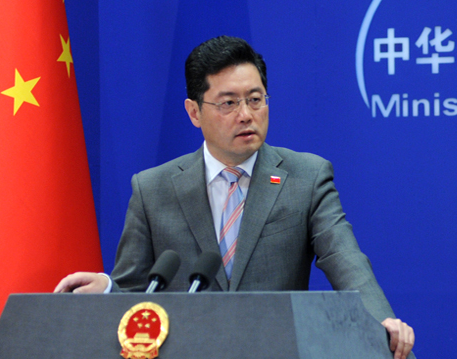
China’s new ambassador to the United States in a hard-hitting speech on Wednesday urged that Washington drop its Cold War mentality in its relations with Beijing. Ambassador Qin Gang emphasized that China is “not the Soviet Union” – demanding that US leaders drop this flawed guiding  assumption.

“The Soviet Union’s collapse was its own making. The Communist Party of the Soviet Union had been rigid, corrupt, closed to the outside world, and detached from the people,” Qin said while addressing an event at the National Committee on US-China Relations. “It had been obsessed with arms race and external aggression. As a result, the country’s development halted.”

Amb. Qin Gang

Noting that China is clearly different, he underscored the robust trade relationship with the US is what keeps China strong and growing, saying it remains mutually beneficial.

“China never bets its own future on other countries. We only want to surpass ourselves. We never take surpassing the US as our goal, and we never have the ambition to challenge and displace America, or to seek hegemony in the world,” he said.

“Our two countries should not be enemies, but partners. Over 70,000 American companies have investments in China, and these investments pay well,” he explained. “I believe that both countries can benefit from the development and prosperity of the other side.”

He took the occasion to lash out at Trump administration policies, which “caused serious damage” to the US-China relationship, but also took aim at Biden’s flawed rhetoric of the two countries being in competition to “win the 21st century.” Further Politico reviewed a list grievances leveled at the current administration as follows:

The list of Qin’s grievances ranged from a warning against U.S. support for Taiwan independence to criticism of the Biden administration’s endorsement of a World Health Organization probe into the origins of the coronavirus.

U.S. government restrictions on the operations of blacklisted Chinese telecom equipment firm Huawei and a raft of China-focused draft legislation moving through Congress drew his most concentrated fire.

Qin accused the Biden administration of leveraging “state power to bring down Huawei” and warned that the passage of legislation, including the EAGLES Act and the Innovation and Competition Act of 2021, “will hijack China-U.S. relations and gravely damage America’s own interests.”

He also condemned the US stepped up military activity near China’s coast, while still emphasizing these ‘aggressions’ are ultimately symptomatic of the false Cold War mentality by US policymakers. 

Tyler Durden
Thu, 09/02/2021 – 17:00

via ZeroHedge News https://ift.tt/3jL20wp Tyler Durden

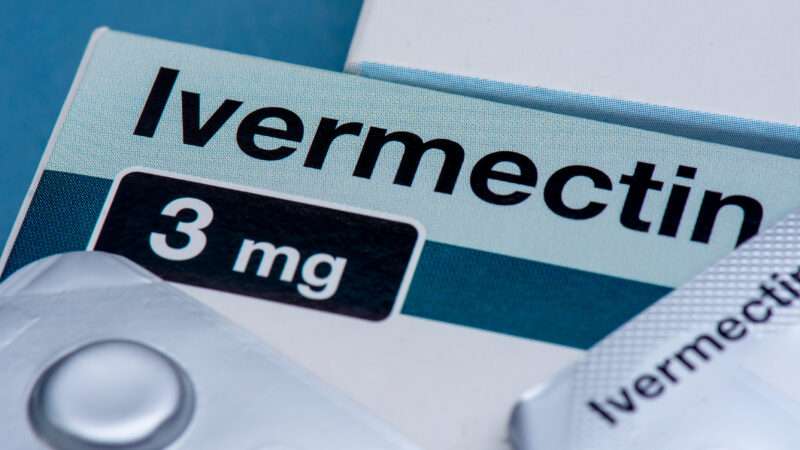
Unfortunately, Ivermectin Is Not a Miracle Cure for COVID-19


ivermectinDreamstime

Diagnosed with COVID-19, the popular podcaster Joe Rogan reportedly says that he has taken the anti-parasitic drug ivermectin as a treatment for the disease. Although the 54-year-old has called himself a “fucking moron” with respect to his earlier misguided ruminations about COVID-19 vaccinations and said “I’m not a respected source of information, even for me,” he is not so moronic that he relied solely on this drug to treat his illness. He also availed himself of a more high-tech, lab-grown, medically proven monoclonal antibody treatment and steroids to fight off the virus. Rogan has not revealed if he has taken a COVID-19 shot.

So what do researchers know about the effectiveness of ivermectin, approved for human use but best known as a horse deworming medicine, in treating COVID-19? At the beginning of the pandemic, scientists around the globe began testing thousands of existing medications in test tubes to see if they could be repurposed to fight against the novel coronavirus. In very preliminary research, researchers found that ivermectin significantly inhibited COVID-19 coronaviruses in cell cultures.

Encouraged by these petri dish findings, some desperate clinicians began administering ivermectin to their COVID-19 patients. The result was a number of hopeful observational studies by clinicians reporting that ivermectin appeared to be effective—in some cases, highly effective—in preventing COVID deaths. Observational studies are notoriously subject to researcher biases and confounders that can mislead clinicians into thinking an intervention works when actually a third factor is responsible.

Nevertheless, a prominent group of American physicians calling themselves the Front Line COVID-19 Critical Care Alliance (FLCCC) combined these preliminary observational and epidemiological studies into a November 13, 2020, preprint meta-analysis asserting that ivermectin “has highly potent real-world, anti-viral, and anti-inflammatory properties against SARS-CoV-2 and COVID-19.” Among other findings, the FLCCC pointed to reports that widespread distribution of ivermectin in Peru had correlated with steep declines in COVID-19 cases and mortality there. According to the group, cases and deaths began to rise dramatically in the same country after the government ceased distributing the drug.

On December 8, 2020, less than a month after the preprint was posted, FLCCC member Pierre Kory was invited by Sen. Ron Johnson (R–Wisc.) to testify before the Senate Committee on Homeland Security and Governmental Affairs. “Ivermectin is effectively a ‘miracle drug’ against COVID-19,” he asserted. (Just three days later, the Food and Drug Administration approved the almost miraculously effective Pfizer-BioNTech COVID-19 vaccine for use.)

Kory further testified: “We are in a pandemic. We are at war. Stop pretending this is peacetime where we are conducting business as usual. The NIH [National Institutes of Health] must rapidly review the data and make a recommendation.” In February 2021, the NIH did just that. “There is insufficient evidence,” the agency concluded, “to recommend either for or against the use of ivermectin for the treatment of COVID-19.”

Since everything that can be politically polarized about this pandemic will be politically polarized, ivermectin ended up being adopted as a therapeutic cause celebre by various talking heads and politicos, most of them on the political right. Most recently, Sen. Rand Paul (R–Ky.) claimed, “The hatred for Trump deranged these people so much, that they’re unwilling to objectively study it.” The senator evidently believes that ivermectin research has been sidelined by being somehow tainted by former president’s ultimately baseless claims that the malaria medicine hydroxychloroquine was an effective COVID-19 treatment. (For the record: Hydroxychloroquine was not used to treat Trump when he fell gravely ill with COVID-19 last October. But the former president was treated with monoclonal antibodies, just as Rogan has been.)

Despite Paul’s claims, research on ivermectin’s efficacy in treating COVID-19 has been ongoing. Has this subsequent research validated Kory’s claim that ivermectin is a miracle drug against COVID-19? It’s complicated, but the answer is largely no.

First: Those dramatic Peruvian results are highly confounded. The steep rise in COVID-19 cases and deaths in that country can most likely be blamed on the breakout of the highly infectious lambda variant rather than to a halt in ivermectin distribution. Meanwhile, the newly reported results of a highly anticipated randomized controlled study of ivermectin in next door Brazil finds that the medicine had “no effect whatsoever” on the disease.

A lot of the hope that ivermectin would be a COVID-19 silver bullet arose from the findings of various meta-analyses, including the one conducted by the FLCCC, that combined the results of various observational studies and small randomized controlled trials. One of the more prominent recent ones was posted as a preprint in May by a team of British public health researchers led by the Newcastle University statistician Andrew Bryant. But other scientists have faulted that study for significant methodological failures.

Also, though it’s not the preprint’s researchers fault, one of the most important studies bolstering their conclusion has been withdrawn because its results appear to be fraudulent. Once the data from that study are removed, the Bryant meta-analysis finds essentially no efficacy for treating COVID-19 with ivermectin.

On July 28, 2021, the authors of a more painstaking meta-analysis of ivermectin COVID-19 treatment studies, published by the Cochrane Library, concluded:

Based on the current very low‐ to low-certainty evidence, we are uncertain about the efficacy and safety of ivermectin used to treat or prevent COVID‐19. The completed studies are small and few are considered high quality. Several studies are underway that may produce clearer answers in review updates. Overall, the reliable evidence available does not support the use of ivermectin for treatment or prevention of COVID‐19 outside of well‐designed randomized trials.

The FLCCC folks are surely sincere, but the best evidence suggests that they are sincerely wrong. The bottom line is that while ivermectin might have some marginal efficacy, it is certainly not a “miracle drug” when it comes to treating COVID-19.

The good news is that Rogan reports that he is feeling better. That is almost certainly due to an infusion of monoclonal antibodies against the COVID-19 virus, not downing a couple of ivermectin tablets.

from Latest – Reason.com https://ift.tt/3mU0BFH
via IFTTT

Unfortunately, Ivermectin Is Not a Miracle Cure for COVID-19


ivermectinDreamstime

Diagnosed with COVID-19, the popular podcaster Joe Rogan reportedly says that he has taken the anti-parasitic drug ivermectin as a treatment for the disease. Although the 54-year-old has called himself a “fucking moron” with respect to his earlier misguided ruminations about COVID-19 vaccinations and said “I’m not a respected source of information, even for me,” he is not so moronic that he relied solely on this drug to treat his illness. He also availed himself of a more high-tech, lab-grown, medically proven monoclonal antibody treatment and steroids to fight off the virus. Rogan has not revealed if he has taken a COVID-19 shot.

So what do researchers know about the effectiveness of ivermectin, approved for human use but best known as a horse deworming medicine, in treating COVID-19? At the beginning of the pandemic, scientists around the globe began testing thousands of existing medications in test tubes to see if they could be repurposed to fight against the novel coronavirus. In very preliminary research, researchers found that ivermectin significantly inhibited COVID-19 coronaviruses in cell cultures.

Encouraged by these petri dish findings, some desperate clinicians began administering ivermectin to their COVID-19 patients. The result was a number of hopeful observational studies by clinicians reporting that ivermectin appeared to be effective—in some cases, highly effective—in preventing COVID deaths. Observational studies are notoriously subject to researcher biases and confounders that can mislead clinicians into thinking an intervention works when actually a third factor is responsible.

Nevertheless, a prominent group of American physicians calling themselves the Front Line COVID-19 Critical Care Alliance (FLCCC) combined these preliminary observational and epidemiological studies into a November 13, 2020, preprint meta-analysis asserting that ivermectin “has highly potent real-world, anti-viral, and anti-inflammatory properties against SARS-CoV-2 and COVID-19.” Among other findings, the FLCCC pointed to reports that widespread distribution of ivermectin in Peru had correlated with steep declines in COVID-19 cases and mortality there. According to the group, cases and deaths began to rise dramatically in the same country after the government ceased distributing the drug.

On December 8, 2020, less than a month after the preprint was posted, FLCCC member Pierre Kory was invited by Sen. Ron Johnson (R–Wisc.) to testify before the Senate Committee on Homeland Security and Governmental Affairs. “Ivermectin is effectively a ‘miracle drug’ against COVID-19,” he asserted. (Just three days later, the Food and Drug Administration approved the almost miraculously effective Pfizer-BioNTech COVID-19 vaccine for use.)

Kory further testified: “We are in a pandemic. We are at war. Stop pretending this is peacetime where we are conducting business as usual. The NIH [National Institutes of Health] must rapidly review the data and make a recommendation.” In February 2021, the NIH did just that. “There is insufficient evidence,” the agency concluded, “to recommend either for or against the use of ivermectin for the treatment of COVID-19.”

Since everything that can be politically polarized about this pandemic will be politically polarized, ivermectin ended up being adopted as a therapeutic cause celebre by various talking heads and politicos, most of them on the political right. Most recently, Sen. Rand Paul (R–Ky.) claimed, “The hatred for Trump deranged these people so much, that they’re unwilling to objectively study it.” The senator evidently believes that ivermectin research has been sidelined by being somehow tainted by former president’s ultimately baseless claims that the malaria medicine hydroxychloroquine was an effective COVID-19 treatment. (For the record: Hydroxychloroquine was not used to treat Trump when he fell gravely ill with COVID-19 last October. But the former president was treated with monoclonal antibodies, just as Rogan has been.)

Despite Paul’s claims, research on ivermectin’s efficacy in treating COVID-19 has been ongoing. Has this subsequent research validated Kory’s claim that ivermectin is a miracle drug against COVID-19? It’s complicated, but the answer is largely no.

First: Those dramatic Peruvian results are highly confounded. The steep rise in COVID-19 cases and deaths in that country can most likely be blamed on the breakout of the highly infectious lambda variant rather than to a halt in ivermectin distribution. Meanwhile, the newly reported results of a highly anticipated randomized controlled study of ivermectin in next door Brazil finds that the medicine had “no effect whatsoever” on the disease.

A lot of the hope that ivermectin would be a COVID-19 silver bullet arose from the findings of various meta-analyses, including the one conducted by the FLCCC, that combined the results of various observational studies and small randomized controlled trials. One of the more prominent recent ones was posted as a preprint in May by a team of British public health researchers led by the Newcastle University statistician Andrew Bryant. But other scientists have faulted that study for significant methodological failures.

Also, though it’s not the preprint’s researchers fault, one of the most important studies bolstering their conclusion has been withdrawn because its results appear to be fraudulent. Once the data from that study are removed, the Bryant meta-analysis finds essentially no efficacy for treating COVID-19 with ivermectin.

On July 28, 2021, the authors of a more painstaking meta-analysis of ivermectin COVID-19 treatment studies, published by the Cochrane Library, concluded:

Based on the current very low‐ to low-certainty evidence, we are uncertain about the efficacy and safety of ivermectin used to treat or prevent COVID‐19. The completed studies are small and few are considered high quality. Several studies are underway that may produce clearer answers in review updates. Overall, the reliable evidence available does not support the use of ivermectin for treatment or prevention of COVID‐19 outside of well‐designed randomized trials.

The FLCCC folks are surely sincere, but the best evidence suggests that they are sincerely wrong. The bottom line is that while ivermectin might have some marginal efficacy, it is certainly not a “miracle drug” when it comes to treating COVID-19.

The good news is that Rogan reports that he is feeling better. That is almost certainly due to an infusion of monoclonal antibodies against the COVID-19 virus, not downing a couple of ivermectin tablets.

from Latest – Reason.com https://ift.tt/3mU0BFH
via IFTTT

Perfect Phone Call? Republicans Demand Unedited Transcript After Biden Tells Afghan President To Lie

Perfect Phone Call? Republicans Demand Unedited Transcript After Biden Tells Afghan President To Lie

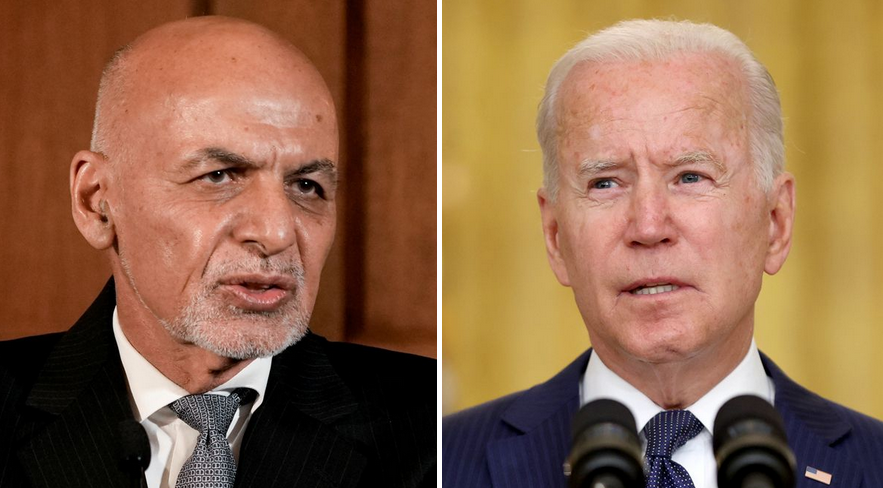
Outraged House Republicans sent a Thursday letter to President Joe Biden demanding the White House release a full, unedited transcript from his call with former Afghan President Ashraf Ghani, after Reuters reported that Biden asked Ghani to lie about how the fight against the Taliban was going in order to “change perception” that they were winning “whether it’s true or not.”

According to excerpts, Ghani pushed back.

“Mr. President, we are facing a full-scale invasion, composed of Taliban, full Pakistani planning and logistical support, and at least 10-15,000 international terrorists, predominantly Pakistanis thrown into this, so that dimension needs to be taken account of,” he said, adding that the Afghan Security Forces wouldn’t be able to maintain control without close air support from America, which Biden promised to provide if Ghani would lie.

The Republican letter, spearheaded by Rep. Claudia Tenney (NY), was signed by 26 other House Republicans, according to the Daily Caller.

In it, the lawmakers blasted Biden’s handling of the withdrawal from Afghanistan after 13 U.S. service members were killed in a terror attack at the Kabul airport and call and demand Biden release the full, unedited and unredacted transcripts of his July 23 conversation with Ghani to the public. -DC

“In the period leading up to the withdrawal, your administration made a series of false assurances to the American people and our allies regarding the situation on the ground. The contrast between your Administration’s official spin and the reality on the ground revealed a bewildering lack of coherence, strategy, and fundamental transparency. It appeared repeatedly as if your Administration was engaging in a deliberate effort to conceal the truth and mislead the American public. On August 31, new evidence emerged that suggests this is exactly what you have been doing since the start of this operation,” reads the letter.

“A troubling new revelation arose that demands immediate explanation. Reuters released excerpts from a July 23 conversation between yourself and Afghan President Ashraf Ghani in which you reportedly pressure Ghani to ‘project a different picture’ than the reality on the ground ‘whether it is true or not.’ The transcripts also indicate that you promised to provide air support to the Afghan military, a vow you never fulfilled.”

“This damning phone call further erodes your credibility and the confidence of the American people in your ability to lead. Your disturbing emphasis on ‘perception,’ a term you used four times in the Reuters excerpts of the call with Ghani, over substance and truth demands scrutiny and accountability,” the letter adds.

(DAILY CALLER OBTAINED) — … by Henry Rodgers

As we noted yesterday, Senate Minority Leader Mitch McConnell has ruled out impeachment over Biden’s lie.

Some Republicans, including Tennessee Sen. Marsha Blackburn, Sen. Josh Hawley of Missouri  and South Carolina Sen. Lindsey Graham, have since said that the President should resign or face impeachment.

It seems that some phone calls are just more ‘perfect’ than others. 

Tyler Durden
Thu, 09/02/2021 – 16:40

via ZeroHedge News https://ift.tt/3zJG1v2 Tyler Durden

This Is How America’s Ultra Wealthy Are Evading The Democrats’ New Taxes

This Is How America’s Ultra Wealthy Are Evading The Democrats’ New Taxes

For most Americans, the term Private Placement Life Insurance, or PPLI, is financial gibberish. But for the ultra-wealthy, those who represent the top 0.1% in the wealthy pyramid, that acronym represents financial freedom from the coming Democratic tax hike tsunami.

As many ultra wealthy Americans – those whose net worth is $20 million and over – scramble for places to hide from Democrat plans to hike their taxes, many on Wall Street think they’ve found just the thing, and as Bloomberg reports today the tax oasis is a niche strategy called private placement life insurance, which is was already gaining popularity among the very rich for its ability to shield fortunes from taxes. Advisers to the top 0.1% already say it’s dominating conversations with their clients.

The threat of higher taxes, which President Biden has affectionately called making billionaires and millionaires pay their “fair share”, isn’t the only factor sparking interest in PPLI: as Bloomberg’s Ben Steverman writes, “a little-noticed change in US insurance law at the end of 2020 makes the tool more powerful, at the same time that competition among insurance carriers and advisory firms is giving rich investors more flexibility, lower costs and a wider choice of products on PPLI platforms.”

The math is simple: as long as assets are held in a PPLI policy, they escape taxes, much to the horror of wealth redistributionists like Elizabeth Warren. When the holder of a PPLI policy dies, heirs inherit the PPLI’s contents tax-free, a perk which strikes at the heart of Biden’s plans to get the very wealthy to pay more taxes on their investments, especially on capital gains that currently aren’t levied if assets are held until death.

Daniel Hemel, a law professor at University of Chicago, said that “Private placement life insurance poses a serious obstacle to President Biden’s goal of guaranteeing that high-income individuals pay tax on large gains at least once per lifetime.” He is talking with Democrats in Washington about ways to limit the strategy. “PPLI is a massive loophole — entirely legal, easy to exploit, and politically very hard to close.”

“Clients are very interested in this right now,” said Tara Thompson Popernik, director of research for Bernstein Private Wealth Management’s wealth planning and analysis group. “It takes some education to get them to wrap their heads around the concept, because it’s not just buying life insurance.”

And once they get educated – put money, don’t pay taxes – they like it. That’s precisely why more and more assets are flowing into the PPLI strategy, yet even so it remains a tiny slice of the trillions of dollars held by the richest Americans. The American Council of Life Insurers, the industry’s trade group, doesn’t even track PPLI policies. If Biden and Democrats are successful in passing a reconciliation bill that hikes taxes, the strategy may go more mainstream, at least among those with the most capital gains to protect from the Internal Revenue Service.

To be sure, PPLI has its drawbacks: according to Bloomberg, complicated rules determine whether a PPLI policy qualifies as life insurance — an important distinction because that’s what gives these accounts their tax benefits. The policies can fail if not funded properly over time. Also once assets are inside a PPLI, they can’t be taken out without a big tax bill, but though they can be borrowed against or rolled into another insurance product.

IRS rules also require policyholders give up day-to-day control of their PPLI’s investment choices and the portfolio needs to be diversified in particular ways, hardly a dealbreaker for those who have already made their money and are only seeking to avoid handing it over to Uncle Sam.

On the other hand, qualifying as life insurance comes with unique perks. Death benefits, paid when an insured person passes away, avoid all taxes, and gains on investments held within an insurance policy build up tax-free. The tool can also be combined with other loopholes: Family offices, for example, can buy PPLI policies inside dynasty trusts, which are vehicles that let multiple generations of wealthy heirs avoid the estate tax.

To exploit its advantage to the maximum, advisers try to stuff as much money into a PPLI while paying as little as possible in insurance costs. “Really the point is to not pay a lot for the insurance piece,” Thompson Popernik said.

The bare minimum one needs to start a PPLI policy is about $2 million, but it’s far more common for investors to devote at least $5 million to the strategy, enough to make the administrative and legal startup costs worthwhile. Withdrawing money from a PPLI while you’re still alive is taxable, so billionaires will be sure to only deploy money that they will never need.

In other words, as Bloomberg notes, one has to be extremely wealthy to even think about a tax shelter like PPLI. “Rich people can do things other people can’t,” said Edward Gordon, president of Preservation Capital Partners. Gordon said he’s “so busy it’s not even funny” advising clients on PPLI policies.

It gets better: a Covid-relief law signed by President Trump in December makes PPLI even more attractive as the package contained a provision that changes the interest rate assumptions on life insurance policies. The politically powerful life insurance industry had argued the current rules were unworkable in a low-interest rate environment, so Congress relaxed the requirement for policies to qualify for favorable tax treatment. As Steverman explains, though lobbyists’ primary goal was tweaking the rules affecting ordinary life insurance products, the upshot is that the wealthy can now put more money into a PPLI policy while paying less to an insurance carrier for life coverage.

“You want to maximize every dollar you can put into the policy,” said David Kleinhandler, principal at life insurance advisory firm AskVest. “There’s a lot of opportunity for people to take advantage of these new regulations.”

While PPLIs has spread in popularity, it has been primarily pitched to clients as a place to put investments, like hedge funds or credit products, that generate lots of income taxable at the top rate. These can surpass 50% when you include the top federal ordinary rate of 37% and state and local income taxes in California and New York City. If all investments are subject to the ordinary rates — as Biden has proposed for those earning more than $1 million per year — then a broader array of investments make sense in PPLI policies.

Meanwhile, Democrats in Congress, who are beginning the process of turning Biden’s tax plan into legislation, disagree on how much to hike rates on capital gains. Because of the growing legislative attention, the potential pitfalls and complexity of PPLI, clients who are initially interested sometimes end up thinking twice before committing their money, advisers say.

“This can get very complicated, and there is a percentage of our clients who value simplicity above all things,” said Jon Ripchick, wealth strategist at Ayco, a firm owned by Goldman Sachs Group Inc. that offers financial planning to corporate executives.

So who is the biggest distributor of PPLI services? We doubt it will come as a shock that Blackstone, via its Lombard International subsidiary, dominates the market, but several other firms are now offering the product. To improve their pitch to the wealthy and their most-trusted advisers, some providers are now allowing those advisers to keep control of the PPLI investments. To comply with the rules, PPLI assets need to go in a separate account that clients technically don’t have any input on. But clients often choose their own adviser to manage that fund, and set goals for how they want it invested.

So what happens next? Well, if Democrats want their tax revolution not to be derailed by a simple loophole, one option they have to stop the wealthy from using PPLI to escape taxes is to cap the size of life-insurance death benefits. Another is to write stricter IRS regulations, perhaps further limiting the control that policyholders are allowed to have over investment choices.

Otherwise, as University of Chicago’s Hemel warned warns, PPLI is a “relatively easy workaround that will allow high-net-worth individuals to generate virtually unlimited amounts of investment income while avoiding capital gains taxes during life and at death.”

Tyler Durden
Thu, 09/02/2021 – 16:20

via ZeroHedge News https://ift.tt/3mScdJg Tyler Durden

Cryptos Jump, Small Caps Pumped, & Dollar Dumps To 1-Month Lows

Cryptos Jump, Small Caps Pumped, & Dollar Dumps To 1-Month Lows

As payrolls data looms tomorrow, today was relatively quiet ahead of the long weekend with the dollar perhaps stealing the headlines as it slipped further, now at one-month lows as claims were flat and productivity and factory orders all slowed considerably (and Morgan Stanley and Goldman Sachs continue to ratchet down GDP growth expectations)…

Source: Bloomberg

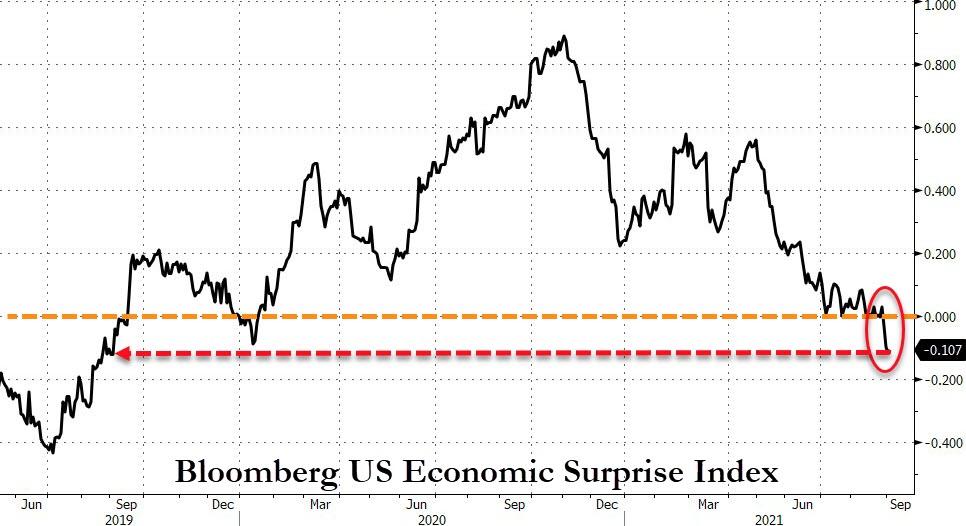
US Macro data has been serially disappointing for months, now back at its weakest since Aug 2019…

Source: Bloomberg

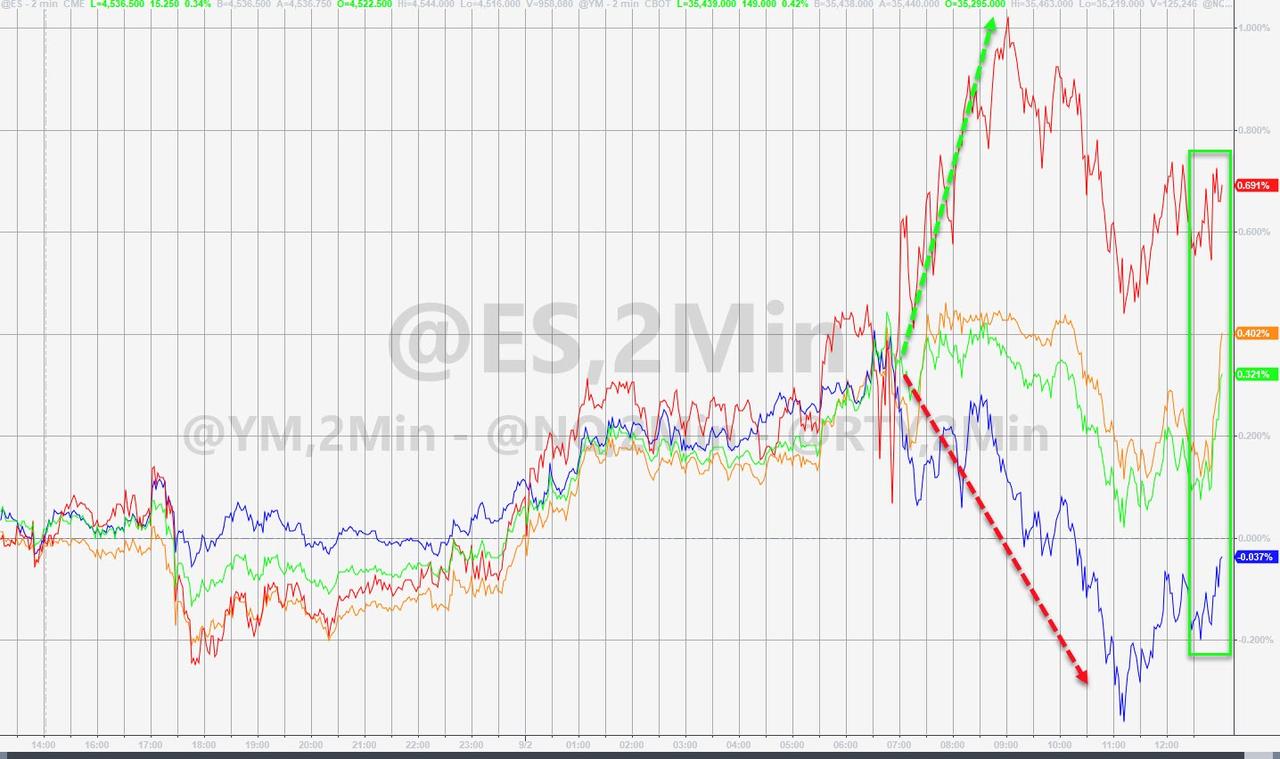
But, of course, stocks don’t care and did what stocks do… levitate. Apart from Nasdaq, the major US equity indices ended higher with Small Caps outperforming…

Record highs for the Nasdaq and S&P 500.

A reminder…

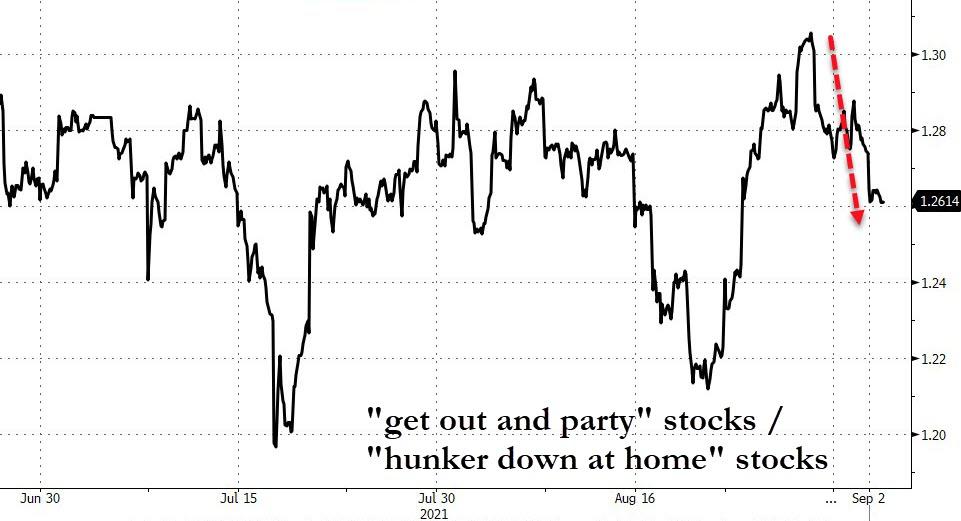
“hunker down at home” stocks outperformed “get out and party stocks” again today…

Source: Bloomberg

The short squeeze continues…

Source: Bloomberg

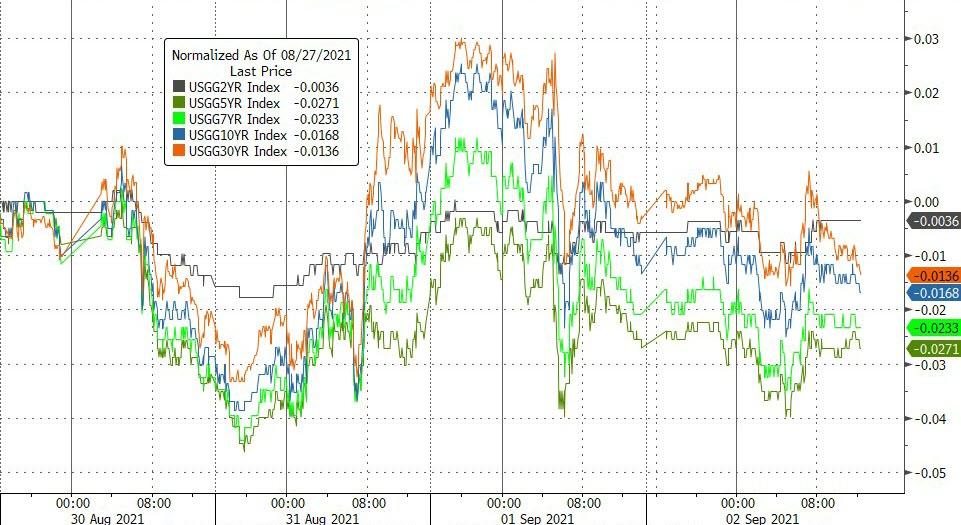
Bonds went nowhere on the day with the long-end maybe edging the rest of the curve and falling around 1bps…

Source: Bloomberg

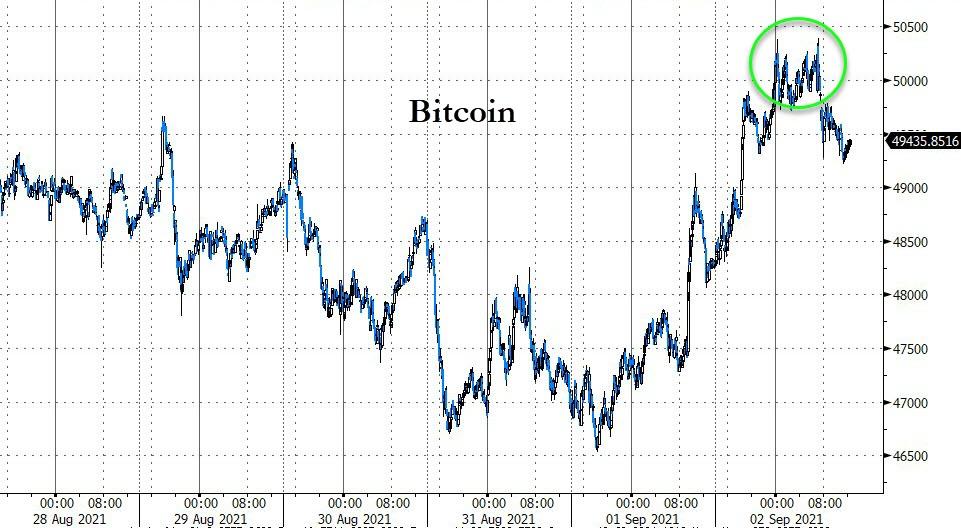
As the dollar dipped today, cryptos rallied with bitcoin back above $50k intraday…

Source: Bloomberg

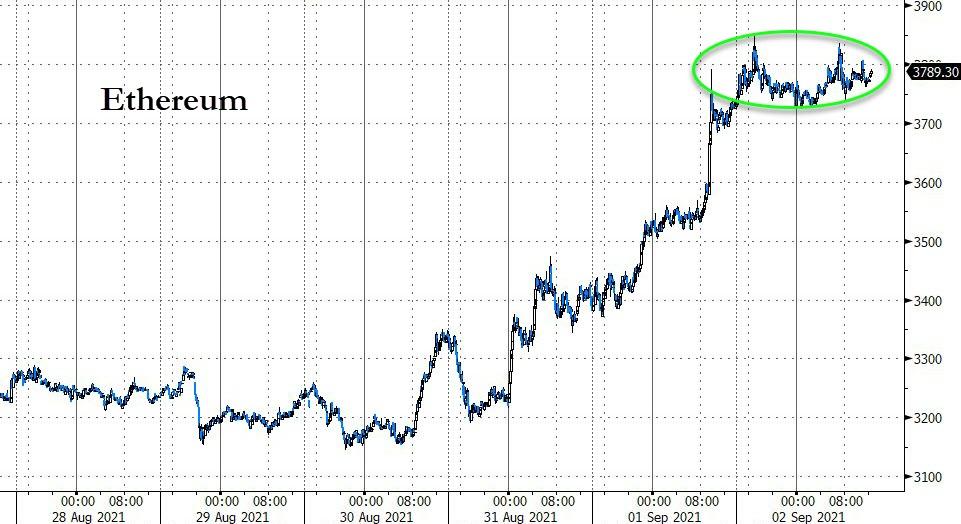
And Ethereum topped $3800…

Source: Bloomberg

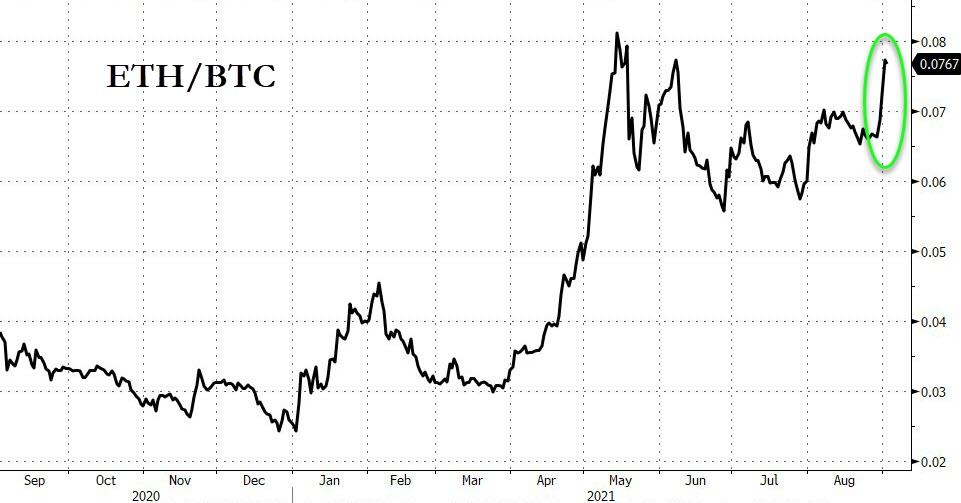
ETH is finding resistance once again at recent highs relative to BTC…

Source: Bloomberg

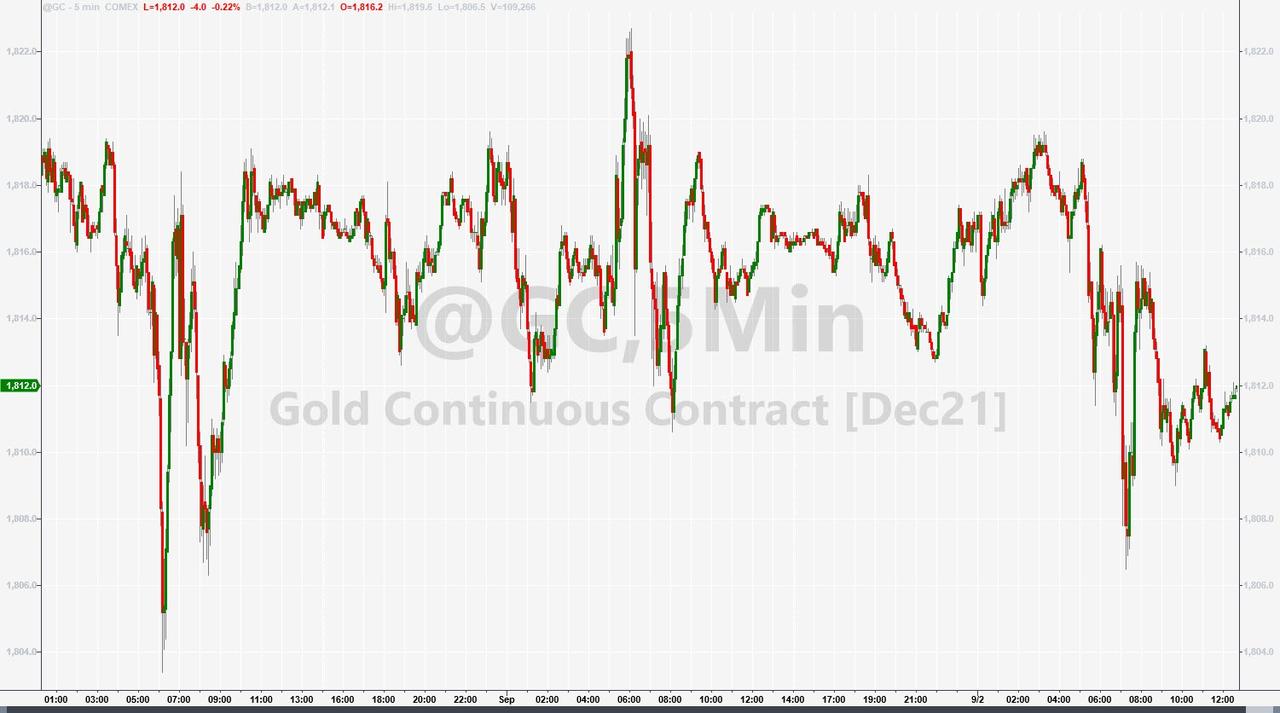
Despite the dollar’s drop, Gold chopped around ending the day lower…

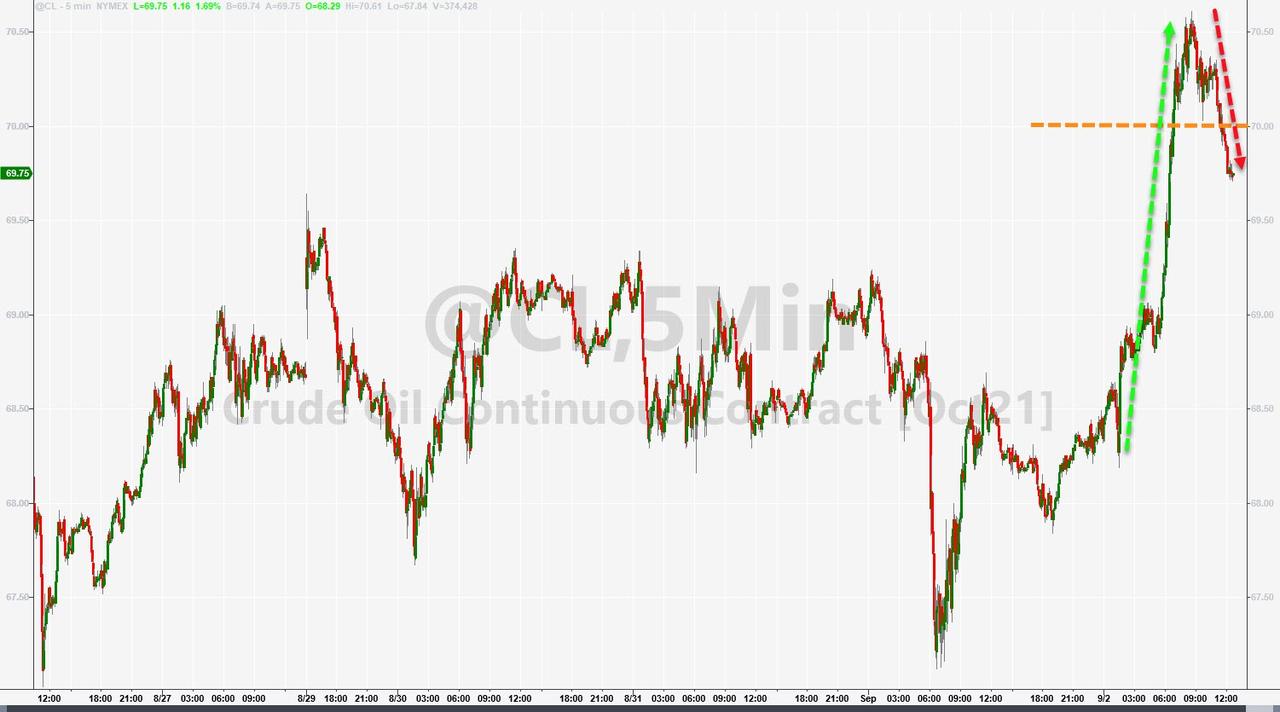
But oil spiked with WTI back above $70 intraday…

Finally, ahead of tomorrow’s “most important ever” payrolls print, we note that a record 50% of small businesses now have job openings… and yet there are 6 million fewer Americans working that before the pandemic lockdowns…

Source: Bloomberg

“Unintended consequence” or Cloward-Piven plan all along?

Tyler Durden
Thu, 09/02/2021 – 16:01

via ZeroHedge News https://ift.tt/3BzhMjS Tyler Durden

An Indictment Accuses Three Cops and Two Paramedics of Killing Elijah McClain With a Cascade of Legal, Tactical, and Medical Errors


Elijah-McClain-selfie

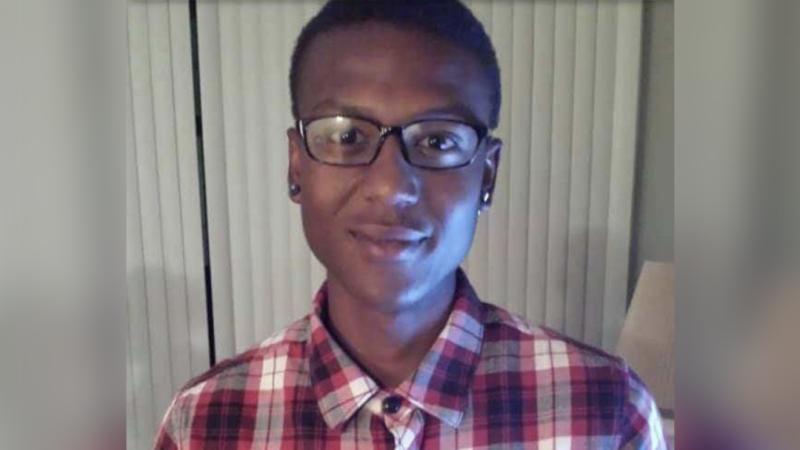
On a Saturday night in August 2019, Elijah McClain was walking home from an Aurora, Colorado, convenience store, where he had just bought three cans of iced tea, when he was accosted by police, who ultimately killed him. McClain, a 23-year-old massage therapist, could not understand what he had done to provoke this confrontation—which is not surprising, because there was no legal justification for stopping, frisking, arresting, or assaulting him.

Yesterday, Colorado Attorney General Phil Weiser announced that a statewide grand jury had indicted three officers and two paramedics who were involved in this baffling incident. The officers (Nathan Woodyard, Jason Rosenblatt, and Randy Roedema) and paramedics (Jeremy Cooper and Peter Cichuniec) face a total of 32 charges, including manslaughter, criminally negligent homicide, and second-degree assault.

“We have the solemn duty to prosecute this case and recognize that it will be difficult to prosecute—these types of cases always are,” Weiser said. “Our goal is to seek justice for Elijah McClain, for his family and friends, and for our state. In so doing, we advance the rule of law and the commitment that everyone is accountable and equal under the law.”

The rule of law was violated from the moment when Woodyard, responding to a 911 call from a teenager who thought McClain “look[ed] sketchy,” ordered McClain to stop. McClain, who was listening to music on earbuds, evidently did not hear Woodyard, and the situation immediately escalated.

Woodyard grabbed McClain, and he and Rosenblatt forced him to a grassy area, where they tackled him, applied a “carotid control” twice, handcuffed him, and pinned him to the ground as he temporarily lost consciousness, repeatedly vomited, and repeatedly complained that they were hurting him and that he could not breathe. Roedema joined the assault, using a “bar hammer lock,” which involved pulling McClain’s arm behind his back. Roedema later said he “cranked pretty hard” on McClain’s shoulder and heard it pop three times. In response to what they perceived as “excited delirium,” Cooper and Cichuniec, the paramedics, injected McClain with an overdose of the anesthetic ketamine.

By the end of this encounter, McClain had no pulse and had to be resuscitated in the ambulance with an injection of epinephrine. He never regained consciousness, and he was declared brain dead three days later. According to the indictment, McClain “suffered hypoxia, cerebral hypoxia, hypoxemia, metabolic acidosis, aspiration, [and] respiratory arrest.” The Adams County Coroner’s Office said the cause of McClain’s death was “undetermined” but added “it may be a homicide if the actions of officers led to his death.” A forensic pathologist cited in the indictment concluded that McClain died due to complications from his violent treatment and the ketamine. He said the manner of death was homicide.

Now let’s go back to the beginning of the encounter. What grounds did Woodyard and the other officers have for stopping McClain, let alone violently subduing him?

Despite the warm weather, McClain was wearing sweat pants, a jacket, a knit cap, and a ski mask, reportedly because he had anemia, one symptom of which is cold extremities. The 911 caller thought the ski mask was suspicious. He also reported that McClain was making “all these kinds of signs” with his hands. The caller added that “he might be a good person or a bad person.” He said no one was in danger and he had not seen any weapons.

In a report issued last February, an independent panel of legal, law enforcement, and medical experts concluded that none of this amounted to “reasonable suspicion” of criminal activity, the standard for an involuntary street stop. “Officer Woodyard’s decision to turn what may have been a consensual encounter with Mr. McClain into an investigatory stop—in fewer than ten seconds—did not appear to be supported by any officer’s reasonable suspicion that Mr. McClain was engaged in criminal activity,” the report said. “This decision had ramifications for the rest of the encounter.”

After grabbing McClain, Woodyard decided to frisk him, a step that is legally justified only if police reasonably suspect the subject is armed. Yet the 911 caller had not reported any weapons (a point that was noted in the police dispatcher’s message), McClain was plainly holding nothing but his phone and the plastic bag from the convenience store, and Woodyard himself later said he “felt safe making an approach” because McClain “didn’t have any weapons.” The panel’s report said “we were not able to identify sufficient evidence that Mr. McClain was armed and dangerous in order to justify a pat-down search.”

The panel said the decision to tackle and pin McClain “likewise cannot be justified by the record.” At this point, Woodyard’s unjustified investigatory stop became an arrest, which is constitutionally permissible only when police have probable cause to believe someone has committed a crime. That is a higher standard than reasonable suspicion, a test the cops had already failed to meet. “Since Officer Woodyard’s order to him to stop, the only facts that had changed were Mr. McClain’s attempt and stated intention to keep walking in the direction he had been going and his ‘tensing up,'” the report said. “In the Panel’s view, none of these facts would be sufficient to establish probable cause of a crime.”

While the officers were manhandling McClain, Roedema exclaimed, “He grabbed your gun, dude.” That statement, Woodyard claimed, “changed the situation.” Roedema later said he was referring to Rosenblatt’s gun. But according to the indictment, Rosenblatt “stated that he did not feel any contact with his service weapon.”

In any case, the independent panel noted, “Once he was lying on the ground, Mr. McClain’s ability to reach an officer’s gun or other weapons was limited by the fact that Officer Woodyard was on the ground behind him, with his gun and pepper spray pinned beneath him.” If McClain “was no longer presenting a threat of harm to the officers, there would have been no justification for Officer Woodyard to apply a carotid hold.” The body camera footage is unclear at this point, because the cameras were dislodged during the struggle. But the available record “does not provide evidence of the officers’ perception of a threat that would justify Officer Woodyard’s carotid hold, which caused Mr. McClain to either partially or fully lose consciousness.”

A carotid hold involves pressing on the sides of the neck to induce temporary unconsciousness by cutting off blood flow to the brain. Woodyard’s use of a carotid hold followed Rosenblatt’s unsuccessful attempt at the same maneuver. “The risk of hypoxia and cerebral hypoxia was exacerbated by applying two carotid control holds,” the indictment says. The three officers “had all been trained that the carotid hold posed dangers and should never be administered more than once.”

The indictment notes that McClain “vomited multiple times while being restrained.” Some of that vomit was found inside his ski mask, which he could not remove while he was restrained but “ultimately came off” after he was handcuffed. “Gurgling sounds by Mr. McClain were audible in body-worn camera video footage,” which was “evidence of potential aspiration.” McClain’s breathing “further indicated he had hypoxia following the police restraint and use of the carotid control hold.”

McClain was 5 feet, 7 inches tall and weighed 143 pounds. But the officers, who said McClain’s strength was “crazy” and “incredible” because of “whatever he’s on,” claimed their violence was justified because he resisted their unlawful attack on him. Providing further evidence of how everyone at the scene exaggerated the threat posed by McClain, Cooper gave him too much ketamine because he estimated that the short, slender man weighed 200 pounds, which was off by 57 pounds, or 40 percent.

After about two minutes on the scene, the indictment says, Cooper and Cichuniec “both concluded that Mr. McClain was suffering from excited delirium.” As three medical experts note in a 2020 Brookings Institution article, “law enforcement officers nationwide are routinely taught that ‘excited delirium’ is a condition characterized by the abrupt onset of aggression and distress, typically in the setting of illicit substance use, often culminating in sudden death.” But “this ‘diagnosis’ is not recognized by the vast majority of medical professionals. In fact, ‘excited delirium’ is not recognized by the American Medical Association, the American Psychiatric Association, or the World Health Organization.”

The indictment says Cooper and Cichuniec reached their conclusion about McClain’s condition “after receiving some information from officers and observing Mr. McClain for about one minute.” The cops were convinced that McClain was “definitely on
something,” and they repeatedly grilled him about what drugs he had taken. “Weed,” he said, but they did not believe him. Toxicology tests later found nothing psychoactive in McClain’s blood except for THC and the ketamine.

The indictment notes that neither paramedic “ascertained Mr. McClain’s vital signs, nor did either of them talk to or physically touch Mr. McClain before diagnosing him with excited delirium.” Based on body camera footage, “an emergency room physician with expertise in paramedic protocols concluded that excited delirium was an inaccurate diagnosis born of the paramedics’ failure to adequately assess Mr. McClain’s symptoms, and further concluded that ketamine should never have been administered.”

No one at the scene questioned that decision. “Yep, sounds good,” Rosenblatt said when Cooper announced that he planned to inject McClain with ketamine. “Perfect, dude, perfect,” Roedema agreed.

Piling error upon error, Cooper administered 500 milligrams of ketamine. Even if McClain actually weighed 200 pounds, that was too high a dose. “At that weight,” the indictment says, “in accordance with the standing order from [the paramedics’] medical director, Mr. McClain should have been administered 453 mg of Ketamine.” The correct dose for a 143-pound man would have been 325 milligrams, so McClain was given 175 milligrams too much, or 54 percent more than he should have received, even assuming that an involuntary ketamine injection was appropriate to begin with. The indictment notes that “the paramedics did not ask Mr. McClain how much he weighed.”

The cascade of legal, tactical, and medical errors that led to McClain’s death is especially appalling because all he wanted to do was go home, as he had every right to do. “Let me go,” he told Woodyard after the officer grabbed him. “I am an introvert! Please respect the boundaries that I am speaking. Stop. Stop! I’m going home!” The cops responded to McClain’s perfectly understandable objections by telling him to “relax,” “stop tensing up,” and “please cooperate.” To which McClain replied: “No. Can you leave me alone?” For reasons only they can fully understand, they could not.

from Latest – Reason.com https://ift.tt/3mX9M89
via IFTTT