Rate Hikes: The Beatings Will Continue Until Morale Declines

Rate Hikes: The Beatings Will Continue Until Morale Declines

Stagflationary crisis events are relatively rare in modern history, and the average mainstream economist will have very little input to give on why they happen and how they can be solved.  Their knowledge is limited on the issue and their experience is non-existent.  

It has been argued by alternative analysts for several years now that the majority of banking executives, investors and economists entering the field in the past decade have never worked within a financial environment without direct monetary intervention by central banks.  They can’t even comprehend a world where the Federal Reserve does not artificially support equities, bonds and other elements of the system.  They have no concept of consequences.

This dynamic is finally being acknowledged by those in the mainstream. Alison Harding-Jones, vice chair of corporate and investment and head of M&A in EMEA at Citigroup, recently noted that the majority of junior bankers had never worked in an investment world without the existence of cheap money. These people are about to experience a rude awakening beyond anything they can imagine.   

It was the long term existence of central bank support that conditioned many economists into assuming the easy money party would never end.  The Fed will step in, they say, because the Fed has always stepped in and nothing will ever change.  But things always change, and the notion that the Fed cares about the longevity of the markets is naive.  The past year alone has debunked that little theory, with rates continuing to climb.

A cycle of cope has formed with a predictable set of reactions – The Fed suggests hikes will continue, the mainstream freaks out.  The Fed then suggests that “one day” the hikes might stop, maybe sooner maybe later.  The mainstream rejoices and interprets the comments to mean that the Fed is about to pivot, markets rocket higher.  Then, the Fed does not pivot, and they freak out again.

No one is asking the question that really matters here:  Why is it so important what the Fed says about rate hikes?  Why is the entire system dependent on their whims?  This is not how it should be.  

The US economy is addicted to cheap money like that money is heroin, and many elements of the system just can’t let it go.  People thought that the central bankers, our resident drug dealers, would never stop providing the fix.  They thought that there was incentive for the Fed to continue dealing that delicious fiat.  But the easy money drug has diminishing returns and the addict is acclimated.  The negative health effects are starting to set in, the addict is beginning to die, and the dealer wants to distance himself from the corpse.

Stagflation has arrived and now there is no reason for the central bank to continue providing easy money because there is nothing to be gained.  

The circumstances surrounding stagflation are chaotic.  Certain sectors of the economy will go into steep decline while others will appear to remain resilient.  For example, US jobs numbers came in far hotter than expected this month (some might suggest a little too hot for reality), inspiring the Biden White House to claim a victory in the midst of fiscal defeat.  At the same time, the US is facing an unprecedented manufacturing slowdown, a housing market sales implosion, a GDP sinking back into contraction, a rising poverty rate, an explosion in homelessness, etc. 

It might be confusing – Why is there better than expected employment numbers and in some cases retail numbers while there is also a major contraction across the board in multiple other areas of the economy?  That’s what happens when a central bank pumps over $8 trillion into the veins of the system in only two years, on top of tens of trillions of dollars over the past decade.  That money is circulating rapidly and wearing down the gears of the machine, some parts break while others still function.  

These are the effects of stagflation, as well as the effects of a central bank which is now abandoning the inflation game and actively seeking to create a deflationary event.  Without the endless trillions in free money which kept the system on life support since 2008/2009, they will get what they want eventually, but it will take time.  

Meaning, the Fed is going to continue with rate hikes well into next year until there is a hard landing; there will be no “soft landing” and Jerome Powell knows this.  He openly warned about it back in the October Fed meeting of 2012, stating that the economy would not know how to function without stimulus measures because those measures had been active for so long.  That was 10 years ago; imagine how bad things are today.

Powell is all too aware of the effects of rate hikes into economic weakness and stagflationary crisis.  He knows what is about to happen, and Joe Biden’s economic advisers likely know as well.  

In the meantime, an important issue that the Fed and many mainstream economists don’t want to discuss is that prices continue to remain painful on most necessities no matter how high interest rates go.  Rent is high, food is high, energy prices fell due to Biden’s market manipulation but are still high, home prices are high, vehicle prices are high, everything is incessantly expensive for the average consumer.  This is not going to stop anytime soon.  

Once stagflation takes hold it hangs on like a bad rash.  When jobs numbers finally hit a wall (and they will, probably by the second quarter of next year), costs will still be suffocating the public’s savings.  If the goal is truly an engineered deflation event that reduces money velocity and drags down prices, we have to ask ourselves how long will that take to accomplish?  Two years?  Five years?  How high will rates have to go?  Maybe only 5%, maybe 10%, maybe more.  How much damage will be done to the middle class and the poor as this process unfolds?  

The Fed does not care.  Those hoping for an immediate pivot should understand that the rate hike beatings will continue until morale declines.  The quantitative tightening will stop when the contraction has fully pummeled the jobs market and the populace in general.  

Tyler Durden
Sun, 12/04/2022 – 18:00

via ZeroHedge News https://ift.tt/CGYaDyg Tyler Durden

UC San Diego Students Say Strike Disrupting Classes, Exams

UC San Diego Students Say Strike Disrupting Classes, Exams

Authored by Micaela Rocaforte via The Epoch Times (emphasis ours),

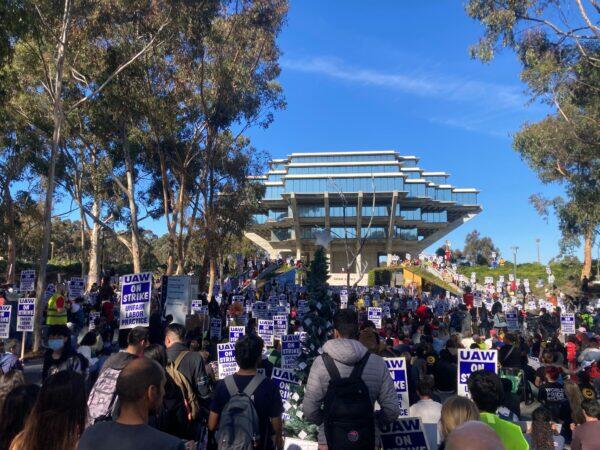
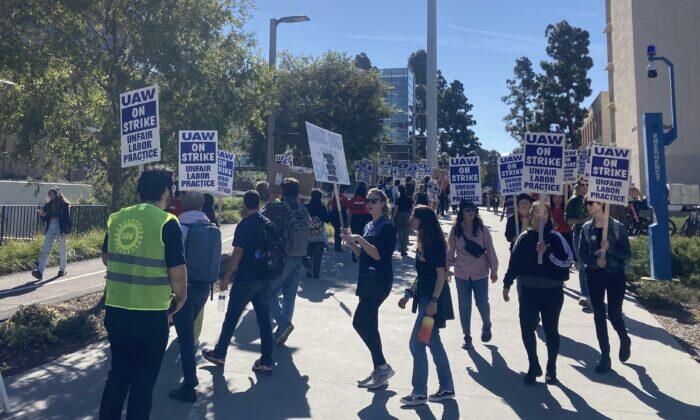
As finals week commences, students at the University of California–San Diego say they are feeling the impact of the largest academic worker strike in U.S. history, now in its third week.

Researchers and student employees protest at the University of California–San Diego in San Diego, Calif., on Nov. 14, 2022. (Courtesy of Philip Zhu)

After months of negotiating pay raises, 48,000 researchers and student employees across all 10 University of California (UC) campuses launched a strike Nov. 14, demanding pay raises due to cost-of-living increases.

This has left some classes without instructors and professors without teaching assistants to grade assignments ahead of end-of-semester exams.

Researchers and student employees protest at the University of California–San Diego’s Geisel Library in San Diego, Calif., on Nov. 14, 2022. (Courtesy of Philip Zhu)

Tarah Lachmandas, a third-year communications major at UC–San Diego, said that while faculty in her department supports the strike, they have adapted final exams to accommodate the absence of teaching assistants.

Our assignments were not graded. They were just marked complete or incomplete,” Lachmandas told the Epoch Times. “And in another class, the professor removed essay questions from the final exam, so it’s just going to be all multiple choice.”

Tristan Fhaardo, a second-year chemical engineering major, said the structure of his classes were upset by the strike.

Attendance in a lot of my lectures has gone down, since teaching assistants were the ones to [take] attendance,” Fhaardo said. “Assignments have been more lenient because [there’s no one to] grade them, and classes have felt a lot more jumbled and disorganized since the strike started.”

However, for Desi—a graduate student and neuroscience researcher on strike, who declined to provide his last name—that’s the goal.

The whole point of the strike is to cause disruption,” Desi told The Epoch Times. “It takes a collective action to create change. … We’re not doing this because we don’t want to work … We’re doing this because we deserve to be able to pay our bills and rent.”

Researchers and student employees protest at the University of California–San Diego in San Diego, Calif., on Nov. 14, 2022. (Courtesy of Philip Zhu)

Other graduate students disagreed with the United Auto Workers’—the union representing the strikers—methods of negotiating higher wages.

Philip Zhu, a chemistry graduate student and teaching assistant who did not strike, told The Epoch Times he thought students still deserved to get the education they paid tuition for.

Although the strike is intended to pressure the university, students are the direct victims,” Zhu said. “I believe if the bargaining team cares … there will be better strategies that don’t place all the power in ‘doing damage’ to force the other party to do what they demand.”

UC officials struck a tentative deal with postdoctoral scholars and academic researchers Nov. 29—though they say they will not return to work until the demands of the graduate students are met.

However, the union’s demands for graduate and student workers could prove to be a bit more complicated.

UC Provost Michael Brown said Nov. 14 that two of the group’s demands—tying compensation to housing costs and waiving nonresident tuition for out-of-state and international students—could cost the UC system up to several hundred million dollars per year and be unfair to resident students, since nonresident students would be given a larger compensation package for the same workload.

Tyler Durden
Sun, 12/04/2022 – 17:25

via ZeroHedge News https://ift.tt/CmHUNAu Tyler Durden

Bipartisan Group Of US Senators Warns CCP Over Quelling Of Protests

Bipartisan Group Of US Senators Warns CCP Over Quelling Of Protests

Authored by Michael Washburn via The Epoch Times (emphasis ours),

As protests continue to rage throughout China over the regime’s harsh COVID-19 policies, and the police respond with notable force, a bipartisan group of U.S. senators has sent a sharply worded letter to Beijing’s ambassador to Washington, Qin Gang, warning of “grave consequences for the U.S.-China relationship” if the communist regime carries out a crackdown reminiscent of the Tiananmen Square massacre of 1989.

A man is arrested while protesters gathered on a street in Shanghai on Nov. 27, 2022. Protests against China’s ‘zero-COVID’ policy took place the night before following a deadly fire in Urumqi, the capital of the Xinjiang region. (Hector Retamal/AFP via Getty Images)

One of the lead signers, Sen. Dan Sullivan (R-Alaska), said in a statement accompanying the letter’s publication on Dec. 1 that the world’s response to Beijing’s efforts to quell the protests has been “tepid at best.” Hence Sullivan and the other signers saw a need to speak out and warn Beijing about what would happen if it failed to respect the right of citizens to signal their opposition to the severe COVID policies that have deprived millions of Chinese of freedom of movement.

The letter emphasizes the nonviolent character of the protests going on in China, implying that any abusive and violent conduct on the part of the regime’s forces will be illegal and unethical.

We are following the current peaceful protests in China over your government’s policies very carefully. We are also closely watching the Chinese Communist Party’s (CCP) reaction to them,” the letter states.

The letter goes on to remind Ambassador Gang about the notorious events of June 1989, which drew worldwide condemnation and became a synonym for excessive force on the part of an authoritarian regime.

“In 1989, the Chinese Communist Party and People’s Liberation Army undertook a violent crackdown on peacefully protesting Chinese students, killing hundreds, if not thousands,” the letter states, before issuing a stark warning.

We caution the CCP in the strongest possible terms not to once again undertake a violent crackdown on peaceful Chinese protestors who simply want more freedom. If that happens, we believe there will be grave consequences for the U.S.-China relationship, causing extraordinary damage to it,” the letter concludes.

Read more here…

Tyler Durden
Sun, 12/04/2022 – 16:50

via ZeroHedge News https://ift.tt/6h980lC Tyler Durden

Antifa Aims To Disrupt Florida Rally Opposing The Sexualization Of Children

Antifa Aims To Disrupt Florida Rally Opposing The Sexualization Of Children

Authored by Jannis Falenstern via The Epoch Times (emphasis ours),

A rally organized to out activism that encourages children to question their gender identity and sexual orientation has inspired fury.

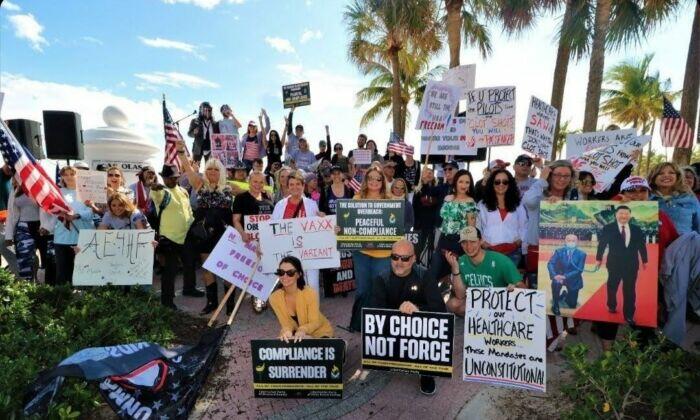
Florida Fathers for Freedom members and others gather on Jan. 23, 2022, in Fort Lauderdale, Fla., at a “Defeat the Mandate” rally to protest forced masking. (Courtesy of Florida Fathers for Freedom)

Now, threats of a rage-filled counter-protest have rally organizers requesting law enforcement officers to attend their planned gathering on Dec. 3 at a beach in Fort Lauderdale, Florida.

Conflict bubbled up after three very different groups organized the Protect the Children rally to display solidarity against policies aimed at sexualizing children, alienating them from their parents, and helping them pursue gender-transition treatment. They plan to gather at Fort Lauderdale Beach on the corner of Las Olas Boulevard at 11 a.m.

Local chapters of Moms for Liberty, Fathers for Freedom, and Gays Against Groomers wanted to come together to peacefully speak against “radicalized sexual curriculum, gender ideology, child grooming, parental alienation, and ‘gender-affirming care,’” said Eulalia Jimenez, president of the Moms for Liberty Miami chapter.

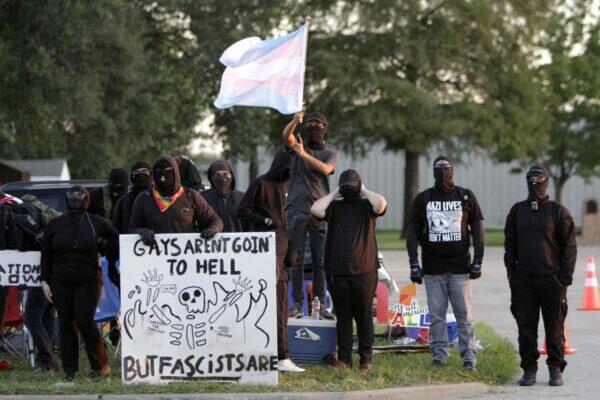
But when Antifa members heard of the gathering, they urged their peers in Twitter posts to “confront this hatred” and “protest against hate.” They referred to Protect the Children rally organizers as “fascists” proliferating “stochastic terrorism,” and spread fliers that read, “We can’t allow this kind of bigotry to go unchecked.”

The term “stochastic terrorism” refers to public demonization through so-called “hate speech,” which some say can be used to incite violence against a person or group.

Antifa members display their own signs at the site of a protest against a drag bingo event at a church in Katy, Texas, on Sept. 24, 2022. (Bobby Sanchez for The Epoch Times)

A flier for the Antifa response urges, “Assert your right to exist! Counter protest against far-right bigotry and stand with the LGBTQ+ community. Bring masks, signs, and rage. Stand against those who aim to erase your existence.”

Jimenez isn’t surprised. Antifa members often disrupt Moms for Liberty gatherings and shout down parents speaking at local school board meetings, she said.

The Protect the Children rally was planned at the beach because it’s a place where people congregate, a “good spot to spread awareness, empower others, and create unity,” Jimenez said.

She hopes the event will be about peace, unity, “empowering others and informing parents and citizens,” she said. “We feel children should have the right to be children.”

The rally isn’t meant to be against other groups.

“It’s not about ugliness and nastiness,” Jimenez said. “And unfortunately, the other side, that’s the way they roll.”

Hijacking LGBT

Antifa’s rhetoric harms the gay community, said Anthony Raimondi, a board member of Gays Against Groomers (GAG).

“As an organization, we want to protect the LGBT community in the sense that the community has been hijacked,” Raimondi told The Epoch Times.

Years ago, gay people erroneously were assumed to be pedophiles, he said.

“We have come so far” in dispelling that assumption, he said. But in the current culture, as many gay people and others oppose efforts to block the sexualization of children, “it’s almost like we’ve been set back,” Raimondi said.

On social media, GAG founder Jaimee Michell has described her group as “a coalition of gays against the sexualization, indoctrination, and medicalization of children.”

Gays Against Groomers posted on its Twitter feed that the gay community has “fought for decades to dismantle binary gender stereotypes, just for radicals to build them up again, and butcher and sterilize children who don’t abide by them.”

Michell also has posted on Twitter, “There is no such thing as a trans kid.”

Anthony Raimondi, a board member of the Miami chapter of Gays Against Groomers, plans to speak at a Protect the Children rally on Fort Lauderdale Beach on Dec. 3, 2022. (Courtesy of Anthony Raimondi)

Jimenez understands the frustration. She’s not just the local leader of the conservative group Moms for Liberty. She’s also the mother of a gay daughter. So she values groups like Gays Against Groomers, she says, because they’ve “stood up and said, ‘No! You’re not going to use us.’”

Jimenez respects that they assert, “We choose [whom] to love, but we don’t push anything on the kids.”

She also has compassion for those participating in Antifa activities. Many, she said, are kids who are just being used.

“Many of them don’t even understand what is really going on,” Jimenez said. “They’re just so desperate for love and attention, and they’re going about it the wrong way.

“Others,” she continued, “are just plain—in my opinion—evil and they do not care who they hurt and what they have to do to get what they want.”

Antifa has the right to assemble, says Florida Fathers for Freedom organizer Elon Gerberg. He’s not worried about the group’s so-called “counter-protest,” calling it nothing more than a “distraction.”

The Protect the Children rally is “about coming together to bring attention to this attack on our children,” Gerberg told The Epoch Times. “In my opinion, they are our most precious commodities and our future leaders. If we can’t stand up for them, who can you stand up for?”

In signing the Parental Rights in Education bill in March, Florida Gov. Ron DeSantis, a Republican, “put his head on the chopping block for parents and the children of the state,” Gerberg said.

Before it was signed into law, the five-page legislation was debated around the country and was reviled by its opponents, who misleadingly referred to the measure as the “Don’t Say Gay Bill.”

Despite what opponents said, the bill doesn’t prohibit teachers or students from discussing a child’s questions about sexual orientation or gender identity, and it doesn’t keep them from talking about LGBT loved ones in class.

Read more here…

Tyler Durden
Sun, 12/04/2022 – 16:15

via ZeroHedge News https://ift.tt/FYwMpZe Tyler Durden

Stocks Have “Considerably More Downside” & Commodities Have A “Brand New Tailwind” In 2023

Stocks Have “Considerably More Downside” & Commodities Have A “Brand New Tailwind” In 2023

Submitted by QTR’s Fringe Finance

Friend of Fringe Finance Mark B. Spiegel of Stanphyl Capital released his most recent investor letter last week, with his updated take on the market’s valuation and Tesla.

Mark is a recurring guest on my podcast (and will be coming back on again soon hopefully) and definitely one of Wall Street’s iconoclasts. I read every letter he publishes and only recently thought it would be a great idea to share them with my readers.

Like many of my friends/guests, he’s the type of voice that gets little coverage in the mainstream media, which, in my opinion, makes him someone worth listening to twice as closely.
Photo: Real Vision

Mark was kind enough to allow me to share his thoughts from his November 2022 investor letter.

Mark’s Thoughts On Macro

Despite the stock market’s recent rally (we were up a hell of a lot more this month before today!) we  continue to carry a large SPY short position, as I believe the major indexes—although not all individual  stocks—have considerably more downside to go, the inevitable hangover from the biggest asset bubble in U.S. history.

For far too long, the Fed printed $120 billion a month and held short-term rates at zero while the government concurrently ran a record fiscal deficit. Now, thanks to the massive inflationary  hangover from those idiotic policies (November’s “not as bad as feared” data not withstanding), the Fed is reducing its balance sheet and raising interest rates, and although the current rate of high-7% year over-year inflation is unsustainable, the eventual end of China’s “zero-Covid policy” and its November reversal on bailing out its real estate industry combined with the end of Biden’s SPR drawdowns will give commodity prices a brand new tailwind in 2023.

Longer term, the war on fossil fuel, expensive “onshoring,” fewer available workers and perpetual government budget deficits make a new baseline of  around 4% inflation (double the Fed’s 2% target) likely. 

Even a 2023 Fed interest rate “pause” at 4.75% (and remember, a “pause” is not a “pivot”!) would,  combined with $90 billion a month in ongoing QT, make current stock market valuations unsustainable,  as stocks are still expensive.

[QTR’s note: This echos Kenny Polcari’s sentiments & my sentiments of recent.]

According to Standard & Poor’s, with 97% of companies having reported, Q3 S&P 500 GAAP earnings came in at around $44.79, which annualizes to $179.16. (And these were the sixth  highest quarterly earnings in history; i.e., they were not “trough.”)

A 16x multiple on that—generous for  a rising rate, recessionary (or even just slow-growth) environment—would bring the S&P 500 down to 2867 vs. November’s close of 4080.11. And remember, just as in bull markets, PE multiples usually overshoot to the upside, in bear markets they often overshoot to the downside. A bottom formed at a  considerably lower multiple is not unfathomable. 

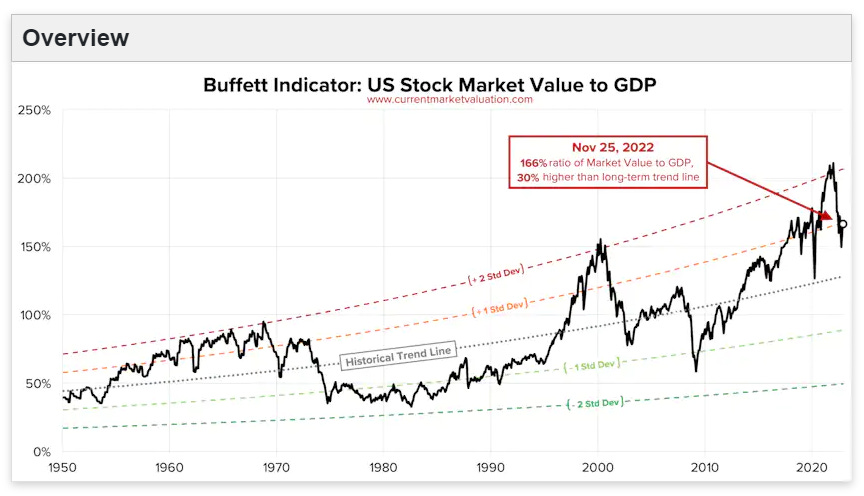
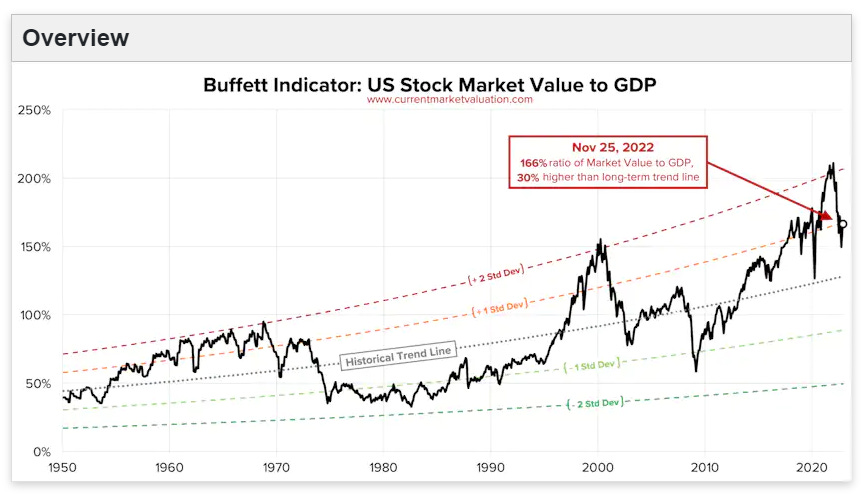
Additionally, we can see from CurrentMarketValuation.com that the U.S. stock market’s valuation as a  percentage of GDP (the so-called “Buffett Indicator”) is still very high, and thus valuations have a long way  to go before reaching “normalcy”:
Regarding sentiment, we can see from Ed Yardeni that in the Investors Intelligence poll the highest the “bear percentage” got so far in the current market was only around 45% (in the most recent poll it was just 31.5%), yet there were multiple times during the 1980s, 1990s and 2008 that it climbed much higher: 
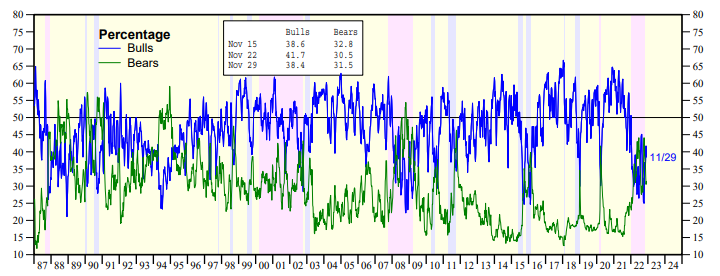
Also, we can see from this old academic paper that during the grinding bear market of 1973 to 1975, when  the S&P 500’s GAAP PE multiple dropped from 18x to 8x, the bears in the Investors Intelligence poll climbed to around 75% and went over 80% during the bear markets of the 1960s.

So if you think that based on this bear market’s sentiment we’ve “seen the bottom,” I wish you luck!

Meanwhile, interest costs on the Federal debt are already set to grow massively. Does anyone seriously think this Fed has the stomach to face the political firestorm of Congress having to slash Medicare, the  defense budget, etc. in order to pay the even higher interest cost that would be created by upping those rates to a level commensurate with crushing even just 4% inflation?

Powell doesn’t have the guts for that, nor does anyone else in Washington; thus, this Fed will likely be behind the inflation curve for at least a  decade. And that’s why we remain long gold (via the GLD ETF). 

Mark On His Fund’s Positions (Positions May Change At Any Time)

We continue to own automaker Stellantis (STLA), which has a great balance sheet with plenty of net cash (and a 7% dividend yield!) and which—at a current price of $15.62/share—sells for only around 3x 2022 earnings estimates of $5.26/share.

I believe Jeep alone (which in September announced a full  electrification strategy) could be worth more than what we paid for the entire company, which also  includes Dodge, Chrysler, Ram, Fiat, Citroen, Peugeot, Opel, Alfa Romeo, Vauxhall, Lancia and Maserati. And if current EV sales are your interest, Stellantis already has Europe’s best-selling mass-market model. 

We continue to own Volkswagen AG (via its VWAPY ADR, which represent “preference shares” that are  identical to “ordinary” shares except they lack voting rights and thus sell at a discount). VW currently sells  for around 4.2x estimated 2022 earnings due to a combination of “recession fears” and short-term issues obtaining energy (until either the Ukraine war is over or alternative supplies are in place), but it controls a massive number of terrific brands including Porsche, of which it recently IPO’d a small percentage at  a $73 billion valuation, thus valuing the rest of the company at only around $10 billion; I believe Audi  alone is worth 4x that! And a Lamborghini IPO may be next. Additionally, VW will pay a January special  dividend of around $1.90 per VWAPY share in proceeds from Porsche’s IPO, and the regular yield is  currently over 5%!

Meanwhile VW Group’s EVs (several of which are more technologically advanced than  any Tesla) combine to heavily outsell Tesla in Europe and by 2025 may outsell Tesla worldwide.

We continue to own General Motors (GM), which currently sells for only around 6.5x the $6.26/share  midpoint of its 2022 GAAP EPS guidance (which was reiterated in November). GM is doing all the right  things in electric cars, autonomous driving (via its Cruise ownership) and software, yet it’s cheap because,  as with other established automakers, many investors have (for now) forsaken it in favor of “electric car  pure-plays,” a sector which has thus become the largest valuation bubble in history.


Get 50% off: If you enjoy this article, would like to support my work, I would love to have you as a subscriber and can offer you 50% off for lifeGet 50% off forever


And regarding  “autonomy,” keep in mind that unlike Tesla, which sells a LiDAR-less fraud to rubes, Cruise is already  running a fleet of fully autonomous cars in San Francisco (and soon Phoenix and Austin); you can see many  videos of this on its YouTube channel. GM will also benefit more than any other manufacturer from the  proposed new EV tax credit, as it will soon have the largest variety of North American-made (a requirement of the credit) EV models fitting within the new price restrictions. Additionally, in August the  company reinstituted a modest dividend.

I thus consider these positions (Stellantis, GM and VW) to be both “freestanding value stock buys” and “relative-value paired trades” against our Tesla short.One oft heard knock against “the autos” is a belief  that their recent earnings have been “peak,” but keep in mind that due to supply chain issues they all  sold around 20% fewer cars than they otherwise could have. Thus, I believe those recent earnings are more like “strong midcycle” and should likely have around a 10x run-rate PE, not the current 3x to 6x. Also, thanks to those same supply chain issues they’re much lighter on inventory than they’d normally  be heading into a recession. Therefore, I believe these stocks have considerable upside from here. 

We continue to own Fuel Tech Inc. (FTEK), a seller of air and water pollution control technologies, which in November reported a solid Q2, with revenue up 6.1% year-over-year (although at a lower gross margin),  .01/share in GAAP earnings and around $600,000 in free cash flow. At a current price of $1.24/share with  30.3 million shares outstanding and $33.9 million in cash and Treasuries (and no debt), this is a 43% gross  margin business selling for an enterprise value of only around 0.14x 26.4 million in TTM revenue. This is  the kind of company that will either ignite growth and its stock will take off (its new “Dissolved Gas  Infusion” water treatment technology is a potential medium-term catalyst for that), or it’s so cheap that  it will make for a good strategic acquisition target, as removing the costs of being an independent public  company could make it instantly earnings-accretive while allowing the buyer to acquire a nice chunk of  revenue very cheaply. In short, I think it’s a good “value stock” in which to park some money and see what  happens. 

And now, Tesla… 

Despite big, margin-slashing price cuts in both China and Europe, Tesla delivery wait times worldwide  have declined substantially, down to just one week in China while in the U.S. (where Musk’s Twitter boondoggle is rapidly destroying the brand) Tesla is choking on Model 3 inventory and offers December Model Y delivery, while Europe’s backlog is expected to be completely gone by year-end. This means Tesla’s production capacity now outstrips its rate of incoming orders despite the new German and Texas  factories producing at only around 10% of capacity! 

Meanwhile, combined deliveries for the last two quarters (Q2 & Q3 2022) were lower than those for  the previous two quarters (Q4 2021 & Q1 2022). As Tesla slashes prices it will undoubtedly sell more  cars (I expect Q4 deliveries to be in the range of around 400,000 vs. previous quarters in the 300,000s,  thanks to the cuts plus a rush to beat year-end expiring EV incentives in China, Germany and France), but any other car company can slash prices and do the same thing. (Welcome to the auto business,  which currently sells for around 5x earnings!) Tesla’s apparent market saturation rate of around 1.6 million cars/year worldwide (at least until it slashes prices yet again!) is massively below its current factories’ production capacity, much less the bulls’ absurd expectations of adding a new factory every six months for the next ten years!

For some valuation perspective, BMW sells around 2 million cars a year with very high margins  (including the best electric SUV now on the market (the new iX), the best luxury EV( the new i7), and  among the best small luxury EVs (the new i4), and has a market cap of around $59 billion. If Tesla grew annual deliveries to the size of BMW’s and had BMW-level margins, at BMW’s current market cap it  would sell for less than $19/share vs. this month’s closing price in the $194s! (Remember: Tesla now  has 3.16 billion shares outstanding!) 

Meanwhile, Elon Musk remains the most vile person ever to head a large-cap U.S. public company, and  we remain short Tesla, the biggest bubble-stock in modern market history, because: 

1) It has a sliding share of the world’s EV market and a share of the overall auto market that’s less than 2%, yet a market cap almost as big the next 6 largest automakers (by market cap) combined

2) It has no “moat” of any kind; i.e., nothing meaningfully proprietary in terms of its electric  car technology (which has now been equaled or surpassed by numerous competitors) and its previously proprietary Superchargers are being opened to everyone), while existing  automakers—unlike Tesla—have a decades-long “experience moat” of knowing how to  mass-produce, distribute and service high-quality cars consistently and profitably. 

3) Excluding working capital benefits and sunsetting emission credit sales Tesla generates only  minimal free cash flow. 

4) Growth in sequential demand for Tesla’s cars is at a crawl relative to expectations.

5) Elon Musk is a pathological liar. 

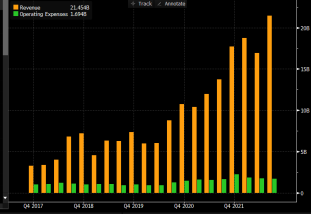
In October Tesla claimed that it had Q3 GAAP earnings of around .87/share excluding sunsetting emission  credit sales. If you believe that after viewing this chart (courtesy of Twitter user @Keubiko), I have a bridge to sell you in Brooklyn:
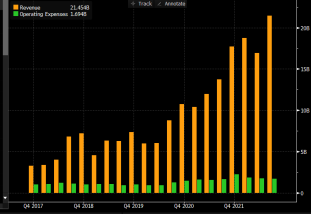
Orange is revenue, green is operating expenses

Furthermore, Tesla’s minimal depreciation of its new factories appears fraudulently low, as does its  warranty reserve. 

Even if you believe Tesla’s clearly nonsensical earnings number, it annualizes to only $3.48/share, which  based on November’s closing price of $194.70 = a run-rate PE ratio of around 56 for a now slow-growing (or growing-but-margin-slashing) car company in an industry with a current average PE of around 5. 

Meanwhile, Tesla has objectively lost its “product edge,” with many competing cars now offering comparable or better real-world range, better interiors, similar or faster charging speeds and much better quality. (Tesla ranks near the bottom of Consumer Reports’ reliability survey while British consumer  organization Which? found it to be one of the least reliable cars in existence.) Thus, due to competitors’ temporary production constraints, waiting times are now longer for many of Tesla’s direct EV competitors than they are for a Tesla.  

In fact, Tesla is likely now the second, third or fourth choice for many EV buyers, and only maintains its  volume lead though a short-lived edge in production capacity that will disappear over the next 12 to 36 months as competitors rapidly increase the ability to produce their superior EVs. Tesla’s poorly-built  Model Y faces current (or imminent) competition from the much better made (and often just better

electric Hyundai Ioniq 5, Kia EV6, Ford Mustang Mach E, Cadillac Lyriq, Nissan Ariya, Audi Q4 e-tron, BMW  iX3, Mercedes EQB, Volvo XC40 Recharge, Chevrolet Blazer EV & $30,000 Equinox EV and Polestar 3. And  Tesla’s Model 3 now has terrific direct “sedan competition” from Volvo’s beautiful Polestar 2, the great  new BMW i4, the upcoming Hyundai Ioniq 6 and Volkswagen Aero, and multiple local competitors in  China. 

And in the high-end electric car segment worldwide the Porsche Taycan (the base model of which is now  considerably less expensive than Tesla’s Model S) outsells the Model S, while the spectacular new BMW  i7, Mercedes EQS, Audi e-Tron GT and Lucid Air make it look like a fast Yugo, and the extremely well  reviewed new BMW iX, Mercedes EQS SUV and Audi Q8 eTron (as well as multiple new Chinese models)  do the same to the Model X. 

Indeed, for years I’ve said “Tesla is Blackberry”—the maker of a first-generation version of a product  that—once the market was proven—would be supplanted into niche obscurity by newer, better versions;  now I can provide a much more recent analogy: Tesla is Netflix.

For years Netflix had an absurd valuation  based on its pioneering position in streaming media, but once it proved that such a market existed myriad  competitors swarmed all over it, and this year the stock collapsed when we learned that not only is Netflix  no longer in “hypergrowth” mode but for the first time since 2011 (when it transitioned from physical  DVDs) it actually lost subscribers. I believe Musk knows that Tesla is “the next Netflix” (hence his recent  “Twitter buying distraction”), with VW, Hyundai/Kia, Ford, GM, Stellantis, BMW, Mercedes, BYD & other  Chinese competitors and, in a few years, Toyota & Honda, being the Disney, HBO Max, Amazon Prime, Peacock, Hulu, Paramount +, etc., of the electric car market, stealing Tesla’s share and eventually  pounding its stock price down 90% or so from today’s, into the valuation of “just another car company.”

Despite this obvious “writing on the wall,” many Tesla bulls sincerely believe that ten years from now the  company will be twice the size of Volkswagen or Toyota, thereby selling around 20 million cars a year (up  from the anticipated Q4 annualized run-rate of around 1.6 million); in fact in May Musk himself even  raised this as a possibility. Setting aside the absurdity of selling that many cars into the limited market of Tesla’s high price points, the “logistical absurdity” of selling 20 million cars/year in ten years means that 

in addition to 2.4 million cars a year of sold-out existing claimed production capacity (once the German  and Texas factories are fully operational), Tesla would have to add 35 more brand new 500,000 car/year  factories with sold out production; i.e., a new factory approximately every single quarter for the next ten years! Only a Teslemming could be dumb enough to believe this! 

Meanwhile, in June the NHTSA announced that its investigation of Tesla’s deadly Autopilot has  expanded into “an engineering analysis,” the last required step before (finally!) demanding a full recall,  and in October it was reported that this deadly scam is being investigated by both the SEC and the DOJ.  The refund liability potential for Tesla for this is in the billions of dollars, and possibly even the tens of  billions if a class action lawsuit proves that the cars involved were purchased solely due to the  (fallacious) promise of “full self-driving.”

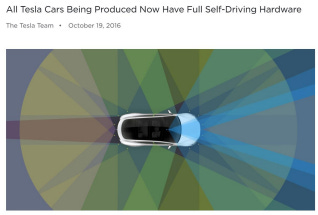
And, of course, there will be a massive “valuation reappraisal”  for Tesla’s stock as the world wakes up to the fact that Tesla’s so-called “autonomy technology” is deadly, trailing-edge garbage. In fact, the NHTSA has reported a slew of Autopilot-related deaths just  since last year. For all Tesla deaths cited in the media—which is likely only a small fraction of those that  have occurred—see TeslaDeaths.com. And Tesla has sold this trashy software for over six years now: 
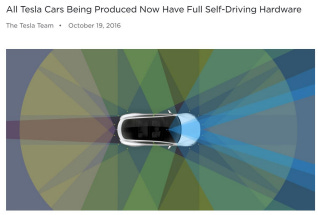
…and still promotes it on its website via a completely fraudulent video!

Another favorite Tesla hype story has been built around so-called “proprietary battery technology.” In fact  though, Tesla has nothing proprietary there—it doesn’t make them, it buys them from Panasonic, CATL and LG, and it’s the biggest liar in the industry regarding the real-world range of its cars. And if new-format 4680 cells enter the market some time in 2024 (as is now expected), even if Tesla makes some of its own,  other manufacturers will gladly sell them to anyone, and BMW has already announced it will buy them  from CATL and EVE. 

And oh, the joke of a “pickup truck” Tesla previewed in 2019 (and still hasn’t shown in production-ready  form) won’t be much of “growth engine” either, as by the time it’s in mass-production in 2024 it will enter  a dogfight of a market; in fact, Ford’s terrific 2022 all-electric F-150 Lightning now has over 200,000 retail  reservations (plus many more fleet reservations), GM has introduced its fantastic 2023 electric Silverado which already has nearly 200,000 reservations, Rivian’s pick-up has gotten excellent early reviews, and  Ram will also be out with a great truck in 2024.

About Mark Spiegel

Mark manages Stanphyl Capital, established in 2011, a deep-value equity & macro long-short investing fund based in New York City. Mark can be reached at mark@stanphylcap.com or at @StanphylCap on Twitter.

Disclaimer: This letter was not reproduced in full. I may own Tesla call and put options and may be long/short TSLA and or any names mentioned. You should assume I have positions in any names I publish about. I have no position in Mark’s funds. Mark is a subscriber to Fringe Finance via a comped subscription I gave him and has been on my podcast. The excerpts from Mark’s letter, above, shall not be construed as an offer to sell, or the solicitation of an offer to sell, any securities or services. Any such offering may only be made at the time a qualified investor receives formal materials describing an offering plus related subscription documentation. There is no guarantee the Fund’s investment strategy will be successful. Investing involves risk, and an investment in the Fund could lose money.
Tyler Durden
Sun, 12/04/2022 – 15:40

via ZeroHedge News https://ift.tt/d3y897g Tyler Durden

“He Turned His Back”: Rail Workers Fume After Biden Forces Unions To Accept Deal

“He Turned His Back”: Rail Workers Fume After Biden Forces Unions To Accept Deal

Rail works are furious after President Joe Biden on Friday signed bipartisan legislation into law to avert an industry strike that could have had grave economic fallout.

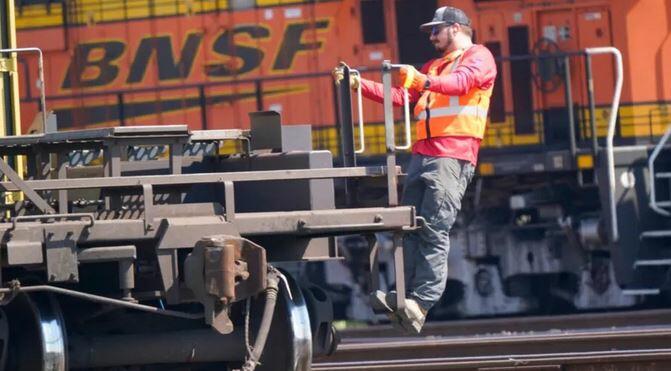
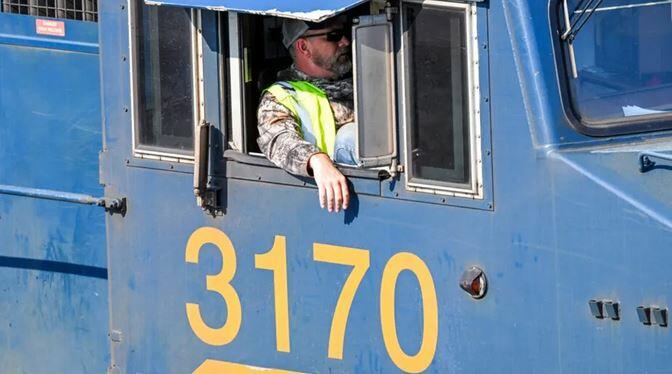
FILE – A worker rides a rail car at a BNSF rail crossing in Saginaw, Texas, Wednesday, Sept. 14, 2022.  (AP Photo/LM Otero, File / AP Newsroom)

One rail worker, Justiun Schaaf, told AP that he had to choose between getting dental work or attending his son’s 7th birthday party.

“Ultimately I decided to take the day off for my kid’s birthday party,” he said, adding “Then when I am finally able to get into the dentist four, five, six months later, the tooth is too bad to repair at that point, so I have to get the tooth pulled out”

According to Schaff, if he had the option of taking a sick day, he “would have never been in that situation.”

In comments after he signed the legislation, Biden acknowledged that more work needs to be done, Fox News reports.

“Look, I know this bill doesn’t have paid sick leave, that these rail workers and, frankly, every worker in America deserves. But that fight isn’t over,” he said.

Roadway mechanic Reece Murtagh was more direct, telling CNN Friday that unionized workers’ collective bargaining rights have been “trampled on.”

“Their voice has not been heard, they voted against the contract,” Murtagh said. “We have a pro-labor president who loves to, you know, pat himself on the back for that, and when the going got tough, he turned his back on the people he’s supposed to be looking out for.” -Fox news

The deal struck by Congress, which is now law, would raise workers’ pay by 24% over five-years, between 2020 and 2024, which includes an immediate payout on average of $11,000 each once ratified. It was approved by eight of the 12 transportation unions involved in the negotiations – with the four dissenting unions arguing that it was unfair because it included insufficient paid-sick leave, of which they wanted seven. Congress nixed that demand from the bill despite efforts by mostly progressive lawmakers to amend the legislation.

“What was negotiated was so much better than anything they ever had,” Biden said during a news briefing alongside French President Emmanuel Macron.

The rail unions said they weren’t able to get more concessions out of the railroads because the big companies knew Congress would intervene and railroads refused to add paid sick days to the deal because they didn’t want to pay much more than a special board of arbitrators appointed by Biden recommended this summer. 

In addition, the railroads said that unions have agreed over the years to forego paid sick leave in favor of higher wages and strong short-term disability benefits. -Fox News

“ou hear when you hire out on the railroad you’re going to miss some things. But you’re not supposed to miss everything,” said retired engineer Jeff Kurtz, an active participant in the Railroad Workers United Coalition. “You shouldn’t miss your kids growing up. You shouldn’t miss the seminal moments in your family’s life.”

Tyler Durden
Sun, 12/04/2022 – 15:05

via ZeroHedge News https://ift.tt/IfKRyvB Tyler Durden

Twitter Staff To Be Grilled Before Congress For Censoring Hunter Biden Laptop Story: Rep. Comer

Twitter Staff To Be Grilled Before Congress For Censoring Hunter Biden Laptop Story: Rep. Comer

Authored by Tom Ozimek via The Epoch Times (emphasis ours),

The top Republican on the House Oversight Committee said that Twitter staff involved in suppressing the Hunter Biden laptop story ahead of the 2020 presidential elections will face Congress and testify about their actions.

Hunter Biden, son of U.S. President Joe Biden, attends an event at the White House in Washington on April 18, 2022. (Drew Angerer/Getty Images)

Rep. James Comer (R-Ky.), the GOP ranking member on the Committee, made the remarks in a Friday appearance on Fox News after Twitter’s new owner Elon Musk dropped part one of the so-called “Twitter Files,” an expose of the inner workings of Twitter’s censorship machine.

Every employee at Twitter who was involved in suppressing the Hunter Biden laptop story will have an opportunity to come before Congress and explain their actions to the American people,” Comer told program host Sean Hannity.

Musk and independent journalist Matt Taibbi on Friday unveiled a series of internal Twitter communications that give insight into steps taken by staff at the social media platform around suppressing the New York Post’s Hunter Biden laptop story.

Republicans have long accused Twitter—and some media outlets—of suppressing the Hunter Biden laptop story, which included reporting that bolstered claims that the president lied when he said he had no involvement in his son’s overseas business dealings.

U.S. President Joe Biden (L) waves alongside his son Hunter Biden after attending mass at Holy Spirit Catholic Church in Johns Island, S.C., on Aug. 13, 2022. (Nicholas Kamm/AFP via Getty Images)

‘Marking This as Unsafe’

In order to suppress the Hunter Biden report, Twitter executives marked it as “unsafe,” limiting its spread and even blocking it from being directly shared via the platform’s direct message function, Taibbi said in comments on the disclosures. He noted that such extreme restrictions were reserved for content such as child pornography.

Messages between executives in Twitter’s communications and policy departments, shared by Taibbi in screenshots, show some confusion about the actions taken, with a communications executive writing: “I’m struggling to understand the policy basis for marking this as unsafe.”

The disclosures show that both Democrats and Republicans had access to Twitter’s censorship system and each side lodged various requests and complaints with the social media platform’s staff. But because of Twitter employees’ predominantly left-leaning political convictions, Democrats had more avenues to press their case, Taibbi said.

The Epoch Times has been unable to independently verify the content of the disclosures shared by Musk and detailed by Taibbi.

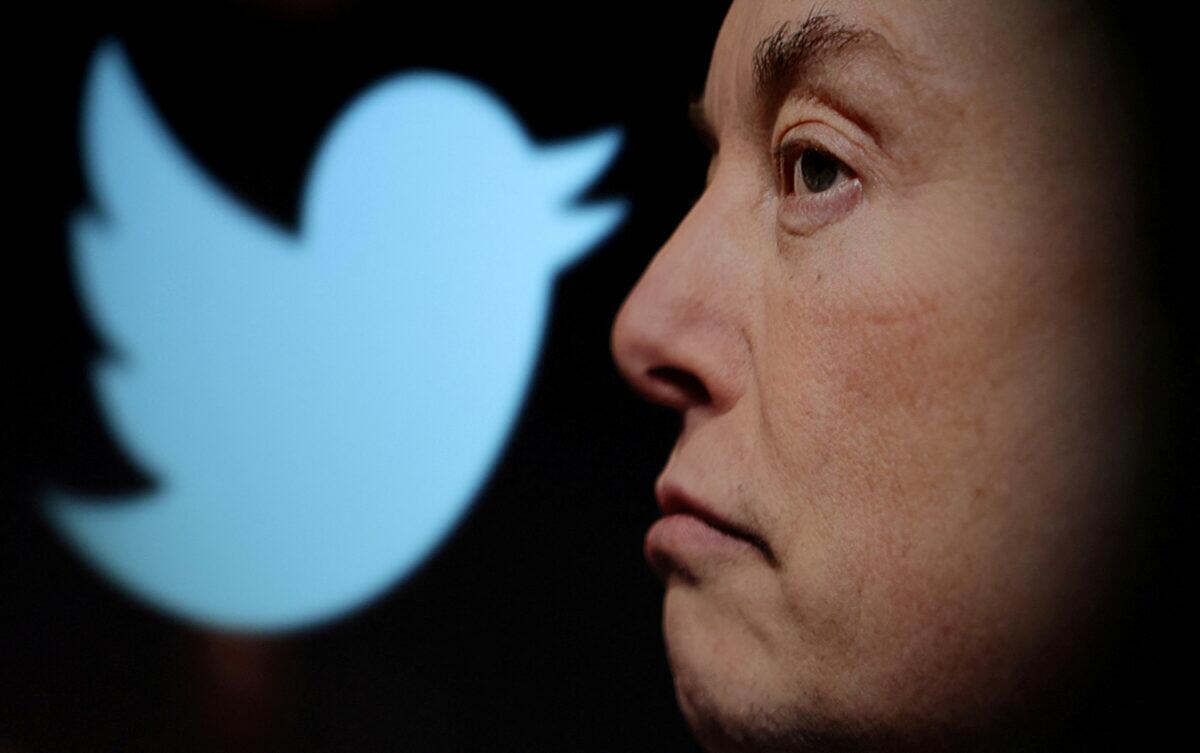
Twitter logo and a photo of Elon Musk are displayed through a magnifier in this illustration taken on Oct. 27, 2022. (Dado Ruvic/Reuters)

‘Just the Beginning’

Comer, in his interview on Fox News, said that the Twitter Files expose shows that the New York Post’s reporting on the Hunter Biden laptop is “being vindicated.”

Read more here…

Tyler Durden
Sun, 12/04/2022 – 14:30

via ZeroHedge News https://ift.tt/WInjRuz Tyler Durden

Apple Accelerates Plans To Shift Production Out Of China

Apple Accelerates Plans To Shift Production Out Of China

Apple has accelerated plans to shift some of its production outside of China, the Wall Street Journal reports, citing insiders.

The company has been reportedly telling suppliers to ‘actively’ plan on assembling Apple products elsewhere in Asia – primarily India and Vietnam, as the company looks to reduce dependence on Taiwanese assemblers spearheaded by Foxconn.

The company’s goal is to ship 40-45% of iPhones from India, vs the current single-digit percentage, according to TF International Securities analyst, Ming-chi Kuo. Vietnam is also expected to shoulder more of the manufacturing of other Apple products, such as AirPods, smartwatches and laptops.

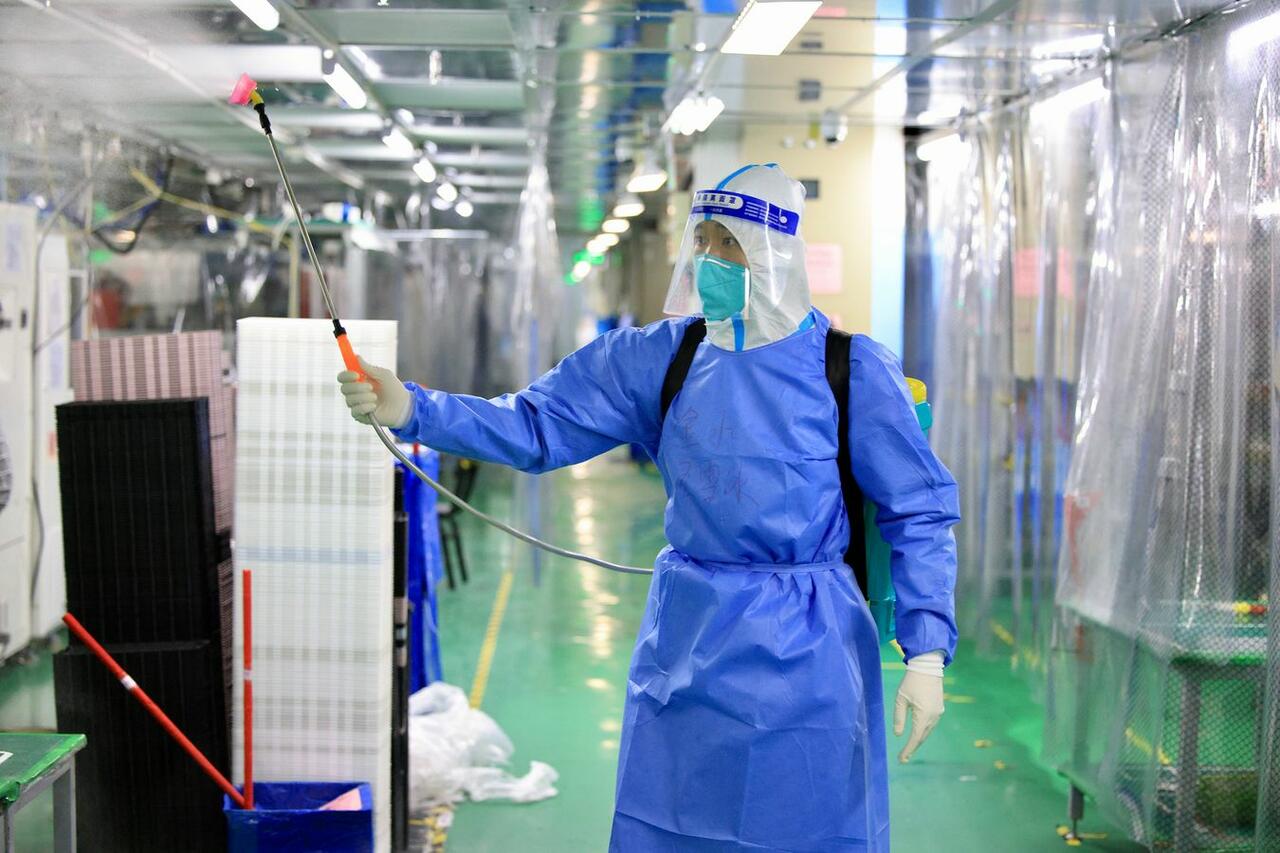
A worker is shown disinfecting equipment.

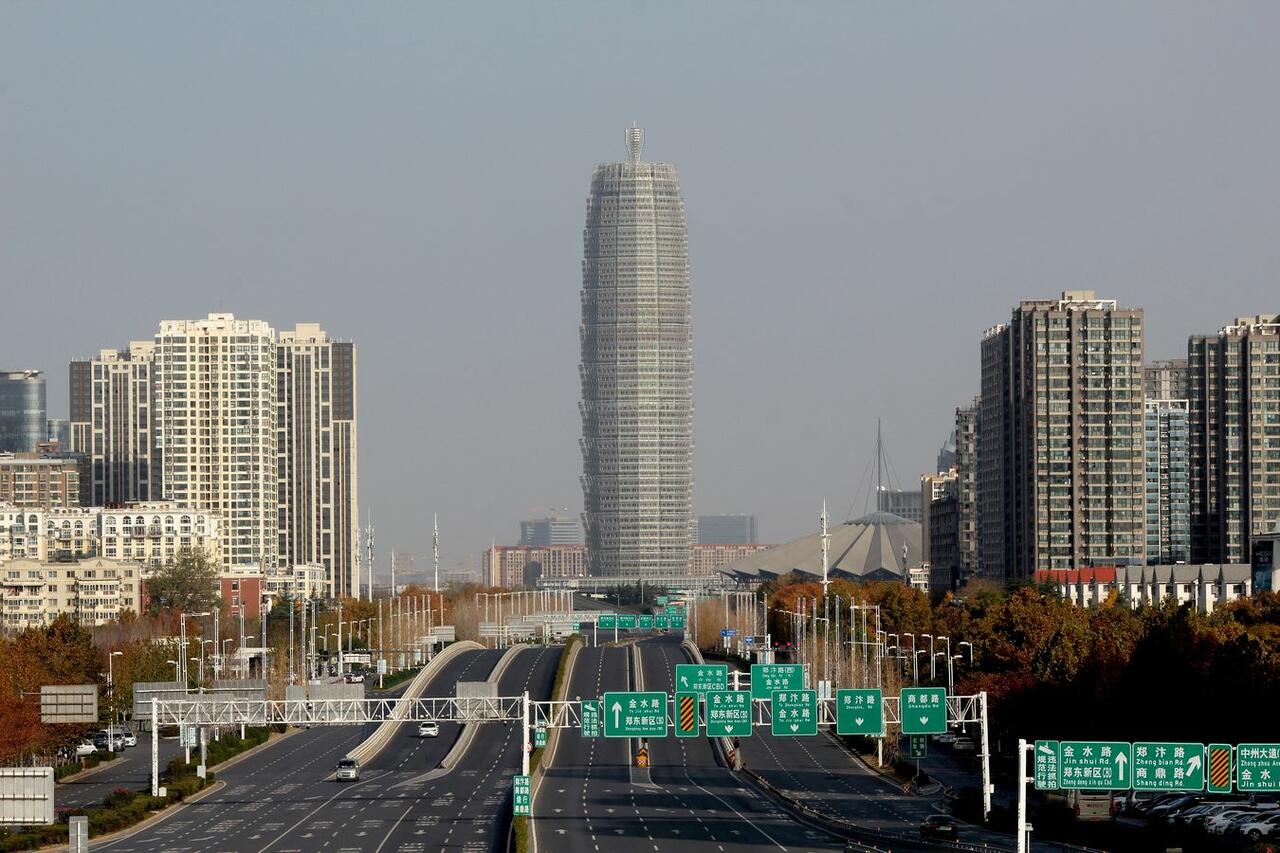
The decision was sparked by turmoil at “iPhone City” inside Zhengzhou (a ‘city-within-a-city’), where as many as 300,000 workers assemble iPhones and other Apple products as a Foxconn-run factory, which produces roughly 85% of the iPhone Pro lineup, according to Counterpoint Research.

In November, violent protests hit the Zhengzhou factory – as workers upset over wages and Covid-19 restrictions began rioting and throwing things at the police. All of this poses a risk to Apple, which has relied on the factory as a stable manufacturing center.

Zhengzhou is home to a giant Foxconn facility known as iPhone City, where a worker is shown at right disinfecting equipment. (Shang Ji/Future Publishing/Getty Images)

“Apple no longer feels comfortable having so much of its business tied up in one place,” according to the report.

So no, Apple isn’t moving production out of concerns over human rights abuses, censorship, or other types of oppression.

“In the past, people didn’t pay attention to concentration risks,” said former US-based Foxconn executive, Alan Yeung. “Free trade was the norm and things were very predictable. Now we’ve entered a new world.”

One response, say the people involved in Apple’s supply chain, is to draw from a bigger pool of assemblers—even if those companies are themselves based in China. Two Chinese companies that are in line to get more Apple business, they say, are Luxshare Precision Industry Co. and Wingtech Technology Co. 

On calls with investors earlier this year, Luxshare executives said some consumer-electronics clients, which they didn’t name, were worried about Chinese supply-chain snafus caused by Covid-19 prevention measures, power shortages and other issues. They said these clients wanted Luxshare to help them do more work outside China. -WSJ

The concerns over production revolve around new product introduction (NPI), which requires teams to work with contractors to translate blueprints and prototypes into a detailed manufacturing plan. According to the report, Apple has put its manufacturing partners on notice to start trying to do more of this outside of China.

That said, unless places like Vietnam and India can excel at NPI as well, they will ‘remain stuck playing second fiddle’ according to supply chain specialists.

For now, consumers doing Christmas shopping are stuck with some of the longest wait times for high-end iPhones in the product’s 15-year history, stretching until after Christmas. Apple issued a rare midquarter warning in November that shipments of the Pro models would be hurt by Covid-19 restrictions at the Zhengzhou facility. -WSJ

The shift marks a massive change in the relationship between Apple and China – which for decades have been engaged in a mutually beneficial relationship.

According to Kup, the supply-chain analyst, iPhone shipments in the fourth quarter of this year were likely to reach between 70 and 75 million units – around 10 million fewer than market projections before the Zhengzhou riots.

“Apple is going to have to find multiple places to replace iPhone City,” said Dan Panzica, a former Foxconn executive who now advises companies on supply-chain issues. “They’re going to have to spread it around and make more villages instead of big cities.”

Tyler Durden
Sun, 12/04/2022 – 13:55

via ZeroHedge News https://ift.tt/TR1F6Zf Tyler Durden

What A GOP House Majority Means For Corporate America

What A GOP House Majority Means For Corporate America

Authored by Zac Moffatt via RealClear Wire,

The results of the 2022 midterms will be dissected endlessly. But among the political ramifications is a very important question for American business executives: With Big Business increasingly involved in political debates (and usually taking sides against Republicans), how will the relationship between the two change under a new GOP House majority?

One answer is that companies should be ready for a wake-up call. This Republican majority will be more populist and less deferential to massive corporations than any that has come to power in the past. Never has the disconnect between executives, employees, and customers been so apparent.

In the coming months, it’s vital for C-suite executives to eliminate their cultural and political blind spots by bringing new voices to their boardrooms – voices belonging to people who see the world differently than they do.

Until now, business has taken Republicans’ relative friendliness for granted. Too often they’ve given into pressure from outside liberal activists or their own left-of-center employees, and taken sides against conservatives, putting themselves at odds with half the country’s consumers – or more.

Republican politicians are now fighting back, using the levers of government to treat these companies as the political actors they become once they enter the arena. Companies should know this and prepare themselves for this new paradigm. They should understand that if they want to be in the political arena, that’s okay. But there’s now liable to be a cost. For one thing, if they behave like political adversaries, Republicans will increasingly treat them as such.

I’ve spent two decades in Republican politics, helping build the largest center-right digital advocacy firm in America that activates grassroots supporters for campaigns and corporations. I’ve seen companies deftly navigate political thickets. I’ve also seen them step on massive landmines.

Chick-fil-A and Patagonia are two brands that couldn’t be more opposite ideologically. Yet surveys show they’re both among the most respected companies in the country. Chick-fil-A’s Midtown Manhattan location is New York’s busiest lunchtime restaurant, while the iconic Patagonia vest is practically ubiquitous among conservative millennials.

How could this be? One answer is disarmingly simple: People don’t mind if you pick a side; they mind if you pick and choose sides depending on the prevailing winds. They mind if you’re craven about your firm’s politics. Conservative Chick-fil-A and progressive Patagonia are the opposite of cynical. They are sincere and quite clear about where they stand – and it shows in all they do. People may not agree with them, but they respect them.

It’s when companies are reactive and impulsive that they get into trouble and alienate their customers. The playbook is well-known. The left and its Twitter mobs spin up companies by claiming the debate of the day is really about “democracy itself,” “civil rights,” or some other rhetoric that raises the stakes, compelling corporate involvement in political fights that have little, if anything, to do with a company’s core business.

We saw this at play with Major League Baseball and Delta Airlines during the battle over Georgia’s election reform bill. Then, when the sky doesn’t fall – or, in that case, when voter turnout doubles after the law passes, Chicken Little becomes The Boy Who Cried Wolf.

I’m sympathetic to those in the C-suite. Imagine you’re sitting in your office one day and suddenly you’re thrust into the middle of a massive political debate. Whatever you need to do to stop the noise seems like the smartest and most rational thing to do. But the liberal online mob in your Twitter mentions doesn’t care about your company. You are a means to an end, a tool to achieve their political goals. If you fold, they’ll come after you again down the line.

Companies need to escape their own bubbles. Too many of them have a reinforcing feedback loop. They focus solely on physical diversity, but not enough on diversity of thought. Wouldn’t it give a CEO pause if they looked around the boardroom and found everyone agreeing with them on business decisions? Shouldn’t it be the same when it comes to wading into political or social debates?

Half the country voted Republican on Nov. 8. The same was true in 2020. C-suite executives need to ask themselves who they regularly talk to that can credibly speak for these voters. And are they doing this proactively, before a problem lands on their lap?

It’s good to stand for something, but a mission doesn’t have to be political. It can simply be making a better product or delivering the best value for shareholders. Decide on it, make it consistent with the business, then ensure it permeates the organization.

For instance, I took a stance that my company is better working together, in person and not solely from our couches. As we emerged from COVID, we committed ourselves to that mission. Today, all 400 of us are in the office working collaboratively once again.

Remember, the next political fight is almost never “the issue of our time.” And no, whatever is in a company’s Twitter mentions probably isn’t “a threat to democracy.” In the end, people want to know that a company does what it’s meant to do. It’s about your product, not your politics.

Tyler Durden
Sun, 12/04/2022 – 13:20

via ZeroHedge News https://ift.tt/d1l9MaB Tyler Durden

US Intelligence Chief Predicts ‘Reduced Tempo’, Waning Morale Of Russian Forces Entering Winter

US Intelligence Chief Predicts ‘Reduced Tempo’, Waning Morale Of Russian Forces Entering Winter

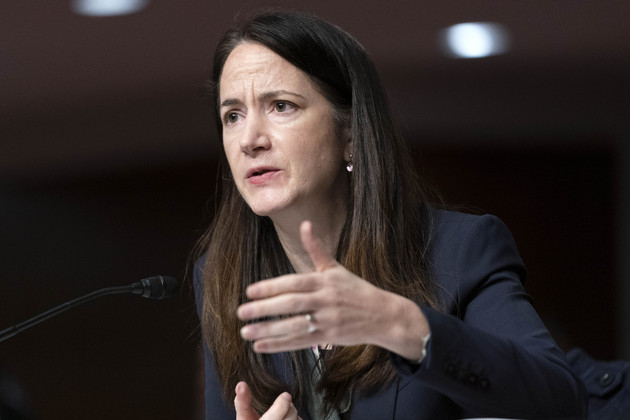
Director of National Intelligence Avril Haines has revealed the United States intel community’s current assessment that it expects the intensity of the Ukraine-Russia war to wane going into the winter months, only to ramp-up again during counteroffensives in the spring.

“Once you get past the winter, the sort of question is: What will the counteroffensive look like?” Haines said before the Reagan Defense Forum in Simi Valley, California on Saturday. “We expect that, frankly, both militaries are gonna be in a situation where they’re gonna be looking to try to refit, resupply, in a sense, reconstitute, so that they’re kind of prepared for that counteroffensive.”

Director of National Intelligence Avril Haines, via AP

“But we actually have a fair amount of skepticism as to whether or not the Russians will be, in fact, prepared to do that,” she continued. “And I think most optimistically for the Ukrainians in that time frame.”

Likely US intelligence’s “skepticism” over Russian forces’ capabilities at this point is related to being beat back in parts of the Donbas over the last two months, and particularly with last month’s recapturing of the city of Kherson after Moscow ordered a large-scale pullback. 

She further assessed that while the cold winter months will have a greater impact on Russians’ morale, she hasn’t seen the Ukrainian side lost their will, despite devastating missile attacks on the national energy grid meant to impose additional collective suffering.

“They’re doing this in order to undermine the Ukrainian will in effect, and I think we’re not seeing any evidence of that being undermined right now at this point,” she said.

Additionally she underscored that Putin is at this point more keenly aware of Russian forces’ “lack of performance and the fact that they did not accomplish more” but yet still may not be fully accepting of “just how challenged they are” – particularly the poor performance of ammo supply and logistics lines.

Speaking of Putin’s chief objectives in the Ukraine invasion, Haines posed, “The challenge is, what does that mean for his near term [and] are they going to be as expansive as they were at the beginning?”

For a contrasting take…

…however, Ukraine’s Defense Ministry says:

Haines questioned further, “Or does he at some point recognize that he’s incapable of doing what it is he intended to originally and sort of downscale what it is that he’s willing to accept?”

Tyler Durden
Sun, 12/04/2022 – 12:45

via ZeroHedge News https://ift.tt/7eK8OAU Tyler Durden