Will Your State Reject The Fed’s Digital Dollar?

Will Your State Reject The Fed’s Digital Dollar?

Authored by MN Gordon via EconomicPrism.com,

Personal and political freedoms are inseparable from economic freedom.  To this end, economic freedom is contingent upon an economy that transacts using honest money that’s free from coercion.
Volumes have been written on America’s experience with money of varying veracity.  Here we’ll touch on a few key events.

Article I, Section 8, of the U.S. Constitution empowers Congress to coin money and regulate its value thereof.  Article I, Section 10, specifies that no state shall make anything but gold and silver coin a tender in payments of debts.

The Federal Reserve Act of 1913, passed by the 63rd Congress and signed into law by President Woodrow Wilson on December 23, 1913, established the Federal Reserve System, the central bank of the United States.  The Federal Reserve Act also delegated the right to issue money from Congress to the Federal Reserve.

In this regard, the current U.S. dollar, a Federal Reserve Note, is illegal money.  It is issued by the Federal Reserve – not Congress – in direct violation of the U.S. Constitution.  Moreover, when states collect tax dollars that are devoid of gold or silver coin, they violate the Constitution.

Economic freedom has been greatly undermined by Washington over the years.  Executive Order 6102 of 1933, for example, forced all American citizens to turn in gold coins and bars.  Gold ownership in the United States, with some small limitations, was illegal for the next 40 years.

Economic freedom was again undermined when President Nixon “temporarily” suspended the convertibility of the dollar into gold in 1971.  This action removed any remaining protection workers and savers had against their hard-earned dollars being inflated away.

But now, as the year 2022 nears its close, another extremely destructive event approaches…

Proof of Concept Project

Over the last 110 years economic freedom in the United States, as in the world, has been in decline.  Through a continuing process of debasement, the Fed has inflated away 96 percent of the dollar’s value.

In other words, today it takes $1 to buy the equivalent of what $0.04 could buy in 1913.  This is a downright disgrace.

Yet over this time, the paper dollar did preserve some modicum of economic freedom.  Payments in cash provide some level of privacy in what you’re buying and selling.  Specifically, the government is unable to readily trace and monitor transactions conducted using cash.

This soon may change…

Have you ever heard of something called the New York Innovation Center?  On November 15, the Federal Reserve Bank of New York published a very important press release.  Here’s a key excerpt:

“The Federal Reserve Bank of New York today announced that its New York Innovation Center (NYIC) will participate in a proof-of-concept project to explore the feasibility of an interoperable network of central bank wholesale digital money and commercial bank digital money operating on a shared multi-entity distributed ledger.

“This U.S. proof-of-concept project is experimenting with the concept of a regulated liability network.  It will test the technical feasibility, legal viability, and business applicability of distributed ledger technology to settle the liabilities of regulated financial institutions through the transfer of central bank liabilities.”

This, without question, marks a significant step in the Fed’s efforts to rollout a Central Bank Digital Currency (CBDC).  The project, as we understand it, will inform how the Fed intends to work with actual banks to introduce a digital dollar.  This digital dollar would ultimately replace the paper dollar and would eliminate the privacy of cash payments.

Traceable and Programmable

David Haggith, publisher and editor-in-chief of The Great Recession Blog, has been closely covering the rapidly approaching advent of CBDCs and digital dollars for several years.  Haggith recently offered the following perspective as to the significance of what’s at stake:

“We’re on the brink of a dramatic change where we’re about to — and I’ll say this boldly — we’re about to abandon the traditional system of money, and accounting, and introduce a new one….  The new accounting is what we call ‘blockchain.’  It means digital.  It means having an almost perfect record of every single transaction that happens in the economy, which will give us far greater clarity over what’s going on…. It also raises huge dangers in terms of the balance of power between states and citizens.”

What you must understand is the adoption of a digital dollar by the U.S. government would be one of the greatest expansions of federal power ever made.  You also must understand that a digital dollar would be much different than a cryptocurrency like bitcoin, which is decentralized and has limitations on its ultimate quantity.

The key distinction is that Fed issued digital dollars would be traceable and programmable and would be integrated with the Fed and private banking.  Specifically, digital dollars would be programmed to have various rules and restrictions governing how and when they are spent.

We know from the executive order released by the Biden administration on March 9, which required several federal agencies to study digital currencies and to identify ways to regulate them, that CBDCs and other policies governing digital assets must mitigate “climate change and pollution” and promote “financial inclusion and equity.”

What does this mean, exactly?

At the World Economic Forum (WEF) earlier this year, one zealous central planner clearly stated that the intent of traceable and programmable CBDCs is to monitor, “where you are traveling, how you are traveling, what you are eating, what you are consuming – individual carbon footprint tracker.”

Will Your State Reject the Fed’s Digital Dollar?

U.S. government debt is now over $31 trillion.  Tack on unfunded liabilities like social security, Medicare, federal debt held by the public, and federal employee and veterans’ benefits, and the government debt number jumps to over $172 trillion.

What’s more, trillion-dollar deficits year after year imply that the government is borrowing money to pay the interest on the debt.  At this point, there really is no honest way for Washington to ever repay all this debt.

The tracking features of CBDCs are very appealing to central planners and government control freaks.  But we believe what’s compelling the urgency of a Fed issued digital dollar is the elaborate cover its rollout will provide.  The introduction of a digital dollar can and will be used as a means to obscure an outright default.

Your account may get credited with digital dollars at rollout.  However, these new digital dollars will come at a price.  We’re not entirely clear on what that is.  But we think it’ll involve a loss of value that’s proportional to the insane levels of debt that Washington’s on the hook for.

In short, this is a last-ditch effort by Washington to mask a government default.  If you don’t own any physical gold and silver yet…, what are you waiting for?  Don’t overcomplicate things.  Go to your local coin shop and pick up a few coins today.

Meanwhile, as the NYIC figures out just how to go about introducing the digital dollar, some states are figuring things out too.  In fact, certain states may not be too keen on a Fed issued – traceable and programmable – digital dollar.

Utah, Nevada, Wyoming, and New Hampshire are already issuing “gold-backs.”  These are privately issued notes that contain actual gold.  They are accepted in these states under their respective legal tender laws, which provides for the adoption of gold and silver as legal tender by the state.

Here in the Volunteer State, Tennessee State Senator Frank Niceley has some ideas too.  He recently chatted with former U.S. Assistant Secretary of Housing and Urban Development, Catherine Ausin Fitts, about the strengths and benefits of a Sovereign State Bank modeled on North Dakota.

Niceley’s intent for a Tennessee Sovereign State Bank is to also include a state bullion depository and provide local banks and credit unions support to counter the threat of a Fed issued digital dollar.

There’s a lot to be worked out, of course.  Nonetheless, it’s about time state and local jurisdictions stood up to Washington and the Fed.  Developing gold-based local alternatives to the Fed’s digital dollar is a start.

Your economic, personal, and political freedoms depend on it.

*  *  *

The window to protect your wealth and financial privacy is closing.  And it’s closing quick.  I don’t like it one bit.  But I’m not going to stand around powerless as Washington’s control freak sociopaths destroy everything I’ve worked so hard for.  For this reason, I’ve dedicated the past 6-months to researching and identifying simple, practical steps everyday Americans can take to protect their wealth and financial privacy.  The findings of my work are documented in the Financial First Aid Kit.  If you’d like to find out more about this important and unique publication, and how to acquire a copy, stop by here today!

Tyler Durden
Sun, 12/04/2022 – 12:10

via ZeroHedge News https://ift.tt/W2G0SbL Tyler Durden

Ukraine Wheat Harvest Crushed Expectations: Satellite Analysis

Ukraine Wheat Harvest Crushed Expectations: Satellite Analysis

After much worrying about the effects of war on the country’s food production, Ukraine’s 2022 wheat harvest far exceeded forecasts — but Russia took a billion-dollar share in the occupied east — according to analysis of satellite imagery by NASA Harvest, an international consortium that uses satellite technology to advance food security. 

“Our satellite-based production numbers for the 2022 winter wheat crop in Ukraine make clear that farmers had a largely successful harvest,” said NASA Harvest program director Inbal Becker-Reshef.

Analysts calculated that farmers throughout Ukraine harvested 26.6 million tons of wheat this year, which is several million tons higher than forecasted

“That’s down from the previous year’s record harvest of 33 million tons, but it’s close to the five-year average of 27.9 million tons,” said Becker-Reshef.

When Russia launched its invasion, some observers warned that perhaps only 70 to 80% of the winter crop would be harvested by summer’s end. However, NASA Harvest concluded that 94% of the crop was reaped

With the war obscuring what’s happening on the ground, the satellite analysis offers a means of observing agricultural activity from a safe distance. “The risks on the ground during the war have made the NASA Harvest monitoring system one of the only safe and reliable ways for researchers to track what is happening to crops in Ukraine,” said NASA scientist Sergii Skakun.

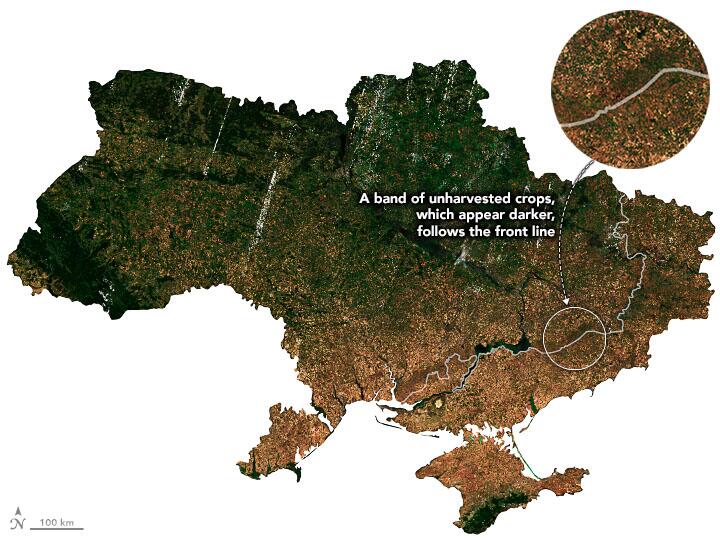
NASA Harvest uses satellite observations and modeling to gauge the cultivation and harvesting of key crops. Crop status can be discerned by studying colors, with unharvested fields appearing dark brown and harvested fields appearing light brown. 

Satellite imagery of Ukraine shows a concentration of unharvested (darker brown) fields near the war’s front lines (via NASA)

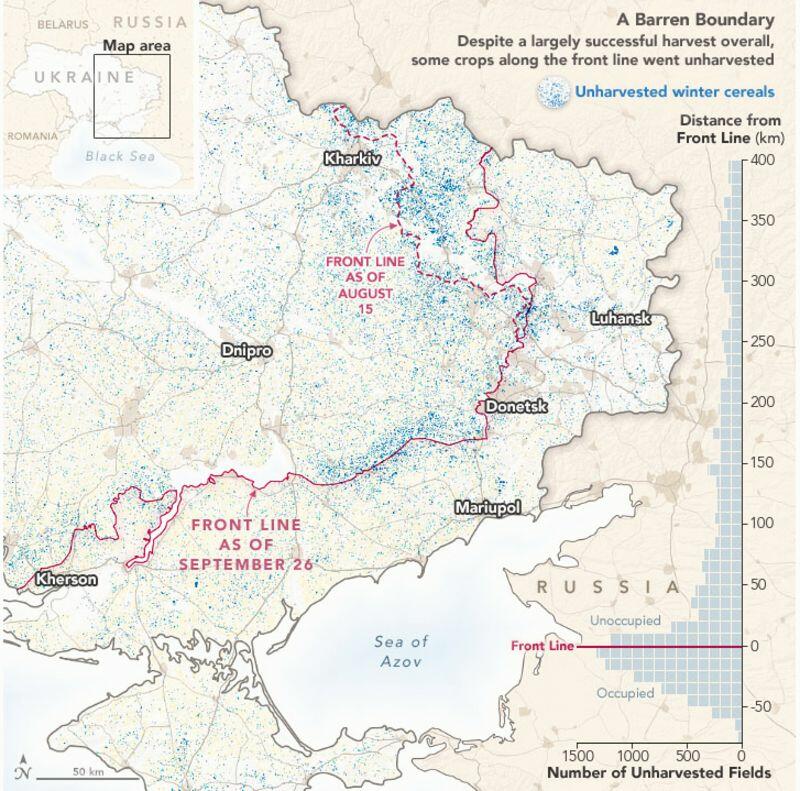
Unsurprisingly, analysts found that the unharvested wheat is concentrated along the principal battle lines

Via NASA

While the analysis is full of good news for the world’s agriculture consumers, it contains a sobering stat for the Ukraine government: A whopping 22% of the wheat was harvested in the Russian-occupied east. That’s about 5.8 million tons worth at least $1 billion, according to NASA Harvest partner Abdolreza Abbassian. 

HarvEast, a principal Ukraine agricultural firm, tells Bloomberg that all of the winter crops it planted in Donetsk were harvested and sold off. 

This year, winter wheat gave a very high yield for this region due to favorable weather conditions,” says HarvEast Chief Executive Officer Dmitry Skornyakov.  “Everything that was harvested on our fields was stolen and exported from Ukraine.”

Bloomberg cites an unnamed prosecutor in Switzerland who cautions that selling looted grain may be considered a war crime.  

Via NASA 

Tyler Durden
Sun, 12/04/2022 – 11:35

via ZeroHedge News https://ift.tt/A1QPd5D Tyler Durden

China Operating Illegal Police Stations Worldwide

China Operating Illegal Police Stations Worldwide

Authored by Judith Bergman via the Gatestone Institute,

  • China has set up at least 54 overseas police stations in 30 countries, including in the United States (New York), Canada, Spain, Italy, France, the Netherlands, the United Kingdom, Hungary, Portugal, the Czech Republic, Brazil, Argentina and Nigeria, according to a recent report from Safeguard Defenders, a human rights NGO.

  • The police stations are part of China’s campaign to “persuade” Chinese citizens suspected of criminal acts – particularly telecommunications fraud, but also political “crimes” such as political dissent – to return to China to face criminal prosecution. China not only threatens the Chinese citizens themselves but also members of their families who have stayed behind in China. Such threats have been continuing for years, as FBI Director Christopher Wray pointed out in 2020, when he mentioned a case from the US in which a Chinese government “emissary” visited a target in the US and told him that he could choose between returning to China or committing suicide.

  • China’s overseas police stations purport merely to have administrative or consular functions, but function as means of threatening Chinese abroad to return to China, thereby skipping the necessary legal requirements under international law.

  • Crucially, the police stations operate without the consent and knowledge of the host countries, such as in the Netherlands, where one of the police stations operates out of a plain ground-floor apartment in Rotterdam belonging to a small Chinese handyman business.

  • Beijing, not surprisingly, has denied all wrongdoing. “The organizations you mentioned are not police stations or police service centers,” Chinese foreign ministry spokesman Zhao Lijian Zhao insisted. “Their activities are to assist local Chinese citizens who need to apply for expired driver’s license renewal online….”

  • Safeguard Defenders has appealed to countries to take swift action against the police stations.

  • “Action needs also be taken to protect a quickly growing Chinese diaspora in the target countries, unless the latter are content with having a foreign government police minority groups on their territory, often to the intentional detriment of the target country and its policies, and aimed at intimidating the diaspora into obedience to the CCP anywhere in the world. Dedicated reporting and protection mechanisms must urgently be made available.” – Safeguard Defenders, January 18, 2022.

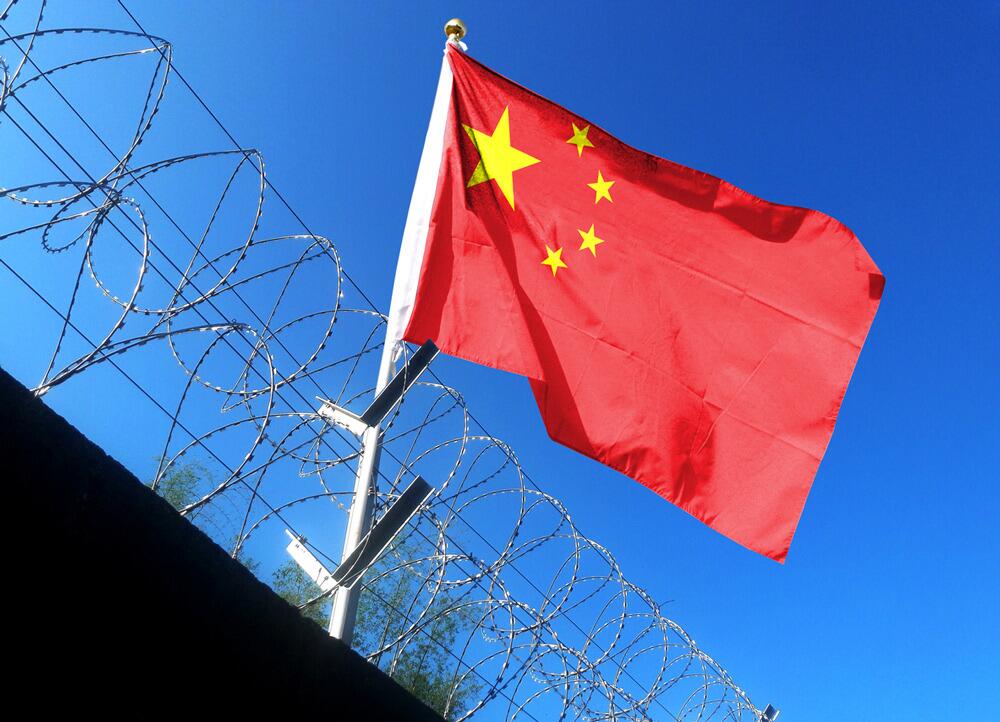
China has set up at least 54 overseas police stations in 30 countries, including in the United States (New York), Canada, Spain, Italy, France, the Netherlands, the United Kingdom, Hungary, Portugal, the Czech Republic, Brazil, Argentina and Nigeria, according to a recent report from Safeguard Defenders, a human rights NGO. Most of these police stations are located in Europe, with nine such police stations in major Spanish cities, four in Italy, and three in Paris, among others.

According to Peter Dahlin, director of Safeguard Defenders, those are just the tip of the iceberg:

We are convinced that there are many more, because these only belong to two jurisdictions – Fuzhou and Qingtian, where most of the Chinese in Spain come from – and China itself admits that it has launched the project in ten. So it could be up to five times more.”

The police stations are part of China’s campaign to “persuade” Chinese citizens suspected of criminal acts – particularly telecommunications fraud, but also political “crimes” such as political dissent – to return to China to face criminal prosecution. China not only threatens the Chinese citizens themselves but also members of their families who have stayed behind in China. Such threats have been continuing for years, as FBI Director Christopher Wray pointed out in 2020, when he mentioned a case from the US in which a Chinese government “emissary” visited a target in the US and told him that he could choose between returning to China or committing suicide.

On August 17, China’s Ministry of Public Security stated:

The number of cross-border telecom fraud cases targeting Chinese residents has been significantly decreased in China, with 230,000 telecom fraud suspects being educated and persuaded to return to China from overseas to confess crimes from April 2021 to July 2022…”

“Official guidelines explicitly outline the different tools made available to ‘persuade’ the targets to voluntarily return to China to face charges,” Safeguard Defenders wrote.

“These include targeting the purported suspects’ children in China, denying them the right to education, as well as targeting family members and relatives in a similar fashion. In short, a full-on ‘guilt by association’ punishment to ‘encourage’ suspects to return from abroad.”

China’s overseas police stations purport merely to have administrative or consular functions, but function as means of threatening Chinese abroad to return to China, thereby skipping the necessary legal requirements under international law. According to Safeguard Defenders:

“These methods allow the CCP and their security organs to circumvent normal bilateral mechanisms of police and judicial cooperation, thereby severely undermining the international rule of law and territorial integrity of the third countries involved… In eschewing regular cooperation mechanisms, the CCP manages to avoid the growing scrutiny of its human rights record and the ensuing difficulties faced in obtaining the return of ‘fugitives’ through legal proceedings such as formal extradition requests. It leaves legal Chinese residents abroad fully exposed to extra-legal targeting by the Chinese police, with little to none of the protection theoretically ensured under both national and international law…

“Openly labeled as overseas police service stations… for example in renewing Chinese driver’s licenses remotely and other tasks traditionally considered of a consular nature… [the stations] also serve a more sinister goal as they contribute to ‘resolutely cracking down on all kinds of illegal and criminal activities involving overseas Chinese.'”

The police stations are obviously also used to target Chinese abroad who disagree with the regime.

One of the aims of these campaigns, obviously, as it is to crack down on dissent, is to silence people,” Laura Harth, a campaign director with Safeguard Defenders said. “So people are afraid. People that are being targeted, that have family members back in China, are afraid to speak out.”

Crucially, the police stations operate without the consent and knowledge of the host countries, such as in the Netherlands, where one of the police stations operates out of a plain ground-floor apartment in Rotterdam belonging to a small Chinese handyman business. Several countries, such as Canada, the Netherlands, the UK, Portugal and Spain, are now investigating the matter and some have already demanded the closure of the Chinese overseas police stations on their soil.

[We] have asked the Chinese ambassador for full clarification on the so-called police service stations carrying out tasks in the Netherlands on behalf of the Chinese government,” Dutch Foreign Minister Wopke Hoekstra wrote on Twitter.

“As no permission was sought from the Netherlands for this, the ministry has informed the ambassador that the stations must close immediately. In addition, the Netherlands itself is also investigating the stations to find out their exact activities.”

In the US, FBI Director FBI director Christopher Wray said that the FBI was investigating the matter.

“We are aware of the existence of these stations. To me, it is outrageous to think that the Chinese police would attempt to set up shop, you know, in New York, let’s say, without proper coordination. It violates sovereignty and circumvents standard judicial and law enforcement cooperation processes.”

Wray added that the FBI was “looking into the legal parameters,” and stated that the FBI has opened charges related to Chinese government harassment, stalking, monitoring and blackmailing Chinese in the US who were critical of China’s President Xi Jinping.

“It’s a real problem and something that we’re talking with our foreign partners about, as well, because we’re not the only country where this has occurred.”

Beijing, not surprisingly, has denied all wrongdoing. “The organizations you mentioned are not police stations or police service centers,” Chinese foreign ministry spokesman Zhao Lijian Zhao insisted.

“Their activities are to assist local Chinese citizens who need to apply for expired driver’s license renewal online, and activities related to physical examination services by providing the venue.”

Nevertheless, the Spanish newspaper El Correo quoted an unnamed official from the Chinese Foreign Ministry in Shanghai, who reportedly acknowledged that the police stations abroad are part of how China operates:

“The bilateral treaties are very cumbersome, and Europe is reluctant to extradite to China. I do not see what is wrong with pressurizing criminals so that they are brought to justice.”

Safeguard Defenders has appealed to countries to take swift action against the Chinese police stations.

“We call on Members of Parliament to raise this issue with their Governments: ask if and how this practice is being monitored; to what extent such operations take place in their country, and what measures are being formulated to counter them. Action needs also be taken to protect a quickly growing Chinese diaspora in the target countries, unless the latter are content with having a foreign government police minority groups on their territory, often to the intentional detriment of the target country and its policies, and aimed at intimidating the diaspora into obedience to the CCP anywhere in the world. Dedicated reporting and protection mechanisms must urgently be made available.”

Judith Bergman, a columnist, lawyer and political analyst, is a Distinguished Senior Fellow at Gatestone Institute.

Tyler Durden
Sun, 12/04/2022 – 11:00

via ZeroHedge News https://ift.tt/S5jYmlT Tyler Durden

OPEC+ Keeps Oil Production Unchanged, Maintains 2MMb/d Output Cut After Launch Of Russia Price Cap

OPEC+ Keeps Oil Production Unchanged, Maintains 2MMb/d Output Cut After Launch Of Russia Price Cap

Two weeks ago, oil tumbled after the WSJ reported a fake news hit piece quoting “delegates” who “said” that Saudi Arabia was preparing for a 500K oil production hike. We quickly countered that this was ridiculous and if anything OPEC+ would seek further production cuts, a view which other media promptly quickly picked up. In the end, the report of an output hike (which some interpreted as a gesture of good will from Saudi crown prince MBS who had just received immunity from the Biden regime), proved to be indeed fake news, but likewise any expectations of further output cuts were dashed when earlier on Sunday OPEC+ agreed to stick to its oil-output targets just two days after G-7 nations agreed to a $60 price cap on Russian oil, despite mounting concerns about oil demand as the world in swept up by a global recession and as new Covid-related lockdowns in China and lingering uncertainty over Russia’s ability to export crude have sent the price of oil sliding.

During a virtual meeting, OPEC+ decided to rollover the production cuts of 2 million barrels a day initially agreed to in October, a move which will allow the group time to assess the market impact of the price cap on Russian oil, the delegates said.

Brent crude plunged to its lowest level since September on Nov. 28, but ended up posting its biggest weekly gain in a month.

“With massive and offsetting fundamental and geopolitical risks bearing down on the oil market, ministers understandably opted to hold steady and hunker down,” said Bob McNally, president of Rapidan Energy Advisers LLC.

Meanwhile, Brent crude closed at $85.42 on Friday, and West Texas Intermediate, the U.S. benchmark, was at $80.34, far below the $90-a-barrel level where some oil-market analysts say the group wants to see prices. Prices have come under downward pressure from Chinese Covid-19 lockdowns that have prompted concerns in OPEC of weakening oil demand.

Oil prices fell Friday after the EU agreed to the cap, as traders discounted fears the mechanism will force much Russian oil out of the market and cause a supply issue. In the end, however, it is all just posturing and the status quo remains as Russia will still sell oil to its traditional customers China and India, who will then resell some of this product to Europe and other nations.

It’s unclear to what extent those measures will curtail Russian exports. The price cap is comfortably above the $50 that the country’s flagship Urals grade of crude currently trades at, according to data from Argus Media. Yet Moscow has said it would rather cut production than sell oil to anyone that adopts the price cap. Speaking on Russian TV, Deputy Prime Minister Alexander Novak said the country will operate strictly in line with market conditions: “We will sell oil and oil products to the countries that will work with us based on market conditions, even if that means we’ll have to somewhat reduce output.” Russia is “not going to use tools linked to the price cap” and is “working on a mechanism banning adoption of the price cap tools, irrespective of what level will be set.”

Russian crude has traded at a steep discount this year, with Argus Media, which assesses commodity prices, pegging the price at about $48 a barrel.

The US and its G7 allies designed the price to cut into Moscow’s oil revenues while keeping Russian oil, a key part of global supply, available on the market, which of course is ridiculous, and is just an attempt by Europe at virtue signaling optics while eating its Russian oil cake too. It aims to take advantage of the concentration of key maritime services in the West to try to curb Moscow’s ability to wage war in Ukraine.

As Bloomberg notes, with these powerful forces poised to push oil markets in unpredictable directions, OPEC watchers said the group’s decision was understandable.

“OPEC+ rolled over the existing quotas as expected amid uncertainty around Russian flows following the price cap, and a weaker China,” said Amrita Sen, chief oil analyst and co-founder at consultant Energy Aspects Ltd. “The group will continue to monitor markets and should fundamentals deteriorate they will meet prior to June — currently the scheduled next ministerial meeting.”

The decision by OPEC+ should hold for at least a few months. The group’s Joint Ministerial Monitoring Committee, led by Saudi Arabia and Russia, will meet again in June. The outlook could be clearer by then, and the panel has the power to call extraordinary meetings if it thinks output policy may need to change; OPEC said it was ready “to meet at any time and take immediate additional measures to address market developments” if needed. Until then three major forces will determine the future path of oil prices: a global economic slowdown which will seek to keep a lid on oil demand, and speculation about the date of China’s reopening which many believe will send oil prices sharply higher. Indeed, as Bloomberg notes, as OPEC+ ministers convened their video conference, officials in Shanghai had just eased some of their Covid restrictions, joining other top-tier Chinese cities as authorities accelerate a shift toward reopening the economy after thousands of demonstrators took to the streets.

A far bigger, and longer-term driver, however is the continued lack of capital spending to boost an aging E&P infrastructure which means that over the next 5 to 10 years, oil will become increasingly scarce in a world where western government are openly hostile toward legacy energy companies.

Tyler Durden
Sun, 12/04/2022 – 10:25

via ZeroHedge News https://ift.tt/8ER1Un5 Tyler Durden

Volokh Conspiracy Holiday Gifts—2022


Gift 2

The holiday season is now upon us! If you are looking for possible gifts for the loyal Volokh Conspiracy readers in your life, what could better than books by VC bloggers?

The latest VC-author book is David Bernstein’s Classified: The Untold Story of Racial Classification in America. It’s an indispensable overview of the history and evolution of the use of racial classifications in the modern US.

VC-ers also published two books last year: Randy Barnett’s The Original Meaning of the Fourteenth Amendment: Its Letter and Spirit (coauthored with Evan Bernick) and the revised edition of own Free to Move: Foot Voting, Migration, and Political Freedom  which officially came out in early 2022). Barnett and Bernick’s book is a major contribution to our understanding of what many consider the single most important amendment to the Constitution. It has already begun to reshape our understanding of the Fourteenth Amendment.

Jonathan Adler’s edited volume Marijuana Federalism was published in 2020. It has everything you ever wanted to know about the relationship between federalism and pot, and includes contributions by leading scholars in several different disciplines.

Free to Move makes the case for expanding opportunities for people to “vote with their feet” in federal systems, the private sector, and through international migration. I describe key advantages of foot voting over conventional ballot box voting, and explain how breaking down barriers to foot voting can massively increase freedom and opportunity for millions of people around the world. The revised edition addresses several new issues, including arguments that migration must be constrained to prevent the spread of  dangerous diseases such as Covid-19, claims that immigrants might generate a political backlash that threatens democracy, and the impact of remote work on foot voting. As with the original edition, I am donating 50% of all royalties from the book to charities benefiting refugees, who – sadly – are in more need than ever in this difficult time.

Among my other favorite books by VC authors are Randy Barnett’s Restoring the Lost Constitution, David Bernstein’s Rehabilitating Lochner, Dale Carpenter, Flagrant Conduct: The Story of Lawrence v. Texas, Jonathan Adler’s Business and the Roberts Court, Josh Blackman’s Unprecedented and Unraveled, and Eugene Volokh, Academic Legal Writing.

Randy’s book is one of the best recent works on originalism and constitutional legitimacy. It is relevant to ongoing debates over legal interpretation that are sure to heat up again as the Supreme Court considers several major cases in the near future. Rehabilitating Lochner explodes numerous myths about one of the Court’s most reviled decisions, one that remains relevant to current debates over “judicial activism.” Flagrant Conduct is a great account of a milestone in the history of gay rights. It provides useful historical context for the still-ongoing battles over same-sex marriage and related issues.

Jonathan Adler’s edited volume is an excellent guide to the issue of whether the Supreme Court favors business interests, and how we might assess claims that it has a pro-business bias. Josh Blackman’s two books provide valuable blow-by-blow accounts of the extensive litigation generated by the Affordable Care Act. Finally, Academic Legal Writing is filled with useful advice, while also somehow managing to make this generally unexciting topic interesting.

The Cambridge Handbook of Classical Liberal Thought (edited by Todd Henderson), includes chapters by three different VC bloggers: Jonathan Adler on environmental policy, David Bernstein on anti-discrimination law, and my own contribution on “voting with your feet.”

This list is not intended to slight important books by Ken Anderson, Sam Bray, Orin Kerr, David Kopel, David Post, and other VC bloggers. I have not discussed them only because their subjects are distant from my own areas of expertise.

In the spirit of shameless self-promotion, I will also mention the expanded second edition of my own book Democracy and Political Ignorance: Why Smaller Government is Smarter. My most recent book before Free to Move was Eminent Domain: A Comparative Perspective, co-edited with Iljoong Kim and Hojun Lee. It analyzes the use and abuse of eminent domain in a variety of countries around the world.

My other books include The Grasping Hand: Kelo v. City of New London and the Limits of Eminent Domain, which is the first book by a legal scholar about one of the Supreme Court’s most controversial modern decisions, and A Conspiracy Against Obamacare: The Volokh Conspiracy and the Health Care Case (coauthored with VC-ers Randy Barnett, Jonathan Adler, David Bernstein, Orin Kerr, and David Kopel). Conspiracy Against Obamacare focuses on the VC’s significant role in the Obamacare litigation, and is the only book that includes contributions by six different VC bloggers. In 2016, the University of Chicago Press published an updated paperback edition of the The Grasping Hand.

I wish all our readers a happy holiday season!

The post Volokh Conspiracy Holiday Gifts—2022 appeared first on Reason.com.

from Latest https://ift.tt/CAhPNuW
via IFTTT

Goldman, BofA, Citi Employees Join Jefferies In Expecting “Slashed’ Bonuses This Holiday Season

Goldman, BofA, Citi Employees Join Jefferies In Expecting “Slashed’ Bonuses This Holiday Season

It turns out it isn’t just Jefferies, as we noted days ago…

In fact, all major banks across Wall Street look ready to “slash” bonuses for the upcoming holiday season, marking a direct pivot from the lavish bonuses they offered up last year, according to multiple sources. 

Bonus pools could be cut as much as 30% at banks like JP Morgan and Bank of America this year due to a slowdown in dealmaking and a tightening economic picture. 

Blooomberg noted this week that investment bankers could wind up getting hit the hardest: revenues for banks could be lower by 50% in 2023. Lower tier employees may see no bonuses at all, follow up reporting by the NY Post noted. 

At Goldman, the Post says traders are also facing cuts to their bonus pools despite the global markets division of the bank raking in $25 billion in 2022. Traders were informed their bonus pool would be cut by “a low double digit percentage” last week.

Some bankers could see bonuses cut as much as 45%, the report speculates. Many are just thankful to be keeping their jobs, it adds. 

Recall, days ago we noted that bankers at Jefferies are also being told to expect smaller bonuses. The firm has warned its staff that 2022 is going to be a “difficult compensation season”.

Jefferies chief executive Rich Handler and president Brian Friedman penned a memo that went out to employees last week, claiming that due to the bank’s aggressive hiring over the last 3 years, in combination with slumping deals, that bonuses would come in lighter than normal.

The letter says: “As always, we will do the right thing for the long-term success of everyone at Jefferies and to continuously invest in our people and our firm, so we can continue to build and prosper. Let’s just spell it out here: ‘This is going to be a more difficult compensation season at Jefferies, just like it will be for every firm in our industry.'”

It continues: “2019 was a decent year for Jefferies and our industry. Despite Covid, 2020 was a very good year and we all know 2021 was the type of year that comes along very rarely in a finance professional’s career.”

Tyler Durden
Sun, 12/04/2022 – 09:55

via ZeroHedge News https://ift.tt/hMsJ9kF Tyler Durden

Help Create the Future by Supporting Reason!


webathon-5

We’ve got just two days left in our annual webathon, the one week a year when we ask our online readers, listeners, and viewers to support our principled libertarian journalism with tax-deductible donations. Give $50 and you get a great Reason stress ball (you’re going to need it). For $500, you get the stress ball, a digital subscription, a shoutout on social media, a 2023 Reason calendar (so good), and a “Taxation Is Theft” or Reason tote bag (suck it, PBS). Go here now to check out various swag levels and to make a donation in increasingly worthless fiat currency or increasingly depreciating crypto (alas).

Reason is published by a 501(c)3 nonprofit (hence the tax deduction for contributions), and your support is what allows us to do what we do. Without your help, articles can’t get written, videos can’t get produced, and podcasts can’t be recorded. So thank you for not just keeping our lights on but keeping our fires for freedom burning too.

Reason was founded in 1968 as a mimeographed monthly magazine and has since evolved into a multimedia juggernaut that includes this website; a policy think tank that champions public pension reform, school choice, infrastructure innovation, and privatization; our pioneering online video platform; and a slate of increasingly popular podcasts.

Beyond a commitment to libertarian principles of “free minds and free markets,” we’ve always focused on the future, on what should come next to make the world more fair, more fun, and more filled with literal and figurative wealth. Regardless of their stated ideology, most intellectual journals and opinion magazines look backward and either want to return to a previous golden age or to control, regulate, and direct the present and the future.

Not us. We were among the first commentary magazines to push ideas, policies, and mindsets that seemed crazy at the time but are now taken for granted: deregulating the airline industry and interstate trucking, legalizing pot and other “illicit” drugs, marriage equality for gays and lesbians, and school choice (especially for poor kids). During the financial crisis, we were virtually alone even among market-friendly outlets in denouncing the Troubled Asset Relief Program (TARP) and the useless stimulus spending that started under George W. Bush and continued under Barack Obama. We weren’t mesmerized or disgusted by Donald Trump’s characteristically bombastic and bullshit-filled rhetoric and instead focused on the actual effects (some good, some bad) of his policies.

While most “think” magazines clutch their pearls at the mere thought of someone else using new technology, we launched our website in the early 1990s, published the very first mass-personalized edition of a consumer magazine in 2004, and, with the help of Drew Carey, embraced online video back in 2007. We’ve consistently said no to wars of choice, to vaccine mandates, to lunatic plans to command and control the economy and the culture in the name of some greater good (read: a particular person’s preference).

Reason staffers fan out across other publications, cable news channels, podcasts, radio shows, and social media, acting as your voice in national debates over economic, political, and cultural freedom. Always and everywhere, we’re arguing in favor of perennial values such as individual rights and pluralism while also defending such innovations as the internet, the sharing economy, and cryptocurrency. Screw the “Great Reset,” we want the “Great Escape.”

We bet on the future because we believe that you should be in charge of your life as much as possible. Please bet on us and our journalism to help make the future better.

The post Help Create the Future by Supporting <i>Reason</i>! appeared first on Reason.com.

from Latest https://ift.tt/4v1wLIt
via IFTTT

Zelensky Seeks To Ban Russian Orthodox Church In Ukraine

Zelensky Seeks To Ban Russian Orthodox Church In Ukraine

Authored by by Kyle Anzalone via The Libertarian Institute,

Ukrainian President Volodymyr Zelensky announced he is seeking to ban all religions with ties to Russia. He claims the move is needed to “guarantee spiritual independence to Ukraine.” This law will target millions of Ukrainians who identify as Russian Orthodox.

During his nightly address on Thursday, Zelensky announced he was introducing legislation that would eliminate religious organizations affiliated with Russia from operating in Ukraine. He said this will make “it impossible for religious organizations affiliated with centers of influence in the Russian Federation to operate in Ukraine.”

The Ukrainian leader said it was necessary to purge the church to preserve the country’s spiritual independence. Adding, “We will never allow anyone to build an empire inside the Ukrainian soul.” Zelensky denounced Ukrainians continuing to attend the parishes as failing to overcome “the temptation of evil.”

He claimed a series of recent raids by Kiev’s intelligence found orthodox churches which remain connected with the Moscow Patriarchate have been acting as operatives for the Kremlin. In his address, Zelensky instructed his security forces to further target Russian Orthodox parishes.

At least two-thirds of Ukrainians identify as Eastern Orthodox Christians. At one point, the majority of Ukrainians attended parishes that followed the Moscow Patriarchate.

Some recent polls say that number has dwindled to under 15%. However, the polling was only conducted in territory that was controlled by Ukrainian forces. Zelensky has vowed to return those regions to Kiev’s authority.

Dmitry Medvedev, deputy chairman of the Russian Security Council, responded by slamming Zelensky’s move as authoritarian. “The current Ukrainian authorities have openly become enemies of Christ and the Orthodox faith,” he said.

Tyler Durden
Sun, 12/04/2022 – 09:20

via ZeroHedge News https://ift.tt/4TqULmF Tyler Durden

NATO Exists To Solve The Problems Created By NATO’s Existence

NATO Exists To Solve The Problems Created By NATO’s Existence

Authored by Caitlin Johnstone via caitlinjohnstone.com,

NATO has doubled down on its determination to eventually add Ukraine to its membership, renewing its 2008 commitment to that goal in a meeting between the foreign ministers of the alliance in Bucharest, Romania this past Tuesday.

Antiwar’s Dave DeCamp writes:

The Romanian city was where NATO initially made the promise to Ukraine back in 2008, and at the time, US officials acknowledged that attempting to bring the country into the alliance could spark a war in the region.

“We made the decision in Bucharest in 2008 at the summit,” NATO Secretary-General Jens Stoltenberg said on Tuesday. “I was there … representing Norway as Prime Minister. I remember very well the decisions. We stand by those decisions. NATO’s door is open.”

In a joint statement, the NATO foreign ministers, including Secretary of State Antony Blinken, said that they “reaffirm” the decisions that were made at the 2008 Bucharest summit.

It has become fashionable among the mainstream western commentariat to claim that Russia’s invasion of Ukraine had nothing to do with NATO expansion, but as recently explained by Philippe Lemoine for the Center for the Study of Partisanship and Ideology, that’s a completely false narrative that requires snipping past comments made by Putin out of the context in which they were made. Many western experts warned for years in advance that NATO expansion would lead to a conflict like the one we’re seeing today, and they were of course correct.

The recent push to expand NATO in Ukraine along with nations like Finland and Sweden as justified by “Russian aggression” is a good example of what professor Richard Sakwa has called the “fateful geographical paradox: that NATO exists to manage the risks created by its existence.” As the late scholar on US-Russia relations Stephen Cohen explained years before the Ukraine crisis erupted in 2014, Moscow sees NATO as an “American sphere of influence,” and the expansion of NATO and NATO influence as expansion of that sphere. It reacts to this with hostility just as the US would react to China or Russia building up aggressive military alliances on its borders, and arguably with vastly more restraint than the US would.

Other future examples of Sakwa’s fateful geographical paradox are likely to include the push to reconfigure NATO into an alliance dedicated to “restraining” China, which of course means halting China’s rise on the world stage and working to constrict, balkanize and usurp it. A recent Financial Times article titled “Washington steps up pressure on European allies to harden China stance” gives new detail to this agenda:

The US is pushing European allies to take a harder stance towards Beijing as it tries to leverage its leadership on Ukraine to gain more support from Nato countries for its efforts to counter China in the Indo-Pacific.

According to people briefed on conversations between the US and its Nato allies, Washington has in recent weeks lobbied members of the transatlantic alliance to toughen up their language on China and to start working on concrete action to restrain Beijing.

US president Joe Biden identified countering China as his main foreign policy goal at the start of his administration, but his efforts have been complicated by the focus on Russia’s invasion of Ukraine in February.

But with Russian president Vladimir Putin’s invasion in its 10th month, Washington was making a concerted effort to push China back up Nato’s agenda, the people said.


The “North Atlantic” Treaty Organization added China to its security concerns for the very first time this past June, and ever since it’s seen a mad push from Washington to ramp up aggressions against Beijing. Another Financial Times article titled “Nato holds first dedicated talks on China threat to Taiwan” details a meeting between alliance members this past September:

They also discussed how Nato should make Beijing aware of the potential ramifications of any military action — a debate that has gained significance following Russia’s invasion of Ukraine amid questions about whether the west was tough enough in its warnings to Moscow.

The US has been urging allies, particularly in Europe, to focus more on the threat to Taiwan, as concerns mount that Chinese president Xi Jinping may order the use of force against the island.

Senior US military officers and officials have floated several possible timelines for military action, with some eager to increase the sense of urgency to ensure Washington and its allies are prepared.

Some are noticing that Washington’s eagerness to “increase the sense of urgency” on this front can easily wind up having a provocative effect which serves as a self-fulfilling prophecy.

Bonnie Glaser, director of the Asia program at the German Marshall Fund of the United States, told Bloomberg a month ago that Washington’s haste to prepare everyone for another major conflict could “end up provoking the war that we seek to deter.”

NATO should be renamed ASFP: the Alliance for Self Fulfilling Prophecies,” tweeted commentator Arnaud Bertrand of the alliance’s discussions about Taiwan.

“A defensive alliance doesn’t look to pick fights with a country on a different continent,” tweeted Jacobin’s Branko Marcetic. “This is some classic mission creep from NATO – or, more accurately, Washington.”

When you ignore all the empty narrative fluff and really boil it down to the raw language of actual behavior, NATO’s existence really does seem to be premised on the circular reasoning that without NATO there’d be nobody to protect the world from the consequences of NATO’s actions. It goes out of its way to threaten powerful nations and then justifies its existence by their responses to those threats. It’s a self-licking ice cream cone, or, if you prefer, a self-licking boot.

And this is all happening as news comes out that European nations are beginning to notice they’re bearing a lot more of the cost of Washington’s proxy warfare in Ukraine than the US is, while the US reaps all the profits. In an article titled “Europe accuses US of profiting from war,” Politico reports:

Top European officials are furious with Joe Biden’s administration and now accuse the Americans of making a fortune from the war, while EU countries suffer.

“The fact is, if you look at it soberly, the country that is most profiting from this war is the U.S. because they are selling more gas and at higher prices, and because they are selling more weapons,” one senior official told POLITICO.

The explosive comments — backed in public and private by officials, diplomats and ministers elsewhere — follow mounting anger in Europe over American subsidies that threaten to wreck European industry.

Washington is taking extreme risks and angering allies at this time because it’s getting to do-or-die time as far as preserving US unipolar hegemony is concerned. As Antiwar’s Ted Snider explains in a recent article, the US proxy war in Ukraine has never really been about Ukraine, and hasn’t even ultimately been about Russia. In the long run this standoff has always been about China, and about the desperate campaign of the US empire to preserve its unrivaled domination of this planet.

“The war in Ukraine has always been about larger US goals,” writes Snider. “It has always been about the American ambition to maintain a unipolar world in which they were the sole polar power at the center and top of the world.”

“Events in Ukraine in 2014 marked the end of the unipolar world of American hegemony,” Snider says. “Russia drew the line and asserted itself as a new pole in a multipolar world order. That is why the war is ‘bigger than Ukraine,’ in the words of the State Department. It is bigger than Ukraine because, in the eyes of Washington, it is the battle for US hegemony.”

“If Ukraine is about Russia, Russia is about China,” Snider writes. “The ‘Russia Problem’ has always been that it is impossible to confront China if China has Russia: it is not desirable to fight both superpowers at once. So, if the long-term goal is to prevent a challenge to the US led unipolar world from China, Russia first needs to be weakened.”

Snider quotes Lyle Goldstein, a visiting professor at Brown University, who says that “In order to maintain its hegemonic position, the US supports Ukraine to wage hybrid warfare against Russia…The purpose is to hit Russia, contain Europe, kidnap ‘allies,’ and threaten China.”

As the world becomes more multipolar and securing total control looks less and less likely, the empire is fighting more and more like a boxer in the later rounds who’s been down on the scorecards the entire fight: taking more risks, throwing wild haymakers, preferring the possibility of a knockout loss over the certainty of losing a decision.

We’re at the most dangerous point in humanity’s abusive relationship with US unipolar domination, for the same reason the most dangerous point in a battered wife’s life is right when she’s trying to escape. The empire is willing to do terrible and risky things to retain control. “If I can’t have you no one can” is a line that can be said to a wife, or to the world.

The importance of opposing these megalomaniacs, and their games of nuclear chicken, has never been higher.

ZeroPointNow
Sun, 12/04/2022 – 08:10

via ZeroHedge News https://ift.tt/xZG0a1F ZeroPointNow