Japan On High Alert As North Korea Plans Satellite Launch In Coming Days

Japan On High Alert As North Korea Plans Satellite Launch In Coming Days

On Monday, North Korea informed neighboring Japan that it plans to launch a satellite into low Earth orbit in the coming days, which might be Pyongyang’s first spy satellite. 

Reuters said Japan had placed missile defense systems on heightened alert and warned it would shoot down any projectile over its airspace. 

“We will take destructive measures against ballistic and other missiles that are confirmed to land in our territory,” Japan’s defense ministry said in a statement, adding it would use Standard Missile-3 or Patriot Missile to destroy the rocket. We detailed last month Japan was preparing for this. 

Prime Minister Fumio Kishida told his cabinet to collect intel on North Korea’s planned rocket launch. He said Japan is already talking with relevant countries to deter its northern neighbor from conducting the launch: 

“For North Korea to go ahead with a ballistic missile launch that it is calling a ‘satellite’ is a serious provocation against our country’s national security.

 “Any launch using ballistic missile technology breaches related UN Security Council resolutions,” Chief Cabinet Secretary Hirokazu Matsuno told reporters. 

AP News pointed out, “North Korea would have to use long-range missile technology banned by UN Security Council resolutions” to catapult a satellite into space. The media outlet said, “Its past launches of Earth observation satellites were seen as disguised missile tests.” 

Just weeks ago, North Korean leader Kim Jong Un inspected a spy satellite at a defense facility in his country. Monday’s launch notice did not provide details about the satellite’s specifics. 

Meanwhile, South Korea launched its first commercial-grade satellite into space last week. Experts told the AP, “Kim would want his country to launch a spy satellite before South Korea does.” 

Reuters said North Korea has attempted to launch “earth observation” satellites, though every attempt has failed. The latest attempt was in 2016.

In the last 1.5 years, North Korea has ramped up missile launches, testing over 100, some of which can carry nuclear weapons to South Korea, Japan, and the mainland US. 

And last week, a US Defense Department told Congress that the Pentagon plans to build a multi-layered air defense system in Guam to keep tabs on North Korea and China. 

Tyler Durden
Mon, 05/29/2023 – 13:05

via ZeroHedge News https://ift.tt/1ni5xeU Tyler Durden

Rabobank: Will The Debt Deal Pass Smoothly Or Will Congress Spoil It In The Last Minute?

Rabobank: Will The Debt Deal Pass Smoothly Or Will Congress Spoil It In The Last Minute?

By Benjamin Picton, Senior Macro Strategist at Rabobank

Market comments

So, a debt deal is done, and now all that remains is for it to be articulated in a bill that can pass through Congress and be signed off by the President. This is by no means a fait accompli, but there should be sufficient support from both Republicans and Democrats to get it over the line before Janet Yellen’s revised X-date of next Monday. Early reports over the weekend suggest that a bill will come before Congress on Wednesday, with the hope of a speedy passage through both the House and Senate. Neither side is happy with the terms of the agreement, which probably suggests that it strikes the right balance.

The debt ceiling will be suspended for two years, which is just long enough to see Biden through to the other side of the 2024 presidential election. Republicans have extracted spending concessions from Biden that limit growth in non-essential spending to 0% in fiscal 2024 and just 1% in fiscal 2025. That represents a real-terms cut, but wasn’t enough for some of the fiscal hawks in the Republican Party who have pointed out that given that the national debt will hit $35 trillion in 2025 under this deal. Likewise, progressive Democrats are upset that Biden has agreed to any spending cuts at all. If the deficit had to be reduced, those members favored tax increases as the means to do it. Despite the Sturm und Drang it looks like the debt can has been kicked down the road once again and that financial repression remains the only real debt reduction strategy that has any prospect of actually working.

Of course, this would require some help from our friends at the Fed. The flow of data on Friday threw up some new challenges for the Fed’s thinking on the future path of the Fed Funds rate. The Core PCE deflator for April came in hot at 0.4% m-o-m vs expectations of 0.3%, and a prior read of just 0.1%. Likewise, personal spending in April lifted by twice as much as expected: up by 0.8%. That’s particularly striking given that personal income only rose by 0.4% in the month, and growth in spending was flat in the month prior. St Louis Fed data shows that average revolving credit balances have grown from the fourth quarter to the first quarter for the last two years, which represents one of the strongest gains we have seen since the mid-2000s. So, reading between the lines, it appears that Americans are spending more, but they are using credit to do it. That sounds an awful lot like Congress (until now, at least), and must weigh on the thinking of the Fed, whose primary tool for slowing the economy is to make that big stock of credit more expensive.

On that subject, the Cleveland Fed’s Loretta Mester suggested that a June rate hike was still a possibility, while noting that “progress on inflation is slow, concerning” and that it would be a mistake for the Fed to under-tighten and allow inflation to persist. She also said that she may revise up her inflation estimate at the June meeting and that she believes the Fed does need to tighten further, even if it doesn’t happen in June. A similarly hawkish Thomas Barkin of the Richmond Fed described labor demand in skilled trades as “crazy hot”, but Susan Collins of the Boston Fed was a little more sanguine. She said that the Fed is at, or near a pause in the hiking cycle, which is a view shared by Rabobank’s Fed expert Philip Marey. The strong run of data over the last few days has seen the traders up their bets on the future path of rates to the extent that a further hike is now fully priced in by July.

Elsewhere over the weekend we saw news that Turkish President Erdogan has been successful in his bid for re-election. Erdogan faced a strong challenge from Kemal Kilicdaroglu, but ultimately prevailed in the second round of voting. Erdogan’s victory has seen further pressure on the Turkish Lira, which is down more than 70% against the USD since the start of 2020, and concerns over Turkey’s dwindling foreign exchange reserves. Erdogan has been successful in positioning Turkey as an increasingly important player in geopolitics, especially since the Russian invasion of Ukraine, but opposition parties believed that unorthodox economic policies and very high inflation would be enough to convince voters to elect for a transition in power.

Turkey isn’t Robinson Crusoe in experiencing pressure on foreign currency reserves. We have seen similar troubles in Argentina, Sri Lanka, Lebanon and a host of other emerging markets in recent months. The rapid policy tightening and accompanying balance sheet runoff from the Fed is sucking dollar liquidity out of the market, and leaving some of those emerging economies unable to service their debts or pay for their imports. China and Russia have been helpfully stepping into the breach in an attempt to end the United States’ “exorbitant privilege” (and protect themselves from US sanctions), but as my compatriot Michael Every points out, the death of the Dollar-based system is much exaggerated.

So, another week of debt-ceiling chicanery beckons, but at least we are nearing the end of it (for now). While the big question around whether or not a deal would be done seems to have been answered, lots of new questions have now fallen out of it: Will the passage of the deal through Congress go smoothly, or will there be last minute spoil attempts? What does the reduced fiscal impulse mean for dollar liquidity and emerging markets? And does the debt deal give the Fed a clear runway for more tightening? I guess we will find out this week.

Preview of the Week ahead

Monday: The Memorial Day holiday in the United States and Bank Holiday in the UK should see a muted start to the week. Expect debt ceiling coverage to soak up most of the headlines. The one event for the day will be remarks by ECB Governing Council member de Cos.

Tuesday: New Zealand building permits for April kick us off. There is no survey estimate for this one, but don’t be surprised if the number looks rubbish. Both the RBNZ and the NZ Government have suggested that housing investment will be under pressure this year as rate hikes and high inflation keep developers on the sidelines.

  • Shortly afterwards we will see employment data for Japan and April building approvals for Australia where survey expectations are for a gain of 2%. Spanish retail sales for April and the preliminary read of Spain’s May CPI will be next up. Surveyed economists are expecting CPI to print at 0.1% m-o-m.
  • Later in the day we will hear from the ECB’s Holzmann, before the Conference Board consumer confidence numbers are released in the United States. The market is looking for a slight dip back below 100. To round out the day we get The Dallas Fed’s manufacturing index, and both Villeroy from the ECB and Barkin from the Fed will be speaking.

Wednesday: RBA Governor Philip Lowe is first up on a very busy day. He will be giving testimony before the Senate Economics Legislation Committee. This comes hot on the heels of leaked details of a private briefing where Governor Lowe reportedly told politicians to brace themselves for more rate hikes. Keep an eye out for comments on wages and productivity, as unit labor costs seem to be the chief concern for the RBA recently.

  • Following Lowe, we have Japanese industrial production, as well as Aussie private sector credit and monthly CPI for April. The ANZ consumer confidence index for New Zealand will also be released.
  • The highlight of the Asian session will be China PMIs for May. Here the manufacturing index is seen improving slightly to a still contractionary 49.5, while the services reading recedes slightly to 55.3.
  • In the European session we will see preliminary May CPI data for France, where the y-o-y reading is expected to fall from 5.9% to 5.5%. This will be followed by French PPI and German employment data for May (unemployment expected to remain steady at 5.6%), before we see Italian CPI (7.5% y-o-y) German CPI (6.4% y-o-y) and the release of the ECB’s Financial Stability Review.
  • In the US session we will get Canadian 1st quarter GDP data (2.5% annualized expected) before the release of May Chicago PMIs and the Jolts survey for April, where job openings are expected to have declined to just over 9,400,000.

The Fed’s Collins, Harker, Bowman and Jefferson will all be speaking, as will the BOE’s Mann and the ECB’s Villeroy and Visco.

Thursday: China’s Caixin manufacturing PMI is first up and expected to confirm a slightly contractionary read of 49.5. This will be followed by manufacturing PMIs for Spain, Italy, France, the UK, Germany, Canada and the United States, as well as UK house prices for May and German retail sales for April.

  • US initial jobless claims will also be released with the market expecting a slight increase to 235,000 w-o-w. The May ISM survey closes out the day in data with the manufacturing index expected to slip 1 tick to 47, while the prices paid index is also expected to moderate slightly to 52.5.
  • ECB speakers on the day will include President Christine Lagarde, Bank of France Governor Villeroy and Financial Stability Board Chair Klaas Knot. followed by the Fed’s Harker.

Friday: The morning brings Aussie home loan data and 1st quarter terms of trade numbers for New Zealand. Later on we get French industrial production and Spanish employment figures before the real hero of the day: US non-farm payrolls.

  • Payrolls for May are expected to have increased by 190,000, while the labor force participation rate remains steady at 62.6% and the unemployment rate moves up one tick to 3.5%. Non-farm payrolls is always an important number, and doubly so this week as the market looks for further direction after the bullish end to last week.

Tyler Durden
Mon, 05/29/2023 – 12:30

via ZeroHedge News https://ift.tt/BL2kgQ5 Tyler Durden

Russia Issues Arrest Warrant For Lindsey Graham Over ‘Killing Russians’ Remarks

Russia Issues Arrest Warrant For Lindsey Graham Over ‘Killing Russians’ Remarks

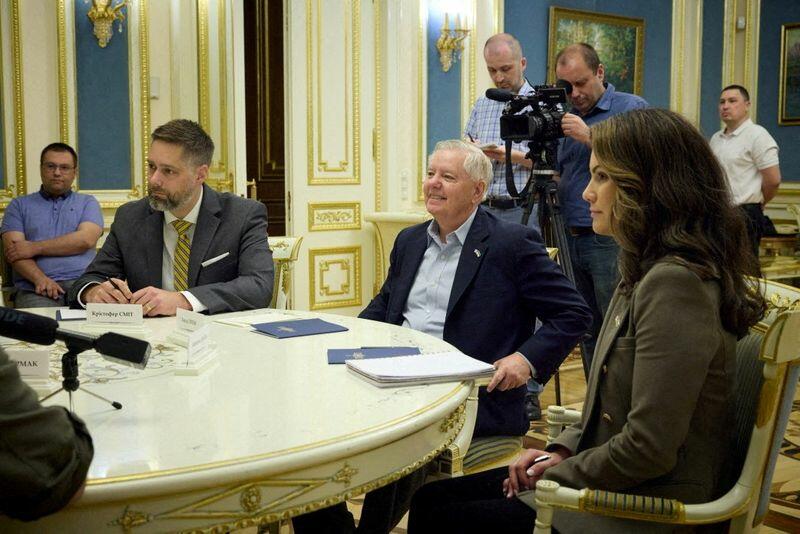
Russia’s Interior Ministry has issued an arrest warrant for South Carolina Senator Lindsey Graham after video surfaced of the Republican hawk telling Ukrainian officials that “Russians are dying” due to US military aid and that “it’s the best money we ever spent.”

There are claims that the video released of the Friday meeting in Kiev wherein Graham spoke the words to Ukraine’s President Zelensky were edited, however. And yet, it was Zelensky himself that posted the edited clip to his official social media channels

Via Reuters

Russia’s Investigative Committee announced the criminal case against Graham as hedeclared the financial involvement of the United States is causing the death of Russian citizens.”

Putin spokesman Dmitry Peskov reacted to Graham’s provocative statements by saying, “It’s difficult to imagine a greater shame for a country than having such senators” while Security Council Deputy Chairman Dmitry Medvedev said the Republican Senator is an “old fool.”

The arrest warrant and him being placed on a ‘wanted list’ will of course remain largely symbolic, given Graham certainly won’t be traveling to Russian territory or through its airspace anytime in the foreseeable future.

On Monday, the Russian Foreign Ministry responded to reporting from Reuters which said Graham’s remarks were taken out of context

Reports by Reuters that remarks by US Senator Lindsey Graham (Republican, South Carolina) made during a meeting with Ukrainian President Vladimir Zelensky may have been taken out of context represent clumsy, shameless excuses, a statement by the Russian Foreign Ministry made public on Monday said.

“‘It turns out,’ that’s not what Senator Graham said or how he said it. Just like with similar cannibalistic musings by former US President George W. Bush, clumsy, shameful excuses are being bandied about: so, allegedly, the senator’s words were taken out of context, there was some ‘editing’ and so on. Who would have doubted that the politician himself and his spin doctors, such as the top Anglo-Saxon media outlets and news agencies, would, as they say, ‘play dumb.’ What’s next? They will tell us that Lindsey Graham is a product of [artificial intelligence] and doesn’t actually exist?” the Foreign Ministry asked rhetorically. It stressed that this “attempt is doomed to fail.” “It is already impossible to clean oneself [and one’s reputation] from the stain of such remarks, even if they were uttered separately,” the ministry added.

But again, it was the Ukrainian presidency’s office itself that was responsible for the editing and circulating of the remarks in the first place.

According to The Hill: “Graham appeared to make the comments in different parts of the conversation, which was edited and posted on Zelensky’s social media account.” 

Tyler Durden
Mon, 05/29/2023 – 11:55

via ZeroHedge News https://ift.tt/orMxAbL Tyler Durden

Lawyer Uses ChatGPT In Court And Now “Greatly Regrets” It

Lawyer Uses ChatGPT In Court And Now “Greatly Regrets” It

Authored by Ciaran Lyons via CoinTelegraph.com,

A New York attorney has been blasted for using ChatGPT for legal research as part of a lawsuit against a Columbian airline.

Steven Schwartz, an attorney with the New York law firm Levidow, Levidow & Oberman, was hired by Robert Mata to pursue an injury claim against Avianca Airlines.

Mata claims he sustained the injury from a serving cart during his flight with the airline in 2019, according to a May 28 report from CNN Business.

However, after a judge noticed inconsistencies and factual errors in the case documentation, Schwartz has admitted to using ChatGPT for his legal research, according to a May 24 sworn affidavit.

He claims that this was his first time using ChatGPT for legal research and “was unaware of the possibility that its content could be false.”

In an April 5 court filing, the judge presiding over the case stated:

“Six of the submitted cases appear to be bogus judicial decisions with bogus quotes and bogus internal citations.”

The judge further claimed that certain cases referenced in the submissions did not exist, and there was an instance where a docket number on a filing was mixed up with another court filing. 

Extract of Steven Schwartz’s affidavit on May 24. Source: courtlistener.com

Schwartz said he also regrets having trusted the artificial chatbot without conducting his own due diligence. The affidavit noted:

“[Schwartz] Greatly regrets having utilized generative artificial intelligence to supplement the legal research performed herein and will never do so in the future without absolute verification of its authenticity.”

In recent times there has been an ongoing debate regarding the extent to which ChatGPT can be integrated into workforces.

However, reports indicate that the intelligence levels of ChatGPT are rapidly advancing.

But developers are skeptical about whether it has the potential to replace humans altogether. 

Blockchain developer Syed Ghazanfer said while he favors ChatGPT, he is doubtful that it has the communication skills to completely replace human workers.

“For it to replace you, you have to communicate requirements which are not possible in native English. That’s why we invented programming languages,” he said.

Tyler Durden
Mon, 05/29/2023 – 11:20

via ZeroHedge News https://ift.tt/PZhATyE Tyler Durden

Old Navy To Shutter Downtown San Francisco Store Amid Retail Exodus

Old Navy To Shutter Downtown San Francisco Store Amid Retail Exodus

Add the Old Navy store in downtown San Francisco to the ever-expanding list of retail stores closing up shop this year. So far, Nordstrom and Nordstrom Rack, Saks Off 5th, Anthropologie, Coco Republic, Whole FoodsT-Mobile, and a slew of other retail shops have shuttered operations in the crime-ridden progressive-run city because officials are failing to enforce law and order, which has led to a massive surge in thefts. 

According to NBC Bay Area, Old Navy’s parent company Gap Inc. wrote in a statement that its store, located at 801 Market Street, will close its doors on July 1. The company is attempting to find a new location in the downtown district that “will better serve the needs of the business and our customers.” 

In other words, the company is relocating from the Market Street location because of out-of-control crime. The other retailers we noted above have specifically mentioned crime as the leading driver in shuttering downtown operations. 

Here’s Gap’s statement from Friday:

“Old Navy is always evaluating its real estate portfolio to ensure a healthy fleet of stores that can provide the best possible experience for our customers. Since our Market Street store opened in the 1990s, the way we leverage flagship locations has changed.”

“As a result, we have taken the difficult decision to close our Market Street store when the lease expires, and we are already working to identify new locations in downtown San Francisco that will better serve the needs of the business and our customers.”

“Gap Inc. has deep roots in San Francisco and is committed to the city. We recently invested in renovating our Downtown San Francisco hub where our teams come together to develop new consumer experiences and product innovations. As part of that remodel, we opened four new stores at our headquarters where customers can experience the latest fashion and experiences from each of our brands, including new Old Navy, Gap, Banana Republic and Athleta stores. In addition, Banana Republic has announced plans for a new flagship store on Geary Street in Union Square.”

We want to thank the Old Navy Market Street employees for their dedication as well as our many customers who visited the store over the years. After the location closes to the public on July 1, we invite customers to shop our nearby locations in San Francisco, Daly City, Colma and Emeryville, or at OldNavy.com.”

Meanwhile, a sobering report from Coldwell Banker (available to pro subs in the usual place) in mid-April revealed San Francisco’s office vacancy rate hit a record high of 29.4%. This is problematic as remote work, and the exodus of businesses and people might stunt the recovery of the metro area. Also, who wants to live in a town where progressive leadership fails to enforce law and order? 

Tyler Durden
Mon, 05/29/2023 – 10:45

via ZeroHedge News https://ift.tt/fjUt50K Tyler Durden

Graham Criticizes Defense Spending In Debt Ceiling Deal: “Biggest Winner Of Biden Defense Budget Is China”

Graham Criticizes Defense Spending In Debt Ceiling Deal: “Biggest Winner Of Biden Defense Budget Is China”

Authored by Frank Fang via The Epoch Times,

Sen. Lindsey Graham (R-S.C.) warned House Speaker Kevin McCarthy (R-Calif.) that China would be the beneficiary of the U.S. defense budget proposed in the tentative debt ceiling deal.

“I respect Kevin McCarthy. I want to raise the debt ceiling. It would be irresponsible not to do it. I want to control spending. I’d like to have a smaller IRS. I’d like to claw back the unused COVID money. I know you can’t get the perfect—but what I will not do is adopt the Biden defense budget and call it a success,” Graham told Fox News on May 28.

“Kevin said that the defense is fully funded. If we adopt the Biden defense budget, it increases defense spending below inflation,” Graham added.

“The Biden defense budget was a joke before, and if we adopt it as Republicans we will be doing a great disservice to the party of [former President] Ronald Reagan,” he added. “The biggest winner of the Biden defense budget is China because they’ll have a bigger navy.”

The debt ceiling agreement negotiated between the White House and Republican leaders in the House would cap defense funding at President Joe Biden’s defense budget request, at $886 billion in fiscal 2024, about a 3.5 percent increase. That is below the current rate of inflation, which was 5 percent in March and 4.9 percent in April.

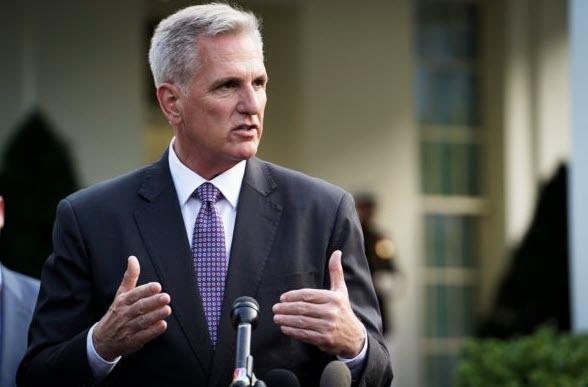
House Speaker Kevin McCarthy (R-Calif.) speaks to the press after meeting President Joe Biden to discuss the debt limit at the White House in Washington on May 22, 2023. (Madalina Vasiliu/The Epoch Times)

Navy

The Navy’s share of the FY2024 defense budget is estimated at $255.8 billion, an amount that Republican lawmakers have argued is inadequate given how quickly China is building up its navy.

During a congressional hearing in March, U.S. Navy Secretary Carlos del Toro acknowledged that under the current budget proposal, the U.S. Navy would have 291 ships by 2028, while China would have “upward of 440” ships.

As of April, the U.S. Navy had a fleet of 298 ships, according to the the Congressional Research Service (pdf).

China currently maintains the largest navy in the world. According to the Pentagon’s 2022 report on China’s military (pdf), the Chinese navy has about 340 ships and submarines, including approximately 125 major surface combatants.

“The overmatch with China is real. The Biden defense budget makes it even worse for us. I look forward to the details, but if you send me the Biden defense budget to the United States Senate and declare it fully funds the military, you will have a hard time with me,” Graham said.

The South Carolina senator added that he would not be “intimidated” by June 5, the deadline marked by Treasury Secretary Janet Yellen to avoid a default on the nation’s financial obligations.

“We should raise the debt ceiling, but we should not cripple the military’s ability to defend the nation as a trade-off,” Graham added. “Spending below inflation is not fully funding the military. Cutting the size of the Navy only helps China.”

Taiwan President Tsai Ing-wen addresses to soldiers amid the COVID-19 pandemic during her visit to a military base in Tainan, southern Taiwan, on April 9, 2020. (Sam Yeh/AFP via Getty Images)

Taiwan

During the Fox News interview, Graham was also asked to comment about U.S. military supply, in the event that China decides to invade Taiwan.

“Ukraine’s consumption of U.S.-supplied materiel is outstripping the capacity of American defense firms to quickly replenish it,” host Shannon Bream said, quoting from a February article from Defense News.

“A Center for Strategic and International Studies report last month found the U.S. defense-industrial base is unprepared for a notional battle with China over Taiwan.”

“How do we manage that?” Bream asked Graham.

“If you don’t see the connection between Ukraine and China, you’re missing a lot,” Graham responded. “We need more defense spending. They’re right about the weapons. We need to increase our arsenal. We have multiple threats. Let’s help Ukraine defeat [Russian President Vladimir] Putin. End the war on favorable terms in Ukraine, you’ll make China less likely to invade Taiwan.”

He added: “The defense budget that they’re proposing as part of this deal makes it impossible for us to do the things we need to do. You’re reducing defense spending at a time we need more of it.”

The report, which was published in January, found that the United States would likely run out of key long-range, precision-guided munitions in less than one week in a battle against China defending Taiwan.

“These shortfalls would make it extremely difficult for the United States to sustain a protracted conflict—and, equally concerning, the deficiencies undermine deterrence,” the report says. “These problems are particularly concerning since China is heavily investing in munitions and acquiring high-end weapons systems and equipment five to six times faster than the United States, according to some U.S. government estimates.”

Taiwan is a self-ruled democracy with its own military, constitution, and currency. However, the Chinese Communist Party sees the self-ruled island as a part of its territory that must be reunited with the mainland, by force if necessary. 

Tyler Durden
Mon, 05/29/2023 – 10:10

via ZeroHedge News https://ift.tt/eiSIl1v Tyler Durden

Carnival Sunshine Cruise Ship Battered By Massive Waves, Leaving Multiple Decks Flooded

Carnival Sunshine Cruise Ship Battered By Massive Waves, Leaving Multiple Decks Flooded

Passengers aboard the Carnival Sunshine had a nightmarish experience as the cruiseliner attempted to return to its home port in Charleston on Friday. The cruise ship was battered by rough seas and powerful winds, flooding the lower decks. The situation worsened late Friday night into early Saturday when passengers saw crew members putting on life jackets. 

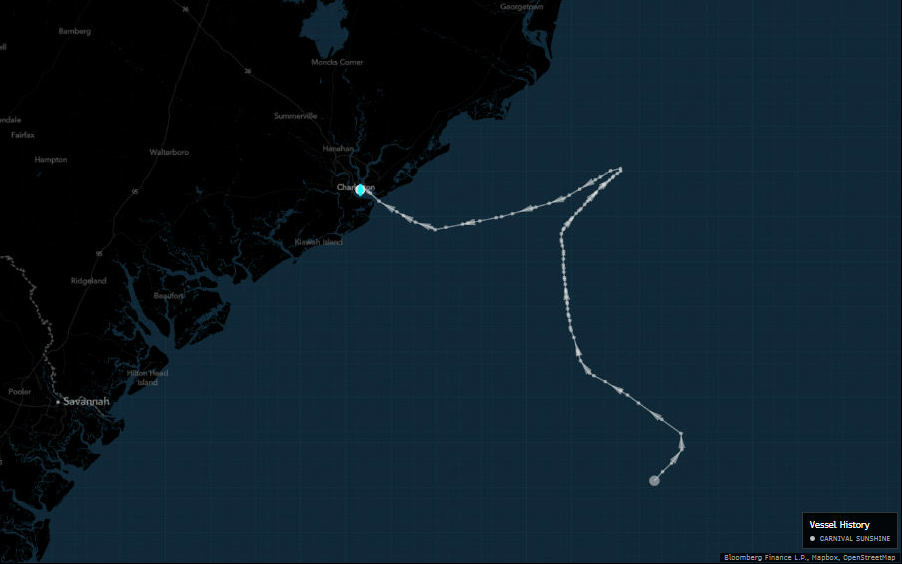
Bloomberg ship tracking data shows the vessel zig-zagged off the coast of Charleston while a low-pressure storm slammed the ship with monster waves and 80 mph winds. 

Passenger Daniel Taylor shared his terrifying experience between Friday evening and mid-day Saturday with Daily Mail

But at around 4.30pm on Friday, the trip took a turn for the worse as the ship approached choppy waters.

Just 15 minutes later, Taylor said, the captain made an announcement that due to the adverse weather conditions, the Sunshine may arrive back in Charleston later than it was scheduled to.

‘He said that the staff would do everything they could to minimize discomfort,’ Taylor recounted, noting that shortly thereafter vomit bags were put out on all the elevators.

By 7pm, he said, the ship started hitting large swells of water.

‘I went to a show in the Liquid Lounge at the front of the ship at that time,’ Taylor said. ‘The sound of us crashing into the swells could be heard over the music playing.

‘Stage lights mounted on the ceiling began to shake, the disco ball started swinging and the LED wall on the stage,’ which he said was probably about 20 to 30 feet tall and wide, ‘began rolling side by side on its own.’

Around 8pm, the staff started closing off and evacuating all the public deck areas, and just about one hour later, Taylor said he went to the buffet, where he saw plates and cups topple.

He then returned to his room on the second level of the ship, where he watched as a glass chalice fell off the counter and shattered. 

Throughout this time, Taylor said, the ship was still traveling at 11 knots per hour, only reducing speed to 5 knots per hour at 11.15pm when winds started hitting the ship at 80mph.

At that point, he said, the ‘captain turned the ship from sailing northwest toward Charleston to head northeast heading directly into the eye of the storm.’

Taylor also said he watched as the cabin across from his started to leak from the ceiling, and told how there were no announcements from the crew.

At around 2am, he said, the staff changed the television screens to a standby announcement — thereby wiping off the screen showing the direction the ship was traveling and how fast.

‘We were no longer able to see where we were going, how fast we were going, what the wind speed was or anything,’ Taylor said. ‘We were blind to what was going on — especially with no weather or course update since 4.45pm the previous day.

‘This was also around the time our Internet went out, so we weren’t able to look at the weather online or contact anyone,’ he added. 

‘At this point, we were hitting large swells over and over. They had to be anywhere from 10 to 20 feet.’

Meanwhile, he said, he saw crew members wearing life jackets.

It wasn’t until 7.30am, Taylor recounted, the cruise director came on the air and made an announcement that they were outside Charleston harbor but could not dock as scheduled.

The ship finally arrived at the port at around 5.30pm Saturday night — more than nine hours after it was scheduled to dock.

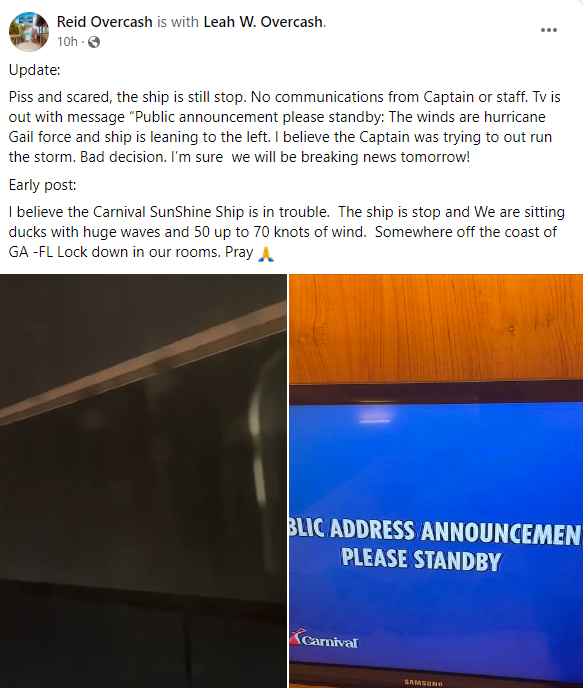
Another passenger posted on Facebook:

 “I believe the Carnival SunShine Ship is in trouble. The ship is stop and We are sitting ducks with huge waves and 50 up to 70 knots of wind. Somewhere off the coast of GA-FL. Lock down in our rooms. Pray.” 

That passenger continued:

“Piss and scared, the ship is still stop. No communications from Captain or staff. TV is out with message “Public announcement please standby:” The winds are hurricane Gail force and ship is leaning to the left. I believe the Captain was trying to our run the storm. Bad decision. I’m sure we will be breaking news tomorrow!”

Passenger Sharon Tutrone tweeted, “After 14 hours of high winds, rain and massive waves. The ship took a hit from a wave that sounded like the ship split in two.”

After nearly a day of hell, the cruise ship arrived in Charleston on Saturday evening. The vessel is back on the seas, sailing on a five-day Bahamas cruise.

Tyler Durden
Mon, 05/29/2023 – 09:35

via ZeroHedge News https://ift.tt/bTV4sZl Tyler Durden

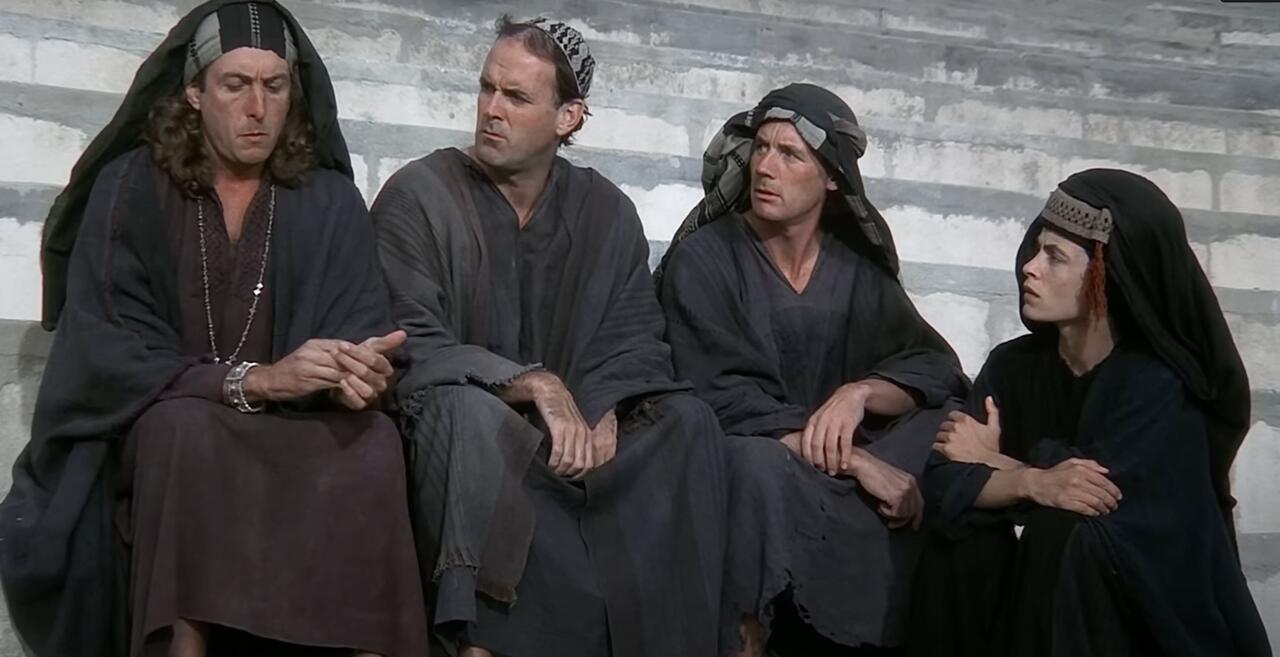
No Laughing Matter: John Cleese Holds Line Against Calls To Cancel Scene In ‘Life Of Brian’

No Laughing Matter: John Cleese Holds Line Against Calls To Cancel Scene In ‘Life Of Brian’

Authored by Jonathan Turley,

We have previously discussed how comedians have been objecting that woke activists are killing comedy. The complaint is that a group of perpetually pissed off, humorless people are remaking the world in their own image.

It began with college campuses where comedians are now saying are dead as venues since you cannot safely make any joke that insults any group other than white straight males or Christians or conservatives. Others have objected to hate speech laws limiting comedians, particularly after some comedians have been prosecuted for “malicious communications” or insulting groups or religious figuresSix out of ten students view offensive jokes as hate speech. This week, however, activists appear to have met their match in a legend of comedy who has opposed the cutting of  a scene from the movie The Life of Brian. 

No, activists are not upset with the endless jokes about Italians, Christians, and Jews. It is the scene involving a man who wants to become a women and have a child. 

John Cleese is refusing to yield.

In The Life of Brianthe scene involves “Stan” who announces that he wants to be a woman named Loretta and have babies

Activists objected that it made fun of transgender people and demanded that it be cut from the film.

The scene shows Stan declaring “I want to be a woman… It’s my right as a man. I want to have babies… It’s every man’s right to have babies if he wants them.” After Cleese’s protest, the character snaps, “Don’t you oppress me!”

Some reported that Cleese had agreed to cut the scene. However, Cleese tweeted out a correction of the “misreporting.”

What is interesting is that Rob Reiner is reportedly working on the reboot. Reiner is known as someone who is a champion of the left in Hollywood. This may be an inauspicious start for the reboot effort.

Cleese is not alone in raising this alarm. Comedians including Chris Rock blamed the range of “unfunny TV shows” on the fact that “everybody’s scared to make a move”. Ricky Gervais objected that the BBC is now paralyzed in fear of offending anyone.  Jennifer Saunders that people now “talk themselves out of stuff now because everything is sensitive.”

The same complaint has been made in the age of woke advertising that funny commercials seem increasingly rare as oppose to corporate virtue signaling.

The director of the classic comedy Airplane! observed that humor is being squeezed out of Hollywood and the movie today would have virtually every joke removed. David Zucker called it the “death of creativity.”

They are now set upon by a legion of humorless people who seek to reduce the world to their own narrow range of acceptable levity or irony.  These comedy giants are set upon by an Army of Lilliputians who have contributed little to culture beyond chilling artists and writers into obedient silence or compulsive comedy criteria.

Of course, Cleese could always use the line from Bryan’s mother: “He’s a very naughty boy! Now, piss off!”

Tyler Durden
Mon, 05/29/2023 – 09:00

via ZeroHedge News https://ift.tt/RNJTcwE Tyler Durden

“The Best Way To Honor Sacrifice…”

“The Best Way To Honor Sacrifice…”

Authored by W.J. Astore via BracingViews.com,

The best way to honor sacrifice is to seek an end to war and militarism

I was asked for a few words about Memorial Day. Here’s what I came up with:

On Memorial Day, we honor those who died in the service of our country. Let us do everything we can as a people and a nation to stop war and all its brutality. 

A peaceful future without war and all its awfulness is the best way to honor our troops, even as we cherish the memory of the heroes who gave their all.

Too often, Memorial Day is reduced to sales events, barbecues, and the like.

It is, of course, a solemn occasion to remember the sacrifice of American service members. To honor the dead. To cherish their memory.

Yet one can also focus too narrowly on the veneration of the dead, using euphemisms like “the fallen” and speaking of how troops willingly “gave” their lives for their country.

The best antidote to this is a short video by Andy Rooney for “60 Minutes” (when that show still had some principles and bite). Rooney, who’d served in World War II, knew of what he spoke.

His goal was to end war, to save the living, to make a better world.

If you haven’t seen it, I urge you to watch it and to reflect on his sad and wise words.

Tyler Durden
Mon, 05/29/2023 – 08:25

via ZeroHedge News https://ift.tt/K6HVogW Tyler Durden

Facts Vs. Fed-Speak: A Comical History With Tragic Consequences

Facts Vs. Fed-Speak: A Comical History With Tragic Consequences

Authored by Matthew Piepenburg via GoldSwitzerland.com,

Below, we look at simple facts in the context of complex markets to underscore the dangerous direction of Fed-Speak and Fed policy.

Keep It Simple, Stupid

It’s true that, “the Devil is in the details.”

Anyone familiar with Wall Street in general, or market math in particular, for example, can wax poetic on acronym jargon, Greek math symbols, sigma moves in bond yields, chart contango or derivative market lingo.

Notwithstanding all those “details,” however, is a more fitting phrase for our times, namely: “Keep it simple, stupid.”

The Simple and the Stupid

The simple facts are clear to almost anyone who wishes to see them.

With US debt, for example, at greater than 120% of its GDP, Uncle Sam has a problem.

That is, he’s broke, and not just debt-ceiling broke, but I mean broke, broke.

It’s just THAT simple.

Consequently, no one wants his IOUs, confirmed by the simple/stupid fact that in 2014, foreign Central Banks stopped buying US Treasuries on net, something not seen in five decades.

In short, the US, and its sacred bonds, just aren’t what they used to be.

To fill this gap, that creature from Jekyll Island otherwise known as the Federal Reserve, which is neither Federal nor a reserve, has to mouse-click money to pay the deficit spending of short-sighted and opportunistic administrations (left and right) year after year after year.

Uncle Fed, along with its TBTF nephews, have thus become the largest marginal financiers of US deficits for the last 8 years.

In short, the Fed and big banks are literally drinking Uncle Sam’s debt-laced Kool aide.

The Fed’s money printer has thus become central to keeping credit markets alive despite the equal fact (paradox) that its rate hikes are simultaneously gutting bonds, banks and small businesses to fight inflation despite the stubborn fact that such inflation is still here.

The Inflation Narrative: Form Over Substance

My view, of course, is that the Fed’s war on inflation is a headline optic rather than policy fact.

Like all debt-soaked and failing regimes, the Fed secretly wants inflation to outpace rates (i.e., it wants “negative real rates”) in order to inflate away some of that aforementioned and embarrassing debt.

But admitting that is akin to political suicide, and the Fed is political, not “independent.”

Thus, the Fed will seek inflation while simultaneously mis/under-reporting CPI inflation by at least 50%. I’ve described this as “having your cake and eating it too.”

All that said, inflation, which was supposed to be transitory, is clearly sticky (as we warned from the beginning), and even its under-reported 6% range has the experts in a tizzy of comical proportions.

Neel Kashkari, for example, is thinking the US may need to get rates to at least 6% to “beat” inflation. James Bullard is asking for more rate hikes too.

But what these “go higher, longer” folks are failing to mention is that rate hikes make Uncle Sam’s bar tab (i.e., debt) even more expensive, a fact which deepens rather than alleviates the US deficit nightmare.

The War on Inflation is a Policy that Actually Adds to Inflation

Ironically, however, few (including Kashkari, Bullard, Powell or just about any economic midget in the House of Representatives) are recognizing the additional paradox that greater deficits only add to (rather than “combat”) the inflation problem, as deficit spending (an economy on debt respirator) keeps artificial demand (and hence) prices rising rather than falling.

Furthermore, these deficits will ultimately be paid for with more fiat fake money created out of thin air at the Eccles building, a policy which is inherently (and by definition): INFLATIONARY.

In short, and as even Warren B. Mosler recently tweeted, “the Fed is chasing its own tail.”

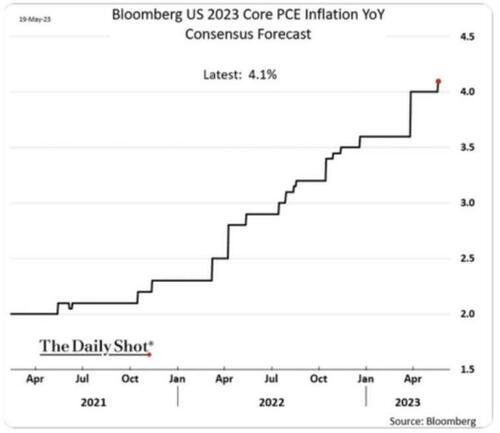
Inflation, in other words, is not only here to stay, the Fed’s “anti-inflationary” rate hike policies are actually making it worse.

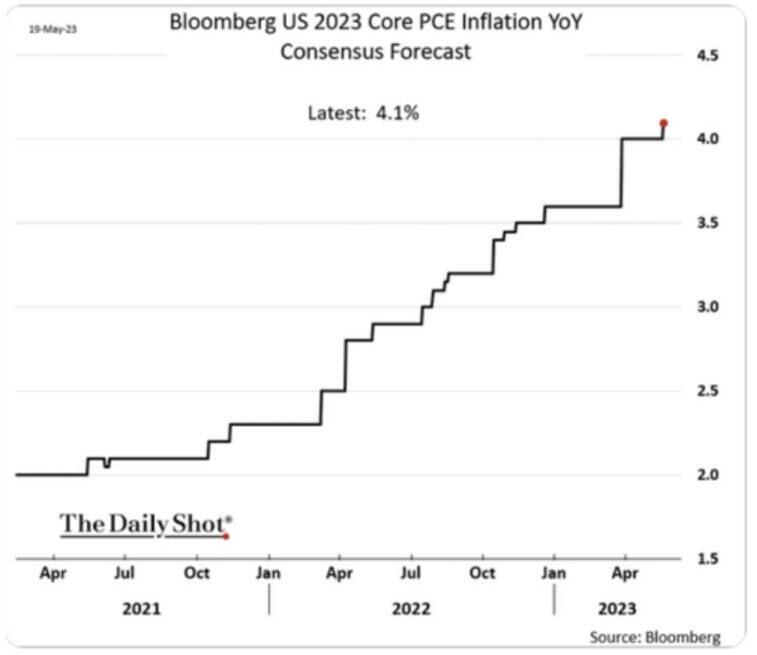
Even party-line economists are forecasting higher core inflation this year:
The Real Solution to Inflation? Scorched Earth.

In fact, the only way to truly dis-inflate the inflation problem is to raise rates high enough to destroy the bond market and the economy.

Afterall, major recessions/depressions do “beat” inflation—along with just about everything and everyone else.

The current Fed’s answer to combatting the inflation problem is in many ways the equivalent of combatting a kitchen rodent problem by placing dynamite in the sink.

Meanwhile, the Rate Hikes Keep Blowing Things Up

Buried beneath the headlines of one failing bank (and tax-payer-funded depositor bailout) after the next, is the equally dark picture of US small businesses, all of which rely on loans to stay afloat.

But according to the U.S. Small Business Association, loan rates for the “little guys” have reached double digit levels.

Needless to say, such debt costs don’t just hurt small enterprises, they destroy them.

This credit crunch is only just beginning, as small enterprises borrow less in the face of rising rates.

Real estate, of course, is just another sector for which the “war on inflation” rate hikes are creating collateral damage.

Homeowners enjoying the fixed low rates of days past are naturally remiss to sell current homes only to face the pain of buying a newer one at much higher mortgage rates.

This means the re-sale inventory for older homes is shrinking, which means the market (as well as price) for new construction homes is spiking—serving as yet another and ironic example of how the Fed’s alleged war on inflation is actually adding to price inflation…

In short, Fed rate hikes can make inflation rise, and equally tragic, is that Fed rate cuts can also make inflation rise, as cheaper money only means greater velocity of the same, which, alas, is inflationary…

See the Paradox?

And that, folks, is the paradox, conundrum, corner or trap in which our central planners have placed us and themselves.

As I’ve warned countless times, we must eventually pick our poison: It’s either a depression or an inflation crisis.

Ultimately, Powell’s rate hikes, having already murdered bonds, stocks and banks, will also murder the economy.

Save the System or the Currency?

At that inevitable moment when the financial and social rubble of a national and then global recession is too impossible to ignore, the central planners will have to take a long and hard look at the glowing red buttons on their money printers and decide which is worthing saving: The “system” or the currency?

The answer is simple. They’ll push the red button while swallowing the blue pill.

Ultimately, and not too far off in our horizon, the central planners will “save” the system (bonds and TBTF banks) by mouse-clicking trillions of more USDs.

This simply means that the deflationary recession ahead will be followed by a hyper-inflationary “solution.”

Again, and worth repeating, history confirms in debt crisis after debt crisis, and failed regime after failed regime, that the last bubble to “pop” is always the currency.

A Long History of Stupid

In my ever-growing data base of things Fed-Chairs have said that turned out to be completely and utterly, well…100% WRONG, one of my favorites was Ben Bernanke’s 2010 assertion that QE would be “temporary” and with “no consequence” to the USD.

According to this false idol, QE was safe because the Fed was merely paying out dollars to purchase Treasuries is an even swap of contractually even values.

What Bernanke failed to foresee or consider, however, is that such an elegant “swap” is anything but elegant when the Fed is marred by an operating loss in which its Treasuries are tanking in value.

That is, the “swap” is now a swindle.

As deficits rise, the TBTF banks will require more mouse-clicked (i.e., inflationary) dollars to meet Uncle Sam’s interest expense promise to the banks (“Interest on Excess Reserves”).

In the early days of standard QE operations, at least the Fed’s printed money was “balanced” by its purchased USTs which the TBTF banks then removed from the market and parked “safely” at the Fed.

But today, given the operating losses in play, the Fed’s raw money printing will be like like raw sewage with nowhere to go but straight into the economy with an inflationary odor.

Bad Options, Fluffy Words

Again, the cornered Fed’s options are simple/stupid: It can continue to hawkishly raise rates higher for longer and send the economy into a depression and the markets into a spiral while declaring victory over inflation, or it can print trillions more fiat dollars to prop the system and neuter/debase the dollar.

And for this wonderful set of options, Bernanke won a Nobel Prize?

The ironies do abound…

But as a famous French moralist once said, the highest offices are rarely, if ever, held by the highest minds.

Gold, of course, is not something the Fed (nor anyone else) can print or mouse-click, and gold’s ultimate role as a currency-insurer is not a matter of debate, but a matter of cycles, history and simple/stupid common sense. (See below).

Markets Are Prepping

In the interim, the markets are slowly catching on to the fact that protecting purchasing power is now more of a priority than looking for safety in grossly and un-naturally inflated “fixed income” or “risk-free-return” bonds.

Why?

Because those bonds are now (thanks to Uncle Fed) empirically and mathematically nothing more than “no-income” and “return-free-risk.”

Meanwhile, hedge funds are building their net short positions in S&P futures at levels not seen since 2007 for the simple reason that they foresee a Powell-induced market implosion off the American bow.

Once that foreseeable implosion occurs, get ready for the Fed’s only pathetic tools left: Lower rates and trillions of instant liquidity—the kind that kills a currency.

In Gold We Trust

The case for gold as insurance against such a backdrop of debt, financial fragility and openly dying currencies is, well: Simple stupid and plain to see.

Few on this round earth see the simple among the complex better than our advisor and friend, Ronni Stoeferle, whose most recent In Gold We Trust Report has just been released.

Co-produced with his Incrementum AG colleague, Mark Valek, this annual report has become the seminal report in the precious metal space.

The 2023 edition is replete with not only the most sobering and clear data points and contextual common sense, but also a litany of entertaining quotations from Churchill and the Austrian School to The Grateful Dead and Anchorman …

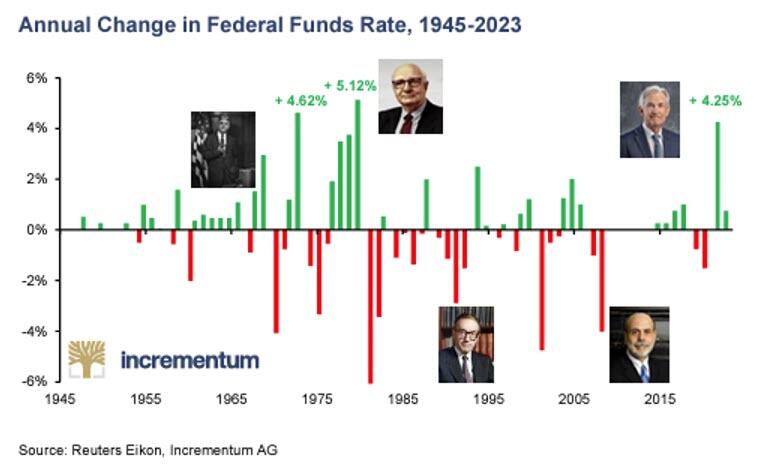
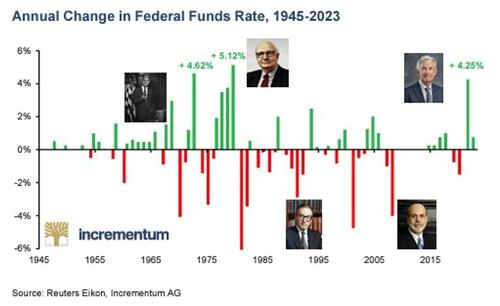
Ronni and Mark unpack the consequences of a Fed that has raised rates too high, too fast and too late, which is, again a fact plain to see:
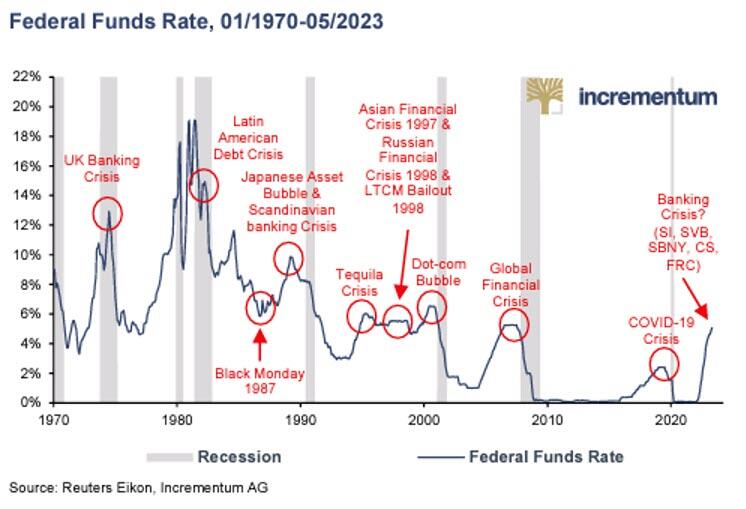
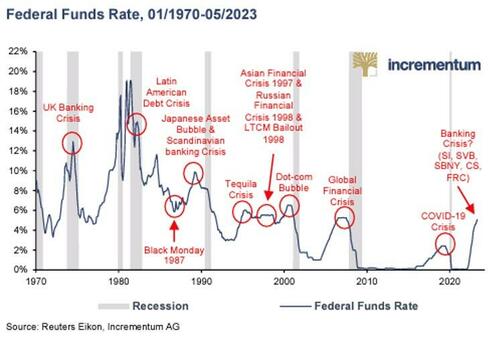
Needless to say, hiking rates into an economic setting already historically “debt fragile” tends to break things (from USTs to regional banks) and portends far more pain ahead, as both history and math also plainly confirm:
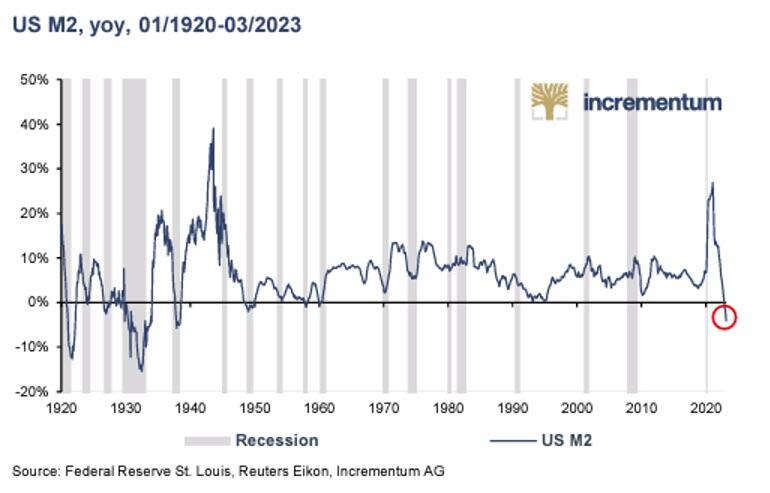
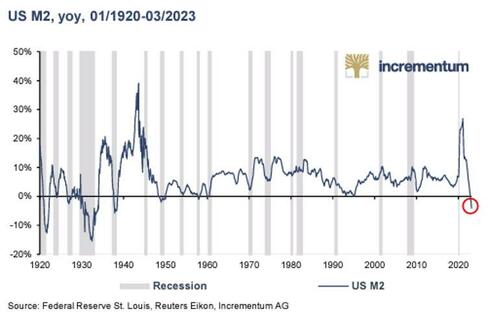
In a debt-soaked world fully addicted to years of instant liquidity from a central bank near you, Powell’s sudden (but again too late, too much) hiking policies will not “softly” restrain market exuberance nor contain inflation without unleashing the mother of all recessions.

Instead, the subsequent and sudden negative growth of money supply will only hasten a recession as opposed to a “softish” landing:
As the foregoing report warns, the looming approach of this recession is already (and further) confirmed by such basic indicators as the Conference Board of Leading Indicators, an inverted yield curve and the alarming spread between 10Y and 2Y yields. 

Self-Inflicted Geopolitical Risks

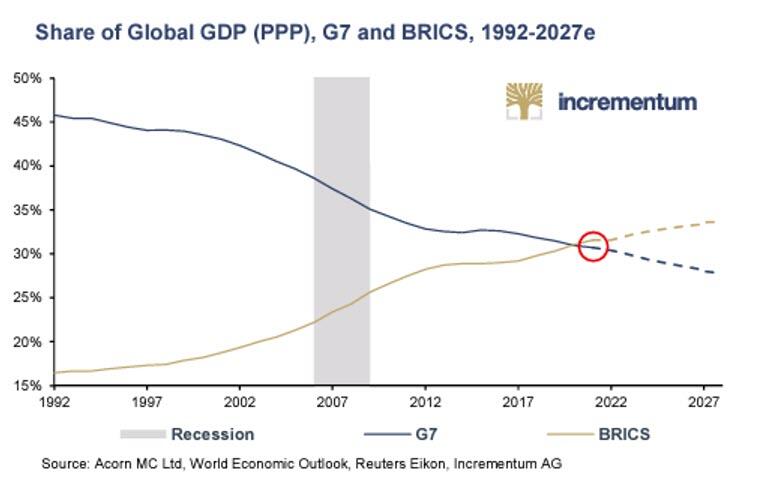
The report further examines the geopolitical shifts of which we have been warning(and writing) since March of 2022, when Western sanctions against Russia unleashed a watershed trend by the BRICS and other nations to seek settlement payments outside of the weaponized USD.

One would be unwise to ignore the significance of this shift or underestimate the growing power of these BRICS (and BRICS “plus”) alliances, as their combined share of global GDP is rising not falling…
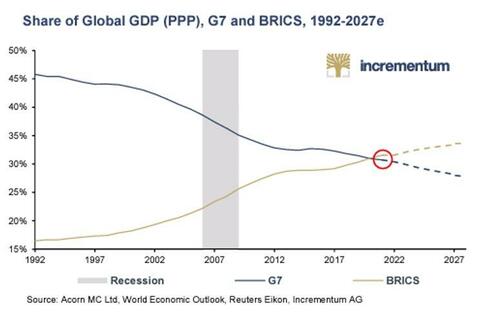
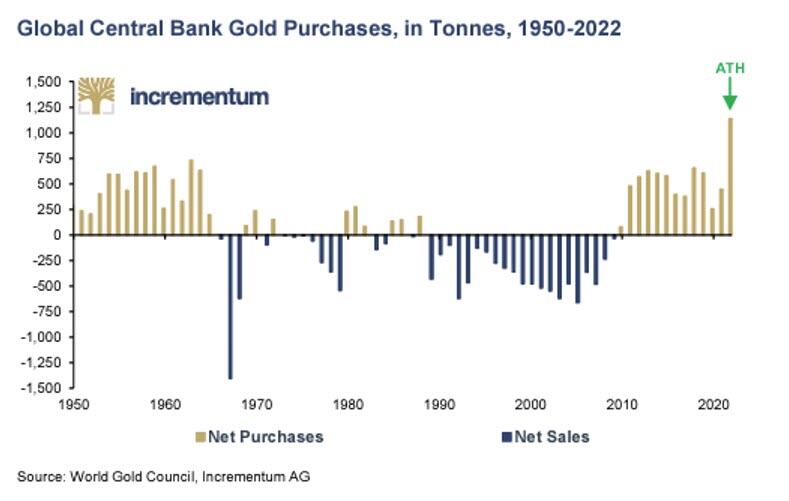
As interest in (and trust for) the now weaponized USD as a payment system declines alongside a weakening faith in Uncle Sam’s IOUs, the world, and its central banks (especially out East) are turning away from USTs and turning toward physical gold.

Again, I give credit to the In Gold We Trust Report:
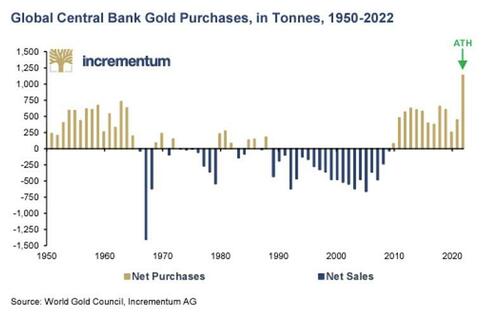
See a trend?

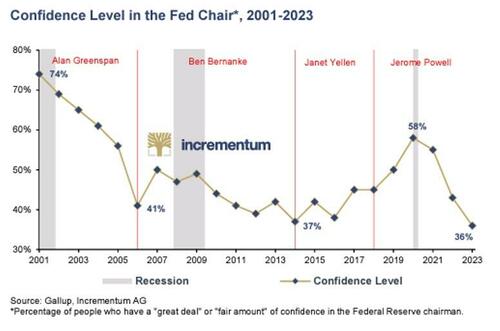
See why?

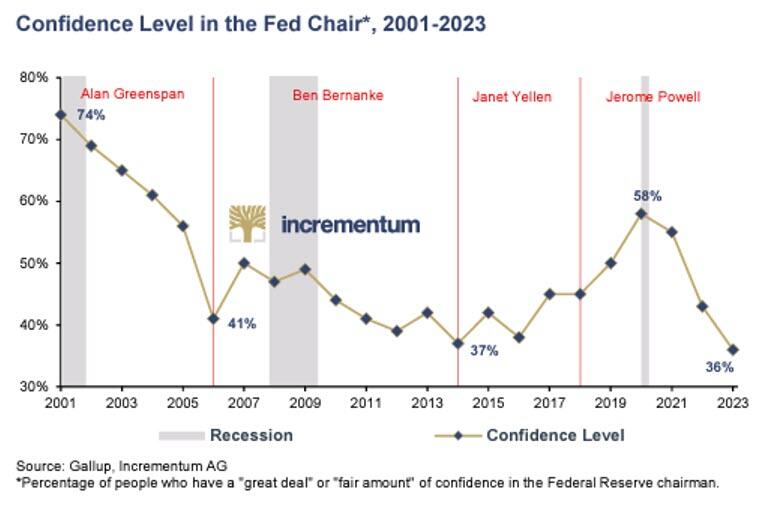
It’s fairly simple, and for this we can thank the fairly stupid policies of the Fed in particular and the declining faith in their prowess in general:
Myths Are Stubborn Things

Many, of course, find it hard to imagine that a Federal Reserve based in DC and within the land of the Great American dream (and world reserve currency) could be anything but wise, efficient and stabilizing, despite an embarrassing Fed track record that is empirically unwise, inefficient and consistently destabilizing…

Myths are hard to break, despite the fact the myth of MMT and QE on demand has been a failed experiment and is sending the US, as well as the global, economy toward a reckoning of historical proportions.

But the messaging of “Keep calm and carry on” from Powell is calming in spirit despite the fact that it hides terrifying math and historically confirmed consequences for the fiat money by which investors still wrongly measure their wealth.

But as Brian Fantana of Anchorman would tell us, trust the central planners.

“They’ve done studies, you know. 60% of the time it works every time.”

As for us, we trust the kind of data Ronni and Mark have gathered and that barbarous relic of gold far more than calming words and debased, fiat currencies.

As history reminds, when currencies die within a backdrop of unsustainable debt, gold in fact does work—and every time.

Tyler Durden
Mon, 05/29/2023 – 07:30

via ZeroHedge News https://ift.tt/jJBlzNX Tyler Durden