“Biden’s A F**king Goof” – Rogan Rages Against Establishment’s “Coordinated Bullshit” Attacks On Trump

“Biden’s A F**king Goof” – Rogan Rages Against Establishment’s “Coordinated Bullshit” Attacks On Trump

Valuetainment’s Patrick Bet-David sat down with famed podcaster Joe Rogan this week for almost three hours, discussing everything ‘politics’ – from DeSantis’s (poor) chances against Trump to Biden’s corruption (and inevitable resignation) to Trump’s (ongoing) mis-treatment by the deep state

Rogan first unloaded on the Bidens and the establishment’s never-ending levels of wilful blindness:

“Joe Biden has been a fucking goof his entire career. He’s been caught lying so many times. He’s so full of shit…

There is so much evidence that he is corrupt. Just undeniable evidence of corruption. The stuff with him and his son…

The guy [Devon Archer] who just testified that was Hunter’s business partner who talked about all the different things that Joe was involved with…

It’s fucking undeniable, and the fact that mainstream news is ignoring this except for right-wing media is f—kin crazy.”

Blasting the mainstream media as “pure propaganda”:

The difference between real journalism and corporate-sponsored mainstream journalism is huge…

Places like The New York Times are involved in propaganda…

Washington Post will bullshit. MSNBC is a pure propaganda network. CNN is largely propaganda.

The media has a narrative that they pushed during the pandemic… They are never going to be able to say we were wrong. They don’t say that. They never correct…

You don’t see those talking heads buck that narrative because there is no benefit in it. They can just gloss over it and continue to do what they do and not lose the respect of the people that watch.”

Then, Rogan reflected on Trump, with a more positive perspective than we have been used to from the podcaster (and reality-based view of hos the former president was treated)”

No one is going to run against Trump on the Republican side and win because you are not going to get the Trump supporters...

The fact that he was the President for four years, and the country was in a great economic situation, and it looked like his policies were actually effective.

Unemployment was down. Business was booming. Regulations were being relaxed. More things were getting done. When you look at it from a policy perspective, what he did on paper was effective…

Everybody thinks there needs to be a wall. Even the Mayor of New York City is now calling to stop immigration into his city…

When you look at the Russia collusion. When you look at the Steele dossier. When you look at all the bullshit, they tried to throw at him that we now know is bullshit.

Not just bullshit, but coordinated bullshit. When you look at the fact that they suppressed this Hunter Biden laptop story.

And 51 intelligence agency representatives signed off on that to say that this is Russian disinformation, which we know they know is not true. That’s scary.

Because now you have the intelligence agencies colluding to keep a guy from being president, who was president during a time when the country was thriving economically.

Additionally, during his discussion with Rogan, Bet-David pressed the podcaster on when he would host the former president for a sit-down.

“At a certain point in time, like… it would be interesting to hear his perspective on a lot of things,” Rogan said.

“I would like to know what it’s like when you actually get into office. What is it actually like when you get in that building?… What is the Deep State really like?… Because it’s very clear that it’s not as simple as elected representatives doing the will of the people.”

Bet-David later asked Rogan whether he felt like Trump was often misunderstood by many.

“I think for sure they have distorted who he is, magnified his faults, and even said things that are absolutely not true, like the Russia collusion thing,” Rogan responded.

While Rogan did not confirm whether he would have the former president on the podcast, he agreed with Bet-David on one thing concerning a potential podcast with Trump: “It would break the internet if it happened.”

Tyler Durden
Sat, 08/05/2023 – 14:00

via ZeroHedge News https://ift.tt/Sq0jRWu Tyler Durden

Democrat Congressman Lied About Devon Archer Testimony, Transcript Shows

Democrat Congressman Lied About Devon Archer Testimony, Transcript Shows

Authored by Zachary Stieber via The Epoch Times (emphasis ours),

A congressman made a misleading statement about the testimony of former Hunter Biden associate Devon Archer, a newly released transcript shows.

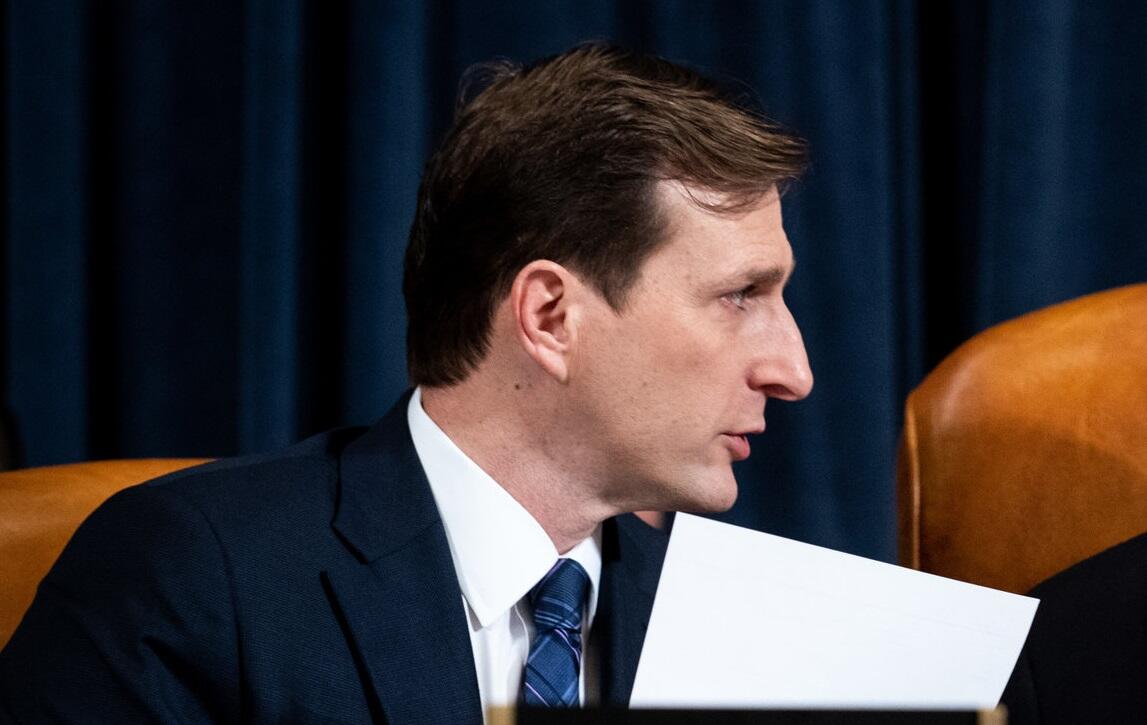
Rep. Dan Goldman (D-N.Y.) said in a briefing with reporters that Mr. Archer told members of Congress, including Mr. Goldman, in a closed-door session that Mr. Hunter Biden sold an “illusion of access” to President Joe Biden to business partners.

That briefing happened before the transcript of the testimony was released. The transcript shows that Mr. Goldman introduced the “illusion of access” term and that Mr. Archer didn’t fully agree.

“Is it fair to say that Hunter Biden was selling the illusion of access to his father?” Mr. Goldman asked.

“Yes,” Mr. Archer replied.

“So when you talk about selling the brand it’s not about selling access to his father. It’s about selling the illusion of access to his father. Is that fair?” Mr. Goldman inquired.

“That’s almost fair,” Mr. Archer said.

“Why almost fair?” Mr. Goldman wondered.

“Because there are touch points and contact points that I can’t deny that happened,” Mr. Archer said. “There were communications.”

Mr. Archer had testified earlier in the session that Mr. Hunter Biden placed Mr. Joe Biden on speaker phone 10 to 20 times while with business associates. On at least one occasion, Jonathan Li, CEO of BHR Partners, was with Mr. Hunter Biden. Mr. Joe Biden had met Mr. Li in China previously.

The talk during the calls typically centered around the weather and did not include discussion of business, according to Mr. Archer.

“They were calls to talk about the weather, and that was signal enough to be powerful,” Mr. Archer said.

Mr. Joe Biden told reporters on the campaign trial in 2020, “I have never spoken to my son about his overseas business dealings.”

Mr. Joe Biden also attended multiple dinners where Mr. Hunter Biden, Mr. Archer, and other business associates were in attendance, including a 2014 dinner at Cafe Milano in Washington, Mr. Archer testified. Yelena Baturina, CEO of Russia’s Inteco, was at one dinner. Mr. Hunter Biden later received a large payment from Ms. Baturina.

The “illusion of access” term was used again later, but by a Democrat whose name was redacted.

“The access to his father was an illusion of access to his father. Is that right?” the Democrat asked.

“Right. An illusion of access to his father, other than social—you know, socials,” said Mr. Archer. “They had dinners together, etc.”

Mr. Archer used an example featuring JPMorgan Chase CEO Jamie Dimon.

“It’s just like when, you know, Jamie Dimon comes in to talk about an IPO. He doesn’t know what the pricing’s going to be or when the date’s going to be. It’s just a conversation, and that was never part of it,” Mr. Archer said.

Mr. Goldman declined to comment.

The first-term Democrat congressman, who served on the team that successfully convinced the House to impeach then-President Donald Trump, spoke to reporters after Mr. Archer testified to the House Oversight Committee behind closed doors on July 31.

Mr. Goldman did not deny that Mr. Joe Biden advocated for the removal of then-Ukrainian prosecutor Viktor Shokin, who was investigating Burisma, but said that was not improper.

“As it pertains to Archer’s testimony about Hunter, there is not a shred of evidence of a single conflict of interest of President Biden ever doing anything in connection or in relation to Hunter Biden’s business ventures, other than advocating for the removal of a prosecutor general who was advantageous to Burisma,” Mr. Goldman said. “The only evidence we have right now of any official action by President Biden in connection to Hunter Biden’s business interests is bad for Hunter Biden’s business interests.”

Mr. Archer testified that the removal of Mr. Shokin would harm Burisma, but later acknowledged he was just repeating what he heard from Washington-based lobbyists.

That’s what was I was told, that it was bad for Burisma. But I don’t know. I don’t know if it was good or bad,” Mr. Archer testified.

Both Mr. Hunter Biden and Mr. Archer sat on Burisma’s board, making approximately $1 million a year each.

Mr. Shokin was removed after Mr. Joe Biden, the vice president at the time, traveled to Ukraine in 2015 and threatened to withhold a loan guarantee if Ukrainian leaders did not force Mr. Shokin out.

If the prosecutor’s not fired, you’re not getting the money,” Mr. Joe Biden said at a public event about the interaction. “Well, son of a [expletive]. He got fired.”

Mr. Shokin has said that the threat was cited when he was ousted. He said in a sworn statement that then-Ukrainian President Petro Poroshenko asked him to resign because of “pressure from the U.S. presidential administration, in particular from Joe Biden.”

Mr. Joe Biden and his allies have said that Mr. Shokin was corrupt and that the ouster was not related to Mr. Hunter Biden’s business.

Tyler Durden
Sat, 08/05/2023 – 13:30

via ZeroHedge News https://ift.tt/0pLN26d Tyler Durden

NYC “Out Of Control” As Twitch Streamer Arrested For Inciting A Riot

NYC “Out Of Control” As Twitch Streamer Arrested For Inciting A Riot

All hell broke out on Friday afternoon when Twitch streamer “Kai Cenat” told his massive following to come out to Manhattan’s Union Square Park, where he would be giving away PlayStation consoles and gift cards, among other items.

Cenat, a 21-year-old who has more than 20 million social media followers, at 12:30 Friday used his Instagram account to announce he’d be showing up at 4:30 to give away PlayStation5’s, computers, microphones and other electronic accessories. 

Between 3 pm and 3:30 pm EST., things spiraled out of control:

What exactly turned the crowd unruly isn’t quite clear, but by 3:30 pm people were seen chucking garbage at police and taking down barriers around the perimeter. Witnesses reported seeing others throwing chairs and bottles. One person had a bruise on his face and he said he was pushed to the ground. –NBC New York

Police estimate the crowd size climbed to a “couple thousand people.” 

The chaos that erupted prompted the highest level of police mobilization by the New York City Police Department. A spokesperson told NBC New York that 1,000 officers were called to Union Park. 

“Soon the park and the surrounding streets were overrun with people. They were disrupting both vehicular and pedestrian traffic. The NYPD responded by calling a mobilization in response to the large crowd. As the crowd grew, so did our mobilization. The crowd was swarmed when the influencer finally arrived at the park. Individuals in the park began to commit acts of violence towards the police and the public,” NYPD Chief of Department Jeffrey Maddrey said. 

Maddrey said the crowd stormed a construction: 

“You had people walking around with shovels, axes, and other tools from the construction trade. In addition, individuals were also lighting fireworks and flash bombs. They were throwing them towards police, and they were throwing them at each other,” Maddrey said. 

Here’s more chaos of what happened:

Police reported 65 were arrested, and thirty of them were juveniles. 

The streamer, Kai Cenat, was arrested at Union Square and police say he’ll be charged with inciting a riot, unlawful assembly and other crimes.

Live-streamer Kai Cenat was arrested on the scene (New York Post)

The unrest is another negative reflection on Mayor Eric Adams, who appears to be struggling to enforce law and order in the crime-ridden metro area. 

Tyler Durden
Sat, 08/05/2023 – 13:00

via ZeroHedge News https://ift.tt/MpuYDPK Tyler Durden

Charges Against Trump Hinge On What He Believed And When

Charges Against Trump Hinge On What He Believed And When

Authored by Philip Wegmann via RealClear Wire,

In a federal courthouse that rioters marched past on their way to storm the U.S. Capitol on Jan. 6, 2021, former President Donald Trump pled not guilty to four felony charges that he had attempted to overturn the results of the 2020 presidential election.

“When you look at what is happening,” he later told reporters, who had waited for him in the rain on the tarmac of Reagan International Airport, “this is a persecution of a political opponent. This was never supposed to happen in America.”

Trump then boarded his plane without taking questions. 

Yet, many questions stemming from special prosecutor Jack Smith’s indictment will remain, and the competing, confusing legal arguments about whether the previous president knowingly lied about whether fraud swayed the last election will likely determine the immediate future of the nation.

The prosecution argues that those claims “were false, and the defendant knew that they were false,” fomenting “an intense national atmosphere of mistrust and anger and eroded public faith in the administration of the election.” The defense retorts that those charges amount to “criminalizing speech.” 

Under the obstruction statute brought by Smith, the government must prove that Trump knew that the 2020 election was fair and that he had corrupt intent when launching a conspiracy to overturn it. Hours after the indictment was released, Trump attorney John Lauro that he’d “like them to try to prove beyond a reasonable doubt that Donald Trump believed that these allegations were false.”

The indictment lists Trump’s claims that there was widespread fraud, and the indictment details how members of his circle, from former Vice President Mike Pence and then-Attorney General William Barr to his own campaign officials, rebutted them in the moment. Not included in the 45-page document? A smoking gun, according to Alan Dershowitz, Harvard Law professor emeritus. 

They seem to have lots of people who are prepared to testify – who will testify – that Donald Trump actually believed that the election was stolen. He was wrong. He was dead wrong. But the Supreme Court of the United States has held repeatedly that there’s no such thing as a false opinion under the First Amendment,” Dershowitz told the Hill Rising. 

“If he had the opinion that he had won the election, then the corruption allegations can’t stand,” the professor continued. 

Getting into the head of Trump, understanding whether he truly believed what he said, then, is central to the case against the former president, a task that has already consumed and maddened much of Washington, D.C. for over half a decade. For evidence that Trump knew he had in fact lost, Smith points to a meeting Trump had on Jan. 3, 2021, with his Joint Chiefs of Staff.

“Yeah, you’re right, it’s too late for us. We’re going to give that to the next guy,” Trump allegedly said of a proposed change to national security policy, insinuating that future decisions should be left to incoming President Biden. 

Trump supporters have dismissed that statement as a passing reference and hardly determinative. His own former attorney general, however, said publicly that he believes Smith has more evidence and that he’s now convinced that his old boss knew that he’d lost the election. 

In a CNN interview, Barr said he arrived at that conclusion after reviewing “comments from people like [Steve] Bannon and [Roger] Stone before the election, saying that he was going to claim it was stolen if he was falling behind on election night, and that that was the plan of action.” 

Stone, a longtime Trump confidant, encouraged Trump to challenge the results of the election, even predicting that there would be violence. 

This is a cheap shot by Bill Barr. While my comments may be a bit coarse, I did not specifically say if Trump lost, he should declare victory,” Stone told RealClearPolitics. The seasoned political operative insisted, instead, that he was simply giving Trump “precisely the same advice that James A. Baker III gave Bill Barr’s boss, George W. Bush.” 

According to Stone, who said he was not in touch with Trump between December of 2020 when he was pardoned and “until long after January 6th,” Trump should declare victory if the outcome was unknown.

Video from November of 2020 later circulated showing Stone saying,  “I really do suspect it’ll still be up in the air. But when that happens the key thing to do is to claim victory. Possession is nine-tenths of the law – no, we won, fuck you. Sorry, over, we won, you’re wrong, fuck you.” 

Stone told RCP that he thinks Trump truly won the election and that he believes the former president sincerely holds that belief as well. “There is a distinct difference between what I said and what Steve Bannon said though,” he added of Trump’s other top aide. 

What Trump’s gonna do is just declare victory. Right? He’s gonna declare victory. But that doesn’t mean he’s a winner,” Bannon told a group of Trump supporters in October of 2020, according to audio of the meeting reported by Mother Jones. “He’s just gonna say he’s a winner.”

“As it sits here today,” Bannon reportedly said later in that conversation, “at 10 or 11 o’clock Trump’s gonna walk in the Oval, tweet out, ‘I’m the winner. Game over. Suck on that.’”

Bannon, who was subpoenaed by Smith last month and who didn’t return RCP’s request for comment after checking with his own legal counsel, was only off by three or four hours. Just past 2 a.m. Wednesday after the election, Trump walked into the East Room of the White House as results were still being tabulated and announced to supporters, “Frankly, we did win this election.”

Trump has never deviated from that claim during or after his time in office. The former president told RCP in July 2020, nearly four months to the day of the election, that if mail-in-ballots were widely used “this will be the most fraudulent election, and rigged election, in the history of our country.”

Opinions, even wrong ones, the former president’s defense argues, are protected speech.

No sitting president has ever been criminally charged for his views, for taking a position,” Lauro told Fox News before alleging that there are “two systems of justice” in the United States. “Was Hillary Clinton prosecuted for the Russian hoax? Were those individuals who said, ‘Don’t worry about the Biden laptop, because it’s just Russian disinformation,’ are they being prosecuted?” he asked host Bret Baier.

Jack Smith does not dispute that the former president had a First Amendment right to speak about the election or even to make false claims about it. The prosecutor says as much in the indictment. He contends, however, that Trump must have known his claims of fraud were false and deliberately enlisted others in a conspiracy to overturn the election.

Just because someone uses words to commit a crime (like a robbery – stick ’em up – or bribery or extortion) that doesn’t make it protected by the First Amendment, Richard L. Hasen, a University of California, Los Angeles law professor and election law expert, told RCP. “What’s different about Trump is that he was talking about political things, including his claim that he won his election. He is not being prosecuted for this lying about winning the election – that prosecution would likely be unconstitutional.”

“The indictment so acknowledges that right to lie on the second page,” Hasen added. “He’s being prosecuted for manipulating election processes and the counting of electoral college votes.”

Smith has called for “a speedy trial.” Trump’s lawyers say they have another objective in mind. Lauro told NPR their goal “is a just trial, not a speedy one,” stressing how they’ll need time to rebut a case that took the federal government almost two and a half years to bring. On Thursday, at Donald Trump’s arraignment, the presiding judge ordered motions from both sides filed by Aug. 28.

Until then, and perhaps until next November, the prosecution and the defense, as well as the entire country, will wrestle with the question of what the former president actually believed about the 2020 election and when he believed it.

Tyler Durden
Sat, 08/05/2023 – 12:30

via ZeroHedge News https://ift.tt/Of8mNqG Tyler Durden

Russian Tanker Hit By Ukrainian Sea Drones, Likely With Help From US Intelligence

Russian Tanker Hit By Ukrainian Sea Drones, Likely With Help From US Intelligence

Overnight saw a major escalation on the Black Sea in the wake of the grain deal collapse, and as Russia is waging war on Ukrainian ports and its ability to export foodstuffs to international markets.

Ukrainian drones reportedly scored a direct hit on a Russian tanker in the Kerch Strait, resulting in damage, however there have been no reports of casualties among the 11 civilian crew members on board. The attack happened at about 11:20 pm Friday (local) just south of the Kerch Strait, according to a statement by Russia’s Federal Agency for Sea and Inland Water Transport.

Ukraine intelligence released drone footage of the attack.

The Russian tanker has since been identified in various international reports as the chemical tanker SIG. The Russian maritime agency described damage “presumably as a result of an attack by a marine drone,” in a Telegram statement. “The ship is afloat,” it added.

The statement detailed that there is a hole “near the waterline on the starboard side, presumably as a result of a sea drone attack” and confirmed there were no casualties.

SIG has previously come under Washington sanctions for transporting jet fuel to Russian forces in Syria. This strongly suggests US intelligence assisted the Ukrainians with targeting information. Again, this is given that this specific tanker happened to be a sanctioned vessel, connected with Russian logistics in Syria.

“The detonation due to the explosion on the ship was visible from the peninsula, which the local residents thought was an explosion in the vicinity of Yakovenkovo settlement not far from the Crimean bridge,” a Russia-installed official in Zaporizhzhia region said additionally.

Ukraine’s military and intelligence appeared to own up to the attack, which in recent weeks has been a new trend, considering through most of the conflict Ukraine has remained silent in terms of taking responsibility for operations in Russian territory. NBC details of Ukrainian officials’ words

The tanker was “transporting fuel for the Russian troops,” the source said, adding that it was well loaded and “the ‘fireworks’ could be seen from afar.” They said that a surface drone and TNT had been used to carry out the attack. NBC News could not verify their claims.

Video broadcast on Ukrainian television and shared by several officials on social media showed a sea drone moving towards the tanker before striking it. The footage cuts out before an explosion is visible. NBC News was not able to independently verify the footage.

SBU chief Vasyl Malyuk responded to the attack in a Telegram post. “Any explosions that happen with the ships of the Russian Federation or the Crimean bridge is an absolutely logical and effective step in relation to the enemy,” he said.

“If the Russians want the explosions to stop, they should use the only option for this — to leave the territorial waters of Ukraine,” the SBU chief added. As for the Crimean bridge, traffic had been briefly halted as a result of the late night attack, but later resumed normally.

Within hours prior to the tanker attack, a Ukrainian sea drone had severely damaged a Russian naval vessel -the Olenogorsky Gornyak – off the port of Novorossiysk, a major hub for Russian exports. These fresh and growing tit-for-tat attacks in and around the Black Sea suggest the prospect for “unlimited war” is growing.

“A new phase”

Since the Feb.2022 invasion it’s been clear that in many ways the Russians have “held back”, also given they had pulled back forces from the capital of Kiev. But increasingly, in the past week locations and infrastructure which had largely been spared from attacks have now been obliterated.

Tyler Durden
Sat, 08/05/2023 – 12:00

via ZeroHedge News https://ift.tt/7RczFgq Tyler Durden

Macleod: Gold Is Replacing The Dollar

Macleod: Gold Is Replacing The Dollar

Authored by Alasdair Macleod via GoldMoney.com,

Financial developments in the Russian and Chinese axis are being generally ignored.

The confirmation by Russia that a trade settlement currency for an expanded BRICS is on the agenda at the Johannesburg summit later this month has barely been reported, and even sound money advocates are highly sceptical.

But all will be revealed in three weeks’ time. Meanwhile, this article looks at how gold standards could return in the wake of a new gold-backed trade settlement currency, if that is what emerges, using the currency board model as a template. 

This is followed by an explanation of why gold reserves must cover the bank note issue. I assess the cover afforded to both the rouble and the renminbi, incorporating assumed levels of non-reserve gold bullion held by both Russia and China. The conclusion is that both nations have ample cover to implement proper gold standards. And that gives the opportunity for other allied nations to implement currency boards with the renminbi.

The availability of above ground gold stocks to support a global retreat from fiat currencies back to the stability of legal money – gold – is then addressed.

The conclusion is that with bullion having migrated in vast quantities from the west to the east in recent decades, there is a deficit for the fiat-committed western alliance and nations in its sphere of influence to back their own currencies.

A gold standard is similar to tried and tested currency boards…

All the vibes coming out of the Russian and Chinese axis strongly point to a new gold-linked trade settlement currency being proposed at the BRICS summit in Johannesburg later this month. Until the details are revealed, we won’t know what this proposal actually is, whether it will fly, whether it will be simply imposed on BRICS members, or if they will have a say about its introduction and if so its form. All we can deduce is that Russia is leading this project and as an educated guess it will incorporate work by Sergei Glazyev.

What we do know is that the majority of the world measured by population and GDP (on a PPP basis) is becoming confident enough to throw off the yoke of American imperialism, and with it will go the hegemonic power of the fiat dollar. And remaining tied to the dollar, it would appear that the days of western fiat currencies are similarly numbered. 

In the western alliance, economists and investors alike will have to re-educate themselves about how the relationship between gold and credit works, and what is required to ensure that the link between them endures. Our politicians will have to wean themselves off from their habitual promises to give everyone everything. They will have to stop believing that they know how to deliver outcomes better than free markets. Social legislation must be rescinded, regulations annulled, and responsibility for the actions of individuals handed back to them.

The position of Russia, China, the members associates and dialog partners of the Shanghai Cooperation Organisation, and BRICS+ is far stronger. None of them are burdened with the social and socialist responsibilities of the so-called advanced nations. They are in a position to operate currency boards to secure the value of their credit systems. But instead of a currency board attached to the dollar, it must be attached directly or indirectly to gold. A gold standard can be regarded as a type of currency board — indeed, it was its forerunner. 

According to the IMF, 

“A currency board combines three elements: an exchange rate that is fixed to an anchor currency, automatic convertibility (that is the right to exchange domestic currency at this fixed rate whenever desired), and a long-term commitment to the system, which is often set out directly in the central bank law. The main reason for countries to contemplate a currency board is to pursue a visible anti-inflationary policy.”

It was the way in which colonial Britain ensured that a colony’s currency was firmly tied to sterling. I remember from my youth in Kenya that the Kenya shilling was exactly the same as a British shilling at twenty to the pound. That rate held until independence in 1963. Today, there are 181 KES to the pound, and the pound has also lost 99% of its purchasing power since 1971 measured in gold. 

The IMF article goes on to say,

“A currency board system can be credible only if the central bank holds sufficient official foreign exchange reserves to at least cover the entire narrow money supply. In this way financial markets and the public at large can be assured that every domestic currency bill is backed by an equivalent amount of foreign exchange in the official coffers. Demand for a “currency board currency” will therefore be higher than for currencies without a guarantee because holders know that rain or shine the liquid money can be easily converted into a major foreign currency in the event of a testing of the system. Currency boards’ architects contend that automatic stabilisers will prevent any major outflows of foreign currency. The mechanism works with changes in money supply within the currency board country — a contraction in the case of a flight into the anchor currency — which will lead to interest rate changes that in turn will induce investors to move funds [back into the currency board currency].”

The operation of a monetary authority becomes strictly limited to controlling the currency issue, swapping the domestic currency for the anchor currency on demand. It must be prohibited from funding government spending, the government operating its banking facilities with commercial banks instead. Banking supervision must be devolved to a separate agency to ensure that the issuance of domestic currency does not get bound up in responsibilities as lender of last resort.

The classic gold standard operates differently in some respects. In common with a currency board system, the currency issuing facility is separated from banking responsibilities, but gold backing need not be 100%. Sir Isaac Newton came up with a minimum 40% formula. And under the 1844 Bank Charter Act, the Bank of England’s issuing department had to back every additional bank note in circulation with gold, exchangeable for bank notes in sovereign coins.

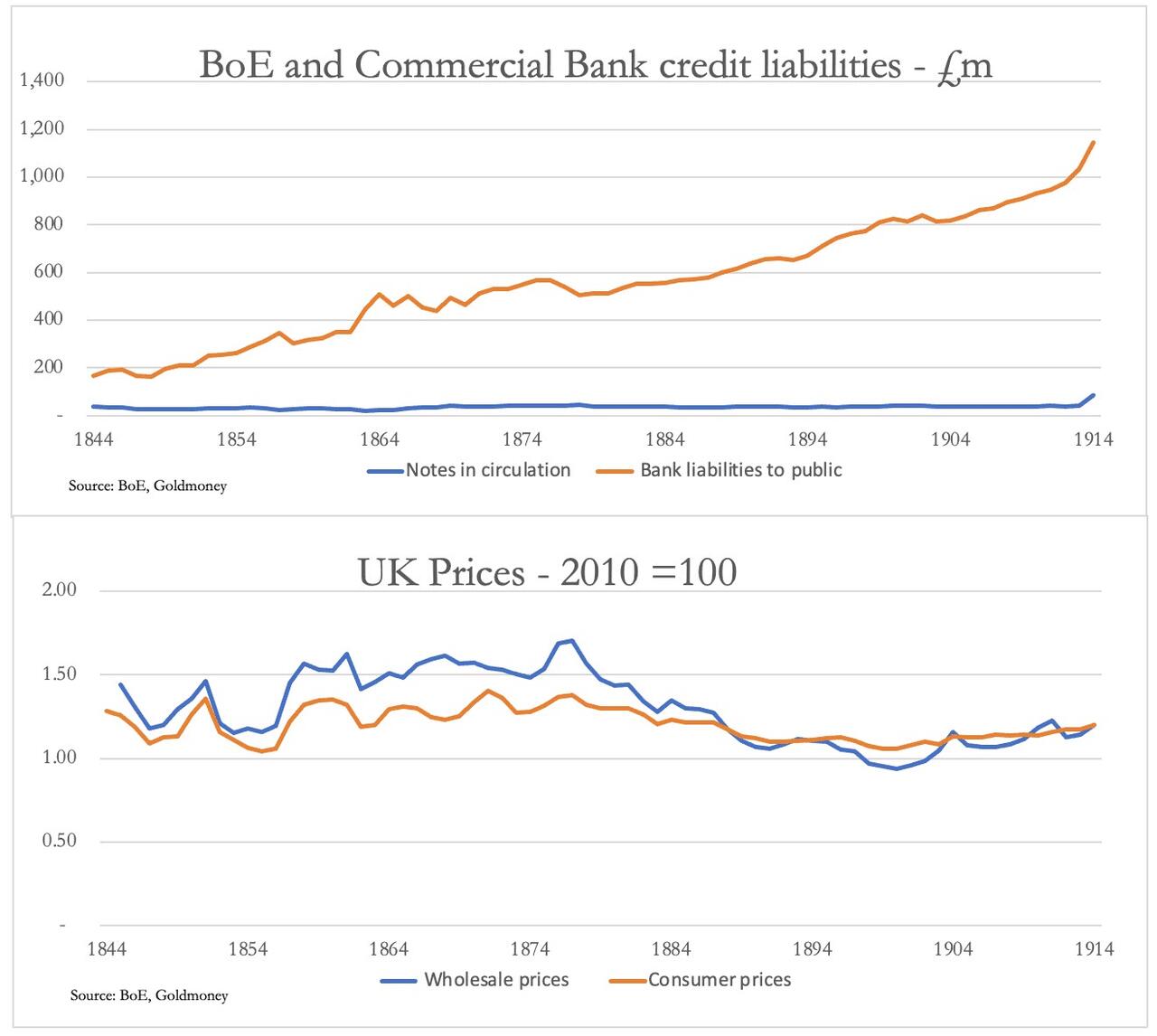
The charts below show how a stable measure of narrow money, such as bank notes in issue, relates to price stability, while broader measures of credit are free to respond to commercial demand without leading to runaway inflation.
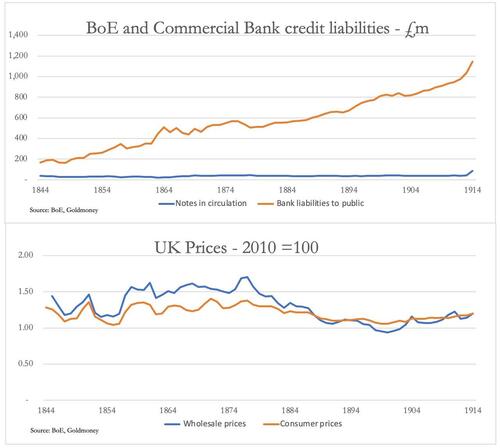
These charts covered the six decades following the introduction of Britain’s 1844 Bank Charter Act, which had the effect of severely limiting the note issue, while permitting commercial bank credit to expand as commerce demanded. While the latter expanded nearly eight times, prices (the lower chart) were remarkably stable, particularly as the savings ratio rose from the 1880s onwards. Clearly, for a gold standard to work, it is the note issue to which credit values are anchored.

Critics of currency boards and gold standards say that they are too inflexible, which is, of course, the point. But without the encumbrance of welfare commitments, it is relatively simple for a government to ensure it never runs a budget deficit. For many emerging economies today, the weakness of their currencies has been due to mismanagement, lack of international credibility, and misguided monetary policies. 

There has also been an evolutionary issue for many African nations. They had made enormous economic and social progress under colonial rule. Understandably, they then sought self-determination which undid many of the advances made in the decades before. Furthermore, many African politicians flirted with communism, only being kept in America’s sphere of influence by foreign aid — which too often fed political corruption. Having suffered from combinations of corruption and mismanagement, they are now offered a better alternative of investment in their infrastructure by China, frequently on the basis of local partnerships.

This is the basis of BRICS+: a new industrial revolution for emerging nations willing to join in. Cementing these prospects will not be Keynesian stimulation. It will be sound money, which means credible gold standards. And a gold-backed trade settlement currency will be the first step.

A gold-backed trade settlement currency offers energy and commodity exporters a better alternative payment medium to dollars. This is one motivation for Russia to devise and back it, supported no doubt by the Saudis and Iranians. It is not popular with India, which has pursued similar monetary policies to Britain. Indeed, relationships between the Reserve Bank of India and the Bank of England have been close historically. But India is likely to be told the payment terms for her energy imports — perhaps sweetened with a discount offered — which means she will have to go along with it.

The second step will involve major currencies within the BRICS block migrating onto gold standards, most likely starting with Russia and then China. The initial move to a gold-backed trade currency is likely to undermine the dollar’s purchasing power, leading to higher oil and gas prices, particularly as depleted reserves need replenishing ahead of the Northern Hemisphere’s winter months. Oil has already risen 18% since end-June, and further price rises will take pressure off Russia’s deteriorating finances. And as the dollar sinks further, a gold standard can be introduced as protection for the rouble, leading to lower, stable interest rates for the domestic economy.

We know this is an objective for the rouble from comments by Sergei Glazyev, President Putin’s senior economic adviser, echoed by Putin himself. Furthermore, a sliding dollar is likely to take down other currencies with it so both the rouble and renminbi are likely to seek protection through gold.

Russia’s gold

Officially, Russia has monetary gold reserves of 2,302 tonnes. But in addition, there are unknown quantities of gold held in the State Fund of Russia and the State Fund for Precious Metals. Anecdotally, these two funds are said to contain an extra 10,000 tonnes between them, bringing Russian state holdings to over 12,000 tonnes. Whatever the true figure is, it is possible that Russia has more gold to monetise than the US Government’s 8,133 tonnes, which is unaudited and rumoured to be wildly overstated.

In an article for the Moscow newspaper Vedomosti last December Sergei Glazyev wrote that,

“Large gold reserves allow Russia to pursue foreign financial policies and minimise dependence on external lenders. The amount of gold reserves affects the country’s reputation, credit rating, and investment attractiveness. Large reserves allow you to plan the state budget for a long time buying off many economic and political risks.”

Glazyev is known to hold similar views to Putin, which presumably is why he was seconded to head up the Eurasian Economic Union committee, which is considering a replacement for the US dollar for trade and commodity pricing. And the practicalities of that situation strongly point to gold being the backing for trade settlements. Glazyev is also the mover and shaker behind the beefed-up Moscow gold exchange. And Russian gold mine output at 325 tonnes is planned to be enhanced and was second only to China’s 375 tonnes last year. 

If we assume that altogether the Russian state can monetise just 10,000 tonnes of its gold, then its gold reserves cover M0 (which we take as proxy for the note issue) four times over, and mine output currently adds a further 11% cover annually. Russia has much to gain from putting the rouble onto a gold standard, which can be easily maintained. The monetary authorities would only have to refocus policy to exercise greater control over M0, which in the year to May was destructively inflated by 24%.

China’s gold

China took its first deliberate step towards eventual domination of the physical gold market as long ago as June 1983, when regulations on the control of gold and silver were passed by the State Council and gold was in the early stages of a protracted bear market. The following Articles selected from the English translation set out the objectives very clearly:

Article 1. These Regulations are formulated to strengthen control over gold and silver, to guarantee the State’s gold and silver requirements for its economic development and to outlaw gold and silver smuggling and speculation and profiteering activities.

Article 3. The State shall pursue a policy of unified control, monopoly purchase and distribution of gold and silver. The total income and expenditure of gold and silver of State organs, the armed forces, organizations, schools, State enterprises, institutions, and collective urban and rural economic organizations (hereinafter referred to as domestic units) shall be incorporated into the State plan for the receipt and expenditure of gold and silver

Article 4. The People’s Bank of China shall be the State organ responsible for the control of gold and silver in the People’s Republic of China.

Importantly, under Article 3 the PBoC is able to allocate gold purchases to other state entities, such as the Peoples’ Liberation Army and the Communist Party Youth Wing, only retaining a small balance for reserve asset purposes. Otherwise, accumulating large quantities of bullion would have been made difficult without this secrecy. Additionally, China has deliberately developed her own gold mine output so that she became the largest producer in the world, mining 6,869 tonnes since 2002. State-owned refineries process this gold along with doré imported from elsewhere.

The regulations quoted above formalise the State’s monopoly over all gold and silver, which is exercised through the Peoples Bank. They allow for the free importation of gold and silver but keep exports under very tight control. On the basis of these regulations and as subsequently amended the PBoC established the Shanghai Gold Exchange in 2002, which remains under its total control and permits the general public to acquire gold. The intent behind the regulations is not to establish or permit the free trade of gold and silver, but to control these commodities in the interest of the state, even when in the possession of members of the public.

This being the case, the growth of Chinese gold imports recorded as deliveries to the public since 2002 is only the most recent evidence of a deliberate act of policy embarked upon forty years ago. China had been accumulating gold for nineteen years before she allowed her own nationals to buy any when private ownership was finally permitted. Furthermore, bullion had been freely available, because in seventeen of those years, gold was in a severe bear market fuelled by a combination of supply from central bank disposals, leasing, scrap, rapidly increasing mine production and investor selling, all of which I estimate totalled about 76,000 tonnes in all. The massive expansion of derivative gold products freed up the supply of physical bullion as well. I assess that as much as 25,000 tonnes of that 76,000 total were quietly accumulated by the PBoC before the public were permitted by the PBoC to buy and own gold in 2002.

Put in another context, the cost of China’s 25,000 tonnes of gold equates to roughly 10% of her exports over the period. And the eighties and early nineties in particular also saw huge capital inflows when multinational corporations were building factories in China, all of which accumulated as foreign exchange in the PBoC’s hands. However, the figure for China’s gold accumulation is at best informed speculation, but given the determination expressed in the 1983 regulations and subsequent events it is clear she had deliberately accumulated a significant undeclared stockpile by 2002, allocated into various state entities. 

So far, China’s long-term plans for the acquisition of gold appear to have achieved some important objectives. Deliveries to the public through the SGE since only 2008 have totalled over 22,000 tonnes, gross of returned scrap, probably exceeding 23,000 tonnes since 2002. 

Assuming that China’s monetary authorities have 25,000 tonnes of gold available which they can monetise, its M0 money supply would be covered about 1.5 times at current gold prices.

Why now is the time for rouble and renminbi gold standards

Evidenced from a number of disparate threads, there can be little doubt that China and Russia are moving towards protecting their currencies and their entire joint project for global industrialisation of emerging economies from an increasingly likely collapse of the post-Bretton Woods fiat currency system. In this context, it started with China’s secret accumulation of gold bullion dating back to 1983, which continued after the establishment of the Shanghai Gold Exchange in 2002. If the PBoC had accumulated 20,000—25,000 tonnes by then, the total could easily exceed 30,000 tonnes today.

Russia came late to this policy, only accelerating its plans to acquire monetary gold following the western alliance’s sanctions. Nevertheless, both nations appear to be in a position to cover their narrow money supply measures comfortably. And from empirical evidence, with suitable reforms it is the narrow measure of money in the form of bank notes issued by the monetary authority which matters in this respect. And as if to confirm an even wider adoption of gold standards, it is usually Asian central banks reporting the accumulation of higher gold reserves.

The other side of gold standards for China and Russia is an accelerated destruction of the US dollar’s purchasing power. This is a course upon which the US dollar is set anyway with its debt trap increasingly visible. But it is China and Russia’s different economic objectives which lead many observers to believe that gold standards are unlikely, with China seeking to protect the value of her export markets by not undermining the major fiat currencies.

Doubtless, this latter point was raised by Janet Yellen at her recent meetings in Beijing, followed by Henry Kissinger. Yellen’s meetings occurred in the days after Russia confirmed that a new gold-backed trade settlement currency is on the BRICS summit agenda later this month. We can reasonably assume that the danger of this move to the dollar’s standing set alarm bells ringing at the US Treasury. Presumably, Yellen was unable to move the Chinese, which was why Henry Kissinger was sent in a last-ditch attempt.

But China’s focus is increasingly on protecting her investments in Asia, Africa, and Latin America. She is aware of the damage that rising dollar interest rates inflicts on these emerging nations. So are the emerging nations, a fact which undoubtedly encourages them to seek protection by joining BRICS. 

Only this week, we find that cash-strapped Argentina has secured from China the equivalent of $1.5 billion in yuan to pay to the IMF as part of a $2.5 billion obligation. China probably believes that America plans to use rising interest rates to drive a wedge between her and emerging nations minded to join BRICS. Argentina needed rescuing from this fate. The Argentinian loan was probably too big for the New Development Bank (the BRICS equivalent of the IMF) but the NDB stands ready to finance the smaller African nations in debt to the IMF.

America has used the trade threat continually since President Trump first introduced discriminatory trade tariffs against China. In the wake of sanctions against Russia, analysts in Beijing are probably concluding that America would lose more than she would gain by implementing trade threats. And as a possible geopolitical dividend, a disunited EU might not follow suit, splitting the western alliance. Therefore, not only will China have changed her trade policy objectives, but for her, hastening the dollar’s demise by reintroducing gold into the monetary system is now the preferred goal.

Global gold distribution

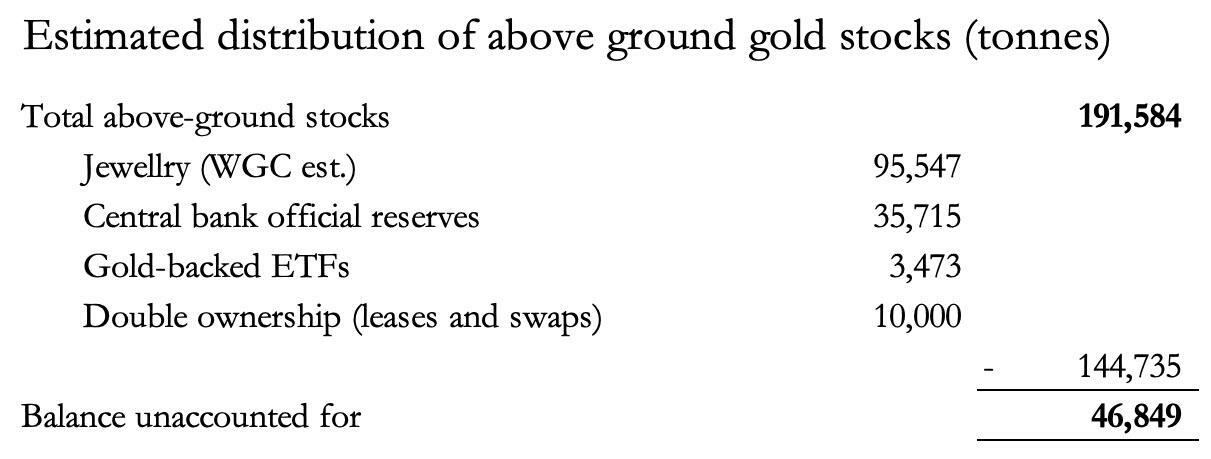
China’s gold policies since 1983 have introduced distortions into the global distribution of gold bullion holdings. By locking up significant quantities of bullion, liquidity available for nations outside the China-Russian axis has become severely limited. To illustrate the point, the table below attempts to identify broad categories of ownership based on an extrapolation of an assessment of above ground stocks carried out by James Turk of Goldmoney with economist Juan Casteñada in 2012, using US Geographical Survey numbers for subsequent years. That work convincingly pointed out that there was no support for the estimates adopted by the World Gold Council, which compared with Goldmoney’s estimate overstated above-ground stocks by about 17,000 tonnes. Accordingly, I believe that in 2022 the total figure is now 191,584 tonnes, not the 208,874 tonnes assumed by the WGC. This difference is material.
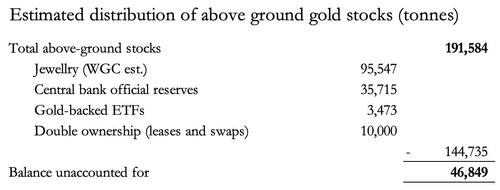
The following notes to the table are by way of explanation:

  • Goldmoney’s estimate of above ground stocks, compared with that of the WGC illustrates the impact on the bottom line, which in this table would otherwise show a balance unaccounted for at 68,535 tonnes. This balance includes undeclared state holdings of gold by Russia and China, which as we have seen could exceed 40,000 tonnes, leaving little room for private investors holding bars and coin.

  • Jewellery is mostly owned by Chinese, Indian, and other Asian nationals, who traditionally use it as a savings medium as much as ornamentation. This explains the size of this category.

  • The Central Bank official reserves are collated by the World Gold Council, as are estimates for gold-backed ETFs. We can assume these figures as reported are accurate, but include double counting.

  • Double ownership of gold through leases and swaps was the subject of detailed research by analyst Frank Veneroso presented to a conference in Lima in 2002.[iii] He concluded that between 10,000—15,000 tonnes of central bank gold was leased or swapped. I have assumed the lower figure, despite the material increase in central bank gold reserves since 2002. This is supported by further analysis which follows.

The last bullet point needs further explanation. Under the IMF’s gold accounting rules, 

“Monetary gold is gold held by a monetary authority principally as an element of its foreign exchange reserves (also sometimes called international reserves). To qualify as monetary gold, the gold must meet the International Monetary Fund’s (IMF’s) definition of monetary gold and the monetary authority must designate the gold as part of its foreign reserve portfolio. Monetary gold includes allocated gold bullion and unallocated gold accounts with non-residents that give title to claim the delivery of gold.”[iv]

An unallocated account arises when a central bank delivers gold under a lease or swap arrangement to a bullion bank, or an institution such as the Bank for International Settlements in return for a deposit credit. The bullion bank takes the bullion onto its own balance sheet, so the central bank loses possession. That the IMF permits a central bank to record this credit as monetary gold despite having given away possession means that there are at least two owners for a given quantity of bullion. And that assumes only one rehypothecation, when there can be no theoretical limit to the use of bullion for a chain of transactions in this fashion.

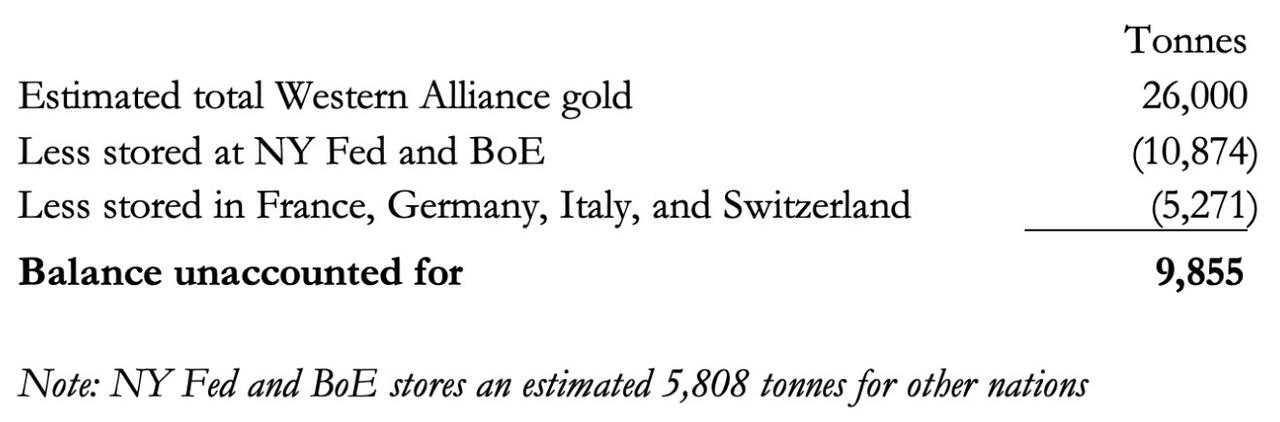
It seems reasonable to assume that unallocated monetary gold is concentrated on the central banks not aligned with the Asian hegemons and firmly in the western alliance camp. The notional total of the latter groups’ holdings is about 26,000 tonnes, depending on which nations are included in the definition, in which case only 16,000 tonnes can be assumed to exist in physical form. Confirmation of this situation came, perhaps, from the difficulty with which Germany sought to repatriate some of her bullion which was meant to be held as earmarked gold (in custody) at the New York Fed.

The major players arranging this merry-go-round are the NY Fed and the Bank of England, which between them currently report physical gold vaulted for foreign central banks totalling 10,874 tonnes. From websites for the major non-Asian holders (Germany, France, Italy, and Switzerland) we know that 5,066 tonnes of this total are for these major holders, except for France, which stores almost all its gold in Paris. Between them, they store 5,271 tonnes of their gold in their own jurisdictions. That leaves 5,808 tonnes held at the NY Fed and the BoE held for the other central banks notionally allied to the West, which is the vast majority of their recorded holdings.

After allowing for the 5,271 tonnes above stored elsewhere, there is still an approximate 10,000-tonne gap between the 26,000 tonnes derived above and the 10,874 tonnes recorded in New York and London. This suggests that there are significant levels of unallocated gold involved, calculated as follows: 
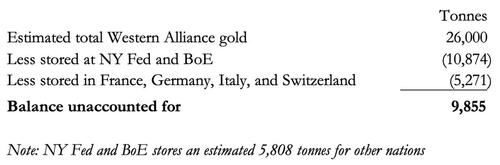
While the calculations in the table above are far from complete, there appears to be a significant gap between total claimed bullion holdings and what is stored in the two main centres. 

In the first table, we noted that 46,898 tonnes of global above-ground gold were unaccounted for. That includes the undeclared bullion holdings of China and Russia, which from the analysis in this article could total over 40,000 tonnes. Private investment holdings in bar and coin will also be in this unexplained balance. The only way in which these two large quantities can be accommodated in the 46,898 balance is due to the double counting and multiple rehypothecations of central bank gold.

Otherwise, the numbers don’t add up.

This leaves very little liquidity for nations trying to escape the impending collapse of the post-Bretton Woods fiat currency regime by seeking to implement their own gold standards. It also calls into question the survivability of the entire bullion banking system, being caught horribly short of deliverable bullion if the market attempts to unwind its positions.

Conclusions

Not only are there clear advantages to the Russian and Chinese axis from supporting a new trade settlement and commodity purchasing gold-backed currency, but the rapidity of its introduction could take the world by surprise. There is now little doubt that the fiat currency regime based on the dollar has run its course, leaving multiple debt traps to be sprung in the western alliance and an outlook of stagflation or worse. 

In other articles for Goldmoney, I have covered the various aspects of an existential crises facing the world’s fiat currency regime. These range from government debt traps, and the bank credit cycle turning down, to the ability of the major central banks to rescue failing commercial banks, given they themselves are in negative equity. The gross values of many derivatives should also be recorded on bank balance sheets, to properly reflect counterparty risks.

To these problems can be added a collapse of the entire bullion trading system, revolving around swaps and leases and frequent rehypothecations of bullion. When the music stops, the extent of the problem which has grown since the early 1980s will become known. The end of the fiat currency system, no doubt accelerated by a move to incorporate gold back into the Russian and Chinese financial systems is likely to be the trigger.

At the very least, if China and Russia’s grand project is to proceed, the renminbi and rouble must be protected from a fiat currency crisis. This is the moment for which the Chinese have been preparing since 1983, and the Russians more recently sparked by western sanctions. They at least have sufficient bullion available to cover their narrow money supply with ample margins and are the two largest nations by goldmine output. A move towards gold backing of other currencies is likely to prove more difficult, because of the shortage of monetary gold due to the double counting of reserves through leasing and swaps. The only solution for many of the BRICS attendees in Johannesburg later this month will be to piggy-back on China’s yuan though a currency board relationship. The rest of the world faces the grim prospect of being ensnared in a widespread fiat currency collapse with no visible escape.
Tyler Durden
Sat, 08/05/2023 – 11:30

via ZeroHedge News https://ift.tt/5BcStIC Tyler Durden

Major Shipper Maersk Warns Of Prolonged And Deeper Downturn In Global Trade

Major Shipper Maersk Warns Of Prolonged And Deeper Downturn In Global Trade

A.P. Moller-Maersk A/S, the world’s largest owner of container ships and one of the best bellwethers for global trade, has spent the last several quarters warning about a slowdown in container demand on major shipping lanes. Maersk executives have cautioned about “dark clouds on the horizon,” sliding demand “from both the US and Europe,” and it’s “going to be bumpy.” 

The Danish shipping and logistics group released yet another warning on Friday. This time it feared a contraction in global trade would be longer and deeper than previously thought: 

The inventory correction observed since Q4 2022 appears to be prolonged and is now expected to last through year end. Based on the continued destocking, A.P. Moller – Maersk now sees global container volume growth in the range of -4% to -1% compared to -2.5% to +0.5% previously. Ocean expects to grow in-line with the market.

On Friday, Maersk CEO Vincent Clerc joined Bloomberg TV’s Dani Burger and Mark Cudmore in an interview, discussing what’s ahead for global trade. The shipping exec said, “Our case is not for a recession, but it is for a really subdued environment that will continue for the rest of this year.” 

The expectation is “to see some recovery in the market in 2024 and getting back to positive growth territory,” Clerc said. 

While discussing the global economy, he said his team is “still quite concerned… there are a lot of moving parts right now, from rate hikes and the risk of recession,” as well as “uncertainty also about GDP growth in China and what demand is going to be in China next year.” 

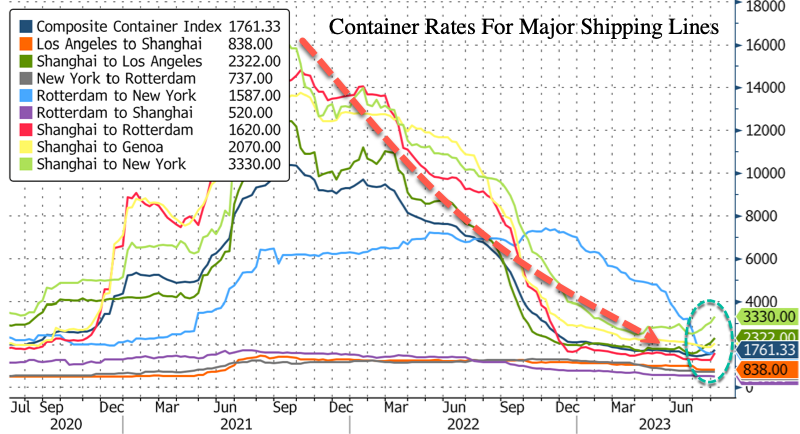
Container shipping depends entirely on globalization trends and enjoyed the most significant boom ever during the 2020-22 Covid era as retailers and other companies restocked inventories to meet pent-up demand from consumers flushed with stimulus checks. But since early 2022, container rates have plunged amid a monetary tightening campaign by global central banks to tame hot inflation that has stymied demand. 

Meanwhile, China is on the brink of deflation, and authorities need more tools to stimulate the economy as a robust recovery is nowhere in sight. There were hopes that the latest rise in container rates was a sign of economic revival in the global economy, but as we noted, it’s likely a function of reduced vessel capacity. 

Maersk reported a better-than-expected first-half performance Friday morning and lifted its annual earnings forecast but warned the second half of 2023 would be challenging. 

“We are in the midst of the biggest correction after the Covid boom of 2021 and 2022,” Maersk CEO Clerc told Finacial Times in a separate interview. 

Here’s what Bloomberg Intelligence is saying about Maersk’s second-quarter earnings report:

“Maersk’s solid 2Q beat and improved full-year guidance are overshadowed by expectations of a prolonged inventory correction, recession risks and weaker volume, which may shape the company’s credit story in the coming months. Softer freight rates, which were down 51% in 2Q, coupled with new ship deliveries and lower disposable incomes could lead to deteriorating credit metrics in 2H and 2024.”

Maersk transports about one-sixth of the world’s containers. Its forecast of a long and deep contraction in global trade is an ominous sign of possible trouble ahead. 

Tyler Durden
Sat, 08/05/2023 – 11:00

via ZeroHedge News https://ift.tt/WBFRyQK Tyler Durden

No Accountability 3 Years After History’s Biggest Non-Nuclear Explosion

No Accountability 3 Years After History’s Biggest Non-Nuclear Explosion

Via The Cradle,

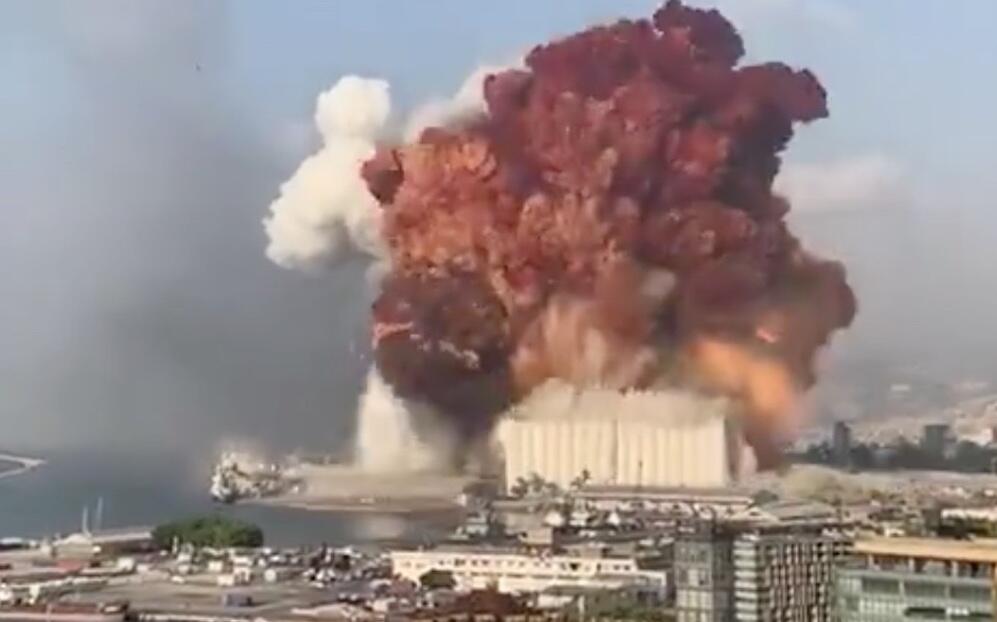
Three years have passed since the city of Beirut was nearly turned to rubble by history’s biggest non-nuclear explosion, which killed well over 200 people and injured thousands. In the intervening time, no official has been held accountable for allowing a vast stockpile of industrial chemical ammonium nitrate to be haphazardly stored in the heart of Beirut for seven years.

The dangerous chemicals ignited on August 4, 2020, creating a massive shockwave that tore through several neighborhoods, causing over $15 billion in damage. According to experts, had the blast not happened by the sea, the entire city of Beirut would have been wiped off the map, as the shockwave was felt as far away as Cyprus.

“This is a day of commemoration, mourning, and protest against the Lebanese state that politicizes our cause and interferes in the judiciary … The judiciary is shackled, justice is out of reach, and the truth is shrouded,” Rima al-Zahed, whose brother was killed in the explosion, told AFP on Friday.

Flagrant politicization and external pressure over the investigation, on top of deep-rooted sectarianism in Lebanese culture, have threatened to leave those responsible for the blast in impunity.

According to an investigation by The Cradle columnist Radwan Mortada, 2,750 tons of improperly stored ammonium nitrate were abandoned in the heart of Beirut for seven years due to negligence from the Lebanese army and the country’s judiciary.

“If the army had carried out its function, entrusted exclusively to Lebanon’s military under the country’s Weapons and Ammunition Law, by supervising the nitrate storage, destruction, or re-export, the devastating explosion would have been averted,” Mortada asserts.

“Similarly, if judges had done their job, a legally binding – not a political one – the decision would have ensured the destruction or immediate exportation of the explosive materials from Warehouse 12 in the Port of Beirut,” The Cradle columnist adds.

But despite the responsibility held by the country’s army and judiciary, from the moment the blast happened until today, western-friendly officials and news outlets have placed the blame on the Lebanese resistance movement Hezbollah, alleging that the group stored the dangerous materials in the port – which is controlled by the US-funded army.

“From the first moment after the port explosion, some malicious TV stations said that Hezbollah was behind blowing up the port,” Hezbollah Secretary General Hassan Nasrallah said during a televised speech on Thursday after expressing his sympathies with the victims’ families.

“Those who blocked the truth in the port blast case are the ones who politicized this case. The real reason behind the loss of the truth in the Beirut port explosion is that some parties link the case to regional events,” Nasrallah added.

Earlier this year, UK-registered company Savaro Ltd was found liable by London’s High Court of Justice for the Beirut Port blast. According to court documents, Savaro was transporting the ammonium nitrate to an explosives company in Mozambique in 2013 before the cargo was impounded at Beirut’s port over a dispute over unpaid transportation fees and the seaworthiness of the vessel transporting it.

The British ruling says Savaro remained the legal owner of the ammonium nitrate and was responsible for its proper storage and any damage caused by it. The ruling also argues that abandoning the dangerous chemicals in Beirut did not absolve the company of any duty of care.

Savaro – a shell company with few employees and no actual activities – has been trying to obtain its dissolution from the UK corporate registry Companies House since 2021, reportedly to evade responsibility for the tragedy. Last year, several of the victims’ families filed a $250 million lawsuit against the US–Norwegian firm TGS suspected of being involved in transferring the explosive material to the port.

Tyler Durden
Sat, 08/05/2023 – 10:30

via ZeroHedge News https://ift.tt/VA9K30o Tyler Durden

US Confidence In Military Hits Lowest Point In Over 20 Years

US Confidence In Military Hits Lowest Point In Over 20 Years

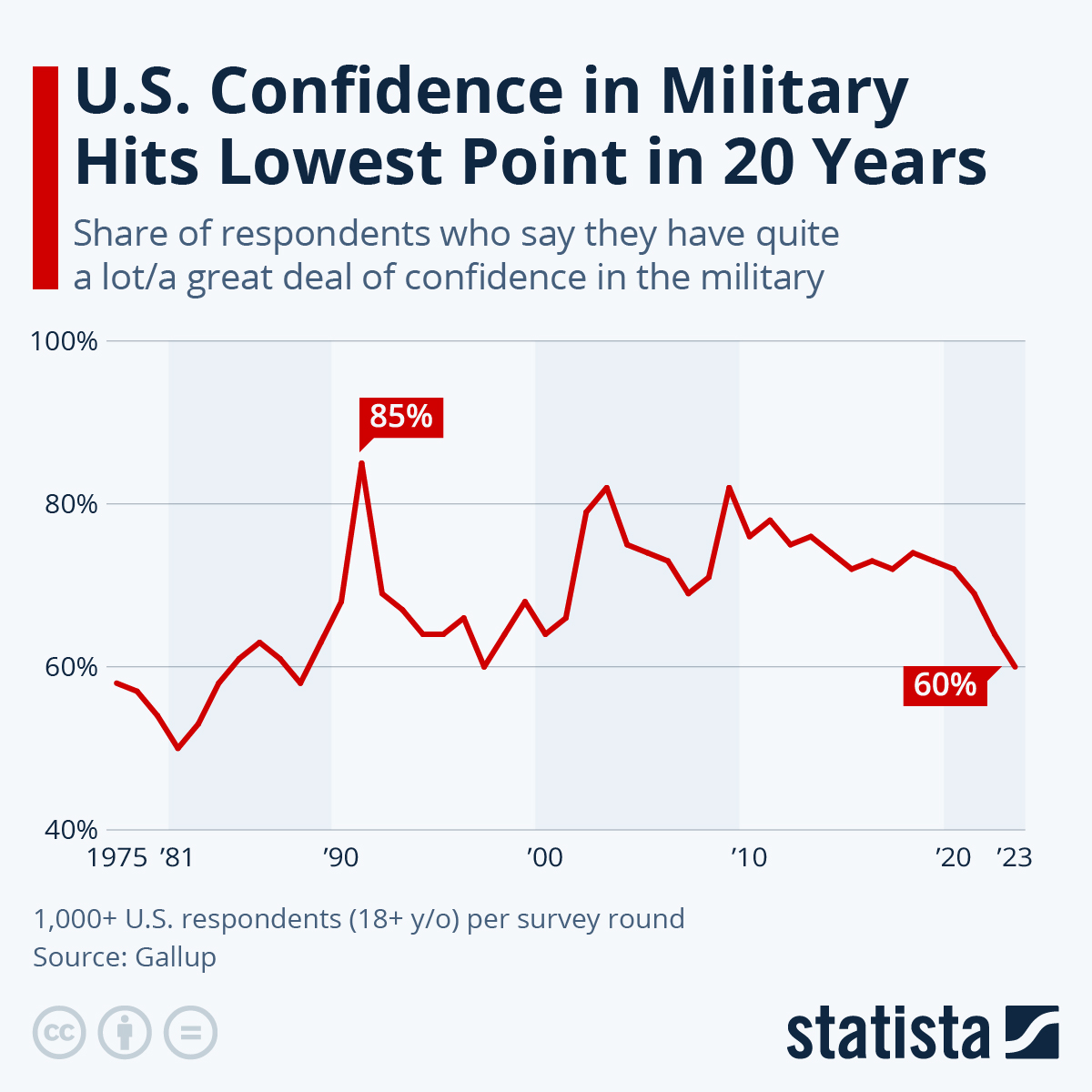
Confidence in the military has fallen to its lowest point in over 20 years in the United States, according to new data released by Gallup.

As Statista’s Anna Fleck reports, in a survey conducted in June, 60 percent of respondents said that they had either a “great deal” or “quite a lot” of confidence in the military. The last time it was this low was in 1997, and prior to that in 1988, when confidence levels dipped to 58 percent.

Gallup analysts highlight how confidence in the military has declined since the U.S. withdrawal from Afghanistan.

Infographic: U.S. Confidence in Military Hits Lowest Point in Over 20 Years | Statista

You will find more infographics at Statista

Republicans have historically shown greater confidence in the U.S. military than Democrats, and while they still do so, the rate has dropped from 91 percent in 2020 to 68 percent in 2023.

As of this year, confidence levels among Democrats stand at 62 percent, while Independents’ confidence are at 55 percent.

Belief in institutions has generally been on the decline in the U.S. in recent years.

According to a wider Gallup poll, last year saw a drop in public confidence in 11 out of 16 institutions, including in the presidency and the Supreme Court. According to the poll conducted June 1-22, 2023, the five institutions with the lowest ratings were newspapers (18 percent), the criminal justice system (17 percent), television news (14 percent), big business (14 percent) and Congress (8 percent).

We give the final word to Kurt Schlichter, who wrote an emotive op-ed this week on the reality that, ‘of course young patriots are rejecting joining our failing military’:

The generals and admirals are in a tizzy because the cannon fodder is refusing to sign on the line that is dotted.

Here is the hard reality.

If you choose to join this military, you’re putting your lives in the hands of people who, at the highest level, don’t care about you at best and hate you at worst and are grossly corrupt and grossly incompetent.

When you die, likely because of their utter failure to adequately perform their duties at even the most basic level of proficiency, your families going to get shafted and you’ll be forgotten or disrespected.

There are consequences for squandering institutional trust for short-term advantage, and one of them is that no one will want to die for you.

And if you think this makes me happy to write, you’re dumb or dishonest enough to be a modern general or admiral.

Tyler Durden
Sat, 08/05/2023 – 09:55

via ZeroHedge News https://ift.tt/Uh6aJ4X Tyler Durden

Chopper, Traitor, Soldier, Spy

Chopper, Traitor, Soldier, Spy

By Teeuwe Mevissen, Senior Macro Strategist at Rabobank

With all the recent news coming out of late, one could not be blamed for making direct comparisons with the Cold War.

Indeed, looking back at the geopolitical events of this week, it is a clear illustration of the ever growing tensions between autocratic states and the West.

But before we dive into this topic lets first discuss this week’s interest rate decision from the Bank of England (BoE).

As was generally expected the BoE raised its policy rate by 25 basis points to a level of 5.25%. But unlike the Fed and the ECB who are close if not at the end of the rate hiking cycle, the market seems to think that the BoE is on a slightly more aggressive rate hiking path given higher and more sticky levels of inflation.

The forward guidance that was provided yesterday could indeed be interpreted as hawkish and reads as follows:

“Given the significant increase in Bank Rate since the start of this tightening cycle, the current monetary policy stance was restrictive. The MPC would continue to monitor closely indications of persistent inflationary pressures and resilience in the economy as a whole, including the tightness of labour market conditions and the behaviour of wage growth and services price inflation. If there were to be evidence of more persistent pressures, then further tightening in monetary policy would be required. The MPC would ensure that Bank Rate was sufficiently restrictive for sufficiently long to return inflation to the 2% target sustainably in the medium term, in line with its remit.”

While the BoE did reduce their growth forecasts through 2025, inflation forecasts were adjusted upwards. While markets on average predict a peak rate of 5,75%, we think the next rate hike by the BoE will be the last rate hike for this year at least bringing the rate to 5.50%. For those who want to read more about yesterday’s interest rate decision please see Stefan Koopman’s post BoE comment here.

While markets mainly focused on the BoE and the downgrade of US creditworthiness by Fitch, some significant, notable and concerning geopolitical developments also took place.

Firstly, two helicopters from Belarus briefly breached Polish airspace after earlier threats to Poland from both the Kremlin as well as the Wagner group.

Moreover, a recent rocket attack on Ukraine’s grain facilities close to the border of Romania, is another example of how close we might be to a direct conflict between NATO and the Russian Union (being Russia and Belarus).

In the past we have seen similar reckless provocations that could lead to a broader escalation.

Meanwhile Putin also seems to be increasingly struggling with internal dissent, or traitors as they are called in Moscow.

Recently some generals and nationalist military bloggers – of which the most prominent is Igor Girkin who is mainly known for downing flight MH17 – have been arrested. The above are all signs that indicate that Putin’s rule is not fully undisputed. In absence of any administrative checks and balances – a characteristic of autocracies – this could mean that the West might face more provocations in an attempt to regain the image of strong and undisputed leader.

Meanwhile China seems to be busy with its own purge.

While speculation about the abrupt disappearance of China’s former Minister of Foreign Affairs Qin Gang is ongoing, the complete military command of China’s rocket force has been reshuffled because of a new anti-corruption investigation. In a bid to increase overall government control a new counter espionage law is now calling for citizens to basically spy on each other.

But for now it seems that is has been Chinese spies that have been caught in the US.

Tyler Durden
Sat, 08/05/2023 – 09:20

via ZeroHedge News https://ift.tt/rXqDxeF Tyler Durden