$300 Trillion & Counting: Visualizing Global Debt Projection

$300 Trillion & Counting: Visualizing Global Debt Projection

Total global debt stands at nearly $305 trillion as of the first quarter of 2023.

Over the next five years, it is projected to jump even further – raising concerns about government leverage in a high interest rate and slower growth environment.

As global debt continues to climb, Visual Capitalist’s Dorothy Neufeld presents this animated graphic shows data and projections for public debt-to-GDP ratios using the World Economic Outlook (April 2023 update) from the IMF.

Growing Global Debt Projections

After rising steadily for years, government debt first ballooned to almost 100% of GDP in 2020. While this ratio has fallen amid an economic rebound and high inflation in 2021 and 2022, it is projected to regain ground and continue climbing.

World government debt is now projected to rise to 99.5% of GDP by 2027. Here’s data going back to 2005, as well as the forecast for global public debt-to-GDP:

Year 🇺🇸 U.S. 🇨🇳 China 🌎 Global Average
2027P 134.0% 105.9% 99.5%
2026P 131.8% 101.0% 98.2%
2025P 129.2% 95.7% 96.8%
2024P 125.9% 90.1% 95.1%
2023P 122.2% 84.4% 93.6%
2022 121.7% 77.5% 92.3%
2021 126.4% 72.3% 95.7%
2020 133.5% 70.1% 99.8%
2019 108.7% 60.4% 84.2%
2018 107.4% 56.7% 82.8%
2017 106.2% 55.0% 82.6%
2016 107.2% 50.7% 83.8%
2015 105.1% 41.5% 79.9%
2014 104.5% 40.0% 78.6%
2013 104.5% 37.0% 78.3%
2012 103.0% 34.4% 79.7%
2011 99.5% 33.8% 77.9%
2010 95.1% 33.9% 76.9%
2009 86.6% 34.6% 74.7%
2008 73.4% 27.2% 64.3%
2007 64.6% 29.2% 61.3%
2006 64.2% 25.6% 64.3%
2005 65.4% 26.3% 68.1%

Debt sharply increased in both 2020 and 2009 in conjunction with economic downturns. Historically, debt levels compared to GDP tend to increase as little as 4% and much as 15% in the five years after a global recession has ended.

In the U.S., public debt-to-GDP is set to reach a record 134% by 2027. The sharp rise in interest rates is increasing net debt servicing costs, which stood at $475 billion last year. Over the next 10 years, net interest costs on U.S. debt are projected to total $10.6 trillion.

China’s debt has also risen rapidly, and is projected to eclipse 100% by 2026. Public debt as a percentage of GDP is forecast to jump fourfold between 2005 and 2027. This year alone, new government debt issuance is projected to hit record levels. A large portion of this debt consists of infrastructure bonds that are focused on boosting the economy.

Comparing Trends Across Global Economies

Below, we show how the public debt-to-GDP ratios for advanced economies compare with emerging markets and low-income countries. Both the U.S. and China are excluded here:

Year Advanced Economies Emerging Markets Low-Income
Countries
2027P 103.8% 57.2% 43.8%
2026P 104.1% 56.9% 44.5%
2025P 104.4% 56.6% 45.3%
2024P 104.5% 56.1% 46.3%
2023P 105.2% 55.7% 47.6%
2022 105.5% 55.2% 47.9%
2021 111.3% 58.6% 47.9%
2020 115.8% 61.4% 48.0%
2019 100.8% 51.6% 42.6%
2018 100.0% 49.8% 41.5%
2017 101.7% 49.1% 41.2%
2016 104.9% 48.3% 38.6%
2015 102.3% 45.2% 35.1%
2014 103.4% 39.9% 31.2%
2013 104.0% 38.4% 30.9%
2012 107.1% 38.0% 29.9%
2011 102.2% 38.3% 29.9%
2010 98.4% 39.6% 28.4%
2009 93.1% 41.1% 29.9%
2008 79.9% 36.4% 27.5%
2007 74.7% 38.4% 29.4%
2006 78.8% 41.0% 33.0%
2005 82.2% 45.9% 42.0%

In a retreat from 2020 highs, public debt is projected to fall meaningfully compared to GDP by 2027 for advanced economies excluding America. Emerging markets are also projected to see this leverage ratio decline.

Low-income countries have smaller debt levels compared to output, which is expected to continue over the next five years. Despite this, 39 of these countries are in debt distress—or are close to it—as high interest rates add pressure to government balance sheets.

Are High Global Debt Levels Sustainable?

The good news is that 60% of economies are forecast to see their public debt-to-GDP ratios fall below COVID-19 peaks by 2027.

On the other hand, many large advanced and emerging economies, including China, Brazil, Japan, and Türkiye are projected to face steeper debt. In the U.S., payments on public debt have soared to record levels due to rising interest rates.

This comes as aging populations, slower economic growth, and healthcare costs are straining government spending, a trend seen across many advanced economies.

Countries with economic growth rising faster than real interest rates may be more likely to sustain high debt levels. But sticky inflation, prompting higher interest rates, will likely make these debt piles even more fragile.

Tyler Durden
Sat, 08/05/2023 – 08:45

via ZeroHedge News https://ift.tt/VuERbKS Tyler Durden

Poland: Wagner Fighters In Belarus Are Trying To ‘Destabilize’ NATO

Poland: Wagner Fighters In Belarus Are Trying To ‘Destabilize’ NATO

Authored by Dave DeCamp via AntiWar.com,

Polish Prime Minister Mateusz Morawiecki claimed on Thursday that Wagner fighters were deployed to Belarus in an attempt to “destabilize” bordering NATO countries, which the alliance refers to as its eastern flank.

Morawiecki called the Russian mercenary force “extremely dangerous” and said it had been “being redeployed to NATO’s eastern flank to destabilize it.” He estimated there could be more than 4,000 Wagner members in Belarus.

Morawiecki made the comments with Lithuanian President Gitanas Naused while meeting at the Suwałki Gap, a strip of land on the Polish-Lithuanian border that stretches from Belarus to the Russian enclave of Kaliningrad.

The Suwałki Gap (Lithuanian-Polish border highlighted in orange)

The two leaders met to discuss the threat they believe Wagner poses to the region.

“Today, the borders of Poland and Lithuania are the borders of the free world that stops the pressure from the despotism from the East,” Morawiecki said.

He warned that Wagner could carry out “sabotage actions” and thanked Lithuania for “military cooperation and for the joint promise that we will defend every piece of land of NATO countries.”

Poland has been beefing up its border with Belarus since Wagner fighters went there as part of a deal to end Yevgeny Prigozhin’s short-lived mutiny against the Russian military establishment. Tensions escalated on Tuesday when Poland accused Belarus of violating its airspace with military helicopters, an accusation Minsk denied.

Separately on Thursday, Polish Defense Minister Mariusz Blaszczak said Warsaw’s response to recent “provocations” has been to “increase the size of the Polish Army on the eastern border of the country by redeploying troops from the west.”

Tyler Durden
Sat, 08/05/2023 – 08:10

via ZeroHedge News https://ift.tt/a3Th7rn Tyler Durden

World Food Prices Jump Most In 18 Months

World Food Prices Jump Most In 18 Months

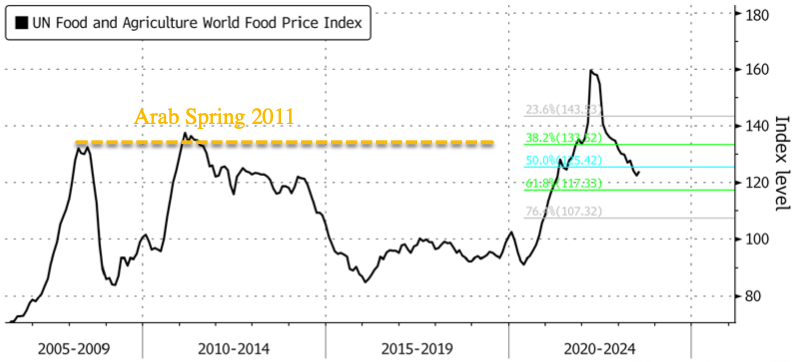
Global food prices increased the most in 1.5 years as trade disruptions from the El Nino weather phenomenon battered agricultural-producing countries, and Russia’s exit from a crucial UN-backed agriculture deal stoked supply concerns. 

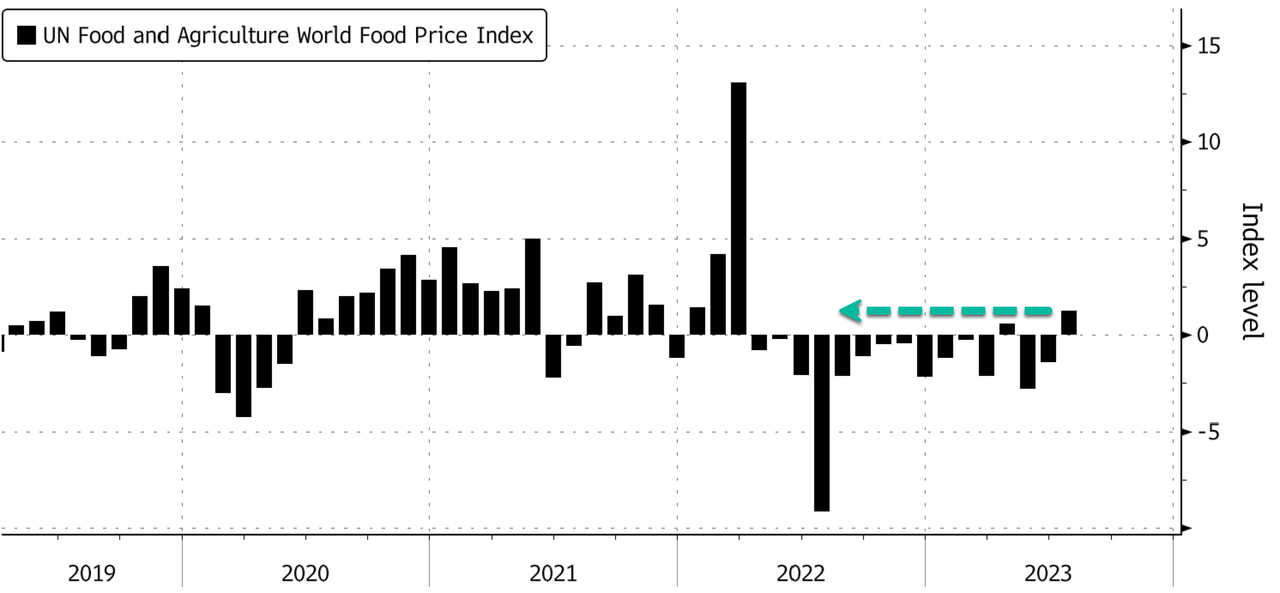
The Food and Agriculture Organization of the United Nations (FAO) reported Friday that the global food index, which tracks monthly changes in the international prices of globally-traded food commodities, averaged 123.9 in July, up 1.3% from the previous month.

The FAO Food Price Index’s July print was the largest monthly gain since March 2022. 

FAO explained the FAO Vegetable Oil Price subcomponent of the index was responsible for the monthly increase:

The increase was driven by a sharp jump in the FAO Vegetable Oil Price Index, which rose 12.1 percent from June after seven months of consecutive declines. International sunflower oil prices rebounded by more than 15 percent in the month, due mostly to renewed uncertainties surrounding the exportable supplies after the Russian Federation’s decision to end implementation of the Black Sea Grain Initiative. World prices for palm, soy and rapeseed oils increased on concerns over output prospects in leading producing countries.

Also, the FAO All Rice Price Index increased 2.8% on the month and 19.7% on the year due to “India’s 20 July prohibition of non-parboiled Indica exports fostered expectations of greater sales in other origins, amplifying upward pressure already exerted on prices by seasonally tighter supplies and Asian purchases,” the report said. 

This upward pressure on rice prices “raises substantial food security concerns for a large swathe of the world population, especially those that are most poor and who dedicate a larger share of their incomes to purchase food,” FAO warned. 

We noted in April and in early May, “El Nino Watch Initiated As Ag-Industry In Crosshairs” and “Global Rice Shortage Looms, Set To Be The Biggest In Decades” as a disruptive El Nino weather pattern wreaks havoc on the world’s ag crops. 

Rising food prices risk fueling social instability for the weakest emerging market economies.  

Tyler Durden
Sat, 08/05/2023 – 07:35

via ZeroHedge News https://ift.tt/yP8GYEC Tyler Durden

Today in Supreme Court History: August 5, 1974

8/5/1974: Shortly after the Supreme Court decided United States v. Nixon, President Nixon released the “smoking gun” tape recorded in the Oval office.

President Richard Nixon

The post Today in Supreme Court History: August 5, 1974 appeared first on Reason.com.

from Latest https://ift.tt/nXPK4ia
via IFTTT

We Don’t Need a War on Screen Time


book2

Unwired: Gaining Control over Addictive Technologies, by Gaia Bernstein, Cambridge University Press, 248 pages, $24.95

“For over a decade,” Seton Hall Law School professor Gaia Bernstein recalls in Unwired, “I often sat down to write at my regular table at the coffee shop near my apartment. I took out my laptop, my iPhone, and my Kindle. I wrote down my list of tasks for the day. But then two and a half hours later, with little writing done and feeling drained, I wondered what happened. The answer was usually texts and emails, but more than anything, uncontrollable Internet browsing: news sites, blogs, Facebook. Every click triggered another. I no longer do this. At least, I try my best not to.”

Although Bernstein calls her behavior “uncontrollable,” she also says she managed to control it. But after several years of studying “technology overuse” and advising people on how to limit their children’s “screen time,” she has concluded that self-discipline and parental supervision are no match for wily capitalists who trick people into unhealthy attachments to their smartphones and computers. The solution, she believes, must include legal restrictions and mandates. Without government action, she says, there is no hope of “gaining control over addictive technologies.”

To make her case that the use of force is an appropriate response to technologies that people like too much, Bernstein mixes anecdotes with a smattering of inconclusive studies and supposedly earthshaking revelations by former industry insiders. It all adds up to the same basic argument that has long been used to justify restrictions on drug use, gambling, and other pleasurable activities that can, but usually do not, lead to self-destructive, life-disrupting habits: Because some people do these things to excess, everyone must suffer.

Like drug prohibitionists who assert that the freedom to use psychoactive substances is illusory, Bernstein is determined to debunk the notion that people have any real choice when it comes to deciding how much time they spend online or what they do there. If you believe that, she says, you have been fooled by “the illusion of control,” which blinds you to the reality that “the technology industry” is “calling the shots.”

Given the underhanded techniques that designers and programmers use to lure and trap the audience they need to generate ad revenue and collect valuable data, Bernstein argues, people cannot reasonably be expected to resist the siren call of the internet. The result, she says, is an increasingly disconnected society in which adults stare at their phones instead of interacting with each other and children face a “public health crisis” caused by their obsession with social media and online games.

One problem for Bernstein’s argument, as she concedes, is that the concept of “screen time” encompasses a wide range of activities, many of which are productive, edifying, sociable, or harmlessly entertaining. Another problem, which Bernstein by and large ignores, is the fine line between “abusive design,” which supposedly encourages people to spend more time on apps, social media platforms, or games than they should, and functional design, which makes those things more attractive or easier to use.

Bernstein warns that ad-dependent and data-hungry businesses are highly motivated to maximize the amount of time that people spend on their platforms. So they come up with “manipulative features,” such as “likes,” autoplay, “pull to refresh,” the “infinite scroll,” notifications, and algorithm-driven recommendations, that encourage users to linger even when it is not in their well-considered interest to do so. But those same features also enhance the user’s experience. If they didn’t, businesses that eschewed them would have an advantage over their competitors.

Bernstein claims that autoplay, for example, serves merely to increase revenue by boosting exposure to advertising. Yet she repeatedly complains about autoplay on Netflix, which makes its money through subscriptions. The company nevertheless has decided that it makes good business sense to cue up the next episode of a series after a viewer has finished the previous one. Other streaming services have made the same decision.

Bernstein says that sneaky move gives people no time to decide whether they actually want to watch the next episode. But a lag allows viewers to stop autoplay with the press of a button. If they are not quick enough, they still have the option of choosing not to binge-watch You or The Diplomat, a decision they can implement with negligible effort. As a justification for government intervention, this is pretty weak tea.

One of the horror stories scattered through Unwired poses a similar puzzle. Daniel Petric, an Ohio teenager, was so obsessed with Halo 3 that he ended up playing it 18 hours a day. After his concerned father “confiscated the game” and locked it in a safe, Bernstein notes, Petric shot both of his parents, killing his mother.

Since Halo is an Xbox game, Bernstein cannot claim that its designers were determined to maximize ad revenue by maximizing play time. Rather, they were determined to maximize sales by making the game as entertaining as possible. While that may be a problem for some people in some circumstances, making video games as boring as possible is plainly not in the interest of most consumers, which is why it is a bad business model. But by Bernstein’s logic, pretty much anything electronic that holds people’s interest is suspect.

Bernstein does not propose a ban on compelling video games or binge-worthy TV shows. But she has lots of other ideas, including government-imposed addictiveness ratings, restrictions on the availability of online games (a policy she assures us is not limited to “totalitarian regimes like China”), mandatory warnings that nag people about spending too much time on an app or website, legally required default settings that would limit smartphone use, and a ban on “social media access by minors.”

Bernstein also suggests “prohibiting specific addictive elements,” such as loot boxes, autoplay, engagement badges, alerts, and the infinite scroll. And she wants the government to consider “prohibiting comments and likes on social media networks,” which would make social something of a misnomer. If those steps proved inadequate, she says, legislators could take “a broader catch-all approach by prohibiting any feature that encourages additional engagement with the platform”—a category capacious enough to cover anything that makes a platform attractive to users.

Other possibilities Bernstein mentions include “a federal tort for social media harm,” a Federal Trade Commission crackdown on excessively engaging platforms, and an effort to break up tech companies through antitrust litigation. She hopes the last strategy, which so far has proven far less successful than she suggests it could be, would create more competition, which in turn would help replace free services that rely on advertising and data harvesting with services that collect fees from users.

But why wait? “Social media is free,” Bernstein writes. “Games are mostly free. But what if they were not? What if users had to pay?” Just as “taxes on cigarettes made them prohibitively expensive” and “effectively reduced the number of smokers,” she says, a “pay-as-you-go model” would deter overuse, especially by teenagers.

Might some of these policies pose constitutional problems? Yes, Bernstein admits. “As laws and courts continuously expand First Amendment protection,” she says, the fight to redesign devices and platforms through legislation and regulation “is likely to be an uphill battle.” But as she sees it, that battle against freedom of speech must be fought, for the sake of our children and future generations.

One of Bernstein’s stories should have prompted her to reflect on the wisdom of her proposals. When she was growing up in Israel, there was just one TV option: a government-run channel that decolorized its meager offerings lest they prove too alluring. The country’s first few prime ministers, who “disfavored the idea of television generally,” viewed even that concession to popular tastes as a regrettable “compromise.” Frustrated Israelis eventually found a workaround: an “anti-eraser” that recolorized the shows and movies that the government wanted everyone to watch in black and white.

Oddly, Bernstein presents that story to bolster her argument that self-help software is not a satisfactory solution to overuse of social media. “Todo-book replaces Facebook’s newsfeed with a user’s to do list,” she writes. “Instead of scrolling the feed, the user now sees tasks that they planned to do that day, and only when they have finished them does the newsfeed unlock.” Although “Todo-book is a neat idea,” she says, “the question becomes ‘why take this circular route’? Why erase color only to restore it?”

This analogy is doubly puzzling. First, Bernstein is comparing Facebook’s newsfeed, which she thinks makes the platform too appealing, with black-and-white broadcasting, which she thinks made TV less appealing. Second, it was the Israeli government, not a private business, that “erase[d] color,” and it was rebellious viewers, aided by clever entrepreneurs, who “restore[d] it.” There is a lesson there about misguided government meddling, but it is clearly not one that Bernstein has learned.

The post We Don't Need a War on Screen Time appeared first on Reason.com.

from Latest https://ift.tt/o7AwSf0
via IFTTT

British Poll: Yes To Net-Zero, But Not If It Costs More

British Poll: Yes To Net-Zero, But Not If It Costs More

Authored by Eric Worrall via WattsUpWithThat.com,

Mistruths about renewables reducing energy bills are threatening to wreck the credibility of mainstream politicians.

British voters: yes to Net Zero, but not if it costs us

A new poll shows how shallow support is for green policies

The UK population is overwhelmingly in favour of the aim to reduce carbon emissions to Net Zero by 2050, but flips to strong opposition if the policy imposes any “additional costs on ordinary people”, according to new polling.

As Prime Minister Rishi Sunak announces his intention to expand carbon capture and increase the amount of oil and gas drilling in the North Sea, the results show a preference for the general goal of Net Zero, rather than any commitment to the policies which would be necessary to deliver it. While over 70% support the broader aim, less than half (42%) agree with the decision to ban the sale of new petrol and diesel cars after 2030. 

The survey, carried out by YouGov, asked 2000 adults from across the UK how they felt about the Government’s green agenda. As well as the marginal opposition to banning petrol cars, only 42% of respondents support the phasing out of new gas boilers, which is due to begin in 2035. 

Read more: https://unherd.com/thepost/british-voters-yes-to-net-zero-but-not-if-it-costs-me/

JoNova has done an excellent piece about Britain’s fickle politicians cooling on Net Zero after the shock Uxbridge by-election win, by an anti ULEZ campaigner.

Have net zero supporters been telling mistruths about the cost of renewables? Like a lot of accountancy, the answer depends on how you squint at the figures.

In real terms, the energy bills people pay in renewable heavy locales like Britain and California are soaring. So in a practical sense, the answer is a resounding yes.

But if you play fancy accounting games with the figures, like adding the social cost of carbon, the alleged damage CO2 emissions will cause in the future, make some very optimistic assumptions about future energy storage costs, and back date those alleged future climate damage costs into today’s economy using a discount factor, you can arrive at other answers.

I doubt most voters will be impressed by the fancy accounting tricks. Adding fake future costs to justify slamming people with higher energy bills today does not mitigate the energy bill pain people are experiencing right now.

People have to live today, here and now. People facing a choice between heating, eating and paying the mortgage don’t care what the weather will be like in 50 years, they have more immediate problems.

Even if anthropogenic climate change starts to bite, and creates more heatwaves, the last thing anyone in today’s world wants is for energy to be so expensive they can’t afford to run their air conditioner.

My prediction: Unless greens find a solution to soaring energy bills, and fast, by 2025 elected politicians who admit they unequivocally support Net Zero will be an endangered species.

Tyler Durden
Sat, 08/05/2023 – 07:00

via ZeroHedge News https://ift.tt/Bh6IsDZ Tyler Durden

The Next Generation Is Being Groomed For Destruction – Here’s Why They Are Vulnerable

The Next Generation Is Being Groomed For Destruction – Here’s Why They Are Vulnerable

Authored by Brandon Smith via Alt-Market.us,

The past week the National Education Association, the largest teachers union in the US, issued guidance on the use of leftist activist symbols in public school classrooms. As part of their advice to teachers, they recommended violating district and state rules and hanging items such as pride flags and BLM flags. This is generally cited as a means to “start a conversation,” a way for teachers to circumvent school rules. They might not be able to spend each day spinning lessons on woke concepts, but if a child asks a question about the flags in the room, then they can provide “context.”

The NEA has been one of the primary driving forces behind the intrusion of woke ideology into the public school setting. Around 97% of their political fundraising goes towards Democrat candidates. They seem to be obsessed with the grooming of children into the leftist fold with lessons focused on Critical Race Theory, gender fluid propaganda and socialism. If you want to know where the sudden surge in social justice cultism came from in terms of America’s kids, leftist teachers and the NEA are to blame.

Keep in mind that the teachers unions are encouraging their members to break the law and lose their jobs, just to double down on political indoctrination. Contrary to popular belief, teachers do NOT have free speech rights while at work. Woke teachers might fantasize about being Robin Williams in Dead Poets Society fighting against the system, but the the truth is they ARE the system. There are numerous reasons why rules for teacher behavior are necessary.

Narcissistic teachers are parasites that view the classroom as a place where they are owed affirmation. They see the children in their class as a captive audience that they can feed off of to gain attention, admiration and justification. They look down on parents as inferiors and treat students as their own personal puppets for molding and controlling.

In their minds, the kids don’t belong to the parents, the kids belong to “society.” Progressive educators see themselves as the benevolent shepherds chosen by the collective to condition the minds of the next generation. Teaching academics is secondary – Manufacturing new leftist recruits is more important to them. This is the hill they have chosen to die on and they will not back away from it. They have made it clear that the targeting of children is their paramount concern.

To be sure, the woke cult is losing steam lately. Even the kids are starting to fight back against it, with the largest spike in conservatism among high school boys that the US has seen in a long time. They are getting fed up. But there is definitely good reasons why leftists are implementing psychological warfare against America’s youth. Lets examine what I feel are the top three…

Reason #1: Young People Are The Most Economically Vulnerable

The political left relies on exploitation of economic disparity in order to maintain power. The better the national financial situation is, the less leverage they have to keep the population in line. They rail against issues like “class inequality” all the time, but really, the greater the wealth gap the more power leftists often have.

Gen Z, for example, has been thoroughly sold since childhood on the idea that they were born into a time of historic economic despair that generations before them never had to deal with. Many of these kids are in their 20s and just exited college only to discover they have a useless degree in a field with low employment prospects, and on top of that they owe tens-of-thousands of dollars in student loans. They feel like they’ve been conned, and in a way they were.

They were fed a narrative which tells them that once you hit adulthood you’re entitled to a living wage and solid career prospects, and that a college degree is a golden ticket to prosperity. They think that they’re supposed to jump into home ownership quickly and that life simply adjusts to their needs. They think that this is how it was for Baby Boomers and Gen X, and that they’ve been handed the meager leftovers of a more prosperous era that previous generations squandered.

This is nonsense.

The fact is, young people from every generation are economically vulnerable simply because they have near-zero life experience and have had no time to accumulate savings and property. Most people in their 20s don’t jump right into a career and a home or even a livable wage. Every single generation had to deal with financial strife. Gen Z is not special.

But what about inflation? What about economic crisis? Yes, there are numerous fiscal threats prevailing over the past several years and stagflation is making life difficult for everyone, not just the young. These conditions are not unprecedented, though.

Baby Boomers and Gen X saw a decade long stagflationary crisis through the 70s and early 80s along with the Vietnam War. My own grandfather lost millions in his freight business due to exploding interest rates in the early 1980s. The Greatest Generation dealt with the Great Depression, WWI, WWII, and the Korean War. Young people today need to get a grip on reality and understand that they don’t know what true struggle is, at least not yet.

At bottom, some of us are born into times of uncertainty. Previous generations sought to rise to the challenge. Gen Z (and Millennials) are the first generations to suggest that they’re owed recompense for their discomfort. This isn’t an attempt to diminish their problems, just put those problems in historic perspective. Leftists use predatory tactics to lure the young in with claims that their lives are unfair – but the fact is, life is unfair and always will be.

You don’t go into the working world with no skills and no experience and a worthless college degree expecting to become an immediate success. You live paycheck to paycheck, grow as a person and eventually find your niche. If you are smart, resourceful, responsible and are willing to put in the effort you will find a way. If not, well, then you don’t deserve prosperity.

Reason #2: Young Adults Are Driven By Sex And Impulse, Not Accomplishment

I should specify that young people in the western world are sexually oriented more than accomplishment oriented. In many other societies the young are pushed to strive for personal success BEFORE pursuing relationships, marriage or sex. In the west, sex is purely recreational and IS the driving force for teens, twenty-somethings and thirty-somethings. Specifically, sex without consequences.

I suspect this is why American innovation, work ethic and academic excellence have been on a perpetual down-slide. Technology has taken up some of the slack in terms of productivity, but the newest generations seem to be the most unimpressive in terms of ambition and excellence. There will be no Albert Einstein or Richard Feynman or Kurt Godel or Nikola Tesla or even a Steve Wosniak produced by Gen Z. They are too preoccupied with being victims and getting their rocks off…

The political left is eminently aware of this dynamic. They know that the minds of young people are easily distracted with thoughts of sexual revolution, generally because they think it means more easy access to sex without responsibility. Teens and young adults are more likely to support sexualized policies for this reason, and not surprisingly they’re more likely to support abortion. Leftists know that sex sells and making it easy for people to kill off unwanted pregnancies is one way to sell sex.

The interesting thing that is happening lately, though, is that the political left is growing more and more hostile to straight sex. Free love for everyone used to be the progressive mantra, but not anymore.

Masculinity is now admonished as predatory and women are encouraged to treat male advances as a threat. The left is systematically de-sexualizing straight people. At the same time, they are hyper-sexualizing LGBT people to the point that Pride Parades are applauded for grotesque displays in the streets in front of children. Young straight men are entering into a dating world which tells them that if they have no interest in “trans women” they are bigoted and evil.

The goal is to maneuver young people into the LGBT fold as the only place where sexual “freedom” is accepted. As long as you don’t want kids or can’t have kids, the leftist establishment is happy to promote a world without restraint. The woke talk often of freedom, but what they really mean is hedonism – The pursuit of pleasure at the expense of conscience and moral compass.

Reason #3: Young People Are Desperate To Find Meaning

For those that can remember back to their teens and twenties, it’s common to be obsessed with personal destiny almost as much as sex. In western society a lot of value is placed on celebrity as well as social legacy. Everyone has dreams of being well known, well liked, leading a movement that changes things for the better, making their mark. The truth is, statistically speaking, the vast majority of people will do very little to make a mark on the world in the way they imagine.

Probably one of the most terrifying realizations for the average person in their teens and 20s is the fact that they are not special. They are not born with a built in greatness and are not fated for messiah status. If they want to do something extraordinary as individuals they will have to work hard for it. In fact, most people that do great things are not necessarily smarter than the common citizen, they just put in the work that others refuse to do.

Then there are those that cut corners. The allure of instant purpose and instant attention has never been more powerful than it is today in the digital age. Rebels without a cause used to be isolated from each other and thus less inclined to do anything stupid. Now, these people are connected to each other within micro-seconds and can organize into mindless mobs at the drop of a hat.

Leftists make finding a purpose easy – You don’t have to accomplish anything. You don’t have to struggle or persevere. You don’t have to be creative or inventive. You don’t have to compete or climb to the top of the heap. All you have to do is destroy. All you have to do is stand on top of the structures that other people built and burn them to the ground. That’s it. It’s simple.

A political movement with no shame is a difficult movement to defeat, if only because right and wrong are no longer a factor in participation. When justification is based on subjective feelings, impulse and self aggrandizement rather than reason and conscience, there is no way to dissuade those activists from their goals. When destruction is the only ideal, diplomacy and debate are unthinkable. It’s like trying to negotiate with a time bomb, or a brain tumor.

Destruction is the easiest motivation for a movement. Creation and conservation are hard. Leftists know that the young are not inclined to ponder ten moves ahead on the chess board. They would rather throw the chess board to the ground and then strut around like they won the game.

The problem is, if meaning is only found in derailing and burning, and legacy is only found in vanity, then the arson must continue into infinity. What happens when there’s nothing left to destroy? There are only two possible outcomes: The leftists in their blind fervor go on to destroy each other, or, the establishment tricks the next generation into constructing their own gulag.

The latter seems to be the end game for progressive elites and globalists – Use young useful idiots as a weapon to forcibly introduce massive social upheaval, then lock them up in a slave camp and call it Utopia.

*  *  *

If you would like to support the work that Alt-Market does while also receiving content on advanced tactics for defeating the globalist agenda, subscribe to our exclusive newsletter The Wild Bunch Dispatch.  Learn more about it HERE.

Tyler Durden
Fri, 08/04/2023 – 23:40

via ZeroHedge News https://ift.tt/Xg2wFdD Tyler Durden

These Are Most Popular Cities For Domestic Travelers In The US

These Are Most Popular Cities For Domestic Travelers In The US

The top 10 highest reviewed city destinations for domestic travelers in the U.S. feature some of the usual suspects – like Boston or Chicago – but lean heavily into locations with natural attractions like Niagara Falls.

Infographic: Most Popular Cities for Domestic Travelers in the US | Statista

You will find more infographics at Statista

However, as Statista’s Thomas Hinton reports, the list, compiled by Booking.com and based on the most highly reviewed destinations by domestic travelers in the USA, named Sedona, with its breathtaking desert landscapes, as the number one domestic travel location, followed by two beachside locations, St. Augustine and Destin, in the top three.

Regardless of the destination, the travel bug is well and truly back.

As shown in one IPSOS survey, well over 70% of respondents are either really excited to travel, or happy to travel in 2023 in most countries.

Infographic: Travel Enthusiasm is High in 2023 | Statista

You will find more infographics at Statista

Nevertheless, the U.S., Belgium and Germany are slightly less keen to travel than other nationalities surveyed. Germany in particular had a significantly higher proportion of respondents who did not wish to travel or care to travel in 2023.

Tyler Durden
Fri, 08/04/2023 – 23:20

via ZeroHedge News https://ift.tt/AseVXOW Tyler Durden

Biden Border Policies Open Loopholes For Human Traffickers, Insiders Say

Biden Border Policies Open Loopholes For Human Traffickers, Insiders Say

Authored by Patricia Tolson via The Epoch Times (emphasis ours),

As “Sound of Freedom” continues to push conversations of child sex trafficking further into the American zeitgeist, insiders and experts say President Joe Biden’s border policies are helping facilitate the burgeoning child sex trafficking industry.

Illegal immigrants board vans after waiting along the border wall to surrender to U.S. Customs and Border Protection (CBP) Border Patrol agents for immigration and asylum claim processing upon crossing the Rio Grande river into the United States on the U.S.-Mexico border in El Paso, Texas, on May 11, 2023. (Patrick T. Fallon/AFP via Getty Images)

Released July 4, “Sound of Freedom” grossed $14 million, becoming the number one film in America.

According to a July 28 press release, national box office sales for “Sound of Freedom” surged past $130 million. The film will soon be released internationally.

The movie is based on the true story of Tim Ballard, a federal agent who rescued a young boy from child traffickers and sets off on a dangerous mission to save the boy’s sister, who is still being held captive.

While some have attacked the film’s credibility, dismissing the story as being based on QAnon “adrenochrome conspiracy” theories that rely on “tired Hollywood tropes,others are comparing the story to what happened on the island owned by billionaire Jeffrey Epstein. Many are wondering why none of the high-profile customers of Mr. Epstein have been arrested. Controversy regarding his alleged prison cell suicide is still the topic of news headlines and social media chatter.

As reported by child welfare nonprofit Save the Children, “Child trafficking affects every country in the world.” Nearly 30 percent of all human trafficking victims worldwide are children, and most are girls. Many victims are trafficked by someone they know, such as a family member.

Despite the myth that trafficking occurs primarily in developing countries, Save the Children alleges that “the United States is one of the most active sex trafficking countries in the world.”

‘They Are Trying to Make a Difference’

As a child, Victor Marx was severely abused, tortured, then left in a commercial cooler to die. By the time he graduated high school, his life was consumed with drugs, fights, and theft. He credits the discipline of the military and his faith in God for his survival. Today, through his organization, All Things Possible, Mr. Marx spends his time hunting sexual predators and rescuing women and children who are being held captive by traffickers and abusers.

Victor Marx, “Pedophile Hunter” and founder of All Things Possible Ministries. (Courtesy of Victor Marx)

Mr. Marx is one of a growing number of people who are calling out the Biden administration for border policies that, they say, actually help human traffickers. However, he said he feels quite differently about the agents on the ground.

In an exclusive interview with The Epoch Times, Mr. Marx shared the story of his latest rescue mission with his wife, Eileen, completed just 48 hours earlier.

The victim is a teenage girl who had been groomed and handed over to a 53-year-old pedophile at the age of 14 by her own mother.

For the safety of the child, who may still be in danger, Mr. Marx asked that The Epoch Times not disclose the name of the victim’s home country or her identity.

Eileen Marx (L) and Victor Marx (R) escort a sex trafficking victim to the waiting plane to get her out of the country on July 25, 2023. (Courtesy of Victor Marx)

A private plane used in the victim’s “Freedom Flight” was made possible by unnamed donors in Alabama. The pilot, whose identity remains secret, is a member of the Blue Angels.

Victor Marx (R) poses for a photo with the Blue Angels pilot who assisted in the rescue of a teenage sex trafficking victim on July 25, 2023. (Courtesy of Victor Marx)

Among the many challenges of the rescue was the young victim’s lack of a passport. Because of this, the victim and her rescuers were detained at the U.S. border. They were separated and questioned for hours.

Border agents suspected Mr. Marx and his wife of trafficking the girl. It wasn’t until two CBP agents were brought in and the lead agent recognized Mr. Marx that everything changed, he said.

Not only did that agent convince the others that the child was safe with Mr. Marx, but he granted the girl emergency entrance into the United States.

“Without a passport, that’s unheard of,” Mr. Marx said. “Hats off to the Department of Homeland Security and the U.S. Customs and Border Protection. They did a good job of doing what they do on that border by making the best decisions for that girl. We even had one of the agents give us a ride to where we were going to stay that night. The agent who let her in without a passport even let me get a photo with him.”

With permission from the agent, identified only as “Officer Wes,” Mr. Marx shared the photo with The Epoch Times.

“It was a very powerful moment,” Mr. Marx recalled, admitting he was still exhausted from the ordeal. But he had one last thing to share.

“I need people to understand, especially with all of those missing children and how messed up our government is, there are many, many people in law enforcement who are good people,” he said. “They might be swimming upstream for lack of support and lack of funding. But they are trying to make a difference and they proved it in our case. It was very encouraging. You will always have agents who will stick their neck out and risk a lot to do the right thing. “

‘Sound of Freedom Has Opened America’s Eyes’

Retired Army Major Jeffrey Prather is a former special operative, former chief of global operations for the Defense Intelligence Agency, and special agent for the Drug Enforcement Administration.

Maj. Prather’s story is “surprisingly similar” to that of Mr. Ballard, he said.

Both studied political science and international relations. Whereas Mr. Ballard was part of the CIA, Maj. Prather became a “Psyop Soldier” in the Army’s Psychological Operations branch, deploying with the Ranger Regiment and 7th Special Forces Group in Central and South America. Just before the Panama invasion, he was recruited by the U.S. Drug Enforcement Administration (DEA).

While Mr. Ballard spent 12 years working along the U.S.–Mexico border in Calexico, California, with Homeland Security, Maj. Prather spent a decade at the border in Nogales, Arizona, as part of the Defense Intelligence Agency’s Human Services.

Read more here…

Tyler Durden
Fri, 08/04/2023 – 23:00

via ZeroHedge News https://ift.tt/kyAe8bN Tyler Durden

Americans Are Losing Faith In The Afterlife

Americans Are Losing Faith In The Afterlife

Belief in God, heaven, hell, angels and the devil is slowly falling in the United States, according to Gallup data.

As Statista’s Anna Fleck reports, while most U.S. Americans still believe in each of the religious entities, they have all seen a downward trend of between three to five percentage points in the past seven years.

When looking back to the turn of the millennium, a more pronounced trend can be seen, with belief in God having fallen from 90 percent of respondents in 2001 to 74 percent in 2023, while belief in heaven slid from 83 percent to 67 percent in that time.

Infographic: Is U.S. Belief in the Afterlife Dying? | Statista

You will find more infographics at Statista

A closer look at the data shows that frequent churchgoers, Protestants and Republicans are the most likely groups to say they believe in the polled entities. Women were also slightly more likely than men to believe in God, angels, heaven and hell, while both sexes were tied over their belief in the devil.

Gallup has polled respondents on their belief in God using slightly different wording over the years, which produces slightly different results each time.

Tyler Durden
Fri, 08/04/2023 – 22:40

via ZeroHedge News https://ift.tt/fU6mF8a Tyler Durden