Watch: US Navy Drone Boat Fires ‘Kamikaze Drones’ In Exercise Amid WW3 Threats 

Watch: US Navy Drone Boat Fires ‘Kamikaze Drones’ In Exercise Amid WW3 Threats 

The US Navy revealed it had recently conducted a live weapons firing exercise in the surrounding waters of the Arabian Peninsula using an unmanned vessel equipped to deploy loitering munitions – drones designed to self-destruct upon striking a target – which successfully eliminated a mock enemy target. 

The exercise was called “Digital Talon” – and performed by the US Naval Forces Central Command (NAVCENT) on Oct. 22. It involved unmanned surface vehicles (USVs) and loitering munitions. The service said the exercise “constituted the first use of lethal munitions from USVs in the Middle East region.” 

A video released by the Navy shows NAVCENT’s Task Force 59, the Navy’s first Unmanned and Artificial Intelligence Task Force, firing loitering munitions, or “kamikaze drones,” from the USV. The drones with a built-in munition (warhead) struck a simulated hostile forces target in the waters of the Arabian Peninsula.

“We are focused on the operational application of new, cutting-edge unmanned systems and artificial intelligence technologies,” Vice Adm. Brad Cooper, NAVCENT commander, wrote in a statement.

Cooper continued, “Last month, we integrated 12 different unmanned platforms with manned ships for ‘manned-unmanned teaming’ operations to conduct enhanced maritime security operations in the waters surrounding the Arabian Peninsula.” 

The exercise comes as the Navy enhances surveillance and security around the Strait of Hormuz, where at least 20% of the world’s oil (nearly 17 million barrels a day) plus 18% of liquified natural gas transits daily. 

Iran has shown hostility in the region against commercial and military vessels transiting the strait – also, tensions between Israel and Hamas risk sparking a broader conflict throughout the Middle East. 

Tyler Durden
Mon, 11/06/2023 – 04:15

via ZeroHedge News https://ift.tt/2GD6erF Tyler Durden

Professor Lockdown Denies Ever Calling For Lockdown

Professor Lockdown Denies Ever Calling For Lockdown

Authored by Will Jones via The Brownstone Institute,

In one of the more bizarre moments at the Covid Inquiry so far, Professor Neil Ferguson, the architect of Britain’s lockdown, today denied ever calling for the first national stay-at-home order – in the latest instance of lockdown backpedalling. 

The Mail  has more.

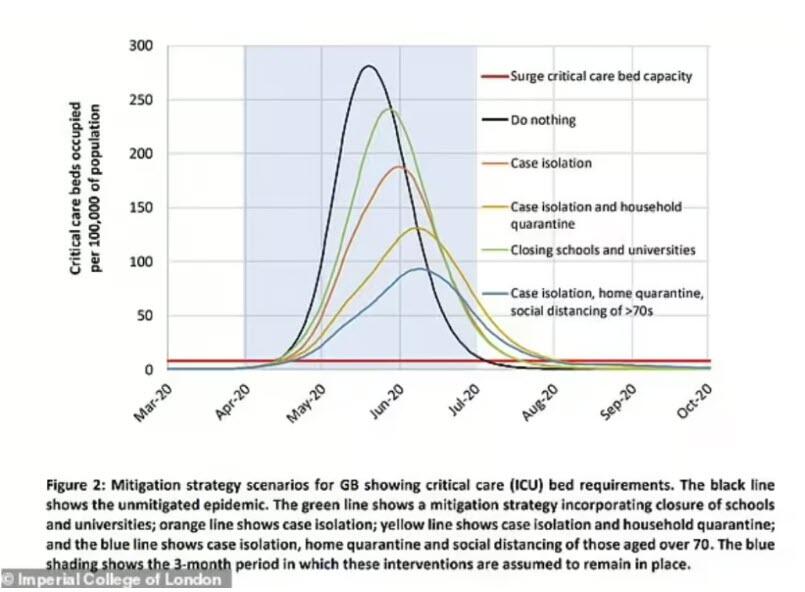
Professor Neil Ferguson’s terrifying March 2020 models warned that 500,000 Brits would die unless tougher action was taken to curb the virus’s spread.

It spooked Boris Johnson into adopting draconian restrictions that saw the country told they “must stay at home.” Vaccines — considered the only safe route out of the pandemic — were still months away from being deployed.

But Professor Ferguson, who quit his role as a SAGE adviser two months after being caught breaking social distancing rules to meet his married lover, today insisted he didn’t tell officials to plunge the country into a lockdown.

He told the UK COVID-19 Inquiry that the situation was “a lot more complex.”

The inquiry is in its second module, which is examining core UK decision-making and political governance.

Hugo Keith KC asked: “Do you feel that you did confine yourself to the provision of scientific advice, or did you become, despite your best endeavours, irrevocably involved in determination of policy?”

Imperial College London’s Professor Ferguson, nicknamed ‘Professor Lockdown’ for his infamous modelling, said it was a “difficult question to answer.”

He said: “I know I’m associated very much with a particular policy.

“But as you’ll be aware from the evidence I’ve given in my statement and statements of evidence, the reality was a lot more complex. 

“I don’t think I stepped over that line to say ‘we need to do this now.’

“What I tried to do was at times, which was stepping outside the scientific advisory role, to try and focus people’s minds on what was going to happen and the consequences of current trends.”

The epidemiologist drew heavy flak for his team’s modelling on the Covid pandemic. 

Their work suggested 500,000 Brits would die if nothing was done to stop the spread of the virus and there would be 250,000 deaths if two-thirds caught Covid.

Worth reading in full.

Ross Clark in the Spectator says that perhaps the most remarkable revelation from Professor Ferguson’s inquiry evidence is that “he spoke to and emailed Ben Warner at No. 10 on March 13th, three days before the Imperial paper [Report 9] was published.”

Warner was a data scientist brought into Downing Street by Dominic Cummings and whom Cummings later credited for inducing pandemic alarm in No. 10, so Ferguson contacting him directly beforehand is significant. 

However, Clark notes that in his email to Warner,

Ferguson then stopped short of damning the Government’s policy of mitigation rather than suppression. In fact, if the Government decided to continue with mitigation, he wrote, ‘there is a rational basis to that decision which I would say the science supports.’ However, he added, the Government should make it clear how many people were likely to die.

“Intriguingly, Ferguson then went on to write: ‘This event is in the natural disaster category and the cure (e.g. massive social distancing, shutdowns) could be worse than the disease.’ In other words, he had at least considered the possibility that lockdowns could cause more damage than they were worth – but neither he nor anyone else seems to have tried to model this.”

Republished from DailySceptic

Tyler Durden
Mon, 11/06/2023 – 03:30

via ZeroHedge News https://ift.tt/KOx5Ebr Tyler Durden

London Remains The Most Attractive City To Move To Start A New Job

London Remains The Most Attractive City To Move To Start A New Job

In a world that’s becoming more globalized and interconnected, moving to another country for work has become ever easier, language barriers notwithstanding, especially for specialized white-collar workers.

As Statista’s Florian Zandt reports, according to the most recent edition of their Decoding Global Talent survey by consulting firm Boston Consulting Group, London remains the top destination for employees willing to switch their home base.

As the chart below shows, cities located in the Middle East and Asia have become more enticing for workers between 2018 and 2020 as well.

Infographic: The Most Attractive Cities To Start a New Job | Statista

You will find more infographics at Statista

For example, 11 percent of survey respondents could imagine moving to Abu Dhabi, Tokyo and Singapore, translating into an improvement by nine, four and eight positions, respectively, compared to the 2018 ranking. More traditional and long-running hot spots like New York and Barcelona fell by six and five ranks. Amsterdam and Dubai complete the top 3, with 15 and 14 percent of respondents claiming they were willing to move to this city for work, respectively.

The survey conducted between October and December 2020 cites efforts by the United Arab Emirates (UAE) to push for a more attractive image and an increase in the Gulf state’s soft power, as well as an at-the-time effective coronavirus response strategy by Asian cities like Tokyo and Singapore as possible reasons for their jump in attractiveness. The Gulf states in particular have long been immigration hot spots. For example, in 2023, nine million people living in the UAE or 88.5 percent of the country’s population were foreign nationals. Roughly half of these foreign nationals are from India (27.49 percent of the country’s population), Pakistan (12.69 percent) and Bangladesh (7.40 percent).

This perceived attractiveness often comes at a price, though. According to the 2023 Mercer Cost of Living City Ranking, Singapore was ranked the second-most expensive city for international workers. Among the 227 cities analyzed, New York City (6), London (17) and Tokyo (19) also placed in the top 20.

Tyler Durden
Mon, 11/06/2023 – 02:45

via ZeroHedge News https://ift.tt/cIxDovZ Tyler Durden

Turkey Is Sustaining Major Inflation. Something Has To Give

Turkey Is Sustaining Major Inflation. Something Has To Give

Authored by Doug French via The Mises Institute,

Bloomberg reports that price inflation in Turkey was more than 60 percent in September. The 61.5 percent reading was released by the Turkish government’s statistical office.

Being on the ground in Turkey for Hans-Hermann and Gülçin Hoppe’s Property and Freedom Society meeting, I can say the vibe was not hyperinflationary. The shelves are not empty and the port city of Bodrum is booming.

Professor Hoppe told the crowd Bodrum has grown from a population of fifty thousand to a million for the whole peninsula.

No matter the destruction to the Turkish lira, money keeps pouring into peninsula real estate, watercraft, and businesses.

“According to statistics by the Turkish Statistical Institute, the average property price in Bodrum in 2021 was around $490 per square foot,” wrote Spencer Elliott for Forbes this past summer.

“Over the last decade, property values have increased dramatically, with the total valuation of the real estate transactions in Bodrum rising from $892 million in 2010 to over $2.1 billion in 2020.”

wrote in 2011, “In 1966, one US dollar bought 9 lire. By 2001, a dollar bought 1.65 million lire. Four years later, six zeros were lopped off the lira and a dollar equaled 1.29 new Turkish lire. Today, a dollar can be traded for around 1.60 lire.”

This year (2023) a single US dollar fetches twenty-five lire at the currency shops in Bodrum.

Government jiggery-pokery with the currency is a way of life in Turkey. Numerous episodes are mentioned by the eminent scholar the late Norman Stone, who was a frequent speaker at the Property and Freedom Society, in his book Turkey: A Short History. But it was not paper and zeros that were manipulated. Writing about Constantinople in 1651, Stone explained that the one hundred thousand local civil servants “were paid in copper money and were expected to pay their taxes in silver . . . [which] brought about a revolt of the guilds.”

But today’s Turkey, which now wants to be known as “Türkiye,” is not Venezuela or Zimbabwe. trip over the hill from Bodrum to Merkez Mah, Çökertme Cd, Yalıkavak Marina revealed Dior, Gucci, and other high-end shops a sidewalk away from one multimillion dollar yacht crammed next to another. Dinner at Salt Bae’s Nusr-Et Bodrum was had amongst beautiful people, with amazing cuisine, tableside flair bartending, and an unforgettable sunset into the shimmering waters of the Aegean Sea.

Hyperinflation seemed pretty good.

Turkish restaurant cuisine has changed subtly over the seventeen years of the Property and Freedom Society. Döner kebab was once offered everywhere. It is a type of kebab using a vertical, constantly rotating spit to slow-roast the meat. The meat is sliced off of it in chunks as it rotates.

Now there are fewer Döner kebabs, and restaurants in the Bodrum harbor area are advertising hamburgers. American burger darling Shake Shack even has a location in the Istanbul airport amongst the duty-free shops that appear every few steps. And at the new, immense Istanbul airport, a passenger must take plenty of steps.

As always, I indulged myself in the Turkish haircut experience, going to the same neighborhood barber I’d patronized on previous trips. Of course, the price reflected the inflation, three hundred Turkish lire. In 2012, the same haircut, nose and ear waxing, and shoulder massage went for twenty Turkish lire, which was twelve dollars at the time. Today’s three hundred lire equals that same twelve dollars.

Other conference goers found a barbershop down near the docks and were charged fifty dollars for the above-mentioned services plus a straight-edge shave. One wonders if it was a bit of selective pricing. I’ve never noticed barber service pricing being posted in a Turkish barber shop so a deal should be made up front.

According to Bloomberg, “Turkey’s inflation print for September sets the stage for a front-loaded move from the central bank to tame price gains. Underlying price pressures signal a higher trajectory for inflation, which we now see peaking at 73 percent in 2Q24, up from our earlier call of 70 percent.”

One knowledgeable Bodrum local confidently said the actual inflation rate was more like 160 percent.

The national minimum wage was raised 34 percent in July to $483 (11,402 lire) monthly, Reuters recently reported.

Labor minister Vedat Isikhan said, “The minimum wage assessment commission completed its work with an agreement between the workers and employers.”

The minimum wage was raised 100 percent last year.

The Turkish central bank bumped its benchmark one-week repo rate by 5 percentage points to 30 percent late last month to slow down the inflation rate.

The rate rise came just weeks after President Recep Tayyip Erdoğan, who once called high interest rates the “mother and father of all evil,” publicly embraced “tight monetary policy,” reported the Financial Times.

Inflation always hits low-income earners the hardest, as they must spend most of their income on food, gas, and rent. Remember the monthly minimum wage from above – it is enough to buy eighty-two gallons of gasoline, which currently goes for 138.849 lire per gallon, and nothing else.

Tyler Durden
Mon, 11/06/2023 – 02:00

via ZeroHedge News https://ift.tt/9nXcbKV Tyler Durden

The Great Reset, Part 2: A Camp With No Outside

The Great Reset, Part 2: A Camp With No Outside

Authored by Simon Elmer via Off-Guardian.org,

‘Today, it is not the city but rather the camp that is the fundamental biopolitical paradigm of the West.’

– Giorgio Agamben, Homo Sacer: Sovereign Power and Bare Life, 1995

In Part 1 of this article, I identified the apparatuses of biopower by which our freedoms and our democracies are threatened in the West today, and which I described as the ‘Four Horsemen of the Apocalypse’.

As I devote a chapter of my new book, The Great Reset, to each of the last three of these apparatuses of biopower – the UN’s Agenda 2030, the WHO’s Pandemic Treaty and Central Bank Digital Currency – I’m only going to discuss the first of them here, although it comes up throughout my book, because a system of Digital Identity is the gateway to the digital camp in which the other three will imprison us.

They all rely on it being in place for their own enforcement, and in this respect it is the most important and the one that has to be most resisted and defeated. Some form of Digital Identity has been talked about for some time, and although everyone appears to know what it is, there doesn’t seem to be much opposition to its implementation in the UK, which I’d suggest indicates that in reality we don’t understand it at all.
THE GATEWAY OF DIGITAL IDENTITY

During the lockdown of the UK, Digital Identity was discussed in relation to the China Health Pass, which is now fully operative and linked to the Chinese system of Social Credit, and which like a traffic light has three signals of access to different aspects of the public realm and services: green for freedom of access; amber for limited access or only on condition of further proofs or acts of compliance (like taking a PCR test); and red for prohibition on everything from receiving a bank loan, accessing your bank account, using public transport, passing between zones of a city to being permitted to leave your home itself. In Europe, a lot of the member states of the European Union universally or partially imposed — for instance, on members of certain industries, like health, education, police and other public services — the use of the EU Digital COVID Certificate, which was collectively known as the ‘Green Pass’. The technology for this was subsequently taken up by the World Health Organization, which in June 2023, in tandem with the European Commission, announced the WHO’s Global Digital Health Certification Network, which it invited all member states — which includes the UK — to adopt and participate in developing.

In the UK itself, we had the NHS COVID Pass, which was never enforced as a requirement of employment except for care workers, but which private businesses were permitted and encouraged to enforce as a condition of employment, access to their premises and use of their services. In April 2022, as coronavirus-justified regulations were lifted in the UK, the Department for Health and Social Care awarded the £18 million contract to develop the NHS COVID Pass to the Danish IT firm, Netcompany Ltd. The specification for the project stated:

The government may introduce a mandatory COVID Pass to access high-risk venues if the data suggests further measures are necessary to protect the NHS. In preparation for this eventuality, we have built the changes to support two levels of domestic passes. The functionality will be toggled off until required. This enables a quick response if/when the Government invokes mandate. If a citizen is fully vaccinated, medically exempt or has been in a clinical trial, they will be eligible for an ‘all venues’ (mandatory) pass. If a citizen only has natural immunity or negative test results, they will only be eligible for a ‘limited venues’ (voluntary) pass.

In anticipation of this mandate and the functionality of Digital Identity being ‘toggled on’, in the first three months of 2023 the UK Government conducted a consultation on draft legislation for what it called — presumably in an attempt to distance it from the widely opposed ‘vaccine passport’ — ‘identity verification’.

The consultation closed on 1 March, 2023; but the legal framework for a system of Digital Identity was first put in place by the Digital Economy Act 2017, which removed the legal barriers to data sharing in the UK. It was initially anticipated that the Statutory Instrument implementing a system of Digital Identity in the UK would be made in July 2023, but we are still waiting for the Government mandate.

What will this system do?

At present, the UK Government is promoting Digital Identity in terms of ease of access, greater convenience and increased safety. So, under the Online Safety Act 2023, Digital Identity will be a requirement of access to the internet, not in order to censor what we can see, read and write but to protect children from pornography and grooming gangs.

Under the Elections Act 2022, it will be a requirement of voting, not in order to further discourage public participation in the electoral process but to stop illegal voting. It will be a requirement of receiving Universal Credit or, in the future, Universal Basic Income, not in order to force the immiserated and unemployed into obligatory retraining and work but to stop fraudulent benefit claims. It will be a requirement of gaining access to public transport, medical care, education and employment, not in order to control us whenever the World Health Organization declares a new pandemic but to protect the population from future health crises. It will be a requirement of travel and movement between nation states and within the UK, not in order to enforce the restrictions on our freedoms imposed by Agenda 2030 but to stop illegal immigration into the UK and save the planet from ‘global boiling’. It will be a requirement of opening a bank account, not to force us into opening a Digital Pound account but to stop financial crime.

And just as it is in China, the system of Social Credit that relies on Digital Identity for its enforcement will not be restricted to individuals, but will apply to both privately-owned companies and publicly-funded institutions. US asset managers like BlackRock, for example, have made it clear that adherence to the behaviours written into the UN’s Sustainable Development Goals and the Environmental, Social and corporate Governance criteria by which they are enforced are now a condition of employment, bank loans, investment and other aspects of business formerly determined by the employment and trading laws of a sovereign state; and the monitoring and enforcement of compliance with these new norms will be increased exponentially with the development and expansion of systems of Digital Identity across the globe.

This enforcement of the biopolitical requirements of citizenship outside of the juridical frameworks of nation states or international law is consistent with the way the NHS COVID Pass was employed in the UK during the two years of lockdown. The decision to require this pass was made by the UK Government, but it wasn’t mandated through legislation, even in the daily coronavirus-justified regulations being made into law. Rather, the responsibility for the enforcement of the COVID Pass was passed onto the private sector. Ultimately, although we have been promised a Statutory Instrument making its requirement into law, I believe the UK’s system of Digital Identity will be handed over to the UK’s businesses, in both the public and private sectors, where it will be enforced as a condition of employment and custom by both employers and those who trade with and make loans to their businesses.

As I will discuss in far greater depth in this book, once the requirements of citizenship are taken out of a juridical framework and become, as Foucault wrote, ‘distributions around the norm’, the more difficult those norms are to challenge. This is the goal of biopower.

The first question any public consultation on Digital Identity should be asking the British public is not — as it did — whether and to what extent it meets this or that objective required by the Digital Economy Act 2017, but rather whether the British public wishes for such a system. The Government has no mandate for its imposition in its election manifesto, and its failure to inform the British public about the system of surveillance and control of which Digital Identity is the key constitutes a dereliction of the duty of any elected executive body to receive informed consent before interfering with the rights and freedoms of those it has been elected to govern. The Government’s sham consultation, to which I responded, provided none of the contexts necessary for the public to make such informed consent. Worse, it assumed the imposition of a system of Digital Identity as a fait accompli. Indeed, by couching its consultation in terms of undisclosed ‘benefits’ to the public and undefined and ideological terms like ‘well-being’, the consultation deliberately concealed the real import, reach and purpose of Digital Identity.

Contrary to what the Government has told us, a system of ‘identity verification’ does not benefit individuals of households or improve public services. We saw this with the UK Health Security Agency’s proposals for the NHS COVID Pass that were nearly introduced in the UK on the justification of tracking and limiting the movements of UK citizens under lockdown. What is more accurately called a system of Digital Identity only benefits those who wish to use such a system to monitor, regulate, correct and, when necessary, to punish those who do not comply with whatever new codes of behaviour, including our speech, the Government and the unelected international technocracies formulating those codes impose upon us.

The ‘Green Pass’ introduced across Europe demonstrated that these will be imposed through prohibitions on our movements, sanctions on our consumptions, extra-legal fixed penalty notices and the removal of our human rights and civil liberties, all of which the Governments of the West have demonstrated they are willing to enforce with extraordinary and in many countries unprecedented levels of police brutality.

Once it is imposed, however, the intervention of the police and the juridical framework within which they loosely act will become less and less necessary, as we move into the biopolitics of stakeholder capitalism. As the UK Government well knows, Digital Identity is not being implemented in isolation from, but in conjunction with, other technologies and programmes for the surveillance and control of the UK population, including the Bank of England’s Digital Pound15-Minute Cities, the London Mayor’s Ultra-Low Emission Zone, the requirements of Agenda 2030 and the enforceable obligations of the WHO’s Pandemic Treaty. Currently being implemented as mere upgrades to the infrastructure of the UK state, these will fundamentally — and, as I have said, perhaps irreversibly — change the ability of the British people to scrutinise, influence or hold our rulers to account. And yet, few members of the British public are even aware of these programmes, let alone how they will be used. We certainly haven’t voted for them. Nor, as the Government’s sham consultation on ‘identity verification’ demonstrates, will we be asked to do so. Digital Identity is the gateway to this collective system of surveillance and control that truly deserves the description ‘totalitarian’.

So little has been divulged about how it will function that it is difficult to say what it will contain; but as part of system of Social Credit, Digital Identity will certainly hold our credit history. It will almost undoubtedly hold our online browsing history. And as the World Health Organization’s Global Digital Health Certification Network indicates, it will definitely hold our biometric data. It will equally certainly hold a record of our social compliance, and what we can learn from China is that social compliance will not only be with the regulations of biosecurity set by a juridical framework but also with the new norms of behaviour we have already so readily accepted and normalised since March 2020. These now include censorship of speech and opinions contrary to those espoused by our Government; increased conditions imposed on our previously inalienable rights and freedoms; and adherence to the dictates of technocracies over whose membership and decisions we have no influence. It will be used to monitor, limit and control our movement through and out of not just our countries but also the 15-Minute Cities currently being imposed on the justification of reducing everything from air pollution to global warming. To this spurious end, it will record and restrict our consumption of energy, heat, food and water.

In practice, it will monitor and record our behaviour, opinions and compliance with the new orthodoxies of woke ideology. And in doing so, it will condition our access to everything from the internet, banking and employment to healthcare, welfare and education. One day, if the Bank of England has its way, it will be the condition of accessing the only kind of currency still in existence, over which it will have complete control.

A CAMP WITH NO OUTSIDE

Why, then, is the British public showing so little interest in, presenting so little opposition to, and demonstrating such passive acceptance of our enclosure in the biosecurity camp to which Digital Identity is the gateway? It’s in order to try and answer this question that, in addition to writing about these new apparatuses of biopower, the second part of my book looks at what are not, properly speaking, technologies of biopower but, rather, the ideologies indoctrinating us for its implementation as the dominant paradigm of governance in the West.

The first of these, of course, is the US proxy war in the Ukraine, which although started in February 2014 with the overthrow of the democratically elected Government, in the minds of most Westerners began in February 2022, as we were emerging from two years of lockdown restrictions. The transition, therefore, from the so-called ‘war on COVID’ to the war on Russia was an almost seamless one, and those obedient to the terms of the former have proven the loudest advocates of the lies of the latter, most obviously about when and why it began.

In certain respects this is a new form of warfare, insofar as the US asset managers that have been driving US foreign policy for some time now are not using the lives of young US soldiers to enforce their interests, as they have in Syria, Iraq, Libya and Afghanistan, but are now using the lives of the citizens of foreign countries — in this instance hundreds of thousands of Ukrainian victims — to force the public assets, natural resources and even the economy of the Ukraine into their hands. It’s a matter of indifference to them that, in doing so, they have reduced parts of the country to ruins, its people to poverty and its institutions to political impotence, except insofar as the carnage justifies them calling on even more US taxpayers’ money to ‘rebuild’ what they have demolished.

Ukraine is a bloody example and warning to the world of what can be done to a formerly sovereign state when the bodies and lives of its people are subject to a war whose goal is biopolitical control over an entire people. Indeed, Ukraine is the testing ground for the digital transformation of the infrastructure of an entire state, including online education and health services, Central Bank Digital Currency, so-called e-governance, including a civil service replaced by smartphone apps, COVID certification on the same, and a judiciary and military run by artificial intelligence. As an image of its dystopian future drawn direct from Hollywood cinema — Ukraine’s 32-year-old Deputy Prime Minister, Mykhailo Fedorov, has dubbed it ‘Judge Dredd’ — the country has already piloted an AI system that produces pre-trial and pre-sentencing reports that assess the risk of a suspect offending.

It’s to the same end, although employing different means, that the orthodoxies of transgenderism have attained their now unquestionable status as part of the official ideology of stakeholder capitalism in the West in a period of time barely longer than it took to impose the equally official orthodoxies of the war in the Ukraine. Few appear to have considered why, in the middle of the vast upheavals we have undergone since March 2020, governments, corporations and public institutions otherwise struggling to save humankind from any number of manufactured ‘crises’ should suddenly devote so much time and effort and money to writing the orthodoxies of ‘trans’ into our laws, implementing them in our policies, promoting them in our media, indoctrinating them through our institutions of education and normalising them in our culture industries.

It is my belief, for which a chapter of this book provides the argument and evidence, that the orthodoxies of trans are not incidental to the revolution in Western capitalism we are undergoing but, rather, instrumental to the new biopolitical paradigm of citizenship to which we will be expected to adhere — and compelled to obey by the technologies of biopower — in the Global Biosecurity State under construction.

Over the last few years I’ve written many times about the ideology of woke, which has now taken its place as the official ideology of stakeholder capitalism, having infiltrated the Cabinets of Western governments along with Klaus Schwab’s Young Global Leaders, and with just as much brazenness and indeed pride.

In my penultimate chapter, I look at how the discourse of White racism developed by woke is being used not only to silence opposition to the regulations, programmes and technologies of the Great Reset of the UK, but also to force through the changes in attitudes, beliefs and behaviours they require for our acceptance and compliance with such blatant attacks on our freedoms.

As with the apparatuses of biopower, therefore, my aim in the second part of my book is to show how the orthodoxies of woke — which now include dehumanisation of the Russian people and the Lysenkoism of transgenderism — are instrumental to the incorporation of the judicial institution, through which the limits of citizenship have until now been made in law, into a biopolitical paradigm, in which the requirements of citizenship in the Global Biosecurity State are normalised by technologies of power, as Foucault wrote, ‘centred on life’.

Finally, the body of my book is topped and tailed by two short texts. The first introduces the book with the argument that one of the conclusions we can draw from the last three-and-a-half years is that the already questionable division of our parliamentary politics into Left and Right no longer has any descriptive or practical purchase on the paradigm of governance by which we are now ruled, and should be abandoned by anyone serious about forming opposition to it. The second text, in the absence of the comforting dreams with which the UK Left has rocked itself to sleep over the past forty years of neoliberalism, concludes my book by proposing one of the ways in which we can resist — initially at least — the construction of the digital camp being built not only around and between but also within us by the technologies of biopower.

In the UK, as across most of the Western World, we lived through an extreme two-year period of lockdown in which almost all our human rights and civil liberties were removed by wave after wave of legislation on the justification of combatting a respiratory virus which anyone who troubled to look at the statistics and the criteria by which they were produced knew had the infection fatality rate of seasonal influenza. Even that’s not quite accurate since, unlike influenza, coronavirus has no effect on the young, who despite being masked for two years, deprived of their education and injected with experimental gene therapies, are as statistically immune to COVID-19 as they are statistically vulnerable to the myocarditis, pericarditis and other damages to their health and immune systems caused by the messenger RNA sequencing the UK state injected into their arms as a vaccine.

Now, however, the West has entered into a more generalised crisis carousel whose names change, week by week, from global boiling to Russian aggression to the cost-of-living to the resurrection of the threat of Islamic terrorism and, as I write, another made-to-order viral strain. But whatever their ostensible cause, the ultimate goal of the technologies of biopower whose imposition these crises justify is to make permanent what were the temporary restrictions on our rights and freedoms under lockdown.

Indeed, the best way to understand these crises is to ask how these new agendas, these new treaties, these new programmes and these new technologies make the State of Emergency under which we lived for two years permanent. Unfortunately, very few people are asking that question, of themselves or others. Under lockdown, thousands of people were forced into quarantine camps, most famously in China; but the digital camp into which we’re being corralled now, and which is enclosing and dividing us even as we return to bickering about Brexit and immigration, is co-extensive with the space of the state itself.

How is it being built? As I’ve said, Digital Identity is the gateway to this camp, over which is written not Arbeit Macht Frei — for there is no escape from a space without an outside — but rather ‘Freedom is Slavery’. And if we imagine this camp and try to visualise its structure, the Internet of Things, which includes the digital panopticon of quick response codes, facial recognition technology and now ULEZ cameras, and the Internet of Bodies to which it connects us, which as I argue in my conclusion includes smartphones, is the camp’s system of surveillance.

15-Minute Cities, which despite being proposed by the World Economic Forum — a corporate think-tank with no legislative authority over the populations of nation states — are being imposed on UK citizens by our local councils and metropolitan authorities, are the barracks into which the different areas of the camp are divided. Despite their vociferous denials to the contrary, as soon as a municipal authority or legislative body decides when, how, where, how often and in what its citizens can move about in their own country, you are on the road to fascism. 15-Minute Cities are the beginning of the transformation of the space of the state itself into a permanent spatialisation of the State of Emergency, which is why they are both justified as a means to ‘save the planet’ and denied as a ‘conspiracy theory’.

And in case we’re naïve enough — which the UK public has demonstrated itself to be beyond the dreams of even the most cynical globalist — to believe that the limits on our freedom of movement will only apply to cars, and are therefore a good thing, Transport for London has already proposed what it calls, with the ubiquity of one of the most powerful information technology companies in the world, ‘smart transport’. Employing not just facial recognition cameras but the AI technology within them, the purpose of smart transport is not merely to monitor our actions but also to learn from our behaviour, turning public transport into a vast training camp for the digital guards of our future.

Finally, Central Bank Digital Currency, in this spatial visualisation of a digital structure, is the perimeter fence of the camp, which it renders impossible to escape; for once this fence is constructed there will no longer be a space outside its extent and reach, or at least, no space inhabitable by a human society larger than a small commune, and most likely nowhere in the West.

Although the Internet of Bodies is ready and waiting to insert its system of monitoring inside us, with the proto-cyborgs for the future already implanting computer chips under their skin and ingesting them into their bodies, these technologies of biopower are, for the present, being implemented through the nation’s smartphones. This includes, of course, a system of Digital Identity; but, initially at least, Central Bank Digital Currency wallets will also go through a smartphone software application.

In anticipation of which, in March of this year the Government launched its Emergency Alert System, which was then tested the following month on the 82 million smartphones in the UK. It has not been made public how many of their owners responded; but what the UK public needs to understand, and soon, is that when the technologies of biopower constituting the digital camp are in place, this alert will not be used to inform us of whatever crisis the Government has invented to terrorise us with next, but rather to instruct us in the operational status of mechanisms of compliance it will be impossible to disobey except at the cost of our liberty.

I say it again, once the legal framework for citizenship is incorporated into a biopolitical paradigm of governance administered by a continuum of regulatory apparatuses, then legislative, legal and political means of contestation will no longer exist except as spectacles of a democracy long since dismantled. In reality, Western democracy, for some time now, has only existed in the fantasies of an endlessly deceived electorate. But it’s a measure of how far we have come since March 2020, how far we have declined as a citizenry worthy of the name, and how ready we are for the totalitarianism of biopower, that there was no protest and little outrage in response to this trial of our abject obedience. On the contrary, the same mouths and faces were wheeled out by the media to repeat the mantra of the unfailing obedient: ‘Well, if it saves lives . . .’ This is the essence of biopower to which the politics of the West is being reset by stakeholder capitalism. And, somehow, the people of the West have to stop it, if we don’t want to live in a camp with no outside.

Tyler Durden
Sun, 11/05/2023 – 23:50

via ZeroHedge News https://ift.tt/9jMNIWu Tyler Durden

South Korean Stocks Soar After Country Inexplicably Bans Short Selling Until June 2024

South Korean Stocks Soar After Country Inexplicably Bans Short Selling Until June 2024

Coming soon to a “developed” capital market near you.

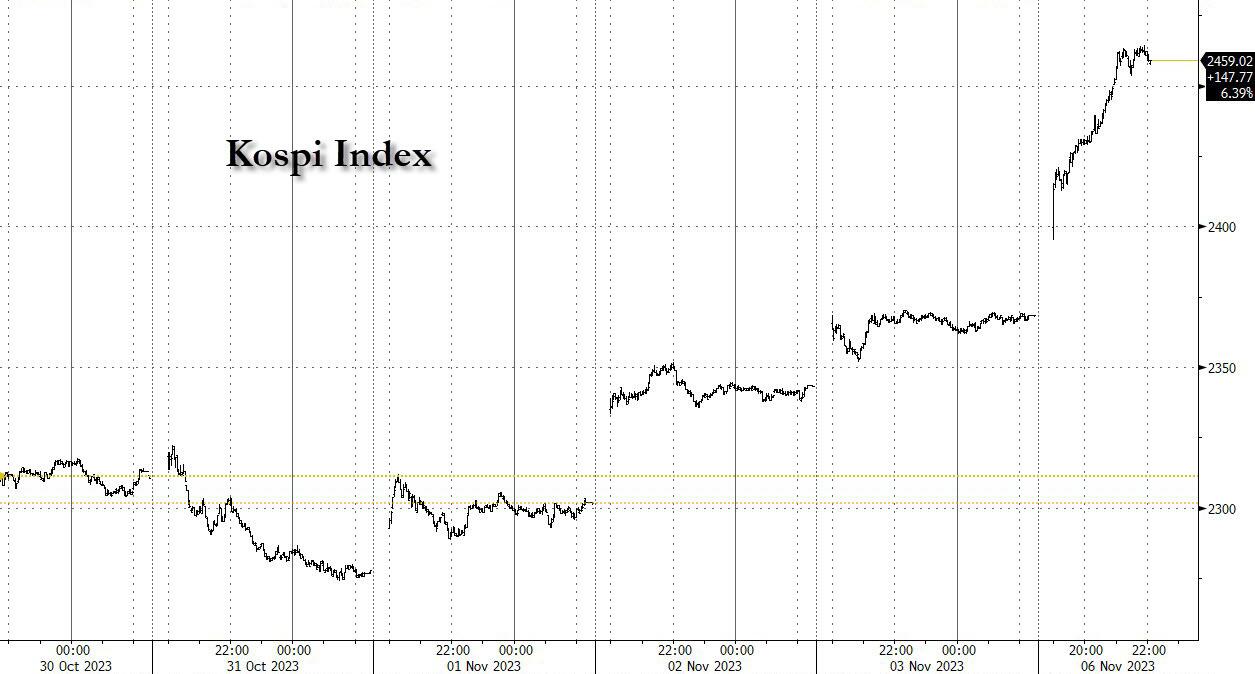
On Sunday, South Korea’s Financial Services Commission shocked markets when it announced it would prohibit stock short-selling until June 2024 to allow regulators to “actively” improve rules and systems, a move analysts said was “unusual” and “unwarranted” when no (obvious) financial crisis or external shock that would lead to a sell-off exists. The news sent Korean stocks surging in early Monday trade.

In a rehash of various short selling bans implemented in the US during periods of market turmoil, the commission announced that trading with borrowed shares will be banned for equities on the Kospi 200 Index and Kosdaq 150 Index from Monday until the end of June.

“Amidst market turmoil, we’ve discovered massive illegal naked short-selling by global investment banks and circumstances of additional illegal activities,” Financial Services Commission Chairman Kim Joo-hyun told a briefing. “It’s a grave situation where illegal short-selling undermines fair price formation and hurts market confidence.”

Lee Bokhyun, governor of the Financial Supervisory Service watchdog, told reporters about 10 global banks will face investigations which account for most short-selling transactions in South Korea.

Translation: stocks are lower than where we want them to be, and so we will blame the short sellers, a familiar refrain. The only problem is what happens when stocks now crash for real, and this time the country won’t be able to blame shorts.

During the ban, South Korea will seek a “fundamental improvement” to level the playing field for retail investors in the coming months, including seeking ways to narrow the different short-selling requirements and conditions between institutions and individual investors, Kim said.  Authorities will also seek stronger punishments on illegal short-selling activities. They will continue to look into short-selling transactions of global banks with the introduction of a special investigation team on Monday.

South Korea started allowing short-selling of stocks on the two indexes in May 2021 while keeping a pandemic-era ban in place for more than 2,000 equities. Reimposing the full ban on the widely used trading practice could hinder the nation’s efforts to seek an upgrade in a key global index, according to Smartkarma Holdings Pte. analyst Brian Freitas.

“The short-sell ban will further jeopardize Korea’s chances of moving from Emerging Market to Developed Market,” Freitas said. “Expect bubbles to form in pockets of the market that are favored by retail investors as short selling no longer acts as a brake on absurd valuations.”

Hilariously, short selling accounts for a tiny portion of the nation’s $1.7 trillion stock market — about 0.6% of the Kospi’s market value and 1.6% of the Kosdaq’s, according to exchange data. And yet, according to regulators, it is the evil short sellers who are responsible for the market not complying with central planning mandates.

According to Bloomberg, the regulator’s announcement comes ahead of general legislative elections to select National Assembly members in April. Some ruling party lawmakers have urged the government to temporarily end stock short-selling in response to demands by retail investors who have staged protests against the practice.

The investors say short-selling leads to unfair advantages for foreign and institutional investors.

South Korean President Yoon Suk Yeol and his party have campaigned on reforms, including changes to the pension
system and the prevention of market monopolies. Yoon’s popularity has edged up in recent months to a high of 34% on Friday, after dipping last year.

The regulator’s ban coincides with a nascent recovery in the main South Korean equity benchmark index. The Kospi has climbed in November after suffering its worst monthly drop in October amid foreign sell-offs. The index is still down more than 10% from its August peak. The small-cap Kosdaq Index also bounced back from the lowest level since January, but is down 17% from its July peak.

Following news of the ban, the Kospi surged 4%, extending its recent gains.

The response from analysts and traders was one of puzzled confusion, with consensus that the move to ban short-selling is “unusual” and “unwarranted” when no financial crisis or external shock that would lead to a sell-off exists (suggesting that it would be warranted to ban short-selling when there is a crisis, which is why markets remain a complete farce 15 years after Lehman). Here are some thoughts from Wongmo Kang of Exome Asset Management.

The ban’s impact could be “more limited” compared to such policy in the past as South Korea has been allowing short selling on companies listed in Kospi 200 Index and Kosdaq 150 Index

  • As South Korea is heavily influenced by retail investors, individual investors might exhibit increased confidence and willingness to engage in the stock market after the measure; that could lead to perception that downside risks are relatively restricted when short selling is prohibited, which may not necessarily be true
  • Funds that employ long-short strategies may need to adjust their long position in accordance with limitations on short position; that may potentially lead to sell out in their long positions
  • There is a possibility that international investors may lose trust and opportunity in the Korean market
  • This policy reversal in short selling is unwarranted now as South Korea is increasingly viewed with excitement and as being diverse as its popular music and electric vehicles. Given this view, short selling should be encouraged as a means of building an efficient market
  • Although financial system improvements to prevent illegal and inefficient activities are necessary, there seems to be a need for efforts to evaluate true values through short selling, especially in markets like South Korea where there are significant surges in “theme” stocks without any clear reasons and company fundamentals

Tyler Durden
Sun, 11/05/2023 – 22:40

via ZeroHedge News https://ift.tt/ZNeoQat Tyler Durden

The 7th Circuit Holds That AR-15s Aren’t Protected By The Second Amendment

The 7th Circuit Holds That AR-15s Aren’t Protected By The Second Amendment

Authored by Andrea Widburg via American Thinker,

Illinois desperately wants to ensure that, within the state’s borders, only criminals have guns.

When it comes to law-abiding citizens, the state will do anything to disarm them.

That includes passing a law that pretty much bans “assault weapons” (a non-existent category that really covers AR-15s, America’s most popular gun) and large-capacity magazines (which really do exist). A federal district court issued an injunction against that part of the law, but a three-judge panel reversed the injunction on grounds that are so asinine and juvenile that they could come only from judges.

The three-judge panel in Barnett v. Raoul (Case No. 23-13530 consisted of a Reagan appointee, a Clinton appointee, and a Trump appointee. Only the latter supported the trial court. The other two judges came up with some astounding logic. I’ve summarized the judges’ logic, along with my commentary (in bolded text).

  1. The Supreme Court in District of Columbia v. Heller, which protects an individual’s right to keep and bear arms irrespective of active involvement in a formal militia, said that the Second Amendment is not a completely unlimited right. This is true. Heller said that.
  2. The Heller decision said that the arms meant to be protected under the Second Amendment were those that were not dedicated solely to military use but were of the type that ordinary citizens would ordinarily have. To that end, the court held that “the Second Amendment does not protect those weapons not typically possessed by law-abiding citizens for lawful purposes….” America’s law-abiding citizens own around 20 million AR-15s, which they use for law-abiding purposes.
  3. In the military, there is a weapon known as the M16.
  4. M16s, because they are military weapons, can be calibrated to function as fully automatic weapons (they keep firing as long as you keep your finger on the trigger) or fired in three-round burst modes per single trigger pull. AR-15s are semi-automatic weapons. This means that you don’t have to manually place a new bullet into the chamber after every shot. Instead, after you fire a shot, a new round is automatically chambered. Every shot requires the user to pull the trigger.
  5. Bump stocks can turn the AR-15 into a fully automatic weapon.
  6. Both M16s and AR-15s use the same ammo and “deliver the same kinetic energy.”
  7. Therefore, the court held that the AR-15 is essentially an M16, making it a weapon of war that can be denied to ordinary civilians.

A few things need to be said here:

First, all civilian weapons can be used in war.

By this logic, because all civilian weapons can be used in war, all civilian weapons are weapons of war and, therefore, are not protected under the Second Amendment. This is insanely stupid logic.

Second, the ammo used for AR-15s and M16s isn’t very powerful.

That’s why the AR-15 is not a good hunting weapon for medium to large game—it’s cruel to the animals because it may injure them without killing them. The reason the military opted for 5.56 ammo is because it meant that soldiers wouldn’t be so weighed down by their ammo. In other words, civilians aren’t using military ammo; the military is using civilian ammo.

Third, the court is saying that the possibility that a weapon can be augmented to become more powerful (i.e., military-esque) removes it from the reach of the Second Amendment.

Again, that’s insane.

Of the 20 million AR-15s in use in America, it’s impossible to imagine how small the percentage is of people who use bump stocks. Most Americans don’t want automatic weapons. They chew up ammo, which means that their time-utility is limited, and the average citizen would have to be weighed down with hundreds of bullets.

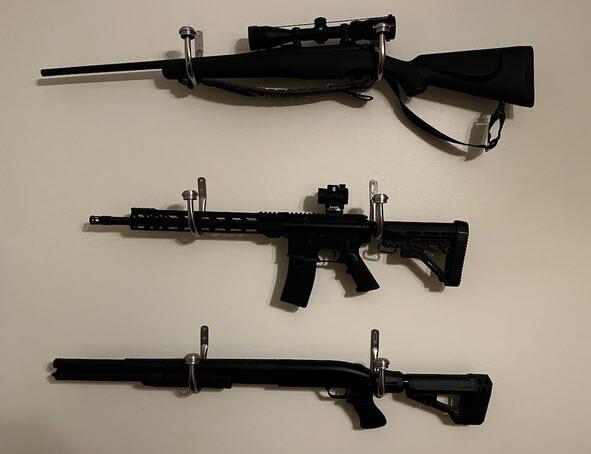
Image: A civilian’s long guns.

I’m unsurprised that a Clinton judge would be behind this risible “logic.”

I’m saddened that a Reagan judge would be, and I can’t even guess his motives.

However, given my very deep disrespect for judges, I’m ready to be very unimpressed by both judges’ intelligence.

Tyler Durden
Sun, 11/05/2023 – 21:30

via ZeroHedge News https://ift.tt/AGEqo78 Tyler Durden

Israel, Palestine, & The “Weaponized Morality” Of The Media

Israel, Palestine, & The “Weaponized Morality” Of The Media

In his inimitable style, comedian JP Sears dares to touch the third rail of ‘whose side to be on’ – Israel vs Palestine in his latest clip.

The satirical conversation between two individuals cynically discuss being pro-war and anti-peace, highlighting a grim acceptance of conflict as inevitable.

“I think we’re on the brink of World War III. I’m very happy for the military-industrial complex.”

The discussion is framed to suggest that their enthusiasm for war is not genuine, but rather a product of media influence, which is depicted as “weaponized morality.”

“I’ve effectively been manipulated by weaponized morality via the media.”

The two ‘Sears’ imply – in their ironic manner – that the media’s portrayal of events has the power to manipulate public sentiment, skewing perceptions of the conflict to support a war agenda.

“The media is just telling us what’s going on, it just so happens that hearing what they tell us has swayed us all to want an incredibly deadly thing.”

Throughout the conversation, there’s a mocking acknowledgment of the reciprocal nature of the aggression and the underlying causes of the conflict. The speakers sarcastically agree on the necessity of retribution against Hamas for attacks on Israeli civilians, while simultaneously noting the disproportionate response that leads to Palestinian civilian casualties; highlighting the polarized views around the world, including extreme positions that echo historical prejudices and the actions of the Israeli government that some deem unjust.

“There’s just no justice in peace.”

The dialogue also references the role of US foreign policy and its financial involvement in the region, hinting at the possibility of a hidden agenda behind the support of both sides, where governments might be conspiring to instigate conflict to serve undisclosed goals (and leveraging media narratives to rally public support).

The US is funding both sides of the war, giving $6 billion to Iran to give to Hamas, and we’re sending billions to Israel to aid in their military effort.”

JP encapsulates this ‘conspiracy’ by noting Netanyahu’s recent presentation at the UN (showing a map of the MidEast with no Palestine on it) and the insinuation that the Israeli government’s previous funding of Hamas could be part of a calculated plan to justify military actions against Palestine.

“War was the goal all along meant to accomplish a further goal that’s not being honestly shared by certain governments.”

Enjoy JP’s satirical take on the debacle…

Tyler Durden
Sun, 11/05/2023 – 20:55

via ZeroHedge News https://ift.tt/dSLwWET Tyler Durden

Trump Campaign Fights For Place On Michigan Ballot

Trump Campaign Fights For Place On Michigan Ballot

Authored by Steven Kovac via The Epoch Times,

Attorneys for President Donald Trump have filed suit in the Michigan Court of Claims in a preemptive effort to preserve his place on the state’s 2024 ballot.

The proactive move is designed to counter at least two pending lawsuits that are attempting to have President Trump disqualified under Section Three of the Fourteenth Amendment of the U.S. Constitution for being an alleged “insurrectionist” in connection with the Jan. 6, 2021 rally-turned-riot at the Capitol Building in Washington.

Because the factual allegations of both anti-Trump suits overlap with one another, this article will focus on LaBrandt et al. v. Benson, filed on Sept. 29, 2023.

The plaintiffs are four registered voters from Michigan.

They are represented by Michigan attorney Mark Brewer and five Massachusetts lawyers from the group Free Speech for People (FSP).

According to its website, FSP is a national “non-profit, non-partisan” political advocacy organization.

The defendant in the suit is Michigan’s Democrat Sect. of State Jocelyn Benson.

FSP has also filed a nearly identical lawsuit in Minnesota.

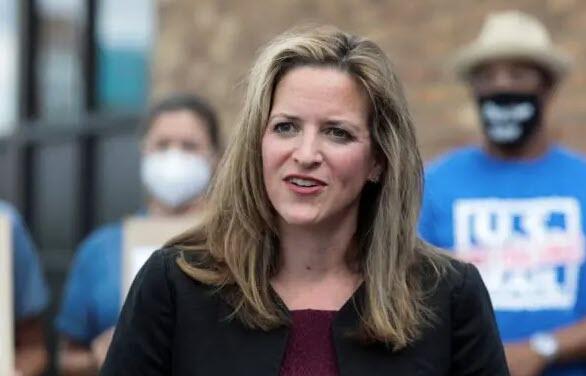
Michigan Secretary of State Jocelyn Benson speaks in Detroit, Michigan, on Aug. 18, 2020. (Rebecca Cook/Reuters)

A separate high-profile case against President Trump is currently being tried in Colorado.

Court Order Could Disqualify Donald Trump

In the Michigan complaint, the plaintiffs asked the court to declare President Trump ineligible to hold public office ever again.

They also asked the court to permanently enjoin Ms. Benson from including President Trump as a candidate in the upcoming Feb. 27 Michigan Republican presidential primary and the Nov. 5, 2024, general election.

Michigan law requires the secretary of state to compile and issue a list of the presidential candidates generally recognized by the national news media and place them on their party’s primary ballot by Nov. 10.

Political Cover?

The plaintiffs assert in their complaint that legal action is necessary because, on Sept. 13, 2023, Ms. Benson published an op-ed in the Washington Post claiming that she lacks the legal authority to investigate and determine whether a presidential candidate should be ineligible to run for office because of a Fourteenth Amendment violation.

“She has declared that she will place Trump’s name on the Michigan 2024 presidential primary ballot unless a court prevents her from doing so,” reads the complaint.

Political observers see Ms. Benson, a former law school dean, as a strong candidate to succeed Democrat Governor Gretchen Whitmer when both are term-limited out of their present positions in 2026.

Serious Allegations

The pleadings allege that President Trump concocted a “scheme to overthrow the government” and “to retain power even if he lost.”

They also allege, “Trump engaged in insurrection or rebellion and is thus disqualified from public office,” pursuant to Section Three of the Fourteenth Amendment.

The Fourteenth Amendment was ratified in 1868 for the purpose of keeping ex-Confederates from holding office in the reconstructed Union.

The complaint also alleged that President Trump “attempted to enlist government officials to illegally overturn the election.”

Not Since Rutherford B. Hayes

In the hotly contested presidential election of 1876 between Republican Rutherford B. Hayes and Democrat Samuel Tilden, the race could not be decided by the Electoral College because the disputes over the electors from four states could not be resolved. Congress created a special Electoral Commission that ultimately sorted things out in favor of Mr. Hayes in March 1877.

This precedent was the basis for the Trump strategy of January 6, 2020.

The 1877 procedure was banned in a bill passed by Congress and signed by President Biden in Dec. 2022.

“On January 4, 2021, Trump and his then-attorney John Eastman met with then-Vice-President Mike Pence and his attorney Greg Jacob to discuss Eastman’s legal theory that Pence might either reject votes on January 6 during the certification process or suspend the proceedings so that states could reexamine the results,” alleges the complaint.

Article Two, Section One of the U.S. Constitution requires the vice-president, in his capacity as President of the Senate, to preside over the counting of electoral votes in a joint session of Congress.

Plaintiffs’ pleadings quote a portion of President Trump’s explanation of the procedure from the speech he delivered at the scene of the Save America Rally held on Jan. 6, 2021, in the Ellipse, a large park south of the White House.

Referring to Mr. Pence, President Trump is alleged to have said, “All he has to do is refer the illegally-submitted electoral votes back to the states that were given false, fraudulent information where they want to recertify.”

Earlier in the program, Mr. Eastman is alleged to have told the crowd, “All that we are demanding of Pence is, this afternoon at 1 o’clock, he let the legislators of the states look into this so we get to the bottom of it.”

Incendiary Rhetoric?

The complaint makes much of what it calls President Trump’s incitement of the crowd to violence. This is important, say the plaintiffs, because, though President Trump committed no overt acts of insurrection, his remarks tie him to the criminal conduct of some of his supporters at the Capitol Building.

The complaint cites a couple of quotes from President Trump’s Ellipse speech as examples of his inflammatory talk.

President Trump is alleged to have said: “We want to go back, and we want to get this right because we’re going to have somebody in there that should not be in there, and our country will be destroyed, and we’re not going to stand for that.

“And we’re going to have to fight much harder.

“And we fight. We fight like hell. And if you don’t fight like hell, you’re not going to have a country anymore.”

Similar Remarks

Following the overturning of Roe v. Wade, Michigan’s Democrat Governor Gretchen Whitmer repeatedly said in public statements, “I will fight like hell” to preserve the right to obtain an abortion.

To date, no legal action has been taken against Ms. Whitmer for her choice of words.

Ten Thousand National Guardsmen

The complaint does not mention that, days before the Ellipse rally, President Trump asked then-Speaker of the House Nancy Pelosi and Washington Mayor Muriel Bowser to concur with his request to deploy 10,000 National Guardsmen to protect the Capitol—something they declined to do.

However, the complaint does list several instances on Jan. 6, in which President Trump appealed to the large and boisterous crowd to remain peaceful.

March ‘Peacefully and Patriotically’

In his Ellipse speech, President Trump is quoted in the complaint as allegedly saying, “I know that everyone here will soon be marching over to the Capitol Building to peacefully and patriotically make your voices heard.”

Among several other appeals for peace and calm by President Trump cited in the complaint are the following:

At 2:38 p.m., Trump posted on X: “Please support our Capitol Police and Law Enforcement. They are truly on the side of our Country. Stay peaceful!”

Later, at 4:17 p.m., the complaint states that President Trump released a video on Twitter directed to the protestors in which he allegedly said: “I know your pain. I know your hurt…I know how you feel, but go home, and go in peace.”

The Trump Team Sues Benson

Representing President Trump in his lawsuit against Ms. Benson is constitutional lawyer David Kallman and his partner Stephen Kallman of the Kallman Legal Group of Lansing, Michigan, as well as Mark Meuser of the Dhillon Law Group.

In a complaint filed on Oct. 30, 2023, President Trump’s legal team asserted that “President Trump did not engage in an insurrection as those terms are used in Section Three of the Fourteenth Amendment.”

His attorneys argue that neither the secretary of state, other state officials, nor the state courts have the legal authority to decide whether a candidate for president is ineligible to appear on the ballot. They contend that the Constitution commits to Congress the responsibility of determining matters of presidential candidates’ qualifications and that the amendment is not self-enforcing but requires an operative act of Congress to carry it out.

None of President Trump’s constitutionally protected free speech concerning the Jan. 6 protest meets the “stringent requirements for ‘incitement’ both because the content itself is not sufficiently explicit and because it does not evince a specific intent to engage in unlawful activity,” reads his complaint.

President Trump’s lawyers asked the court to declare that, as “a matter of federal constitutional law” and according to Michigan statute, Ms. Benson lacks the authority to determine whether a presidential candidate may be disqualified.

A Preemptive Blow

They also asked the court to enjoin Ms. Benson from refusing to place President Trump on the ballot based on allegations relating to Section Three of the Fourteenth Amendment.

As early as Aug. 18, 2023, Trump attorney David Warrington of the Dhillon Law Group sought confirmation from Ms. Benson that, pursuant to Michigan law, she would include President Trump’s name on the Secretary of State’s list and be placed on the ballot.

According to the Trump complaint, Ms. Benson did not respond.

The Michigan Office of the Secretary of State does not comment on pending litigation.

All three cases are scheduled for hearings on Nov. 9 at the Michigan Court of Appeals courtroom in Grand Rapids.

Tyler Durden
Sun, 11/05/2023 – 20:20

via ZeroHedge News https://ift.tt/CGxFp1U Tyler Durden

Florida “Booty Patrol” Driver Busted, Cops Mocked

Florida “Booty Patrol” Driver Busted, Cops Mocked

Sheriffs in central Florida are being mocked online after an 18-year-old man accused of “impersonating law enforcement” was ticketed for plastering “Booty Patrol” on his truck, which he styled to look similar to a Border Patrol vehicle.

The DeSoto County Sheriff’s Office warned the public about the Florida Teen, Gabriel Luviano, who they slapped with a $113 citation for adding red and blue rights to his Chevy Silverado, which also features a green diagonal stripe and a logo which reads “National Booty Behavior Protection” in addition to “BOOTY PATROL.”

Luviano told NBC 2: he choose “Booty Patrol” because “it’s the closest you could get to Border Patrol and still have the B in it,” adding that it was never his intention to impersonate federal agents.

“It was just to have a little fun, you know?” he said, adding that “It was never my intent to pull over people or nothing.”

Luviano told the outlet that local cops – aside from the guy who pulled him over, love the truck.

I have videos of cops coming up to me and they just want a picture,” he said.

Facebook Warning

“We want to emphasize that DCSO located the vehicle on Sunday, and our initial post aimed to raise awareness about this incident, ensuring that the public can avoid being duped by such individuals,” deputies posted on Facebook. “We extend our sincere gratitude to everyone who called in with information about the suspicious vehicle, as your continued support is crucial in helping us maintain a safe and secure community for our residents.”

According to the NY Post, the comments section was full of hilarious replies.

Is this serious? If anyone thinks this is a real officer they have a problem. I have seen this drive around all the time and I always get such a chuckle out of it,” said one Floridian. “Leave the man alone.”

““It’s a little sad to see this happening to the car community,” wrote another person. “This is just merely a show truck. Always has been. Never seen him have his blue lights on and seen him all over Desoto, Manatee, and Sarasota county.”

Tyler Durden
Sun, 11/05/2023 – 19:45

via ZeroHedge News https://ift.tt/qFyG7fO Tyler Durden