Netanyahu’s ‘Political Days Are Numbered’: White House

Netanyahu’s ‘Political Days Are Numbered’: White House

Via The Cradle,

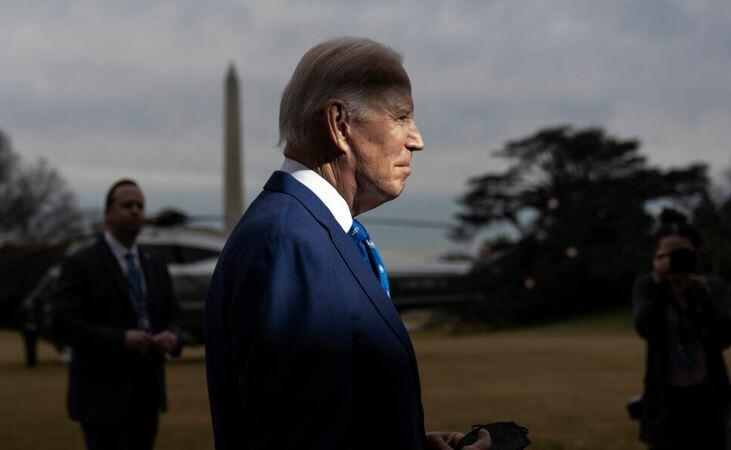
Joe Biden and top White House aides have discussed the likelihood that Benjamin Netanyahu’s “political days are numbered,” and are gauging potential successors as the popularity of the Israeli prime minister continues to plummet following last month’s successful Hamas attack on Israel, Politico reported on 2 November. 

The topic of Netanyahu’s anticipated fall from power has come up in recent White House meetings including following Biden’s most recent trip to Israel in which he met with Netanyahu following the surprise Hamas attack on 7 October, according to two senior administration officials.

Biden has even suggested to Netanyahu that he should think about lessons he would share with his eventual successor, the two administration officials added.

Separately, a current US official and a former US official both confirmed that the Biden administration believes Netanyahu will not remain in office for long. The current official believes Netanyahu’s term as prime minister may last a just matter of months due to the Israeli public’s anger resulting from the surprise Hamas attack on 7 October and the intelligence failures that appeared to have occurred to allow it.

Some 1,400 Israelis died during the Hamas attack, including soldiers and civilians. Some were killed by Hamas fighters, while others were killed in the crossfire as Israel used overwhelming force to eliminate Hamas fighters who had taken many Israelis captive.

Hamas managed to take over 200 Israelis captive back to Gaza, and the Israeli public and even the captives themselves have been harshly critical of Netanyahu and his right-wing settler government, which have prioritized targeting Hamas and killing Palestinian civilians in Gaza over the captives’ safe return.

Further, many Israelis believe the government deliberately allowed the Hamas attack to happen, citing the slow response of the army and police as Hamas fighters penetrated deep into Israeli territory and targeted both military bases and settlements in the Gaza envelope.

Netanyahu has promised to investigate the intelligence failings, but refuses to do so until the war is over, which may take months or even years.

“There’s going to have to be a reckoning within Israeli society about what happened,” said the official who, like others, was granted anonymity to detail private conversations.

“Ultimately, the buck stops on the prime minister’s desk.”

Biden’s trip to Tel Aviv last month was one largely of support, but the current US official said that Netanyahu’s tenuous hold on power is always “in the background” during internal Biden administration talks about West Asia. And Biden aides already are engaging an array of other Israeli politicians, both in the government and the opposition, in the war effort.

According to the two senior administration officials as well as the current and former US official, “those talks have also provided a way to gauge the thinking of various Israelis who might take the helm of the country,” Politico wrote. 

This suggests the US may be looking to choose Netanyahu’s successor, as they did in Ukraine following the 2014 coup against then President Viktor Yanukovych.

US officials have taken note of Netanyahu’s falling approval ratings and predict that any forthcoming Israeli or US assessments about the intelligence failure will likely be even more damning for the prime minister.

Biden administration officials have offered public declarations of solidarity with the Israeli government, despite condemnations from human rights groups that Israel has targeted Palestinian civilians “on a mass scale.” But they are nevertheless concerned with who Netanyahu’s successor may be, and what the “day after” will look like in Gaza if Hamas is defeated. 

The Israeli government has prepared plans to ethnically cleanse and annex Gaza, forcing the strip’s 2.3 million residents to flee to Egypt as refugees, never to return. The White House included funding for relocating Gazans to Egypt’s Sinai in its recent supplemental funding request to Congress, suggesting approval of such an effort. 

At the same time, White House officials have also floated the possibility of installing the Palestinian Authority, led by Mahmoud Abbas, in power in Gaza, or possibility of sending a multinational force, though not necessarily one with US troops, to control the territory.

Netanyahu and Biden were at odds even before the war. Netanyahu was a strong supporter of former President Donald Trump, and did not appear pleased that Biden defeated him in the 2020 election. Biden has also distanced himself from Netanyahu following the prime minister’s effort to overhaul Israel’s judiciary upon regaining power in elections last December. Netanyahu has also been critical of US efforts to negotiate with Iran and the Biden White House’s lax efforts to enforce sanctions on Iran’s oil exports. This is presumably due to the influence of China, Iran’s biggest purchaser of oil, on Biden through business dealings with his son Hunter. 

Tyler Durden
Sun, 11/05/2023 – 19:10

via ZeroHedge News https://ift.tt/cg1xYph Tyler Durden

Appeals Court Freezes Trump Gag Order Issued By Out-Of-Control Woke Judge

Appeals Court Freezes Trump Gag Order Issued By Out-Of-Control Woke Judge

A federal appeals court late Friday slapped down a gag order issued against former President Donald Trump, after his legal team filed an emergency motion Thursday to lift it while his appeal plays out before the court regarding the Biden DOJ’s charges of conspiracy for challenging the results of the 2020 election.

According to a three-judge panel of the US Court of Appeals for the DC Circuit, the gag order from District Judge Tanya Chutkan is “administratively stayed pending further order of the court.”

The gag order prohibited Trump from making any public statements that might “target” the prosecution and defense legal teams, court staff, supporting personnel, and any “reasonably foreseeable” potential witnesses in the case. Trump had originally asked Chutkan to halt the gag order – which she briefly did, before later reimposing it after the prosecution handed her (Chutkan)

“The purpose of this administrative stay is to give the court sufficient opportunity to consider the emergency motion for a stay pending appeal and should not be construed in any way as a ruling on the merits of that motion.”

The move by the appeals court is the latest in the gag order saga, which was triggered by a request by special counsel Jack Smith and imposed when Judge Chutkan issued the order on Oct. 17.

President Trump has been outspoken in the past about Mr. Smith, who is leading the election interference case against him, and others.

The former president has pleaded not guilty in the case. –Epoch Times

Chutkan, a US District Court judge in the District of Columbia, previously worked at a law firm that represented Fusion GPS, the company that helped orchestrate the Russia collusion hoax targeting former President Donald Trump. During her stint with Boies Schiller Flexner, the Democrat-friendly law firm also reportedly represented Clinton Cabal foot soldier Huma Abedin, the former wife of disgraced Democrat Anthony Weiner.

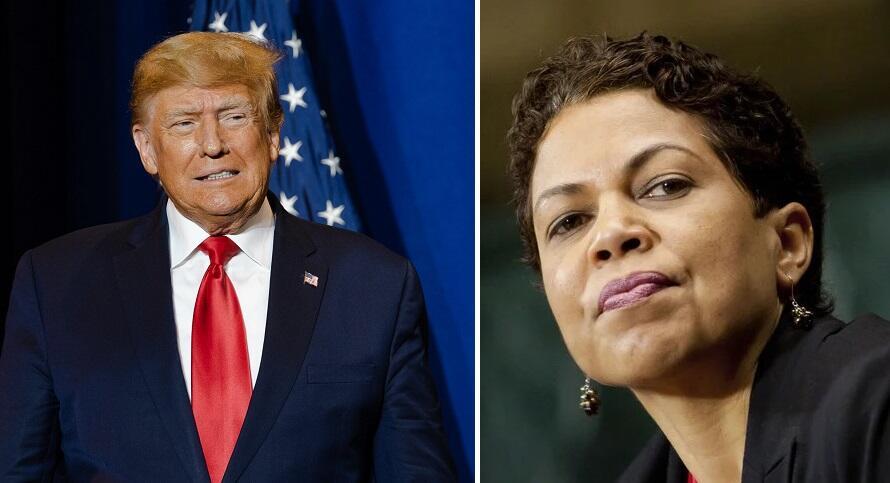
Trump, Judge Tanya Chutkan

If it’s any indication of how radical-left Judge Chutkan is, two of the appeals court judges are Obama appointees, and one is a Biden appointee.

In August, Rep. Matt Gaetz (R-FL) introduced a resolution to censure Chutkan “for showing open bias and partisanship in her official duties on the bench.”

“Judge Tanya Chutkan’s extreme sentencing of January 6th defendants, while openly supporting the violent Black Lives Matter riots of 2020, showcases a complete disregard for her duty of impartiality and the rule of law,” Mr. Gaetz said.

Mr. Gaetz’s resolution points to a few other cases of “open partisanship,” including the fact that the Obama-appointed district judge had donated thousands of dollars to his presidential campaign, and that during another Jan. 6-related sentencing she “lamented” that President Trump “remains free to this day.

More via The Epoch Times:

‘Heckler’s Veto’

President Trump’s attorneys have argued that their client had made public statements about the Washington election case “for months” but that the Justice Department has so far “submitted no evidence of any actual or imminent threat to the administration of justice.”

“The prosecution’s claim that his core political speech suddenly poses a threat to the administration of justice is baseless. The prosecutors and potential witnesses addressed by President Trump’s speech are high-level government officials and public figures, many of whom routinely attack President Trump in their own public statements, media interviews, and books,” they wrote in court filings.

They argued that the gag order reflected bias and animosity against President Trump and was meritless.

The prosecution’s request for a Gag Order bristles with hostility to President Trump’s viewpoint and his relentless criticism of the government—including of the prosecution itself,” his attorneys wrote in the filing.

“The Gag Order embodies this unconstitutional hostility to President Trump’s viewpoint. It should be immediately stayed,” they said.

“No court in American history has imposed a gag order on a criminal defendant who is actively campaigning for public office—let alone the leading candidate for President of the United States,” his attorneys continued. “Given the Gag Order’s extraordinary nature, one would expect an extraordinary justification for it. Yet none exists.”

As Jonathan Turley wrote two weeks ago regarding Chutkan’s order;

As has long been the case, many are turning a blind eye to the implications of this order. They cannot see beyond the name at the top of the caption page. But this order would allow any judge to effectively strip a political candidate of the ability to contest the merits and motivations involved in his own prosecution, including challenging the veracity of prosecutors or witnesses.

In some of these cases, there is ample reason for such criticism. While I have long said that the Mar-a-Lago prosecution by Smith is well-supported in both law and facts, other prosecutions currently ongoing are clearly politically motivated. The most obvious is the prosecution brought by Alvin Bragg in New York — a case that contorts existing law in an attempt to bag a political figure unpopular in his jurisdiction.

While the Chutkan gag order does not extend to the other cases, they constitute a daisy-chain of trials that will have Trump running between courts before the election. There is much to criticize in Smith’s second indictment, which will be tried before a judge who previously denounced Trump in a district where 95 percent of the voters opposed Trump.

After Chutkan ordered a trial just before Super Tuesday, she is now gagging only one candidate — the very candidate who is campaigning against the weaponization of the criminal justice system. You do not have to like or support Trump to recognize the serious problem inherent in such a gag order.

Tyler Durden
Sun, 11/05/2023 – 18:35

via ZeroHedge News https://ift.tt/plUtCHb Tyler Durden

Tverberg: Today’s Energy Bottleneck May Bring Down Major Governments

Tverberg: Today’s Energy Bottleneck May Bring Down Major Governments

Authored by Gail Tverberg via OurFiniteWorld.com,

Recently, I explained the key role played by diesel and jet fuel. In this post, I try to explain the energy bottleneck the world is facing because of an inadequate supply of these types of fuels, and the effects such a bottleneck may have. The world’s self-organizing economy tends to squeeze out what may be considered non-essential parts when bottlenecks are hit. Strangely, it appears to me that some central governments may be squeezed out. Countries that are rich enough to have big pension programs for their citizens seem to be especially vulnerable to having their governments collapse.
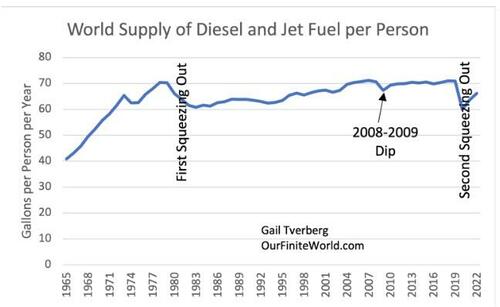
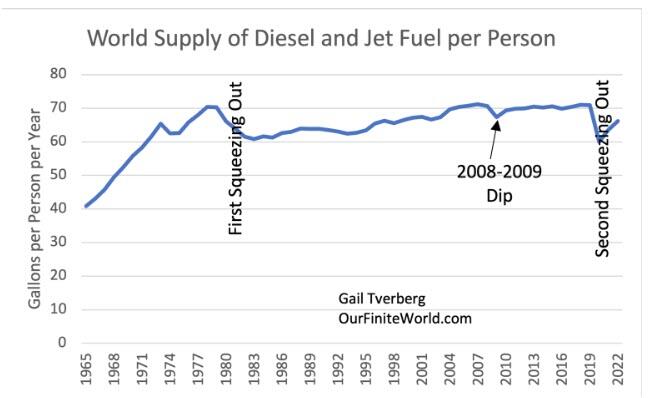
Figure 1. World supply of diesel and jet fuel per person, based on Middle Distillate data of the 2023 Statistical Review of World Energy, produced by the Energy Institute. Notes added by Gail Tverberg.

This squeezing out of non-essential parts of the economy can happen by war, but it can also happen because of financial problems brought about by “not sufficient actual goods and services to go around.” An underlying problem is that governments can print money, but they cannot print the actual resources needed to produce finished goods and services. I think that in the current situation, a squeezing out for financial reasons, or because legislators can’t agree, is at least as likely as another world war.

For example, the US had trouble electing a Speaker of the House of Representatives because legislators disagreed about funding plans. I can imagine a long shutdown occurring because of this impasse. Perhaps not this time around, but sometime in the next few years, such a disagreement may lead to a permanent shutdown of the US central government, leaving the individual states on their own. Programs of the US central government, such as Social Security and Medicare, would likely disappear. It would be up to the individual states to sponsor whatever replacement programs they are able to afford.

[1] An overview of the problem

In my view, we are in the midst of a great “squeezing out.” The economy, and in fact the entire universe, is a physics-based system that constantly evolves. Every part of the economy requires energy of the right types. Humans and animals eat food. Today’s economy requires many forms of fossil fuels, plus human labor. This evolution is in the direction of ever-greater complexity and ever-greater efficiency.

Right now, there is a bottleneck in energy supply caused by too much population relative to the amount of oil of the type used to make diesel and jet fuel (Figure 1). My concern is that many governments and businesses will collapse in response to what I call the Second Squeezing Out. In 1991, the central government of the Soviet Union collapsed, following a long downward slide starting about 1982.

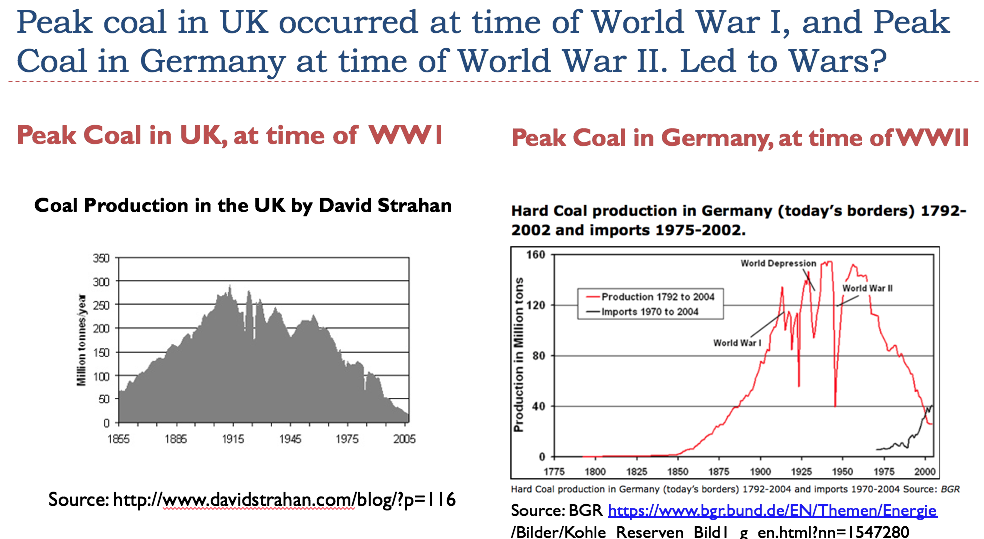
All parts of economies, including government organizations and businesses, constantly evolve. They grow for a while, but when limits are hit, they are likely to shrink and may collapse. The current energy bottleneck is sufficiently dire that some observers worry about another world war taking place. Such a war could change national boundaries and reduce import capabilities of parts of the world. This would be a type of squeezing out of major parts of the world economy. In fact, shortages of coal seem to have set the stage for both World War I and World War II.

Each squeezing out is different. When there are physically not enough goods and services to go around, some inefficient parts of the economy must be squeezed out. Payments to pensioners seem to me to be particularly inefficient because pensioners are not themselves creating finished goods and services.

World leaders would like us to believe that they are in charge of what happens in the world economy. But what these leaders can accomplish is limited by the actual resources that can be extracted and the finished goods and services that can be produced with these resources. When there are not enough goods and services to go around, unplanned changes to the economy tend to take place. These changes work in the direction of allowing parts of the system to go forward, without being burdened by the less efficient portions.

[2] The importance of diesel and jet fuel

Diesel and jet fuel are important to today’s industrial economy because they fuel nearly all long-distance transportation of goods, whether by ship, train, large truck, or airplane. Diesel also powers most of today’s modern agricultural equipment. Without the use of modern agricultural equipment, overall food production would decline drastically.

Without diesel, there would also be many other problems besides reduced food production. Diesel is used to power many of the specialized vehicles used in road maintenance. Without the ability to use these vehicles, it would become difficult to keep roads repaired.

Without diesel and jet fuel, there would also be an electricity problem because transmission lines are maintained using a combination of land-based vehicles powered by diesel and helicopters powered by jet fuel. Without electricity transmission, homes and offices without their own solar panels and batteries wouldn’t be able to keep the lights on. Gasoline pumps require electricity to operate, so they wouldn’t operate either. Without diesel and electricity, the list of problems is endless.

[3] Green energy is itself a dead end, but subsidizing green energy can temporarily hide other problems.

Green energy sounds appealing, but it is terribly limited in what it can do. Green energy cannot operate agricultural machinery. It cannot make new wind turbines or solar panels. Green energy cannot exist without fossil fuels. It is simply an add-on to the current system.

The reason why we hear so much about green energy is because making people believe that a green revolution is possible provides many temporary benefits. For example:

  • The extra debt needed to subsidize green energy indirectly increases GDP. (GDP calculations ignore whether added debt was used to produce the added goods and services counted as GDP.)

  • Manufacturers can pretend that their products (such as vehicles) will operate as they do today for years and years.

  • The educational system is given many more areas to provide courses in.

  • Citizens are given the hope that the economy will grow endlessly.

  • Young people are given hope for the future.

  • Politicians look like they are doing something for voters.

Unfortunately, by the time that the debt comes due to pay for subsidized green energy, it will be apparent that the return on this technology is far too low. The overall system will tend to collapse. Green energy is only a temporary Band-Aid to hide a very disturbing problem. Its impact is tiny and short-lived. And it cannot prevent climate change.

[4] Energy bottlenecks are a frequent problem.

Energy bottlenecks are a frequent problem partly because the human population has tended to increase ever since early humans learned to control fire. At the same time, resources, such as arable land, fresh water supply, and minerals of all kinds, are in limited supply. Extraction becomes increasingly difficult over time (requiring more inputs to produce the same output) because the easiest-to-produce resources tend to be exploited first. Extracting more fossil fuels to meet the energy needs of a growing economy may look like it would be easy, but, in practice, it is not.

As a result of energy bottlenecks, civilizations often collapse. Sometimes war with another group is involved. In such a case, the population of the losing civilization falls.

[5] The standard supply and demand model of economics makes it look like prices will rise in response to fossil fuel shortages. The discussion in Section [4] shows that energy supply bottlenecks often occur. When they do occur, the response is very different.
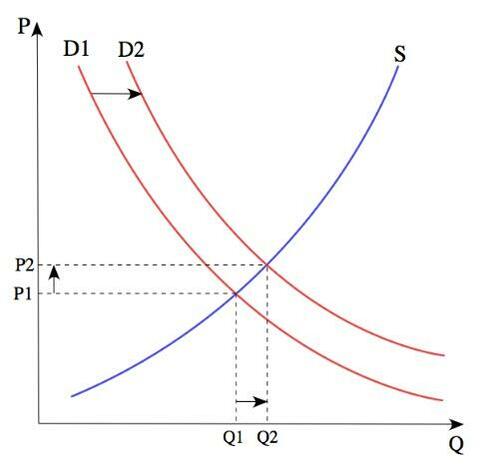
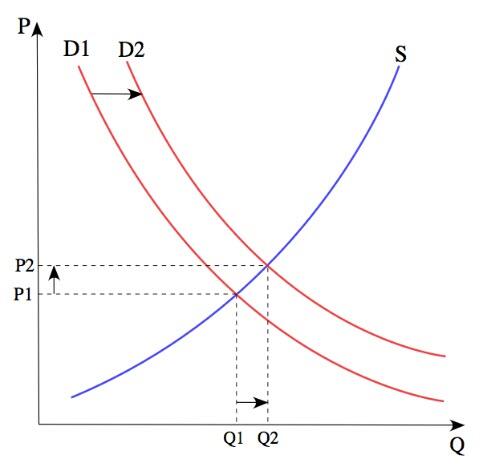
Figure 2. From Wikipedia: The price P of a product is determined by a balance between production at each price (supply S) and the desires of those with purchasing power at each price (demand D). The diagram shows a positive shift in demand from D1 to D2, resulting in an increase in price (P) and quantity sold (Q) of the product.

The model of many economists is far too simple. Based on the model shown on Figure 2, it is easy to get the idea that a shortage of oil will lead to a rise in prices. As a result, more oil will be produced, and the problem will be solved. Or perhaps efficiency changes, or substitution for a different type of fuel, will fix the problem.

When bottlenecks appear, the real situation is quite different. For example, increases in oil prices tend to cause food prices to rise, and thus increase inflation. Politicians know that citizens don’t like inflation and therefore will not vote for them. As a result, politicians tend to hold down prices. The resulting prices tend to fall too low for producers, and they start producing less, rather than more.

Energy products of the right kinds are essential for making every part of GDP. If there is not enough of the right kinds of energy products to go around, what I call some kind of “squeezing out” is likely to take place. Early on, there may be changes that reduce energy consumption, such as cutbacks in international trade. More businesses may fail. Eventually, some parts of the world economy may disappear, such as the central government of the Soviet Union in 1991. Or war may take place.

[6] When there is not enough energy of the right kinds to go around, spreading what little is available “thinner” doesn’t work.

As an example, if people need to eat 2,000 kilocalories per day, and if the food supply that is available would only supply 500 kilocalories per day (on average), giving everyone the same quantity would lead to everyone starving. Similarly, if a communist government gives every worker the same wage, lateness and “slacking off” become huge problems. Experience in many places has shown that equal pay for all, regardless of native abilities, responsibilities, or effort, simply doesn’t work. Somehow, diligent work and greater responsibility needs to be rewarded.

When an energy bottleneck occurs (leading to too little finished goods and services in total being produced), what I call a “squeezing out” takes place. Such a squeezing out may be initiated in many ways, including a war, angry citizens overturning a government, financial problems, or a shift in climate. The winners in a squeezing out end up ahead; the losers see collapsing institutions of many kinds, including failing businesses and disappearing government organizations.

[7] Most people do not understand the interconnected nature of the world economy, and the way the whole system tends to evolve.

The Universe is made up of many temporary structures, each of which needs to “dissipate” energy to stay away from a cold, dead state. We are all aware that plants and animals behave in this manner, but businesses of all kinds and government organizations also require energy of the right kinds to grow. They get much of their energy from financial payments that act as temporary placeholders for goods and services that will be made in the future using various types of energy, including human labor.

Strangely enough, because of the physics of the situation, business and government organizations are also temporary in nature, and in some sense, they also evolve. In physics terms, all these structures are dissipative structures. Physicist Francois Roddier writes about this broader kind of evolution in his book, The Thermodynamics of Evolution. In fact, economies themselves are dissipative structures. I have written about the economy as a self-organizing system powered by energy many times, including herehere, and here. All these self-organizing structures eventually come to an end.

History is full of records of economies that have collapsed. The book Secular Cycles by Peter Turchin and Serjey Nefedov analyzes eight of these failed economies. Populations tend to grow after a new resource is found or is acquired through war. Once population growth hits what Turchin calls carrying capacity, these economies hit a period of stagflation. This period lasted 50 to 60 years in the sample of eight economies analyzed. Stagflation was followed by a major contraction, typically with failing or overturned governments and declining overall population.

[8] Logic and some calculations suggest that the world economy is likely to be reaching a major downturn, about now.

One way of estimating when a major contraction (or squeezing out) would occur would be to look at oil supply. We know that US oil production hit a peak and started to decline in 1970, changing the dynamics of the world economy. This started a period of stagflation for many of the wealthier economies of the world. Adding 50 to 60 years to 1970 suggests that a major downturn would take place in the 2020 to 2030 timeframe. Since it was the wealthier economies that first entered stagflation, it would not be surprising if these economies tend to collapse first.

There have been several studies computing estimates of when the extraction of fossil fuels would become unaffordable. Back in 1957, Rear Admiral Hyman Rickover of the US Navy gave a speech in which he talked about the connection of the level of fossil fuel supply to the standard of living of an economy, and to the ability of its military to defend the country. With respect to the timing of limits to affordable supply, he said, “. . .total fossil fuel reserves recoverable at not over twice today’s unit cost are likely to run out at some time between the years 2000 and 2050, if present standards of living and population growth rates are taken into account.”

Confusion arises because some people would like to believe that fossil fuel prices can rise to extraordinarily high levels, and this will somehow permit more fossil fuels to be extracted. However, as I discussed in Section [5], the problem is really a two-sided one. Politicians want to hold fossil fuel prices down to prevent inflation, while oil producers (such as those in OPEC+) choose to reduce production if prices are not sufficiently high to meet their needs.

An easily missed point is that tax revenue from the sale of oil is often a large share of the total tax revenue of oil exporting countries. Because of this issue, in order for prices of oil to be adequate for oil exporters, they must include a wide margin for payment of taxes. These taxes are used to support the rest of the economy. For example, in Saudi Arabia, taxes provide support for huge building programs that provide jobs for citizens, but are of questionable long term value. These projects keep citizens happy, at least temporarily. Without adequate subsidy from tax revenue, citizens would want to overturn governments–a form of collapse.

[9] Energy problems are easily hidden because “scientific models” are considered to be important in forecasting the future. These models tend to be misleading because they leave out important elements regarding how the economy really works.

The easiest models to make are the ones that seem to say, “the future will be very similar to the recent past.” These models miss turning points. They assume that growth will continue even though resource extraction can be expected to become more difficult. Some examples of overly simple models include the following:

  • Money is a store of value. (Not if the economy has stopped functioning properly because insufficient energy resources are available.)

  • Forecasts of Social Security payments recipients will be able to receive in the future are overstated. (It takes energy of the right kinds to produce the goods and services that the elderly require. If the economy is not producing enough goods and services because of energy extraction limits, the share that pensioners can receive will need to fall so that workers can be paid adequately. Inflation-adjusted benefits to the elderly must be much lower or disappear completely.)

  • Climate models give high estimates. (These models miss the real-world difficulty of extracting fossil fuels. They also assume the economy can grow indefinitely, greatly overstating future CO2.)

  • Future energy supply based on “Reserve to Production” ratios give high estimates. (Reserve amounts are often puffed-up numbers to make an oil exporting country look wealthy.)

  • Energy Return on Energy Invested models greatly overestimate the value of intermittent wind and solar energy. (It is easy to assume that all types of energy are equivalent, but intermittent wind and solar cannot replace diesel and jet fuel.)

[10] Added complexity is not a solution to our energy problems.

Many people believe that if we can just be smarter, we can solve our energy problem. We can add more fuel-efficient engines, more advanced education, and more international trade, for example. Unfortunately, many things go wrong, leading to an upward energy complexity spiral. Difficulties include:

  • The complexity changes with the best payback tend to be discovered and implemented very early.

  • Added complexity may lead to higher energy consumption if cost savings result. For example, more vehicles may be sold if reduced fuel consumption makes their operation more affordable to a wider number of users.

  • Wage disparity results because the wages paid to highly educated employees and those in managerial positions leave little funding available to pay less-skilled workers.

  • Less-skilled workers indirectly compete with similarly skilled workers in low-wage countries, further holding their wages down.

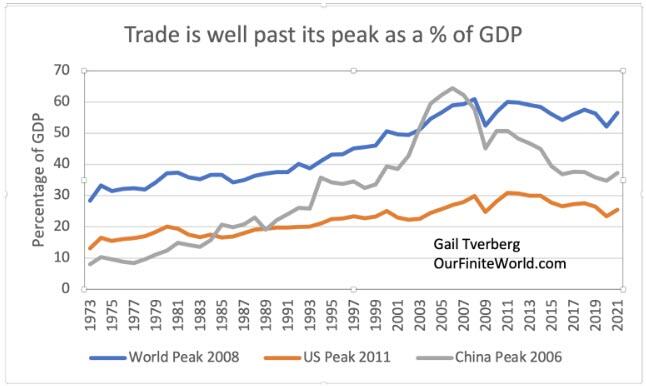
It is clear that we are now moving past the limits of complexity. For example, international trade as a percentage of GDP has been falling for the world, the US, and China.
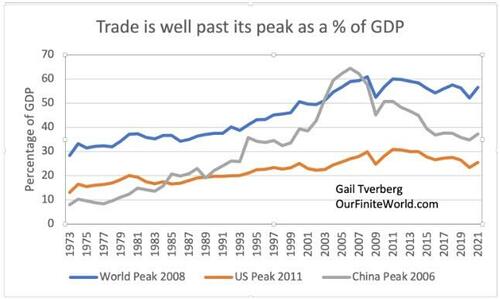
Figure 3. Trade as a percentage of GDP based on World Bank data for the World, the United States, and China.

Countries are now actively trying to bring supply lines back closer to home. Trips for goods across the Atlantic and the Pacific Oceans are being reduced, saving diesel and jet fuel.

[11] Repayment of debt with interest acts like a Ponzi Scheme if there is inadequate growth in the energy supply.

Most people today do not realize the extent to which the entire financial system is dependent on growing inexpensive-to-produce energy supply of the right kinds. It takes physical resources of the right kinds to produce goods and services. Resources such as fresh water, copper, lithium, and fossil fuels require more and more energy consumption to produce the same amount of supply because the easiest-to-extract resources are extracted first.

When the economy is far from limits, adding more debt (or other types of promises, such as shares of stock) does seem to increase “demand” for finished goods and services, and this, in turn, tends to increase the production of fossil fuels and other commodities. Thus, for a while, increased debt does indeed increase energy supply.

But when we start reaching extraction limits, instead of producing more fossil fuels and other commodities, higher debt tends to produce inflation. (In other words, more money plus practically the same amount of finished goods and services tends to lead to inflation.) This is the issue central banks are up against today. Central banks raise interest rates in response to the higher level of inflation, partly to compensate lenders for the inflation that is taking place, and partly to make their own economies more competitive in the world economy. The combination of higher interest rates and higher inflation is problematic in many ways:

(a) Ordinary citizens find that they must cut back on discretionary goods and services to balance their budgets. This tends to push economies in the direction of recession and debt defaults. Some citizens find they need to apply for government assistance programs for the first time.

(b) Businesses find it more difficult to operate profitably with higher interest rates and inflation. Businesses increasingly expand in programs supported by government subsidies, such as those for electric cars and batteries, as it becomes increasingly difficult to make a profit without a subsidy. In the US, defaults seem especially likely on commercial real estate loans.

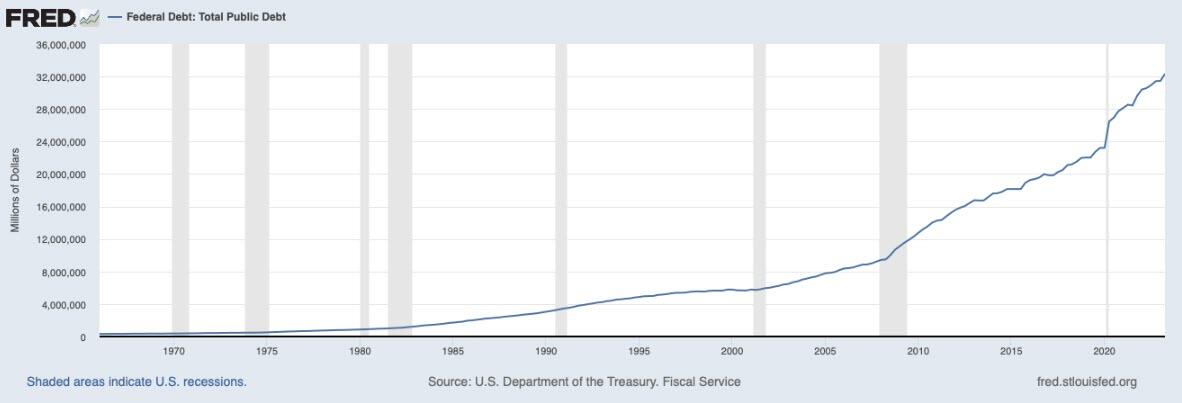
(c) Governments become especially squeezed. Many of them find that their own tax revenue is falling at precisely the time when citizens need their programs most. Governments also find that with higher interest rates, interest costs on their own debt rises. Subsidized programs increasingly seem to be needed to keep the economy operating. The number of retirees also grows year after year. Government debt levels spiral upward, as shown for the US on Figure 6.

With all these issues, the world becomes increasingly prone to war. Political parties, and even groups within political parties, find it increasingly difficult to agree on solutions to problems. The stage seems to be set for an array of worrisome outcomes, including major debt defaults, failing governments, and even widespread war.

[12] The world economy was able to grow rapidly in the 1950 to 1980 period because of a rapid rise in energy consumption. Now, there is an energy bottleneck. The recent increases in interest rates seem likely to burst debt bubbles. They may even squeeze out some major economies with pension programs for their citizens.
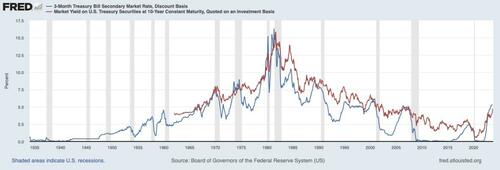
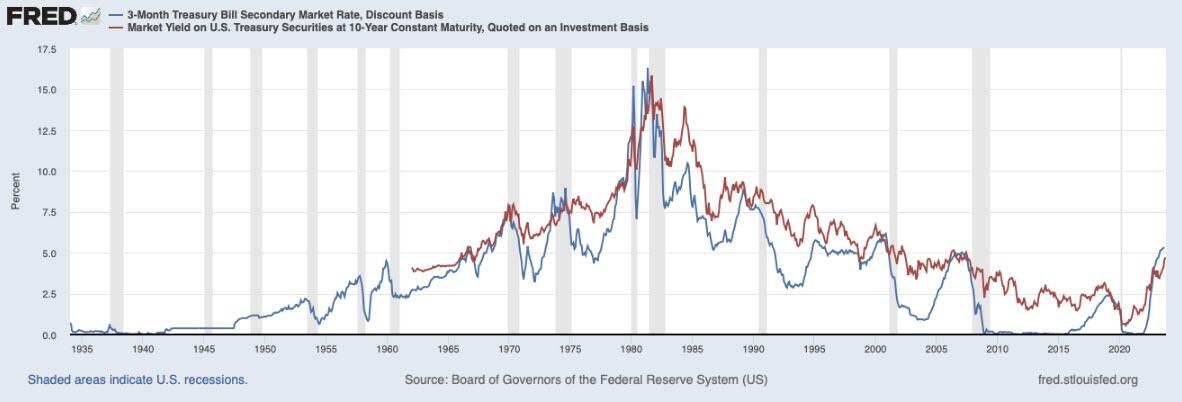
Figure 4. Measures of average interest rates of 3-month US Treasury Bills and 10-year Treasury Securities, in a chart produced by the Federal Reserve of St. Louis.

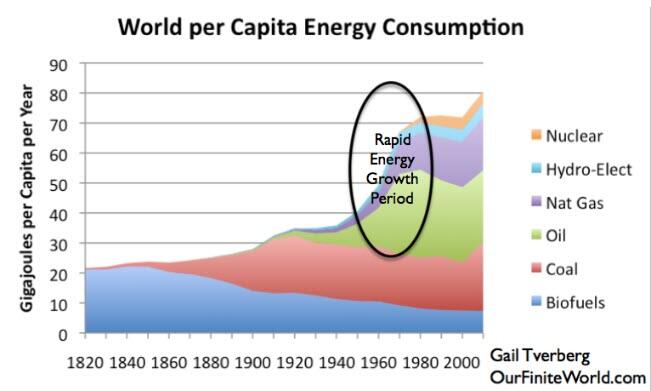
On Figure 4, the significant increases in interest rates up until 1981 corresponded to a huge increase in world energy consumption in the 1950 to 1980 period (Figure 5).
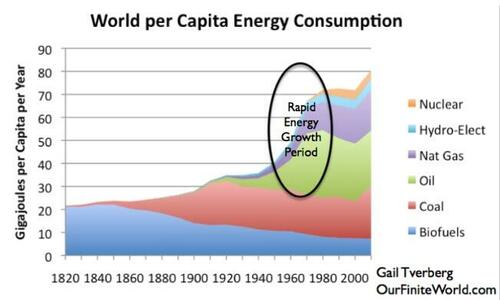
Figure 5. World per capita energy consumption, with the 1950-1980 period of rapid growth highlighted. World Energy Consumption by source, based on Vaclav Smil’s estimates from Energy Transitions: History, Requirements and Prospects (Appendix) together with data from BP’s Statistical Review of World Energy for 1965 and subsequent years. Population estimates used to produce per capita amounts are based on estimates by Angus Maddison for dates prior to 1950. They are based on UN estimates for more recent years. Chart prepared by Gail Tverberg in 2018.

The rapid rise in fossil fuel consumption in Figure 5 was the reason why the economy was able to grow as rapidly as it did in the 1950 to 1980 period. Raising interest rates acted like brakes on the economy and lowered oil prices. The Soviet Union was the economy most harmed by these low oil prices. It also had a communist form of government that did not work well, compared to capitalism. Ultimately, the central government of the Soviet Union collapsed in 1991.

Now, the rise in interest rates during 2022 and 2023 on Figure 4 correspond to a very different situation. Extraction of fossil fuels, and in particular the heavy oil used to produce diesel and jet fuel, is no longer growing rapidly. Instead, what has been growing is debt, especially government debt. Figure 6 shows US government debt through April 2023. US government debt spurted upward in 2020 and is still rising rapidly.
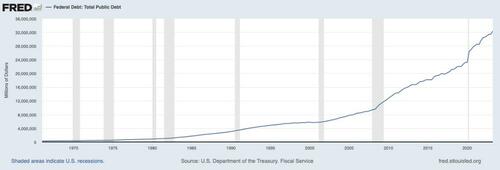
Figure 6. US Public Debt, based on a chart prepared by the Federal Reserve Bank of St. Louis.

The business closures in 2020 and interruptions in travel reduced oil prices and provided a good excuse for more government debt. All this debt added buying power, but it didn’t actually produce very many goods and services. Instead, it added a debt bubble. Similarly, investing in close-to-useless green energy temporarily added GDP, but it mostly added a huge debt bubble. Raising interest rates is likely to burst these debt bubbles.

The US and other rich countries have also put in place pension plans for the elderly. These are not treated as debt, but they depend upon resources of all kinds being available to feed, clothe, and provide shelter to a growing army of retirees. If there is not enough diesel to allow as many goods and services to be produced as are produced today, there is likely to be a huge problem if payouts to pensioners aren’t significantly reduced. Other citizens will be unhappy if retirees get a disproportionately large share of the reduced supply of goods and services. Some will say, “Why work if retirees on pensions get more than those of us who are still working?”

Thus, the world seems to be increasingly in a situation where more squeezing out will take place. Major governments, especially those with pension plans for their citizens, seem especially vulnerable. No one understood that there had been a temporary rapid rise in energy consumption per capita in the 1950 to 1980 period (Figure 5) that led to a temporary spurt in interest rates on bonds. This temporary rise in interest rates made pension programs look far more feasible than they really are for the longterm.

[13] How does the problem resolve itself?

It seems to me that the problem of debt bubbles and of unaffordably generous pension plans is very widespread. Analysts of all kinds have missed the hidden brakes on economies caused by inadequate energy resources of the right kinds, relative to rising populations. Collapse of at least some central governments seems possible. Perhaps some of these collapses can be postponed by rollbacks in government-sponsored programs, particularly those for the elderly and for those who are not working.

But even aside from the pension problem, there is a problem with many debts not being repayable in an economy that is forced to slow, as described in Section [11]. Many other promises become iffy as well. For instance, derivatives may not be able to pay as planned.

If there are problems with inadequate supply of essential materials, they are likely to spill over to asset values. For example, a farm that cannot purchase fuel for its agricultural equipment is, in some sense, not worth very much, since workers with simple tools like shovels cannot produce very much food. Likewise, a factory with permanently broken supply lines is not worth much.

I wish I could provide a happy-ever-after ending. The closest I can come to such an ending is to say that it appears to me that there is a literal Higher Power that is somehow providing an enormous amount of energy in a way that allows the Universe to continually expand. This literal Higher Power is, in some way, influencing the world today, through the self-organizing nature of the economy. The book Rare Earth: Why Complex Life Is Uncommon in the Universe, by Ward and Brownlee, explains that life could not have happened on the Earth, as quickly as it did, by chance alone. Perhaps things will turn out differently than we expect.

Tyler Durden
Sun, 11/05/2023 – 18:00

via ZeroHedge News https://ift.tt/yatIJQk Tyler Durden

Democrats Rattled After NYT Poll Shows Trump Beating Biden In Majority Of Swing States

Democrats Rattled After NYT Poll Shows Trump Beating Biden In Majority Of Swing States

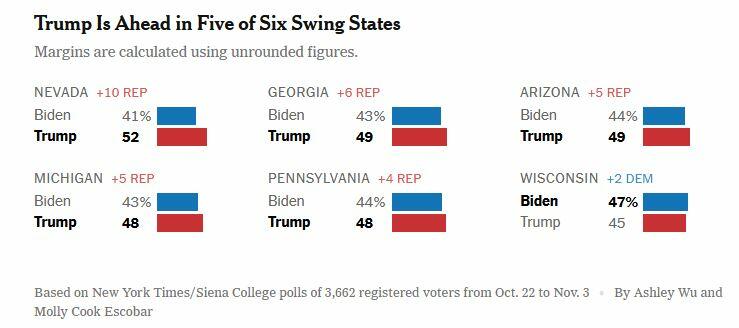
Democrats are in panic mode after a NY Times poll released on Sunday shows Trump wiping the floor with President Biden in 5 out of 6 battleground swing states that Biden carried in 2020. In short, if the 2024 election were held today, according to the Times, Trump would absolutely clobber Biden.

According to the poll from NYT and Sienna College, Biden would lose to Trump by margins ranging from three to 10 percentage points among registered voters in Arizona, Georgia, Michigan, Nevada and Pennsylvania, while Biden only leads Trump by 2% in the 6th state, Wisconsin.

As Axios sums up:

  • Biden led Trump in Wisconsin but is down 4 points in Pennsylvania, 5 in Arizona, 6 in Georgia, 5 in Michigan, and 10 in Nevada.
  • 71 percent said Biden was “too old,” including 54 percent of Biden’s supporters.
  • Only 39 percent of those voters felt the same about Trump, who would be the oldest president ever inaugurated and has shared no details about his health.
  • Swing state voters said they trust Trump over Biden on the economy by a 22-point margin, 59 to 37 percent.
  • Trump and Biden are effectively tied among voters under 30 — a large shift from 2020.

What’s more, Biden is also polling weaker than alternative Democrats – including Vice President Kamala Harris. According to the poll, Trump leads Biden by 5 points and Harris by 3, while a generic, unnamed Democrat would fare even better with an 8-point lead over Trump (13% better than Biden).

According to Democratic strategist David Axelrod, it’s ‘very late to change horses’ in terms of Biden’s 2024 run, and this poll will “send tremors of doubt thru the party.’

The stakes of miscalculation here are too dramatic to ignore,” Axelrod continued.

Former Obama senior advisor and Pod Save America host Dan Pfeiffer wrote a blog post on how Democrats should react to the “very bad NYT Poll,” and said that he didn’t want to sugarcoat it: “While some of Trump’s gains among Black, Hispanic, and young voters may be hard to believe, numbers like these are broadly consistent with the trendlines in recent polls. This poll shows that not only can Trump win, he might now be a slight favorite to do so. Even if we don’t take the results literally, we should take them very, very seriously.

In short, Democrats have to win back demographics they’ve lost since 2020:

Instead of doom-scrolling and tweeting through our panic, we should see this poll as a roadmap on how to reconstitute the anti-MAGA majority. We have to persuade the voters we have lost since 2020. Here’s one place to start. -Message Box News

Team Biden downplayed the poll, with re-election campaign spox Kevin Munoz telling Axios that “predictions more than a year out tend to look a little different a year later. Don’t take our word for it: Gallup predicted an eight point loss for President Obama only for him to win handedly a year later.”

“We’ll win in 2024 by putting our heads down and doing the work, not by fretting about a poll,” he continued.

Maybe that’s why mercenary neocon Bill Kristol just told ol’ Joe to pack it in?

Tyler Durden
Sun, 11/05/2023 – 17:25

via ZeroHedge News https://ift.tt/nEpyUwF Tyler Durden

Police Find No Evidence That Israel Supporter Attack UNC Muslim Student With Knife

Police Find No Evidence That Israel Supporter Attack UNC Muslim Student With Knife

Authored by Micaiah Bilger via TheCollegeFix.com,

Police are investigating an online claim alleging an individual wearing an Israeli flag attacked a Muslim student Tuesday near the University North Carolina, Chapel Hill — but so far say there is no evidence the attack took place.

The UNC Muslim Students Association claimed on its Instagram page Thursday that a Muslim student was attacked with a knife by “an individual wearing an Israeli flag” on the evening of Oct. 31 on Franklin Street.


A post shared by UNC MSA (@uncmsa)

A UNC Chapel Hill police spokesperson told the News & Observer the only evidence they have of the alleged attack is a social media post, and no one reported the incident to their department.

“Was a student attacked on Franklin Street? Neither Chapel Hill Police nor UNC-Chapel Hill can confirm this attack happened as described,” the newspaper reported Nov. 1

“According to the UNC police blotter, no incidents of assault or harassment were reported around 6 p.m. Tuesday evening,” the Observer reported in a fact-check piece.

“Additionally, Chapel Hill police said no one has reported this crime. The department currently does not have any evidence of the attack happening, outside of the social media post, according to police spokesperson Alex Carrasquillo,” the newspaper reported.

The alleged attacked happened on Halloween night on Franklin Street, a very popular and heavily traversed road next to campus.

The News & Observer reported that its request to the association for more information has not been answered.

The reports of the alleged attack appear to have come from Instagram posts by the UNC Muslim Students Association.

In an Oct. 31 Instagram story, the association wrote: “Attention: There are pro-Israeli people on Franklin attacking Muslim students. Please stay away from the area, especially if you’re hijabi, and be careful,” according to the News & Observer.

In a Nov. 1 statement, the Chapel Hill Police Department said it was aware of “a social media post describing an assault of a community member who is Muslim” and was working to contact the victim and investigate.

The Muslim Students Association stated the student is not available for media interviews.

“We thank law enforcement for investigating this incident and we encourage any interested reporters to contact them for additional information,” it wrote on Instagram.

However, the allegations have raised questions.

The activism group Stop Antisemitism posted on X:

“If this is true, it’s awful. Where can we find more details – a police report? media not reporting on it?”

The College Fix could not find any alerts about an assault or similar incident on Alert Carolina, an emergency alert system for UNC students, their families and local residents.

A message, which appears to have been sent by the Muslim student group to its members earlier this week, stated that “police were present on the scene and are aware of the situation,” according to an X post by Abed Ayoub, executive director of the American-Arab Anti-Discrimination Committee.

A spokesperson for the department confirmed to The Daily Tar Heel, the UNC Chapel Hill student newspaper, that police did speak “to someone who anonymously identified as a victim and, while respecting their anonymity, we are still working to determine what happened.”

Police also told the student newspaper, as of Wednesday afternoon, no one had filed an official incident report, but they continue to investigate. Police asked anyone with information to call 911 or contact the Chapel Hill Police Department.

“The circumstances that were described in the post must not be tolerated in our community,” Chapel Hill Police Chief Celisa Lehew said in a statement.

“It is important that anyone who has information reach out to us as soon as possible. We recognize the importance of diversity, equity, and inclusion in our community and will continue to work carefully to ensure an environment where everyone feels safe and respected.”

Since Oct. 7 when Hamas terrorists attacked Israel, killing more than 1,200 civilians, there has been a wave of attacks targeting Jewish students and Israel supporters at U.S. higher education institutions.

On Oct. 12 at UNC Chapel Hill, an Israeli professor was pushed during a pro-Palestinian protest, WRAL News reported.

Last week, a pro-Palestine protest turned violent at Tulane University and three students were assaulted, The College Fix reported. And at Drexel University in Pennsylvania, a Jewish student’s door was set on fire.

Meanwhile, students who were arrested at the University of Massachusetts, Amherst during a pro-Palestinian sit-in last week were arraigned on trespassing charges.

Tyler Durden
Sun, 11/05/2023 – 16:50

via ZeroHedge News https://ift.tt/sfwRKk7 Tyler Durden

US Rolls Out 50th Weapons Package For Ukraine

US Rolls Out 50th Weapons Package For Ukraine

Authored by Kyle Anzalone via The Libertarian Institute, 

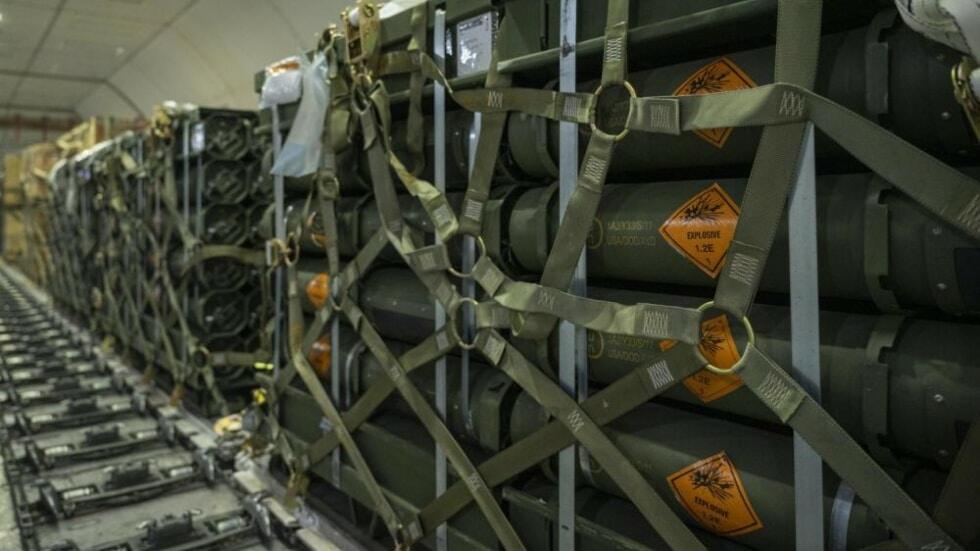
The US rolled out its 50th weapons package for Ukraine. The arms shipment will include air defenses, artillery rounds, and anti-armor weapons. The Pentagon will purchase $300 million in arms on behalf of Kiev, depleting all the funds in the Ukraine Security Assistance Initiative (USAI).

On Friday, The Department of Defense announced a new $425 million in military aid package for Ukraine. $125 million in weapons will be sent directly from American stockpiles through the Presidential Drawdown Authority (PDA). The funds used to transfer the arms came from a Pentagon accounting error that gave the White House access to an additional $6 billion in PDA funds.

Image source: US Air Force

The weapons to be shipped to Ukraine include:

  • Additional munitions for National Advanced Surface-to-Air Missile Systems (NASAMS)
  • Additional ammunition for High Mobility Artillery Rocket Systems (HIMARS)
  • 155mm and 105mm artillery rounds
  • Tube-Launched, Optically-Tracked, Wire-Guided (TOW) missiles
  • Javelin and AT-4 anti-armor systems
  • More than 3 million rounds of small arms ammunition and grenades
  • Demolitions munitions for obstacle clearing
  • M18A1 Claymore anti-personnel munitions
  • 12 trucks to transport heavy equipment
  • Cold weather gear
  • Spare parts, maintenance, and other field equipment

The Pentagon will additionally purchase $300 million in “laser-guided munitions to counter Unmanned Aerial Systems” for Ukraine. The weapons will be bought with USAI funds. The Department of Defense reports that its USAI funding has now been depleted. Arms purchased through this program will take months or years to reach Ukraine.

For months, the White House has pressed Congress to pass a multi-billion aid package for Ukraine. In October, the Biden administration rolled out a $105 billion bill that includes $61 billion in assistance for Kiev. The White House hopes the aid will maintain the Ukrainian military and the Zelensky administration through 2024 election.

However, the situation in Ukraine is becoming increasingly bleak. The top Ukrainian defense official told the Economist outlets that the war has reached a stalemate. Additionally, an aide to Zelensky said corruption was rampant, and Ukrainian officials were stealing “like there is no tomorrow.”

Tyler Durden
Sun, 11/05/2023 – 15:40

via ZeroHedge News https://ift.tt/frehtzU Tyler Durden

Kamala Harris’ Stepdaughter Helps Raise $8M For Gaza While Mom’s Admin Pushing Billions For Israel

Kamala Harris’ Stepdaughter Helps Raise $8M For Gaza While Mom’s Admin Pushing Billions For Israel

Vice President Kamala Harris’ stepdaughter, Ella Emhoff, has begun publicly raising money for Gaza – promoting a fundraiser on her personal Instagram account “supporting urgent relief for Gaza’s children” which is now absent from her profile.

The promotion asks her 315,000 Instagram followers to support the Palestinian cause, without mentioning that her stepmother’s administration wants to send billions to Israel as part of a $100 billion package.

Ella Emhoff’s Instagram page (screenshot)

The fundraiser, which has netted more than $7.8 million so far, is being operated by the Palestinian Children’s Relief Fund, a nonprofit based in Kent, Ohio, which raked in more than $21 million in 2021, according to ProPublica.

It’s unclear how much, if anything, Ella Emhoff has personally donated to the cause. –NY Post

It’s of tremendous concern and I find it abhorrent,” Rep. Jeff VanDrew (R-NJ), a member of the House Homeland Security Committee told the outlet. “To be honest with you, I am kind of stunned by it. It’s disturbing to the maximum degree.”

VanDrew said it was almost certain that Hamas would be able to siphon any humanitarian cash that went to Gaza.

Despite her father being Jewish, Ella’s rep told The Forward in 2021 that “Ella is not Jewish.”

It’s not something she grew up with. Ella truly has no qualms with the faith, but she does not want to speak on behalf of Judaism, as she does not celebrate herself.”

Emhoff — whose biological mom is film producer Kerstin Emhoff — has styled herself as a model and making boobs-out appearances at New York Fashion Week.

She is close with her stepmother, who congratulated her in an X posting after Emhoff’s graduation from Parsons in 2021.

Keep dreaming with ambition and there is nothing you cannot achieve,” Harris wrote. -NY Post

We wonder if Ella was perhaps protesting outside the White House on Saturday? Maybe she wore this:

Tyler Durden
Sun, 11/05/2023 – 15:05

via ZeroHedge News https://ift.tt/ZQS4rIn Tyler Durden

What A Fire!

What A Fire!

By Peter Tchir of Academy Securities

Last week we wrote the “We Didn’t Start the Fire” remake. It was meant to be a quick (and hopefully mildly entertaining) way to highlight just how many things are affecting markets and the global economy (geopolitically, internationally, and domestically). The list of issues facing us is long, and certainly helped create the “wall of worry” that Wall Street managed to climb this week.

The Geopolitical Front

While there were many headlines this week, nothing much has changed from our previous view that the risk of escalation remains real, and that we’ll have difficulty forming a domestic policy that keeps everyone happy.

We tackled the Middle East in this week’s webinar. The replay runs just under an hour but it’s a fantastic way to keep up to date on the many moving parts in the region along with some global issues. Beyond the military aspects, we explore supply chain issues, energy policy, and even the roles of various international organizations. Rachel Washburn, who was embedded with special forces in Afghanistan as an Army Intelligence officer, moderated the conversation and did a great job of including many questions that the audience was peppering her with from the get-go. Generals (Ret.) Deptula and Robeson brought a wealth of relevant information, perspective, and thoughts on where this could go. General Deptula, a retired Air Force general, was able to provide some deep insight into the air campaign, while General Robeson’s Marine Corps career was extremely relevant to the discussion around the fighting on the ground. I highly recommend watching the replay.

As a backdrop, prior to the webinar and last weekend’s Billy Joel tribute, you can find:

  • Multiple SITREPS on the events in the region. Each SITREP is a reaction to events as they occur in real time. They are driven by the expertise of Academy’s Geopolitical Intelligence Group, and are a key tool in our efforts to keep clients informed of what the events mean and what the reactions and consequences are likely to be.
  • On the more “macro” front, there is not much of a change following our two prior pieces:

We will continue to do our best to provide insights that hopefully help you navigate this on many levels, as it is a complex, treacherous, and highly emotional situation that is constantly evolving (or devolving, as the case may be).

The Market Dumpster Fire

Ok, we had the exact opposite of a dumpster fire in markets last week, unless you were short or owned puts. Stock indices were up around 6% for the week! If we want to nitpick, the Russell 2000 was up almost 8%!

Credit spreads tightened, though the CDX indices heavily outperformed the actual bond market (the CDX indices tend to correlate much more to equities than actual bonds). The rally in high yield bonds was impressive, but very much in line with what would be expected given the rally in bond yields and equities.

But the market that’s “truly on fire” (or at least the market that sparked the flames) was the Treasury market.

On October 23rd, the 10-year breached 5%. It almost did it again on the 26th, and it briefly traded below 4.5% on Friday! A move between 40 bps and 50 bps in just over a week is extreme by any standard and drove markets. WIRP (and the probability of Fed actions) has almost completely ruled out a hike and we now have an almost 30% chance of a cut at the March meeting! What a difference a week makes!

While the move is quite large, it is completely understandable:

  • The Fed’s refunding was not as bad as feared (or priced in) especially at the long end. In D.C. Has Done The Fed’s Job, we expressed several reasons why the fear about supply, while likely correct longer-term, was overdone.
  • We suspected that Powell would try to sound hawkish, but include many caveats (especially surrounding the moves in the yield curve and real yields). He couldn’t be as hawkish as many were positioned for (The Game is Slipping Away).
  • Our assessment of the Fed meeting (The Fed & Treasury Behind Us) was bullish with the caveats that the Middle East could disrupt the “everything rally” (it hasn’t yet) and that the economic data could be bad enough to bring recession chatter back to the headlines (not yet).
  • The Jobs Report Was Universally Weak. One thing that I learned quickly was that when you send out a report titled “weak report” and you only glance at the replies, your first reaction is to think that the comments were calling my report weak . In any case, this report was weak enough to keep the “everything rally” going.

But all that is history, where are we going?

Bottom Line

The “easy” part of the Treasury rally is over. We could bounce around, but I am looking for more weakness on the data side to push us below 4.3% on the 10-year. After the recent rally, we might drift higher in yields first and see some shorts get put on, but I think that we’ll see 4.3% before 4.75%.

The Treasury market moves will be mainly expressed 5 years and out as the Fed will be in no rush to cut rates. This implies that a bet on more negative curves is the direction to lean towards.

On credit spreads, I like credit spreads a lot here, especially for high quality IG.

  • Cash credit spreads have some room to move tighter, given the move in CDX spreads and other risk assets.
  • The calendar should start to slow as we head towards Thanksgiving.
  • With all the noise still coming out of D.C., I keep thinking that investors should be overweight high-quality corporates as opposed to government securities. These corporates have good governance, global businesses, and every intention to pay back every dollar that they owe, when they owe it. I am still toying with the idea of what the “new safe asset” is, and it isn’t super important today, but it is a “hypothetical” question worth exploring and high-quality corporates keep coming to mind.

Stocks will likely follow earnings, yields, and may try to rally some more as we’re about to be bombarded with “seasonal” effects (or at least the reporting will focus on seasonal effects). I like stocks until we get to 4.3% on the 10-year, and then would be extremely nervous as we won’t get there without greater recession concerns!

We should expect some consolidation, but I continue to favor more of the “everything” rally.

Hope you enjoyed the extra hour of sleep, though the cost of it getting dark so early doesn’t seem to be worth the price.

Tyler Durden
Sun, 11/05/2023 – 14:30

via ZeroHedge News https://ift.tt/xhcyogw Tyler Durden

Gateway Project Rail Tunnel Between NY And NJ Breaks Ground After Decades Of Red Tape

Gateway Project Rail Tunnel Between NY And NJ Breaks Ground After Decades Of Red Tape

A $16.1 billion rail tunnel in between New York and New Jersey is finally set to break ground after more than 10 years of delays. And we’re sure we’ll be happy to report that its up and operating in probably another 100 years.  

But we digress. “A new rail tunnel linking New York and New Jersey is officially starting construction,” Bloomberg reported last week. The project is called the “Gateway Project”. 

US Secretary of Transportation Mayor Pete was joined at a ceremony in Hudson Yards by New York Governor Kathy Hochul, Senators Kirsten Gillibrand and Chuck Schumer. He remarked: “This is a day that I know that this city, this region, this country has been looking for and waiting for for a very long time.” 

Uh, no, Pete. That will be the day when the tunnel is actually up and running and people don’t need to wait 2 hours and pay $75 to get through the Lincoln Tunnel. 

But we digress again. The Bloomberg report notes that The Gateway Project should be a crucial solution for alleviating traffic bottlenecks beneath the Hudson River—a pivotal juncture on the Northeast Corridor that spans from Boston to Washington.

It is the nation’s most frequented passenger rail line, catering to over 750,000 passengers daily. The current tunnel, under Amtrak’s ownership and also serving New Jersey Transit, has stood for over a hundred years and faces mounting reliability concerns.

The first construction phase will lay underground casings linking the new tunnel to New York’s Pennsylvania Station. However, commuters won’t see benefits until the tunnel, with its two tracks, is operational by 2035. And we’ll take the “over” on that date. 

This year, the Gateway tunnel secured a $6.9 billion grant from the Federal Transit Administration, with an additional $3.8 billion announced on Friday. This brings Washington’s total contribution to over $11 billion, covering around 70% of the project’s cost, according to Schumer. New York and New Jersey will shoulder the remaining expenses.

The push for a tunnel alleviating rail congestion between New York and New Jersey began in the 1990s but faced political hindrances and delays. A prior tunnel initiative, already funded, was halted by New Jersey Governor Chris Christie in 2010. The Gateway proposal surfaced in 2011 but faced challenges during the Trump era, according to Bloomberg

Biden’s infrastructure legislation allocated $8 billion over five years to the Capital Investment Grant program, which prioritized Gateway. Additionally, Biden’s team earmarked $292 million from this law earlier this year for a pivotal early stage of the project.

Think of how many tunnels we could have built – and how quickly we could have them finished – with the $100 billion we just shipped to Ukraine?

Tyler Durden
Sun, 11/05/2023 – 13:55

via ZeroHedge News https://ift.tt/Ubg3FNe Tyler Durden

Man Pleads Guilty to Driving Car at “Stop Asian Hate” Demonstrators

From a Justice Department press release dated Oct. 24, but just posted on Westlaw a few days ago:

A Diamond Bar man pled guilty today to a federal criminal civil rights charge for disrupting a “Stop Asian Hate” rally in March 2021 by running a red light and driving through a crowded crosswalk of peaceful demonstrators while shouting racial slurs and epithets.

On the third day of trial, Steve Lee Dominguez, 57, pleaded guilty to one felony count of bias-motivated interference with federally protected activities….

According to the Plea Agreement,

Defendant drove to the “Stop Asian Hate” rally in his car, a black Honda four-door sedan. When he approached the intersection at the center of the rally, he stopped and yelled “Go back to China!” and “fuck China!” to the rally participants, including the Victims. Defendant then deliberately ran a red light and drove his car, which was at all times a dangerous weapon, through the crosswalk of the intersection. He made an illegal U-turn and cut off the route of several rally participants who were lawfully crossing the street in the crosswalk. The Victims, other adults, and a nine-year-old child had to quickly move to avoid being hit by defendant’s car. Defendant then got out of his car and continued to yell racial epithets and threatening language at the rally participants, including “come on you fucking Niggers,” “you Jap motherfucker,” “Fuck you, you Gook!” and “Fuck you, I’ll be back,” among others.

The Justice Department press release also states,

He then called the police, identified himself as “John Doe” and falsely reported to police that the rally participants were blocking the street and he had to run a red light “because they were about to trample my car,” according to evidence presented at trial. He also requested that police “get some control out” at the intersection.

The post Man Pleads Guilty to Driving Car at "Stop Asian Hate" Demonstrators appeared first on Reason.com.

from Latest https://ift.tt/NMxpv3Z
via IFTTT